FULL ENDING Karen Turned My Grandfather’s Pasture Into Her Midnight Party—and Forgot I Had Cameras in the Dark
𝗙𝗨𝗟𝗟 𝗦𝗧𝗢𝗥𝗬
She laughed softly, as if I had said something childish.
“Well, I would phrase that differently. I tried to help him make a practical decision. He was a very stubborn man.”
“He was.”
“And now that the property has passed to you,” she said, lifting the folder slightly, “I thought it might be time to revisit that conversation.”
I looked at the folder.
“No.”
She blinked.
“I’m sorry?”
“No.”
“You have not even heard the offer.”
“I do not need to.”
Her smile thinned another inch.
“Evan, I understand this is an emotional time. But maintaining acreage is expensive. The fencing alone must be overwhelming. Then there are livestock regulations, insurance, upkeep, taxes—”
“I know what it costs.”
“Do you?” she asked, voice sharpening under the sweetness. “Because people often inherit rural property with romantic ideas, and then reality sets in. Briar Glen has resources. We could preserve the character of the space while making it useful to the community.”
Useful.
That word scraped against something raw in me.
“It is useful,” I said. “It is a farm.”
She glanced past me toward the pasture, where three cows stood near the fence chewing like they had all the time in the world.
“That is not exactly the best use of land surrounded by residential development.”
“It is the best use to me.”
Karen studied me through those huge sunglasses.
Then she looked toward the no-trespassing sign nailed to the fence by the driveway.
“Your grandfather was very defensive.”
“My grandfather understood boundaries.”
The air changed.
Only a little, but enough.
“Well,” she said, tucking the folder tighter under her arm, “I hope you will not make this more difficult than it needs to be.”
“Selling is not difficult,” I said. “I’m not doing it.”
For the first time, her smile disappeared completely.
“I will leave my card.”
“You can keep it.”
She stared at me for a long second. Then she gave a small, humorless laugh.
“I see he trained you well.”
“No,” I said. “He trusted me.”
That landed.
Her jaw tightened, and she turned away without another word.
If that had been the last time I saw Karen Whitmore, my life would have been easier.
It was not.
Over the next year, she came back again and again.
Sometimes she arrived with another offer. Sometimes with a developer’s representative. Sometimes with one of the HOA board members, always men who looked uncomfortable standing too close to manure but very comfortable using words like value optimization and community integration.
Each time, I said no.
Each time, Karen acted as if my refusal was a temporary misunderstanding.
She was not used to being denied.
I knew that from the way my neighbors talked about her.
Technically, I was not part of Briar Glen. That had been the whole point of my grandfather refusing the developer. But I lived beside the neighborhood, shopped at the same grocery store, drove the same road, and knew plenty of people who did live under Karen’s little kingdom.
Most of them could not stand her.
Karen had rules for everything. Porch lights had to match an approved model. Mailbox numbers had to meet size and placement standards. Trash cans could not be visible from the street, even from certain upstairs windows, because Karen insisted visibility was not only a street-level concern. Holiday decorations had approved date ranges. Garage doors could not stay open longer than a reasonable period, though reasonable seemed to mean whatever Karen felt like that week.
If your grass was a day past the mowing schedule, she sent one of her sons to mow it and charged you up to a hundred dollars. She called it a maintenance courtesy. The neighbors called it robbery, but quietly, because Karen had a way of converting criticism into fines.
She had two sons. The older one, Brandon, was in his early twenties, handsome in the lazy, careless way of someone who had always been told rules bent around him. He drove too fast through the development, threw beer cans in the wrong recycling bins, and looked at everyone like they were background characters in his mother’s show.
Her younger son still lived at home and seemed less awful, mostly because he looked exhausted by the whole family.
Karen’s husband, from what I heard, made enough money to smooth over consequences. I almost never saw him. He existed in neighborhood gossip as a wallet with a golf schedule.
Karen, though, was everywhere.
She walked Briar Glen like a mayor, inspector, judge, and executioner rolled into one. She stopped contractors on driveways. She measured hedge heights. She photographed children’s bikes left too long near garage doors. She once sent a warning letter because a resident had planted marigolds that were “too visually aggressive” beside a walkway.
That was the woman who wanted my land.
Not because she loved it.
Not because she understood it.
Because it was the one piece of ground touching Briar Glen that refused to answer to her.
At first, she stayed annoying but predictable.
Then I began catching her on the property.
The first time, I found fresh tire tracks near the back lane. I assumed a neighbor had turned around in the wrong place. The second time, a gate I knew I had latched was hanging open. Nothing got out, thank God, but I stood there holding the chain in my hand, looking toward the neighborhood roofs beyond the tree line, and felt that low animal certainty that comes before trouble.
The third time, I saw Karen herself.
It was late afternoon. I had come back from the city earlier than usual because a storm was moving in and I wanted to secure the chicken run. I was walking past the old equipment shed when I spotted movement near the south pasture fence.
Karen stood beside the gate with a man in a polo shirt and khakis. She was pointing across my land, her other hand moving in sweeping gestures as if she were explaining future landscaping.
I walked up quietly enough that she did not hear me until I was close.
“Can I help you?”
She turned so fast her folder slapped against her hip.
The man startled.
Karen recovered quickly.
“Evan,” she said, as if we had planned to meet. “We were just looking at the boundary.”
“From my side of it?”
“There is no need to be hostile.”
“You’re trespassing.”
The man took one step back.
Karen did not.
“This gate was not locked.”
“That is not permission.”
“I am president of the HOA bordering this property.”
“And I am the owner of this property.”
She gave me a patient look, the kind teachers give slow children in bad movies.
“Boundaries between communities are often more flexible in practice than they look on paper.”
“No,” I said. “They are not.”
The man cleared his throat.
“Maybe we should go, Karen.”
She ignored him.
“You really are determined to let this place sit underused.”
The cows were grazing less than twenty yards away. Chickens scratched near the coop. Hay bales were stacked under the lean-to. The garden was coming in thick behind the farmhouse.
I looked around, then back at her.
“Underused?”
“You know what I mean.”
“No, Karen. I really don’t think I do.”
Her face flushed, but only slightly. People like Karen do not like being asked to explain the ugly part out loud.
“This land could serve families,” she said. “Children. Community gatherings. Events. Walking trails. A proper green space instead of…” She glanced at the pasture. “This.”
I felt my grandfather beside me so strongly then that it almost hurt.
“This,” I said, “is not yours.”
She lowered her voice.
“You will not be able to manage it forever.”
I stepped closer.
“Get off my land.”
The man backed away immediately.
Karen held my gaze a second longer, then smiled.
“We will talk again.”
“No. We won’t.”
But we did.
Not always directly. Sometimes it was through strange little incidents that would have seemed unrelated if I had not known better.
A sign disappeared.
Then another.
A section of fence near the neighborhood trail entrance was cut. Cleanly. Deliberately. Not broken by weather, not pushed by deer. Cut.
I replaced it and added a lock.
A week later, I found footprints in the soft ground near the barn.
Then one of my neighbors, a woman named Denise who lived on the Briar Glen side but had always been kind to me, stopped by with her golden retriever and an apologetic expression.
“I thought you should know,” she said.
My stomach sank before she even finished.
“What?”
“Karen has been telling people the back field is a disputed common area.”
I stared at her.
“She what?”
Denise winced.
“She says your grandfather’s paperwork was unclear, and that the HOA has a claim to some access rights.”
“That is a lie.”
“I figured. But some people believe her because she says it with such confidence.”
Confidence.
That was Karen’s real talent.
Not law. Not leadership. Not community building.
Confidence.
She could say nonsense like it had been engraved on a courthouse wall, and some people would nod because she sounded too certain to be completely wrong.
I thanked Denise and called a real estate attorney the next morning. His name was Marcus Reed, and he had handled a minor easement question for my grandfather years before. He pulled the records, reviewed the deeds, and told me exactly what I already knew.
The land was mine.
Briar Glen had no ownership interest, no easement, no common-area rights, no claim.
“Document everything,” Marcus said. “Karen Whitmore has a reputation.”
That was all he said, but it was enough.
I bought cameras.
Not the fake ones Karen would have expected. Real cameras. Good ones. Motion detection. Night vision. Cloud backup. I installed them around the barn, the driveway, the south gate, the pasture entrance, the equipment shed, and the stretch of fence nearest Briar Glen.
I put a few aimed low enough to catch animals and a few wide enough to catch people doing things they would later claim they had not done.
For a while, the cameras mostly caught raccoons, deer, cats, wind, and my own exhausted face moving through darkness with feed buckets.
Then, little by little, they caught Karen.
Never breaking anything.
Never long enough to make a dramatic case.
Just walking near the boundary. Standing by the gate. Peering toward the barn. Once, walking with Brandon along the trail side and gesturing toward the pasture while he kicked at the dirt.
I saved everything.
Marcus told me to keep saving.
“This kind of person escalates when she gets bored,” he said.
He was right.
The trouble was that I did not live at the farm full-time. My office still required me in the city several days a week, and while I hated leaving the place, the job paid for feed, repairs, insurance, and everything else sentiment alone could not cover.
Karen figured out my schedule.
I know she did because the little trespasses started happening when I was away.
A gate moved.
Trash appeared near the tree line.
A folding chair was left by the pasture.
A neighbor later mentioned seeing Brandon and some friends walking back from the woods late one night, laughing too loudly.
I confronted Karen at a community roadside cleanup event Denise had talked me into attending.
Karen stood near a folding table with coffee and clipboards, wearing white jeans, a red sweater, and sunglasses perched in her hair like a crown. When she saw me approach, her mouth tightened.
“We need to talk,” I said.
“I’m very busy coordinating volunteers.”
“You need to stop going on my property.”
She glanced around, aware of people nearby.
“Evan, I have no idea what you mean.”
“I have cameras.”
That changed her face.
Only for a second.
Then she smiled.
“Good. Then you know I have done nothing improper.”
“You have no reason to be there.”
“People walk near boundaries. That is not a crime.”
“Crossing them is.”
She leaned closer, lowering her voice so the neighbors would not hear.
“You are creating hostility where none needs to exist.”
“I am protecting my land.”
“You are hoarding land you barely use.”
There it was again.
The accusation beneath every offer.
The moral frame she had built around greed.
I was not preserving a farm. I was hoarding.
I was not refusing to sell. I was denying the community.
I was not setting boundaries. I was being hostile.
“Listen carefully,” I said. “If I catch you on my property again, I will call the police.”
Her eyes hardened.
“You would call the police on a neighbor?”
“You are not my neighbor when you cross that fence.”
She smiled like I had entertained her.
“We’ll see.”
Those two words stayed with me.
We’ll see.
Not an apology.
Not a denial.
A promise.
Three weeks later, on a Thursday night, I was in my city apartment, dead asleep, when my phone lit up beside the bed.
At first, I ignored it.
Then it buzzed again.
And again.
The sound dragged me upward through exhaustion. I had gone to bed after midnight because a work deadline had eaten the evening. I needed to be in the office by eight. My first thought was that a raccoon had found the chicken feed or a deer was nosing around the fence.
I reached for the phone and opened the camera alert.
Motion detected: South pasture.
The thumbnail was dark and grainy. I tapped it.
For a few seconds, I saw nothing but black fields, the pale line of fence, and a moving blur near the gate.
Then light flashed across the screen.
Red.
Green.
Gold.
I sat up so fast the blanket fell to the floor.
Another alert.
Motion detected: Barn entrance.
Then another.
Motion detected: Equipment lane.
I switched cameras.
At first, I thought something was wrong with the audio because all I heard was thumping bass, voices, laughter, and a high electronic squeal. Then the image adjusted.
There were cars in my pasture.
Not one. Not two.
Cars.
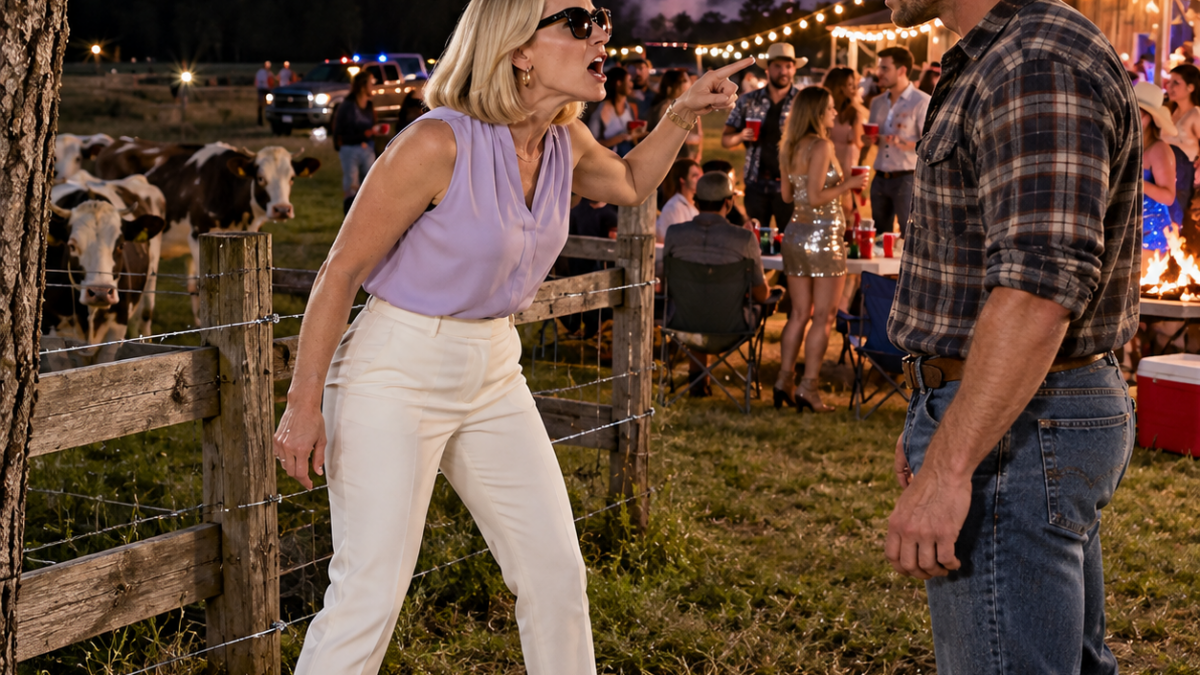
Headlights cut across the grass. People moved in clumps, holding red plastic cups. A folding table had been set up near the old oak tree. Someone had strung battery lights along the fence. Near the far edge of the pasture, sparks shot upward, followed by a burst of fireworks exploding above the tree line.
For a second, my mind refused to understand what my eyes were seeing.
Then another camera caught Karen.
She stood near the gate in a white jacket, one hand raised as she shouted something over the music. Brandon was beside her, laughing with a group of young people I did not recognize.
Karen had thrown a party on my land.
No.
Not just a party.
A barbecue. An afterparty. A full-blown midnight event with music, drinking, fireworks, vehicles, strangers, and God knew what else.
On my grandfather’s pasture.
My heart was pounding so hard I could feel it in my ears.
I got dressed without thinking. Jeans. Boots. Jacket. Keys. Phone charger. Pepper spray from the drawer. Not because I planned to use it, but because I did not know what I was driving into.
I left my apartment thirty minutes after the first alert.
The city streets were almost empty. The highway out to the farm unrolled beneath my headlights like a long black ribbon. The whole drive, I kept checking the cameras at red lights and stop signs until the road turned rural enough that I had to focus.
The party was getting worse.
More people. Louder music. Fireworks. Cars parked along the field lane and half on the grass. Someone had dragged out a portable grill. Someone else was dancing on the old flatbed trailer I used for feed bags.
My hands gripped the steering wheel so hard my fingers hurt.
I thought of my grandfather teaching me how to close the south gate when I was eight.
“You shut it right every time,” he said. “Not because you think something will happen every time. Because the one time you get lazy is the time a cow finds the road.”
I thought of him refusing the developer.
I thought of Karen saying we’ll see.
By the time I turned onto the county road, I could see light above the tree line.
My pasture was glowing.
Music pulsed through the woods before I reached the driveway. Bass thumped through my truck doors. Fireworks cracked overhead, scattering sparks against the dark. My no-trespassing signs reflected in my headlights as I pulled in.
There were tire marks in the wet grass.
Fresh ones.
Deep ones.
A sedan was parked half across the lane leading to the barn. I drove around it, engine growling, and stopped near the equipment shed.
For a moment, I just sat there.
Because if I got out too angry, Karen would use it. If I shouted first, she would become the victim in her own story. If I touched anyone, if I shoved someone away from my animals or grabbed a drunk kid off my trailer, she would twist that too.
So I took out my phone.
Hit record.
Then I stepped into the chaos.
The smell hit first.
Smoke. Beer. lighter fluid. Trampled grass. Sweet chemical fireworks. Cheap perfume. Marijuana somewhere near the tree line. Music slammed against my chest, some remix with a beat so heavy it rattled the old metal siding on the shed.
The cows were bunched near the far fence, nervous, heads high, eyes reflecting white in the flashes. That almost broke my control right there.
People turned as I walked through.
Some looked confused. Some ignored me. Some were too drunk to notice.
A young guy I did not know raised his cup.
“Yo, nice farm, man!”
I kept walking.
I filmed everything.
The DJ setup under a pop-up canopy.
The fireworks stacked near the fence.
The coolers.
The beer cans.
The grill.
The cars.
The kids who looked too young to be holding anything stronger than soda.
The lights tied to my fence posts.
The people standing on my trailer.
Then I saw Karen.
She was near the old oak tree, surrounded by a cluster of neighborhood adults who looked uncomfortable but not uncomfortable enough to leave. Brandon was nearby, his arm around a girl who could not have been more than eighteen, maybe less. Karen held a plastic cup in one hand and her phone in the other, laughing like she had won something.
I walked straight toward her.
Her smile froze when she saw me.
For a moment, the lights flashed red across her face and made her look almost monstrous.
Then she recovered.
“Evan,” she called over the music. “What are you doing here?”
The absurdity nearly made me laugh.
“What am I doing here?”
“This is not a good time.”
“You are on my land.”
She rolled her eyes like I was embarrassing her.
“We are having a community event.”
“No. You are trespassing.”
Several people nearby went quiet.
Karen noticed them listening. Her posture changed. She squared her shoulders and lifted her chin, slipping into president mode.
“This land borders Briar Glen and has historically been treated as overflow green space.”
“That is a lie.”
Her smile sharpened.
“It is a matter of interpretation.”
“No,” I said. “It is a matter of deeds, fences, signs, cameras, and the police if you do not shut this down right now.”
At the word police, a few heads turned.
Karen stepped closer, lowering her voice.
“Do not make a scene.”
I looked around at the fireworks, the DJ, the drunk strangers, the headlights cutting across my pasture.
“You made the scene.”
Her nostrils flared.
“You are wasting this land. Do you understand that? Wasting it. Your grandfather was stubborn, and now you are turning stubbornness into selfishness. This could be something beautiful for everyone.”
“It already is.”
“It is a cow field.”
“It is my cow field.”
She gave a short, ugly laugh.
“God, listen to yourself.”
I felt the anger rise, hot and clean.
But I kept my voice steady.
“I have restrained myself from involving authorities in your harassment. That ends tonight. Get them off my land.”
Karen looked at me for one long second.
Then she spat at my feet.
The people closest to us went silent.
Even Brandon stared.
Karen’s face was flushed, not with shame, but rage. The mask had slipped, and beneath the polished HOA president was something small, mean, and furious that I had not bowed.
“You pathetic little farmer,” she hissed. “You have no idea what you’re fighting.”
I looked down at the spit darkening the dirt near my boot.
Then I looked back at her.
“You’re right,” I said.
She blinked.
I shrugged.
Then I turned and walked away.
Behind me, Karen laughed too loudly.
“That’s what I thought!” she shouted. “Go home, Evan!”
I did not go home.
I walked to the driveway, far enough from the music that I could hear myself think, and called 911.
The dispatcher asked for my emergency.
“My private property is being used for an unauthorized party,” I said. “There are dozens of people here, alcohol, fireworks, loud music, and possible underage drinking. I am the property owner. I did not give permission.”
She asked for the address.
I gave it.
She asked if anyone was threatening me.
I looked back toward the pasture.
A firework screamed upward and burst above the barn.
“My livestock are scared, and there are intoxicated people near equipment,” I said. “I need officers here before someone gets hurt.”
Then I went back to recording.
I did not confront Karen again.
That was the hardest part.
Every instinct in me wanted to drag the DJ’s plug out of the speaker, kick over every cooler, and physically herd people off the land. But I knew better. Karen wanted me angry. She wanted me to become the unreasonable one. She wanted one shaky phone clip of me yelling at drunk kids so she could tell the neighborhood I had attacked a community gathering.
So I documented.
I recorded the DJ announcing last call for the grill.
I recorded Brandon handing drinks from a cooler to people who looked too young.
I recorded fireworks being launched despite the county burn and fireworks ban that had been issued after two dry weeks.
I recorded people drinking in open containers on land not licensed or permitted for an event.
I recorded a young man stumbling behind the equipment shed with a joint in his hand.
I recorded Karen laughing near the food table, very much not trying to shut anything down.
Then, while waiting for the police, I pulled up county regulations on my phone and screenshotted the relevant pages. Noise ordinance. Fireworks ban. Open container restrictions. Trespassing. Liability for serving alcohol to minors.
By the time the first patrol car turned into the drive, most of the older neighborhood adults had already slipped away.
Cowards, maybe.
Or people who suddenly realized Karen’s confidence did not protect them from consequences.
The young crowd did what young drunk crowds do when blue lights appear.
They scattered.
Some ran toward the trees. Some ducked behind cars. One girl tripped near the fence and started crying. Someone shouted, “Cops!” as if the flashing lights had been subtle.
Karen’s face in those blue lights is something I will remember for the rest of my life.
Not because she looked afraid at first.
Because she looked offended.
As if the police had violated etiquette by answering my call.
Two officers got out of the first car. A third vehicle arrived behind them within minutes, then another. One officer approached me while the others began telling people to stop moving, turn down the music, and gather near the drive.
“I’m the property owner,” I said before he had to ask. “My name is Evan Mercer.”
I handed him my driver’s license and pulled up the property records I kept saved in my phone because Marcus had told me to be ready.
“This land is mine. I did not authorize any event here. The HOA next door has been harassing me about this property for months.”
The officer, a broad-shouldered man with tired eyes and a calm voice, looked toward the pasture.
“Who organized this?”
I pointed.
“Karen Whitmore. HOA president. White jacket.”
He glanced over.
Karen was already marching toward us.
“Officer,” she called, breathless with manufactured authority. “Thank goodness. I was just trying to get this under control.”
I stared at her.
She did not look at me.
The officer turned.
“Ma’am, stay where you are for a moment.”
Karen stopped, clearly not used to being told to wait.
“I need to explain,” she said. “This young man is confused.”
“This young man owns the property,” I said.
Karen snapped her eyes toward me.
“This property is part of Briar Glen’s community use area.”
“Do you have documentation showing that?” the officer asked.
She hesitated.
Only half a second.
Enough.
“The HOA has maps,” she said.
“Recorded property documents?” he asked.
“We can provide those later.”
I almost admired the audacity.
Almost.
I pulled up the county parcel map and showed the officer. Then I showed him photos of the posted signs, screenshots from earlier camera footage of Karen on the land, and the videos I had recorded that night.
The DJ.
The fireworks.
The coolers.
Karen near the crowd.
Brandon handing out drinks.
The officer’s expression changed slowly as he watched.
Not surprise exactly.
Recognition.
Every cop, teacher, nurse, bartender, and customer service worker learns that look eventually. The look people get when they realize the loudest person in the room is probably lying.
Karen kept talking.
“This is being blown out of proportion. The community has used this area informally before.”
“No, it hasn’t,” I said.
She turned on me.
“You are impossible.”
“Ma’am,” the officer said, sharper now. “I need you to stop interrupting.”
Karen’s mouth opened.
Then closed.
I took a breath.
The night felt cold suddenly, though maybe that was adrenaline wearing thin.
More officers moved through the pasture, checking IDs, separating groups, asking who had been drinking, who had driven, who had brought alcohol, who had set up fireworks. The DJ shut down completely, leaving the sudden absence of music ringing in my ears.
Without the bass, the farm sounded wrong.
Cars idled.
People whispered.
Somebody vomited near the shrubs by the fence.
The cows shifted nervously in the dark.
One officer came back carrying a cardboard box with unopened fireworks. Another spoke quietly into his radio. A third was questioning Brandon, who looked a lot less confident now that his mother was not close enough to control the conversation.
Karen saw that and tried to move toward him.
An officer blocked her.
“Stay here.”
“That is my son.”
“And we are speaking to him.”
“You cannot question him without me.”
“He is an adult, ma’am.”
That seemed to frustrate her more.
When the first officer asked Karen for her statement, she tried to rewrite the night in real time.
She said she had heard there was an unauthorized party and came to shut it down.
I laughed once before I could stop myself.
The officer looked at me.
“Sorry,” I said. “I have video.”
Karen shot me a look that could have stripped paint.
“I was attempting to de-escalate,” she said.
“You were holding a drink and laughing by the food table,” I replied.
“I was blending in so they would not panic.”
“Karen.”
The single word came from Brandon.
He stood near the second patrol car, arms folded, face pale.
Karen turned.
“Brandon, do not say anything.”
He looked at the officers.
“My mom organized it.”
Karen froze.
For one perfect second, the entire night seemed to hold its breath.
Brandon swallowed.
“She told me to invite people. She said the neighborhood needed to start using the land so Evan couldn’t keep pretending it was separate.”
Karen’s face went white.
“That is not true.”
Brandon looked at her like he was exhausted in a way I understood too well.
“You bought the food. You brought the coolers. You told me to get people here.”
“Stop talking,” Karen snapped.
The officer’s voice cut through.
“Ma’am, do not instruct witnesses.”
Karen turned on him next.
“He is confused.”
“No,” Brandon said quietly. “I’m done.”
I did not know Brandon well. I still do not know whether guilt got him, fear got him, or just the realization that his mother would happily let him take the fall. But in that moment, he did the one thing Karen could not control.
He told the truth.
The rest unraveled fast.
A few of the younger people admitted Brandon had invited them. Two said Karen had been there when they arrived. One said she told them where to park. Another said she had joked that “Evan never uses this side anyway.” Several minors had alcohol in their systems. One of the coolers contained drinks Karen had bought, according to a receipt Brandon had in his truck because she had sent him to pick up extra ice and beer earlier that evening.
Karen tried to walk away halfway through the questioning.
She did it casually at first, edging toward the dark side of the driveway as if she were simply stepping out of the way. But a deputy watching her moved with her.
“Ma’am.”
“I need to call my husband.”
“You can do that here.”
“I do not consent to being detained.”
“You are not free to leave right now.”
Her composure cracked.
“You people have no idea who I am.”
The deputy did not blink.
“I know your name is Karen Whitmore and we are investigating an unlawful event on private property.”
“I am president of the HOA.”
“Congratulations.”
I looked away because I almost laughed, and I did not want to give Karen anything to work with.
The night dragged on for hours.
Parents were called for minors. Some of the drunker kids were taken in to sober up. Vehicles were documented. Fireworks were seized. Karen’s statement changed twice, then three times, each version collapsing against somebody else’s video, somebody else’s text messages, or my cameras.
At one point, the main officer came back to me.
“You willing to press trespassing charges?”
I looked past him toward Karen.
She stood under the harsh wash of headlights, arms crossed, makeup smudged under one eye, still trying to look superior while everything she built slid out from under her.
I thought about my grandfather.
Not as a fragile old man near the end, but as I remembered him best, standing by the pasture fence at sunrise, hat low over his eyes, watching the animals with quiet pride.
He had protected this land from developers.
I had to protect it from Karen.
“Yes,” I said. “I am.”
Law enforcement did not need me for everything, though.
The fireworks ban carried fines. The noise violation was obvious. The alcohol situation was much worse. Because minors had been drinking and because Karen had helped provide alcohol for the event, she was facing consequences that no HOA board vote could smooth over.
By four in the morning, the pasture was nearly empty.
The grass was scarred with tire tracks. Burned firework debris littered the ground. Beer cans glinted in the weeds. A folding table lay on its side near the oak tree. My trailer had muddy footprints all over it. The fence lights someone had strung were half-torn and swinging in the wind.
Karen was gone by then, taken away for processing after refusing one too many lawful instructions and continuing to interfere.
Brandon left separately, looking hollow.
I stayed.
One of the officers asked if I had someone who could come be with me.
I almost said no.
Then I thought of Denise.
I called her.
She answered on the second ring, voice thick with sleep and fear.
“Evan? Are you okay?”
“Karen threw a party on my land.”
There was a silence.
Then she said, “I’ll be there in ten minutes.”
She arrived in pajamas under a coat, hair shoved into a messy bun, face pale with fury. When she saw the pasture, she covered her mouth.
“Oh my God.”
“Yeah.”
“Evan, I’m so sorry.”
“You didn’t do it.”
“No, but we all let her become this.”
That was the first time anyone from Briar Glen said it plainly.
We all let her become this.
The sun rose slowly over the wreckage.
In daylight, the damage looked worse.
Not catastrophic. Not permanent. But intimate. That was the part people who have never loved land might not understand. It was not just trash. It was disrespect made visible. Crushed grass where animals grazed. Scorch marks near dry brush. Empty cans near my grandfather’s fence. Grease dumped beside the oak tree where he used to sit when his knees hurt.
Denise helped me collect the worst of the trash. Two more neighbors came after she called them. Then three more. People who had avoided Karen’s wrath for years showed up with gloves, garbage bags, coffee, and guilty faces.
Nobody said much at first.
They just cleaned.
By noon, the pasture looked almost normal from a distance.
But I knew.
I knew where the tire ruts were. I knew where a firework had burned a black mark into the grass. I knew where Karen had stood and spat at my feet.
Marcus called later that morning after I sent him everything.
“Do not delete a single file,” he said. “Send me copies. All of it.”
“I already backed it up.”
“Good.”
He exhaled.
“She gave you a gift.”
“It does not feel like one.”
“No. But legally? She walked into your pasture with a marching band and confessed to months of intent.”
He was right.
Within forty-eight hours, Karen’s arrest and the party were
𝗧𝗛𝗘 𝗘𝗡𝗗
Karen Turned My Grandfather’s Pasture Into Her Midnight Party—and Forgot I Had Cameras in the Dark
She spent years trying to buy my grandfather’s land, then decided she could simply use it when I refused to sell.
By the time I saw the fireworks over my pasture, I already knew Karen had crossed a line she could never uncross.
I was twenty-nine when my grandfather died and left me the land everybody else in my family had expected him to sell.
Not a house in town. Not a savings account big enough to change my life overnight. Not some neat inheritance that could be divided into checks, signed, deposited, and forgotten. He left me acres of woods, pasture, fencing, muddy lanes, aging outbuildings, stubborn memories, and the kind of responsibility that sits on your chest before sunrise and waits for you to get up.
The property had once been much bigger. My great-grandfather had owned enough land that, according to family stories, you could ride all morning and still be on ground that carried our name. Over the years, pieces had been sold off. Some for emergencies. Some because times were hard. Some because younger generations did not want to work land when office jobs and neighborhoods with paved sidewalks seemed cleaner and easier.
By the time I was born, my grandfather had kept the heart of it.
A few acres in the woods. Pasture. An old farmhouse he had patched more times than I could count. A barn that smelled like hay, dust, old leather, and everything good about being a child who still believed adults lived forever. When I was little, there had still been horses. I remember them mostly as warm noses over stall doors and the heavy sound of hooves shifting in straw. Later, when my grandfather’s body started betraying him, the horses were sold. Then the dairy cows went. For a long time, there were only chickens, a vegetable patch, and my grandfather pretending not to grieve the parts of himself age had taken from him.
He loved work the way some men love religion.
Not because it was easy.
Because it gave shape to the day.
When I inherited the place, I brought cows back.
People told me I was being sentimental. Maybe I was. But I remembered the way my grandfather’s eyes had changed whenever he talked about the old dairy years. I remembered him standing by the empty pasture fence, hands hooked over the top rail, pretending he was just checking posts when really he was staring at ghosts.
So I bought a small herd and began rebuilding what I could.
It was not profitable at first. It was barely manageable. I had a hybrid job in the city, which meant half the week I worked from an apartment surrounded by traffic noise and office deadlines, and the other half I drove back to the farm, changed shoes, and tried to become the kind of person my grandfather had believed I already was.
My parents thought I was crazy.
My aunts thought he should have divided the estate.
My cousins thought I would sell eventually.
But my grandfather had known better. He picked me because I had spent more time with him than anyone else. He picked me because I knew where the fence line dipped near the creek, where the ground stayed wet after rain, which hens were mean, which gate latch needed lifting before it would slide. He picked me because when he talked about land, I listened.
And because I understood why he had refused Karen.
Karen Whitmore was the president of the homeowners association next door.
The neighborhood had been built on land my grandfather could have sold. Years before he passed, a developer offered him good money for a huge piece of the property. The only catch was that he would also have to join the HOA connected to the housing development.
He turned them down immediately.
I still remember him sitting at the kitchen table with that offer packet folded in front of him, his jaw set, his coffee going cold.
“I watched my father’s land get cut away piece by piece,” he told me. “I’m not going to do the same thing just because somebody dressed it up in nice paper.”
The developer built anyway, wrapping neat streets and matching houses around the edge of what my grandfather kept. Where the new neighborhood bordered his property, he put up signs in plain black letters.
PRIVATE PROPERTY.
NO TRESPASSING.
NOT PART OF HOA.
Karen hated those signs.
I knew because she told him so.
And after he died, she started telling me.
part2
Karen first showed up at my door eleven days after the funeral.
I remember that because I was still sleeping badly, still eating whatever could be made in one pan, still finding my grandfather’s handwriting in drawers and losing half an hour to grief when I should have been fixing a fence. The house felt enormous without him. Every room had his absence in it. His boots were still by the mudroom door, caked with dirt from a field I had not yet been able to walk without feeling like I was trespassing on someone else’s life.
That morning, I had just come in from feeding the chickens when a black Lexus SUV rolled into the driveway like it owned the gravel.
A woman stepped out wearing cream-colored slacks, a fitted navy blouse, oversized sunglasses, and the kind of white blazer no sane person wears anywhere near a working farm. Her blond hair was cut into a sharp bob that did not move in the wind. She carried a leather folder against her chest and walked toward the porch with a smile that had more teeth than warmth.
I knew who she was before she introduced herself.
“Good morning,” she said. “You must be the grandson.”
Not my name.
The grandson.
“I’m Evan,” I said.
“Karen Whitmore,” she replied, extending her hand as if she were greeting me at a charity luncheon instead of standing beside a chicken coop. “President of the Briar Glen Homeowners Association.”
I shook her hand because my grandfather had raised me right, even when people did not deserve it.
“I know who you are.”
Her smile tightened.
“Then you probably know I had many conversations with your grandfather over the years.”
“I know you tried to buy land he did not want to sell.”
She laughed softly, as if I had said something childish.
“Well, I would phrase that differently. I tried to help him make a practical decision. He was a very stubborn man.”
“He was.”
“And now that the property has passed to you,” she said, lifting the folder slightly, “I thought it might be time to revisit that conversation.”
I looked at the folder.
“No.”
She blinked.
“I’m sorry?”
“No.”
“You have not even heard the offer.”
“I do not need to.”
Her smile thinned another inch.
“Evan, I understand this is an emotional time. But maintaining acreage is expensive. The fencing alone must be overwhelming. Then there are livestock regulations, insurance, upkeep, taxes—”
“I know what it costs.”
“Do you?” she asked, voice sharpening under the sweetness. “Because people often inherit rural property with romantic ideas, and then reality sets in. Briar Glen has resources. We could preserve the character of the space while making it useful to the community.”
Useful.
That word scraped against something raw in me.
“It is useful,” I said. “It is a farm.”
She glanced past me toward the pasture, where three cows stood near the fence chewing like they had all the time in the world.
“That is not exactly the best use of land surrounded by residential development.”
“It is the best use to me.”
Karen studied me through those huge sunglasses.
Then she looked toward the no-trespassing sign nailed to the fence by the driveway.
“Your grandfather was very defensive.”
“My grandfather understood boundaries.”
The air changed.
Only a little, but enough.
“Well,” she said, tucking the folder tighter under her arm, “I hope you will not make this more difficult than it needs to be.”
“Selling is not difficult,” I said. “I’m not doing it.”
For the first time, her smile disappeared completely.
“I will leave my card.”
“You can keep it.”
She stared at me for a long second. Then she gave a small, humorless laugh.
“I see he trained you well.”
“No,” I said. “He trusted me.”
That landed.
Her jaw tightened, and she turned away without another word.
If that had been the last time I saw Karen Whitmore, my life would have been easier.
It was not.
Over the next year, she came back again and again.
Sometimes she arrived with another offer. Sometimes with a developer’s representative. Sometimes with one of the HOA board members, always men who looked uncomfortable standing too close to manure but very comfortable using words like value optimization and community integration.
Each time, I said no.
Each time, Karen acted as if my refusal was a temporary misunderstanding.
She was not used to being denied.
I knew that from the way my neighbors talked about her.
Technically, I was not part of Briar Glen. That had been the whole point of my grandfather refusing the developer. But I lived beside the neighborhood, shopped at the same grocery store, drove the same road, and knew plenty of people who did live under Karen’s little kingdom.
Most of them could not stand her.
Karen had rules for everything. Porch lights had to match an approved model. Mailbox numbers had to meet size and placement standards. Trash cans could not be visible from the street, even from certain upstairs windows, because Karen insisted visibility was not only a street-level concern. Holiday decorations had approved date ranges. Garage doors could not stay open longer than a reasonable period, though reasonable seemed to mean whatever Karen felt like that week.
If your grass was a day past the mowing schedule, she sent one of her sons to mow it and charged you up to a hundred dollars. She called it a maintenance courtesy. The neighbors called it robbery, but quietly, because Karen had a way of converting criticism into fines.
She had two sons. The older one, Brandon, was in his early twenties, handsome in the lazy, careless way of someone who had always been told rules bent around him. He drove too fast through the development, threw beer cans in the wrong recycling bins, and looked at everyone like they were background characters in his mother’s show.
Her younger son still lived at home and seemed less awful, mostly because he looked exhausted by the whole family.
Karen’s husband, from what I heard, made enough money to smooth over consequences. I almost never saw him. He existed in neighborhood gossip as a wallet with a golf schedule.
Karen, though, was everywhere.
She walked Briar Glen like a mayor, inspector, judge, and executioner rolled into one. She stopped contractors on driveways. She measured hedge heights. She photographed children’s bikes left too long near garage doors. She once sent a warning letter because a resident had planted marigolds that were “too visually aggressive” beside a walkway.
That was the woman who wanted my land.
Not because she loved it.
Not because she understood it.
Because it was the one piece of ground touching Briar Glen that refused to answer to her.
At first, she stayed annoying but predictable.
Then I began catching her on the property.
The first time, I found fresh tire tracks near the back lane. I assumed a neighbor had turned around in the wrong place. The second time, a gate I knew I had latched was hanging open. Nothing got out, thank God, but I stood there holding the chain in my hand, looking toward the neighborhood roofs beyond the tree line, and felt that low animal certainty that comes before trouble.
The third time, I saw Karen herself.
It was late afternoon. I had come back from the city earlier than usual because a storm was moving in and I wanted to secure the chicken run. I was walking past the old equipment shed when I spotted movement near the south pasture fence.
Karen stood beside the gate with a man in a polo shirt and khakis. She was pointing across my land, her other hand moving in sweeping gestures as if she were explaining future landscaping.
I walked up quietly enough that she did not hear me until I was close.
“Can I help you?”
She turned so fast her folder slapped against her hip.
The man startled.
Karen recovered quickly.
“Evan,” she said, as if we had planned to meet. “We were just looking at the boundary.”
“From my side of it?”
“There is no need to be hostile.”
“You’re trespassing.”
The man took one step back.
Karen did not.
“This gate was not locked.”
“That is not permission.”
“I am president of the HOA bordering this property.”
“And I am the owner of this property.”
She gave me a patient look, the kind teachers give slow children in bad movies.
“Boundaries between communities are often more flexible in practice than they look on paper.”
“No,” I said. “They are not.”
The man cleared his throat.
“Maybe we should go, Karen.”
She ignored him.
“You really are determined to let this place sit underused.”
The cows were grazing less than twenty yards away. Chickens scratched near the coop. Hay bales were stacked under the lean-to. The garden was coming in thick behind the farmhouse.
I looked around, then back at her.
“Underused?”
“You know what I mean.”
“No, Karen. I really don’t think I do.”
Her face flushed, but only slightly. People like Karen do not like being asked to explain the ugly part out loud.
“This land could serve families,” she said. “Children. Community gatherings. Events. Walking trails. A proper green space instead of…” She glanced at the pasture. “This.”
I felt my grandfather beside me so strongly then that it almost hurt.
“This,” I said, “is not yours.”
She lowered her voice.
“You will not be able to manage it forever.”
I stepped closer.
“Get off my land.”
The man backed away immediately.
Karen held my gaze a second longer, then smiled.
“We will talk again.”
“No. We won’t.”
But we did.
Not always directly. Sometimes it was through strange little incidents that would have seemed unrelated if I had not known better.
A sign disappeared.
Then another.
A section of fence near the neighborhood trail entrance was cut. Cleanly. Deliberately. Not broken by weather, not pushed by deer. Cut.
I replaced it and added a lock.
A week later, I found footprints in the soft ground near the barn.
Then one of my neighbors, a woman named Denise who lived on the Briar Glen side but had always been kind to me, stopped by with her golden retriever and an apologetic expression.
“I thought you should know,” she said.
My stomach sank before she even finished.
“What?”
“Karen has been telling people the back field is a disputed common area.”
I stared at her.
“She what?”
Denise winced.
“She says your grandfather’s paperwork was unclear, and that the HOA has a claim to some access rights.”
“That is a lie.”
“I figured. But some people believe her because she says it with such confidence.”
Confidence.
That was Karen’s real talent.
Not law. Not leadership. Not community building.
Confidence.
She could say nonsense like it had been engraved on a courthouse wall, and some people would nod because she sounded too certain to be completely wrong.
I thanked Denise and called a real estate attorney the next morning. His name was Marcus Reed, and he had handled a minor easement question for my grandfather years before. He pulled the records, reviewed the deeds, and told me exactly what I already knew.
The land was mine.
Briar Glen had no ownership interest, no easement, no common-area rights, no claim.
“Document everything,” Marcus said. “Karen Whitmore has a reputation.”
That was all he said, but it was enough.
I bought cameras.
Not the fake ones Karen would have expected. Real cameras. Good ones. Motion detection. Night vision. Cloud backup. I installed them around the barn, the driveway, the south gate, the pasture entrance, the equipment shed, and the stretch of fence nearest Briar Glen.
I put a few aimed low enough to catch animals and a few wide enough to catch people doing things they would later claim they had not done.
For a while, the cameras mostly caught raccoons, deer, cats, wind, and my own exhausted face moving through darkness with feed buckets.
Then, little by little, they caught Karen.
Never breaking anything.
Never long enough to make a dramatic case.
Just walking near the boundary. Standing by the gate. Peering toward the barn. Once, walking with Brandon along the trail side and gesturing toward the pasture while he kicked at the dirt.
I saved everything.
Marcus told me to keep saving.
“This kind of person escalates when she gets bored,” he said.
He was right.
The trouble was that I did not live at the farm full-time. My office still required me in the city several days a week, and while I hated leaving the place, the job paid for feed, repairs, insurance, and everything else sentiment alone could not cover.
Karen figured out my schedule.
I know she did because the little trespasses started happening when I was away.
A gate moved.
Trash appeared near the tree line.
A folding chair was left by the pasture.
A neighbor later mentioned seeing Brandon and some friends walking back from the woods late one night, laughing too loudly.
I confronted Karen at a community roadside cleanup event Denise had talked me into attending.
Karen stood near a folding table with coffee and clipboards, wearing white jeans, a red sweater, and sunglasses perched in her hair like a crown. When she saw me approach, her mouth tightened.
“We need to talk,” I said.
“I’m very busy coordinating volunteers.”
“You need to stop going on my property.”
She glanced around, aware of people nearby.
“Evan, I have no idea what you mean.”
“I have cameras.”
That changed her face.
Only for a second.
Then she smiled.
“Good. Then you know I have done nothing improper.”
“You have no reason to be there.”
“People walk near boundaries. That is not a crime.”
“Crossing them is.”
She leaned closer, lowering her voice so the neighbors would not hear.
“You are creating hostility where none needs to exist.”
“I am protecting my land.”
“You are hoarding land you barely use.”
There it was again.
The accusation beneath every offer.
The moral frame she had built around greed.
I was not preserving a farm. I was hoarding.
I was not refusing to sell. I was denying the community.
I was not setting boundaries. I was being hostile.
“Listen carefully,” I said. “If I catch you on my property again, I will call the police.”
Her eyes hardened.
“You would call the police on a neighbor?”
“You are not my neighbor when you cross that fence.”
She smiled like I had entertained her.
“We’ll see.”
Those two words stayed with me.
We’ll see.
Not an apology.
Not a denial.
A promise.
Three weeks later, on a Thursday night, I was in my city apartment, dead asleep, when my phone lit up beside the bed.
At first, I ignored it.
Then it buzzed again.
And again.
The sound dragged me upward through exhaustion. I had gone to bed after midnight because a work deadline had eaten the evening. I needed to be in the office by eight. My first thought was that a raccoon had found the chicken feed or a deer was nosing around the fence.
I reached for the phone and opened the camera alert.
Motion detected: South pasture.
The thumbnail was dark and grainy. I tapped it.
For a few seconds, I saw nothing but black fields, the pale line of fence, and a moving blur near the gate.
Then light flashed across the screen.
Red.
Green.
Gold.
I sat up so fast the blanket fell to the floor.
Another alert.
Motion detected: Barn entrance.
Then another.
Motion detected: Equipment lane.
I switched cameras.
At first, I thought something was wrong with the audio because all I heard was thumping bass, voices, laughter, and a high electronic squeal. Then the image adjusted.
There were cars in my pasture.
Not one. Not two.
Cars.
Headlights cut across the grass. People moved in clumps, holding red plastic cups. A folding table had been set up near the old oak tree. Someone had strung battery lights along the fence. Near the far edge of the pasture, sparks shot upward, followed by a burst of fireworks exploding above the tree line.
For a second, my mind refused to understand what my eyes were seeing.
Then another camera caught Karen.
She stood near the gate in a white jacket, one hand raised as she shouted something over the music. Brandon was beside her, laughing with a group of young people I did not recognize.
Karen had thrown a party on my land.
No.
Not just a party.
A barbecue. An afterparty. A full-blown midnight event with music, drinking, fireworks, vehicles, strangers, and God knew what else.
On my grandfather’s pasture.
My heart was pounding so hard I could feel it in my ears.
I got dressed without thinking. Jeans. Boots. Jacket. Keys. Phone charger. Pepper spray from the drawer. Not because I planned to use it, but because I did not know what I was driving into.
I left my apartment thirty minutes after the first alert.
The city streets were almost empty. The highway out to the farm unrolled beneath my headlights like a long black ribbon. The whole drive, I kept checking the cameras at red lights and stop signs until the road turned rural enough that I had to focus.
The party was getting worse.
More people. Louder music. Fireworks. Cars parked along the field lane and half on the grass. Someone had dragged out a portable grill. Someone else was dancing on the old flatbed trailer I used for feed bags.
My hands gripped the steering wheel so hard my fingers hurt.
I thought of my grandfather teaching me how to close the south gate when I was eight.
“You shut it right every time,” he said. “Not because you think something will happen every time. Because the one time you get lazy is the time a cow finds the road.”
I thought of him refusing the developer.
I thought of Karen saying we’ll see.
By the time I turned onto the county road, I could see light above the tree line.
My pasture was glowing.
Music pulsed through the woods before I reached the driveway. Bass thumped through my truck doors. Fireworks cracked overhead, scattering sparks against the dark. My no-trespassing signs reflected in my headlights as I pulled in.
There were tire marks in the wet grass.
Fresh ones.
Deep ones.
A sedan was parked half across the lane leading to the barn. I drove around it, engine growling, and stopped near the equipment shed.
For a moment, I just sat there.
Because if I got out too angry, Karen would use it. If I shouted first, she would become the victim in her own story. If I touched anyone, if I shoved someone away from my animals or grabbed a drunk kid off my trailer, she would twist that too.
So I took out my phone.
Hit record.
Then I stepped into the chaos.
The smell hit first.
Smoke. Beer. lighter fluid. Trampled grass. Sweet chemical fireworks. Cheap perfume. Marijuana somewhere near the tree line. Music slammed against my chest, some remix with a beat so heavy it rattled the old metal siding on the shed.
The cows were bunched near the far fence, nervous, heads high, eyes reflecting white in the flashes. That almost broke my control right there.
People turned as I walked through.
Some looked confused. Some ignored me. Some were too drunk to notice.
A young guy I did not know raised his cup.
“Yo, nice farm, man!”
I kept walking.
I filmed everything.
The DJ setup under a pop-up canopy.
The fireworks stacked near the fence.
The coolers.
The beer cans.
The grill.
The cars.
The kids who looked too young to be holding anything stronger than soda.
The lights tied to my fence posts.
The people standing on my trailer.
Then I saw Karen.
She was near the old oak tree, surrounded by a cluster of neighborhood adults who looked uncomfortable but not uncomfortable enough to leave. Brandon was nearby, his arm around a girl who could not have been more than eighteen, maybe less. Karen held a plastic cup in one hand and her phone in the other, laughing like she had won something.
I walked straight toward her.
Her smile froze when she saw me.
For a moment, the lights flashed red across her face and made her look almost monstrous.
Then she recovered.
“Evan,” she called over the music. “What are you doing here?”
The absurdity nearly made me laugh.
“What am I doing here?”
“This is not a good time.”
“You are on my land.”
She rolled her eyes like I was embarrassing her.
“We are having a community event.”
“No. You are trespassing.”
Several people nearby went quiet.
Karen noticed them listening. Her posture changed. She squared her shoulders and lifted her chin, slipping into president mode.
“This land borders Briar Glen and has historically been treated as overflow green space.”
“That is a lie.”
Her smile sharpened.
“It is a matter of interpretation.”
“No,” I said. “It is a matter of deeds, fences, signs, cameras, and the police if you do not shut this down right now.”
At the word police, a few heads turned.
Karen stepped closer, lowering her voice.
“Do not make a scene.”
I looked around at the fireworks, the DJ, the drunk strangers, the headlights cutting across my pasture.
“You made the scene.”
Her nostrils flared.
“You are wasting this land. Do you understand that? Wasting it. Your grandfather was stubborn, and now you are turning stubbornness into selfishness. This could be something beautiful for everyone.”
“It already is.”
“It is a cow field.”
“It is my cow field.”
She gave a short, ugly laugh.
“God, listen to yourself.”
I felt the anger rise, hot and clean.
But I kept my voice steady.
“I have restrained myself from involving authorities in your harassment. That ends tonight. Get them off my land.”
Karen looked at me for one long second.
Then she spat at my feet.
The people closest to us went silent.
Even Brandon stared.
Karen’s face was flushed, not with shame, but rage. The mask had slipped, and beneath the polished HOA president was something small, mean, and furious that I had not bowed.
“You pathetic little farmer,” she hissed. “You have no idea what you’re fighting.”
I looked down at the spit darkening the dirt near my boot.
Then I looked back at her.
“You’re right,” I said.
She blinked.
I shrugged.
Then I turned and walked away.
Behind me, Karen laughed too loudly.
“That’s what I thought!” she shouted. “Go home, Evan!”
I did not go home.
I walked to the driveway, far enough from the music that I could hear myself think, and called 911.
The dispatcher asked for my emergency.
“My private property is being used for an unauthorized party,” I said. “There are dozens of people here, alcohol, fireworks, loud music, and possible underage drinking. I am the property owner. I did not give permission.”
She asked for the address.
I gave it.
She asked if anyone was threatening me.
I looked back toward the pasture.
A firework screamed upward and burst above the barn.
“My livestock are scared, and there are intoxicated people near equipment,” I said. “I need officers here before someone gets hurt.”
Then I went back to recording.
I did not confront Karen again.
That was the hardest part.
Every instinct in me wanted to drag the DJ’s plug out of the speaker, kick over every cooler, and physically herd people off the land. But I knew better. Karen wanted me angry. She wanted me to become the unreasonable one. She wanted one shaky phone clip of me yelling at drunk kids so she could tell the neighborhood I had attacked a community gathering.
So I documented.
I recorded the DJ announcing last call for the grill.
I recorded Brandon handing drinks from a cooler to people who looked too young.
I recorded fireworks being launched despite the county burn and fireworks ban that had been issued after two dry weeks.
I recorded people drinking in open containers on land not licensed or permitted for an event.
I recorded a young man stumbling behind the equipment shed with a joint in his hand.
I recorded Karen laughing near the food table, very much not trying to shut anything down.
Then, while waiting for the police, I pulled up county regulations on my phone and screenshotted the relevant pages. Noise ordinance. Fireworks ban. Open container restrictions. Trespassing. Liability for serving alcohol to minors.
By the time the first patrol car turned into the drive, most of the older neighborhood adults had already slipped away.
Cowards, maybe.
Or people who suddenly realized Karen’s confidence did not protect them from consequences.
The young crowd did what young drunk crowds do when blue lights appear.
They scattered.
Some ran toward the trees. Some ducked behind cars. One girl tripped near the fence and started crying. Someone shouted, “Cops!” as if the flashing lights had been subtle.
Karen’s face in those blue lights is something I will remember for the rest of my life.
Not because she looked afraid at first.
Because she looked offended.
As if the police had violated etiquette by answering my call.
Two officers got out of the first car. A third vehicle arrived behind them within minutes, then another. One officer approached me while the others began telling people to stop moving, turn down the music, and gather near the drive.
“I’m the property owner,” I said before he had to ask. “My name is Evan Mercer.”
I handed him my driver’s license and pulled up the property records I kept saved in my phone because Marcus had told me to be ready.
“This land is mine. I did not authorize any event here. The HOA next door has been harassing me about this property for months.”
The officer, a broad-shouldered man with tired eyes and a calm voice, looked toward the pasture.
“Who organized this?”
I pointed.
“Karen Whitmore. HOA president. White jacket.”
He glanced over.
Karen was already marching toward us.
“Officer,” she called, breathless with manufactured authority. “Thank goodness. I was just trying to get this under control.”
I stared at her.
She did not look at me.
The officer turned.
“Ma’am, stay where you are for a moment.”
Karen stopped, clearly not used to being told to wait.
“I need to explain,” she said. “This young man is confused.”
“This young man owns the property,” I said.
Karen snapped her eyes toward me.
“This property is part of Briar Glen’s community use area.”
“Do you have documentation showing that?” the officer asked.
She hesitated.
Only half a second.
Enough.
“The HOA has maps,” she said.
“Recorded property documents?” he asked.
“We can provide those later.”
I almost admired the audacity.
Almost.
I pulled up the county parcel map and showed the officer. Then I showed him photos of the posted signs, screenshots from earlier camera footage of Karen on the land, and the videos I had recorded that night.
The DJ.
The fireworks.
The coolers.
Karen near the crowd.
Brandon handing out drinks.
The officer’s expression changed slowly as he watched.
Not surprise exactly.
Recognition.
Every cop, teacher, nurse, bartender, and customer service worker learns that look eventually. The look people get when they realize the loudest person in the room is probably lying.
Karen kept talking.
“This is being blown out of proportion. The community has used this area informally before.”
“No, it hasn’t,” I said.
She turned on me.
“You are impossible.”
“Ma’am,” the officer said, sharper now. “I need you to stop interrupting.”
Karen’s mouth opened.
Then closed.
I took a breath.
The night felt cold suddenly, though maybe that was adrenaline wearing thin.
More officers moved through the pasture, checking IDs, separating groups, asking who had been drinking, who had driven, who had brought alcohol, who had set up fireworks. The DJ shut down completely, leaving the sudden absence of music ringing in my ears.
Without the bass, the farm sounded wrong.
Cars idled.
People whispered.
Somebody vomited near the shrubs by the fence.
The cows shifted nervously in the dark.
One officer came back carrying a cardboard box with unopened fireworks. Another spoke quietly into his radio. A third was questioning Brandon, who looked a lot less confident now that his mother was not close enough to control the conversation.
Karen saw that and tried to move toward him.
An officer blocked her.
“Stay here.”
“That is my son.”
“And we are speaking to him.”
“You cannot question him without me.”
“He is an adult, ma’am.”
That seemed to frustrate her more.
When the first officer asked Karen for her statement, she tried to rewrite the night in real time.
She said she had heard there was an unauthorized party and came to shut it down.
I laughed once before I could stop myself.
The officer looked at me.
“Sorry,” I said. “I have video.”
Karen shot me a look that could have stripped paint.
“I was attempting to de-escalate,” she said.
“You were holding a drink and laughing by the food table,” I replied.
“I was blending in so they would not panic.”
“Karen.”
The single word came from Brandon.
He stood near the second patrol car, arms folded, face pale.
Karen turned.
“Brandon, do not say anything.”
He looked at the officers.
“My mom organized it.”
Karen froze.
For one perfect second, the entire night seemed to hold its breath.
Brandon swallowed.
“She told me to invite people. She said the neighborhood needed to start using the land so Evan couldn’t keep pretending it was separate.”
Karen’s face went white.
“That is not true.”
Brandon looked at her like he was exhausted in a way I understood too well.
“You bought the food. You brought the coolers. You told me to get people here.”
“Stop talking,” Karen snapped.
The officer’s voice cut through.
“Ma’am, do not instruct witnesses.”
Karen turned on him next.
“He is confused.”
“No,” Brandon said quietly. “I’m done.”
I did not know Brandon well. I still do not know whether guilt got him, fear got him, or just the realization that his mother would happily let him take the fall. But in that moment, he did the one thing Karen could not control.
He told the truth.
The rest unraveled fast.
A few of the younger people admitted Brandon had invited them. Two said Karen had been there when they arrived. One said she told them where to park. Another said she had joked that “Evan never uses this side anyway.” Several minors had alcohol in their systems. One of the coolers contained drinks Karen had bought, according to a receipt Brandon had in his truck because she had sent him to pick up extra ice and beer earlier that evening.
Karen tried to walk away halfway through the questioning.
She did it casually at first, edging toward the dark side of the driveway as if she were simply stepping out of the way. But a deputy watching her moved with her.
“Ma’am.”
“I need to call my husband.”
“You can do that here.”
“I do not consent to being detained.”
“You are not free to leave right now.”
Her composure cracked.
“You people have no idea who I am.”
The deputy did not blink.
“I know your name is Karen Whitmore and we are investigating an unlawful event on private property.”
“I am president of the HOA.”
“Congratulations.”
I looked away because I almost laughed, and I did not want to give Karen anything to work with.
The night dragged on for hours.
Parents were called for minors. Some of the drunker kids were taken in to sober up. Vehicles were documented. Fireworks were seized. Karen’s statement changed twice, then three times, each version collapsing against somebody else’s video, somebody else’s text messages, or my cameras.
At one point, the main officer came back to me.
“You willing to press trespassing charges?”
I looked past him toward Karen.
She stood under the harsh wash of headlights, arms crossed, makeup smudged under one eye, still trying to look superior while everything she built slid out from under her.
I thought about my grandfather.
Not as a fragile old man near the end, but as I remembered him best, standing by the pasture fence at sunrise, hat low over his eyes, watching the animals with quiet pride.
He had protected this land from developers.
I had to protect it from Karen.
“Yes,” I said. “I am.”
Law enforcement did not need me for everything, though.
The fireworks ban carried fines. The noise violation was obvious. The alcohol situation was much worse. Because minors had been drinking and because Karen had helped provide alcohol for the event, she was facing consequences that no HOA board vote could smooth over.
By four in the morning, the pasture was nearly empty.
The grass was scarred with tire tracks. Burned firework debris littered the ground. Beer cans glinted in the weeds. A folding table lay on its side near the oak tree. My trailer had muddy footprints all over it. The fence lights someone had strung were half-torn and swinging in the wind.
Karen was gone by then, taken away for processing after refusing one too many lawful instructions and continuing to interfere.
Brandon left separately, looking hollow.
I stayed.
One of the officers asked if I had someone who could come be with me.
I almost said no.
Then I thought of Denise.
I called her.
She answered on the second ring, voice thick with sleep and fear.
“Evan? Are you okay?”
“Karen threw a party on my land.”
There was a silence.
Then she said, “I’ll be there in ten minutes.”
She arrived in pajamas under a coat, hair shoved into a messy bun, face pale with fury. When she saw the pasture, she covered her mouth.
“Oh my God.”
“Yeah.”
“Evan, I’m so sorry.”
“You didn’t do it.”
“No, but we all let her become this.”
That was the first time anyone from Briar Glen said it plainly.
We all let her become this.
The sun rose slowly over the wreckage.
In daylight, the damage looked worse.
Not catastrophic. Not permanent. But intimate. That was the part people who have never loved land might not understand. It was not just trash. It was disrespect made visible. Crushed grass where animals grazed. Scorch marks near dry brush. Empty cans near my grandfather’s fence. Grease dumped beside the oak tree where he used to sit when his knees hurt.
Denise helped me collect the worst of the trash. Two more neighbors came after she called them. Then three more. People who had avoided Karen’s wrath for years showed up with gloves, garbage bags, coffee, and guilty faces.
Nobody said much at first.
They just cleaned.
By noon, the pasture looked almost normal from a distance.
But I knew.
I knew where the tire ruts were. I knew where a firework had burned a black mark into the grass. I knew where Karen had stood and spat at my feet.
Marcus called later that morning after I sent him everything.
“Do not delete a single file,” he said. “Send me copies. All of it.”
“I already backed it up.”
“Good.”
He exhaled.
“She gave you a gift.”
“It does not feel like one.”
“No. But legally? She walked into your pasture with a marching band and confessed to months of intent.”
He was right.
Within forty-eight hours, Karen’s arrest and the party were