𝗙𝗨𝗟𝗟 𝗦𝗧𝗢𝗥𝗬 Karen Tried to Force Me to Give Her Son My Prescription Pills—Then She Put Her Hands on Me When I Said No
𝗙𝗨𝗟𝗟 𝗦𝗧𝗢𝗥𝗬
Missing my medication could leave me dizzy, unwell, and potentially in real trouble.
And the medication wasn’t something another person—especially a child—could safely treat like candy.
That mattered later.
At two thirty-three, I finished with the previous family and walked toward reception.
Before I even rounded the corner, I heard Karen.
“This is ridiculous.”
Maya was behind the desk, wearing the expression she used when she was only three sentences away from saying something that would require an HR meeting.
A woman stood in front of her.
Around forty.
Tall.
Blond.
Strikingly attractive and obviously aware of it.
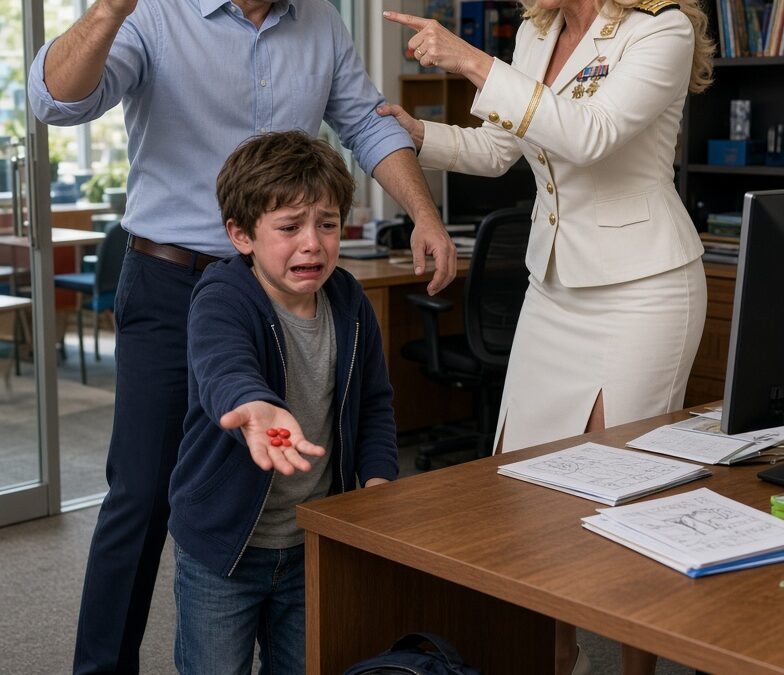
Her makeup was flawless. Her hair fell over her shoulders in polished waves, and she wore a fitted white military-style outfit with gold decorative buttons, a sharply cinched waist, and a deep neckline that emphasized her very full chest. It was the kind of outfit that commanded attention before the person wearing it had even spoken.
Karen knew that.
She used appearance the same way some people used status.
When she wanted something, her smile became warm and flirtatious.
When she didn’t get it, the smile disappeared and the person underneath came out.
Beside her was a boy I guessed to be seven or eight.
He was kicking the base of a trash can.
Not hard enough to knock it over.
Yet.
Magazines were scattered across the floor around him.
One decorative pillow had somehow made it from a waiting-room chair to the opposite side of the lobby.
Karen didn’t look at him.
She was focused on Maya.
“I arrived on time.”
“Yes, ma’am,” Maya said.
“And I’ve been standing here.”
“You’ve been here about five minutes.”
“Exactly.”
Maya saw me.
Relief flashed across her face.
I put on my professional smile.
“Karen?”
She turned.
Her eyes moved over me slowly, evaluating.
“Yes.”
“I’m sorry for the short wait. I’m the center director. Come on back and we’ll get started.”
She glanced at her watch.
“I have another appointment later.”
“We should have plenty of time.”
Her son kicked the trash can again.
I looked at him.
Then at Karen.
She smiled.
“He’s energetic.”
That was one word.
I crouched slightly.
“Hey, buddy. We’ve got coloring books and blocks in my office if you want something to do.”
He didn’t answer.
Karen touched my arm lightly.
“He doesn’t really do structured play.”
Structured play.
Apparently not destroying office furniture counted as structured.
I smiled.
“That’s fine. We have options.”
She leaned toward me.
“I’m sure you’ll be able to keep him entertained.”
The flirtatious sweetness lasted until we reached my office.
Then she saw the tuition schedule.
Her expression changed.
We sat across from each other.
Her son ignored both guest chairs and started examining my bookshelf.
I opened the intake packet.
“Before we talk scheduling, I’d like to get a sense of what you’re looking for.”
“Results.”
Karen crossed her legs.
“Obviously.”
“Sure. What areas is he struggling with?”
“His teacher says reading comprehension.”
“Okay.”
“I don’t necessarily agree.”
“Why?”
“Because he’s extremely intelligent.”
“I don’t doubt that.”
“He gets bored.”
“That’s possible.”
“His teacher doesn’t challenge him enough.”
“We hear that sometimes.”
Karen leaned toward me.
“He needs somebody who understands gifted children.”
Her son pulled a book halfway out of my shelf.
Another book fell onto the floor.
I looked over.
“Hey, could you put that back for me?”
He stared at me.
Then walked away.
The book remained on the floor.
Karen didn’t react.
I turned back.
“We can do an assessment first.”
“I don’t want him labeled.”
“The assessment isn’t about labeling him. It helps us understand where he actually needs support.”
“I already told you.”
“Reading comprehension.”
“Yes.”
“But knowing the exact skill gaps helps us choose the right materials.”
Karen waved her hand.
“Fine.”
I moved to tuition.
“Our standard program—”
“That price is wrong.”
I stopped.
“I’m sorry?”
She pointed at the page.
“That cannot be what you charge.”
“It is.”
“For tutoring?”
“Yes.”
“For a child?”
I almost asked who else she thought we tutored.
Instead, I said, “Our pricing includes individual academic planning, progress tracking, materials, and instruction.”
She smiled suddenly.
There it was.
Charm mode.
“I’m sure you can make an exception.”
“We don’t discount individual enrollment.”
“Everyone discounts.”
“We don’t.”
“You’re the director.”
“Yes.”
“So you have discretion.”
“Not over that.”
Karen tilted her head.
“You’re telling me there’s absolutely nothing you can do for me?”
The tone was almost playful.
Had I been a different person, perhaps it would have worked.
I smiled politely.
“I can help find the schedule that gives you the best value, but the tuition rate itself is fixed.”
The warmth disappeared instantly.
“That’s ridiculous.”
“I understand it’s an investment.”
“No, it’s overpriced.”
I let that pass.
Her son had moved toward a cabinet.
I kept half an eye on him.
“We also have cancellation policies—”
“I won’t pay cancellation fees.”
“They’re part of the enrollment agreement.”
“I just told you I’m not paying them.”
“And I’m explaining that if you enroll, the same policy applies to every family.”
“That’s terrible customer service.”
“We give twenty-four hours to reschedule without penalty.”
“What if something happens?”
“We consider true emergencies individually.”
“So you do have discretion.”
“In emergencies.”
Karen smiled like she’d caught me lying under oath.
“Exactly.”
Her son walked behind my chair.
I turned slightly.
“Hey, buddy, remember the play area?”
He ignored me.
Karen sighed.
“Can we please focus?”
I looked at her.
“Absolutely.”
For the next twenty minutes, every sentence became a negotiation.
She wanted guaranteed grade improvement.
I explained that no ethical tutoring center could guarantee a specific grade because we didn’t control his school assignments, classroom behavior, effort, testing conditions, or teacher.
She wanted a specific tutor she had heard about from another parent.
I explained availability depended on schedules and academic fit.
She wanted immediate after-school time slots that were already full.
She told me to “move somebody.”
I said no.
She wanted weekend sessions at weekday pricing.
I said no.
Each refusal made her visibly angrier.
Meanwhile, her son kept wandering.
Books.
Desk ornaments.
Pens.
A framed certificate.
Anything within reach.
Every few minutes, I redirected him.
Every time, Karen reacted as if I were inconveniencing her.
Eventually we reached the cancellation section again.
“This is unacceptable,” she said.
I took a breath.
“Which part?”
“If I cancel on the same day because something comes up, you’re going to charge me?”
“Unless it’s a genuine emergency, yes.”
“That’s theft.”
“No.”
“It is.”
“The tutor has reserved that time.”
“That’s your staffing problem.”
I opened my mouth.
Then I heard it.
Zzzzip.
A zipper opening.
It was a tiny sound.
But I knew exactly what it was.
I spun around.
Karen’s son was crouched behind my desk.
My backpack was pulled out from underneath it.
Open.
His hand was inside.
Everything in me went cold.
“Hey.”
He pulled out the prescription bottle.
For half a second, my brain simply stopped.
Then I saw the red pills inside.
I pushed back from my desk.
The chair rolled hard enough to hit the wall.
“Put that down.”
The boy looked at me.
Then twisted the cap.
It opened.
My stomach dropped.
I normally checked the child-resistant cap carefully.
That morning I’d been late.
I must not have fully tightened it.
Before I could reach him, he tipped the bottle.
Several pills rolled into his palm.
“Put those down right now.”
My voice changed.
No customer-service softness.
No negotiation.
I moved around the desk and caught his wrist before his hand could reach his mouth.
He tried pulling away.
I opened his fingers and swept every pill into my own hand.
Then I took the bottle from him.
His face crumpled.
He screamed.
Not cried.
Screamed.
The kind of full-body tantrum where a child seems almost shocked that the universe has denied him something.
He dropped to the floor.
Kicked his legs.
Hit the carpet with both hands.
“My candy!”
I secured the bottle cap.
“Those are not candy.”
“My candy!”
Karen shot out of the chair.
“What did you do?”
I turned.
“Your son opened my bag.”
She rushed around the desk.
“He’s screaming!”
“He had my prescription medication in his hand.”
Karen shoved me.
Not hard enough to knock me down.
Hard enough to make me stagger against the desk.
“What is wrong with you?”
I stared at her.
“Excuse me?”
“You scared him!”
“He opened medication.”
Karen scooped the boy up.
He was still screaming.
She glared at me like I had slapped him.
“Why would you yell at a child?”
“Because he was seconds away from putting prescription pills in his mouth.”
She looked at the bottle.
Then something happened that still doesn’t make sense to me.
Her anger didn’t turn into fear.
A normal parent—even an obnoxious one—would have looked at that bottle and panicked.
Did he swallow any?
What medication?
Do we need poison control?
Do we need an ambulance?
Karen did none of that.
She narrowed her eyes at the pills.
Then looked at me.
“Those look like candy.”
I stared at her.
“They aren’t.”
“Then why are they bright red?”
“Because that’s what the manufacturer made them look like.”
Her son reached toward the bottle.
“I want it!”
Karen bounced him slightly.
“I know, baby.”
I couldn’t believe what I was hearing.
She pointed at my hand.
“Just give him one.”
For a second, the room went completely silent in my head.
I thought I had misunderstood.
“What?”
“One.”
She spoke slowly, as if I were the difficult one.
“He’s already upset.”
I stared at her.
“This is blood pressure medication.”
“So?”
“So I’m not giving it to your son.”
“He thinks it’s candy.”
“It isn’t candy.”
Karen rolled her eyes.
“Oh, please.”
I felt something hot rise behind my ribs.
“I’m serious.”
“So am I.”
She put the boy down.
He immediately started crying louder.
“I want red candy!”
Karen pointed at him.
“Look what you did.”
“What I did?”
“You grabbed him.”
“Because he had dangerous medication.”
“You frightened him.”
“He went through my personal bag.”
“He’s a child.”
“Yes.”
“Children are curious.”
“That doesn’t make my backpack public property.”
Karen stepped closer.
“Don’t lecture me.”
“Then control your child.”
Her eyes sharpened.
“You do not tell me how to parent my son.”
“He opened my private medication.”
“You keep saying that like it’s some kind of crime.”
“He stole something from my bag that could make him very sick.”
The word stole infuriated her.
“My son is not a thief.”
“I didn’t call him a thief.”
“You just said he stole it.”
“He took something that wasn’t his.”
“He is seven.”
“And that’s why you should be supervising him.”
Karen’s face flushed.
The flirtatious polished woman from reception had disappeared completely.
Now there was only anger.
Entitlement.
And something almost frantic beneath it.
“You have no right to judge me.”
“I’m not judging you.”
“Yes, you are.”
“I am telling you I’m not giving your son prescription medication.”
Karen stared at the bottle.
Then held out her hand.
“Give it to me.”
I actually laughed once.
“No.”
“Give me the bottle.”
“Absolutely not.”
“I’ll decide whether my son can have one.”
I stepped back.
“No, you won’t.”
“You’re not his mother.”
“Exactly.”
I held the bottle closer to my chest.
“Which is why I’m not giving him medication prescribed to me.”
Karen moved closer.
“You are being completely ridiculous.”
“I’ve told you what this is.”
“They look like candy.”
“They could look like gummy bears. They’re still medication.”
“You’re exaggerating because you don’t want to share.”
That sentence stunned me more than everything before it.
“Share?”
“Yes.”
“With your son?”
“Yes.”
“My prescription?”
She threw up her hands.
“One pill.”
“No.”
“Half of one.”
“No.”
“Do you hear him?”
“I hear him.”
“He is crying because of you.”
“He is crying because I stopped him from swallowing medication.”
“You don’t know that he would swallow it.”
“He was raising his hand toward his mouth.”
“You’re lying.”
I felt my pulse hammering.
Ironically, the last thing someone with my condition needed was this conversation.
I put the bottle behind my back.
“This meeting is over.”
Karen stared at me.
“No.”
“Yes.”
“You don’t get to dismiss me.”
“This is my office.”
“I am a paying customer.”
“You haven’t enrolled.”
“Unbelievable.”
She turned toward her son.
“Come on.”
For one brief, beautiful second, I thought it was over.
Then the boy screamed:
“I WANT THE CANDY!”
Karen turned back.
The look in her eyes changed.
She wasn’t embarrassed anymore.
She wasn’t trying to reason.
She had decided I was the problem.
“Give him one.”
“No.”
Her voice rose.
“Give him one.”
“No.”
“Stop being selfish.”
“Karen, leave.”
Her lips pulled tight.
Then she moved.
Fast.
She lunged toward the hand holding the bottle.
I jerked it away.
Her other hand caught my right forearm.
Her fingernails dug into my skin.
Pain shot through me.
“Let go!”
“Give me the bottle!”
She pulled.
I twisted away.
Her nails dragged down my forearm.
The pain went from pressure to burning.
I saw blood immediately.
Three red lines opened across my skin.
“LET GO OF ME!”
I yanked my arm hard.
Her grip broke.
She stumbled backward.
Her son screamed even louder.
My chair crashed over.
Something fell from the desk.
Then the office door flew open.
My boss, Linda, stood there.
Behind her was Maya.
Linda took in the room in one sweep.
Karen.
Screaming child.
Overturned chair.
Me holding my arm.
Blood.
Prescription bottle.
“What is going on?”
Karen answered before I could.
“Thank God.”
She pointed at me.
“Your employee attacked my son.”
Linda looked at me.
I couldn’t speak for a second.
Adrenaline made my hands shake.
Karen continued.
“She screamed at him, grabbed him, and then attacked me when I tried to protect him.”
“What?”
“She stole his candy.”
Linda’s eyes moved toward the orange pharmacy bottle in my hand.
Then toward the scratches.
Her voice changed.
“Candy?”
Karen pointed.
“Those.”
Linda looked at me.
I swallowed.
“Her son went through my backpack.”
My voice was shaking.
“He pulled out my blood pressure medication. He opened it and dumped pills into his hand. I stopped him before he could swallow anything.”
Linda stared at Karen.
I continued.
“She demanded I give him one.”
Karen scoffed.
“I demanded she stop traumatizing my child.”
“She tried to take the bottle.”
Karen snapped:
“Because you were waving it around in front of him.”
“I was putting it away.”
“She scratched herself.”
I looked at my arm.
Blood was starting to run toward my wrist.
For some reason, that lie calmed me.
Until that moment, part of me was still reacting emotionally.
Trying to understand.
Trying to make sense of someone demanding prescription medicine for a child.
Then Karen lied.
Cleanly.
Instantly.
No hesitation.
I understood something important.
She wasn’t confused.
She would rewrite anything necessary to protect herself.
Linda understood too.
She pulled out her phone.
“I’m calling the police.”
Karen’s face changed.
“You don’t need to do that.”
Linda dialed.
“We absolutely do.”
“Just fire her.”
Linda stared at her.
“What?”
“Fire her.”
Karen pointed at me.
“And give my son his candy.”
Maya made a sound behind Linda.
Somewhere between a cough and disbelief.
Linda spoke into the phone.
“We need officers at our tutoring center. One of my employees has been assaulted.”
Karen stepped toward the doorway.
“We’re leaving.”
Linda moved aside just enough to keep distance but blocked the direct exit.
“Please stay until police arrive.”
Karen laughed.
“You cannot detain me.”
“I am asking you to wait for police because my employee is bleeding.”
“You’re all going to regret this.”
Her son had stopped screaming now.
He stood beside her watching everyone.
The transformation was almost eerie.
Without the tantrum, he looked simply confused.
Karen took his hand.
“Come on.”
Linda didn’t touch her.
She just said:
“If you leave, I’m giving police your enrollment paperwork, contact information, and camera footage.”
Karen stopped.
Camera footage.
I looked toward the corner of my office.
Our center had security cameras in the hallway and reception, though not directly recording the private interior of my office.
Karen didn’t know that.
Her eyes darted toward the ceiling.
For the first time, real uncertainty appeared.
“You record clients?”
“Public areas.”
Linda’s voice was calm.
“Police can sort out the rest.”
Karen’s confidence faltered.
Then she did what people like her often do when control slips away.
She got louder.
“I will sue this company.”
Nobody answered.
“I’ll sue every one of you personally.”
Linda stayed on the phone.
“You assaulted me.”
I looked at her.
“You scratched yourself!”
Blood was still running down my arm.
Karen pointed at Linda.
“You have no idea who my husband is.”
There it was.
Status.
The final card.
“My husband is extremely important.”
Linda covered the phone for a second.
“That’s wonderful.”
I nearly laughed despite everything.
Karen’s face turned purple.
“He has connections.”
“I’m sure he does.”
“You think this is funny?”
“No.”
Linda looked at my arm.
“I’m finding it difficult to focus on your husband’s professional importance while my employee is bleeding.”
Maya stepped into the room.
“Do you want first aid?”
I nodded.
“Please.”
Karen scoffed.
“Oh, give me a break.”
Maya looked at her.
Something in Maya’s face made Karen stop talking.
Maya wasn’t large.
Wasn’t intimidating.
But she had spent twenty minutes watching Karen treat her like garbage in reception.
She looked very ready for a conversation Karen would not enjoy.
Instead, Maya took me toward the sink near the staff room.
My arm burned.
My hands were shaking so badly I nearly dropped the bottle.
Linda stayed with Karen.
Within minutes, police arrived.
Two officers.
The first walked into reception.
Karen immediately began crying.
Not gradually.
Not because emotion finally overwhelmed her.
It switched on.
One second angry.
The next devastated.
“Officer, thank God.”
She pressed one hand dramatically against her chest.
“That woman attacked my child.”
The officer looked toward me.
I had paper towels pressed against my forearm.
Karen continued.
“My son only wanted candy.”
The officer frowned.
“Candy?”
“She had these red candies and she violently grabbed him when he picked some up.”
I said quietly:
“They’re prescription pills.”
The second officer looked at the bottle.
Karen turned toward him.
“She claims that.”
I held it up.
“My name is on the pharmacy label.”
Silence.
The first officer looked at Karen.
“Ma’am, come into the hallway with me.”
“I need you to arrest her.”
“Come with me, please.”
“She assaulted my child.”
“We’ll take everyone’s statement.”
Karen glared at me as she followed him out.
The second officer stayed with Linda and me.
He introduced himself as Officer Morales.
“Tell me what happened from the beginning.”
I did.
I explained my condition.
The medication.
Why it was in my backpack.
Where the backpack had been.
The boy going behind the desk.
The zipper.
The bottle.
The pills.
Taking them from his hand.
Karen demanding I give him one.
Her attempting to take the bottle.
Her fingernails digging into my arm.
Officer Morales looked at the scratches.
“Medical attention yet?”
“Not yet.”
“We’ll document them.”
Linda corroborated what she had seen when she entered.
She couldn’t say she witnessed the initial struggle.
She could say Karen was yelling, I was holding the prescription bottle, and my arm was already bleeding.
Maya confirmed hearing the shouting and seeing Karen aggressive in the doorway.
Officer Morales asked for the bottle.
I handed it over carefully.
He checked the label.
My name.
Medication.
Pharmacy.
Prescription instructions.
He opened the cap only after asking permission and looked at the pills.
Small.
Round.
Red.
He closed it.
“She says these are candy?”
“Yes.”
“You told her what they were?”
“Repeatedly.”
“And she still wanted you to give one to the child?”
“Yes.”
He exhaled through his nose.
Not quite a sigh.
Not quite disbelief.
“Okay.”
He took photographs of my arm.
Then he went into the hallway.
Through the partially open office door, I could hear Karen.
“She hates children.”
Officer Morales said something too quiet to hear.
Karen replied:
“She grabbed his wrist.”
Then the first officer asked:
“Why?”
Karen hesitated.
“Because he found something.”
“What?”
“A treat.”
“Where?”
Another hesitation.
“In her bag.”
“So your son opened her personal bag?”
“He’s curious.”
“And removed a prescription bottle?”
“She says it’s prescription.”
“The label has her name on it.”
Silence.
Then Karen said:
“She shouldn’t keep things that look like candy around children.”
Officer Morales asked:
“Inside a closed backpack under her desk?”
Karen’s voice sharpened.
“You don’t understand. He was crying.”
“What does that have to do with the medication?”
“He wanted one.”
“And after she told you it was prescription medication?”
“I still think she’s exaggerating.”
There was a pause.
Then one officer said:
“Let’s speak with your son.”
Karen objected immediately.
“He’s traumatized.”
“We’ll talk to him gently.”
“He doesn’t need interrogation.”
“Ma’am.”
The tone ended the argument.
The child was moved away from Karen.
One of the officers crouched.
I couldn’t hear every word.
But children are often very bad co-conspirators because they don’t understand which facts adults want hidden.
A few minutes later, I heard him say:
“I found the candy in the lady’s bag.”
Then:
“Mom said she should give me one.”
Silence.
Then:
“Mom tried to take it.”
Karen interrupted.
“He doesn’t understand what happened.”
The first officer stood.
“That’s enough.”
“What?”
“Ma’am, turn around.”
Karen stared at him.
“For what?”
“You’re being placed under arrest.”
Her face went blank.
“No.”
“Turn around and place your hands behind your back.”
“No.”
Her voice rose.
“You cannot arrest me.”
The officer remained calm.
“We absolutely can.”
“For what?”
“Assault and battery and attempted theft involving prescription medication, based on the statements and evidence we’re gathering.”
Karen looked toward my office.
Then screamed:
“She attacked me!”
The officer repeated:
“Hands behind your back.”
“My husband will destroy you.”
“Hands behind your back.”
“You don’t know who he is.”
“Ma’am.”
“He knows judges.”
The second officer stepped closer.
Karen jerked her arm away when they reached for her.
Her son began crying again.
That was the first moment in the entire incident when I felt something besides anger toward him.
He was a child.
A badly behaved child, yes.
But still a child.
He hadn’t taught himself that every tantrum deserved a reward.
He hadn’t taught himself that other people’s property belonged to him.
He hadn’t taught himself that boundaries disappeared when they became inconvenient.
Karen had.
Watching his mother get handcuffed clearly terrified him.
He started calling for her.
Karen, somehow, made it worse.
“See what you’ve done?”
She shouted toward me.
“This is your fault!”
The officer guided her toward the exit.
She twisted around.
“You’re going to pay for this!”
Linda stepped in front of me.
Not aggressively.
Protectively.
The police escorted Karen outside.
Her white fitted uniform that had seemed so commanding when she arrived now looked almost surreal beneath handcuffed wrists.
Her son remained inside while officers contacted his father.
Maya brought him into the break room.
She gave him a juice box.
A packet of crackers.
Actual food.
No pills required.
I sat in my office afterward, staring at the overturned chair.
Adrenaline was fading.
Pain was replacing it.
The scratches burned.
My shoulder ached from pulling away.
My chest felt tight enough that Linda noticed.
“You need to go to urgent care.”
“I’m okay.”
“No.”
“I just need a minute.”
“You have a blood pressure condition, you’ve been assaulted, and you’re shaking.”
“I’ll be fine.”
Linda pointed at me.
“That wasn’t a suggestion.”
Under different circumstances, I would have argued.
I didn’t have the energy.
Karen’s husband arrived before I left.
He looked nothing like the mythical powerful man she’d used as a threat.
He looked terrified.
Mid-forties.
Business clothes.
Face pale.
He hurried inside.
“Where’s my son?”
Maya brought the boy out.
He ran to his father.
The man hugged him.
Then looked around.
“What happened?”
The officer gave him a brief explanation.
His eyes moved toward me.
Then toward the prescription bottle.
Then toward my bleeding arm.
His expression changed from confusion to horror.
“She wanted him to take what?”
The officer answered quietly.
Karen’s husband stared at his son.
“Did you swallow anything?”
The boy shook his head.
“No.”
“You promise?”
“He says he didn’t,” the officer said. “Based on what everyone reports, the medication was taken away before ingestion.”
The man closed his eyes.
For several seconds, he just held his son.
Then he looked at me.
“I am so sorry.”
I didn’t know what to say.
So I nodded.
He looked at the scratches again.
“Did she do that?”
“Yes.”
His face seemed to collapse slightly.
“I am sorry.”
There was something in his voice that made me think this wasn’t the first time Karen’s behavior had forced him to apologize.
He took his son home.
I went to urgent care.
The doctor cleaned the scratches thoroughly.
They were deeper than I had thought.
Nothing catastrophic.
No stitches.
But enough to require treatment, antibiotic ointment, bandaging, and a tetanus booster because human fingernails are not exactly sterile surgical instruments.
The nurse asked:
“Cat?”
“No.”
“Dog?”
“Parent.”
She stopped writing.
“Parent?”
“Long story.”
She looked at the scratches.
“I’ve got time.”
I didn’t tell her the whole story.
I was too tired.
That night, I sat on my couch with my arm bandaged.
For the first time since it happened, I cried.
Not dramatically.
No sobbing.
Just tears.
My body finally stopped operating on adrenaline and everything caught up.
The fear when I saw the pills in that child’s hand.
The realization of what might have happened if I’d turned around ten seconds later.
Karen’s nails.
Her lies.
The police.
Her screaming while being handcuffed.
I kept replaying the same image.
The boy’s palm.
Bright red pills.
His hand starting toward his mouth.
Ten seconds.
Maybe less.
If I hadn’t heard the zipper, I might have spent the rest of my life wondering whether I could have prevented something terrible.
That thought was worse than the scratches.
The next day, Linda called.
“How are you?”
“Sore.”
“Stay home.”
“I can work.”
“That wasn’t the question.”
I smiled despite myself.
“Thank you.”
“We’re reviewing everything.”
“Everything?”
“Office safety. Intake procedures. Children during consultations. Personal storage.”
“I don’t want everyone punished because one parent—”
“They won’t be.”
Her voice softened.
“But we learned something.”
So had I.
That afternoon, I contacted a lawyer.
I hadn’t originally planned to sue.
At first, I thought the criminal process would be enough.
Then I looked at the bandages.
Thought about the urgent care bill.
Thought about Karen telling police I had scratched myself.
Thought about her trying to steal medication after being told what it was.
I realized that if I simply walked away, Karen would probably turn herself into the victim by the end of the week.
My attorney, Michael Grant, listened without interrupting.
When I finished, he said:
“You have documentation?”
“Police report.”
“Medical records?”
“Yes.”
“Witnesses?”
“My boss and coworker saw the aftermath. The police spoke to her son too.”
“And the prescription is clearly yours?”
“Yes.”
“This isn’t complicated.”
“It feels complicated.”
“Emotionally, yes.”
He paused.
“Factually, not especially.”
That helped.
The criminal case moved separately.
I won’t pretend I enjoyed that process.
Statements.
Follow-up calls.
Questions.
Documentation.
There is nothing cinematic about legal consequences when you’re actually living through them.
Mostly it is paperwork and waiting.
Karen’s story shifted repeatedly.
First I attacked her son.
Then I misunderstood what she wanted.
Then she claimed she had only asked to see the bottle.
Then she suggested she’d been concerned about whether I was storing medication properly around children.
That one almost impressed me.
The woman who demanded I hand her son a pill tried reinventing herself as a medication-safety advocate.
Unfortunately for her, too many people had heard too much.
Her son’s account.
My injuries.
The prescription.
Linda.
Maya.
Police observations.
Her own statements.
The civil case moved forward.
Michael filed claims tied to the assault, medical expenses, emotional distress, and attempted taking of the medication.
Karen retained an attorney.
Then came the deposition.
I wasn’t in the room with her for every moment, but later I read the transcript.
It was extraordinary.
Her lawyer had clearly coached her to be careful.
Karen was not built for careful.
When asked whether she knew the bottle contained prescription medication, she tried to say she had believed I was joking.
Then opposing questioning returned to my repeated statements that it was blood pressure medicine.
Karen said I had “overreacted.”
When asked whether she’d requested a pill for her son, she first denied it.
Then admitted she may have asked because she “wanted to calm the situation.”
When asked why she would request a medication she believed might be prescription, she said:
“I did not believe it was dangerous.”
Asked whether she had medical training?
No.
Pharmacy training?
No.
Nursing training?
No.
Any basis for deciding whether a prescription medication was safe for a child?
She became angry.
The transcript showed it.
She said:
“I am his mother. I know my own child.”
That sentence destroyed whatever remained of her defense.
Being his mother did not make her qualified to prescribe someone else’s medication.
Then came the assault.
Did she grab me?
Only because I had frightened her child.
Did her fingernails scratch me?
She didn’t know.
Did she attempt to take the bottle?
She had tried to “remove it from the situation.”
Why?
Because her son was upset.
Her attorney requested a break soon afterward.
A week later, Karen’s lawyer contacted Michael about settlement.
I wasn’t surprised.
Michael wasn’t either.
“They don’t want this in front of a jury.”
“What do you think?”
“I think we negotiate.”
“I don’t want years of this.”
“Neither do I.”
“But I don’t want her walking away like nothing happened.”
“She won’t.”
We calculated everything.
Medical expenses.
Legal costs.
Lost work time.
Physical injury.
Emotional harm.
The seriousness of her conduct.
We demanded a substantial settlement.
Karen’s attorney pushed back immediately.
They claimed the amount was excessive.
Claimed she didn’t have enough available cash.
Claimed the incident had already cost her significantly because of the criminal matter.
Michael didn’t move much.
“If they want trial,” he told me, “we can discuss trial.”
That changed the tone.
Then something happened I hadn’t expected.
Karen’s husband became involved in settlement discussions.
Not directly with me.
Through attorneys.
Apparently, Karen had not told him the full truth at first.
She had described the incident as an argument with an employee who “got physical” with their son.
Then he saw records.
Police reports.
The claims.
Her deposition.
He learned that she had demanded prescription medication for their child after being told what it was.
That detail seemed to be the breaking point.
Eventually, they agreed to the settlement.
The amount covered my medical costs, legal fees, and a significant payment for the injury and emotional distress.
When Michael called to tell me it was finalized, I expected to feel triumphant.
I didn’t.
I felt tired.
Relieved.
Mostly relieved.
“That’s it?” I asked.
“Once final documents are signed and payment clears, yes.”
I sat quietly.
Michael said:
“You okay?”
“Yeah.”
“You don’t sound happy.”
“I don’t know what happy is supposed to look like after something this stupid.”
He laughed softly.
“Usually relief.”
“Then I’m relieved.”
The money didn’t erase anything.
It didn’t erase the scratches.
It didn’t erase the image of those pills in the boy’s hand.
It didn’t erase hearing Karen scream that everything was my fault.
But consequences matter.
Especially when somebody has spent years learning that aggression gets results.
I later heard that Karen’s marriage fell apart.
I didn’t celebrate that.
I only knew pieces through people connected to the tutoring center and eventually through her husband during the broader legal process.
Apparently, he was horrified.
Not just because she had been arrested.
Not just because the case cost money.
Because she had knowingly pushed for their son to ingest unknown prescription medication after the owner explicitly warned her it was dangerous.
He could not understand it.
Neither could I.
At some point afterward, he filed for divorce.
Whether my incident was the only reason, I don’t know.
Marriages are complicated.
I suspect what happened in my office was less a single crack than the moment he finally saw how many cracks were already there.
Karen had spent the entire afternoon insisting that being a mother gave her the right to override everyone around her.
My office.
My bag.
My medication.
My body.
Police.
Her husband.
Reality itself.
Eventually, reality won.
I returned to the tutoring center once my arm improved.
Linda had already changed our procedures.
Children who couldn’t remain seated or use the designated play area during adult intake meetings would stay in the supervised waiting area with staff.
Parents were informed before the appointment.
Personal offices had lockable storage.
Staff were encouraged to keep medication in secured drawers or cabinets when possible.
I felt guilty at first.
“This is because of me.”
Linda shook her head.
“No.”
“Because of what happened to me.”
“Different sentence.”
She was right.
The first week back was harder than I expected.
Every zipper sound made me look down.
Every child walking behind my desk made my shoulders tighten.
Maya noticed.
One afternoon she put coffee on my desk.
“You know nobody is touching your bag again.”
“I know.”
“We’ll tackle them.”
I smiled.
“Please don’t tackle children.”
“Fine.”
“Or parents.”
She considered.
“No promises on parents.”
That made me laugh.
The scar faded slowly.
Three thin marks remained visible for months.
Sometimes parents asked about them.
I usually said:
“Workplace incident.”
That was enough.
Then one afternoon, nearly a year later, a new family came in.
A mother.
A boy about eight.
He was restless.
Not badly behaved.
Just bored.
His mother and I were discussing scheduling when he stood and wandered toward my bookshelf.
I felt that same automatic tension.
His mother noticed immediately.
“Ethan.”
He stopped.
“Come back over here, please.”
He returned.
She smiled apologetically.
“Sorry. He gets curious.”
“No problem.”
She handed him a coloring book from our play area.
He sat down.
That simple moment almost made me emotional.
Because that was all Karen had ever needed to do.
Watch your child.
Set a boundary.
Accept no.
Nobody expects children to behave perfectly.
Children make mistakes.
They grab things.
They get curious.
They throw tantrums.
Adults are supposed to be the guardrails.
That is what Karen failed to understand.
Her son’s behavior was dangerous.
Her behavior made it catastrophic.
If she had reacted normally when I took the pills away, the entire story could have ended in sixty seconds.
“Oh my God, I’m sorry.”
“Did he swallow any?”
“No.”
“Thank goodness.”
“Please don’t touch other people’s bags.”
Done.
No police.
No urgent care.
No lawsuit.
No settlement.
No divorce fallout.
No scar.
Karen had dozens of exits.
She chose none of them.
At the first exit, she could have apologized.
Instead, she blamed me.
At the second, she could have accepted that the pills weren’t candy.
Instead, she argued.
At the third, she could have removed her crying child.
Instead, she demanded medication.
At the fourth, she could have heard no.
Instead, she tried to take the bottle.
At the fifth, she could have stopped before touching me.
Instead, she dug her nails into my arm.
At the sixth, she could have told police the truth.
Instead, she accused me of assault.
At every stage, she had a choice between embarrassment and escalation.
She always chose escalation.
That was who Karen was.
Not a mother having one bad afternoon.
Not a confused woman who misunderstood medicine.
A person who believed other people’s boundaries existed only until she wanted something badly enough.
I think about her son sometimes.
Not often.
But sometimes.
He would be older now.
I hope somebody taught him the lessons his mother refused to.
That another person’s bag is not yours to search.
Another person’s medication is not candy.
Crying doesn’t transform no into yes.
And love doesn’t mean giving a child everything he demands.
Sometimes love means grabbing his wrist because the thing in his hand could hurt him.
That afternoon, Karen accused me of terrifying her son.
Maybe I did scare him for a few seconds.
I can live with that.
Because he didn’t swallow the pills.
He went home.
He was okay.
And no matter how many times Karen screamed that I had done something terrible, that fact mattered more than her feelings.
I kept working at the center for years afterward.
We grew.
Hired more tutors.
Expanded our test-prep program.
Maya eventually became an assistant director.
Linda retired.
The security policy Karen indirectly inspired remained.
Occasionally, new employees would ask why parents were specifically told not to allow children behind staff desks.
Maya would look at me.
I’d look at her.
Neither of us needed to say much.
“Long story,” I would tell them.
Sometimes Maya added:
“Involving candy that wasn’t candy.”
Then I’d glare at her.
She’d laugh.
Life moved on.
That’s the strange thing about frightening experiences.
For a while, they feel enormous.
They take over every conversation.
Every thought.
Every night.
Then gradually they become one room in a much larger house.
You don’t live there anymore.
You just remember where it is.
For months, Karen lived in my head.
Her voice.
Give him one.
He’s crying because of you.
Give me the bottle.
You don’t tell me how to parent my child.
Eventually, those words lost their power.
The scar faded.
The case closed.
The settlement cleared.
My health stabilized.
Work became normal again.
And one day, I realized I had gone an entire week without thinking about her.
That felt better than the settlement check.
I don’t know exactly what happened to Karen afterward beyond what I heard about the divorce.
I don’t know whether she learned anything.
People like her sometimes do.
Sometimes they don’t.
Part of me imagines she told everyone the same story forever.
That an unstable tutoring-center employee overreacted.
That police misunderstood.
That lawyers exploited the situation.
That her husband betrayed her.
That everyone else was the problem.
Maybe that is easier than admitting she stood in an office and demanded prescription blood pressure medication because her son wanted something red and round.
But whether she learned didn’t matter anymore.
I did.
I learned that being professional does not mean accepting abuse.
Being patient doesn’t require endless patience.
Customer service does not mean surrendering basic boundaries.
And when somebody crosses from difficult into dangerous, you do not owe them politeness at the expense of safety.
Most importantly, I learned that saying no can be an act of protection.
Karen heard no and considered it cruelty.
Her son heard no and screamed.
But that no may have kept him out of an emergency room.
Maybe worse.
So if I had that afternoon to live again, I wouldn’t change the moment that made Karen furious.
I would still move the chair.
Still grab his wrist.
Still take those pills.
Still tell her absolutely not.
Still protect the medication.
Still call police after she put her hands on me.
The only thing I might change is this:
I would stop trying so hard to understand her.
Because there was no reasonable explanation hiding somewhere inside that situation.
Karen wasn’t confused about what I said.
She simply believed her demand mattered more.
And for the first time that afternoon, someone refused to let that belief control the room.
She walked into my tutoring center expecting discounts, guarantees, special treatment, and obedience.
She walked out in handcuffs.
Not because she was a demanding parent.
Not because her son misbehaved.
Not because she argued over tuition.
She walked out in handcuffs because when someone finally told her no, she decided that another person’s property, medication, body, and safety were all less important than getting her way.
And that was one tantrum no amount of entitlement could save her from.
𝗧𝗛𝗘 𝗘𝗡𝗗
Karen Tried to Force Me to Give Her Son My Prescription Pills—Then She Put Her Hands on Me When I Said No
The little boy had already dumped a handful of my prescription pills into his palm when I realized what he was holding.
His mother didn’t panic when I told her the medication could seriously hurt him.
She looked me straight in the eye, pointed at the bottle in my hand, and demanded that I give her crying son one anyway.
I had dealt with difficult parents before.
Working as the center director of a private tutoring center meant dealing with people at their most anxious, ambitious, protective, demanding, and occasionally irrational.
Most parents were good people.
Even the intense ones usually came from an understandable place.
They worried about grades.
College.
Test scores.
Whether their child was falling behind.
Whether they were failing as parents.
Sometimes that anxiety came out as impatience. Sometimes it became endless questions. Occasionally it meant somebody argued with me for twenty minutes over a cancellation fee clearly written in the contract they had signed.
I could handle that.
I had learned how.
You smiled.
Stayed calm.
Repeated the policy.
Let people feel heard without promising things you couldn’t deliver.
And when somebody walked into my office already angry, I reminded myself that they were usually angry at a problem, not at me.
Karen was different.
From the moment she entered our building, she treated every person around her as though they had personally disappointed her by existing incorrectly.
My receptionist, Maya, gave me the first warning.
I was finishing an intake meeting with another family when my office phone buzzed.
Maya’s extension.
I picked up.
“Everything okay?”
Her voice dropped.
“Your two-thirty is here.”
“Great. I’ll be out in five.”
There was a pause.
“You may want ten.”
That made me smile.
“Why?”
“She’s already complained about the parking lot.”
“That was quick.”
“And the temperature.”
“Too hot?”
“Too cold.”
“Of course.”
“And she says making her wait for her scheduled appointment is disrespectful.”
I checked the time.
Two twenty-eight.
I looked at Maya through the glass wall separating reception from the hallway.
She gave me a look.
“What else?”
“Her son is kicking the trash can.”
I closed my eyes.
“How old?”
“Seven? Eight?”
“Is she stopping him?”
“No.”
“Anything broken?”
“Not yet.”
I glanced at the family seated across from me and lowered my voice.
“I’ll be there as soon as I finish.”
“Good luck.”
She hung up.
I should explain something about my office before I go further.
Because what happened later sounds insane enough that people sometimes assume I left medication sitting in some obvious place where a child could casually grab it.
I didn’t.
I have a medical condition that causes severe hypertension.
I’d managed it for years.
Most of the time, you wouldn’t know anything was wrong with me. I worked full days, exercised carefully, lived normally, and rarely talked about it unless there was a practical reason.
But managing it required medication.
Specific medication.
Specific dosage.
Specific schedule.
I took it twice daily, and because one of those doses fell during working hours, I kept the prescription bottle in my personal backpack.
The backpack stayed zipped.
It stayed underneath my desk.
Inside my private office.
The pills themselves were small, round, and coated red.
To an adult, they looked exactly like medication.
To a young child who didn’t know better?
I could see how they might resemble candy.
Which was precisely why no child had any reason to be digging through my private bag.
Missing my medication could leave me dizzy, unwell, and potentially in real trouble.
And the medication wasn’t something another person—especially a child—could safely treat like candy.
That mattered later.
At two thirty-three, I finished with the previous family and walked toward reception.
Before I even rounded the corner, I heard Karen.
“This is ridiculous.”
Maya was behind the desk, wearing the expression she used when she was only three sentences away from saying something that would require an HR meeting.
A woman stood in front of her.
Around forty.
Tall.
Blond.
Strikingly attractive and obviously aware of it.
Her makeup was flawless. Her hair fell over her shoulders in polished waves, and she wore a fitted white military-style outfit with gold decorative buttons, a sharply cinched waist, and a deep neckline that emphasized her very full chest. It was the kind of outfit that commanded attention before the person wearing it had even spoken.
Karen knew that.
She used appearance the same way some people used status.
When she wanted something, her smile became warm and flirtatious.
When she didn’t get it, the smile disappeared and the person underneath came out.
Beside her was a boy I guessed to be seven or eight.
He was kicking the base of a trash can.
Not hard enough to knock it over.
Yet.
Magazines were scattered across the floor around him.
One decorative pillow had somehow made it from a waiting-room chair to the opposite side of the lobby.
Karen didn’t look at him.
She was focused on Maya.
“I arrived on time.”
“Yes, ma’am,” Maya said.
“And I’ve been standing here.”
“You’ve been here about five minutes.”
“Exactly.”
Maya saw me.
Relief flashed across her face.
I put on my professional smile.
“Karen?”
She turned.
Her eyes moved over me slowly, evaluating.
“Yes.”
“I’m sorry for the short wait. I’m the center director. Come on back and we’ll get started.”
She glanced at her watch.
“I have another appointment later.”
“We should have plenty of time.”
Her son kicked the trash can again.
I looked at him.
Then at Karen.
She smiled.
“He’s energetic.”
That was one word.
I crouched slightly.
“Hey, buddy. We’ve got coloring books and blocks in my office if you want something to do.”
He didn’t answer.
Karen touched my arm lightly.
“He doesn’t really do structured play.”
Structured play.
Apparently not destroying office furniture counted as structured.
I smiled.
“That’s fine. We have options.”
She leaned toward me.
“I’m sure you’ll be able to keep him entertained.”
The flirtatious sweetness lasted until we reached my office.
Then she saw the tuition schedule.
Her expression changed.
We sat across from each other.
Her son ignored both guest chairs and started examining my bookshelf.
I opened the intake packet.
“Before we talk scheduling, I’d like to get a sense of what you’re looking for.”
“Results.”
Karen crossed her legs.
“Obviously.”
“Sure. What areas is he struggling with?”
“His teacher says reading comprehension.”
“Okay.”
“I don’t necessarily agree.”
“Why?”
“Because he’s extremely intelligent.”
“I don’t doubt that.”
“He gets bored.”
“That’s possible.”
“His teacher doesn’t challenge him enough.”
“We hear that sometimes.”
Karen leaned toward me.
“He needs somebody who understands gifted children.”
Her son pulled a book halfway out of my shelf.
Another book fell onto the floor.
I looked over.
“Hey, could you put that back for me?”
He stared at me.
Then walked away.
The book remained on the floor.
Karen didn’t react.
I turned back.
“We can do an assessment first.”
“I don’t want him labeled.”
“The assessment isn’t about labeling him. It helps us understand where he actually needs support.”
“I already told you.”
“Reading comprehension.”
“Yes.”
“But knowing the exact skill gaps helps us choose the right materials.”
Karen waved her hand.
“Fine.”
I moved to tuition.
“Our standard program—”
“That price is wrong.”
I stopped.
“I’m sorry?”
She pointed at the page.
“That cannot be what you charge.”
“It is.”
“For tutoring?”
“Yes.”
“For a child?”
I almost asked who else she thought we tutored.
Instead, I said, “Our pricing includes individual academic planning, progress tracking, materials, and instruction.”
She smiled suddenly.
There it was.
Charm mode.
“I’m sure you can make an exception.”
“We don’t discount individual enrollment.”
“Everyone discounts.”
“We don’t.”
“You’re the director.”
“Yes.”
“So you have discretion.”
“Not over that.”
Karen tilted her head.
“You’re telling me there’s absolutely nothing you can do for me?”
The tone was almost playful.
Had I been a different person, perhaps it would have worked.
I smiled politely.
“I can help find the schedule that gives you the best value, but the tuition rate itself is fixed.”
The warmth disappeared instantly.
“That’s ridiculous.”
“I understand it’s an investment.”
“No, it’s overpriced.”
I let that pass.
Her son had moved toward a cabinet.
I kept half an eye on him.
“We also have cancellation policies—”
“I won’t pay cancellation fees.”
“They’re part of the enrollment agreement.”
“I just told you I’m not paying them.”
“And I’m explaining that if you enroll, the same policy applies to every family.”
“That’s terrible customer service.”
“We give twenty-four hours to reschedule without penalty.”
“What if something happens?”
“We consider true emergencies individually.”
“So you do have discretion.”
“In emergencies.”
Karen smiled like she’d caught me lying under oath.
“Exactly.”
Her son walked behind my chair.
I turned slightly.
“Hey, buddy, remember the play area?”
He ignored me.
Karen sighed.
“Can we please focus?”
I looked at her.
“Absolutely.”
For the next twenty minutes, every sentence became a negotiation.
She wanted guaranteed grade improvement.
I explained that no ethical tutoring center could guarantee a specific grade because we didn’t control his school assignments, classroom behavior, effort, testing conditions, or teacher.
She wanted a specific tutor she had heard about from another parent.
I explained availability depended on schedules and academic fit.
She wanted immediate after-school time slots that were already full.
She told me to “move somebody.”
I said no.
She wanted weekend sessions at weekday pricing.
I said no.
Each refusal made her visibly angrier.
Meanwhile, her son kept wandering.
Books.
Desk ornaments.
Pens.
A framed certificate.
Anything within reach.
Every few minutes, I redirected him.
Every time, Karen reacted as if I were inconveniencing her.
Eventually we reached the cancellation section again.
“This is unacceptable,” she said.
I took a breath.
“Which part?”
“If I cancel on the same day because something comes up, you’re going to charge me?”
“Unless it’s a genuine emergency, yes.”
“That’s theft.”
“No.”
“It is.”
“The tutor has reserved that time.”
“That’s your staffing problem.”
I opened my mouth.
Then I heard it.
Zzzzip.
A zipper opening.
It was a tiny sound.
But I knew exactly what it was.
I spun around.
Karen’s son was crouched behind my desk.
My backpack was pulled out from underneath it.
Open.
His hand was inside.
Everything in me went cold.
“Hey.”
He pulled out the prescription bottle.
For half a second, my brain simply stopped.
Then I saw the red pills inside.
I pushed back from my desk.
The chair rolled hard enough to hit the wall.
“Put that down.”
The boy looked at me.
Then twisted the cap.
It opened.
My stomach dropped.
I normally checked the child-resistant cap carefully.
That morning I’d been late.
I must not have fully tightened it.
Before I could reach him, he tipped the bottle.
Several pills rolled into his palm.
“Put those down right now.”
My voice changed.
No customer-service softness.
No negotiation.
I moved around the desk and caught his wrist before his hand could reach his mouth.
He tried pulling away.
I opened his fingers and swept every pill into my own hand.
Then I took the bottle from him.
His face crumpled.
He screamed.
Not cried.
Screamed.
The kind of full-body tantrum where a child seems almost shocked that the universe has denied him something.
He dropped to the floor.
Kicked his legs.
Hit the carpet with both hands.
“My candy!”
I secured the bottle cap.
“Those are not candy.”
“My candy!”
Karen shot out of the chair.
“What did you do?”
I turned.
“Your son opened my bag.”
She rushed around the desk.
“He’s screaming!”
“He had my prescription medication in his hand.”
Karen shoved me.
Not hard enough to knock me down.
Hard enough to make me stagger against the desk.
“What is wrong with you?”
I stared at her.
“Excuse me?”
“You scared him!”
“He opened medication.”
Karen scooped the boy up.
He was still screaming.
She glared at me like I had slapped him.
“Why would you yell at a child?”
“Because he was seconds away from putting prescription pills in his mouth.”
She looked at the bottle.
Then something happened that still doesn’t make sense to me.
Her anger didn’t turn into fear.
A normal parent—even an obnoxious one—would have looked at that bottle and panicked.
Did he swallow any?
What medication?
Do we need poison control?
Do we need an ambulance?
Karen did none of that.
She narrowed her eyes at the pills.
Then looked at me.
“Those look like candy.”
I stared at her.
“They aren’t.”
“Then why are they bright red?”
“Because that’s what the manufacturer made them look like.”
Her son reached toward the bottle.
“I want it!”
Karen bounced him slightly.
“I know, baby.”
I couldn’t believe what I was hearing.
She pointed at my hand.
“Just give him one.”
For a second, the room went completely silent in my head.
I thought I had misunderstood.
“What?”
“One.”
She spoke slowly, as if I were the difficult one.
“He’s already upset.”
I stared at her.
“This is blood pressure medication.”
“So?”
“So I’m not giving it to your son.”
“He thinks it’s candy.”
“It isn’t candy.”
Karen rolled her eyes.
“Oh, please.”
I felt something hot rise behind my ribs.
“I’m serious.”
“So am I.”
She put the boy down.
He immediately started crying louder.
“I want red candy!”
Karen pointed at him.
“Look what you did.”
“What I did?”
“You grabbed him.”
“Because he had dangerous medication.”
“You frightened him.”
“He went through my personal bag.”
“He’s a child.”
“Yes.”
“Children are curious.”
“That doesn’t make my backpack public property.”
Karen stepped closer.
“Don’t lecture me.”
“Then control your child.”
Her eyes sharpened.
“You do not tell me how to parent my son.”
“He opened my private medication.”
“You keep saying that like it’s some kind of crime.”
“He stole something from my bag that could make him very sick.”
The word stole infuriated her.
“My son is not a thief.”
“I didn’t call him a thief.”
“You just said he stole it.”
“He took something that wasn’t his.”
“He is seven.”
“And that’s why you should be supervising him.”
Karen’s face flushed.
The flirtatious polished woman from reception had disappeared completely.
Now there was only anger.
Entitlement.
And something almost frantic beneath it.
“You have no right to judge me.”
“I’m not judging you.”
“Yes, you are.”
“I am telling you I’m not giving your son prescription medication.”
Karen stared at the bottle.
Then held out her hand.
“Give it to me.”
I actually laughed once.
“No.”
“Give me the bottle.”
“Absolutely not.”
“I’ll decide whether my son can have one.”
I stepped back.
“No, you won’t.”
“You’re not his mother.”
“Exactly.”
I held the bottle closer to my chest.
“Which is why I’m not giving him medication prescribed to me.”
Karen moved closer.
“You are being completely ridiculous.”
“I’ve told you what this is.”
“They look like candy.”
“They could look like gummy bears. They’re still medication.”
“You’re exaggerating because you don’t want to share.”
That sentence stunned me more than everything before it.
“Share?”
“Yes.”
“With your son?”
“Yes.”
“My prescription?”
She threw up her hands.
“One pill.”
“No.”
“Half of one.”
“No.”
“Do you hear him?”
“I hear him.”
“He is crying because of you.”
“He is crying because I stopped him from swallowing medication.”
“You don’t know that he would swallow it.”
“He was raising his hand toward his mouth.”
“You’re lying.”
I felt my pulse hammering.
Ironically, the last thing someone with my condition needed was this conversation.
I put the bottle behind my back.
“This meeting is over.”
Karen stared at me.
“No.”
“Yes.”
“You don’t get to dismiss me.”
“This is my office.”
“I am a paying customer.”
“You haven’t enrolled.”
“Unbelievable.”
She turned toward her son.
“Come on.”
For one brief, beautiful second, I thought it was over.
Then the boy screamed:
“I WANT THE CANDY!”
Karen turned back.
The look in her eyes changed.
She wasn’t embarrassed anymore.
She wasn’t trying to reason.
She had decided I was the problem.
“Give him one.”
“No.”
Her voice rose.
“Give him one.”
“No.”
“Stop being selfish.”
“Karen, leave.”
Her lips pulled tight.
Then she moved.
Fast.
She lunged toward the hand holding the bottle.
I jerked it away.
Her other hand caught my right forearm.
Her fingernails dug into my skin.
Pain shot through me.
“Let go!”
“Give me the bottle!”
She pulled.
I twisted away.
Her nails dragged down my forearm.
The pain went from pressure to burning.
I saw blood immediately.
Three red lines opened across my skin.
“LET GO OF ME!”
I yanked my arm hard.
Her grip broke.
She stumbled backward.
Her son screamed even louder.
My chair crashed over.
Something fell from the desk.
Then the office door flew open.
My boss, Linda, stood there.
Behind her was Maya.
Linda took in the room in one sweep.
Karen.
Screaming child.
Overturned chair.
Me holding my arm.
Blood.
Prescription bottle.
“What is going on?”
Karen answered before I could.
“Thank God.”
She pointed at me.
“Your employee attacked my son.”
Linda looked at me.
I couldn’t speak for a second.
Adrenaline made my hands shake.
Karen continued.
“She screamed at him, grabbed him, and then attacked me when I tried to protect him.”
“What?”
“She stole his candy.”
Linda’s eyes moved toward the orange pharmacy bottle in my hand.
Then toward the scratches.
Her voice changed.
“Candy?”
Karen pointed.
“Those.”
Linda looked at me.
I swallowed.
“Her son went through my backpack.”
My voice was shaking.
“He pulled out my blood pressure medication. He opened it and dumped pills into his hand. I stopped him before he could swallow anything.”
Linda stared at Karen.
I continued.
“She demanded I give him one.”
Karen scoffed.
“I demanded she stop traumatizing my child.”
“She tried to take the bottle.”
Karen snapped:
“Because you were waving it around in front of him.”
“I was putting it away.”
“She scratched herself.”
I looked at my arm.
Blood was starting to run toward my wrist.
For some reason, that lie calmed me.
Until that moment, part of me was still reacting emotionally.
Trying to understand.
Trying to make sense of someone demanding prescription medicine for a child.
Then Karen lied.
Cleanly.
Instantly.
No hesitation.
I understood something important.
She wasn’t confused.
She would rewrite anything necessary to protect herself.
Linda understood too.
She pulled out her phone.
“I’m calling the police.”
Karen’s face changed.
“You don’t need to do that.”
Linda dialed.
“We absolutely do.”
“Just fire her.”
Linda stared at her.
“What?”
“Fire her.”
Karen pointed at me.
“And give my son his candy.”
Maya made a sound behind Linda.
Somewhere between a cough and disbelief.
Linda spoke into the phone.
“We need officers at our tutoring center. One of my employees has been assaulted.”
Karen stepped toward the doorway.
“We’re leaving.”
Linda moved aside just enough to keep distance but blocked the direct exit.
“Please stay until police arrive.”
Karen laughed.
“You cannot detain me.”
“I am asking you to wait for police because my employee is bleeding.”
“You’re all going to regret this.”
Her son had stopped screaming now.
He stood beside her watching everyone.
The transformation was almost eerie.
Without the tantrum, he looked simply confused.
Karen took his hand.
“Come on.”
Linda didn’t touch her.
She just said:
“If you leave, I’m giving police your enrollment paperwork, contact information, and camera footage.”
Karen stopped.
Camera footage.
I looked toward the corner of my office.
Our center had security cameras in the hallway and reception, though not directly recording the private interior of my office.
Karen didn’t know that.
Her eyes darted toward the ceiling.
For the first time, real uncertainty appeared.
“You record clients?”
“Public areas.”
Linda’s voice was calm.
“Police can sort out the rest.”
Karen’s confidence faltered.
Then she did what people like her often do when control slips away.
She got louder.
“I will sue this company.”
Nobody answered.
“I’ll sue every one of you personally.”
Linda stayed on the phone.
“You assaulted me.”
I looked at her.
“You scratched yourself!”
Blood was still running down my arm.
Karen pointed at Linda.
“You have no idea who my husband is.”
There it was.
Status.
The final card.
“My husband is extremely important.”
Linda covered the phone for a second.
“That’s wonderful.”
I nearly laughed despite everything.
Karen’s face turned purple.
“He has connections.”
“I’m sure he does.”
“You think this is funny?”
“No.”
Linda looked at my arm.
“I’m finding it difficult to focus on your husband’s professional importance while my employee is bleeding.”
Maya stepped into the room.
“Do you want first aid?”
I nodded.
“Please.”
Karen scoffed.
“Oh, give me a break.”
Maya looked at her.
Something in Maya’s face made Karen stop talking.
Maya wasn’t large.
Wasn’t intimidating.
But she had spent twenty minutes watching Karen treat her like garbage in reception.
She looked very ready for a conversation Karen would not enjoy.
Instead, Maya took me toward the sink near the staff room.
My arm burned.
My hands were shaking so badly I nearly dropped the bottle.
Linda stayed with Karen.
Within minutes, police arrived.
Two officers.
The first walked into reception.
Karen immediately began crying.
Not gradually.
Not because emotion finally overwhelmed her.
It switched on.
One second angry.
The next devastated.
“Officer, thank God.”
She pressed one hand dramatically against her chest.
“That woman attacked my child.”
The officer looked toward me.
I had paper towels pressed against my forearm.
Karen continued.
“My son only wanted candy.”
The officer frowned.
“Candy?”
“She had these red candies and she violently grabbed him when he picked some up.”
I said quietly:
“They’re prescription pills.”
The second officer looked at the bottle.
Karen turned toward him.
“She claims that.”
I held it up.
“My name is on the pharmacy label.”
Silence.
The first officer looked at Karen.
“Ma’am, come into the hallway with me.”
“I need you to arrest her.”
“Come with me, please.”
“She assaulted my child.”
“We’ll take everyone’s statement.”
Karen glared at me as she followed him out.
The second officer stayed with Linda and me.
He introduced himself as Officer Morales.
“Tell me what happened from the beginning.”
I did.
I explained my condition.
The medication.
Why it was in my backpack.
Where the backpack had been.
The boy going behind the desk.
The zipper.
The bottle.
The pills.
Taking them from his hand.
Karen demanding I give him one.
Her attempting to take the bottle.
Her fingernails digging into my arm.
Officer Morales looked at the scratches.
“Medical attention yet?”
“Not yet.”
“We’ll document them.”
Linda corroborated what she had seen when she entered.
She couldn’t say she witnessed the initial struggle.
She could say Karen was yelling, I was holding the prescription bottle, and my arm was already bleeding.
Maya confirmed hearing the shouting and seeing Karen aggressive in the doorway.
Officer Morales asked for the bottle.
I handed it over carefully.
He checked the label.
My name.
Medication.
Pharmacy.
Prescription instructions.
He opened the cap only after asking permission and looked at the pills.
Small.
Round.
Red.
He closed it.
“She says these are candy?”
“Yes.”
“You told her what they were?”
“Repeatedly.”
“And she still wanted you to give one to the child?”
“Yes.”
He exhaled through his nose.
Not quite a sigh.
Not quite disbelief.
“Okay.”
He took photographs of my arm.
Then he went into the hallway.
Through the partially open office door, I could hear Karen.
“She hates children.”
Officer Morales said something too quiet to hear.
Karen replied:
“She grabbed his wrist.”
Then the first officer asked:
“Why?”
Karen hesitated.
“Because he found something.”
“What?”
“A treat.”
“Where?”
Another hesitation.
“In her bag.”
“So your son opened her personal bag?”
“He’s curious.”
“And removed a prescription bottle?”
“She says it’s prescription.”
“The label has her name on it.”
Silence.
Then Karen said:
“She shouldn’t keep things that look like candy around children.”
Officer Morales asked:
“Inside a closed backpack under her desk?”
Karen’s voice sharpened.
“You don’t understand. He was crying.”
“What does that have to do with the medication?”
“He wanted one.”
“And after she told you it was prescription medication?”
“I still think she’s exaggerating.”
There was a pause.
Then one officer said:
“Let’s speak with your son.”
Karen objected immediately.
“He’s traumatized.”
“We’ll talk to him gently.”
“He doesn’t need interrogation.”
“Ma’am.”
The tone ended the argument.
The child was moved away from Karen.
One of the officers crouched.
I couldn’t hear every word.
But children are often very bad co-conspirators because they don’t understand which facts adults want hidden.
A few minutes later, I heard him say:
“I found the candy in the lady’s bag.”
Then:
“Mom said she should give me one.”
Silence.
Then:
“Mom tried to take it.”
Karen interrupted.
“He doesn’t understand what happened.”
The first officer stood.
“That’s enough.”
“What?”
“Ma’am, turn around.”
Karen stared at him.
“For what?”
“You’re being placed under arrest.”
Her face went blank.
“No.”
“Turn around and place your hands behind your back.”
“No.”
Her voice rose.
“You cannot arrest me.”
The officer remained calm.
“We absolutely can.”
“For what?”
“Assault and battery and attempted theft involving prescription medication, based on the statements and evidence we’re gathering.”
Karen looked toward my office.
Then screamed:
“She attacked me!”
The officer repeated:
“Hands behind your back.”
“My husband will destroy you.”
“Hands behind your back.”
“You don’t know who he is.”
“Ma’am.”
“He knows judges.”
The second officer stepped closer.
Karen jerked her arm away when they reached for her.
Her son began crying again.
That was the first moment in the entire incident when I felt something besides anger toward him.
He was a child.
A badly behaved child, yes.
But still a child.
He hadn’t taught himself that every tantrum deserved a reward.
He hadn’t taught himself that other people’s property belonged to him.
He hadn’t taught himself that boundaries disappeared when they became inconvenient.
Karen had.
Watching his mother get handcuffed clearly terrified him.
He started calling for her.
Karen, somehow, made it worse.
“See what you’ve done?”
She shouted toward me.
“This is your fault!”
The officer guided her toward the exit.
She twisted around.
“You’re going to pay for this!”
Linda stepped in front of me.
Not aggressively.
Protectively.
The police escorted Karen outside.
Her white fitted uniform that had seemed so commanding when she arrived now looked almost surreal beneath handcuffed wrists.
Her son remained inside while officers contacted his father.
Maya brought him into the break room.
She gave him a juice box.
A packet of crackers.
Actual food.
No pills required.
I sat in my office afterward, staring at the overturned chair.
Adrenaline was fading.
Pain was replacing it.
The scratches burned.
My shoulder ached from pulling away.
My chest felt tight enough that Linda noticed.
“You need to go to urgent care.”
“I’m okay.”
“No.”
“I just need a minute.”
“You have a blood pressure condition, you’ve been assaulted, and you’re shaking.”
“I’ll be fine.”
Linda pointed at me.
“That wasn’t a suggestion.”
Under different circumstances, I would have argued.
I didn’t have the energy.
Karen’s husband arrived before I left.
He looked nothing like the mythical powerful man she’d used as a threat.
He looked terrified.
Mid-forties.
Business clothes.
Face pale.
He hurried inside.
“Where’s my son?”
Maya brought the boy out.
He ran to his father.
The man hugged him.
Then looked around.
“What happened?”
The officer gave him a brief explanation.
His eyes moved toward me.
Then toward the prescription bottle.
Then toward my bleeding arm.
His expression changed from confusion to horror.
“She wanted him to take what?”
The officer answered quietly.
Karen’s husband stared at his son.
“Did you swallow anything?”
The boy shook his head.
“No.”
“You promise?”
“He says he didn’t,” the officer said. “Based on what everyone reports, the medication was taken away before ingestion.”
The man closed his eyes.
For several seconds, he just held his son.
Then he looked at me.
“I am so sorry.”
I didn’t know what to say.
So I nodded.
He looked at the scratches again.
“Did she do that?”
“Yes.”
His face seemed to collapse slightly.
“I am sorry.”
There was something in his voice that made me think this wasn’t the first time Karen’s behavior had forced him to apologize.
He took his son home.
I went to urgent care.
The doctor cleaned the scratches thoroughly.
They were deeper than I had thought.
Nothing catastrophic.
No stitches.
But enough to require treatment, antibiotic ointment, bandaging, and a tetanus booster because human fingernails are not exactly sterile surgical instruments.
The nurse asked:
“Cat?”
“No.”
“Dog?”
“Parent.”
She stopped writing.
“Parent?”
“Long story.”
She looked at the scratches.
“I’ve got time.”
I didn’t tell her the whole story.
I was too tired.
That night, I sat on my couch with my arm bandaged.
For the first time since it happened, I cried.
Not dramatically.
No sobbing.
Just tears.
My body finally stopped operating on adrenaline and everything caught up.
The fear when I saw the pills in that child’s hand.
The realization of what might have happened if I’d turned around ten seconds later.
Karen’s nails.
Her lies.
The police.
Her screaming while being handcuffed.
I kept replaying the same image.
The boy’s palm.
Bright red pills.
His hand starting toward his mouth.
Ten seconds.
Maybe less.
If I hadn’t heard the zipper, I might have spent the rest of my life wondering whether I could have prevented something terrible.
That thought was worse than the scratches.
The next day, Linda called.
“How are you?”
“Sore.”
“Stay home.”
“I can work.”
“That wasn’t the question.”
I smiled despite myself.
“Thank you.”
“We’re reviewing everything.”
“Everything?”
“Office safety. Intake procedures. Children during consultations. Personal storage.”
“I don’t want everyone punished because one parent—”
“They won’t be.”
Her voice softened.
“But we learned something.”
So had I.
That afternoon, I contacted a lawyer.
I hadn’t originally planned to sue.
At first, I thought the criminal process would be enough.
Then I looked at the bandages.
Thought about the urgent care bill.
Thought about Karen telling police I had scratched myself.
Thought about her trying to steal medication after being told what it was.
I realized that if I simply walked away, Karen would probably turn herself into the victim by the end of the week.
My attorney, Michael Grant, listened without interrupting.
When I finished, he said:
“You have documentation?”
“Police report.”
“Medical records?”
“Yes.”
“Witnesses?”
“My boss and coworker saw the aftermath. The police spoke to her son too.”
“And the prescription is clearly yours?”
“Yes.”
“This isn’t complicated.”
“It feels complicated.”
“Emotionally, yes.”
He paused.
“Factually, not especially.”
That helped.
The criminal case moved separately.
I won’t pretend I enjoyed that process.
Statements.
Follow-up calls.
Questions.
Documentation.
There is nothing cinematic about legal consequences when you’re actually living through them.
Mostly it is paperwork and waiting.
Karen’s story shifted repeatedly.
First I attacked her son.
Then I misunderstood what she wanted.
Then she claimed she had only asked to see the bottle.
Then she suggested she’d been concerned about whether I was storing medication properly around children.
That one almost impressed me.
The woman who demanded I hand her son a pill tried reinventing herself as a medication-safety advocate.
Unfortunately for her, too many people had heard too much.
Her son’s account.
My injuries.
The prescription.
Linda.
Maya.
Police observations.
Her own statements.
The civil case moved forward.
Michael filed claims tied to the assault, medical expenses, emotional distress, and attempted taking of the medication.
Karen retained an attorney.
Then came the deposition.
I wasn’t in the room with her for every moment, but later I read the transcript.
It was extraordinary.
Her lawyer had clearly coached her to be careful.
Karen was not built for careful.
When asked whether she knew the bottle contained prescription medication, she tried to say she had believed I was joking.
Then opposing questioning returned to my repeated statements that it was blood pressure medicine.
Karen said I had “overreacted.”
When asked whether she’d requested a pill for her son, she first denied it.
Then admitted she may have asked because she “wanted to calm the situation.”
When asked why she would request a medication she believed might be prescription, she said:
“I did not believe it was dangerous.”
Asked whether she had medical training?
No.
Pharmacy training?
No.
Nursing training?
No.
Any basis for deciding whether a prescription medication was safe for a child?
She became angry.
The transcript showed it.
She said:
“I am his mother. I know my own child.”
That sentence destroyed whatever remained of her defense.
Being his mother did not make her qualified to prescribe someone else’s medication.
Then came the assault.
Did she grab me?
Only because I had frightened her child.
Did her fingernails scratch me?
She didn’t know.
Did she attempt to take the bottle?
She had tried to “remove it from the situation.”
Why?
Because her son was upset.
Her attorney requested a break soon afterward.
A week later, Karen’s lawyer contacted Michael about settlement.
I wasn’t surprised.
Michael wasn’t either.
“They don’t want this in front of a jury.”
“What do you think?”
“I think we negotiate.”
“I don’t want years of this.”
“Neither do I.”
“But I don’t want her walking away like nothing happened.”
“She won’t.”
We calculated everything.
Medical expenses.
Legal costs.
Lost work time.
Physical injury.
Emotional harm.
The seriousness of her conduct.
We demanded a substantial settlement.
Karen’s attorney pushed back immediately.
They claimed the amount was excessive.
Claimed she didn’t have enough available cash.
Claimed the incident had already cost her significantly because of the criminal matter.
Michael didn’t move much.
“If they want trial,” he told me, “we can discuss trial.”
That changed the tone.
Then something happened I hadn’t expected.
Karen’s husband became involved in settlement discussions.
Not directly with me.
Through attorneys.
Apparently, Karen had not told him the full truth at first.
She had described the incident as an argument with an employee who “got physical” with their son.
Then he saw records.
Police reports.
The claims.
Her deposition.
He learned that she had demanded prescription medication for their child after being told what it was.
That detail seemed to be the breaking point.
Eventually, they agreed to the settlement.
The amount covered my medical costs, legal fees, and a significant payment for the injury and emotional distress.
When Michael called to tell me it was finalized, I expected to feel triumphant.
I didn’t.
I felt tired.
Relieved.
Mostly relieved.
“That’s it?” I asked.
“Once final documents are signed and payment clears, yes.”
I sat quietly.
Michael said:
“You okay?”
“Yeah.”
“You don’t sound happy.”
“I don’t know what happy is supposed to look like after something this stupid.”
He laughed softly.
“Usually relief.”
“Then I’m relieved.”
The money didn’t erase anything.
It didn’t erase the scratches.
It didn’t erase the image of those pills in the boy’s hand.
It didn’t erase hearing Karen scream that everything was my fault.
But consequences matter.
Especially when somebody has spent years learning that aggression gets results.
I later heard that Karen’s marriage fell apart.
I didn’t celebrate that.
I only knew pieces through people connected to the tutoring center and eventually through her husband during the broader legal process.
Apparently, he was horrified.
Not just because she had been arrested.
Not just because the case cost money.
Because she had knowingly pushed for their son to ingest unknown prescription medication after the owner explicitly warned her it was dangerous.
He could not understand it.
Neither could I.
At some point afterward, he filed for divorce.
Whether my incident was the only reason, I don’t know.
Marriages are complicated.
I suspect what happened in my office was less a single crack than the moment he finally saw how many cracks were already there.
Karen had spent the entire afternoon insisting that being a mother gave her the right to override everyone around her.
My office.
My bag.
My medication.
My body.
Police.
Her husband.
Reality itself.
Eventually, reality won.
I returned to the tutoring center once my arm improved.
Linda had already changed our procedures.
Children who couldn’t remain seated or use the designated play area during adult intake meetings would stay in the supervised waiting area with staff.
Parents were informed before the appointment.
Personal offices had lockable storage.
Staff were encouraged to keep medication in secured drawers or cabinets when possible.
I felt guilty at first.
“This is because of me.”
Linda shook her head.
“No.”
“Because of what happened to me.”
“Different sentence.”
She was right.
The first week back was harder than I expected.
Every zipper sound made me look down.
Every child walking behind my desk made my shoulders tighten.
Maya noticed.
One afternoon she put coffee on my desk.
“You know nobody is touching your bag again.”
“I know.”
“We’ll tackle them.”
I smiled.
“Please don’t tackle children.”
“Fine.”
“Or parents.”
She considered.
“No promises on parents.”
That made me laugh.
The scar faded slowly.
Three thin marks remained visible for months.
Sometimes parents asked about them.
I usually said:
“Workplace incident.”
That was enough.
Then one afternoon, nearly a year later, a new family came in.
A mother.
A boy about eight.
He was restless.
Not badly behaved.
Just bored.
His mother and I were discussing scheduling when he stood and wandered toward my bookshelf.
I felt that same automatic tension.
His mother noticed immediately.
“Ethan.”
He stopped.
“Come back over here, please.”
He returned.
She smiled apologetically.
“Sorry. He gets curious.”
“No problem.”
She handed him a coloring book from our play area.
He sat down.
That simple moment almost made me emotional.
Because that was all Karen had ever needed to do.
Watch your child.
Set a boundary.
Accept no.
Nobody expects children to behave perfectly.
Children make mistakes.
They grab things.
They get curious.
They throw tantrums.
Adults are supposed to be the guardrails.
That is what Karen failed to understand.
Her son’s behavior was dangerous.
Her behavior made it catastrophic.
If she had reacted normally when I took the pills away, the entire story could have ended in sixty seconds.
“Oh my God, I’m sorry.”
“Did he swallow any?”
“No.”
“Thank goodness.”
“Please don’t touch other people’s bags.”
Done.
No police.
No urgent care.
No lawsuit.
No settlement.
No divorce fallout.
No scar.
Karen had dozens of exits.
She chose none of them.
At the first exit, she could have apologized.
Instead, she blamed me.
At the second, she could have accepted that the pills weren’t candy.
Instead, she argued.
At the third, she could have removed her crying child.
Instead, she demanded medication.
At the fourth, she could have heard no.
Instead, she tried to take the bottle.
At the fifth, she could have stopped before touching me.
Instead, she dug her nails into my arm.
At the sixth, she could have told police the truth.
Instead, she accused me of assault.
At every stage, she had a choice between embarrassment and escalation.
She always chose escalation.
That was who Karen was.
Not a mother having one bad afternoon.
Not a confused woman who misunderstood medicine.
A person who believed other people’s boundaries existed only until she wanted something badly enough.
I think about her son sometimes.
Not often.
But sometimes.
He would be older now.
I hope somebody taught him the lessons his mother refused to.
That another person’s bag is not yours to search.
Another person’s medication is not candy.
Crying doesn’t transform no into yes.
And love doesn’t mean giving a child everything he demands.
Sometimes love means grabbing his wrist because the thing in his hand could hurt him.
That afternoon, Karen accused me of terrifying her son.
Maybe I did scare him for a few seconds.
I can live with that.
Because he didn’t swallow the pills.
He went home.
He was okay.
And no matter how many times Karen screamed that I had done something terrible, that fact mattered more than her feelings.
I kept working at the center for years afterward.
We grew.
Hired more tutors.
Expanded our test-prep program.
Maya eventually became an assistant director.
Linda retired.
The security policy Karen indirectly inspired remained.
Occasionally, new employees would ask why parents were specifically told not to allow children behind staff desks.
Maya would look at me.
I’d look at her.
Neither of us needed to say much.
“Long story,” I would tell them.
Sometimes Maya added:
“Involving candy that wasn’t candy.”
Then I’d glare at her.
She’d laugh.
Life moved on.
That’s the strange thing about frightening experiences.
For a while, they feel enormous.
They take over every conversation.
Every thought.
Every night.
Then gradually they become one room in a much larger house.
You don’t live there anymore.
You just remember where it is.
For months, Karen lived in my head.
Her voice.
Give him one.
He’s crying because of you.
Give me the bottle.
You don’t tell me how to parent my child.
Eventually, those words lost their power.
The scar faded.
The case closed.
The settlement cleared.
My health stabilized.
Work became normal again.
And one day, I realized I had gone an entire week without thinking about her.
That felt better than the settlement check.
I don’t know exactly what happened to Karen afterward beyond what I heard about the divorce.
I don’t know whether she learned anything.
People like her sometimes do.
Sometimes they don’t.
Part of me imagines she told everyone the same story forever.
That an unstable tutoring-center employee overreacted.
That police misunderstood.
That lawyers exploited the situation.
That her husband betrayed her.
That everyone else was the problem.
Maybe that is easier than admitting she stood in an office and demanded prescription blood pressure medication because her son wanted something red and round.
But whether she learned didn’t matter anymore.
I did.
I learned that being professional does not mean accepting abuse.
Being patient doesn’t require endless patience.
Customer service does not mean surrendering basic boundaries.
And when somebody crosses from difficult into dangerous, you do not owe them politeness at the expense of safety.
Most importantly, I learned that saying no can be an act of protection.
Karen heard no and considered it cruelty.
Her son heard no and screamed.
But that no may have kept him out of an emergency room.
Maybe worse.
So if I had that afternoon to live again, I wouldn’t change the moment that made Karen furious.
I would still move the chair.
Still grab his wrist.
Still take those pills.
Still tell her absolutely not.
Still protect the medication.
Still call police after she put her hands on me.
The only thing I might change is this:
I would stop trying so hard to understand her.
Because there was no reasonable explanation hiding somewhere inside that situation.
Karen wasn’t confused about what I said.
She simply believed her demand mattered more.
And for the first time that afternoon, someone refused to let that belief control the room.
She walked into my tutoring center expecting discounts, guarantees, special treatment, and obedience.
She walked out in handcuffs.
Not because she was a demanding parent.
Not because her son misbehaved.
Not because she argued over tuition.
She walked out in handcuffs because when someone finally told her no, she decided that another person’s property, medication, body, and safety were all less important than getting her way.
And that was one tantrum no amount of entitlement could save her from.