𝗙𝗨𝗟𝗟 𝗦𝗧𝗢𝗥𝗬 Karen Tried to Ban My Service Dog From the Neighborhood Until the Law Came for Her Instead
PART 2
Karen was around forty, maybe a little older, though she carried herself like a woman who considered aging a personal insult.
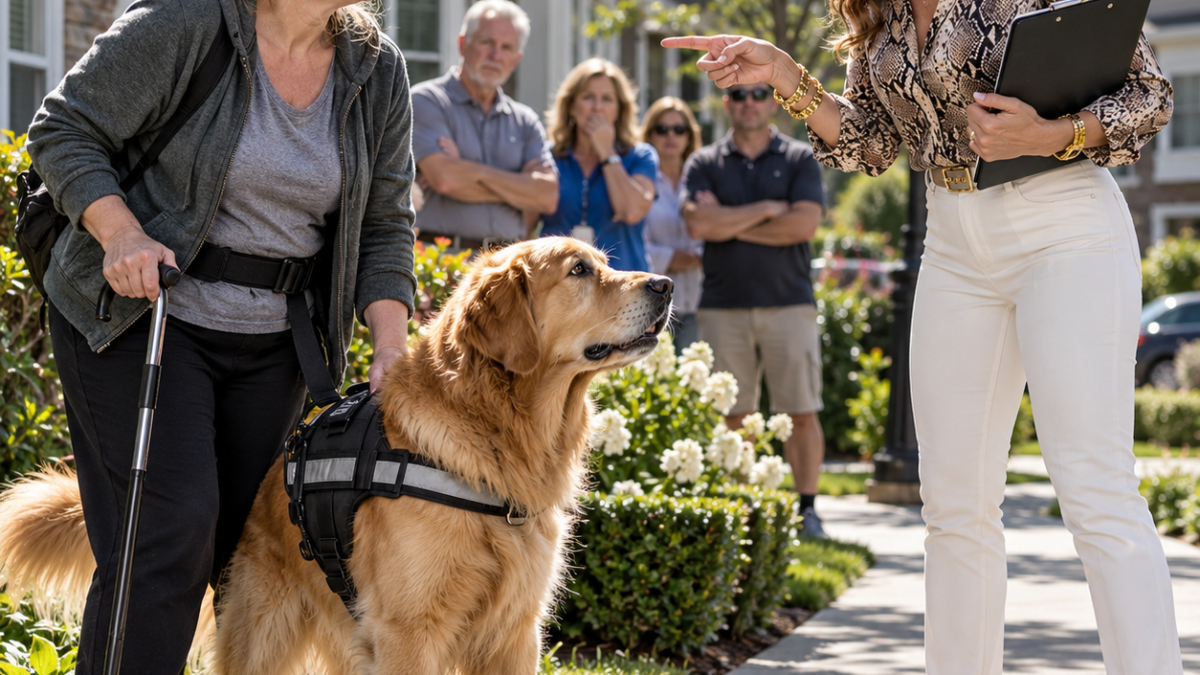
She was beautiful in the kind of polished suburban way that made people look twice before they knew better—long caramel-brown hair blown into soft waves, bright lipstick, fitted designer blouses, slim white pants, gold bracelets, and heels clicking across sidewalks that were never meant for heels. She had a curvy, graceful figure, perfect nails, and a smile so practiced it could pass for warmth if you did not notice how quickly it disappeared when someone disagreed with her.
Karen worked from home, or at least that was what people said.
From what I saw, her real job was inspecting everyone else’s life.
Within two months of joining the HOA board, she became impossible to miss. She walked the neighborhood with a clipboard tucked against her chest, measuring grass with a little folding ruler. She photographed trash cans left out an hour too long. She complained about garden beds being “visually chaotic.” She sent reminders about acceptable patio furniture colors, wind chime volume, porch decorations, and the emotional threat of visible garden hoses.
People laughed at first.
Then the fines started.
Karen did not want community.
She wanted control.
My lawn and garden gave her nothing to attack because I paid a service to maintain them. The workers came every Tuesday morning, trimmed everything neatly, cleaned up, and left before Karen could even build a complaint around them.
So she found another target.
Samson.
At first, it was just looks.
I would pass Karen’s house with Samson walking calmly at my side, and she would stand near her front steps, arms crossed, watching us like we were dragging mud across white carpet. If Samson paused at a corner or turned his head toward a squirrel, her mouth would tighten. If a neighbor smiled at him, Karen’s eyes narrowed.
One morning, while Samson and I were walking near the common garden path, she stepped out from behind a hedge as if she had been waiting.
“Excuse me,” she said.
I stopped.
Samson stopped too, instantly, shoulder aligned with my leg.
Karen looked him over with open disgust.
“That dog is very large.”
“Yes,” I said. “He’s a golden retriever.”
“He makes some residents uncomfortable.”
I looked around. The only other person nearby was Mr. Lewis, who was watering flowers and waving at Samson.
“Who?”
“I don’t disclose complainants.”
“Of course.”
Her smile sharpened.
“Dogs can be unpredictable.”
“Samson is a trained service animal.”
“I’ve heard people call all kinds of animals service animals these days.”
There it was.
Not curiosity.
Accusation.
I kept my voice calm. Stress could trigger symptoms, and Karen seemed like the kind of woman who would enjoy watching me struggle.
“He is not an emotional support animal. He is not a pet in a vest. He is trained to assist me with my medical condition.”
Her eyes flicked down my body, quick and invasive.
“You don’t look disabled.”
It was not the first time someone had said that to me.
It still landed like a slap.
“Not all disabilities are visible.”
Karen gave a soft laugh.
“How convenient.”
Samson shifted slightly, pressing against my leg, grounding me.
I took one slow breath.
“Have a good morning, Karen.”
I moved past her.
She called after me, “This will have to be reviewed.”
I did not turn around.
I should have known she meant it.
The letter arrived two weeks later.
It sat in my mailbox in a white envelope with the HOA logo in the corner. I opened it at my kitchen table with Samson lying beside my chair, his head resting on his paws.
The first line made my hands go cold.
On behalf of the HOA, you are hereby given ten days to remove your animal from the premises.
Not dog.
Not service animal.
Animal.
The letter said Samson was a menace to the community. It claimed he barked intolerably, left messes in common areas, and posed a threat to public safety. It said that if I failed to comply, I would be fined, and the Humane Society would be contacted to remove him. Until then, Samson was banned from all sidewalks, common areas, walking paths, and any place residents gathered.
It was signed by Karen Whitmore, HOA Board Member.
I read it three times.
Samson had never attacked anyone.
Samson almost never barked.
Samson relieved himself in a corner of my yard whenever possible, and when he could not, I cleaned up after him immediately. I carried bags, tools, wipes—everything. I was more careful than most pet owners because I knew people like Karen waited for excuses.
Still, she had invented one.
No.
She had invented several.
I sat there for a long time, the letter trembling slightly in my hand.
Then Samson lifted his head and placed his chin on my knee.
That broke me.
Not because I was afraid of losing a pet.
Because Karen was trying to take away my independence.
She was trying to turn my medical support into a neighborhood nuisance, my disability into an inconvenience, my body into something the HOA could vote on.
I cried quietly, one hand on Samson’s head.
Then I wiped my face, opened my laptop, and started writing.
My first response was polite.
Too polite, honestly.
I wrote to the board explaining that Samson was a trained service animal, not a companion pet. I described the tasks he performed for me. I stated that his vest was not decorative, that he had been certified after extensive training, and that I had medical documentation supporting my need for him.
I cited the Americans with Disabilities Act.
I cited the Fair Housing Act.
I requested immediate withdrawal of the ban.
I asked for a meeting if they believed there had been a misunderstanding.
Part of me still thought reason would matter.
The HOA scheduled a hearing.
I left Samson at home that evening because I wanted to show good faith. It was a mistake emotionally, though not legally. Walking into that clubhouse without him felt like walking into court without my cane, my balance, or my courage.
The meeting room smelled like burnt coffee and lemon cleaner. Five board members sat behind a folding table. Karen sat near the center in a fitted navy dress, pearl earrings, and a white blazer draped over her shoulders like she was starring in her own trial. The HOA president, a gray-haired man named Richard, looked uncomfortable before I even sat down.
Karen looked satisfied.
“Thank you for attending,” Richard said.
I nodded, hands folded tightly in my lap.
“I’m here about the letter banning Samson.”
Karen leaned forward.
“The animal.”
“His name is Samson. He is my service dog.”
Richard cleared his throat.
“We understand that is your position.”
My position.
As if this were a disagreement about paint color.
“It is not a position,” I said. “It is a fact.”
Karen smiled.
“Then why isn’t he here?”
“Because I was trying to avoid escalating the situation.”
“How convenient,” she said.
A younger board member shifted uncomfortably.
I looked directly at Richard.
“Legally, he could be here. He is allowed in common areas because he assists me with a disability. You cannot ban him from sidewalks or shared spaces simply because a board member dislikes animals.”
Karen’s smile vanished.
“I don’t dislike animals,” she said. “I dislike dangerous situations.”
“Samson is not dangerous.”
“We have received reports.”
“From whom?”
Karen tapped her pen against her notepad.
“Residents have concerns.”
“Are there written complaints?”
“People are afraid to come forward.”
“That is convenient,” I said quietly.
Her eyes flashed.
Richard lifted a hand.
“Let’s keep this civil.”
I pulled out a folder.
“I brought medical documentation from my doctor and information about service animal protections under federal law.”
Karen barely glanced at it.
“Does he wear a muzzle?”
“No.”
“Why not?”
“Because he uses his mouth to perform tasks. He retrieves items for me.”
Her eyebrows lifted dramatically.
“So he can be off-leash?”
“He works on a harness when we walk. In certain controlled situations, if I fall or need assistance, I may need to release him to retrieve an item.”
Karen turned to the other board members as if I had confessed to releasing wolves.
“We cannot allow a large dog to run freely around the neighborhood.”
“That is not what happens.”
“I have heard him growl.”
I stared at her.
“When?”
“At an adult.”
“Who?”
“I don’t have to disclose that.”
“Because it didn’t happen.”
Karen’s face flushed.
Richard looked at me.
“Would you be willing to limit Samson’s presence in common areas while we review the legal questions?”
“No.”
The word surprised even me.
But once it was out, I felt stronger.
“No,” I repeated. “I will not limit my medical assistance because Karen invented complaints.”
Karen slammed her pen down.
“How dare you?”
“How dare you try to separate me from my service dog?”
The room went still.
For a second, I saw something like doubt cross Richard’s face.
Then Karen leaned toward him and began speaking softly, urgently, using words like liability, attack, children, insurance, safety, precedent. She did not have evidence, but she had fear, and fear spreads faster in boardrooms than facts.
They asked me to wait outside while they discussed.
I sat in the hallway, hands shaking, legs aching, wishing Samson were there.
Fifteen minutes later, they called me back in.
Richard could not meet my eyes.
“The board has voted to uphold the temporary ban pending further review.”
Temporary.
Ban.
Those words blurred for a moment.
Karen looked at me with triumph tucked behind a sympathetic expression.
“This is for the community’s safety,” she said.
I stood slowly.
“No,” I said. “It’s for your ego.”
Then I walked out before my legs could betray me in front of her.
By the time I got home, fatigue had settled into my bones like wet cement.
Samson met me at the door, tail low, sensing distress before I said anything. He pressed against my side, steady and warm, and helped me make it to the couch.
For three days, I barely left the house.
Not because the ban was legal.
Because stress makes MS worse, and Karen’s little crusade had triggered symptoms I had worked hard to manage. My legs felt unreliable. My hands tingled. My vision blurred at the edges when I got too tired. Every time I thought about walking Samson and having some board member photograph us, fine me, or call animal control, my chest tightened.
That was when fear turned into anger.
Not loud anger.
Focused anger.
I called a disability rights attorney named Marissa Lane.
I expected her to be sympathetic.
I did not expect her to be furious.
After I emailed the letter, my response, the hearing notice, and the board’s decision, she called me back within an hour.
“They put this in writing?” she asked.
“Yes.”
“They banned a documented service animal from common areas and sidewalks?”
“Yes.”
“After you gave them notice of your disability-related need?”
“Yes.”
There was a pause.
Then Marissa said, “Good.”
I blinked.
“Good?”
“Good for evidence. Bad for them.”
For the first time in weeks, I smiled.
Marissa was calm, but there was steel underneath every word. She explained that the HOA had exposed itself to serious legal consequences under disability and housing laws. She told me they could not treat Samson like an ordinary pet, could not ban him based on vague fear, could not demand removal without evidence of direct threat, and absolutely could not retaliate against me for asserting my rights.
Then she wrote the demand letter.
It was not emotional.
It was worse.
It was precise.
It identified every legal violation. It included citations to the ADA and Fair Housing Act. It referenced my medical documentation, Samson’s training, the absence of evidence that he had ever harmed anyone, and the board’s refusal to reasonably accommodate a disabled resident.
Then it explained potential damages.
Civil penalties.
Compensatory damages.
Attorney’s fees.
Possible personal liability for board members who knowingly voted for an unlawful ban after receiving documentation.
That phrase did the work.
Personal liability.
Marissa demanded immediate rescission of the ban, written confirmation that Samson could access all areas where I was permitted, a formal apology, removal of all fines or threatened penalties, mandatory board training on disability rights and housing law, and a written policy preventing future discrimination against residents with service animals.
The letter was delivered on a Monday.
The emergency meeting notice went out Tuesday morning.
Every HOA member was told attendance was strongly encouraged due to “urgent legal exposure.”
I did not attend that first emergency meeting.
Marissa advised me not to. She attended by phone.
But I heard about it afterward from Mrs. Alvarez, who lived two doors down and had always loved Samson from a respectful distance.
Apparently, the mood was panic.
Richard opened the meeting pale and sweating. Karen arrived in a red dress, heels, and a face full of confidence, but that confidence lasted only until the HOA’s attorney began speaking.
He explained, in very careful language, that the board had acted without adequate investigation, without legal review, and despite clear notice that Samson was a service animal. He explained that fear of a large dog was not enough. Vague claims of growling were not enough. Aesthetic preference was not enough. Personal dislike of animals was not enough.
Then he explained financial exposure.
People stopped whispering.
Then he explained personal exposure.
People stopped breathing.
Karen tried to interrupt.
Mrs. Alvarez told me she stood up and said, “But we cannot be expected to allow dangerous animals.”
The attorney asked, “Do you have documented evidence that this service animal has bitten, attacked, or directly threatened anyone?”
Karen said residents had complained.
“Written complaints?”
Karen said people were afraid.
“Names?”
Karen said that was confidential.
“Incident reports?”
None.
“Animal control records?”
None.
“Veterinary or behavioral evaluations?”
None.
The attorney reportedly stared at her for a long moment.
Then he said, “So the board upheld a service animal ban based on undocumented hearsay.”
Karen sat down.
The vote to overturn the ban was unanimous.
Even Karen voted yes once she realized the room had turned.
The written apology arrived the next day.
It was formal, stiff, and clearly lawyer-approved, but it was still an apology. The board acknowledged acting hastily, failing to gather proper facts, failing to consider the legal protections applicable to service animals, and causing unnecessary distress.
More importantly, the letter stated clearly that Samson was permitted anywhere in the neighborhood that I was permitted to go.
Sidewalks.
Common areas.
Clubhouse.
Walking paths.
Gardens.
Everywhere.
I read the letter twice while Samson sat beside me.
Then I clipped on his vest and harness.
We went for a walk.
It was a short walk because my body was still recovering from the stress. But it felt like crossing a border back into my own life.
Samson moved slowly beside me, matching my pace the way he always did. Neighbors came outside. Some waved. Some looked embarrassed. Mrs. Alvarez stood on her porch and pressed both hands over her heart when she saw us.
Karen watched from her window.
I saw the curtain move.
I kept walking.
The next month, the HOA board announced Karen had resigned from the committee.
That was the polite version.
The real version, according to Mrs. Alvarez, was that the board asked her to step down after discovering she had exaggerated or invented complaints about Samson. Several residents denied ever saying what Karen claimed they had said. One neighbor admitted Karen had pushed her to say she felt unsafe, even though she had never interacted with Samson. Another said Karen kept referring to Samson as “that animal” and insisted dogs made the neighborhood look “less upscale.”
Less upscale.
That was what my independence looked like to her.
A stain on curb appeal.
After Karen was removed, Richard came to my house.
He stood on the porch holding his hat in both hands, looking older than he had at the hearing.
“I owe you a personal apology,” he said.
I did not invite him in.
But I listened.
“We should have done our homework,” he continued. “We let fear and pressure guide us. That was wrong.”
“Yes,” I said. “It was.”
He swallowed.
“I’m sorry.”
I looked down at Samson, who sat calmly at my side, then back at Richard.
“I accept your apology. But I need you to understand something. This was not just stressful. It made me sick.”
His face tightened.
“My symptoms worsened. I stopped using common areas. I shortened walks. I felt like I had to choose between protecting myself from the HOA and using the dog who helps me live independently.”
“I understand.”
“No,” I said gently. “You don’t. But I hope you try.”
He nodded.
Then he surprised me.
“We’d like to ask if you would consider joining the board.”
I almost laughed.
“After all this?”
“Especially after all this. We need someone who understands these issues.”
I looked at him for a long moment.
Part of me wanted to say absolutely not. I did not want more meetings, more policies, more neighborhood drama. I wanted Samson, quiet walks, my backyard, and days where my illness did not have to become a public debate.
But then I thought about the next person.
The next disabled resident.
The next service dog.
The next person who might not have the energy, knowledge, money, or family support to fight back.
“I can’t promise perfect attendance,” I said. “My condition is unpredictable.”
“We understand.”
“There will be days I can barely manage work and basic life.”
“We understand.”
“And if I join, I’m not there to make everyone comfortable. I’m there to make sure this never happens again.”
Richard nodded.
“That is exactly why we’re asking.”
So I said yes.
Karen did not take that well.
For several weeks, she avoided me. Then one morning, I found her near the mailboxes, dressed in a white blouse and pale blue slacks, sunglasses covering half her face though the sky was cloudy.
Samson and I approached slowly.
Her mouth tightened.
I thought she might stay silent.
She did not.
“I hope you’re enjoying your little victory,” she said.
I stopped.
Samson stopped with me.
“This was never about victory.”
“Please. You humiliated me.”
“You did that yourself.”
Her lips pressed together.
“You have no idea how disruptive that dog is.”
“He has never disrupted anything except your sense of control.”
She took off her sunglasses.
Her eyes were sharp and angry.
“You think because you have paperwork and a diagnosis, everyone has to bend around you.”
There it was.
The truth underneath all her safety language.
I felt Samson’s steady warmth beside my leg.
“No, Karen,” I said. “I think because I have a disability, the law says I still get to live in my home, walk through my neighborhood, and use the help I need without being harassed by someone who thinks aesthetics matter more than people.”
Her face flushed.
“You always play the victim.”
“I am not a victim.”
I looked down at Samson.
“I’m a woman with a service dog. That should never have threatened you.”
For once, Karen had no answer.
She put her sunglasses back on and walked away.
That moment stayed with me.
Not because I won the exchange.
Because I finally understood her.
Karen was not afraid of Samson. Not really. She was afraid of anything that reminded her the world did not arrange itself around her preferences. My illness made her uncomfortable. Samson made that illness visible. He turned my private struggle into something she had to walk past every day.
So she tried to remove him.
Not for safety.
For comfort.
Her comfort.
That is what people like Karen often call “community standards.”
Over the following months, the board completed disability rights training. Policies were rewritten. Complaint procedures changed. No animal-related enforcement could move forward without documented evidence and legal review when assistance animals were involved. The board learned the difference between pets, emotional support animals, and trained service animals. They learned what questions they could and could not ask. They learned that personal feelings were not legal standards.
I attended as many meetings as my health allowed.
Sometimes Samson came with me and lay quietly beside my chair while board members discussed budgets, landscaping, roof repairs, and the endless suburban theater of parking rules. At first, people were awkward around him. Too polite. Too careful. Then, slowly, he became ordinary again.
That was what I wanted.
Not attention.
Not pity.
Ordinary.
My life with Samson returned to its rhythm.
Morning walks when my legs allowed it. Slow afternoons in the backyard listening to birds. Evenings when he fetched my phone before I realized I had left it too far away. Bad days when he braced while I stood. Worse days when he stayed beside the couch, warm and patient, reminding me I was not alone inside a body that sometimes felt like a locked room.
My children noticed the change too.
My daughter came over one Sunday with groceries and found me in the garden while Samson rested in the shade.
“You look better,” she said.
“I feel safer.”
Her face softened.
“I hated that they did that to you.”
“Me too.”
“Are you glad you fought?”
I watched Samson lift his head at the sound of a squirrel moving along the fence.
“Yes,” I said. “But I wish I hadn’t had to.”
That is the part people forget when they celebrate standing up for yourself.
Winning does not erase the exhaustion of having been forced to fight.
Karen lost her board seat. The HOA apologized. Samson was protected. I gained a voice in decisions that might affect someone like me in the future.
But I still lost weeks of peace.
I lost trust in neighbors who should have asked questions before believing the worst. I lost energy my body could not easily replace. I lost the illusion that people would see a service vest and automatically understand dignity, law, and need.
Still, I gained something too.
I gained the knowledge that I could defend my life without apologizing for needing help.
Before all this, I sometimes felt embarrassed when Samson assisted me in public. Not because of him. Never because of him. Because needing help in front of others can make you feel exposed. Every brace, every retrieved item, every slow step becomes a small announcement that your body has limits.
Karen tried to turn that exposure into shame.
She failed.
Now, when Samson and I walk through the neighborhood, I do not lower my eyes. I do not shorten the route past Karen’s house. I do not rush through common areas as if I am borrowing space.
I belong there.
So does he.
One afternoon, months after everything settled, a little girl named Mia stopped with her mother near the walking path. Mia was maybe six, with pigtails and a serious expression.
“Is he working?” she asked.
Her mother looked nervous.
I smiled.
“Yes, he is.”
“So I can’t pet him?”
“Not while he’s working.”
Mia nodded solemnly.
“What’s his job?”
I looked at Samson, standing calmly beside me.
“He helps me when my body has trouble doing what I need it to do.”
She thought about that.
Then she said, “That’s a good job.”
I felt my throat tighten.
“Yes,” I said. “It is.”
She waved at Samson without touching him.
“Good job,” she whispered.
Samson, perfect professional that he was, did not move.
But his tail gave one soft thump.
That is the neighborhood I want.
Not perfect lawns.
Not matching porch lights.
Not a place where one woman with a clipboard can decide compassion violates the aesthetic.
A real community is not measured by grass height or fence color. It is measured by whether people make room for one another to live with dignity.
Karen never understood that.
She thought the HOA gave her power over everyone else’s comfort, bodies, homes, and choices. She thought if something bothered her, she could call it dangerous. She thought if she put enough fear into the right people, they would turn her preference into policy.
For a moment, they did.
Then the law reminded them that disabled people do not lose rights because a board member dislikes the shape of their accommodation.
Samson is sleeping beside me as I write this, his golden head resting on his paws, his vest hanging by the door for tomorrow.
Tomorrow we will walk the same sidewalks Karen tried to ban him from.
We will pass the clubhouse where the board voted against us, and the meeting room where they later reversed themselves in panic. We will pass the mailboxes where Karen told me I played the victim. We will pass neighbors who wave, some with warmth, some with guilt, some with the careful politeness of people who learned something the hard way.
And Samson will not care about any of it.
He will walk beside me, steady and calm, doing what he was trained to do.
Helping me move through the world.
Karen wanted him gone because she thought he made the neighborhood look less perfect.
But perfection was never what I needed.
I needed balance.
I needed independence.
I needed the right to exist outside my front door without someone turning my medical needs into a violation notice.
And thanks to one very good dog, one very sharp lawyer, and one board that finally realized fear was about to become expensive, I got all of that back.
Karen measured lawns.
She measured fences.
She measured appearances.
But she never measured the cost of trying to take away someone’s service dog.
By the time she did, it was already too late.
𝗧𝗛𝗘 𝗘𝗡𝗗
Karen Tried to Ban My Service Dog From the Neighborhood Until the Law Came for Her Instead
Karen looked at my golden retriever like he was a stain on her perfect neighborhood.
She thought a clipboard, a fake safety complaint, and a few frightened board members could take away the one creature who helped me stand.
But Samson was not just my dog, and by the time Karen understood that, she had already put the entire HOA in legal danger.
The first time Samson helped me off the floor, I cried into his fur.
I wish I could say it was one of those beautiful movie moments where sunlight came through the window and music swelled and I realized everything would be okay. It was not like that. It was ugly. Humiliating. Painful in the quiet way that makes a person feel smaller inside her own body.
I had dropped a glass in the kitchen.
That was all.
My hand had gone numb, the glass had slipped, and suddenly there were shards across the tile. I stepped back too quickly, my leg failed me, and I went down hard enough to knock the breath out of myself. For a minute, I just lay there, staring at the ceiling fan while my heart hammered and my pride bled out faster than anything else.
Multiple sclerosis teaches you many things you never wanted to learn.
It teaches you that independence is not one big thing you lose all at once. It disappears in pieces. A missed step. A hand that will not grip. A day when your legs feel like someone else’s badly wired machinery. A morning when getting dressed costs so much energy that the rest of the day becomes a negotiation.
Before Samson, I hated asking for help.
I hated calling my adult children when they were working, living, trying to build their own lives. I hated the pause in their voices when I said, “I’m okay, but…” I hated knowing that they loved me enough to come and that I hated myself for needing them to.
Then Samson came into my life.
He was a golden retriever, large, gentle, and beautiful, with warm brown eyes that seemed to understand more than most people bothered to hear. But he was not simply a sweet dog. He was trained. Certified. Matched to my needs after long conversations with my doctor, my therapist, and the service organization that helped us become a team.
He learned how to brace when I needed balance. He learned how to fetch specific items from specific places: my phone from the side table, my medicine pouch from the basket by the couch, a dropped cane, a water bottle from the lower shelf of the refrigerator. He learned when to stay close and when to give me space. He learned my rhythms, my bad days, the tiny changes in my breathing when fatigue turned dangerous.
I learned too.
I learned how to work with him. How to give clear commands. How to trust his body beside mine. How to stop seeing help as failure.
For three years, Samson gave me back pieces of myself I thought MS had taken forever.
Most of my neighbors understood.
They knew not to pet him when he wore his vest. They knew not to call him over, offer treats, whistle at him, or distract him while he was working. Some asked polite questions. Some simply smiled from their porches as we took our regular walks through the neighborhood. Children were curious, but their parents explained, and Samson passed by with his calm golden dignity like a small king on official business.
Our complex did not have many animals.
A couple down the street had a toy poodle small enough to fit in a purse, but they traveled most of the year. A few people had indoor cats. One man had a budgie whose cage he rolled near the window on sunny afternoons. Samson was the only dog most people saw every day, and for a long time, that was not a problem.
Then Karen Whitmore moved in.
PART 2
Karen was around forty, maybe a little older, though she carried herself like a woman who considered aging a personal insult.
She was beautiful in the kind of polished suburban way that made people look twice before they knew better—long caramel-brown hair blown into soft waves, bright lipstick, fitted designer blouses, slim white pants, gold bracelets, and heels clicking across sidewalks that were never meant for heels. She had a curvy, graceful figure, perfect nails, and a smile so practiced it could pass for warmth if you did not notice how quickly it disappeared when someone disagreed with her.
Karen worked from home, or at least that was what people said.
From what I saw, her real job was inspecting everyone else’s life.
Within two months of joining the HOA board, she became impossible to miss. She walked the neighborhood with a clipboard tucked against her chest, measuring grass with a little folding ruler. She photographed trash cans left out an hour too long. She complained about garden beds being “visually chaotic.” She sent reminders about acceptable patio furniture colors, wind chime volume, porch decorations, and the emotional threat of visible garden hoses.
People laughed at first.
Then the fines started.
Karen did not want community.
She wanted control.
My lawn and garden gave her nothing to attack because I paid a service to maintain them. The workers came every Tuesday morning, trimmed everything neatly, cleaned up, and left before Karen could even build a complaint around them.
So she found another target.
Samson.
At first, it was just looks.
I would pass Karen’s house with Samson walking calmly at my side, and she would stand near her front steps, arms crossed, watching us like we were dragging mud across white carpet. If Samson paused at a corner or turned his head toward a squirrel, her mouth would tighten. If a neighbor smiled at him, Karen’s eyes narrowed.
One morning, while Samson and I were walking near the common garden path, she stepped out from behind a hedge as if she had been waiting.
“Excuse me,” she said.
I stopped.
Samson stopped too, instantly, shoulder aligned with my leg.
Karen looked him over with open disgust.
“That dog is very large.”
“Yes,” I said. “He’s a golden retriever.”
“He makes some residents uncomfortable.”
I looked around. The only other person nearby was Mr. Lewis, who was watering flowers and waving at Samson.
“Who?”
“I don’t disclose complainants.”
“Of course.”
Her smile sharpened.
“Dogs can be unpredictable.”
“Samson is a trained service animal.”
“I’ve heard people call all kinds of animals service animals these days.”
There it was.
Not curiosity.
Accusation.
I kept my voice calm. Stress could trigger symptoms, and Karen seemed like the kind of woman who would enjoy watching me struggle.
“He is not an emotional support animal. He is not a pet in a vest. He is trained to assist me with my medical condition.”
Her eyes flicked down my body, quick and invasive.
“You don’t look disabled.”
It was not the first time someone had said that to me.
It still landed like a slap.
“Not all disabilities are visible.”
Karen gave a soft laugh.
“How convenient.”
Samson shifted slightly, pressing against my leg, grounding me.
I took one slow breath.
“Have a good morning, Karen.”
I moved past her.
She called after me, “This will have to be reviewed.”
I did not turn around.
I should have known she meant it.
The letter arrived two weeks later.
It sat in my mailbox in a white envelope with the HOA logo in the corner. I opened it at my kitchen table with Samson lying beside my chair, his head resting on his paws.
The first line made my hands go cold.
On behalf of the HOA, you are hereby given ten days to remove your animal from the premises.
Not dog.
Not service animal.
Animal.
The letter said Samson was a menace to the community. It claimed he barked intolerably, left messes in common areas, and posed a threat to public safety. It said that if I failed to comply, I would be fined, and the Humane Society would be contacted to remove him. Until then, Samson was banned from all sidewalks, common areas, walking paths, and any place residents gathered.
It was signed by Karen Whitmore, HOA Board Member.
I read it three times.
Samson had never attacked anyone.
Samson almost never barked.
Samson relieved himself in a corner of my yard whenever possible, and when he could not, I cleaned up after him immediately. I carried bags, tools, wipes—everything. I was more careful than most pet owners because I knew people like Karen waited for excuses.
Still, she had invented one.
No.
She had invented several.
I sat there for a long time, the letter trembling slightly in my hand.
Then Samson lifted his head and placed his chin on my knee.
That broke me.
Not because I was afraid of losing a pet.
Because Karen was trying to take away my independence.
She was trying to turn my medical support into a neighborhood nuisance, my disability into an inconvenience, my body into something the HOA could vote on.
I cried quietly, one hand on Samson’s head.
Then I wiped my face, opened my laptop, and started writing.
My first response was polite.
Too polite, honestly.
I wrote to the board explaining that Samson was a trained service animal, not a companion pet. I described the tasks he performed for me. I stated that his vest was not decorative, that he had been certified after extensive training, and that I had medical documentation supporting my need for him.
I cited the Americans with Disabilities Act.
I cited the Fair Housing Act.
I requested immediate withdrawal of the ban.
I asked for a meeting if they believed there had been a misunderstanding.
Part of me still thought reason would matter.
The HOA scheduled a hearing.
I left Samson at home that evening because I wanted to show good faith. It was a mistake emotionally, though not legally. Walking into that clubhouse without him felt like walking into court without my cane, my balance, or my courage.
The meeting room smelled like burnt coffee and lemon cleaner. Five board members sat behind a folding table. Karen sat near the center in a fitted navy dress, pearl earrings, and a white blazer draped over her shoulders like she was starring in her own trial. The HOA president, a gray-haired man named Richard, looked uncomfortable before I even sat down.
Karen looked satisfied.
“Thank you for attending,” Richard said.
I nodded, hands folded tightly in my lap.
“I’m here about the letter banning Samson.”
Karen leaned forward.
“The animal.”
“His name is Samson. He is my service dog.”
Richard cleared his throat.
“We understand that is your position.”
My position.
As if this were a disagreement about paint color.
“It is not a position,” I said. “It is a fact.”
Karen smiled.
“Then why isn’t he here?”
“Because I was trying to avoid escalating the situation.”
“How convenient,” she said.
A younger board member shifted uncomfortably.
I looked directly at Richard.
“Legally, he could be here. He is allowed in common areas because he assists me with a disability. You cannot ban him from sidewalks or shared spaces simply because a board member dislikes animals.”
Karen’s smile vanished.
“I don’t dislike animals,” she said. “I dislike dangerous situations.”
“Samson is not dangerous.”
“We have received reports.”
“From whom?”
Karen tapped her pen against her notepad.
“Residents have concerns.”
“Are there written complaints?”
“People are afraid to come forward.”
“That is convenient,” I said quietly.
Her eyes flashed.
Richard lifted a hand.
“Let’s keep this civil.”
I pulled out a folder.
“I brought medical documentation from my doctor and information about service animal protections under federal law.”
Karen barely glanced at it.
“Does he wear a muzzle?”
“No.”
“Why not?”
“Because he uses his mouth to perform tasks. He retrieves items for me.”
Her eyebrows lifted dramatically.
“So he can be off-leash?”
“He works on a harness when we walk. In certain controlled situations, if I fall or need assistance, I may need to release him to retrieve an item.”
Karen turned to the other board members as if I had confessed to releasing wolves.
“We cannot allow a large dog to run freely around the neighborhood.”
“That is not what happens.”
“I have heard him growl.”
I stared at her.
“When?”
“At an adult.”
“Who?”
“I don’t have to disclose that.”
“Because it didn’t happen.”
Karen’s face flushed.
Richard looked at me.
“Would you be willing to limit Samson’s presence in common areas while we review the legal questions?”
“No.”
The word surprised even me.
But once it was out, I felt stronger.
“No,” I repeated. “I will not limit my medical assistance because Karen invented complaints.”
Karen slammed her pen down.
“How dare you?”
“How dare you try to separate me from my service dog?”
The room went still.
For a second, I saw something like doubt cross Richard’s face.
Then Karen leaned toward him and began speaking softly, urgently, using words like liability, attack, children, insurance, safety, precedent. She did not have evidence, but she had fear, and fear spreads faster in boardrooms than facts.
They asked me to wait outside while they discussed.
I sat in the hallway, hands shaking, legs aching, wishing Samson were there.
Fifteen minutes later, they called me back in.
Richard could not meet my eyes.
“The board has voted to uphold the temporary ban pending further review.”
Temporary.
Ban.
Those words blurred for a moment.
Karen looked at me with triumph tucked behind a sympathetic expression.
“This is for the community’s safety,” she said.
I stood slowly.
“No,” I said. “It’s for your ego.”
Then I walked out before my legs could betray me in front of her.
By the time I got home, fatigue had settled into my bones like wet cement.
Samson met me at the door, tail low, sensing distress before I said anything. He pressed against my side, steady and warm, and helped me make it to the couch.
For three days, I barely left the house.
Not because the ban was legal.
Because stress makes MS worse, and Karen’s little crusade had triggered symptoms I had worked hard to manage. My legs felt unreliable. My hands tingled. My vision blurred at the edges when I got too tired. Every time I thought about walking Samson and having some board member photograph us, fine me, or call animal control, my chest tightened.
That was when fear turned into anger.
Not loud anger.
Focused anger.
I called a disability rights attorney named Marissa Lane.
I expected her to be sympathetic.
I did not expect her to be furious.
After I emailed the letter, my response, the hearing notice, and the board’s decision, she called me back within an hour.
“They put this in writing?” she asked.
“Yes.”
“They banned a documented service animal from common areas and sidewalks?”
“Yes.”
“After you gave them notice of your disability-related need?”
“Yes.”
There was a pause.
Then Marissa said, “Good.”
I blinked.
“Good?”
“Good for evidence. Bad for them.”
For the first time in weeks, I smiled.
Marissa was calm, but there was steel underneath every word. She explained that the HOA had exposed itself to serious legal consequences under disability and housing laws. She told me they could not treat Samson like an ordinary pet, could not ban him based on vague fear, could not demand removal without evidence of direct threat, and absolutely could not retaliate against me for asserting my rights.
Then she wrote the demand letter.
It was not emotional.
It was worse.
It was precise.
It identified every legal violation. It included citations to the ADA and Fair Housing Act. It referenced my medical documentation, Samson’s training, the absence of evidence that he had ever harmed anyone, and the board’s refusal to reasonably accommodate a disabled resident.
Then it explained potential damages.
Civil penalties.
Compensatory damages.
Attorney’s fees.
Possible personal liability for board members who knowingly voted for an unlawful ban after receiving documentation.
That phrase did the work.
Personal liability.
Marissa demanded immediate rescission of the ban, written confirmation that Samson could access all areas where I was permitted, a formal apology, removal of all fines or threatened penalties, mandatory board training on disability rights and housing law, and a written policy preventing future discrimination against residents with service animals.
The letter was delivered on a Monday.
The emergency meeting notice went out Tuesday morning.
Every HOA member was told attendance was strongly encouraged due to “urgent legal exposure.”
I did not attend that first emergency meeting.
Marissa advised me not to. She attended by phone.
But I heard about it afterward from Mrs. Alvarez, who lived two doors down and had always loved Samson from a respectful distance.
Apparently, the mood was panic.
Richard opened the meeting pale and sweating. Karen arrived in a red dress, heels, and a face full of confidence, but that confidence lasted only until the HOA’s attorney began speaking.
He explained, in very careful language, that the board had acted without adequate investigation, without legal review, and despite clear notice that Samson was a service animal. He explained that fear of a large dog was not enough. Vague claims of growling were not enough. Aesthetic preference was not enough. Personal dislike of animals was not enough.
Then he explained financial exposure.
People stopped whispering.
Then he explained personal exposure.
People stopped breathing.
Karen tried to interrupt.
Mrs. Alvarez told me she stood up and said, “But we cannot be expected to allow dangerous animals.”
The attorney asked, “Do you have documented evidence that this service animal has bitten, attacked, or directly threatened anyone?”
Karen said residents had complained.
“Written complaints?”
Karen said people were afraid.
“Names?”
Karen said that was confidential.
“Incident reports?”
None.
“Animal control records?”
None.
“Veterinary or behavioral evaluations?”
None.
The attorney reportedly stared at her for a long moment.
Then he said, “So the board upheld a service animal ban based on undocumented hearsay.”
Karen sat down.
The vote to overturn the ban was unanimous.
Even Karen voted yes once she realized the room had turned.
The written apology arrived the next day.
It was formal, stiff, and clearly lawyer-approved, but it was still an apology. The board acknowledged acting hastily, failing to gather proper facts, failing to consider the legal protections applicable to service animals, and causing unnecessary distress.
More importantly, the letter stated clearly that Samson was permitted anywhere in the neighborhood that I was permitted to go.
Sidewalks.
Common areas.
Clubhouse.
Walking paths.
Gardens.
Everywhere.
I read the letter twice while Samson sat beside me.
Then I clipped on his vest and harness.
We went for a walk.
It was a short walk because my body was still recovering from the stress. But it felt like crossing a border back into my own life.
Samson moved slowly beside me, matching my pace the way he always did. Neighbors came outside. Some waved. Some looked embarrassed. Mrs. Alvarez stood on her porch and pressed both hands over her heart when she saw us.
Karen watched from her window.
I saw the curtain move.
I kept walking.
The next month, the HOA board announced Karen had resigned from the committee.
That was the polite version.
The real version, according to Mrs. Alvarez, was that the board asked her to step down after discovering she had exaggerated or invented complaints about Samson. Several residents denied ever saying what Karen claimed they had said. One neighbor admitted Karen had pushed her to say she felt unsafe, even though she had never interacted with Samson. Another said Karen kept referring to Samson as “that animal” and insisted dogs made the neighborhood look “less upscale.”
Less upscale.
That was what my independence looked like to her.
A stain on curb appeal.
After Karen was removed, Richard came to my house.
He stood on the porch holding his hat in both hands, looking older than he had at the hearing.
“I owe you a personal apology,” he said.
I did not invite him in.
But I listened.
“We should have done our homework,” he continued. “We let fear and pressure guide us. That was wrong.”
“Yes,” I said. “It was.”
He swallowed.
“I’m sorry.”
I looked down at Samson, who sat calmly at my side, then back at Richard.
“I accept your apology. But I need you to understand something. This was not just stressful. It made me sick.”
His face tightened.
“My symptoms worsened. I stopped using common areas. I shortened walks. I felt like I had to choose between protecting myself from the HOA and using the dog who helps me live independently.”
“I understand.”
“No,” I said gently. “You don’t. But I hope you try.”
He nodded.
Then he surprised me.
“We’d like to ask if you would consider joining the board.”
I almost laughed.
“After all this?”
“Especially after all this. We need someone who understands these issues.”
I looked at him for a long moment.
Part of me wanted to say absolutely not. I did not want more meetings, more policies, more neighborhood drama. I wanted Samson, quiet walks, my backyard, and days where my illness did not have to become a public debate.
But then I thought about the next person.
The next disabled resident.
The next service dog.
The next person who might not have the energy, knowledge, money, or family support to fight back.
“I can’t promise perfect attendance,” I said. “My condition is unpredictable.”
“We understand.”
“There will be days I can barely manage work and basic life.”
“We understand.”
“And if I join, I’m not there to make everyone comfortable. I’m there to make sure this never happens again.”
Richard nodded.
“That is exactly why we’re asking.”
So I said yes.
Karen did not take that well.
For several weeks, she avoided me. Then one morning, I found her near the mailboxes, dressed in a white blouse and pale blue slacks, sunglasses covering half her face though the sky was cloudy.
Samson and I approached slowly.
Her mouth tightened.
I thought she might stay silent.
She did not.
“I hope you’re enjoying your little victory,” she said.
I stopped.
Samson stopped with me.
“This was never about victory.”
“Please. You humiliated me.”
“You did that yourself.”
Her lips pressed together.
“You have no idea how disruptive that dog is.”
“He has never disrupted anything except your sense of control.”
She took off her sunglasses.
Her eyes were sharp and angry.
“You think because you have paperwork and a diagnosis, everyone has to bend around you.”
There it was.
The truth underneath all her safety language.
I felt Samson’s steady warmth beside my leg.
“No, Karen,” I said. “I think because I have a disability, the law says I still get to live in my home, walk through my neighborhood, and use the help I need without being harassed by someone who thinks aesthetics matter more than people.”
Her face flushed.
“You always play the victim.”
“I am not a victim.”
I looked down at Samson.
“I’m a woman with a service dog. That should never have threatened you.”
For once, Karen had no answer.
She put her sunglasses back on and walked away.
That moment stayed with me.
Not because I won the exchange.
Because I finally understood her.
Karen was not afraid of Samson. Not really. She was afraid of anything that reminded her the world did not arrange itself around her preferences. My illness made her uncomfortable. Samson made that illness visible. He turned my private struggle into something she had to walk past every day.
So she tried to remove him.
Not for safety.
For comfort.
Her comfort.
That is what people like Karen often call “community standards.”
Over the following months, the board completed disability rights training. Policies were rewritten. Complaint procedures changed. No animal-related enforcement could move forward without documented evidence and legal review when assistance animals were involved. The board learned the difference between pets, emotional support animals, and trained service animals. They learned what questions they could and could not ask. They learned that personal feelings were not legal standards.
I attended as many meetings as my health allowed.
Sometimes Samson came with me and lay quietly beside my chair while board members discussed budgets, landscaping, roof repairs, and the endless suburban theater of parking rules. At first, people were awkward around him. Too polite. Too careful. Then, slowly, he became ordinary again.
That was what I wanted.
Not attention.
Not pity.
Ordinary.
My life with Samson returned to its rhythm.
Morning walks when my legs allowed it. Slow afternoons in the backyard listening to birds. Evenings when he fetched my phone before I realized I had left it too far away. Bad days when he braced while I stood. Worse days when he stayed beside the couch, warm and patient, reminding me I was not alone inside a body that sometimes felt like a locked room.
My children noticed the change too.
My daughter came over one Sunday with groceries and found me in the garden while Samson rested in the shade.
“You look better,” she said.
“I feel safer.”
Her face softened.
“I hated that they did that to you.”
“Me too.”
“Are you glad you fought?”
I watched Samson lift his head at the sound of a squirrel moving along the fence.
“Yes,” I said. “But I wish I hadn’t had to.”
That is the part people forget when they celebrate standing up for yourself.
Winning does not erase the exhaustion of having been forced to fight.
Karen lost her board seat. The HOA apologized. Samson was protected. I gained a voice in decisions that might affect someone like me in the future.
But I still lost weeks of peace.
I lost trust in neighbors who should have asked questions before believing the worst. I lost energy my body could not easily replace. I lost the illusion that people would see a service vest and automatically understand dignity, law, and need.
Still, I gained something too.
I gained the knowledge that I could defend my life without apologizing for needing help.
Before all this, I sometimes felt embarrassed when Samson assisted me in public. Not because of him. Never because of him. Because needing help in front of others can make you feel exposed. Every brace, every retrieved item, every slow step becomes a small announcement that your body has limits.
Karen tried to turn that exposure into shame.
She failed.
Now, when Samson and I walk through the neighborhood, I do not lower my eyes. I do not shorten the route past Karen’s house. I do not rush through common areas as if I am borrowing space.
I belong there.
So does he.
One afternoon, months after everything settled, a little girl named Mia stopped with her mother near the walking path. Mia was maybe six, with pigtails and a serious expression.
“Is he working?” she asked.
Her mother looked nervous.
I smiled.
“Yes, he is.”
“So I can’t pet him?”
“Not while he’s working.”
Mia nodded solemnly.
“What’s his job?”
I looked at Samson, standing calmly beside me.
“He helps me when my body has trouble doing what I need it to do.”
She thought about that.
Then she said, “That’s a good job.”
I felt my throat tighten.
“Yes,” I said. “It is.”
She waved at Samson without touching him.
“Good job,” she whispered.
Samson, perfect professional that he was, did not move.
But his tail gave one soft thump.
That is the neighborhood I want.
Not perfect lawns.
Not matching porch lights.
Not a place where one woman with a clipboard can decide compassion violates the aesthetic.
A real community is not measured by grass height or fence color. It is measured by whether people make room for one another to live with dignity.
Karen never understood that.
She thought the HOA gave her power over everyone else’s comfort, bodies, homes, and choices. She thought if something bothered her, she could call it dangerous. She thought if she put enough fear into the right people, they would turn her preference into policy.
For a moment, they did.
Then the law reminded them that disabled people do not lose rights because a board member dislikes the shape of their accommodation.
Samson is sleeping beside me as I write this, his golden head resting on his paws, his vest hanging by the door for tomorrow.
Tomorrow we will walk the same sidewalks Karen tried to ban him from.
We will pass the clubhouse where the board voted against us, and the meeting room where they later reversed themselves in panic. We will pass the mailboxes where Karen told me I played the victim. We will pass neighbors who wave, some with warmth, some with guilt, some with the careful politeness of people who learned something the hard way.
And Samson will not care about any of it.
He will walk beside me, steady and calm, doing what he was trained to do.
Helping me move through the world.
Karen wanted him gone because she thought he made the neighborhood look less perfect.
But perfection was never what I needed.
I needed balance.
I needed independence.
I needed the right to exist outside my front door without someone turning my medical needs into a violation notice.
And thanks to one very good dog, one very sharp lawyer, and one board that finally realized fear was about to become expensive, I got all of that back.
Karen measured lawns.
She measured fences.
She measured appearances.
But she never measured the cost of trying to take away someone’s service dog.
By the time she did, it was already too late.