FULL ENDING Karen Threatened to Evict Me Over My Yellow Door, but My House Was Never in Her HOA
part2
The first notice arrived the next morning.
It was folded neatly and tucked into my mailbox, printed on HOA letterhead with the name of the development across the street at the top. I opened it while standing in my driveway with my work bag over my shoulder.
NOTICE OF VIOLATION.
Unauthorized exterior paint color.
Unapproved front-yard cultivation.
Failure to maintain community aesthetic standards.
Ten days to cure.
Potential fines.
I read it once.
Then again.
Then I laughed, folded it, and put it in a kitchen drawer before leaving for work.
That was my first mistake.
Not because the notice mattered legally. It didn’t. But because I underestimated Karen. I thought she was merely controlling. I had not yet understood that control, when challenged, can turn into obsession.
That afternoon, as I stepped out of my car, Karen appeared from across the street like she had been waiting behind a curtain.
“Did you receive your notice?” she asked.
“I did.”
“And?”
“And nothing. You can’t issue violation notices to someone who isn’t part of your HOA.”
Her gaze drifted to my door. “If you refuse to take this seriously, you could be fined.”
“No, I couldn’t.”
“Or evicted.”
That word hit the air between us like a slap.
Evicted.
I had lived in that house over twenty years. I had paid it off. I had patched its roof, replaced its water heater, planted its trees, repaired its steps, and spent more nights than I could count listening to rain hit its windows while thanking God it was mine.
Karen said evicted as casually as someone ordering pie at a diner.
I set my bag down on the porch.
“Don’t you have better things to do than threaten people’s homes?”
“I’m enforcing rules.”
“They are not my rules.”
“You live within the community.”
“I live across from it.”
“I don’t know how things were done before,” Karen said, lifting her chin, “and frankly, I don’t care. I’m in charge now, and I intend to bring this neighborhood into full compliance.”
I looked at her.
Beautiful. Perfect. Ridiculous. Dangerous.
“When exactly do you have time for all this?” I asked. “Don’t you work?”
Her eyes narrowed. “My schedule is none of your concern.”
“Then my door is none of yours.”
Her voice cooled. “Paint it a normal color and remove the garden before I arrange for someone to do it for you and send you the bill.”
My patience ended.
Maybe it was because I was tired from work. Maybe because I had spent decades teaching students how to distinguish confidence from correctness. Maybe because no one gets to threaten my home while standing beside my pepper plants.
I stepped down from the porch.
“If you or anyone else comes onto my property without my permission, that is trespassing. My door stays yellow. My garden stays where it is. You will leave me alone.”
Karen’s lips parted slightly.
Then she smiled.
“I want to see your ID.”
“What?”
“I need to confirm you are who you say you are and that you actually live here.”
I stared at her. “You came to my house, threatened me, and now you want identification?”
“For all I know, you could be a squatter.”
“A squatter with a vegetable garden and a paid-off mortgage?”
“You may be misrepresenting yourself.”
I almost told her exactly where she could file that concern.
Instead, I pulled out my driver’s license because I wanted the conversation over and, foolishly, thought proof would matter. She leaned forward, looked at it, then straightened.
“I’ll check the HOA registry.”
“Good luck,” I said. “I’m not in it.”
I asked her to leave.
She did.
But the next week proved she had not retreated.
She had mobilized.
The notices began coming every few days.
Door color.
Garden placement.
Improper landscaping.
Unauthorized edible plants visible from street.
Noncompliant address display.
Vehicle angled too close to curb.
Outdoor hose visible.
Porch chair not approved.
One notice claimed my front yard created “visual disorder incompatible with community values.” That one nearly became my favorite, because if one tomato plant could threaten community values, those values needed stronger roots.
At first, I responded in writing.
I sent a calm letter to the HOA address printed on the notices. I included a photocopy of my deed, my property tax record, and documentation showing my house sat outside the development governed by the HOA. I explained that I was not a member, never had been a member, and would not comply with rules that did not apply to me.
Karen replied personally.
My deed, she wrote, appeared “inconsistent with association understanding.”
Association understanding.
That was her phrase for fantasy.
She claimed my home should have been included when the HOA formed and that any omission was “administrative oversight.” She demanded that I pay retroactive dues, remove the garden, repaint the door, and submit an exterior compliance application.
I wrote back one sentence.
I am not a member of your HOA. Stop contacting me.
She did not stop.
She began standing on the sidewalk and shouting.
Not every day, but often enough that I started listening for her voice even when she wasn’t there. Sometimes I would be watering tomatoes, and she would appear across the street, clipboard in hand, calling, “You have until Friday.” Other times she would slow her SUV in front of my house, window down, sunglasses on, watching like my door had personally betrayed her.
I started keeping records.
Every notice went into a folder.
Every envelope.
Every certified letter.
Every date Karen appeared.
Every conversation I could remember afterward.
I bought a small notebook and wrote on the front: HOA Nonsense. Later, I crossed out “Nonsense” and wrote “Harassment.”
Because that was what it became.
A neighbor from the newer side, a quiet man named Ellis, stopped one morning while walking his dog.
“She’s after you now?” he asked softly.
I lowered the watering can. “Now?”
He glanced toward Karen’s house. “She gets focused.”
“Has she done this before?”
He hesitated.
That was answer enough.
“People usually pay or change whatever she wants,” he said. “It’s easier.”
“I’m not paying.”
“I know.” He looked at my door and smiled faintly. “I like the yellow, by the way.”
“Thank you.”
Then he walked on.
That small kindness stayed with me longer than it should have. When someone is trying to make you feel crazy, one sane voice can feel like a handrail in the dark.
But Karen escalated.
Certified letters started arriving, and the amounts attached to them were no longer laughable.
$2,500.
$3,000.
$5,000.
Each claimed unpaid fines, administrative fees, inspection fees, enforcement costs, and retroactive dues. I signed for them at the mailbox with a growing knot in my stomach. I knew they were nonsense, but nonsense printed on official paper and sent by certified mail has weight.
Then anonymous posts appeared in local social media groups.
Photos of my house.
My yellow door.
My garden.
Captions about declining neighborhood standards, careless residents, and “people who refuse to respect the community they benefit from.”
No name attached.
Of course not.
But I knew.
I asked group administrators to remove the posts. Some did. Some didn’t. One replied that neighborhood concerns were allowed as long as addresses weren’t posted. My house number was visible in one photo. Apparently, that did not count enough.
People commented.
Some defended me.
Some said rules exist for a reason.
Some said vegetable gardens in front yards were tacky.
One person wrote, If she doesn’t like HOA rules, she shouldn’t live in an HOA neighborhood.
I typed a reply three times and deleted it each time.
I did not live in an HOA neighborhood.
That was the whole point.
After a month, I began feeling physically ill from it.
Not dramatic illness. The quiet kind. Tight shoulders. Sour stomach. Waking at three in the morning thinking about liens, fines, and whether ignorance could become expensive if repeated by a confident enough woman. I knew I was right, but being right did not make the letters stop. Being right did not remove my house from social media. Being right did not prevent Karen from standing on the sidewalk and shouting, “This can get much worse for you.”
One afternoon, a certified notice arrived threatening a lien against my property for unpaid HOA dues and fines.
I sat at my kitchen table with that letter in front of me for a long time.
Then I called a lawyer.
Her name was Rachel Moore, a real estate attorney recommended by one of my former colleagues. Her office was small, tidy, and full of plants that looked much healthier than mine. She read through my folder while I sat across from her, hands clasped, trying not to look as exhausted as I felt.
When she finished, she took off her glasses.
“She has no authority over your property.”
“I know.”
Rachel looked at the stack of notices. “Knowing and making her stop are different things.”
That sentence almost made me cry from relief.
Because that was exactly it.
I knew.
But I needed someone who could make knowing matter.
Rachel drafted a cease and desist letter to Karen, the HOA board, and the management address listed on their correspondence. It stated clearly that my property was not part of the HOA, not subject to its covenants, and not liable for dues, fines, inspections, or enforcement costs. It demanded they stop contacting me, stop placing notices in my mailbox, stop photographing my property for enforcement, and stop threatening liens or eviction.
For a few days, silence.
Then Karen came back.
She did not step onto my property this time. She stayed on the sidewalk, as if that detail made her reasonable.
“The HOA attorney says we have jurisdiction,” she called.
I was pruning basil.
I looked up. “Then I guess I’ll see you in court.”
Her smile thinned.
“You don’t want that.”
“No, Karen. You don’t want that.”
I informed Rachel.
She wrote another letter asking for the contact information of the HOA’s attorney so counsel could communicate directly and resolve the matter without court intervention.
No attorney replied.
Instead, I received notice of a lien.
Eight thousand dollars.
Recorded against my property for unpaid HOA dues, fines, administrative fees, and enforcement costs.
I drove to Rachel’s office with the notice in the passenger seat like it might explode.
She read it once.
Then her entire expression changed.
Before that moment, she had been professional, concerned, firm. Now she looked almost offended.
“This is fraudulent,” she said.
“What does that mean?”
“It means we are no longer dealing with harassment only. They recorded a false claim against your title.”
“Can they take my house?”
“Not legally. But a lien can cloud title, interfere with refinancing, cause stress, and create damages. She crossed a line.”
I gripped the arms of the chair.
“What do we do?”
Rachel closed the file.
“We sue.”
The lawsuit named Karen personally and the HOA.
Harassment.
Intentional infliction of emotional distress.
Fraudulent lien.
Slander of title.
Whatever else Rachel believed the facts supported.
She also filed an emergency motion to have the lien expunged.
I had never been part of a lawsuit before. I had spent my life teaching essays, grading grammar, paying bills, and quietly minding my own business. Suddenly, my yellow door had become Exhibit A in a war over authority Karen never had.
The first court hearing was terrifying.
Not because the judge was unkind. He wasn’t. But courtrooms make ordinary people feel small. The wood, the flags, the formal language, the lawyers speaking in a rhythm I did not fully understand. Karen arrived wearing a fitted black dress, cream blazer, pearls, and heels sharp enough to announce every step. Her hair was perfect. Her lipstick was deep red. She looked less like a defendant and more like a woman expecting to chair the proceeding.
She smiled when she saw me.
It was not a friendly smile.
It said, I still think you will break first.
The HOA sent a different representative, a board treasurer named Paul, who looked confused and increasingly pale as Rachel began presenting documents.
My deed.
My tax records.
The public creation documents for the HOA.
Maps showing the development boundary.
Proof that my side of the street was not included.
Copies of Karen’s notices.
Certified letters.
The lien.
Karen’s written claim that my deed was fake.
The judge reviewed the documents carefully.
Then he looked at the HOA’s representative.
“Where is the recorded instrument subjecting this property to the association?”
Paul looked at Karen.
Karen lifted her chin. “Your Honor, the property benefits from the community and has always been understood to be part of the neighborhood.”
The judge did not blink.
“That was not my question.”
Her attorney—because she had one now, though apparently not the mythical HOA attorney she had threatened me with—shifted beside her.
The judge repeated, “Where is the recorded instrument?”
There wasn’t one.
There had never been one.
The emergency motion was granted. The lien was ordered expunged while the case proceeded.
I walked out of that courtroom shaking.
Rachel touched my shoulder. “You did well.”
“I didn’t say anything.”
“Sometimes that’s doing well.”
The fallout inside the HOA began almost immediately.
It turned out Karen had not told the board everything.
That was the polite version.
The less polite version was that she had lied.
She had told them my property was an uncooperative member parcel with unpaid dues. She had said I refused communication. She had said my documents were “suspicious.” She had claimed legal counsel confirmed their jurisdiction, though no actual attorney had provided such confirmation. She had pushed the board to approve collection action based on her summary, not the full records.
The board members panicked once Rachel sent them the real documents.
Within days, Karen was removed as president.
Then removed from the board entirely.
The HOA contacted Rachel asking to discuss settlement.
Karen did not settle quickly.
Of course she didn’t.
People like Karen rarely stop when exposed. They double down because admitting one lie means every prior command becomes suspect.
Her court filings painted herself as a dedicated community leader unfairly targeted by a hostile resident. She claimed she acted in good faith. She claimed she relied on neighborhood understanding. She claimed my property damaged community aesthetics and reduced property values. She claimed emotional distress because I had “publicly humiliated” her by refusing compliance.
Rachel read that line aloud and paused.
I stared at her.
“She claimed emotional distress?”
“Yes.”
“Because I wouldn’t repaint my door?”
“Essentially.”
I laughed so hard I had to wipe my eyes.
It was not joyful laughter. It was the kind that comes after months of fear, when absurdity finally becomes too large to hold silently.
Discovery made everything worse for Karen.
Emails showed she had been fixated on my house from the moment I painted the door. She sent photos to other board members with captions like, This is what happens when edge properties are allowed to ignore standards and If we let this stand, compliance will collapse.
Compliance will collapse.
Over a vegetable garden.
Over a yellow door.
One board member had replied, Is she actually part of the HOA?
Karen responded, She should be.
Should be.
That phrase became important.
Not is.
Should be.
Rachel underlined it in red.
There were also messages about retroactive dues. Karen had calculated them herself, adding arbitrary administrative fees. When one board member asked whether they had authority to charge a non-member, Karen wrote, Authority must be asserted or it is lost.
Rachel printed that email on thick paper for court.
Karen had not misunderstood.
She had tried to create power by using it.
The social media posts came up too.
We could not prove every anonymous post was hers, but metadata and screenshots helped connect at least two to accounts tied to her personal email. The posts were removed as part of preliminary agreements with the group administrators once Rachel sent notices.
Neighbors began cooperating.
Quietly at first.
Ellis provided a statement about seeing Karen photograph my house repeatedly. Mr. Bell wrote that our side of the street had never been part of the HOA and that residents had never paid dues. Another neighbor confirmed Karen had said at a community event that she intended to “bring the older homes into line.”
It became clear that many people had been afraid of her.
Not dramatic fear.
Practical fear.
Fear of fines. Fear of being targeted. Fear of becoming the next folder on Karen’s desk. Her power had been built partly from paperwork and partly from everyone else deciding it was easier to avoid her attention.
I understood that.
I had almost done the same.
Settlement with the HOA came first.
The association agreed in writing that my property was not part of the HOA, had never been part of the HOA, and was not subject to its rules, fees, fines, or enforcement authority. They paid my attorney fees related to the lien and emergency motion. They agreed to correct and release any recorded claims. They issued a written apology stating that enforcement actions against my property had been improper. They adopted a policy requiring legal review before any lien could be recorded.
Their new acting president, Paul—the same treasurer who had looked pale in court—called me once after the agreement.
“I’m sorry,” he said.
It sounded honest.
I surprised myself by accepting it.
“I hope you understand,” he continued, “many of us didn’t know what she was doing.”
“I believe some of you didn’t.”
He heard the word some and did not argue.
Good.
Karen’s case continued.
The day she had to testify, she arrived in a pale blue dress and nude heels, looking polished but thinner than before. Stress had sharpened her face. She still carried herself like someone important, but the room no longer treated her as if importance could be self-declared.
Rachel questioned her calmly.
“Mrs. Whitcomb, did you have a recorded document showing my client’s property was part of the HOA?”
“I believed—”
“Yes or no.”
“No.”
“Did you have a dues agreement signed by my client?”
“No.”
“Did you have any title document listing her home as association property?”
“No.”
“Did my client repeatedly provide documents showing she was not part of the HOA?”
Karen’s lips pressed together.
“Yes.”
“And after receiving those documents, did you continue sending fines?”
“I believed they were not valid.”
“What made you believe her deed was fake?”
Karen hesitated.
“Her refusal to comply raised concerns.”
Rachel paused.
“Her refusal to comply with rules that did not apply to her made you doubt the validity of her deed?”
Karen’s attorney shifted uncomfortably.
Karen’s face flushed.
“I was protecting the community.”
Rachel walked to the evidence binder and pulled out a copy of Karen’s email.
“You wrote, ‘Authority must be asserted or it is lost.’ What did you mean?”
Karen’s voice tightened. “That homeowners associations must enforce standards consistently.”
“Even against people who are not members?”
“I believed she should have been included.”
“But she was not.”
Karen said nothing.
Rachel looked at the judge.
“No further questions.”
I will remember that silence for the rest of my life.
There was no dramatic confession.
No shouting.
No collapse.
Just Karen sitting there with her own words in front of her, unable to make them sound reasonable.
The court ruled in my favor.
Karen was ordered to pay more than twenty thousand dollars in damages, fees, and costs attributable to her personal actions beyond the HOA settlement. A permanent injunction barred her from contacting me, approaching my property, placing notices in my mailbox or on my door, photographing my home for enforcement purposes, or making claims of authority over me.
The false online information had to be removed.
The lien was expunged.
County records remained clear.
My yellow door stayed yellow.
When the ruling was read, Karen sat perfectly still.
No tears.
No apology.
Just a face emptied by consequences.
Outside the courtroom, she passed me in the hallway.
For a second, I thought she would say something, injunction or not.
Rachel stepped slightly closer to me.
Karen looked from Rachel to me, then away.
She kept walking.
That was the last time she ever spoke near me.
Her reputation did not survive the case.
Not because I spread gossip. I didn’t have to. Court records are public, and neighborhoods run on information the way gardens run on water. People learned that Karen had filed fines against a non-member. They learned about the fraudulent lien. They learned she had ignored documents, misled her board, and tried to use the HOA to bully someone outside its reach.
Within months, her house went up for sale.
I saw the sign while watering my tomatoes.
For a moment, I stood there with the hose in my hand, watching sunlight flash off the white post.
I expected to feel triumphant.
Instead, I felt tired.
Then relieved.
Then, finally, a small, honest satisfaction.
Karen had crossed the street to bring my house under her control.
In the end, she was the one who left.
Moving trucks arrived on a gray morning. I watched from my porch with coffee, partly because I am human and partly because I wanted to make sure she did not leave one last notice taped somewhere out of spite.
She came out wearing oversized sunglasses and a beige coat, directing movers with clipped gestures. Still beautiful. Still polished. Still trying to look like the main character in a story where she had chosen to leave rather than been defeated by her own arrogance.
At one point, she looked across the street.
At me.
At the yellow door.
At the garden.
Her mouth tightened.
I lifted my coffee slightly.
Not a wave.
A toast.
She turned away first.
The moving truck pulled out before noon.
The neighborhood felt quieter after that.
Not immediately healed. Places do not heal instantly when controlling people leave. For a while, everyone still behaved as if Karen might return from behind a hedge with a clipboard. HOA residents whispered about refunds, reversed fines, and board elections. Their new leadership held meetings about transparency and legal review. People on my side of the street joked about forming our own anti-HOA association, whose only rule would be mandatory snacks.
I declined to be president.
My garden thrived that year.
Maybe because I spent more time in it.
Maybe because I needed to prove something to myself.
The tomatoes came in heavy and sweet. The peppers grew brighter than expected. Basil took over one corner like it had territorial ambitions. I left baskets on neighbors’ porches with notes that said, Please take these before I become sauce.
One evening, Ellis crossed the street from the HOA side and stood near the sidewalk.
“Still not joining?” he asked, smiling.
“Not even if you offer free pool access.”
He laughed. “Good.”
Then he looked at the door.
“It really is a nice color.”
“I know.”
We stood there in peaceful silence.
That was the thing Karen never understood. Neighborhoods are not made beautiful by obedience. They are made livable by restraint. By knowing where your rights end and another person’s door begins. By caring more about actual harm than cosmetic irritation. By letting people plant tomatoes if tomatoes are not hurting anyone.
She thought control created order.
But control without humility creates fear.
And fear is a terrible foundation for community.
Months later, after everything was finished, I found the first violation notice in the kitchen drawer.
I had forgotten it there.
The paper was slightly curled at the edges. Unauthorized exterior paint color. Unapproved front-yard cultivation. Ten days to cure.
I read it again and remembered how casually I had dismissed it at first. How I had thought ignoring nonsense would make nonsense go away.
Sometimes it does.
Sometimes it learns your address.
I took the notice outside, sat on the porch, and tore it into small pieces.
Not because I needed the gesture.
Because it felt good.
The yellow door glowed behind me in the late afternoon sun. The garden smelled like basil and warm soil. Somewhere down the street, Mr. Bell’s terrier barked at absolutely nothing. Across the street, children from the HOA side rode bikes in circles near the private park entrance, laughing as if rules had not nearly turned my home into a battlefield.
I closed my eyes.
For the first time in months, my body believed the fight was over.
I still keep the legal folder.
The lien release.
The injunction.
The court order.
The HOA’s written apology.
Karen’s emails.
The notices.
All of it.
Not because I want to relive what happened, but because I learned something that year: ownership is not only about paying for a place. It is about defending the boundary between your life and someone else’s appetite for control.
Karen thought my yellow door was a violation.
She was wrong.
It was a warning.
Not to the neighborhood.
To people like her.
A warning that this house belonged to someone who had earned her peace the hard way.
Someone who knew the difference between tenant and homeowner, between authority and arrogance, between a rule and a threat.
Someone who had spent years teaching students that words mean things.
Lien meant something.
Eviction meant something.
Trespass meant something.
Harassment meant something.
And so did mine.
My house.
My garden.
My door.
My life.
Karen tried to make me repaint it into something she could tolerate.
Instead, she made me understand exactly how bright I was still willing to be.
𝗧𝗛𝗘 𝗘𝗡𝗗
Karen Threatened to Evict Me Over My Yellow Door, but My House Was Never in Her HOA
Karen crossed the street like she owned every blade of grass in the neighborhood, pointed at my yellow front door, and told me to repaint it before she made me regret it.
She didn’t know I had owned my home for more than twenty years, paid it off completely, and never signed a single piece of paper giving her HOA power over me.
By the time she filed a fake lien against my house, she had stopped being annoying and started giving me everything I needed to destroy her authority for good.
I painted the door yellow because I wanted to come home to sunlight.
That was all.
Not rebellion. Not protest. Not some dramatic statement against beige houses, gray trim, and people who believe a neighborhood looks best when every home seems slightly afraid to be noticed. I was semi-retired, tired of living for other people’s comfort, and old enough to understand that joy does not always arrive as a grand life change. Sometimes it is a paint can, a brush, and one Saturday morning where nobody needs you urgently.
My house sat on the older side of the street, in a part of the city that had existed long before the development across from us was built. Our homes had history. Different rooflines. Different porches. Different trees. Some had vegetable gardens, some had sheds, some had wind chimes or birdbaths or front steps repaired by a cousin who meant well but should never be trusted with concrete.
Across the street was the newer development.
Everything over there looked deliberate. Smooth sidewalks. Matching mailboxes. Young trees staked upright as if even they were expected to follow rules. Five years earlier, that development had formed a homeowner association because they had amenities to manage: a community garden, a private park, a small outdoor swimming pool, and some shared landscaping at the entrance.
That made sense to me.
They had shared spaces. They needed shared rules.
But our side of the street never joined. We did not use their pool. We did not attend their meetings. We did not pay their dues. We did not ask permission to choose porch lights or plant tomatoes. We existed beside them, not beneath them.
I had lived in my house for over twenty years.
I had paid it off.
That deed was mine in the way few things in life had ever been mine. I had worked, saved, sacrificed, refinanced once, paid extra when I could, and finally reached the day when no bank held its hand over my roof. When I held the payoff letter, I cried in my kitchen. Quietly, because I was not the type to make a production of happiness.
So when I decided to make changes after easing into semi-retirement, I wanted them to be mine too.
First, I put in a vegetable garden in the front yard.
That might sound strange to people who think vegetables belong hidden behind houses like family secrets, but my front yard had the best sun. I planted tomatoes, peppers, basil, cucumbers, and a few marigolds because an old neighbor once told me they kept pests away. I liked kneeling in the dirt in the morning. I liked watching small green things become food. I liked giving extra tomatoes to people on my side of the street and having them return later with jam, muffins, or gossip.
Then I painted the door.
Sunshine yellow.
Bright, warm, cheerful, almost impossible to ignore.
When I stepped back and looked at it, brush still in my hand, I smiled so hard my cheeks hurt. My house looked awake. Alive. Like it had been waiting years for me to stop choosing safe colors.
My neighbor Mr. Bell from two houses down walked by with his little terrier and called, “That door could guide ships home in a storm.”
“Good,” I said. “Then nobody can say they got lost.”
He laughed.
For one whole week, I enjoyed that yellow door in peace.
Then Karen crossed the street.
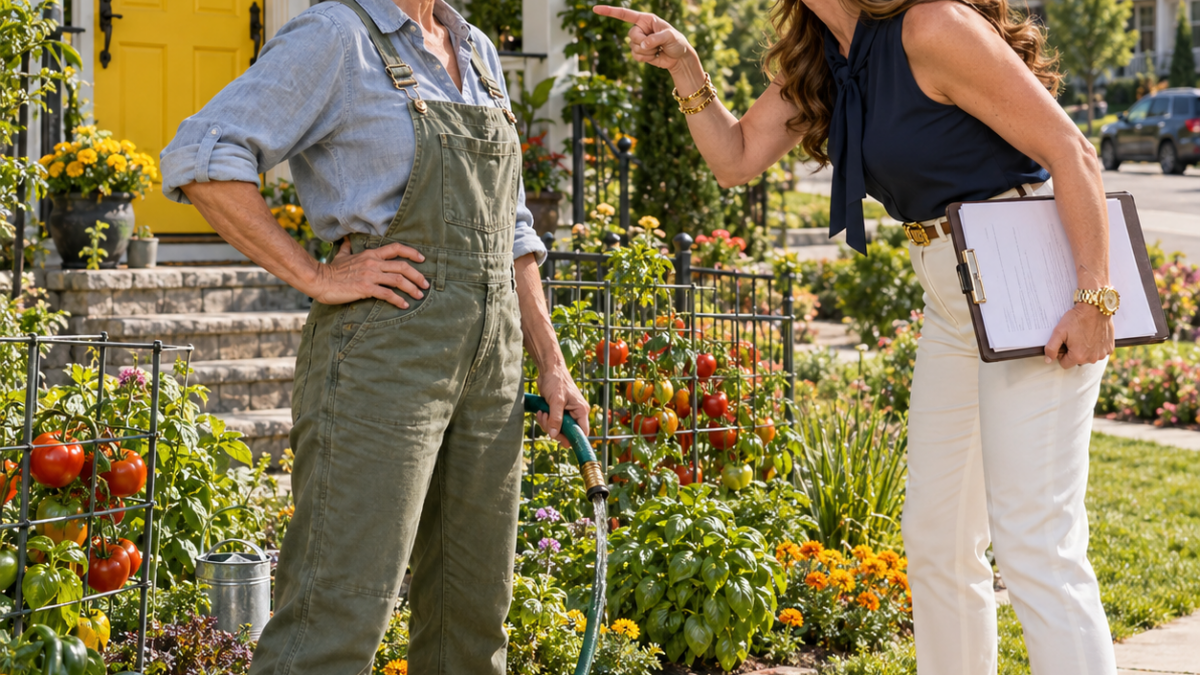
I saw her coming from my front garden while I was watering pepper plants. She moved with the confidence of someone who expected the world to step aside before being asked. She was around forty, maybe a little over, glamorous in a way that looked expensive even at nine in the morning. Long chestnut hair brushed into loose waves. Large sunglasses. Fitted white pants. A sleeveless navy blouse. Gold bracelets stacked at one wrist. Red lipstick perfect enough to seem hostile.
She was beautiful.
No point pretending otherwise.
But the closer she came, the more her beauty felt like polished glass: reflective, cold, and sharp along the edges.
She stopped just short of my lawn as if crossing onto my property required a ceremony.
“You need to repaint that door,” she said.
No hello.
No introduction.
Just command.
I turned off the hose. “Good morning.”
She looked briefly annoyed, as if manners were an unnecessary delay. “That color is not acceptable.”
“Acceptable to whom?”
“To the community.”
I glanced at my yellow door, then at her perfect sunglasses. “I find it cheerful.”
“It’s garish,” she said. “White, brown, deep green, or approved neutral tones are acceptable. Yellow is not.”
“Approved by whom?”
“The HOA.”
I almost laughed.
Almost.
Instead, I set the hose down carefully. Years of teaching English had trained me not to raise my voice at the first ridiculous sentence. Students said ridiculous things daily. Usually, calm questions exposed the problem.
“I’m not in your HOA,” I said.
Karen’s lips curved slightly. “Yes, you are.”
“No. I’m not.”
“I am the HOA president.”
She said it like a title in a royal court.
“That may be,” I said, “but your HOA is across the street.”
“Our authority covers this street.”
“Your authority covers the newer development. This side of the street predates it.”
She removed her sunglasses slowly, revealing green eyes that were much harder than her smile.
“You’re confused,” she said.
“I assure you I’m not.”
“Homeowners and tenants often misunderstand these matters.”
“I’m not a tenant. I own this home.”
“Homeowner, tenant, resident—it doesn’t matter.”
My teacher instincts twitched.
“It matters quite a bit,” I said. “A tenant rents. A homeowner owns. Those words are not interchangeable.”
Her smile tightened.
I continued, “My home is paid for. I do not pay rent. I do not pay HOA dues. I do not use your amenities. I am not listed in your governing documents. Therefore, I am not under your control.”
Karen stared at me as if I had committed a social crime by responding in complete sentences.
“The association has standards,” she said.
“Your association has standards for its members.”
“You benefit from the value our community brings.”
“I benefit from living in the house I paid for.”
Her face changed then.
Not much.
Just enough for me to see that this was not going to end with a neighborly misunderstanding. Karen had crossed the street expecting obedience. Instead, she had found grammar, property rights, and a woman too old to be intimidated by a pretty stranger with a clipboard.
She looked past me toward the garden. “And that mess in your yard needs to go.”
“My tomatoes?”
“Vegetable gardens belong in the rear yard, screened from view.”
“My tomatoes belong where they get sun.”
“That is not how this neighborhood is run.”
I picked up the hose again. “This side of the street is not yours to run.”
Karen slipped her sunglasses back on.
“We’ll see,” she said.
Then she turned and walked away, heels clicking against the sidewalk like punctuation.
part2
The first notice arrived the next morning.
It was folded neatly and tucked into my mailbox, printed on HOA letterhead with the name of the development across the street at the top. I opened it while standing in my driveway with my work bag over my shoulder.
NOTICE OF VIOLATION.
Unauthorized exterior paint color.
Unapproved front-yard cultivation.
Failure to maintain community aesthetic standards.
Ten days to cure.
Potential fines.
I read it once.
Then again.
Then I laughed, folded it, and put it in a kitchen drawer before leaving for work.
That was my first mistake.
Not because the notice mattered legally. It didn’t. But because I underestimated Karen. I thought she was merely controlling. I had not yet understood that control, when challenged, can turn into obsession.
That afternoon, as I stepped out of my car, Karen appeared from across the street like she had been waiting behind a curtain.
“Did you receive your notice?” she asked.
“I did.”
“And?”
“And nothing. You can’t issue violation notices to someone who isn’t part of your HOA.”
Her gaze drifted to my door. “If you refuse to take this seriously, you could be fined.”
“No, I couldn’t.”
“Or evicted.”
That word hit the air between us like a slap.
Evicted.
I had lived in that house over twenty years. I had paid it off. I had patched its roof, replaced its water heater, planted its trees, repaired its steps, and spent more nights than I could count listening to rain hit its windows while thanking God it was mine.
Karen said evicted as casually as someone ordering pie at a diner.
I set my bag down on the porch.
“Don’t you have better things to do than threaten people’s homes?”
“I’m enforcing rules.”
“They are not my rules.”
“You live within the community.”
“I live across from it.”
“I don’t know how things were done before,” Karen said, lifting her chin, “and frankly, I don’t care. I’m in charge now, and I intend to bring this neighborhood into full compliance.”
I looked at her.
Beautiful. Perfect. Ridiculous. Dangerous.
“When exactly do you have time for all this?” I asked. “Don’t you work?”
Her eyes narrowed. “My schedule is none of your concern.”
“Then my door is none of yours.”
Her voice cooled. “Paint it a normal color and remove the garden before I arrange for someone to do it for you and send you the bill.”
My patience ended.
Maybe it was because I was tired from work. Maybe because I had spent decades teaching students how to distinguish confidence from correctness. Maybe because no one gets to threaten my home while standing beside my pepper plants.
I stepped down from the porch.
“If you or anyone else comes onto my property without my permission, that is trespassing. My door stays yellow. My garden stays where it is. You will leave me alone.”
Karen’s lips parted slightly.
Then she smiled.
“I want to see your ID.”
“What?”
“I need to confirm you are who you say you are and that you actually live here.”
I stared at her. “You came to my house, threatened me, and now you want identification?”
“For all I know, you could be a squatter.”
“A squatter with a vegetable garden and a paid-off mortgage?”
“You may be misrepresenting yourself.”
I almost told her exactly where she could file that concern.
Instead, I pulled out my driver’s license because I wanted the conversation over and, foolishly, thought proof would matter. She leaned forward, looked at it, then straightened.
“I’ll check the HOA registry.”
“Good luck,” I said. “I’m not in it.”
I asked her to leave.
She did.
But the next week proved she had not retreated.
She had mobilized.
The notices began coming every few days.
Door color.
Garden placement.
Improper landscaping.
Unauthorized edible plants visible from street.
Noncompliant address display.
Vehicle angled too close to curb.
Outdoor hose visible.
Porch chair not approved.
One notice claimed my front yard created “visual disorder incompatible with community values.” That one nearly became my favorite, because if one tomato plant could threaten community values, those values needed stronger roots.
At first, I responded in writing.
I sent a calm letter to the HOA address printed on the notices. I included a photocopy of my deed, my property tax record, and documentation showing my house sat outside the development governed by the HOA. I explained that I was not a member, never had been a member, and would not comply with rules that did not apply to me.
Karen replied personally.
My deed, she wrote, appeared “inconsistent with association understanding.”
Association understanding.
That was her phrase for fantasy.
She claimed my home should have been included when the HOA formed and that any omission was “administrative oversight.” She demanded that I pay retroactive dues, remove the garden, repaint the door, and submit an exterior compliance application.
I wrote back one sentence.
I am not a member of your HOA. Stop contacting me.
She did not stop.
She began standing on the sidewalk and shouting.
Not every day, but often enough that I started listening for her voice even when she wasn’t there. Sometimes I would be watering tomatoes, and she would appear across the street, clipboard in hand, calling, “You have until Friday.” Other times she would slow her SUV in front of my house, window down, sunglasses on, watching like my door had personally betrayed her.
I started keeping records.
Every notice went into a folder.
Every envelope.
Every certified letter.
Every date Karen appeared.
Every conversation I could remember afterward.
I bought a small notebook and wrote on the front: HOA Nonsense. Later, I crossed out “Nonsense” and wrote “Harassment.”
Because that was what it became.
A neighbor from the newer side, a quiet man named Ellis, stopped one morning while walking his dog.
“She’s after you now?” he asked softly.
I lowered the watering can. “Now?”
He glanced toward Karen’s house. “She gets focused.”
“Has she done this before?”
He hesitated.
That was answer enough.
“People usually pay or change whatever she wants,” he said. “It’s easier.”
“I’m not paying.”
“I know.” He looked at my door and smiled faintly. “I like the yellow, by the way.”
“Thank you.”
Then he walked on.
That small kindness stayed with me longer than it should have. When someone is trying to make you feel crazy, one sane voice can feel like a handrail in the dark.
But Karen escalated.
Certified letters started arriving, and the amounts attached to them were no longer laughable.
$2,500.
$3,000.
$5,000.
Each claimed unpaid fines, administrative fees, inspection fees, enforcement costs, and retroactive dues. I signed for them at the mailbox with a growing knot in my stomach. I knew they were nonsense, but nonsense printed on official paper and sent by certified mail has weight.
Then anonymous posts appeared in local social media groups.
Photos of my house.
My yellow door.
My garden.
Captions about declining neighborhood standards, careless residents, and “people who refuse to respect the community they benefit from.”
No name attached.
Of course not.
But I knew.
I asked group administrators to remove the posts. Some did. Some didn’t. One replied that neighborhood concerns were allowed as long as addresses weren’t posted. My house number was visible in one photo. Apparently, that did not count enough.
People commented.
Some defended me.
Some said rules exist for a reason.
Some said vegetable gardens in front yards were tacky.
One person wrote, If she doesn’t like HOA rules, she shouldn’t live in an HOA neighborhood.
I typed a reply three times and deleted it each time.
I did not live in an HOA neighborhood.
That was the whole point.
After a month, I began feeling physically ill from it.
Not dramatic illness. The quiet kind. Tight shoulders. Sour stomach. Waking at three in the morning thinking about liens, fines, and whether ignorance could become expensive if repeated by a confident enough woman. I knew I was right, but being right did not make the letters stop. Being right did not remove my house from social media. Being right did not prevent Karen from standing on the sidewalk and shouting, “This can get much worse for you.”
One afternoon, a certified notice arrived threatening a lien against my property for unpaid HOA dues and fines.
I sat at my kitchen table with that letter in front of me for a long time.
Then I called a lawyer.
Her name was Rachel Moore, a real estate attorney recommended by one of my former colleagues. Her office was small, tidy, and full of plants that looked much healthier than mine. She read through my folder while I sat across from her, hands clasped, trying not to look as exhausted as I felt.
When she finished, she took off her glasses.
“She has no authority over your property.”
“I know.”
Rachel looked at the stack of notices. “Knowing and making her stop are different things.”
That sentence almost made me cry from relief.
Because that was exactly it.
I knew.
But I needed someone who could make knowing matter.
Rachel drafted a cease and desist letter to Karen, the HOA board, and the management address listed on their correspondence. It stated clearly that my property was not part of the HOA, not subject to its covenants, and not liable for dues, fines, inspections, or enforcement costs. It demanded they stop contacting me, stop placing notices in my mailbox, stop photographing my property for enforcement, and stop threatening liens or eviction.
For a few days, silence.
Then Karen came back.
She did not step onto my property this time. She stayed on the sidewalk, as if that detail made her reasonable.
“The HOA attorney says we have jurisdiction,” she called.
I was pruning basil.
I looked up. “Then I guess I’ll see you in court.”
Her smile thinned.
“You don’t want that.”
“No, Karen. You don’t want that.”
I informed Rachel.
She wrote another letter asking for the contact information of the HOA’s attorney so counsel could communicate directly and resolve the matter without court intervention.
No attorney replied.
Instead, I received notice of a lien.
Eight thousand dollars.
Recorded against my property for unpaid HOA dues, fines, administrative fees, and enforcement costs.
I drove to Rachel’s office with the notice in the passenger seat like it might explode.
She read it once.
Then her entire expression changed.
Before that moment, she had been professional, concerned, firm. Now she looked almost offended.
“This is fraudulent,” she said.
“What does that mean?”
“It means we are no longer dealing with harassment only. They recorded a false claim against your title.”
“Can they take my house?”
“Not legally. But a lien can cloud title, interfere with refinancing, cause stress, and create damages. She crossed a line.”
I gripped the arms of the chair.
“What do we do?”
Rachel closed the file.
“We sue.”
The lawsuit named Karen personally and the HOA.
Harassment.
Intentional infliction of emotional distress.
Fraudulent lien.
Slander of title.
Whatever else Rachel believed the facts supported.
She also filed an emergency motion to have the lien expunged.
I had never been part of a lawsuit before. I had spent my life teaching essays, grading grammar, paying bills, and quietly minding my own business. Suddenly, my yellow door had become Exhibit A in a war over authority Karen never had.
The first court hearing was terrifying.
Not because the judge was unkind. He wasn’t. But courtrooms make ordinary people feel small. The wood, the flags, the formal language, the lawyers speaking in a rhythm I did not fully understand. Karen arrived wearing a fitted black dress, cream blazer, pearls, and heels sharp enough to announce every step. Her hair was perfect. Her lipstick was deep red. She looked less like a defendant and more like a woman expecting to chair the proceeding.
She smiled when she saw me.
It was not a friendly smile.
It said, I still think you will break first.
The HOA sent a different representative, a board treasurer named Paul, who looked confused and increasingly pale as Rachel began presenting documents.
My deed.
My tax records.
The public creation documents for the HOA.
Maps showing the development boundary.
Proof that my side of the street was not included.
Copies of Karen’s notices.
Certified letters.
The lien.
Karen’s written claim that my deed was fake.
The judge reviewed the documents carefully.
Then he looked at the HOA’s representative.
“Where is the recorded instrument subjecting this property to the association?”
Paul looked at Karen.
Karen lifted her chin. “Your Honor, the property benefits from the community and has always been understood to be part of the neighborhood.”
The judge did not blink.
“That was not my question.”
Her attorney—because she had one now, though apparently not the mythical HOA attorney she had threatened me with—shifted beside her.
The judge repeated, “Where is the recorded instrument?”
There wasn’t one.
There had never been one.
The emergency motion was granted. The lien was ordered expunged while the case proceeded.
I walked out of that courtroom shaking.
Rachel touched my shoulder. “You did well.”
“I didn’t say anything.”
“Sometimes that’s doing well.”
The fallout inside the HOA began almost immediately.
It turned out Karen had not told the board everything.
That was the polite version.
The less polite version was that she had lied.
She had told them my property was an uncooperative member parcel with unpaid dues. She had said I refused communication. She had said my documents were “suspicious.” She had claimed legal counsel confirmed their jurisdiction, though no actual attorney had provided such confirmation. She had pushed the board to approve collection action based on her summary, not the full records.
The board members panicked once Rachel sent them the real documents.
Within days, Karen was removed as president.
Then removed from the board entirely.
The HOA contacted Rachel asking to discuss settlement.
Karen did not settle quickly.
Of course she didn’t.
People like Karen rarely stop when exposed. They double down because admitting one lie means every prior command becomes suspect.
Her court filings painted herself as a dedicated community leader unfairly targeted by a hostile resident. She claimed she acted in good faith. She claimed she relied on neighborhood understanding. She claimed my property damaged community aesthetics and reduced property values. She claimed emotional distress because I had “publicly humiliated” her by refusing compliance.
Rachel read that line aloud and paused.
I stared at her.
“She claimed emotional distress?”
“Yes.”
“Because I wouldn’t repaint my door?”
“Essentially.”
I laughed so hard I had to wipe my eyes.
It was not joyful laughter. It was the kind that comes after months of fear, when absurdity finally becomes too large to hold silently.
Discovery made everything worse for Karen.
Emails showed she had been fixated on my house from the moment I painted the door. She sent photos to other board members with captions like, This is what happens when edge properties are allowed to ignore standards and If we let this stand, compliance will collapse.
Compliance will collapse.
Over a vegetable garden.
Over a yellow door.
One board member had replied, Is she actually part of the HOA?
Karen responded, She should be.
Should be.
That phrase became important.
Not is.
Should be.
Rachel underlined it in red.
There were also messages about retroactive dues. Karen had calculated them herself, adding arbitrary administrative fees. When one board member asked whether they had authority to charge a non-member, Karen wrote, Authority must be asserted or it is lost.
Rachel printed that email on thick paper for court.
Karen had not misunderstood.
She had tried to create power by using it.
The social media posts came up too.
We could not prove every anonymous post was hers, but metadata and screenshots helped connect at least two to accounts tied to her personal email. The posts were removed as part of preliminary agreements with the group administrators once Rachel sent notices.
Neighbors began cooperating.
Quietly at first.
Ellis provided a statement about seeing Karen photograph my house repeatedly. Mr. Bell wrote that our side of the street had never been part of the HOA and that residents had never paid dues. Another neighbor confirmed Karen had said at a community event that she intended to “bring the older homes into line.”
It became clear that many people had been afraid of her.
Not dramatic fear.
Practical fear.
Fear of fines. Fear of being targeted. Fear of becoming the next folder on Karen’s desk. Her power had been built partly from paperwork and partly from everyone else deciding it was easier to avoid her attention.
I understood that.
I had almost done the same.
Settlement with the HOA came first.
The association agreed in writing that my property was not part of the HOA, had never been part of the HOA, and was not subject to its rules, fees, fines, or enforcement authority. They paid my attorney fees related to the lien and emergency motion. They agreed to correct and release any recorded claims. They issued a written apology stating that enforcement actions against my property had been improper. They adopted a policy requiring legal review before any lien could be recorded.
Their new acting president, Paul—the same treasurer who had looked pale in court—called me once after the agreement.
“I’m sorry,” he said.
It sounded honest.
I surprised myself by accepting it.
“I hope you understand,” he continued, “many of us didn’t know what she was doing.”
“I believe some of you didn’t.”
He heard the word some and did not argue.
Good.
Karen’s case continued.
The day she had to testify, she arrived in a pale blue dress and nude heels, looking polished but thinner than before. Stress had sharpened her face. She still carried herself like someone important, but the room no longer treated her as if importance could be self-declared.
Rachel questioned her calmly.
“Mrs. Whitcomb, did you have a recorded document showing my client’s property was part of the HOA?”
“I believed—”
“Yes or no.”
“No.”
“Did you have a dues agreement signed by my client?”
“No.”
“Did you have any title document listing her home as association property?”
“No.”
“Did my client repeatedly provide documents showing she was not part of the HOA?”
Karen’s lips pressed together.
“Yes.”
“And after receiving those documents, did you continue sending fines?”
“I believed they were not valid.”
“What made you believe her deed was fake?”
Karen hesitated.
“Her refusal to comply raised concerns.”
Rachel paused.
“Her refusal to comply with rules that did not apply to her made you doubt the validity of her deed?”
Karen’s attorney shifted uncomfortably.
Karen’s face flushed.
“I was protecting the community.”
Rachel walked to the evidence binder and pulled out a copy of Karen’s email.
“You wrote, ‘Authority must be asserted or it is lost.’ What did you mean?”
Karen’s voice tightened. “That homeowners associations must enforce standards consistently.”
“Even against people who are not members?”
“I believed she should have been included.”
“But she was not.”
Karen said nothing.
Rachel looked at the judge.
“No further questions.”
I will remember that silence for the rest of my life.
There was no dramatic confession.
No shouting.
No collapse.
Just Karen sitting there with her own words in front of her, unable to make them sound reasonable.
The court ruled in my favor.
Karen was ordered to pay more than twenty thousand dollars in damages, fees, and costs attributable to her personal actions beyond the HOA settlement. A permanent injunction barred her from contacting me, approaching my property, placing notices in my mailbox or on my door, photographing my home for enforcement purposes, or making claims of authority over me.
The false online information had to be removed.
The lien was expunged.
County records remained clear.
My yellow door stayed yellow.
When the ruling was read, Karen sat perfectly still.
No tears.
No apology.
Just a face emptied by consequences.
Outside the courtroom, she passed me in the hallway.
For a second, I thought she would say something, injunction or not.
Rachel stepped slightly closer to me.
Karen looked from Rachel to me, then away.
She kept walking.
That was the last time she ever spoke near me.
Her reputation did not survive the case.
Not because I spread gossip. I didn’t have to. Court records are public, and neighborhoods run on information the way gardens run on water. People learned that Karen had filed fines against a non-member. They learned about the fraudulent lien. They learned she had ignored documents, misled her board, and tried to use the HOA to bully someone outside its reach.
Within months, her house went up for sale.
I saw the sign while watering my tomatoes.
For a moment, I stood there with the hose in my hand, watching sunlight flash off the white post.
I expected to feel triumphant.
Instead, I felt tired.
Then relieved.
Then, finally, a small, honest satisfaction.
Karen had crossed the street to bring my house under her control.
In the end, she was the one who left.
Moving trucks arrived on a gray morning. I watched from my porch with coffee, partly because I am human and partly because I wanted to make sure she did not leave one last notice taped somewhere out of spite.
She came out wearing oversized sunglasses and a beige coat, directing movers with clipped gestures. Still beautiful. Still polished. Still trying to look like the main character in a story where she had chosen to leave rather than been defeated by her own arrogance.
At one point, she looked across the street.
At me.
At the yellow door.
At the garden.
Her mouth tightened.
I lifted my coffee slightly.
Not a wave.
A toast.
She turned away first.
The moving truck pulled out before noon.
The neighborhood felt quieter after that.
Not immediately healed. Places do not heal instantly when controlling people leave. For a while, everyone still behaved as if Karen might return from behind a hedge with a clipboard. HOA residents whispered about refunds, reversed fines, and board elections. Their new leadership held meetings about transparency and legal review. People on my side of the street joked about forming our own anti-HOA association, whose only rule would be mandatory snacks.
I declined to be president.
My garden thrived that year.
Maybe because I spent more time in it.
Maybe because I needed to prove something to myself.
The tomatoes came in heavy and sweet. The peppers grew brighter than expected. Basil took over one corner like it had territorial ambitions. I left baskets on neighbors’ porches with notes that said, Please take these before I become sauce.
One evening, Ellis crossed the street from the HOA side and stood near the sidewalk.
“Still not joining?” he asked, smiling.
“Not even if you offer free pool access.”
He laughed. “Good.”
Then he looked at the door.
“It really is a nice color.”
“I know.”
We stood there in peaceful silence.
That was the thing Karen never understood. Neighborhoods are not made beautiful by obedience. They are made livable by restraint. By knowing where your rights end and another person’s door begins. By caring more about actual harm than cosmetic irritation. By letting people plant tomatoes if tomatoes are not hurting anyone.
She thought control created order.
But control without humility creates fear.
And fear is a terrible foundation for community.
Months later, after everything was finished, I found the first violation notice in the kitchen drawer.
I had forgotten it there.
The paper was slightly curled at the edges. Unauthorized exterior paint color. Unapproved front-yard cultivation. Ten days to cure.
I read it again and remembered how casually I had dismissed it at first. How I had thought ignoring nonsense would make nonsense go away.
Sometimes it does.
Sometimes it learns your address.
I took the notice outside, sat on the porch, and tore it into small pieces.
Not because I needed the gesture.
Because it felt good.
The yellow door glowed behind me in the late afternoon sun. The garden smelled like basil and warm soil. Somewhere down the street, Mr. Bell’s terrier barked at absolutely nothing. Across the street, children from the HOA side rode bikes in circles near the private park entrance, laughing as if rules had not nearly turned my home into a battlefield.
I closed my eyes.
For the first time in months, my body believed the fight was over.
I still keep the legal folder.
The lien release.
The injunction.
The court order.
The HOA’s written apology.
Karen’s emails.
The notices.
All of it.
Not because I want to relive what happened, but because I learned something that year: ownership is not only about paying for a place. It is about defending the boundary between your life and someone else’s appetite for control.
Karen thought my yellow door was a violation.
She was wrong.
It was a warning.
Not to the neighborhood.
To people like her.
A warning that this house belonged to someone who had earned her peace the hard way.
Someone who knew the difference between tenant and homeowner, between authority and arrogance, between a rule and a threat.
Someone who had spent years teaching students that words mean things.
Lien meant something.
Eviction meant something.
Trespass meant something.
Harassment meant something.
And so did mine.
My house.
My garden.
My door.
My life.
Karen tried to make me repaint it into something she could tolerate.
Instead, she made me understand exactly how bright I was still willing to be.