𝙍𝙚𝙖𝙙𝙈𝙤𝙧𝙚👉 Karen Thought My Lamborghini Was Proof I Didn’t Deserve Peace
part2
I had lived in our neighborhood for fifteen years before the HOA became part of it.
For most of that time, the place was peaceful. Not perfect, but peaceful. Kids rode bikes in the cul-de-sac. People waved while mowing. Packages left on porches usually stayed there. If someone’s fence leaned too far, another neighbor helped fix it before anyone thought about paperwork.
Then a few houses got neglected after owners moved or rented them out badly. Lawns went wild. One place had junk piled beside the garage for almost a year. Another had peeling paint and broken gutters. People got frustrated. Meetings happened. A homeowners association was proposed.
I voted yes.
I regret that now, though at the time it made sense.
The first few months were actually decent. Common areas got cleaned up. Rundown properties were pressured into basic maintenance. The board included reasonable people. Tom, a retired teacher, knew property management better than anyone expected. Sarah worked in real estate and understood value without acting like every mailbox was a moral issue. Bob was gruff, but fair. He had helped me with questions when I installed a new fence the year before.
Then there was Karen Whitmore.
Karen was the HOA secretary, and from the first meeting, she treated that title like it came with a badge, crown, and emergency powers.
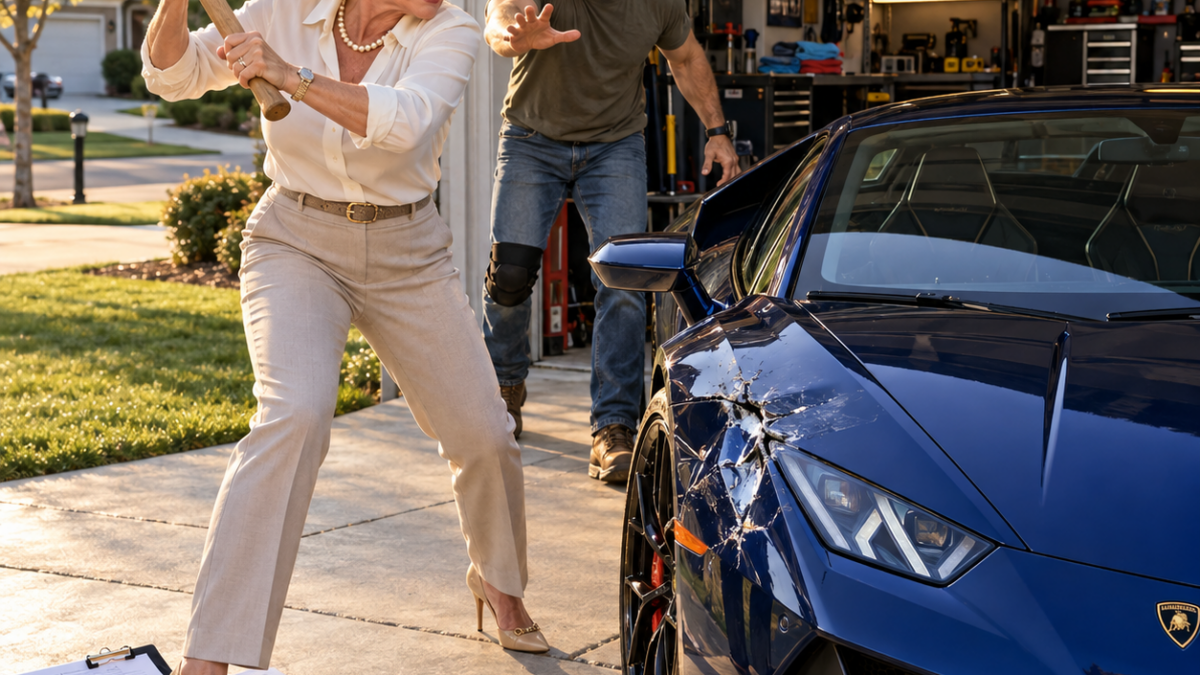
She was in her late fifties, recently divorced, always dressed like she was on her way to a committee luncheon. Crisp blouses, pearls, pressed slacks, hair sprayed into submission. Her smile was thin and temporary, something she used only until someone resisted her. She had a clipboard more often than some people had phones.
Karen did not want a nice neighborhood.
She wanted a neighborhood that obeyed her.
Six months before the Lamborghini incident, she decided my lawn was “inconsistent with community standards.”
I kept my lawn neat. The VA even helped cover a landscaping service as part of my disability benefits. The grass was green, trimmed, clean. But there was a small patch of clover mixed in near the front walk, and Karen treated it like I had planted poison ivy in the shape of a profanity.
She sent a violation notice demanding I remove all clover within forty-eight hours or face fines.
I called Tom.
He laughed for almost ten seconds.
“John,” he said, “clover is good for lawns. Karen’s been watching too much television. Ignore it.”
The board backed me up and told Karen to stop issuing notices without approval.
She did not stop.
The worst incident before my car involved the Burger family across the street. Their kids, eight and ten, liked riding bikes in the cul-de-sac after school. Normal kid stuff. Helmets, laughter, races around the circle, chalk obstacle courses. Our street barely had traffic.
Karen called the police.
On children riding bikes.
When the officers showed up, they told her kids playing outside was not a crime and left looking annoyed.
That should have embarrassed her.
Instead, she started timing them.
I saw her one afternoon standing on the sidewalk with a stopwatch and clipboard, tracking how long they rode, how many times they circled, how loud they laughed. Mr. Burger finally threatened to call the police on her for harassment. That was the first time I thought, This woman has something wrong inside her that rules will not fix.
Then I bought the Lamborghini, and her obsession found a new target.
About a month after I brought it home, I was in my garage detailing it with the door open for airflow. It was a mild Saturday. I had classic rock playing on the shop radio, not loud enough to bother anyone. Just me, microfiber towels, wax, and that midnight blue paint shining under the garage lights.
I was working slowly because slow was the point.
Then a shadow fell across the driveway.
“Excuse me.”
I looked up.
Karen stood there at the edge of my garage like she had caught me burying evidence.
“Morning, Karen.”
“You cannot operate a commercial garage in a residential neighborhood.”
I blinked.
“What?”
She stepped closer, phone already in hand.
“A commercial garage. Auto repair. Detailing business. Whatever this is.”
I looked at the car. Then at the bottle of wax in my hand. Then back at her.
“I’m cleaning my own car.”
“With the garage door open?”
“For ventilation.”
“And the music?”
“The radio?”
“It’s disruptive.”
“It’s at a normal volume.”
She began taking pictures.
Not one or two. Several. The car, the shelves, my tools, me holding the wax applicator.
“I’m documenting this violation.”
“There’s no violation.”
“You have created the appearance of an automotive business. This neighborhood has standards.”
I set the applicator down carefully.
That was something I learned in the Army and relearned in therapy: put down whatever is in your hand before anger makes it part of the conversation.
“Karen,” I said, “I am not running a business. I am not working on anyone else’s vehicle. I am cleaning my own car in my own garage.”
“People don’t want to live next to someone who thinks their garage is an auto shop.”
“People also don’t want to live next to someone who photographs them on their own property.”
Her eyes sharpened.
“Are you threatening me?”
“No. I’m asking you to leave.”
She smiled, but not kindly.
“We’ll see what the board has to say.”
“The board can look at my clean car if they want.”
That was the wrong thing to say, because Karen hated being laughed at even when nobody laughed.
The notices started the following week.
Excessive noise from garage activities.
Commercial vehicle storage.
Failure to maintain closed-garage standards.
That last one did not even exist.
I called Tom again.
This time, he did not laugh.
“She sent you what?”
I emailed him pictures of the notices.
He called back twenty minutes later, angry.
“She is making up rules again. These fines were not authorized. Do not pay anything.”
“I wasn’t planning to.”
“She’s been doing this to other residents too. We’ve overturned a dozen in the last few months.”
“Then why is she still on the board?”
A pause.
“Because removing someone gets messy.”
“Messier than letting her harass people?”
Another pause.
“You’re not wrong.”
After that, Karen escalated in the way petty tyrants do when no one stops them early.
She walked past my house multiple times a day. Not subtle walks. Patrols. Slow, deliberate, clipboard in hand, pretending to check common areas that did not exist near my driveway. She timed how long my garage door stayed open. She asked neighbors whether they had noticed “business traffic,” which was absurd because no one came by except friends and the occasional delivery driver.
She left notes taped to my garage door.
Reminder: residential garages are for parking vehicles, not commercial activities.
Please be considerate of neighbors regarding noise.
HOA regulations require compliance with community standards.
I saved every note.
Emily wanted me to file a formal complaint.
“Against her,” she said one evening, holding one of the notes like it smelled bad. “Not with her. Against her.”
“I know.”
“John, she’s stalking your garage.”
“She’s annoying my garage.”
“She’s harassing you.”
“She wants a reaction.”
“She’s going to get one eventually.”
I looked at her.
Emily softened, but only a little.
“You keep trying to out-calm people who mistake calm for weakness.”
That landed harder than I wanted.
Because she was right.
I had spent years learning not to react too fast. Not to let adrenaline drive. Not to let disrespect matter more than peace. But sometimes restraint becomes a room other people think they can move into without permission.
Still, I decided to ignore Karen.
I figured if I refused to feed her obsession, she would find some other shrub, mailbox, or bicycle child to police.
I was wrong.
The weekend everything happened, I drove my Honda to visit my sister two hours away. Her husband travels for work, and I try to help with her kids when I can. I left Saturday morning and planned to come back Sunday evening.
Before I left, I checked the Lamborghini like I always did.
Locked. Covered. Garage secured. Cameras active.
The cameras had been installed a year earlier after a string of break-ins nearby. They covered the driveway, garage entrance, and front approach. Good picture quality. Night vision. Audio near the garage.
I never imagined they would capture Karen with a sledgehammer.
I came home Sunday around seven.
Everything looked normal.
I parked the Honda in the driveway, carried my overnight bag inside, sorted through mail, took a shower, ate leftovers, and tried to convince myself I was not too old to spend a weekend being climbed on by my nephews.
About an hour later, I decided to check the car.
Part of it was practical. I wanted to start it since it had been sitting. Most of it was simply that I liked looking at it.
I opened the door from the house into the garage.
At first, my brain did not understand what I was seeing.
The cover was half ripped off and hanging to one side.
The windshield was shattered.
The side windows were broken.
The hood was caved in with deep, ugly dents. The mirrors dangled by wires. The driver’s side door was mangled so badly it sat uneven in the frame. The body panels were scarred with repeated impact marks, chipped paint, exposed material, violence written across every curve that had once looked perfect.
For a few seconds, I did not move.
I heard my own breathing.
That was all.
Then something inside me went very still.
Not calm.
Still.
There is a difference.
I stepped closer, careful not to touch anything.
The damage was deliberate. Focused. Nothing else in the garage was disturbed. My tools were there. Equipment untouched. Shelves intact. Whoever had done this had come for the car and only the car.
My first thought was Karen.
My second thought was: Be smarter than your anger.
I backed out of the garage and called 911.
Then, while waiting for police, I pulled up the security footage.
There she was.
2:07 a.m. Sunday.
Karen walking up my driveway under the pale wash of the motion light, wearing dark clothes and carrying a sledgehammer.
She paused at the garage side door.
I later realized she must have found the emergency release or forced the side latch enough to get inside. The footage did not show every angle, but it showed enough. It showed her entering. It caught the sounds from inside: glass breaking, metal crunching, repeated dull strikes, her breathing hard, something like a sob or laugh after one particularly heavy blow.
Twenty minutes.
She spent twenty minutes destroying my car.
When she came out, she still had the sledgehammer.
She looked around once, then walked back across the street like she had just taken out the trash.
I watched the footage twice.
The second time, my hands began to shake.
Emily came into the room behind me.
“John?”
I paused the video before the worst part.
She saw my face and went pale.
“What happened?”
I could not soften it.
“She destroyed the Lamborghini.”
Emily covered her mouth.
“Karen?”
I nodded.
Her eyes filled with tears—not because of the car exactly, though she knew what it meant to me, but because she understood violation. She understood what it meant for someone to enter the place where I went to feel peaceful and turn it into a crime scene.
Police arrived twenty minutes later.
Officer Willow was the first through the door, with his partner, Officer Harris. Willow was mid-thirties, sharp-eyed, calm without being cold. I walked them to the garage.
He stopped when he saw the car.
“Damn,” he said quietly.
“That about sums it up.”
“You got cameras?”
“Yes.”
We went inside and I showed them the footage.
Willow watched without interrupting.
Then he watched it again.
When the video ended, he leaned back and shook his head.
“That’s about as clear-cut as it gets.”
“Good.”
“Do you want to press charges?”
“Absolutely.”
He studied me for a moment, maybe measuring whether I was angry enough to complicate things.
I was angry.
But I was also trained enough to know evidence was better than emotion.
Willow said, “Before we go over there, would you be willing to call her on speaker? Don’t threaten. Don’t accuse too hard. Just ask if she knows anything. Sometimes people talk when they think they’re only speaking to the victim.”
I looked at Emily.
She crossed her arms and nodded once.
I called Karen.
Willow and Harris stood close enough to hear.
Karen answered on the fourth ring.
“What do you want?”
No hello. No neighborly mask.
“Karen,” I said, keeping my voice flat, “someone destroyed my Lamborghini this weekend while I was out of town. Do you know anything about it?”
There was a pause.
Too long.
Then her voice sharpened.
“Why would you call me?”
“You’ve been complaining about the car for weeks.”
“I complain about violations.”
“I have security footage of someone who looks exactly like you walking into my garage with a sledgehammer.”
Her breath changed.
For one second, I thought she might deny it.
Instead, rage won.
“Good.”
Willow’s eyes lifted to mine.
Karen continued, voice rising.
“I’m glad someone finally did something about that ridiculous car.”
I said, carefully, “Are you saying you know who destroyed it?”
“You think you’re so special, don’t you?” she snapped. “Flaunting that thing around the neighborhood like some kind of big shot.”
“It stays in my garage.”
“With the door open. Where everyone has to see it.”
Officer Willow motioned with one hand.
Keep going.
“Karen,” I said, “are you saying you destroyed my car?”
“Damn right I did.”
Emily closed her eyes.
Karen’s voice poured out now, ugly and shaking.
“Every night I had to look at that thing sitting there, knowing you’re living high on government disability money while the rest of us work for everything we have. You’re just a broken-down soldier who got lucky, and you act like you earned something special.”
My hand tightened around the phone.
Willow gave me a warning look.
Stay calm.
I breathed through my nose.
“I served twenty years.”
“Oh, please. Everyone worships veterans like you’re saints. You got injured and now taxpayers bought you a Lamborghini.”
“I bought it with my money.”
“You don’t deserve it.”
There it was.
The heart of her.
Not noise. Not garage rules. Not property values.
Jealousy wrapped in moral judgment.
“So yes,” Karen said, “I took a sledgehammer to it. And I’m glad I did.”
Officer Willow held out his hand.
I gave him the phone.
“Ma’am,” he said, “this is Officer Willow with the city police. You have just confessed to felony vandalism. We’ll be over to speak with you in a few minutes.”
There was a sound like the phone hitting something.
Then silence.
Willow ended the call.
Twenty minutes later, Karen was in handcuffs on her front lawn.
I watched from my driveway as officers walked her to the cruiser. She was screaming, of course. Not apologies. Not regret. Not fear for what she had done.
Unfair.
That was the word she kept using.
“This is unfair!”
“He provoked me!”
“He thinks he’s better than everyone!”
“You people always protect men like him!”
Neighbors came outside slowly, drawn by flashing lights and Karen’s voice. Tom stood near his mailbox in pajama pants and a jacket, looking stunned and furious. Sarah was on her porch with one hand over her mouth. Mr. Burger had both his kids behind him, though they were trying to peek around his sides.
Karen saw the audience and twisted toward them.
“You all know I was right about him!”
No one answered.
That silence seemed to hurt her more than the handcuffs.
The next morning, USAA sent an adjuster.
His name was Paul, and he had the solemn expression of a man who had seen hail damage, deer collisions, garage fires, flood cars, and every kind of automotive misery, but maybe not many HOA secretaries with sledgehammers.
He walked around the Lamborghini slowly, tablet in hand.
“Jesus,” he muttered.
“Is that the official estimate?”
He glanced at me.
“Sorry.”
“No, that’s fair.”
He documented everything. Windows. body panels. hood. door. mirrors. interior glass contamination. frame concerns. specialty paint. exotic parts. labor at a certified shop. The number grew fast.
Eighty thousand dollars was the early guess.
Maybe more.
Insurance would handle a lot. Karen would be facing restitution. The car could be repaired.
Everyone kept telling me that.
It can be repaired.
They meant well.
But for me, the damage was not only financial. It was personal in a way I struggled to explain without sounding shallow.
I had not bought the car because I needed transportation. I had bought it because I had spent years surviving environments where beauty felt either distant or temporary. Working on that car gave me peace. It was a project, a reward, a symbol of life after service that was not all appointments and pain management.
Karen did not just dent metal.
She attacked the idea that I was allowed to enjoy something.
Paul was in the driveway talking through next steps when Karen came back.
I did not know she had made bail.
I should have expected it, but part of me assumed even she would be smart enough to hide until court.
Instead, I heard her before I saw her.
“You ruined my life!”
I turned.
Karen was charging across the street from her house, hair wild, face red, both hands gripping the same sledgehammer.
For a split second, my brain refused the image.
Nobody could be that stupid.
Then she raised it.
“Karen, stop!”
She did not stop.
“I lost my job because of you!” she screamed. “I lost everything!”
Paul froze beside the insurance car.
I moved without thinking in the old trained way.
Not fast like movies. Just correctly.
Karen swung the sledgehammer toward my head.
I stepped offline. Her momentum carried the blow past me. I grabbed her wrists, turned with the motion, and drove her down onto the driveway hard enough to knock the air out of her.
The sledgehammer skidded away.
“Stay down,” I said.
She did not.
She rolled, scrambled up, and came at me again with her nails aimed for my face, screaming names I will not bother repeating.
I did not want to hit her.
I need that understood.
But I also was not going to let her claw my eyes after she had just tried to crush my skull.
I threw one controlled punch to her jaw.
She dropped.
Out cold.
For half a second, everything went quiet.
Paul stood with his tablet hanging at his side, mouth open.
“Call 911,” I said.
Then I realized I was already pulling out my phone.
“This is John Miller,” I told dispatch. “I need police and an ambulance. The woman who vandalized my car just attacked me in my driveway with a sledgehammer. I defended myself. She’s unconscious but breathing.”
My voice sounded too calm.
That happens sometimes after danger. Your body spends all its panic on action and leaves your voice empty.
Paramedics arrived first. Karen came around while they were checking her. The moment she realized where she was, she started yelling again.
“He assaulted me!”
Paul, bless him, finally found his voice.
“She attacked him with a sledgehammer.”
Karen tried to sit up.
The paramedic told her to stay still.
She told him he was part of the conspiracy.
Then Officer Willow arrived again.
He stepped out of the cruiser, saw me, saw Karen, saw the sledgehammer on the driveway, and shook his head.
“Some people never learn.”
“No,” I said. “Apparently not.”
Karen was arrested again, this time for assault with a deadly weapon and violation of bail conditions. She screamed as they put her in the cruiser, but there was less confidence in it now. The performance had cracked. Panic showed through.
At her second arraignment, the judge denied bail.
I was told he looked at the sequence—felony vandalism, confession, release, immediate attack with a deadly weapon—and decided the community had seen enough of Karen Whitmore for the moment.
The district attorney contacted me soon after.
Multiple felony charges.
Vandalism.
Breaking and entering.
Assault with a deadly weapon.
Violation of bail.
Potential enhancements because of the value of the damage.
Her public defender reached out through proper channels about a possible plea.
I was not feeling generous.
Had she destroyed the car and stopped there, maybe time would have softened me. Maybe I would have cared more about restitution than prison. Maybe I would have told myself she was pathetic, jealous, unwell, and that dragging things out would only keep me tied to her.
But she came at my head with a sledgehammer.
That simplified my feelings.
The HOA board held an emergency meeting two nights after the second arrest.
I attended because Tom asked me to.
Emily came with me, mostly because she wanted to see Karen removed from something, even if Karen herself was sitting in jail and could not attend.
The meeting room was packed.
Residents who had ignored HOA meetings for a year suddenly had opinions. The Burger family was there. Sarah from the board looked exhausted. Bob looked like he was hoping someone would dare defend Karen so he could verbally flatten them. Tom sat at the front with a folder so thick it looked like a tax audit.
He opened the meeting with a statement.
“Karen Whitmore has abused her position, issued unauthorized notices, harassed residents, and is now facing serious criminal charges after allegedly vandalizing a homeowner’s vehicle and assaulting him while out on bail.”
Allegedly.
Legal language has its place.
But everyone in the room knew.
The board voted unanimously to remove her as secretary.
Then they voted to void every unauthorized violation notice she had issued over the previous year.
Then they voted to send formal apologies to affected residents.
Several neighbors spoke.
Mr. Burger stood up and described Karen following his children with a stopwatch. His voice shook, not from fear, but from the effort of staying civil.
An elderly woman named Mrs. Patterson said Karen had threatened to fine her over ceramic garden rabbits her late husband had bought her.
A young couple said Karen had photographed their backyard through a gap in the fence.
Then Tom looked at me.
I had not planned to speak.
But the room turned, and suddenly silence asked something of me.
So I stood.
“My car can be repaired,” I said.
My voice sounded rough.
“I know that. Insurance is handling it. A shop will fix the glass, the panels, the paint. Eventually it’ll look the way it did.”
I looked around the room.
“But this was never just about my car. It was about someone using a little bit of authority to make people feel like their own homes weren’t theirs anymore.”
No one moved.
“I served twenty years in the Army. I know what real authority looks like. Real authority comes with responsibility. It comes with limits. It does not mean you get to invent rules because you are jealous, angry, bored, or lonely.”
Emily reached over and squeezed my hand.
I continued.
“I don’t want revenge from this board. The courts can handle Karen. What I want is for none of you to ignore the next Karen until she gets this far.”
That part landed.
I saw Tom lower his eyes.
Good.
Because he was a decent man, but decent people had let Karen remain messy because removal was inconvenient.
Inconvenient had become eighty thousand dollars in damage and a sledgehammer attack.
After the meeting, people came up to apologize.
Some meant it deeply. Some were apologizing because it was socially required. I accepted both versions politely.
Mr. Burger shook my hand.
“My kids are glad you knocked her out,” he said quietly.
I almost laughed.
“Tell them not to say that at school.”
He smiled for the first time that night.
The legal process moved slowly, as it always does until suddenly it does not.
Karen lost her job after the first arrest. From what Tom later told me, she had worked as an administrative assistant and had already been on thin ice for conflicts with coworkers. Apparently, attacking a disabled veteran’s car with a sledgehammer was not great for professional reputation.
Her sister had posted bail the first time.
She did not try again.
Karen’s jealousy came out in pieces during the case.
Luxury car resentment. Anger about my VA disability. Comments she had made to neighbors about “government-funded toys.” Claims that my garage activities made her feel mocked. It was absurd and pathetic, but also revealing.
She had built a whole story in her head where I was the villain simply because I had something she wanted.
Not stole.
Not flaunted.
Not used against her.
Owned.
That was enough.
The plea negotiations took time. The prosecutor kept me informed but did not ask me to decide the law. I appreciated that. Victims deserve a voice, but not a steering wheel for the whole justice system.
Karen eventually accepted a plea that included prison time, restitution, probation after release, and a no-contact order. The assault charge carried the most weight, as it should have. The vandalism established what she was willing to destroy. The second attack showed what she was willing to risk when consequences arrived.
At sentencing, she looked smaller than I remembered.
No pressed blouse. No pearls. No clipboard. Jail does not flatter people who built themselves out of control.
She cried when speaking to the judge.
She said stress had overwhelmed her.
She said she felt invisible.
She said seeing my car every day reminded her of everything she had lost after her divorce, everything she had worked for and still could not have.
She apologized, but mostly to the room.
Not really to me.
That was all right.
I did not need her apology to move on.
When it was my turn to speak, I kept it short.
I told the judge the car mattered to me because it represented peace after years of service and injury. I told him Karen had not only destroyed property; she had invaded my home, targeted me because of my disability benefits, and then attacked me physically when the law did not bend to her anger.
Then I said, “I hope she gets help. But I also hope she finally understands that pain does not give a person the right to destroy what someone else survived to build.”
Karen did not look at me.
Maybe that was for the best.
The Lamborghini came back six weeks later.
The specialty shop did beautiful work. Midnight blue paint restored. Glass replaced. Panels corrected. Door aligned. Every scar gone from the surface.
When the transport truck delivered it, half the neighborhood somehow found reasons to be outside.
Tom pretended to adjust his mailbox.
Bob watered one shrub for twelve minutes.
Mr. Burger’s kids stood at the edge of their driveway vibrating with excitement.
Emily watched from beside me as the car rolled down the ramp.
“You okay?” she asked.
“I don’t know yet.”
That was the truth.
The car looked perfect.
But for a moment, all I saw was shattered glass.
Then one of the Burger kids whispered, loudly, “It looks like Batman’s car.”
I laughed.
The spell broke.
I walked around it slowly, touched the roof, then opened the driver’s door. The smell of leather and clean interior hit me, and something in my chest loosened.
Not fixed.
Loosened.
That Saturday, I took it out early.
No dramatic route. No showing off. Just empty roads, sunrise, careful speed, engine note rising and settling like breath.
For the first few miles, I was tense.
Then the road opened a little, and the V10 sang behind me, and I remembered why I bought it.
Not for Karen.
Not for neighbors.
Not for strangers.
For myself.
When I came back, I left the garage door open while I wiped the car down.
Not as a message.
As a choice.
Tom walked over with two coffees.
“Looks good,” he said.
“Yeah.”
“Board passed new rules.”
“That so?”
“No single officer can issue fines without review. No photographing residents’ property except from public areas and only with documented cause. No enforcement notes without board approval. Complaint appeal process. Removal procedures.”
“Sounds like an HOA discovered due process.”
He grimaced.
“We earned that.”
I took the coffee.
“At least you did something with it.”
Tom nodded toward the car.
“You know, Karen always talked about wanting a luxury car.”
“So I heard.”
“Said life cheated her.”
I looked at the Lamborghini, sunlight moving across the hood.
“Life cheats a lot of people.”
“True.”
“Most don’t pick up sledgehammers.”
Tom sighed.
“No. They don’t.”
Months have passed now.
The neighborhood is quieter in a way that feels earned, not fragile. Kids ride bikes without being timed. Mrs. Patterson’s ceramic rabbits remain in her garden, silently offensive to no one worth respecting. My garage opens when I want it open. Sometimes neighbors stop by to talk cars. Sometimes I help them with small repairs, very clearly for free, because I still have no desire to run a commercial garage in a residential neighborhood.
Emily says I smile more now when I work on the Lamborghini.
I think she is right.
Not because what happened was good. It was not. I would erase it if I could. I would rather have my original paint untouched, my garage unviolated, my sleep free of that image of Karen running across the driveway with a sledgehammer raised.
But surviving something ugly can clarify what matters.
Karen thought the car represented arrogance.
She was wrong.
It represented recovery.
Every hour I spent saving for it, every therapy session that got me strong enough to work comfortably in the garage, every careful investment, every decision not to let injury shrink my life down to pain management and television—that car carried all of it for me.
That was why her attack hurt.
That was why repairing it mattered.
Not because metal is more important than people.
Because joy is not shallow when you had to fight to feel it again.
Karen could not understand that.
People like her rarely do. They see happiness and assume it was stolen from them. They see someone else’s peace and treat it like an accusation. They see a beautiful thing in another person’s garage and decide the world has been unfair unless they can ruin it.
She wanted me ashamed.
Of the car.
Of my benefits.
Of surviving.
Of owning something she could not control.
Instead, she exposed herself.
She lost her board seat. Her job. Her freedom for a while. Her ability to terrorize the neighborhood behind fake notices and invented rules.
The HOA learned a painful lesson.
So did I.
I learned that ignoring a bully can look wise until it becomes permission. I learned that documentation matters. I learned that cameras are worth every penny. I learned that restraint does not mean silence forever.
And I learned that sometimes the most defiant thing you can do after someone tries to destroy your joy is open the garage door again.
So I do.
On clear Saturdays, I raise the door, turn on the radio, and take my time with the paint.
The midnight blue still shifts in the light.
Black in the shade.
Blue in the sun.
Almost purple under the streetlights.
Beautiful.
Mine.
And no longer hidden from anyone who thinks my happiness needs their approval.
𝗧𝗛𝗘 𝗘𝗡𝗗
Karen Thought My Lamborghini Was Proof I Didn’t Deserve Peace
Karen didn’t hate my car because it was loud, expensive, or parked in my garage.
She hated it because I had survived enough to buy something beautiful, and she could not stand watching me enjoy it.
By the time she picked up the sledgehammer, she had already decided my happiness was a violation she had the right to correct.
I bought the Lamborghini for myself, not for anyone else.
That matters, because people like Karen always think everything you own is a message aimed at them. Your fence is a challenge. Your lawn is an insult. Your open garage is a performance. Your car is not a car; it is a declaration that you think you are better than them.
I never thought I was better than anyone.
Most mornings, my knee reminded me exactly how breakable I was before I even made it downstairs.
I am forty-two years old, retired Army, and officially rated seventy percent disabled through the VA. I did multiple tours in Afghanistan and Iraq before a knee injury finally ended the only career I had ever really imagined for myself. I will not pretend retirement came easily. Some men leave the service and slide into civilian life like they were just changing jackets. I was not one of them.
For months, I woke up before dawn because my body still expected formation. I checked locks three times. I sat with my back to walls in restaurants. I flinched at fireworks and hated myself for it. My knee ached in cold weather and after too much walking. Some days it felt like somebody had filled the joint with gravel and tightened a bolt through it.
Physical therapy helped.
Time helped.
My wife, Emily, helped more than both, though she would never say it that way.
But what really surprised me was how much working on cars helped.
My dad had been a mechanic. He raised me around engines, grease, scraped knuckles, and the kind of patience that only comes from trying to remove a rusted bolt without losing your mind. When I was a teenager, he taught me bodywork, basic repair, how to listen to an engine, how to respect machines without worshiping them. Then the Army swallowed most of my adult life, and for years, I barely touched anything more complicated than routine maintenance.
After I retired, my therapist suggested hobbies that kept me moving but did not punish my knee.
So I went back to cars.
At first, it was small. Helping a neighbor change brake pads. Restoring an old motorcycle carburetor. Detailing my Honda Accord until it looked far better than a practical sedan needed to look. The work gave my hands something to do while my mind settled. It was quiet in the right way. Me, tools, music, and a machine that only asked for attention and care.
The Lamborghini Huracán had been a dream long before I could afford one.
Not because I wanted to impress strangers at gas stations. Not because I needed people filming me at stoplights. I loved the engineering. The naturally aspirated V10. The way the lines seemed both aggressive and clean. The sound, yes, but also the balance, the design, the precision of it. To some people, cars like that are trophies. To me, it was art with an engine.
I saved for years.
Deployment money. Disability payments. Careful investments. A lucky run in the stock market I will not pretend was pure genius. I lived below my means because after twenty years in uniform, I did not need much. Emily and I talked it through for months. We ran numbers. We checked insurance. We argued once, laughed twice, and finally agreed that life had taken enough from me that maybe buying one beautiful, ridiculous thing was not a crime.
Two months before Karen destroyed it, I brought home a 2023 Huracán in midnight blue.
The color looked black in the shade, blue under sun, and almost purple under streetlights. It was the kind of paint that made you stop walking past it even when it was yours.
I kept it in the garage most of the time.
The Honda was my daily driver. The Lamborghini was for Saturday mornings, light traffic, careful roads, and long sessions in the garage where I cleaned, inspected, polished, and sometimes just stood there admiring the thing like a fool.
For a little while, it made me happy.
Quietly happy.
Then Karen noticed.
part2
I had lived in our neighborhood for fifteen years before the HOA became part of it.
For most of that time, the place was peaceful. Not perfect, but peaceful. Kids rode bikes in the cul-de-sac. People waved while mowing. Packages left on porches usually stayed there. If someone’s fence leaned too far, another neighbor helped fix it before anyone thought about paperwork.
Then a few houses got neglected after owners moved or rented them out badly. Lawns went wild. One place had junk piled beside the garage for almost a year. Another had peeling paint and broken gutters. People got frustrated. Meetings happened. A homeowners association was proposed.
I voted yes.
I regret that now, though at the time it made sense.
The first few months were actually decent. Common areas got cleaned up. Rundown properties were pressured into basic maintenance. The board included reasonable people. Tom, a retired teacher, knew property management better than anyone expected. Sarah worked in real estate and understood value without acting like every mailbox was a moral issue. Bob was gruff, but fair. He had helped me with questions when I installed a new fence the year before.
Then there was Karen Whitmore.
Karen was the HOA secretary, and from the first meeting, she treated that title like it came with a badge, crown, and emergency powers.
She was in her late fifties, recently divorced, always dressed like she was on her way to a committee luncheon. Crisp blouses, pearls, pressed slacks, hair sprayed into submission. Her smile was thin and temporary, something she used only until someone resisted her. She had a clipboard more often than some people had phones.
Karen did not want a nice neighborhood.
She wanted a neighborhood that obeyed her.
Six months before the Lamborghini incident, she decided my lawn was “inconsistent with community standards.”
I kept my lawn neat. The VA even helped cover a landscaping service as part of my disability benefits. The grass was green, trimmed, clean. But there was a small patch of clover mixed in near the front walk, and Karen treated it like I had planted poison ivy in the shape of a profanity.
She sent a violation notice demanding I remove all clover within forty-eight hours or face fines.
I called Tom.
He laughed for almost ten seconds.
“John,” he said, “clover is good for lawns. Karen’s been watching too much television. Ignore it.”
The board backed me up and told Karen to stop issuing notices without approval.
She did not stop.
The worst incident before my car involved the Burger family across the street. Their kids, eight and ten, liked riding bikes in the cul-de-sac after school. Normal kid stuff. Helmets, laughter, races around the circle, chalk obstacle courses. Our street barely had traffic.
Karen called the police.
On children riding bikes.
When the officers showed up, they told her kids playing outside was not a crime and left looking annoyed.
That should have embarrassed her.
Instead, she started timing them.
I saw her one afternoon standing on the sidewalk with a stopwatch and clipboard, tracking how long they rode, how many times they circled, how loud they laughed. Mr. Burger finally threatened to call the police on her for harassment. That was the first time I thought, This woman has something wrong inside her that rules will not fix.
Then I bought the Lamborghini, and her obsession found a new target.
About a month after I brought it home, I was in my garage detailing it with the door open for airflow. It was a mild Saturday. I had classic rock playing on the shop radio, not loud enough to bother anyone. Just me, microfiber towels, wax, and that midnight blue paint shining under the garage lights.
I was working slowly because slow was the point.
Then a shadow fell across the driveway.
“Excuse me.”
I looked up.
Karen stood there at the edge of my garage like she had caught me burying evidence.
“Morning, Karen.”
“You cannot operate a commercial garage in a residential neighborhood.”
I blinked.
“What?”
She stepped closer, phone already in hand.
“A commercial garage. Auto repair. Detailing business. Whatever this is.”
I looked at the car. Then at the bottle of wax in my hand. Then back at her.
“I’m cleaning my own car.”
“With the garage door open?”
“For ventilation.”
“And the music?”
“The radio?”
“It’s disruptive.”
“It’s at a normal volume.”
She began taking pictures.
Not one or two. Several. The car, the shelves, my tools, me holding the wax applicator.
“I’m documenting this violation.”
“There’s no violation.”
“You have created the appearance of an automotive business. This neighborhood has standards.”
I set the applicator down carefully.
That was something I learned in the Army and relearned in therapy: put down whatever is in your hand before anger makes it part of the conversation.
“Karen,” I said, “I am not running a business. I am not working on anyone else’s vehicle. I am cleaning my own car in my own garage.”
“People don’t want to live next to someone who thinks their garage is an auto shop.”
“People also don’t want to live next to someone who photographs them on their own property.”
Her eyes sharpened.
“Are you threatening me?”
“No. I’m asking you to leave.”
She smiled, but not kindly.
“We’ll see what the board has to say.”
“The board can look at my clean car if they want.”
That was the wrong thing to say, because Karen hated being laughed at even when nobody laughed.
The notices started the following week.
Excessive noise from garage activities.
Commercial vehicle storage.
Failure to maintain closed-garage standards.
That last one did not even exist.
I called Tom again.
This time, he did not laugh.
“She sent you what?”
I emailed him pictures of the notices.
He called back twenty minutes later, angry.
“She is making up rules again. These fines were not authorized. Do not pay anything.”
“I wasn’t planning to.”
“She’s been doing this to other residents too. We’ve overturned a dozen in the last few months.”
“Then why is she still on the board?”
A pause.
“Because removing someone gets messy.”
“Messier than letting her harass people?”
Another pause.
“You’re not wrong.”
After that, Karen escalated in the way petty tyrants do when no one stops them early.
She walked past my house multiple times a day. Not subtle walks. Patrols. Slow, deliberate, clipboard in hand, pretending to check common areas that did not exist near my driveway. She timed how long my garage door stayed open. She asked neighbors whether they had noticed “business traffic,” which was absurd because no one came by except friends and the occasional delivery driver.
She left notes taped to my garage door.
Reminder: residential garages are for parking vehicles, not commercial activities.
Please be considerate of neighbors regarding noise.
HOA regulations require compliance with community standards.
I saved every note.
Emily wanted me to file a formal complaint.
“Against her,” she said one evening, holding one of the notes like it smelled bad. “Not with her. Against her.”
“I know.”
“John, she’s stalking your garage.”
“She’s annoying my garage.”
“She’s harassing you.”
“She wants a reaction.”
“She’s going to get one eventually.”
I looked at her.
Emily softened, but only a little.
“You keep trying to out-calm people who mistake calm for weakness.”
That landed harder than I wanted.
Because she was right.
I had spent years learning not to react too fast. Not to let adrenaline drive. Not to let disrespect matter more than peace. But sometimes restraint becomes a room other people think they can move into without permission.
Still, I decided to ignore Karen.
I figured if I refused to feed her obsession, she would find some other shrub, mailbox, or bicycle child to police.
I was wrong.
The weekend everything happened, I drove my Honda to visit my sister two hours away. Her husband travels for work, and I try to help with her kids when I can. I left Saturday morning and planned to come back Sunday evening.
Before I left, I checked the Lamborghini like I always did.
Locked. Covered. Garage secured. Cameras active.
The cameras had been installed a year earlier after a string of break-ins nearby. They covered the driveway, garage entrance, and front approach. Good picture quality. Night vision. Audio near the garage.
I never imagined they would capture Karen with a sledgehammer.
I came home Sunday around seven.
Everything looked normal.
I parked the Honda in the driveway, carried my overnight bag inside, sorted through mail, took a shower, ate leftovers, and tried to convince myself I was not too old to spend a weekend being climbed on by my nephews.
About an hour later, I decided to check the car.
Part of it was practical. I wanted to start it since it had been sitting. Most of it was simply that I liked looking at it.
I opened the door from the house into the garage.
At first, my brain did not understand what I was seeing.
The cover was half ripped off and hanging to one side.
The windshield was shattered.
The side windows were broken.
The hood was caved in with deep, ugly dents. The mirrors dangled by wires. The driver’s side door was mangled so badly it sat uneven in the frame. The body panels were scarred with repeated impact marks, chipped paint, exposed material, violence written across every curve that had once looked perfect.
For a few seconds, I did not move.
I heard my own breathing.
That was all.
Then something inside me went very still.
Not calm.
Still.
There is a difference.
I stepped closer, careful not to touch anything.
The damage was deliberate. Focused. Nothing else in the garage was disturbed. My tools were there. Equipment untouched. Shelves intact. Whoever had done this had come for the car and only the car.
My first thought was Karen.
My second thought was: Be smarter than your anger.
I backed out of the garage and called 911.
Then, while waiting for police, I pulled up the security footage.
There she was.
2:07 a.m. Sunday.
Karen walking up my driveway under the pale wash of the motion light, wearing dark clothes and carrying a sledgehammer.
She paused at the garage side door.
I later realized she must have found the emergency release or forced the side latch enough to get inside. The footage did not show every angle, but it showed enough. It showed her entering. It caught the sounds from inside: glass breaking, metal crunching, repeated dull strikes, her breathing hard, something like a sob or laugh after one particularly heavy blow.
Twenty minutes.
She spent twenty minutes destroying my car.
When she came out, she still had the sledgehammer.
She looked around once, then walked back across the street like she had just taken out the trash.
I watched the footage twice.
The second time, my hands began to shake.
Emily came into the room behind me.
“John?”
I paused the video before the worst part.
She saw my face and went pale.
“What happened?”
I could not soften it.
“She destroyed the Lamborghini.”
Emily covered her mouth.
“Karen?”
I nodded.
Her eyes filled with tears—not because of the car exactly, though she knew what it meant to me, but because she understood violation. She understood what it meant for someone to enter the place where I went to feel peaceful and turn it into a crime scene.
Police arrived twenty minutes later.
Officer Willow was the first through the door, with his partner, Officer Harris. Willow was mid-thirties, sharp-eyed, calm without being cold. I walked them to the garage.
He stopped when he saw the car.
“Damn,” he said quietly.
“That about sums it up.”
“You got cameras?”
“Yes.”
We went inside and I showed them the footage.
Willow watched without interrupting.
Then he watched it again.
When the video ended, he leaned back and shook his head.
“That’s about as clear-cut as it gets.”
“Good.”
“Do you want to press charges?”
“Absolutely.”
He studied me for a moment, maybe measuring whether I was angry enough to complicate things.
I was angry.
But I was also trained enough to know evidence was better than emotion.
Willow said, “Before we go over there, would you be willing to call her on speaker? Don’t threaten. Don’t accuse too hard. Just ask if she knows anything. Sometimes people talk when they think they’re only speaking to the victim.”
I looked at Emily.
She crossed her arms and nodded once.
I called Karen.
Willow and Harris stood close enough to hear.
Karen answered on the fourth ring.
“What do you want?”
No hello. No neighborly mask.
“Karen,” I said, keeping my voice flat, “someone destroyed my Lamborghini this weekend while I was out of town. Do you know anything about it?”
There was a pause.
Too long.
Then her voice sharpened.
“Why would you call me?”
“You’ve been complaining about the car for weeks.”
“I complain about violations.”
“I have security footage of someone who looks exactly like you walking into my garage with a sledgehammer.”
Her breath changed.
For one second, I thought she might deny it.
Instead, rage won.
“Good.”
Willow’s eyes lifted to mine.
Karen continued, voice rising.
“I’m glad someone finally did something about that ridiculous car.”
I said, carefully, “Are you saying you know who destroyed it?”
“You think you’re so special, don’t you?” she snapped. “Flaunting that thing around the neighborhood like some kind of big shot.”
“It stays in my garage.”
“With the door open. Where everyone has to see it.”
Officer Willow motioned with one hand.
Keep going.
“Karen,” I said, “are you saying you destroyed my car?”
“Damn right I did.”
Emily closed her eyes.
Karen’s voice poured out now, ugly and shaking.
“Every night I had to look at that thing sitting there, knowing you’re living high on government disability money while the rest of us work for everything we have. You’re just a broken-down soldier who got lucky, and you act like you earned something special.”
My hand tightened around the phone.
Willow gave me a warning look.
Stay calm.
I breathed through my nose.
“I served twenty years.”
“Oh, please. Everyone worships veterans like you’re saints. You got injured and now taxpayers bought you a Lamborghini.”
“I bought it with my money.”
“You don’t deserve it.”
There it was.
The heart of her.
Not noise. Not garage rules. Not property values.
Jealousy wrapped in moral judgment.
“So yes,” Karen said, “I took a sledgehammer to it. And I’m glad I did.”
Officer Willow held out his hand.
I gave him the phone.
“Ma’am,” he said, “this is Officer Willow with the city police. You have just confessed to felony vandalism. We’ll be over to speak with you in a few minutes.”
There was a sound like the phone hitting something.
Then silence.
Willow ended the call.
Twenty minutes later, Karen was in handcuffs on her front lawn.
I watched from my driveway as officers walked her to the cruiser. She was screaming, of course. Not apologies. Not regret. Not fear for what she had done.
Unfair.
That was the word she kept using.
“This is unfair!”
“He provoked me!”
“He thinks he’s better than everyone!”
“You people always protect men like him!”
Neighbors came outside slowly, drawn by flashing lights and Karen’s voice. Tom stood near his mailbox in pajama pants and a jacket, looking stunned and furious. Sarah was on her porch with one hand over her mouth. Mr. Burger had both his kids behind him, though they were trying to peek around his sides.
Karen saw the audience and twisted toward them.
“You all know I was right about him!”
No one answered.
That silence seemed to hurt her more than the handcuffs.
The next morning, USAA sent an adjuster.
His name was Paul, and he had the solemn expression of a man who had seen hail damage, deer collisions, garage fires, flood cars, and every kind of automotive misery, but maybe not many HOA secretaries with sledgehammers.
He walked around the Lamborghini slowly, tablet in hand.
“Jesus,” he muttered.
“Is that the official estimate?”
He glanced at me.
“Sorry.”
“No, that’s fair.”
He documented everything. Windows. body panels. hood. door. mirrors. interior glass contamination. frame concerns. specialty paint. exotic parts. labor at a certified shop. The number grew fast.
Eighty thousand dollars was the early guess.
Maybe more.
Insurance would handle a lot. Karen would be facing restitution. The car could be repaired.
Everyone kept telling me that.
It can be repaired.
They meant well.
But for me, the damage was not only financial. It was personal in a way I struggled to explain without sounding shallow.
I had not bought the car because I needed transportation. I had bought it because I had spent years surviving environments where beauty felt either distant or temporary. Working on that car gave me peace. It was a project, a reward, a symbol of life after service that was not all appointments and pain management.
Karen did not just dent metal.
She attacked the idea that I was allowed to enjoy something.
Paul was in the driveway talking through next steps when Karen came back.
I did not know she had made bail.
I should have expected it, but part of me assumed even she would be smart enough to hide until court.
Instead, I heard her before I saw her.
“You ruined my life!”
I turned.
Karen was charging across the street from her house, hair wild, face red, both hands gripping the same sledgehammer.
For a split second, my brain refused the image.
Nobody could be that stupid.
Then she raised it.
“Karen, stop!”
She did not stop.
“I lost my job because of you!” she screamed. “I lost everything!”
Paul froze beside the insurance car.
I moved without thinking in the old trained way.
Not fast like movies. Just correctly.
Karen swung the sledgehammer toward my head.
I stepped offline. Her momentum carried the blow past me. I grabbed her wrists, turned with the motion, and drove her down onto the driveway hard enough to knock the air out of her.
The sledgehammer skidded away.
“Stay down,” I said.
She did not.
She rolled, scrambled up, and came at me again with her nails aimed for my face, screaming names I will not bother repeating.
I did not want to hit her.
I need that understood.
But I also was not going to let her claw my eyes after she had just tried to crush my skull.
I threw one controlled punch to her jaw.
She dropped.
Out cold.
For half a second, everything went quiet.
Paul stood with his tablet hanging at his side, mouth open.
“Call 911,” I said.
Then I realized I was already pulling out my phone.
“This is John Miller,” I told dispatch. “I need police and an ambulance. The woman who vandalized my car just attacked me in my driveway with a sledgehammer. I defended myself. She’s unconscious but breathing.”
My voice sounded too calm.
That happens sometimes after danger. Your body spends all its panic on action and leaves your voice empty.
Paramedics arrived first. Karen came around while they were checking her. The moment she realized where she was, she started yelling again.
“He assaulted me!”
Paul, bless him, finally found his voice.
“She attacked him with a sledgehammer.”
Karen tried to sit up.
The paramedic told her to stay still.
She told him he was part of the conspiracy.
Then Officer Willow arrived again.
He stepped out of the cruiser, saw me, saw Karen, saw the sledgehammer on the driveway, and shook his head.
“Some people never learn.”
“No,” I said. “Apparently not.”
Karen was arrested again, this time for assault with a deadly weapon and violation of bail conditions. She screamed as they put her in the cruiser, but there was less confidence in it now. The performance had cracked. Panic showed through.
At her second arraignment, the judge denied bail.
I was told he looked at the sequence—felony vandalism, confession, release, immediate attack with a deadly weapon—and decided the community had seen enough of Karen Whitmore for the moment.
The district attorney contacted me soon after.
Multiple felony charges.
Vandalism.
Breaking and entering.
Assault with a deadly weapon.
Violation of bail.
Potential enhancements because of the value of the damage.
Her public defender reached out through proper channels about a possible plea.
I was not feeling generous.
Had she destroyed the car and stopped there, maybe time would have softened me. Maybe I would have cared more about restitution than prison. Maybe I would have told myself she was pathetic, jealous, unwell, and that dragging things out would only keep me tied to her.
But she came at my head with a sledgehammer.
That simplified my feelings.
The HOA board held an emergency meeting two nights after the second arrest.
I attended because Tom asked me to.
Emily came with me, mostly because she wanted to see Karen removed from something, even if Karen herself was sitting in jail and could not attend.
The meeting room was packed.
Residents who had ignored HOA meetings for a year suddenly had opinions. The Burger family was there. Sarah from the board looked exhausted. Bob looked like he was hoping someone would dare defend Karen so he could verbally flatten them. Tom sat at the front with a folder so thick it looked like a tax audit.
He opened the meeting with a statement.
“Karen Whitmore has abused her position, issued unauthorized notices, harassed residents, and is now facing serious criminal charges after allegedly vandalizing a homeowner’s vehicle and assaulting him while out on bail.”
Allegedly.
Legal language has its place.
But everyone in the room knew.
The board voted unanimously to remove her as secretary.
Then they voted to void every unauthorized violation notice she had issued over the previous year.
Then they voted to send formal apologies to affected residents.
Several neighbors spoke.
Mr. Burger stood up and described Karen following his children with a stopwatch. His voice shook, not from fear, but from the effort of staying civil.
An elderly woman named Mrs. Patterson said Karen had threatened to fine her over ceramic garden rabbits her late husband had bought her.
A young couple said Karen had photographed their backyard through a gap in the fence.
Then Tom looked at me.
I had not planned to speak.
But the room turned, and suddenly silence asked something of me.
So I stood.
“My car can be repaired,” I said.
My voice sounded rough.
“I know that. Insurance is handling it. A shop will fix the glass, the panels, the paint. Eventually it’ll look the way it did.”
I looked around the room.
“But this was never just about my car. It was about someone using a little bit of authority to make people feel like their own homes weren’t theirs anymore.”
No one moved.
“I served twenty years in the Army. I know what real authority looks like. Real authority comes with responsibility. It comes with limits. It does not mean you get to invent rules because you are jealous, angry, bored, or lonely.”
Emily reached over and squeezed my hand.
I continued.
“I don’t want revenge from this board. The courts can handle Karen. What I want is for none of you to ignore the next Karen until she gets this far.”
That part landed.
I saw Tom lower his eyes.
Good.
Because he was a decent man, but decent people had let Karen remain messy because removal was inconvenient.
Inconvenient had become eighty thousand dollars in damage and a sledgehammer attack.
After the meeting, people came up to apologize.
Some meant it deeply. Some were apologizing because it was socially required. I accepted both versions politely.
Mr. Burger shook my hand.
“My kids are glad you knocked her out,” he said quietly.
I almost laughed.
“Tell them not to say that at school.”
He smiled for the first time that night.
The legal process moved slowly, as it always does until suddenly it does not.
Karen lost her job after the first arrest. From what Tom later told me, she had worked as an administrative assistant and had already been on thin ice for conflicts with coworkers. Apparently, attacking a disabled veteran’s car with a sledgehammer was not great for professional reputation.
Her sister had posted bail the first time.
She did not try again.
Karen’s jealousy came out in pieces during the case.
Luxury car resentment. Anger about my VA disability. Comments she had made to neighbors about “government-funded toys.” Claims that my garage activities made her feel mocked. It was absurd and pathetic, but also revealing.
She had built a whole story in her head where I was the villain simply because I had something she wanted.
Not stole.
Not flaunted.
Not used against her.
Owned.
That was enough.
The plea negotiations took time. The prosecutor kept me informed but did not ask me to decide the law. I appreciated that. Victims deserve a voice, but not a steering wheel for the whole justice system.
Karen eventually accepted a plea that included prison time, restitution, probation after release, and a no-contact order. The assault charge carried the most weight, as it should have. The vandalism established what she was willing to destroy. The second attack showed what she was willing to risk when consequences arrived.
At sentencing, she looked smaller than I remembered.
No pressed blouse. No pearls. No clipboard. Jail does not flatter people who built themselves out of control.
She cried when speaking to the judge.
She said stress had overwhelmed her.
She said she felt invisible.
She said seeing my car every day reminded her of everything she had lost after her divorce, everything she had worked for and still could not have.
She apologized, but mostly to the room.
Not really to me.
That was all right.
I did not need her apology to move on.
When it was my turn to speak, I kept it short.
I told the judge the car mattered to me because it represented peace after years of service and injury. I told him Karen had not only destroyed property; she had invaded my home, targeted me because of my disability benefits, and then attacked me physically when the law did not bend to her anger.
Then I said, “I hope she gets help. But I also hope she finally understands that pain does not give a person the right to destroy what someone else survived to build.”
Karen did not look at me.
Maybe that was for the best.
The Lamborghini came back six weeks later.
The specialty shop did beautiful work. Midnight blue paint restored. Glass replaced. Panels corrected. Door aligned. Every scar gone from the surface.
When the transport truck delivered it, half the neighborhood somehow found reasons to be outside.
Tom pretended to adjust his mailbox.
Bob watered one shrub for twelve minutes.
Mr. Burger’s kids stood at the edge of their driveway vibrating with excitement.
Emily watched from beside me as the car rolled down the ramp.
“You okay?” she asked.
“I don’t know yet.”
That was the truth.
The car looked perfect.
But for a moment, all I saw was shattered glass.
Then one of the Burger kids whispered, loudly, “It looks like Batman’s car.”
I laughed.
The spell broke.
I walked around it slowly, touched the roof, then opened the driver’s door. The smell of leather and clean interior hit me, and something in my chest loosened.
Not fixed.
Loosened.
That Saturday, I took it out early.
No dramatic route. No showing off. Just empty roads, sunrise, careful speed, engine note rising and settling like breath.
For the first few miles, I was tense.
Then the road opened a little, and the V10 sang behind me, and I remembered why I bought it.
Not for Karen.
Not for neighbors.
Not for strangers.
For myself.
When I came back, I left the garage door open while I wiped the car down.
Not as a message.
As a choice.
Tom walked over with two coffees.
“Looks good,” he said.
“Yeah.”
“Board passed new rules.”
“That so?”
“No single officer can issue fines without review. No photographing residents’ property except from public areas and only with documented cause. No enforcement notes without board approval. Complaint appeal process. Removal procedures.”
“Sounds like an HOA discovered due process.”
He grimaced.
“We earned that.”
I took the coffee.
“At least you did something with it.”
Tom nodded toward the car.
“You know, Karen always talked about wanting a luxury car.”
“So I heard.”
“Said life cheated her.”
I looked at the Lamborghini, sunlight moving across the hood.
“Life cheats a lot of people.”
“True.”
“Most don’t pick up sledgehammers.”
Tom sighed.
“No. They don’t.”
Months have passed now.
The neighborhood is quieter in a way that feels earned, not fragile. Kids ride bikes without being timed. Mrs. Patterson’s ceramic rabbits remain in her garden, silently offensive to no one worth respecting. My garage opens when I want it open. Sometimes neighbors stop by to talk cars. Sometimes I help them with small repairs, very clearly for free, because I still have no desire to run a commercial garage in a residential neighborhood.
Emily says I smile more now when I work on the Lamborghini.
I think she is right.
Not because what happened was good. It was not. I would erase it if I could. I would rather have my original paint untouched, my garage unviolated, my sleep free of that image of Karen running across the driveway with a sledgehammer raised.
But surviving something ugly can clarify what matters.
Karen thought the car represented arrogance.
She was wrong.
It represented recovery.
Every hour I spent saving for it, every therapy session that got me strong enough to work comfortably in the garage, every careful investment, every decision not to let injury shrink my life down to pain management and television—that car carried all of it for me.
That was why her attack hurt.
That was why repairing it mattered.
Not because metal is more important than people.
Because joy is not shallow when you had to fight to feel it again.
Karen could not understand that.
People like her rarely do. They see happiness and assume it was stolen from them. They see someone else’s peace and treat it like an accusation. They see a beautiful thing in another person’s garage and decide the world has been unfair unless they can ruin it.
She wanted me ashamed.
Of the car.
Of my benefits.
Of surviving.
Of owning something she could not control.
Instead, she exposed herself.
She lost her board seat. Her job. Her freedom for a while. Her ability to terrorize the neighborhood behind fake notices and invented rules.
The HOA learned a painful lesson.
So did I.
I learned that ignoring a bully can look wise until it becomes permission. I learned that documentation matters. I learned that cameras are worth every penny. I learned that restraint does not mean silence forever.
And I learned that sometimes the most defiant thing you can do after someone tries to destroy your joy is open the garage door again.
So I do.
On clear Saturdays, I raise the door, turn on the radio, and take my time with the paint.
The midnight blue still shifts in the light.
Black in the shade.
Blue in the sun.
Almost purple under the streetlights.
Beautiful.
Mine.
And no longer hidden from anyone who thinks my happiness needs their approval.