𝗙𝗨𝗟𝗟 𝗦𝗧𝗢𝗥𝗬 Karen Thought Her HOA Could Own My House Until I Found the Fraud Hiding Behind Her Smile
part2
The letters began arriving three days later.
At first, I treated them like junk mail from a cult with better stationery.
Brookstone Meadows Homeowners Association appeared across the top in dark green letters, with a little drawing of a tree that looked too symmetrical to be real. Under that came words like FINAL NOTICE, FAILURE TO COMPLY, DAILY PENALTY SCHEDULE, and BOARD ENFORCEMENT ACTION.
The fines changed each time.
One letter said I owed $1,850.
The next said $2,300.
Then $3,100.
Then $4,900 because Karen had apparently discovered the phrase “continuing violation” and fallen in love with it.
I kept every envelope in a drawer beside the kitchen sink, mostly because I was amused enough to save them but not worried enough to act. That was my first mistake. Not legal mistake. Emotional mistake. I underestimated how dangerous a bored person with petty power could become when nobody stopped her early.
My house was mine.
That felt so obvious that I assumed obviousness had force.
It doesn’t.
Not against someone willing to lie loudly.
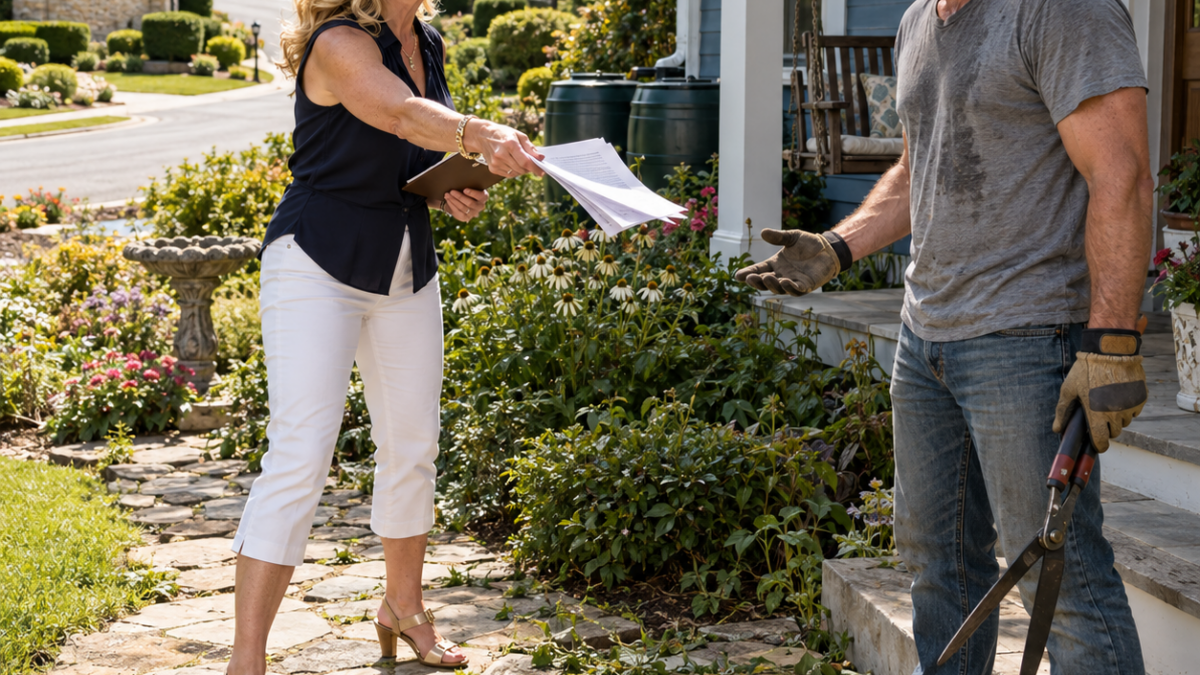
Two weeks after Karen showed up in my yard, I came home from work and found her standing on the sidewalk in front of my house with three HOA residents clustered around her. Two women in tennis skirts and a man with a golden retriever stood beside her, all looking at my porch like it was an abandoned gas station.
Karen was speaking before I even got out of my truck.
“—and when one property ignores the standards, everyone’s values suffer.”
I shut the truck door.
All four heads turned.
Karen smiled like she had been waiting.
“Mr. Price,” she called, loudly enough for the neighbors across the street to hear. “I’m glad you’re home. We were just discussing the ongoing violations.”
I walked up my driveway slowly.
“Why are you discussing my house with strangers?”
The man with the dog looked uncomfortable. The tennis-skirt women did not.
Karen lifted her chin.
“This affects the whole community.”
“I’m not in your community.”
One of the women frowned. “But you’re right next to it.”
“So is the gas station down the road.”
Karen turned slightly toward them, lowering her voice in a way meant to sound patient but still be overheard.
“This is exactly the resistance we’ve been dealing with.”
I looked at her.
“Resistance to what? Paying fines I don’t owe? Redoing a walkway you don’t own? Joining a group I never joined?”
Her smile sharpened.
“The documents are under review.”
“What documents?”
“Your membership status.”
“There is no membership status.”
She tapped her clipboard.
“Then it should be easy for you to provide proof.”
I laughed once, but this time it had no humor in it.
“You want me to prove I’m not in your HOA?”
“That would settle the matter.”
“No, Karen. You made the claim. You prove I am.”
The dog owner cleared his throat.
“Maybe there’s just some confusion.”
“There isn’t,” I said, still looking at Karen.
Her eyes flashed.
“Mr. Price, your hostility is not helping your case.”
“I don’t have a case.”
“You will if the fines remain unpaid.”
That got the attention of the little audience.
Karen knew it would.
She had timed this for people to see. She wanted me defensive in public. She wanted neighbors whispering that the man outside the HOA was being unreasonable. She wanted the pressure of eyes on me, because pressure is control disguised as concern.
“Get off my property,” I said.
The two women stiffened like I had cursed in church.
Karen placed one hand dramatically on her chest.
“I am standing on the sidewalk.”
“You walked across my lawn to inspect my porch. I saw you.”
“I am documenting violations.”
“You are trespassing.”
Her face hardened.
For one second, I saw what lived under all the polished blouses and community-language speeches. Rage. Not hot, messy rage. The disciplined kind. The kind that waits behind teeth.
“You are making a serious mistake,” she said.
“No,” I told her. “I made one when I thought you’d get bored.”
That night, I pulled out my closing documents, deed, property tax records, old survey, and the county parcel map. I spread them across the dining room table under the yellow overhead light and went through everything line by line.
I already knew the answer.
Still, seeing it in black and white helped.
My property was never annexed into Brookstone Meadows. No covenant. No deed restriction. No HOA membership. No assessment obligation. No architectural review. Nothing.
The Brookstone Meadows boundary stopped at the drainage easement behind their entry sign. My parcel sat outside it like it always had.
The next morning, I scanned everything and emailed it to the HOA address printed on Karen’s letters.
Dear Ms. Vale and Brookstone Meadows HOA Board,
Attached are the deed, county parcel record, and survey documents confirming that my property is not part of Brookstone Meadows and is not subject to your HOA covenants, fees, fines, or architectural rules. Please cease all further attempts to assess fines or enforce HOA rules against my property.
Daniel Price
I expected some grudging apology.
Maybe not from Karen, but from someone.
A treasurer. A secretary. A lawyer. An adult.
Instead, two days later, I received another letter.
Failure to Cure Violation. Daily fines will double beginning Monday.
That was when annoyance became anger.
I printed the same documents, made copies, and mailed them certified.
Karen signed for them herself.
I knew because the green receipt card came back with her name written in a tight, slanted hand.
Five days after that, she stood at the end of my driveway while I was unloading groceries.
“Certified mail,” I called. “You got the documents.”
She glanced toward the bags in my truck bed.
“Your side yard is visible from the community entrance.”
I stared at her.
“What?”
“The rain barrels. They need to be removed.”
“I sent proof.”
“And the walkway remains noncompliant.”
“You signed for proof that I’m not in your HOA.”
She gave a small shrug.
“The board has not accepted your interpretation.”
“My interpretation? It’s a deed.”
“It’s incomplete.”
That was a lie so bold it almost impressed me.
“You didn’t even read it.”
Her smile returned.
“Actually, I had it reviewed.”
“By who?”
“The board.”
“The board is not a court.”
“No,” she said, and her voice turned soft. “But the board can make your life very complicated.”
A breeze moved through the maple tree near the curb. A plastic grocery bag rustled in the truck bed. I remember those small sounds because the world often becomes strangely detailed when someone threatens you clearly enough.
Karen reached into the folder under her arm and pulled out a business card.
Vale Landscape & Exterior Design.
Her name.
Her company.
“I’m going to be generous,” she said. “My company has worked with many homes in Brookstone Meadows. We can bring your walkway, beds, and exterior frontage into harmony for a discounted rate.”
I took the card and looked at it.
The logo was a leaf curling around a stone path.
Of course it was.
“You’re fining me for a walkway,” I said slowly, “and offering to charge me money to replace it through your company.”
She smiled like I had finally understood.
“It would resolve the issue efficiently.”
“No. It would pay you twice.”
Her expression changed.
“Be careful.”
I stepped closer.
“No, Karen. You be careful. Because what you just described sounds a lot like extortion.”
Her nostrils flared.
“I tried to help you.”
“You tried to shake me down.”
“You are damaging property values for everyone around you.”
“I’m damaging your scam.”
She turned on her heel and walked away.
The next day, I received three separate violation letters.
One for the walkway.
One for the rain barrels.
One for “hostile conduct toward board representative.”
The fines doubled daily after that, at least according to Karen’s math. Within two weeks, I allegedly owed the HOA more than fifteen thousand dollars. By the end of the month, over thirty.
It would have been funny if Karen had stayed on paper.
She didn’t.
She began showing up whenever I was outside. Sometimes alone, sometimes with one or two residents in tow, sometimes standing across the street pretending to take photos of the entrance landscaping while aiming her phone at my house. If neighbors were outside, she made sure to speak loudly.
“This is what happens when people refuse standards.”
“We’re doing everything we can, but he won’t cooperate.”
“One property can drag down a whole neighborhood.”
I tried explaining to a few residents that I was not part of their HOA. Most seemed sympathetic in the weak way people are sympathetic when helping might cost them something.
“Yeah, Karen can be a lot,” one man whispered near the mailbox.
“Then say something.”
He looked toward the HOA entrance as if Karen might rise from behind the hedges.
“I don’t want to get on her radar.”
That was how she ruled.
Not by being respected.
By making herself exhausting enough that surrender looked like peace.
Then the city inspector came.
I was home on a Friday morning because a plumbing leak had forced me to take time off work. I heard a knock and opened the door to find a man in khakis holding a tablet.
“Code enforcement,” he said. “We received a complaint about overgrown vegetation, possible pest harborage, and unsafe exterior conditions.”
I looked past him at my trimmed lawn, mulched beds, and completely normal bushes.
“Let me guess,” I said. “Anonymous complaint?”
He gave me a tired smile.
“We don’t disclose complainants.”
“Was she blond?”
He looked down at his tablet.
“I don’t disclose hair color either.”
I liked him immediately.
He walked the property, took photos, checked the side yard, looked at the rain barrels, examined the hedges Karen had apparently described as a wildlife hazard, and found nothing wrong.
“These are native plantings,” he said.
“Yes.”
“Rain barrels are allowed.”
“Yes.”
“Walkway looks fine to me.”
“Thank you.”
He closed the tablet.
“I’ll mark it unfounded.”
“Will that stop future complaints?”
He gave me the look of a man who had seen too much neighborhood drama to believe in miracles.
“No.”
Karen filed four more complaints over the next six weeks.
Each one brought the city back.
Each one was cleared.
Each one cost me time, stress, and a growing sense that my house was no longer private. It felt watched. Judged. Surrounded by a government Karen did not control but had learned how to weaponize.
At night, I started checking the windows.
That embarrassed me.
I am not a paranoid person. I don’t scare easily. But harassment does something strange to your nervous system. It turns ordinary noises into warnings. A car slowing down outside becomes a threat. A letter in the mailbox becomes a weapon. A woman with a clipboard becomes a shadow across your kitchen floor even when she isn’t there.
One evening, after another city inspection, I sat at my kitchen table and opened the drawer full of HOA letters. There were so many by then that the envelopes had started curling at the edges.
I spread them out.
Fines. Threats. Accusations. False claims. Daily penalties. Demands to hire Karen’s company. Certified proof ignored. City complaints.
For the first time, I admitted something I had been avoiding.
This was not going to stop because I was right.
Right does not enforce itself.
I needed help.
I started trying to contact anyone connected to the HOA besides Karen. The website listed board members but no direct numbers. Emails bounced or went unanswered. The community office phone went straight to voicemail. At one point, I found an old PDF newsletter from years earlier with contact information for former board volunteers.
Most numbers were dead.
One wasn’t.
His name was Robert Cline.
When I called, he sounded wary before I finished introducing myself.
“If this is about Brookstone, I’m not on the board anymore.”
“I know. I’m calling because Karen Vale is harassing me.”
The line went quiet.
Then he sighed.
“What did she do?”
That question told me more than any warning could have.
I explained. The fines. The documents. The certified mail. The landscaping company. The city complaints.
Robert listened without interrupting.
When I finished, he said, “You’re not the first.”
My grip tightened on the phone.
“She’s done this before?”
“Not exactly like this. But yes. Pressure campaigns. Fines that don’t make sense. Steering work toward her company. Threatening people until they pay just to make her go away.”
“Why hasn’t anyone stopped her?”
Another sigh.
“Because most people are inside the HOA, and she controls the board. If you fight, she fines you. If you complain, she calls it misconduct. If you run against her, she digs into your property history and makes your life hell.”
“What about the rest of the board?”
“Rubber stamps now. The good ones left.”
“Why did you leave?”
He was silent for a long time.
“Because I saw things I didn’t want my name near.”
The room seemed to cool around me.
“What things?”
“I shouldn’t say.”
“Robert, she’s trying to bury me in fake fines.”
“I believe you.”
“She offered me a discount through her company to fix violations she invented.”
He cursed softly.
Then he said, “Meet me somewhere public.”
We met the next morning at a diner outside town.
Robert was in his sixties, broad-shouldered, with white hair and a face lined by years of sun. He looked like the kind of man who had once believed in committees and now regretted it.
He brought a folder.
Not a big one.
But heavy enough.
“I’m not doing this for revenge,” he said before opening it.
“I am,” I admitted.
That almost made him smile.
“At least you’re honest.”
Inside were copies of old board minutes, invoices, internal emails, and financial summaries from the year before Robert resigned. At first, the documents were just numbers. Landscaping contracts. Maintenance expenses. Special project reimbursements. Event budgets. Consulting charges.
Then Robert pointed.
“Vale Landscape,” he said.
Karen’s company.
Again and again.
Paid for entrance maintenance. Paid for seasonal planting. Paid for walkway repairs. Paid for drainage improvements. Paid for consultation. Paid for emergency cleanup. Paid for design review.
“Some of those jobs were real,” Robert said. “Some were inflated. Some I’m not sure happened at all.”
I flipped through the invoices.
“Why didn’t you report it?”
“I tried raising it internally.”
“And?”
“She turned the board against me. Said I was confused, bitter, maybe having memory issues. I left before she could make it worse.”
He pulled out another sheet.
“This is what worried me most.”
It was a tax filing summary tied to Vale Landscape & Exterior Design. Robert had highlighted reported income numbers that did not match the HOA payment records.
“I’m not a tax attorney,” he said. “But I ran a small business for thirty years. These numbers don’t smell right.”
I looked at him.
“You think she’s skimming HOA funds?”
“I think she’s paying her own company with association money, inflating invoices, then manipulating what gets reported through the business. Could be tax fraud. Could be embezzlement. Could be both.”
The diner noise faded around me.
Forks on plates. Coffee pouring. A child whining near the counter.
All of it sounded far away.
Karen had not just been bullying me.
She had been building a machine.
The HOA gave her authority. The fines created fear. Her landscaping company gave her a way to extract money. The board gave her cover. The residents gave her silence because silence felt safer than becoming next.
I thought of her standing in my driveway with that business card.
A discount.
A favor.
A trap.
“What do I do with this?” I asked.
Robert closed the folder.
“That depends what kind of person you are.”
At home, I sat with the folder for hours.
I am not going to pretend I floated above anger like some noble monk. I was furious. I wanted Karen exposed. I wanted her humiliated. I wanted every resident who whispered sympathy but stayed silent to see what their fear had protected.
But anger alone is dangerous. It can make you sloppy.
So I got careful.
I made copies of everything Robert gave me. I built a timeline. I matched Karen’s letters to city complaints, fines, and offers from her company. I downloaded public business filings for Vale Landscape & Exterior Design. I searched tax liens, county records, HOA meeting minutes, vendor contracts, and anything else available without breaking the law.
Then I did two things.
First, I submitted a detailed report to the IRS whistleblower office.
I included suspected underreported business income, possible self-dealing, HOA payments to Karen’s company, and supporting documents. I did not exaggerate. I did not write like a man seeking revenge. I wrote like a man stacking bricks.
Second, I called a journalist.
Her name was Marissa Lane, and she worked for the local paper. She had written about municipal corruption, shady contractors, and a school board procurement mess a few years back. I emailed her a short message explaining that an HOA president appeared to be using her position to harass nonmembers, direct business to her landscaping company, and possibly misuse association funds.
She called me within two hours.
“Can you prove any of that?” she asked.
“I can prove enough for questions.”
“That’s my favorite kind.”
We met at the same diner.
This time, I brought copies.
Marissa was younger than I expected, sharp-eyed, with a recorder she asked permission to use and a notebook already half full before I finished the first cup of coffee. She did not care about my feelings, which made me trust her more. She cared about documents, names, dates, money, and whether other people would confirm a pattern.
“Will Robert talk?” she asked.
“Maybe.”
“Will residents talk?”
“If they’re not terrified.”
She smiled without humor.
“Terrified people talk anonymously.”
The article did not run right away.
That was good.
Marissa dug.
She spoke to Robert. Then two former board members. Then three residents who had paid Karen’s company after receiving violation notices. Then one elderly widow who had been fined for “improper front bed composition” and pressured into a $4,800 landscaping job she could not afford. Then a young couple who had received daily fines until they hired Vale Landscape to replace perfectly good shrubs.
She found city complaint records.
Mine were not the only ones.
Karen had filed complaints against residents who challenged her, then offered them “solutions” through her business. She had pushed board votes approving vendor contracts without disclosing the full scope of her personal financial interest. She had raised dues while association money flowed steadily toward companies connected to her.
By the time Marissa called to tell me the story was running Sunday, her voice sounded almost grim.
“This is bigger than your walkway.”
“I know.”
“Are you ready for people to blame you?”
I looked out my kitchen window toward the HOA entrance.
Karen’s precious monument sign glowed under landscape lights probably paid to her own company.
“They already do.”
The headline hit like a brick through glass.
HOA PRESIDENT ACCUSED OF HARASSING NEIGHBORS WHILE PROFITING FROM ENFORCEMENT WORK
Below it, Marissa laid out the pattern: fines, pressure, self-dealing, city complaints, vendor payments, former board concerns, and my situation as the non-HOA homeowner Karen had tried to regulate anyway. The article quoted me only once.
“I am not part of Brookstone Meadows. Ms. Vale had no authority over my property, but she attempted to fine me, pressure me into hiring her company, and involve the city when I refused.”
It was plain.
It was true.
It was enough.
By noon, my phone was full of messages.
Some supportive.
Some curious.
Some furious.
One Brookstone resident wrote, You should have handled this privately. Another said, You don’t know what you’ve done to this neighborhood. A third simply sent, Thank you. She did this to my mother too.
Karen posted a statement on the HOA website that afternoon.
It called the article “defamatory,” “misleading,” and “an attack on community standards by disgruntled individuals resistant to accountability.” She claimed all contracts had been approved by the board, all complaints were legitimate, and all fines were issued according to governing documents.
Then she made the mistake of mentioning me.
Certain adjacent property owners have attempted to benefit from proximity to Brookstone Meadows while refusing to respect the standards that preserve value for our residents.
Adjacent property owners.
Plural language for one man she could not control.
That statement did not calm people down.
It poured gasoline.
Residents started comparing notes. Private messages became group chats. Group chats became emergency meetings in driveways and kitchens. People found old invoices. Violation letters. Emails from Karen. Receipts from Vale Landscape. Photos of before-and-after jobs that looked suspiciously unnecessary. The elderly widow’s adult son contacted Marissa with more documents. Another former board member admitted Karen had blocked financial audits.
And then the IRS notice arrived at Vale Landscape.
I did not know that officially at first.
I heard it from the neighborhood gossip chain, the same one that had carried Karen’s insults for months. A resident who worked in accounting saw Karen storm out of her office building crying into a phone. Someone else said two men in suits had visited. Robert called me later and said an investigator had contacted him about HOA payments.
Karen disappeared from public view for exactly six days.
Then she came to my house.
It was raining hard that evening, the kind of rain that makes streetlights blur and gutters overflow. I heard pounding on my front door just after eight.
Not knocking.
Pounding.
I opened it with my phone already recording in my hand.
Karen stood on the porch, soaked, hair plastered near her temples, mascara smudged under one eye. Her expensive blouse clung to her shoulders. For the first time since I had known her, she looked less polished than furious.
“You,” she said.
“Good evening.”
“You did this.”
“I reported what you did.”
“You went to the press.”
“You went to the city. Repeatedly.”
Her face twisted.
“You have no idea what you’ve started.”
“I think I’m learning.”
“My business is being audited.”
“Sounds stressful.”
Her eyes went wide with outrage.
“You smug little coward.”
I kept the phone steady.
“You should leave.”
“You ruined me over a walkway.”
“No, Karen. You tried to extort me over a walkway. Then I found out the walkway was one thread in a much uglier sweater.”
“You had no right.”
“To report suspected fraud?”
“To destroy someone’s life.”
Rain blew onto the porch between us.
For a moment, something like pity flickered. Not sympathy. Not forgiveness. Just the sudden awareness that Karen, underneath the title and clipboard and threats, was a person watching consequences approach faster than she could outrun them.
Then she leaned closer and whispered, “If I lose everything, that is on you.”
The pity vanished.
“No,” I said. “That is the first honest bill you’ve ever received.”
She slapped me.
It was fast, sharp, and stupid.
My head turned with the force of it. Heat spread across my cheek.
For one second, she looked shocked at herself.
Then she saw the phone.
I had recorded everything.
Her mouth opened.
I said, very quietly, “Get off my porch.”
She stepped back into the rain.
I closed the door.
My hand was shaking when I saved the video.
I did not call the police. Maybe I should have. Instead, I sent the clip to Marissa, Robert, and my attorney, because by then I had finally hired one. His name was Paul Emery, a calm man with steel-gray hair who specialized in civil disputes and seemed delighted by clean documentation.
His response to the video was immediate.
Do not engage with her again. We will send a cease-and-desist tomorrow.
The next months moved like a storm system.
The IRS investigation deepened. The state attorney general’s office began looking into HOA financial practices. Residents filed formal complaints. Brookstone Meadows held an emergency meeting that collapsed into shouting before the agenda was approved. Karen tried to preside and was booed so loudly she left through a side door.
The board suspended her pending review.
She claimed the suspension was illegal.
Then Dennis, the HOA treasurer—not his real name, but close enough—resigned abruptly. That told everyone what they needed to know. Treasurers do not vanish during clean audits.
The financial report that eventually leaked was brutal.
Vale Landscape had received inflated payments for work either overpriced, unnecessary, incomplete, or never verified. Karen had failed to disclose conflicts. HOA funds had been routed through vague project categories. Her business income filings did not match records investigators obtained. There were questions about payroll, equipment deductions, cash transfers, and personal expenses disguised as business costs.
The phrase “tax fraud” began appearing in places Karen could not threaten into silence.
Her company lost contracts almost immediately. Brookstone canceled its vendor agreement. Other clients followed. Once the article updates spread, nobody wanted Vale Landscape touching their shrubs. Her business collapsed in stages: first staff gone, then trucks repossessed, then office closed, then bankruptcy filing.
Karen lost the HOA presidency before the bankruptcy finalized.
Not gracefully.
At the removal meeting, according to Robert, she stood in front of a packed clubhouse and accused the residents of betrayal.
“I protected this community,” she shouted. “I raised your property values. I enforced standards when all of you were too weak to do it.”
An older man stood up in the back and said, “You stole from us.”
People clapped.
Karen tried to speak over them.
Nobody listened.
That was the first consequence.
The second was financial.
The third was social.
The fourth was her house.
I did not celebrate when I heard she had lost it.
I need to be honest about that.
Part of me wanted to.
The angry part. The part that remembered her standing in my yard with strangers, calling my home a violation. The part that remembered city inspectors, daily fines, that business card, the slap on my porch, the months of feeling watched inside my own kitchen.
That part of me wanted to open a bottle and toast.
But there was another part too.
The part that understood a house is never just siding and drywall. Even Karen’s house. Even after everything. Losing a home is a particular kind of collapse. It takes your routines, your privacy, your proof of stability. It turns your life into boxes and judgment.
So when I heard she had gone from HOA president to bankrupt former business owner to woman sleeping in her car, I did not cheer.
I also did not apologize to the universe for refusing to weep.
At first, people were satisfied.
Brookstone residents talked about justice. They celebrated the new board. They posted angry comments under news articles. They shared clips of Karen being shouted down at the meeting. Some thanked me privately, though most still did not want to be seen doing it publicly.
Then the story changed.
Because people are strange with consequences.
They like accountability until it has a face.
When word spread that Karen had lost her house, the same people who once called her a thief began lowering their voices. Someone saw her at a shelter intake office. Someone saw her sleeping in a park. Someone said her sister would not take her in. Someone else said she had tried applying for work but nobody wanted the scandal attached to their business.
Suddenly, I became the problem again.
The first direct accusation came from a woman named Melanie, who lived three houses inside the HOA entrance. She stopped me while I was getting mail.
“You must be proud,” she said.
I turned with a stack of envelopes in my hand.
“Of what?”
“Karen.”
“What about her?”
Melanie’s mouth tightened.
“She’s homeless.”
I waited.
“And?”
She blinked like she expected shame to fill in the blank.
“And you don’t feel bad?”
“I feel bad that she stole from people.”
“She’s sleeping in a shelter.”
“She should not have committed fraud.”
“You went to the press.”
“She went after my house.”
“You could have just gotten a lawyer.”
“I did.”
“You could have handled it quietly.”
I stared at her.
“Quietly is how she got away with it.”
Melanie looked away first.
“She was awful,” she admitted. “But nobody deserves that.”
“She did not become homeless because I told the truth. She became homeless because the truth was expensive.”
“That sounds cold.”
“Maybe. But it’s accurate.”
The collection started a week later.
A few Brookstone residents decided to raise money for Karen. Temporary housing, food, maybe legal support. I heard about it from Robert, who sounded disgusted and amused in equal measure.
“They’re passing a hat,” he said.
“For Karen?”
“For Karen.”
“The same Karen who stole from them?”
“People enjoy moral theater after they finish enjoying revenge.”
I wanted to stay out of it.
I really did.
Then Melanie came to my door with an envelope.
I opened it and found her standing there with another woman, both wearing expressions of solemn charity.
“We’re collecting donations for Karen,” Melanie said.
I looked at the envelope.
Then at her.
“No.”
She flinched.
“You don’t even want to hear—”
“No.”
“She has nowhere to go.”
“She stole enough money from this neighborhood.”
“That’s cruel.”
“What’s cruel is using widows and retirees as revenue streams.”
“She lost everything.”
“So did some of her victims.”
The other woman crossed her arms.
“This is exactly why people think you went too far.”
I laughed, but it came out tired.
“People think I went too far because now they can see the end result. They didn’t mind when she was aiming at me.”
“That’s not fair.”
“No, it wasn’t fair when she tried to fine a nonmember into hiring her company. It wasn’t fair when she filed false complaints with the city. It wasn’t fair when residents stayed silent because they didn’t want to be next. But now that Karen is sleeping in the consequences, suddenly fairness is urgent.”
Melanie’s face reddened.
“You have no compassion.”
That sentence hit something in me.
Because I did.
That was the problem.
Compassion had been gnawing at me for days, quiet and unwelcome. I did picture Karen in a shelter. I did picture her in a park at night, cold and humiliated. I did wonder whether destruction was justice or just another kind of ugliness once it crossed a certain line.
But compassion is not the same as responsibility.
And I refused to let people hand me the bill for Karen’s choices simply because I was the one who stopped paying in silence.
“I have compassion,” I said. “I just don’t have amnesia.”
I closed the door.
After that, the neighborhood divided itself into invisible camps.
Some people thought I had done the right thing. Some thought I had gone too far by involving the press. Some thought reporting to the IRS was justified but public exposure was cruel. A few believed Karen was a victim of “cancel culture,” which was a ridiculous phrase to use for an adult woman caught steering HOA money into her own company and threatening nonmembers with fake fines.
The new HOA board sent me a formal letter of apology.
It was stiff but real.
Brookstone Meadows Homeowners Association acknowledges that your property is not and has never been subject to association covenants, assessments, fines, or architectural standards. The association regrets prior communications and enforcement attempts made under former leadership.
Paul read it and nodded.
“Frame it.”
I didn’t frame it.
I put it in the same folder as everything else.
The fines disappeared. The city complaints stopped. No more violation letters arrived. Karen’s name was removed from the HOA website. Vale Landscape’s sign came down from the small office park on the other side of town.
My life got quiet again.
But not the same quiet as before.
There is a quiet that comes from peace, and there is a quiet that comes after a fight, when everything has stopped moving but your body still expects impact. For weeks, I kept bracing. Every car slowing outside my house made me look up. Every unexpected knock tightened my chest. I checked the mailbox like it might bite.
Then slowly, the house became mine again.
I repainted the porch swing.
I planted more native flowers, partly because I liked them and partly because I knew Karen would have hated every wild, bright inch. I cleaned the rain barrels. I reset one uneven stone in the walkway but left the rest exactly as they were. The walkway was not perfect. It had never been perfect. My father and I had laid it ourselves one long weekend with a rented compactor, bad measurements, and too much confidence. Every uneven edge belonged to a memory.
One morning, Robert stopped by while I was pulling weeds near the front bed.
He stood at the edge of the walkway and looked down.
“Still noncompliant,” he said.
I grinned.
“Deeply.”
He handed me a coffee.
For a while, we stood there watching cars roll past the HOA entrance. Brookstone looked calmer under the new board. Less manicured maybe, but calmer. A few residents waved now. Some still looked away.
“Do you regret it?” Robert asked.
I did not answer immediately.
Regret is not simple.
Did I regret reporting fraud? No.
Did I regret talking to Marissa? No.
Did I regret that Karen lost the power she used to hurt people? Absolutely not.
Did I enjoy knowing she had no home? No.
That was the part people wanted to flatten. They wanted me either cruel or saintly, either villain or hero, either destroyer or victim. Real life did not fit. I could believe Karen deserved consequences and still feel the weight of what those consequences looked like. I could refuse to donate to her and still hope she found a legal way to survive. I could pity the woman without excusing the president.
“I regret that nobody stopped her sooner,” I said finally.
Robert nodded.
“That includes me.”
I looked at him.
He stared toward the HOA sign.
“I knew enough to leave,” he said. “Not enough to fight.”
“You gave me the documents.”
“After she came for someone outside the fence.”
“Maybe that’s what it took.”
He smiled sadly.
“Maybe.”
The IRS case ended quietly compared to the news storm that started it.
There was no dramatic perp walk, no courtroom shouting, no Karen collapsing in tears while the judge slammed a gavel. It was mostly penalties, settlements, bankruptcy proceedings, business dissolution, and a tax debt that would follow her for years. The state investigation into HOA funds resulted in findings that forced Brookstone to restructure its accounting, submit to an independent audit, and adopt conflict-of-interest rules with actual teeth.
Karen was barred from serving on the HOA board again.
That mattered more to me than I expected.
Power had been her addiction.
Removing the title was like taking the crown from someone who had mistaken costume jewelry for divine right.
A year later, I saw her once.
I was leaving the grocery store with two bags in my cart when I noticed a woman near the bus stop.
At first, I only saw the posture.
Straight-backed even in defeat.
Then she turned her head.
Karen.
Her hair was shorter and darker at the roots. She wore jeans, a gray sweatshirt, and sneakers instead of gold-buckled sandals. There was a duffel bag near her feet. She looked thinner. Older. Smaller, but only physically. Her eyes still had the same hard center.
For a second, we stared at each other.
My first feeling was not triumph.
It was surprise.
Then discomfort.
Then something dangerously close to sadness.
She looked away first.
I loaded my groceries into the truck.
I could have said something. I could have offered money. I could have asked if she had somewhere to go. I could have performed compassion for myself or for the ghost audience of neighbors who thought I lacked it.
I did none of that.
I got in my truck and sat there with the engine off.
Through the windshield, I watched the bus arrive. Karen picked up her duffel and climbed on without looking back.
For days afterward, I thought about that moment.
Not constantly, but enough.
Was I cruel?
Was I satisfied?
Was I responsible?
I kept returning to the same truth: I did not create Karen’s fraud. I did not make her file false complaints. I did not force her to skim, inflate, threaten, or extort. I did not tell her to turn neighborly governance into a personal cash machine. I did not make her slap me on my own porch. I did not make her sign tax filings. I did not make her confuse authority with ownership.
I opened the door she had hidden behind.
What happened after that was not all mine to carry.
Still, the moral weight of exposure is real. Anyone who tells you otherwise has never watched accountability turn into rubble.
The neighborhood eventually moved on because neighborhoods always do. People who once whispered about Karen began whispering about a new family painting their garage door black. The HOA argued about pool hours and holiday lights. The new board published boring financial reports with more detail than anyone wanted to read, which was exactly how it should be. Robert joined the finance committee as an advisor, probably because guilt can be useful if it becomes service.
As for me, I became the guy on the edge who had taken down Karen.
Some people said it with admiration.
Some with warning.
I learned to accept both.
One afternoon, a new resident knocked on my door. Young guy, nervous, holding a letter.
“Sorry to bother you,” he said. “I heard you know stuff about the HOA.”
“That depends what kind of stuff.”
He handed me the letter.
It was a violation notice for a fence stain color. Legitimate property, legitimate member, maybe legitimate issue. I looked it over and gave it back.
“You’re in the HOA,” I said. “So first, check the covenants. Don’t trust the summary. Read the actual rules. Then ask for the specific section they’re relying on. Get everything in writing. Be polite, but don’t be scared of them.”
He nodded quickly.
“People said you hate the HOA.”
“I hate unchecked power,” I said. “Different thing.”
He looked toward the Brookstone entrance.
“Same thing sometimes.”
“Only when people let it be.”
After he left, I sat on the porch swing and looked at my walkway.
The stones were warm in the sun, uneven as ever. Bees moved through the flowers. A rabbit sat near the birdbath, chewing something it probably shouldn’t. Across the road, the Brookstone fountain sprayed water into the fake lake, catching light in silver bursts.
For the first time in months, I felt the quiet settle without fear underneath it.
Karen had wanted conformity.
She had wanted control.
She had wanted my house to bend because it was near her kingdom, and kingdoms hate reminders that borders exist.
But my house was still blue.
My rain barrels still stood by the side wall.
My flowers still grew wild enough to make neat people nervous.
My walkway still led from the road to my porch in a crooked line my father’s hands had helped set.
And Karen, wherever she was, no longer had the power to call any of it a violation.
That is the part people miss when they say I ruined her.
I did not ruin Karen by reporting her.
I survived her by refusing to be quiet.
There is a difference.
A bully with a title can do real damage. A clipboard can become a weapon. A fine can become a threat. A complaint can become harassment. A business card can become extortion when held by someone who also claims the power to punish you. People love to say, “Just ignore it,” until the letters pile up, the city knocks, the neighbors stare, and your own home starts feeling like disputed territory.
I ignored Karen at first.
That did not make me peaceful.
It made me available.
The day I stopped being available was the day her whole machine started shaking.
Do I have a heart?
Yes.
That is why I was angry.
Because Karen did not only bother me. She frightened elderly homeowners. She pressured families. She trained an entire neighborhood to lower their eyes. She used other people’s fear as a business model. And when someone finally dragged that into daylight, people wanted to mourn the darkness because the light was harsh.
I will not pretend harshness is kindness.
But sometimes it is necessary.
If I had gone quietly to court over my own fines, maybe I would have won. Maybe Karen would have stopped bothering me. Maybe my walkway would have been safe, my rain barrels left alone, my mailbox free of green-lettered threats.
And maybe the widow would still be paying off landscaping she never needed.
Maybe the young couple would have drained savings to satisfy another invented standard.
Maybe Brookstone residents would still be watching their dues disappear into a company Karen controlled.
Maybe the next person outside the HOA boundary would have been easier to scare.
Quiet solutions protect quiet corruption.
I did not owe Karen that.
Months after everything settled, I finally found the first packet she had handed me that morning. I had shoved it into a kitchen drawer and forgotten about it. The paper was creased, the ink slightly faded. Nonconforming walkway. Nonstandard landscape. Unapproved exterior features.
At the bottom, under the fine total, Karen had signed in blue ink.
Karen Vale, HOA President.
I ran my thumb over the signature.
Then I walked outside and sat on the top porch step.
The sun was going down behind Brookstone Meadows, turning the HOA sign gold. For a second, it looked almost beautiful. That was the thing about controlled places. From far away, they could seem peaceful. Clean. Ordered. Safe.
But peace built on fear is just silence with landscaping.
I tore the violation notice in half.
Then again.
Then again.
I dropped the pieces into the trash and went back inside.
My house smelled like coffee and sawdust because I had been repairing a bookshelf in the living room. The porch swing creaked in the evening breeze. Somewhere down the road, a dog barked. No one stood on my sidewalk with a clipboard. No city inspector knocked. No certified letter waited by the door.
I slept deeply that night.
For the first time in a long time.
And if Karen ever wonders whether I feel guilty, the honest answer is this:
I feel the weight of it.
But guilt belongs to the person who did wrong.
Not the person who finally told the truth.