𝗙𝗨𝗟𝗟 𝗦𝗧𝗢𝗥𝗬 Karen Sold My Grandmother’s Beach House While I Was Overseas, Then Smiled When I Came Home to Find Strangers Living There
𝗙𝗨𝗟𝗟 𝗦𝗧𝗢𝗥𝗬
She had a soft, seductive voice when she wanted something.
A cutting one when she didn’t get it.
And a smile that could be charming from far away but never reached her eyes up close.
For years, Karen had wanted my grandmother’s property under her control.
The association claimed it was an eyesore because it was modest and older than the villas around it. They complained the exterior did not match the new coastal aesthetic. They disliked the low stone wall, the wooden shutters, the wild flowering vines my grandmother had loved, and the fact that the path beside the house gave old fishing families easier access to the beach.
But the truth was simpler.
They wanted the land.
My grandmother had refused them.
My mother had ignored them.
Then I was overseas, grieving, buried in documents, and absent.
Karen saw opportunity where decent people would have seen someone’s family home.
I finally flew back once Amina confirmed the estate transfer was complete.
The trip was supposed to be healing.
I pictured myself opening the gate, walking through the dusty rooms, maybe crying in the kitchen where my grandmother used to hum while preparing tea. I planned to inspect repairs, hire contractors, and decide whether I wanted to use the place as a vacation home or restore it slowly until I could retire there one day.
I landed exhausted but hopeful.
At the airport, I hired a driver and gave him the address.
The farther we drove from the city, the more nervous I became. The roads changed. Familiar landmarks were gone. Places from my childhood had been replaced by cafés with English menus and resorts with names like Ocean Pearl and The Meridian Coast.
Then we reached the street.
For a moment, I recognized almost nothing.
Then I saw the roofline.
My grandmother’s house.
Still there.
Smaller than memory, weathered by salt air, but standing.
My chest tightened.
Then I saw the strange car parked outside.
The open windows.
The laundry hanging near the side porch.
The children’s sandals by the door.
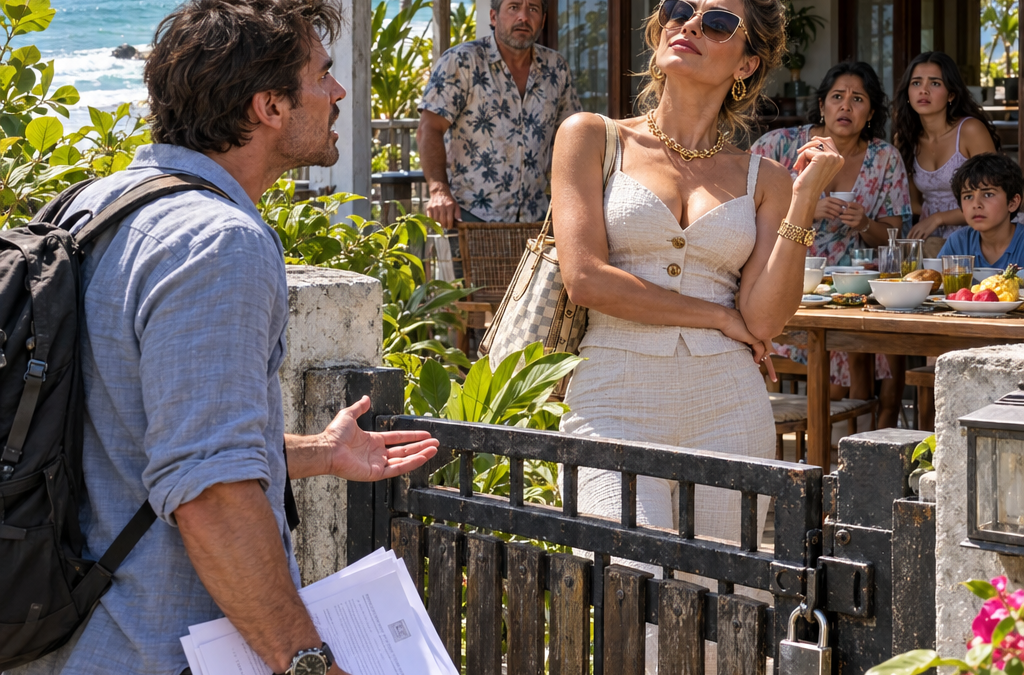
And the family sitting at the front porch table eating breakfast.
I got out of the car slowly.
The driver asked if I was sure this was the right address.
I didn’t answer.
A middle-aged man sitting on the porch looked up from his plate. He had a heavy body, a red face, and the annoyed confidence of someone used to being obeyed. His wife sat beside him. Two children stared at me over bowls of rice.
I walked to the gate.
It had a new lock.
My grandmother’s old brass lock was gone.
“Excuse me,” I called.
The man stood.
“Can I help you?”
His tone said clearly that he did not want to.
“What are you doing in this house?”
His expression hardened immediately.
“This is my house.”
“No, it isn’t.”
His wife gathered the children closer.
I gripped the gate.
“This was my grandmother’s house. I’m the legal owner.”
The man laughed once.
A short, ugly sound.
“You need to leave.”
“I have the title documents.”
“So do I.”
My stomach dropped.
He stepped off the porch and walked toward me.
“I bought this property legally through the neighborhood association. If you don’t leave, I’ll call security.”
Security.
At my grandmother’s house.
For a moment, grief and rage hit me so hard I could barely breathe.
I pulled out my phone and called Amina.
She answered on the second ring.
“I’m at the house,” I said.
“Good. Is everything okay?”
“There are people living in it.”
Silence.
“What?”
“They say they bought it through the neighborhood association.”
Another silence, colder this time.
“Do not argue with them further. Come to my office.”
Over the next few days, Amina and I uncovered the theft.
I use that word deliberately.
Not mistake.
Not dispute.
Theft.
The neighborhood association had declared my grandmother’s house abandoned.
They filed papers at the local land registry claiming the property had been vacant for years and that no owner could be located. They claimed they had made repeated attempts to contact the owner. They submitted inspection reports describing a deteriorating, unsecured building with broken windows, graffiti, and a partial roof collapse.
All lies.
Using those documents, and with help from corrupt registry officials, they obtained a certificate of abandonment.
That certificate allowed the property to be auctioned.
The auction was not public in any meaningful sense. It was barely advertised. No legitimate notice reached me, my lawyer, or any address connected to my family.
The only bidder was the man now living in the house.
His name was Victor.
He was Karen’s nephew.
He bought my grandmother’s beachfront property for a fraction of its real value.
Eight months before I arrived, he moved his family into my house.
When Amina finished explaining, I sat in her office unable to speak.
There are kinds of anger that burn hot and disappear.
This was different.
It was deep, slow, and poisonous.
These people had not only stolen property.
They had invaded memory.
They had sat on my grandmother’s porch, eaten at her table, slept under her roof, and looked at me like I was trespassing when I came home.
Amina folded her hands on her desk.
“What they did is illegal on several levels. Fraud. Forgery. False declarations. Potential bribery. Sale of property they did not own.”
“Can we get it back?”
“Yes.”
“How long?”
She exhaled.
“It will not be quick.”
“I don’t care.”
“It will be expensive.”
“I don’t care.”
Her eyes softened.
“We need to build a case so strong they cannot bury it.”
“Then we build it.”
And we did.
The first step was evidence.
Amina filed requests with the land registry for every document connected to the abandonment certificate and auction. When the copies arrived, the fraud looked almost insulting in its laziness.
The association claimed they had sent registered letters to the owner at several addresses.
None were mine.
None belonged to my mother.
None had any connection to my grandmother.
One was a commercial building in the capital.
One address did not exist at all.
Another belonged to a defunct business that had closed years earlier.
“They didn’t even try to make this convincing,” I said.
Amina looked grim.
“They didn’t think they had to.”
The inspection reports were worse.
Broken windows.
Collapsed roof section.
Graffiti on interior walls.
Evidence of abandonment.
I still had Mrs. Santos’s photos.
Timestamped.
Clear.
Taken months before she died, well within the period the association claimed the house was falling apart.
No broken windows.
No collapsed roof.
No graffiti.
The garden was overgrown, yes.
The paint faded, yes.
But the house was intact.
Locked.
Maintained.
Not abandoned.
Then we found Mrs. Santos’s son.
His name was Rafael, and he still lived in the area.
When I explained what had happened, his face changed from politeness to fury.
“My mother told them,” he said.
“Told who?”
“The association woman. Karen. Her people. They came many times asking about that house.”
My pulse quickened.
“What did your mother say?”
“She said the owner was abroad. Family inheritance. Legal paperwork. She said someone would come.”
Rafael gave a written statement detailing multiple conversations between his mother and Karen’s association representatives. They had been explicitly told the property had an active owner. They knew exactly why it was empty.
Karen had not mistaken absence for abandonment.
She had used absence as cover.
When we finally met Karen in person, it was outside the association office, a modern white building beside one of the newer developments.
She arrived in a cream linen dress and oversized sunglasses, stepping from a black SUV like she was arriving at a charity gala instead of a meeting about stolen property.
Victor came with her.
So did an association lawyer who looked nervous before anyone spoke.
Karen removed her sunglasses and smiled at me.
“You must be the heir.”
I hated the way she said it.
Not owner.
Heir.
Like I was a technicality.
“I’m the legal owner of the beach house your association sold.”
Her smile cooled.
“That matter was handled through proper channels.”
“No, it wasn’t.”
She tilted her head.
“I understand this is emotional for you.”
The rage that moved through me was almost physical.
“Do not talk to me like grief makes me stupid.”
Victor muttered something under his breath.
Amina shot him a look that silenced him.
Karen’s eyes narrowed.
“We followed the law.”
“You filed false contact attempts.”
“I’m not personally involved in every administrative detail.”
“You submitted fake inspection reports.”
“That is your allegation.”
“You sold my property to your nephew.”
Her smile twitched.
“Victor purchased the property at auction.”
“A rigged auction.”
“Careful.”
The word came out softly.
Almost sweet.
There was the Karen underneath the polish.
The woman who had probably intimidated residents, vendors, workers, and local officials for years with a smile and a threat wrapped together.
I stepped closer.
“No. You be careful.”
Her eyebrows lifted.
“This property belonged to my grandmother. It belongs to me now. You stole it while I was overseas handling the deaths of my family. I am going to get it back. And when I do, I’m going to make sure everyone knows exactly what you did.”
Karen put her sunglasses back on.
“Foreign heirs always think they can fly in and throw money around.”
“I don’t need to throw money.”
I looked at the folder in Amina’s hand.
“I have documents.”
For the first time, Karen’s expression changed.
Only slightly.
But I saw it.
Not fear.
Calculation.
That was enough.
We filed the civil suit within weeks.
Karen, the association, Victor, and the individuals connected to the fraudulent transfer were all named.
We sought to void the sale, regain the property, recover damages, and expose the fraud.
At the same time, we filed criminal complaints for fraud, forgery, bribery, and corruption.
But I wanted more than a quiet court battle.
Karen cared about reputation.
That much was obvious.
She had built herself into a pillar of the community. HOA president. Charity organizer. Wealthy expat hostess. The woman who gave speeches about responsible development and preserving neighborhood values while stealing a dead woman’s home.
So we went to the press.
Amina connected me with a local journalist named Leila who covered real estate corruption.
I gave her everything we could legally share.
The false abandonment documents.
The fake addresses.
The fabricated inspections.
Mrs. Santos’s timestamped photos.
Rafael’s statement.
The sweetheart auction.
Victor’s connection to Karen.
My family history.
A photo of my grandmother on the porch from years before, wearing a blue dress and smiling toward the ocean.
Leila did her own verification.
She spoke to long-time residents.
That was when we learned I was not the first target.
Other original landowners had been pressured, harassed, fined, threatened, or tricked into selling cheaply. A few had lost smaller parcels through questionable registry procedures. Most had lacked the money, documents, or stamina to fight.
Karen had mistaken my distance for weakness.
The article landed like a bomb.
The headline did not hide behind polite language.
It described how a neighborhood association allegedly used fraudulent abandonment claims to transfer a family beach house to the president’s relative.
It included my grandmother’s photo.
It described the house as a family property passed down through generations.
It named Karen.
It named Victor.
It named the registry office.
Suddenly, the theft was no longer paperwork hidden in government drawers.
It was a story people could understand.
A dead grandmother’s house.
An heir overseas.
A glamorous association president.
A rigged auction.
A nephew living in stolen rooms.
Karen tried to deny everything.
She posted a statement saying the association had acted in good faith to address abandoned properties and improve community safety.
No one believed her for long.
The documents were too clear.
Her social world reacted first.
Her charity organization quietly removed her from leadership.
Invitations stopped.
People who had once smiled beside her at fundraisers began claiming they barely knew her.
The wealthy expat community, which had tolerated her arrogance when it came dressed in linen and pearls, suddenly discovered moral concern once journalists started calling.
Karen hated that more than anything.
I heard from Leila that Karen called her editor twice, threatening defamation.
The editor invited her to submit evidence correcting the record.
She submitted nothing.
Victor panicked sooner.
Through intermediaries, he offered to sell the house back to me for what he had paid.
When Amina told me, I stared at her.
“He wants me to buy my own stolen property?”
“That is the offer.”
“Tell him no.”
“I assumed.”
“No. Tell him absolutely not. Tell him I’m not paying a thief rent for my memories.”
Amina’s mouth twitched.
“I’ll phrase it more professionally.”
“Don’t phrase it too professionally.”
The criminal investigation deepened.
The registry official who approved the abandonment certificate claimed he had been misled by paperwork.
Then investigators found suspicious deposits into accounts controlled by his relatives around the time the certificate was issued.
He was suspended.
Then charged.
Once that happened, the atmosphere changed.
Civil fraud was one thing.
Corruption charges were another.
People began talking.
Former association staff.
Registry clerks.
Long-time residents.
Someone leaked meeting notes showing Karen had repeatedly discussed “absorbing legacy properties” into the association’s development plan.
Legacy properties.
That was what they called homes like my grandmother’s.
Not family homes.
Not legally owned land.
Legacy properties.
Problems to be absorbed.
In court, Victor’s lawyers tried to delay.
They challenged standing.
They questioned translations.
They claimed my family had neglected the house.
They suggested the transfer process was imperfect but made in good faith.
The judge was not impressed.
Amina was ruthless.
She presented the chain of title.
The estate documents.
The false registry contacts.
The fake addresses.
The fabricated inspection reports.
The timestamped photos.
Rafael’s statement.
The relationship between Karen and Victor.
The suspiciously low auction price.
The payments tied to the registry official.
With every hearing, Karen looked less like a queen and more like a woman trapped in a room full of receipts.
Still, she tried to perform.
She arrived in court beautifully dressed, shoulders back, lips painted, hair perfect. She smiled at cameras outside. She told people she was confident truth would prevail.
Inside, she avoided looking at me.
The judgment came fourteen months after we filed.
The court voided the sale completely.
Victor was ordered to vacate within sixty days.
The property reverted fully to me.
Victor was held liable for occupation damages, including the rental value of the home for the time he lived there unlawfully, legal fees, and compensation for damage and distress connected to his illegal occupation.
Then came Karen.
The court found the association and Karen personally liable for fraud.
Personally.
That word mattered.
She had tried to hide behind the organization, claiming everything had been done by committee and through administrative processes. But the evidence showed she had orchestrated the scheme, directed the filings, and ensured Victor was positioned to acquire the property.
She was ordered to pay substantial damages.
Investigation costs.
Legal fees.
Deferred maintenance losses.
Punitive damages for willful misconduct.
The total was roughly four times what Victor had paid in the fake auction.
Karen tried to argue the association should pay.
The court disagreed.
She had abused her position for a personal scheme.
The association collapsed almost immediately under the scandal and financial exposure.
Members resigned.
Residents abandoned it.
Long-time locals celebrated quietly.
Some newer homeowners tried to form a replacement organization with proper governance, but the name was poisoned. The idea of another HOA in that area became a joke people told with bitterness.
On the criminal side, the registry official was convicted and sent to prison. Not for decades, but enough to destroy his career and pension.
Karen was charged with fraud and forgery. Her criminal case was slower, tangled in motions and appeals, but Amina told me conviction was likely.
Victor escaped criminal charges because prosecutors decided he was more opportunist than architect, but financially he was ruined.
He lost the house.
He lost the money he paid.
He lost renovation expenses.
He owed damages.
His wife left him before the dust settled.
I did not celebrate that part.
Children had lived in that house too. They did not create the fraud.
But sympathy has limits.
Their father had eaten breakfast on my grandmother’s porch and threatened to call security on me when I came home.
Eventually, the sixty days ended.
Victor left.
Not gracefully.
When I finally walked through the gate as legal owner again, the house was a mess.
Trash in corners.
Fixtures damaged.
Cabinet doors loose.
A cracked bathroom mirror.
Scratches on the floor.
Petty destruction.
The kind cowards leave behind when they have already lost.
I documented everything for additional damages.
Then I stood alone in the front room and listened.
The house sounded different than I remembered.
Smaller.
Emptier.
But beneath the damage, beneath Victor’s ugly furniture marks and the smell of strangers, something remained.
The light through the windows.
The slow ceiling fan.
The shape of the staircase.
The ocean beyond the porch.
I walked into the kitchen and opened the cabinet near the window.
Inside, pushed to the back, was one chipped teacup.
Blue flowers around the rim.
My grandmother’s.
I picked it up and nearly dropped it because my hands started shaking.
Later, I found an old calendar behind a shelf with her handwriting in the margins.
Doctor appointment.
Market day.
Call Lina.
Lina was my mother.
In a bedroom drawer, under a loose lining, I found a faded photograph of my grandparents standing on the beach. My grandfather was laughing. My grandmother was pretending not to.
Victor’s family had lived in that house for over a year and had not even cleared away all the proof that it belonged to someone before them.
I sat on the floor holding the photograph and cried harder than I had cried in years.
Not only because of grief.
Because Karen had tried to erase us and failed.
I renovated carefully.
New roof.
Updated plumbing.
Fresh paint inside and out.
Repairs to the porch.
A proper security system.
A legitimate property management company to inspect the house whenever I was away.
I kept the old staircase, even though it still creaked.
I kept the cabinet near the kitchen window.
I kept the chipped teacup.
The judgment money covered the legal fees and renovation costs, with enough left over that the financial damage Karen meant to inflict became part of restoring what she tried to take.
The first evening I slept there again, I sat on the porch until the sky turned purple.
The ocean looked exactly as it had when I was a child.
That felt impossible.
Everything else had changed.
My grandparents were gone.
My mother was gone.
The village had transformed.
The association had risen and collapsed.
Karen had gone from untouchable queen to disgraced defendant.
Victor had gone from smug owner to broke trespasser.
And yet the water still moved the same way.
I thought about my grandmother chasing that early HOA president away with a broom.
I wished she could have seen Karen fall.
Maybe she did, somehow.
Maybe memory has its own kind of witness.
Karen’s final public humiliation came months later.
Before one of her criminal hearings, reporters caught her outside the courthouse. She wore dark sunglasses and a white suit, but she looked thinner, sharper, her beauty hardened by stress into something brittle.
One reporter asked whether she had any apology for the family whose home had been illegally sold.
Karen stopped.
For a second, I thought she might say something human.
Instead, she lifted her chin.
“This has been a very complicated misunderstanding.”
That sentence told me everything.
Even after the judgment, even after the evidence, even after the collapse of her association and the charges against her, Karen could not say theft.
Could not say fraud.
Could not say grandmother.
Could not say mine.
A complicated misunderstanding.
That was what people like Karen called harm when they finally had to stand near consequences.
I stopped waiting for remorse after that.
Remorse was irrelevant.
The house was back.
The title was clean.
The damages were paid.
The association was gone.
Karen’s name, once spoken with admiration in certain circles, now carried the sour taste of scandal.
The people who helped her learned the same lesson.
Connections can open doors.
Documents can close them.
I visit the beach house several times a year now.
Sometimes I go alone.
Sometimes I bring friends.
I am considering retiring there one day, exactly as I had imagined before all of this happened.
But now that dream has weight.
Not just nostalgia.
Not just inheritance.
Defense.
I know the cost of keeping it.
Every time I unlock the gate, I remember standing outside while Victor told me to leave before he called security.
Every time I step onto the porch, I remember Karen’s polished smile outside the association office and the way she said, “I understand this is emotional for you.”
As if emotion made truth weaker.
It did not.
Emotion made me relentless.
Grief gave me patience.
Rage gave me stamina.
Love for my grandmother gave me a reason to keep going through hearings, translations, legal bills, delays, interviews, and sleepless nights.
Karen had counted on distance.
She counted on bureaucracy.
She counted on corruption.
She counted on the idea that a foreign heir would be overwhelmed, take a settlement, and disappear.
She never understood that the house was not an investment to me.
It was the last room in the world where I could still feel my grandmother.
You do not let someone steal that quietly.
The last time I stood on the porch, the sun was setting and the sea was turning gold.
The repaired shutters moved slightly in the wind.
Inside, the chipped teacup sat on the kitchen shelf where it belonged.
I thought about Karen in court, Victor in whatever rented apartment he had crawled into, the corrupt official in prison, and the dissolved association that had once acted like it owned the coast.
Then I looked at the ocean my grandmother had watched for decades.
Same horizon.
Same waves.
Same house.
Legally, rightfully, permanently mine.
Karen tried to turn my absence into abandonment.
She tried to turn grief into weakness.
She tried to sell my family history at a rigged auction and smile while strangers moved into our memories.
But in the end, she lost everything she valued most.
Her power.
Her reputation.
Her money.
Her little kingdom.
And I got back what mattered.
Not just the property.
Not just the title.
Not just the damages.
I got back the porch.
The stairs.
The kitchen light.
The sound of waves at night.
The house my grandmother loved.
The home Karen thought no one would fight for.
And every time I sit there watching the tide come in, I know exactly what my grandmother would say.
She would tell me to sweep the porch.
Lock the gate.
And never let people like Karen mistake silence for surrender again.
𝗧𝗛𝗘 𝗘𝗡𝗗
Karen Sold My Grandmother’s Beach House While I Was Overseas, Then Smiled When I Came Home to Find Strangers Living There
I came back after years of grief, paperwork, and distance expecting to unlock my grandmother’s beach house for the first time as its rightful owner.
Instead, I found a strange family eating breakfast on her porch, a fake sale recorded at the land office, and a glamorous neighborhood queen named Karen who believed I was too far away, too alone, and too broken to fight back.
She was wrong about all three.
My grandmother’s beach house was never just a house to me.
It sat on a narrow strip of coastline in Southeast Asia, in a place that used to be quiet before wealthy expats, boutique resorts, and polished vacation developments discovered it and decided peace looked better when it came with guarded gates, imported tiles, and rules about what color people could paint their doors.
Before all that, the area had been fishing boats, coconut trees, old women sweeping sand from front steps, stray dogs sleeping in the road, and families who knew each other by name.
My grandparents bought their land decades earlier, back when no one important thought the beach was important.
My grandfather had been practical. He saw a cheap piece of oceanfront land where he could build a simple retirement home. My grandmother saw forever.
They built a modest two-story house facing the water, with a shaded front porch, wide windows, and a set of stairs that creaked no matter how many times my grandfather repaired them. When I was a child, that house felt enormous. The ceiling fans turned slowly above us. My grandmother kept chipped teacups in a cabinet near the kitchen window. My mother would sit on the porch in the evenings, one leg tucked beneath her, watching the tide come in like she was seeing an old friend arrive.
I learned to swim in that ocean.
I learned the smell of rain before a storm.
I learned that my grandmother could scare off men twice her size with nothing but a broom and the right tone of voice.
By the time I grew up, moved abroad, and started working in tech, the beach house had become less a place I visited and more a fixed point in my memory.
Then my grandfather died.
Years later, my grandmother followed him.
I was overseas when it happened. The timing was brutal. Work, immigration paperwork, travel restrictions, embassy appointments, and the cold machinery of international bureaucracy all collided at the worst possible moment. I could not get back for her funeral.
That failure sat inside me like a stone.
My mother handled the estate at first. Then she died unexpectedly three years later.
After that, I became the sole surviving heir to several family properties, including the beach house.
People say inheritance like it is a clean transfer, like someone hands you keys and the past becomes yours.
It was nothing like that.
It was death certificates, authenticated signatures, inheritance tax filings, translations, title searches, registry appointments, estate documents in a language I only partly understood, and emails sent across time zones to people who answered when they felt like it.
I hired a local lawyer named Amina.
She was careful, sharp, and patient in a way I desperately needed. She warned me from the beginning that transferring everything properly could take years.
She was right.
During that time, the beach house sat empty.
I wasn’t worried at first. My grandmother had an old friend nearby, a neighbor named Mrs. Santos, who had checked on the property even after my grandmother died. Every few months she sent photos. The gate closed. The porch swept. The roof intact. The windows unbroken. The house quiet, lonely, but safe.
Then Mrs. Santos died in her eighties.
After that, I had no one watching the property.
I told myself I would arrange something soon.
I told myself the legal transfer was almost done.
I told myself an empty house that had survived decades could survive a little longer.
For nearly two years, no one I trusted physically visited the beach house.
That was the opening Karen had been waiting for.
PART 2
The neighborhood had changed while I was away.
By the time my legal paperwork was finally complete, the sleepy coastal road near my grandmother’s house had transformed into something almost unrecognizable. Vacation villas stood behind white walls. Small resorts advertised yoga retreats and curated local experiences. Foreign buyers walked around in linen shirts, talking loudly about authenticity while hiring other people to remove anything too authentic from their view.
And then there was the neighborhood association.
They called themselves an HOA, which was ridiculous because that was not really how property law worked there, not in the American sense. But rich people love importing whatever structures make them feel powerful, and soon this association began acting like it governed the entire area.
It was made up mostly of newer residents from the developments around the original properties.
My grandmother’s house had always been a thorn in their side.
It sat on one of the best beachfront lots in the area, with direct ocean access and a clear view no developer had managed to block. It predated their association by decades. My grandparents had never signed anything, never paid dues, never agreed to rules, and never acknowledged their authority.
My grandmother had, according to family legend, once chased their former president off her porch with a broom after he taped a violation notice to her door.
I used to laugh at that story.
I stopped laughing when I met Karen.
Her full name was Karen Beaumont, though whether Beaumont was her legal surname or some social-climbing reinvention, I never bothered to learn. She was the association president, and she looked exactly like the kind of woman who had spent her entire life discovering that beauty, money, and confidence could push doors open long before honesty ever reached the handle.
She was around forty, maybe forty-two. American, according to people in the area, though she had reinvented herself as an international community leader after marrying into money and buying a villa near the beach. She was striking—long dark-blonde hair that always looked freshly styled, tanned skin, full lips, designer sunglasses, gold jewelry, and fitted linen dresses that made her seem casual only to people who didn’t understand how much money it cost to look effortlessly expensive.
She had a soft, seductive voice when she wanted something.
A cutting one when she didn’t get it.
And a smile that could be charming from far away but never reached her eyes up close.
For years, Karen had wanted my grandmother’s property under her control.
The association claimed it was an eyesore because it was modest and older than the villas around it. They complained the exterior did not match the new coastal aesthetic. They disliked the low stone wall, the wooden shutters, the wild flowering vines my grandmother had loved, and the fact that the path beside the house gave old fishing families easier access to the beach.
But the truth was simpler.
They wanted the land.
My grandmother had refused them.
My mother had ignored them.
Then I was overseas, grieving, buried in documents, and absent.
Karen saw opportunity where decent people would have seen someone’s family home.
I finally flew back once Amina confirmed the estate transfer was complete.
The trip was supposed to be healing.
I pictured myself opening the gate, walking through the dusty rooms, maybe crying in the kitchen where my grandmother used to hum while preparing tea. I planned to inspect repairs, hire contractors, and decide whether I wanted to use the place as a vacation home or restore it slowly until I could retire there one day.
I landed exhausted but hopeful.
At the airport, I hired a driver and gave him the address.
The farther we drove from the city, the more nervous I became. The roads changed. Familiar landmarks were gone. Places from my childhood had been replaced by cafés with English menus and resorts with names like Ocean Pearl and The Meridian Coast.
Then we reached the street.
For a moment, I recognized almost nothing.
Then I saw the roofline.
My grandmother’s house.
Still there.
Smaller than memory, weathered by salt air, but standing.
My chest tightened.
Then I saw the strange car parked outside.
The open windows.
The laundry hanging near the side porch.
The children’s sandals by the door.
And the family sitting at the front porch table eating breakfast.
I got out of the car slowly.
The driver asked if I was sure this was the right address.
I didn’t answer.
A middle-aged man sitting on the porch looked up from his plate. He had a heavy body, a red face, and the annoyed confidence of someone used to being obeyed. His wife sat beside him. Two children stared at me over bowls of rice.
I walked to the gate.
It had a new lock.
My grandmother’s old brass lock was gone.
“Excuse me,” I called.
The man stood.
“Can I help you?”
His tone said clearly that he did not want to.
“What are you doing in this house?”
His expression hardened immediately.
“This is my house.”
“No, it isn’t.”
His wife gathered the children closer.
I gripped the gate.
“This was my grandmother’s house. I’m the legal owner.”
The man laughed once.
A short, ugly sound.
“You need to leave.”
“I have the title documents.”
“So do I.”
My stomach dropped.
He stepped off the porch and walked toward me.
“I bought this property legally through the neighborhood association. If you don’t leave, I’ll call security.”
Security.
At my grandmother’s house.
For a moment, grief and rage hit me so hard I could barely breathe.
I pulled out my phone and called Amina.
She answered on the second ring.
“I’m at the house,” I said.
“Good. Is everything okay?”
“There are people living in it.”
Silence.
“What?”
“They say they bought it through the neighborhood association.”
Another silence, colder this time.
“Do not argue with them further. Come to my office.”
Over the next few days, Amina and I uncovered the theft.
I use that word deliberately.
Not mistake.
Not dispute.
Theft.
The neighborhood association had declared my grandmother’s house abandoned.
They filed papers at the local land registry claiming the property had been vacant for years and that no owner could be located. They claimed they had made repeated attempts to contact the owner. They submitted inspection reports describing a deteriorating, unsecured building with broken windows, graffiti, and a partial roof collapse.
All lies.
Using those documents, and with help from corrupt registry officials, they obtained a certificate of abandonment.
That certificate allowed the property to be auctioned.
The auction was not public in any meaningful sense. It was barely advertised. No legitimate notice reached me, my lawyer, or any address connected to my family.
The only bidder was the man now living in the house.
His name was Victor.
He was Karen’s nephew.
He bought my grandmother’s beachfront property for a fraction of its real value.
Eight months before I arrived, he moved his family into my house.
When Amina finished explaining, I sat in her office unable to speak.
There are kinds of anger that burn hot and disappear.
This was different.
It was deep, slow, and poisonous.
These people had not only stolen property.
They had invaded memory.
They had sat on my grandmother’s porch, eaten at her table, slept under her roof, and looked at me like I was trespassing when I came home.
Amina folded her hands on her desk.
“What they did is illegal on several levels. Fraud. Forgery. False declarations. Potential bribery. Sale of property they did not own.”
“Can we get it back?”
“Yes.”
“How long?”
She exhaled.
“It will not be quick.”
“I don’t care.”
“It will be expensive.”
“I don’t care.”
Her eyes softened.
“We need to build a case so strong they cannot bury it.”
“Then we build it.”
And we did.
The first step was evidence.
Amina filed requests with the land registry for every document connected to the abandonment certificate and auction. When the copies arrived, the fraud looked almost insulting in its laziness.
The association claimed they had sent registered letters to the owner at several addresses.
None were mine.
None belonged to my mother.
None had any connection to my grandmother.
One was a commercial building in the capital.
One address did not exist at all.
Another belonged to a defunct business that had closed years earlier.
“They didn’t even try to make this convincing,” I said.
Amina looked grim.
“They didn’t think they had to.”
The inspection reports were worse.
Broken windows.
Collapsed roof section.
Graffiti on interior walls.
Evidence of abandonment.
I still had Mrs. Santos’s photos.
Timestamped.
Clear.
Taken months before she died, well within the period the association claimed the house was falling apart.
No broken windows.
No collapsed roof.
No graffiti.
The garden was overgrown, yes.
The paint faded, yes.
But the house was intact.
Locked.
Maintained.
Not abandoned.
Then we found Mrs. Santos’s son.
His name was Rafael, and he still lived in the area.
When I explained what had happened, his face changed from politeness to fury.
“My mother told them,” he said.
“Told who?”
“The association woman. Karen. Her people. They came many times asking about that house.”
My pulse quickened.
“What did your mother say?”
“She said the owner was abroad. Family inheritance. Legal paperwork. She said someone would come.”
Rafael gave a written statement detailing multiple conversations between his mother and Karen’s association representatives. They had been explicitly told the property had an active owner. They knew exactly why it was empty.
Karen had not mistaken absence for abandonment.
She had used absence as cover.
When we finally met Karen in person, it was outside the association office, a modern white building beside one of the newer developments.
She arrived in a cream linen dress and oversized sunglasses, stepping from a black SUV like she was arriving at a charity gala instead of a meeting about stolen property.
Victor came with her.
So did an association lawyer who looked nervous before anyone spoke.
Karen removed her sunglasses and smiled at me.
“You must be the heir.”
I hated the way she said it.
Not owner.
Heir.
Like I was a technicality.
“I’m the legal owner of the beach house your association sold.”
Her smile cooled.
“That matter was handled through proper channels.”
“No, it wasn’t.”
She tilted her head.
“I understand this is emotional for you.”
The rage that moved through me was almost physical.
“Do not talk to me like grief makes me stupid.”
Victor muttered something under his breath.
Amina shot him a look that silenced him.
Karen’s eyes narrowed.
“We followed the law.”
“You filed false contact attempts.”
“I’m not personally involved in every administrative detail.”
“You submitted fake inspection reports.”
“That is your allegation.”
“You sold my property to your nephew.”
Her smile twitched.
“Victor purchased the property at auction.”
“A rigged auction.”
“Careful.”
The word came out softly.
Almost sweet.
There was the Karen underneath the polish.
The woman who had probably intimidated residents, vendors, workers, and local officials for years with a smile and a threat wrapped together.
I stepped closer.
“No. You be careful.”
Her eyebrows lifted.
“This property belonged to my grandmother. It belongs to me now. You stole it while I was overseas handling the deaths of my family. I am going to get it back. And when I do, I’m going to make sure everyone knows exactly what you did.”
Karen put her sunglasses back on.
“Foreign heirs always think they can fly in and throw money around.”
“I don’t need to throw money.”
I looked at the folder in Amina’s hand.
“I have documents.”
For the first time, Karen’s expression changed.
Only slightly.
But I saw it.
Not fear.
Calculation.
That was enough.
We filed the civil suit within weeks.
Karen, the association, Victor, and the individuals connected to the fraudulent transfer were all named.
We sought to void the sale, regain the property, recover damages, and expose the fraud.
At the same time, we filed criminal complaints for fraud, forgery, bribery, and corruption.
But I wanted more than a quiet court battle.
Karen cared about reputation.
That much was obvious.
She had built herself into a pillar of the community. HOA president. Charity organizer. Wealthy expat hostess. The woman who gave speeches about responsible development and preserving neighborhood values while stealing a dead woman’s home.
So we went to the press.
Amina connected me with a local journalist named Leila who covered real estate corruption.
I gave her everything we could legally share.
The false abandonment documents.
The fake addresses.
The fabricated inspections.
Mrs. Santos’s timestamped photos.
Rafael’s statement.
The sweetheart auction.
Victor’s connection to Karen.
My family history.
A photo of my grandmother on the porch from years before, wearing a blue dress and smiling toward the ocean.
Leila did her own verification.
She spoke to long-time residents.
That was when we learned I was not the first target.
Other original landowners had been pressured, harassed, fined, threatened, or tricked into selling cheaply. A few had lost smaller parcels through questionable registry procedures. Most had lacked the money, documents, or stamina to fight.
Karen had mistaken my distance for weakness.
The article landed like a bomb.
The headline did not hide behind polite language.
It described how a neighborhood association allegedly used fraudulent abandonment claims to transfer a family beach house to the president’s relative.
It included my grandmother’s photo.
It described the house as a family property passed down through generations.
It named Karen.
It named Victor.
It named the registry office.
Suddenly, the theft was no longer paperwork hidden in government drawers.
It was a story people could understand.
A dead grandmother’s house.
An heir overseas.
A glamorous association president.
A rigged auction.
A nephew living in stolen rooms.
Karen tried to deny everything.
She posted a statement saying the association had acted in good faith to address abandoned properties and improve community safety.
No one believed her for long.
The documents were too clear.
Her social world reacted first.
Her charity organization quietly removed her from leadership.
Invitations stopped.
People who had once smiled beside her at fundraisers began claiming they barely knew her.
The wealthy expat community, which had tolerated her arrogance when it came dressed in linen and pearls, suddenly discovered moral concern once journalists started calling.
Karen hated that more than anything.
I heard from Leila that Karen called her editor twice, threatening defamation.
The editor invited her to submit evidence correcting the record.
She submitted nothing.
Victor panicked sooner.
Through intermediaries, he offered to sell the house back to me for what he had paid.
When Amina told me, I stared at her.
“He wants me to buy my own stolen property?”
“That is the offer.”
“Tell him no.”
“I assumed.”
“No. Tell him absolutely not. Tell him I’m not paying a thief rent for my memories.”
Amina’s mouth twitched.
“I’ll phrase it more professionally.”
“Don’t phrase it too professionally.”
The criminal investigation deepened.
The registry official who approved the abandonment certificate claimed he had been misled by paperwork.
Then investigators found suspicious deposits into accounts controlled by his relatives around the time the certificate was issued.
He was suspended.
Then charged.
Once that happened, the atmosphere changed.
Civil fraud was one thing.
Corruption charges were another.
People began talking.
Former association staff.
Registry clerks.
Long-time residents.
Someone leaked meeting notes showing Karen had repeatedly discussed “absorbing legacy properties” into the association’s development plan.
Legacy properties.
That was what they called homes like my grandmother’s.
Not family homes.
Not legally owned land.
Legacy properties.
Problems to be absorbed.
In court, Victor’s lawyers tried to delay.
They challenged standing.
They questioned translations.
They claimed my family had neglected the house.
They suggested the transfer process was imperfect but made in good faith.
The judge was not impressed.
Amina was ruthless.
She presented the chain of title.
The estate documents.
The false registry contacts.
The fake addresses.
The fabricated inspection reports.
The timestamped photos.
Rafael’s statement.
The relationship between Karen and Victor.
The suspiciously low auction price.
The payments tied to the registry official.
With every hearing, Karen looked less like a queen and more like a woman trapped in a room full of receipts.
Still, she tried to perform.
She arrived in court beautifully dressed, shoulders back, lips painted, hair perfect. She smiled at cameras outside. She told people she was confident truth would prevail.
Inside, she avoided looking at me.
The judgment came fourteen months after we filed.
The court voided the sale completely.
Victor was ordered to vacate within sixty days.
The property reverted fully to me.
Victor was held liable for occupation damages, including the rental value of the home for the time he lived there unlawfully, legal fees, and compensation for damage and distress connected to his illegal occupation.
Then came Karen.
The court found the association and Karen personally liable for fraud.
Personally.
That word mattered.
She had tried to hide behind the organization, claiming everything had been done by committee and through administrative processes. But the evidence showed she had orchestrated the scheme, directed the filings, and ensured Victor was positioned to acquire the property.
She was ordered to pay substantial damages.
Investigation costs.
Legal fees.
Deferred maintenance losses.
Punitive damages for willful misconduct.
The total was roughly four times what Victor had paid in the fake auction.
Karen tried to argue the association should pay.
The court disagreed.
She had abused her position for a personal scheme.
The association collapsed almost immediately under the scandal and financial exposure.
Members resigned.
Residents abandoned it.
Long-time locals celebrated quietly.
Some newer homeowners tried to form a replacement organization with proper governance, but the name was poisoned. The idea of another HOA in that area became a joke people told with bitterness.
On the criminal side, the registry official was convicted and sent to prison. Not for decades, but enough to destroy his career and pension.
Karen was charged with fraud and forgery. Her criminal case was slower, tangled in motions and appeals, but Amina told me conviction was likely.
Victor escaped criminal charges because prosecutors decided he was more opportunist than architect, but financially he was ruined.
He lost the house.
He lost the money he paid.
He lost renovation expenses.
He owed damages.
His wife left him before the dust settled.
I did not celebrate that part.
Children had lived in that house too. They did not create the fraud.
But sympathy has limits.
Their father had eaten breakfast on my grandmother’s porch and threatened to call security on me when I came home.
Eventually, the sixty days ended.
Victor left.
Not gracefully.
When I finally walked through the gate as legal owner again, the house was a mess.
Trash in corners.
Fixtures damaged.
Cabinet doors loose.
A cracked bathroom mirror.
Scratches on the floor.
Petty destruction.
The kind cowards leave behind when they have already lost.
I documented everything for additional damages.
Then I stood alone in the front room and listened.
The house sounded different than I remembered.
Smaller.
Emptier.
But beneath the damage, beneath Victor’s ugly furniture marks and the smell of strangers, something remained.
The light through the windows.
The slow ceiling fan.
The shape of the staircase.
The ocean beyond the porch.
I walked into the kitchen and opened the cabinet near the window.
Inside, pushed to the back, was one chipped teacup.
Blue flowers around the rim.
My grandmother’s.
I picked it up and nearly dropped it because my hands started shaking.
Later, I found an old calendar behind a shelf with her handwriting in the margins.
Doctor appointment.
Market day.
Call Lina.
Lina was my mother.
In a bedroom drawer, under a loose lining, I found a faded photograph of my grandparents standing on the beach. My grandfather was laughing. My grandmother was pretending not to.
Victor’s family had lived in that house for over a year and had not even cleared away all the proof that it belonged to someone before them.
I sat on the floor holding the photograph and cried harder than I had cried in years.
Not only because of grief.
Because Karen had tried to erase us and failed.
I renovated carefully.
New roof.
Updated plumbing.
Fresh paint inside and out.
Repairs to the porch.
A proper security system.
A legitimate property management company to inspect the house whenever I was away.
I kept the old staircase, even though it still creaked.
I kept the cabinet near the kitchen window.
I kept the chipped teacup.
The judgment money covered the legal fees and renovation costs, with enough left over that the financial damage Karen meant to inflict became part of restoring what she tried to take.
The first evening I slept there again, I sat on the porch until the sky turned purple.
The ocean looked exactly as it had when I was a child.
That felt impossible.
Everything else had changed.
My grandparents were gone.
My mother was gone.
The village had transformed.
The association had risen and collapsed.
Karen had gone from untouchable queen to disgraced defendant.
Victor had gone from smug owner to broke trespasser.
And yet the water still moved the same way.
I thought about my grandmother chasing that early HOA president away with a broom.
I wished she could have seen Karen fall.
Maybe she did, somehow.
Maybe memory has its own kind of witness.
Karen’s final public humiliation came months later.
Before one of her criminal hearings, reporters caught her outside the courthouse. She wore dark sunglasses and a white suit, but she looked thinner, sharper, her beauty hardened by stress into something brittle.
One reporter asked whether she had any apology for the family whose home had been illegally sold.
Karen stopped.
For a second, I thought she might say something human.
Instead, she lifted her chin.
“This has been a very complicated misunderstanding.”
That sentence told me everything.
Even after the judgment, even after the evidence, even after the collapse of her association and the charges against her, Karen could not say theft.
Could not say fraud.
Could not say grandmother.
Could not say mine.
A complicated misunderstanding.
That was what people like Karen called harm when they finally had to stand near consequences.
I stopped waiting for remorse after that.
Remorse was irrelevant.
The house was back.
The title was clean.
The damages were paid.
The association was gone.
Karen’s name, once spoken with admiration in certain circles, now carried the sour taste of scandal.
The people who helped her learned the same lesson.
Connections can open doors.
Documents can close them.
I visit the beach house several times a year now.
Sometimes I go alone.
Sometimes I bring friends.
I am considering retiring there one day, exactly as I had imagined before all of this happened.
But now that dream has weight.
Not just nostalgia.
Not just inheritance.
Defense.
I know the cost of keeping it.
Every time I unlock the gate, I remember standing outside while Victor told me to leave before he called security.
Every time I step onto the porch, I remember Karen’s polished smile outside the association office and the way she said, “I understand this is emotional for you.”
As if emotion made truth weaker.
It did not.
Emotion made me relentless.
Grief gave me patience.
Rage gave me stamina.
Love for my grandmother gave me a reason to keep going through hearings, translations, legal bills, delays, interviews, and sleepless nights.
Karen had counted on distance.
She counted on bureaucracy.
She counted on corruption.
She counted on the idea that a foreign heir would be overwhelmed, take a settlement, and disappear.
She never understood that the house was not an investment to me.
It was the last room in the world where I could still feel my grandmother.
You do not let someone steal that quietly.
The last time I stood on the porch, the sun was setting and the sea was turning gold.
The repaired shutters moved slightly in the wind.
Inside, the chipped teacup sat on the kitchen shelf where it belonged.
I thought about Karen in court, Victor in whatever rented apartment he had crawled into, the corrupt official in prison, and the dissolved association that had once acted like it owned the coast.
Then I looked at the ocean my grandmother had watched for decades.
Same horizon.
Same waves.
Same house.
Legally, rightfully, permanently mine.
Karen tried to turn my absence into abandonment.
She tried to turn grief into weakness.
She tried to sell my family history at a rigged auction and smile while strangers moved into our memories.
But in the end, she lost everything she valued most.
Her power.
Her reputation.
Her money.
Her little kingdom.
And I got back what mattered.
Not just the property.
Not just the title.
Not just the damages.
I got back the porch.
The stairs.
The kitchen light.
The sound of waves at night.
The house my grandmother loved.
The home Karen thought no one would fight for.
And every time I sit there watching the tide come in, I know exactly what my grandmother would say.
She would tell me to sweep the porch.
Lock the gate.
And never let people like Karen mistake silence for surrender again.