𝗙𝗨𝗟𝗟 𝗦𝗧𝗢𝗥𝗬 Karen Smiled While Banning Me From the Pool She Forgot Was Built on My Land
𝗙𝗨𝗟𝗟 𝗦𝗧𝗢𝗥𝗬
I did not attend most of them. They were boring, and technically I was not a member because I did not live inside San Aurelio Heights. But the agenda that evening mentioned “possible expansion of recreational facilities,” and since those facilities sat on my land, I decided to listen.
Karen stood at the front of the clubhouse in a sleeveless white dress, a tablet in one hand, red nails flashing as she moved through the agenda. She was talking about landscaping when her eyes landed on me.
She stopped mid-sentence.
“Excuse me,” she said, pointing with the tablet. “Who are you?”
Every head turned.
I raised my hand slightly. “I’m the landowner.”
Karen blinked once.
“The what?”
Mang Tony, sitting near the front, cleared his throat. “He owns the lot where the pool and clubhouse were built. The HOA leases the land from him.”
Karen’s smile tightened.
“This is a members’ meeting.”
“Yes,” Tony said gently, “but he is a stakeholder. We’ve always invited him when we discuss facilities on his property.”
“My property?” Karen repeated, almost laughing. “The recreational center belongs to San Aurelio Heights.”
“The structures belong to the HOA,” I said calmly. “The land belongs to me.”
A few people looked down at their papers.
Karen stared at me as if I had tracked mud across her white tile floor.
“Well,” she said, recovering her smile, “I’m sure someone should have briefed me on that.”
Tony looked embarrassed. “It’s in the lease file.”
“I’ll review it,” she said.
The way she said review made it sound like a threat.
After the meeting, Tony caught up with me outside.
“I’m sorry about that,” he said quietly. “She’s still learning how things work.”
I looked back through the clubhouse windows. Karen was laughing with two board members, head tilted, one hand resting lightly on a man’s sleeve while he nodded at everything she said.
“Is she?” I asked.
Tony sighed.
That should have been the first warning.
Over the next year, Karen turned the pool from a neighborhood facility into a stage for her authority.
Some rules were reasonable. Shower before swimming. No glass near the pool. No loud music after certain hours. Nobody objected to those.
But then came the others.
All guests had to be registered forty-eight hours in advance. Each household was limited to four guest visits per month. Residents had to show membership cards at the guard station. Lounge chairs near the deep end became “priority seating” for board-approved events. Birthday parties required deposits, forms, and Karen’s personal approval.
The place slowly changed.
It became less relaxed. Less friendly.
The guards stopped smiling as much. Parents whispered before asking questions. Older residents who used to do water exercises in the mornings started avoiding weekends because Karen’s circle treated the pool like a private resort.
Still, I stayed out of it.
I owned the land. They ran the facilities. As long as they honored the lease, I had no reason to interfere.
Then one Tuesday morning, I arrived with a towel over my shoulder and a book under my arm, expecting my usual quiet swim.
The guard at the gate shifted uncomfortably.
“Sir,” he said, “membership card?”
I thought he was joking.
“I don’t have one. You know me.”
“Yes, sir, but Ma’am Karen said everyone entering must present a membership card.”
“I’m not entering as a guest. I’m the landowner.”
His face tightened with panic. Poor guy. He was barely twenty-five and clearly did not want to be the person standing between an HOA president and the man whose land the pool was built on.
“Sir, I know, but we have instructions.”
“Call your supervisor.”
He did.
The supervisor came. Then someone from the HOA office came. There was whispering, phone calling, nervous glancing. Finally, they let me in, but the supervisor said, “Sir, we may need to verify your access with the board.”
“You can verify it with Article 7, Section 3 of the lease,” I said.
He nodded like he understood, but his face told me he did not.
Three days later, I received a letter.
It was printed on HOA letterhead and signed by Karen Whitmore.
According to the letter, my “previous informal access arrangement” was under review. Until the board resolved the matter, I was instructed to refrain from using the facilities.
I stared at the phrase informal access arrangement for a long time.
There was nothing informal about a signed lease.
I called my lawyer, Luis.
Luis had helped me review the original agreement years earlier. He was careful, patient, and had the kind of calm voice that made unreasonable people sound even more ridiculous by contrast. I sent him a scan of Karen’s letter.
He called me ten minutes later.
“Is she serious?” he asked.
“Apparently.”
“Send them the highlighted provision.”
“I can do that.”
“No,” he said. “I’ll do it.”
A certified letter went out the next day with a copy of the lease, Article 7, Section 3 highlighted in yellow.
The lessor retains the right to reasonable personal use of any recreational facilities constructed upon the leased property.
Plain words.
Clear meaning.
I thought that would end it.
It did not.
Karen responded with a letter claiming that the right applied only to the “original lessor,” meaning my grandfather, and since he was deceased, the right had not transferred to me.
When Luis read that, he went silent for several seconds.
Then he said, “That is not how inheritance works.”
Her letter also claimed that even if the access right transferred, the HOA could regulate it, and therefore I would be required to register as a guest forty-eight hours in advance any time I wanted to use the pool.
“A guest,” I said.
“To access your own land,” Luis replied.
I could hear him rubbing his forehead through the phone.
He sent another letter. Firm this time. Not rude, but sharp. He explained that lease rights and ownership rights transferred through inheritance, that the HOA’s position was legally baseless, and that requiring me to register as a guest to access facilities built on my land was unreasonable and contrary to the lease.
Karen sent a shorter response.
The matter was now “under legal review.”
Until then, I should stay away.
I probably should have stayed away just to avoid drama.
But I had spent years being easy to deal with. I had leased them the land for almost nothing. I had let them enjoy the facilities without interference. I had smiled, waved, and accepted their small yearly payments while the value they got from my property was far greater than what they paid.
There is a moment when patience stops being virtue and starts becoming permission.
So the following Saturday, I went to the pool.
I brought a printed copy of the lease with the access clause highlighted. I showed it to the guard before he could ask for a membership card.
He looked terrified.
“Sir, Ma’am Karen said—”
“I know what she said. This says something else.”
He read the highlighted section. Then he looked at me, then at the pool, then back at the paper.
“I don’t want trouble, sir.”
“Neither do I.”
That was true.
At least it was true when I said it.
He let me in.
The pool was crowded because it was a hot weekend afternoon. Children shrieked near the shallow end. Parents sat under umbrellas. A few teenagers occupied the far side, laughing too loudly, shoving each other, splashing anyone close enough to become part of their entertainment.
I found an empty lounge chair in the corner, put down my towel, and went for a swim.
For about ten minutes, I almost enjoyed myself.
Then someone cannonballed beside me.
A wall of water slapped my face.
I stopped, wiped my eyes, and turned.
A teenage boy surfaced beside me, laughing.
He was sixteen or seventeen, tall, lean, with expensive swim trunks, wet blond hair, and the lazy arrogance of a kid who had never been told no by anyone he feared. His friends laughed from the edge.
I ignored him and started swimming again.
He did it again.
This time, closer.
Water surged over my head.
When he came up, he grinned. “Careful, old man.”
I was in my thirties.
I gave him one look and moved to another lane.
He followed.
The third splash was not an accident.
I got out of the pool.
I was irritated, but I was not going to argue with a teenager. I dried off, sat on my lounge chair, opened my book, and tried to let it go.
Twenty minutes later, a shadow fell across my page.
The same boy stood in front of me with three friends behind him.
“You’re in my spot,” he said.
I looked around.
There were no towels, bags, sandals, or signs. Nothing marked the chair.
“I’ve been sitting here for a while,” I said.
He smirked. “Yeah, and now you can move.”
“No.”
His expression changed, not because he was surprised, but because he seemed offended that the word existed.
“You know who I am?”
“Not really.”
“My mom runs this place.”
That explained the posture. The voice. The confidence.
Karen’s son.
Of course.
“Your mom does not run my chair,” I said.
His friends made low sounds, half laughter, half warning.
He stepped closer.
“My mom says you’re the guy who keeps trying to sneak in.”
“I’m not sneaking anywhere.”
“You’re not a member.”
“I don’t have to be.”
He laughed. “Everybody has to be a member.”
“Not the landowner.”
That wiped the smile off his face for a second.
Then he recovered.
“My mom said you lie about that.”
“Your mom should read the lease.”
His eyes narrowed.
“This is our pool.”
“It is a pool built on my land.”
He looked at his friends and laughed like I had just claimed to own the moon.
“You’re crazy.”
I closed my book.
“Walk away.”
Instead, he raised his voice so people nearby could hear.
“I’m banning you from this pool.”
The absurdity of it almost made me laugh.
Almost.
“You are what?”
“You heard me. You’re banned. Get out before I call security.”
A sixteen-year-old was trying to ban me from my own property.
The worst part was not even him. It was the adults nearby. People glanced over, then looked away. A mother gathered her child’s floaties and pretended to search through a bag. An older man I had seen many times at the pool suddenly became fascinated with his phone.
Nobody wanted to be noticed disagreeing with Karen’s family.
Her son saw that silence and mistook it for power.
“Security!” he shouted.
The guard came over looking like he wanted to sink into the concrete.
The boy pointed at me.
“He’s trespassing. Remove him.”
The guard swallowed.
“Sir,” he said to me softly, “management instructions say you should not be using the facilities while the issue is unresolved.”
“The issue is not unresolved,” I said. “The lease is clear.”
Karen’s son scoffed.
“You sound like such a loser.”
That was when he called his mother.
Karen arrived fifteen minutes later.
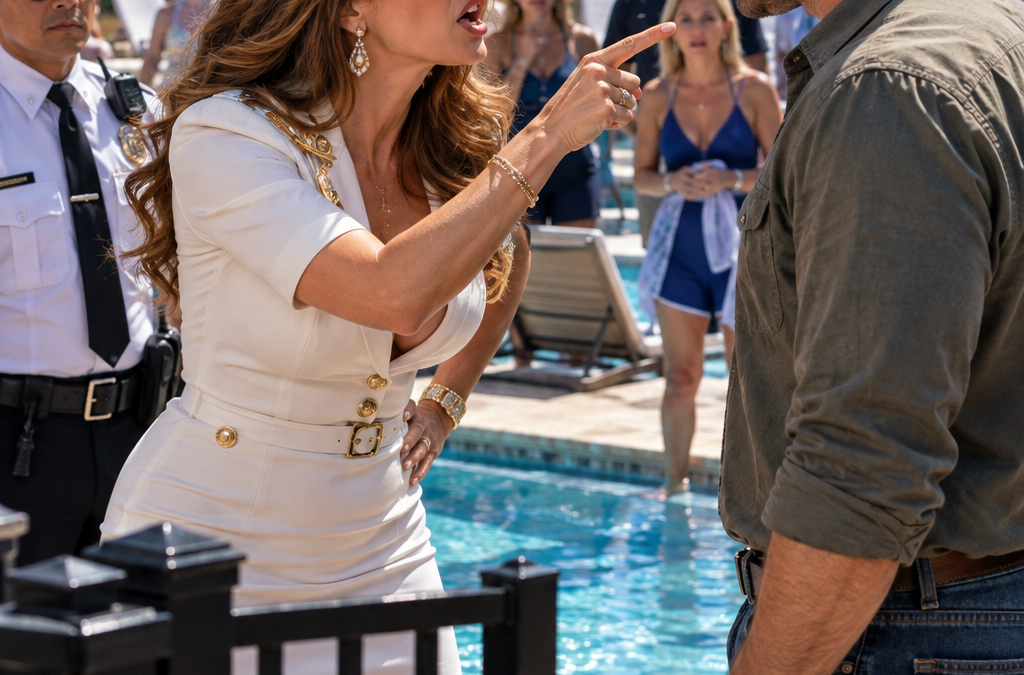
She came through the pool gate like she had been waiting her whole life for a scene big enough to deserve her entrance. She wore a black wrap dress over a white swimsuit, wedge sandals, sunglasses, and a wide-brimmed hat. Her lipstick was perfect. Her jaw was tight. Her son stood beside her with his arms crossed and a grin on his face.
“Unbelievable,” she said when she reached me.
“Good afternoon, Karen.”
“Do not speak to me like we’re friends.”
“We’re definitely not friends.”
Her eyes flashed.
“I warned you in writing not to come here until the board completed its review.”
“You don’t have the authority to suspend my rights under the lease.”
“You are creating a disturbance.”
“Your son created the disturbance.”
Her head turned slightly toward him, but only for a second.
“My son told me you were harassing minors.”
I stared at her.
“That is disgusting.”
“What is disgusting is a grown man forcing his way into a private family facility where he does not belong.”
I stood slowly.
The people around us went quiet.
“I own the land under this facility.”
Karen laughed.
It was not loud. It was worse. Controlled, dismissive, cruel.
“You own paperwork. We built this community.”
“You built on land you lease from me.”
“And now you are abusing that arrangement.”
“By swimming?”
“By intimidating residents.”
“Karen, your son called security on me because I wouldn’t give him a lounge chair.”
Her son rolled his eyes. “Because you’re not supposed to be here.”
Karen pointed one red nail at me.
“You need to leave.”
“No.”
“I am calling the police.”
“Go ahead.”
The crowd seemed to inhale at once.
Karen’s lips parted slightly. She had expected fear. Compliance. Maybe embarrassment. What she got was me standing barefoot on wet concrete, holding my towel, tired of pretending she was reasonable.
She took out her phone and called.
Then we waited.
Her son spent the next twenty minutes making comments just loud enough for me to hear.
“Can’t wait to see him in handcuffs.”
“Imagine being this desperate to use a pool.”
“My mom’s going to destroy him.”
One of his friends laughed every time. Another looked uncomfortable but said nothing.
When the officers arrived, Karen transformed.
Her shoulders softened. Her voice trembled just enough. She walked toward them like a distressed woman at the mercy of a threatening man.
“Thank God you’re here,” she said. “This individual is trespassing and refusing to leave. He has been harassing residents and frightening my son.”
One officer looked at me.
“Sir?”
I handed him the lease copy.
“I’m the landowner,” I said. “The HOA leases this property from me. My access rights are written into the agreement. Highlighted section.”
The officer read it.
The second officer leaned over and read too.
Karen stood nearby, arms crossed, jaw tight.
“This is a civil matter,” the first officer said after a moment.
Karen blinked. “Excuse me?”
“Based on what he’s shown us, he appears to have a legitimate claim to be on the property. We cannot remove him for trespassing.”
“He is not a member.”
“That may be an HOA issue. It’s not a criminal trespass issue if he has documented property rights.”
“He’s lying.”
The officer held up the paper slightly.
“Do you have evidence this document is fraudulent?”
Karen’s face colored.
“This is ridiculous. I am the HOA president.”
“I understand.”
“No, you clearly don’t. This man is disrupting a private residential amenity.”
“Ma’am,” the second officer said, firmer now, “you need to resolve this through lawyers or the courts. We are not arresting someone who has paperwork showing he owns the land.”
Karen stared at them like they had betrayed civilization itself.
“I want your badge numbers.”
They gave them without flinching.
After they left, the pool area was silent.
Karen turned to me.
The performance was gone now. No trembling voice. No polite mask. Only rage.
“This is not over,” she said.
“I assumed not.”
“I will make sure you never set foot on this property again.”
“This property?”
Her mouth tightened.
“My community,” she said. “You don’t belong here. I don’t care what your papers say.”
That sentence settled deep in me.
Not because it was new.
Because it was honest.
Karen did not care what the lease said. She did not care what the officers said. She did not care who owned the land. In her mind, belonging was not legal. It was social. It was aesthetic. It was whether a person looked like they matched the world she wanted to control.
And to her, I did not match.
I stayed at the pool for another hour out of principle.
But I did not enjoy one second of it.
After that day, things changed.
The guards who used to greet me warmly became stiff and silent. Residents stared when I walked in. Some whispered. Some moved their bags when I sat nearby, as if ownership was contagious. A few gave me openly hostile looks.
The rumor reached me through Mang Tony.
Karen was telling people I was trying to scam the HOA out of its recreation area. That I had found some technicality in old paperwork. That I was harassing her family because she had “stood up to me.” That my land claim was questionable.
Questionable.
The land my grandfather bought. The land I inherited properly. The land the HOA had leased from me for years.
Karen then sent a formal demand letter.
She wanted certified copies of my grandfather’s will, title transfer documents, tax receipts, proof of identity, and proof that I had authority to enforce the lease.
Luis said, “This is harassment.”
“Should we refuse?”
“We can. But if we send everything, she loses that excuse.”
So we sent it all.
Every document.
Every transfer.
Every receipt.
Every page proving what she already knew.
Two weeks later, she sent another letter claiming one signature on the original lease “appeared suspicious” and demanded forensic handwriting analysis.
Luis called me after reading it.
“She’s not trying to win legally,” he said. “She’s trying to exhaust you.”
“It’s working.”
“Then we need to decide how far you want to take this.”
I still hesitated.
That is the part I am not proud of.
I kept thinking about the families who had done nothing wrong. The older residents who used the pool for exercise. The kids who had birthday parties there. The guards who just wanted a paycheck. Mang Tony, who had always treated me respectfully.
I did not want to punish everyone because Karen was unbearable.
So I waited.
I let the lawyers send letters. I avoided weekends. I tried weekday mornings again, hoping quiet hours would make the place feel normal.
That was my mistake.
The final straw came on a Wednesday.
The pool was almost empty when I arrived. Three older women were doing gentle exercises in the shallow end. A maintenance worker was cleaning leaves near the clubhouse. The sky was bright, and for the first time in weeks, I thought maybe I could swim in peace.
I was halfway through my laps when Karen’s son arrived with his friends.
School must have been on break.
They saw me immediately.
I kept swimming.
The first cannonball landed beside me within two minutes.
Water slammed into my face.
I moved to the other side.
They followed.
Another splash. Then another.
One of the older women said, “Boys, please.”
They ignored her.
Karen’s son floated near the lane rope and said loudly, “Hey, guys, this is the crazy dude who thinks he owns the place.”
His friends laughed.
I stopped swimming.
He grinned.
“My mom says he’s probably mentally ill and we should feel bad for him.”
One friend said, “He looks like a squatter.”
Another said, “Maybe he can’t afford his own pool.”
I climbed out of the water.
Slowly.
Quietly.
I did not yell. I did not threaten him. I did not even look at the adults watching from the shade, waiting to see whether I would finally become the unstable man Karen had described.
I picked up my towel.
Karen’s son smirked like he had won.
And maybe, in that moment, he had.
Because I left.
But as I walked out through the gate, dripping water onto the concrete path, something inside me went cold and clear.
I was done begging to be respected on my own land.
That afternoon, I called Luis.
“Terminate the lease,” I said.
He was quiet for a second.
“Are you sure?”
“Yes.”
“The income is small, but terminating early will still create a fight.”
“I don’t care about the income.”
“We need grounds.”
“Find them.”
He did.
Article 2, Section 2 of the lease required the HOA to maintain respectful relations with the lessor and refrain from harassment, defamation, intimidation, or interference with the lessor’s rights under the agreement.
Karen had violated all of it.
The denial of access. The false claim that my rights had not transferred. The guest registration demand. The police call. The rumor campaign. The document demands. The forensic signature accusation. Her son’s public harassment, encouraged by what she had told him.
Luis assembled everything.
Dates. Copies. Witness statements. Police incident notes. Letters. Security gate logs. Screenshots of messages residents had forwarded to Mang Tony. A neat timeline of arrogance.
Then he sent the notice of termination.
Under the lease, the HOA had ninety days to vacate the property. They could remove whatever movable structures they wanted. Anything left after the deadline would become mine.
The response was instant.
Karen sent a furious letter accusing me of breach of contract, harassment, fraud, and bad faith. She threatened lawsuits, government complaints, tax investigations, and media exposure. She claimed I was trying to “steal HOA improvements” and “deprive families of community resources.”
Luis responded with a letter so calm it felt surgical.
He listed every breach.
He attached evidence.
He warned that false reports to government agencies could expose her and the HOA to additional liability.
Then the rest of the board finally woke up.
Not when Karen humiliated me.
Not when she called the police.
Not when she spread rumors.
Not when her son harassed me in front of residents.
They acted when the pool was about to disappear.
An emergency board meeting was called.
I did not attend, but Mang Tony told me what happened.
Karen arrived expecting support. She wore red, apparently, like she was going to war. She tried to frame the whole thing as a hostile attack by an unreasonable landowner. She said she had been protecting the community. She said I was manipulative, unstable, and dangerous.
Then the treasurer asked if she had read Article 7, Section 3 before sending the first letter.
Karen said the provision was ambiguous.
It was not.
The vice president asked why she had told residents the HOA owned the pool property.
Karen denied saying that.
Someone produced screenshots.
Another board member asked why the police had been called when the lease clearly gave me access.
Karen said she feared for resident safety.
Mang Tony asked whether I had ever threatened anyone.
Silence.
Then they discussed the termination notice.
That was when reality entered the room.
Without my land, there was no pool. No clubhouse. No playground. No shaded picnic area. The HOA could not move the pool. They could remove furniture, equipment, maybe salvage some fixtures, but the heart of the amenity was gone.
And property values?
Those beautiful brochures?
Those families who bought homes believing they had access to a community pool?
All of that now sat inside a ninety-day countdown.
Karen resigned before the meeting ended.
The official wording was “voluntary resignation to avoid further division within the community.”
Mang Tony said she cried.
I do not know if that is true.
I know only that the next letter I received was not from Karen.
It was from the board.
They apologized.
Not fully. People rarely apologize fully when lawyers are involved. The letter used words like misunderstanding, miscommunication, regrettable escalation, and inconsistent interpretation. But beneath all the polished language, the meaning was clear.
Karen was gone.
They wanted me to withdraw the termination.
They promised to honor the lease. They offered to remove the new access rules as applied to me. They said they valued my generosity and hoped to restore a positive relationship.
For one night, I considered it.
I sat at my kitchen table with the letter in front of me and imagined saying yes.
The pool would stay. The older residents would keep exercising. The kids would have their birthday parties. The guards would keep their routine. The HOA would move on. Maybe the new board would be better.
Maybe everyone would pretend nothing happened.
But I would still know.
I would know how quickly their smiles vanished when Karen pointed at me. I would know how easily residents believed I was a scammer. I would remember the silence of adults while a teenager tried to throw me out. I would remember the police standing beside the pool while Karen told them I did not belong.
And even if Karen was gone, her son’s voice would still echo in that place.
Crazy dude.
Mentally ill.
Squatter.
I realized something then.
The question was not whether the HOA deserved another chance.
The question was whether I wanted to keep offering generosity to people who only valued it when they were about to lose it.
I wrote one sentence to Luis.
The termination stands.
The ninety days were ugly.
Residents who had ignored me for months suddenly wanted to talk.
Some apologized sincerely.
Patricia, one of the older women who exercised in the shallow end, came to my house with homemade bread and tears in her eyes.
“I should have spoken up,” she said.
I believed her.
But belief did not change anything.
Others were angry.
One man told me his children had learned to swim in that pool.
I told him I was sorry.
He asked if I really was.
I did not answer.
A mother messaged me saying her daughter’s birthday party had to be canceled because of me. Another resident said property values would drop. Someone else said I was punishing innocent people.
Maybe I was.
Or maybe I was simply ending a favor.
There is a difference between taking something from people and refusing to keep giving it after they help make your life miserable.
The HOA tried one last offer.
A new lease rate. Much higher than before.
Formal recognition of my ownership. Guaranteed unrestricted access. Written apology posted to all residents. A plaque at the clubhouse acknowledging my contribution.
A plaque.
I almost laughed when Luis read that part.
“They think this is about recognition,” I said.
“What is it about?” he asked.
I looked out my window toward the road leading to San Aurelio Heights.
“Peace.”
The deadline arrived.
The HOA removed what it could. Lounge chairs. Umbrellas. Playground equipment. Kitchen appliances from the clubhouse. Office files. Pool cleaning tools. Even some light fixtures.
The pool remained, of course. A silent blue rectangle under the sun.
The clubhouse remained too, stripped and hollow.
On the ninety-first day, I walked through the gate with my own contractor.
The guardhouse was empty. The pool deck was scattered with leaves. Without people, the place looked strangely fake, like a resort set abandoned after filming.
I stood at the edge of the pool for a long time.
I remembered the early days, when the place had felt easy. Kids laughing. Mang Tony waving from a picnic table. Guards greeting me by name. Quiet weekday swims when the water was still and the world felt simple.
I was sadder than I expected.
Anger can carry you to the finish line, but it does not always celebrate with you when you get there.
The contractor stood beside me.
“You sure?” he asked.
I nodded.
“Fill it.”
The demolition took weeks.
The clubhouse came down first. The sound of walls breaking echoed across the subdivision. Residents watched from behind curtains and balconies. Some stood on the sidewalks with folded arms. Others could not look.
Then the pool was drained, broken, filled, and leveled.
By the time the work was finished, there was no blue water, no tiled deck, no shaded picnic area, no signboard with pool hours. Just a wide empty lot with fresh soil and young trees planted along the edges.
I thought I would feel victorious.
I mostly felt tired.
But I also felt free.
No guard would ever again ask me for a membership card to enter my own property. No HOA president would review my rights like they were a privilege she could suspend. No teenager would stand on my land and ban me from it because his mother told him power was inherited through arrogance.
A few months later, a developer contacted me.
He had heard the lot was available. San Aurelio Heights was fully built out, and the residents now had no nearby convenience store inside walking distance. He wanted to buy the property and build a small commercial complex: a convenience store, a coffee shop, a pharmacy, and a couple of service spaces.
My first instinct was no.
My grandfather’s voice again.
Never sell land.
But then I looked at the offer.
It was far beyond anything I had imagined that awkward little lot could bring. Enough to pay off my house. Enough to secure my children’s education. Enough to repair irrigation on the farmland and still have savings.
I visited my grandfather’s grave before I signed.
I stood there under the heat, holding the folder, feeling foolish for asking a dead man’s permission.
“You told me not to sell without a reason better than money,” I said quietly.
The wind moved through the grass.
I looked toward the road, toward the subdivision beyond the trees.
“This is for family,” I said. “And peace.”
I signed the papers the next week.
The commercial complex went up quickly.
Where Karen once posed beside the pool like a queen beside a private lake, residents now bought laundry detergent, bottled water, coffee, medicine, snacks, and overpriced sunscreen. The children who once had a free playground now tugged their parents toward shelves of candy. The families who used to host pool parties now paid retail for convenience.
I did not build that complex to spite them.
But I would be lying if I said the irony never warmed me.
As for Karen, she did not last long in San Aurelio Heights after the pool disappeared.
Without the presidency, without the admiration, without the ability to glide through the subdivision like she owned every sidewalk, the place turned cold for her. Residents blamed her openly. Some for losing the pool. Some for costing them an amenity. Some for embarrassing the subdivision. Some simply because it was easier to hate one woman than admit they had stood silent while she targeted me.
She sold her house within months.
I saw her once before she left.
I was leaving the newly opened convenience store with a bottle of water when she stepped out of a white SUV near the curb.
For a second, we just looked at each other.
She was still beautiful. Still polished. Still dressed like the world owed her a better background. But something in her had changed. Her smile, when it came, was thin and tired.
“You must be proud,” she said.
I looked at the store behind me. “Not exactly.”
“You destroyed something people loved.”
“No,” I said. “I stopped letting people who hated me use my land.”
Her eyes flashed, but the old force was gone.
“My son lost friends because of you.”
“Your son learned consequences because of you.”
She stepped closer.
“You think you’re better than me?”
“No.”
That seemed to surprise her.
I continued, “I think I had something you wanted. You forgot that wanting something does not make it yours.”
For once, Karen had no answer.
She got back into the SUV and shut the door.
I never saw her again.
Sometimes people ask if I regret it.
Not directly, of course. They dress the question up.
Do you think maybe the board would have changed?
Do you feel bad for the families?
Was there no other solution?
The honest answer is complicated.
Yes, I feel bad for the older residents who lost their morning exercise spot. Yes, I feel bad for the children whose summer afternoons changed because adults failed to act like adults. Yes, I know not every person in San Aurelio Heights deserved to lose the pool.
But I also know this.
Kindness is not a contract for unlimited abuse.
Generosity does not require you to stand quietly while someone humiliates you.
And ownership means nothing if you need permission from a bully to enjoy what is yours.
I gave that HOA a gift for years. A cheap lease. A beautiful amenity. A place for their families to gather. I did not interfere. I did not demand special treatment. I did not ask for applause.
All I asked was to swim sometimes on land my grandfather left me.
Karen could not tolerate even that.
She needed every inch of the place to bend around her authority. She needed the guards to obey her, the board to fear her, the residents to admire her, and me to disappear because my existence reminded her that her kingdom was built on somebody else’s ground.
In the end, that was her mistake.
Not the letters.
Not the police call.
Not even her spoiled son.
Her real mistake was believing that because I had been generous, I must also be weak.
My grandfather understood people like her long before I did.
People do not steal land all at once.
They borrow a corner.
Then a path.
Then a right.
Then they look you in the eye and ask why you are trespassing on what they have decided should belong to them.
Karen asked that question in every possible way.
I answered it once.
With ninety days’ notice.
𝗧𝗛𝗘 𝗘𝗡𝗗
Karen Smiled While Banning Me From the Pool She Forgot Was Built on My Land
I let the HOA use my land for almost nothing because I believed a neighborhood pool would bring people together.
Then Karen decided I looked too ordinary to belong there.
She did not know the one person she humiliated in front of everyone was the only person who could take the whole thing away.
The first thing my grandfather ever taught me about land was that you do not really own it unless you are willing to protect it.
At the time, I thought he meant fences, titles, tax receipts, and survey markers. I imagined locks on gates, signatures on old documents, and maybe the occasional argument with a neighbor about a tree branch hanging over the wrong side of a boundary line. I did not understand that protecting land also meant protecting yourself from people who thought kindness was weakness.
My grandfather, my lolo, understood that part better than anyone.
He bought land when everyone else in our province thought he was wasting money on fields, coconut trees, and empty lots nobody cared about. Back then, the roads were rough, the subdivisions had not arrived yet, and the nearest commercial strip was just a few sari-sari stores, a repair shop, and a bakery that opened before sunrise. People laughed at him sometimes. They said he was stubborn, that he was putting money into dirt.
He would just smile and say, “They are not making more dirt.”
Years later, when he passed away, that dirt became the most valuable thing he left behind.
I inherited several pieces of property from him, most of them agricultural. Some were coconut farms leased to farmers who had known my family for years. Some were rice fields that flooded beautifully in season and shimmered like sheets of glass under the morning sun. But there was one lot that became the center of everything, a rectangular piece of land that sat inside the borders of a gated subdivision called San Aurelio Heights.
The subdivision grew around it because my grandfather refused to sell.
A developer had bought almost everything around his property decades earlier, carved the land into lots, built matching houses, paved private roads, installed a gatehouse, and sold a lifestyle to families who wanted security, status, and a swimming pool in their brochures. But my grandfather’s lot remained his. He would not let it go.
After he died, that lot became mine.
For a while, it was just open space, grass and weeds, sitting awkwardly among polished homes with tiled roofs and trimmed hedges. Then the HOA approached me with an offer.
They wanted to build a community pool and recreation area. The subdivision had grown, the residents wanted amenities, but there was no open parcel large enough inside their official property. My lot was perfect.
They asked to buy it.
I said no.
Not because I hated them. Not because I wanted to make things hard. I just heard my grandfather’s voice in my head.
Never sell land unless you have a reason better than money.
So I offered them a lease instead.
A long-term lease. Ten years. Cheap. Honestly, embarrassingly cheap. They would maintain the property, pay the real estate taxes, build whatever recreational facilities they wanted, and pay me a small yearly amount. In return, the community would get its pool, and I would keep ownership of the land.
There was one important condition.
I retained the right to use any facilities built on my property.
It was written plainly in the lease. Article 7, Section 3. No hidden language. No vague interpretation. I could use the pool and recreation area for reasonable personal use because, whether the HOA liked it or not, the land beneath their bright blue water still belonged to me.
For the first few years, that arrangement worked beautifully.
The HOA built a pool, a small clubhouse, shaded picnic tables, a playground, and a landscaped walkway. I used the pool once or twice a month, usually on quiet weekday mornings. The guards knew me. The older residents waved. Kids splashed around after school. Families hosted birthdays under the covered area.
It felt like one of the rare times a practical arrangement also turned into something good.
Then Karen Whitmore moved in.
PART 2
Karen was American, around forty, and the kind of beautiful that looked expensive before she even spoke.
She had honey-brown hair that fell in perfect loose waves over her shoulders, bright white teeth, smooth tanned skin, and a body she dressed like she expected every room to become a camera lens. She wore fitted resort dresses, high heels on pool tiles, oversized sunglasses, gold bracelets that clicked when she pointed, and perfume that lingered after she left like an accusation.
At first, people loved her.
She was charming in that polished way some people mistake for leadership. She remembered names when she needed something. She laughed loudly with the men on the board. She touched people’s arms when making requests. She brought pastries to meetings and called everyone “sweetheart” until she had enough power to stop pretending.
Within six months, Karen became HOA president.
Nobody could quite explain how it happened. The old president, Mang Tony, had been steady, quiet, and fair. He was the kind of man who kept records in labeled folders and remembered which residents were caring for sick parents or struggling with repairs. Karen was different. She came in like a storm wearing lipstick. She spoke over people, formed committees, rewrote procedures, and made every disagreement feel like a personal attack against community standards.
The first time she noticed me, I was sitting in the back row of an HOA meeting.
I did not attend most of them. They were boring, and technically I was not a member because I did not live inside San Aurelio Heights. But the agenda that evening mentioned “possible expansion of recreational facilities,” and since those facilities sat on my land, I decided to listen.
Karen stood at the front of the clubhouse in a sleeveless white dress, a tablet in one hand, red nails flashing as she moved through the agenda. She was talking about landscaping when her eyes landed on me.
She stopped mid-sentence.
“Excuse me,” she said, pointing with the tablet. “Who are you?”
Every head turned.
I raised my hand slightly. “I’m the landowner.”
Karen blinked once.
“The what?”
Mang Tony, sitting near the front, cleared his throat. “He owns the lot where the pool and clubhouse were built. The HOA leases the land from him.”
Karen’s smile tightened.
“This is a members’ meeting.”
“Yes,” Tony said gently, “but he is a stakeholder. We’ve always invited him when we discuss facilities on his property.”
“My property?” Karen repeated, almost laughing. “The recreational center belongs to San Aurelio Heights.”
“The structures belong to the HOA,” I said calmly. “The land belongs to me.”
A few people looked down at their papers.
Karen stared at me as if I had tracked mud across her white tile floor.
“Well,” she said, recovering her smile, “I’m sure someone should have briefed me on that.”
Tony looked embarrassed. “It’s in the lease file.”
“I’ll review it,” she said.
The way she said review made it sound like a threat.
After the meeting, Tony caught up with me outside.
“I’m sorry about that,” he said quietly. “She’s still learning how things work.”
I looked back through the clubhouse windows. Karen was laughing with two board members, head tilted, one hand resting lightly on a man’s sleeve while he nodded at everything she said.
“Is she?” I asked.
Tony sighed.
That should have been the first warning.
Over the next year, Karen turned the pool from a neighborhood facility into a stage for her authority.
Some rules were reasonable. Shower before swimming. No glass near the pool. No loud music after certain hours. Nobody objected to those.
But then came the others.
All guests had to be registered forty-eight hours in advance. Each household was limited to four guest visits per month. Residents had to show membership cards at the guard station. Lounge chairs near the deep end became “priority seating” for board-approved events. Birthday parties required deposits, forms, and Karen’s personal approval.
The place slowly changed.
It became less relaxed. Less friendly.
The guards stopped smiling as much. Parents whispered before asking questions. Older residents who used to do water exercises in the mornings started avoiding weekends because Karen’s circle treated the pool like a private resort.
Still, I stayed out of it.
I owned the land. They ran the facilities. As long as they honored the lease, I had no reason to interfere.
Then one Tuesday morning, I arrived with a towel over my shoulder and a book under my arm, expecting my usual quiet swim.
The guard at the gate shifted uncomfortably.
“Sir,” he said, “membership card?”
I thought he was joking.
“I don’t have one. You know me.”
“Yes, sir, but Ma’am Karen said everyone entering must present a membership card.”
“I’m not entering as a guest. I’m the landowner.”
His face tightened with panic. Poor guy. He was barely twenty-five and clearly did not want to be the person standing between an HOA president and the man whose land the pool was built on.
“Sir, I know, but we have instructions.”
“Call your supervisor.”
He did.
The supervisor came. Then someone from the HOA office came. There was whispering, phone calling, nervous glancing. Finally, they let me in, but the supervisor said, “Sir, we may need to verify your access with the board.”
“You can verify it with Article 7, Section 3 of the lease,” I said.
He nodded like he understood, but his face told me he did not.
Three days later, I received a letter.
It was printed on HOA letterhead and signed by Karen Whitmore.
According to the letter, my “previous informal access arrangement” was under review. Until the board resolved the matter, I was instructed to refrain from using the facilities.
I stared at the phrase informal access arrangement for a long time.
There was nothing informal about a signed lease.
I called my lawyer, Luis.
Luis had helped me review the original agreement years earlier. He was careful, patient, and had the kind of calm voice that made unreasonable people sound even more ridiculous by contrast. I sent him a scan of Karen’s letter.
He called me ten minutes later.
“Is she serious?” he asked.
“Apparently.”
“Send them the highlighted provision.”
“I can do that.”
“No,” he said. “I’ll do it.”
A certified letter went out the next day with a copy of the lease, Article 7, Section 3 highlighted in yellow.
The lessor retains the right to reasonable personal use of any recreational facilities constructed upon the leased property.
Plain words.
Clear meaning.
I thought that would end it.
It did not.
Karen responded with a letter claiming that the right applied only to the “original lessor,” meaning my grandfather, and since he was deceased, the right had not transferred to me.
When Luis read that, he went silent for several seconds.
Then he said, “That is not how inheritance works.”
Her letter also claimed that even if the access right transferred, the HOA could regulate it, and therefore I would be required to register as a guest forty-eight hours in advance any time I wanted to use the pool.
“A guest,” I said.
“To access your own land,” Luis replied.
I could hear him rubbing his forehead through the phone.
He sent another letter. Firm this time. Not rude, but sharp. He explained that lease rights and ownership rights transferred through inheritance, that the HOA’s position was legally baseless, and that requiring me to register as a guest to access facilities built on my land was unreasonable and contrary to the lease.
Karen sent a shorter response.
The matter was now “under legal review.”
Until then, I should stay away.
I probably should have stayed away just to avoid drama.
But I had spent years being easy to deal with. I had leased them the land for almost nothing. I had let them enjoy the facilities without interference. I had smiled, waved, and accepted their small yearly payments while the value they got from my property was far greater than what they paid.
There is a moment when patience stops being virtue and starts becoming permission.
So the following Saturday, I went to the pool.
I brought a printed copy of the lease with the access clause highlighted. I showed it to the guard before he could ask for a membership card.
He looked terrified.
“Sir, Ma’am Karen said—”
“I know what she said. This says something else.”
He read the highlighted section. Then he looked at me, then at the pool, then back at the paper.
“I don’t want trouble, sir.”
“Neither do I.”
That was true.
At least it was true when I said it.
He let me in.
The pool was crowded because it was a hot weekend afternoon. Children shrieked near the shallow end. Parents sat under umbrellas. A few teenagers occupied the far side, laughing too loudly, shoving each other, splashing anyone close enough to become part of their entertainment.
I found an empty lounge chair in the corner, put down my towel, and went for a swim.
For about ten minutes, I almost enjoyed myself.
Then someone cannonballed beside me.
A wall of water slapped my face.
I stopped, wiped my eyes, and turned.
A teenage boy surfaced beside me, laughing.
He was sixteen or seventeen, tall, lean, with expensive swim trunks, wet blond hair, and the lazy arrogance of a kid who had never been told no by anyone he feared. His friends laughed from the edge.
I ignored him and started swimming again.
He did it again.
This time, closer.
Water surged over my head.
When he came up, he grinned. “Careful, old man.”
I was in my thirties.
I gave him one look and moved to another lane.
He followed.
The third splash was not an accident.
I got out of the pool.
I was irritated, but I was not going to argue with a teenager. I dried off, sat on my lounge chair, opened my book, and tried to let it go.
Twenty minutes later, a shadow fell across my page.
The same boy stood in front of me with three friends behind him.
“You’re in my spot,” he said.
I looked around.
There were no towels, bags, sandals, or signs. Nothing marked the chair.
“I’ve been sitting here for a while,” I said.
He smirked. “Yeah, and now you can move.”
“No.”
His expression changed, not because he was surprised, but because he seemed offended that the word existed.
“You know who I am?”
“Not really.”
“My mom runs this place.”
That explained the posture. The voice. The confidence.
Karen’s son.
Of course.
“Your mom does not run my chair,” I said.
His friends made low sounds, half laughter, half warning.
He stepped closer.
“My mom says you’re the guy who keeps trying to sneak in.”
“I’m not sneaking anywhere.”
“You’re not a member.”
“I don’t have to be.”
He laughed. “Everybody has to be a member.”
“Not the landowner.”
That wiped the smile off his face for a second.
Then he recovered.
“My mom said you lie about that.”
“Your mom should read the lease.”
His eyes narrowed.
“This is our pool.”
“It is a pool built on my land.”
He looked at his friends and laughed like I had just claimed to own the moon.
“You’re crazy.”
I closed my book.
“Walk away.”
Instead, he raised his voice so people nearby could hear.
“I’m banning you from this pool.”
The absurdity of it almost made me laugh.
Almost.
“You are what?”
“You heard me. You’re banned. Get out before I call security.”
A sixteen-year-old was trying to ban me from my own property.
The worst part was not even him. It was the adults nearby. People glanced over, then looked away. A mother gathered her child’s floaties and pretended to search through a bag. An older man I had seen many times at the pool suddenly became fascinated with his phone.
Nobody wanted to be noticed disagreeing with Karen’s family.
Her son saw that silence and mistook it for power.
“Security!” he shouted.
The guard came over looking like he wanted to sink into the concrete.
The boy pointed at me.
“He’s trespassing. Remove him.”
The guard swallowed.
“Sir,” he said to me softly, “management instructions say you should not be using the facilities while the issue is unresolved.”
“The issue is not unresolved,” I said. “The lease is clear.”
Karen’s son scoffed.
“You sound like such a loser.”
That was when he called his mother.
Karen arrived fifteen minutes later.
She came through the pool gate like she had been waiting her whole life for a scene big enough to deserve her entrance. She wore a black wrap dress over a white swimsuit, wedge sandals, sunglasses, and a wide-brimmed hat. Her lipstick was perfect. Her jaw was tight. Her son stood beside her with his arms crossed and a grin on his face.
“Unbelievable,” she said when she reached me.
“Good afternoon, Karen.”
“Do not speak to me like we’re friends.”
“We’re definitely not friends.”
Her eyes flashed.
“I warned you in writing not to come here until the board completed its review.”
“You don’t have the authority to suspend my rights under the lease.”
“You are creating a disturbance.”
“Your son created the disturbance.”
Her head turned slightly toward him, but only for a second.
“My son told me you were harassing minors.”
I stared at her.
“That is disgusting.”
“What is disgusting is a grown man forcing his way into a private family facility where he does not belong.”
I stood slowly.
The people around us went quiet.
“I own the land under this facility.”
Karen laughed.
It was not loud. It was worse. Controlled, dismissive, cruel.
“You own paperwork. We built this community.”
“You built on land you lease from me.”
“And now you are abusing that arrangement.”
“By swimming?”
“By intimidating residents.”
“Karen, your son called security on me because I wouldn’t give him a lounge chair.”
Her son rolled his eyes. “Because you’re not supposed to be here.”
Karen pointed one red nail at me.
“You need to leave.”
“No.”
“I am calling the police.”
“Go ahead.”
The crowd seemed to inhale at once.
Karen’s lips parted slightly. She had expected fear. Compliance. Maybe embarrassment. What she got was me standing barefoot on wet concrete, holding my towel, tired of pretending she was reasonable.
She took out her phone and called.
Then we waited.
Her son spent the next twenty minutes making comments just loud enough for me to hear.
“Can’t wait to see him in handcuffs.”
“Imagine being this desperate to use a pool.”
“My mom’s going to destroy him.”
One of his friends laughed every time. Another looked uncomfortable but said nothing.
When the officers arrived, Karen transformed.
Her shoulders softened. Her voice trembled just enough. She walked toward them like a distressed woman at the mercy of a threatening man.
“Thank God you’re here,” she said. “This individual is trespassing and refusing to leave. He has been harassing residents and frightening my son.”
One officer looked at me.
“Sir?”
I handed him the lease copy.
“I’m the landowner,” I said. “The HOA leases this property from me. My access rights are written into the agreement. Highlighted section.”
The officer read it.
The second officer leaned over and read too.
Karen stood nearby, arms crossed, jaw tight.
“This is a civil matter,” the first officer said after a moment.
Karen blinked. “Excuse me?”
“Based on what he’s shown us, he appears to have a legitimate claim to be on the property. We cannot remove him for trespassing.”
“He is not a member.”
“That may be an HOA issue. It’s not a criminal trespass issue if he has documented property rights.”
“He’s lying.”
The officer held up the paper slightly.
“Do you have evidence this document is fraudulent?”
Karen’s face colored.
“This is ridiculous. I am the HOA president.”
“I understand.”
“No, you clearly don’t. This man is disrupting a private residential amenity.”
“Ma’am,” the second officer said, firmer now, “you need to resolve this through lawyers or the courts. We are not arresting someone who has paperwork showing he owns the land.”
Karen stared at them like they had betrayed civilization itself.
“I want your badge numbers.”
They gave them without flinching.
After they left, the pool area was silent.
Karen turned to me.
The performance was gone now. No trembling voice. No polite mask. Only rage.
“This is not over,” she said.
“I assumed not.”
“I will make sure you never set foot on this property again.”
“This property?”
Her mouth tightened.
“My community,” she said. “You don’t belong here. I don’t care what your papers say.”
That sentence settled deep in me.
Not because it was new.
Because it was honest.
Karen did not care what the lease said. She did not care what the officers said. She did not care who owned the land. In her mind, belonging was not legal. It was social. It was aesthetic. It was whether a person looked like they matched the world she wanted to control.
And to her, I did not match.
I stayed at the pool for another hour out of principle.
But I did not enjoy one second of it.
After that day, things changed.
The guards who used to greet me warmly became stiff and silent. Residents stared when I walked in. Some whispered. Some moved their bags when I sat nearby, as if ownership was contagious. A few gave me openly hostile looks.
The rumor reached me through Mang Tony.
Karen was telling people I was trying to scam the HOA out of its recreation area. That I had found some technicality in old paperwork. That I was harassing her family because she had “stood up to me.” That my land claim was questionable.
Questionable.
The land my grandfather bought. The land I inherited properly. The land the HOA had leased from me for years.
Karen then sent a formal demand letter.
She wanted certified copies of my grandfather’s will, title transfer documents, tax receipts, proof of identity, and proof that I had authority to enforce the lease.
Luis said, “This is harassment.”
“Should we refuse?”
“We can. But if we send everything, she loses that excuse.”
So we sent it all.
Every document.
Every transfer.
Every receipt.
Every page proving what she already knew.
Two weeks later, she sent another letter claiming one signature on the original lease “appeared suspicious” and demanded forensic handwriting analysis.
Luis called me after reading it.
“She’s not trying to win legally,” he said. “She’s trying to exhaust you.”
“It’s working.”
“Then we need to decide how far you want to take this.”
I still hesitated.
That is the part I am not proud of.
I kept thinking about the families who had done nothing wrong. The older residents who used the pool for exercise. The kids who had birthday parties there. The guards who just wanted a paycheck. Mang Tony, who had always treated me respectfully.
I did not want to punish everyone because Karen was unbearable.
So I waited.
I let the lawyers send letters. I avoided weekends. I tried weekday mornings again, hoping quiet hours would make the place feel normal.
That was my mistake.
The final straw came on a Wednesday.
The pool was almost empty when I arrived. Three older women were doing gentle exercises in the shallow end. A maintenance worker was cleaning leaves near the clubhouse. The sky was bright, and for the first time in weeks, I thought maybe I could swim in peace.
I was halfway through my laps when Karen’s son arrived with his friends.
School must have been on break.
They saw me immediately.
I kept swimming.
The first cannonball landed beside me within two minutes.
Water slammed into my face.
I moved to the other side.
They followed.
Another splash. Then another.
One of the older women said, “Boys, please.”
They ignored her.
Karen’s son floated near the lane rope and said loudly, “Hey, guys, this is the crazy dude who thinks he owns the place.”
His friends laughed.
I stopped swimming.
He grinned.
“My mom says he’s probably mentally ill and we should feel bad for him.”
One friend said, “He looks like a squatter.”
Another said, “Maybe he can’t afford his own pool.”
I climbed out of the water.
Slowly.
Quietly.
I did not yell. I did not threaten him. I did not even look at the adults watching from the shade, waiting to see whether I would finally become the unstable man Karen had described.
I picked up my towel.
Karen’s son smirked like he had won.
And maybe, in that moment, he had.
Because I left.
But as I walked out through the gate, dripping water onto the concrete path, something inside me went cold and clear.
I was done begging to be respected on my own land.
That afternoon, I called Luis.
“Terminate the lease,” I said.
He was quiet for a second.
“Are you sure?”
“Yes.”
“The income is small, but terminating early will still create a fight.”
“I don’t care about the income.”
“We need grounds.”
“Find them.”
He did.
Article 2, Section 2 of the lease required the HOA to maintain respectful relations with the lessor and refrain from harassment, defamation, intimidation, or interference with the lessor’s rights under the agreement.
Karen had violated all of it.
The denial of access. The false claim that my rights had not transferred. The guest registration demand. The police call. The rumor campaign. The document demands. The forensic signature accusation. Her son’s public harassment, encouraged by what she had told him.
Luis assembled everything.
Dates. Copies. Witness statements. Police incident notes. Letters. Security gate logs. Screenshots of messages residents had forwarded to Mang Tony. A neat timeline of arrogance.
Then he sent the notice of termination.
Under the lease, the HOA had ninety days to vacate the property. They could remove whatever movable structures they wanted. Anything left after the deadline would become mine.
The response was instant.
Karen sent a furious letter accusing me of breach of contract, harassment, fraud, and bad faith. She threatened lawsuits, government complaints, tax investigations, and media exposure. She claimed I was trying to “steal HOA improvements” and “deprive families of community resources.”
Luis responded with a letter so calm it felt surgical.
He listed every breach.
He attached evidence.
He warned that false reports to government agencies could expose her and the HOA to additional liability.
Then the rest of the board finally woke up.
Not when Karen humiliated me.
Not when she called the police.
Not when she spread rumors.
Not when her son harassed me in front of residents.
They acted when the pool was about to disappear.
An emergency board meeting was called.
I did not attend, but Mang Tony told me what happened.
Karen arrived expecting support. She wore red, apparently, like she was going to war. She tried to frame the whole thing as a hostile attack by an unreasonable landowner. She said she had been protecting the community. She said I was manipulative, unstable, and dangerous.
Then the treasurer asked if she had read Article 7, Section 3 before sending the first letter.
Karen said the provision was ambiguous.
It was not.
The vice president asked why she had told residents the HOA owned the pool property.
Karen denied saying that.
Someone produced screenshots.
Another board member asked why the police had been called when the lease clearly gave me access.
Karen said she feared for resident safety.
Mang Tony asked whether I had ever threatened anyone.
Silence.
Then they discussed the termination notice.
That was when reality entered the room.
Without my land, there was no pool. No clubhouse. No playground. No shaded picnic area. The HOA could not move the pool. They could remove furniture, equipment, maybe salvage some fixtures, but the heart of the amenity was gone.
And property values?
Those beautiful brochures?
Those families who bought homes believing they had access to a community pool?
All of that now sat inside a ninety-day countdown.
Karen resigned before the meeting ended.
The official wording was “voluntary resignation to avoid further division within the community.”
Mang Tony said she cried.
I do not know if that is true.
I know only that the next letter I received was not from Karen.
It was from the board.
They apologized.
Not fully. People rarely apologize fully when lawyers are involved. The letter used words like misunderstanding, miscommunication, regrettable escalation, and inconsistent interpretation. But beneath all the polished language, the meaning was clear.
Karen was gone.
They wanted me to withdraw the termination.
They promised to honor the lease. They offered to remove the new access rules as applied to me. They said they valued my generosity and hoped to restore a positive relationship.
For one night, I considered it.
I sat at my kitchen table with the letter in front of me and imagined saying yes.
The pool would stay. The older residents would keep exercising. The kids would have their birthday parties. The guards would keep their routine. The HOA would move on. Maybe the new board would be better.
Maybe everyone would pretend nothing happened.
But I would still know.
I would know how quickly their smiles vanished when Karen pointed at me. I would know how easily residents believed I was a scammer. I would remember the silence of adults while a teenager tried to throw me out. I would remember the police standing beside the pool while Karen told them I did not belong.
And even if Karen was gone, her son’s voice would still echo in that place.
Crazy dude.
Mentally ill.
Squatter.
I realized something then.
The question was not whether the HOA deserved another chance.
The question was whether I wanted to keep offering generosity to people who only valued it when they were about to lose it.
I wrote one sentence to Luis.
The termination stands.
The ninety days were ugly.
Residents who had ignored me for months suddenly wanted to talk.
Some apologized sincerely.
Patricia, one of the older women who exercised in the shallow end, came to my house with homemade bread and tears in her eyes.
“I should have spoken up,” she said.
I believed her.
But belief did not change anything.
Others were angry.
One man told me his children had learned to swim in that pool.
I told him I was sorry.
He asked if I really was.
I did not answer.
A mother messaged me saying her daughter’s birthday party had to be canceled because of me. Another resident said property values would drop. Someone else said I was punishing innocent people.
Maybe I was.
Or maybe I was simply ending a favor.
There is a difference between taking something from people and refusing to keep giving it after they help make your life miserable.
The HOA tried one last offer.
A new lease rate. Much higher than before.
Formal recognition of my ownership. Guaranteed unrestricted access. Written apology posted to all residents. A plaque at the clubhouse acknowledging my contribution.
A plaque.
I almost laughed when Luis read that part.
“They think this is about recognition,” I said.
“What is it about?” he asked.
I looked out my window toward the road leading to San Aurelio Heights.
“Peace.”
The deadline arrived.
The HOA removed what it could. Lounge chairs. Umbrellas. Playground equipment. Kitchen appliances from the clubhouse. Office files. Pool cleaning tools. Even some light fixtures.
The pool remained, of course. A silent blue rectangle under the sun.
The clubhouse remained too, stripped and hollow.
On the ninety-first day, I walked through the gate with my own contractor.
The guardhouse was empty. The pool deck was scattered with leaves. Without people, the place looked strangely fake, like a resort set abandoned after filming.
I stood at the edge of the pool for a long time.
I remembered the early days, when the place had felt easy. Kids laughing. Mang Tony waving from a picnic table. Guards greeting me by name. Quiet weekday swims when the water was still and the world felt simple.
I was sadder than I expected.
Anger can carry you to the finish line, but it does not always celebrate with you when you get there.
The contractor stood beside me.
“You sure?” he asked.
I nodded.
“Fill it.”
The demolition took weeks.
The clubhouse came down first. The sound of walls breaking echoed across the subdivision. Residents watched from behind curtains and balconies. Some stood on the sidewalks with folded arms. Others could not look.
Then the pool was drained, broken, filled, and leveled.
By the time the work was finished, there was no blue water, no tiled deck, no shaded picnic area, no signboard with pool hours. Just a wide empty lot with fresh soil and young trees planted along the edges.
I thought I would feel victorious.
I mostly felt tired.
But I also felt free.
No guard would ever again ask me for a membership card to enter my own property. No HOA president would review my rights like they were a privilege she could suspend. No teenager would stand on my land and ban me from it because his mother told him power was inherited through arrogance.
A few months later, a developer contacted me.
He had heard the lot was available. San Aurelio Heights was fully built out, and the residents now had no nearby convenience store inside walking distance. He wanted to buy the property and build a small commercial complex: a convenience store, a coffee shop, a pharmacy, and a couple of service spaces.
My first instinct was no.
My grandfather’s voice again.
Never sell land.
But then I looked at the offer.
It was far beyond anything I had imagined that awkward little lot could bring. Enough to pay off my house. Enough to secure my children’s education. Enough to repair irrigation on the farmland and still have savings.
I visited my grandfather’s grave before I signed.
I stood there under the heat, holding the folder, feeling foolish for asking a dead man’s permission.
“You told me not to sell without a reason better than money,” I said quietly.
The wind moved through the grass.
I looked toward the road, toward the subdivision beyond the trees.
“This is for family,” I said. “And peace.”
I signed the papers the next week.
The commercial complex went up quickly.
Where Karen once posed beside the pool like a queen beside a private lake, residents now bought laundry detergent, bottled water, coffee, medicine, snacks, and overpriced sunscreen. The children who once had a free playground now tugged their parents toward shelves of candy. The families who used to host pool parties now paid retail for convenience.
I did not build that complex to spite them.
But I would be lying if I said the irony never warmed me.
As for Karen, she did not last long in San Aurelio Heights after the pool disappeared.
Without the presidency, without the admiration, without the ability to glide through the subdivision like she owned every sidewalk, the place turned cold for her. Residents blamed her openly. Some for losing the pool. Some for costing them an amenity. Some for embarrassing the subdivision. Some simply because it was easier to hate one woman than admit they had stood silent while she targeted me.
She sold her house within months.
I saw her once before she left.
I was leaving the newly opened convenience store with a bottle of water when she stepped out of a white SUV near the curb.
For a second, we just looked at each other.
She was still beautiful. Still polished. Still dressed like the world owed her a better background. But something in her had changed. Her smile, when it came, was thin and tired.
“You must be proud,” she said.
I looked at the store behind me. “Not exactly.”
“You destroyed something people loved.”
“No,” I said. “I stopped letting people who hated me use my land.”
Her eyes flashed, but the old force was gone.
“My son lost friends because of you.”
“Your son learned consequences because of you.”
She stepped closer.
“You think you’re better than me?”
“No.”
That seemed to surprise her.
I continued, “I think I had something you wanted. You forgot that wanting something does not make it yours.”
For once, Karen had no answer.
She got back into the SUV and shut the door.
I never saw her again.
Sometimes people ask if I regret it.
Not directly, of course. They dress the question up.
Do you think maybe the board would have changed?
Do you feel bad for the families?
Was there no other solution?
The honest answer is complicated.
Yes, I feel bad for the older residents who lost their morning exercise spot. Yes, I feel bad for the children whose summer afternoons changed because adults failed to act like adults. Yes, I know not every person in San Aurelio Heights deserved to lose the pool.
But I also know this.
Kindness is not a contract for unlimited abuse.
Generosity does not require you to stand quietly while someone humiliates you.
And ownership means nothing if you need permission from a bully to enjoy what is yours.
I gave that HOA a gift for years. A cheap lease. A beautiful amenity. A place for their families to gather. I did not interfere. I did not demand special treatment. I did not ask for applause.
All I asked was to swim sometimes on land my grandfather left me.
Karen could not tolerate even that.
She needed every inch of the place to bend around her authority. She needed the guards to obey her, the board to fear her, the residents to admire her, and me to disappear because my existence reminded her that her kingdom was built on somebody else’s ground.
In the end, that was her mistake.
Not the letters.
Not the police call.
Not even her spoiled son.
Her real mistake was believing that because I had been generous, I must also be weak.
My grandfather understood people like her long before I did.
People do not steal land all at once.
They borrow a corner.
Then a path.
Then a right.
Then they look you in the eye and ask why you are trespassing on what they have decided should belong to them.
Karen asked that question in every possible way.
I answered it once.
With ninety days’ notice.