𝗙𝗨𝗟𝗟 𝗦𝗧𝗢𝗥𝗬 Karen Shredded My $3,000 Sneakers on Livestream to Destroy My Shop
part2
It was not glamorous at first.
The carpet needed replacing. The back room smelled like cardboard and old dust. One section of track lighting flickered no matter how many bulbs I changed. The sign above the entrance cost more than I wanted to admit. The first month, I slept badly every night because I kept thinking about rent, payroll, inventory, insurance, theft, taxes, and what would happen if people stopped coming.
But they did not stop.
The store grew.
I learned what my community wanted and what it could afford. That mattered to me. I was not in a luxury mall in a wealthy city. I could not fill the shelves only with thousand-dollar collector pieces and expect local families to cheer. Most of my inventory stayed practical: Sketchers, Converse, running shoes, school shoes, everyday sneakers, sandals in summer, hiking boots when I could get a good deal.
But every now and then, I carried rare pairs.
Limited edition Air Force Ones. Yeezys. A few special releases that sneakerheads recognized immediately. I usually kept those in the back, away from constant handling, because rare shoes attract attention and attention attracts risk. I did, however, keep a display pair out front sometimes. Not for sale. Clearly marked. A way of letting serious collectors know, quietly, that I had access to things most small mall shops did not.
One of those display pairs became the center of the worst and best thing that ever happened to my business.
They were Yeezys.
Real ones.
Limited, authenticated, expensive. Three thousand dollars expensive.
Even saying that number still makes me wince a little, because I grew up knowing what three thousand dollars meant. It meant rent, bills, emergencies, months of groceries if you were careful. But in the sneaker world, rarity has its own economy, and these were exactly the kind of shoes that made certain customers stop mid-step and lean closer to the display case.
I kept them visible but not easy to grab.
Or at least I thought I did.
Before I get to that, I need to tell you about Karen.
Karen lived in my neighborhood.
Every neighborhood seems to have one person who treats peace like an inconvenience and other people’s lives like unpaid theater. Karen was ours. She was in her late fifties, always dressed slightly too formally for whatever she was doing, always wearing perfume strong enough to arrive before she did, always speaking with the confidence of someone who had never once considered that she might be the problem.
She was not loud in a fun way.
She was loud in the exhausting way.
The first time I met her, she asked what I did for work. I told her I owned a sneaker shop in the mall.
Her face changed.
Not dramatically. Just enough.
“Oh,” she said. “You mean you work retail.”
“I own the store.”
“Yes, but it’s retail.”
The way she said it made retail sound like a contagious disease.
I smiled politely because that is what you do when you have neighbors.
“It’s my business,” I said.
She tilted her head.
“Selling shoes?”
“Yes.”
“That’s your business?”
“Yes, Karen. Shoes.”
She laughed once, and not kindly.
“Well. I suppose people do all sorts of things these days.”
That was the beginning.
After that, she made little comments whenever she saw me.
If I was outside cutting the grass, she told me it was too long.
If I parked slightly crooked in my own driveway, she said her fifteen-year-old grandson could park better.
If I brought home boxes from the shop, she asked if I was “still playing store.”
If I left early in the morning, she asked if I was going to “my little shoe booth,” even after I had told her multiple times I had a real storefront.
I tried to ignore her.
Most neighbors did.
Karen had a reputation for finding something wrong with everyone. One neighbor’s flowers were “too loud.” Another neighbor’s dog was “emotionally manipulative” because it barked when she walked by the fence. She once told a retired man that his porch swing made the block look poor.
Nobody liked her.
But until the Yeezy incident, she was mostly just irritating.
Then one afternoon, around four o’clock, she walked into my store.
I was behind the register ringing up a customer when I saw her come through the entrance. For a second, I genuinely thought I was mistaken. Karen had made it clear she did not respect my business, did not understand sneakers, and did not think selling shoes counted as real work. Yet there she was, smiling too brightly, carrying a large purse, looking around like she had entered a museum she expected to criticize.
The store was busy.
After-school rush. Maybe two dozen people inside. Kids trying on shoes. Parents checking prices. One of my employees helping a teenager decide between two pairs of running shoes. The noise level was normal: chatter, footsteps, boxes sliding, paper crinkling, kids laughing.
I greeted Karen because customer service does not get suspended just because the customer once insulted your life choices.
“Hey, Karen. Looking for anything specific?”
She turned that bright smile on me.
“My grandchildren need new shoes.”
That surprised me.
“Oh, sure. What kind? School? Sports? Casual?”
She walked closer to the front display.
“Just something nice. Children today are very particular.”
“That’s true.”
“What’s popular?”
I gave her the same explanation I gave anyone. I asked ages, sizes if she knew them, what activities they needed the shoes for, favorite colors, whether comfort mattered more than style. Basic questions.
She answered vaguely.
That should have warned me.
Karen loved talking about her family. Usually, she could brag about her relatives for twenty minutes without needing air. That day, she barely gave details. Her eyes kept moving around the store, not like a shopper comparing options, but like someone mapping a room.
Still, I gave her the benefit of the doubt.
I wanted to believe maybe she was trying.
Maybe she had finally decided my store was legitimate. Maybe one of her grandchildren had specifically asked for shoes from my shop and forced her to confront the possibility that my business was not a joke. Maybe I was being unfair by assuming the worst.
That is one of the dangerous things about wanting to be reasonable.
Sometimes you extend good faith to people who showed up with bad intentions.
Karen bought one modest pair of shoes.
Nothing rare. Nothing expensive. A normal pair for a kid.
She paid without arguing, which should have been my second warning. Karen argued about everything. If oxygen had a receipt, she would ask for a discount.
Instead, she left smiling.
“Nice little place,” she said.
Little.
I let it go.
The rest of the day passed quickly. We closed at nine. Like always, I stayed after to check inventory, straighten displays, count the register, review receipts, and make sure nothing had gone missing. In a shoe store, little things can disappear fast if you are not careful. Insoles. Socks. Laces. Sometimes even one shoe, which is useless but apparently not useless enough to stop people.
At first, everything looked normal.
Then I felt it.
I know that sounds dramatic, but anyone who owns a shop understands. You develop a sense for your space. You know how things sit. You know when a shelf has been touched, when a display is slightly wrong, when an empty spot exists where your mind expected shape.
Something was off near the rare display.
I walked closer.
The Yeezys were gone.
For a moment, I stood there with my hand on the glass, staring at the space where three thousand dollars had been that morning.
My stomach dropped.
I checked behind the display. Under the nearby bench. Inside the wrong shelf. Behind the counter. I asked my employee if she had moved them. She had not. We searched the store.
Nothing.
I pulled up security footage, heart pounding.
The problem was the crowd.
The store had been busy enough that bodies blocked angles. Families passed in front of cameras. Kids moved fast. A cluster gathered near the display around the time Karen had been in the store, but I could not clearly see a hand take the shoes. I watched the footage again and again until my eyes hurt.
Nothing clear enough.
I filed an internal report for my own records. I considered calling the police right then, but all I had was missing merchandise and unclear footage. It could have been anyone in the rush.
Except my gut kept whispering one name.
Karen.
I did not sleep well that night.
I kept replaying her vague answers, her purse, the way her eyes scanned the store. But suspicion is not proof, and I knew better than to accuse someone because I disliked them.
The next day, Karen gave me proof herself.
It was a weekday, quieter than the day before. Late morning. A few customers browsing, one mother and son trying on basketball shoes, my employee Jasmine restocking shelves near the back.
The bell above the entrance chimed.
Karen walked in.
She looked triumphant.
That is the only word for it. Triumphant. Her chin was lifted, mouth pulled into a tight smile, eyes glittering with the kind of excitement people get when they believe they are about to become important.
Her phone was held out in front of her.
Recording.
Or streaming.
I did not know which at first.
I stepped from behind the counter.
“Karen?”
She aimed the phone at me.
“Everyone, I’m here inside the so-called sneaker store I told you about.”
My stomach tightened.
A few customers turned.
Jasmine looked over from the back shelf.
Karen’s voice became louder, theatrical.
“This man has been scamming our community, and today I’m going to show you exactly how.”
I raised both hands slightly.
“Karen, what are you doing?”
She ignored me and walked straight to the register counter.
“People work hard for their money,” she announced to her phone. “Parents bring their children here thinking they are buying authentic, quality shoes. But some so-called business owners think they can cheat decent families by selling fake merchandise at outrageous prices.”
The mother near the basketball shoes pulled her son closer.
My face went hot.
“Karen,” I said, carefully, “you need to stop.”
Instead, she reached into her purse.
For one surreal second, I thought she might pull out paperwork.
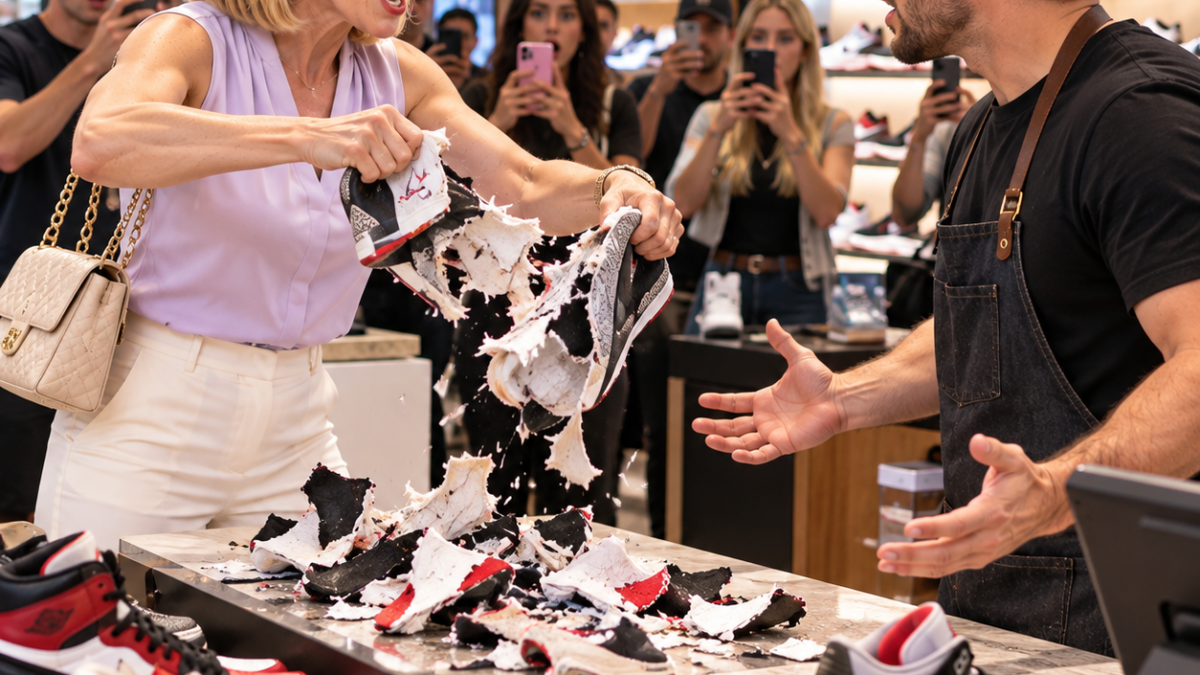
She dumped a pile of shredded fabric, foam, leather, and rubber onto my counter.
Pieces scattered across the glass.
Gray. Tan. Torn stitching. Ruined material.
The remains of my Yeezys.
I could not speak.
My mind recognized them before my emotions caught up. The texture. The color. A torn section of sole. The part of the upper I had carefully examined when they arrived. The authenticated pair I had bought, insured, documented, and displayed.
Destroyed.
Karen smiled into her camera.
“These,” she said, pointing at the pile, “are the fake Yeezys he was trying to use to trick people. I removed them from his display yesterday to investigate, and as you can see, they fell apart like cheap garbage.”
The room went silent.
Even the mall noise outside seemed to fade.
I heard my own voice come out low.
“You stole three-thousand-dollar shoes from my store.”
Karen laughed.
“Oh, don’t be ridiculous. They were fake.”
“They were real.”
“They were on display to deceive customers.”
“They were not for sale from the display.”
“But you had them here.”
“They were authentic.”
She turned the phone back toward herself.
“Listen to how defensive he sounds. That’s what scammers do when they’re caught.”
Something in me wanted to shout.
Something in me wanted to grab the phone, sweep the shredded pieces into a box, demand she leave, demand she explain herself like a sane person.
But behind Karen, I saw Jasmine quietly pick up the store phone.
Good girl.
She called the police while Karen kept performing.
“You people need to understand,” Karen said, panning her phone across my store without permission, “small business does not mean honest business. Anyone can open a shop and pretend to be legitimate.”
I stepped closer to the counter.
“Karen, you need to stop recording inside my store.”
“This is a public mall.”
“This is a private business.”
“You have something to hide.”
“I have security cameras, purchase records, shipment logs, authentication documentation, and a woman on camera who just confessed to stealing and destroying my property.”
That made her hesitate.
Only briefly.
Then she recovered.
“I didn’t steal. I exposed fraud.”
“You took merchandise without paying.”
“It was evidence.”
“Evidence of what?”
“That you’re a scammer.”
“Karen, you destroyed a real pair of shoes worth three thousand dollars.”
Her eyes flashed.
“No shoe is worth that. That’s how I know they were fake.”
And there it was.
The logic of someone who believes reality must rearrange itself around her feelings.
She did not understand the value, so the value was false.
She did not respect my business, so my business had to be a scam.
She disliked me, so I deserved punishment.
A small crowd gathered outside the store entrance.
That was the part that made my chest tighten hardest. Not just the money, not just the theft, not just the pile of shredded sneakers on my counter. It was the eyes. Customers. Mall walkers. Teenagers. Employees from nearby stores. People hearing the word scammer attached to the business I had built from a kiosk and a folding stool.
Reputation is fragile.
Karen knew that.
She was counting on it.
Two officers arrived faster than I expected.
Maybe because mall security had also been alerted. Maybe because Jasmine explained enough. Either way, they walked in just as Karen was telling her livestream audience that she had “bravely intervened on behalf of consumers.”
The first officer, a woman named Officer Patel, approached calmly.
“What’s going on here?”
Karen spun toward her.
“Thank goodness. I need to report fraudulent business practices.”
Officer Patel looked at the shredded pile on the counter.
Then at me.
I said, “This woman stole a pair of display Yeezys from my store yesterday and just returned after destroying them. She is currently recording herself admitting it.”
Karen’s mouth fell open.
“That is not what happened.”
The second officer, Officer Grant, pointed to her phone.
“Are you recording right now?”
“Yes, because people need to know—”
“Turn it off, please.”
“I have a right—”
“Ma’am,” Patel said, “turn it off.”
Karen lifted her chin.
“I’m exposing a criminal.”
Grant reached gently but firmly toward the phone.
“You can either turn it off, or we can secure it as evidence while it’s still recording.”
That word changed the air.
Evidence.
Karen looked at her phone like it had betrayed her.
Then she tapped the screen.
The recording ended.
Or so she thought.
Patel separated us and took statements.
I explained everything. The missing shoes. The security footage. Karen’s visit the previous day. Her return with the shredded remains. Her statements on camera. Jasmine confirmed what she heard. Two customers gave their names as witnesses. Mall security pulled footage showing Karen entering the mall both days.
Karen kept interrupting.
“They were fake!”
“They weren’t hers!”
“I was protecting people!”
“He’s trying to intimidate me because I found out!”
Officer Patel finally looked at her and said, “Ma’am, whether you believed they were fake or not, you took property from a business and destroyed it.”
Karen’s face reddened.
“I didn’t steal them for myself.”
“That is not the only way theft works.”
“I brought them back!”
Grant glanced at the shredded pieces.
“You brought back pieces.”
Karen looked truly offended, as if he was focusing on a technicality.
Then came the moment I will never forget.
Officer Patel asked, “Did you take the shoes from the display yesterday?”
Karen crossed her arms.
“I removed them for investigation.”
“So yes.”
“I had reason.”
“You took them without permission?”
Karen’s mouth tightened.
“I did what any decent person would do.”
Patel nodded once, the way officers do when a person has just made their job easier.
Karen was arrested in my store.
She shouted the entire time.
Not crying. Not apologizing. Shouting.
“This is retaliation!”
“He’s a scammer!”
“You’re protecting criminals!”
“Everyone saw it!”
And yes, everyone did see it.
Just not the way she meant.
After the police took her out, the store felt like a room after a glass breaks. People spoke quietly. A few customers left. One teenage boy near the entrance whispered, “That was insane,” and his mother shushed him even though he was right.
I closed early.
I could not stand behind the register smiling at customers with the remains of three-thousand-dollar shoes in an evidence bag and my hands still shaking.
For the next two days, I moved through my routine like someone wearing the wrong body.
I answered police questions. Sent purchase records. Pulled invoices. Found authentication documents. Printed shipment logs. Provided security footage. Called my insurance carrier. Reassured employees. Reassured myself. Failed at that last one more than once.
The money mattered.
Of course it mattered.
Three thousand dollars is not nothing, especially for a small business. But what really frightened me was the livestream.
I did not know how many people had seen it live. I did not know whether clips were being shared. I did not know whether people believed her. In small business, perception can kill you faster than facts can save you. One viral accusation, one edited clip, one confident liar with a phone can undo years of trust.
That thought kept me awake.
Then the story took a turn I never expected.
The police accessed the livestream recording during the investigation.
I still do not know every technical detail. Maybe someone saved it. Maybe it archived automatically. Maybe one of her viewers submitted it. What mattered was that they got it.
And it was worse for Karen than anything I could have imagined.
The stream apparently began before she entered the mall.
She was sitting in her car, talking to the camera, telling viewers she was about to expose a fraudulent sneaker shop run by her “dishonest neighbor.” She talked about having “retrieved” the display shoes the day before. She said she had cut them apart to prove they were fake. She bragged that she was going to “teach him a lesson” and “show his customers what kind of man he really is.”
Then the stream showed her walking into my store.
It captured her dumping the shredded remains onto my counter.
It captured her admitting they were the display pair.
It captured her accusing me, ignoring my request to stop, and insisting no shoes could be worth that much.
In trying to ruin me publicly, Karen had created the cleanest possible confession.
Court came a few weeks later.
I was nervous in a way that surprised me. I had done nothing wrong. I had documents. Video. Witnesses. Police reports. But court has a way of making even honest people feel like the floor might shift under them.
Karen arrived dressed like she was going to church or a city council meeting. Conservative blouse. Neat hair. Pale lipstick. She looked smaller without the phone in her hand, but her expression still carried that same offended certainty.
As if the entire legal system was inconveniencing her.
I testified.
I told the court about my business, the rare display shoes, Karen’s visit, the missing pair, her return, the livestream, the shredded remains, and the value. My records were submitted: shipment logs, authentication proof, purchase documentation, resale value estimates.
Karen’s defense tried to suggest she believed she was protecting consumers.
The prosecutor asked whether protecting consumers usually involved stealing private property, destroying it, and livestreaming accusations without verifying anything.
Karen did not have a good answer.
The livestream answered for her anyway.
Watching it in court was surreal.
There I was on a screen, behind my own counter, face tight with shock while Karen performed outrage for an audience that had become a jury of her own making. I hated seeing my store that way. I hated hearing her call me a scammer. I hated how calm she sounded while standing over something she had destroyed.
But I also felt something loosen in me.
Because nobody in that room looked like they believed her.
The verdict was guilty.
Felony vandalism. Property damage. Restitution. Fines.
Karen avoided jail time, mostly because of her age, lack of prior serious record, and her lawyer’s argument that restitution would make me whole faster than incarceration. I had mixed feelings about that, but I was not the judge.
She had to pay me the full value of the Yeezys.
Every dollar.
Watching Karen hear that amount from the judge was almost worth the stress.
Almost.
Her face went slack first.
Then red.
Then pale.
She looked at me once from across the room, and for the first time since I had known her, she did not look smug.
She looked cornered by her own choices.
After court, she disappeared from neighborhood life almost completely. No more driveway critiques. No more comments about my grass. No more “little shoe booth” remarks. Curtains closed. Car in the garage. Quick trips to the mailbox. People avoided her more openly than before.
I thought that would be the end.
I was wrong again.
Because Karen’s attempt to destroy my store became the reason half the city learned it existed.
At first, I panicked when the local news called.
A reporter wanted a statement about “the sneaker store vandalism incident.” My first instinct was to refuse. I did not want drama. I did not want my face on television. I did not want customers thinking of my store as a crime scene.
But my friend Marcus, who owned a barbershop two storefronts down, told me something I needed to hear.
“Man,” he said, “people already talking. You might as well make sure they hear the truth from you.”
So I gave a short statement.
Professional. Calm. No insults.
I said my store valued authenticity, customers, and community trust. I said the destroyed shoes were real, documented, and legally purchased. I said I was grateful to my employees, witnesses, mall security, and law enforcement. I said small businesses survive because people choose facts over rumors.
The news ran the story.
Then another outlet picked it up.
Then sneaker pages online started sharing it.
The headline wrote itself: Local Woman Steals Rare Sneakers, Destroys Them on Livestream to “Expose” Fake Store, Gets Charged.
The internet did what the internet does.
Suddenly, people were curious.
The first Saturday after the story aired, I arrived to open the store and found five teenagers waiting outside.
One of them grinned and asked, “Is this the place where that lady went crazy over the Yeezys?”
I sighed.
“Yes.”
“Cool.”
They came in and bought socks, which was not dramatic but still money.
Then more people came.
Kids. Parents. Sneakerheads from other towns. People who had seen the clip. People who wanted to support the store. People who wanted to ask questions. People who wanted to see the display case. People who treated the shop like a weird little landmark.
“Is this the counter?”
“Were you standing right here?”
“What did she cut them with?”
“Did she really livestream it?”
“Do you still sell Yeezys?”
That last question became common enough that I had to put up a polite sign:
Yes, everything rare is authenticated.
No, nothing on display may be removed for “investigation.”
My employees thought that was hilarious.
Sales doubled.
Not for one day.
Not for one week.
Consistently.
At first, I thought it was just curiosity traffic. People love drama, and drama fades. But many of them became real customers. They liked the store. They liked the selection. They liked that we carried affordable shoes and rare pairs under the same roof without making anyone feel stupid for asking questions.
Parents came because they heard I treated customers honestly.
Collectors came because they heard my authentication records were good enough to embarrass a criminal in court.
Kids came because the store had become “the crazy Yeezy lady place,” which was not the branding I would have chosen but apparently worked better than anything I had paid for.
Business boomed so much that I had to hire another part-time employee.
Then I had to adjust inventory.
Then I had to talk to mall management about possibly expanding into the vacant unit beside mine if traffic stayed strong.
All because Karen thought shredding my shoes would bankrupt me.
I tried not to enjoy that too much.
I failed sometimes.
Still, there were quieter moments when the whole thing felt heavier.
One night, after closing, I stood behind the counter and looked at the display case. The new rare pairs were secured differently now. Better locks. Better camera angle. More distance from casual reach. The empty space where the Yeezys had been was filled, but I still remembered the pile of shredded fabric on the glass.
Jasmine noticed me staring.
“You okay?”
“Yeah.”
“You don’t look okay.”
“I’m thinking.”
“That’s dangerous.”
I smiled.
She leaned on the counter.
“You know none of this was your fault, right?”
“I know.”
“Do you?”
That was a fair question.
Because when someone attacks your business, there is always a part of you that wonders what you could have done differently. Should I have watched her more closely? Should I have trusted my gut? Should I have placed the display farther back? Should I have banned her the moment she insulted my work as a neighbor?
Maybe.
But responsibility has limits.
Karen chose to steal.
Karen chose to destroy.
Karen chose to lie.
Karen chose to livestream.
The fact that I wanted to believe she might act like a normal customer did not make me responsible for her deciding not to.
“I know,” I said again, and this time I meant it more.
Jasmine nodded.
“Good. Because honestly, she was always going to do something. People like that don’t stop at opinions.”
She was right.
Karen had not really hated the Yeezys.
She hated that I had built something she could not belittle out of existence.
For years, she had dismissed my business as fake work. Retail. Shoes. A little shop. A booth. A hustle. Something beneath whatever standard she used to measure importance. Seeing customers in my store, seeing kids excited, seeing rare shoes in a display case, seeing proof that I was not struggling or lying or pretending—it bothered her.
So she created a story where my success had to be dishonest.
That is the oldest trick small people use against anyone building something.
If they cannot understand it, it must be fake.
If they cannot control it, it must be wrong.
If they cannot have it, no one deserves it.
Karen convinced herself she was a hero because villainy is easier when you call it justice.
The neighborhood changed after court too.
People who used to tolerate Karen stopped indulging her. If she complained, they walked away. If she tried to criticize someone’s yard, they reminded her she had a felony case over sneakers. Not kindly, from what I heard.
One neighbor, Mrs. Alvarez, told me Karen tried to complain about her garden hose being visible from the street.
Mrs. Alvarez replied, “At least I didn’t livestream myself committing a crime.”
That ended the conversation.
I did feel bad for Karen once.
Only once.
I saw her at the grocery store a couple months after court. She was in the cereal aisle, standing alone, looking at her phone. Two women from the neighborhood turned into the aisle, saw her, went quiet, and turned right back around.
Karen saw them.
Her face changed.
For a second, she looked old, embarrassed, and painfully alone.
I felt a small pinch of pity.
Then I remembered standing behind my counter while she called me a scammer to an audience, with the remains of my property dumped in front of me like a trophy.
Pity is not the same as guilt.
I let the feeling pass.
She brought that isolation on herself, one cruel choice at a time.
As for me, I kept working.
That is the part people miss in dramatic stories. The news clip ends. The comments move on. The internet finds a new villain. But the business still has to open the next morning. Shoes still need ordering. Employees need schedules. Floors need cleaning. Customers need help finding the right size. Bills do not care that you went viral.
The boom helped, but it also forced me to become better fast.
More customers meant more inventory pressure. More inventory meant more cash flow risk. More attention meant more eyes on every mistake. I upgraded cameras. Improved rare-item storage. Built clearer authentication displays. Added educational cards explaining how we verify limited releases. Created a wall for affordable back-to-school options so families did not feel pushed toward hype shoes they could not afford.
That mattered to me most.
I did not want to become famous only for expensive sneakers and a crazy neighbor. I wanted the store to stay what I built it to be: a place where the kid with forty dollars and the collector with four thousand both got treated with respect.
The expansion question became real after three months.
Sales stayed high.
Not double every day, but close enough to change the math. The vacant unit beside mine was still open. Mall management wanted me to take it. My accountant told me to be cautious but not afraid. Marcus from the barbershop told me fear was just rent charged by failure before it even moved in.
I hated how good that line was.
Eventually, I signed the lease.
The expanded store opened six months after Karen’s livestream.
We added more seating, a better kids’ section, a running-shoe fitting area, a secure rare-sneaker room, and a small wall telling the story of how the business started from a kiosk. I did not mention Karen by name anywhere. She did not deserve a plaque.
But near the rare display, I placed one small framed sign:
Authenticity is documented. Trust is earned. Theft is still theft.
Customers take pictures of it all the time.
The opening weekend was packed.
My parents came. Friends came. Regular customers came. Kids who had bought their school shoes from me years earlier came back taller, older, pretending not to be emotional about a sneaker store growing up with them. Jasmine cried when she saw the new employee break room, though she denied it immediately.
At one point, I stepped behind the counter and looked around.
The store was full.
Not chaotic. Alive.
Shoeboxes moving. Kids laughing. Parents asking questions. Employees helping. A teenager staring reverently at a rare pair in the secured case. A runner testing shoes near the fitting area. A little boy trying to convince his mother that light-up sneakers made him faster.
I thought about the mall kiosk.
The folding stool.
The fear.
The years of being told selling shoes was not a real job by people who had never built anything.
And yes, I thought about Karen.
Not with hatred.
With disbelief, mostly.
She had wanted to expose me.
In a strange way, she did.
She exposed that my business was real. My records were solid. My customers cared. My community was willing to show up. My little shop had more support than I knew.
She also exposed herself.
And unlike my business, she did not survive the attention well.
Sometimes customers still ask about her.
“Whatever happened to the lady?”
I usually keep it short.
“She paid restitution and fines. I haven’t seen much of her since.”
That is enough.
The story is funny to people from a distance. Crazy lady shreds sneakers. Livestream confession. Business booms. Easy headline. Easy laugh.
But from inside it, the story was about something more serious.
It was about how fragile a dream can feel when someone attacks it publicly.
It was about how quickly a lie can enter a room if spoken with enough confidence.
It was about the difference between reputation and character.
Reputation is what people say when they do not know enough.
Character is what remains when the footage is reviewed, the receipts are printed, the witnesses speak, and the truth has to stand under fluorescent courtroom lights.
Karen tried to destroy my reputation.
She failed because my character had paperwork.
I still keep a copy of the original shipment log in my office.
Not because I need it now. The case is over. Restitution was paid. The shoes are gone. The business moved forward.
I keep it as a reminder.
Document everything.
Trust your gut.
Do not let someone else’s contempt define the value of your work.
And never underestimate the promotional power of a furious woman accidentally confessing to a felony on livestream.
That last one is not exactly business-school advice, but it worked for me.
Today, when I unlock the store in the morning, I still feel a little of what I felt the first day I opened the kiosk. Nerves. Gratitude. Responsibility. The quiet thrill of having built a door people choose to walk through.
The bell rings.
Customers come in.
Some need running shoes. Some need school shoes. Some want rare sneakers. Some just want to look around because they heard this was the place where a neighbor tried to ruin me and somehow made me busier.
I help them all.
Because at the end of the day, Karen never understood the simplest thing about my business.
I was never just selling shoes.
I was building something people could trust.
And when she shredded those Yeezys to teach me a lesson, the only lesson she proved was one every small business owner already knows.
If your foundation is real, even someone trying to tear you down can end up sending more people through your door.
𝗧𝗛𝗘 𝗘𝗡𝗗
Karen Shredded My $3,000 Sneakers on Livestream to Destroy My Shop
Karen walked into my sneaker store smiling like a customer, but she had already decided I was a scammer who needed to be punished.
The next day, she came back with her phone recording, dumped a pile of shredded fabric on my counter, and told the internet she had exposed my fake business.
She thought she was destroying my reputation, but all she really did was turn herself into the best advertisement my shop ever had.
For as long as I can remember, I wanted to own something that was mine.
Not just a house or a car or a shelf with my name on it. I mean a business. A place. A door people walked through because of something I had built with my own hands, my own decisions, my own stubborn little dream. When other kids said they wanted to be astronauts, doctors, athletes, or actors, I always said I wanted to run a shop.
The type of shop changed over the years.
For a while, I thought maybe I would own a café. I pictured warm lights, regular customers, coffee smells, and a little chalkboard menu by the counter. Then I thought maybe a bakery, until I realized I could barely make toast without turning it into evidence of a small kitchen fire. When I got older and discovered online marketplaces, I briefly imagined selling art prints, stickers, custom shirts, handmade things that people would love enough to share.
There was one major problem with that plan.
I had no creative talent.
I could not draw. I could not paint. I could not make music. I could not bake. I could not design clever little products from scratch. I admired people who could do those things. Honestly, I still do. There is something magical about taking a blank page, a lump of clay, a ball of dough, or a string of notes and turning it into something people want.
But that was not me.
I was not an inventor. I was not an artist. I was not the kind of person who could wake up one morning, sketch a cute design, upload it somewhere, and watch people buy it.
For a long time, that made me feel like my dream had no shape.
I knew I wanted a business, but I did not know what I could offer.
Then I realized the answer had been under my feet the whole time.
Sports were the one thing I had always understood.
In high school, I played almost everything I could fit into a calendar. Tennis. Track. Soccer. Pickup basketball when someone needed an extra body. Running just because I liked seeing how far my legs could take me before my lungs complained. And every sport taught me something most casual shoppers never think about until their feet hurt.
Shoes matter.
Not in a shallow way. Not just brand names and colors and hype drops. Real shoes. The right shoes. Tennis shoes with support for lateral movement. Running shoes that fit your stride and arch. Cleats that match the field. Hiking boots that do not chew your ankles raw. Sneakers that feel good enough to wear all day. Some people need durability. Some need comfort. Some need performance. Some just need something they can afford that makes them feel good walking into school.
I became the kid everyone asked about shoes.
By senior year, I could talk soles, fit, brands, materials, knockoffs, resale prices, and performance differences better than I could talk about half my classes. I loved it. I loved matching people with the right pair. I loved watching someone try on shoes and feel the difference immediately.
That was when the dream finally became specific.
A sneaker store.
Not just a hype shop for rich collectors. Not just walls of shoes nobody in my town could afford. A real sneaker store for real people. Athletic shoes. Casual shoes. Running shoes. Tennis shoes. Cleats when I could get them. Affordable pairs for families. Occasional rare pairs for collectors. A place where kids could come in excited, parents could come in nervous about price, and both could leave feeling respected.
I started small.
Very small.
My first “store” was a mall kiosk in the middle of the walkway, the kind people pass while eating pretzels or pretending not to notice salespeople. I had a few shelves, a card reader, a folding stool, and the kind of hope that makes you ignore how badly your feet hurt after standing ten hours.
It was hard.
People think owning a small business means freedom. It does, in a way. But at first, freedom mostly means you are free to work every job at once. I was the cashier, stockroom, cleaner, marketer, customer service desk, accountant, buyer, and complaint department. If something went wrong, there was no manager to call.
I was the manager.
And if I failed, the dream failed with me.
But little by little, people came back.
Kids dragged parents over because I remembered what size they wore. Runners came in because I did not just sell them the most expensive shoe on the wall. I asked questions. Basketball players asked about traction. Moms asked what would survive a school year. Teenagers came in looking for Converse, Vans, Sketchers, anything that let them feel stylish without bankrupting their parents.
Eventually, a small storefront opened inside the mall.
I applied for the lease.
When I got approved, I sat in my car in the parking lot and cried for five minutes before calling anyone.
That store became my home.
part2
It was not glamorous at first.
The carpet needed replacing. The back room smelled like cardboard and old dust. One section of track lighting flickered no matter how many bulbs I changed. The sign above the entrance cost more than I wanted to admit. The first month, I slept badly every night because I kept thinking about rent, payroll, inventory, insurance, theft, taxes, and what would happen if people stopped coming.
But they did not stop.
The store grew.
I learned what my community wanted and what it could afford. That mattered to me. I was not in a luxury mall in a wealthy city. I could not fill the shelves only with thousand-dollar collector pieces and expect local families to cheer. Most of my inventory stayed practical: Sketchers, Converse, running shoes, school shoes, everyday sneakers, sandals in summer, hiking boots when I could get a good deal.
But every now and then, I carried rare pairs.
Limited edition Air Force Ones. Yeezys. A few special releases that sneakerheads recognized immediately. I usually kept those in the back, away from constant handling, because rare shoes attract attention and attention attracts risk. I did, however, keep a display pair out front sometimes. Not for sale. Clearly marked. A way of letting serious collectors know, quietly, that I had access to things most small mall shops did not.
One of those display pairs became the center of the worst and best thing that ever happened to my business.
They were Yeezys.
Real ones.
Limited, authenticated, expensive. Three thousand dollars expensive.
Even saying that number still makes me wince a little, because I grew up knowing what three thousand dollars meant. It meant rent, bills, emergencies, months of groceries if you were careful. But in the sneaker world, rarity has its own economy, and these were exactly the kind of shoes that made certain customers stop mid-step and lean closer to the display case.
I kept them visible but not easy to grab.
Or at least I thought I did.
Before I get to that, I need to tell you about Karen.
Karen lived in my neighborhood.
Every neighborhood seems to have one person who treats peace like an inconvenience and other people’s lives like unpaid theater. Karen was ours. She was in her late fifties, always dressed slightly too formally for whatever she was doing, always wearing perfume strong enough to arrive before she did, always speaking with the confidence of someone who had never once considered that she might be the problem.
She was not loud in a fun way.
She was loud in the exhausting way.
The first time I met her, she asked what I did for work. I told her I owned a sneaker shop in the mall.
Her face changed.
Not dramatically. Just enough.
“Oh,” she said. “You mean you work retail.”
“I own the store.”
“Yes, but it’s retail.”
The way she said it made retail sound like a contagious disease.
I smiled politely because that is what you do when you have neighbors.
“It’s my business,” I said.
She tilted her head.
“Selling shoes?”
“Yes.”
“That’s your business?”
“Yes, Karen. Shoes.”
She laughed once, and not kindly.
“Well. I suppose people do all sorts of things these days.”
That was the beginning.
After that, she made little comments whenever she saw me.
If I was outside cutting the grass, she told me it was too long.
If I parked slightly crooked in my own driveway, she said her fifteen-year-old grandson could park better.
If I brought home boxes from the shop, she asked if I was “still playing store.”
If I left early in the morning, she asked if I was going to “my little shoe booth,” even after I had told her multiple times I had a real storefront.
I tried to ignore her.
Most neighbors did.
Karen had a reputation for finding something wrong with everyone. One neighbor’s flowers were “too loud.” Another neighbor’s dog was “emotionally manipulative” because it barked when she walked by the fence. She once told a retired man that his porch swing made the block look poor.
Nobody liked her.
But until the Yeezy incident, she was mostly just irritating.
Then one afternoon, around four o’clock, she walked into my store.
I was behind the register ringing up a customer when I saw her come through the entrance. For a second, I genuinely thought I was mistaken. Karen had made it clear she did not respect my business, did not understand sneakers, and did not think selling shoes counted as real work. Yet there she was, smiling too brightly, carrying a large purse, looking around like she had entered a museum she expected to criticize.
The store was busy.
After-school rush. Maybe two dozen people inside. Kids trying on shoes. Parents checking prices. One of my employees helping a teenager decide between two pairs of running shoes. The noise level was normal: chatter, footsteps, boxes sliding, paper crinkling, kids laughing.
I greeted Karen because customer service does not get suspended just because the customer once insulted your life choices.
“Hey, Karen. Looking for anything specific?”
She turned that bright smile on me.
“My grandchildren need new shoes.”
That surprised me.
“Oh, sure. What kind? School? Sports? Casual?”
She walked closer to the front display.
“Just something nice. Children today are very particular.”
“That’s true.”
“What’s popular?”
I gave her the same explanation I gave anyone. I asked ages, sizes if she knew them, what activities they needed the shoes for, favorite colors, whether comfort mattered more than style. Basic questions.
She answered vaguely.
That should have warned me.
Karen loved talking about her family. Usually, she could brag about her relatives for twenty minutes without needing air. That day, she barely gave details. Her eyes kept moving around the store, not like a shopper comparing options, but like someone mapping a room.
Still, I gave her the benefit of the doubt.
I wanted to believe maybe she was trying.
Maybe she had finally decided my store was legitimate. Maybe one of her grandchildren had specifically asked for shoes from my shop and forced her to confront the possibility that my business was not a joke. Maybe I was being unfair by assuming the worst.
That is one of the dangerous things about wanting to be reasonable.
Sometimes you extend good faith to people who showed up with bad intentions.
Karen bought one modest pair of shoes.
Nothing rare. Nothing expensive. A normal pair for a kid.
She paid without arguing, which should have been my second warning. Karen argued about everything. If oxygen had a receipt, she would ask for a discount.
Instead, she left smiling.
“Nice little place,” she said.
Little.
I let it go.
The rest of the day passed quickly. We closed at nine. Like always, I stayed after to check inventory, straighten displays, count the register, review receipts, and make sure nothing had gone missing. In a shoe store, little things can disappear fast if you are not careful. Insoles. Socks. Laces. Sometimes even one shoe, which is useless but apparently not useless enough to stop people.
At first, everything looked normal.
Then I felt it.
I know that sounds dramatic, but anyone who owns a shop understands. You develop a sense for your space. You know how things sit. You know when a shelf has been touched, when a display is slightly wrong, when an empty spot exists where your mind expected shape.
Something was off near the rare display.
I walked closer.
The Yeezys were gone.
For a moment, I stood there with my hand on the glass, staring at the space where three thousand dollars had been that morning.
My stomach dropped.
I checked behind the display. Under the nearby bench. Inside the wrong shelf. Behind the counter. I asked my employee if she had moved them. She had not. We searched the store.
Nothing.
I pulled up security footage, heart pounding.
The problem was the crowd.
The store had been busy enough that bodies blocked angles. Families passed in front of cameras. Kids moved fast. A cluster gathered near the display around the time Karen had been in the store, but I could not clearly see a hand take the shoes. I watched the footage again and again until my eyes hurt.
Nothing clear enough.
I filed an internal report for my own records. I considered calling the police right then, but all I had was missing merchandise and unclear footage. It could have been anyone in the rush.
Except my gut kept whispering one name.
Karen.
I did not sleep well that night.
I kept replaying her vague answers, her purse, the way her eyes scanned the store. But suspicion is not proof, and I knew better than to accuse someone because I disliked them.
The next day, Karen gave me proof herself.
It was a weekday, quieter than the day before. Late morning. A few customers browsing, one mother and son trying on basketball shoes, my employee Jasmine restocking shelves near the back.
The bell above the entrance chimed.
Karen walked in.
She looked triumphant.
That is the only word for it. Triumphant. Her chin was lifted, mouth pulled into a tight smile, eyes glittering with the kind of excitement people get when they believe they are about to become important.
Her phone was held out in front of her.
Recording.
Or streaming.
I did not know which at first.
I stepped from behind the counter.
“Karen?”
She aimed the phone at me.
“Everyone, I’m here inside the so-called sneaker store I told you about.”
My stomach tightened.
A few customers turned.
Jasmine looked over from the back shelf.
Karen’s voice became louder, theatrical.
“This man has been scamming our community, and today I’m going to show you exactly how.”
I raised both hands slightly.
“Karen, what are you doing?”
She ignored me and walked straight to the register counter.
“People work hard for their money,” she announced to her phone. “Parents bring their children here thinking they are buying authentic, quality shoes. But some so-called business owners think they can cheat decent families by selling fake merchandise at outrageous prices.”
The mother near the basketball shoes pulled her son closer.
My face went hot.
“Karen,” I said, carefully, “you need to stop.”
Instead, she reached into her purse.
For one surreal second, I thought she might pull out paperwork.
She dumped a pile of shredded fabric, foam, leather, and rubber onto my counter.
Pieces scattered across the glass.
Gray. Tan. Torn stitching. Ruined material.
The remains of my Yeezys.
I could not speak.
My mind recognized them before my emotions caught up. The texture. The color. A torn section of sole. The part of the upper I had carefully examined when they arrived. The authenticated pair I had bought, insured, documented, and displayed.
Destroyed.
Karen smiled into her camera.
“These,” she said, pointing at the pile, “are the fake Yeezys he was trying to use to trick people. I removed them from his display yesterday to investigate, and as you can see, they fell apart like cheap garbage.”
The room went silent.
Even the mall noise outside seemed to fade.
I heard my own voice come out low.
“You stole three-thousand-dollar shoes from my store.”
Karen laughed.
“Oh, don’t be ridiculous. They were fake.”
“They were real.”
“They were on display to deceive customers.”
“They were not for sale from the display.”
“But you had them here.”
“They were authentic.”
She turned the phone back toward herself.
“Listen to how defensive he sounds. That’s what scammers do when they’re caught.”
Something in me wanted to shout.
Something in me wanted to grab the phone, sweep the shredded pieces into a box, demand she leave, demand she explain herself like a sane person.
But behind Karen, I saw Jasmine quietly pick up the store phone.
Good girl.
She called the police while Karen kept performing.
“You people need to understand,” Karen said, panning her phone across my store without permission, “small business does not mean honest business. Anyone can open a shop and pretend to be legitimate.”
I stepped closer to the counter.
“Karen, you need to stop recording inside my store.”
“This is a public mall.”
“This is a private business.”
“You have something to hide.”
“I have security cameras, purchase records, shipment logs, authentication documentation, and a woman on camera who just confessed to stealing and destroying my property.”
That made her hesitate.
Only briefly.
Then she recovered.
“I didn’t steal. I exposed fraud.”
“You took merchandise without paying.”
“It was evidence.”
“Evidence of what?”
“That you’re a scammer.”
“Karen, you destroyed a real pair of shoes worth three thousand dollars.”
Her eyes flashed.
“No shoe is worth that. That’s how I know they were fake.”
And there it was.
The logic of someone who believes reality must rearrange itself around her feelings.
She did not understand the value, so the value was false.
She did not respect my business, so my business had to be a scam.
She disliked me, so I deserved punishment.
A small crowd gathered outside the store entrance.
That was the part that made my chest tighten hardest. Not just the money, not just the theft, not just the pile of shredded sneakers on my counter. It was the eyes. Customers. Mall walkers. Teenagers. Employees from nearby stores. People hearing the word scammer attached to the business I had built from a kiosk and a folding stool.
Reputation is fragile.
Karen knew that.
She was counting on it.
Two officers arrived faster than I expected.
Maybe because mall security had also been alerted. Maybe because Jasmine explained enough. Either way, they walked in just as Karen was telling her livestream audience that she had “bravely intervened on behalf of consumers.”
The first officer, a woman named Officer Patel, approached calmly.
“What’s going on here?”
Karen spun toward her.
“Thank goodness. I need to report fraudulent business practices.”
Officer Patel looked at the shredded pile on the counter.
Then at me.
I said, “This woman stole a pair of display Yeezys from my store yesterday and just returned after destroying them. She is currently recording herself admitting it.”
Karen’s mouth fell open.
“That is not what happened.”
The second officer, Officer Grant, pointed to her phone.
“Are you recording right now?”
“Yes, because people need to know—”
“Turn it off, please.”
“I have a right—”
“Ma’am,” Patel said, “turn it off.”
Karen lifted her chin.
“I’m exposing a criminal.”
Grant reached gently but firmly toward the phone.
“You can either turn it off, or we can secure it as evidence while it’s still recording.”
That word changed the air.
Evidence.
Karen looked at her phone like it had betrayed her.
Then she tapped the screen.
The recording ended.
Or so she thought.
Patel separated us and took statements.
I explained everything. The missing shoes. The security footage. Karen’s visit the previous day. Her return with the shredded remains. Her statements on camera. Jasmine confirmed what she heard. Two customers gave their names as witnesses. Mall security pulled footage showing Karen entering the mall both days.
Karen kept interrupting.
“They were fake!”
“They weren’t hers!”
“I was protecting people!”
“He’s trying to intimidate me because I found out!”
Officer Patel finally looked at her and said, “Ma’am, whether you believed they were fake or not, you took property from a business and destroyed it.”
Karen’s face reddened.
“I didn’t steal them for myself.”
“That is not the only way theft works.”
“I brought them back!”
Grant glanced at the shredded pieces.
“You brought back pieces.”
Karen looked truly offended, as if he was focusing on a technicality.
Then came the moment I will never forget.
Officer Patel asked, “Did you take the shoes from the display yesterday?”
Karen crossed her arms.
“I removed them for investigation.”
“So yes.”
“I had reason.”
“You took them without permission?”
Karen’s mouth tightened.
“I did what any decent person would do.”
Patel nodded once, the way officers do when a person has just made their job easier.
Karen was arrested in my store.
She shouted the entire time.
Not crying. Not apologizing. Shouting.
“This is retaliation!”
“He’s a scammer!”
“You’re protecting criminals!”
“Everyone saw it!”
And yes, everyone did see it.
Just not the way she meant.
After the police took her out, the store felt like a room after a glass breaks. People spoke quietly. A few customers left. One teenage boy near the entrance whispered, “That was insane,” and his mother shushed him even though he was right.
I closed early.
I could not stand behind the register smiling at customers with the remains of three-thousand-dollar shoes in an evidence bag and my hands still shaking.
For the next two days, I moved through my routine like someone wearing the wrong body.
I answered police questions. Sent purchase records. Pulled invoices. Found authentication documents. Printed shipment logs. Provided security footage. Called my insurance carrier. Reassured employees. Reassured myself. Failed at that last one more than once.
The money mattered.
Of course it mattered.
Three thousand dollars is not nothing, especially for a small business. But what really frightened me was the livestream.
I did not know how many people had seen it live. I did not know whether clips were being shared. I did not know whether people believed her. In small business, perception can kill you faster than facts can save you. One viral accusation, one edited clip, one confident liar with a phone can undo years of trust.
That thought kept me awake.
Then the story took a turn I never expected.
The police accessed the livestream recording during the investigation.
I still do not know every technical detail. Maybe someone saved it. Maybe it archived automatically. Maybe one of her viewers submitted it. What mattered was that they got it.
And it was worse for Karen than anything I could have imagined.
The stream apparently began before she entered the mall.
She was sitting in her car, talking to the camera, telling viewers she was about to expose a fraudulent sneaker shop run by her “dishonest neighbor.” She talked about having “retrieved” the display shoes the day before. She said she had cut them apart to prove they were fake. She bragged that she was going to “teach him a lesson” and “show his customers what kind of man he really is.”
Then the stream showed her walking into my store.
It captured her dumping the shredded remains onto my counter.
It captured her admitting they were the display pair.
It captured her accusing me, ignoring my request to stop, and insisting no shoes could be worth that much.
In trying to ruin me publicly, Karen had created the cleanest possible confession.
Court came a few weeks later.
I was nervous in a way that surprised me. I had done nothing wrong. I had documents. Video. Witnesses. Police reports. But court has a way of making even honest people feel like the floor might shift under them.
Karen arrived dressed like she was going to church or a city council meeting. Conservative blouse. Neat hair. Pale lipstick. She looked smaller without the phone in her hand, but her expression still carried that same offended certainty.
As if the entire legal system was inconveniencing her.
I testified.
I told the court about my business, the rare display shoes, Karen’s visit, the missing pair, her return, the livestream, the shredded remains, and the value. My records were submitted: shipment logs, authentication proof, purchase documentation, resale value estimates.
Karen’s defense tried to suggest she believed she was protecting consumers.
The prosecutor asked whether protecting consumers usually involved stealing private property, destroying it, and livestreaming accusations without verifying anything.
Karen did not have a good answer.
The livestream answered for her anyway.
Watching it in court was surreal.
There I was on a screen, behind my own counter, face tight with shock while Karen performed outrage for an audience that had become a jury of her own making. I hated seeing my store that way. I hated hearing her call me a scammer. I hated how calm she sounded while standing over something she had destroyed.
But I also felt something loosen in me.
Because nobody in that room looked like they believed her.
The verdict was guilty.
Felony vandalism. Property damage. Restitution. Fines.
Karen avoided jail time, mostly because of her age, lack of prior serious record, and her lawyer’s argument that restitution would make me whole faster than incarceration. I had mixed feelings about that, but I was not the judge.
She had to pay me the full value of the Yeezys.
Every dollar.
Watching Karen hear that amount from the judge was almost worth the stress.
Almost.
Her face went slack first.
Then red.
Then pale.
She looked at me once from across the room, and for the first time since I had known her, she did not look smug.
She looked cornered by her own choices.
After court, she disappeared from neighborhood life almost completely. No more driveway critiques. No more comments about my grass. No more “little shoe booth” remarks. Curtains closed. Car in the garage. Quick trips to the mailbox. People avoided her more openly than before.
I thought that would be the end.
I was wrong again.
Because Karen’s attempt to destroy my store became the reason half the city learned it existed.
At first, I panicked when the local news called.
A reporter wanted a statement about “the sneaker store vandalism incident.” My first instinct was to refuse. I did not want drama. I did not want my face on television. I did not want customers thinking of my store as a crime scene.
But my friend Marcus, who owned a barbershop two storefronts down, told me something I needed to hear.
“Man,” he said, “people already talking. You might as well make sure they hear the truth from you.”
So I gave a short statement.
Professional. Calm. No insults.
I said my store valued authenticity, customers, and community trust. I said the destroyed shoes were real, documented, and legally purchased. I said I was grateful to my employees, witnesses, mall security, and law enforcement. I said small businesses survive because people choose facts over rumors.
The news ran the story.
Then another outlet picked it up.
Then sneaker pages online started sharing it.
The headline wrote itself: Local Woman Steals Rare Sneakers, Destroys Them on Livestream to “Expose” Fake Store, Gets Charged.
The internet did what the internet does.
Suddenly, people were curious.
The first Saturday after the story aired, I arrived to open the store and found five teenagers waiting outside.
One of them grinned and asked, “Is this the place where that lady went crazy over the Yeezys?”
I sighed.
“Yes.”
“Cool.”
They came in and bought socks, which was not dramatic but still money.
Then more people came.
Kids. Parents. Sneakerheads from other towns. People who had seen the clip. People who wanted to support the store. People who wanted to ask questions. People who wanted to see the display case. People who treated the shop like a weird little landmark.
“Is this the counter?”
“Were you standing right here?”
“What did she cut them with?”
“Did she really livestream it?”
“Do you still sell Yeezys?”
That last question became common enough that I had to put up a polite sign:
Yes, everything rare is authenticated.
No, nothing on display may be removed for “investigation.”
My employees thought that was hilarious.
Sales doubled.
Not for one day.
Not for one week.
Consistently.
At first, I thought it was just curiosity traffic. People love drama, and drama fades. But many of them became real customers. They liked the store. They liked the selection. They liked that we carried affordable shoes and rare pairs under the same roof without making anyone feel stupid for asking questions.
Parents came because they heard I treated customers honestly.
Collectors came because they heard my authentication records were good enough to embarrass a criminal in court.
Kids came because the store had become “the crazy Yeezy lady place,” which was not the branding I would have chosen but apparently worked better than anything I had paid for.
Business boomed so much that I had to hire another part-time employee.
Then I had to adjust inventory.
Then I had to talk to mall management about possibly expanding into the vacant unit beside mine if traffic stayed strong.
All because Karen thought shredding my shoes would bankrupt me.
I tried not to enjoy that too much.
I failed sometimes.
Still, there were quieter moments when the whole thing felt heavier.
One night, after closing, I stood behind the counter and looked at the display case. The new rare pairs were secured differently now. Better locks. Better camera angle. More distance from casual reach. The empty space where the Yeezys had been was filled, but I still remembered the pile of shredded fabric on the glass.
Jasmine noticed me staring.
“You okay?”
“Yeah.”
“You don’t look okay.”
“I’m thinking.”
“That’s dangerous.”
I smiled.
She leaned on the counter.
“You know none of this was your fault, right?”
“I know.”
“Do you?”
That was a fair question.
Because when someone attacks your business, there is always a part of you that wonders what you could have done differently. Should I have watched her more closely? Should I have trusted my gut? Should I have placed the display farther back? Should I have banned her the moment she insulted my work as a neighbor?
Maybe.
But responsibility has limits.
Karen chose to steal.
Karen chose to destroy.
Karen chose to lie.
Karen chose to livestream.
The fact that I wanted to believe she might act like a normal customer did not make me responsible for her deciding not to.
“I know,” I said again, and this time I meant it more.
Jasmine nodded.
“Good. Because honestly, she was always going to do something. People like that don’t stop at opinions.”
She was right.
Karen had not really hated the Yeezys.
She hated that I had built something she could not belittle out of existence.
For years, she had dismissed my business as fake work. Retail. Shoes. A little shop. A booth. A hustle. Something beneath whatever standard she used to measure importance. Seeing customers in my store, seeing kids excited, seeing rare shoes in a display case, seeing proof that I was not struggling or lying or pretending—it bothered her.
So she created a story where my success had to be dishonest.
That is the oldest trick small people use against anyone building something.
If they cannot understand it, it must be fake.
If they cannot control it, it must be wrong.
If they cannot have it, no one deserves it.
Karen convinced herself she was a hero because villainy is easier when you call it justice.
The neighborhood changed after court too.
People who used to tolerate Karen stopped indulging her. If she complained, they walked away. If she tried to criticize someone’s yard, they reminded her she had a felony case over sneakers. Not kindly, from what I heard.
One neighbor, Mrs. Alvarez, told me Karen tried to complain about her garden hose being visible from the street.
Mrs. Alvarez replied, “At least I didn’t livestream myself committing a crime.”
That ended the conversation.
I did feel bad for Karen once.
Only once.
I saw her at the grocery store a couple months after court. She was in the cereal aisle, standing alone, looking at her phone. Two women from the neighborhood turned into the aisle, saw her, went quiet, and turned right back around.
Karen saw them.
Her face changed.
For a second, she looked old, embarrassed, and painfully alone.
I felt a small pinch of pity.
Then I remembered standing behind my counter while she called me a scammer to an audience, with the remains of my property dumped in front of me like a trophy.
Pity is not the same as guilt.
I let the feeling pass.
She brought that isolation on herself, one cruel choice at a time.
As for me, I kept working.
That is the part people miss in dramatic stories. The news clip ends. The comments move on. The internet finds a new villain. But the business still has to open the next morning. Shoes still need ordering. Employees need schedules. Floors need cleaning. Customers need help finding the right size. Bills do not care that you went viral.
The boom helped, but it also forced me to become better fast.
More customers meant more inventory pressure. More inventory meant more cash flow risk. More attention meant more eyes on every mistake. I upgraded cameras. Improved rare-item storage. Built clearer authentication displays. Added educational cards explaining how we verify limited releases. Created a wall for affordable back-to-school options so families did not feel pushed toward hype shoes they could not afford.
That mattered to me most.
I did not want to become famous only for expensive sneakers and a crazy neighbor. I wanted the store to stay what I built it to be: a place where the kid with forty dollars and the collector with four thousand both got treated with respect.
The expansion question became real after three months.
Sales stayed high.
Not double every day, but close enough to change the math. The vacant unit beside mine was still open. Mall management wanted me to take it. My accountant told me to be cautious but not afraid. Marcus from the barbershop told me fear was just rent charged by failure before it even moved in.
I hated how good that line was.
Eventually, I signed the lease.
The expanded store opened six months after Karen’s livestream.
We added more seating, a better kids’ section, a running-shoe fitting area, a secure rare-sneaker room, and a small wall telling the story of how the business started from a kiosk. I did not mention Karen by name anywhere. She did not deserve a plaque.
But near the rare display, I placed one small framed sign:
Authenticity is documented. Trust is earned. Theft is still theft.
Customers take pictures of it all the time.
The opening weekend was packed.
My parents came. Friends came. Regular customers came. Kids who had bought their school shoes from me years earlier came back taller, older, pretending not to be emotional about a sneaker store growing up with them. Jasmine cried when she saw the new employee break room, though she denied it immediately.
At one point, I stepped behind the counter and looked around.
The store was full.
Not chaotic. Alive.
Shoeboxes moving. Kids laughing. Parents asking questions. Employees helping. A teenager staring reverently at a rare pair in the secured case. A runner testing shoes near the fitting area. A little boy trying to convince his mother that light-up sneakers made him faster.
I thought about the mall kiosk.
The folding stool.
The fear.
The years of being told selling shoes was not a real job by people who had never built anything.
And yes, I thought about Karen.
Not with hatred.
With disbelief, mostly.
She had wanted to expose me.
In a strange way, she did.
She exposed that my business was real. My records were solid. My customers cared. My community was willing to show up. My little shop had more support than I knew.
She also exposed herself.
And unlike my business, she did not survive the attention well.
Sometimes customers still ask about her.
“Whatever happened to the lady?”
I usually keep it short.
“She paid restitution and fines. I haven’t seen much of her since.”
That is enough.
The story is funny to people from a distance. Crazy lady shreds sneakers. Livestream confession. Business booms. Easy headline. Easy laugh.
But from inside it, the story was about something more serious.
It was about how fragile a dream can feel when someone attacks it publicly.
It was about how quickly a lie can enter a room if spoken with enough confidence.
It was about the difference between reputation and character.
Reputation is what people say when they do not know enough.
Character is what remains when the footage is reviewed, the receipts are printed, the witnesses speak, and the truth has to stand under fluorescent courtroom lights.
Karen tried to destroy my reputation.
She failed because my character had paperwork.
I still keep a copy of the original shipment log in my office.
Not because I need it now. The case is over. Restitution was paid. The shoes are gone. The business moved forward.
I keep it as a reminder.
Document everything.
Trust your gut.
Do not let someone else’s contempt define the value of your work.
And never underestimate the promotional power of a furious woman accidentally confessing to a felony on livestream.
That last one is not exactly business-school advice, but it worked for me.
Today, when I unlock the store in the morning, I still feel a little of what I felt the first day I opened the kiosk. Nerves. Gratitude. Responsibility. The quiet thrill of having built a door people choose to walk through.
The bell rings.
Customers come in.
Some need running shoes. Some need school shoes. Some want rare sneakers. Some just want to look around because they heard this was the place where a neighbor tried to ruin me and somehow made me busier.
I help them all.
Because at the end of the day, Karen never understood the simplest thing about my business.
I was never just selling shoes.
I was building something people could trust.
And when she shredded those Yeezys to teach me a lesson, the only lesson she proved was one every small business owner already knows.
If your foundation is real, even someone trying to tear you down can end up sending more people through your door.