Karen Shot Me Because I Changed the Wi-Fi Password She Had Been Stealing for Months
part2
Karen lived next door.
I had known her since I moved in, though known is too generous a word. I knew her the way you know a storm drain you always step around. She was just there, part of the landscape, unpleasant but avoidable if you paid attention.
She was in her late forties, maybe early fifties, with brassy blonde hair, a permanent squint, and the suspicious posture of someone who believed other people’s mail held clues about her personal enemies. She did not work, at least not in all the years I lived beside her. According to neighborhood gossip, she claimed some kind of back condition that prevented employment. I am not a doctor and have no interest in diagnosing anyone from across a lawn, but I will say I saw her haul patio stones, drag furniture, climb ladders, and spend hours bending over DIY projects with energy that seemed oddly selective.
Again, not my business.
Or it would not have been, if she had understood the same boundary.
Karen spent most of her day on her porch.
Not sitting peacefully.
Monitoring.
That is the only word for it.
She watched people get mail. Watched delivery trucks. Watched dog walkers. Watched recycling bins. Watched me carry packages to my car. She had a way of calling out comments that sounded casual until you heard the suspicion underneath.
“More mail?”
“Another delivery?”
“Busy today.”
“What’s in those boxes?”
I tried to be polite for a long time.
“Paintings,” I told her once while carrying two flat A4 shipping boxes to my car. “I sell pet portraits online.”
She looked me up and down, then gave this little snort.
“Must be nice living off the government.”
I actually stopped walking.
Not because the insult wounded me deeply, but because it was so strange. I had just told her I worked. I was holding the work in my hands. And, according to her own loud porch conversations, she was the one on benefits.
But I did not correct her.
That is another mistake I made with Karen. I kept choosing peace by swallowing little things. At first, it felt mature. Wise. Why argue with a woman who clearly wanted conflict the way some people want coffee? Life was too short. I had paintings to finish and customers to answer. If Karen needed to believe I was some government-funded layabout playing artist on the internet, fine. Let her have her imaginary version of me.
The problem with people like Karen is that every silence becomes permission in their minds.
Over the next year, she kept making comments.
“Working hard or hardly working?”
“Another box? Must be nice.”
“Some of us have real problems.”
Once, when I was loading a large portrait of a Great Dane into my car to drop at the post office, she shouted, “Hope taxpayers aren’t funding that hobby.”
I waved without looking at her.
I told myself ignoring her was easier than explaining my income to a woman who once yelled at a lawn care crew for “mowing in a provocative pattern.”
Then my internet slowed down.
At first, I blamed the weather. Then the service provider. Then my laptop. Then the website. Technology, to me, is less a set of systems and more a haunted house with invoices. I would be uploading listing photos and the page would freeze. Client messages took forever to load. Shipping labels spun in eternal circles. My daughter complained during video calls that I looked like a blurry ghost.
Finally, when she came home for a weekend visit, she watched me mutter at my laptop for fifteen minutes and said, “Mom, your Wi-Fi is terrible.”
“It’s been weird lately.”
“When did you last restart the router?”
I gave her the face mothers give daughters when daughters use obvious questions as traps.
She sighed. “What’s your Wi-Fi password?”
I told her.
The silence that followed was not respectful.
“Mom.”
“What?”
“Your password is password?”
“It came that way.”
“You left it that way?”
“Nobody cares about my Wi-Fi.”
She stared at me the way I imagine doctors stare at people who say they’ve had chest pain for six months but didn’t want to make a fuss.
Five minutes later, she had me logged into the router admin panel.
I will admit I did not understand half of what I saw. Lists. Addresses. Device names. Numbers. My daughter moved through it with the focus of someone defusing a bomb made of incompetence.
Then she said, “Oh my God.”
That is never good.
“What?”
“How many devices do you own?”
“I don’t know. Laptop, phone, tablet, printer, TV, maybe the smart speaker if it hasn’t died from my neglect.”
“There are a lot more than that connected.”
She turned the laptop toward me and pointed.
Six unknown devices.
Karen-phone.
Karen-TV.
Karen-iPad.
Something that said Karen-Laptop.
Two others with Karen’s name embedded in some form I did not understand.
For a second, I just blinked.
“Maybe it’s accidental?” I said.
My daughter looked at me.
“Mom.”
“What?”
“You think six of her devices accidentally connected to a network called whatever yours is with the password password and stayed on it for months?”
“When you put it like that…”
“She’s stealing your Wi-Fi.”
Stealing sounded dramatic until she showed me the logs.
Karen had been connected for months.
Months.
My internet had been slow not because of ghosts, clouds, or the algorithm, but because my porch-squatting neighbor had helped herself to the connection I paid for, probably streaming shows, scrolling, and doing whatever else she did when not policing my mailbox.
I was annoyed.
But honestly, not furious yet.
That surprises people when I tell the story. They expect me to say I marched over immediately and confronted her. I did not. I am not confrontational. I do not enjoy raised voices. I do not like scenes. My first instinct was not revenge. It was avoidance.
“Just change the password,” my daughter said.
“I should probably talk to her.”
“Why?”
“So she doesn’t feel embarrassed?”
My daughter stared at me again, but softer this time.
“She stole from you, Mom.”
“I know.”
“Your business uses this internet.”
“I know.”
“She didn’t care if it messed with your work.”
That landed.
Still, I waited weeks.
I wish I could say I used those weeks to craft a plan. I did not. I procrastinated because the thought of Karen at my door made my stomach tighten. Every day I told myself I would handle it tomorrow. Every evening, I painted, shipped orders, and ignored the little spinning loading circle like a coward with a brush.
Eventually, after another frozen upload and another warning from my daughter that my online shop could suffer if I did not secure my network, I changed the password.
No speech.
No confrontation.
No note.
Just a new password, a stronger one this time, and a full evening of reconnecting every device in my house while mumbling things about how printers are designed by people who hate humanity.
For exactly forty-seven minutes, peace existed.
Then someone pounded on my front door hard enough to rattle the frame.
I knew before I opened it.
Karen stood on my porch with her laptop shoved against her chest, face red, hair wild, eyes blazing.
“What have you done?”
I looked at the laptop.
On the screen, large and accusing, were the words: No Internet Connection.
“Hello, Karen.”
“Don’t you ‘hello’ me. Did you change the password?”
“Yes.”
Her mouth fell open like I had admitted to poisoning the town well.
“Why on earth would you do that?”
“Because it’s my Wi-Fi.”
“It wasn’t hurting you!”
“It was slowing down my work.”
Her eyes narrowed. “Your work.”
“Yes. My work.”
“You mean your little pretend art thing?”
I took a slow breath.
“I mean my business.”
She scoffed. “Give me the new password.”
“No.”
She blinked.
It was the same look she probably gave vending machines that refused wrinkled dollar bills.
“What do you mean no?”
“I mean I’m not giving you the password.”
“I need it.”
“Then pay for internet.”
“I can’t afford internet.”
“That’s not my responsibility.”
Her voice sharpened. “You’re endangering my children.”
That one threw me.
“Your children?”
“They need internet for schoolwork.”
“Karen, your children haven’t lived with you in years.”
Her lips pressed into a thin line. I knew from gossip—because Karen spread other people’s business loudly and neighbors eventually returned the favor—that her ex-husband had full custody.
“How dare you bring up my children and my personal life?”
“You brought them up.”
“I did no such thing.”
“You said they need internet for schoolwork ten seconds ago.”
She thrust the laptop toward me. “Just type in the password.”
“No.”
“I’ll stand here all day.”
“You can stand wherever you want, but you’re not using my Wi-Fi anymore.”
“You selfish leech.”
I almost laughed.
Almost.
“You stole internet from me for months.”
“I borrowed access.”
“Without asking.”
“You left it open.”
“It had a password.”
“It was password.”
“That doesn’t make it yours.”
She leaned closer. “You sit around all day painting dogs and living off checks from the government. The least you can do is share.”
There it was again.
All the little comments. The assumptions. The contempt. The way she had created a version of me in her head and decided that version owed her something.
I felt my patience burn down to a clean, bright point.
“I make more in one week from my ‘pretend little art job’ than you make in a year,” I said. “You’re the one leeching off a connection you don’t pay for. That may work with whoever else you bully, but it does not work with me.”
Then I shut the door in her face.
It felt wonderful.
For about six seconds.
Then she started pounding again.
“Open this door!”
I walked away.
She stayed.
For the first hour, she banged, shouted, and demanded the password. Then she disappeared long enough that I hoped she had given up. I went back to painting a spaniel with very soulful eyes.
When I checked the window later, Karen was back.
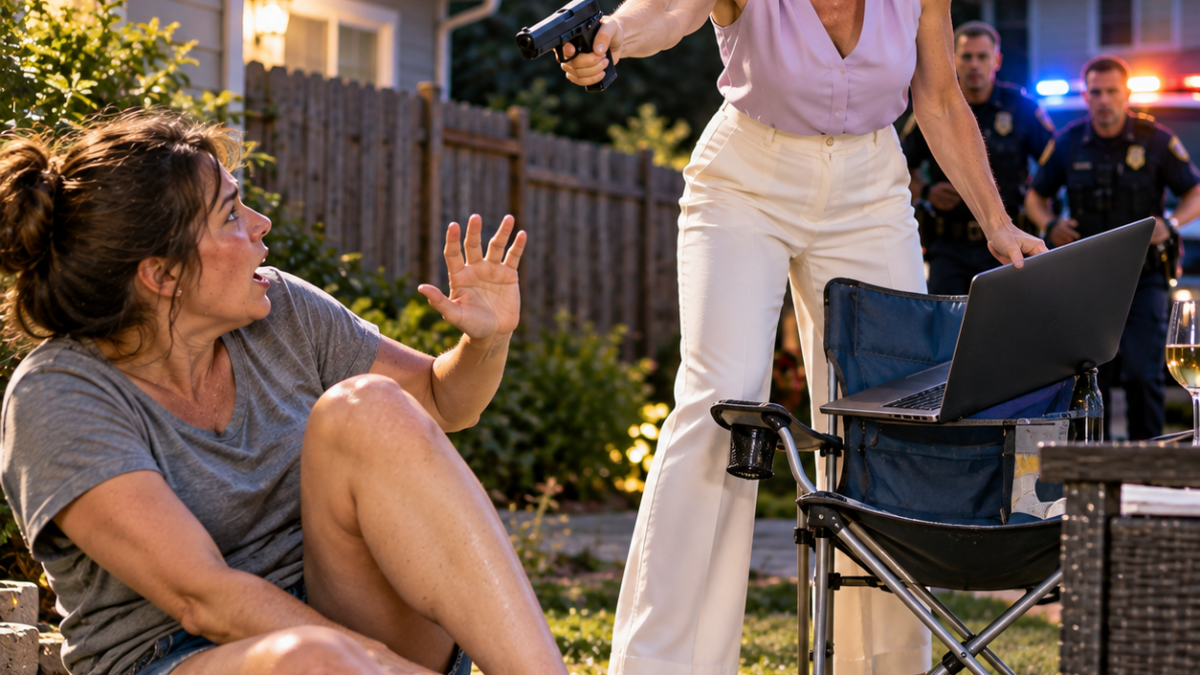
With a lawn chair.
She had set it up in my front yard, just off the walkway, facing my house like she had started a protest movement with one member and no slogan. The laptop sat on her lap. Her arms were crossed. Every few minutes, she shouted something I could not hear clearly through the speaker I had turned up in my studio.
A neighbor texted me a photo.
Karen in the chair, glaring at my house.
Caption: Is she camping?
I replied: Apparently for Wi-Fi rights.
Two hours later, another photo came.
Karen asleep in the chair, mouth open, laptop sliding sideways.
I should have called someone then.
Maybe the police. Maybe a mental health line. Maybe her ex-husband, if I had known him. But at the time, she looked ridiculous, not dangerous. A grown woman had tired herself out protesting a password. It seemed pathetic more than threatening.
I even managed to sneak out the back, drive to the store, buy groceries, come home, and get inside without waking her.
That should have been the end.
It was not.
As a petty joke I still regret, I left a cold beer in the cup holder of her lawn chair.
I did it because she had fallen asleep on my property after harassing me all afternoon, and because some childish part of me wanted her to wake up and know I had been there. It felt harmless.
Karen woke up, found it, drank it, and apparently decided that if one beer appeared, she should go get many more.
By late evening, there was a small pile of empties near her chair.
So much for having no money.
The sun went down. My porch light came on. My neighbor texted again: She’s still there.
I had paintings to pack, labels to print, and a throbbing headache. I considered calling the police for trespassing but dreaded the scene. I told myself she would get bored, get cold, or get too drunk and stumble home.
Around eleven, I remembered the trash.
That is the stupid little detail that put me outside.
Trash night.
I grabbed the kitchen bag, tied it off, and stepped out the side door, thinking only of the bins near the driveway. I had almost forgotten Karen was out front. Almost.
As I reached the bins, I heard laughing.
Not happy laughter.
Drunken, jagged giggling from the chair.
I froze.
Maybe if I stayed quiet, she would not notice.
I dropped the bag into the bin as gently as possible.
The lid still clicked.
Karen’s head snapped up.
“You.”
I closed my eyes for half a second.
“Go home, Karen.”
She pushed herself upright, swaying.
“I got a problem with you.”
“I know.”
“You think you’re better than me.”
“No. I think I pay for my own internet.”
Her face twisted as she tried to focus. “Password.”
“We’ve discussed this.”
“Give me the password.”
“No.”
She muttered something I could not understand. Her words were slurred into each other, anger and alcohol making her mouth loose and ugly. I started walking back toward my door.
That was when she sat down again.
I thought she had given up.
Instead, she reached beneath the chair.
At first, my brain refused to understand what came up in her hand.
Then the porch light caught metal.
A pistol.
Small.
Dark.
Real.
My body went cold so fast it felt like being dropped into water.
“Karen,” I said, and my voice sounded like it belonged to someone else. “Put that down.”
She lifted the gun.
The barrel wavered.
Drunkenly.
Dangerously.
“You don’t tell me no.”
There are moments when time does not slow down exactly, but your attention becomes monstrous. Every detail swells. The beer bottles glittering in the grass. The laptop half open beside her. The smell of trash from the bin. The porch light humming. The gun shaking in her hand. My own breath too loud in my ears.
I thought of my daughter.
Not dramatically. Not in full memories. Just her face flashing through my mind with brutal clarity.
Then Karen fired.
The sound cracked across the yard.
I screamed before I knew why.
For one strange second, I thought she had missed completely. Then fire exploded through my foot. Not metaphorical fire. Actual, white-hot, nauseating pain that shot up my leg and folded me sideways against the trash bin.
The bullet had gone through my big toe.
I looked down and saw blood spreading across my sandal.
Then I screamed again.
Karen seemed to sober all at once.
Her face changed from rage to shock.
She looked at the gun.
Then at me.
Then she staggered backward, nearly tripping over her chair, and lurched toward her house.
I do not know if she thought running inside erased bullets.
Maybe in Karen’s world, consequences worked only if she acknowledged them.
My next-door neighbor, Tom, burst out of his house seconds later.
“What happened?”
“She shot me,” I gasped.
He ran to me, saw my foot, and swore so loudly another porch light came on across the street. He helped me inside because I could barely put weight on that side. Every step made my vision spot.
“Call 911,” he said.
“I am.”
My hands shook so badly I almost dropped the phone.
The operator asked questions.
I answered badly.
Yes, I was shot.
No, I did not think the shooter was still outside.
Yes, I knew who did it.
Yes, she had gone into the house next door.
Yes, I was bleeding.
Tom stayed with me, pressing a towel around my foot while I sat on the floor just inside my front door, sweating and shaking.
Sirens arrived faster than I expected and slower than I needed.
Police first.
Then paramedics.
Everything became lights, voices, gloves, radios, questions.
An officer crouched beside me while paramedics cut away my sandal and examined the wound.
“Who shot you?”
“My neighbor. Karen. Next door.”
“With what?”
“A gun. Pistol. She was in my yard.”
“Where is she now?”
“Her house.”
Another officer swept a flashlight over the yard. They found the shell casing in the grass. They saw the chair, the beer bottles, the laptop, the trampled patch where Karen had staged her absurd little siege. They photographed everything. Taped off the area. Took Tom’s statement. Spoke to the neighbor across the street who had heard the shot and seen Karen stumble back toward her house.
One officer went to Karen’s door.
Then another joined him.
Knocking.
Calling her name.
More knocking.
No answer.
Then the sound of a door being forced open.
I was still on my entry floor, paramedics working on my foot, when I heard shouting from next door. A crash. Glass breaking. A muffled yell.
A few minutes later, they dragged Karen out.
She looked wild.
Hair messy. Face flushed. One sleeve ripped. Still drunk, or maybe just furious enough to mimic it. Her hands were cuffed behind her back.
“You can’t do this!” she shouted. “I was sleeping! I don’t know anything about any gunfire!”
An officer walking behind her said, “Then it’s strange we found the gun in your house.”
She stopped shouting for half a second.
Only half.
“That’s not mine!”
“It was warm.”
“I said it’s not mine!”
The officer did not bother arguing.
Karen saw me through my open doorway and lunged in my direction.
“You lying witch!”
Two officers tightened their hold and pulled her back.
I sat there with my bandaged foot in a paramedic’s hands, pain pulsing up my leg, and suddenly felt something colder than fear.
Clarity.
This woman had stolen from me for months, harassed me all day, sat drunk in my yard, shot me, run home, lied to police, and still believed she was the wronged party.
“See you in court,” I called.
Maybe it was petty.
Maybe I was in shock.
Maybe both.
She screamed curses at me all the way to the cruiser.
At the hospital, they cleaned and treated the wound. I will spare the details, because toes are disgusting even before bullets get involved. The injury was painful and frightening, but I was lucky. That word came up a lot.
Lucky.
Lucky her drunk aim dipped.
Lucky it hit my toe and not my chest.
Lucky Tom heard the shot.
Lucky police found the gun.
Lucky.
I hated the word for a while.
Luck felt too close to suggesting what happened was random, and there had been nothing random about Karen choosing to pull a trigger because she could not steal my internet anymore.
My daughter arrived at the hospital pale and furious.
Seeing her face did what the bullet had not done.
It broke me.
I cried then. Ugly, exhausted tears. She held my hand and cried too, and kept saying, “Mom,” like she was checking whether the word still worked.
The case took time.
Cases always do.
Police processed the scene. Officers came back for follow-up statements. They collected Ring camera footage from neighbors. My own doorbell had captured parts of the afternoon protest and audio of some shouting, though not the shot clearly because I had been near the side bins. Tom’s statement mattered. The shell casing mattered. The gun recovered from Karen’s house mattered. The paramedic report mattered. The beer bottles and chair and laptop mattered more than I would have guessed because they supported the timeline.
Karen, naturally, claimed innocence.
Then confusion.
Then self-defense.
Then some bizarre story about me threatening her first.
Her story changed depending on who was listening.
The facts did not.
I had never been in a courtroom for anything more serious than jury duty. Walking into one as the victim in an assault case felt unreal. Karen arrived wearing a neat blouse, hair done, face arranged into the expression of a misunderstood woman prepared to be vindicated.
She even smirked at me.
I remember that smirk more clearly than I remember parts of the shooting.
It told me she still thought performance could beat evidence.
For the first ten minutes, she stayed calm.
Then the prosecutor began describing why the confrontation happened.
Wi-Fi.
My Wi-Fi.
The password.
Her devices.
The unauthorized access.
The daylong protest.
The alcohol.
The gun.
Karen’s face tightened more with each sentence.
When the prosecutor said she had no legal right to use my internet connection, Karen slammed her palm on the defense table.
“She wouldn’t let me use it!”
The courtroom went silent.
Her attorney leaned toward her sharply.
The judge warned her.
Karen sat back, breathing hard.
Then, minutes later, when my statement was being discussed, she lost it completely.
“It’s all her fault!” Karen shouted. “She didn’t let me use her Wi-Fi!”
The judge’s voice cracked through the room.
“Silence.”
Karen stood halfway up. “She thinks she’s better than everyone with her stupid paintings and her stupid internet!”
“Sit down,” the judge ordered.
“I should have shot her head!”
The gasp in the courtroom felt like a physical wave.
Karen clapped a hand over her mouth.
Too late.
Even her own attorney looked like he wanted to disappear into the floor.
The judge stared at her for a long moment.
“One more word,” he said, very quietly, “and you will regret it.”
Karen finally sat.
I sat on the other side of the room with my daughter beside me, my foot aching inside a medical boot, and felt the last little piece of fear I had been carrying shift into something else.
Not triumph.
Not yet.
But certainty.
Karen was not going to talk her way out of this.
The charges felt endless when the judge read them. Assault with a deadly weapon. Discharging a firearm. Trespass-related counts. Threats. Other firearm violations I did not fully understand because legal language has its own cold rhythm. The details blended together, but the meaning did not.
She had done something serious.
The court treated it seriously.
Karen was sentenced to several years in prison, with the possibility of time reduced depending on behavior and other factors I honestly stopped trying to track. I did not need to understand every technical piece. I only needed to hear the part where she was taken out of the courtroom and would not be coming home next door that night.
This time, she did not scream.
She cried.
Quietly at first.
Then harder.
I watched her leave and felt less satisfaction than I expected. There was some, yes. I am not noble enough to pretend otherwise. But mostly I felt tired. Tired that it had gone so far. Tired that a password had become a wound. Tired that I would forever have to explain to people that, yes, my neighbor shot me over Wi-Fi, and no, I am not exaggerating.
Recovery was slower than I wanted.
The toe healed, mostly. It still aches in cold weather, and I have an ugly scar that makes sandals a conversation risk. I had to delay commissions, refund one order, and explain to several customers that their portraits would be late because of a “medical emergency,” which was technically true and much less ridiculous than the full version.
Emotionally, it took longer.
For months, sudden bangs made me flinch. A car backfiring sent me to the floor once before I could stop myself. I kept checking the window toward Karen’s house even though she was gone. I changed every password I had. Wi-Fi, email, shop accounts, bank, everything. My daughter set up security properly and lectured me for two hours while pretending not to cry.
Karen’s house stayed empty for a while.
Then her relatives cleared it out. I watched from behind curtains as furniture came and went, as trash bags piled by the curb, as the porch chair that had once been her observation post disappeared into a truck. Eventually, the house sold to a young couple with a baby and a fat orange cat that likes to sit in the window and judge my garden.
They introduced themselves with cookies.
I almost cried.
It is amazing how healing normal neighbors can be.
The first time the new woman next door asked for my Wi-Fi password, she did it as a joke after hearing a sanitized version of the story from Tom.
“Too soon?” she asked immediately.
I laughed so hard my foot hurt.
“No,” I said. “But you still can’t have it.”
We became friends after that.
My business recovered too. Better than recovered, actually. When I was ready, I painted a portrait of Daisy, Tom’s old dog, as a thank-you for helping me that night. He cried when I gave it to him, though he blamed allergies. Then his sister ordered one. Then someone from his work. Then, through the strange math of human connection, the story of “the artist who got shot over Wi-Fi” spread locally and brought me more commissions than I knew what to do with for a while.
I did not use the story for marketing.
That felt gross.
But people heard anyway.
People always hear.
Sometimes now, when I sit in my studio and upload a finished portrait, I watch the progress bar move smoothly across the screen and think about how something as invisible as internet access became the center of the most visible violence I have ever experienced.
Karen believed need erased ownership.
Not real need. Not hunger, not shelter, not emergency. Convenience. Entitlement. She could not afford internet, or claimed she could not, but she could afford beer when she wanted to stage a drunken occupation of my lawn. She could not respect my work, but she felt entitled to the infrastructure that made it possible. She called me a leech while feeding off something I paid for.
That hypocrisy used to enrage me.
Now, mostly, it teaches me.
Boundaries do not become cruel because someone dislikes them.
No is not violence.
Changing my own password was not an attack.
Refusing to subsidize a neighbor who insulted me was not selfish.
Karen spent so long taking little things—bandwidth, peace, dignity, truth—that when I finally took back one small thing, she treated it like theft from her.
That is what entitlement does.
It turns other people’s boundaries into personal insults.
I keep my router password written in a secure place now, and it is not password. My daughter made sure of that. She also set up a guest network for actual guests, because apparently that is a thing adults with functioning digital lives do.
The network name?
Not Yours Karen.
My daughter set it.
I kept it.
Maybe that is petty.
I have earned petty.
The scar on my toe is still there. So is the little mark on the trash bin where I grabbed it when the pain hit. For a while, I thought about replacing the bin, but I never did. It sits by the driveway every week, ugly and ordinary, a reminder that terrifying things can happen in the middle of chores.
Life does not wait for dramatic lighting.
Sometimes the night you get shot is trash night.
Sometimes the villain is your neighbor in a lawn chair.
Sometimes the motive is Wi-Fi.
And sometimes justice sounds like a judge silencing a woman who finally says the quiet part out loud in front of everyone.
I do not think about Karen every day anymore.
That feels like victory.
I paint. I ship orders. I drink too much coffee. I argue with printers. I answer clients who want me to capture the exact sparkle in their cat’s eyes. I sit in my robe at noon sometimes, making a living from the thing Karen called pretend.
The internet works beautifully.
My daughter still checks on my shop.
Tom still waves from across the lawn.
The orange cat next door still judges me.
And every time my Wi-Fi connects without a problem, every time a file uploads smoothly, every time I lock my door and feel safe in the home and studio I built for myself, I remember one simple truth Karen never understood.
You can sit on my lawn.
You can shout at my door.
You can call my work fake, my life easy, my boundaries selfish.
You can even pull a gun and turn your own entitlement into evidence.
But you do not get the password.
Not anymore.
𝗧𝗛𝗘 𝗘𝗡𝗗
Karen Shot Me Because I Changed the Wi-Fi Password She Had Been Stealing for Months
Karen thought my internet was a public utility just because she had been stealing it quietly.
When I changed one password, she showed up drunk in my yard with a lawn chair, a laptop, and a gun.
I used to believe the worst thing a neighbor could steal was peace.
That was before Karen stole my Wi-Fi, my patience, one clean night of my life, and very nearly my big toe.
I know that sounds absurd. It still sounds absurd to me, and I was the one standing barefoot in my own yard with blood filling my sandal while my neighbor staggered backward with a pistol in her hand because she had decided my internet password belonged to her. There are moments so stupid and frightening at the same time that your brain refuses to file them anywhere sensible. Mine still pulls that night out sometimes, turns it around under the light, and asks, Did that really happen?
Yes.
It did.
And all of it started because I was lazy with a router.
For the past few years, I have made my living as a freelance artist. Specifically, I paint pet portraits. Dogs in bow ties. Cats looking judgmental. Golden retrievers with gray around their muzzles. A parrot once, though I swore never again because feathers are a nightmare when the client wants every little color shift perfect. People love their animals fiercely, and I love being trusted with that kind of love. There is something sacred about painting a dog someone had for fifteen years, or a cat who slept on someone’s chest through chemotherapy, or a little terrier a kid grew up with and lost right before leaving for college.
It is not glamorous work in the way people imagine artists live.
Most days, I am in old sweatpants, my hair clipped badly on top of my head, coffee going cold beside me, paint on my wrist, my phone full of reference photos, and a half-finished canvas judging me from the easel. I sell through Etsy and a few other sites. I answer messages. I package paintings. I print labels. I argue with bubble wrap. I take photos in good light and curse every cloud that ruins my schedule.
But it is mine.
That matters.
For years, painting had been the thing I did after work, after dinner, after everyone else went to bed. Then one day, slowly and almost by accident, it became the work. Enough orders came in. Then more. Then repeat customers. Then holiday commissions booked months ahead. My daughter helped me set up the online side because, in my opinion, websites have far too many buttons and every single one of them is waiting to make me feel ninety years old.
She was in college by the time this happened, but she still checked on my listings, helped with shop updates, and talked to me like I was a talented cavewoman when I asked where the shipping settings went.
“Mom,” she would say, “you cannot keep naming every listing ‘custom pet painting.’”
“But that’s what it is.”
“Yes, but the algorithm wants more.”
I still do not trust the algorithm.
When I moved into my house, I turned the old office into a studio. It had north-facing light, a decent closet for supplies, and enough space for my worktable, easel, printer, shelves, canvases, and the growing mountain of packing materials that made it look like I was preparing to mail myself to another state. Working from home felt like a dream. I could paint in a robe. I could take breaks with my own coffee. I could throw laundry in between layers drying.
All of it depended on internet.
Orders. Messages. Reference photos. Shipping labels. Payments. Uploads. Video calls with clients who wanted to explain why their pug’s left eye had more “soul” than the reference photo showed. My business existed in paint, yes, but it also lived online.
Which is why my first mistake was ridiculous.
When I moved in, I installed the router with the default settings and called it done.
The network name was whatever the router came with.
The password was password.
Literally.
Password.
I know.
Every tech-savvy person reading that just made a noise.
My daughter made the same noise later.
At the time, I thought, Who is going to bother using my Wi-Fi? I lived in a quiet residential neighborhood. My house was not an airport. My neighbors had homes, bills, routers, and presumably enough dignity not to steal from a woman painting Labradors in her spare bedroom.
That was before I truly understood Karen.
part2
Karen lived next door.
I had known her since I moved in, though known is too generous a word. I knew her the way you know a storm drain you always step around. She was just there, part of the landscape, unpleasant but avoidable if you paid attention.
She was in her late forties, maybe early fifties, with brassy blonde hair, a permanent squint, and the suspicious posture of someone who believed other people’s mail held clues about her personal enemies. She did not work, at least not in all the years I lived beside her. According to neighborhood gossip, she claimed some kind of back condition that prevented employment. I am not a doctor and have no interest in diagnosing anyone from across a lawn, but I will say I saw her haul patio stones, drag furniture, climb ladders, and spend hours bending over DIY projects with energy that seemed oddly selective.
Again, not my business.
Or it would not have been, if she had understood the same boundary.
Karen spent most of her day on her porch.
Not sitting peacefully.
Monitoring.
That is the only word for it.
She watched people get mail. Watched delivery trucks. Watched dog walkers. Watched recycling bins. Watched me carry packages to my car. She had a way of calling out comments that sounded casual until you heard the suspicion underneath.
“More mail?”
“Another delivery?”
“Busy today.”
“What’s in those boxes?”
I tried to be polite for a long time.
“Paintings,” I told her once while carrying two flat A4 shipping boxes to my car. “I sell pet portraits online.”
She looked me up and down, then gave this little snort.
“Must be nice living off the government.”
I actually stopped walking.
Not because the insult wounded me deeply, but because it was so strange. I had just told her I worked. I was holding the work in my hands. And, according to her own loud porch conversations, she was the one on benefits.
But I did not correct her.
That is another mistake I made with Karen. I kept choosing peace by swallowing little things. At first, it felt mature. Wise. Why argue with a woman who clearly wanted conflict the way some people want coffee? Life was too short. I had paintings to finish and customers to answer. If Karen needed to believe I was some government-funded layabout playing artist on the internet, fine. Let her have her imaginary version of me.
The problem with people like Karen is that every silence becomes permission in their minds.
Over the next year, she kept making comments.
“Working hard or hardly working?”
“Another box? Must be nice.”
“Some of us have real problems.”
Once, when I was loading a large portrait of a Great Dane into my car to drop at the post office, she shouted, “Hope taxpayers aren’t funding that hobby.”
I waved without looking at her.
I told myself ignoring her was easier than explaining my income to a woman who once yelled at a lawn care crew for “mowing in a provocative pattern.”
Then my internet slowed down.
At first, I blamed the weather. Then the service provider. Then my laptop. Then the website. Technology, to me, is less a set of systems and more a haunted house with invoices. I would be uploading listing photos and the page would freeze. Client messages took forever to load. Shipping labels spun in eternal circles. My daughter complained during video calls that I looked like a blurry ghost.
Finally, when she came home for a weekend visit, she watched me mutter at my laptop for fifteen minutes and said, “Mom, your Wi-Fi is terrible.”
“It’s been weird lately.”
“When did you last restart the router?”
I gave her the face mothers give daughters when daughters use obvious questions as traps.
She sighed. “What’s your Wi-Fi password?”
I told her.
The silence that followed was not respectful.
“Mom.”
“What?”
“Your password is password?”
“It came that way.”
“You left it that way?”
“Nobody cares about my Wi-Fi.”
She stared at me the way I imagine doctors stare at people who say they’ve had chest pain for six months but didn’t want to make a fuss.
Five minutes later, she had me logged into the router admin panel.
I will admit I did not understand half of what I saw. Lists. Addresses. Device names. Numbers. My daughter moved through it with the focus of someone defusing a bomb made of incompetence.
Then she said, “Oh my God.”
That is never good.
“What?”
“How many devices do you own?”
“I don’t know. Laptop, phone, tablet, printer, TV, maybe the smart speaker if it hasn’t died from my neglect.”
“There are a lot more than that connected.”
She turned the laptop toward me and pointed.
Six unknown devices.
Karen-phone.
Karen-TV.
Karen-iPad.
Something that said Karen-Laptop.
Two others with Karen’s name embedded in some form I did not understand.
For a second, I just blinked.
“Maybe it’s accidental?” I said.
My daughter looked at me.
“Mom.”
“What?”
“You think six of her devices accidentally connected to a network called whatever yours is with the password password and stayed on it for months?”
“When you put it like that…”
“She’s stealing your Wi-Fi.”
Stealing sounded dramatic until she showed me the logs.
Karen had been connected for months.
Months.
My internet had been slow not because of ghosts, clouds, or the algorithm, but because my porch-squatting neighbor had helped herself to the connection I paid for, probably streaming shows, scrolling, and doing whatever else she did when not policing my mailbox.
I was annoyed.
But honestly, not furious yet.
That surprises people when I tell the story. They expect me to say I marched over immediately and confronted her. I did not. I am not confrontational. I do not enjoy raised voices. I do not like scenes. My first instinct was not revenge. It was avoidance.
“Just change the password,” my daughter said.
“I should probably talk to her.”
“Why?”
“So she doesn’t feel embarrassed?”
My daughter stared at me again, but softer this time.
“She stole from you, Mom.”
“I know.”
“Your business uses this internet.”
“I know.”
“She didn’t care if it messed with your work.”
That landed.
Still, I waited weeks.
I wish I could say I used those weeks to craft a plan. I did not. I procrastinated because the thought of Karen at my door made my stomach tighten. Every day I told myself I would handle it tomorrow. Every evening, I painted, shipped orders, and ignored the little spinning loading circle like a coward with a brush.
Eventually, after another frozen upload and another warning from my daughter that my online shop could suffer if I did not secure my network, I changed the password.
No speech.
No confrontation.
No note.
Just a new password, a stronger one this time, and a full evening of reconnecting every device in my house while mumbling things about how printers are designed by people who hate humanity.
For exactly forty-seven minutes, peace existed.
Then someone pounded on my front door hard enough to rattle the frame.
I knew before I opened it.
Karen stood on my porch with her laptop shoved against her chest, face red, hair wild, eyes blazing.
“What have you done?”
I looked at the laptop.
On the screen, large and accusing, were the words: No Internet Connection.
“Hello, Karen.”
“Don’t you ‘hello’ me. Did you change the password?”
“Yes.”
Her mouth fell open like I had admitted to poisoning the town well.
“Why on earth would you do that?”
“Because it’s my Wi-Fi.”
“It wasn’t hurting you!”
“It was slowing down my work.”
Her eyes narrowed. “Your work.”
“Yes. My work.”
“You mean your little pretend art thing?”
I took a slow breath.
“I mean my business.”
She scoffed. “Give me the new password.”
“No.”
She blinked.
It was the same look she probably gave vending machines that refused wrinkled dollar bills.
“What do you mean no?”
“I mean I’m not giving you the password.”
“I need it.”
“Then pay for internet.”
“I can’t afford internet.”
“That’s not my responsibility.”
Her voice sharpened. “You’re endangering my children.”
That one threw me.
“Your children?”
“They need internet for schoolwork.”
“Karen, your children haven’t lived with you in years.”
Her lips pressed into a thin line. I knew from gossip—because Karen spread other people’s business loudly and neighbors eventually returned the favor—that her ex-husband had full custody.
“How dare you bring up my children and my personal life?”
“You brought them up.”
“I did no such thing.”
“You said they need internet for schoolwork ten seconds ago.”
She thrust the laptop toward me. “Just type in the password.”
“No.”
“I’ll stand here all day.”
“You can stand wherever you want, but you’re not using my Wi-Fi anymore.”
“You selfish leech.”
I almost laughed.
Almost.
“You stole internet from me for months.”
“I borrowed access.”
“Without asking.”
“You left it open.”
“It had a password.”
“It was password.”
“That doesn’t make it yours.”
She leaned closer. “You sit around all day painting dogs and living off checks from the government. The least you can do is share.”
There it was again.
All the little comments. The assumptions. The contempt. The way she had created a version of me in her head and decided that version owed her something.
I felt my patience burn down to a clean, bright point.
“I make more in one week from my ‘pretend little art job’ than you make in a year,” I said. “You’re the one leeching off a connection you don’t pay for. That may work with whoever else you bully, but it does not work with me.”
Then I shut the door in her face.
It felt wonderful.
For about six seconds.
Then she started pounding again.
“Open this door!”
I walked away.
She stayed.
For the first hour, she banged, shouted, and demanded the password. Then she disappeared long enough that I hoped she had given up. I went back to painting a spaniel with very soulful eyes.
When I checked the window later, Karen was back.
With a lawn chair.
She had set it up in my front yard, just off the walkway, facing my house like she had started a protest movement with one member and no slogan. The laptop sat on her lap. Her arms were crossed. Every few minutes, she shouted something I could not hear clearly through the speaker I had turned up in my studio.
A neighbor texted me a photo.
Karen in the chair, glaring at my house.
Caption: Is she camping?
I replied: Apparently for Wi-Fi rights.
Two hours later, another photo came.
Karen asleep in the chair, mouth open, laptop sliding sideways.
I should have called someone then.
Maybe the police. Maybe a mental health line. Maybe her ex-husband, if I had known him. But at the time, she looked ridiculous, not dangerous. A grown woman had tired herself out protesting a password. It seemed pathetic more than threatening.
I even managed to sneak out the back, drive to the store, buy groceries, come home, and get inside without waking her.
That should have been the end.
It was not.
As a petty joke I still regret, I left a cold beer in the cup holder of her lawn chair.
I did it because she had fallen asleep on my property after harassing me all afternoon, and because some childish part of me wanted her to wake up and know I had been there. It felt harmless.
Karen woke up, found it, drank it, and apparently decided that if one beer appeared, she should go get many more.
By late evening, there was a small pile of empties near her chair.
So much for having no money.
The sun went down. My porch light came on. My neighbor texted again: She’s still there.
I had paintings to pack, labels to print, and a throbbing headache. I considered calling the police for trespassing but dreaded the scene. I told myself she would get bored, get cold, or get too drunk and stumble home.
Around eleven, I remembered the trash.
That is the stupid little detail that put me outside.
Trash night.
I grabbed the kitchen bag, tied it off, and stepped out the side door, thinking only of the bins near the driveway. I had almost forgotten Karen was out front. Almost.
As I reached the bins, I heard laughing.
Not happy laughter.
Drunken, jagged giggling from the chair.
I froze.
Maybe if I stayed quiet, she would not notice.
I dropped the bag into the bin as gently as possible.
The lid still clicked.
Karen’s head snapped up.
“You.”
I closed my eyes for half a second.
“Go home, Karen.”
She pushed herself upright, swaying.
“I got a problem with you.”
“I know.”
“You think you’re better than me.”
“No. I think I pay for my own internet.”
Her face twisted as she tried to focus. “Password.”
“We’ve discussed this.”
“Give me the password.”
“No.”
She muttered something I could not understand. Her words were slurred into each other, anger and alcohol making her mouth loose and ugly. I started walking back toward my door.
That was when she sat down again.
I thought she had given up.
Instead, she reached beneath the chair.
At first, my brain refused to understand what came up in her hand.
Then the porch light caught metal.
A pistol.
Small.
Dark.
Real.
My body went cold so fast it felt like being dropped into water.
“Karen,” I said, and my voice sounded like it belonged to someone else. “Put that down.”
She lifted the gun.
The barrel wavered.
Drunkenly.
Dangerously.
“You don’t tell me no.”
There are moments when time does not slow down exactly, but your attention becomes monstrous. Every detail swells. The beer bottles glittering in the grass. The laptop half open beside her. The smell of trash from the bin. The porch light humming. The gun shaking in her hand. My own breath too loud in my ears.
I thought of my daughter.
Not dramatically. Not in full memories. Just her face flashing through my mind with brutal clarity.
Then Karen fired.
The sound cracked across the yard.
I screamed before I knew why.
For one strange second, I thought she had missed completely. Then fire exploded through my foot. Not metaphorical fire. Actual, white-hot, nauseating pain that shot up my leg and folded me sideways against the trash bin.
The bullet had gone through my big toe.
I looked down and saw blood spreading across my sandal.
Then I screamed again.
Karen seemed to sober all at once.
Her face changed from rage to shock.
She looked at the gun.
Then at me.
Then she staggered backward, nearly tripping over her chair, and lurched toward her house.
I do not know if she thought running inside erased bullets.
Maybe in Karen’s world, consequences worked only if she acknowledged them.
My next-door neighbor, Tom, burst out of his house seconds later.
“What happened?”
“She shot me,” I gasped.
He ran to me, saw my foot, and swore so loudly another porch light came on across the street. He helped me inside because I could barely put weight on that side. Every step made my vision spot.
“Call 911,” he said.
“I am.”
My hands shook so badly I almost dropped the phone.
The operator asked questions.
I answered badly.
Yes, I was shot.
No, I did not think the shooter was still outside.
Yes, I knew who did it.
Yes, she had gone into the house next door.
Yes, I was bleeding.
Tom stayed with me, pressing a towel around my foot while I sat on the floor just inside my front door, sweating and shaking.
Sirens arrived faster than I expected and slower than I needed.
Police first.
Then paramedics.
Everything became lights, voices, gloves, radios, questions.
An officer crouched beside me while paramedics cut away my sandal and examined the wound.
“Who shot you?”
“My neighbor. Karen. Next door.”
“With what?”
“A gun. Pistol. She was in my yard.”
“Where is she now?”
“Her house.”
Another officer swept a flashlight over the yard. They found the shell casing in the grass. They saw the chair, the beer bottles, the laptop, the trampled patch where Karen had staged her absurd little siege. They photographed everything. Taped off the area. Took Tom’s statement. Spoke to the neighbor across the street who had heard the shot and seen Karen stumble back toward her house.
One officer went to Karen’s door.
Then another joined him.
Knocking.
Calling her name.
More knocking.
No answer.
Then the sound of a door being forced open.
I was still on my entry floor, paramedics working on my foot, when I heard shouting from next door. A crash. Glass breaking. A muffled yell.
A few minutes later, they dragged Karen out.
She looked wild.
Hair messy. Face flushed. One sleeve ripped. Still drunk, or maybe just furious enough to mimic it. Her hands were cuffed behind her back.
“You can’t do this!” she shouted. “I was sleeping! I don’t know anything about any gunfire!”
An officer walking behind her said, “Then it’s strange we found the gun in your house.”
She stopped shouting for half a second.
Only half.
“That’s not mine!”
“It was warm.”
“I said it’s not mine!”
The officer did not bother arguing.
Karen saw me through my open doorway and lunged in my direction.
“You lying witch!”
Two officers tightened their hold and pulled her back.
I sat there with my bandaged foot in a paramedic’s hands, pain pulsing up my leg, and suddenly felt something colder than fear.
Clarity.
This woman had stolen from me for months, harassed me all day, sat drunk in my yard, shot me, run home, lied to police, and still believed she was the wronged party.
“See you in court,” I called.
Maybe it was petty.
Maybe I was in shock.
Maybe both.
She screamed curses at me all the way to the cruiser.
At the hospital, they cleaned and treated the wound. I will spare the details, because toes are disgusting even before bullets get involved. The injury was painful and frightening, but I was lucky. That word came up a lot.
Lucky.
Lucky her drunk aim dipped.
Lucky it hit my toe and not my chest.
Lucky Tom heard the shot.
Lucky police found the gun.
Lucky.
I hated the word for a while.
Luck felt too close to suggesting what happened was random, and there had been nothing random about Karen choosing to pull a trigger because she could not steal my internet anymore.
My daughter arrived at the hospital pale and furious.
Seeing her face did what the bullet had not done.
It broke me.
I cried then. Ugly, exhausted tears. She held my hand and cried too, and kept saying, “Mom,” like she was checking whether the word still worked.
The case took time.
Cases always do.
Police processed the scene. Officers came back for follow-up statements. They collected Ring camera footage from neighbors. My own doorbell had captured parts of the afternoon protest and audio of some shouting, though not the shot clearly because I had been near the side bins. Tom’s statement mattered. The shell casing mattered. The gun recovered from Karen’s house mattered. The paramedic report mattered. The beer bottles and chair and laptop mattered more than I would have guessed because they supported the timeline.
Karen, naturally, claimed innocence.
Then confusion.
Then self-defense.
Then some bizarre story about me threatening her first.
Her story changed depending on who was listening.
The facts did not.
I had never been in a courtroom for anything more serious than jury duty. Walking into one as the victim in an assault case felt unreal. Karen arrived wearing a neat blouse, hair done, face arranged into the expression of a misunderstood woman prepared to be vindicated.
She even smirked at me.
I remember that smirk more clearly than I remember parts of the shooting.
It told me she still thought performance could beat evidence.
For the first ten minutes, she stayed calm.
Then the prosecutor began describing why the confrontation happened.
Wi-Fi.
My Wi-Fi.
The password.
Her devices.
The unauthorized access.
The daylong protest.
The alcohol.
The gun.
Karen’s face tightened more with each sentence.
When the prosecutor said she had no legal right to use my internet connection, Karen slammed her palm on the defense table.
“She wouldn’t let me use it!”
The courtroom went silent.
Her attorney leaned toward her sharply.
The judge warned her.
Karen sat back, breathing hard.
Then, minutes later, when my statement was being discussed, she lost it completely.
“It’s all her fault!” Karen shouted. “She didn’t let me use her Wi-Fi!”
The judge’s voice cracked through the room.
“Silence.”
Karen stood halfway up. “She thinks she’s better than everyone with her stupid paintings and her stupid internet!”
“Sit down,” the judge ordered.
“I should have shot her head!”
The gasp in the courtroom felt like a physical wave.
Karen clapped a hand over her mouth.
Too late.
Even her own attorney looked like he wanted to disappear into the floor.
The judge stared at her for a long moment.
“One more word,” he said, very quietly, “and you will regret it.”
Karen finally sat.
I sat on the other side of the room with my daughter beside me, my foot aching inside a medical boot, and felt the last little piece of fear I had been carrying shift into something else.
Not triumph.
Not yet.
But certainty.
Karen was not going to talk her way out of this.
The charges felt endless when the judge read them. Assault with a deadly weapon. Discharging a firearm. Trespass-related counts. Threats. Other firearm violations I did not fully understand because legal language has its own cold rhythm. The details blended together, but the meaning did not.
She had done something serious.
The court treated it seriously.
Karen was sentenced to several years in prison, with the possibility of time reduced depending on behavior and other factors I honestly stopped trying to track. I did not need to understand every technical piece. I only needed to hear the part where she was taken out of the courtroom and would not be coming home next door that night.
This time, she did not scream.
She cried.
Quietly at first.
Then harder.
I watched her leave and felt less satisfaction than I expected. There was some, yes. I am not noble enough to pretend otherwise. But mostly I felt tired. Tired that it had gone so far. Tired that a password had become a wound. Tired that I would forever have to explain to people that, yes, my neighbor shot me over Wi-Fi, and no, I am not exaggerating.
Recovery was slower than I wanted.
The toe healed, mostly. It still aches in cold weather, and I have an ugly scar that makes sandals a conversation risk. I had to delay commissions, refund one order, and explain to several customers that their portraits would be late because of a “medical emergency,” which was technically true and much less ridiculous than the full version.
Emotionally, it took longer.
For months, sudden bangs made me flinch. A car backfiring sent me to the floor once before I could stop myself. I kept checking the window toward Karen’s house even though she was gone. I changed every password I had. Wi-Fi, email, shop accounts, bank, everything. My daughter set up security properly and lectured me for two hours while pretending not to cry.
Karen’s house stayed empty for a while.
Then her relatives cleared it out. I watched from behind curtains as furniture came and went, as trash bags piled by the curb, as the porch chair that had once been her observation post disappeared into a truck. Eventually, the house sold to a young couple with a baby and a fat orange cat that likes to sit in the window and judge my garden.
They introduced themselves with cookies.
I almost cried.
It is amazing how healing normal neighbors can be.
The first time the new woman next door asked for my Wi-Fi password, she did it as a joke after hearing a sanitized version of the story from Tom.
“Too soon?” she asked immediately.
I laughed so hard my foot hurt.
“No,” I said. “But you still can’t have it.”
We became friends after that.
My business recovered too. Better than recovered, actually. When I was ready, I painted a portrait of Daisy, Tom’s old dog, as a thank-you for helping me that night. He cried when I gave it to him, though he blamed allergies. Then his sister ordered one. Then someone from his work. Then, through the strange math of human connection, the story of “the artist who got shot over Wi-Fi” spread locally and brought me more commissions than I knew what to do with for a while.
I did not use the story for marketing.
That felt gross.
But people heard anyway.
People always hear.
Sometimes now, when I sit in my studio and upload a finished portrait, I watch the progress bar move smoothly across the screen and think about how something as invisible as internet access became the center of the most visible violence I have ever experienced.
Karen believed need erased ownership.
Not real need. Not hunger, not shelter, not emergency. Convenience. Entitlement. She could not afford internet, or claimed she could not, but she could afford beer when she wanted to stage a drunken occupation of my lawn. She could not respect my work, but she felt entitled to the infrastructure that made it possible. She called me a leech while feeding off something I paid for.
That hypocrisy used to enrage me.
Now, mostly, it teaches me.
Boundaries do not become cruel because someone dislikes them.
No is not violence.
Changing my own password was not an attack.
Refusing to subsidize a neighbor who insulted me was not selfish.
Karen spent so long taking little things—bandwidth, peace, dignity, truth—that when I finally took back one small thing, she treated it like theft from her.
That is what entitlement does.
It turns other people’s boundaries into personal insults.
I keep my router password written in a secure place now, and it is not password. My daughter made sure of that. She also set up a guest network for actual guests, because apparently that is a thing adults with functioning digital lives do.
The network name?
Not Yours Karen.
My daughter set it.
I kept it.
Maybe that is petty.
I have earned petty.
The scar on my toe is still there. So is the little mark on the trash bin where I grabbed it when the pain hit. For a while, I thought about replacing the bin, but I never did. It sits by the driveway every week, ugly and ordinary, a reminder that terrifying things can happen in the middle of chores.
Life does not wait for dramatic lighting.
Sometimes the night you get shot is trash night.
Sometimes the villain is your neighbor in a lawn chair.
Sometimes the motive is Wi-Fi.
And sometimes justice sounds like a judge silencing a woman who finally says the quiet part out loud in front of everyone.
I do not think about Karen every day anymore.
That feels like victory.
I paint. I ship orders. I drink too much coffee. I argue with printers. I answer clients who want me to capture the exact sparkle in their cat’s eyes. I sit in my robe at noon sometimes, making a living from the thing Karen called pretend.
The internet works beautifully.
My daughter still checks on my shop.
Tom still waves from across the lawn.
The orange cat next door still judges me.
And every time my Wi-Fi connects without a problem, every time a file uploads smoothly, every time I lock my door and feel safe in the home and studio I built for myself, I remember one simple truth Karen never understood.
You can sit on my lawn.
You can shout at my door.
You can call my work fake, my life easy, my boundaries selfish.
You can even pull a gun and turn your own entitlement into evidence.
But you do not get the password.
Not anymore.