𝙍𝙚𝙖𝙙𝙈𝙤𝙧𝙚👉 Karen Sent Me to Jail Over Dead Grass, but She Forgot Droughts Don’t Only Kill Poor Men’s Lawns
part2
The first time I met Karen in person over the violations, I was still trying to be reasonable.
That was another mistake.
Reasonable only works when the other person wants a solution. Karen wanted surrender, and she wanted it dressed up as policy.
I went to the HOA office after work on a Thursday, still in my mechanic’s uniform because I had picked up Emily from after-school care and barely had time to rinse my hands. The office sat inside the clubhouse, a cool, overly bright room with framed community photos on the wall and a bowl of decorative lemons on the reception table that I’m pretty sure nobody was supposed to eat.
Karen was waiting for me in a conference room with glass walls.
She did not stand when I came in.
“Mr. Miller,” she said.
“Call me Jack.”
She smiled tightly. “Mr. Miller, then.”
That told me enough.
I sat across from her. A leather folder lay in front of her, my violation letter tucked neatly inside.
“I wanted to talk about the lawn,” I said. “The county has watering restrictions. I can’t water enough to bring those patches back right now.”
Karen folded her hands.
“We are aware of the county restrictions.”
“Then you know why half the problem exists.”
“The restrictions still allow responsible watering within permitted windows.”
“I’m watering when I can. It’s not enough.”
“That suggests the lawn may need professional restoration.”
“That costs money.”
“Yes,” she said, as if money was a weather condition only irresponsible people failed to plan around.
I took a breath.
“I can reseed once the restrictions lift or when rain comes back. But if I put seed down now, it’ll die.”
Her eyes moved briefly to my uniform.
“This community has standards, Mr. Miller. Every homeowner accepted them when purchasing property here.”
“I’m not arguing that. I’m asking for time.”
“You’ve had time.”
“This is the first letter.”
“It is the first formal letter.”
Formal.
That word made my jaw tighten.
“What about the truck?” I asked.
Karen opened the folder and pulled out a photograph.
My pickup.
Someone had taken the picture from across the street, zoomed in on the rusted side panel and cracked tail light cover. It looked worse in the photo than in real life, though not by much.
“This vehicle is not in good aesthetic condition,” she said.
“It’s legal.”
“That is not the standard.”
“It runs. It’s registered. It’s insured. It’s my work truck.”
“We are not discussing function.”
“Maybe we should be.”
She leaned back slightly.
“Mr. Miller, this is not a rural service road. This is a residential community with a certain visual expectation.”
I almost laughed.
“Rural service road?”
“I simply mean—”
“You mean I drive a truck that looks like I use it for work.”
Her lips pressed together.
“I did not say that.”
“No. You took a picture of it and fined me.”
“The board has concerns.”
“About rust?”
“About property values.”
There it was.
Property values.
The sacred phrase people use when they want to make class judgment sound financial.
I looked around the clubhouse conference room, at the framed photo of smiling residents holding wine glasses during some neighborhood gala I had never attended because tickets were sixty dollars per person and I had a kid who needed new sneakers.
“Karen,” I said, carefully, “I’m a single dad. I work full time. I keep my house maintained. My grass is cut. My truck is old, but it’s not abandoned. I’m asking for common sense.”
Her smile faded.
“Common sense would have been considering whether this neighborhood was a good fit for your circumstances before purchasing.”
For a second, I thought I had misheard her.
“My circumstances?”
She lifted her chin.
“Some communities require a level of upkeep that not every homeowner is prepared for.”
The heat rose slowly up my neck.
“You mean people like me shouldn’t live here.”
“I mean every homeowner should meet the standards.”
“No,” I said. “You meant exactly what you said.”
She closed the folder.
“I can see this meeting is becoming unproductive.”
“It became unproductive when you insulted me.”
Her eyes sharpened.
“Your fines will begin accruing if the violations are not cured within the notice period.”
I stood.
“Then send me the specific covenant that says my legal pickup can’t sit in my driveway.”
“It’s under aesthetic standards.”
“That’s vague.”
“It’s enforceable.”
“We’ll see.”
She smiled again, and this time it was cold.
“Yes,” she said. “We will.”
The fines started two weeks later.
At first, they were small enough to be terrifying in a quiet way. Fifty dollars here. A hundred there. Lawn violation. Vehicle violation. Administrative charge. Reinspection fee. Certified notice fee. I paid some when I could, mostly the lawn ones, because I knew the covenant did require landscaping to be maintained. Even if the drought made that nearly impossible, I was still afraid of letting the amount grow.
The truck fines I resisted.
Every letter about the pickup made me angrier. They never quoted a specific line saying work vehicles had to be new, pretty, or free of rust. They just repeated phrases like “visual harmony,” “aesthetic condition,” and “community image.” I wrote back twice asking what exact standard I had violated.
Nobody answered directly.
Karen called once.
“You are creating unnecessary conflict,” she said.
“I asked a simple question.”
“The board has already determined the vehicle is noncompliant.”
“Based on what?”
“Based on visible condition.”
“Is there a rust percentage chart somewhere?”
She sighed. “Sarcasm will not help you.”
“Neither will pretending you can fine me because my truck embarrasses you.”
Her voice dropped.
“Your daughter deserves better than watching her father turn himself into the neighborhood problem.”
That one landed.
She knew it would.
For a moment, I saw red so bright I had to close my eyes.
“You don’t mention my daughter again,” I said.
“Then behave like an adult responsible for her environment.”
I hung up before I said something that could be used against me.
After that, Karen stopped pretending this was only about grass and a truck. She began making examples.
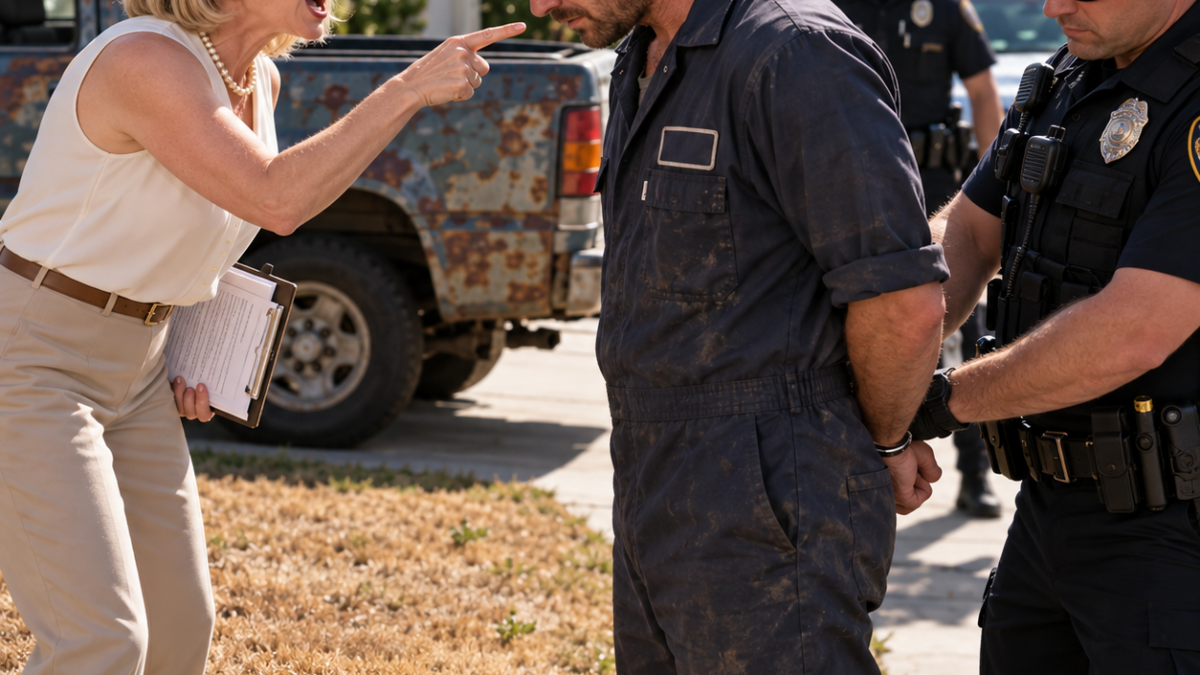
She approached me once while I was unloading groceries, waiting until two neighbors were walking by with a small white dog before speaking loudly enough for them to hear.
“Mr. Miller, your account is seriously delinquent.”
I set a gallon of milk down in the truck bed.
“I’m not doing this in the driveway.”
“Community rules apply whether you find them convenient or not.”
The neighbors slowed.
Of course they did.
Karen’s eyes flicked toward them, then back to me.
“Every other homeowner manages to maintain standards.”
“Every other homeowner isn’t being targeted over a work truck.”
“If you feel targeted, perhaps you should consider why your property is the one attracting attention.”
I leaned closer, keeping my voice low.
“Because you don’t think a mechanic belongs here.”
Her expression shifted.
Only slightly.
But enough.
“People who belong,” she said, “do not need to be reminded this often.”
The woman with the dog looked away. Her husband suddenly found the sidewalk fascinating.
Karen walked off with the satisfied posture of someone who had drawn blood without raising her voice.
That night, Emily asked why Mrs. Reynolds had looked at us weird at the mailbox.
I told her adults were strange.
She nodded like that confirmed something she already knew.
For four months, the pressure built.
I paid what I could. I wrote letters. I asked for hearings. I attended one board meeting where Karen sat at the center of the table like a judge, flanked by board members who nodded whenever she spoke. I explained the drought restrictions. I explained my budget. I explained that the truck was necessary for work.
One board member, a retired man named Allen, looked uncomfortable.
Karen did not.
“Mr. Miller,” she said, “the association is not unsympathetic to personal hardship.”
That was a lie.
“However, hardship does not exempt a homeowner from rules that protect everyone.”
“I’m not asking to be exempt forever. I’m asking for time until watering restrictions lift.”
“And the vehicle?”
“I’m not replacing a functioning truck because it offends your taste.”
Her eyes hardened.
“The board will continue enforcement.”
“Of course you will.”
A week later, they filed for a court injunction.
The legal papers arrived on a Tuesday afternoon, and I remember standing in the doorway with the envelope in my hand while Emily practiced spelling words at the table. Injunction. Compliance. Failure to appear. Contempt.
Those words lived in a different world than mine.
I fixed transmissions. I packed lunches. I calculated whether I could delay the electric bill until payday. I did not know how to navigate civil court.
The papers said I had to appear before a judge. If I failed to appear, the court could enter an order requiring me to fix the violations within a specific timeframe. If I failed to obey that order, I could face contempt.
I called the HOA office.
Karen answered.
“This is Karen.”
“I got court papers.”
“Yes.”
“You really filed for an injunction over grass and a truck?”
“We filed to enforce community standards after months of noncompliance.”
“I’ve been trying to work with you.”
“You’ve been making partial payments while continuing violations.”
“There is a drought.”
“There are landscapers who handle these situations professionally.”
“I can’t afford that.”
“Then perhaps you should sell before the problem grows larger.”
I gripped the phone until it creaked.
“That’s what you want, isn’t it?”
She said nothing.
“You want me gone.”
Her silence was answer enough.
Then she said, “The hearing date is in your paperwork. I suggest you take it seriously.”
I did.
At least, I thought I did.
The official court notice came by mail. I put it on the refrigerator with a magnet shaped like a dolphin Emily had painted in third grade. I arranged to take time off work. I asked my parents if they could pick Emily up from school that day. I even borrowed a dress shirt from my brother because mine had a stain near the cuff.
Then, four days later, another letter appeared in my mailbox.
It looked official.
That is the part I still hate remembering.
The paper was good quality. The formatting looked like government correspondence. The header said something like Judicial Administrative Services, and the letter stated there had been a scheduling conflict with the judge. My hearing was being moved three weeks later. It included a new date, a case number, and language about updated docket management.
I was stressed, exhausted, and naive.
I believed it.
I moved the magnet on the refrigerator. I told my boss the date had changed. I told my parents never mind for now. I did not call the courthouse. I did not think someone would fake a court scheduling letter over an HOA case. That possibility did not exist in my mind.
Now, years later, I know better.
Always verify with the clerk.
Always keep every piece of paper.
Always assume that people willing to ruin you over dead grass may not stop at honest methods.
The real hearing came and went without me.
Because I did not appear, the judge entered the injunction by default. The order required me to cure the landscaping and vehicle violations within thirty days.
I did not know that until I was served the order a week later.
Even then, because I still believed the hearing had simply moved, I thought there had been some paperwork overlap. I called the HOA office. Karen was unavailable. I left messages. No one called back.
Thirty days passed.
My lawn remained brown because the drought remained real.
My truck remained in my driveway because I still needed to work.
Then I was served with a motion for contempt.
That was when I understood the ground had vanished under me.
I tore through the house looking for the rescheduling letter. Kitchen drawer. Desk pile. Trash bin. Old mail basket. Truck cab. Nothing. I had thrown it away, thinking it was routine paperwork after the court order arrived.
At the contempt hearing, I showed up early.
I wore the borrowed shirt. I brought my HOA letters, watering restriction printouts, photos of the lawn, truck registration, insurance documents, payment receipts, and every scrap I could gather. My hands sweated so badly I almost dropped the folder in the courthouse hallway.
Karen sat with the HOA attorney.
She wore a pale yellow blazer and a calm expression.
When our case was called, the HOA attorney made me sound like a scofflaw. He said the association had followed notice procedures. He said I had failed to appear. He said I had ignored a court order. He said the community had been patient, but enforcement meant nothing if court orders were treated as suggestions.
Then it was my turn.
I tried to explain the fake letter.
The judge listened with a face that told me he had heard too many bad excuses before lunch.
“Do you have the letter?” he asked.
“No, Your Honor. I threw it away.”
“Did you call the clerk to confirm the changed date?”
“No, sir. I thought—”
“You thought a court hearing could be rescheduled by a letter from an entity you did not verify?”
My face burned.
“I know now I should have called.”
The HOA attorney stood.
“Your Honor, the association has no knowledge of any such letter. It appears Mr. Miller is attempting to avoid responsibility after failing to take these proceedings seriously.”
Karen looked straight ahead.
Not smug.
Not smiling.
That was worse.
She looked clean.
The judge sighed.
I learned later he was known for being tough on contempt cases. I also learned he had seen multiple HOA enforcement disputes that month and was tired of homeowners ignoring orders. None of that helped me then.
“Mr. Miller,” he said, “you were properly served. You failed to appear. The court entered an order. You failed to comply. Whether you misunderstood something or not, you are responsible for verifying court dates and obeying court orders.”
“I understand, Your Honor. I just need time. There are county watering restrictions. I can’t make grass grow without violating—”
“The time to raise that was at the original hearing.”
I swallowed.
“My truck is legal. I use it for work.”
“The time to raise that was also at the original hearing.”
I looked at Karen.
She did not look back.
The judge gave me a choice.
Pay a $2,000 contempt fine immediately or spend forty-eight hours in county jail.
I did not have $2,000.
Not in checking, not in savings, not hidden under a mattress, not anywhere.
My mouth went dry.
“Your Honor,” I said, “I’m a single father.”
His expression flickered, but only briefly.
“You should have considered that before ignoring a court order.”
A deputy came to my side.
I remember the sound of his belt. The jingle of metal. The way the courtroom seemed to narrow until all I could see was Karen’s yellow blazer and the deputy’s hand near my elbow.
They took me into custody.
For brown grass.
For an old truck.
For being too poor to pay $2,000 on command.
County jail was not dangerous for me, not really. It was humiliating.
That difference matters.
I was processed like anyone else. Belt taken. Shoelaces taken. Wallet taken. Phone taken. Dignity placed somewhere outside the building with the rest of my property. The holding area smelled like sweat, disinfectant, and old fear. Men asked what I was in for. When I told them contempt over HOA violations, they laughed because of course they did.
One guy with a tattoo crawling up his neck said, “Man, I stole a boat once and got less time than that.”
A guard joked that I should have spray-painted the grass green.
Another inmate told me his aunt lived in an HOA and he would rather sleep under a bridge.
I smiled when people joked because that was easier than crying in front of strangers.
But at night, on the thin mattress, staring at the ceiling under fluorescent light, I thought about Emily.
My parents had picked her up. I knew she was safe. But safe is not the same as okay. She knew her father had gone to court and not come home. She knew Grandma’s voice sounded too cheerful when explaining that Daddy would be back soon. She was eleven, old enough to understand jail and young enough to imagine the worst parts incorrectly.
I pictured her lying in my old childhood room at my parents’ house, clutching the stuffed dolphin she pretended she no longer needed.
That was the moment shame became something else.
Rage.
Not loud rage. Not reckless rage.
A steady, focused rage.
Karen wanted me embarrassed enough to fold, poor enough to leave, scared enough to obey. She had taken my lawn, my truck, my money, my peace, and then forty-eight hours of my freedom. She had made my daughter afraid.
I decided in that cell that if I could not prove the fake letter, I would prove everything else.
When I got out, Emily ran into me so hard she nearly knocked the air from my lungs.
I held her in my parents’ living room while she cried into my shirt.
“Why did they take you?” she whispered.
How do you explain adult cruelty to a child without breaking something in them?
I stroked her hair.
“Because some people used rules the wrong way. But I’m home now.”
“Are they going to take you again?”
“No.”
I made that promise before I knew if I could keep it.
Then I went to war.
The first thing I did was call a lawyer.
His name was Frank Delgado, and he specialized in HOA disputes, which I did not even know was a whole legal ecosystem until my life became ridiculous enough to need one. His office was small, cluttered, and blessedly normal. No decorative lemons. No glass conference room. Just shelves of files, a coffee mug with chipped paint, and a man who listened without looking bored.
I told him everything.
The drought. The truck. Karen’s comments. The fines. The vague covenants. The fake scheduling letter. The contempt hearing. Jail.
Frank leaned back.
“Can you prove the fake letter?”
“No.”
“Then we set that aside unless it surfaces later.”
My heart sank.
“But?”
“But the vehicle enforcement is weak. Legal, registered, functional work truck. Vague aesthetic clause. Possible selective enforcement. The lawn enforcement during county watering restrictions is also risky for them, especially if they’re pushing you to violate environmental rules.”
I sat forward.
“So I have a chance?”
“You have more than a chance,” he said. “You have a story.”
I did not understand what he meant until later.
Frank sent the HOA a letter first.
It challenged the vehicle fines as likely unenforceable and selectively applied. It pointed out that continued landscaping fines during active county watering restrictions could be construed as encouraging wasteful or unlawful water use. It requested suspension of fines, removal of any lien activity, and a meeting to resolve the matter before further litigation.
Karen’s reply came through the HOA attorney.
The association denies wrongdoing and will continue to enforce all valid covenants.
Frank smiled when he read it.
“They want to be stupid in writing. Helpful.”
The second thing I did was call reporters.
At first, nobody cared. HOA fines were not exactly breaking news. One TV station intern took my name and never called back. Another asked whether there was video of my arrest. There wasn’t. A local radio producer said it sounded “too small.”
Then a reporter from the county paper named Lisa Tran called.
“Is it true you were jailed over brown grass during watering restrictions?” she asked.
“That’s one way to put it.”
“That’s the way readers will understand.”
Lisa came to my house two days later.
She was young, sharp, and wore sneakers with her dress pants. I showed her the lawn, the brown patches, the county watering restriction notice, the HOA letters, the truck, the court documents, and the spot on the refrigerator where the fake letter had been before I threw it away.
She took notes while Emily sat at the kitchen table doing homework, glancing up now and then.
“Can I quote you?” Lisa asked.
“Yes.”
“What do you want people to understand?”
I looked through the window at my truck.
“I’m not asking to let my house fall apart. I cut my grass. I maintain my place. I work. I pay what I can. But I was told to fix drought-damaged grass without enough water and replace a legal work truck because it looked poor. Then I went to jail because I couldn’t pay two thousand dollars immediately. That doesn’t feel like community standards. It feels like punishment for not looking rich enough.”
Lisa looked up from her notebook.
“That’s the quote.”
The article ran the following Sunday.
SINGLE FATHER JAILED AFTER HOA BATTLE OVER LAWN DURING DROUGHT
It included a photo of me standing beside my pickup, arms crossed, looking more tired than angry. It quoted county watering rules. It quoted Frank saying HOAs should be cautious enforcing landscaping standards when local restrictions limit irrigation. It quoted Karen too.
Her statement was short.
The association enforces standards equally to preserve property values and community integrity.
Community integrity.
That phrase became a joke faster than she expected.
The article got shared locally. Then a TV station picked it up for a human-interest segment. A reporter came out and filmed my lawn, my truck, and Emily’s swing set in the backyard. They interviewed neighbors, some of whom admitted off camera that Karen had gone too far. A few even said on camera that many lawns had brown patches but mine seemed to be targeted harder.
Karen hated the attention.
I knew because the next HOA newsletter included a long message about “misinformation” and “outside media narratives.” She wrote that enforcement decisions were not personal and that homeowners who purchased in the community agreed to maintain standards regardless of individual circumstances.
Individual circumstances.
Such as drought.
Poverty.
Single parenthood.
Reality.
While the media pressure built, I started watching.
Not spying. Not trespassing. Just noticing.
And once you start noticing hypocrites, they become generous.
Karen’s lawn was perfect.
Too perfect.
Emerald green in a neighborhood slowly turning patchy under watering restrictions. The grass in front of her house looked like a golf course. Her flower beds were lush. Her hedges glossy. At first, I assumed she was paying for some drought-resistant treatment or had a well exemption.
Then I drove by after work one Wednesday afternoon and saw her sprinklers running.
At 2:15 p.m.
In full sun.
On a day her address was not allowed to water.
I pulled over legally down the street and took a photo.
Then I took another the next day.
And another.
For a week, I documented Karen’s sprinklers running outside permitted times, sometimes daily. Her perfect lawn was not moral superiority. It was evidence.
I reported her to the county utilities department.
Not loudly.
Not on Facebook.
Just a formal complaint with photos, dates, times, and address.
County enforcement moved faster than I expected.
Karen received a warning first. Then, after another documented violation, a fine. More importantly, she had to stop watering outside restrictions.
Within two weeks, her lawn began to brown.
Not as badly as mine. She had money, treatments, better irrigation. But the green started fading in patches near the driveway. The edges crisped. One section by the mailbox turned the same sad beige as everyone else’s.
I drove past one evening and saw her standing in the yard, arms crossed, staring down at it like the grass had betrayed her.
I did not honk.
I wanted to.
But I didn’t.
Then other lawns followed.
Without illegal watering, half the neighborhood started showing drought stress. Board members’ lawns. Wealthy residents’ lawns. Homes with stone lions by the front door. Homes with three-car garages. Homes where nobody owned a rusty pickup but everybody owned brown grass now.
The illusion broke.
Karen could bully one mechanic’s yard and call it standards.
She could not fine the whole neighborhood without starting a revolt.
The emergency HOA meeting happened two weeks after the TV segment aired.
I attended with Frank.
The clubhouse was packed. People stood along the walls, whispering, sweating, holding violation letters of their own. Karen sat at the board table in a navy blazer, face tight, lips pale under lipstick. For once, she did not look untouchable.
A man from the back stood up during open comments.
“I got a lawn warning yesterday,” he said. “Are you going to send me to jail too?”
Murmurs spread.
Karen tapped the microphone.
“The association did not send anyone to jail.”
I stood before I could stop myself.
“You asked the court to enforce an order you knew I couldn’t comply with during a drought.”
Her eyes cut toward me.
“You failed to appear.”
“After I received a fake scheduling letter.”
The room stirred.
Karen’s face stayed still.
“That allegation is baseless.”
Frank put one hand lightly on my arm, warning me not to go too far without proof.
So I stopped there.
Another resident stood.
“Why was your lawn green when everyone else was following restrictions?”
Karen’s jaw tightened.
“My personal property is not the subject of this meeting.”
A woman near the front laughed sharply.
“It became our business when you fined people for dead grass while watering illegally.”
That was the turn.
You could feel it.
The board announced that landscaping violation fines would be suspended for the duration of county watering restrictions. They would review the vehicle aesthetic standards for clarity and consistency. They would also establish a hardship review process.
Karen read those announcements like each word tasted poisonous.
Frank leaned toward me.
“They’re retreating.”
“Is it enough?”
“No,” he said. “But now they know they’re losing.”
The settlement came after that.
The HOA did not apologize. That would have required humility, and Karen had not budgeted for that. But their attorney called Frank and began negotiating.
They agreed to drop all existing fines against me, including the vehicle fines.
They agreed to remove any lien threats or collection actions.
They agreed to reimburse the contempt-related court costs.
They agreed to suspend landscaping enforcement while watering restrictions remained in effect.
They agreed to review vehicle standards and apply them consistently rather than using vague language to target specific homeowners.
In exchange, I agreed not to sue for harassment, selective enforcement, or any alleged role in the scheduling confusion.
Frank explained the risk.
“We may never prove the fake letter came from them. Litigation would be expensive. This gives you practical relief.”
“What about Karen?”
He sighed.
“Karen is a political problem now.”
He was right.
The next board election did what my lawsuit might not have.
Karen did not run again.
Officially, she wanted to “step back from community service.”
That was the phrase in the newsletter.
Unofficially, she had become the woman who got a single dad jailed over dead grass while illegally watering her own lawn. The jokes followed her everywhere. Someone stuck a small plastic jail bar decoration in a brown patch near the clubhouse during Halloween. It was removed within an hour, but photos circulated for weeks.
Two other board members stepped down with her.
The new board was not perfect. No HOA board ever is. But they were sane. They focused on actual maintenance: broken sidewalks, storm drains, pool repairs, common area lighting. They sent reminders instead of threats. They stopped treating every imperfection like a moral failure.
My truck stayed in the driveway until it finally died three years later.
When it did, I bought a newer used pickup on my own timeline, with money I had saved, not because Karen shamed me into debt. I stood at the dealership signing papers and thought about the old truck with surprising affection. It had outlasted her presidency. That seemed fitting.
When the drought ended in 2012, I reseeded the lawn myself. I borrowed a spreader from a neighbor, bought the seed on sale, and watered within the rules. The grass came back slowly, unevenly at first, then thick enough that Emily and I lay on it one evening looking up at clouds.
She was thirteen by then.
Older.
Sharper.
Still carrying pieces of what happened.
“Do you ever wish we moved?” she asked.
I turned my head.
“Sometimes.”
“Why didn’t we?”
“Because leaving because you want to is different than leaving because someone pushes you.”
She thought about that.
“Karen was a bully.”
“Yes.”
“You beat her.”
I looked up at the sky.
“I survived her.”
“That’s better?”
“Sometimes.”
She nodded like she understood.
Maybe she did.
Years passed. Emily grew up. She became the kind of woman who reads contracts before signing them, keeps receipts, verifies court dates, and once called her apartment management company three times in one day because they tried to charge a fee not listed in her lease. I asked if she thought that was excessive.
She said, “You went to jail over grass, Dad.”
Fair point.
The experience changed me too.
I learned to document everything. Certified mail. Photos. Dates. Names. Screenshots. Phone logs. I learned that rules are only fair when applied honestly, and that vague language is where bullies hide. I learned that public attention can do what private pleading cannot. I learned that shame is a weapon, and refusing to carry it can make powerful people furious.
Most of all, I learned that people like Karen rarely start with handcuffs.
They start with tone.
A look.
A comment about people like you.
A photograph taken from across the street.
A phrase like community standards.
Then the letters come. Then fines. Then lawyers. Then court orders. Then one bad day, if you are tired and poor and trusting enough to believe a fake letter, you are standing in front of a judge being told your freedom costs two thousand dollars.
I still drive past Karen sometimes.
She still lives in the neighborhood, though not on the board. Her lawn is decent, not perfect. She drives a silver crossover now instead of the white SUV. Once, at the grocery store, we ended up in the same checkout line. She recognized me and looked away so quickly it was almost funny.
I did not say anything.
I had nothing left to prove to her.
A few years after everything, the county paper did a follow-up piece on HOA reform after several disputes in different neighborhoods. Lisa Tran, the same reporter, called me for a quote. I told her the truth.
“I don’t hate rules. I hate when rules become a costume for contempt.”
She used that line.
Emily framed the article and gave it to me as a joke for Father’s Day.
It hangs in my garage above the workbench now, next to a photo of her in her high school graduation gown. In the photo, she is smiling so big it looks like sunlight invented a face. That is the thing I think about when I remember those forty-eight hours in jail. Not Karen. Not the judge. Not the guard joking about green spray paint.
Emily.
The fear in her voice when she asked if they would take me again.
The way she learned too young that adults with authority can be wrong.
The way she also learned that being wronged does not mean staying quiet.
If there is any good in the story, it is that.
I wish she had learned it from a book.
I wish she had learned it from some harmless school debate or a movie where the villain gets defeated before bedtime. I wish she had not had to learn it because her father came home from county jail smelling like disinfectant and humiliation.
But life teaches with whatever tools are nearby.
In our case, it used brown grass, a rusted pickup, and a woman named Karen who mistook poverty for weakness.
She was wrong.
Poor does not mean careless.
Working class does not mean disposable.
A rusty truck does not mean a man lacks dignity.
Dead grass during a drought does not mean a father is failing his daughter.
And a neighborhood that only looks perfect because people are afraid is not a community.
It is a showroom with mailboxes.
My lawn is green now most of the year. Not perfect, but alive. The new pickup has dents because I use it like a truck, and if anyone thinks that lowers the moral tone of the street, they have had the good sense not to tell me. The HOA sends emails about pool passes, holiday lights, storm prep, and speed bumps. Boring things. Healthy things.
Sometimes, during dry spells, patches still brown near the sidewalk.
When they do, I water within the rules, wait for rain, and refuse to panic.
Because I know something Karen never understood.
Grass can come back.
So can dignity.
And if someone tries to bury you under shame, fines, and paperwork, sometimes all you need is one stubborn root, one witness, one reporter, one lawyer, one photograph of a sprinkler running illegally in the afternoon sun.
Karen wanted me to feel like I did not belong.
But I stayed.
My daughter grew up.
The truck lasted as long as it needed to.
The grass returned when the rain did.
And the woman who tried to turn my life into a violation became a lesson the whole neighborhood still remembers whenever the weather gets dry and the lawns start turning brown.
𝗧𝗛𝗘 𝗘𝗡𝗗
Karen Sent Me to Jail Over Dead Grass, but She Forgot Droughts Don’t Only Kill Poor Men’s Lawns
Karen looked at my brown grass, my rusted pickup, and my mechanic’s uniform, then decided I did not belong in her perfect neighborhood.
By the time she was finished proving it, I had spent forty-eight hours in county jail for a lawn I was legally forbidden to water.
I used to think the worst thing an HOA could do was fine you.
That was before Karen Whitaker taught me that a clipboard, a courtroom, and a grudge could put a single father behind bars.
Back in 2010, I lived in central Florida in a neighborhood I probably had no business affording, at least not according to people like her. I was born and raised in Florida, which means I can say this with love and exhaustion: this state has a way of turning ordinary problems into stories nobody believes unless they happened to you. A man getting jailed over brown grass and an old pickup sounds like a punchline until you’re the one being booked.
At the time, I was thirty-eight years old, divorced, and raising my eleven-year-old daughter, Emily, mostly on my own. Her mother was around, but not in any dependable way, and I had learned early that being angry about that did not pack lunches, sign permission slips, or sit through math homework. So I did what I had to do.
I worked as a mechanic.
Not the shiny dealership kind where the floor smells like fresh coffee and customers sit in leather chairs watching cable news. I worked in a hot shop with oil in the concrete, sweat under my collar, and a boss who believed air-conditioning made men soft. I came home most days smelling like brake dust, gasoline, and whatever old truck had decided to leak on me before five o’clock.
I did not make much money, but I made enough to keep the lights on, the pantry stocked, and Emily in the school district I had fought hard to reach.
That was the reason for the house.
Not the granite counters. Not the palm-lined entrance. Not the little community pond with a fountain that looked expensive even when it clogged with algae. I bought that house because the public school was excellent, and Emily deserved classrooms where teachers knew her name, not because I cared about matching mailboxes or decorative hedges.
The house itself was modest compared to the rest of the neighborhood. Same square footage on paper, sure, but you could tell which owners had money left over after buying. My neighbors had manicured lawns, stone borders, clean SUVs, and men who left for work in suits while I backed out in a rusty blue pickup that coughed on cold mornings and rattled like it had opinions.
I loved that truck.
It was ugly, yes. I knew that. The paint was faded, the rear bumper had been replaced with one from a junkyard, and rust had started chewing around the wheel wells. But it ran. It hauled tools. It carried lumber, mulch, groceries, bicycles, and once, after a hurricane, half a fallen fence from Mrs. Alvarez’s yard three streets over. It was registered, insured, street legal, and paid for.
Paid for mattered.
People with money always underestimate the beauty of things that do not come with monthly payments.
My lawn was another story.
I tried. I really did. I mowed it every week. I edged the driveway. I pulled weeds by hand because herbicide felt like an unnecessary expense when my knees still worked. But that spring and summer were brutal. Central Florida was under drought conditions, and the county had outdoor watering restrictions. You could water only on certain days, only during certain early morning or evening hours, and even then it felt like trying to save a sinking boat with a coffee mug.
Brown patches appeared near the sidewalk first.
Then along the side yard.
Then a rough oval opened under the oak tree where the soil was thin and stubborn.
I bought cheap seed once, stood in the hardware aisle doing math in my head, then put it back because seed without water was just bird food.
Emily noticed me staring at the grass one evening.
“It’s not that bad, Dad,” she said.
I looked at the brown patch spreading near the mailbox.
“It looks like a sad pancake.”
She laughed. “Nobody cares.”
She was eleven. She still believed that.
Karen cared.
Karen Whitaker was the HOA president, though president never felt strong enough for how she carried herself. She acted more like a border guard for a small, wealthy country. Mid-forties, blond hair cut into a smooth bob, pearl earrings, sharp smile, white SUV always spotless, and a closet full of sleeveless blouses that looked pressed by fear itself. She had a voice that could sound sweet while making you feel like you had failed an inspection.
The first violation letter arrived in June.
I opened it at the kitchen table while Emily ate cereal across from me, reading the back of the box like it contained classified information.
The letter said my property was out of compliance with community standards due to “visible turf deterioration” and “an unsightly vehicle inconsistent with neighborhood aesthetic values.”
Unsightly vehicle.
I read that phrase twice.
Then I looked through the front window at my old pickup sitting in the driveway, sun bouncing off the rust on its hood.
The HOA had called my truck ugly in writing.
Emily looked up. “What?”
“Nothing.”
She tilted her head. “You made the face.”
“What face?”
“The money face.”
I folded the letter.
“It’s just HOA stuff.”
Her shoulders sank a little, and that hurt worse than the letter. Kids know more than you want them to know. They hear the sighs. They notice when you put groceries back. They understand that some envelopes bring tension into a room.
“It’s okay,” I told her. “I’ll handle it.”
I believed that then.
That was before I understood Karen did not want compliance.
She wanted me reminded of my place.
part2
The first time I met Karen in person over the violations, I was still trying to be reasonable.
That was another mistake.
Reasonable only works when the other person wants a solution. Karen wanted surrender, and she wanted it dressed up as policy.
I went to the HOA office after work on a Thursday, still in my mechanic’s uniform because I had picked up Emily from after-school care and barely had time to rinse my hands. The office sat inside the clubhouse, a cool, overly bright room with framed community photos on the wall and a bowl of decorative lemons on the reception table that I’m pretty sure nobody was supposed to eat.
Karen was waiting for me in a conference room with glass walls.
She did not stand when I came in.
“Mr. Miller,” she said.
“Call me Jack.”
She smiled tightly. “Mr. Miller, then.”
That told me enough.
I sat across from her. A leather folder lay in front of her, my violation letter tucked neatly inside.
“I wanted to talk about the lawn,” I said. “The county has watering restrictions. I can’t water enough to bring those patches back right now.”
Karen folded her hands.
“We are aware of the county restrictions.”
“Then you know why half the problem exists.”
“The restrictions still allow responsible watering within permitted windows.”
“I’m watering when I can. It’s not enough.”
“That suggests the lawn may need professional restoration.”
“That costs money.”
“Yes,” she said, as if money was a weather condition only irresponsible people failed to plan around.
I took a breath.
“I can reseed once the restrictions lift or when rain comes back. But if I put seed down now, it’ll die.”
Her eyes moved briefly to my uniform.
“This community has standards, Mr. Miller. Every homeowner accepted them when purchasing property here.”
“I’m not arguing that. I’m asking for time.”
“You’ve had time.”
“This is the first letter.”
“It is the first formal letter.”
Formal.
That word made my jaw tighten.
“What about the truck?” I asked.
Karen opened the folder and pulled out a photograph.
My pickup.
Someone had taken the picture from across the street, zoomed in on the rusted side panel and cracked tail light cover. It looked worse in the photo than in real life, though not by much.
“This vehicle is not in good aesthetic condition,” she said.
“It’s legal.”
“That is not the standard.”
“It runs. It’s registered. It’s insured. It’s my work truck.”
“We are not discussing function.”
“Maybe we should be.”
She leaned back slightly.
“Mr. Miller, this is not a rural service road. This is a residential community with a certain visual expectation.”
I almost laughed.
“Rural service road?”
“I simply mean—”
“You mean I drive a truck that looks like I use it for work.”
Her lips pressed together.
“I did not say that.”
“No. You took a picture of it and fined me.”
“The board has concerns.”
“About rust?”
“About property values.”
There it was.
Property values.
The sacred phrase people use when they want to make class judgment sound financial.
I looked around the clubhouse conference room, at the framed photo of smiling residents holding wine glasses during some neighborhood gala I had never attended because tickets were sixty dollars per person and I had a kid who needed new sneakers.
“Karen,” I said, carefully, “I’m a single dad. I work full time. I keep my house maintained. My grass is cut. My truck is old, but it’s not abandoned. I’m asking for common sense.”
Her smile faded.
“Common sense would have been considering whether this neighborhood was a good fit for your circumstances before purchasing.”
For a second, I thought I had misheard her.
“My circumstances?”
She lifted her chin.
“Some communities require a level of upkeep that not every homeowner is prepared for.”
The heat rose slowly up my neck.
“You mean people like me shouldn’t live here.”
“I mean every homeowner should meet the standards.”
“No,” I said. “You meant exactly what you said.”
She closed the folder.
“I can see this meeting is becoming unproductive.”
“It became unproductive when you insulted me.”
Her eyes sharpened.
“Your fines will begin accruing if the violations are not cured within the notice period.”
I stood.
“Then send me the specific covenant that says my legal pickup can’t sit in my driveway.”
“It’s under aesthetic standards.”
“That’s vague.”
“It’s enforceable.”
“We’ll see.”
She smiled again, and this time it was cold.
“Yes,” she said. “We will.”
The fines started two weeks later.
At first, they were small enough to be terrifying in a quiet way. Fifty dollars here. A hundred there. Lawn violation. Vehicle violation. Administrative charge. Reinspection fee. Certified notice fee. I paid some when I could, mostly the lawn ones, because I knew the covenant did require landscaping to be maintained. Even if the drought made that nearly impossible, I was still afraid of letting the amount grow.
The truck fines I resisted.
Every letter about the pickup made me angrier. They never quoted a specific line saying work vehicles had to be new, pretty, or free of rust. They just repeated phrases like “visual harmony,” “aesthetic condition,” and “community image.” I wrote back twice asking what exact standard I had violated.
Nobody answered directly.
Karen called once.
“You are creating unnecessary conflict,” she said.
“I asked a simple question.”
“The board has already determined the vehicle is noncompliant.”
“Based on what?”
“Based on visible condition.”
“Is there a rust percentage chart somewhere?”
She sighed. “Sarcasm will not help you.”
“Neither will pretending you can fine me because my truck embarrasses you.”
Her voice dropped.
“Your daughter deserves better than watching her father turn himself into the neighborhood problem.”
That one landed.
She knew it would.
For a moment, I saw red so bright I had to close my eyes.
“You don’t mention my daughter again,” I said.
“Then behave like an adult responsible for her environment.”
I hung up before I said something that could be used against me.
After that, Karen stopped pretending this was only about grass and a truck. She began making examples.
She approached me once while I was unloading groceries, waiting until two neighbors were walking by with a small white dog before speaking loudly enough for them to hear.
“Mr. Miller, your account is seriously delinquent.”
I set a gallon of milk down in the truck bed.
“I’m not doing this in the driveway.”
“Community rules apply whether you find them convenient or not.”
The neighbors slowed.
Of course they did.
Karen’s eyes flicked toward them, then back to me.
“Every other homeowner manages to maintain standards.”
“Every other homeowner isn’t being targeted over a work truck.”
“If you feel targeted, perhaps you should consider why your property is the one attracting attention.”
I leaned closer, keeping my voice low.
“Because you don’t think a mechanic belongs here.”
Her expression shifted.
Only slightly.
But enough.
“People who belong,” she said, “do not need to be reminded this often.”
The woman with the dog looked away. Her husband suddenly found the sidewalk fascinating.
Karen walked off with the satisfied posture of someone who had drawn blood without raising her voice.
That night, Emily asked why Mrs. Reynolds had looked at us weird at the mailbox.
I told her adults were strange.
She nodded like that confirmed something she already knew.
For four months, the pressure built.
I paid what I could. I wrote letters. I asked for hearings. I attended one board meeting where Karen sat at the center of the table like a judge, flanked by board members who nodded whenever she spoke. I explained the drought restrictions. I explained my budget. I explained that the truck was necessary for work.
One board member, a retired man named Allen, looked uncomfortable.
Karen did not.
“Mr. Miller,” she said, “the association is not unsympathetic to personal hardship.”
That was a lie.
“However, hardship does not exempt a homeowner from rules that protect everyone.”
“I’m not asking to be exempt forever. I’m asking for time until watering restrictions lift.”
“And the vehicle?”
“I’m not replacing a functioning truck because it offends your taste.”
Her eyes hardened.
“The board will continue enforcement.”
“Of course you will.”
A week later, they filed for a court injunction.
The legal papers arrived on a Tuesday afternoon, and I remember standing in the doorway with the envelope in my hand while Emily practiced spelling words at the table. Injunction. Compliance. Failure to appear. Contempt.
Those words lived in a different world than mine.
I fixed transmissions. I packed lunches. I calculated whether I could delay the electric bill until payday. I did not know how to navigate civil court.
The papers said I had to appear before a judge. If I failed to appear, the court could enter an order requiring me to fix the violations within a specific timeframe. If I failed to obey that order, I could face contempt.
I called the HOA office.
Karen answered.
“This is Karen.”
“I got court papers.”
“Yes.”
“You really filed for an injunction over grass and a truck?”
“We filed to enforce community standards after months of noncompliance.”
“I’ve been trying to work with you.”
“You’ve been making partial payments while continuing violations.”
“There is a drought.”
“There are landscapers who handle these situations professionally.”
“I can’t afford that.”
“Then perhaps you should sell before the problem grows larger.”
I gripped the phone until it creaked.
“That’s what you want, isn’t it?”
She said nothing.
“You want me gone.”
Her silence was answer enough.
Then she said, “The hearing date is in your paperwork. I suggest you take it seriously.”
I did.
At least, I thought I did.
The official court notice came by mail. I put it on the refrigerator with a magnet shaped like a dolphin Emily had painted in third grade. I arranged to take time off work. I asked my parents if they could pick Emily up from school that day. I even borrowed a dress shirt from my brother because mine had a stain near the cuff.
Then, four days later, another letter appeared in my mailbox.
It looked official.
That is the part I still hate remembering.
The paper was good quality. The formatting looked like government correspondence. The header said something like Judicial Administrative Services, and the letter stated there had been a scheduling conflict with the judge. My hearing was being moved three weeks later. It included a new date, a case number, and language about updated docket management.
I was stressed, exhausted, and naive.
I believed it.
I moved the magnet on the refrigerator. I told my boss the date had changed. I told my parents never mind for now. I did not call the courthouse. I did not think someone would fake a court scheduling letter over an HOA case. That possibility did not exist in my mind.
Now, years later, I know better.
Always verify with the clerk.
Always keep every piece of paper.
Always assume that people willing to ruin you over dead grass may not stop at honest methods.
The real hearing came and went without me.
Because I did not appear, the judge entered the injunction by default. The order required me to cure the landscaping and vehicle violations within thirty days.
I did not know that until I was served the order a week later.
Even then, because I still believed the hearing had simply moved, I thought there had been some paperwork overlap. I called the HOA office. Karen was unavailable. I left messages. No one called back.
Thirty days passed.
My lawn remained brown because the drought remained real.
My truck remained in my driveway because I still needed to work.
Then I was served with a motion for contempt.
That was when I understood the ground had vanished under me.
I tore through the house looking for the rescheduling letter. Kitchen drawer. Desk pile. Trash bin. Old mail basket. Truck cab. Nothing. I had thrown it away, thinking it was routine paperwork after the court order arrived.
At the contempt hearing, I showed up early.
I wore the borrowed shirt. I brought my HOA letters, watering restriction printouts, photos of the lawn, truck registration, insurance documents, payment receipts, and every scrap I could gather. My hands sweated so badly I almost dropped the folder in the courthouse hallway.
Karen sat with the HOA attorney.
She wore a pale yellow blazer and a calm expression.
When our case was called, the HOA attorney made me sound like a scofflaw. He said the association had followed notice procedures. He said I had failed to appear. He said I had ignored a court order. He said the community had been patient, but enforcement meant nothing if court orders were treated as suggestions.
Then it was my turn.
I tried to explain the fake letter.
The judge listened with a face that told me he had heard too many bad excuses before lunch.
“Do you have the letter?” he asked.
“No, Your Honor. I threw it away.”
“Did you call the clerk to confirm the changed date?”
“No, sir. I thought—”
“You thought a court hearing could be rescheduled by a letter from an entity you did not verify?”
My face burned.
“I know now I should have called.”
The HOA attorney stood.
“Your Honor, the association has no knowledge of any such letter. It appears Mr. Miller is attempting to avoid responsibility after failing to take these proceedings seriously.”
Karen looked straight ahead.
Not smug.
Not smiling.
That was worse.
She looked clean.
The judge sighed.
I learned later he was known for being tough on contempt cases. I also learned he had seen multiple HOA enforcement disputes that month and was tired of homeowners ignoring orders. None of that helped me then.
“Mr. Miller,” he said, “you were properly served. You failed to appear. The court entered an order. You failed to comply. Whether you misunderstood something or not, you are responsible for verifying court dates and obeying court orders.”
“I understand, Your Honor. I just need time. There are county watering restrictions. I can’t make grass grow without violating—”
“The time to raise that was at the original hearing.”
I swallowed.
“My truck is legal. I use it for work.”
“The time to raise that was also at the original hearing.”
I looked at Karen.
She did not look back.
The judge gave me a choice.
Pay a $2,000 contempt fine immediately or spend forty-eight hours in county jail.
I did not have $2,000.
Not in checking, not in savings, not hidden under a mattress, not anywhere.
My mouth went dry.
“Your Honor,” I said, “I’m a single father.”
His expression flickered, but only briefly.
“You should have considered that before ignoring a court order.”
A deputy came to my side.
I remember the sound of his belt. The jingle of metal. The way the courtroom seemed to narrow until all I could see was Karen’s yellow blazer and the deputy’s hand near my elbow.
They took me into custody.
For brown grass.
For an old truck.
For being too poor to pay $2,000 on command.
County jail was not dangerous for me, not really. It was humiliating.
That difference matters.
I was processed like anyone else. Belt taken. Shoelaces taken. Wallet taken. Phone taken. Dignity placed somewhere outside the building with the rest of my property. The holding area smelled like sweat, disinfectant, and old fear. Men asked what I was in for. When I told them contempt over HOA violations, they laughed because of course they did.
One guy with a tattoo crawling up his neck said, “Man, I stole a boat once and got less time than that.”
A guard joked that I should have spray-painted the grass green.
Another inmate told me his aunt lived in an HOA and he would rather sleep under a bridge.
I smiled when people joked because that was easier than crying in front of strangers.
But at night, on the thin mattress, staring at the ceiling under fluorescent light, I thought about Emily.
My parents had picked her up. I knew she was safe. But safe is not the same as okay. She knew her father had gone to court and not come home. She knew Grandma’s voice sounded too cheerful when explaining that Daddy would be back soon. She was eleven, old enough to understand jail and young enough to imagine the worst parts incorrectly.
I pictured her lying in my old childhood room at my parents’ house, clutching the stuffed dolphin she pretended she no longer needed.
That was the moment shame became something else.
Rage.
Not loud rage. Not reckless rage.
A steady, focused rage.
Karen wanted me embarrassed enough to fold, poor enough to leave, scared enough to obey. She had taken my lawn, my truck, my money, my peace, and then forty-eight hours of my freedom. She had made my daughter afraid.
I decided in that cell that if I could not prove the fake letter, I would prove everything else.
When I got out, Emily ran into me so hard she nearly knocked the air from my lungs.
I held her in my parents’ living room while she cried into my shirt.
“Why did they take you?” she whispered.
How do you explain adult cruelty to a child without breaking something in them?
I stroked her hair.
“Because some people used rules the wrong way. But I’m home now.”
“Are they going to take you again?”
“No.”
I made that promise before I knew if I could keep it.
Then I went to war.
The first thing I did was call a lawyer.
His name was Frank Delgado, and he specialized in HOA disputes, which I did not even know was a whole legal ecosystem until my life became ridiculous enough to need one. His office was small, cluttered, and blessedly normal. No decorative lemons. No glass conference room. Just shelves of files, a coffee mug with chipped paint, and a man who listened without looking bored.
I told him everything.
The drought. The truck. Karen’s comments. The fines. The vague covenants. The fake scheduling letter. The contempt hearing. Jail.
Frank leaned back.
“Can you prove the fake letter?”
“No.”
“Then we set that aside unless it surfaces later.”
My heart sank.
“But?”
“But the vehicle enforcement is weak. Legal, registered, functional work truck. Vague aesthetic clause. Possible selective enforcement. The lawn enforcement during county watering restrictions is also risky for them, especially if they’re pushing you to violate environmental rules.”
I sat forward.
“So I have a chance?”
“You have more than a chance,” he said. “You have a story.”
I did not understand what he meant until later.
Frank sent the HOA a letter first.
It challenged the vehicle fines as likely unenforceable and selectively applied. It pointed out that continued landscaping fines during active county watering restrictions could be construed as encouraging wasteful or unlawful water use. It requested suspension of fines, removal of any lien activity, and a meeting to resolve the matter before further litigation.
Karen’s reply came through the HOA attorney.
The association denies wrongdoing and will continue to enforce all valid covenants.
Frank smiled when he read it.
“They want to be stupid in writing. Helpful.”
The second thing I did was call reporters.
At first, nobody cared. HOA fines were not exactly breaking news. One TV station intern took my name and never called back. Another asked whether there was video of my arrest. There wasn’t. A local radio producer said it sounded “too small.”
Then a reporter from the county paper named Lisa Tran called.
“Is it true you were jailed over brown grass during watering restrictions?” she asked.
“That’s one way to put it.”
“That’s the way readers will understand.”
Lisa came to my house two days later.
She was young, sharp, and wore sneakers with her dress pants. I showed her the lawn, the brown patches, the county watering restriction notice, the HOA letters, the truck, the court documents, and the spot on the refrigerator where the fake letter had been before I threw it away.
She took notes while Emily sat at the kitchen table doing homework, glancing up now and then.
“Can I quote you?” Lisa asked.
“Yes.”
“What do you want people to understand?”
I looked through the window at my truck.
“I’m not asking to let my house fall apart. I cut my grass. I maintain my place. I work. I pay what I can. But I was told to fix drought-damaged grass without enough water and replace a legal work truck because it looked poor. Then I went to jail because I couldn’t pay two thousand dollars immediately. That doesn’t feel like community standards. It feels like punishment for not looking rich enough.”
Lisa looked up from her notebook.
“That’s the quote.”
The article ran the following Sunday.
SINGLE FATHER JAILED AFTER HOA BATTLE OVER LAWN DURING DROUGHT
It included a photo of me standing beside my pickup, arms crossed, looking more tired than angry. It quoted county watering rules. It quoted Frank saying HOAs should be cautious enforcing landscaping standards when local restrictions limit irrigation. It quoted Karen too.
Her statement was short.
The association enforces standards equally to preserve property values and community integrity.
Community integrity.
That phrase became a joke faster than she expected.
The article got shared locally. Then a TV station picked it up for a human-interest segment. A reporter came out and filmed my lawn, my truck, and Emily’s swing set in the backyard. They interviewed neighbors, some of whom admitted off camera that Karen had gone too far. A few even said on camera that many lawns had brown patches but mine seemed to be targeted harder.
Karen hated the attention.
I knew because the next HOA newsletter included a long message about “misinformation” and “outside media narratives.” She wrote that enforcement decisions were not personal and that homeowners who purchased in the community agreed to maintain standards regardless of individual circumstances.
Individual circumstances.
Such as drought.
Poverty.
Single parenthood.
Reality.
While the media pressure built, I started watching.
Not spying. Not trespassing. Just noticing.
And once you start noticing hypocrites, they become generous.
Karen’s lawn was perfect.
Too perfect.
Emerald green in a neighborhood slowly turning patchy under watering restrictions. The grass in front of her house looked like a golf course. Her flower beds were lush. Her hedges glossy. At first, I assumed she was paying for some drought-resistant treatment or had a well exemption.
Then I drove by after work one Wednesday afternoon and saw her sprinklers running.
At 2:15 p.m.
In full sun.
On a day her address was not allowed to water.
I pulled over legally down the street and took a photo.
Then I took another the next day.
And another.
For a week, I documented Karen’s sprinklers running outside permitted times, sometimes daily. Her perfect lawn was not moral superiority. It was evidence.
I reported her to the county utilities department.
Not loudly.
Not on Facebook.
Just a formal complaint with photos, dates, times, and address.
County enforcement moved faster than I expected.
Karen received a warning first. Then, after another documented violation, a fine. More importantly, she had to stop watering outside restrictions.
Within two weeks, her lawn began to brown.
Not as badly as mine. She had money, treatments, better irrigation. But the green started fading in patches near the driveway. The edges crisped. One section by the mailbox turned the same sad beige as everyone else’s.
I drove past one evening and saw her standing in the yard, arms crossed, staring down at it like the grass had betrayed her.
I did not honk.
I wanted to.
But I didn’t.
Then other lawns followed.
Without illegal watering, half the neighborhood started showing drought stress. Board members’ lawns. Wealthy residents’ lawns. Homes with stone lions by the front door. Homes with three-car garages. Homes where nobody owned a rusty pickup but everybody owned brown grass now.
The illusion broke.
Karen could bully one mechanic’s yard and call it standards.
She could not fine the whole neighborhood without starting a revolt.
The emergency HOA meeting happened two weeks after the TV segment aired.
I attended with Frank.
The clubhouse was packed. People stood along the walls, whispering, sweating, holding violation letters of their own. Karen sat at the board table in a navy blazer, face tight, lips pale under lipstick. For once, she did not look untouchable.
A man from the back stood up during open comments.
“I got a lawn warning yesterday,” he said. “Are you going to send me to jail too?”
Murmurs spread.
Karen tapped the microphone.
“The association did not send anyone to jail.”
I stood before I could stop myself.
“You asked the court to enforce an order you knew I couldn’t comply with during a drought.”
Her eyes cut toward me.
“You failed to appear.”
“After I received a fake scheduling letter.”
The room stirred.
Karen’s face stayed still.
“That allegation is baseless.”
Frank put one hand lightly on my arm, warning me not to go too far without proof.
So I stopped there.
Another resident stood.
“Why was your lawn green when everyone else was following restrictions?”
Karen’s jaw tightened.
“My personal property is not the subject of this meeting.”
A woman near the front laughed sharply.
“It became our business when you fined people for dead grass while watering illegally.”
That was the turn.
You could feel it.
The board announced that landscaping violation fines would be suspended for the duration of county watering restrictions. They would review the vehicle aesthetic standards for clarity and consistency. They would also establish a hardship review process.
Karen read those announcements like each word tasted poisonous.
Frank leaned toward me.
“They’re retreating.”
“Is it enough?”
“No,” he said. “But now they know they’re losing.”
The settlement came after that.
The HOA did not apologize. That would have required humility, and Karen had not budgeted for that. But their attorney called Frank and began negotiating.
They agreed to drop all existing fines against me, including the vehicle fines.
They agreed to remove any lien threats or collection actions.
They agreed to reimburse the contempt-related court costs.
They agreed to suspend landscaping enforcement while watering restrictions remained in effect.
They agreed to review vehicle standards and apply them consistently rather than using vague language to target specific homeowners.
In exchange, I agreed not to sue for harassment, selective enforcement, or any alleged role in the scheduling confusion.
Frank explained the risk.
“We may never prove the fake letter came from them. Litigation would be expensive. This gives you practical relief.”
“What about Karen?”
He sighed.
“Karen is a political problem now.”
He was right.
The next board election did what my lawsuit might not have.
Karen did not run again.
Officially, she wanted to “step back from community service.”
That was the phrase in the newsletter.
Unofficially, she had become the woman who got a single dad jailed over dead grass while illegally watering her own lawn. The jokes followed her everywhere. Someone stuck a small plastic jail bar decoration in a brown patch near the clubhouse during Halloween. It was removed within an hour, but photos circulated for weeks.
Two other board members stepped down with her.
The new board was not perfect. No HOA board ever is. But they were sane. They focused on actual maintenance: broken sidewalks, storm drains, pool repairs, common area lighting. They sent reminders instead of threats. They stopped treating every imperfection like a moral failure.
My truck stayed in the driveway until it finally died three years later.
When it did, I bought a newer used pickup on my own timeline, with money I had saved, not because Karen shamed me into debt. I stood at the dealership signing papers and thought about the old truck with surprising affection. It had outlasted her presidency. That seemed fitting.
When the drought ended in 2012, I reseeded the lawn myself. I borrowed a spreader from a neighbor, bought the seed on sale, and watered within the rules. The grass came back slowly, unevenly at first, then thick enough that Emily and I lay on it one evening looking up at clouds.
She was thirteen by then.
Older.
Sharper.
Still carrying pieces of what happened.
“Do you ever wish we moved?” she asked.
I turned my head.
“Sometimes.”
“Why didn’t we?”
“Because leaving because you want to is different than leaving because someone pushes you.”
She thought about that.
“Karen was a bully.”
“Yes.”
“You beat her.”
I looked up at the sky.
“I survived her.”
“That’s better?”
“Sometimes.”
She nodded like she understood.
Maybe she did.
Years passed. Emily grew up. She became the kind of woman who reads contracts before signing them, keeps receipts, verifies court dates, and once called her apartment management company three times in one day because they tried to charge a fee not listed in her lease. I asked if she thought that was excessive.
She said, “You went to jail over grass, Dad.”
Fair point.
The experience changed me too.
I learned to document everything. Certified mail. Photos. Dates. Names. Screenshots. Phone logs. I learned that rules are only fair when applied honestly, and that vague language is where bullies hide. I learned that public attention can do what private pleading cannot. I learned that shame is a weapon, and refusing to carry it can make powerful people furious.
Most of all, I learned that people like Karen rarely start with handcuffs.
They start with tone.
A look.
A comment about people like you.
A photograph taken from across the street.
A phrase like community standards.
Then the letters come. Then fines. Then lawyers. Then court orders. Then one bad day, if you are tired and poor and trusting enough to believe a fake letter, you are standing in front of a judge being told your freedom costs two thousand dollars.
I still drive past Karen sometimes.
She still lives in the neighborhood, though not on the board. Her lawn is decent, not perfect. She drives a silver crossover now instead of the white SUV. Once, at the grocery store, we ended up in the same checkout line. She recognized me and looked away so quickly it was almost funny.
I did not say anything.
I had nothing left to prove to her.
A few years after everything, the county paper did a follow-up piece on HOA reform after several disputes in different neighborhoods. Lisa Tran, the same reporter, called me for a quote. I told her the truth.
“I don’t hate rules. I hate when rules become a costume for contempt.”
She used that line.
Emily framed the article and gave it to me as a joke for Father’s Day.
It hangs in my garage above the workbench now, next to a photo of her in her high school graduation gown. In the photo, she is smiling so big it looks like sunlight invented a face. That is the thing I think about when I remember those forty-eight hours in jail. Not Karen. Not the judge. Not the guard joking about green spray paint.
Emily.
The fear in her voice when she asked if they would take me again.
The way she learned too young that adults with authority can be wrong.
The way she also learned that being wronged does not mean staying quiet.
If there is any good in the story, it is that.
I wish she had learned it from a book.
I wish she had learned it from some harmless school debate or a movie where the villain gets defeated before bedtime. I wish she had not had to learn it because her father came home from county jail smelling like disinfectant and humiliation.
But life teaches with whatever tools are nearby.
In our case, it used brown grass, a rusted pickup, and a woman named Karen who mistook poverty for weakness.
She was wrong.
Poor does not mean careless.
Working class does not mean disposable.
A rusty truck does not mean a man lacks dignity.
Dead grass during a drought does not mean a father is failing his daughter.
And a neighborhood that only looks perfect because people are afraid is not a community.
It is a showroom with mailboxes.
My lawn is green now most of the year. Not perfect, but alive. The new pickup has dents because I use it like a truck, and if anyone thinks that lowers the moral tone of the street, they have had the good sense not to tell me. The HOA sends emails about pool passes, holiday lights, storm prep, and speed bumps. Boring things. Healthy things.
Sometimes, during dry spells, patches still brown near the sidewalk.
When they do, I water within the rules, wait for rain, and refuse to panic.
Because I know something Karen never understood.
Grass can come back.
So can dignity.
And if someone tries to bury you under shame, fines, and paperwork, sometimes all you need is one stubborn root, one witness, one reporter, one lawyer, one photograph of a sprinkler running illegally in the afternoon sun.
Karen wanted me to feel like I did not belong.
But I stayed.
My daughter grew up.
The truck lasted as long as it needed to.
The grass returned when the rain did.
And the woman who tried to turn my life into a violation became a lesson the whole neighborhood still remembers whenever the weather gets dry and the lawns start turning brown.