𝗙𝗨𝗟𝗟 𝗦𝗧𝗢𝗥𝗬 Karen Saw Me Carrying Groceries and Decided I Couldn’t Possibly Live on Her Street
part2
For a second, I thought she must have been talking to someone else.
There are moments when your brain protects you by refusing to understand disrespect right away. I had groceries in my hands. I was ten minutes from putting the chicken in the refrigerator. My house was right down the street. I was not prepared for a confrontation in front of a woman’s garden.
But when I turned around, Karen was walking toward me.
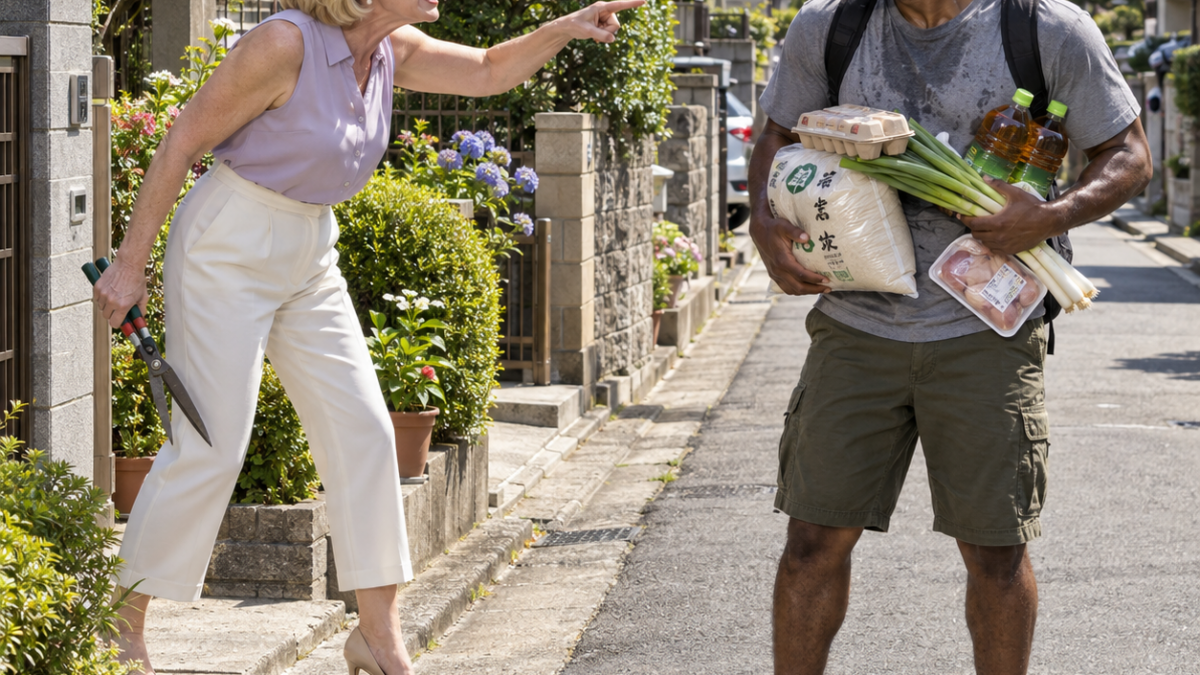
She moved quickly, garden shears still in one hand, chin lifted, shoulders back, eyes locked on me with a confidence that made no sense. Her hair was sprayed into place despite the humidity. She wore white cropped pants, a pale blue blouse, and pearl earrings, as if accusing strangers on the street was something one should dress for.
“What are you doing here?” she demanded.
Her English was American. Midwest, maybe. Flat and sharp. Hearing my own country in her voice should have comforted me. Instead, it made everything feel worse.
“I live down the street,” I answered in Japanese first, then in English because she had chosen it. “I’m just going home.”
She looked at the grocery bags like I might have stolen them from someone’s kitchen.
“You live here?”
“Yes.”
“In this neighborhood?”
“Yes.”
Her lips pressed together.
“This is a residents-only area.”
I glanced up and down the quiet street. No gate. No guard booth. No sign. No wall. Just a public residential road with houses, mailboxes, bikes, and laundry hanging from balconies.
“It’s a public street,” I said carefully. “And I live here.”
“I know everyone who lives on this street.”
“No, you don’t.”
Her eyebrows lifted.
It was not the answer she expected.
“Excuse me?”
“You don’t know me,” I said. “That doesn’t mean I don’t live here.”
Her eyes narrowed.
“Don’t get smart with me.”
Something inside me tightened.
Back home, that phrase had history. It carried all the weight of people who thought respect meant obedience. I took a breath and reminded myself where I was, reminded myself that the chicken was getting warm, reminded myself that Aiko would not want this to become worse in the middle of the street.
“My fiancée and I rent the house near the corner,” I said. “The one with the small persimmon tree.”
Karen stared at me.
Then she shook her head.
“I don’t believe you.”
I almost laughed, not because it was funny, but because the alternative was letting anger step forward before wisdom could catch up.
“You don’t have to believe me.”
“Yes, I do,” she said. “Because people cannot just wander into private neighborhoods and claim they belong.”
“I am not wandering.”
“You are making me uncomfortable.”
There it was.
The accusation that did not need facts.
I was standing on a public street, holding eggs, rice, tea, and chicken. I had greeted her politely. I had answered her questions. But Karen had already rearranged the scene in her mind so that her discomfort became evidence against me.
“I’m going home,” I said.
I turned to leave.
“Don’t walk away from me.”
I did not stop.
“Hey!”
Her voice cracked down the street, loud enough that a curtain moved in a nearby window.
I kept going.
My heart was beating fast by the time I reached our house. I slid the door open, stepped inside, and set the grocery bags on the kitchen counter harder than I meant to. One egg cracked. Aiko would have teased me for that if she had been home.
She was at work, so the house was quiet.
I washed my hands, put the chicken away, and tried to convince myself it was over.
It was not.
Thirty minutes later, the doorbell rang.
When I opened the door, two police officers stood outside.
They were polite. That almost made it worse.
The older one bowed slightly. The younger one looked uncomfortable before he said a word. Behind them, the afternoon sun slanted across the street, and I could see Karen standing near her garden pretending not to watch.
The older officer spoke first in Japanese.
“We received a report of a suspicious person entering the neighborhood.”
My mouth went dry.
Even when you have done nothing wrong, police at your door can pull fear out of places you thought you had under control. I had legal status. I had a lease. I had a Japanese fiancée, a landlord, documents, identification. Still, I felt my body become careful. My voice lowered. My hands stayed visible.
Because I knew what Karen wanted.
She wanted the officers to see me through her fear before they saw me as a person.
“I live here,” I said.
The younger officer glanced past me into the house.
I stepped aside.
“My fiancée and I rent this home. I can show you identification. I can show you photos. My landlord’s number too.”
The older officer nodded.
I brought my residence card, passport copy, lease paperwork, and my phone with photos of me and Aiko in the house. Us cooking in the kitchen. Us standing outside on moving day. A selfie she had taken in the entryway while laughing because I had hit my head on the doorframe.
The officers relaxed as they looked through everything.
“I’m sorry,” the older one said. “A neighbor called.”
“I know which neighbor.”
He did not confirm it, but his eyes shifted slightly toward the street.
“I understand,” he said.
I gave him our landlord’s number. He called, spoke briefly, and the landlord must have confirmed everything because the officer bowed again and apologized for the trouble.
After they left, I stood in the entryway for a long time with my hand still on the door.
My house no longer felt completely like my house.
That was Karen’s first victory.
Not legal. Not official.
Emotional.
She had put uncertainty inside my own doorway.
When Aiko came home, she found me sitting at the kitchen table with the groceries still half-unpacked and one cracked egg in a bowl because I had not known what else to do with it.
“What happened?” she asked immediately.
I told her.
At first, she was silent.
Aiko was not a loud person. Her anger did not explode. It gathered. Her face became still, her hands folded in front of her, and her eyes focused so sharply I could almost hear thoughts arranging themselves in order.
“She called the police?”
“Yes.”
“Because you walked home?”
“Because I walked home while looking like me.”
Aiko closed her eyes.
I regretted saying it the moment it came out, not because it was untrue, but because truth can hurt the people who love you when they cannot protect you from it.
She reached across the table and took my hand.
“I am sorry.”
“You didn’t do it.”
“But I brought you here.”
“No,” I said. “I came here. For you.”
Her fingers tightened around mine.
“We should talk to her.”
“No.”
Aiko looked surprised.
“I don’t want to start a neighborhood war,” I said. “Maybe the police coming embarrassed her. Maybe she’ll leave it alone.”
Aiko did not look convinced.
Neither was I.
But both of us were tired, and sometimes tired people mistake hope for strategy.
For three days, nothing happened.
I walked past Karen’s house twice. Once she was not outside. Once she was trimming the same bush and turned her back as I passed. It was rude, but I accepted rude gladly if it meant quiet.
Then I saw the patrol car.
It was waiting near our house when I came back from the train station after work. The same younger officer stepped out, looking even more uncomfortable this time.
My stomach dropped.
“Another report?” I asked.
He bowed.
“I’m sorry.”
That report claimed I had been looking into car windows.
I had not.
I had walked home, carrying my work bag and an umbrella.
Again, I showed identification. Again, the officers confirmed I lived there. Again, they apologized.
The third call came four days later.
This time Karen claimed I had been loitering near the vending machine at the corner.
I had stopped there to buy tea.
The fourth call came the following week.
She said I had been “watching houses.”
I had been waiting for Aiko, who had texted me that she was five minutes away.
Each time, the police came. Each time, they were polite. Each time, they left after confirming what they already knew.
And each time, something in me became smaller.
I hated that most.
I hated that Karen changed my route. I hated that I started checking whether she was outside before walking home. I hated that I rehearsed explanations in Japanese under my breath before turning onto my own street. I hated that I began carrying extra copies of documents in my bag, as if proof of belonging had become something I needed to keep within reach.
One evening, I took the long way home.
Then I did it again the next day.
The long route added almost twenty minutes. It wound past a busier road, down a side street, around a small park, and back toward our house from the opposite direction. It was inconvenient and humiliating, but for a week no police came to the door.
Aiko noticed immediately.
“You are avoiding her.”
“I’m avoiding the police.”
“You should not have to.”
“I know.”
She stood in the kitchen doorway, still in her work clothes, her hair pinned back, her face tired and furious.
“This is our home too.”
I wanted to argue, but I could not.
Because she was right.
Karen had not only targeted me. She had invaded our relationship, our routines, our sense of safety. Aiko now waited for my texts to know I had made it home without incident. She watched my face when the doorbell rang. She spoke more softly on the phone with her mother, avoiding details because she knew her parents would worry.
Racism rarely stops at the person it points at.
It spreads.
It makes the people who love you live on alert too.
Then Karen escalated.
If I avoided her house, she could no longer call the police on me as easily. So she changed methods.
The rumors began quietly.
Aiko heard the first one from the elderly man across the street, Mr. Tanaka. He was in his seventies, gentle, patient, and one of the first neighbors who had truly welcomed me. He brought us oranges in winter and advice year-round. His English was limited, my Japanese was imperfect, but somehow we had built a friendship out of gestures, short sentences, and his firm belief that I did not know how to prune anything correctly.
He stopped Aiko one morning while I was at work.
“Is everything all right?” he asked.
“With what?”
He looked pained.
“There is talk.”
By evening, Aiko had told me.
Karen had been saying I had taken over the house while the owner was away. That Aiko was either being manipulated or corrupted by me. That I was not really her fiancé. That foreigners sometimes entered neighborhoods and found vulnerable women to use. That our landlord might not even know I was living there.
I sat very still as Aiko repeated it.
She was shaking by the end, not with fear, but with anger so deep it had nowhere to go.
“She said I was corrupted?” I asked.
Aiko nodded.
“By you.”
For a moment, neither of us spoke.
Then I laughed once.
It sounded awful.
Aiko flinched.
“I’m sorry,” I said. “I just—corrupted. Like I’m some disease.”
“You are not.”
“I know.”
But knowing a thing does not stop it from cutting.
Karen had reduced our love to contamination.
The next day, our landlord texted me a screenshot.
Karen had somehow found his contact information and messaged him directly. Her message was written in awkward formal Japanese, but the meaning was clear. She was concerned that an unknown foreign man was occupying his property and frightening residents. She suggested he inspect the home immediately and verify that all occupants were legal and approved.
I stared at the screenshot for a long time.
Then another message arrived from him.
Please do not worry. I know this is false. I am sorry she is troubling you. Tell me if you need help.
That was the first time that day I could breathe fully.
But Karen was not done.
Two mornings later, on my way to the train station, I saw the sign.
RESIDENTS ONLY.
It was printed on white paper, laminated badly, and taped to a utility pole near the corner.
Below it, in smaller English letters, someone had written:
NO OUTSIDERS.
I stood there while commuters walked around me.
My hands went cold.
Farther down the street, another sign was taped to a wall.
Then another near the vending machine.
Then one near Karen’s house.
They were not official city signs. They were not approved neighborhood notices. They were Karen’s work. I knew it with the certainty you feel when someone’s hatred develops a handwriting.
I photographed every one.
When I got home that evening, Aiko was already waiting with a folder on the table.
She had printed city maps, neighborhood association documents, public road information, and the local rules about posting unauthorized signs. Her face was calm now, but not soft.
“We are done avoiding this,” she said.
“Yes,” I replied.
We spent the next two nights preparing.
The neighborhood had a local association, not an American-style HOA exactly, but close enough in function that I understood the structure. It handled dues, cleanup schedules, small repairs, disaster preparedness, community announcements, and occasional disputes. Meetings were held every Sunday morning at a small community hall not far from our street.
Aiko and I had attended before, mostly sitting quietly near the back.
This time, we would speak.
I dreaded it.
That is the truth.
I dreaded standing in front of neighbors and saying, out loud, that I was being targeted. I worried I would sound dramatic. I worried I would sound angry. I worried my Japanese would fail me at the worst possible moment. I worried Karen’s words had already done damage I could not see.
Most of all, I worried that if I asked the neighborhood to choose, they might choose comfort.
Not Karen.
Not openly.
Just silence.
Silence can feel like a side when you are the one being harmed.
Sunday morning arrived gray and humid.
Aiko and I walked to the community hall together. She carried the folder. I carried one of Karen’s laminated signs in a flat envelope. My stomach was tight enough that I had barely managed breakfast.
About twenty people attended that day. Mostly older residents, a few parents, Mr. Tanaka, and the association leader, Mr. Sato, a retired school principal with silver hair and a voice that could quiet a room without rising.
Karen was not there.
Of course she was not there.
Bullies often skip the rooms where their targets are allowed to speak.
For the first half hour, the meeting covered normal things. Trash collection. A broken streetlight. A reminder about summer storm preparations. Someone’s dog had been barking at night. Someone else had concerns about bicycles being left too close to the alley.
I sat through all of it with my palms damp.
Then Mr. Sato asked if there were any other matters.
Aiko looked at me.
I stood.
The room turned toward me.
I bowed first.
My voice shook on the first sentence, and I hated that, but I kept going.
“I am sorry to take everyone’s time, but Aiko and I need help with a serious problem.”
Aiko stood beside me.
That helped.
I explained what had happened. The first confrontation. The police calls. The repeated accusations. The longer route I had started taking to avoid trouble. The rumors. The message to our landlord. The signs.
At the word signs, people began murmuring.
Aiko opened the folder and passed around the photographs. Then I removed the laminated notice from the envelope and held it up.
RESIDENTS ONLY.
NO OUTSIDERS.
The room became very quiet.
I looked at the faces around me.
Some shocked. Some embarrassed. Some angry. Some, like Mr. Tanaka, deeply sad.
“I live here,” I said. “I know I look different. I know I am foreign. I understand that not everyone is used to me. But this is my home with Aiko. I should be able to walk on my own street without police being called because of my skin.”
My Japanese was not perfect.
It did not need to be.
The meaning landed.
Aiko stepped forward then, and her voice was steadier than mine.
“This is not only hurting him,” she said. “It is hurting both of us. It is humiliating. It is frightening. And it is wrong.”
Mr. Tanaka stood slowly.
He was not a tall man, but everyone looked at him.
“He belongs here,” he said.
His voice was rough with age, but firm.
“He greets me every morning. He helps carry heavy things. He is polite. He lives here.”
An older woman near the front nodded.
“I saw those signs,” she said. “I thought they were strange. I did not know who posted them.”
A younger father spoke next.
“My son asked if the foreign man was dangerous because of them.”
The room shifted.
That sentence did something the rest had not.
It forced everyone to see what Karen’s signs were teaching.
Not safety.
Suspicion.
Mr. Sato stood.
He bowed to me first. Then to Aiko.
“I am very sorry,” he said. “This behavior is unacceptable. You are welcome in this neighborhood. This road is public. No resident has the authority to decide who may walk here, and no one may post unauthorized signs.”
He turned to the room.
“All signs will be removed today. If more appear, the association will take formal action. We will also notify the person responsible that harassment of residents will not be tolerated.”
He did not say Karen’s name.
He did not have to.
Relief hit me so suddenly I almost sat down too fast.
I had prepared myself for questions, doubts, polite discomfort, maybe even someone suggesting that I should simply avoid Karen to keep peace. Instead, the room had done what I had been afraid it would not do.
It had made the problem public.
And in making it public, it took some of Karen’s power away.
After the meeting, people approached us.
Awkwardly at first.
An apology from one neighbor who had heard rumors but not challenged them. A bow from another. A quiet “I am sorry” from a woman who admitted she had seen the police at our door and wondered. Mr. Tanaka squeezed my shoulder and told me to walk the normal way home.
“Shortest path,” he said in English, very serious.
I smiled despite myself.
“Shortest path.”
That afternoon, the signs came down.
Not just ours. Every one Karen had posted. Mr. Sato and two association members walked the street with a folder and removed them from poles, walls, fences, and corners. I watched from our front window as one of the signs near Karen’s house was peeled away.
Karen came outside.
I could not hear every word, but I saw enough.
Her face turned red. Her hands moved sharply. Mr. Sato stood with the patience of a man who had spent decades dealing with children and knew better than to be impressed by tantrums. At one point, Karen pointed down the street toward our house.
Mr. Sato did not look.
He simply bowed once, said something, and walked away with the sign in his hand.
Later, Denise—one of the younger mothers on the street who had started talking to Aiko after the meeting—told us Karen had received a formal warning. If she posted unauthorized signs again or continued using the association’s name to intimidate people, she could be removed from the neighborhood association and reported for harassment.
Karen did not take it well.
That part I did not see, but I did not need to.
For the next several days, she slammed her gate every time she went in or out. She stopped pretending not to stare. When I walked by her house on the normal route, she stood in her garden with her arms crossed, sunglasses on even when the sky was cloudy.
The first time, my body wanted to turn around.
I did not let it.
I walked the shortest path home.
My heart hammered the whole way, but I walked.
Karen watched me pass.
I looked ahead, nodded politely, and said, “Good afternoon.”
She went inside without answering.
That became our routine.
I greeted her.
She retreated.
In a strange way, it was almost peaceful.
The police calls stopped.
That alone changed my life.
No more officers at the door while dinner cooled. No more sudden fear when a patrol car turned onto the street. No more reaching for documents to prove I belonged in my own entryway.
The rumors did not vanish as quickly.
Rumors are like smoke in fabric. Even after the fire is out, they linger.
Karen kept trying.
She told one person Aiko had been pressured into speaking at the meeting. She told another that the association was afraid of being called racist. She claimed the police had privately agreed with her but could not act because of “politics.” That one almost made me laugh. Leave it to an American Karen in Japan to import American cable-news paranoia into a Nagasaki suburb.
But her credibility had cracked.
People had seen the signs.
They had heard me speak.
They had watched Mr. Sato remove her fake notices with his own hands.
And perhaps most importantly, they had begun talking to one another instead of letting Karen control the story.
Aiko told me that Mrs. Nakamura, an elderly widow three houses away, had scolded Karen outside the market.
“You shame us,” she had said.
Karen apparently sputtered something about safety.
Mrs. Nakamura replied, “He carries my rice when it is heavy. What do you carry except complaints?”
I wish I had been there.
I would have framed the moment.
A week after the meeting, the older police officer who had come to our house the first time stopped me near the station.
At first, I tensed.
Then he bowed.
“I wanted to apologize again,” he said.
“You already did.”
“Yes,” he replied. “But we came many times. That should not have happened.”
I did not know what to say.
He continued, choosing his words carefully.
“We have noted the pattern. If there are more false reports, it will be handled differently.”
Something in my chest loosened.
“Thank you.”
He nodded.
“Please walk safely.”
It was a small conversation, but it mattered.
Not because it fixed everything.
Because patterns are dangerous when no one names them.
Now, officially, someone had.
For a while, I expected Karen to do something bigger.
People like her rarely accept humiliation quietly. I thought she might approach my landlord again, or confront Aiko at work, or invent some new accusation. I stayed alert. I saved screenshots. I kept copies of everything.
But Karen had lost the room.
And without an audience willing to believe her, she was reduced to glaring from behind curtains.
One evening, maybe a month after the meeting, I came home by the normal route and found Mr. Tanaka sweeping outside his gate.
He looked up and smiled.
“Coffee?” he asked.
That was new.
We had talked many times, exchanged food, helped each other with little things, but I had never gone inside his house.
I said yes.
His living room was small and warm, full of books, framed photographs, and the faint smell of old tatami and green tea. His wife had passed years earlier. Her picture sat near the family altar with fresh flowers beside it.
He poured coffee because he knew I preferred it, though I suspected he did not drink much himself.
“You were brave,” he said after a while.
“At the meeting?”
He nodded.
“I was scared.”
“That is why brave.”
I looked down at my cup.
The coffee was too weak, but I drank it like it was perfect.
“I almost didn’t say anything,” I admitted.
“I know.”
I looked up.
He smiled sadly.
“People who are hurt often think they must not trouble others. But if you do not say, bad people continue.”
Bad people continue.
Simple words.
True ones.
That night, I told Aiko what he had said.
She leaned against me on the couch, her head on my shoulder.
“I was afraid too,” she said.
“I know.”
“I was afraid they would not believe us.”
“Me too.”
“I was afraid you would regret coming here.”
That one hurt.
I turned toward her.
“I don’t regret you.”
Her eyes shone.
“That is not what I asked.”
“No,” I said softly. “I don’t regret coming here.”
And I meant it.
Not because everything was easy.
It was not.
Not because Japan was perfect.
It was not.
Not because love magically erased racism, loneliness, language barriers, homesickness, or the strange ache of being visibly different in a place that often valued sameness.
I did not regret coming because my life here was real.
Aiko was real.
Our home was real.
The neighbors who stood up were real.
Karen was real too, unfortunately, but she did not get to be the whole story.
That became important to me.
For a while, I had allowed her to define the neighborhood in my mind. Her glare. Her calls. Her rumors. Her signs. She became the face of every fear I carried as a foreign Black man trying to build a life somewhere new.
But after the meeting, I started noticing the other faces again.
Mrs. Nakamura waving me over to take extra mandarins.
Denise’s little boy practicing English by shouting, “Good morning!” at full volume whenever he saw me.
Mr. Sato bowing with formal dignity every Sunday.
The young couple near the corner asking Aiko and me for restaurant recommendations because they had seen us laughing outside one place downtown.
The landlord texting once a month just to make sure Karen was not causing trouble again.
Community did not arrive all at once.
It gathered.
Piece by piece.
Enough pieces to cover some of the damage Karen had done.
Not all.
I will not pretend the story ended with me feeling completely safe forever.
That would be dishonest.
Some wounds leave habits behind.
Even now, if someone stares too long, I notice. If a police car slows down, part of me goes still. If I see a handwritten sign where it does not belong, I read it twice. When I walk past Karen’s house, I still feel the old awareness in my shoulders, though it no longer controls my feet.
Karen still lives at the end of the street.
She still trims those terrified bushes.
She still wears sunglasses like armor.
But she does not speak to me anymore.
Once, several months after the meeting, she was outside when I passed with Aiko. Aiko greeted her first, bright and calm.
“Good afternoon.”
Karen stared at us.
Then, without a word, she picked up her basket of gardening tools and went inside.
Aiko watched the door close.
Then she said, in English, “Coward.”
I laughed so hard I had to stop walking.
It felt good.
Not because the situation was funny.
Because we were still there.
Still walking the shortest path.
Still going home.
The biggest change came from something small.
One Sunday after an association meeting, Mr. Sato asked if I would help with the neighborhood disaster preparedness committee. Earthquakes, storms, emergency supplies, evacuation routes—things everyone took seriously.
I said yes.
At first, I thought he was just being kind, making a point that I belonged. Maybe he was. But then he handed me a box of inventory forms and I realized belonging sometimes looks like paperwork nobody else wants to do.
So I helped.
I counted water bottles, checked batteries, updated contact lists, carried boxes, translated a few simple English labels for emergency materials because the neighborhood had more foreign residents than people realized. A Brazilian family near the main road. A Filipino caregiver living with an elderly couple. A Korean student renting a small apartment above a garage. Me.
Karen had tried to make the neighborhood smaller.
The work made it larger.
During one meeting, Mr. Sato asked if I would share my experience with the committee—not the painful details, just suggestions for making sure all residents knew emergency procedures and felt comfortable asking for help.
I spoke carefully.
This time my voice did not shake.
I said people should not assume who belongs. I said landlords should be encouraged to introduce renters to the association. I said emergency contact forms should include multiple languages when possible. I said public streets are public streets, and safety should never be used as an excuse for suspicion without evidence.
No one argued.
Afterward, Mr. Tanaka clapped once, loudly, like he had forgotten he was not at a performance.
Everyone laughed.
I did too.
A year after the first police call, Aiko and I got married.
We did not have a huge wedding. A small ceremony, family, close friends, simple food, flowers her mother helped arrange. Megan flew from the States and cried more than Aiko’s mother, which I did not think was possible. My best friend gave a speech about how I had moved across the world for coffee with a stranger and somehow made it sound less foolish than it was.
We held a small celebration in a rented room near the harbor.
Several neighbors came.
Mr. Tanaka wore a suit that looked older than I was and brought us a gift wrapped so carefully I hesitated to open it. It was a small framed calligraphy piece. Aiko read it first and smiled.
“What does it say?” I asked.
“Home is where people call your name with kindness.”
I had to turn away for a moment.
Karen, of course, did not come.
She was not invited.
But a week later, something unexpected happened.
Aiko and I returned from the grocery store together. As we walked past Karen’s house, she was outside watering plants. I braced myself out of habit.
Aiko said, “Good afternoon.”
I nodded.
Karen did not go inside this time.
She stood there, hose in hand, water pooling around her shoes.
For one strange second, I thought she might speak. Maybe apologize. Maybe say congratulations. Maybe offer some bitter little sentence that pretended to be peace.
Instead, she looked at me, then at Aiko’s wedding ring, then back at her plants.
Nothing.
That was fine.
I had stopped waiting for decency from people who treated it like a tax.
We walked on.
At our gate, Aiko squeezed my hand.
“You okay?”
I looked back once.
Karen was still watering the same plant, though the soil was already soaked.
“Yeah,” I said. “I am.”
And I was.
The fastest path home had become normal again.
That may sound like a small victory.
It is not.
When someone tries to make you feel like an intruder in your own life, walking home without changing direction becomes an act of recovery. Standing at your own door without fear becomes recovery. Opening the curtains becomes recovery. Greeting neighbors without wondering what they have heard becomes recovery.
I had thought justice would feel like Karen being punished more dramatically.
A fine. A public apology. A police warning delivered with stern authority. Something clean and cinematic.
Instead, justice arrived in quieter forms.
A room full of neighbors looking at her signs and recognizing them as wrong.
An association leader saying, “You are welcome here.”
A landlord refusing to doubt me.
An old man inviting me for coffee.
Police noting the pattern.
Children learning my name instead of Karen’s fear.
Karen losing the one thing she seemed to value most: control over the story.
That was enough.
Not perfect.
Enough.
There are still days when Japan feels lonely. Days when I miss the ease of blending in, even though back home I did not always blend safely either. Days when language exhausts me and cultural mistakes embarrass me and I want to be understood without having to translate my whole self first.
But then Aiko laughs in the kitchen.
Mr. Tanaka leaves vegetables by our door.
Denise’s son yells, “Hello!” like he is announcing me to the whole street.
The neighborhood emergency committee sends me messages about battery inventory.
And I remember that belonging is not always something granted once and settled forever.
Sometimes it is built.
Sometimes it is defended.
Sometimes it is spoken aloud in a community hall with your hands shaking and one of your enemy’s fake signs lying on the table.
Karen thought my Blackness made me suspicious.
She thought being American like me gave her some special authority to judge which foreigner deserved respect.
She thought the police would frighten me into taking longer roads, smaller steps, quieter breaths.
For a while, she was right about the fear.
But she was wrong about the ending.
I am still here.
I still live on the same street with my wife. I still walk past Karen’s house when it is the shortest way home. I still greet her when I feel like it—not because she deserves my politeness, but because I refuse to let her decide what kind of man I become.
Sometimes she retreats inside.
Sometimes she pretends not to hear.
Once, she dropped a pair of pruning shears because I said good morning too cheerfully.
That one carried me for days.
The signs are gone now.
No more RESIDENTS ONLY.
No more NO OUTSIDERS.
No more paper warnings taped to poles by a woman who mistook her prejudice for neighborhood policy.
But I kept one.
Mr. Sato gave it to me after the meeting, folded neatly inside a clear sleeve. He seemed embarrassed when he handed it over, but I thanked him. I keep it in a drawer with our lease, wedding documents, and emergency committee forms.
Not because I enjoy looking at it.
Because it reminds me of something I never want to forget.
Hate does not always arrive screaming.
Sometimes it knocks politely on official doors. Sometimes it calls the police in a calm voice. Sometimes it says residents only when it really means not you. Sometimes it claims to protect a community while poisoning it from the inside.
And when that happens, silence helps it grow.
I do not believe every stare is hatred. I do not believe every awkward question is racism. I do not believe people should be condemned for honest ignorance when they are willing to learn.
But Karen was not confused.
Karen was not curious.
Karen was not afraid because of anything I had done.
She was angry because I existed somewhere she did not want me to exist, loved someone she did not think I should love, and belonged to a place she had decided should never make room for me.
She lost.
Not because I fought her alone.
Because, in the end, the neighborhood she claimed to protect chose not to become her weapon.
That is the part I hold onto.
Aiko and I still talk sometimes about whether this house will be permanent. Maybe one day we will move closer to her work. Maybe we will buy a place of our own. Maybe we will leave Nagasaki entirely. Life changes. Plans shift. Love makes new maps.
But wherever we go, I will remember this street.
I will remember the fear, yes.
But I will also remember walking home after the signs came down, passing Karen’s silent house, hearing Mr. Tanaka call my name from across the road.
Not foreigner.
Not suspicious person.
Not outsider.
My name.
Spoken with kindness.
And for that moment, that was enough to make the whole street feel like home.
𝗧𝗛𝗘 𝗘𝗡𝗗
Karen Saw Me Carrying Groceries and Decided I Couldn’t Possibly Live on Her Street
I crossed an ocean for love, learned a new language, and built a quiet life in a country that did not always know what to do with a Black man from America.
Then Karen looked at me on my own street and decided I was the threat.
The first time my neighbor called the police on me, I was carrying groceries.
That is the part I keep coming back to. Not because groceries matter, but because it was so painfully ordinary. A bag of rice was cutting into my left hand. A carton of eggs was balanced on top of a bundle of green onions. I had two bottles of tea pressed against my ribs and a pack of chicken sliding dangerously toward the sidewalk.
I was tired, sweaty, and thinking about dinner.
I was not thinking about racism.
I was not thinking about immigration.
I was not thinking about what my face looked like to a woman who had already decided I did not belong.
I had been living in Nagasaki for almost a year by then. I was in my thirties, originally from the States, and I had moved to Japan because of the woman I loved. Her name was Aiko, and she had this way of making the world feel less sharp around the edges. We met years earlier in a café when I was traveling with friends, back when I still thought love at first sight was something people invented after the fact to make themselves sound poetic.
Then I saw her.
She was sitting near the window with a book open beside her coffee, sunlight resting on her cheek like it had chosen her on purpose. I do not know what gave me the courage to speak to her, but I asked if I could sit for a minute, and somehow one minute became an hour. Then two.
We stayed friends for two years after that. Messages. Long emails. Late-night video calls. Old-fashioned letters when we wanted to be dramatic. Eventually friendship became love, love became distance, and distance became a decision.
One of us had to move.
It was easier for me.
So I packed my life into suitcases, said goodbye to familiar streets, and moved to Japan.
Aiko and I stayed with her parents at first. They were kind, careful people who watched me closely in the beginning—not with cruelty, but with the guarded worry of parents whose daughter had brought home a foreign fiancé from another continent. Over time, we found a rhythm. Her father learned that I liked strong coffee. Her mother learned that I would eat almost anything if she explained what it was first. I learned when to speak, when to bow, and when silence carried more respect than words.
After I proposed, Aiko and I rented a small house in the suburbs.
It was not grand, but it was ours. A narrow two-story place with a tiled roof, a tiny garden, sliding doors that stuck when it rained, and a view down a peaceful street where old people swept their front steps before breakfast. The landlord lived across the city and was one of the kindest men I had met in Japan. The neighbors were mostly older couples, young families, and a few quiet single residents who bowed politely and minded their own business.
Aiko insisted we introduce ourselves properly.
“It will help,” she told me.
“With what?”
She looked at me gently.
“With everything.”
She did not say because you are Black.
She did not need to.
Japan had been good to me in many ways, but pretending my skin did not enter rooms before I did would have been dishonest. Most people were not cruel. Some were curious. Some were awkward. Children stared. Older people sometimes stared longer. A few people moved seats on trains, and a few others smiled with exaggerated warmth as if kindness itself required theater.
I had dealt with worse back home, but this was different. In America, racism often knew its own language. In Japan, sometimes it came disguised as confusion, fear, fascination, or a failure of imagination. I tried not to take every stare as hatred. I tried to give people space to be human.
But Karen did not need space.
Karen needed consequences.
She lived near the end of our street in a house with trimmed hedges, white curtains, and a front garden arranged so precisely it looked like each plant had been warned not to embarrass her. She was American too, a pale woman in her late fifties with stiff blond hair, thin lips, and the kind of sunglasses people wear when they want to look important while judging everyone. She had married into the neighborhood years earlier, from what I understood, and had decided that being foreign herself did not stop her from policing which foreigners were acceptable.
I had seen her before, but we had never really spoken.
Until that afternoon.
I was walking home with groceries when I passed her house. She was crouched near a planter, clipping leaves from a bush that already looked terrified of making mistakes. Because Aiko had taught me to be polite, I nodded and greeted her in Japanese.
“Good afternoon.”
Karen did not answer.
She stared.
Not the surprised glance I was used to. Not the curious double-take. This was a full, cold, deliberate inspection. Her eyes moved over my face, my hands, the grocery bags, my shoes, the street behind me, like she was searching for the part of the picture that would prove I was doing something wrong.
I kept walking.
Then she shouted, in English, “Stop.”
part2
For a second, I thought she must have been talking to someone else.
There are moments when your brain protects you by refusing to understand disrespect right away. I had groceries in my hands. I was ten minutes from putting the chicken in the refrigerator. My house was right down the street. I was not prepared for a confrontation in front of a woman’s garden.
But when I turned around, Karen was walking toward me.
She moved quickly, garden shears still in one hand, chin lifted, shoulders back, eyes locked on me with a confidence that made no sense. Her hair was sprayed into place despite the humidity. She wore white cropped pants, a pale blue blouse, and pearl earrings, as if accusing strangers on the street was something one should dress for.
“What are you doing here?” she demanded.
Her English was American. Midwest, maybe. Flat and sharp. Hearing my own country in her voice should have comforted me. Instead, it made everything feel worse.
“I live down the street,” I answered in Japanese first, then in English because she had chosen it. “I’m just going home.”
She looked at the grocery bags like I might have stolen them from someone’s kitchen.
“You live here?”
“Yes.”
“In this neighborhood?”
“Yes.”
Her lips pressed together.
“This is a residents-only area.”
I glanced up and down the quiet street. No gate. No guard booth. No sign. No wall. Just a public residential road with houses, mailboxes, bikes, and laundry hanging from balconies.
“It’s a public street,” I said carefully. “And I live here.”
“I know everyone who lives on this street.”
“No, you don’t.”
Her eyebrows lifted.
It was not the answer she expected.
“Excuse me?”
“You don’t know me,” I said. “That doesn’t mean I don’t live here.”
Her eyes narrowed.
“Don’t get smart with me.”
Something inside me tightened.
Back home, that phrase had history. It carried all the weight of people who thought respect meant obedience. I took a breath and reminded myself where I was, reminded myself that the chicken was getting warm, reminded myself that Aiko would not want this to become worse in the middle of the street.
“My fiancée and I rent the house near the corner,” I said. “The one with the small persimmon tree.”
Karen stared at me.
Then she shook her head.
“I don’t believe you.”
I almost laughed, not because it was funny, but because the alternative was letting anger step forward before wisdom could catch up.
“You don’t have to believe me.”
“Yes, I do,” she said. “Because people cannot just wander into private neighborhoods and claim they belong.”
“I am not wandering.”
“You are making me uncomfortable.”
There it was.
The accusation that did not need facts.
I was standing on a public street, holding eggs, rice, tea, and chicken. I had greeted her politely. I had answered her questions. But Karen had already rearranged the scene in her mind so that her discomfort became evidence against me.
“I’m going home,” I said.
I turned to leave.
“Don’t walk away from me.”
I did not stop.
“Hey!”
Her voice cracked down the street, loud enough that a curtain moved in a nearby window.
I kept going.
My heart was beating fast by the time I reached our house. I slid the door open, stepped inside, and set the grocery bags on the kitchen counter harder than I meant to. One egg cracked. Aiko would have teased me for that if she had been home.
She was at work, so the house was quiet.
I washed my hands, put the chicken away, and tried to convince myself it was over.
It was not.
Thirty minutes later, the doorbell rang.
When I opened the door, two police officers stood outside.
They were polite. That almost made it worse.
The older one bowed slightly. The younger one looked uncomfortable before he said a word. Behind them, the afternoon sun slanted across the street, and I could see Karen standing near her garden pretending not to watch.
The older officer spoke first in Japanese.
“We received a report of a suspicious person entering the neighborhood.”
My mouth went dry.
Even when you have done nothing wrong, police at your door can pull fear out of places you thought you had under control. I had legal status. I had a lease. I had a Japanese fiancée, a landlord, documents, identification. Still, I felt my body become careful. My voice lowered. My hands stayed visible.
Because I knew what Karen wanted.
She wanted the officers to see me through her fear before they saw me as a person.
“I live here,” I said.
The younger officer glanced past me into the house.
I stepped aside.
“My fiancée and I rent this home. I can show you identification. I can show you photos. My landlord’s number too.”
The older officer nodded.
I brought my residence card, passport copy, lease paperwork, and my phone with photos of me and Aiko in the house. Us cooking in the kitchen. Us standing outside on moving day. A selfie she had taken in the entryway while laughing because I had hit my head on the doorframe.
The officers relaxed as they looked through everything.
“I’m sorry,” the older one said. “A neighbor called.”
“I know which neighbor.”
He did not confirm it, but his eyes shifted slightly toward the street.
“I understand,” he said.
I gave him our landlord’s number. He called, spoke briefly, and the landlord must have confirmed everything because the officer bowed again and apologized for the trouble.
After they left, I stood in the entryway for a long time with my hand still on the door.
My house no longer felt completely like my house.
That was Karen’s first victory.
Not legal. Not official.
Emotional.
She had put uncertainty inside my own doorway.
When Aiko came home, she found me sitting at the kitchen table with the groceries still half-unpacked and one cracked egg in a bowl because I had not known what else to do with it.
“What happened?” she asked immediately.
I told her.
At first, she was silent.
Aiko was not a loud person. Her anger did not explode. It gathered. Her face became still, her hands folded in front of her, and her eyes focused so sharply I could almost hear thoughts arranging themselves in order.
“She called the police?”
“Yes.”
“Because you walked home?”
“Because I walked home while looking like me.”
Aiko closed her eyes.
I regretted saying it the moment it came out, not because it was untrue, but because truth can hurt the people who love you when they cannot protect you from it.
She reached across the table and took my hand.
“I am sorry.”
“You didn’t do it.”
“But I brought you here.”
“No,” I said. “I came here. For you.”
Her fingers tightened around mine.
“We should talk to her.”
“No.”
Aiko looked surprised.
“I don’t want to start a neighborhood war,” I said. “Maybe the police coming embarrassed her. Maybe she’ll leave it alone.”
Aiko did not look convinced.
Neither was I.
But both of us were tired, and sometimes tired people mistake hope for strategy.
For three days, nothing happened.
I walked past Karen’s house twice. Once she was not outside. Once she was trimming the same bush and turned her back as I passed. It was rude, but I accepted rude gladly if it meant quiet.
Then I saw the patrol car.
It was waiting near our house when I came back from the train station after work. The same younger officer stepped out, looking even more uncomfortable this time.
My stomach dropped.
“Another report?” I asked.
He bowed.
“I’m sorry.”
That report claimed I had been looking into car windows.
I had not.
I had walked home, carrying my work bag and an umbrella.
Again, I showed identification. Again, the officers confirmed I lived there. Again, they apologized.
The third call came four days later.
This time Karen claimed I had been loitering near the vending machine at the corner.
I had stopped there to buy tea.
The fourth call came the following week.
She said I had been “watching houses.”
I had been waiting for Aiko, who had texted me that she was five minutes away.
Each time, the police came. Each time, they were polite. Each time, they left after confirming what they already knew.
And each time, something in me became smaller.
I hated that most.
I hated that Karen changed my route. I hated that I started checking whether she was outside before walking home. I hated that I rehearsed explanations in Japanese under my breath before turning onto my own street. I hated that I began carrying extra copies of documents in my bag, as if proof of belonging had become something I needed to keep within reach.
One evening, I took the long way home.
Then I did it again the next day.
The long route added almost twenty minutes. It wound past a busier road, down a side street, around a small park, and back toward our house from the opposite direction. It was inconvenient and humiliating, but for a week no police came to the door.
Aiko noticed immediately.
“You are avoiding her.”
“I’m avoiding the police.”
“You should not have to.”
“I know.”
She stood in the kitchen doorway, still in her work clothes, her hair pinned back, her face tired and furious.
“This is our home too.”
I wanted to argue, but I could not.
Because she was right.
Karen had not only targeted me. She had invaded our relationship, our routines, our sense of safety. Aiko now waited for my texts to know I had made it home without incident. She watched my face when the doorbell rang. She spoke more softly on the phone with her mother, avoiding details because she knew her parents would worry.
Racism rarely stops at the person it points at.
It spreads.
It makes the people who love you live on alert too.
Then Karen escalated.
If I avoided her house, she could no longer call the police on me as easily. So she changed methods.
The rumors began quietly.
Aiko heard the first one from the elderly man across the street, Mr. Tanaka. He was in his seventies, gentle, patient, and one of the first neighbors who had truly welcomed me. He brought us oranges in winter and advice year-round. His English was limited, my Japanese was imperfect, but somehow we had built a friendship out of gestures, short sentences, and his firm belief that I did not know how to prune anything correctly.
He stopped Aiko one morning while I was at work.
“Is everything all right?” he asked.
“With what?”
He looked pained.
“There is talk.”
By evening, Aiko had told me.
Karen had been saying I had taken over the house while the owner was away. That Aiko was either being manipulated or corrupted by me. That I was not really her fiancé. That foreigners sometimes entered neighborhoods and found vulnerable women to use. That our landlord might not even know I was living there.
I sat very still as Aiko repeated it.
She was shaking by the end, not with fear, but with anger so deep it had nowhere to go.
“She said I was corrupted?” I asked.
Aiko nodded.
“By you.”
For a moment, neither of us spoke.
Then I laughed once.
It sounded awful.
Aiko flinched.
“I’m sorry,” I said. “I just—corrupted. Like I’m some disease.”
“You are not.”
“I know.”
But knowing a thing does not stop it from cutting.
Karen had reduced our love to contamination.
The next day, our landlord texted me a screenshot.
Karen had somehow found his contact information and messaged him directly. Her message was written in awkward formal Japanese, but the meaning was clear. She was concerned that an unknown foreign man was occupying his property and frightening residents. She suggested he inspect the home immediately and verify that all occupants were legal and approved.
I stared at the screenshot for a long time.
Then another message arrived from him.
Please do not worry. I know this is false. I am sorry she is troubling you. Tell me if you need help.
That was the first time that day I could breathe fully.
But Karen was not done.
Two mornings later, on my way to the train station, I saw the sign.
RESIDENTS ONLY.
It was printed on white paper, laminated badly, and taped to a utility pole near the corner.
Below it, in smaller English letters, someone had written:
NO OUTSIDERS.
I stood there while commuters walked around me.
My hands went cold.
Farther down the street, another sign was taped to a wall.
Then another near the vending machine.
Then one near Karen’s house.
They were not official city signs. They were not approved neighborhood notices. They were Karen’s work. I knew it with the certainty you feel when someone’s hatred develops a handwriting.
I photographed every one.
When I got home that evening, Aiko was already waiting with a folder on the table.
She had printed city maps, neighborhood association documents, public road information, and the local rules about posting unauthorized signs. Her face was calm now, but not soft.
“We are done avoiding this,” she said.
“Yes,” I replied.
We spent the next two nights preparing.
The neighborhood had a local association, not an American-style HOA exactly, but close enough in function that I understood the structure. It handled dues, cleanup schedules, small repairs, disaster preparedness, community announcements, and occasional disputes. Meetings were held every Sunday morning at a small community hall not far from our street.
Aiko and I had attended before, mostly sitting quietly near the back.
This time, we would speak.
I dreaded it.
That is the truth.
I dreaded standing in front of neighbors and saying, out loud, that I was being targeted. I worried I would sound dramatic. I worried I would sound angry. I worried my Japanese would fail me at the worst possible moment. I worried Karen’s words had already done damage I could not see.
Most of all, I worried that if I asked the neighborhood to choose, they might choose comfort.
Not Karen.
Not openly.
Just silence.
Silence can feel like a side when you are the one being harmed.
Sunday morning arrived gray and humid.
Aiko and I walked to the community hall together. She carried the folder. I carried one of Karen’s laminated signs in a flat envelope. My stomach was tight enough that I had barely managed breakfast.
About twenty people attended that day. Mostly older residents, a few parents, Mr. Tanaka, and the association leader, Mr. Sato, a retired school principal with silver hair and a voice that could quiet a room without rising.
Karen was not there.
Of course she was not there.
Bullies often skip the rooms where their targets are allowed to speak.
For the first half hour, the meeting covered normal things. Trash collection. A broken streetlight. A reminder about summer storm preparations. Someone’s dog had been barking at night. Someone else had concerns about bicycles being left too close to the alley.
I sat through all of it with my palms damp.
Then Mr. Sato asked if there were any other matters.
Aiko looked at me.
I stood.
The room turned toward me.
I bowed first.
My voice shook on the first sentence, and I hated that, but I kept going.
“I am sorry to take everyone’s time, but Aiko and I need help with a serious problem.”
Aiko stood beside me.
That helped.
I explained what had happened. The first confrontation. The police calls. The repeated accusations. The longer route I had started taking to avoid trouble. The rumors. The message to our landlord. The signs.
At the word signs, people began murmuring.
Aiko opened the folder and passed around the photographs. Then I removed the laminated notice from the envelope and held it up.
RESIDENTS ONLY.
NO OUTSIDERS.
The room became very quiet.
I looked at the faces around me.
Some shocked. Some embarrassed. Some angry. Some, like Mr. Tanaka, deeply sad.
“I live here,” I said. “I know I look different. I know I am foreign. I understand that not everyone is used to me. But this is my home with Aiko. I should be able to walk on my own street without police being called because of my skin.”
My Japanese was not perfect.
It did not need to be.
The meaning landed.
Aiko stepped forward then, and her voice was steadier than mine.
“This is not only hurting him,” she said. “It is hurting both of us. It is humiliating. It is frightening. And it is wrong.”
Mr. Tanaka stood slowly.
He was not a tall man, but everyone looked at him.
“He belongs here,” he said.
His voice was rough with age, but firm.
“He greets me every morning. He helps carry heavy things. He is polite. He lives here.”
An older woman near the front nodded.
“I saw those signs,” she said. “I thought they were strange. I did not know who posted them.”
A younger father spoke next.
“My son asked if the foreign man was dangerous because of them.”
The room shifted.
That sentence did something the rest had not.
It forced everyone to see what Karen’s signs were teaching.
Not safety.
Suspicion.
Mr. Sato stood.
He bowed to me first. Then to Aiko.
“I am very sorry,” he said. “This behavior is unacceptable. You are welcome in this neighborhood. This road is public. No resident has the authority to decide who may walk here, and no one may post unauthorized signs.”
He turned to the room.
“All signs will be removed today. If more appear, the association will take formal action. We will also notify the person responsible that harassment of residents will not be tolerated.”
He did not say Karen’s name.
He did not have to.
Relief hit me so suddenly I almost sat down too fast.
I had prepared myself for questions, doubts, polite discomfort, maybe even someone suggesting that I should simply avoid Karen to keep peace. Instead, the room had done what I had been afraid it would not do.
It had made the problem public.
And in making it public, it took some of Karen’s power away.
After the meeting, people approached us.
Awkwardly at first.
An apology from one neighbor who had heard rumors but not challenged them. A bow from another. A quiet “I am sorry” from a woman who admitted she had seen the police at our door and wondered. Mr. Tanaka squeezed my shoulder and told me to walk the normal way home.
“Shortest path,” he said in English, very serious.
I smiled despite myself.
“Shortest path.”
That afternoon, the signs came down.
Not just ours. Every one Karen had posted. Mr. Sato and two association members walked the street with a folder and removed them from poles, walls, fences, and corners. I watched from our front window as one of the signs near Karen’s house was peeled away.
Karen came outside.
I could not hear every word, but I saw enough.
Her face turned red. Her hands moved sharply. Mr. Sato stood with the patience of a man who had spent decades dealing with children and knew better than to be impressed by tantrums. At one point, Karen pointed down the street toward our house.
Mr. Sato did not look.
He simply bowed once, said something, and walked away with the sign in his hand.
Later, Denise—one of the younger mothers on the street who had started talking to Aiko after the meeting—told us Karen had received a formal warning. If she posted unauthorized signs again or continued using the association’s name to intimidate people, she could be removed from the neighborhood association and reported for harassment.
Karen did not take it well.
That part I did not see, but I did not need to.
For the next several days, she slammed her gate every time she went in or out. She stopped pretending not to stare. When I walked by her house on the normal route, she stood in her garden with her arms crossed, sunglasses on even when the sky was cloudy.
The first time, my body wanted to turn around.
I did not let it.
I walked the shortest path home.
My heart hammered the whole way, but I walked.
Karen watched me pass.
I looked ahead, nodded politely, and said, “Good afternoon.”
She went inside without answering.
That became our routine.
I greeted her.
She retreated.
In a strange way, it was almost peaceful.
The police calls stopped.
That alone changed my life.
No more officers at the door while dinner cooled. No more sudden fear when a patrol car turned onto the street. No more reaching for documents to prove I belonged in my own entryway.
The rumors did not vanish as quickly.
Rumors are like smoke in fabric. Even after the fire is out, they linger.
Karen kept trying.
She told one person Aiko had been pressured into speaking at the meeting. She told another that the association was afraid of being called racist. She claimed the police had privately agreed with her but could not act because of “politics.” That one almost made me laugh. Leave it to an American Karen in Japan to import American cable-news paranoia into a Nagasaki suburb.
But her credibility had cracked.
People had seen the signs.
They had heard me speak.
They had watched Mr. Sato remove her fake notices with his own hands.
And perhaps most importantly, they had begun talking to one another instead of letting Karen control the story.
Aiko told me that Mrs. Nakamura, an elderly widow three houses away, had scolded Karen outside the market.
“You shame us,” she had said.
Karen apparently sputtered something about safety.
Mrs. Nakamura replied, “He carries my rice when it is heavy. What do you carry except complaints?”
I wish I had been there.
I would have framed the moment.
A week after the meeting, the older police officer who had come to our house the first time stopped me near the station.
At first, I tensed.
Then he bowed.
“I wanted to apologize again,” he said.
“You already did.”
“Yes,” he replied. “But we came many times. That should not have happened.”
I did not know what to say.
He continued, choosing his words carefully.
“We have noted the pattern. If there are more false reports, it will be handled differently.”
Something in my chest loosened.
“Thank you.”
He nodded.
“Please walk safely.”
It was a small conversation, but it mattered.
Not because it fixed everything.
Because patterns are dangerous when no one names them.
Now, officially, someone had.
For a while, I expected Karen to do something bigger.
People like her rarely accept humiliation quietly. I thought she might approach my landlord again, or confront Aiko at work, or invent some new accusation. I stayed alert. I saved screenshots. I kept copies of everything.
But Karen had lost the room.
And without an audience willing to believe her, she was reduced to glaring from behind curtains.
One evening, maybe a month after the meeting, I came home by the normal route and found Mr. Tanaka sweeping outside his gate.
He looked up and smiled.
“Coffee?” he asked.
That was new.
We had talked many times, exchanged food, helped each other with little things, but I had never gone inside his house.
I said yes.
His living room was small and warm, full of books, framed photographs, and the faint smell of old tatami and green tea. His wife had passed years earlier. Her picture sat near the family altar with fresh flowers beside it.
He poured coffee because he knew I preferred it, though I suspected he did not drink much himself.
“You were brave,” he said after a while.
“At the meeting?”
He nodded.
“I was scared.”
“That is why brave.”
I looked down at my cup.
The coffee was too weak, but I drank it like it was perfect.
“I almost didn’t say anything,” I admitted.
“I know.”
I looked up.
He smiled sadly.
“People who are hurt often think they must not trouble others. But if you do not say, bad people continue.”
Bad people continue.
Simple words.
True ones.
That night, I told Aiko what he had said.
She leaned against me on the couch, her head on my shoulder.
“I was afraid too,” she said.
“I know.”
“I was afraid they would not believe us.”
“Me too.”
“I was afraid you would regret coming here.”
That one hurt.
I turned toward her.
“I don’t regret you.”
Her eyes shone.
“That is not what I asked.”
“No,” I said softly. “I don’t regret coming here.”
And I meant it.
Not because everything was easy.
It was not.
Not because Japan was perfect.
It was not.
Not because love magically erased racism, loneliness, language barriers, homesickness, or the strange ache of being visibly different in a place that often valued sameness.
I did not regret coming because my life here was real.
Aiko was real.
Our home was real.
The neighbors who stood up were real.
Karen was real too, unfortunately, but she did not get to be the whole story.
That became important to me.
For a while, I had allowed her to define the neighborhood in my mind. Her glare. Her calls. Her rumors. Her signs. She became the face of every fear I carried as a foreign Black man trying to build a life somewhere new.
But after the meeting, I started noticing the other faces again.
Mrs. Nakamura waving me over to take extra mandarins.
Denise’s little boy practicing English by shouting, “Good morning!” at full volume whenever he saw me.
Mr. Sato bowing with formal dignity every Sunday.
The young couple near the corner asking Aiko and me for restaurant recommendations because they had seen us laughing outside one place downtown.
The landlord texting once a month just to make sure Karen was not causing trouble again.
Community did not arrive all at once.
It gathered.
Piece by piece.
Enough pieces to cover some of the damage Karen had done.
Not all.
I will not pretend the story ended with me feeling completely safe forever.
That would be dishonest.
Some wounds leave habits behind.
Even now, if someone stares too long, I notice. If a police car slows down, part of me goes still. If I see a handwritten sign where it does not belong, I read it twice. When I walk past Karen’s house, I still feel the old awareness in my shoulders, though it no longer controls my feet.
Karen still lives at the end of the street.
She still trims those terrified bushes.
She still wears sunglasses like armor.
But she does not speak to me anymore.
Once, several months after the meeting, she was outside when I passed with Aiko. Aiko greeted her first, bright and calm.
“Good afternoon.”
Karen stared at us.
Then, without a word, she picked up her basket of gardening tools and went inside.
Aiko watched the door close.
Then she said, in English, “Coward.”
I laughed so hard I had to stop walking.
It felt good.
Not because the situation was funny.
Because we were still there.
Still walking the shortest path.
Still going home.
The biggest change came from something small.
One Sunday after an association meeting, Mr. Sato asked if I would help with the neighborhood disaster preparedness committee. Earthquakes, storms, emergency supplies, evacuation routes—things everyone took seriously.
I said yes.
At first, I thought he was just being kind, making a point that I belonged. Maybe he was. But then he handed me a box of inventory forms and I realized belonging sometimes looks like paperwork nobody else wants to do.
So I helped.
I counted water bottles, checked batteries, updated contact lists, carried boxes, translated a few simple English labels for emergency materials because the neighborhood had more foreign residents than people realized. A Brazilian family near the main road. A Filipino caregiver living with an elderly couple. A Korean student renting a small apartment above a garage. Me.
Karen had tried to make the neighborhood smaller.
The work made it larger.
During one meeting, Mr. Sato asked if I would share my experience with the committee—not the painful details, just suggestions for making sure all residents knew emergency procedures and felt comfortable asking for help.
I spoke carefully.
This time my voice did not shake.
I said people should not assume who belongs. I said landlords should be encouraged to introduce renters to the association. I said emergency contact forms should include multiple languages when possible. I said public streets are public streets, and safety should never be used as an excuse for suspicion without evidence.
No one argued.
Afterward, Mr. Tanaka clapped once, loudly, like he had forgotten he was not at a performance.
Everyone laughed.
I did too.
A year after the first police call, Aiko and I got married.
We did not have a huge wedding. A small ceremony, family, close friends, simple food, flowers her mother helped arrange. Megan flew from the States and cried more than Aiko’s mother, which I did not think was possible. My best friend gave a speech about how I had moved across the world for coffee with a stranger and somehow made it sound less foolish than it was.
We held a small celebration in a rented room near the harbor.
Several neighbors came.
Mr. Tanaka wore a suit that looked older than I was and brought us a gift wrapped so carefully I hesitated to open it. It was a small framed calligraphy piece. Aiko read it first and smiled.
“What does it say?” I asked.
“Home is where people call your name with kindness.”
I had to turn away for a moment.
Karen, of course, did not come.
She was not invited.
But a week later, something unexpected happened.
Aiko and I returned from the grocery store together. As we walked past Karen’s house, she was outside watering plants. I braced myself out of habit.
Aiko said, “Good afternoon.”
I nodded.
Karen did not go inside this time.
She stood there, hose in hand, water pooling around her shoes.
For one strange second, I thought she might speak. Maybe apologize. Maybe say congratulations. Maybe offer some bitter little sentence that pretended to be peace.
Instead, she looked at me, then at Aiko’s wedding ring, then back at her plants.
Nothing.
That was fine.
I had stopped waiting for decency from people who treated it like a tax.
We walked on.
At our gate, Aiko squeezed my hand.
“You okay?”
I looked back once.
Karen was still watering the same plant, though the soil was already soaked.
“Yeah,” I said. “I am.”
And I was.
The fastest path home had become normal again.
That may sound like a small victory.
It is not.
When someone tries to make you feel like an intruder in your own life, walking home without changing direction becomes an act of recovery. Standing at your own door without fear becomes recovery. Opening the curtains becomes recovery. Greeting neighbors without wondering what they have heard becomes recovery.
I had thought justice would feel like Karen being punished more dramatically.
A fine. A public apology. A police warning delivered with stern authority. Something clean and cinematic.
Instead, justice arrived in quieter forms.
A room full of neighbors looking at her signs and recognizing them as wrong.
An association leader saying, “You are welcome here.”
A landlord refusing to doubt me.
An old man inviting me for coffee.
Police noting the pattern.
Children learning my name instead of Karen’s fear.
Karen losing the one thing she seemed to value most: control over the story.
That was enough.
Not perfect.
Enough.
There are still days when Japan feels lonely. Days when I miss the ease of blending in, even though back home I did not always blend safely either. Days when language exhausts me and cultural mistakes embarrass me and I want to be understood without having to translate my whole self first.
But then Aiko laughs in the kitchen.
Mr. Tanaka leaves vegetables by our door.
Denise’s son yells, “Hello!” like he is announcing me to the whole street.
The neighborhood emergency committee sends me messages about battery inventory.
And I remember that belonging is not always something granted once and settled forever.
Sometimes it is built.
Sometimes it is defended.
Sometimes it is spoken aloud in a community hall with your hands shaking and one of your enemy’s fake signs lying on the table.
Karen thought my Blackness made me suspicious.
She thought being American like me gave her some special authority to judge which foreigner deserved respect.
She thought the police would frighten me into taking longer roads, smaller steps, quieter breaths.
For a while, she was right about the fear.
But she was wrong about the ending.
I am still here.
I still live on the same street with my wife. I still walk past Karen’s house when it is the shortest way home. I still greet her when I feel like it—not because she deserves my politeness, but because I refuse to let her decide what kind of man I become.
Sometimes she retreats inside.
Sometimes she pretends not to hear.
Once, she dropped a pair of pruning shears because I said good morning too cheerfully.
That one carried me for days.
The signs are gone now.
No more RESIDENTS ONLY.
No more NO OUTSIDERS.
No more paper warnings taped to poles by a woman who mistook her prejudice for neighborhood policy.
But I kept one.
Mr. Sato gave it to me after the meeting, folded neatly inside a clear sleeve. He seemed embarrassed when he handed it over, but I thanked him. I keep it in a drawer with our lease, wedding documents, and emergency committee forms.
Not because I enjoy looking at it.
Because it reminds me of something I never want to forget.
Hate does not always arrive screaming.
Sometimes it knocks politely on official doors. Sometimes it calls the police in a calm voice. Sometimes it says residents only when it really means not you. Sometimes it claims to protect a community while poisoning it from the inside.
And when that happens, silence helps it grow.
I do not believe every stare is hatred. I do not believe every awkward question is racism. I do not believe people should be condemned for honest ignorance when they are willing to learn.
But Karen was not confused.
Karen was not curious.
Karen was not afraid because of anything I had done.
She was angry because I existed somewhere she did not want me to exist, loved someone she did not think I should love, and belonged to a place she had decided should never make room for me.
She lost.
Not because I fought her alone.
Because, in the end, the neighborhood she claimed to protect chose not to become her weapon.
That is the part I hold onto.
Aiko and I still talk sometimes about whether this house will be permanent. Maybe one day we will move closer to her work. Maybe we will buy a place of our own. Maybe we will leave Nagasaki entirely. Life changes. Plans shift. Love makes new maps.
But wherever we go, I will remember this street.
I will remember the fear, yes.
But I will also remember walking home after the signs came down, passing Karen’s silent house, hearing Mr. Tanaka call my name from across the road.
Not foreigner.
Not suspicious person.
Not outsider.
My name.
Spoken with kindness.
And for that moment, that was enough to make the whole street feel like home.