.Karen Ran an Electric Fence Through My Garden, Then Learned Reclaimed Land Still Has Property Lines
.p 𝗣𝗔𝗥𝗧 𝟮
Then we went on vacation.
It was a two-week family trip we had planned for months. Nothing extravagant. Just a cabin near the mountains, some hiking, a lake day, and enough time away from chores that my husband and I could remember what our faces looked like when we were not thinking about bills or school schedules.
Before we left, I did the responsible things.
Held the mail. Asked a friend to check the porch. Set timers on lights. Locked everything. Watered deeply. Mulched the beds. Left the garden in the best shape I could and accepted that two weeks away in summer meant I might lose a few things but not everything.
I was not worried about the house.
We lived in a nice neighborhood. Quiet. Safe. The kind of place where people complained about garbage bins more often than actual crime. I did not expect break-ins.
I should have worried about the woman next door with a grudge and too much free time.
We came home on a Saturday afternoon.
The kids were tired. My husband was sunburned on one shoulder. The car smelled like fast food, sunscreen, and damp towels. I remember feeling that bittersweet relief of returning home after a good trip. The house looked normal from the street. The front lawn was a little long, but fine. The porch was clear. The mailbox was empty, just like it should have been.
Then I walked into the backyard.
For a moment, my mind refused to understand what I was seeing.
There was a fence.
A new fence.
Not along the boundary.
Through my yard.
Through my garden.
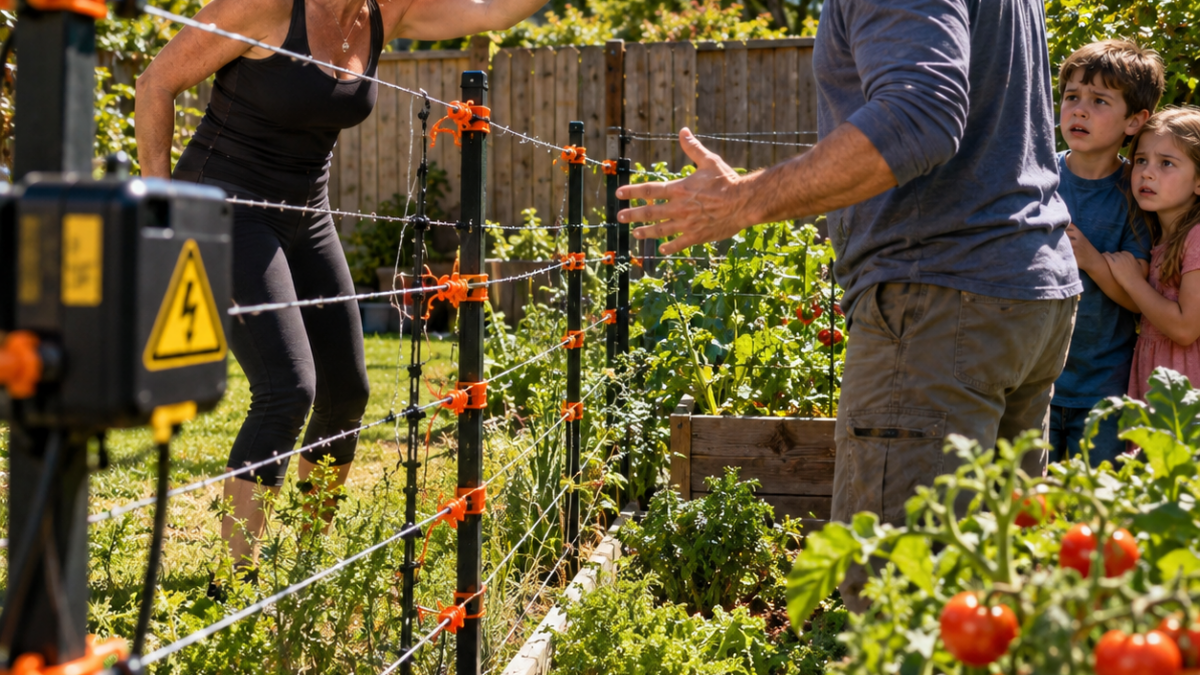
Metal posts had been driven into the ground in a crooked but deliberate line that cut across the back portion of my property and sliced straight through the vegetable beds. Wire ran between the posts, bright warning tags clipped here and there. On Karen’s side of the fence—my side, actually, but the side she had stolen—half my garden was trampled, picked over, and ruined.
A sign hung from the wire.
RECLAIMED LAND.
Below it, in smaller letters:
TRESPASSERS WILL BE SHOCKED.
My first thought was not anger.
It was my children.
They had followed us outside, still chattering about who got to pick the first tomato when we came home. My youngest was already moving toward the yard when I saw the sign clearly.
“Stop!” I shouted.
She froze.
My voice must have scared her because her eyes went wide.
“Do not move closer,” I said. “Both of you. Back to the patio. Now.”
My husband came around the side of the house, carrying a bag from the car.
“What happened?”
I pointed.
He saw the fence.
Then the sign.
Then the wire.
His face changed in a way I had almost never seen.
Quiet fury.
“Is that electric?”
“I think so.”
The kids stood behind us, confused and nervous. My daughter whispered, “Why is there a fence in the garden?”
I did not answer her because if I opened my mouth, I was afraid of what would come out.
Most of my good vegetables were now on Karen’s side of the fence. Tomatoes, beans, half the pepper bed, the zucchini patch, the basil that had finally recovered from a heat wave. Some plants had been pulled out by the roots. Others were stripped badly, picked all at once by someone who did not know or care how to harvest without damaging the plant. Wooden markers my kids painted were cracked or tossed aside.
It felt like coming home to find someone had ripped pages out of a family album.
Then Karen appeared.
Of course she did.
She stepped out of her back door wearing a white sleeveless blouse, fitted shorts, sunglasses, and a smile so satisfied I wanted to tear it off her face with words alone.
“Back already?” she called.
My husband took a step forward.
I put a hand on his arm.
No.
Not because he was wrong to be angry.
Because Karen was holding her phone.
Recording.
I forced myself to walk toward the fence, stopping far enough away that I could not accidentally touch it.
“What did you do?” I asked.
Karen lifted her phone higher.
“I reclaimed my land.”
“This is my property.”
“It was never yours.”
“You ran an electric fence through my garden.”
“I protected what belongs to me.”
“You put my children in danger.”
She tilted her head, eyes glittering behind her sunglasses.
“I wouldn’t need an electric fence if you were a trustworthy neighbor.”
My whole body shook.
“You destroyed my garden.”
“You mean you planted vegetables on stolen land.”
I took out my own phone and began recording.
Karen smiled wider.
“Good. Take pictures. They’ll show the truth.”
“They’ll show a dangerous illegal fence on my property.”
“They’ll show that I’m serious.”
“Karen, do you really think this ends well for you?”
Her expression hardened.
“If you challenge me, I will take you to court. I have better lawyers than you. And watch your language, because I’m recording everything.”
My husband said, very quietly, “We are calling everyone.”
Karen laughed.
“Call whoever you want.”
That was exactly what we did.
The first call was to the police.
They came out, looked at the fence, listened to both of us, and then gave us the answer people get when authorities do not want to step into anything involving property lines.
“Civil dispute.”
I stood there, exhausted, furious, with my children afraid to enter their own backyard, listening to an officer explain that because Karen claimed she believed the land was hers, they could not simply make her remove it.
“She installed an electric fence through my yard.”
“You’ll need to handle the property dispute through civil court.”
“It’s dangerous.”
“You can contact code enforcement.”
“She stole vegetables.”
He looked tired.
“Document everything.”
Document everything.
Those words would become my religion.
If the police would not help, I would build the case so thoroughly that no one else could ignore it.
That night, after the kids were asleep, my husband and I sat at the kitchen table surrounded by papers, laptops, and anger.
I pulled out the survey. The deed. Old closing documents. Photos from before vacation. Photos from after. We saved the video of Karen admitting she had “reclaimed” the land. We wrote down everything she said, with dates and times. We photographed the sign, the posts, the wire, the damage, the distance from the patio, the distance from the kids’ play area, the ruined beds, the pulled plants, the harvested vegetables, the tools and supplies scattered near the fence.
The next morning, I began making calls.
Code enforcement.
The utility company.
The fire department.
The city building office.
Environmental services.
Anyone who might have even a tiny piece of authority over unsafe fencing, improper electrical work, unpermitted structures, fire hazards, or encroachments.
Some people transferred me.
Some sounded bored.
Some told me it sounded like a civil issue.
So I kept repeating the part that mattered.
“There is an electric fence improperly installed through a residential backyard near children.”
That got attention.
Especially when I mentioned that it appeared to be wired into household electrical without visible permit tags, proper barriers, or compliant warnings.
I am not an electrician. I did not pretend to be one. But I knew enough to know that Karen’s setup looked wrong. Messy wires. Hasty connections. Equipment scattered across the ground. Extension lines running in ways that made my husband mutter words I would not repeat in front of the kids.
We kept the children inside unless one of us was physically with them.
They hated it.
I hated it more.
My youngest kept asking when the garden would be safe again. My oldest, old enough to understand more, asked whether Karen could really take our yard.
“No,” I said.
But I was scared enough that the word felt like something I had to hold up with both hands.
Karen, meanwhile, performed victory.
She strutted around her backyard watering plants that were not hers. She picked tomatoes from my vines and made sure I saw. She waved to passing neighbors and told anyone who would listen that she had finally proved I had stolen her land. She used phrases like official correction and reclaimed boundary as if repeating them could make them real.
But the more she talked, the worse she made it for herself.
Neighbors began asking questions.
One man from across the street came over while I was photographing the fence from my side.
“What’s going on back here?” he asked.
“Karen built an electric fence through my property while we were on vacation.”
He stared.
“She what?”
I showed him the photos and the survey.
He looked toward Karen’s yard.
“She told my wife you admitted the survey was wrong.”
“I absolutely did not.”
He shook his head.
“That woman is something else.”
That was the polite version.
Over the next few days, I worked the problem like a second job.
By morning, phone calls.
By afternoon, emails.
By evening, documentation.
We recorded a video showing how close the fence was to normal play areas. We measured how many steps from the back door to the wire. We photographed the warning sign, which was not enough on its own and definitely not enough to make the hazard acceptable. We documented that the fence had no protective buffer on my side, no secondary barrier, and no permit visible anywhere.
I researched local rules until my eyes burned.
I learned more about residential electric fencing than I ever wanted to know. Regulations about location, voltage controllers, permitted agricultural use versus residential restrictions, signage spacing, proper installation, grounding, power sources, setbacks, and liability. I made a spreadsheet because rage apparently turns me into an office manager.
My husband helped me repair what little we could. The side of the garden still accessible to us had been spared the worst, so we planted new seeds. It was late in the season, but I needed the act of planting more than I needed the harvest. The kids helped paint temporary markers. My daughter painted a snowman on one, which made no sense for tomatoes, but it made her happy.
It gave us something Karen had not taken.
Motion.
The feeling that we were not just waiting.
Karen got sloppy.
The fence required maintenance she had clearly not planned for. Tools sat near the posts. A roll of spare wire lay half across the line. One support leaned badly after a storm. Some wiring looked hastily patched. She had equipment resting on my side of the property and seemed to forget that every inch of it went into my growing folder.
Then the inspectors started coming.
First, city code enforcement.
A man with a tablet and a measuring wheel walked the property while Karen hovered behind him, trying to charm him into seeing things her way.
“This is my land,” she said. “I have a right to protect my property.”
He looked at the survey I handed him.
“That is not what this shows.”
“She paid for that.”
“It is recorded.”
Karen’s mouth tightened.
He measured distances. Took photos. Asked where the power source was. Examined the signage. Looked at the proximity to my garden, patio, and children’s play area. His expression grew more serious the longer he looked.
Then the utility representative came.
He was less patient.
The moment he saw how the fence was powered, his face changed.
“Who installed this?”
Karen lifted her chin.
“A contractor.”
“Name?”
She hesitated.
“I don’t have it on me.”
“Permit?”
“It’s a fence.”
“It’s electrified equipment tied into residential power.”
She had no answer.
The fire marshal came last.
That was the visit that made Karen stop smiling.
He walked the line, checked the connections, looked at the dry mulch near parts of the wire, studied the haphazard placement, and said, loudly enough for all of us to hear, “This is a hazard.”
Karen tried again.
“It’s on my property.”
“No,” he said. “It appears to encroach. And even if it didn’t, unsafe electrical installation does not become safe because you like where you put it.”
I nearly applauded.
I did not.
But I wanted to.
Two weeks after we returned from vacation, Karen received official notice.
The fence had to be removed immediately.
Not eventually.
Not after a hearing.
Immediately.
The notices cited unsafe electrical work, lack of proper permits, code violations, fire hazard concerns, improper installation, and encroachment. There were fines. There were inspection costs. There were warnings about escalating penalties if she failed to comply.
Karen came to the fence that afternoon holding the papers in one hand and fury in the other.
“This is because of you,” she snapped.
“Yes.”
“You think you won.”
“No,” I said. “I think my kids can use the yard again once your dangerous fence is gone.”
“You haven’t heard the last of this.”
“I’m counting on hearing from the city, actually.”
Her face twisted.
“I still own that land.”
“No, Karen. You don’t.”
“These fines are about the fence, not the boundary.”
“Then we’ll clarify the boundary too.”
That was the next step.
I hired a licensed surveyor to come out and mark the property line again, clearly and officially. The city also sent someone to verify. The result was exactly what it had always been.
My land was mine.
Karen’s land was hers.
Corner lots had extra space.
Reality had not changed because she found it unfair.
I sent Karen a certified letter with copies of the updated survey results, the marker locations, and a written demand that she stay off our property and stop removing or damaging plants, structures, or markers. My tone was formal. Dry. Boring.
Boring is useful when dealing with people who feed on drama.
The fence came down over a weekend.
Not gracefully.
Not with apology.
Karen hired someone to remove it, and I watched from my patio with a cup of coffee while the posts came out of the ground one by one. The RECLAIMED LAND sign disappeared first. That gave me a satisfaction so petty and pure I will not apologize for it.
When the last wire was gone, my yard looked wounded.
The garden was a mess. Trampled soil. Broken stakes. Uprooted plants. Empty spaces where thriving rows had been. Some plants might recover, but most would not. The season was too far along for a full comeback.
I walked through the beds that evening after the workers left.
For the first time, with the immediate danger gone, I let myself grieve it.
That may sound dramatic if you have never loved a garden. But I had spent months growing that food. My kids had helped. My husband had built. We had waited for those tomatoes, checked those peppers, laughed about the zucchini. Karen had not just stolen vegetables. She had violated a piece of our home that carried our hands in it.
My youngest found the broken marker she had painted for basil.
She held it up.
“Can we fix it?”
I crouched beside her.
“Yes,” I said. “We can fix it.”
So we did.
Not all at once.
Not perfectly.
But we rebuilt.
We pulled out the ruined plants. Saved what we could. Turned the soil. Added compost. Repaired the irrigation lines that had been damaged. My husband built new raised beds, sturdier than the old ones. We placed decorative fencing fully inside our property line, not because Karen had any right to demand it, but because I wanted a visible, beautiful reminder of where our space began.
The kids painted new signs.
Tomatoes.
Peppers.
Basil.
Beans.
My youngest painted another snowman.
Still no reason.
Still perfect.
I added survey markers that were clear but tasteful. I kept copies of everything in a folder: deed, survey, city notices, inspection reports, photos, certified mail receipts, and a timeline of the whole event. Not because I wanted to live in fear, but because I had learned that proof is peace.
Word spread through the neighborhood.
Karen had been telling people I stole land.
Now people had seen inspectors at her house, watched the fence come down, heard about the fines, and realized the story was not what she claimed. Some neighbors apologized for believing her. Some admitted they thought something seemed off but did not want to get involved.
Karen retreated.
Not completely. People like her rarely disappear from their own resentment. She still gives me dirty looks when I’m outside. She still makes a point of turning away if we cross paths. Sometimes I catch her staring at the new garden fence as if it personally insulted her.
Maybe it does.
I hope so.
Because it is beautiful.
The garden came back stronger.
The raised beds drain better. The new markers make the kids proud. The little decorative fence keeps rabbits out, mostly, which is more than I can say for Karen. The basil grew thick. The tomatoes eventually recovered enough to give us a late harvest. The peppers surprised me by producing after I thought they were done. The zucchini, naturally, survived like a weed with ambition.
The first time I picked tomatoes from the rebuilt garden, I stood there for a moment with the basket in my hand and felt something settle inside me.
Not victory exactly.
Something calmer.
Karen wanted me to lose control. She wanted screaming, panic, a neighbor war she could twist into evidence that I was unreasonable. She wanted me to touch the fence, damage it, threaten her, or give her one careless moment she could record and use.
Instead, I documented.
I called the right departments.
I kept my family safe.
I made the danger impossible to ignore.
I stood up for myself the right way.
That did not feel as dramatic as tearing the fence down with my bare hands would have felt.
But it worked.
And it lasted.
My kids can play in the yard again. They know where the property line is now, though I wish they had not had to learn it because of an electric fence. They know that adults can behave badly. They also know that paperwork, patience, and truth can be stronger than someone’s tantrum.
A few weeks after the garden was safe again, my oldest asked me, “Why did Karen do that?”
I thought about giving a gentle answer.
Something about misunderstandings.
Something about disagreements.
But he was old enough for a better truth.
“Because she wanted something that wasn’t hers,” I said. “And she thought wanting it badly enough meant she could take it.”
He frowned.
“That’s not how it works.”
“No,” I said. “It isn’t.”
He looked toward Karen’s house.
“Is she going to try again?”
I followed his gaze.
Karen’s blinds moved slightly.
“I don’t know,” I said honestly. “But if she does, we’ll be ready.”
That is the strange gift bad neighbors give you.
They teach you exactly how prepared you can become.
Before this, I knew where my survey was in a vague adult way. Now I can put my hand on it in thirty seconds. Before this, I assumed property markers were enough. Now I know when they were last checked, who verified them, and where every one sits. Before this, I thought of my garden as a peaceful place. Now it is still peaceful, but it is also defended.
Not by electricity.
Not by threats.
By records.
By boundaries.
By the knowledge that kindness does not require surrender.
I still garden in the evenings.
Sometimes Karen is outside too. She pretends not to watch me. I pretend not to notice her pretending. I tie tomatoes. Trim basil. Pull weeds. Let the kids water too much because childhood should include small harmless mistakes with hoses. My husband sits on the patio sometimes, drinking iced tea and admiring the raised beds like he built Versailles.
The corner lot still has extra space.
My space.
The garden still grows.
My garden.
And every time I pass the spot where that ugly sign once hung—RECLAIMED LAND, TRESPASSERS WILL BE SHOCKED—I think about how ridiculous and dangerous entitlement becomes when someone convinces herself unfairness is the same as theft.
Karen thought a fence could create ownership.
She thought an electric current could make a lie stronger.
She thought waiting until we were gone made her brave.
But property lines do not move because a jealous neighbor gets bored. Surveys do not change because someone hates your tomatoes. And stolen land does not become reclaimed land just because Karen prints a sign.
In the end, all she proved was that my garden could survive more than bad weather.
It could survive her.
And every tomato I pick from that rebuilt soil tastes a little bit like proof.
𝗧𝗛𝗘 𝗘𝗡𝗗
Karen Ran an Electric Fence Through My Garden, Then Learned Reclaimed Land Still Has Property Lines
Karen waited until my family left for vacation, then sliced an electric fence straight through my backyard and called it “reclaimed land.”
She stole my vegetables, endangered my children, and smiled like a woman who thought a warning sign could rewrite a survey.
By the time the inspectors finished walking the property, the fence was gone, the fines were real, and my garden had become the one thing she could not take from me.
I have always loved my garden more than most people understand.
To someone who has never grown food, a vegetable garden probably looks peaceful in a simple, decorative way. A few tomato plants. Some herbs. A line of peppers. Maybe squash leaves spreading too aggressively in July, because squash never learned boundaries and never will. People see the final result—the baskets of tomatoes, the fresh basil, the cucumbers still cool from the shade—and they think it just happens because dirt is magical and plants are generous.
It does not just happen.
A garden is work.
It is early mornings with soil under your fingernails before coffee. It is kneeling until your back complains. It is fighting pests, guessing wrong about weather, learning which part of the yard gets sun at which hour, losing seedlings to one surprise cold night, and pretending you are not personally offended when something you babied for months decides to die anyway.
But when it works, it feels like a small miracle you helped negotiate.
That was why I loved it.
My corner lot gave me just enough extra space to make the garden something special. Not huge, not commercial, not some influencer homestead fantasy with matching baskets and a golden retriever running through lavender rows. Just a good, honest backyard garden. Raised beds near the sunny side. Trellises along the fence. Tomatoes, peppers, beans, lettuce, basil, carrots, onions, and a stubborn patch of zucchini that produced like it had a personal vendetta against hunger.
My kids helped paint plant markers. My husband built the first raised bed after watching three YouTube tutorials and declaring himself “basically a carpenter now.” The garden became part of our family rhythm. The kids would run outside after school to check whether the cherry tomatoes were ready. My youngest called basil “pizza leaves.” My oldest liked carrots because pulling them from the dirt felt like treasure hunting.
It was not just food.
It was ours.
That fact bothered Karen.
Karen lived next door, and from the day she moved in, she acted like my extra strip of corner-lot space had been stolen directly from her soul. She was the kind of neighbor who could turn any ordinary conversation into a complaint and any complaint into a campaign. Early forties, maybe a little older, with glossy dark-blonde hair, sharp cheekbones, tight workout clothes, and a face that had probably once been very beautiful before resentment settled into every expression. She wore big sunglasses even when it was cloudy and always seemed to have a reusable coffee tumbler in one hand, like she needed a prop for judgment.
I did not know much about her husband. He was quiet, almost ghostlike. He mowed. He carried groceries. He gave the occasional tired wave. Karen did the talking for both of them, and unfortunately, she loved talking.
At first, she complained in the normal annoying-neighbor way.
“Your corner lot is so much bigger than ours.”
“Yes, corner lots are shaped differently.”
“It doesn’t seem fair.”
“I didn’t design the subdivision.”
Then it changed.
She began saying part of my yard was actually hers.
Not asking.
Not wondering.
Declaring.
“You know these lines are wrong,” she said one afternoon while I was watering tomatoes.
I glanced up. She stood at the chain-link boundary between our yards, sunglasses pushed into her hair, lips pursed.
“What lines?”
“The property lines.”
“They’re not wrong.”
“They are. Nobody gets that much extra space just because they’re on a corner.”
“That is literally what happens sometimes.”
She laughed, not because anything was funny, but because she thought laughter made her sound superior.
“Someone moved the markers.”
“No one moved the markers.”
“You don’t know that.”
“I have the survey.”
That should have ended it.
It did not.
Over the next few months, Karen became obsessed. She claimed the original lot lines had been different. She said official records had been changed. She said survey markers were wrong from the start. She said corner lots were a scam developers used to cheat “regular homeowners” out of land. She said if I were a good neighbor, I would “rectify the imbalance.”
Meaning give her part of my yard.
I showed her the survey once.
That was my mistake.
Not because it weakened my position, but because I learned that facts do not calm people like Karen. Facts only offend them.
She looked at the paper and said, “Well, of course your survey says that.”
I stared at her.
“My survey?”
“You probably paid someone to draw it that way.”
“Karen, this is the recorded property survey.”
“Recorded by people.”
“Yes. That is how records work.”
She did not appreciate that.
After that, she turned petty.
She made fun of my garden.
At first, she did it indirectly. Little comments tossed over the fence while pretending she was just making conversation.
“Those tomatoes look a little sad.”
“Are cucumbers supposed to be that color?”
“I hope you’re not feeding those to the kids.”
Then she became more obvious.
“You know, if that land were mine, I’d make it look nice.”
I was kneeling by the peppers, tying a plant to a support stake.
“It does look nice.”
“To you, maybe.”
I looked at my thriving beds, the green leaves, the yellow flowers, the first red blush on the tomatoes.
“Yes,” I said. “To me.”
She wanted to get under my skin.
Sometimes she did. I am not made of stone. But I refused to show it because Karen fed on reaction the way aphids feed on seedlings. The more visibly upset you became, the more alive she seemed.
So I kept gardening.
I kept my surveys in a folder.
I kept my side of the line clean.
And I thought that would be enough.
Then we went on vacation.
It was a two-week family trip we had planned for months. Nothing extravagant. Just a cabin near the mountains, some hiking, a lake day, and enough time away from chores that my husband and I could remember what our faces looked like when we were not thinking about bills or school schedules.
Before we left, I did the responsible things.
Held the mail. Asked a friend to check the porch. Set timers on lights. Locked everything. Watered deeply. Mulched the beds. Left the garden in the best shape I could and accepted that two weeks away in summer meant I might lose a few things but not everything.
I was not worried about the house.
We lived in a nice neighborhood. Quiet. Safe. The kind of place where people complained about garbage bins more often than actual crime. I did not expect break-ins.
I should have worried about the woman next door with a grudge and too much free time.
We came home on a Saturday afternoon.
The kids were tired. My husband was sunburned on one shoulder. The car smelled like fast food, sunscreen, and damp towels. I remember feeling that bittersweet relief of returning home after a good trip. The house looked normal from the street. The front lawn was a little long, but fine. The porch was clear. The mailbox was empty, just like it should have been.
Then I walked into the backyard.
For a moment, my mind refused to understand what I was seeing.
There was a fence.
A new fence.
Not along the boundary.
Through my yard.
Through my garden.
Metal posts had been driven into the ground in a crooked but deliberate line that cut across the back portion of my property and sliced straight through the vegetable beds. Wire ran between the posts, bright warning tags clipped here and there. On Karen’s side of the fence—my side, actually, but the side she had stolen—half my garden was trampled, picked over, and ruined.
A sign hung from the wire.
RECLAIMED LAND.
Below it, in smaller letters:
TRESPASSERS WILL BE SHOCKED.
My first thought was not anger.
It was my children.
They had followed us outside, still chattering about who got to pick the first tomato when we came home. My youngest was already moving toward the yard when I saw the sign clearly.
“Stop!” I shouted.
She froze.
My voice must have scared her because her eyes went wide.
“Do not move closer,” I said. “Both of you. Back to the patio. Now.”
My husband came around the side of the house, carrying a bag from the car.
“What happened?”
I pointed.
He saw the fence.
Then the sign.
Then the wire.
His face changed in a way I had almost never seen.
Quiet fury.
“Is that electric?”
“I think so.”
The kids stood behind us, confused and nervous. My daughter whispered, “Why is there a fence in the garden?”
I did not answer her because if I opened my mouth, I was afraid of what would come out.
Most of my good vegetables were now on Karen’s side of the fence. Tomatoes, beans, half the pepper bed, the zucchini patch, the basil that had finally recovered from a heat wave. Some plants had been pulled out by the roots. Others were stripped badly, picked all at once by someone who did not know or care how to harvest without damaging the plant. Wooden markers my kids painted were cracked or tossed aside.
It felt like coming home to find someone had ripped pages out of a family album.
Then Karen appeared.
Of course she did.
She stepped out of her back door wearing a white sleeveless blouse, fitted shorts, sunglasses, and a smile so satisfied I wanted to tear it off her face with words alone.
“Back already?” she called.
My husband took a step forward.
I put a hand on his arm.
No.
Not because he was wrong to be angry.
Because Karen was holding her phone.
Recording.
I forced myself to walk toward the fence, stopping far enough away that I could not accidentally touch it.
“What did you do?” I asked.
Karen lifted her phone higher.
“I reclaimed my land.”
“This is my property.”
“It was never yours.”
“You ran an electric fence through my garden.”
“I protected what belongs to me.”
“You put my children in danger.”
She tilted her head, eyes glittering behind her sunglasses.
“I wouldn’t need an electric fence if you were a trustworthy neighbor.”
My whole body shook.
“You destroyed my garden.”
“You mean you planted vegetables on stolen land.”
I took out my own phone and began recording.
Karen smiled wider.
“Good. Take pictures. They’ll show the truth.”
“They’ll show a dangerous illegal fence on my property.”
“They’ll show that I’m serious.”
“Karen, do you really think this ends well for you?”
Her expression hardened.
“If you challenge me, I will take you to court. I have better lawyers than you. And watch your language, because I’m recording everything.”
My husband said, very quietly, “We are calling everyone.”
Karen laughed.
“Call whoever you want.”
That was exactly what we did.
The first call was to the police.
They came out, looked at the fence, listened to both of us, and then gave us the answer people get when authorities do not want to step into anything involving property lines.
“Civil dispute.”
I stood there, exhausted, furious, with my children afraid to enter their own backyard, listening to an officer explain that because Karen claimed she believed the land was hers, they could not simply make her remove it.
“She installed an electric fence through my yard.”
“You’ll need to handle the property dispute through civil court.”
“It’s dangerous.”
“You can contact code enforcement.”
“She stole vegetables.”
He looked tired.
“Document everything.”
Document everything.
Those words would become my religion.
If the police would not help, I would build the case so thoroughly that no one else could ignore it.
That night, after the kids were asleep, my husband and I sat at the kitchen table surrounded by papers, laptops, and anger.
I pulled out the survey. The deed. Old closing documents. Photos from before vacation. Photos from after. We saved the video of Karen admitting she had “reclaimed” the land. We wrote down everything she said, with dates and times. We photographed the sign, the posts, the wire, the damage, the distance from the patio, the distance from the kids’ play area, the ruined beds, the pulled plants, the harvested vegetables, the tools and supplies scattered near the fence.
The next morning, I began making calls.
Code enforcement.
The utility company.
The fire department.
The city building office.
Environmental services.
Anyone who might have even a tiny piece of authority over unsafe fencing, improper electrical work, unpermitted structures, fire hazards, or encroachments.
Some people transferred me.
Some sounded bored.
Some told me it sounded like a civil issue.
So I kept repeating the part that mattered.
“There is an electric fence improperly installed through a residential backyard near children.”
That got attention.
Especially when I mentioned that it appeared to be wired into household electrical without visible permit tags, proper barriers, or compliant warnings.
I am not an electrician. I did not pretend to be one. But I knew enough to know that Karen’s setup looked wrong. Messy wires. Hasty connections. Equipment scattered across the ground. Extension lines running in ways that made my husband mutter words I would not repeat in front of the kids.
We kept the children inside unless one of us was physically with them.
They hated it.
I hated it more.
My youngest kept asking when the garden would be safe again. My oldest, old enough to understand more, asked whether Karen could really take our yard.
“No,” I said.
But I was scared enough that the word felt like something I had to hold up with both hands.
Karen, meanwhile, performed victory.
She strutted around her backyard watering plants that were not hers. She picked tomatoes from my vines and made sure I saw. She waved to passing neighbors and told anyone who would listen that she had finally proved I had stolen her land. She used phrases like official correction and reclaimed boundary as if repeating them could make them real.
But the more she talked, the worse she made it for herself.
Neighbors began asking questions.
One man from across the street came over while I was photographing the fence from my side.
“What’s going on back here?” he asked.
“Karen built an electric fence through my property while we were on vacation.”
He stared.
“She what?”
I showed him the photos and the survey.
He looked toward Karen’s yard.
“She told my wife you admitted the survey was wrong.”
“I absolutely did not.”
He shook his head.
“That woman is something else.”
That was the polite version.
Over the next few days, I worked the problem like a second job.
By morning, phone calls.
By afternoon, emails.
By evening, documentation.
We recorded a video showing how close the fence was to normal play areas. We measured how many steps from the back door to the wire. We photographed the warning sign, which was not enough on its own and definitely not enough to make the hazard acceptable. We documented that the fence had no protective buffer on my side, no secondary barrier, and no permit visible anywhere.
I researched local rules until my eyes burned.
I learned more about residential electric fencing than I ever wanted to know. Regulations about location, voltage controllers, permitted agricultural use versus residential restrictions, signage spacing, proper installation, grounding, power sources, setbacks, and liability. I made a spreadsheet because rage apparently turns me into an office manager.
My husband helped me repair what little we could. The side of the garden still accessible to us had been spared the worst, so we planted new seeds. It was late in the season, but I needed the act of planting more than I needed the harvest. The kids helped paint temporary markers. My daughter painted a snowman on one, which made no sense for tomatoes, but it made her happy.
It gave us something Karen had not taken.
Motion.
The feeling that we were not just waiting.
Karen got sloppy.
The fence required maintenance she had clearly not planned for. Tools sat near the posts. A roll of spare wire lay half across the line. One support leaned badly after a storm. Some wiring looked hastily patched. She had equipment resting on my side of the property and seemed to forget that every inch of it went into my growing folder.
Then the inspectors started coming.
First, city code enforcement.
A man with a tablet and a measuring wheel walked the property while Karen hovered behind him, trying to charm him into seeing things her way.
“This is my land,” she said. “I have a right to protect my property.”
He looked at the survey I handed him.
“That is not what this shows.”
“She paid for that.”
“It is recorded.”
Karen’s mouth tightened.
He measured distances. Took photos. Asked where the power source was. Examined the signage. Looked at the proximity to my garden, patio, and children’s play area. His expression grew more serious the longer he looked.
Then the utility representative came.
He was less patient.
The moment he saw how the fence was powered, his face changed.
“Who installed this?”
Karen lifted her chin.
“A contractor.”
“Name?”
She hesitated.
“I don’t have it on me.”
“Permit?”
“It’s a fence.”
“It’s electrified equipment tied into residential power.”
She had no answer.
The fire marshal came last.
That was the visit that made Karen stop smiling.
He walked the line, checked the connections, looked at the dry mulch near parts of the wire, studied the haphazard placement, and said, loudly enough for all of us to hear, “This is a hazard.”
Karen tried again.
“It’s on my property.”
“No,” he said. “It appears to encroach. And even if it didn’t, unsafe electrical installation does not become safe because you like where you put it.”
I nearly applauded.
I did not.
But I wanted to.
Two weeks after we returned from vacation, Karen received official notice.
The fence had to be removed immediately.
Not eventually.
Not after a hearing.
Immediately.
The notices cited unsafe electrical work, lack of proper permits, code violations, fire hazard concerns, improper installation, and encroachment. There were fines. There were inspection costs. There were warnings about escalating penalties if she failed to comply.
Karen came to the fence that afternoon holding the papers in one hand and fury in the other.
“This is because of you,” she snapped.
“Yes.”
“You think you won.”
“No,” I said. “I think my kids can use the yard again once your dangerous fence is gone.”
“You haven’t heard the last of this.”
“I’m counting on hearing from the city, actually.”
Her face twisted.
“I still own that land.”
“No, Karen. You don’t.”
“These fines are about the fence, not the boundary.”
“Then we’ll clarify the boundary too.”
That was the next step.
I hired a licensed surveyor to come out and mark the property line again, clearly and officially. The city also sent someone to verify. The result was exactly what it had always been.
My land was mine.
Karen’s land was hers.
Corner lots had extra space.
Reality had not changed because she found it unfair.
I sent Karen a certified letter with copies of the updated survey results, the marker locations, and a written demand that she stay off our property and stop removing or damaging plants, structures, or markers. My tone was formal. Dry. Boring.
Boring is useful when dealing with people who feed on drama.
The fence came down over a weekend.
Not gracefully.
Not with apology.
Karen hired someone to remove it, and I watched from my patio with a cup of coffee while the posts came out of the ground one by one. The RECLAIMED LAND sign disappeared first. That gave me a satisfaction so petty and pure I will not apologize for it.
When the last wire was gone, my yard looked wounded.
The garden was a mess. Trampled soil. Broken stakes. Uprooted plants. Empty spaces where thriving rows had been. Some plants might recover, but most would not. The season was too far along for a full comeback.
I walked through the beds that evening after the workers left.
For the first time, with the immediate danger gone, I let myself grieve it.
That may sound dramatic if you have never loved a garden. But I had spent months growing that food. My kids had helped. My husband had built. We had waited for those tomatoes, checked those peppers, laughed about the zucchini. Karen had not just stolen vegetables. She had violated a piece of our home that carried our hands in it.
My youngest found the broken marker she had painted for basil.
She held it up.
“Can we fix it?”
I crouched beside her.
“Yes,” I said. “We can fix it.”
So we did.
Not all at once.
Not perfectly.
But we rebuilt.
We pulled out the ruined plants. Saved what we could. Turned the soil. Added compost. Repaired the irrigation lines that had been damaged. My husband built new raised beds, sturdier than the old ones. We placed decorative fencing fully inside our property line, not because Karen had any right to demand it, but because I wanted a visible, beautiful reminder of where our space began.
The kids painted new signs.
Tomatoes.
Peppers.
Basil.
Beans.
My youngest painted another snowman.
Still no reason.
Still perfect.
I added survey markers that were clear but tasteful. I kept copies of everything in a folder: deed, survey, city notices, inspection reports, photos, certified mail receipts, and a timeline of the whole event. Not because I wanted to live in fear, but because I had learned that proof is peace.
Word spread through the neighborhood.
Karen had been telling people I stole land.
Now people had seen inspectors at her house, watched the fence come down, heard about the fines, and realized the story was not what she claimed. Some neighbors apologized for believing her. Some admitted they thought something seemed off but did not want to get involved.
Karen retreated.
Not completely. People like her rarely disappear from their own resentment. She still gives me dirty looks when I’m outside. She still makes a point of turning away if we cross paths. Sometimes I catch her staring at the new garden fence as if it personally insulted her.
Maybe it does.
I hope so.
Because it is beautiful.
The garden came back stronger.
The raised beds drain better. The new markers make the kids proud. The little decorative fence keeps rabbits out, mostly, which is more than I can say for Karen. The basil grew thick. The tomatoes eventually recovered enough to give us a late harvest. The peppers surprised me by producing after I thought they were done. The zucchini, naturally, survived like a weed with ambition.
The first time I picked tomatoes from the rebuilt garden, I stood there for a moment with the basket in my hand and felt something settle inside me.
Not victory exactly.
Something calmer.
Karen wanted me to lose control. She wanted screaming, panic, a neighbor war she could twist into evidence that I was unreasonable. She wanted me to touch the fence, damage it, threaten her, or give her one careless moment she could record and use.
Instead, I documented.
I called the right departments.
I kept my family safe.
I made the danger impossible to ignore.
I stood up for myself the right way.
That did not feel as dramatic as tearing the fence down with my bare hands would have felt.
But it worked.
And it lasted.
My kids can play in the yard again. They know where the property line is now, though I wish they had not had to learn it because of an electric fence. They know that adults can behave badly. They also know that paperwork, patience, and truth can be stronger than someone’s tantrum.
A few weeks after the garden was safe again, my oldest asked me, “Why did Karen do that?”
I thought about giving a gentle answer.
Something about misunderstandings.
Something about disagreements.
But he was old enough for a better truth.
“Because she wanted something that wasn’t hers,” I said. “And she thought wanting it badly enough meant she could take it.”
He frowned.
“That’s not how it works.”
“No,” I said. “It isn’t.”
He looked toward Karen’s house.
“Is she going to try again?”
I followed his gaze.
Karen’s blinds moved slightly.
“I don’t know,” I said honestly. “But if she does, we’ll be ready.”
That is the strange gift bad neighbors give you.
They teach you exactly how prepared you can become.
Before this, I knew where my survey was in a vague adult way. Now I can put my hand on it in thirty seconds. Before this, I assumed property markers were enough. Now I know when they were last checked, who verified them, and where every one sits. Before this, I thought of my garden as a peaceful place. Now it is still peaceful, but it is also defended.
Not by electricity.
Not by threats.
By records.
By boundaries.
By the knowledge that kindness does not require surrender.
I still garden in the evenings.
Sometimes Karen is outside too. She pretends not to watch me. I pretend not to notice her pretending. I tie tomatoes. Trim basil. Pull weeds. Let the kids water too much because childhood should include small harmless mistakes with hoses. My husband sits on the patio sometimes, drinking iced tea and admiring the raised beds like he built Versailles.
The corner lot still has extra space.
My space.
The garden still grows.
My garden.
And every time I pass the spot where that ugly sign once hung—RECLAIMED LAND, TRESPASSERS WILL BE SHOCKED—I think about how ridiculous and dangerous entitlement becomes when someone convinces herself unfairness is the same as theft.
Karen thought a fence could create ownership.
She thought an electric current could make a lie stronger.
She thought waiting until we were gone made her brave.
But property lines do not move because a jealous neighbor gets bored. Surveys do not change because someone hates your tomatoes. And stolen land does not become reclaimed land just because Karen prints a sign.
In the end, all she proved was that my garden could survive more than bad weather.
It could survive her.
And every tomato I pick from that rebuilt soil tastes a little bit like proof.