𝗙𝗨𝗟𝗟 𝗦𝗧𝗢𝗥𝗬 Karen Promised My Lake House to Her Son, Then Learned the Deed Had My Name on It
𝗙𝗨𝗟𝗟 𝗦𝗧𝗢𝗥𝗬
Karen smiled then, but it was not pleasant.
“That is not really the point.”
“It feels like the point.”
“The community has always understood that this property would eventually be brought into alignment with the rest of the lakefront.”
“Brought into alignment.”
“Yes.”
“With your son’s name on the deed?”
Her chin lifted.
“Preston deserves a proper start. This house is ideal for him, and frankly, it makes far more sense for someone connected to the community to own it.”
I laughed once. I did not mean to. It just came out, short and stunned.
Karen’s eyes narrowed behind her sunglasses.
“This is not funny.”
“No,” I said. “It’s insane.”
Her posture changed.
Only slightly.
But I saw it.
Karen Whitmore was not a woman used to being called insane in her own kingdom.
“You should be careful how you speak to me,” she said.
“I am being careful. If I wasn’t, you would already be leaving.”
She drew herself up, white blouse bright against the dark green of the pines.
“This property exists within the visual boundary of our community. The HOA has standards, interests, and long-term planning authority.”
“This house is private property. My grandfather bought it before your HOA existed.”
“Your grandfather was difficult.”
“My grandfather was smart.”
Her jaw tightened.
“Do not mistake sentiment for legal protection.”
“Do not mistake your imagination for law.”
That was the first time I saw the real Karen underneath the polished surface.
It came and went fast, like something ugly passing behind a curtain. Her mouth flattened. Her nostrils flared. Her fingers tightened around the strap of her purse.
Then the smile returned.
“You are emotional,” she said. “I understand. Inheritance can make people feel attached to things they are not equipped to manage.”
“I’m equipped enough to know I’m not giving my house to your son.”
“He has been told this property would be his.”
“Then whoever told him that lied.”
Her face went cold.
I knew, in that instant, that the person who had lied was her.
Karen looked at the house again, but this time there was no neighborly pretense in it. She examined the porch, the windows, the roofline, the view beyond the trees. She looked at my grandfather’s house the way people look at something in a store window before deciding how badly they want it.
“You will regret being unreasonable,” she said.
I adjusted the grocery bags again.
“Are we done?”
“For now.”
She turned and walked back to a pearl-white SUV parked halfway in the road, because apparently even her car thought the world should make room.
I stood there until she drove away.
Then I went inside, set the groceries on the counter, and realized the eggs had cracked anyway.
That night, I sat on the back porch and called my older sister, Megan.
She lived three states away and had always thought moving into the lake house was a terrible idea.
“Karen did what?” she asked.
I told her again.
There was a pause.
Then Megan said, “That is either the funniest thing I’ve heard all year or the beginning of a documentary where everyone interviewed says, ‘We never thought it would go that far.’”
“I’m leaning toward the second.”
“You need a lawyer.”
“I know.”
“And cameras.”
“I know.”
“And stop being polite to rich lunatics.”
“I was not that polite.”
“Were there groceries in your arms?”
“Yes.”
“Then you were vulnerable.”
I almost smiled.
Almost.
But after we hung up, the house felt different.
Not unsafe, exactly.
Violated.
Karen had stood in my driveway and spoken about my grandfather’s house as if I were just a temporary inconvenience between her and what she wanted. I kept replaying the conversation, searching for any hint that she had been bluffing, confused, drunk on her own authority.
But no.
Karen believed the world could be rearranged by force of entitlement.
I called a lawyer the next morning.
His name was David Fletcher, a property attorney recommended by a coworker. He had a calm voice, a dry sense of humor, and the tired patience of a man who had spent twenty years explaining to people that wanting something badly did not create ownership rights.
I brought him the deed, tax records, old purchase documents, the HOA invitation letters, and every scrap of paper I had involving the property.
David reviewed everything and confirmed what I already knew.
The house was mine.
The HOA had no authority over it.
The property predated the association by more than twenty years and had never been annexed, pledged, restricted, or voluntarily enrolled.
“You are not subject to their covenants,” David said, tapping the folder. “They can invite you. They can glare at you. They can complain at cocktail parties. They cannot govern you.”
“What about this idea that it was promised to her son?”
David looked at me over his glasses.
“Did you promise it?”
“No.”
“Did your grandfather promise it in a written, enforceable agreement?”
“Absolutely not.”
“Then her son can start his adult life with disappointment. It builds character.”
For the first time since Karen had appeared in my driveway, I laughed properly.
David advised me to document everything.
“If she comes back, write down the date, time, and what was said. If she sends letters, save them. If anyone trespasses, call the police. People like this rely on the target wanting things to stay quiet. Do not keep it quiet.”
That turned out to be the most useful advice anyone could have given me.
The first fine arrived three days later.
It came in an official-looking envelope with the Briar Shore Estates Homeowners Association logo at the top. The paper was thick. The wording was formal. The amount was ridiculous.
$150 for an unapproved exterior fixture.
According to the notice, my front door knocker was not an approved finish under HOA architectural guidelines.
I read the letter twice.
Then I walked to the front door and stared at it.
I did not have a door knocker.
I had a plain black handle, a deadbolt, and a small brass peephole my grandfather had installed after someone stole fishing rods from a neighbor’s garage in 1998.
No knocker.
I took a photo of the door, saved the letter, and emailed both to David.
His reply came ten minutes later.
Do not respond yet. Keep everything.
The next fine arrived the following week.
$200 for excessive moisture in rear lawn area.
I stood in the backyard with the letter in one hand, looking at the grass sloping down toward the lake.
The lake.
The enormous body of water five yards away from the wet grass.
Karen was fining me because the ground beside a lake was damp.
After that, the fines came faster.
Improper mailbox appearance.
Unapproved porch furniture.
Nonconforming dock tone.
Failure to maintain approved lakefront visual harmony.
Unauthorized native plant growth.
I had to admit, that last one almost impressed me. Karen had found a way to fine weeds for not being imported.
Every notice was fake, but each one carried the same threat. Continued noncompliance could result in additional penalties, legal collection efforts, and enforcement action.
At first, I tried to treat the whole thing like paperwork theater.
I made a folder.
Then I made a second folder when the first one got too full.
I photographed everything she mentioned. I saved envelopes. I noted postmarks. I made a spreadsheet because if Karen wanted to wage war through office supplies, I could meet her on that battlefield.
But the anger built anyway.
It built when I came home from work and found another envelope waiting.
It built when I saw Karen watching from her car as I checked my mail.
It built when Preston drove past my house too slowly, music thumping, one hand dangling out the window like he already owned the road.
Then Karen began showing up in person.
Sometimes she stood by the mailbox.
Sometimes at the edge of the driveway.
Once, I found her at the base of my front steps, holding a clipboard, examining my porch as if she were conducting an inspection.
I had been coming back from a run, sweat cooling under my shirt, lungs still working hard.
“What are you doing?” I asked.
She turned with a smile.
“Documenting violations.”
“You’re trespassing.”
“I am on an approach area visible from the road.”
“You are on my property.”
“Visibility creates community impact.”
“Karen, get off my property.”
She clicked her pen.
“You know, this could all become much easier.”
“There is no version of this where I give Preston my house.”
“You keep saying that as if the matter is entirely yours to decide.”
“It is.”
Her eyes moved across my face, cold and measuring.
“You are very proud for someone who inherited what he has.”
The words hit harder than I expected.
Because that was the thing people like Karen always tried to do. If they could not take what you had, they tried to make you feel unworthy of having it.
I stepped closer.
“My grandfather worked for this house. He paid for it. He cared for it. He chose who he wanted to leave it to. That was me. Not you. Not your son. Me.”
For once, Karen did not answer immediately.
Then she smiled.
“People can be pressured into making better choices.”
I felt the back of my neck go cold.
“Was that a threat?”
“It was advice.”
“No,” I said. “It was recorded.”
Her eyes flicked to my phone in my hand.
I had not actually been recording before that moment, but she did not know that.
Karen’s smile disappeared.
She left without another word.
The cease-and-desist letter went out the next morning.
David sent it by certified mail to Karen, the HOA board, and the management company. It stated plainly that my property was not under HOA jurisdiction, that the fines were invalid, that continued contact or false enforcement attempts would be treated as harassment, and that any further trespass would be reported.
I also filed a police report.
The officer at the desk was polite but not surprised. Apparently, Karen’s name was not new to the department.
“She ever threaten you directly?” he asked.
“Not in a way she’d admit.”
He nodded like he understood exactly what I meant.
“We’ll document it. If she comes onto the property again, call us.”
For about two weeks, the official-looking HOA notices stopped.
I thought maybe David’s letter had scared her.
Then the personal letters began.
No HOA logo this time.
No legal phrasing.
Just Karen’s name and her demands.
The first one said I had caused unnecessary distress to her family by refusing to honor a community understanding.
The second said Preston had been emotionally devastated by my selfishness.
The third offered me a choice.
Transfer ownership of the property to Preston before his eighteenth birthday, or provide Karen with enough money to purchase him an equivalent lakefront home.
I read that sentence so many times it stopped looking like English.
Enough money to buy him another lakefront home.
As if I had ruined his birthday by not handing over mine.
I called Megan again.
She did not laugh this time.
“This is getting dangerous.”
“I know.”
“No, I mean actually dangerous. People who write things like that are not just annoying.”
“I filed a police report.”
“File another.”
“I sent everything to David.”
“Good. Send copies somewhere else too. Cloud storage. Email. Me. Someone.”
So I did.
Every letter got scanned. Every envelope photographed. Every interaction documented. I bought security cameras and installed them around the front door, driveway, dock, garage, and the side yard facing the road. I put up no-trespassing signs.
For a while, Karen went quiet.
Then my yard got destroyed.
I had been at work late and came home in the dark, tired enough that I almost missed the first sign. The mailbox leaned at a strange angle, its post cracked near the base. When my headlights swept across the driveway, I saw trash scattered over the lawn.
Not a little trash.
Bags of it.
Fast-food wrappers. Empty cans. rotten food. Paper plates. Plastic bags caught in the shrubs and fluttering against the porch rail. Across the sidewalk, someone had spray-painted a sloppy message in red.
MOVE OUT.
For a second, I sat in the car with both hands on the wheel.
The engine idled. The headlights lit the damage. The lake beyond the house was black and still.
Then something in me went very calm.
That scared me more than anger would have.
I took photos before touching anything. Wide shots. Close-ups. Mailbox. Spray paint. Trash. Tire tracks at the edge of the lawn. Footprints in a muddy patch near the side yard. I called the police, made another report, and sent everything to David.
The officer who came out shined a flashlight across the yard and sighed.
“You know who did it?”
“I know who wanted it done.”
“That’s not the same thing.”
“I know.”
He looked at the spray paint.
“Cameras catch anything?”
“Not their faces. They stayed low and came from the road side. Hoodies. Two or three of them. Looks young.”
He nodded slowly.
“Teenagers?”
“That would be my guess.”
Preston’s friends, maybe. Preston himself, maybe. Boys who thought vandalism was funny because someone else’s mother told them it was justice.
The insurance claim barely helped. My deductible took care of most of the pain itself. I replaced the mailbox. I scrubbed the sidewalk until my shoulders ached. Some of the paint came up quickly. Some of it clung in the pores of the concrete like a stain that wanted to be remembered.
The trash was worse than it should have been.
Wind carried pieces everywhere. Into the hedges, down the slope, against the dock steps, under the porch. I spent an entire Saturday picking it up bit by bit, angrier with every bottle cap and greasy wrapper.
By evening, my back hurt and my hands smelled like old beer.
I sat on the dock as the sun went down, looking at the house reflected in the water.
For the first time, I wondered if Karen might win simply by exhausting me.
Not legally.
Not morally.
But practically.
That is the part people do not understand about harassment. It does not need to defeat you in one dramatic blow. It can wear you down through repetition. One letter. One fine. One threat. One mess. One repair bill. One night of bad sleep. One more reason to dread your own mailbox.
Karen knew that.
She was counting on it.
The next morning, I bought better cameras.
I put one high under the eaves, hidden in the trim. One inside the front window facing the yard. One aimed toward the mailbox. One by the side gate. Motion lights went up too. Bright ones.
Then I cleaned my shotgun.
I need to be clear about this, because people hear the word shotgun and start writing a different story in their heads.
I did not want to hurt anyone.
I have never wanted to hurt anyone.
The shotgun was registered, legal, and usually stayed locked away. My grandfather had owned it before me, and he had drilled safety into me with the seriousness other men reserve for religion. You do not point a gun at anything you do not intend to destroy. You do not use a gun to win an argument. You do not let fear make decisions your conscience has to live with.
But I was alone in a house Karen wanted.
Teenage boys had already come onto my property once.
One had smashed my mailbox with what was probably a bat.
And I would not pretend there was no possibility they might come back.
Two nights later, they did.
It was after midnight when the motion light snapped on.
I woke instantly.
Maybe I had not really been sleeping. Not deeply. Not since the vandalism.
I lay still for one second, listening.
Then I heard it.
A metallic clank outside.
A laugh.
A low male voice.
My bedroom faced the front yard. I moved to the window and looked down through the blinds.
Three figures stood near the mailbox.
Hoodies. Broad shoulders. Young bodies trying to move quietly and failing. One of them held something long in his right hand. In the hard white glare of the motion light, I could not tell if it was a bat, a pipe, or something else.
My mouth went dry.
One kicked at the new mailbox post.
Another pointed toward the house.
I grabbed my phone first and hit record.
Then I called 911 and whispered the address.
“There are people on my property,” I told the dispatcher. “They vandalized it before. One may be holding a weapon. I am inside the house.”
She told me officers were being sent.
Then she asked if I was armed.
I hesitated.
“Yes.”
“Do not go outside if you can avoid it.”
That was good advice.
It was also difficult advice when one of them started walking toward the porch.
The old porch boards creaked under his weight.
I do not know what he planned to do. Maybe bang on the door. Maybe spray paint it. Maybe break a window. Maybe nothing. Fear makes every possibility stand up at once.
I left the line open with the dispatcher, set the phone on the dresser, and took the shotgun from the locked cabinet.
My hands were steady.
That surprised me.
I went to the front door but did not open it.
Instead, I turned on the porch light and shouted through the door.
“This is private property. Police are on the way. Leave now.”
The porch went silent.
Then someone outside laughed.
A voice called, “Go back inside, loser.”
Another said, “You don’t want to come out here.”
I heard the long object strike the porch rail.
Wood cracked.
Heat went through me.
Not anger now.
Protectiveness.
I thought of my grandfather’s hand on that same railing. I thought of him leaning there with coffee, watching storms cross the lake. I thought of Karen telling her son this place belonged to him. I thought of red spray paint on the sidewalk.
I opened the door.
Only halfway.
The storm door stayed between us.
The shotgun was in my hands, pointed down at the floor, safety on, my finger nowhere near the trigger.
But they could see it.
All three froze.
The boy on the porch was close enough now that I could see his face. He was young. Seventeen or eighteen. Maybe nineteen. Athletic build, angry eyes, but beneath that, fear arrived fast.
The one by the mailbox whispered something I could not hear.
I spoke slowly.
“This is private property. You have been warned. Leave immediately.”
The boy on the porch stared at the shotgun.
A minute earlier, they had been laughing.
Now no one made a sound.
“I’m not pointing this at you,” I said. “I don’t want to. I don’t want you hurt. But I am not helpless, and the police are coming.”
That broke them.
The boy on the porch stumbled backward so fast he almost fell down the steps. The one holding the bat or pipe dropped it, then grabbed it again, apparently realizing leaving evidence was a bad idea. They ran toward a dark sedan parked down the road with its lights off.
By the time patrol lights flashed at the far curve, the car was gone.
But my cameras had caught more this time.
Not perfect faces, but the car. The shape. The partial plate. Clothing. The object in one boy’s hand. Audio of the threats. Video of them running.
The officer who arrived first watched the footage in my living room while I sat at the table, the shotgun unloaded and locked away again.
“You handled that more calmly than most people would,” he said.
“I didn’t feel calm.”
“You didn’t do anything stupid. That matters.”
A second officer took photos of the porch rail and the mailbox area. They found a muddy footprint near the steps and took pictures of that too.
I asked if they thought it would be enough.
The first officer looked at me.
“It may be enough to scare them from coming back.”
He was right.
At least about that.
The vandalism stopped.
The letters slowed.
Then stopped too.
For nearly two weeks, nothing happened.
No fake fines. No personal demands. No cars idling too long near the driveway. Preston did not speed past the house. Karen did not appear by the mailbox with sunglasses and a manufactured smile.
The silence felt good.
Then rumors started.
I heard the first one from a neighbor named Mr. Alvarez, who lived two houses down but outside the HOA like me. He stopped by while I was repainting the porch rail where it had cracked.
“You know they’re saying you pulled a gun on kids for walking past?”
I set the brush down.
“They were on my porch after midnight with a weapon.”
“I figured it was something like that.”
“Who’s saying it?”
He tilted his head toward the HOA side of the road.
“Who do you think?”
Of course.
Karen had lost the ability to frighten me directly, so she had moved to reputation. She told people I was unstable. That I had threatened neighborhood boys. That I was paranoid, aggressive, dangerous. One version had me pointing a gun at Karen herself in broad daylight. Another had me and Karen in some kind of standoff like a bad Western movie.
It would have been funny if it had not been so calculated.
She knew exactly what she was doing.
If she could make me seem dangerous, then every boundary I defended became suspicious. Every no-trespassing sign became hostility. Every refusal to sell became evidence that I was unstable.
David told me not to respond publicly.
“Document the rumors if they lead to specific consequences,” he said. “But do not get into a neighborhood shouting match. She wants emotion. Stay boring.”
Stay boring.
That became my strategy.
When people stared, I waved.
When someone asked what happened, I said, “There was trespassing. Police reports were filed. Cameras captured it.”
No drama.
No shouting.
No long defense.
The truth, repeated calmly, has a way of outlasting lies that need constant decoration.
And Karen’s lies needed a lot of decoration.
The problem with living in a wealthy lake community is that everyone talks, but not everyone is loyal. A few people who disliked Karen began telling me what she was saying. Others sent me screenshots from group chats. One neighbor, clearly tired of her, forwarded a message where Karen wrote that I had “weaponized an inherited property against the community.”
Weaponized.
My grandfather’s porch was now a weapon because I refused to give it away.
Meanwhile, Preston’s eighteenth birthday came and went.
He did not get my house.
From what I heard, he got a new car.
A better one.
A ridiculous black convertible that he drove along the lake road for three days before scratching the passenger side on a stone mailbox post. I did not laugh when I heard that.
Not where anyone could see.
Karen’s harassment changed after that.
It no longer came in constant waves. Instead, it became cold and distant. Dirty looks at the grocery store. Stiff silence when our cars passed. Preston staring at my house whenever he drove by, though now he did it slower, as if even he understood that the game had become real.
I kept the cameras running.
I kept the folders.
I kept the police reports and David’s letters.
And slowly, my life became my life again.
That was the part I had missed most.
Not peace as an abstract idea, but ordinary peace.
Morning coffee on the dock without checking the driveway every two minutes.
Mowing the grass because it needed mowing, not because someone might invent a fine.
Sitting by the water after work and listening to boats move across the lake.
Repairing the porch rail properly instead of just patching Karen’s damage.
The house began to feel like home again.
One Saturday in early fall, Megan visited.
She had not seen the place since the worst of it, though she knew every detail because I had sent her every letter, photo, and police report. She arrived with two bottles of wine, three grocery bags, and the expression of an older sister prepared to judge everyone involved.
She walked the property with me.
I showed her the new cameras, the replaced mailbox, the faint red shadow still visible in one crack of the sidewalk if the light hit it right.
She stood there, hands on her hips.
“I hate her.”
“You’ve never met her.”
“I’ve met her species.”
We sat on the dock that evening with our feet over the water.
The lake was calm, turning copper under the sunset.
Megan looked back at the house.
“I understand now,” she said.
“What?”
“Why Grandpa left it to you.”
I did not answer right away.
She nudged my shoulder.
“I’m serious. The rest of us would have sold it the second things got ugly.”
“I thought about it.”
“I know. But you didn’t.”
The water lapped softly against the dock posts.
“I almost hated him for leaving it to me,” I admitted.
Megan looked at me sharply.
“Really?”
“Not hated. That’s too strong. But there were moments when it felt like he gave me a fight instead of a gift.”
She took that in.
Then she said, “Maybe he gave you both.”
I looked back at the house.
Maybe she was right.
Inheritance is not only receiving something. Sometimes it is discovering whether you are willing to become the person needed to keep it.
Karen had forced that question on me before I was ready.
But she had not answered it for me.
I did.
A few weeks later, I ran into Karen at the post office.
Of all places.
I was mailing a package to Megan. Karen was standing at the counter, arguing with the clerk about certified mail pricing as if the postal service were a personal insult. She wore a camel coat, leather gloves, and a silk scarf. Preston stood beside her, bored and irritated, scrolling on his phone.
I considered leaving.
Then I decided I was tired of rearranging my life around Karen’s presence.
So I got in line.
She noticed me in the reflection of the glass door.
Her shoulders stiffened.
Preston looked up, saw me, and looked away quickly.
The clerk handed Karen her receipt.
She turned, and for a moment we stood face-to-face under the fluorescent lights.
Neither of us spoke.
Then Karen smiled.
Not the old smile.
This one had strain in it.
“I hope you are enjoying your little victory,” she said.
The line behind me went quiet.
I shifted the package under my arm.
“I’m enjoying my house.”
Her eyes flashed.
“You know, people have long memories in this community.”
“So do cameras.”
Preston’s head snapped up.
Karen’s lips parted, then closed.
I stepped forward to the counter.
She left without another word.
That was the closest thing we ever had to a final confrontation.
No courtroom.
No dramatic confession.
No public apology.
No moment where Karen broke down and admitted she had tried to bully me out of a house because she had promised her spoiled son something she did not own.
Real life often denies you the clean scene you think you deserve.
But it gives you quieter endings.
A mailbox that stays standing.
A porch that no one trespasses on.
A lake morning without dread.
A woman who used to threaten you now choosing silence because she knows the record is not on her side.
By winter, Karen’s influence had faded.
Not completely. People like her rarely lose all power unless a bigger scandal knocks them flat. But she lost the illusion that everyone feared her. A few neighbors challenged fines. Someone demanded proper board votes before enforcement letters went out. Another resident questioned whether Karen had been using HOA resources for personal vendettas.
I heard about it secondhand.
I stayed out of it.
That was their mess to clean up.
But I did take quiet satisfaction in knowing that the woman who had once acted like queen of the lake now had to watch her subjects read the bylaws.
Preston eventually went away to college.
I saw the black convertible leave packed with boxes, Karen fussing at him in the driveway while he ignored her. He did not look toward my house when he passed.
I wondered if he ever understood how close his mother had come to turning him into something worse than spoiled.
Maybe he did.
Maybe not.
It was not my job to save him from her.
My job was to protect what was mine.
The following spring, I planted a row of hydrangeas along the side yard.
That sounds small, but to me it mattered.
For more than a year, every change I made to the property had been defensive. Cameras. lights. signs. locks. repairs after damage. Documentation.
The hydrangeas were different.
They were not a response to Karen.
They were for me.
My grandfather’s wife, my grandmother, had planted blue hydrangeas by the porch when my mother was a little girl. They had died long before I inherited the place, but in old photos, the bushes were enormous, blooming like pieces of summer sky against the cedar siding.
I spent a whole Saturday digging holes, mixing compost, setting the plants, watering them in.
Mr. Alvarez came by while I was finishing.
“Looks good,” he said.
“Hope they take.”
“They will.”
He glanced toward the road.
“No HOA approval?”
I grinned.
“Tragic, isn’t it?”
He laughed hard enough to cough.
By June, the bushes had begun to bloom.
Soft blue at first, then deeper.
I took a picture and sent it to Megan.
She replied: Grandpa would love that.
I think he would have.
I think he would have loved that the house survived Karen, but more than that, I think he would have loved that I had stopped living like a man under siege.
Because survival is not the same as living.
For months, Karen had narrowed my world down to threats, letters, locks, and worst-case scenarios. She made me think about ownership constantly, but not in the way love thinks about ownership. Not stewardship. Not gratitude. Not care.
Just defense.
The hydrangeas reminded me that keeping a place also means allowing beauty back into it.
That summer, the lake was busier than usual. Boats cut white lines across the water. Kids shouted from docks. Grills smoked on weekends. Music drifted from porches in the evenings, mostly at reasonable volume, though one neighbor had a terrible fondness for yacht rock.
I sat on my dock often.
Sometimes with coffee.
Sometimes with beer.
Sometimes with nothing but the sound of water touching wood.
I kept expecting Karen to make another move.
For a long time, my body still reacted to every strange car slowing near the driveway. Every envelope from an unfamiliar sender tightened my stomach. Every motion alert on my phone pulled me back into that night at the window.
That is another thing people do not understand.
Even when harassment stops, your nervous system does not get the memo immediately.
It takes time to believe quiet is real.
But slowly, I did.
The folder of letters moved from my desk to a cabinet.
Then from the cabinet to a storage box.
The shotgun stayed locked away.
The cameras stayed on, but I stopped checking them unless something actually happened.
And nothing did.
One afternoon, nearly a year after Karen first stood in my driveway with her insane demand, David called me.
“I just wanted to check in,” he said. “Any new contact?”
“No.”
“No letters?”
“No.”
“No trespass?”
“No.”
“No mysterious claims that you owe someone’s child a lake house?”
“Not this week.”
He chuckled.
“Good. Keep the records, but I think she got the message.”
“Which part? The legal letter, the police reports, or the shotgun?”
“Probably the combination.”
I sat at the kitchen table, looking through the screen door toward the lake.
“Part of me wishes I had sued her.”
“That part of you is human.”
“Would I have won?”
“On some claims, maybe. Harassment, trespass if we could tie it together, possibly civil damages for the vandalism if the kids talked. But it would have been expensive, slow, ugly, and uncertain.”
“So walking away was smart?”
“You did not walk away,” David said. “You stood your ground without letting her drag you into a war that consumed your life. There is a difference.”
After we hung up, I thought about that for a long time.
Standing your ground does not always look like a movie scene.
Sometimes it looks like making copies.
Calling a lawyer.
Filing a report.
Refusing to respond to bait.
Replacing a mailbox.
Installing cameras.
Keeping your voice steady when someone wants you reckless.
Karen wanted me to either surrender or explode.
I did neither.
That may be the thing I am proudest of.
Late that fall, I hosted Thanksgiving at the lake house.
It was the first family holiday there since my grandfather died. Megan came with her husband and their kids. My mother came, though she spent most of the day quietly touching things as if the house itself were a person she had missed. A few cousins came too, including one who had once hinted that selling would be more practical.
Nobody said that now.
The house was loud in a way it had not been in years.
Kids ran across the porch. Someone burned the rolls. Megan argued with our cousin about football. My mother cried once in the hallway where she thought no one could see, then wiped her face and came back smiling.
After dinner, we walked down to the dock.
The air was cold enough that our breath showed. The lake lay dark and wide under a pale moon.
My nephew, who was eight, asked, “Is this house going to be ours forever?”
Everyone got quiet.
I crouched beside him.
“I don’t know about forever,” I said. “Forever is a long time. But it belongs to our family now, and we take care of what belongs to us.”
He nodded seriously, as if I had given him a job.
Maybe I had.
That night, after everyone went to bed, I found myself standing alone in the kitchen.
The old floorboards creaked beneath my feet. The refrigerator hummed. Moonlight silvered the counters. For a second, I could almost see my grandfather sitting at the table, one hand around a coffee mug, smiling like he had known all along I would figure it out.
I wished I could tell him everything.
About Karen.
About the fake fines.
About Preston.
About the vandalism.
About the night those boys froze on the porch because they finally understood I was not just some harmless obstacle between them and what they wanted.
But then I realized he probably did not need the details.
He would care about the ending.
The house was still here.
I was still here.
That was enough.
I still see Karen sometimes.
Not often. She still lives in the community, though she spends less time parading around like royalty now. When we pass each other at the grocery store or the post office, she looks through me with the stiff dignity of a person who has decided defeat does not count if she refuses to acknowledge the game.
I let her.
There is no satisfaction in arguing with someone who has already lost the only argument that mattered.
Her son never got my house.
She never got money from me.
The HOA never gained authority over my property.
The fake fines sit in a folder where they belong, useful only if Karen ever forgets herself again.
And me?
I get mornings on the dock.
I get storms rolling over the lake while rain drums on the old roof.
I get hydrangeas blooming by the porch.
I get to repaint the shutters whatever color I want without asking a committee of bored rich people whether blue violates visual harmony.
I get to live in the house my grandfather chose for me.
That may not sound dramatic to someone who has never had a person try to bully them out of their own life. But peace, after months of harassment, feels like victory every single day.
I have learned a few things from all this.
I learned that entitlement does not always shout. Sometimes it arrives dressed beautifully, smiling politely, using words like community and fairness while reaching for your keys.
I learned that people who cannot control you will often try to make you look unstable for resisting.
I learned that paperwork matters. So do cameras. So do certified letters. So do police reports filed before things get worse.
I learned that a person can be ridiculous and dangerous at the same time.
Most of all, I learned that inherited things are not free.
Not really.
Someone paid for them before you.
With money. Work. Time. Refusal. Sacrifice. Stubbornness.
My grandfather paid for this house long before Karen knew it existed. He protected it by never joining the HOA. He protected it by keeping records, paying taxes, fixing what broke, and teaching me that a home is not valuable because other people want it.
It is valuable because of what it holds.
And this house holds him.
It holds summer mornings from my childhood. It holds my grandmother’s dead hydrangeas and the new ones I planted in their place. It holds Megan laughing on the dock. It holds my mother’s quiet tears in the hallway. It holds the sound of rain, the smell of old cedar, the scrape of chairs on the kitchen floor, the weight of every ordinary day Karen thought she could purchase, pressure, or steal.
Sometimes, when the lake is very still, I think about the first thing Karen said.
We need to discuss the transfer.
She believed ownership was a conversation she could start without me.
She believed my “no” was just the opening position in a negotiation.
She believed a spoiled boy’s expectation mattered more than a deed, a will, a history, and a life.
She was wrong.
The transfer never happened.
The house did not move from my name to Preston’s.
But something did transfer that year.
My grandfather’s stubbornness finally became mine.
And I will carry it as long as this house stands.
𝗧𝗛𝗘 𝗘𝗡𝗗
Karen Promised My Lake House to Her Son, Then Learned the Deed Had My Name on It
Karen stood on my porch with a smile sharp enough to cut glass and told me my grandfather’s lake house had already been promised to her son.
She thought fake HOA fines, threats, and fear would make me hand over the only home that had ever truly felt like mine.
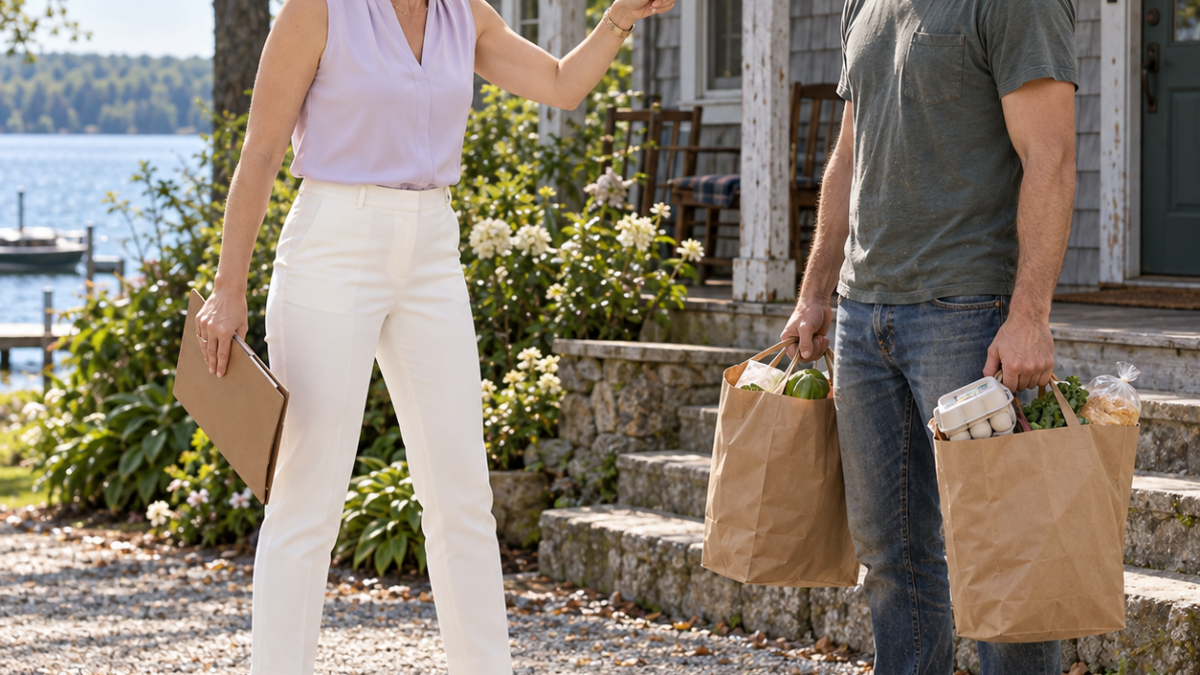
The first time Karen told me I needed to give her teenage son my house, I was carrying groceries in from the car.
That detail still bothers me.
Not because groceries matter, but because ordinary moments have a way of turning into the ones you remember forever. One second, I was trying to balance two paper bags against my hip while keeping a carton of eggs from sliding out. The next, I was standing in my driveway, staring at a woman in white linen pants and oversized sunglasses while she explained, with perfect seriousness, that my lake house belonged to her son.
The house did not look like something worth starting a war over, at least not from the road.
It was old cedar siding, weathered gray by sun and lake wind. The porch sagged a little on the left side no matter how many times I repaired it. The dock had been rebuilt twice and still creaked like it was warning everybody to step gently. The stone steps down to the water were uneven because my grandfather had set half of them himself before his knees got bad.
But to me, it was perfect.
My grandfather bought that house long before the lake became expensive. Back then, the area was quiet and a little forgotten, mostly fishermen, retirees, summer families, and people who knew how to fix their own screen doors. Then money discovered the shoreline. Old cabins got torn down. Big glass houses went up. Driveways became gated. Lawns became manicured. People started saying “lakefront portfolio” instead of “home.”
The neighborhood changed tax brackets around me.
I did not.
I inherited the house because my grandfather left it to me, and I moved in because it was the only place where I could still hear his voice clearly.
He had taught me how to skip stones there. How to bait a hook. How to sit quietly on the dock at sunrise without needing to fill the air with words. When I was a kid, he used to say the lake remembered everything. I thought he meant fish, storms, seasons.
Now I think he meant people.
The house was older than the HOA by more than twenty years. Not a technicality. Not a gray area. My grandfather owned it before the surrounding properties were folded into a private association with rules about dock colors, approved roof materials, and whether a wind chime could be considered a noise violation.
When I moved in, the HOA board invited me to join.
I declined.
Politely.
They sent another invitation.
I declined again.
Less politely.
I knew enough to understand that once I voluntarily joined, I would never get out easily. More than that, I knew I would never belong there. The people around the lake were not all terrible, but most had a kind of inherited confidence I had never learned how to fake. Their cars were cleaner than my living room. Their dogs had better grooming schedules than I did. Their children called adults by first names and discussed ski trips like everyone had a preferred mountain.
I was not poor, but I was not them.
And Karen Whitmore made sure I knew it.
She was the unofficial queen of the lake community, though officially she called herself HOA president. She was the kind of woman who could turn a welcome basket into a warning. Tall, polished, blond, always dressed like she had just stepped away from a country club luncheon to inspect someone else’s failure. Her smile never reached her eyes. Her voice had a soft, expensive edge, the kind people use when they want cruelty to sound like manners.
Karen had one son, Preston.
He was seventeen, nearly eighteen, and spoiled so badly it seemed to have hardened into personality. He drove a silver sports car too fast along the lake road, left fast-food bags in other people’s driveways, and looked at working people like they were furniture that had learned to speak.
Karen adored him.
Everyone else endured him.
I had no idea that, somewhere inside Karen’s mind, my grandfather’s lake house had become his birthday present.
Not until she stepped into my driveway, looked past me toward the porch, and said, “We need to discuss the transfer.”
part2
I shifted the grocery bags higher against my chest, certain I had misheard her.
“The what?”
“The transfer,” Karen repeated, as if the word were obvious. “Of the house.”
The carton of eggs slipped sideways. I caught it with my elbow.
“My house?”
Her mouth tightened with impatience.
“This property, yes.”
I looked behind me, half expecting someone else to be there. A camera crew, maybe. A prank. A real estate agent with a nervous apology. But it was just Karen in my driveway, standing under the clear afternoon sun as if she had every right to be there.
“I’m sorry,” I said slowly. “Why would I transfer my house?”
She sighed.
Not a confused sigh.
A disappointed one.
The kind adults use on children who forgot instructions.
“Because it was promised to Preston when he turned eighteen.”
For a few seconds, I could not make words come out.
The lake moved behind the house, soft and blue through the gap between the trees. A gull cried somewhere over the water. My car ticked as the engine cooled. Everything in the world seemed normal except for the woman in my driveway telling me I owed her son a house.
“Promised by who?” I finally asked.
Karen smiled then, but it was not pleasant.
“That is not really the point.”
“It feels like the point.”
“The community has always understood that this property would eventually be brought into alignment with the rest of the lakefront.”
“Brought into alignment.”
“Yes.”
“With your son’s name on the deed?”
Her chin lifted.
“Preston deserves a proper start. This house is ideal for him, and frankly, it makes far more sense for someone connected to the community to own it.”
I laughed once. I did not mean to. It just came out, short and stunned.
Karen’s eyes narrowed behind her sunglasses.
“This is not funny.”
“No,” I said. “It’s insane.”
Her posture changed.
Only slightly.
But I saw it.
Karen Whitmore was not a woman used to being called insane in her own kingdom.
“You should be careful how you speak to me,” she said.
“I am being careful. If I wasn’t, you would already be leaving.”
She drew herself up, white blouse bright against the dark green of the pines.
“This property exists within the visual boundary of our community. The HOA has standards, interests, and long-term planning authority.”
“This house is private property. My grandfather bought it before your HOA existed.”
“Your grandfather was difficult.”
“My grandfather was smart.”
Her jaw tightened.
“Do not mistake sentiment for legal protection.”
“Do not mistake your imagination for law.”
That was the first time I saw the real Karen underneath the polished surface.
It came and went fast, like something ugly passing behind a curtain. Her mouth flattened. Her nostrils flared. Her fingers tightened around the strap of her purse.
Then the smile returned.
“You are emotional,” she said. “I understand. Inheritance can make people feel attached to things they are not equipped to manage.”
“I’m equipped enough to know I’m not giving my house to your son.”
“He has been told this property would be his.”
“Then whoever told him that lied.”
Her face went cold.
I knew, in that instant, that the person who had lied was her.
Karen looked at the house again, but this time there was no neighborly pretense in it. She examined the porch, the windows, the roofline, the view beyond the trees. She looked at my grandfather’s house the way people look at something in a store window before deciding how badly they want it.
“You will regret being unreasonable,” she said.
I adjusted the grocery bags again.
“Are we done?”
“For now.”
She turned and walked back to a pearl-white SUV parked halfway in the road, because apparently even her car thought the world should make room.
I stood there until she drove away.
Then I went inside, set the groceries on the counter, and realized the eggs had cracked anyway.
That night, I sat on the back porch and called my older sister, Megan.
She lived three states away and had always thought moving into the lake house was a terrible idea.
“Karen did what?” she asked.
I told her again.
There was a pause.
Then Megan said, “That is either the funniest thing I’ve heard all year or the beginning of a documentary where everyone interviewed says, ‘We never thought it would go that far.’”
“I’m leaning toward the second.”
“You need a lawyer.”
“I know.”
“And cameras.”
“I know.”
“And stop being polite to rich lunatics.”
“I was not that polite.”
“Were there groceries in your arms?”
“Yes.”
“Then you were vulnerable.”
I almost smiled.
Almost.
But after we hung up, the house felt different.
Not unsafe, exactly.
Violated.
Karen had stood in my driveway and spoken about my grandfather’s house as if I were just a temporary inconvenience between her and what she wanted. I kept replaying the conversation, searching for any hint that she had been bluffing, confused, drunk on her own authority.
But no.
Karen believed the world could be rearranged by force of entitlement.
I called a lawyer the next morning.
His name was David Fletcher, a property attorney recommended by a coworker. He had a calm voice, a dry sense of humor, and the tired patience of a man who had spent twenty years explaining to people that wanting something badly did not create ownership rights.
I brought him the deed, tax records, old purchase documents, the HOA invitation letters, and every scrap of paper I had involving the property.
David reviewed everything and confirmed what I already knew.
The house was mine.
The HOA had no authority over it.
The property predated the association by more than twenty years and had never been annexed, pledged, restricted, or voluntarily enrolled.
“You are not subject to their covenants,” David said, tapping the folder. “They can invite you. They can glare at you. They can complain at cocktail parties. They cannot govern you.”
“What about this idea that it was promised to her son?”
David looked at me over his glasses.
“Did you promise it?”
“No.”
“Did your grandfather promise it in a written, enforceable agreement?”
“Absolutely not.”
“Then her son can start his adult life with disappointment. It builds character.”
For the first time since Karen had appeared in my driveway, I laughed properly.
David advised me to document everything.
“If she comes back, write down the date, time, and what was said. If she sends letters, save them. If anyone trespasses, call the police. People like this rely on the target wanting things to stay quiet. Do not keep it quiet.”
That turned out to be the most useful advice anyone could have given me.
The first fine arrived three days later.
It came in an official-looking envelope with the Briar Shore Estates Homeowners Association logo at the top. The paper was thick. The wording was formal. The amount was ridiculous.
$150 for an unapproved exterior fixture.
According to the notice, my front door knocker was not an approved finish under HOA architectural guidelines.
I read the letter twice.
Then I walked to the front door and stared at it.
I did not have a door knocker.
I had a plain black handle, a deadbolt, and a small brass peephole my grandfather had installed after someone stole fishing rods from a neighbor’s garage in 1998.
No knocker.
I took a photo of the door, saved the letter, and emailed both to David.
His reply came ten minutes later.
Do not respond yet. Keep everything.
The next fine arrived the following week.
$200 for excessive moisture in rear lawn area.
I stood in the backyard with the letter in one hand, looking at the grass sloping down toward the lake.
The lake.
The enormous body of water five yards away from the wet grass.
Karen was fining me because the ground beside a lake was damp.
After that, the fines came faster.
Improper mailbox appearance.
Unapproved porch furniture.
Nonconforming dock tone.
Failure to maintain approved lakefront visual harmony.
Unauthorized native plant growth.
I had to admit, that last one almost impressed me. Karen had found a way to fine weeds for not being imported.
Every notice was fake, but each one carried the same threat. Continued noncompliance could result in additional penalties, legal collection efforts, and enforcement action.
At first, I tried to treat the whole thing like paperwork theater.
I made a folder.
Then I made a second folder when the first one got too full.
I photographed everything she mentioned. I saved envelopes. I noted postmarks. I made a spreadsheet because if Karen wanted to wage war through office supplies, I could meet her on that battlefield.
But the anger built anyway.
It built when I came home from work and found another envelope waiting.
It built when I saw Karen watching from her car as I checked my mail.
It built when Preston drove past my house too slowly, music thumping, one hand dangling out the window like he already owned the road.
Then Karen began showing up in person.
Sometimes she stood by the mailbox.
Sometimes at the edge of the driveway.
Once, I found her at the base of my front steps, holding a clipboard, examining my porch as if she were conducting an inspection.
I had been coming back from a run, sweat cooling under my shirt, lungs still working hard.
“What are you doing?” I asked.
She turned with a smile.
“Documenting violations.”
“You’re trespassing.”
“I am on an approach area visible from the road.”
“You are on my property.”
“Visibility creates community impact.”
“Karen, get off my property.”
She clicked her pen.
“You know, this could all become much easier.”
“There is no version of this where I give Preston my house.”
“You keep saying that as if the matter is entirely yours to decide.”
“It is.”
Her eyes moved across my face, cold and measuring.
“You are very proud for someone who inherited what he has.”
The words hit harder than I expected.
Because that was the thing people like Karen always tried to do. If they could not take what you had, they tried to make you feel unworthy of having it.
I stepped closer.
“My grandfather worked for this house. He paid for it. He cared for it. He chose who he wanted to leave it to. That was me. Not you. Not your son. Me.”
For once, Karen did not answer immediately.
Then she smiled.
“People can be pressured into making better choices.”
I felt the back of my neck go cold.
“Was that a threat?”
“It was advice.”
“No,” I said. “It was recorded.”
Her eyes flicked to my phone in my hand.
I had not actually been recording before that moment, but she did not know that.
Karen’s smile disappeared.
She left without another word.
The cease-and-desist letter went out the next morning.
David sent it by certified mail to Karen, the HOA board, and the management company. It stated plainly that my property was not under HOA jurisdiction, that the fines were invalid, that continued contact or false enforcement attempts would be treated as harassment, and that any further trespass would be reported.
I also filed a police report.
The officer at the desk was polite but not surprised. Apparently, Karen’s name was not new to the department.
“She ever threaten you directly?” he asked.
“Not in a way she’d admit.”
He nodded like he understood exactly what I meant.
“We’ll document it. If she comes onto the property again, call us.”
For about two weeks, the official-looking HOA notices stopped.
I thought maybe David’s letter had scared her.
Then the personal letters began.
No HOA logo this time.
No legal phrasing.
Just Karen’s name and her demands.
The first one said I had caused unnecessary distress to her family by refusing to honor a community understanding.
The second said Preston had been emotionally devastated by my selfishness.
The third offered me a choice.
Transfer ownership of the property to Preston before his eighteenth birthday, or provide Karen with enough money to purchase him an equivalent lakefront home.
I read that sentence so many times it stopped looking like English.
Enough money to buy him another lakefront home.
As if I had ruined his birthday by not handing over mine.
I called Megan again.
She did not laugh this time.
“This is getting dangerous.”
“I know.”
“No, I mean actually dangerous. People who write things like that are not just annoying.”
“I filed a police report.”
“File another.”
“I sent everything to David.”
“Good. Send copies somewhere else too. Cloud storage. Email. Me. Someone.”
So I did.
Every letter got scanned. Every envelope photographed. Every interaction documented. I bought security cameras and installed them around the front door, driveway, dock, garage, and the side yard facing the road. I put up no-trespassing signs.
For a while, Karen went quiet.
Then my yard got destroyed.
I had been at work late and came home in the dark, tired enough that I almost missed the first sign. The mailbox leaned at a strange angle, its post cracked near the base. When my headlights swept across the driveway, I saw trash scattered over the lawn.
Not a little trash.
Bags of it.
Fast-food wrappers. Empty cans. rotten food. Paper plates. Plastic bags caught in the shrubs and fluttering against the porch rail. Across the sidewalk, someone had spray-painted a sloppy message in red.
MOVE OUT.
For a second, I sat in the car with both hands on the wheel.
The engine idled. The headlights lit the damage. The lake beyond the house was black and still.
Then something in me went very calm.
That scared me more than anger would have.
I took photos before touching anything. Wide shots. Close-ups. Mailbox. Spray paint. Trash. Tire tracks at the edge of the lawn. Footprints in a muddy patch near the side yard. I called the police, made another report, and sent everything to David.
The officer who came out shined a flashlight across the yard and sighed.
“You know who did it?”
“I know who wanted it done.”
“That’s not the same thing.”
“I know.”
He looked at the spray paint.
“Cameras catch anything?”
“Not their faces. They stayed low and came from the road side. Hoodies. Two or three of them. Looks young.”
He nodded slowly.
“Teenagers?”
“That would be my guess.”
Preston’s friends, maybe. Preston himself, maybe. Boys who thought vandalism was funny because someone else’s mother told them it was justice.
The insurance claim barely helped. My deductible took care of most of the pain itself. I replaced the mailbox. I scrubbed the sidewalk until my shoulders ached. Some of the paint came up quickly. Some of it clung in the pores of the concrete like a stain that wanted to be remembered.
The trash was worse than it should have been.
Wind carried pieces everywhere. Into the hedges, down the slope, against the dock steps, under the porch. I spent an entire Saturday picking it up bit by bit, angrier with every bottle cap and greasy wrapper.
By evening, my back hurt and my hands smelled like old beer.
I sat on the dock as the sun went down, looking at the house reflected in the water.
For the first time, I wondered if Karen might win simply by exhausting me.
Not legally.
Not morally.
But practically.
That is the part people do not understand about harassment. It does not need to defeat you in one dramatic blow. It can wear you down through repetition. One letter. One fine. One threat. One mess. One repair bill. One night of bad sleep. One more reason to dread your own mailbox.
Karen knew that.
She was counting on it.
The next morning, I bought better cameras.
I put one high under the eaves, hidden in the trim. One inside the front window facing the yard. One aimed toward the mailbox. One by the side gate. Motion lights went up too. Bright ones.
Then I cleaned my shotgun.
I need to be clear about this, because people hear the word shotgun and start writing a different story in their heads.
I did not want to hurt anyone.
I have never wanted to hurt anyone.
The shotgun was registered, legal, and usually stayed locked away. My grandfather had owned it before me, and he had drilled safety into me with the seriousness other men reserve for religion. You do not point a gun at anything you do not intend to destroy. You do not use a gun to win an argument. You do not let fear make decisions your conscience has to live with.
But I was alone in a house Karen wanted.
Teenage boys had already come onto my property once.
One had smashed my mailbox with what was probably a bat.
And I would not pretend there was no possibility they might come back.
Two nights later, they did.
It was after midnight when the motion light snapped on.
I woke instantly.
Maybe I had not really been sleeping. Not deeply. Not since the vandalism.
I lay still for one second, listening.
Then I heard it.
A metallic clank outside.
A laugh.
A low male voice.
My bedroom faced the front yard. I moved to the window and looked down through the blinds.
Three figures stood near the mailbox.
Hoodies. Broad shoulders. Young bodies trying to move quietly and failing. One of them held something long in his right hand. In the hard white glare of the motion light, I could not tell if it was a bat, a pipe, or something else.
My mouth went dry.
One kicked at the new mailbox post.
Another pointed toward the house.
I grabbed my phone first and hit record.
Then I called 911 and whispered the address.
“There are people on my property,” I told the dispatcher. “They vandalized it before. One may be holding a weapon. I am inside the house.”
She told me officers were being sent.
Then she asked if I was armed.
I hesitated.
“Yes.”
“Do not go outside if you can avoid it.”
That was good advice.
It was also difficult advice when one of them started walking toward the porch.
The old porch boards creaked under his weight.
I do not know what he planned to do. Maybe bang on the door. Maybe spray paint it. Maybe break a window. Maybe nothing. Fear makes every possibility stand up at once.
I left the line open with the dispatcher, set the phone on the dresser, and took the shotgun from the locked cabinet.
My hands were steady.
That surprised me.
I went to the front door but did not open it.
Instead, I turned on the porch light and shouted through the door.
“This is private property. Police are on the way. Leave now.”
The porch went silent.
Then someone outside laughed.
A voice called, “Go back inside, loser.”
Another said, “You don’t want to come out here.”
I heard the long object strike the porch rail.
Wood cracked.
Heat went through me.
Not anger now.
Protectiveness.
I thought of my grandfather’s hand on that same railing. I thought of him leaning there with coffee, watching storms cross the lake. I thought of Karen telling her son this place belonged to him. I thought of red spray paint on the sidewalk.
I opened the door.
Only halfway.
The storm door stayed between us.
The shotgun was in my hands, pointed down at the floor, safety on, my finger nowhere near the trigger.
But they could see it.
All three froze.
The boy on the porch was close enough now that I could see his face. He was young. Seventeen or eighteen. Maybe nineteen. Athletic build, angry eyes, but beneath that, fear arrived fast.
The one by the mailbox whispered something I could not hear.
I spoke slowly.
“This is private property. You have been warned. Leave immediately.”
The boy on the porch stared at the shotgun.
A minute earlier, they had been laughing.
Now no one made a sound.
“I’m not pointing this at you,” I said. “I don’t want to. I don’t want you hurt. But I am not helpless, and the police are coming.”
That broke them.
The boy on the porch stumbled backward so fast he almost fell down the steps. The one holding the bat or pipe dropped it, then grabbed it again, apparently realizing leaving evidence was a bad idea. They ran toward a dark sedan parked down the road with its lights off.
By the time patrol lights flashed at the far curve, the car was gone.
But my cameras had caught more this time.
Not perfect faces, but the car. The shape. The partial plate. Clothing. The object in one boy’s hand. Audio of the threats. Video of them running.
The officer who arrived first watched the footage in my living room while I sat at the table, the shotgun unloaded and locked away again.
“You handled that more calmly than most people would,” he said.
“I didn’t feel calm.”
“You didn’t do anything stupid. That matters.”
A second officer took photos of the porch rail and the mailbox area. They found a muddy footprint near the steps and took pictures of that too.
I asked if they thought it would be enough.
The first officer looked at me.
“It may be enough to scare them from coming back.”
He was right.
At least about that.
The vandalism stopped.
The letters slowed.
Then stopped too.
For nearly two weeks, nothing happened.
No fake fines. No personal demands. No cars idling too long near the driveway. Preston did not speed past the house. Karen did not appear by the mailbox with sunglasses and a manufactured smile.
The silence felt good.
Then rumors started.
I heard the first one from a neighbor named Mr. Alvarez, who lived two houses down but outside the HOA like me. He stopped by while I was repainting the porch rail where it had cracked.
“You know they’re saying you pulled a gun on kids for walking past?”
I set the brush down.
“They were on my porch after midnight with a weapon.”
“I figured it was something like that.”
“Who’s saying it?”
He tilted his head toward the HOA side of the road.
“Who do you think?”
Of course.
Karen had lost the ability to frighten me directly, so she had moved to reputation. She told people I was unstable. That I had threatened neighborhood boys. That I was paranoid, aggressive, dangerous. One version had me pointing a gun at Karen herself in broad daylight. Another had me and Karen in some kind of standoff like a bad Western movie.
It would have been funny if it had not been so calculated.
She knew exactly what she was doing.
If she could make me seem dangerous, then every boundary I defended became suspicious. Every no-trespassing sign became hostility. Every refusal to sell became evidence that I was unstable.
David told me not to respond publicly.
“Document the rumors if they lead to specific consequences,” he said. “But do not get into a neighborhood shouting match. She wants emotion. Stay boring.”
Stay boring.
That became my strategy.
When people stared, I waved.
When someone asked what happened, I said, “There was trespassing. Police reports were filed. Cameras captured it.”
No drama.
No shouting.
No long defense.
The truth, repeated calmly, has a way of outlasting lies that need constant decoration.
And Karen’s lies needed a lot of decoration.
The problem with living in a wealthy lake community is that everyone talks, but not everyone is loyal. A few people who disliked Karen began telling me what she was saying. Others sent me screenshots from group chats. One neighbor, clearly tired of her, forwarded a message where Karen wrote that I had “weaponized an inherited property against the community.”
Weaponized.
My grandfather’s porch was now a weapon because I refused to give it away.
Meanwhile, Preston’s eighteenth birthday came and went.
He did not get my house.
From what I heard, he got a new car.
A better one.
A ridiculous black convertible that he drove along the lake road for three days before scratching the passenger side on a stone mailbox post. I did not laugh when I heard that.
Not where anyone could see.
Karen’s harassment changed after that.
It no longer came in constant waves. Instead, it became cold and distant. Dirty looks at the grocery store. Stiff silence when our cars passed. Preston staring at my house whenever he drove by, though now he did it slower, as if even he understood that the game had become real.
I kept the cameras running.
I kept the folders.
I kept the police reports and David’s letters.
And slowly, my life became my life again.
That was the part I had missed most.
Not peace as an abstract idea, but ordinary peace.
Morning coffee on the dock without checking the driveway every two minutes.
Mowing the grass because it needed mowing, not because someone might invent a fine.
Sitting by the water after work and listening to boats move across the lake.
Repairing the porch rail properly instead of just patching Karen’s damage.
The house began to feel like home again.
One Saturday in early fall, Megan visited.
She had not seen the place since the worst of it, though she knew every detail because I had sent her every letter, photo, and police report. She arrived with two bottles of wine, three grocery bags, and the expression of an older sister prepared to judge everyone involved.
She walked the property with me.
I showed her the new cameras, the replaced mailbox, the faint red shadow still visible in one crack of the sidewalk if the light hit it right.
She stood there, hands on her hips.
“I hate her.”
“You’ve never met her.”
“I’ve met her species.”
We sat on the dock that evening with our feet over the water.
The lake was calm, turning copper under the sunset.
Megan looked back at the house.
“I understand now,” she said.
“What?”
“Why Grandpa left it to you.”
I did not answer right away.
She nudged my shoulder.
“I’m serious. The rest of us would have sold it the second things got ugly.”
“I thought about it.”
“I know. But you didn’t.”
The water lapped softly against the dock posts.
“I almost hated him for leaving it to me,” I admitted.
Megan looked at me sharply.
“Really?”
“Not hated. That’s too strong. But there were moments when it felt like he gave me a fight instead of a gift.”
She took that in.
Then she said, “Maybe he gave you both.”
I looked back at the house.
Maybe she was right.
Inheritance is not only receiving something. Sometimes it is discovering whether you are willing to become the person needed to keep it.
Karen had forced that question on me before I was ready.
But she had not answered it for me.
I did.
A few weeks later, I ran into Karen at the post office.
Of all places.
I was mailing a package to Megan. Karen was standing at the counter, arguing with the clerk about certified mail pricing as if the postal service were a personal insult. She wore a camel coat, leather gloves, and a silk scarf. Preston stood beside her, bored and irritated, scrolling on his phone.
I considered leaving.
Then I decided I was tired of rearranging my life around Karen’s presence.
So I got in line.
She noticed me in the reflection of the glass door.
Her shoulders stiffened.
Preston looked up, saw me, and looked away quickly.
The clerk handed Karen her receipt.
She turned, and for a moment we stood face-to-face under the fluorescent lights.
Neither of us spoke.
Then Karen smiled.
Not the old smile.
This one had strain in it.
“I hope you are enjoying your little victory,” she said.
The line behind me went quiet.
I shifted the package under my arm.
“I’m enjoying my house.”
Her eyes flashed.
“You know, people have long memories in this community.”
“So do cameras.”
Preston’s head snapped up.
Karen’s lips parted, then closed.
I stepped forward to the counter.
She left without another word.
That was the closest thing we ever had to a final confrontation.
No courtroom.
No dramatic confession.
No public apology.
No moment where Karen broke down and admitted she had tried to bully me out of a house because she had promised her spoiled son something she did not own.
Real life often denies you the clean scene you think you deserve.
But it gives you quieter endings.
A mailbox that stays standing.
A porch that no one trespasses on.
A lake morning without dread.
A woman who used to threaten you now choosing silence because she knows the record is not on her side.
By winter, Karen’s influence had faded.
Not completely. People like her rarely lose all power unless a bigger scandal knocks them flat. But she lost the illusion that everyone feared her. A few neighbors challenged fines. Someone demanded proper board votes before enforcement letters went out. Another resident questioned whether Karen had been using HOA resources for personal vendettas.
I heard about it secondhand.
I stayed out of it.
That was their mess to clean up.
But I did take quiet satisfaction in knowing that the woman who had once acted like queen of the lake now had to watch her subjects read the bylaws.
Preston eventually went away to college.
I saw the black convertible leave packed with boxes, Karen fussing at him in the driveway while he ignored her. He did not look toward my house when he passed.
I wondered if he ever understood how close his mother had come to turning him into something worse than spoiled.
Maybe he did.
Maybe not.
It was not my job to save him from her.
My job was to protect what was mine.
The following spring, I planted a row of hydrangeas along the side yard.
That sounds small, but to me it mattered.
For more than a year, every change I made to the property had been defensive. Cameras. lights. signs. locks. repairs after damage. Documentation.
The hydrangeas were different.
They were not a response to Karen.
They were for me.
My grandfather’s wife, my grandmother, had planted blue hydrangeas by the porch when my mother was a little girl. They had died long before I inherited the place, but in old photos, the bushes were enormous, blooming like pieces of summer sky against the cedar siding.
I spent a whole Saturday digging holes, mixing compost, setting the plants, watering them in.
Mr. Alvarez came by while I was finishing.
“Looks good,” he said.
“Hope they take.”
“They will.”
He glanced toward the road.
“No HOA approval?”
I grinned.
“Tragic, isn’t it?”
He laughed hard enough to cough.
By June, the bushes had begun to bloom.
Soft blue at first, then deeper.
I took a picture and sent it to Megan.
She replied: Grandpa would love that.
I think he would have.
I think he would have loved that the house survived Karen, but more than that, I think he would have loved that I had stopped living like a man under siege.
Because survival is not the same as living.
For months, Karen had narrowed my world down to threats, letters, locks, and worst-case scenarios. She made me think about ownership constantly, but not in the way love thinks about ownership. Not stewardship. Not gratitude. Not care.
Just defense.
The hydrangeas reminded me that keeping a place also means allowing beauty back into it.
That summer, the lake was busier than usual. Boats cut white lines across the water. Kids shouted from docks. Grills smoked on weekends. Music drifted from porches in the evenings, mostly at reasonable volume, though one neighbor had a terrible fondness for yacht rock.
I sat on my dock often.
Sometimes with coffee.
Sometimes with beer.
Sometimes with nothing but the sound of water touching wood.
I kept expecting Karen to make another move.
For a long time, my body still reacted to every strange car slowing near the driveway. Every envelope from an unfamiliar sender tightened my stomach. Every motion alert on my phone pulled me back into that night at the window.
That is another thing people do not understand.
Even when harassment stops, your nervous system does not get the memo immediately.
It takes time to believe quiet is real.
But slowly, I did.
The folder of letters moved from my desk to a cabinet.
Then from the cabinet to a storage box.
The shotgun stayed locked away.
The cameras stayed on, but I stopped checking them unless something actually happened.
And nothing did.
One afternoon, nearly a year after Karen first stood in my driveway with her insane demand, David called me.
“I just wanted to check in,” he said. “Any new contact?”
“No.”
“No letters?”
“No.”
“No trespass?”
“No.”
“No mysterious claims that you owe someone’s child a lake house?”
“Not this week.”
He chuckled.
“Good. Keep the records, but I think she got the message.”
“Which part? The legal letter, the police reports, or the shotgun?”
“Probably the combination.”
I sat at the kitchen table, looking through the screen door toward the lake.
“Part of me wishes I had sued her.”
“That part of you is human.”
“Would I have won?”
“On some claims, maybe. Harassment, trespass if we could tie it together, possibly civil damages for the vandalism if the kids talked. But it would have been expensive, slow, ugly, and uncertain.”
“So walking away was smart?”
“You did not walk away,” David said. “You stood your ground without letting her drag you into a war that consumed your life. There is a difference.”
After we hung up, I thought about that for a long time.
Standing your ground does not always look like a movie scene.
Sometimes it looks like making copies.
Calling a lawyer.
Filing a report.
Refusing to respond to bait.
Replacing a mailbox.
Installing cameras.
Keeping your voice steady when someone wants you reckless.
Karen wanted me to either surrender or explode.
I did neither.
That may be the thing I am proudest of.
Late that fall, I hosted Thanksgiving at the lake house.
It was the first family holiday there since my grandfather died. Megan came with her husband and their kids. My mother came, though she spent most of the day quietly touching things as if the house itself were a person she had missed. A few cousins came too, including one who had once hinted that selling would be more practical.
Nobody said that now.
The house was loud in a way it had not been in years.
Kids ran across the porch. Someone burned the rolls. Megan argued with our cousin about football. My mother cried once in the hallway where she thought no one could see, then wiped her face and came back smiling.
After dinner, we walked down to the dock.
The air was cold enough that our breath showed. The lake lay dark and wide under a pale moon.
My nephew, who was eight, asked, “Is this house going to be ours forever?”
Everyone got quiet.
I crouched beside him.
“I don’t know about forever,” I said. “Forever is a long time. But it belongs to our family now, and we take care of what belongs to us.”
He nodded seriously, as if I had given him a job.
Maybe I had.
That night, after everyone went to bed, I found myself standing alone in the kitchen.
The old floorboards creaked beneath my feet. The refrigerator hummed. Moonlight silvered the counters. For a second, I could almost see my grandfather sitting at the table, one hand around a coffee mug, smiling like he had known all along I would figure it out.
I wished I could tell him everything.
About Karen.
About the fake fines.
About Preston.
About the vandalism.
About the night those boys froze on the porch because they finally understood I was not just some harmless obstacle between them and what they wanted.
But then I realized he probably did not need the details.
He would care about the ending.
The house was still here.
I was still here.
That was enough.
I still see Karen sometimes.
Not often. She still lives in the community, though she spends less time parading around like royalty now. When we pass each other at the grocery store or the post office, she looks through me with the stiff dignity of a person who has decided defeat does not count if she refuses to acknowledge the game.
I let her.
There is no satisfaction in arguing with someone who has already lost the only argument that mattered.
Her son never got my house.
She never got money from me.
The HOA never gained authority over my property.
The fake fines sit in a folder where they belong, useful only if Karen ever forgets herself again.
And me?
I get mornings on the dock.
I get storms rolling over the lake while rain drums on the old roof.
I get hydrangeas blooming by the porch.
I get to repaint the shutters whatever color I want without asking a committee of bored rich people whether blue violates visual harmony.
I get to live in the house my grandfather chose for me.
That may not sound dramatic to someone who has never had a person try to bully them out of their own life. But peace, after months of harassment, feels like victory every single day.
I have learned a few things from all this.
I learned that entitlement does not always shout. Sometimes it arrives dressed beautifully, smiling politely, using words like community and fairness while reaching for your keys.
I learned that people who cannot control you will often try to make you look unstable for resisting.
I learned that paperwork matters. So do cameras. So do certified letters. So do police reports filed before things get worse.
I learned that a person can be ridiculous and dangerous at the same time.
Most of all, I learned that inherited things are not free.
Not really.
Someone paid for them before you.
With money. Work. Time. Refusal. Sacrifice. Stubbornness.
My grandfather paid for this house long before Karen knew it existed. He protected it by never joining the HOA. He protected it by keeping records, paying taxes, fixing what broke, and teaching me that a home is not valuable because other people want it.
It is valuable because of what it holds.
And this house holds him.
It holds summer mornings from my childhood. It holds my grandmother’s dead hydrangeas and the new ones I planted in their place. It holds Megan laughing on the dock. It holds my mother’s quiet tears in the hallway. It holds the sound of rain, the smell of old cedar, the scrape of chairs on the kitchen floor, the weight of every ordinary day Karen thought she could purchase, pressure, or steal.
Sometimes, when the lake is very still, I think about the first thing Karen said.
We need to discuss the transfer.
She believed ownership was a conversation she could start without me.
She believed my “no” was just the opening position in a negotiation.
She believed a spoiled boy’s expectation mattered more than a deed, a will, a history, and a life.
She was wrong.
The transfer never happened.
The house did not move from my name to Preston’s.
But something did transfer that year.
My grandfather’s stubbornness finally became mine.
And I will carry it as long as this house stands.