FULL ENDING Karen Pointed at My Backyard Pool Like It Was Hers Until the Truth Walked Into the Room
𝗙𝗨𝗟𝗟 𝗦𝗧𝗢𝗥𝗬
Karen leaned slightly closer to the fence. Her perfume drifted over the gate, sweet and heavy.
“Do you have documentation proving that?”
“Yes.”
“Then you should submit it to the board.”
“No.”
Her eyebrows lifted.
“No?”
“No. I don’t report to your board.”
For the first time, the smile fell completely.
Karen was still beautiful without it, maybe even more striking, but the softness vanished. What remained was pure entitlement dressed in expensive fabric.
“We’ll see about that,” she said.
Then she turned and marched away, clipboard pressed to her chest like a shield.
I watched her go, shook my head, and went back to skimming the pool.
I honestly thought that would be the end of it.
I should have known better.
A week later, the first envelope arrived.
It was printed on HOA letterhead, even though the HOA had no authority over me. Inside was a notice of violation citing improper pool fencing, failure to submit exterior improvement plans, and unauthorized recreational structure maintenance. It claimed I had seven days to bring my property into compliance or daily fines would begin accruing.
I read it twice at the kitchen counter while my coffee went cold.
Then I laughed.
My wife looked up from packing lunch for the kids.
“What?”
I handed her the letter.
She read it, sighed, and said, “Is this the clipboard woman?”
“That obvious?”
“She has clipboard energy.”
I tossed the notice onto the counter. “They can’t fine us.”
“I know.”
“They can’t put a lien on the house.”
“I know.”
“They can’t regulate a property that isn’t in the HOA.”
“I know,” she repeated, then looked at me carefully. “But does she know?”
That was the problem.
Karen did not know, and worse, Karen did not care.
Over the next two weeks, the notices kept coming.
Daily fines.
Escalated enforcement.
Final warning.
Intent to pursue lien.
Each letter was more dramatic than the last, full of bold fonts, underlined phrases, and language that sounded like someone had swallowed a legal dictionary without understanding digestion.
I stacked them neatly on the kitchen counter.
My wife called it the Karen pile.
Then Karen went public.
One evening, my neighbor Doug texted me a screenshot from the neighborhood Facebook group. I was not a member, obviously, because I had no desire to read forty-seven comments about mailbox numbers or dog poop, but Doug believed in forwarding drama as a public service.
Karen had posted:
DANGEROUS POOL FENCE — CHILDREN AT RISK — HOA ACTION REQUIRED.
Below that was a long rant about how a “noncompliant homeowner” was refusing to follow safety standards and placing neighborhood children in danger. She claimed my pool fence was unsafe, my maintenance schedule was unknown, and my backyard pool created a liability risk for the entire community.
She did not name me directly.
She did not have to.
Everyone knew which pool she meant.
The comments were exactly what you would expect.
Is this the big blue pool near the old house?
I always wondered how that was allowed.
Karen is right. Rules exist for a reason.
What if a child gets hurt?
A few reasonable people pushed back.
Isn’t that property not part of the HOA?
I thought their lot was excluded.
Maybe we should check before assuming.
Karen replied to one of them with a heart emoji and the sentence: Safety is not optional.
I stared at my phone in disbelief.
My wife read over my shoulder.
“She’s making it sound like our pool is some abandoned pit full of snakes.”
“Snakes might make the HOA back off.”
“Don’t tempt me.”
The next day, someone slowed their car in front of our house and took a picture.
Two days later, a woman walking a dog stopped across the street and stared at the fence until I stepped onto the porch. Then she hurried away.
By Friday, my kids heard about it.
My son came home from school quiet, dropped his backpack by the door, and asked, “Dad, is our pool dangerous?”
That was when it stopped being funny.
I knelt in front of him.
“No. Our pool is safe.”
“Caleb said his mom said we’re breaking rules.”
“Caleb’s mom is listening to someone who doesn’t know what she’s talking about.”
“Are they going to take it away?”
I felt anger move through me, slow and hot.
“No,” I said. “Nobody is taking our pool.”
That night, I pulled out the documents.
The old property records. The survey from 1978. The plat map from when the subdivision was created. The HOA incorporation documents. The county boundary records. Everything my grandfather had carefully kept in a metal filing cabinet and everything I had digitized after inheriting the house.
The truth was not hidden.
It was boring, official, stamped, recorded truth.
My lot sat outside the HOA.
The development curved around us like water around stone.
Karen could scream all she wanted. Paper did not care.
But Karen was not finished.
Three days later, Doug sent me another screenshot.
EMERGENCY HOA BOARD MEETING.
Topic: Rogue Pool Situation and Immediate Community Safety Action.
Rogue pool.
I read that phrase out loud three times because it sounded like something from a low-budget shark movie.
My wife pinched the bridge of her nose.
“She’s insane.”
“She’s committed.”
“Those are not mutually exclusive.”
The flyer Karen posted had bold red lettering, exclamation points, and a clip-art caution sign. It invited residents to attend a special meeting at the community center to discuss “ongoing noncompliance, safety risks, and jurisdictional enforcement concerns.”
Jurisdictional enforcement concerns.
Karen had turned my backyard into a constitutional crisis.
I could have responded online.
I could have posted the records.
I could have written a long explanation and spent the next six hours arguing with people who had already decided feelings were evidence.
Instead, I took a personal day from work and went to the county recorder’s office.
If Karen wanted a performance, I would bring props.
The clerk at the recorder’s office was a patient woman named Ms. Ramirez, who listened while I explained the situation and then gave the kind of sigh government employees give when private citizens weaponize ignorance.
“HOA dispute?” she asked.
“How did you know?”
She smiled. “They all have the same smell.”
She helped me obtain certified copies of everything: the original property survey, the subdivision plat map, the HOA boundary declaration, and the incorporation documents. Each copy carried official stamps, raised seals, recording numbers, dates, and signatures.
Beautiful, boring, undeniable paperwork.
I bought a new binder.
Then I made copies.
Then I waited.
Karen kept posting.
She kept collecting sympathy.
She kept feeding outrage to people who wanted to believe their HOA president was protecting them from the dangerous backyard pool menace.
I let her.
That might sound passive, but it was not.
There is a point in every conflict when your opponent is no longer fighting you. They are fighting reality. And if you are patient, reality usually hits harder than you ever could.
The night of the emergency meeting, the community center parking lot was almost full.
I arrived ten minutes early with my binder under one arm. Through the windows, I could see people gathering in rows of folding chairs. Some were whispering. Some were smiling like they had come to watch theater. Doug waved me over as soon as I stepped inside.
“This is ridiculous,” he said under his breath.
“I know.”
“No, I mean she has a PowerPoint.”
I looked toward the front.
He was right.
Karen stood near a projector screen, wearing a fitted red dress, nude heels, and a blazer draped over her shoulders like she was about to announce a hostile takeover. Her hair fell in glossy waves. Her lips were painted perfectly. A sleek laptop sat on the table in front of her, beside a stack of folders and a stainless steel water bottle.
She looked confident.
More than confident.
Radiant.
This was her stage.
When she saw me, her eyes flashed with satisfaction.
I sat near the middle, not too close, not hiding in the back.
The room filled until people stood along the walls. At least forty residents had come. Maybe more. A few board members sat at the front table, including Mr. Patterson, a retired attorney who had always seemed too reasonable to belong on an HOA board.
Karen tapped her microphone.
It squealed.
She smiled tightly, adjusted it, and began.
“Thank you all for coming on such short notice. I know this is unusual, but as your HOA president, I take safety, property values, and community standards very seriously.”
She clicked to the first slide.
COMMUNITY RESPONSIBILITY AND SHARED SAFETY.
There was a stock photo of smiling children running through sprinklers.
Karen spoke for ten minutes about standards. Then five minutes about liability. Then another five about property values. Her voice was smooth, dramatic, almost seductive in its certainty. She knew how to make nonsense sound civic-minded.
Then she clicked to a slide showing a photo of my pool.
My pool.
My backyard.
Taken from outside my fence.
My hands tightened around the binder.
“This,” Karen announced, pointing at the screen, “is the issue before us.”
The room shifted.
Some people glanced at me.
Karen continued.
“This pool structure and surrounding fence do not meet current HOA standards. The owner has repeatedly refused to comply with notices, has failed to submit maintenance documentation, and has rejected board authority despite multiple warnings.”
I raised my hand.
Karen ignored me.
“In addition, there is concern that the pool functions as a community-adjacent amenity and therefore creates shared neighborhood liability.”
I raised my hand higher.
Mr. Patterson noticed.
“Karen,” he said, “perhaps we should let him respond.”
Karen’s smile froze.
“Of course.”
She turned toward me.
“Please. Explain why you believe safety rules do not apply to you.”
I stood slowly.
“They do apply to me. County safety rules apply to me. Building codes apply to me. Health regulations apply to me. Your HOA rules do not.”
Murmurs moved through the room.
Karen folded her arms.
“That is your opinion.”
“No,” I said. “It’s the county’s record.”
Her eyes narrowed.
I walked to the front and placed my binder on the table.
“Can I ask you a simple question first?”
Karen lifted her chin. “Go ahead.”
“Do you have any document showing that my property is part of this HOA?”
She gave a dismissive laugh.
“Everyone in this subdivision is part of the HOA.”
“That’s not what I asked.”
Her smile thinned.
“The neighborhood is governed by this association.”
“My property is not.”
“You are surrounded by HOA homes.”
“That doesn’t make me subject to HOA authority any more than standing near a school makes me enrolled in third grade.”
A few people laughed.
Karen’s face tightened.
I opened the binder.
“This is the original property survey from 1978, when my grandparents built the house. This is the subdivision plat map filed when your development was created. This is the HOA boundary declaration. This is the incorporation paperwork. All certified copies from the county recorder’s office.”
I laid them out one by one.
The room leaned forward.
I pointed to the boundary line on the plat map.
“Here is the HOA boundary. Here is my lot. Notice how the boundary curves around it. That is because my property existed first and was specifically excluded.”
Mr. Patterson stood and came closer.
I continued.
“I am not a member. My grandparents were not members. I have never paid dues, never signed covenants, and never consented to HOA control. My pool is permitted by the county, maintained by me, and located entirely on my private property.”
The room went silent.
Not quiet.
Silent.
Karen stared at the documents as if they had personally betrayed her.
Then she grabbed one.
“These are forgeries.”
There it was.
The desperate move.
Mr. Patterson looked up sharply.
“Karen.”
“No.” Her voice rose. “No, this is ridiculous. He cannot just walk in here with fake papers and undermine the authority of this association.”
“They’re certified copies,” I said.
“You printed them.”
“They have county seals.”
“Anyone can make a seal.”
Mr. Patterson took the document gently but firmly from her hand.
He held it up, ran his thumb over the raised stamp, checked the recording number, then looked at her.
“Karen, this appears authentic.”
Her face flushed red.
“You’re taking his side?”
“I’m reading the document.”
“He is committing fraud in front of all of you.”
A woman in the back whispered, “Oh my God.”
Karen’s hands shook as she pulled out her phone.
“I’m calling the police.”
Mr. Patterson’s eyes widened.
“I would strongly advise against that.”
She was already dialing.
That was Karen’s real flaw.
Not arrogance. Lots of people are arrogant.
Karen’s problem was that she could not retreat. To retreat meant admitting she had been wrong, and Karen’s entire personality was built around never being wrong. So when faced with a hole, she did not climb out. She ordered a shovel, hired a crew, and demanded permits for a basement.
She paced at the front of the room, speaking loudly into her phone.
“Yes, I need officers at the HOA community center. A man is presenting fraudulent county documents. He is interfering with official HOA business and creating a safety issue.”
I sat down.
Doug leaned over from the row behind me.
“She actually called 911.”
“Seems that way.”
“For paperwork.”
“Dangerous paperwork.”
He choked back a laugh.
The wait was excruciating and beautiful.
Some residents whispered. Others avoided eye contact with Karen. A few pulled out phones, pretending to check messages while obviously recording. Mr. Patterson sat stiffly at the board table, jaw tight, probably calculating the legal liability in real time.
Karen kept glancing at me.
I smiled once.
That made her angrier.
Twenty-five minutes later, two officers walked in.
One was older, broad-shouldered, tired around the eyes. The other looked young enough to still believe some calls might make sense.
Karen rushed toward them.
“Officers, thank God. This man is presenting forged documents to avoid HOA compliance. He has been defying safety enforcement and—”
The older officer raised one hand.
“Ma’am. Slow down.”
Karen inhaled sharply, offended by the interruption.
“What is the emergency?” he asked.
“I just told you.”
“You told dispatch there was fraud in progress and a safety issue. Is anyone in danger?”
Karen hesitated.
“The community is at risk.”
“Is anyone injured?”
“No, but—”
“Is there a weapon?”
“No.”
“Is there a threat?”
“He is threatening our authority.”
The younger officer blinked.
The older officer looked past Karen at me.
“Sir, can I see the documents?”
“Of course.”
I handed him the binder.
He examined the first page, then the next. He looked at the seals, the stamps, the recording numbers. He asked if these were certified copies. I said yes. He pulled out his phone and stepped aside to make a call.
The room held its breath.
Karen stood near the projector screen, arms crossed, chin high, but the red had drained from her face. Her usual allies would not look at her. Even the woman who had posted three comments about “pool safety” seemed suddenly fascinated by her purse.
The officer returned after a few minutes.
“Ma’am,” he said to Karen, “these documents are authentic. They are on file with the county recorder. According to county records, this property is not part of your HOA.”
Karen opened her mouth.
Nothing came out.
For once.
The officer continued.
“It was excluded when the subdivision was created. The owner is correct.”
“But he has to follow our rules,” she said weakly. “Everyone has to.”
“No, ma’am. Not if his property is not subject to your association.”
“This is a civil matter,” the younger officer added.
The older one gave him a look, then turned back to Karen.
“Actually, from what I’m hearing, this is not even much of a civil matter unless you continue pursuing enforcement you have no authority to pursue.”
Karen stiffened.
“Excuse me?”
“Sending violation notices, threatening liens, publicly accusing him of creating a safety hazard, and calling police over authentic documents could expose you or the association to legal problems.”
The room was so quiet I could hear the air conditioner hum.
The officer looked directly at her.
“Do you understand?”
Karen’s lips pressed together.
She did not answer.
“Ma’am?”
“Yes,” she said, the word barely audible.
Mr. Patterson covered his mouth with one hand.
Whether to hide discomfort or laughter, I could not tell.
The officers gave me a brief nod. As they walked out, the older one muttered to the younger one, loud enough for half the room to hear, “HOA calls. Every damn time.”
Someone in the back snorted.
That broke the spell.
A ripple of nervous laughter moved through the room. Karen stood frozen at the front, humiliated, the pool slide still projected behind her like evidence from a trial she had just lost.
Mr. Patterson cleared his throat.
“Well,” he said slowly, “I think we need to table this discussion.”
Karen snapped toward him.
“Table it? We need to address his violations.”
“No,” he said, sharper now. “We need to address ours.”
The room went still again.
Mr. Patterson looked around at the board members, then back at Karen.
“We have sent violation notices and threatened liens against a property that is not in our association. We have publicly represented that we have authority we do not have. You just called the police on a non-member over certified county records. This creates serious liability for the board.”
Karen’s eyes flashed.
“I was protecting the community.”
“You were wrong.”
It was a small sentence.
But in that room, it landed like thunder.
Karen looked around, searching for someone to rescue her.
Nobody did.
The woman who had cheered her on online stared at her lap. One board member shuffled papers. Another suddenly became deeply interested in his water bottle. The men who usually laughed at Karen’s jokes looked away like her humiliation might be contagious.
That was when Karen truly understood.
Her authority had never been as solid as she thought.
It depended on people believing her. Fearing her. Wanting her approval. Following her confidence instead of checking the facts.
And now the facts were on the table.
Stamped.
Certified.
Unmoved.
The meeting dissolved awkwardly after that.
People stood, whispered, gathered bags, and drifted toward the exit. Several neighbors stopped by to look at the documents. A few apologized.
“I didn’t know,” one man said.
“You could have checked,” I replied.
He looked embarrassed. “Yeah. I should have.”
A woman named Lisa touched my arm lightly.
“I’m sorry I liked Karen’s post.”
“Okay.”
She waited, maybe hoping I would tell her it was fine.
I didn’t.
Doug clapped me on the shoulder near the door.
“That was the best HOA meeting I’ve ever attended.”
“How many have you attended?”
“Enough to know that one had production value.”
I almost laughed.
Almost.
But mostly I was tired.
Drama looks fun from the outside. Inside it, even when you win, you still have to carry the weight of being lied about.
When I got home, my wife was waiting in the kitchen.
“Well?”
I set the binder on the table.
“The police confirmed the documents were real in front of everyone.”
Her eyes widened.
“She called the police?”
“During the meeting.”
My wife stared for a second, then burst out laughing.
I laughed too.
Not because it was funny.
Because if I did not laugh, I might finally let myself feel how angry I was.
The next morning, the Facebook group exploded.
Doug sent screenshots like a war correspondent.
Karen’s original posts had vanished.
In their place were comments from people who had attended the meeting.
Just to clarify: county records confirm the pool property is NOT in the HOA.
Maybe we should be more careful before making accusations.
Calling 911 over certified documents was not okay.
Does the HOA owe him an apology?
Karen did not respond.
By noon, I received an email from the HOA.
The subject line read:
NOTICE OF SPECIAL BOARD MEETING — LEADERSHIP REVIEW.
The only agenda item was “recent enforcement actions and board procedures.”
I did not attend.
I had made my point. I had no desire to sit in another room while people who should have known better debated how embarrassed they were.
But news travels.
Mr. Patterson’s wife told Doug, who told my wife, who told me while pretending she did not enjoy the chain of gossip.
The board asked Karen to resign.
Karen refused.
She said she had done nothing wrong. She claimed I had manipulated the situation, that the officers were confused, that the documents needed deeper review, and that the board was surrendering its authority to “technicalities.”
Technicalities.
That was Karen’s word for recorded property law.
The board held a vote of no confidence.
Unanimous.
Every single member voted against her.
Apparently, Karen stood so fast her chair tipped backward and hit the floor. She called them cowards. She said they would regret turning on her. She accused Mr. Patterson of being biased, Doug of poisoning the neighborhood, and me of conducting a “coordinated smear campaign.”
Then she stormed out.
A classic Karen exit, my wife said.
I asked if there was another kind.
Within a week, the HOA sent me a formal letter.
It acknowledged that my property was not part of the association. It withdrew all notices, fines, and enforcement threats. It stated that no lien action would be taken and that future board training would include verification of jurisdiction before enforcement.
Verification of jurisdiction.
Fancy words for check whether the property is actually in the HOA before threatening someone.
The letter included an apology, but it was the kind written by people trying not to get sued.
I accepted it anyway.
Not because it was enough.
Because peace was worth more than dragging the humiliation out.
Karen did not apologize.
Of course she didn’t.
For a while, she tried to pretend nothing had happened. She still walked the neighborhood in her expensive sunglasses, but the clipboard disappeared. People no longer stopped to chat with her the same way. Her smile stayed sharp, but it had nowhere to land.
I saw her one afternoon near the sidewalk by my fence.
She had paused there, staring at the pool through the slats.
I stepped outside.
“Need something?”
She turned slowly.
For the first time since I had known her, she looked uncertain.
Only for a second.
Then the old expression returned.
“You must feel very proud,” she said.
“I feel tired.”
“You embarrassed me.”
“You called the police on me.”
“You could have handled it privately.”
I looked at her for a long moment.
“You came to my gate. You sent notices. You threatened fines. You posted about my pool online. You organized an emergency meeting. You took a photo of my backyard and put it in a PowerPoint. Then you called 911.”
Her lips tightened.
“I was doing my job.”
“No,” I said. “You were trying to make my property yours.”
Her eyes flashed.
“That pool affects the neighborhood.”
“That pool belongs to my family.”
“You live beside a community. You have responsibilities.”
“I follow the law. I maintain my property. I keep my pool safe. What I don’t have is an obligation to obey a club I never joined.”
Karen looked over my shoulder at the water, blue and bright under the afternoon sun.
“You think paperwork makes you untouchable.”
“No,” I said. “I think paperwork stops people like you from inventing power.”
That hit her.
I saw it.
For a second, the polished mask cracked, and beneath it was something ugly and small. Karen had wanted control, yes, but more than that, she had wanted surrender. She wanted me to acknowledge her authority. She wanted me to submit my home, my backyard, my grandfather’s property, and my family’s summer memories to her clipboard.
She did not want safety.
She wanted obedience.
“You’ll regret making enemies here,” she said.
I smiled faintly.
“Karen, you lost your board seat because you picked a fight with a survey map.”
She walked away without another word.
After that, things slowly returned to normal.
No more violation letters appeared in the mailbox.
No more strangers photographed my fence.
No more Facebook posts about rogue pools and children at risk.
My son came home one day and told me Caleb had apologized. Not perfectly. Not dramatically. Just a quiet, “My mom said your dad was right.” For eight-year-olds, that was practically a legal settlement.
The summer kept going.
The kids swam until their fingers wrinkled. My wife brought out lemonade and pretended not to smile when my playlist started. Doug came over one Saturday with a six-pack and said, “For emotional damages.”
“I don’t drink much,” I said.
“Then I’ll suffer through them for you.”
A few neighbors stopped by over the next month.
Some apologized sincerely. Some apologized vaguely. Some did not apologize at all but became suddenly very friendly, which was its own kind of admission. One older woman brought cookies and said, “I always thought Karen was too much.”
I wanted to ask why she had never said so.
I didn’t.
People are brave in hindsight.
By the end of the season, the pool felt like ours again.
Not a legal issue.
Not a community hazard.
Not a slide in Karen’s ridiculous presentation.
Just water, sunlight, laughter, and family.
One evening, after the kids had gone inside, I sat alone by the pool with my feet in the water. The sky was turning pink behind the roofline, and the subdivision beyond our fence was settling into dinner sounds—garage doors, barking dogs, someone rolling a trash bin too loudly over pavement.
I thought about my grandparents.
I thought about the year they built this house, when none of those HOA streets existed, when the land around them was quiet and open and nobody imagined that decades later, a woman with a clipboard would try to claim authority over their backyard.
My grandfather kept every document.
Every receipt.
Every survey.
Every county notice.
As a kid, I used to think he was obsessive. He had folders for things most people would have thrown away. He believed paper mattered because memory was fragile and people lied when property was involved.
I wished he could have seen Karen’s face when the officer confirmed the records.
He would have loved that.
My wife came outside and handed me a glass of iced tea.
“You okay?” she asked.
“Yeah.”
“Thinking about Karen?”
“Thinking about paperwork.”
She sat beside me.
“That’s the most suburban sentence you’ve ever said.”
I laughed.
Maybe she was right.
But paperwork had protected us.
Not because paper has power by itself. Paper only matters when it tells the truth and someone is willing to stand behind it. My grandparents had protected the property by refusing to join the HOA. I protected it by refusing to be intimidated by someone who mistook volume for authority.
Karen thought confidence could overwrite records.
She thought a Facebook post could become fact if enough people liked it.
She thought calling something community safety would hide the fact that she wanted control.
She was wrong.
And she was publicly wrong, which for Karen was probably worse than legally wrong.
Sometimes, months later, I still find myself glancing toward the mailbox expecting another envelope. Habits take time to die. But the letters never come.
Karen still lives in the neighborhood, though she keeps her distance now. She no longer walks near my fence. She no longer carries a clipboard. When we pass each other in the grocery store, she looks through me like I am a window she dislikes.
That is fine.
I did not need her friendship.
I needed her out of my backyard.
The HOA revised its procedures after the whole mess. Mr. Patterson sent a short note letting me know all future enforcement actions would require confirmation that the property was actually subject to HOA jurisdiction.
It was absurd that such a rule needed to exist.
But then again, Karen had existed.
As for my pool, it is still fenced, still clean, still maintained like I have a personal vendetta against algae. The county inspector came by during a routine check that year and found everything in order. I kept the report in the same binder as the rest of the documents.
Just in case.
Because peace is wonderful, but proof is better.
I learned something from all of it.
There is a specific kind of person who cannot stand boundaries.
Not because the boundaries hurt them, but because boundaries remind them they are not the center of the world. Karen did not need my pool. She did not need my fence changed. She did not need to protect children from a hazard that did not exist.
She needed me to obey.
And when I would not, she built a whole fantasy where my backyard became a community asset, my fence became a public danger, and her authority magically stretched across legal lines just because she wanted it to.
But wanting does not create ownership.
Confidence does not create jurisdiction.
A clipboard does not create law.
And a PowerPoint presentation, no matter how dramatic, does not beat a county recorder’s seal.
That is the part I still enjoy.
Karen had graphs. I had deeds.
Karen had outrage. I had surveys.
Karen had a room full of people waiting for a spectacle.
I had the truth in a binder.
In the end, the truth did not need to yell.
It just needed to be opened on the table.
𝗧𝗛𝗘 𝗘𝗡𝗗
Karen Pointed at My Backyard Pool Like It Was Hers Until the Truth Walked Into the Room
She came to my fence with a clipboard, a painted smile, and the kind of confidence only a person with no authority can have.
My pool had been in my family longer than her HOA had existed.
But Karen did not want facts—she wanted control, and she was willing to humiliate herself in front of the entire neighborhood to get it.
I have always believed in keeping life simple.
Not small. Not boring. Simple.
I wanted a steady job, a home where my kids could run barefoot through the grass, a wife who could laugh at my bad jokes, and a backyard where summer felt like something we owned instead of something we had to schedule. I did not need a country club. I did not need a mansion on a hill. I did not need neighbors applauding my landscaping choices or measuring the acceptable shade of beige on my mailbox.
All I really wanted was peace.
For years, that peace was our backyard pool.
It was not Olympic-sized, not heated by some fancy underground system, not designed by an architect with a European last name. It was just a clean, bright, blue rectangle surrounded by concrete, a wooden fence, a few lounge chairs, and the kind of family noise that made a house feel alive. My kids learned to swim there. They cannonballed until I thought they might empty it one splash at a time. My wife pretended to hate my summer playlist, then hummed the songs while cutting watermelon in the kitchen. On hot evenings after work, I would float on my back, stare up at the sky, and let the day rinse off me.
That pool mattered to me.
Partly because I had saved for it like a lunatic, working overtime, skipping vacations, and doing half the prep work myself so the contractor’s bill would not crush us. But mostly because of where it stood.
The house had been in my family for decades.
My grandparents built it in the late seventies, back when the land around us was still open, ordinary, and quiet. There were no HOA newsletters then. No approved exterior color palettes. No rules about where trash cans could sit or whether a basketball hoop was visually disruptive to community harmony. Just my grandparents, their little house, a stretch of land, and the kind of freedom people do not appreciate until someone tries to regulate it out of existence.
Years later, developers came in and built a subdivision around us.
They curved their streets around my family’s lot because the property was already there and my grandparents had no interest in joining their planned community. The legal documents were clear. The county surveys were clear. The subdivision map was clear. My property was excluded from the HOA when the development was created.
I was not a member.
I had never been a member.
I owed them nothing but basic human decency and the same county laws everyone else followed.
For a long time, that worked fine.
Most of the neighbors understood it. Some were friendly. Some were jealous of the pool in that polite suburban way where they complimented it too much and stared at it too long from the sidewalk. A few joked that I had the best deal in the area because I got to live near the manicured HOA neighborhood without paying dues or answering to their board.
I always laughed and said, “That’s exactly the idea.”
Then Karen moved in.
Karen was around forty, maybe a little older, though she fought age like it had personally insulted her. She was beautiful in a very deliberate way—long chestnut hair blown out into perfect waves, bright lipstick, manicured nails, expensive sunglasses, fitted dresses that looked more appropriate for a rooftop cocktail bar than a neighborhood sidewalk. She had a curvy, polished figure, a perfume cloud that arrived before she did, and a smile that made men stand straighter and women instinctively check for the knife.
At first glance, Karen seemed charming.
That was part of the problem.
She knew how to tilt her head, soften her voice, and laugh like she was letting you in on something. But the charm only lasted until you disagreed with her. Then the warmth disappeared so fast you wondered if you had imagined it.
Karen did not join the HOA.
She conquered it.
Within months, she was on committees. Then she was chairing committees. Then she was “helping clarify standards.” Then she became the woman everyone called when a hedge grew too wild or a garage door stayed open too long. She carried a clipboard like a weapon and walked the neighborhood in heels that clicked against the sidewalk like tiny gavels.
She noticed everything.
Kids’ bikes left on lawns.
Holiday decorations still up three days too long.
A flower bed she personally considered “visually chaotic.”
And eventually, of course, she noticed my pool.
PART 2
The first confrontation happened on a Tuesday morning.
I remember that because Tuesdays were usually quiet. My wife was at work, the kids were at school, and I had taken a personal day because my brain needed twelve hours without emails, budgets, or anyone asking me if I had “a quick second.” I was outside skimming leaves off the pool. The sun was warm, the water was calm, and for once, nobody needed anything from me.
Then I heard the clicking.
Sharp.
Fast.
Purposeful.
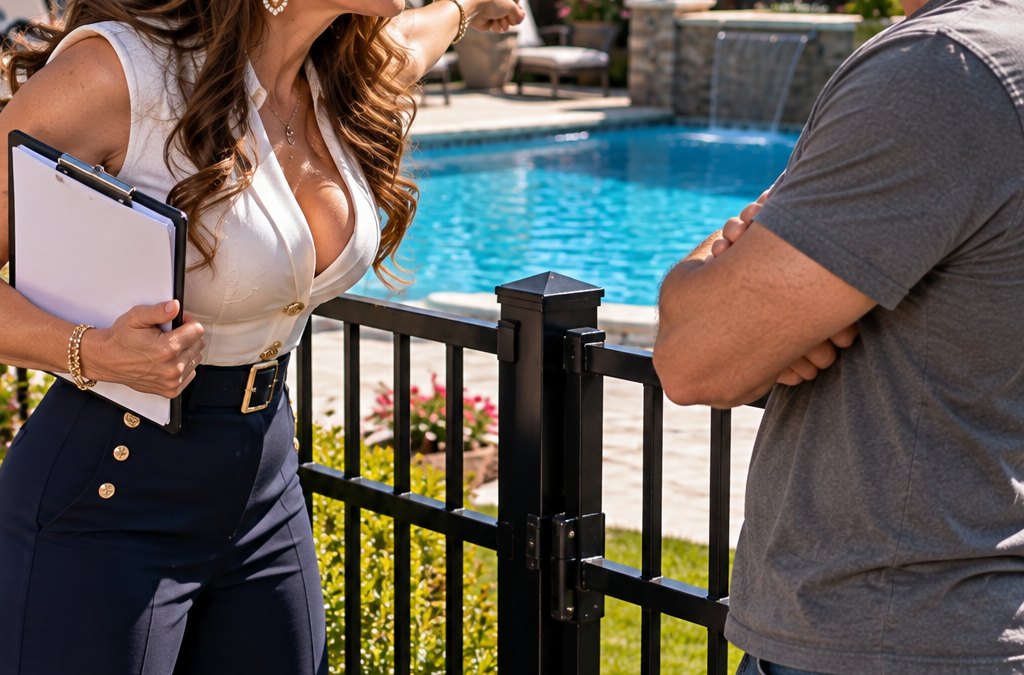
I looked over and saw Karen marching toward my gate from the sidewalk, clipboard tucked against her chest, sunglasses perched on her head, red nails wrapped around a pen. She wore a white sleeveless blouse, high-waisted navy pants, and heels that had no business near anyone’s property line.
She stopped at the fence like she was inspecting a border crossing.
“Good morning,” she called.
I rested the skimmer against the side of the pool.
“Morning.”
“We need to talk about your pool fence.”
That was her opening.
Not hello.
Not sorry to bother you.
We need to talk.
I walked over slowly, already tired.
“What about it?”
Karen looked at the fence as if it had offended her personally.
“It’s not compliant.”
“With what?”
“HOA regulations.”
I stared at her for a second, waiting for the punch line.
There wasn’t one.
“I’m not in your HOA, Karen.”
Her smile tightened.
“Everyone in this subdivision is subject to HOA standards.”
“I’m not in the subdivision.”
“You live inside the neighborhood boundary.”
“No,” I said. “The subdivision was built around my property. My lot predates the HOA. My grandparents opted out when the development was created.”
Karen blinked like I had started speaking another language.
“That’s not how HOAs work.”
“It is when the property was excluded from the declaration.”
She gave a small laugh, the kind people use when they are trying to make you feel childish.
“I think you may be confused.”
“I’m not.”
“The pool fence must meet our approved height, style, and color standards.”
“It meets county code.”
“I’m not talking about county code.”
“I am.”
Her jaw shifted.
“You can’t just ignore community standards because you feel special.”
That one almost made me laugh.
“I don’t feel special. I feel outside your HOA, because I am.”
Karen leaned slightly closer to the fence. Her perfume drifted over the gate, sweet and heavy.
“Do you have documentation proving that?”
“Yes.”
“Then you should submit it to the board.”
“No.”
Her eyebrows lifted.
“No?”
“No. I don’t report to your board.”
For the first time, the smile fell completely.
Karen was still beautiful without it, maybe even more striking, but the softness vanished. What remained was pure entitlement dressed in expensive fabric.
“We’ll see about that,” she said.
Then she turned and marched away, clipboard pressed to her chest like a shield.
I watched her go, shook my head, and went back to skimming the pool.
I honestly thought that would be the end of it.
I should have known better.
A week later, the first envelope arrived.
It was printed on HOA letterhead, even though the HOA had no authority over me. Inside was a notice of violation citing improper pool fencing, failure to submit exterior improvement plans, and unauthorized recreational structure maintenance. It claimed I had seven days to bring my property into compliance or daily fines would begin accruing.
I read it twice at the kitchen counter while my coffee went cold.
Then I laughed.
My wife looked up from packing lunch for the kids.
“What?”
I handed her the letter.
She read it, sighed, and said, “Is this the clipboard woman?”
“That obvious?”
“She has clipboard energy.”
I tossed the notice onto the counter. “They can’t fine us.”
“I know.”
“They can’t put a lien on the house.”
“I know.”
“They can’t regulate a property that isn’t in the HOA.”
“I know,” she repeated, then looked at me carefully. “But does she know?”
That was the problem.
Karen did not know, and worse, Karen did not care.
Over the next two weeks, the notices kept coming.
Daily fines.
Escalated enforcement.
Final warning.
Intent to pursue lien.
Each letter was more dramatic than the last, full of bold fonts, underlined phrases, and language that sounded like someone had swallowed a legal dictionary without understanding digestion.
I stacked them neatly on the kitchen counter.
My wife called it the Karen pile.
Then Karen went public.
One evening, my neighbor Doug texted me a screenshot from the neighborhood Facebook group. I was not a member, obviously, because I had no desire to read forty-seven comments about mailbox numbers or dog poop, but Doug believed in forwarding drama as a public service.
Karen had posted:
DANGEROUS POOL FENCE — CHILDREN AT RISK — HOA ACTION REQUIRED.
Below that was a long rant about how a “noncompliant homeowner” was refusing to follow safety standards and placing neighborhood children in danger. She claimed my pool fence was unsafe, my maintenance schedule was unknown, and my backyard pool created a liability risk for the entire community.
She did not name me directly.
She did not have to.
Everyone knew which pool she meant.
The comments were exactly what you would expect.
Is this the big blue pool near the old house?
I always wondered how that was allowed.
Karen is right. Rules exist for a reason.
What if a child gets hurt?
A few reasonable people pushed back.
Isn’t that property not part of the HOA?
I thought their lot was excluded.
Maybe we should check before assuming.
Karen replied to one of them with a heart emoji and the sentence: Safety is not optional.
I stared at my phone in disbelief.
My wife read over my shoulder.
“She’s making it sound like our pool is some abandoned pit full of snakes.”
“Snakes might make the HOA back off.”
“Don’t tempt me.”
The next day, someone slowed their car in front of our house and took a picture.
Two days later, a woman walking a dog stopped across the street and stared at the fence until I stepped onto the porch. Then she hurried away.
By Friday, my kids heard about it.
My son came home from school quiet, dropped his backpack by the door, and asked, “Dad, is our pool dangerous?”
That was when it stopped being funny.
I knelt in front of him.
“No. Our pool is safe.”
“Caleb said his mom said we’re breaking rules.”
“Caleb’s mom is listening to someone who doesn’t know what she’s talking about.”
“Are they going to take it away?”
I felt anger move through me, slow and hot.
“No,” I said. “Nobody is taking our pool.”
That night, I pulled out the documents.
The old property records. The survey from 1978. The plat map from when the subdivision was created. The HOA incorporation documents. The county boundary records. Everything my grandfather had carefully kept in a metal filing cabinet and everything I had digitized after inheriting the house.
The truth was not hidden.
It was boring, official, stamped, recorded truth.
My lot sat outside the HOA.
The development curved around us like water around stone.
Karen could scream all she wanted. Paper did not care.
But Karen was not finished.
Three days later, Doug sent me another screenshot.
EMERGENCY HOA BOARD MEETING.
Topic: Rogue Pool Situation and Immediate Community Safety Action.
Rogue pool.
I read that phrase out loud three times because it sounded like something from a low-budget shark movie.
My wife pinched the bridge of her nose.
“She’s insane.”
“She’s committed.”
“Those are not mutually exclusive.”
The flyer Karen posted had bold red lettering, exclamation points, and a clip-art caution sign. It invited residents to attend a special meeting at the community center to discuss “ongoing noncompliance, safety risks, and jurisdictional enforcement concerns.”
Jurisdictional enforcement concerns.
Karen had turned my backyard into a constitutional crisis.
I could have responded online.
I could have posted the records.
I could have written a long explanation and spent the next six hours arguing with people who had already decided feelings were evidence.
Instead, I took a personal day from work and went to the county recorder’s office.
If Karen wanted a performance, I would bring props.
The clerk at the recorder’s office was a patient woman named Ms. Ramirez, who listened while I explained the situation and then gave the kind of sigh government employees give when private citizens weaponize ignorance.
“HOA dispute?” she asked.
“How did you know?”
She smiled. “They all have the same smell.”
She helped me obtain certified copies of everything: the original property survey, the subdivision plat map, the HOA boundary declaration, and the incorporation documents. Each copy carried official stamps, raised seals, recording numbers, dates, and signatures.
Beautiful, boring, undeniable paperwork.
I bought a new binder.
Then I made copies.
Then I waited.
Karen kept posting.
She kept collecting sympathy.
She kept feeding outrage to people who wanted to believe their HOA president was protecting them from the dangerous backyard pool menace.
I let her.
That might sound passive, but it was not.
There is a point in every conflict when your opponent is no longer fighting you. They are fighting reality. And if you are patient, reality usually hits harder than you ever could.
The night of the emergency meeting, the community center parking lot was almost full.
I arrived ten minutes early with my binder under one arm. Through the windows, I could see people gathering in rows of folding chairs. Some were whispering. Some were smiling like they had come to watch theater. Doug waved me over as soon as I stepped inside.
“This is ridiculous,” he said under his breath.
“I know.”
“No, I mean she has a PowerPoint.”
I looked toward the front.
He was right.
Karen stood near a projector screen, wearing a fitted red dress, nude heels, and a blazer draped over her shoulders like she was about to announce a hostile takeover. Her hair fell in glossy waves. Her lips were painted perfectly. A sleek laptop sat on the table in front of her, beside a stack of folders and a stainless steel water bottle.
She looked confident.
More than confident.
Radiant.
This was her stage.
When she saw me, her eyes flashed with satisfaction.
I sat near the middle, not too close, not hiding in the back.
The room filled until people stood along the walls. At least forty residents had come. Maybe more. A few board members sat at the front table, including Mr. Patterson, a retired attorney who had always seemed too reasonable to belong on an HOA board.
Karen tapped her microphone.
It squealed.
She smiled tightly, adjusted it, and began.
“Thank you all for coming on such short notice. I know this is unusual, but as your HOA president, I take safety, property values, and community standards very seriously.”
She clicked to the first slide.
COMMUNITY RESPONSIBILITY AND SHARED SAFETY.
There was a stock photo of smiling children running through sprinklers.
Karen spoke for ten minutes about standards. Then five minutes about liability. Then another five about property values. Her voice was smooth, dramatic, almost seductive in its certainty. She knew how to make nonsense sound civic-minded.
Then she clicked to a slide showing a photo of my pool.
My pool.
My backyard.
Taken from outside my fence.
My hands tightened around the binder.
“This,” Karen announced, pointing at the screen, “is the issue before us.”
The room shifted.
Some people glanced at me.
Karen continued.
“This pool structure and surrounding fence do not meet current HOA standards. The owner has repeatedly refused to comply with notices, has failed to submit maintenance documentation, and has rejected board authority despite multiple warnings.”
I raised my hand.
Karen ignored me.
“In addition, there is concern that the pool functions as a community-adjacent amenity and therefore creates shared neighborhood liability.”
I raised my hand higher.
Mr. Patterson noticed.
“Karen,” he said, “perhaps we should let him respond.”
Karen’s smile froze.
“Of course.”
She turned toward me.
“Please. Explain why you believe safety rules do not apply to you.”
I stood slowly.
“They do apply to me. County safety rules apply to me. Building codes apply to me. Health regulations apply to me. Your HOA rules do not.”
Murmurs moved through the room.
Karen folded her arms.
“That is your opinion.”
“No,” I said. “It’s the county’s record.”
Her eyes narrowed.
I walked to the front and placed my binder on the table.
“Can I ask you a simple question first?”
Karen lifted her chin. “Go ahead.”
“Do you have any document showing that my property is part of this HOA?”
She gave a dismissive laugh.
“Everyone in this subdivision is part of the HOA.”
“That’s not what I asked.”
Her smile thinned.
“The neighborhood is governed by this association.”
“My property is not.”
“You are surrounded by HOA homes.”
“That doesn’t make me subject to HOA authority any more than standing near a school makes me enrolled in third grade.”
A few people laughed.
Karen’s face tightened.
I opened the binder.
“This is the original property survey from 1978, when my grandparents built the house. This is the subdivision plat map filed when your development was created. This is the HOA boundary declaration. This is the incorporation paperwork. All certified copies from the county recorder’s office.”
I laid them out one by one.
The room leaned forward.
I pointed to the boundary line on the plat map.
“Here is the HOA boundary. Here is my lot. Notice how the boundary curves around it. That is because my property existed first and was specifically excluded.”
Mr. Patterson stood and came closer.
I continued.
“I am not a member. My grandparents were not members. I have never paid dues, never signed covenants, and never consented to HOA control. My pool is permitted by the county, maintained by me, and located entirely on my private property.”
The room went silent.
Not quiet.
Silent.
Karen stared at the documents as if they had personally betrayed her.
Then she grabbed one.
“These are forgeries.”
There it was.
The desperate move.
Mr. Patterson looked up sharply.
“Karen.”
“No.” Her voice rose. “No, this is ridiculous. He cannot just walk in here with fake papers and undermine the authority of this association.”
“They’re certified copies,” I said.
“You printed them.”
“They have county seals.”
“Anyone can make a seal.”
Mr. Patterson took the document gently but firmly from her hand.
He held it up, ran his thumb over the raised stamp, checked the recording number, then looked at her.
“Karen, this appears authentic.”
Her face flushed red.
“You’re taking his side?”
“I’m reading the document.”
“He is committing fraud in front of all of you.”
A woman in the back whispered, “Oh my God.”
Karen’s hands shook as she pulled out her phone.
“I’m calling the police.”
Mr. Patterson’s eyes widened.
“I would strongly advise against that.”
She was already dialing.
That was Karen’s real flaw.
Not arrogance. Lots of people are arrogant.
Karen’s problem was that she could not retreat. To retreat meant admitting she had been wrong, and Karen’s entire personality was built around never being wrong. So when faced with a hole, she did not climb out. She ordered a shovel, hired a crew, and demanded permits for a basement.
She paced at the front of the room, speaking loudly into her phone.
“Yes, I need officers at the HOA community center. A man is presenting fraudulent county documents. He is interfering with official HOA business and creating a safety issue.”
I sat down.
Doug leaned over from the row behind me.
“She actually called 911.”
“Seems that way.”
“For paperwork.”
“Dangerous paperwork.”
He choked back a laugh.
The wait was excruciating and beautiful.
Some residents whispered. Others avoided eye contact with Karen. A few pulled out phones, pretending to check messages while obviously recording. Mr. Patterson sat stiffly at the board table, jaw tight, probably calculating the legal liability in real time.
Karen kept glancing at me.
I smiled once.
That made her angrier.
Twenty-five minutes later, two officers walked in.
One was older, broad-shouldered, tired around the eyes. The other looked young enough to still believe some calls might make sense.
Karen rushed toward them.
“Officers, thank God. This man is presenting forged documents to avoid HOA compliance. He has been defying safety enforcement and—”
The older officer raised one hand.
“Ma’am. Slow down.”
Karen inhaled sharply, offended by the interruption.
“What is the emergency?” he asked.
“I just told you.”
“You told dispatch there was fraud in progress and a safety issue. Is anyone in danger?”
Karen hesitated.
“The community is at risk.”
“Is anyone injured?”
“No, but—”
“Is there a weapon?”
“No.”
“Is there a threat?”
“He is threatening our authority.”
The younger officer blinked.
The older officer looked past Karen at me.
“Sir, can I see the documents?”
“Of course.”
I handed him the binder.
He examined the first page, then the next. He looked at the seals, the stamps, the recording numbers. He asked if these were certified copies. I said yes. He pulled out his phone and stepped aside to make a call.
The room held its breath.
Karen stood near the projector screen, arms crossed, chin high, but the red had drained from her face. Her usual allies would not look at her. Even the woman who had posted three comments about “pool safety” seemed suddenly fascinated by her purse.
The officer returned after a few minutes.
“Ma’am,” he said to Karen, “these documents are authentic. They are on file with the county recorder. According to county records, this property is not part of your HOA.”
Karen opened her mouth.
Nothing came out.
For once.
The officer continued.
“It was excluded when the subdivision was created. The owner is correct.”
“But he has to follow our rules,” she said weakly. “Everyone has to.”
“No, ma’am. Not if his property is not subject to your association.”
“This is a civil matter,” the younger officer added.
The older one gave him a look, then turned back to Karen.
“Actually, from what I’m hearing, this is not even much of a civil matter unless you continue pursuing enforcement you have no authority to pursue.”
Karen stiffened.
“Excuse me?”
“Sending violation notices, threatening liens, publicly accusing him of creating a safety hazard, and calling police over authentic documents could expose you or the association to legal problems.”
The room was so quiet I could hear the air conditioner hum.
The officer looked directly at her.
“Do you understand?”
Karen’s lips pressed together.
She did not answer.
“Ma’am?”
“Yes,” she said, the word barely audible.
Mr. Patterson covered his mouth with one hand.
Whether to hide discomfort or laughter, I could not tell.
The officers gave me a brief nod. As they walked out, the older one muttered to the younger one, loud enough for half the room to hear, “HOA calls. Every damn time.”
Someone in the back snorted.
That broke the spell.
A ripple of nervous laughter moved through the room. Karen stood frozen at the front, humiliated, the pool slide still projected behind her like evidence from a trial she had just lost.
Mr. Patterson cleared his throat.
“Well,” he said slowly, “I think we need to table this discussion.”
Karen snapped toward him.
“Table it? We need to address his violations.”
“No,” he said, sharper now. “We need to address ours.”
The room went still again.
Mr. Patterson looked around at the board members, then back at Karen.
“We have sent violation notices and threatened liens against a property that is not in our association. We have publicly represented that we have authority we do not have. You just called the police on a non-member over certified county records. This creates serious liability for the board.”
Karen’s eyes flashed.
“I was protecting the community.”
“You were wrong.”
It was a small sentence.
But in that room, it landed like thunder.
Karen looked around, searching for someone to rescue her.
Nobody did.
The woman who had cheered her on online stared at her lap. One board member shuffled papers. Another suddenly became deeply interested in his water bottle. The men who usually laughed at Karen’s jokes looked away like her humiliation might be contagious.
That was when Karen truly understood.
Her authority had never been as solid as she thought.
It depended on people believing her. Fearing her. Wanting her approval. Following her confidence instead of checking the facts.
And now the facts were on the table.
Stamped.
Certified.
Unmoved.
The meeting dissolved awkwardly after that.
People stood, whispered, gathered bags, and drifted toward the exit. Several neighbors stopped by to look at the documents. A few apologized.
“I didn’t know,” one man said.
“You could have checked,” I replied.
He looked embarrassed. “Yeah. I should have.”
A woman named Lisa touched my arm lightly.
“I’m sorry I liked Karen’s post.”
“Okay.”
She waited, maybe hoping I would tell her it was fine.
I didn’t.
Doug clapped me on the shoulder near the door.
“That was the best HOA meeting I’ve ever attended.”
“How many have you attended?”
“Enough to know that one had production value.”
I almost laughed.
Almost.
But mostly I was tired.
Drama looks fun from the outside. Inside it, even when you win, you still have to carry the weight of being lied about.
When I got home, my wife was waiting in the kitchen.
“Well?”
I set the binder on the table.
“The police confirmed the documents were real in front of everyone.”
Her eyes widened.
“She called the police?”
“During the meeting.”
My wife stared for a second, then burst out laughing.
I laughed too.
Not because it was funny.
Because if I did not laugh, I might finally let myself feel how angry I was.
The next morning, the Facebook group exploded.
Doug sent screenshots like a war correspondent.
Karen’s original posts had vanished.
In their place were comments from people who had attended the meeting.
Just to clarify: county records confirm the pool property is NOT in the HOA.
Maybe we should be more careful before making accusations.
Calling 911 over certified documents was not okay.
Does the HOA owe him an apology?
Karen did not respond.
By noon, I received an email from the HOA.
The subject line read:
NOTICE OF SPECIAL BOARD MEETING — LEADERSHIP REVIEW.
The only agenda item was “recent enforcement actions and board procedures.”
I did not attend.
I had made my point. I had no desire to sit in another room while people who should have known better debated how embarrassed they were.
But news travels.
Mr. Patterson’s wife told Doug, who told my wife, who told me while pretending she did not enjoy the chain of gossip.
The board asked Karen to resign.
Karen refused.
She said she had done nothing wrong. She claimed I had manipulated the situation, that the officers were confused, that the documents needed deeper review, and that the board was surrendering its authority to “technicalities.”
Technicalities.
That was Karen’s word for recorded property law.
The board held a vote of no confidence.
Unanimous.
Every single member voted against her.
Apparently, Karen stood so fast her chair tipped backward and hit the floor. She called them cowards. She said they would regret turning on her. She accused Mr. Patterson of being biased, Doug of poisoning the neighborhood, and me of conducting a “coordinated smear campaign.”
Then she stormed out.
A classic Karen exit, my wife said.
I asked if there was another kind.
Within a week, the HOA sent me a formal letter.
It acknowledged that my property was not part of the association. It withdrew all notices, fines, and enforcement threats. It stated that no lien action would be taken and that future board training would include verification of jurisdiction before enforcement.
Verification of jurisdiction.
Fancy words for check whether the property is actually in the HOA before threatening someone.
The letter included an apology, but it was the kind written by people trying not to get sued.
I accepted it anyway.
Not because it was enough.
Because peace was worth more than dragging the humiliation out.
Karen did not apologize.
Of course she didn’t.
For a while, she tried to pretend nothing had happened. She still walked the neighborhood in her expensive sunglasses, but the clipboard disappeared. People no longer stopped to chat with her the same way. Her smile stayed sharp, but it had nowhere to land.
I saw her one afternoon near the sidewalk by my fence.
She had paused there, staring at the pool through the slats.
I stepped outside.
“Need something?”
She turned slowly.
For the first time since I had known her, she looked uncertain.
Only for a second.
Then the old expression returned.
“You must feel very proud,” she said.
“I feel tired.”
“You embarrassed me.”
“You called the police on me.”
“You could have handled it privately.”
I looked at her for a long moment.
“You came to my gate. You sent notices. You threatened fines. You posted about my pool online. You organized an emergency meeting. You took a photo of my backyard and put it in a PowerPoint. Then you called 911.”
Her lips tightened.
“I was doing my job.”
“No,” I said. “You were trying to make my property yours.”
Her eyes flashed.
“That pool affects the neighborhood.”
“That pool belongs to my family.”
“You live beside a community. You have responsibilities.”
“I follow the law. I maintain my property. I keep my pool safe. What I don’t have is an obligation to obey a club I never joined.”
Karen looked over my shoulder at the water, blue and bright under the afternoon sun.
“You think paperwork makes you untouchable.”
“No,” I said. “I think paperwork stops people like you from inventing power.”
That hit her.
I saw it.
For a second, the polished mask cracked, and beneath it was something ugly and small. Karen had wanted control, yes, but more than that, she had wanted surrender. She wanted me to acknowledge her authority. She wanted me to submit my home, my backyard, my grandfather’s property, and my family’s summer memories to her clipboard.
She did not want safety.
She wanted obedience.
“You’ll regret making enemies here,” she said.
I smiled faintly.
“Karen, you lost your board seat because you picked a fight with a survey map.”
She walked away without another word.
After that, things slowly returned to normal.
No more violation letters appeared in the mailbox.
No more strangers photographed my fence.
No more Facebook posts about rogue pools and children at risk.
My son came home one day and told me Caleb had apologized. Not perfectly. Not dramatically. Just a quiet, “My mom said your dad was right.” For eight-year-olds, that was practically a legal settlement.
The summer kept going.
The kids swam until their fingers wrinkled. My wife brought out lemonade and pretended not to smile when my playlist started. Doug came over one Saturday with a six-pack and said, “For emotional damages.”
“I don’t drink much,” I said.
“Then I’ll suffer through them for you.”
A few neighbors stopped by over the next month.
Some apologized sincerely. Some apologized vaguely. Some did not apologize at all but became suddenly very friendly, which was its own kind of admission. One older woman brought cookies and said, “I always thought Karen was too much.”
I wanted to ask why she had never said so.
I didn’t.
People are brave in hindsight.
By the end of the season, the pool felt like ours again.
Not a legal issue.
Not a community hazard.
Not a slide in Karen’s ridiculous presentation.
Just water, sunlight, laughter, and family.
One evening, after the kids had gone inside, I sat alone by the pool with my feet in the water. The sky was turning pink behind the roofline, and the subdivision beyond our fence was settling into dinner sounds—garage doors, barking dogs, someone rolling a trash bin too loudly over pavement.
I thought about my grandparents.
I thought about the year they built this house, when none of those HOA streets existed, when the land around them was quiet and open and nobody imagined that decades later, a woman with a clipboard would try to claim authority over their backyard.
My grandfather kept every document.
Every receipt.
Every survey.
Every county notice.
As a kid, I used to think he was obsessive. He had folders for things most people would have thrown away. He believed paper mattered because memory was fragile and people lied when property was involved.
I wished he could have seen Karen’s face when the officer confirmed the records.
He would have loved that.
My wife came outside and handed me a glass of iced tea.
“You okay?” she asked.
“Yeah.”
“Thinking about Karen?”
“Thinking about paperwork.”
She sat beside me.
“That’s the most suburban sentence you’ve ever said.”
I laughed.
Maybe she was right.
But paperwork had protected us.
Not because paper has power by itself. Paper only matters when it tells the truth and someone is willing to stand behind it. My grandparents had protected the property by refusing to join the HOA. I protected it by refusing to be intimidated by someone who mistook volume for authority.
Karen thought confidence could overwrite records.
She thought a Facebook post could become fact if enough people liked it.
She thought calling something community safety would hide the fact that she wanted control.
She was wrong.
And she was publicly wrong, which for Karen was probably worse than legally wrong.
Sometimes, months later, I still find myself glancing toward the mailbox expecting another envelope. Habits take time to die. But the letters never come.
Karen still lives in the neighborhood, though she keeps her distance now. She no longer walks near my fence. She no longer carries a clipboard. When we pass each other in the grocery store, she looks through me like I am a window she dislikes.
That is fine.
I did not need her friendship.
I needed her out of my backyard.
The HOA revised its procedures after the whole mess. Mr. Patterson sent a short note letting me know all future enforcement actions would require confirmation that the property was actually subject to HOA jurisdiction.
It was absurd that such a rule needed to exist.
But then again, Karen had existed.
As for my pool, it is still fenced, still clean, still maintained like I have a personal vendetta against algae. The county inspector came by during a routine check that year and found everything in order. I kept the report in the same binder as the rest of the documents.
Just in case.
Because peace is wonderful, but proof is better.
I learned something from all of it.
There is a specific kind of person who cannot stand boundaries.
Not because the boundaries hurt them, but because boundaries remind them they are not the center of the world. Karen did not need my pool. She did not need my fence changed. She did not need to protect children from a hazard that did not exist.
She needed me to obey.
And when I would not, she built a whole fantasy where my backyard became a community asset, my fence became a public danger, and her authority magically stretched across legal lines just because she wanted it to.
But wanting does not create ownership.
Confidence does not create jurisdiction.
A clipboard does not create law.
And a PowerPoint presentation, no matter how dramatic, does not beat a county recorder’s seal.
That is the part I still enjoy.
Karen had graphs. I had deeds.
Karen had outrage. I had surveys.
Karen had a room full of people waiting for a spectacle.
I had the truth in a binder.
In the end, the truth did not need to yell.
It just needed to be opened on the table.