Karen Paved a Driveway Through My Woods While I Was Gone, Then Claimed the HOA Owned My Land
part2
The driveway issue came up almost casually.
Karen had a circular driveway connecting to the main road in front of her house, but she also had an oversized garage near the back of her property. She loved that garage. She talked about it like it was a private showroom. Her late-model SUV sat inside, along with some restored convertible she only drove when the weather was perfect and enough people were outside to admire it.
One afternoon, while I was hauling a fallen branch toward my woodpile, she appeared at the edge of her yard in white shorts, wedge sandals, and a fitted blue blouse that had absolutely no business near mud.
She watched me for a few seconds before speaking.
“You know, better access back there would benefit both our properties.”
I stopped dragging the branch.
“Back where?”
She pointed toward the wooded strip between our lots.
“My garage. Your side lot. That whole area.”
“My woods?”
She gave a small laugh.
“That’s a dramatic way to describe underused land.”
“It’s trees.”
“It’s unmanaged growth.”
“It’s my unmanaged growth.”
Her smile tightened.
“I’ve been looking at options for a secondary driveway.”
“Good luck.”
“It would be much cleaner if it ran along that side.”
“Your side?”
She tilted her head.
“Along the boundary.”
That was the first time I felt something cold move through me.
“Karen, you are not building anything on my property.”
Her smile came back too fast.
“Of course not. Nobody said that.”
But she had said enough.
Over the next few weeks, she mentioned the driveway several more times.
Always indirectly.
Always with phrases like access improvement, neighborhood flow, safety benefit, and property value enhancement.
She never asked permission.
That was important.
Asking would mean acknowledging I had the right to say no.
Karen preferred to behave as if agreement already existed somewhere in the air and I was simply being slow to recognize it.
Then I left for a work trip.
I am a consultant, and sometimes that means extended travel. This project was supposed to take several weeks. I locked up the house, paused a few deliveries, let a friend know I’d be gone, and left thinking my property would be exactly as I left it when I returned.
It was not.
I got home late on a Thursday afternoon.
I remember the light because the sun was low enough to cut through the trees at an angle, that warm gold light that usually made the place feel peaceful. I turned into my driveway tired, hungry, and already thinking about ordering takeout.
Then I saw the gap in the woods.
At first, my brain refused to process it.
There was open space where there should have been trees.
Fresh asphalt where there should have been leaves.
A black strip of paved driveway ran from the road, across the wooded edge of my property, and angled toward Karen’s garage.
For a few seconds, I just sat in my car.
The engine idled.
My hands stayed on the steering wheel.
My mind kept trying to turn what I saw into something else.
A utility project.
A temporary path.
A mistake in perception caused by exhaustion.
Then I got out.
The smell hit me first.
Fresh asphalt.
Cut wood.
Disturbed dirt.
I walked toward it slowly, because part of me knew that if I moved too fast, I might do something stupid.
The driveway was real.
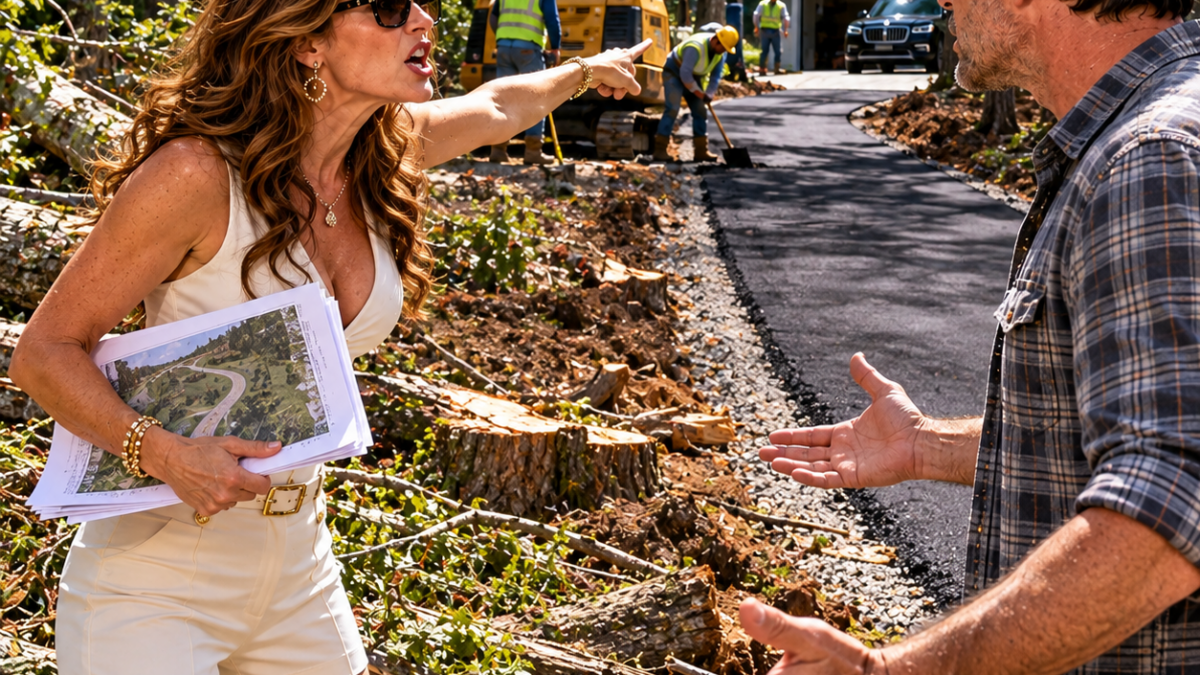
A full paved driveway, maybe twelve feet wide, professionally built with a gravel base and clean edges, cutting across the side of my property like someone had taken a knife to the woods. It entered from the road, ran through the trees, crossed the eastern section of my land, and connected to Karen’s backyard garage.
Six trees were gone.
Not saplings.
Trees.
Mature enough to matter. Mature enough to cast shade. Mature enough that I had noticed them every season since buying the house.
The stumps were ground low. Brush had been cleared. The undergrowth was gone. Tire marks and construction equipment tracks were still visible in the disturbed soil along the edges.
I stood there staring at the black pavement, and the shock slowly turned into rage.
Not hot rage.
Worse.
Controlled rage.
The kind that makes your vision feel too sharp.
I went straight to Karen’s house.
Her driveway was immaculate, of course. Her front landscaping looked like a magazine spread. White hydrangeas. Trimmed hedges. A stone walkway. A tasteful seasonal wreath on the door because people like Karen always remember the public-facing details.
I knocked.
She opened the door wearing a cream blouse, tight dark jeans, and gold jewelry. She looked at me as if she had been expecting me.
“Well,” she said, smiling. “You’re back.”
I did not return the smile.
“What the hell did you do to my land?”
Her eyes narrowed slightly, but her smile stayed.
“I assume you’re talking about the driveway.”
“Yes, Karen. I’m talking about the driveway you built through my woods.”
She leaned one shoulder against the doorframe.
“The HOA approved it.”
For a second, I could not speak.
Then I said, slowly, “The HOA has no authority over my property.”
Her smile sharpened.
“The HOA conducted a survey.”
“My property was surveyed when I bought it.”
“And things change.”
“Property lines do not change because you want garage access.”
Her expression hardened at the edges.
“It was determined to be the best route for neighborhood safety and accessibility.”
“Neighborhood safety?”
“It creates an additional access point and improves property values.”
“It creates a private driveway to your garage.”
“Don’t be small-minded.”
That almost made me laugh.
“Karen, you cut down my trees.”
“The area was overgrown.”
“You paved my land.”
“It benefits the community.”
“I am not part of your community association.”
She sighed like I was testing her patience.
“Maybe if you had joined the HOA like a responsible homeowner, you would have been included in the discussion.”
That sentence landed like a slap.
Not because it surprised me.
Because it confirmed exactly what this was.
Punishment.
I had refused her authority, and she had decided to act as though my refusal erased my rights.
“You need to remove it,” I said.
Her eyebrows lifted.
“No.”
“No?”
“The driveway is staying.”
“It is on my land.”
“It is on HOA-approved access space.”
“That phrase means nothing.”
“It means you should stop making this difficult before you create legal problems for yourself.”
I stared at her.
She leaned closer, voice lower now.
“The HOA has lawyers.”
“Good.”
Her smile flickered.
“Good?”
“Yes. You’re going to need them.”
I left before I said anything that could hurt my own case later.
The second I got home, I pulled out my closing file. Deed. Survey. Boundary records. Every document I had saved because some paranoid part of me had always known not being in an HOA did not mean an HOA would leave me alone.
I spread everything across my kitchen table.
My old survey showed exactly what I already knew: the driveway crossed my land.
But I needed something current.
Something professional.
Something Karen could not dismiss as outdated.
So I hired a licensed surveyor and paid for a rush job.
Those days waiting were some of the most infuriating of my life.
Every morning, Karen used that driveway.
Every evening, she used it again.
Her SUV glided across my property like she was daring me to stop her. Sometimes she slowed when she saw me outside. Once, she even lifted her hand in a little wave.
I did not wave back.
Neighbors told me later that construction crews had been there for over a week while I was gone. They worked during business hours. Professional trucks. Paving equipment. Chainsaws. Gravel deliveries. Several people assumed I had hired them because it looked legitimate.
That was what made it so invasive.
Karen had not sneaked out with a shovel.
She had confidently staged a construction project on my land in broad daylight, trusting that the appearance of authority would discourage questions.
The surveyor confirmed everything.
The driveway crossed my property line by about forty feet at its deepest point and ran along my eastern border for roughly sixty feet.
I asked him to mark the line clearly.
He did.
Flags.
Paint.
Property pins.
There it was in bright, undeniable color: Karen’s beautiful new driveway running straight through land that belonged to me.
I took photos.
Dozens of them.
Then videos.
Close-ups of the property pins.
The stumps.
The asphalt.
The tire marks.
The cleared brush.
I documented every tree that had been cut.
Then I went back to Karen’s house.
This time, I brought the survey.
She opened the door wearing workout clothes, her hair pulled back, a sheen of sweat on her collarbone like she had been doing yoga or pretending to.
I held out the survey.
“You built on my property. The driveway needs to be removed immediately.”
She barely looked at it.
“We have our own survey.”
“Then show it to me.”
“It’s HOA business.”
“It crosses my land.”
“You are not a member, so you don’t have rights to internal HOA documents.”
I let out a short laugh.
“You used your internal HOA document to pave my land, but I don’t have a right to see it?”
“Correct.”
“That is insane.”
Her face hardened.
“What’s insane is your refusal to cooperate with neighborhood improvements.”
“Karen, this is trespass.”
“This is access.”
“This is destruction of property.”
“This is progress.”
“Show me the survey.”
“No.”
“Then remove the driveway.”
“No.”
She folded her arms.
“The HOA is tired of your property being an eyesore. This is only the beginning of the improvements we’ve discussed.”
Something in my stomach tightened.
“What improvements?”
She gave a vague little gesture toward my land.
“We’re considering several projects to enhance the neighborhood.”
“On my property?”
“Possibly extending utilities. Maybe creating a small park area. Nothing final.”
“A park.”
“It would make better use of the land.”
“My land.”
“Underused land.”
There it was again.
The word she used when she meant mine, but wanted it to sound negotiable.
I walked away.
This time, I called a property attorney.
His name was Martin Hayes, and he had the tired voice of a man who had spent thirty years watching people do stupid things near boundary lines.
I sent him everything.
My deed.
Original survey.
Rush survey.
Photos.
Videos.
Karen’s emails about neighborhood standards.
Notes from our conversations.
He called me after reviewing the file.
“I have to ask,” he said, “because sometimes there’s an old easement buried somewhere people forget about. Have you ever granted access across that side?”
“No.”
“Any shared driveway agreement?”
“No.”
“Utility easement?”
“Not where she paved.”
“Prior owner?”
“Nothing in the closing documents.”
He exhaled.
“Then this is one of the dumbest things I’ve seen in a while.”
“Good dumb or bad dumb?”
“For her? Bad. For you? Very good.”
He explained that what Karen had done was trespass, destruction of property, and potentially criminal mischief depending on how prosecutors viewed the tree cutting and fraudulent approvals. He said the civil case looked extremely strong and that intentional trespass could open the door to treble damages.
“Treble?” I asked.
“Triple. In certain circumstances.”
That was the first moment I felt something other than rage.
Not joy.
Not yet.
But the beginning of balance.
Martin sent Karen and the HOA a certified demand letter.
Remove the driveway within thirty days.
Compensate for the trees, land damage, survey costs, and attorney fees.
Stop using the driveway immediately.
Acknowledge in writing that my property was not subject to HOA authority.
Karen did not respond personally.
The HOA attorney did.
His letter claimed the HOA had conducted proper due diligence, that the driveway was placed on HOA-controlled land, and that my survey was incorrect.
Attached was their survey.
Martin called me after reading it.
He was laughing.
Not chuckling.
Laughing.
“Have you heard of Precision Property Solutions?”
“No.”
“It’s not a licensed surveying company.”
“What is it?”
“A property management company.”
He paused.
“And it is owned by Karen’s brother-in-law.”
For a moment, I just stood in my kitchen holding the phone.
“They faked a survey?”
“It appears they produced something that looks like a survey without being licensed to perform one.”
“Is that illegal?”
“Let’s just say it is not going to improve their position.”
Martin filed suit against Karen personally, the HOA, and Precision Property Solutions.
Fraud.
Trespass.
Property damage.
Destruction of trees.
Civil conspiracy.
A handful of other claims I did not fully understand but enjoyed hearing him say.
We also filed a police report.
While everything started moving, Karen continued using the driveway.
Every day.
Every single day.
My attorney advised me not to block it yet, not physically interfere, not do anything that could be portrayed as retaliation before the preliminary hearing.
So I waited.
And every day, I watched Karen drive across my property like she had already won.
She got bolder.
She parked her SUV halfway down the new driveway, right near the property line, as if marking territory. She told neighbors I was the one facing legal trouble for interfering with HOA improvements. One neighbor, who had always been friendly, pulled me aside and said Karen bragged at an HOA meeting that she had “found a way to handle problem properties.”
Problem properties.
That was what I had become.
Not a homeowner.
Not a neighbor.
A problem.
By the time the preliminary hearing arrived, I was sleeping badly and checking my cameras more than any sane person should. I hated how much space Karen had taken up in my head. That might have been the worst part before court—the sense that my home no longer felt untouched by her.
The hearing changed everything.
Karen arrived in court looking immaculate.
Navy pencil skirt. White blouse. Hair curled. Makeup perfect. She walked beside the HOA attorney like she was attending a board luncheon instead of defending herself for paving someone else’s property.
I sat with Martin and forced myself not to stare.
Their attorney tried to lean heavily on the survey.
Martin let him.
Then he introduced licensing board records showing Precision Property Solutions was not licensed to conduct surveys, had no licensed surveyors on staff, and was owned by Karen’s brother-in-law.
Then he brought in my surveyor.
My actual licensed surveyor.
The surveyor explained the property line clearly, calmly, and with the exhausted patience of someone who had spent his career watching people argue with maps.
The driveway was on my land.
No question.
The judge’s face changed during the hearing.
At first, he was neutral.
Then skeptical.
Then annoyed.
By the time the HOA attorney tried to argue that the HOA had relied on the fake survey in good faith, the judge cut him off.
“Counsel, even if the survey had been valid, how does this association claim authority to authorize construction on property outside its jurisdiction?”
The attorney tried to answer.
The answer did not survive first contact with logic.
The judge granted the preliminary injunction.
Karen was ordered to stop using the driveway immediately.
The HOA was barred from further activity on my property.
The judge also ordered Karen to show cause why she should not be held in contempt for building on property she knew or should have known was not hers.
Outside the courtroom, Karen approached me.
Martin immediately stepped between us.
Karen smiled past him.
“This could have been handled neighbor to neighbor.”
I looked at her.
“You cut down my trees while I was out of town.”
Her smile thinned.
“You’re enjoying this.”
“No. I enjoyed my woods.”
She had no answer to that.
For two days, she obeyed.
Then I came home from work and found her SUV parked on the illegal driveway.
Not near it.
On it.
On my side of the property line.
I took photos.
Called Martin.
He told me to call the police because now there was a court order.
The officers arrived and went to Karen’s door.
I watched from my porch as she came out in a fitted red dress and heels, looking offended that law enforcement had interrupted her evening.
She argued.
Of course she did.
She told them the driveway was on her property.
The officers explained there was a court order.
She said the court order was under dispute.
They explained that did not matter.
She said I was harassing her.
They told her to move the vehicle.
Eventually, she did.
But before she went inside, she looked across the yard at me and called out, “You are going to regret this.”
One officer turned toward her.
“Ma’am, don’t make threats.”
She disappeared into her house.
That night, I barely slept.
Not because I was afraid of Karen physically.
Because I finally understood that she was not going to stop until something stopped her.
Relying on police every time she violated the order was not a plan.
I needed a boundary she could not smirk through.
So I called Martin the next morning.
“I want to block it.”
“How?”
“Physically.”
“Everything must stay on your side of the line.”
“I know.”
“No damage to her property.”
“I know.”
“No booby traps.”
“I’m angry, not stupid.”
He approved the idea once I sent him a proposed plan.
At first, I considered a fence, but fencing felt too easy for Karen to argue about. Placement disputes. Access claims. Emergency access nonsense.
So I went bigger.
I rented heavy equipment.
I ordered six massive concrete barriers—the kind used for highway construction. Each one was about four feet tall, eight feet long, and heavy enough that nobody was moving it without machinery.
Then I rented an excavator and hired an operator.
I scheduled everything for Saturday morning.
I knew Karen would be home.
That was not an accident.
The flatbed arrived first.
The barriers came down onto my front lawn one by one with deep, satisfying thuds.
Karen came outside almost immediately.
She stood on her porch in yoga pants, a tight zip-up jacket, and sunglasses, arms crossed, watching.
Then the excavator arrived.
That brought out more neighbors.
I met the operator with my survey, showed him the property pins, the marked boundary, and the exact location where the barriers needed to go. Everything was on my land, set back about two feet from the line so there could be no argument that I had encroached.
Karen stormed over before we started.
“What do you think you’re doing?”
I looked at the excavator, then at the concrete barriers.
“Property improvements.”
“You cannot block that driveway.”
“It’s on my property.”
“It’s under litigation.”
“And subject to an injunction you violated.”
Her jaw clenched.
“You’re acting like a child.”
“You paved through my woods.”
“The HOA approved an access improvement.”
“You mean your brother-in-law forged a survey.”
Her face went pale for half a second.
Then the color came back hot.
“Be very careful.”
“No, Karen. That’s what you should have done.”
I nodded to the operator.
He started.
There is something deeply satisfying about watching heavy machinery enforce a boundary.
The first barrier was lifted and placed directly across the illegal driveway where it crossed onto my land. Then the second. Then the third. Six in total, forming a solid line of concrete across the asphalt.
Karen stood in her yard, phone pressed to her ear, speaking rapidly.
I assumed she was calling the HOA attorney, her brother-in-law, the president of the universe, whoever she thought could still save her shortcut.
Then the operator used the excavator to nestle the barriers slightly into the ground so they could not be nudged aside.
But I was not done.
Behind the barriers, still fully on my side, he dug a trench about three feet deep and four feet wide running parallel to the concrete line. The dirt came up and formed a berm on my side.
The result was beautiful.
Not aesthetically.
It looked ridiculous, honestly.
Concrete barriers, fresh trench, dirt mound, broken driveway.
But it was beautiful in the way consequences can be beautiful.
The illegal driveway was now completely useless.
Even if Karen hired equipment to move the barriers, she would hit the trench. If she filled the trench, she would hit the berm. Every inch of it was on my land.
At one point, she yelled, “You’re going to be in serious legal trouble for this!”
I smiled and waved.
That made her angrier.
After the operator finished, I paid him, and the excavator was hauled away. Then I put up several signs along the barrier.
PRIVATE PROPERTY.
NO TRESPASSING.
VIOLATORS WILL BE PROSECUTED.
I installed two trail cameras facing the barriers to document any tampering.
The next business day, the HOA attorney called Martin and threatened to sue me for interfering with HOA infrastructure.
Martin told him to go pound sand.
Professionally, I assume.
He reminded them that there was already a court order supporting my position and that any further harassment would be added to the lawsuit.
For a while, things went quiet.
Karen could not use her shiny new driveway anymore. She had to use the original circular driveway she had apparently found so unbearable. My cameras caught her walking up to the barriers several times, just staring. Once she brought a measuring tape. Another time she brought someone I did not recognize, and they stood there pointing, whispering, and looking annoyed.
I saved all of it.
Then the police called.
A detective asked if I could come in for an interview about the property dispute.
I called Martin.
He came with me.
At the station, the detective explained they had been investigating the fake survey. They wanted to understand the timeline and exactly what Karen had told me and when.
I walked through everything.
The comments.
The driveway hints.
The work trip.
The construction.
The confrontation.
Her claim that the HOA approved it.
The refusal to show the survey.
The brother-in-law connection.
Martin kept me from rambling, but honestly, I had nothing to hide.
Karen was the one who had turned a property dispute into a fraud investigation.
The arrests came a few weeks later.
I was not home when it happened.
Neighbors told me about it afterward with the same excitement people usually reserve for tornado sightings.
Police came to Karen’s house.
Not one cruiser.
Several.
Karen was arrested and charged with multiple felonies, including fraud connected to the fake survey, criminal mischief for the property damage, and theft of property for cutting down and removing my trees. Her brother-in-law was arrested too for creating and providing the fake survey.
Once the arrest became public record, the local newspaper picked up the story.
HOA BOARD MEMBER ACCUSED OF USING FAKE SURVEY TO BUILD DRIVEWAY ON NEIGHBOR’S LAND.
It became a whole thing.
Property rights.
HOA overreach.
Fake survey.
Trees.
Concrete barriers.
People love a story with concrete barriers.
Karen became toxic almost overnight.
The HOA forced her to resign from the board. Neighbors who had supported her quietly backed away. Some who had repeated her talking points suddenly developed amnesia. Apparently, nobody had really believed her, they were just trying to keep the peace.
Funny how peace always seems to mean the wronged person should swallow the damage quietly.
Our civil lawsuit continued.
Karen tried to settle.
More than once.
At first, the offers were insulting.
A little money to remove the driveway.
No admission of wrongdoing.
Mutual confidentiality.
Martin laughed at one of them for a full ten seconds before saying no.
We were not just suing for removal anymore.
We were suing for treble damages for intentional trespass, compensation for the six mature trees at replacement value, survey costs, attorney fees, emotional distress, punitive damages, and the cost of restoring the land.
The criminal trial happened first.
I attended several days.
Watching Karen sit at the defense table was surreal. She still dressed perfectly, though less flashy now. Her hair was smooth. Her makeup understated. She looked like she wanted the jury to see a misunderstood suburban woman, not the kind of person who would fake a survey and pave someone else’s woods.
The prosecutor dismantled that image piece by piece.
They brought in an expert from the state surveyor licensing board who explained the legal requirements for survey companies and confirmed that Precision Property Solutions had no surveying license, no licensed surveyors, and no authority to produce the document Karen used.
They brought in my surveyor, who explained the actual property line in detail.
They showed emails and messages proving Karen knew there was a boundary issue before construction.
They showed her statements claiming HOA approval.
They showed her brother-in-law’s connection.
They showed photos of the trees.
Then came the part that stayed with me.
The prosecutor asked a simple question in closing.
“Why fake a survey if you believe the land is yours?”
Karen was convicted on all charges.
The judge noted that while she had no prior criminal record, the conduct had been deliberate, calculated, and followed by continued defiance of court orders. She received eighteen months in county jail, with the possibility of work release after six months. Her brother-in-law received twelve months.
I expected to feel triumphant.
Instead, I felt exhausted.
Justice, it turns out, is not always a lightning strike.
Sometimes it is just the end of being forced to prove the obvious.
The civil case settled shortly after the conviction.
Karen’s homeowner’s insurance refused to cover her because her actions were intentional and criminal. The HOA’s insurer fought involvement too, but the association still had exposure because they had supported the project and allowed her to act under board authority.
In the end, Karen had to sell her house to pay the settlement.
The total amount was over $200,000.
That included treble damages for intentional trespass, removal costs for the driveway, replacement valuation for the six trees—around $15,000 per tree once experts got involved—my legal fees, surveying costs, restoration work, punitive damages, and compensation for the time and stress of fighting the whole nightmare.
I watched from my porch when the demolition crew arrived.
The same stretch of asphalt Karen had treated like a victory got cut, broken, ripped up, and hauled away in chunks. The sound was violent and satisfying. Machines tore into the pavement while workers loaded pieces into trucks.
Where her driveway had been, crews brought in new topsoil, regraded the area, and followed a landscape architect’s restoration plan that I got to approve.
New trees were planted.
Not the same as the old ones.
They never are.
But they were mine.
The settlement also required the HOA to send a formal letter to all members acknowledging that my property was not subject to HOA authority, that the HOA had no right to approve construction on it, and that all future contact regarding my property had to go through written legal channels.
Karen served about ten months before release.
By then, her house had been sold. Her marriage had fallen apart, or at least that was what neighbors told me. Her husband filed for divorce, and after her release, she moved out of state to live with family.
Her brother-in-law lost his property management business.
The HOA survived, but barely in the same form. There were meetings. Resignations. Angry residents. Financial questions. People wanted to know how board authority had been used to support a project that ended in felony convictions and a six-figure settlement.
Good question.
I used part of the settlement to install a privacy fence along the entire property line between my land and Karen’s former house.
A beautiful fence.
Tall.
Solid.
Legal.
I also installed a much nicer driveway on my own property, partly because I wanted one and partly because I admit it gave me great satisfaction to watch my so-called eyesore property become better maintained than most of the houses that had whispered about it.
The concrete barriers stayed.
People ask about that.
Technically, I did not need them anymore after the illegal driveway was removed. But I kept them near the old access point as a reminder. Over time, they became something of a neighborhood landmark. New neighbors sometimes ask why there are highway barriers near the edge of the woods.
I tell them the story.
Not always the long version.
Sometimes just enough.
“Someone tried to steal a driveway through my land.”
Their eyes always widen.
“Seriously?”
“Very.”
The barriers are ugly.
I know that.
But I like them.
They remind me what a boundary looks like when politeness fails.
Sometimes I wonder if I went too far.
That is the honest truth.
There were moments, especially after Karen was sentenced, when I thought about the settlement offers I had rejected. If I had accepted early, she might not have gone to jail. She might not have lost the house. Her brother-in-law might not have lost his business. The HOA might not have been dragged into public embarrassment.
But then I remember the trees.
I remember standing in my woods smelling fresh asphalt where shade used to be.
I remember her smirk when she told me the HOA approved it.
I remember her saying this was only the beginning of improvements they had planned.
I remember her parking on my land after a judge told her not to.
I remember that none of this happened because she made one mistake.
It happened because she made a dozen choices.
She chose to treat my refusal as an obstacle instead of an answer.
She chose to use a fake survey.
She chose to hire crews while I was out of town.
She chose to cut down my trees.
She chose to threaten me with HOA lawyers.
She chose to keep using the driveway after being told it was illegal.
She chose to violate the court order.
She chose arrogance at every turn until the system finally ran out of patience.
I did not ruin Karen’s life.
Karen built a road to that outcome herself.
Unfortunately for her, forty feet of it crossed my land.
The woods are quieter now.
The new trees are still young, but they are growing. The disturbed soil has settled. The privacy fence gives me back some of the peace she stole. The neighborhood is calmer too, though I can feel the HOA watching itself more carefully these days.
They should.
Every property line is a promise.
A legal promise.
A moral promise.
A line that says this is mine, that is yours, and neither of us gets to erase the other because convenience, beauty, or power makes trespass tempting.
Karen never understood that.
She thought authority came from titles, meetings, board votes, glossy letters, and the confidence to say something was legal before anyone checked.
She thought my land was vulnerable because it was wooded, quiet, and outside her control.
She thought I would complain, maybe threaten, maybe accept some token payment, and eventually give in because fighting would be too stressful.
She underestimated how deeply people love the places that give them peace.
She underestimated the value of six trees.
She underestimated the usefulness of documentation.
Most of all, she underestimated what happens when someone who wants to be left alone is finally forced to fight.
I bought this house because I wanted distance from people like her.
In the end, she gave me the money to build a better fence.
Now, when I stand on my porch in the evening and look toward the eastern woods, I can still see the faint line where the illegal driveway used to cut through. Nature is covering it slowly. Grass first. Then weeds. Then saplings. One day, if I stay here long enough, the land will hide the scar almost completely.
But I will remember.
Karen paved over my property like it belonged to her.
I made sure the law tore it back out.
And every time I pass those concrete barriers, I feel the same quiet satisfaction.
Some people need a survey to understand a line.
Karen needed a judge, a demolition crew, and a criminal conviction.
𝗧𝗛𝗘 𝗘𝗡𝗗
Karen Paved a Driveway Through My Woods While I Was Gone, Then Claimed the HOA Owned My Land
Karen waited until I left town, cut down six of my trees, and paved a private driveway straight through my land like my property line was only a suggestion.
When I came home and demanded answers, she smiled and told me the HOA had approved it, so I should stop being difficult before their lawyers made my life miserable.
She thought a fake survey, a board title, and a few threats would scare me into silence—but she had built her shortcut across the wrong person’s property.
When I bought my house, the biggest selling point was not the square footage, the kitchen, or even the land, though the land was what made me fall in love with it.
It was just under two acres, tucked into the edge of a quiet suburban neighborhood where the streets curved gently, the houses sat far enough apart to breathe, and the back half of my property turned into woods thick enough that summer evenings smelled like leaves, soil, and whatever flowers the deer had not eaten yet. The house sat in a clearing, modest but solid, with an old porch, a gravel side path, and a backyard that faded into trees instead of another fence line.
It felt private.
Not isolated. Not rural. Just private enough that I could come home after a long work trip, set my bag down, open a window, and hear wind instead of somebody else’s leaf blower.
The real estate agent mentioned the surrounding neighborhood had an HOA, but my property was specifically not part of it. That was not a minor detail to me. It was one of the reasons I bought the place.
I had heard enough HOA horror stories to know I wanted nothing to do with one.
My property predated the association by decades. The previous owner had refused to join when the HOA was formed, and during closing, I made absolutely sure every document confirmed that I was not subject to their rules, fees, meetings, committees, architectural standards, landscaping demands, mailbox opinions, or whatever else bored people invented to feel important.
For years, everything was fine.
I knew the neighbors casually. We waved. Sometimes we talked at the mailbox. Nobody bothered me. I kept my property reasonably maintained. I was not trying to win landscaping awards, but I was not running a junkyard either. The grass got cut. The driveway stayed clear. The woods stayed woods.
Then Karen moved into the house east of mine.
Karen Whitcomb was around forty, maybe forty-two, and looked like the kind of woman who had never walked into a room without checking who was watching. She was beautiful in a polished, dangerous way—long auburn hair, sharp cheekbones, glossy lips, expensive sunglasses, and tight dresses that somehow looked both suburban and predatory. She flirted when it served her, especially with contractors, board members, and men who mistook her smile for warmth. But the second someone pushed back, the charm vanished, and what remained was pure control.
She was on the HOA board when I met her.
That should have been my first warning.
At first, she seemed normal enough. A little too interested in what everyone else was doing, maybe, but not outright hostile. She waved from her driveway. She complimented the wooded part of my lot once, though even then her tone made it sound like she was evaluating it for future use.
Then her attitude shifted.
It started with comments.
“Your yard would look so much better if you thinned out those trees.”
“That back corner is getting a little wild, don’t you think?”
“Neighborhood standards matter, even for properties outside the formal boundary.”
Formal boundary.
That phrase stuck with me.
I would smile politely and remind her, “I’m not part of the HOA.”
And Karen would smile back like I had said something childish.
“Technically,” she would say.
That one word bothered me every time.
Technically.
As if legal boundaries were annoying little details she planned to smooth out once she found the right pressure point.
Then she started talking about my joining the HOA.
Not asking.
Talking.
“It would be wonderful if you came into alignment with the rest of us.”
“The neighborhood works better when everyone participates.”
“People notice when one property refuses to cooperate.”
I declined every time.
Politely at first.
Then less politely.
My property legally could not be forced into the HOA, and I had the paperwork to prove it.
Karen did not like that.
People like her rarely hate rules. They love rules when they control them. What they hate are limits.
And I was a limit.
part2
The driveway issue came up almost casually.
Karen had a circular driveway connecting to the main road in front of her house, but she also had an oversized garage near the back of her property. She loved that garage. She talked about it like it was a private showroom. Her late-model SUV sat inside, along with some restored convertible she only drove when the weather was perfect and enough people were outside to admire it.
One afternoon, while I was hauling a fallen branch toward my woodpile, she appeared at the edge of her yard in white shorts, wedge sandals, and a fitted blue blouse that had absolutely no business near mud.
She watched me for a few seconds before speaking.
“You know, better access back there would benefit both our properties.”
I stopped dragging the branch.
“Back where?”
She pointed toward the wooded strip between our lots.
“My garage. Your side lot. That whole area.”
“My woods?”
She gave a small laugh.
“That’s a dramatic way to describe underused land.”
“It’s trees.”
“It’s unmanaged growth.”
“It’s my unmanaged growth.”
Her smile tightened.
“I’ve been looking at options for a secondary driveway.”
“Good luck.”
“It would be much cleaner if it ran along that side.”
“Your side?”
She tilted her head.
“Along the boundary.”
That was the first time I felt something cold move through me.
“Karen, you are not building anything on my property.”
Her smile came back too fast.
“Of course not. Nobody said that.”
But she had said enough.
Over the next few weeks, she mentioned the driveway several more times.
Always indirectly.
Always with phrases like access improvement, neighborhood flow, safety benefit, and property value enhancement.
She never asked permission.
That was important.
Asking would mean acknowledging I had the right to say no.
Karen preferred to behave as if agreement already existed somewhere in the air and I was simply being slow to recognize it.
Then I left for a work trip.
I am a consultant, and sometimes that means extended travel. This project was supposed to take several weeks. I locked up the house, paused a few deliveries, let a friend know I’d be gone, and left thinking my property would be exactly as I left it when I returned.
It was not.
I got home late on a Thursday afternoon.
I remember the light because the sun was low enough to cut through the trees at an angle, that warm gold light that usually made the place feel peaceful. I turned into my driveway tired, hungry, and already thinking about ordering takeout.
Then I saw the gap in the woods.
At first, my brain refused to process it.
There was open space where there should have been trees.
Fresh asphalt where there should have been leaves.
A black strip of paved driveway ran from the road, across the wooded edge of my property, and angled toward Karen’s garage.
For a few seconds, I just sat in my car.
The engine idled.
My hands stayed on the steering wheel.
My mind kept trying to turn what I saw into something else.
A utility project.
A temporary path.
A mistake in perception caused by exhaustion.
Then I got out.
The smell hit me first.
Fresh asphalt.
Cut wood.
Disturbed dirt.
I walked toward it slowly, because part of me knew that if I moved too fast, I might do something stupid.
The driveway was real.
A full paved driveway, maybe twelve feet wide, professionally built with a gravel base and clean edges, cutting across the side of my property like someone had taken a knife to the woods. It entered from the road, ran through the trees, crossed the eastern section of my land, and connected to Karen’s backyard garage.
Six trees were gone.
Not saplings.
Trees.
Mature enough to matter. Mature enough to cast shade. Mature enough that I had noticed them every season since buying the house.
The stumps were ground low. Brush had been cleared. The undergrowth was gone. Tire marks and construction equipment tracks were still visible in the disturbed soil along the edges.
I stood there staring at the black pavement, and the shock slowly turned into rage.
Not hot rage.
Worse.
Controlled rage.
The kind that makes your vision feel too sharp.
I went straight to Karen’s house.
Her driveway was immaculate, of course. Her front landscaping looked like a magazine spread. White hydrangeas. Trimmed hedges. A stone walkway. A tasteful seasonal wreath on the door because people like Karen always remember the public-facing details.
I knocked.
She opened the door wearing a cream blouse, tight dark jeans, and gold jewelry. She looked at me as if she had been expecting me.
“Well,” she said, smiling. “You’re back.”
I did not return the smile.
“What the hell did you do to my land?”
Her eyes narrowed slightly, but her smile stayed.
“I assume you’re talking about the driveway.”
“Yes, Karen. I’m talking about the driveway you built through my woods.”
She leaned one shoulder against the doorframe.
“The HOA approved it.”
For a second, I could not speak.
Then I said, slowly, “The HOA has no authority over my property.”
Her smile sharpened.
“The HOA conducted a survey.”
“My property was surveyed when I bought it.”
“And things change.”
“Property lines do not change because you want garage access.”
Her expression hardened at the edges.
“It was determined to be the best route for neighborhood safety and accessibility.”
“Neighborhood safety?”
“It creates an additional access point and improves property values.”
“It creates a private driveway to your garage.”
“Don’t be small-minded.”
That almost made me laugh.
“Karen, you cut down my trees.”
“The area was overgrown.”
“You paved my land.”
“It benefits the community.”
“I am not part of your community association.”
She sighed like I was testing her patience.
“Maybe if you had joined the HOA like a responsible homeowner, you would have been included in the discussion.”
That sentence landed like a slap.
Not because it surprised me.
Because it confirmed exactly what this was.
Punishment.
I had refused her authority, and she had decided to act as though my refusal erased my rights.
“You need to remove it,” I said.
Her eyebrows lifted.
“No.”
“No?”
“The driveway is staying.”
“It is on my land.”
“It is on HOA-approved access space.”
“That phrase means nothing.”
“It means you should stop making this difficult before you create legal problems for yourself.”
I stared at her.
She leaned closer, voice lower now.
“The HOA has lawyers.”
“Good.”
Her smile flickered.
“Good?”
“Yes. You’re going to need them.”
I left before I said anything that could hurt my own case later.
The second I got home, I pulled out my closing file. Deed. Survey. Boundary records. Every document I had saved because some paranoid part of me had always known not being in an HOA did not mean an HOA would leave me alone.
I spread everything across my kitchen table.
My old survey showed exactly what I already knew: the driveway crossed my land.
But I needed something current.
Something professional.
Something Karen could not dismiss as outdated.
So I hired a licensed surveyor and paid for a rush job.
Those days waiting were some of the most infuriating of my life.
Every morning, Karen used that driveway.
Every evening, she used it again.
Her SUV glided across my property like she was daring me to stop her. Sometimes she slowed when she saw me outside. Once, she even lifted her hand in a little wave.
I did not wave back.
Neighbors told me later that construction crews had been there for over a week while I was gone. They worked during business hours. Professional trucks. Paving equipment. Chainsaws. Gravel deliveries. Several people assumed I had hired them because it looked legitimate.
That was what made it so invasive.
Karen had not sneaked out with a shovel.
She had confidently staged a construction project on my land in broad daylight, trusting that the appearance of authority would discourage questions.
The surveyor confirmed everything.
The driveway crossed my property line by about forty feet at its deepest point and ran along my eastern border for roughly sixty feet.
I asked him to mark the line clearly.
He did.
Flags.
Paint.
Property pins.
There it was in bright, undeniable color: Karen’s beautiful new driveway running straight through land that belonged to me.
I took photos.
Dozens of them.
Then videos.
Close-ups of the property pins.
The stumps.
The asphalt.
The tire marks.
The cleared brush.
I documented every tree that had been cut.
Then I went back to Karen’s house.
This time, I brought the survey.
She opened the door wearing workout clothes, her hair pulled back, a sheen of sweat on her collarbone like she had been doing yoga or pretending to.
I held out the survey.
“You built on my property. The driveway needs to be removed immediately.”
She barely looked at it.
“We have our own survey.”
“Then show it to me.”
“It’s HOA business.”
“It crosses my land.”
“You are not a member, so you don’t have rights to internal HOA documents.”
I let out a short laugh.
“You used your internal HOA document to pave my land, but I don’t have a right to see it?”
“Correct.”
“That is insane.”
Her face hardened.
“What’s insane is your refusal to cooperate with neighborhood improvements.”
“Karen, this is trespass.”
“This is access.”
“This is destruction of property.”
“This is progress.”
“Show me the survey.”
“No.”
“Then remove the driveway.”
“No.”
She folded her arms.
“The HOA is tired of your property being an eyesore. This is only the beginning of the improvements we’ve discussed.”
Something in my stomach tightened.
“What improvements?”
She gave a vague little gesture toward my land.
“We’re considering several projects to enhance the neighborhood.”
“On my property?”
“Possibly extending utilities. Maybe creating a small park area. Nothing final.”
“A park.”
“It would make better use of the land.”
“My land.”
“Underused land.”
There it was again.
The word she used when she meant mine, but wanted it to sound negotiable.
I walked away.
This time, I called a property attorney.
His name was Martin Hayes, and he had the tired voice of a man who had spent thirty years watching people do stupid things near boundary lines.
I sent him everything.
My deed.
Original survey.
Rush survey.
Photos.
Videos.
Karen’s emails about neighborhood standards.
Notes from our conversations.
He called me after reviewing the file.
“I have to ask,” he said, “because sometimes there’s an old easement buried somewhere people forget about. Have you ever granted access across that side?”
“No.”
“Any shared driveway agreement?”
“No.”
“Utility easement?”
“Not where she paved.”
“Prior owner?”
“Nothing in the closing documents.”
He exhaled.
“Then this is one of the dumbest things I’ve seen in a while.”
“Good dumb or bad dumb?”
“For her? Bad. For you? Very good.”
He explained that what Karen had done was trespass, destruction of property, and potentially criminal mischief depending on how prosecutors viewed the tree cutting and fraudulent approvals. He said the civil case looked extremely strong and that intentional trespass could open the door to treble damages.
“Treble?” I asked.
“Triple. In certain circumstances.”
That was the first moment I felt something other than rage.
Not joy.
Not yet.
But the beginning of balance.
Martin sent Karen and the HOA a certified demand letter.
Remove the driveway within thirty days.
Compensate for the trees, land damage, survey costs, and attorney fees.
Stop using the driveway immediately.
Acknowledge in writing that my property was not subject to HOA authority.
Karen did not respond personally.
The HOA attorney did.
His letter claimed the HOA had conducted proper due diligence, that the driveway was placed on HOA-controlled land, and that my survey was incorrect.
Attached was their survey.
Martin called me after reading it.
He was laughing.
Not chuckling.
Laughing.
“Have you heard of Precision Property Solutions?”
“No.”
“It’s not a licensed surveying company.”
“What is it?”
“A property management company.”
He paused.
“And it is owned by Karen’s brother-in-law.”
For a moment, I just stood in my kitchen holding the phone.
“They faked a survey?”
“It appears they produced something that looks like a survey without being licensed to perform one.”
“Is that illegal?”
“Let’s just say it is not going to improve their position.”
Martin filed suit against Karen personally, the HOA, and Precision Property Solutions.
Fraud.
Trespass.
Property damage.
Destruction of trees.
Civil conspiracy.
A handful of other claims I did not fully understand but enjoyed hearing him say.
We also filed a police report.
While everything started moving, Karen continued using the driveway.
Every day.
Every single day.
My attorney advised me not to block it yet, not physically interfere, not do anything that could be portrayed as retaliation before the preliminary hearing.
So I waited.
And every day, I watched Karen drive across my property like she had already won.
She got bolder.
She parked her SUV halfway down the new driveway, right near the property line, as if marking territory. She told neighbors I was the one facing legal trouble for interfering with HOA improvements. One neighbor, who had always been friendly, pulled me aside and said Karen bragged at an HOA meeting that she had “found a way to handle problem properties.”
Problem properties.
That was what I had become.
Not a homeowner.
Not a neighbor.
A problem.
By the time the preliminary hearing arrived, I was sleeping badly and checking my cameras more than any sane person should. I hated how much space Karen had taken up in my head. That might have been the worst part before court—the sense that my home no longer felt untouched by her.
The hearing changed everything.
Karen arrived in court looking immaculate.
Navy pencil skirt. White blouse. Hair curled. Makeup perfect. She walked beside the HOA attorney like she was attending a board luncheon instead of defending herself for paving someone else’s property.
I sat with Martin and forced myself not to stare.
Their attorney tried to lean heavily on the survey.
Martin let him.
Then he introduced licensing board records showing Precision Property Solutions was not licensed to conduct surveys, had no licensed surveyors on staff, and was owned by Karen’s brother-in-law.
Then he brought in my surveyor.
My actual licensed surveyor.
The surveyor explained the property line clearly, calmly, and with the exhausted patience of someone who had spent his career watching people argue with maps.
The driveway was on my land.
No question.
The judge’s face changed during the hearing.
At first, he was neutral.
Then skeptical.
Then annoyed.
By the time the HOA attorney tried to argue that the HOA had relied on the fake survey in good faith, the judge cut him off.
“Counsel, even if the survey had been valid, how does this association claim authority to authorize construction on property outside its jurisdiction?”
The attorney tried to answer.
The answer did not survive first contact with logic.
The judge granted the preliminary injunction.
Karen was ordered to stop using the driveway immediately.
The HOA was barred from further activity on my property.
The judge also ordered Karen to show cause why she should not be held in contempt for building on property she knew or should have known was not hers.
Outside the courtroom, Karen approached me.
Martin immediately stepped between us.
Karen smiled past him.
“This could have been handled neighbor to neighbor.”
I looked at her.
“You cut down my trees while I was out of town.”
Her smile thinned.
“You’re enjoying this.”
“No. I enjoyed my woods.”
She had no answer to that.
For two days, she obeyed.
Then I came home from work and found her SUV parked on the illegal driveway.
Not near it.
On it.
On my side of the property line.
I took photos.
Called Martin.
He told me to call the police because now there was a court order.
The officers arrived and went to Karen’s door.
I watched from my porch as she came out in a fitted red dress and heels, looking offended that law enforcement had interrupted her evening.
She argued.
Of course she did.
She told them the driveway was on her property.
The officers explained there was a court order.
She said the court order was under dispute.
They explained that did not matter.
She said I was harassing her.
They told her to move the vehicle.
Eventually, she did.
But before she went inside, she looked across the yard at me and called out, “You are going to regret this.”
One officer turned toward her.
“Ma’am, don’t make threats.”
She disappeared into her house.
That night, I barely slept.
Not because I was afraid of Karen physically.
Because I finally understood that she was not going to stop until something stopped her.
Relying on police every time she violated the order was not a plan.
I needed a boundary she could not smirk through.
So I called Martin the next morning.
“I want to block it.”
“How?”
“Physically.”
“Everything must stay on your side of the line.”
“I know.”
“No damage to her property.”
“I know.”
“No booby traps.”
“I’m angry, not stupid.”
He approved the idea once I sent him a proposed plan.
At first, I considered a fence, but fencing felt too easy for Karen to argue about. Placement disputes. Access claims. Emergency access nonsense.
So I went bigger.
I rented heavy equipment.
I ordered six massive concrete barriers—the kind used for highway construction. Each one was about four feet tall, eight feet long, and heavy enough that nobody was moving it without machinery.
Then I rented an excavator and hired an operator.
I scheduled everything for Saturday morning.
I knew Karen would be home.
That was not an accident.
The flatbed arrived first.
The barriers came down onto my front lawn one by one with deep, satisfying thuds.
Karen came outside almost immediately.
She stood on her porch in yoga pants, a tight zip-up jacket, and sunglasses, arms crossed, watching.
Then the excavator arrived.
That brought out more neighbors.
I met the operator with my survey, showed him the property pins, the marked boundary, and the exact location where the barriers needed to go. Everything was on my land, set back about two feet from the line so there could be no argument that I had encroached.
Karen stormed over before we started.
“What do you think you’re doing?”
I looked at the excavator, then at the concrete barriers.
“Property improvements.”
“You cannot block that driveway.”
“It’s on my property.”
“It’s under litigation.”
“And subject to an injunction you violated.”
Her jaw clenched.
“You’re acting like a child.”
“You paved through my woods.”
“The HOA approved an access improvement.”
“You mean your brother-in-law forged a survey.”
Her face went pale for half a second.
Then the color came back hot.
“Be very careful.”
“No, Karen. That’s what you should have done.”
I nodded to the operator.
He started.
There is something deeply satisfying about watching heavy machinery enforce a boundary.
The first barrier was lifted and placed directly across the illegal driveway where it crossed onto my land. Then the second. Then the third. Six in total, forming a solid line of concrete across the asphalt.
Karen stood in her yard, phone pressed to her ear, speaking rapidly.
I assumed she was calling the HOA attorney, her brother-in-law, the president of the universe, whoever she thought could still save her shortcut.
Then the operator used the excavator to nestle the barriers slightly into the ground so they could not be nudged aside.
But I was not done.
Behind the barriers, still fully on my side, he dug a trench about three feet deep and four feet wide running parallel to the concrete line. The dirt came up and formed a berm on my side.
The result was beautiful.
Not aesthetically.
It looked ridiculous, honestly.
Concrete barriers, fresh trench, dirt mound, broken driveway.
But it was beautiful in the way consequences can be beautiful.
The illegal driveway was now completely useless.
Even if Karen hired equipment to move the barriers, she would hit the trench. If she filled the trench, she would hit the berm. Every inch of it was on my land.
At one point, she yelled, “You’re going to be in serious legal trouble for this!”
I smiled and waved.
That made her angrier.
After the operator finished, I paid him, and the excavator was hauled away. Then I put up several signs along the barrier.
PRIVATE PROPERTY.
NO TRESPASSING.
VIOLATORS WILL BE PROSECUTED.
I installed two trail cameras facing the barriers to document any tampering.
The next business day, the HOA attorney called Martin and threatened to sue me for interfering with HOA infrastructure.
Martin told him to go pound sand.
Professionally, I assume.
He reminded them that there was already a court order supporting my position and that any further harassment would be added to the lawsuit.
For a while, things went quiet.
Karen could not use her shiny new driveway anymore. She had to use the original circular driveway she had apparently found so unbearable. My cameras caught her walking up to the barriers several times, just staring. Once she brought a measuring tape. Another time she brought someone I did not recognize, and they stood there pointing, whispering, and looking annoyed.
I saved all of it.
Then the police called.
A detective asked if I could come in for an interview about the property dispute.
I called Martin.
He came with me.
At the station, the detective explained they had been investigating the fake survey. They wanted to understand the timeline and exactly what Karen had told me and when.
I walked through everything.
The comments.
The driveway hints.
The work trip.
The construction.
The confrontation.
Her claim that the HOA approved it.
The refusal to show the survey.
The brother-in-law connection.
Martin kept me from rambling, but honestly, I had nothing to hide.
Karen was the one who had turned a property dispute into a fraud investigation.
The arrests came a few weeks later.
I was not home when it happened.
Neighbors told me about it afterward with the same excitement people usually reserve for tornado sightings.
Police came to Karen’s house.
Not one cruiser.
Several.
Karen was arrested and charged with multiple felonies, including fraud connected to the fake survey, criminal mischief for the property damage, and theft of property for cutting down and removing my trees. Her brother-in-law was arrested too for creating and providing the fake survey.
Once the arrest became public record, the local newspaper picked up the story.
HOA BOARD MEMBER ACCUSED OF USING FAKE SURVEY TO BUILD DRIVEWAY ON NEIGHBOR’S LAND.
It became a whole thing.
Property rights.
HOA overreach.
Fake survey.
Trees.
Concrete barriers.
People love a story with concrete barriers.
Karen became toxic almost overnight.
The HOA forced her to resign from the board. Neighbors who had supported her quietly backed away. Some who had repeated her talking points suddenly developed amnesia. Apparently, nobody had really believed her, they were just trying to keep the peace.
Funny how peace always seems to mean the wronged person should swallow the damage quietly.
Our civil lawsuit continued.
Karen tried to settle.
More than once.
At first, the offers were insulting.
A little money to remove the driveway.
No admission of wrongdoing.
Mutual confidentiality.
Martin laughed at one of them for a full ten seconds before saying no.
We were not just suing for removal anymore.
We were suing for treble damages for intentional trespass, compensation for the six mature trees at replacement value, survey costs, attorney fees, emotional distress, punitive damages, and the cost of restoring the land.
The criminal trial happened first.
I attended several days.
Watching Karen sit at the defense table was surreal. She still dressed perfectly, though less flashy now. Her hair was smooth. Her makeup understated. She looked like she wanted the jury to see a misunderstood suburban woman, not the kind of person who would fake a survey and pave someone else’s woods.
The prosecutor dismantled that image piece by piece.
They brought in an expert from the state surveyor licensing board who explained the legal requirements for survey companies and confirmed that Precision Property Solutions had no surveying license, no licensed surveyors, and no authority to produce the document Karen used.
They brought in my surveyor, who explained the actual property line in detail.
They showed emails and messages proving Karen knew there was a boundary issue before construction.
They showed her statements claiming HOA approval.
They showed her brother-in-law’s connection.
They showed photos of the trees.
Then came the part that stayed with me.
The prosecutor asked a simple question in closing.
“Why fake a survey if you believe the land is yours?”
Karen was convicted on all charges.
The judge noted that while she had no prior criminal record, the conduct had been deliberate, calculated, and followed by continued defiance of court orders. She received eighteen months in county jail, with the possibility of work release after six months. Her brother-in-law received twelve months.
I expected to feel triumphant.
Instead, I felt exhausted.
Justice, it turns out, is not always a lightning strike.
Sometimes it is just the end of being forced to prove the obvious.
The civil case settled shortly after the conviction.
Karen’s homeowner’s insurance refused to cover her because her actions were intentional and criminal. The HOA’s insurer fought involvement too, but the association still had exposure because they had supported the project and allowed her to act under board authority.
In the end, Karen had to sell her house to pay the settlement.
The total amount was over $200,000.
That included treble damages for intentional trespass, removal costs for the driveway, replacement valuation for the six trees—around $15,000 per tree once experts got involved—my legal fees, surveying costs, restoration work, punitive damages, and compensation for the time and stress of fighting the whole nightmare.
I watched from my porch when the demolition crew arrived.
The same stretch of asphalt Karen had treated like a victory got cut, broken, ripped up, and hauled away in chunks. The sound was violent and satisfying. Machines tore into the pavement while workers loaded pieces into trucks.
Where her driveway had been, crews brought in new topsoil, regraded the area, and followed a landscape architect’s restoration plan that I got to approve.
New trees were planted.
Not the same as the old ones.
They never are.
But they were mine.
The settlement also required the HOA to send a formal letter to all members acknowledging that my property was not subject to HOA authority, that the HOA had no right to approve construction on it, and that all future contact regarding my property had to go through written legal channels.
Karen served about ten months before release.
By then, her house had been sold. Her marriage had fallen apart, or at least that was what neighbors told me. Her husband filed for divorce, and after her release, she moved out of state to live with family.
Her brother-in-law lost his property management business.
The HOA survived, but barely in the same form. There were meetings. Resignations. Angry residents. Financial questions. People wanted to know how board authority had been used to support a project that ended in felony convictions and a six-figure settlement.
Good question.
I used part of the settlement to install a privacy fence along the entire property line between my land and Karen’s former house.
A beautiful fence.
Tall.
Solid.
Legal.
I also installed a much nicer driveway on my own property, partly because I wanted one and partly because I admit it gave me great satisfaction to watch my so-called eyesore property become better maintained than most of the houses that had whispered about it.
The concrete barriers stayed.
People ask about that.
Technically, I did not need them anymore after the illegal driveway was removed. But I kept them near the old access point as a reminder. Over time, they became something of a neighborhood landmark. New neighbors sometimes ask why there are highway barriers near the edge of the woods.
I tell them the story.
Not always the long version.
Sometimes just enough.
“Someone tried to steal a driveway through my land.”
Their eyes always widen.
“Seriously?”
“Very.”
The barriers are ugly.
I know that.
But I like them.
They remind me what a boundary looks like when politeness fails.
Sometimes I wonder if I went too far.
That is the honest truth.
There were moments, especially after Karen was sentenced, when I thought about the settlement offers I had rejected. If I had accepted early, she might not have gone to jail. She might not have lost the house. Her brother-in-law might not have lost his business. The HOA might not have been dragged into public embarrassment.
But then I remember the trees.
I remember standing in my woods smelling fresh asphalt where shade used to be.
I remember her smirk when she told me the HOA approved it.
I remember her saying this was only the beginning of improvements they had planned.
I remember her parking on my land after a judge told her not to.
I remember that none of this happened because she made one mistake.
It happened because she made a dozen choices.
She chose to treat my refusal as an obstacle instead of an answer.
She chose to use a fake survey.
She chose to hire crews while I was out of town.
She chose to cut down my trees.
She chose to threaten me with HOA lawyers.
She chose to keep using the driveway after being told it was illegal.
She chose to violate the court order.
She chose arrogance at every turn until the system finally ran out of patience.
I did not ruin Karen’s life.
Karen built a road to that outcome herself.
Unfortunately for her, forty feet of it crossed my land.
The woods are quieter now.
The new trees are still young, but they are growing. The disturbed soil has settled. The privacy fence gives me back some of the peace she stole. The neighborhood is calmer too, though I can feel the HOA watching itself more carefully these days.
They should.
Every property line is a promise.
A legal promise.
A moral promise.
A line that says this is mine, that is yours, and neither of us gets to erase the other because convenience, beauty, or power makes trespass tempting.
Karen never understood that.
She thought authority came from titles, meetings, board votes, glossy letters, and the confidence to say something was legal before anyone checked.
She thought my land was vulnerable because it was wooded, quiet, and outside her control.
She thought I would complain, maybe threaten, maybe accept some token payment, and eventually give in because fighting would be too stressful.
She underestimated how deeply people love the places that give them peace.
She underestimated the value of six trees.
She underestimated the usefulness of documentation.
Most of all, she underestimated what happens when someone who wants to be left alone is finally forced to fight.
I bought this house because I wanted distance from people like her.
In the end, she gave me the money to build a better fence.
Now, when I stand on my porch in the evening and look toward the eastern woods, I can still see the faint line where the illegal driveway used to cut through. Nature is covering it slowly. Grass first. Then weeds. Then saplings. One day, if I stay here long enough, the land will hide the scar almost completely.
But I will remember.
Karen paved over my property like it belonged to her.
I made sure the law tore it back out.
And every time I pass those concrete barriers, I feel the same quiet satisfaction.
Some people need a survey to understand a line.
Karen needed a judge, a demolition crew, and a criminal conviction.