𝗙𝗨𝗟𝗟 𝗦𝗧𝗢𝗥𝗬 Karen Parked in My Driveway Like She Owned My Life Until the Police Learned What Kind of Woman She Really Was
𝗙𝗨𝗟𝗟 𝗦𝗧𝗢𝗥𝗬
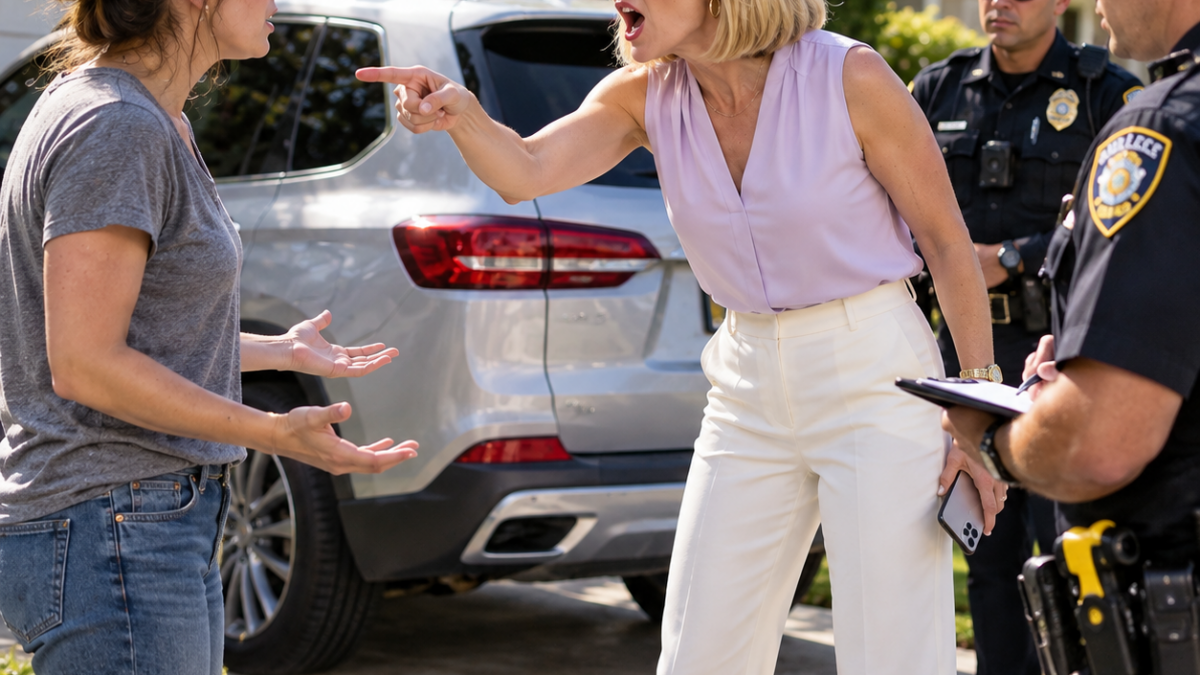
Up close, she had a face made for disapproval. Thin eyebrows, sharp cheekbones, lips pressed together like the world kept disappointing her on purpose. Her perfume floated through the evening air, heavy and sweet.
“I know where I parked,” she said.
I blinked.
“Okay. Then could you not park here?”
Her smirk deepened.
“I have parking rights.”
For a second, I genuinely thought I had heard her wrong.
“You have what?”
“Parking rights.” She said it again, slower, like English might be my second language. “I’ve parked here before.”
“That doesn’t give you rights.”
“I used this driveway when your grandmother lived here.”
“My grandmother let you?”
She gave a vague little shrug. “She never complained.”
That sentence made something in me tighten.
My grandmother had spent her last years too tired to argue with cashiers who rang things up wrong. She apologized to furniture when she bumped into it. The idea that Karen might have decided silence meant permission made my skin go hot.
“She wasn’t able to deal with much toward the end,” I said carefully. “But I live here now, and I’m telling you not to park in my driveway.”
Karen tilted her head.
“How old are you?”
The question was so insulting in context that I almost laughed.
“Old enough to own the house.”
“You inherited it,” she said, like that made it less mine.
“Yes.”
“So you’re new to how things work around here.”
“No,” I said. “I grew up here.”
“Then you should understand neighbors help each other.”
“I’m asking you not to block my driveway.”
“I wasn’t blocking anything.”
“You were parked in it.”
Her eyes flicked toward my car at the curb.
“You found a place.”
That was the first time I really saw her.
Not the sunglasses and stiff hair and expensive purse. Not the neighborly costume. Her.
Karen Whitaker was the kind of woman who believed inconvenience only counted when it happened to her. If she needed something, it became reasonable. If you objected, you became selfish. She did not see other people’s property as owned. She saw it as available unless defended with enough force to annoy her.
“I’m not debating this,” I said. “Please don’t park here again.”
She rolled her eyes and opened her car door.
“Young people are so territorial.”
Then she got in and drove away.
I stood on the curb, jaw clenched, and watched her pull into her own driveway.
Her own empty driveway.
That was the part that kept replaying in my head later. She had space. She had access. She had no need to use mine except that she wanted to, and wanting something was apparently enough for Karen.
For the next couple of weeks, she treated my driveway like a public option.
Sometimes I came home and found her SUV there for ten minutes. Sometimes an hour. Sometimes she parked with one tire on the grass because she could not be bothered to align herself with the concrete. Once, I found a fast-food cup tossed near my hedge, lipstick on the straw, ice melted into the bottom. Another time, she left a crumpled receipt in the driveway and it blew under my car.
Each incident by itself was small enough to make me feel ridiculous for being angry.
That was the trap.
A single drop is not a flood. But when it keeps dripping into the same place, eventually the ceiling gives.
I started parking in my own driveway whenever I could, hoping the obvious presence of my car would stop her. Instead, Karen adapted. If my driveway was full, she parked across the apron, half blocking the entrance. If I was already out, she took the open space. If I came home while she was there, she acted surprised, annoyed, or both.
Once, I caught her carrying grocery bags from her SUV.
“Karen,” I said, because by then Mrs. Alvarez had given me her name with a warning look. “You can’t keep doing this.”
She did not even stop walking.
“I’ll only be a minute.”
“You said that last time.”
“And I was.”
“You were there forty-five minutes.”
She turned, one grocery bag hooked over her wrist.
“Are you timing me now?”
“I’m documenting it.”
That made her laugh.
“Oh, please.”
“I’m serious.”
“So am I,” she snapped, and the mask slipped. “Your grandmother was never this rude.”
“My grandmother was sick.”
The words came out sharper than I intended.
Karen’s face hardened.
“Well,” she said, “maybe if she had raised you better, you would understand respect.”
For a moment, everything went quiet inside me.
The street, the birds, the distant hum of a lawn mower—gone.
I saw my grandmother’s hands shaking around a teacup. I saw her sitting in the old recliner, apologizing because she could not make dinner anymore. I saw her trying to smile when she forgot my name for thirty seconds and both of us pretended it had not happened.
And here was Karen, using her gentleness as proof that she had agreed to be stepped on.
“Move your car,” I said.
Karen stared at me.
“Excuse me?”
“Move. Your. Car.”
She must have heard something in my voice because, for once, she did not argue. She huffed, muttered something under her breath, and moved the SUV back to her own driveway.
But it did not end.
People like Karen do not treat boundaries as information. They treat them as challenges.
The breaking point came on the morning of my job interview.
It was not just any interview. It was the first real chance I had gotten since graduation. A junior operations role at a logistics company downtown. Full-time, benefits, growth potential—the kind of job that could turn the house from a temporary financial miracle into an actual future. I had prepared for days. I researched the company. I printed extra copies of my resume. I ironed my only good shirt twice because the first time did not feel lucky enough.
I woke early, showered, shaved carefully, and stood in front of the bathroom mirror practicing answers while my stomach tried to fold itself in half.
Tell me about a time you solved a problem under pressure.
I almost laughed at the memory later.
At 8:10, I walked out the front door with forty-five minutes to spare.
Karen’s SUV was across my driveway.
Not in it.
Across it.
My car was parked inside, nose toward the street, completely blocked.
At first, I stopped dead on the porch.
My brain refused to accept what my eyes were seeing. It was so perfectly cruel that it felt staged. Her SUV sat perpendicular across the driveway apron, rear bumper nearly touching my front fender, front end angled into the street. There was no way to squeeze around it. No way to back out. No room to maneuver.
I knocked on her door.
No answer.
I rang the bell.
Nothing.
I called the number Mrs. Alvarez had given me for emergencies, swallowing my pride hard enough to taste it.
Straight to voicemail.
I knocked again, louder this time.
Still nothing.
A neighbor’s curtains shifted.
I stood there in my suit, sweating under my collar, feeling the minutes fall away.
At 8:22, I ordered an Uber.
At 8:39, it arrived.
At 9:08, I walked into the interview eighteen minutes late, breathless, apologetic, and already defeated.
The receptionist gave me a sympathetic look that somehow made it worse. The hiring manager still saw me, but I could feel the energy in the room had shifted before I sat down. I tried to explain without sounding like a man who could not control his own life.
“My neighbor blocked my driveway,” I said.
Even to my own ears, it sounded ridiculous.
The interview lasted twenty-three minutes.
They thanked me for coming in.
Two days later, I got the email.
We have decided to move forward with another candidate.
I read it sitting at my grandmother’s kitchen table.
For a long time, I just stared at the screen.
Then I closed the laptop, walked outside, and looked at the empty rectangle of concrete that had somehow become the battlefield for my whole life.
That was when I stopped being polite.
Not reckless.
Not cruel.
Just done.
The next morning, I went to a hardware store and bought the biggest, clearest sign I could find.
PRIVATE DRIVEWAY. NO PARKING. VIOLATORS WILL BE TOWED AT OWNER’S EXPENSE.
I bolted it to the fence beside the driveway, level with a driver’s window, impossible to miss. I took pictures from three angles. Then I printed a written notice and taped it to Karen’s windshield the next time she parked there.
Karen,
This is private property. You do not have permission to park in this driveway or block access to it. If your vehicle is parked here again, it will be towed. This is your final written warning.
I signed my name.
She came outside twenty minutes later, read it, crumpled it in one fist, and threw it into my yard.
Then she looked directly at my front window.
She knew I was watching.
She smiled.
The next day, she parked in my driveway again.
This time, she left a note of her own on the dashboard.
It was written in thick black marker on torn cardboard.
YOU DON’T OWN THE STREET. I WILL PARK WHEREVER I WANT.
She had signed it.
Karen.
I stood there, reading that note through the windshield, and felt an odd calm settle over me.
There are moments in life when a person accidentally gives you permission to stop feeling guilty.
Karen had just handed me mine in Sharpie.
I called the tow company.
“Private property tow?” the dispatcher asked.
“Yes.”
“Is there signage?”
“Yes.”
“Is the vehicle blocking access?”
“Yes.”
“Do you own or occupy the property?”
“Yes.”
“We’ll send someone.”
The tow truck arrived twenty-five minutes later. The driver was a broad man named Eddie with a gray beard and the expression of someone who had seen every possible version of entitled stupidity.
He looked at the sign.
He looked at the SUV.
He looked at Karen’s note.
Then he looked at me.
“Neighbor?”
“Next door.”
He sighed. “Always is.”
I showed him proof of ownership, my ID, the warning photos, and the note she had tossed in my yard, now unfolded from where I had retrieved it and placed it in a folder. Eddie nodded with professional appreciation.
“You’re more prepared than most.”
“I’m learning.”
He hooked up the SUV in less than ten minutes.
Watching it roll away was more satisfying than I am proud to admit.
For the first time in weeks, my driveway was empty.
Mine.
I stood there with a cup of coffee, the morning sun warming the cracked concrete, and felt something inside me unclench. It was not victory exactly. It was quieter than that. More like breathing normally after you did not realize you had been holding air in your chest for too long.
Peace lasted fifty-three minutes.
Then Karen came storming across the lawn.
I heard her before I saw her.
“What did you do?”
Her voice tore through the neighborhood like a siren.
I stepped out onto the porch.
Karen was red-faced, hair wild around the edges despite the hairspray, sunglasses shoved crookedly on top of her head. She wore a matching workout set, though I doubted she had been exercising unless rage counted as cardio. Her phone was clutched in one hand, her car keys in the other, as if the keys alone should have summoned the SUV back.
“What did you do to my car?” she shrieked.
“I had it towed.”
“You stole it!”
“No. It was towed from private property.”
“You had no right!”
I pointed to the sign.
She barely looked.
“That sign is illegal.”
“No, it isn’t.”
“You can’t just make rules.”
“It’s my driveway.”
“It is not your driveway in the way you think it is.”
I almost asked what that meant, but I already knew the answer would be nonsense dressed as confidence.
“Call the tow yard,” I said. “They’ll tell you how to get it back.”
“You are paying for this.”
“No.”
Her mouth opened.
I repeated it before she could start.
“No.”
Something ugly flashed across her face.
“You little brat.”
I stepped down from the porch.
Karen took a half step back, not because I threatened her, but because bullies hate when the person they are shouting at gets closer calmly.
“You blocked me in on the morning of a job interview,” I said. “You ignored verbal requests. You ignored a written warning. You ignored a posted sign. You chose this.”
Her voice dropped into a hiss.
“You have no idea who you’re messing with.”
I looked at her house. Same peeling trim as mine. Same small driveway. Same cracked walkway.
“I think I do.”
That was when she dialed 911.
I should have been more alarmed.
Instead, I was stunned by the sheer theatrical commitment.
She lifted the phone to her ear and turned away from me just enough to perform for the imaginary jury in her head.
“Yes, I need police,” she said loudly. “My neighbor stole my vehicle.”
I closed my eyes.
Grand theft driveway, apparently.
“No, he had it taken,” she continued. “He arranged for someone to remove it without my consent. I want him arrested.”
I folded my arms and waited.
Mrs. Alvarez appeared on her porch across the street, watering can in hand, not watering anything.
Karen paced in my yard while she talked to the dispatcher, escalating the story with every sentence.
“He has been harassing me for weeks,” she said. “He threatened me. He stole my car. I don’t feel safe.”
That part made my stomach turn.
Not because I thought the claim would hold.
Because I understood, suddenly, how easily people like Karen reached for words that could ruin lives. Harassment. Threat. Unsafe. She did not care what those words meant. She cared how they sounded in a uniformed officer’s ear.
I went inside, grabbed my folder, and came back out before the officers arrived.
Two patrol cars pulled up ten minutes later.
Karen rushed them before they had both feet on the curb.
“Officers, thank God,” she said, one hand pressed dramatically to her chest. “That man stole my SUV.”
The older officer, a woman with tired eyes and silver in her dark hair, held up a hand.
“Ma’am, slow down.”
“He had people come and take it. I want him arrested.”
The younger officer looked at me.
“Sir, is that your property?”
“Yes,” I said. “I live here.”
Karen snapped, “He inherited it. He barely even lives here.”
The older officer’s eyes flicked toward her.
“That wasn’t my question.”
I almost smiled.
Almost.
Karen launched into a story so bold it would have been impressive if it had not been aimed at me. According to her, I had been angry for no reason. I had harassed her over “shared neighborhood parking.” I had “stalked” her vehicle. Then, that morning, I had arranged to have it “stolen” while she was inside her home. At one point, she implied I might have personally moved it.
The younger officer glanced at my driveway, then back at me.
I could see the question forming.
If I stole her car, why was I standing there without it?
The older officer let Karen talk for several minutes. That patience was either training or punishment. Karen mistook it for belief and grew more confident.
“He is unstable,” she said. “He has been obsessed with where I park. I have rights here. I used this driveway for years before he showed up.”
The officer turned to me.
“Your side?”
I handed her the folder.
Inside were photos of the sign, photos of Karen’s SUV in the driveway, photos of the note she had left, a copy of my written warning, a picture of the crumpled warning after she threw it in my yard, and the tow receipt Eddie had given me.
The older officer read silently.
The younger officer leaned in.
Karen kept talking until she noticed they were not looking at her.
“What is that?” she demanded.
“Documentation,” I said.
She scoffed. “He’s been building a file on me. See? That’s harassment.”
The older officer looked at her over the papers.
“Ma’am, documenting repeated unauthorized parking on private property is not harassment.”
Karen blinked like the sentence had been spoken in another language.
The officer pointed toward the sign.
“That sign is clear. This is his driveway. He gave warning. The tow appears lawful. You’ll need to contact the impound lot.”
Karen’s face changed color.
I had seen people get angry before, but this was different. This was entitlement colliding with reality at full speed.
“No,” she said.
The officer’s eyebrows rose.
“No?”
“No. You are not understanding me. He stole my car.”
“It was towed.”
“Because he called them.”
“From private property.”
“I have parking rights.”
The younger officer asked, “Do you have documentation of those rights?”
Karen’s mouth opened, then closed.
“I don’t need documentation. Ask anyone. I parked here before.”
“That does not create a legal right.”
Karen laughed once, high and sharp.
“You people are unbelievable.”
The older officer’s posture shifted. Not aggressive. Alert.
“Ma’am, I need you to lower your voice.”
“I will not lower my voice when my property has been stolen.”
“Your vehicle is at a tow yard.”
“Because of him!”
The officer stayed calm.
“Then you can address the tow through the proper channels.”
Karen pointed at me.
“Arrest him.”
“No.”
It was a small word.
It broke something in her.
Her face twisted, and she stepped toward the older officer.
“You work for me,” she snapped. “My taxes pay your salary.”
The younger officer said, “Ma’am, step back.”
Karen ignored him.
“This is corruption. This is what happens when lazy cops don’t want to do their jobs. He is standing right there, admitting he took my vehicle, and you’re doing nothing.”
“Ma’am,” the older officer said, firmer now, “you need to calm down.”
“Don’t tell me to calm down!”
She shoved the officer.
It was not a stumble. Not an accidental brush.
Two hands to the chest.
For one stunned half second, nobody moved.
Even Karen looked surprised by herself.
Then the younger officer reached for her arm.
“Ma’am, turn around.”
Karen swung.
Her open hand caught him across the side of the face.
Mrs. Alvarez gasped from across the street.
The older officer grabbed Karen’s other arm, and Karen started flailing, screaming, twisting with a wild strength that seemed to come from pure disbelief that consequences had arrived. She kicked backward, nearly lost a sandal, and screamed that they were assaulting her.
“Stop resisting!” the younger officer shouted.
“I know my rights!”
“Hands behind your back!”
“You can’t touch me!”
They could.
They did.
Within seconds, Karen was on the grass, wrists cuffed behind her back, still screaming into my front yard.
“This is his fault!” she yelled. “He did this! He stole my car!”
The older officer looked at me while catching her breath.
I raised both hands slightly, palms out, because what else was there to do?
“I’m just standing here.”
Karen kicked at the grass.
“You’ll pay for this!”
The younger officer, cheek red where she had hit him, helped lift her to her feet.
“No,” he said, voice flat. “You will.”
They put her in the back of the patrol car.
Even through the closed door, I could hear her yelling.
The neighborhood had gone completely still.
People stood in doorways and behind curtains. Mrs. Alvarez crossed herself. A man walking his dog at the corner had frozen in place, the dog sniffing a mailbox like police violence over driveway parking was part of its regular route.
The older officer gave me back my folder.
“You did everything right,” she said.
It should have comforted me.
Instead, my hands started shaking.
Not badly. Just enough that the papers trembled when I took them.
“Is he okay?” I asked, nodding toward her partner.
“He’ll be fine.”
“I didn’t think she’d do that.”
The officer looked toward the patrol car, where Karen was still moving behind the glass like a trapped wasp.
“People surprise you.”
After they left, the street remained quiet for a long time.
I picked up Karen’s sandal from the edge of my lawn and set it beside her porch steps because, despite everything, my grandmother had raised me not to leave someone’s shoe in the grass.
Then I went inside.
The house felt different.
Not peaceful exactly. The adrenaline had nowhere to go, so it moved around in my body like electricity. I walked from room to room, unable to sit. I washed my coffee mug even though it was already clean. I checked the front window twelve times. I opened my laptop, closed it, opened it again.
Eventually, I sat at the kitchen table and cried.
Not because I was scared of Karen.
Because I was exhausted.
Because one woman had taken a place that already held grief and made it feel unsafe. Because I had spent weeks feeling ridiculous for wanting control over my own driveway. Because I had lost a job opportunity, sleep, and peace to someone who believed my reluctance to fight meant she had won.
And because when the police car pulled away with her in the back, I felt relief so strong it embarrassed me.
News traveled fast.
By evening, three neighbors had knocked on my door.
Mrs. Alvarez came first with a container of chicken soup and the kind of look that said she had been waiting for Karen to explode for years.
“She always was mean,” she said, standing in my kitchen. “But not like that.”
“What was she like with my grandmother?”
Mrs. Alvarez looked down at the soup container.
“She parked there sometimes. Your grandmother didn’t like it.”
My throat tightened.
“She told you that?”
“She said she didn’t want trouble.”
Of course she had.
My grandmother, who had survived medical appointments, bills, loneliness, and pain with quiet dignity, had been bullied in her own driveway by a woman who later used that silence as permission.
I had to grip the counter.
Mrs. Alvarez touched my arm.
“You stopped it,” she said.
“I wish I’d stopped it sooner.”
“She would not want you blaming yourself.”
Maybe not.
But grief has teeth, and guilt gives it something to chew.
Over the next few days, more pieces surfaced.
Karen’s car remained at the tow yard, gathering daily storage fees. Her family tried to get it released but ran into paperwork issues because Karen was in custody. Someone said her sister came by the house and left furious after discovering Karen had hidden some financial problems. Someone else said the SUV was behind on payments. I did not know what was true, and I tried not to care.
Then came the bond hearing.
I heard about it from Mr. Patel two houses down, who had a nephew working at the courthouse and a talent for delivering neighborhood news with the solemnity of a weather report.
“Three hundred seventy-five thousand,” he told me over the fence.
I thought I had misheard.
“Her bond?”
He nodded.
“Because of the assault charges?”
“Multiple charges. Assault on law enforcement. Resisting. False report. Disorderly conduct. And apparently prior issues.”
That last part spread quickly.
Karen had a history. Not dramatic enough for anyone to warn me directly, apparently, but enough that people nodded afterward and said things like, I always wondered when she’d go too far. A prior disorderly conduct incident. Some screaming match at a store. A neighbor dispute before she moved in. Stories emerged like mushrooms after rain.
That made me angry in a new way.
Not because people had known everything. They hadn’t.
But because they had known enough to avoid her, and avoidance had created a path straight to my grandmother, then to me.
Karen had counted on everyone deciding she was not worth the trouble.
And for a long time, she had been right.
Her family did not get her out right away. Whether they could not afford it or would not risk putting up property, I never knew for sure. Her house went quiet. No SUV. No shouting. No gold sandals clicking across my concrete. Her blinds stayed closed.
For the first time since I moved in, I parked in my driveway without checking the window every twenty minutes.
That sounds like a small thing.
It was not.
I began reclaiming my routines.
Morning coffee on the porch. Saturday yard work. Groceries unloaded directly from my trunk to my kitchen without parking on the street. I cleaned the garage and found an old box of my grandfather’s fishing lures. I painted the front railing blue because my grandmother had always wanted to but worried it would look “too bold.”
It looked beautiful.
One afternoon, I sat on the porch steps and watched the paint dry, and Mrs. Alvarez called across the street, “Your grandmother would like that.”
I had to look away for a second.
The logistics company never called back, but another opportunity came a month later. A better one, somehow. Smaller company, kinder interview, manager who laughed when I said I believed in documentation because of a recent neighbor issue.
I got that job.
On my first day, I walked out of the house an hour early.
Not because I needed to.
Because for once, I could.
My car was waiting in my driveway, exactly where I had left it.
The sign remained on the fence.
PRIVATE DRIVEWAY. NO PARKING. VIOLATORS WILL BE TOWED AT OWNER’S EXPENSE.
I had considered taking it down after Karen was arrested, but I decided against it. Not out of fear. Out of principle. Boundaries should not disappear just because the person who tested them is gone.
A few weeks later, I received a letter from Karen.
The envelope had been forwarded through some legal process, and the handwriting was stiff and angry. I almost threw it away unopened. Then I thought of every time I had stayed silent because I wanted peace, and I opened it.
It was not an apology.
Of course it wasn’t.
She blamed me for everything.
Her arrest. Her bond. Her car fees. Her reputation. Her family’s stress. The embarrassment. The charges. She wrote that I had “provoked a misunderstanding” and that any decent neighbor would have knocked on her door instead of calling a tow truck.
I laughed out loud at that part.
I had knocked.
I had asked.
I had warned.
She ended the letter with one sentence underlined twice.
You ruined my life over a parking spot.
I read that sentence several times.
Then I took out a pen and wrote a response I never mailed.
No, Karen. You ruined your life because you believed nobody else’s no mattered.
I folded her letter, put it in the same folder as the photographs, tow slip, and police report, and slid it into my file cabinet.
Not because I needed it anymore.
Because I wanted a record of the truth.
Months passed.
Karen eventually came back to the neighborhood, but not in the way she had left it. She moved quietly. Her family helped her clean out the house. The SUV never returned. A smaller sedan appeared briefly, then vanished. For two days, there was a rental truck in her driveway—her driveway, not mine—and then she was gone.
She did not knock.
She did not look at my house.
On the final afternoon, I saw her standing by the curb while movers loaded a sofa. Her hair was still blond, but shorter. Her sunglasses were gone. She looked smaller without an audience.
For one second, she glanced toward my driveway.
Then she looked away.
I felt no triumph.
That surprised me.
I had imagined, during the worst of it, that seeing Karen defeated would feel like a parade inside my chest. Instead, it felt like watching a storm move off after knocking down branches. Relief, yes. Satisfaction, yes. But mostly, I felt tired of the damage.
Mrs. Alvarez came over that evening with two lemonades.
“She’s gone,” she said, sitting beside me on the porch.
“I saw.”
“You okay?”
I watched the sunset turn the street gold.
“Yeah,” I said. “I think so.”
“You know,” she said, “your grandmother used to say this house needed someone stubborn.”
I smiled a little.
“She called me stubborn all the time.”
“She meant it as praise.”
I looked at the driveway.
Cracked concrete. Faded oil stain near the garage. One corner dark where rainwater collected. Nothing special to anyone else.
But it was mine.
Not because paperwork said so, though it did.
Because my grandmother had trusted me with it. Because I had come back to a place full of ghosts and bills and repairs and tried to make a life. Because I had learned, painfully and late, that keeping peace with someone determined to take from you is not kindness. It is surrender.
Karen taught me that.
Not intentionally.
People like Karen rarely teach by wisdom. They teach by impact.
She taught me that entitlement does not always arrive shouting. Sometimes it arrives with a wave from your driveway. Sometimes it smiles. Sometimes it says it has rights. Sometimes it uses your politeness as a ladder. Sometimes it calls the police and cries victim while standing on the line it crossed.
And sometimes, if you are lucky and prepared, it reveals itself in front of witnesses.
The new neighbors who moved into Karen’s house were a young couple with a baby and a golden retriever. On their first weekend, the husband knocked on my door and introduced himself. He looked nervous, like maybe he had heard stories.
“Hey,” he said, pointing toward the driveway. “Just wanted to ask—we’re having family over Sunday. If someone parks badly or anything, please tell us. We don’t want to be those neighbors.”
I almost laughed.
Instead, I shook his hand.
“Thanks for asking.”
As he walked away, I looked at the sign.
For a moment, I thought about explaining the whole thing. The SUV. The interview. The tow truck. The police. Karen swinging at officers in my front yard because she could not survive being told no.
But some stories do not need to be told right away.
Some stories live quietly in the rules they leave behind.
Now, every morning before work, I step onto the porch with my coffee and look at the driveway out of habit. Most days, it is empty except for my car. Some mornings, sunlight hits the windshield. Some mornings, rain beads on the hood. In autumn, maple leaves gather near the tires, and I sweep them away with the old broom my grandmother kept by the door.
The house still creaks.
The water heater still sounds like angry marbles.
The porch steps still complain.
But it feels like home again.
Not untouched. Not innocent.
Mine.
And if there is one thing I know now, it is this:
A driveway can be just concrete to the world and still be the line between being walked over and standing up.
Karen thought she was fighting over a parking spot.
She never understood that I was fighting for the first place I had ever belonged.
𝗧𝗛𝗘 𝗘𝗡𝗗
Karen Parked in My Driveway Like She Owned My Life Until the Police Learned What Kind of Woman She Really Was
Karen did not just steal my driveway.
She stole my mornings, my patience, and the last peaceful thing my grandmother had left me.
The first time I saw her SUV sitting in my driveway, I thought there had to be a reasonable explanation.
That was back when I still believed most people needed a reason before they crossed a line.
I had inherited my grandmother’s house only a few months earlier. Even now, the word inherited feels too clean for what actually happened. It sounds like paperwork and keys and a quiet transfer of property. It does not capture the smell of her lavender hand soap still sitting by the bathroom sink, or the dent in the living room carpet where her recliner had been, or the way I kept expecting to hear her humming in the kitchen every time the old refrigerator kicked on.
My parents were never really in the picture. My grandparents raised me in that house, and when my grandfather died, the place seemed to shrink around my grandmother. She held on as long as she could. Then her health started slipping in a way none of us could pretend around anymore, and she moved into an assisted living facility across town.
She told me to take the house.
Not because it was a grand gift. Not because she was rich. Because she wanted someone who loved it to live in it.
I was fresh out of college, broke in the specific way that makes every grocery receipt feel personal, and trying to build an adult life out of borrowed furniture, student debt, and quiet panic. The house was old, but it was paid for. The roof needed work, the porch steps complained under every footstep, and the water heater sounded like it was full of angry marbles, but it was home.
Or at least I was trying to make it feel like home again.
For the first few weeks, I spent my evenings unpacking boxes and my weekends fixing small things my grandmother had been too tired to manage. I replaced cracked outlet covers. I cleaned gutters. I trimmed the overgrown hedge along the side yard. I found my grandfather’s old socket set in the garage and cried for ten minutes with a wrench in my hand because grief is strange like that. It waits until you are doing something practical, then steps out from behind a memory and hits you in the chest.
The neighborhood looked almost the same as it had when I was a kid.
Small houses. Narrow lawns. Driveways barely wide enough for one car. People who waved from porches but knew when not to ask questions. Across the street, Mrs. Alvarez still had the blue ceramic birdbath she had owned since I was eight. Two doors down, the Millers’ old maple tree was bigger but still dropped leaves like it was trying to bury the sidewalk every fall.
And next door lived Karen Whitaker.
I did not know her name yet that first morning.
All I knew was that when I stepped outside with my travel mug and keys, there was a silver SUV parked in my driveway like it belonged there.
At first, I stopped on the porch and just stared.
My car was on the street because I had been unloading boxes the night before and left the driveway clear. The SUV sat squarely in the middle of the concrete, close enough to the garage that nobody else could pull in, angled just slightly like the person who parked it had not even bothered to straighten out.
I checked the house number.
Mine.
I looked up and down the street.
No delivery truck. No moving crew. No confused visitor standing by the door.
Then a woman came walking from next door.
She moved like the sidewalk owed her an apology. Mid-forties, maybe early fifties, with stiff blond hair sprayed into place and sunglasses perched on her head even though the morning was cloudy. She wore white jeans, a coral blouse, and sandals with gold buckles that clicked against my driveway as if announcing royalty.
She had a purse over one shoulder and a phone in her hand.
When she saw me, she did not look embarrassed.
She did not say sorry.
She did not ask if I lived there.
She smiled.
Not warmly. Not kindly.
A small, smug smile, like she had caught me noticing something I was too powerless to change.
Then she lifted one hand in a quick little wave, opened the SUV door, climbed in, backed out of my driveway, and drove away.
I stood there holding my coffee, still half asleep, wondering if I had somehow missed a whole conversation.
Maybe she had known my grandmother.
Maybe there had been some temporary arrangement.
Maybe she had parked there once because her driveway was blocked or she had guests or some emergency had happened.
That was what I told myself.
Because back then, I still wanted things to be simple.
part2
The second time it happened, I tried to be polite.
That is something people like Karen count on. They count on good manners being stronger than self-respect. They count on decent people feeling awkward about enforcing obvious boundaries. They count on the pause between being offended and saying so.
I came home from work on a Wednesday evening after spending nine hours at a temp admin job that made my brain feel like printer paper. I was tired, hungry, and thinking about whether I had enough energy to cook pasta or whether dinner was going to be peanut butter on toast over the sink.
Then I turned onto my street and saw the silver SUV in my driveway again.
This time, I knew it was not an accident.
My headlights washed over its rear bumper as I slowed down. Same vehicle. Same crooked angle. Same complete disregard for the fact that someone else might live there.
I parked on the street in front of my own house and sat there for a moment with both hands on the wheel.
I could feel the old version of myself reaching for excuses.
Maybe she forgot.
Maybe she thought the house was still empty.
Maybe there really was some agreement with Grandma.
Then my front porch light came on, and the woman stepped out from next door.
Not my porch. Hers.
She walked across the strip of grass between our houses, fishing her keys out of her purse. She looked at me, looked at my car parked at the curb, and smirked.
That smirk did it.
I got out.
“Hey,” I called, keeping my voice as calm as I could. “Just so you know, this is my driveway.”
She stopped beside her SUV and turned slowly.
Up close, she had a face made for disapproval. Thin eyebrows, sharp cheekbones, lips pressed together like the world kept disappointing her on purpose. Her perfume floated through the evening air, heavy and sweet.
“I know where I parked,” she said.
I blinked.
“Okay. Then could you not park here?”
Her smirk deepened.
“I have parking rights.”
For a second, I genuinely thought I had heard her wrong.
“You have what?”
“Parking rights.” She said it again, slower, like English might be my second language. “I’ve parked here before.”
“That doesn’t give you rights.”
“I used this driveway when your grandmother lived here.”
“My grandmother let you?”
She gave a vague little shrug. “She never complained.”
That sentence made something in me tighten.
My grandmother had spent her last years too tired to argue with cashiers who rang things up wrong. She apologized to furniture when she bumped into it. The idea that Karen might have decided silence meant permission made my skin go hot.
“She wasn’t able to deal with much toward the end,” I said carefully. “But I live here now, and I’m telling you not to park in my driveway.”
Karen tilted her head.
“How old are you?”
The question was so insulting in context that I almost laughed.
“Old enough to own the house.”
“You inherited it,” she said, like that made it less mine.
“Yes.”
“So you’re new to how things work around here.”
“No,” I said. “I grew up here.”
“Then you should understand neighbors help each other.”
“I’m asking you not to block my driveway.”
“I wasn’t blocking anything.”
“You were parked in it.”
Her eyes flicked toward my car at the curb.
“You found a place.”
That was the first time I really saw her.
Not the sunglasses and stiff hair and expensive purse. Not the neighborly costume. Her.
Karen Whitaker was the kind of woman who believed inconvenience only counted when it happened to her. If she needed something, it became reasonable. If you objected, you became selfish. She did not see other people’s property as owned. She saw it as available unless defended with enough force to annoy her.
“I’m not debating this,” I said. “Please don’t park here again.”
She rolled her eyes and opened her car door.
“Young people are so territorial.”
Then she got in and drove away.
I stood on the curb, jaw clenched, and watched her pull into her own driveway.
Her own empty driveway.
That was the part that kept replaying in my head later. She had space. She had access. She had no need to use mine except that she wanted to, and wanting something was apparently enough for Karen.
For the next couple of weeks, she treated my driveway like a public option.
Sometimes I came home and found her SUV there for ten minutes. Sometimes an hour. Sometimes she parked with one tire on the grass because she could not be bothered to align herself with the concrete. Once, I found a fast-food cup tossed near my hedge, lipstick on the straw, ice melted into the bottom. Another time, she left a crumpled receipt in the driveway and it blew under my car.
Each incident by itself was small enough to make me feel ridiculous for being angry.
That was the trap.
A single drop is not a flood. But when it keeps dripping into the same place, eventually the ceiling gives.
I started parking in my own driveway whenever I could, hoping the obvious presence of my car would stop her. Instead, Karen adapted. If my driveway was full, she parked across the apron, half blocking the entrance. If I was already out, she took the open space. If I came home while she was there, she acted surprised, annoyed, or both.
Once, I caught her carrying grocery bags from her SUV.
“Karen,” I said, because by then Mrs. Alvarez had given me her name with a warning look. “You can’t keep doing this.”
She did not even stop walking.
“I’ll only be a minute.”
“You said that last time.”
“And I was.”
“You were there forty-five minutes.”
She turned, one grocery bag hooked over her wrist.
“Are you timing me now?”
“I’m documenting it.”
That made her laugh.
“Oh, please.”
“I’m serious.”
“So am I,” she snapped, and the mask slipped. “Your grandmother was never this rude.”
“My grandmother was sick.”
The words came out sharper than I intended.
Karen’s face hardened.
“Well,” she said, “maybe if she had raised you better, you would understand respect.”
For a moment, everything went quiet inside me.
The street, the birds, the distant hum of a lawn mower—gone.
I saw my grandmother’s hands shaking around a teacup. I saw her sitting in the old recliner, apologizing because she could not make dinner anymore. I saw her trying to smile when she forgot my name for thirty seconds and both of us pretended it had not happened.
And here was Karen, using her gentleness as proof that she had agreed to be stepped on.
“Move your car,” I said.
Karen stared at me.
“Excuse me?”
“Move. Your. Car.”
She must have heard something in my voice because, for once, she did not argue. She huffed, muttered something under her breath, and moved the SUV back to her own driveway.
But it did not end.
People like Karen do not treat boundaries as information. They treat them as challenges.
The breaking point came on the morning of my job interview.
It was not just any interview. It was the first real chance I had gotten since graduation. A junior operations role at a logistics company downtown. Full-time, benefits, growth potential—the kind of job that could turn the house from a temporary financial miracle into an actual future. I had prepared for days. I researched the company. I printed extra copies of my resume. I ironed my only good shirt twice because the first time did not feel lucky enough.
I woke early, showered, shaved carefully, and stood in front of the bathroom mirror practicing answers while my stomach tried to fold itself in half.
Tell me about a time you solved a problem under pressure.
I almost laughed at the memory later.
At 8:10, I walked out the front door with forty-five minutes to spare.
Karen’s SUV was across my driveway.
Not in it.
Across it.
My car was parked inside, nose toward the street, completely blocked.
At first, I stopped dead on the porch.
My brain refused to accept what my eyes were seeing. It was so perfectly cruel that it felt staged. Her SUV sat perpendicular across the driveway apron, rear bumper nearly touching my front fender, front end angled into the street. There was no way to squeeze around it. No way to back out. No room to maneuver.
I knocked on her door.
No answer.
I rang the bell.
Nothing.
I called the number Mrs. Alvarez had given me for emergencies, swallowing my pride hard enough to taste it.
Straight to voicemail.
I knocked again, louder this time.
Still nothing.
A neighbor’s curtains shifted.
I stood there in my suit, sweating under my collar, feeling the minutes fall away.
At 8:22, I ordered an Uber.
At 8:39, it arrived.
At 9:08, I walked into the interview eighteen minutes late, breathless, apologetic, and already defeated.
The receptionist gave me a sympathetic look that somehow made it worse. The hiring manager still saw me, but I could feel the energy in the room had shifted before I sat down. I tried to explain without sounding like a man who could not control his own life.
“My neighbor blocked my driveway,” I said.
Even to my own ears, it sounded ridiculous.
The interview lasted twenty-three minutes.
They thanked me for coming in.
Two days later, I got the email.
We have decided to move forward with another candidate.
I read it sitting at my grandmother’s kitchen table.
For a long time, I just stared at the screen.
Then I closed the laptop, walked outside, and looked at the empty rectangle of concrete that had somehow become the battlefield for my whole life.
That was when I stopped being polite.
Not reckless.
Not cruel.
Just done.
The next morning, I went to a hardware store and bought the biggest, clearest sign I could find.
PRIVATE DRIVEWAY. NO PARKING. VIOLATORS WILL BE TOWED AT OWNER’S EXPENSE.
I bolted it to the fence beside the driveway, level with a driver’s window, impossible to miss. I took pictures from three angles. Then I printed a written notice and taped it to Karen’s windshield the next time she parked there.
Karen,
This is private property. You do not have permission to park in this driveway or block access to it. If your vehicle is parked here again, it will be towed. This is your final written warning.
I signed my name.
She came outside twenty minutes later, read it, crumpled it in one fist, and threw it into my yard.
Then she looked directly at my front window.
She knew I was watching.
She smiled.
The next day, she parked in my driveway again.
This time, she left a note of her own on the dashboard.
It was written in thick black marker on torn cardboard.
YOU DON’T OWN THE STREET. I WILL PARK WHEREVER I WANT.
She had signed it.
Karen.
I stood there, reading that note through the windshield, and felt an odd calm settle over me.
There are moments in life when a person accidentally gives you permission to stop feeling guilty.
Karen had just handed me mine in Sharpie.
I called the tow company.
“Private property tow?” the dispatcher asked.
“Yes.”
“Is there signage?”
“Yes.”
“Is the vehicle blocking access?”
“Yes.”
“Do you own or occupy the property?”
“Yes.”
“We’ll send someone.”
The tow truck arrived twenty-five minutes later. The driver was a broad man named Eddie with a gray beard and the expression of someone who had seen every possible version of entitled stupidity.
He looked at the sign.
He looked at the SUV.
He looked at Karen’s note.
Then he looked at me.
“Neighbor?”
“Next door.”
He sighed. “Always is.”
I showed him proof of ownership, my ID, the warning photos, and the note she had tossed in my yard, now unfolded from where I had retrieved it and placed it in a folder. Eddie nodded with professional appreciation.
“You’re more prepared than most.”
“I’m learning.”
He hooked up the SUV in less than ten minutes.
Watching it roll away was more satisfying than I am proud to admit.
For the first time in weeks, my driveway was empty.
Mine.
I stood there with a cup of coffee, the morning sun warming the cracked concrete, and felt something inside me unclench. It was not victory exactly. It was quieter than that. More like breathing normally after you did not realize you had been holding air in your chest for too long.
Peace lasted fifty-three minutes.
Then Karen came storming across the lawn.
I heard her before I saw her.
“What did you do?”
Her voice tore through the neighborhood like a siren.
I stepped out onto the porch.
Karen was red-faced, hair wild around the edges despite the hairspray, sunglasses shoved crookedly on top of her head. She wore a matching workout set, though I doubted she had been exercising unless rage counted as cardio. Her phone was clutched in one hand, her car keys in the other, as if the keys alone should have summoned the SUV back.
“What did you do to my car?” she shrieked.
“I had it towed.”
“You stole it!”
“No. It was towed from private property.”
“You had no right!”
I pointed to the sign.
She barely looked.
“That sign is illegal.”
“No, it isn’t.”
“You can’t just make rules.”
“It’s my driveway.”
“It is not your driveway in the way you think it is.”
I almost asked what that meant, but I already knew the answer would be nonsense dressed as confidence.
“Call the tow yard,” I said. “They’ll tell you how to get it back.”
“You are paying for this.”
“No.”
Her mouth opened.
I repeated it before she could start.
“No.”
Something ugly flashed across her face.
“You little brat.”
I stepped down from the porch.
Karen took a half step back, not because I threatened her, but because bullies hate when the person they are shouting at gets closer calmly.
“You blocked me in on the morning of a job interview,” I said. “You ignored verbal requests. You ignored a written warning. You ignored a posted sign. You chose this.”
Her voice dropped into a hiss.
“You have no idea who you’re messing with.”
I looked at her house. Same peeling trim as mine. Same small driveway. Same cracked walkway.
“I think I do.”
That was when she dialed 911.
I should have been more alarmed.
Instead, I was stunned by the sheer theatrical commitment.
She lifted the phone to her ear and turned away from me just enough to perform for the imaginary jury in her head.
“Yes, I need police,” she said loudly. “My neighbor stole my vehicle.”
I closed my eyes.
Grand theft driveway, apparently.
“No, he had it taken,” she continued. “He arranged for someone to remove it without my consent. I want him arrested.”
I folded my arms and waited.
Mrs. Alvarez appeared on her porch across the street, watering can in hand, not watering anything.
Karen paced in my yard while she talked to the dispatcher, escalating the story with every sentence.
“He has been harassing me for weeks,” she said. “He threatened me. He stole my car. I don’t feel safe.”
That part made my stomach turn.
Not because I thought the claim would hold.
Because I understood, suddenly, how easily people like Karen reached for words that could ruin lives. Harassment. Threat. Unsafe. She did not care what those words meant. She cared how they sounded in a uniformed officer’s ear.
I went inside, grabbed my folder, and came back out before the officers arrived.
Two patrol cars pulled up ten minutes later.
Karen rushed them before they had both feet on the curb.
“Officers, thank God,” she said, one hand pressed dramatically to her chest. “That man stole my SUV.”
The older officer, a woman with tired eyes and silver in her dark hair, held up a hand.
“Ma’am, slow down.”
“He had people come and take it. I want him arrested.”
The younger officer looked at me.
“Sir, is that your property?”
“Yes,” I said. “I live here.”
Karen snapped, “He inherited it. He barely even lives here.”
The older officer’s eyes flicked toward her.
“That wasn’t my question.”
I almost smiled.
Almost.
Karen launched into a story so bold it would have been impressive if it had not been aimed at me. According to her, I had been angry for no reason. I had harassed her over “shared neighborhood parking.” I had “stalked” her vehicle. Then, that morning, I had arranged to have it “stolen” while she was inside her home. At one point, she implied I might have personally moved it.
The younger officer glanced at my driveway, then back at me.
I could see the question forming.
If I stole her car, why was I standing there without it?
The older officer let Karen talk for several minutes. That patience was either training or punishment. Karen mistook it for belief and grew more confident.
“He is unstable,” she said. “He has been obsessed with where I park. I have rights here. I used this driveway for years before he showed up.”
The officer turned to me.
“Your side?”
I handed her the folder.
Inside were photos of the sign, photos of Karen’s SUV in the driveway, photos of the note she had left, a copy of my written warning, a picture of the crumpled warning after she threw it in my yard, and the tow receipt Eddie had given me.
The older officer read silently.
The younger officer leaned in.
Karen kept talking until she noticed they were not looking at her.
“What is that?” she demanded.
“Documentation,” I said.
She scoffed. “He’s been building a file on me. See? That’s harassment.”
The older officer looked at her over the papers.
“Ma’am, documenting repeated unauthorized parking on private property is not harassment.”
Karen blinked like the sentence had been spoken in another language.
The officer pointed toward the sign.
“That sign is clear. This is his driveway. He gave warning. The tow appears lawful. You’ll need to contact the impound lot.”
Karen’s face changed color.
I had seen people get angry before, but this was different. This was entitlement colliding with reality at full speed.
“No,” she said.
The officer’s eyebrows rose.
“No?”
“No. You are not understanding me. He stole my car.”
“It was towed.”
“Because he called them.”
“From private property.”
“I have parking rights.”
The younger officer asked, “Do you have documentation of those rights?”
Karen’s mouth opened, then closed.
“I don’t need documentation. Ask anyone. I parked here before.”
“That does not create a legal right.”
Karen laughed once, high and sharp.
“You people are unbelievable.”
The older officer’s posture shifted. Not aggressive. Alert.
“Ma’am, I need you to lower your voice.”
“I will not lower my voice when my property has been stolen.”
“Your vehicle is at a tow yard.”
“Because of him!”
The officer stayed calm.
“Then you can address the tow through the proper channels.”
Karen pointed at me.
“Arrest him.”
“No.”
It was a small word.
It broke something in her.
Her face twisted, and she stepped toward the older officer.
“You work for me,” she snapped. “My taxes pay your salary.”
The younger officer said, “Ma’am, step back.”
Karen ignored him.
“This is corruption. This is what happens when lazy cops don’t want to do their jobs. He is standing right there, admitting he took my vehicle, and you’re doing nothing.”
“Ma’am,” the older officer said, firmer now, “you need to calm down.”
“Don’t tell me to calm down!”
She shoved the officer.
It was not a stumble. Not an accidental brush.
Two hands to the chest.
For one stunned half second, nobody moved.
Even Karen looked surprised by herself.
Then the younger officer reached for her arm.
“Ma’am, turn around.”
Karen swung.
Her open hand caught him across the side of the face.
Mrs. Alvarez gasped from across the street.
The older officer grabbed Karen’s other arm, and Karen started flailing, screaming, twisting with a wild strength that seemed to come from pure disbelief that consequences had arrived. She kicked backward, nearly lost a sandal, and screamed that they were assaulting her.
“Stop resisting!” the younger officer shouted.
“I know my rights!”
“Hands behind your back!”
“You can’t touch me!”
They could.
They did.
Within seconds, Karen was on the grass, wrists cuffed behind her back, still screaming into my front yard.
“This is his fault!” she yelled. “He did this! He stole my car!”
The older officer looked at me while catching her breath.
I raised both hands slightly, palms out, because what else was there to do?
“I’m just standing here.”
Karen kicked at the grass.
“You’ll pay for this!”
The younger officer, cheek red where she had hit him, helped lift her to her feet.
“No,” he said, voice flat. “You will.”
They put her in the back of the patrol car.
Even through the closed door, I could hear her yelling.
The neighborhood had gone completely still.
People stood in doorways and behind curtains. Mrs. Alvarez crossed herself. A man walking his dog at the corner had frozen in place, the dog sniffing a mailbox like police violence over driveway parking was part of its regular route.
The older officer gave me back my folder.
“You did everything right,” she said.
It should have comforted me.
Instead, my hands started shaking.
Not badly. Just enough that the papers trembled when I took them.
“Is he okay?” I asked, nodding toward her partner.
“He’ll be fine.”
“I didn’t think she’d do that.”
The officer looked toward the patrol car, where Karen was still moving behind the glass like a trapped wasp.
“People surprise you.”
After they left, the street remained quiet for a long time.
I picked up Karen’s sandal from the edge of my lawn and set it beside her porch steps because, despite everything, my grandmother had raised me not to leave someone’s shoe in the grass.
Then I went inside.
The house felt different.
Not peaceful exactly. The adrenaline had nowhere to go, so it moved around in my body like electricity. I walked from room to room, unable to sit. I washed my coffee mug even though it was already clean. I checked the front window twelve times. I opened my laptop, closed it, opened it again.
Eventually, I sat at the kitchen table and cried.
Not because I was scared of Karen.
Because I was exhausted.
Because one woman had taken a place that already held grief and made it feel unsafe. Because I had spent weeks feeling ridiculous for wanting control over my own driveway. Because I had lost a job opportunity, sleep, and peace to someone who believed my reluctance to fight meant she had won.
And because when the police car pulled away with her in the back, I felt relief so strong it embarrassed me.
News traveled fast.
By evening, three neighbors had knocked on my door.
Mrs. Alvarez came first with a container of chicken soup and the kind of look that said she had been waiting for Karen to explode for years.
“She always was mean,” she said, standing in my kitchen. “But not like that.”
“What was she like with my grandmother?”
Mrs. Alvarez looked down at the soup container.
“She parked there sometimes. Your grandmother didn’t like it.”
My throat tightened.
“She told you that?”
“She said she didn’t want trouble.”
Of course she had.
My grandmother, who had survived medical appointments, bills, loneliness, and pain with quiet dignity, had been bullied in her own driveway by a woman who later used that silence as permission.
I had to grip the counter.
Mrs. Alvarez touched my arm.
“You stopped it,” she said.
“I wish I’d stopped it sooner.”
“She would not want you blaming yourself.”
Maybe not.
But grief has teeth, and guilt gives it something to chew.
Over the next few days, more pieces surfaced.
Karen’s car remained at the tow yard, gathering daily storage fees. Her family tried to get it released but ran into paperwork issues because Karen was in custody. Someone said her sister came by the house and left furious after discovering Karen had hidden some financial problems. Someone else said the SUV was behind on payments. I did not know what was true, and I tried not to care.
Then came the bond hearing.
I heard about it from Mr. Patel two houses down, who had a nephew working at the courthouse and a talent for delivering neighborhood news with the solemnity of a weather report.
“Three hundred seventy-five thousand,” he told me over the fence.
I thought I had misheard.
“Her bond?”
He nodded.
“Because of the assault charges?”
“Multiple charges. Assault on law enforcement. Resisting. False report. Disorderly conduct. And apparently prior issues.”
That last part spread quickly.
Karen had a history. Not dramatic enough for anyone to warn me directly, apparently, but enough that people nodded afterward and said things like, I always wondered when she’d go too far. A prior disorderly conduct incident. Some screaming match at a store. A neighbor dispute before she moved in. Stories emerged like mushrooms after rain.
That made me angry in a new way.
Not because people had known everything. They hadn’t.
But because they had known enough to avoid her, and avoidance had created a path straight to my grandmother, then to me.
Karen had counted on everyone deciding she was not worth the trouble.
And for a long time, she had been right.
Her family did not get her out right away. Whether they could not afford it or would not risk putting up property, I never knew for sure. Her house went quiet. No SUV. No shouting. No gold sandals clicking across my concrete. Her blinds stayed closed.
For the first time since I moved in, I parked in my driveway without checking the window every twenty minutes.
That sounds like a small thing.
It was not.
I began reclaiming my routines.
Morning coffee on the porch. Saturday yard work. Groceries unloaded directly from my trunk to my kitchen without parking on the street. I cleaned the garage and found an old box of my grandfather’s fishing lures. I painted the front railing blue because my grandmother had always wanted to but worried it would look “too bold.”
It looked beautiful.
One afternoon, I sat on the porch steps and watched the paint dry, and Mrs. Alvarez called across the street, “Your grandmother would like that.”
I had to look away for a second.
The logistics company never called back, but another opportunity came a month later. A better one, somehow. Smaller company, kinder interview, manager who laughed when I said I believed in documentation because of a recent neighbor issue.
I got that job.
On my first day, I walked out of the house an hour early.
Not because I needed to.
Because for once, I could.
My car was waiting in my driveway, exactly where I had left it.
The sign remained on the fence.
PRIVATE DRIVEWAY. NO PARKING. VIOLATORS WILL BE TOWED AT OWNER’S EXPENSE.
I had considered taking it down after Karen was arrested, but I decided against it. Not out of fear. Out of principle. Boundaries should not disappear just because the person who tested them is gone.
A few weeks later, I received a letter from Karen.
The envelope had been forwarded through some legal process, and the handwriting was stiff and angry. I almost threw it away unopened. Then I thought of every time I had stayed silent because I wanted peace, and I opened it.
It was not an apology.
Of course it wasn’t.
She blamed me for everything.
Her arrest. Her bond. Her car fees. Her reputation. Her family’s stress. The embarrassment. The charges. She wrote that I had “provoked a misunderstanding” and that any decent neighbor would have knocked on her door instead of calling a tow truck.
I laughed out loud at that part.
I had knocked.
I had asked.
I had warned.
She ended the letter with one sentence underlined twice.
You ruined my life over a parking spot.
I read that sentence several times.
Then I took out a pen and wrote a response I never mailed.
No, Karen. You ruined your life because you believed nobody else’s no mattered.
I folded her letter, put it in the same folder as the photographs, tow slip, and police report, and slid it into my file cabinet.
Not because I needed it anymore.
Because I wanted a record of the truth.
Months passed.
Karen eventually came back to the neighborhood, but not in the way she had left it. She moved quietly. Her family helped her clean out the house. The SUV never returned. A smaller sedan appeared briefly, then vanished. For two days, there was a rental truck in her driveway—her driveway, not mine—and then she was gone.
She did not knock.
She did not look at my house.
On the final afternoon, I saw her standing by the curb while movers loaded a sofa. Her hair was still blond, but shorter. Her sunglasses were gone. She looked smaller without an audience.
For one second, she glanced toward my driveway.
Then she looked away.
I felt no triumph.
That surprised me.
I had imagined, during the worst of it, that seeing Karen defeated would feel like a parade inside my chest. Instead, it felt like watching a storm move off after knocking down branches. Relief, yes. Satisfaction, yes. But mostly, I felt tired of the damage.
Mrs. Alvarez came over that evening with two lemonades.
“She’s gone,” she said, sitting beside me on the porch.
“I saw.”
“You okay?”
I watched the sunset turn the street gold.
“Yeah,” I said. “I think so.”
“You know,” she said, “your grandmother used to say this house needed someone stubborn.”
I smiled a little.
“She called me stubborn all the time.”
“She meant it as praise.”
I looked at the driveway.
Cracked concrete. Faded oil stain near the garage. One corner dark where rainwater collected. Nothing special to anyone else.
But it was mine.
Not because paperwork said so, though it did.
Because my grandmother had trusted me with it. Because I had come back to a place full of ghosts and bills and repairs and tried to make a life. Because I had learned, painfully and late, that keeping peace with someone determined to take from you is not kindness. It is surrender.
Karen taught me that.
Not intentionally.
People like Karen rarely teach by wisdom. They teach by impact.
She taught me that entitlement does not always arrive shouting. Sometimes it arrives with a wave from your driveway. Sometimes it smiles. Sometimes it says it has rights. Sometimes it uses your politeness as a ladder. Sometimes it calls the police and cries victim while standing on the line it crossed.
And sometimes, if you are lucky and prepared, it reveals itself in front of witnesses.
The new neighbors who moved into Karen’s house were a young couple with a baby and a golden retriever. On their first weekend, the husband knocked on my door and introduced himself. He looked nervous, like maybe he had heard stories.
“Hey,” he said, pointing toward the driveway. “Just wanted to ask—we’re having family over Sunday. If someone parks badly or anything, please tell us. We don’t want to be those neighbors.”
I almost laughed.
Instead, I shook his hand.
“Thanks for asking.”
As he walked away, I looked at the sign.
For a moment, I thought about explaining the whole thing. The SUV. The interview. The tow truck. The police. Karen swinging at officers in my front yard because she could not survive being told no.
But some stories do not need to be told right away.
Some stories live quietly in the rules they leave behind.
Now, every morning before work, I step onto the porch with my coffee and look at the driveway out of habit. Most days, it is empty except for my car. Some mornings, sunlight hits the windshield. Some mornings, rain beads on the hood. In autumn, maple leaves gather near the tires, and I sweep them away with the old broom my grandmother kept by the door.
The house still creaks.
The water heater still sounds like angry marbles.
The porch steps still complain.
But it feels like home again.
Not untouched. Not innocent.
Mine.
And if there is one thing I know now, it is this:
A driveway can be just concrete to the world and still be the line between being walked over and standing up.
Karen thought she was fighting over a parking spot.
She never understood that I was fighting for the first place I had ever belonged.