𝗙𝗨𝗟𝗟 𝗦𝗧𝗢𝗥𝗬 Karen Kicked My Prosthetic Leg to Prove I Was Faking, Then the Whole Beach Watched Her Get Arrested
part2
At first, Karen did not speak to me.
She spoke around me.
That is worse sometimes.
Direct insults are at least honest. Speaking around someone lets the speaker pretend they are not doing what everyone can hear them doing.
She fussed with the umbrella, complained about the sand, scolded one of the teenagers for putting the cooler in the wrong spot, then turned her head just enough toward my towel.
“Some people,” she said loudly, “will do anything for attention.”
Marcus stopped mid-sentence.
My other friend, Darnell, looked over his shoulder.
I kept my eyes on the sky.
Karen continued, voice bright and poisonous.
“I mean, really. It is getting ridiculous these days. Everyone wants sympathy. Everyone wants special treatment.”
One of the women in her group murmured something too low for me to hear.
Karen’s answer came louder.
“Oh, please. I bet that leg is fake.”
My body went still.
Not tense exactly.
Still.
That kind of stillness that comes from years of learning the difference between irritation and danger.
Marcus sat up.
“Man,” he said under his breath, “tell me she’s not talking about you.”
“She’s trying to,” I said.
Karen was not finished.
“I have seen videos,” she said. “People fake disabilities all the time. They get money. They get free things. They get attention. And the rest of us pay for it.”
Free things.
That almost made me laugh.
We were on a public beach. The ocean was free. The sand was free. The sun was free. The only thing my missing leg had gotten me that day was extra effort crossing the sand and the pleasure of being stared at by a woman dressed like a judgmental patio umbrella.
I tried to ignore her.
People ask why I did not shut her down immediately. The answer is simple: I was tired. Not physically, though the sand always wore me out. I was tired of every stranger who thought my body required their opinion. Tired of explaining. Tired of deciding whether a confrontation was worth the emotional cost. Tired of knowing that even when I was right, I could still become the problem if I reacted too strongly.
So I stayed on my towel.
Karen started circling.
I wish I were exaggerating.
She walked past me once, pretending to adjust the umbrella. Then again, pretending to look for something in the sand. The third time, she slowed near my left side, her shadow falling across my prosthetic. I could feel her staring at it.
Darnell sat up fully.
“Lady,” he said, “you good?”
Karen ignored him.
She came closer.
“So,” she said to me, “is that thing even real?”
I turned my head slowly.
“Excuse me?”
Her face was closer than I wanted it. She had pale skin flushed from heat, lipstick too bright, and eyes full of the kind of suspicion people mistake for intelligence. Up close, she smelled like expensive sunscreen and entitlement.
“That,” she said, pointing at my prosthetic. “Is it real, or are you just trying to get sympathy?”
Marcus muttered something that would have gotten us kicked off the beach if he had said it louder.
I took a breath.
“Ma’am, I’m just trying to enjoy the beach.”
“I asked you a question.”
“And I answered enough of it.”
Her mouth tightened.
“Don’t get an attitude with me.”
That phrase.
Always a warning bell.
I pushed my sunglasses up onto my forehead.
“Yes,” I said evenly. “It is real.”
She leaned back a little, studying me like she expected guilt to leak out through my pores.
“I bet if I tugged on it, it would come right off and your real leg would be underneath.”
For a second, none of my friends spoke.
Even the ocean seemed quieter.
I sat up.
“You are not touching me.”
“If it is real, why are you so defensive?”
“Because a stranger is standing over me demanding proof of my amputation.”
Her friends were watching now. One woman looked embarrassed. A man in a visor suddenly found the horizon fascinating. The teenagers had noticed too, their faces shifting between discomfort and the morbid interest people get when they sense a public scene forming.
Karen folded her arms.
“Take it off, then.”
“No.”
“If it is real, you should not have a problem proving it.”
That was when my patience finally snapped.
Not explosively.
Worse.
Coldly.
I reached for my walking stick.
Marcus put a hand out.
“You sure?”
“I’m sure.”
I planted the stick in the sand and pushed myself upright carefully. Standing from a towel on soft sand with a prosthetic is not graceful. It is work. My balance shifted, the socket pulled, and my good leg had to compensate. But I got up.
I am six-one when I stand straight.
Karen had clearly expected me to stay seated beneath her judgment. When I rose, her chin lifted, but her eyes flickered.
Good.
I wanted her to understand that disabled did not mean small.
I steadied myself with the stick and looked down at her.
“You think you can walk over here, get in my face, and demand I remove part of my body because you are curious?”
Her lips parted.
I did not let her speak.
“I have seen a lot worse than your face, ma’am, though not by much. I served this country. I paid for that service in bone, blood, and years of pain you do not get to inspect. You do not get to touch me. You do not get to test me. You do not get to stand here talking about tax dollars like I am some scam you found on the internet.”
Her face reddened.
Behind me, Darnell said quietly, “There it is.”
I should have stopped there.
Maybe if Karen had possessed even a small instinct for self-preservation, she would have backed away. Maybe her friends would have pulled her aside. Maybe the moment would have ended with her humiliated but free to pretend later that she had only been asking questions.
Instead, Karen stepped forward.
“You people always have a sob story,” she snapped.
I tightened my grip on the stick.
“Back up.”
“I just want to know if it is fake.”
“It isn’t.”
“Then this should not hurt.”
And then she kicked me.
Right in the joint of my prosthetic.
Hard.
People who have never worn a prosthetic may not understand what that means. The leg itself did not feel pain like flesh would. But the force traveled through the socket, through my residual limb, through my hip and balance and spine. Worse, it struck the part keeping me stable on ground that was already unstable.
My left side buckled.
The stick dug into the sand and slid.
I went down hard.
Not onto concrete, no. Sand is softer. But falling wrong with a prosthetic is not soft. My hip twisted, my shoulder hit, and pain flashed through me bright enough to steal my breath.
For a second, all I heard was my friends shouting.
Marcus yelled her name, or maybe just a curse.
Darnell lunged forward. Another friend grabbed him from behind because Darnell is loyal, strong, and occasionally too ready to become evidence.
Karen stood over me, smiling.
Smiling.
“See?” she announced. “He is faking. If the leg was fake, it would not hurt.”
That sentence was so stupid it almost floated above the moment like a balloon.
I was on the ground because she had kicked my medical device and knocked me off balance, and somehow in her mind that proved I had lied.
People nearby had turned.
Some had phones out now.
The beach, which had been a blur of ordinary noise seconds earlier, tightened around us. Children stared. Parents pulled them back. The teenagers in Karen’s group looked horrified.
I grabbed for my walking stick.
My hands were shaking now, partly from pain, partly from fury.
I tried to push myself up.
The sand shifted.
My balance failed again.
The stick slipped out of my hand.
That is the official version, and I stand by it.
The stick swung awkwardly as I caught myself, and the end of it struck Karen low across the hip and thigh. Not hard enough to do real damage, but enough to catch her completely off guard.
She yelped.
Her arms windmilled.
Then Karen went down too.
And learned, apparently for the first time, that sand is not made of pillows.
She landed on her hip, then her shoulder, then bumped her head against the packed wet sand near the edge of our towels. For a moment, she lay there blinking at the sky, stunned into silence.
I will not pretend there was not a tiny, ugly part of me that enjoyed that silence.
But only for a second.
Because then everything exploded.
Her friends rushed toward her. My friends rushed toward me. Someone yelled for a lifeguard. Karen started moaning dramatically, one hand pressed to her temple.
“He hit me!” she cried. “He attacked me with that stick!”
Marcus snapped, “You kicked him!”
“I did not!”
A woman standing nearby held up her phone.
“Yes, you did. I recorded it.”
Karen’s head turned toward her.
That was the first moment I saw fear cut through the performance.
The lifeguard arrived at a jog, young, tan, serious, and visibly unhappy to be dealing with adults behaving worse than children.
“What happened?” he asked.
Karen pointed at me from the sand.
“He attacked me!”
I was still trying to get fully upright, jaw clenched, hip screaming, pride hurting almost as much as the fall. Darnell had one hand near my elbow but was not touching unless I let him.
“She kicked my prosthetic,” I said.
The lifeguard looked at my leg.
Then at Karen.
Karen’s voice rose.
“He is faking that! He was harassing me. I asked a simple question, and he hit me with his cane!”
“It is a walking stick,” I said.
“You used it as a weapon!”
“You used your foot as one first.”
People began talking all at once.
“She kicked him.”
“I saw it.”
“She was bothering him before that.”
“She asked him to take it off.”
“He told her not to touch him.”
“The stick slipped when he fell.”
The lifeguard held up both hands.
“Okay. Everyone calm down.”
Karen did not calm down.
Karen had discovered that volume was her last available strategy.
“I want police!” she shouted. “I want him arrested. He assaulted me. Look at my hip. It is probably broken.”
“You were standing after you kicked him,” a teenage boy said.
Karen glared at him.
“Shut up.”
That came from one of her own group.
A young girl, maybe fifteen, arms crossed, face red with embarrassment.
Karen looked betrayed.
The lifeguard called police because that was procedure when there was a physical altercation. While we waited, he asked if I needed medical assistance.
I said no at first.
Then Marcus gave me a look.
I corrected myself.
“I need to check the socket and make sure nothing is damaged.”
That was the thing people forget. Karen had not just kicked “a fake leg.” She had struck a medical device I relied on to move. If she had damaged the joint, the alignment, or the socket, I could have been dealing with serious consequences long after her beach tantrum ended.
My hands were still unsteady as I checked the prosthetic.
It seemed intact.
I was lucky.
Luck made me angrier.
Because I should not have needed luck to sit on a beach without being attacked.
Two officers arrived about fifteen minutes later.
By then Karen had recovered enough to stand, though she leaned heavily on one of her friends and made sure to wince whenever an officer looked her way. I was seated again, partly because my hip hurt and partly because standing on sand during a police conversation sounded like an unnecessary sequel to disaster.
The first officer was a woman with a calm face and sharp eyes. The second was older, broad-shouldered, and already looked tired of the entire beach.
Karen began before they even finished speaking to the lifeguard.
“Officers, thank God. This man assaulted me. I was minding my own business, and he hit me with his stick. I think I need an ambulance.”
The female officer looked at me.
“And you are?”
“My name is Nathan Cole.”
Karen huffed loudly.
The officer ignored her.
“What happened, Mr. Cole?”
I explained.
I kept it simple.
I was sitting with my friends. Karen began making comments about my prosthetic. She approached me. She demanded I remove it. I told her no. I stood up to tell her to back off. She kicked the prosthetic joint, causing me to fall. While I was trying to get up, my walking stick slipped and struck her.
Karen kept interrupting.
“That is not true.”
“He is lying.”
“He was threatening me.”
“He is unstable.”
The older officer finally said, “Ma’am, stop talking while he is talking.”
Karen looked offended down to her bones.
Then the videos came out.
One by one.
The woman nearby had recorded from the moment Karen approached me directly. Another person had caught the kick. A third had a wider angle showing me fall, reach for my stick, and Karen get struck only after I was already on the ground trying to recover.
The female officer watched the clearest video twice.
Her expression changed.
Not dramatically.
Just enough.
She looked up at Karen.
“Ma’am, did you kick his prosthetic leg?”
Karen’s mouth opened.
Closed.
“I was trying to verify—”
“Did you kick his prosthetic leg?”
“I barely touched it.”
The officer turned the phone slightly, replaying the video where Karen’s foot drove into the joint with enough force to drop me.
The silence afterward was beautiful.
The older officer said, “That is not barely.”
Karen’s performance shifted instantly.
“I thought it was fake.”
“That does not make it legal to kick someone,” the female officer said.
“He hit me with a stick.”
“After you knocked him down.”
“He could have broken my hip.”
“You interfered with a medical device and caused him to fall.”
For the first time, Karen seemed to understand that this was not going the way it was supposed to go.
Her voice changed.
Softer.
Panicked.
“I am the victim here.”
“No,” Marcus said under his breath, “you are the footage.”
I almost laughed, but my hip reminded me not to.
At first, they separated both of us.
That part bothered me more than I wanted to admit. I understood procedure. I understood they had to ask questions. But sitting there with an officer near me while Karen wailed about being attacked made old anger rise up in my chest.
I had been kicked.
Humiliated.
Knocked down in public.
And still, for a few minutes, the world treated the situation like both sides might be equally responsible.
That is how it often works. The person who starts the harm counts on the chaos afterward to muddy the truth.
But this time, truth had angles.
High definition.
Multiple witnesses.
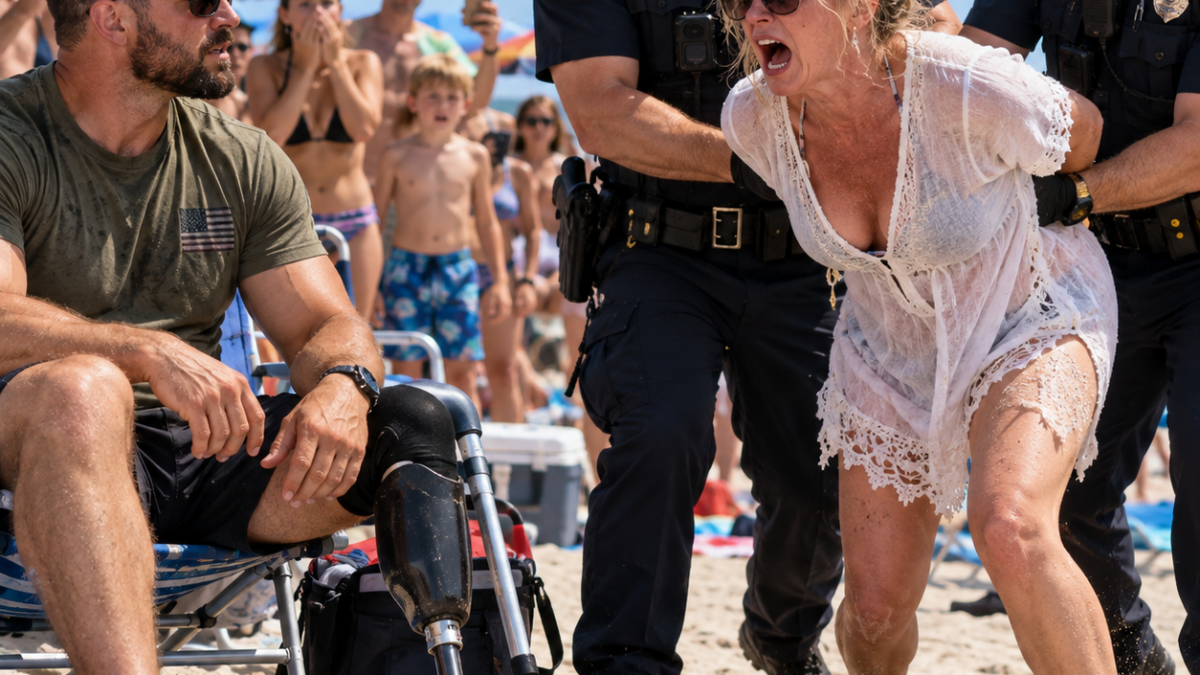
Karen was arrested for assault and battery.
When the officer told her to turn around, she stared as if the words were in another language.
“You cannot be serious.”
“I am.”
“But he hit me!”
“We reviewed the videos. You initiated physical contact by kicking his prosthetic. That is assault.”
“I pay taxes!”
The older officer actually paused.
I do not know what answer he expected, but it clearly was not that.
“So does he,” the female officer said.
Karen pointed at me one more time as if she could still summon authority through outrage.
“He is dangerous!”
“No, ma’am,” the officer replied. “He was sitting on a towel.”
They cuffed her while half the beach watched.
I will not pretend it was not satisfying.
It was.
Not because I enjoy seeing anyone arrested. I do not. But because there are moments when consequences need to be visible. Karen had tried to make an example out of me. Instead, she became one.
As they led her away, she kept twisting toward the officers.
“My hip is bruised!”
“You can request medical attention at booking,” one said.
“He attacked me!”
“You are under arrest for assault.”
“I was just asking questions!”
“You kicked him.”
That simple sentence followed her across the sand.
You kicked him.
Not misunderstood.
Not overreacted.
Not expressed concern.
Kicked him.
Her friends did not follow at first. They stood there frozen in the wreckage of association. One woman approached me quietly after Karen was far enough away.
“I am sorry,” she said.
I looked at her.
She seemed sincere, but I was not feeling generous.
“You watched her circle me.”
Her face fell.
“I know.”
“You watched her keep going.”
She nodded, eyes wet now.
“I should have stopped her.”
“Yes,” I said. “You should have.”
She did not argue.
That helped.
The lifeguard offered again to call medical. I let him check me over enough to satisfy everyone. My prosthetic seemed undamaged, though the joint had taken a hard strike. My hip and shoulder were sore, and I knew I would feel the fall more the next day. But nothing was broken. Nothing torn. Nothing requiring the emergency room.
Lucky.
Again.
I hated that word.
After the police left, the beach slowly remembered itself.
Children went back to the water. Umbrellas shifted in the wind. Someone’s portable speaker started playing again, quieter than before. The ocean kept rolling in like none of us mattered, which was both rude and comforting.
My friends hovered.
That annoyed me until it did not.
Marcus handed me water.
Darnell sat beside me, still breathing like he wanted to fight the entire concept of rude strangers.
“You good?” he asked.
“No.”
He nodded.
“You want to leave?”
I looked at the water.
For a second, yes.
I wanted to pack up, go home, ice my hip, and spend the rest of the day somewhere no one could see me. I wanted to be alone with the kind of anger that does not fit in public.
But then I thought about Karen.
I thought about her standing over me, smiling.
I thought about her wanting to turn my body into a spectacle, my pain into proof, my existence into some scam she had the right to investigate.
And I realized leaving would feel too much like surrender.
“No,” I said. “I want to swim.”
Marcus smiled slowly.
“There he is.”
Getting to the water after all that was not graceful.
It took both of them, one on each side, though they were careful to make it look casual because they knew me well. We moved slowly across the sand. I sat near the wet line, removed the prosthetic, wrapped it properly, and left it with Marcus like it was treasure, because it was.
Then Darnell helped me down to the water.
The first wave hit cold around my waist and stole my breath.
The second made me laugh.
Not because I was happy exactly.
Because my body remembered freedom.
In the water, the missing leg mattered differently. Balance changed. Weight changed. Pain loosened. The ocean held what the sand would not.
I floated on my back and looked up at the bright empty sky.
For a few minutes, I was not the veteran Karen had kicked. Not the man people had filmed. Not the guy with the prosthetic. Not the public lesson.
Just Nathan.
Alive.
Angry.
Floating.
Still there.
Later, when we returned to the towels, the spot where Karen had set up was mostly empty. Her umbrella remained crooked in the sand, her beach bag half-zipped, her group packing in embarrassed silence. One of the teenagers looked at me and gave a small, awkward nod.
I nodded back.
That kid would remember the day differently than Karen wanted.
Good.
The legal follow-up came later, of course.
Statements. Calls. Questions. The kind of paperwork that always seems to punish the person who wanted least to be involved. I cooperated. I gave my account. My friends gave theirs. The bystanders shared videos. The case was not complicated.
Karen had assaulted me.
On camera.
In public.
While accusing me of faking a disability.
I heard through the process that she tried to claim she had been defending taxpayers from fraud. I wish I were joking. Apparently, in her mind, the beach was under threat from a disabled veteran tanning too suspiciously near her umbrella.
That defense went nowhere.
She faced assault and battery charges, and the fact that she interfered with a prosthetic did not help her. People sometimes think medical devices are accessories. They are not. A prosthetic is not a prop. It is not a costume piece. It is not a public exhibit. It is part of how I move through the world, and she attacked it because she felt entitled to proof.
I did not celebrate every update.
Mostly, I wanted the whole thing behind me.
But I was glad she faced consequences.
I was glad the officers saw the videos.
I was glad strangers spoke up.
That mattered more than I expected.
Because for all the ugliness of that day, there was one thing that kept replaying in my mind in a way that did not hurt.
People told the truth.
Not everyone.
Not immediately.
But enough.
When Karen lied, people contradicted her.
When she claimed I attacked first, people held up videos.
When she tried to make herself small and wounded, people said, no, we saw you.
We saw you.
Those words can save a person.
Not always physically.
Sometimes they save the part of you that starts wondering whether standing up for yourself is worth the trouble.
I wish I could say the incident did not affect me.
It did.
For a while, going back to the beach felt harder. I caught myself scanning people more. If someone stared at my leg too long, my shoulders tightened. If a stranger walked too close, my hand moved toward the walking stick. I hated that Karen had added another layer of caution to a place I had worked hard to enjoy.
But I went back.
Not right away.
But I went.
The first time, just me and Marcus. Early morning. Almost empty beach. Cool air. Packed sand near the water. We did not stay long. I sat, listened to the waves, watched gulls fight over something probably disgusting, and left before anxiety could turn victory into punishment.
The next time, I stayed longer.
Eventually, I swam again.
That is recovery sometimes.
Not forgetting.
Returning.
People still stare.
They always will.
Some are curious. Some are rude. Some are children still learning where to put their eyes. I can handle staring. I can handle questions if they come with respect. I have even had good conversations with strangers who asked carefully, listened well, and treated me like a human being instead of a mystery object.
What I cannot tolerate is entitlement disguised as skepticism.
Nobody owes a stranger proof of pain.
Nobody owes a public performance of trauma.
Nobody owes access to their body because someone else spends too much time online watching videos about scams.
Karen thought doubt gave her rights.
It did not.
It gave her handcuffs.
Every now and then, one of my friends still jokes about the stick slipping.
“Totally innocent,” Darnell says, every time.
“Tragic accident,” Marcus adds.
I usually roll my eyes.
But the truth is, I do not feel proud of that part. Not exactly. I am not ashamed either. I was on the ground because she put me there. I was trying to get up. The stick moved. Physics introduced itself to Karen’s hip. That is between her and gravity.
What I am proud of is that I did not become what she tried to make me.
She wanted me humiliated.
I got back up.
She wanted me exposed.
I kept my dignity.
She wanted people to see a fraud.
They saw an assault.
She wanted sympathy.
She got consequences.
The day after it happened, I woke up sore everywhere.
My hip hurt. My shoulder hurt. My residual limb was tender from the socket pressure after the fall. I sat on the edge of my bed for a while before putting the prosthetic on. Some mornings are like that. You look at the leg and remember that independence is not automatic. It is assembled daily.
I checked the joint carefully again.
Still okay.
Then I strapped in and stood.
A little stiff.
A little angry.
Still standing.
That was enough.
I made coffee, stepped out onto my small balcony, and let the morning air hit my face. Somewhere down the street, a dog barked at absolutely nothing. A delivery truck rumbled past. Life was ordinary in the most beautiful way.
My phone buzzed.
A text from Marcus.
Beach next weekend?
I stared at it for a long moment.
Then I typed back:
Only if you bring snacks.
He replied instantly.
And body armor?
I smiled.
No. Just sunscreen.
Because I refused to let Karen own the beach.
I refused to let her own my prosthetic, my story, my anger, or my willingness to be seen.
Losing a leg taught me many things I never wanted to learn. It taught me patience. Pain. Adaptation. The difference between help and pity. The difference between attention and respect. It taught me that people can be kind in ways that mend something inside you, and cruel in ways that reopen wounds they know nothing about.
That day on the beach taught me something else.
Some people will look at your scars and see only an opportunity to prove their own ugliness.
Let them.
The truth has a way of standing up too.
Sometimes with witnesses.
Sometimes with video.
Sometimes with a lifeguard, two police officers, and a walking stick that “slips” at exactly the right time.
Karen thought my prosthetic was fake because she could not imagine a world where someone else’s suffering was real unless she approved it.
But my leg was real.
My service was real.
My pain was real.
And when they put her in the back of that police car, her consequences were real too.
𝗧𝗛𝗘 𝗘𝗡𝗗
Karen Kicked My Prosthetic Leg to Prove I Was Faking, Then the Whole Beach Watched Her Get Arrested
Karen thought my missing leg was a performance, my pain was a trick, and my silence meant she could humiliate me in front of everyone.
She picked the wrong veteran, the wrong beach, and the wrong day to test how far entitlement could go.
I lost my left leg before I ever learned how to live without being watched.
That is the part nobody tells you about coming home with part of yourself missing. People talk about the surgery, the rehab, the phantom pain, the paperwork, the medals, the pity, the “thank you for your service” speeches that come from strangers who mean well but do not know where to put their eyes. They talk about learning to walk again like it is a training montage, like one day you fall, the next day you grit your teeth, and by the end of the week you are climbing mountains while patriotic music plays in the background.
Real life is uglier than that.
Real life is learning how to stand in the shower without feeling betrayed by gravity. It is waking up at three in the morning because a foot you do not have anymore is burning like it is still attached. It is trying to smile while a child stares at the empty space below your knee and his mother yanks him away like your body is something contagious. It is practicing stairs until your hands blister because you refuse to be trapped by a building without a ramp.
For me, the missing piece was my left leg from the knee down.
I do not like talking about how it happened. I was Army. I served. I came home honorably discharged and permanently changed. That is usually all I say, because the details belong to me and to the men who were there, not to every curious person who thinks a prosthetic is an invitation.
Over the years, I got good at living with it.
Better than good, actually.
My prosthetic was solid, expensive, and fitted well. With long pants on, most people never noticed unless they watched me walk for a while. My gait had a slight difference, especially when I was tired, but nothing dramatic. On a normal sidewalk, in boots or jeans, I could move through the world without becoming the center of it.
The beach was different.
Sand does not care how much rehab you have done. Sand shifts. It slides. It gives way under the wrong pressure and grabs when you need it to release. With my prosthetic, balance on loose sand was a nightmare. I had learned to manage it with a walking stick, patience, and friends who knew when to help without making a production out of helping.
That day was supposed to be easy.
Just sun, salt air, and the kind of stupid jokes men tell each other when they have known one another long enough to be cruel without being unkind.
My friends and I had picked a spot away from the densest part of the beach. It was late morning, bright and hot, with gulls screaming overhead and kids shrieking every time cold water hit their knees. The ocean was rolling in gentle blue-green lines, flashing silver where the sun caught it. The air smelled like sunscreen, salt, fried food from the boardwalk, and warm towels.
I had not gone in the water yet.
Getting into the ocean required taking the prosthetic off, getting help over the sand, and trusting someone to keep the leg safe while I swam. Some models can handle water better than others, but I had read enough about salt damage and corrosion to be cautious. That leg was not just equipment. It was my mobility, my independence, and an expensive piece of my daily life.
So I was stretched out on a towel, my prosthetic visible, my walking stick beside me, sunglasses on, trying to get some color and enjoy doing absolutely nothing.
My friends were arguing over whether one of them could still throw a football farther than he could in college. He could not. We all knew it. He did not. That was the entertainment.
For a while, everything was perfect.
Then Karen arrived.
I did not know her name, obviously. Karen is just what my mind named her the moment she walked into my day and started acting like the beach had been waiting for her inspection.
She came across the sand loaded down with enough gear to establish a colony. Giant umbrella. Oversized beach bag. Cooler. Folding chair. Woven basket. A towel rolled under one arm. Sunglasses with gold rims. A sun hat so wide it looked like it had its own weather system. Her makeup was too heavy for heat and salt air, and she wore a flowing white cover-up that dragged behind her like she expected someone to follow with a fan.
She had a group with her. A couple of adults, a few teenagers, some younger kids. The children immediately ran toward the water, which made sense. The adults looked like they had already spent the morning trying not to irritate her.
There was plenty of space.
That matters.
The beach was not empty, but it was open enough that she could have set up twenty, thirty, forty feet away without bothering anyone.
Instead, she planted herself within five feet of us.
Not beside us by accident.
Right there.
Close enough that when she snapped her towel open, sand hit my arm.
One of my friends, Marcus, lifted his sunglasses and looked at me.
I gave him the tiny head shake that meant don’t start.
I had no idea how much I would regret that.
part2
At first, Karen did not speak to me.
She spoke around me.
That is worse sometimes.
Direct insults are at least honest. Speaking around someone lets the speaker pretend they are not doing what everyone can hear them doing.
She fussed with the umbrella, complained about the sand, scolded one of the teenagers for putting the cooler in the wrong spot, then turned her head just enough toward my towel.
“Some people,” she said loudly, “will do anything for attention.”
Marcus stopped mid-sentence.
My other friend, Darnell, looked over his shoulder.
I kept my eyes on the sky.
Karen continued, voice bright and poisonous.
“I mean, really. It is getting ridiculous these days. Everyone wants sympathy. Everyone wants special treatment.”
One of the women in her group murmured something too low for me to hear.
Karen’s answer came louder.
“Oh, please. I bet that leg is fake.”
My body went still.
Not tense exactly.
Still.
That kind of stillness that comes from years of learning the difference between irritation and danger.
Marcus sat up.
“Man,” he said under his breath, “tell me she’s not talking about you.”
“She’s trying to,” I said.
Karen was not finished.
“I have seen videos,” she said. “People fake disabilities all the time. They get money. They get free things. They get attention. And the rest of us pay for it.”
Free things.
That almost made me laugh.
We were on a public beach. The ocean was free. The sand was free. The sun was free. The only thing my missing leg had gotten me that day was extra effort crossing the sand and the pleasure of being stared at by a woman dressed like a judgmental patio umbrella.
I tried to ignore her.
People ask why I did not shut her down immediately. The answer is simple: I was tired. Not physically, though the sand always wore me out. I was tired of every stranger who thought my body required their opinion. Tired of explaining. Tired of deciding whether a confrontation was worth the emotional cost. Tired of knowing that even when I was right, I could still become the problem if I reacted too strongly.
So I stayed on my towel.
Karen started circling.
I wish I were exaggerating.
She walked past me once, pretending to adjust the umbrella. Then again, pretending to look for something in the sand. The third time, she slowed near my left side, her shadow falling across my prosthetic. I could feel her staring at it.
Darnell sat up fully.
“Lady,” he said, “you good?”
Karen ignored him.
She came closer.
“So,” she said to me, “is that thing even real?”
I turned my head slowly.
“Excuse me?”
Her face was closer than I wanted it. She had pale skin flushed from heat, lipstick too bright, and eyes full of the kind of suspicion people mistake for intelligence. Up close, she smelled like expensive sunscreen and entitlement.
“That,” she said, pointing at my prosthetic. “Is it real, or are you just trying to get sympathy?”
Marcus muttered something that would have gotten us kicked off the beach if he had said it louder.
I took a breath.
“Ma’am, I’m just trying to enjoy the beach.”
“I asked you a question.”
“And I answered enough of it.”
Her mouth tightened.
“Don’t get an attitude with me.”
That phrase.
Always a warning bell.
I pushed my sunglasses up onto my forehead.
“Yes,” I said evenly. “It is real.”
She leaned back a little, studying me like she expected guilt to leak out through my pores.
“I bet if I tugged on it, it would come right off and your real leg would be underneath.”
For a second, none of my friends spoke.
Even the ocean seemed quieter.
I sat up.
“You are not touching me.”
“If it is real, why are you so defensive?”
“Because a stranger is standing over me demanding proof of my amputation.”
Her friends were watching now. One woman looked embarrassed. A man in a visor suddenly found the horizon fascinating. The teenagers had noticed too, their faces shifting between discomfort and the morbid interest people get when they sense a public scene forming.
Karen folded her arms.
“Take it off, then.”
“No.”
“If it is real, you should not have a problem proving it.”
That was when my patience finally snapped.
Not explosively.
Worse.
Coldly.
I reached for my walking stick.
Marcus put a hand out.
“You sure?”
“I’m sure.”
I planted the stick in the sand and pushed myself upright carefully. Standing from a towel on soft sand with a prosthetic is not graceful. It is work. My balance shifted, the socket pulled, and my good leg had to compensate. But I got up.
I am six-one when I stand straight.
Karen had clearly expected me to stay seated beneath her judgment. When I rose, her chin lifted, but her eyes flickered.
Good.
I wanted her to understand that disabled did not mean small.
I steadied myself with the stick and looked down at her.
“You think you can walk over here, get in my face, and demand I remove part of my body because you are curious?”
Her lips parted.
I did not let her speak.
“I have seen a lot worse than your face, ma’am, though not by much. I served this country. I paid for that service in bone, blood, and years of pain you do not get to inspect. You do not get to touch me. You do not get to test me. You do not get to stand here talking about tax dollars like I am some scam you found on the internet.”
Her face reddened.
Behind me, Darnell said quietly, “There it is.”
I should have stopped there.
Maybe if Karen had possessed even a small instinct for self-preservation, she would have backed away. Maybe her friends would have pulled her aside. Maybe the moment would have ended with her humiliated but free to pretend later that she had only been asking questions.
Instead, Karen stepped forward.
“You people always have a sob story,” she snapped.
I tightened my grip on the stick.
“Back up.”
“I just want to know if it is fake.”
“It isn’t.”
“Then this should not hurt.”
And then she kicked me.
Right in the joint of my prosthetic.
Hard.
People who have never worn a prosthetic may not understand what that means. The leg itself did not feel pain like flesh would. But the force traveled through the socket, through my residual limb, through my hip and balance and spine. Worse, it struck the part keeping me stable on ground that was already unstable.
My left side buckled.
The stick dug into the sand and slid.
I went down hard.
Not onto concrete, no. Sand is softer. But falling wrong with a prosthetic is not soft. My hip twisted, my shoulder hit, and pain flashed through me bright enough to steal my breath.
For a second, all I heard was my friends shouting.
Marcus yelled her name, or maybe just a curse.
Darnell lunged forward. Another friend grabbed him from behind because Darnell is loyal, strong, and occasionally too ready to become evidence.
Karen stood over me, smiling.
Smiling.
“See?” she announced. “He is faking. If the leg was fake, it would not hurt.”
That sentence was so stupid it almost floated above the moment like a balloon.
I was on the ground because she had kicked my medical device and knocked me off balance, and somehow in her mind that proved I had lied.
People nearby had turned.
Some had phones out now.
The beach, which had been a blur of ordinary noise seconds earlier, tightened around us. Children stared. Parents pulled them back. The teenagers in Karen’s group looked horrified.
I grabbed for my walking stick.
My hands were shaking now, partly from pain, partly from fury.
I tried to push myself up.
The sand shifted.
My balance failed again.
The stick slipped out of my hand.
That is the official version, and I stand by it.
The stick swung awkwardly as I caught myself, and the end of it struck Karen low across the hip and thigh. Not hard enough to do real damage, but enough to catch her completely off guard.
She yelped.
Her arms windmilled.
Then Karen went down too.
And learned, apparently for the first time, that sand is not made of pillows.
She landed on her hip, then her shoulder, then bumped her head against the packed wet sand near the edge of our towels. For a moment, she lay there blinking at the sky, stunned into silence.
I will not pretend there was not a tiny, ugly part of me that enjoyed that silence.
But only for a second.
Because then everything exploded.
Her friends rushed toward her. My friends rushed toward me. Someone yelled for a lifeguard. Karen started moaning dramatically, one hand pressed to her temple.
“He hit me!” she cried. “He attacked me with that stick!”
Marcus snapped, “You kicked him!”
“I did not!”
A woman standing nearby held up her phone.
“Yes, you did. I recorded it.”
Karen’s head turned toward her.
That was the first moment I saw fear cut through the performance.
The lifeguard arrived at a jog, young, tan, serious, and visibly unhappy to be dealing with adults behaving worse than children.
“What happened?” he asked.
Karen pointed at me from the sand.
“He attacked me!”
I was still trying to get fully upright, jaw clenched, hip screaming, pride hurting almost as much as the fall. Darnell had one hand near my elbow but was not touching unless I let him.
“She kicked my prosthetic,” I said.
The lifeguard looked at my leg.
Then at Karen.
Karen’s voice rose.
“He is faking that! He was harassing me. I asked a simple question, and he hit me with his cane!”
“It is a walking stick,” I said.
“You used it as a weapon!”
“You used your foot as one first.”
People began talking all at once.
“She kicked him.”
“I saw it.”
“She was bothering him before that.”
“She asked him to take it off.”
“He told her not to touch him.”
“The stick slipped when he fell.”
The lifeguard held up both hands.
“Okay. Everyone calm down.”
Karen did not calm down.
Karen had discovered that volume was her last available strategy.
“I want police!” she shouted. “I want him arrested. He assaulted me. Look at my hip. It is probably broken.”
“You were standing after you kicked him,” a teenage boy said.
Karen glared at him.
“Shut up.”
That came from one of her own group.
A young girl, maybe fifteen, arms crossed, face red with embarrassment.
Karen looked betrayed.
The lifeguard called police because that was procedure when there was a physical altercation. While we waited, he asked if I needed medical assistance.
I said no at first.
Then Marcus gave me a look.
I corrected myself.
“I need to check the socket and make sure nothing is damaged.”
That was the thing people forget. Karen had not just kicked “a fake leg.” She had struck a medical device I relied on to move. If she had damaged the joint, the alignment, or the socket, I could have been dealing with serious consequences long after her beach tantrum ended.
My hands were still unsteady as I checked the prosthetic.
It seemed intact.
I was lucky.
Luck made me angrier.
Because I should not have needed luck to sit on a beach without being attacked.
Two officers arrived about fifteen minutes later.
By then Karen had recovered enough to stand, though she leaned heavily on one of her friends and made sure to wince whenever an officer looked her way. I was seated again, partly because my hip hurt and partly because standing on sand during a police conversation sounded like an unnecessary sequel to disaster.
The first officer was a woman with a calm face and sharp eyes. The second was older, broad-shouldered, and already looked tired of the entire beach.
Karen began before they even finished speaking to the lifeguard.
“Officers, thank God. This man assaulted me. I was minding my own business, and he hit me with his stick. I think I need an ambulance.”
The female officer looked at me.
“And you are?”
“My name is Nathan Cole.”
Karen huffed loudly.
The officer ignored her.
“What happened, Mr. Cole?”
I explained.
I kept it simple.
I was sitting with my friends. Karen began making comments about my prosthetic. She approached me. She demanded I remove it. I told her no. I stood up to tell her to back off. She kicked the prosthetic joint, causing me to fall. While I was trying to get up, my walking stick slipped and struck her.
Karen kept interrupting.
“That is not true.”
“He is lying.”
“He was threatening me.”
“He is unstable.”
The older officer finally said, “Ma’am, stop talking while he is talking.”
Karen looked offended down to her bones.
Then the videos came out.
One by one.
The woman nearby had recorded from the moment Karen approached me directly. Another person had caught the kick. A third had a wider angle showing me fall, reach for my stick, and Karen get struck only after I was already on the ground trying to recover.
The female officer watched the clearest video twice.
Her expression changed.
Not dramatically.
Just enough.
She looked up at Karen.
“Ma’am, did you kick his prosthetic leg?”
Karen’s mouth opened.
Closed.
“I was trying to verify—”
“Did you kick his prosthetic leg?”
“I barely touched it.”
The officer turned the phone slightly, replaying the video where Karen’s foot drove into the joint with enough force to drop me.
The silence afterward was beautiful.
The older officer said, “That is not barely.”
Karen’s performance shifted instantly.
“I thought it was fake.”
“That does not make it legal to kick someone,” the female officer said.
“He hit me with a stick.”
“After you knocked him down.”
“He could have broken my hip.”
“You interfered with a medical device and caused him to fall.”
For the first time, Karen seemed to understand that this was not going the way it was supposed to go.
Her voice changed.
Softer.
Panicked.
“I am the victim here.”
“No,” Marcus said under his breath, “you are the footage.”
I almost laughed, but my hip reminded me not to.
At first, they separated both of us.
That part bothered me more than I wanted to admit. I understood procedure. I understood they had to ask questions. But sitting there with an officer near me while Karen wailed about being attacked made old anger rise up in my chest.
I had been kicked.
Humiliated.
Knocked down in public.
And still, for a few minutes, the world treated the situation like both sides might be equally responsible.
That is how it often works. The person who starts the harm counts on the chaos afterward to muddy the truth.
But this time, truth had angles.
High definition.
Multiple witnesses.
Karen was arrested for assault and battery.
When the officer told her to turn around, she stared as if the words were in another language.
“You cannot be serious.”
“I am.”
“But he hit me!”
“We reviewed the videos. You initiated physical contact by kicking his prosthetic. That is assault.”
“I pay taxes!”
The older officer actually paused.
I do not know what answer he expected, but it clearly was not that.
“So does he,” the female officer said.
Karen pointed at me one more time as if she could still summon authority through outrage.
“He is dangerous!”
“No, ma’am,” the officer replied. “He was sitting on a towel.”
They cuffed her while half the beach watched.
I will not pretend it was not satisfying.
It was.
Not because I enjoy seeing anyone arrested. I do not. But because there are moments when consequences need to be visible. Karen had tried to make an example out of me. Instead, she became one.
As they led her away, she kept twisting toward the officers.
“My hip is bruised!”
“You can request medical attention at booking,” one said.
“He attacked me!”
“You are under arrest for assault.”
“I was just asking questions!”
“You kicked him.”
That simple sentence followed her across the sand.
You kicked him.
Not misunderstood.
Not overreacted.
Not expressed concern.
Kicked him.
Her friends did not follow at first. They stood there frozen in the wreckage of association. One woman approached me quietly after Karen was far enough away.
“I am sorry,” she said.
I looked at her.
She seemed sincere, but I was not feeling generous.
“You watched her circle me.”
Her face fell.
“I know.”
“You watched her keep going.”
She nodded, eyes wet now.
“I should have stopped her.”
“Yes,” I said. “You should have.”
She did not argue.
That helped.
The lifeguard offered again to call medical. I let him check me over enough to satisfy everyone. My prosthetic seemed undamaged, though the joint had taken a hard strike. My hip and shoulder were sore, and I knew I would feel the fall more the next day. But nothing was broken. Nothing torn. Nothing requiring the emergency room.
Lucky.
Again.
I hated that word.
After the police left, the beach slowly remembered itself.
Children went back to the water. Umbrellas shifted in the wind. Someone’s portable speaker started playing again, quieter than before. The ocean kept rolling in like none of us mattered, which was both rude and comforting.
My friends hovered.
That annoyed me until it did not.
Marcus handed me water.
Darnell sat beside me, still breathing like he wanted to fight the entire concept of rude strangers.
“You good?” he asked.
“No.”
He nodded.
“You want to leave?”
I looked at the water.
For a second, yes.
I wanted to pack up, go home, ice my hip, and spend the rest of the day somewhere no one could see me. I wanted to be alone with the kind of anger that does not fit in public.
But then I thought about Karen.
I thought about her standing over me, smiling.
I thought about her wanting to turn my body into a spectacle, my pain into proof, my existence into some scam she had the right to investigate.
And I realized leaving would feel too much like surrender.
“No,” I said. “I want to swim.”
Marcus smiled slowly.
“There he is.”
Getting to the water after all that was not graceful.
It took both of them, one on each side, though they were careful to make it look casual because they knew me well. We moved slowly across the sand. I sat near the wet line, removed the prosthetic, wrapped it properly, and left it with Marcus like it was treasure, because it was.
Then Darnell helped me down to the water.
The first wave hit cold around my waist and stole my breath.
The second made me laugh.
Not because I was happy exactly.
Because my body remembered freedom.
In the water, the missing leg mattered differently. Balance changed. Weight changed. Pain loosened. The ocean held what the sand would not.
I floated on my back and looked up at the bright empty sky.
For a few minutes, I was not the veteran Karen had kicked. Not the man people had filmed. Not the guy with the prosthetic. Not the public lesson.
Just Nathan.
Alive.
Angry.
Floating.
Still there.
Later, when we returned to the towels, the spot where Karen had set up was mostly empty. Her umbrella remained crooked in the sand, her beach bag half-zipped, her group packing in embarrassed silence. One of the teenagers looked at me and gave a small, awkward nod.
I nodded back.
That kid would remember the day differently than Karen wanted.
Good.
The legal follow-up came later, of course.
Statements. Calls. Questions. The kind of paperwork that always seems to punish the person who wanted least to be involved. I cooperated. I gave my account. My friends gave theirs. The bystanders shared videos. The case was not complicated.
Karen had assaulted me.
On camera.
In public.
While accusing me of faking a disability.
I heard through the process that she tried to claim she had been defending taxpayers from fraud. I wish I were joking. Apparently, in her mind, the beach was under threat from a disabled veteran tanning too suspiciously near her umbrella.
That defense went nowhere.
She faced assault and battery charges, and the fact that she interfered with a prosthetic did not help her. People sometimes think medical devices are accessories. They are not. A prosthetic is not a prop. It is not a costume piece. It is not a public exhibit. It is part of how I move through the world, and she attacked it because she felt entitled to proof.
I did not celebrate every update.
Mostly, I wanted the whole thing behind me.
But I was glad she faced consequences.
I was glad the officers saw the videos.
I was glad strangers spoke up.
That mattered more than I expected.
Because for all the ugliness of that day, there was one thing that kept replaying in my mind in a way that did not hurt.
People told the truth.
Not everyone.
Not immediately.
But enough.
When Karen lied, people contradicted her.
When she claimed I attacked first, people held up videos.
When she tried to make herself small and wounded, people said, no, we saw you.
We saw you.
Those words can save a person.
Not always physically.
Sometimes they save the part of you that starts wondering whether standing up for yourself is worth the trouble.
I wish I could say the incident did not affect me.
It did.
For a while, going back to the beach felt harder. I caught myself scanning people more. If someone stared at my leg too long, my shoulders tightened. If a stranger walked too close, my hand moved toward the walking stick. I hated that Karen had added another layer of caution to a place I had worked hard to enjoy.
But I went back.
Not right away.
But I went.
The first time, just me and Marcus. Early morning. Almost empty beach. Cool air. Packed sand near the water. We did not stay long. I sat, listened to the waves, watched gulls fight over something probably disgusting, and left before anxiety could turn victory into punishment.
The next time, I stayed longer.
Eventually, I swam again.
That is recovery sometimes.
Not forgetting.
Returning.
People still stare.
They always will.
Some are curious. Some are rude. Some are children still learning where to put their eyes. I can handle staring. I can handle questions if they come with respect. I have even had good conversations with strangers who asked carefully, listened well, and treated me like a human being instead of a mystery object.
What I cannot tolerate is entitlement disguised as skepticism.
Nobody owes a stranger proof of pain.
Nobody owes a public performance of trauma.
Nobody owes access to their body because someone else spends too much time online watching videos about scams.
Karen thought doubt gave her rights.
It did not.
It gave her handcuffs.
Every now and then, one of my friends still jokes about the stick slipping.
“Totally innocent,” Darnell says, every time.
“Tragic accident,” Marcus adds.
I usually roll my eyes.
But the truth is, I do not feel proud of that part. Not exactly. I am not ashamed either. I was on the ground because she put me there. I was trying to get up. The stick moved. Physics introduced itself to Karen’s hip. That is between her and gravity.
What I am proud of is that I did not become what she tried to make me.
She wanted me humiliated.
I got back up.
She wanted me exposed.
I kept my dignity.
She wanted people to see a fraud.
They saw an assault.
She wanted sympathy.
She got consequences.
The day after it happened, I woke up sore everywhere.
My hip hurt. My shoulder hurt. My residual limb was tender from the socket pressure after the fall. I sat on the edge of my bed for a while before putting the prosthetic on. Some mornings are like that. You look at the leg and remember that independence is not automatic. It is assembled daily.
I checked the joint carefully again.
Still okay.
Then I strapped in and stood.
A little stiff.
A little angry.
Still standing.
That was enough.
I made coffee, stepped out onto my small balcony, and let the morning air hit my face. Somewhere down the street, a dog barked at absolutely nothing. A delivery truck rumbled past. Life was ordinary in the most beautiful way.
My phone buzzed.
A text from Marcus.
Beach next weekend?
I stared at it for a long moment.
Then I typed back:
Only if you bring snacks.
He replied instantly.
And body armor?
I smiled.
No. Just sunscreen.
Because I refused to let Karen own the beach.
I refused to let her own my prosthetic, my story, my anger, or my willingness to be seen.
Losing a leg taught me many things I never wanted to learn. It taught me patience. Pain. Adaptation. The difference between help and pity. The difference between attention and respect. It taught me that people can be kind in ways that mend something inside you, and cruel in ways that reopen wounds they know nothing about.
That day on the beach taught me something else.
Some people will look at your scars and see only an opportunity to prove their own ugliness.
Let them.
The truth has a way of standing up too.
Sometimes with witnesses.
Sometimes with video.
Sometimes with a lifeguard, two police officers, and a walking stick that “slips” at exactly the right time.
Karen thought my prosthetic was fake because she could not imagine a world where someone else’s suffering was real unless she approved it.
But my leg was real.
My service was real.
My pain was real.
And when they put her in the back of that police car, her consequences were real too.