Karen Kept Ramming My Trash Can With Her Car, So I Made Sure the Next Hit Would Be Her Last
𝗣𝗔𝗥𝗧 𝟮
The timing made sense.
The reason still did not.
I stood there beside that stupid trash can, staring down the street toward Karen’s house, and tried to figure out why a grown woman with a nice home, a manicured yard, a tiny dog, and apparently no shortage of free time had decided my garbage bin deserved weekly punishment.
Had I parked somewhere she disliked?
Had leaves from my tree blown into her yard?
Had my trash can offended her sense of street symmetry?
With Karen, any of those could have been enough.
My first instinct was to confront her.
I imagined walking up to her door, pointing at the rubber marks, and demanding she stop.
Then I imagined her reaction.
The fake gasp.
The hand pressed to her chest.
The offended tone.
“How dare you accuse me?”
She would deny it.
She would probably tell the whole street I was harassing her.
She would turn herself into the victim before I finished my first sentence.
People like Karen don’t respond to reason because reason isn’t the game they’re playing.
She wasn’t knocking over my trash can because she needed a solution to a problem.
She was doing it because it gave her a tiny thrill of control.
So I kept quiet.
For a few more weeks, I let her continue.
Not because I enjoyed cleaning up trash.
I hated it.
Every Thursday became a test of patience. I would leave for work wondering whether I’d come home to garbage across the curb. Sometimes she knocked it over after pickup. Sometimes, once she got bolder, she hit it before the truck came, which meant the garbage crew skipped it or left bags spilled out because the can was lying sideways.
That was when annoyance turned into fury.
It was no longer just petty damage.
It was making me live around her tantrum.
Trash would sit an extra week if I missed collection. Broken bags attracted flies. Once, a neighbor’s dog got into something and dragged food wrappers across my lawn.
Karen had taken a basic part of adult life—putting out garbage—and turned it into a weekly hostage situation.
I considered cameras.
It would have been easy enough. Set one up. Catch her car hitting the bin. Post it in the neighborhood group. Send it to the HOA. Let everyone see Queen Karen doing her little curbside crimes.
The thought was satisfying.
But then I pictured the drama.
The comments.
The arguments.
Karen claiming the video was misleading.
Her friends defending her.
Some neighbor saying everyone needed to calm down because it was “just a trash can.”
A meeting, maybe.
A formal complaint.
Weeks of hearing about it.
I didn’t want to build a courtroom around my garbage bin.
I wanted the can to stop moving.
That was the cleanest solution.
If Karen got satisfaction from knocking it over, I needed to remove the payoff.
Make it pointless.
Make it impossible.
So I started researching how people kept trash cans upright in windy areas.
At first, the solutions were basic.
Bungee cords.
Rocks in the bottom.
A strap to the fence.
Weighted bases.
Nothing felt right.
Too obvious. Too ugly. Too easy for Karen to undo or complain about. I didn’t want some ridiculous contraption sitting in front of my house that made me look like I was preparing for a hurricane every Wednesday night.
I wanted normal from the street.
Solid underneath.
That was when I found a few discussions about anchoring bins near rural roads. People used posts, concrete pads, locking brackets. Most of it was designed to stop animals or storms, but the idea was perfect.
If I could secure the can to something below ground, it would look ordinary but stay put.
I called my buddy Marcus.
Marcus did metal work and had the exact kind of practical mind you want when your problem is half engineering and half revenge.
He came over that Saturday afternoon, looked at the damaged trash can, then looked at me.
“She’s hitting it with a car?”
“That’s my working theory.”
He crouched down and examined the rubber marks.
“That’s not a theory. That’s a signature.”
“I want it to stop moving.”
Marcus smiled.
It was not a friendly smile.
It was the kind of smile men get when a project becomes unnecessarily satisfying.
“I can help with that.”
I bought a heavy-duty commercial trash bin that looked close enough to a regular municipal can that nobody would notice unless they were deeply invested in garbage aesthetics.
Marcus brought a steel pipe, a flat steel plate, bolts, and a locking pin system he sketched on the back of an envelope while drinking iced tea in my garage.
We dug a narrow hole near the spot where the can always sat, close enough for pickup but clearly within my property line. That part mattered. I measured twice, then a third time, because I knew Karen would seize on anything even slightly questionable.
The hole went deep enough to matter.
We set the steel pipe in concrete.
Marcus welded a short sleeve and bracket setup to match the base of the new can. The mechanism allowed me to roll the can into place and slide a locking pin through a reinforced section near the bottom. When unlocked, it rolled normally. When locked, it might as well have been part of the driveway.
From the street, it looked like a regular trash can sitting where a regular trash can belonged.
Underneath, it was married to concrete and steel.
Marcus stepped back when we finished.
“She’s going to have a bad morning.”
“I don’t want anyone hurt.”
“Then hopefully she stops driving into people’s property.”
That was the thing.
I wasn’t setting a trap in the road.
I wasn’t placing spikes where people walked.
I wasn’t hiding anything dangerous in a public space.
I put a reinforced trash can on my own property, in a legal spot, where it was supposed to be.
If Karen left it alone, nothing happened.
If she drove into it, that was Karen’s decision meeting physics.
I took photos of the installation.
Not because I planned to show them around.
Because if Karen tried to lie—and Karen always tried to lie—I wanted proof of exactly where everything sat.
Wednesday night came.
I rolled the new can down like normal.
Same spot.
Same angle.
Handle out.
Lid closed.
The only difference was the quiet metallic click when I slid the locking pin into place.
I stood there for a second afterward, looking at it.
It looked innocent.
Almost boring.
Perfect.
Thursday morning, I stayed home until after pickup.
I told work I had a delayed start.
The garbage truck came through, emptied the can, set it down, and moved on.
The can stayed exactly where it belonged.
I went inside and made coffee.
Then I waited.
For nearly forty minutes, nothing happened.
Part of me wondered if Karen had changed her routine. Maybe she sensed something. Maybe she had gotten tired of the game. Maybe my new can looked just different enough that she hesitated.
Then I heard an engine.
Slow.
Too slow.
I stepped to the side of the window where I could see without being obvious.
Karen’s car came into view.
A silver SUV, always spotless, always parked in her driveway at an angle that made sure everyone could see she’d paid too much for it. She crept along the curb, sunglasses on, one hand high on the steering wheel, her mouth set in that familiar little line of superiority.
She slowed near my driveway.
My pulse picked up.
For one moment, I thought she might just pass.
Then she turned the wheel slightly.
The SUV’s front corner moved toward my trash can.
I remember thinking, She’s really doing it.
Even after weeks.
Even in broad daylight.
Even when the can was on my property.
She was actually doing it.
The impact sound was not like before.
Before, it had been a hollow plastic thud followed by the scrape of the can tipping over.
This was a violent metallic bang.
The SUV jerked.
The trash can did not move.
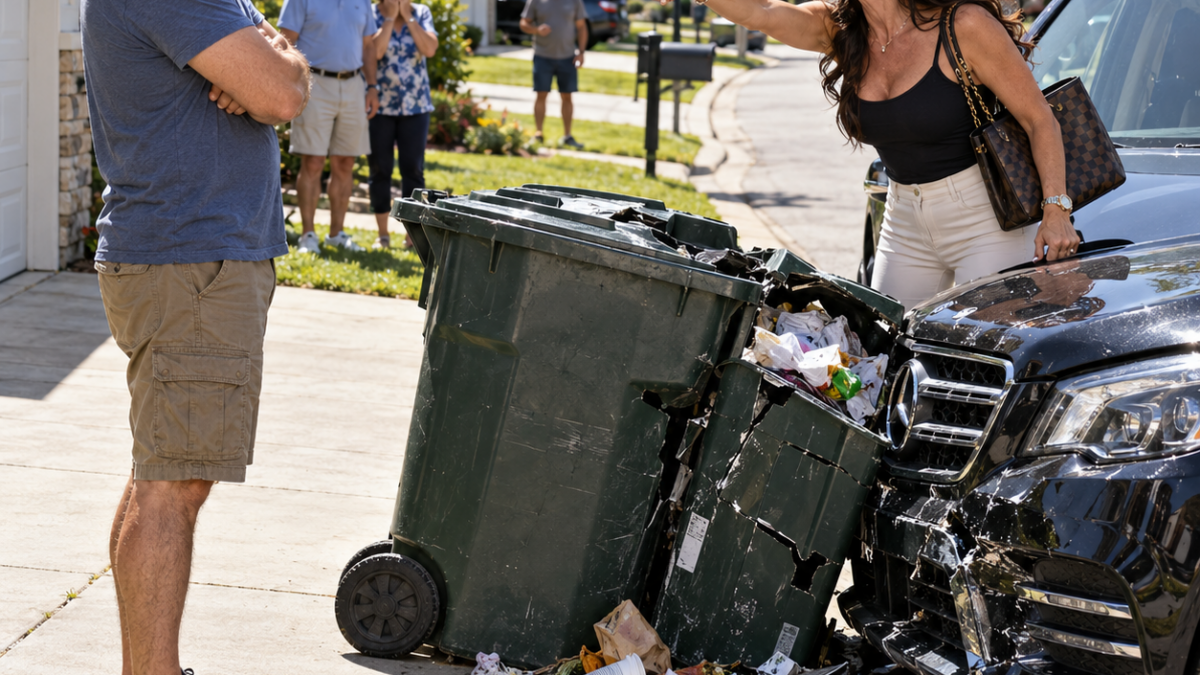
Karen’s bumper crumpled against it with a cracking sound that made me flinch. The front end dipped awkwardly. Something scraped. Something else snapped. A thin stream of fluid began dripping onto the pavement.
For half a second, the entire street went silent.
Then Karen screamed.
I stepped outside slowly.
Not running.
Not laughing.
Not giving her anything she could use.
Just walked onto my porch with my coffee cup in hand.
Karen had already jumped out of her SUV. Her sunglasses were crooked, her hair had fallen partly across her face, and the polished neighborhood queen looked, for once, completely ridiculous.
Her front bumper was split.
One side hung lower than the other.
The plastic grille was cracked.
A crease ran across the corner where it had met my very committed trash can.
Karen pointed at me.
“You!”
I raised my eyebrows.
“Morning.”
“What did you do?”
“I drank coffee.”
“You ruined my car!”
I walked down the porch steps.
“Looks like you hit my trash can.”
“You rigged it!”
“Rigged it?”
“Don’t play stupid with me!”
Neighbors were starting to emerge.
Mr. Allen from across the street came out in slippers. Mrs. Wu opened her front door. A couple two houses down stood near their garage, pretending they weren’t listening while absolutely listening.
Karen’s voice rose.
“You put a dangerous obstruction by the road!”
“It’s not in the road.”
“It destroyed my bumper!”
“Your bumper drove onto my property.”
Her face went red.
“You trapped me.”
I almost laughed, but I caught myself.
“Karen, did I force you to drive into my trash can?”
“You knew I would hit it!”
That sentence hung in the air.
Several neighbors looked at one another.
Karen realized what she had said about one second too late.
I tilted my head.
“Why would I know that?”
Her mouth opened.
Closed.
Opened again.
“You’ve been putting it too close to the curb.”
“It’s where the garbage truck collects it.”
“It’s a hazard.”
“Only if someone drives into it.”
She stepped closer, finger stabbing the air near my chest.
“You think you’re clever, don’t you?”
“No.”
I looked at her damaged SUV.
“I think you should call your insurance.”
Someone else called the non-emergency police line before I could.
Probably Mr. Allen. He was already on his phone, speaking in that calm retired-man voice that made everything sound more official.
Karen paced near her car, switching between yelling at me and taking photos of the trash can.
She tried to pull it.
It did not move.
She tried harder.
Still nothing.
That made her even angrier.
“What is wrong with you?” she snapped. “Who bolts down a trash can?”
“Someone tired of finding it knocked over.”
“I never touched your stupid can!”
I glanced at her SUV still pressed against it.
“Interesting position to take.”
The officer arrived twenty minutes later.
By then, half the street was watching from porches, driveways, or windows.
Karen immediately rushed him.
“Officer, this man intentionally damaged my vehicle.”
The officer looked past her at the SUV, then at the trash can, then at the tire marks.
“How did he damage it?”
“He put that thing there.”
The officer looked again.
“His trash can?”
“It’s not just a trash can. It’s bolted to the ground.”
“Is it on his property?”
Karen hesitated.
“It’s close to the road.”
“Is it on his property?”
She looked at me like she wanted me to vanish.
“Technically.”
The officer turned to me.
“Sir, can you explain what happened?”
“Sure.”
I kept my voice calm.
“My trash can has been knocked over and damaged repeatedly on trash days. I installed a secure base on my own property to keep it upright. This morning, she drove into it.”
Karen exploded.
“That’s not what happened!”
The officer held up a hand.
“Ma’am.”
“He set a trap!”
“Did you drive into the trash can?”
“It was in my way!”
The officer walked over, crouched, and looked at the ground.
There were tire marks.
Not on the road.
Not even along the edge.
They curved from the street toward the can.
He took photos.
He took more photos of the damage.
He checked the placement relative to the curb and property line. I showed him the survey marker near the driveway and the pictures from installation. He nodded, not dramatically, but enough that I felt my shoulders loosen.
Karen kept talking.
“He has been harassing me for weeks.”
I stared at her.
That was the first time my calm almost cracked.
“I have not spoken to you in weeks.”
“You’ve been provoking me with this trash can.”
Mrs. Wu audibly whispered, “Provoking her with a trash can?”
I pretended not to hear.
The officer did not seem amused.
“Ma’am, based on the position of the vehicle and the marks, it appears you left the roadway and struck stationary property.”
Karen’s mouth dropped open.
“He made it stationary on purpose!”
The officer paused.
Then said, very slowly, “Property is generally allowed to be stationary.”
Mr. Allen coughed into his hand.
I looked down so Karen wouldn’t see me smile.
The officer completed the report. He did not accuse her of anything dramatic on the spot, but he did document the impact, tire marks, placement, and the fact that the can was on my property.
Karen drove away with her bumper hanging like a broken jaw.
Not very far, apparently. I later heard she had to pull over and call for a tow because the damage was worse than she’d thought.
That should have been the end.
Of course, Karen made sure it wasn’t.
Within two days, I heard she had filed an insurance claim, accusing me of creating a hidden hazard designed to damage her vehicle.
Her insurance denied it.
The report said she had driven into stationary private property. Intentional or negligent impact, either way, not my responsibility.
That left her with the repair bill.
And from what Mr. Allen heard from his nephew, who worked at a body shop across town, the estimate was ugly.
Modern bumpers are not just plastic anymore.
Sensors.
Brackets.
Fluid lines.
Paint matching.
Calibration.
Karen had not tapped a trash can.
She had introduced her SUV’s front end to an anchored object that had no interest in losing.
She tried the HOA next.
Technically, our neighborhood did have one, though it was more toothless than tyrannical. Mostly it handled shared entrance landscaping and the occasional reminder not to leave junk cars on lawns. Karen loved invoking it when convenient, because any institution with rules attracted her like a porch light attracts insects.
She filed a complaint saying my trash can was an illegal structure, a safety hazard, an eyesore, and a deliberate trap.
The HOA sent someone to inspect.
He stood at the curb, looked at the can, looked at the property line, looked at me, and sighed like a man who had already dealt with Karen too many times.
“It’s on your property.”
“Yes.”
“Garbage collection can access it.”
“Yes.”
“It doesn’t block the sidewalk or street.”
“No.”
He looked at the reinforced base.
“Little intense.”
“Windy area.”
His mouth twitched.
“Right.”
A week later, Karen’s complaint was denied.
Then she called the city.
The city checked placement.
Same result.
Legal.
On my property.
Not blocking the road.
No violation.
For a while, Karen tried to control the story.
She told neighbors I had booby-trapped my trash can.
She said I had been waiting at the window like a lunatic hoping she would crash.
She said I was dangerous.
She said I was unstable.
But stories are hard to sell when everybody on the street has eyes.
They had seen the angle.
They had seen the tire marks.
They had seen her car half onto my curb.
And, most importantly, they had all dealt with Karen long enough to know she was capable of exactly what had happened.
People started putting together older incidents.
A dented recycling bin at the Millers’ house.
A cracked planter near Mrs. Wu’s driveway.
A mailbox scuff Karen had blamed on delivery drivers.
Nobody could prove those were her.
But once a pattern reveals itself, people stop calling things coincidences.
Karen’s power came from the assumption that no one would challenge her over small things.
Who wants to start a fight over a trash can?
Who wants to argue about leaves?
Who wants to be the neighbor posting camera footage over a knocked-over bin?
She operated in that gray area where each individual incident felt too petty to escalate, but all of them together created a constant pressure around her.
She counted on everyone being too polite, too tired, or too embarrassed to push back.
My trash can changed that.
Not because I gave a speech.
Not because I humiliated her online.
Because she finally ran into a boundary that did not yield.
Literally.
The next few trash days were peaceful in a way I had not realized I missed.
I rolled the can down Wednesday night.
Locked it in place.
Went to work Thursday.
Came home.
Still upright.
No garbage in the street.
No cracked lid.
No tire marks.
Just a trash can doing its boring little job.
The garbage truck driver noticed too.
The week after the crash, he set the can down, looked toward my porch where I happened to be standing, and gave me a little nod.
Not a wave.
Not a laugh.
Just a nod.
Like, Respect.
I nodded back.
That nod may have been one of the most satisfying moments of the entire ordeal.
Karen disappeared from her usual routines for a while.
No morning dog walks past my house.
No slow drives down the block.
No standing in her driveway with other neighbors pretending not to gossip while absolutely gossiping.
Her SUV sat in her driveway for a couple of weeks with the front patched badly. The paint didn’t match. The bumper looked uneven. One sensor cover was missing. For a woman who cared deeply about appearances, it must have been torture.
Eventually the SUV vanished and she started driving an older sedan.
I never asked why.
I didn’t need to.
The street got quieter.
Kids rode bikes without her shouting from the porch.
People parked near her mailbox without receiving handwritten notes.
She stopped correcting how neighbors placed yard bags.
Even her dog seemed calmer, though that might have been my imagination.
One evening about a month later, I was bringing in groceries when Karen walked out to get her mail.
For the first time since the crash, we were outside at the same time with no audience.
She looked over.
I expected a glare.
Maybe a comment.
Maybe one more accusation.
Instead, she looked away.
Fast.
Like eye contact cost too much.
That felt better than an apology.
Karen would never apologize.
People like her don’t apologize because apologies require admitting they share the same rules as everyone else.
But avoidance?
Avoidance was acknowledgment.
A silent confession.
I carried my groceries inside smiling.
The reinforced can remained.
After a while, I stopped locking it every single week because Karen clearly was not going to try again. But on windy nights, the anchor turned out to be genuinely useful. Storms came through, other bins rolled down the street, and mine stayed exactly where I put it.
Neighbors noticed.
A couple asked about it.
I gave vague answers.
“Just a little wind-proofing.”
“Looks sturdy.”
“That was the idea.”
Nobody pressed too hard.
They understood enough.
Marcus came over one Saturday months later, and we stood in the driveway drinking beer while he admired his handiwork.
“Still standing?”
“Like a monument.”
“To garbage?”
“To consequences.”
He laughed.
“Same thing, sometimes.”
Karen never bothered my trash can again.
She never bothered anyone else’s either, as far as I know.
No more dented bins.
No more mysterious scuffs.
No more weekly curbside sabotage.
The street slowly returned to being boring.
Beautifully, wonderfully boring.
It is amazing how much peace can be stolen in tiny pieces.
A knocked-over trash can sounds ridiculous until it happens every week.
Until you dread coming home on Thursdays.
Until you find yourself cleaning coffee grounds and food wrappers out of the gutter in your work shoes.
Until you realize someone is doing something small and ugly just because they can.
Karen understood the power of small harassment.
That was why she used it.
It gave her plausible deniability.
It made you feel petty for caring.
It turned your anger into something you had to justify.
But the thing about small harassment is that the person doing it often mistakes restraint for helplessness.
I was never helpless.
I was patient.
There is a difference.
I could have confronted her.
I could have filmed her.
I could have dragged the whole neighborhood into it.
Instead, I made my trash can honest.
It stayed where I put it.
Karen exposed herself by trying to move it.
That was all.
The best part is that my life did not become some big neighborhood war afterward.
No lawsuits.
No screaming matches after the police report.
No dramatic HOA showdown.
Just Karen’s damaged car, her denied insurance claim, her failed complaints, and a street full of people quietly understanding that she had finally driven into the consequences of her own behavior.
The can is still there.
Every Wednesday night, I roll it down.
Sometimes I lock it.
Sometimes I don’t.
The steel sleeve is still hidden.
The concrete still sits beneath the surface.
The bolts are still tight.
Most people walking past would never know anything unusual happened there.
They would see an ordinary trash can near an ordinary curb in an ordinary neighborhood.
But I know.
Karen knows.
The garbage truck driver probably knows.
And every Thursday, when I come home from work and find that can standing upright exactly where I left it, I feel a small, quiet satisfaction that never gets old.
Some people talk about karma like it is a mystical force floating around the universe, waiting to balance scales.
I don’t know about that.
In my experience, karma usually looks more practical.
A survey line.
A steel pipe.
A locking pin.
A bag of concrete.
A person who thinks rules do not apply to her finally meeting something that refuses to move.
Karen wanted to make a mess.
She made an insurance claim.
She wanted to prove she owned the street.
She proved she could not control one trash can.
She wanted me to clean up after her every week.
Instead, she got to explain to a police officer, an insurance adjuster, the HOA, the city, and half the neighborhood why her SUV had climbed onto my property and lost a fight with a garbage bin.
That was enough for me.
The street is peaceful again.
The kids ride their bikes.
The neighbors wave.
The lawns get mowed.
The garbage truck comes every Thursday morning.
And Karen, once the loudest woman on the block, now keeps her eyes forward whenever she passes my house.
I never needed revenge that looked dramatic.
I just needed my trash can to stay standing.
And every week, it does.
𝗧𝗛𝗘 𝗘𝗡𝗗
Karen Kept Ramming My Trash Can With Her Car, So I Made Sure the Next Hit Would Be Her Last
Karen treated our quiet street like her personal kingdom, and my trash can became the tiny piece of territory she decided she had to conquer.
Every Thursday, she knocked it over, scattered garbage into the road, and walked away smiling like nobody would ever prove it.
So I stopped trying to prove it—and made sure the next time she hit it, the can would not move an inch.
I live on the kind of street people describe as boring when they mean peaceful.
Small houses. Short driveways. Mailboxes close to the curb. Kids riding bikes after school. Retired men watering lawns at exactly the same time every evening like it was a neighborhood ritual. Most people waved, kept their grass cut, and minded their own business unless somebody needed help carrying something heavy.
I liked that.
I didn’t need drama where I lived. I had enough stress at work, enough bills, enough ordinary adult nonsense waiting for me every week. When I pulled into my driveway at the end of the day, all I wanted was a quiet street, a hot shower, and a house where nobody needed anything from me for a few hours.
For a long time, that was exactly what I had.
Then there was Karen.
Every neighborhood has one person who decides seniority is the same thing as authority. Karen had lived on our block longer than almost anyone, and somewhere along the way, she convinced herself that meant she owned the rhythm of the entire street.
She was about forty, maybe forty-two, and annoyingly attractive in a way that made her even more unbearable. She had glossy dark hair that always looked freshly styled, sharp cheekbones, expensive sunglasses, and a body she displayed in fitted yoga sets or tight little sundresses like she was constantly waiting to be photographed. She could be charming when she wanted something, leaning too close, touching a neighbor’s arm, laughing in this breathy, flirty way that made some men forget she was insulting them five seconds earlier.
But most of the time, Karen wore authority like perfume.
Strong.
Artificial.
Impossible to ignore.
She complained about everything.
Kids riding bikes too close to her lawn.
Leaves blowing into her yard.
Delivery trucks stopping too long.
People parking near her mailbox.
Dogs barking once and then never again.
She was the self-appointed street sheriff, neighborhood inspector, traffic supervisor, and moral authority, all wrapped into one woman with perfect hair and a permanent expression of disgust.
Up until the trash can situation, I had mostly avoided her.
We had exchanged maybe ten sentences in the years I lived there.
Five of those were her telling me my lawn guy blew a few grass clippings near her curb.
The other five were me trying not to say what I actually thought.
My weekly routine was simple.
Every Wednesday night, I rolled my trash can down to the curb. Same spot every time. Handle facing out. Lid closed. It sat near the end of my driveway, fully on my side, not blocking the road, not touching anyone else’s property, not creating any issue a sane person would care about.
Thursday morning, the garbage truck came through.
Thursday evening, I came home from work, rolled the can back up, and forgot about it until the next week.
I never imagined I would one day think this much about a trash can.
The first time I came home and found it knocked over, I assumed it was nothing.
The can was lying on its side near the curb, lid half-open, a couple of bags split and some garbage scattered into the street. Annoying, sure, but not exactly a mystery. Maybe the garbage truck clipped it. Maybe wind caught it after pickup. Maybe some raccoon with personal problems tried to fight its way into the leftovers.
I cleaned everything up.
The lid had a fresh crack, which irritated me, but I told myself it wasn’t worth getting worked up over.
The next Thursday, it happened again.
Same can.
Same position.
Same mess.
Everyone else’s trash cans stood upright like obedient little soldiers.
Mine was on its side in the street.
That was when I started paying attention.
The week after that, I came home to find it tipped over again, but this time the can had a dent near the base. Low. Right around bumper height.
I crouched beside it in my work clothes, staring at the mark.
The lid had scuffs too.
Not random scratches.
Long gray streaks across the plastic.
I looked up and down the street.
Quiet houses.
Parked cars.
Perfect lawns.
No witnesses.
No confession.
Just my trash scattered again like someone wanted me to know I had been chosen.
At first, I didn’t want to believe it was Karen.
Not because she was above it.
Because even for her, repeatedly knocking over a trash can felt so stupid that I hoped there was another explanation.
But the more it happened, the more obvious it became.
Only mine was targeted.
Only after pickup.
Always on trash day.
Always in the same general window.
And Karen’s house sat just far enough down the street that she passed my curb whenever she took her dog on her dramatic little walks.
I decided to stay home one Thursday and watch.
I had a floating personal day at work, and while using it to investigate garbage-can vandalism was not how I imagined spending my time off, by then my patience was gone.
The garbage truck came through around midmorning.
My can was emptied and set back upright.
I made coffee, stayed near the front window, and waited.
About an hour later, Karen appeared.
She was walking her tiny white dog, wearing black leggings, a pale pink athletic top, oversized sunglasses, and the kind of white sneakers that never seemed to touch dirt. She paused near my driveway, looked at the can, then kept walking.
I thought maybe I had been wrong.
Maybe I was becoming paranoid.
Then, ten minutes later, I heard it.
Thud.
Solid.
Deliberate.
I stepped to the window.
My trash can was on its side again, halfway into the street.
Karen was already walking back toward her house, hips swaying, ponytail bouncing, not a care in the world.
That was the moment I stopped giving her the benefit of the doubt.
PART 2
The next week, I moved the trash can farther up my driveway.
Not far enough to miss pickup, but enough that nobody casually walking a dog should have any reason to touch it. It sat clearly inside my property line, angled neatly, out of the sidewalk path and away from the street.
I figured that would end it.
It did not.
Thursday evening, I pulled into my driveway and found the can knocked over again.
This time, it had fresh scratches near the bottom and black smudges along one side.
I crouched down.
Tire rubber.
That changed everything.
Karen wasn’t just kicking it over or shoving it with her hand while pretending to walk her dog.
She was hitting it with her car.
Slowly, probably. Just enough to knock it down and make a mess. Just enough to damage my property without turning it into an obvious collision.
Suddenly, the dents made sense.
The scuffs made sense.
The timing made sense.
The reason still did not.
I stood there beside that stupid trash can, staring down the street toward Karen’s house, and tried to figure out why a grown woman with a nice home, a manicured yard, a tiny dog, and apparently no shortage of free time had decided my garbage bin deserved weekly punishment.
Had I parked somewhere she disliked?
Had leaves from my tree blown into her yard?
Had my trash can offended her sense of street symmetry?
With Karen, any of those could have been enough.
My first instinct was to confront her.
I imagined walking up to her door, pointing at the rubber marks, and demanding she stop.
Then I imagined her reaction.
The fake gasp.
The hand pressed to her chest.
The offended tone.
“How dare you accuse me?”
She would deny it.
She would probably tell the whole street I was harassing her.
She would turn herself into the victim before I finished my first sentence.
People like Karen don’t respond to reason because reason isn’t the game they’re playing.
She wasn’t knocking over my trash can because she needed a solution to a problem.
She was doing it because it gave her a tiny thrill of control.
So I kept quiet.
For a few more weeks, I let her continue.
Not because I enjoyed cleaning up trash.
I hated it.
Every Thursday became a test of patience. I would leave for work wondering whether I’d come home to garbage across the curb. Sometimes she knocked it over after pickup. Sometimes, once she got bolder, she hit it before the truck came, which meant the garbage crew skipped it or left bags spilled out because the can was lying sideways.
That was when annoyance turned into fury.
It was no longer just petty damage.
It was making me live around her tantrum.
Trash would sit an extra week if I missed collection. Broken bags attracted flies. Once, a neighbor’s dog got into something and dragged food wrappers across my lawn.
Karen had taken a basic part of adult life—putting out garbage—and turned it into a weekly hostage situation.
I considered cameras.
It would have been easy enough. Set one up. Catch her car hitting the bin. Post it in the neighborhood group. Send it to the HOA. Let everyone see Queen Karen doing her little curbside crimes.
The thought was satisfying.
But then I pictured the drama.
The comments.
The arguments.
Karen claiming the video was misleading.
Her friends defending her.
Some neighbor saying everyone needed to calm down because it was “just a trash can.”
A meeting, maybe.
A formal complaint.
Weeks of hearing about it.
I didn’t want to build a courtroom around my garbage bin.
I wanted the can to stop moving.
That was the cleanest solution.
If Karen got satisfaction from knocking it over, I needed to remove the payoff.
Make it pointless.
Make it impossible.
So I started researching how people kept trash cans upright in windy areas.
At first, the solutions were basic.
Bungee cords.
Rocks in the bottom.
A strap to the fence.
Weighted bases.
Nothing felt right.
Too obvious. Too ugly. Too easy for Karen to undo or complain about. I didn’t want some ridiculous contraption sitting in front of my house that made me look like I was preparing for a hurricane every Wednesday night.
I wanted normal from the street.
Solid underneath.
That was when I found a few discussions about anchoring bins near rural roads. People used posts, concrete pads, locking brackets. Most of it was designed to stop animals or storms, but the idea was perfect.
If I could secure the can to something below ground, it would look ordinary but stay put.
I called my buddy Marcus.
Marcus did metal work and had the exact kind of practical mind you want when your problem is half engineering and half revenge.
He came over that Saturday afternoon, looked at the damaged trash can, then looked at me.
“She’s hitting it with a car?”
“That’s my working theory.”
He crouched down and examined the rubber marks.
“That’s not a theory. That’s a signature.”
“I want it to stop moving.”
Marcus smiled.
It was not a friendly smile.
It was the kind of smile men get when a project becomes unnecessarily satisfying.
“I can help with that.”
I bought a heavy-duty commercial trash bin that looked close enough to a regular municipal can that nobody would notice unless they were deeply invested in garbage aesthetics.
Marcus brought a steel pipe, a flat steel plate, bolts, and a locking pin system he sketched on the back of an envelope while drinking iced tea in my garage.
We dug a narrow hole near the spot where the can always sat, close enough for pickup but clearly within my property line. That part mattered. I measured twice, then a third time, because I knew Karen would seize on anything even slightly questionable.
The hole went deep enough to matter.
We set the steel pipe in concrete.
Marcus welded a short sleeve and bracket setup to match the base of the new can. The mechanism allowed me to roll the can into place and slide a locking pin through a reinforced section near the bottom. When unlocked, it rolled normally. When locked, it might as well have been part of the driveway.
From the street, it looked like a regular trash can sitting where a regular trash can belonged.
Underneath, it was married to concrete and steel.
Marcus stepped back when we finished.
“She’s going to have a bad morning.”
“I don’t want anyone hurt.”
“Then hopefully she stops driving into people’s property.”
That was the thing.
I wasn’t setting a trap in the road.
I wasn’t placing spikes where people walked.
I wasn’t hiding anything dangerous in a public space.
I put a reinforced trash can on my own property, in a legal spot, where it was supposed to be.
If Karen left it alone, nothing happened.
If she drove into it, that was Karen’s decision meeting physics.
I took photos of the installation.
Not because I planned to show them around.
Because if Karen tried to lie—and Karen always tried to lie—I wanted proof of exactly where everything sat.
Wednesday night came.
I rolled the new can down like normal.
Same spot.
Same angle.
Handle out.
Lid closed.
The only difference was the quiet metallic click when I slid the locking pin into place.
I stood there for a second afterward, looking at it.
It looked innocent.
Almost boring.
Perfect.
Thursday morning, I stayed home until after pickup.
I told work I had a delayed start.
The garbage truck came through, emptied the can, set it down, and moved on.
The can stayed exactly where it belonged.
I went inside and made coffee.
Then I waited.
For nearly forty minutes, nothing happened.
Part of me wondered if Karen had changed her routine. Maybe she sensed something. Maybe she had gotten tired of the game. Maybe my new can looked just different enough that she hesitated.
Then I heard an engine.
Slow.
Too slow.
I stepped to the side of the window where I could see without being obvious.
Karen’s car came into view.
A silver SUV, always spotless, always parked in her driveway at an angle that made sure everyone could see she’d paid too much for it. She crept along the curb, sunglasses on, one hand high on the steering wheel, her mouth set in that familiar little line of superiority.
She slowed near my driveway.
My pulse picked up.
For one moment, I thought she might just pass.
Then she turned the wheel slightly.
The SUV’s front corner moved toward my trash can.
I remember thinking, She’s really doing it.
Even after weeks.
Even in broad daylight.
Even when the can was on my property.
She was actually doing it.
The impact sound was not like before.
Before, it had been a hollow plastic thud followed by the scrape of the can tipping over.
This was a violent metallic bang.
The SUV jerked.
The trash can did not move.
Karen’s bumper crumpled against it with a cracking sound that made me flinch. The front end dipped awkwardly. Something scraped. Something else snapped. A thin stream of fluid began dripping onto the pavement.
For half a second, the entire street went silent.
Then Karen screamed.
I stepped outside slowly.
Not running.
Not laughing.
Not giving her anything she could use.
Just walked onto my porch with my coffee cup in hand.
Karen had already jumped out of her SUV. Her sunglasses were crooked, her hair had fallen partly across her face, and the polished neighborhood queen looked, for once, completely ridiculous.
Her front bumper was split.
One side hung lower than the other.
The plastic grille was cracked.
A crease ran across the corner where it had met my very committed trash can.
Karen pointed at me.
“You!”
I raised my eyebrows.
“Morning.”
“What did you do?”
“I drank coffee.”
“You ruined my car!”
I walked down the porch steps.
“Looks like you hit my trash can.”
“You rigged it!”
“Rigged it?”
“Don’t play stupid with me!”
Neighbors were starting to emerge.
Mr. Allen from across the street came out in slippers. Mrs. Wu opened her front door. A couple two houses down stood near their garage, pretending they weren’t listening while absolutely listening.
Karen’s voice rose.
“You put a dangerous obstruction by the road!”
“It’s not in the road.”
“It destroyed my bumper!”
“Your bumper drove onto my property.”
Her face went red.
“You trapped me.”
I almost laughed, but I caught myself.
“Karen, did I force you to drive into my trash can?”
“You knew I would hit it!”
That sentence hung in the air.
Several neighbors looked at one another.
Karen realized what she had said about one second too late.
I tilted my head.
“Why would I know that?”
Her mouth opened.
Closed.
Opened again.
“You’ve been putting it too close to the curb.”
“It’s where the garbage truck collects it.”
“It’s a hazard.”
“Only if someone drives into it.”
She stepped closer, finger stabbing the air near my chest.
“You think you’re clever, don’t you?”
“No.”
I looked at her damaged SUV.
“I think you should call your insurance.”
Someone else called the non-emergency police line before I could.
Probably Mr. Allen. He was already on his phone, speaking in that calm retired-man voice that made everything sound more official.
Karen paced near her car, switching between yelling at me and taking photos of the trash can.
She tried to pull it.
It did not move.
She tried harder.
Still nothing.
That made her even angrier.
“What is wrong with you?” she snapped. “Who bolts down a trash can?”
“Someone tired of finding it knocked over.”
“I never touched your stupid can!”
I glanced at her SUV still pressed against it.
“Interesting position to take.”
The officer arrived twenty minutes later.
By then, half the street was watching from porches, driveways, or windows.
Karen immediately rushed him.
“Officer, this man intentionally damaged my vehicle.”
The officer looked past her at the SUV, then at the trash can, then at the tire marks.
“How did he damage it?”
“He put that thing there.”
The officer looked again.
“His trash can?”
“It’s not just a trash can. It’s bolted to the ground.”
“Is it on his property?”
Karen hesitated.
“It’s close to the road.”
“Is it on his property?”
She looked at me like she wanted me to vanish.
“Technically.”
The officer turned to me.
“Sir, can you explain what happened?”
“Sure.”
I kept my voice calm.
“My trash can has been knocked over and damaged repeatedly on trash days. I installed a secure base on my own property to keep it upright. This morning, she drove into it.”
Karen exploded.
“That’s not what happened!”
The officer held up a hand.
“Ma’am.”
“He set a trap!”
“Did you drive into the trash can?”
“It was in my way!”
The officer walked over, crouched, and looked at the ground.
There were tire marks.
Not on the road.
Not even along the edge.
They curved from the street toward the can.
He took photos.
He took more photos of the damage.
He checked the placement relative to the curb and property line. I showed him the survey marker near the driveway and the pictures from installation. He nodded, not dramatically, but enough that I felt my shoulders loosen.
Karen kept talking.
“He has been harassing me for weeks.”
I stared at her.
That was the first time my calm almost cracked.
“I have not spoken to you in weeks.”
“You’ve been provoking me with this trash can.”
Mrs. Wu audibly whispered, “Provoking her with a trash can?”
I pretended not to hear.
The officer did not seem amused.
“Ma’am, based on the position of the vehicle and the marks, it appears you left the roadway and struck stationary property.”
Karen’s mouth dropped open.
“He made it stationary on purpose!”
The officer paused.
Then said, very slowly, “Property is generally allowed to be stationary.”
Mr. Allen coughed into his hand.
I looked down so Karen wouldn’t see me smile.
The officer completed the report. He did not accuse her of anything dramatic on the spot, but he did document the impact, tire marks, placement, and the fact that the can was on my property.
Karen drove away with her bumper hanging like a broken jaw.
Not very far, apparently. I later heard she had to pull over and call for a tow because the damage was worse than she’d thought.
That should have been the end.
Of course, Karen made sure it wasn’t.
Within two days, I heard she had filed an insurance claim, accusing me of creating a hidden hazard designed to damage her vehicle.
Her insurance denied it.
The report said she had driven into stationary private property. Intentional or negligent impact, either way, not my responsibility.
That left her with the repair bill.
And from what Mr. Allen heard from his nephew, who worked at a body shop across town, the estimate was ugly.
Modern bumpers are not just plastic anymore.
Sensors.
Brackets.
Fluid lines.
Paint matching.
Calibration.
Karen had not tapped a trash can.
She had introduced her SUV’s front end to an anchored object that had no interest in losing.
She tried the HOA next.
Technically, our neighborhood did have one, though it was more toothless than tyrannical. Mostly it handled shared entrance landscaping and the occasional reminder not to leave junk cars on lawns. Karen loved invoking it when convenient, because any institution with rules attracted her like a porch light attracts insects.
She filed a complaint saying my trash can was an illegal structure, a safety hazard, an eyesore, and a deliberate trap.
The HOA sent someone to inspect.
He stood at the curb, looked at the can, looked at the property line, looked at me, and sighed like a man who had already dealt with Karen too many times.
“It’s on your property.”
“Yes.”
“Garbage collection can access it.”
“Yes.”
“It doesn’t block the sidewalk or street.”
“No.”
He looked at the reinforced base.
“Little intense.”
“Windy area.”
His mouth twitched.
“Right.”
A week later, Karen’s complaint was denied.
Then she called the city.
The city checked placement.
Same result.
Legal.
On my property.
Not blocking the road.
No violation.
For a while, Karen tried to control the story.
She told neighbors I had booby-trapped my trash can.
She said I had been waiting at the window like a lunatic hoping she would crash.
She said I was dangerous.
She said I was unstable.
But stories are hard to sell when everybody on the street has eyes.
They had seen the angle.
They had seen the tire marks.
They had seen her car half onto my curb.
And, most importantly, they had all dealt with Karen long enough to know she was capable of exactly what had happened.
People started putting together older incidents.
A dented recycling bin at the Millers’ house.
A cracked planter near Mrs. Wu’s driveway.
A mailbox scuff Karen had blamed on delivery drivers.
Nobody could prove those were her.
But once a pattern reveals itself, people stop calling things coincidences.
Karen’s power came from the assumption that no one would challenge her over small things.
Who wants to start a fight over a trash can?
Who wants to argue about leaves?
Who wants to be the neighbor posting camera footage over a knocked-over bin?
She operated in that gray area where each individual incident felt too petty to escalate, but all of them together created a constant pressure around her.
She counted on everyone being too polite, too tired, or too embarrassed to push back.
My trash can changed that.
Not because I gave a speech.
Not because I humiliated her online.
Because she finally ran into a boundary that did not yield.
Literally.
The next few trash days were peaceful in a way I had not realized I missed.
I rolled the can down Wednesday night.
Locked it in place.
Went to work Thursday.
Came home.
Still upright.
No garbage in the street.
No cracked lid.
No tire marks.
Just a trash can doing its boring little job.
The garbage truck driver noticed too.
The week after the crash, he set the can down, looked toward my porch where I happened to be standing, and gave me a little nod.
Not a wave.
Not a laugh.
Just a nod.
Like, Respect.
I nodded back.
That nod may have been one of the most satisfying moments of the entire ordeal.
Karen disappeared from her usual routines for a while.
No morning dog walks past my house.
No slow drives down the block.
No standing in her driveway with other neighbors pretending not to gossip while absolutely gossiping.
Her SUV sat in her driveway for a couple of weeks with the front patched badly. The paint didn’t match. The bumper looked uneven. One sensor cover was missing. For a woman who cared deeply about appearances, it must have been torture.
Eventually the SUV vanished and she started driving an older sedan.
I never asked why.
I didn’t need to.
The street got quieter.
Kids rode bikes without her shouting from the porch.
People parked near her mailbox without receiving handwritten notes.
She stopped correcting how neighbors placed yard bags.
Even her dog seemed calmer, though that might have been my imagination.
One evening about a month later, I was bringing in groceries when Karen walked out to get her mail.
For the first time since the crash, we were outside at the same time with no audience.
She looked over.
I expected a glare.
Maybe a comment.
Maybe one more accusation.
Instead, she looked away.
Fast.
Like eye contact cost too much.
That felt better than an apology.
Karen would never apologize.
People like her don’t apologize because apologies require admitting they share the same rules as everyone else.
But avoidance?
Avoidance was acknowledgment.
A silent confession.
I carried my groceries inside smiling.
The reinforced can remained.
After a while, I stopped locking it every single week because Karen clearly was not going to try again. But on windy nights, the anchor turned out to be genuinely useful. Storms came through, other bins rolled down the street, and mine stayed exactly where I put it.
Neighbors noticed.
A couple asked about it.
I gave vague answers.
“Just a little wind-proofing.”
“Looks sturdy.”
“That was the idea.”
Nobody pressed too hard.
They understood enough.
Marcus came over one Saturday months later, and we stood in the driveway drinking beer while he admired his handiwork.
“Still standing?”
“Like a monument.”
“To garbage?”
“To consequences.”
He laughed.
“Same thing, sometimes.”
Karen never bothered my trash can again.
She never bothered anyone else’s either, as far as I know.
No more dented bins.
No more mysterious scuffs.
No more weekly curbside sabotage.
The street slowly returned to being boring.
Beautifully, wonderfully boring.
It is amazing how much peace can be stolen in tiny pieces.
A knocked-over trash can sounds ridiculous until it happens every week.
Until you dread coming home on Thursdays.
Until you find yourself cleaning coffee grounds and food wrappers out of the gutter in your work shoes.
Until you realize someone is doing something small and ugly just because they can.
Karen understood the power of small harassment.
That was why she used it.
It gave her plausible deniability.
It made you feel petty for caring.
It turned your anger into something you had to justify.
But the thing about small harassment is that the person doing it often mistakes restraint for helplessness.
I was never helpless.
I was patient.
There is a difference.
I could have confronted her.
I could have filmed her.
I could have dragged the whole neighborhood into it.
Instead, I made my trash can honest.
It stayed where I put it.
Karen exposed herself by trying to move it.
That was all.
The best part is that my life did not become some big neighborhood war afterward.
No lawsuits.
No screaming matches after the police report.
No dramatic HOA showdown.
Just Karen’s damaged car, her denied insurance claim, her failed complaints, and a street full of people quietly understanding that she had finally driven into the consequences of her own behavior.
The can is still there.
Every Wednesday night, I roll it down.
Sometimes I lock it.
Sometimes I don’t.
The steel sleeve is still hidden.
The concrete still sits beneath the surface.
The bolts are still tight.
Most people walking past would never know anything unusual happened there.
They would see an ordinary trash can near an ordinary curb in an ordinary neighborhood.
But I know.
Karen knows.
The garbage truck driver probably knows.
And every Thursday, when I come home from work and find that can standing upright exactly where I left it, I feel a small, quiet satisfaction that never gets old.
Some people talk about karma like it is a mystical force floating around the universe, waiting to balance scales.
I don’t know about that.
In my experience, karma usually looks more practical.
A survey line.
A steel pipe.
A locking pin.
A bag of concrete.
A person who thinks rules do not apply to her finally meeting something that refuses to move.
Karen wanted to make a mess.
She made an insurance claim.
She wanted to prove she owned the street.
She proved she could not control one trash can.
She wanted me to clean up after her every week.
Instead, she got to explain to a police officer, an insurance adjuster, the HOA, the city, and half the neighborhood why her SUV had climbed onto my property and lost a fight with a garbage bin.
That was enough for me.
The street is peaceful again.
The kids ride their bikes.
The neighbors wave.
The lawns get mowed.
The garbage truck comes every Thursday morning.
And Karen, once the loudest woman on the block, now keeps her eyes forward whenever she passes my house.
I never needed revenge that looked dramatic.
I just needed my trash can to stay standing.
And every week, it does.