FULL ENDING Karen Invited 210 People to a Wedding on My Land, but I Came Home Before the Bride Walked Down the Aisle
part2
I came home on a Wednesday afternoon, three days earlier than expected.
A supplier delay on the commercial job had shut us down temporarily, and rather than sit in a motel eating gas station sandwiches and arguing with emails, I decided to drive home, handle paperwork, check on my equipment, and sleep in my own bed.
I turned onto my street expecting quiet.
Instead, I found a wedding venue.
At first, my brain refused to understand what I was seeing.
My empty lot was covered in white chairs.
Rows of them.
Perfect rows, lined up facing a wooden arch wrapped in fake flowers. There were long tables under rented tents, a small stage, stacks of decorations, strings of lights, floral arrangements, a dance floor platform, and a delivery truck backing toward the far side of the property. Two men were unloading what looked like sound equipment.
For a second, I thought I had turned onto the wrong street.
Then I saw my house.
My driveway.
My mailbox.
My lot.
I pulled over and sat there with my hands on the steering wheel, staring.
There are moments in life when anger does not arrive immediately because confusion gets there first and takes up the whole room.
A man in a black polo walked past my truck carrying a bundle of white fabric.
I rolled down my window.
“Hey.”
He stopped.
“Yeah?”
“What are you doing?”
He looked at me like I had asked why the sky was overhead.
“Wedding setup.”
“On whose property?”
He glanced around. “The venue.”
I got out of the truck slowly.
“This is not a venue.”
He smiled, uncertain now.
“Sir, I just work for the rental company.”
“Who hired you?”
He checked something on his phone.
“Whitmore wedding.”
Of course.
I closed my eyes.
Karen.
It had to be Karen.
Within twenty minutes, after asking enough vendors and two confused neighbors, I pieced together the unbelievable shape of it.
Brittany’s wedding was scheduled for Saturday.
Two hundred and ten guests had RSVP’d.
Karen had decided my empty lot would be the perfect outdoor venue.
She had not asked me.
She had not texted.
She had not left a note.
She had not contacted my business.
She had not even bothered to invent a fake permission slip, as far as I could tell.
She had simply waited until I was out of town and started building her daughter’s wedding on my land.
The arrogance was so complete it almost became art.
A caterer had already been given parking instructions. A florist had installed arrangements. Rental crews had delivered chairs, tables, tents, and a stage. A DJ had a setup schedule. Someone had marked off where portable restroom trailers were supposed to go. Guests had apparently been told the ceremony would take place on “the open green beside the Calloway property,” which Karen had described as a “community event space.”
Community event space.
My private lot.
I walked the perimeter, taking photos and videos of everything. The chairs. The delivery tags. The vendor trucks. The tents. The stage. The decorations. The tire marks. The workers stepping around my property as if they had rented it fair and square.
Then I called my cousin Matt.
He answered on the third ring.
“Please tell me you’re not dead,” he said.
“Not yet.”
“That sounds bad.”
“Karen is hosting Brittany’s wedding on your future house lot.”
Silence.
Then: “I’m sorry, what?”
I sent him a photo.
His reply was immediate.
That woman needs medication and a lawsuit.
I almost laughed.
Almost.
The next morning, I woke early, made coffee, and waited.
I did not have to wait long.
At 8:17 a.m., Karen arrived in her white SUV with Brittany, Brittany’s fiancé, two women carrying garment bags, and a man who appeared to be either a wedding planner or someone very committed to holding a tablet dramatically. Another vendor van followed.
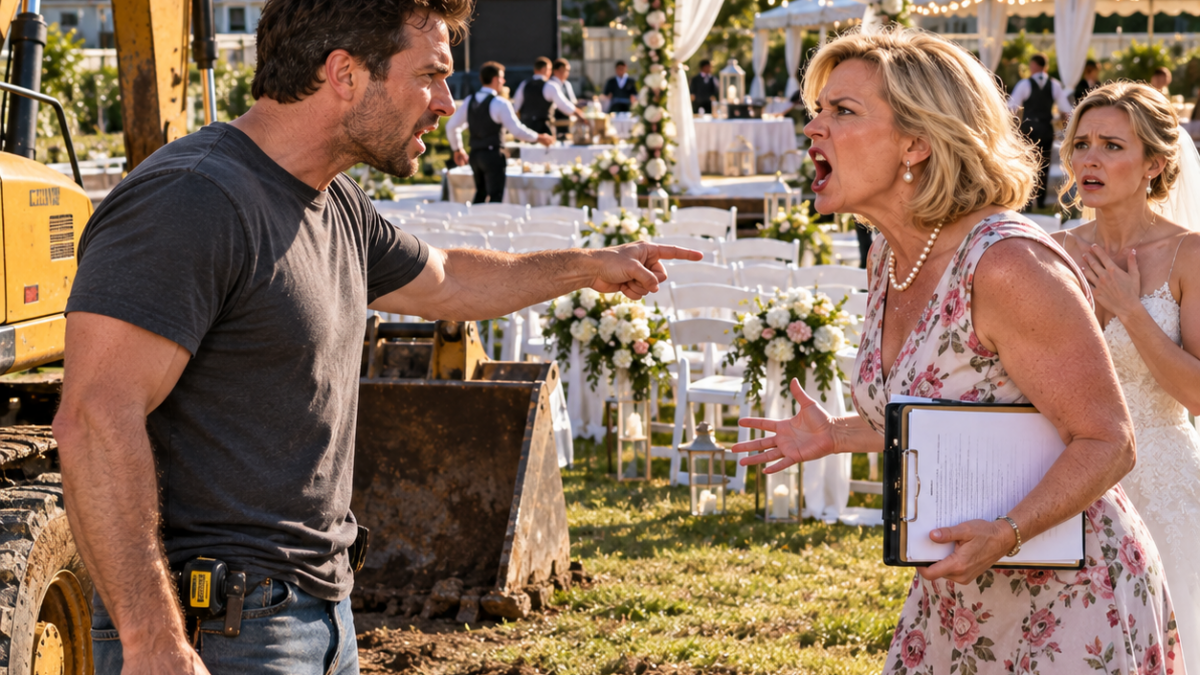
I stepped out onto my porch.
Karen saw me and froze for half a second.
That half second told me everything.
She had not expected me home.
Then her face rearranged itself into outrage, as if I had rudely interrupted my own trespassing.
“Grant,” she called. “What are you doing here?”
I walked down the porch steps.
“I live here.”
Brittany turned to her mother.
“You said he was gone until next week.”
Karen shot her a look.
I smiled.
“Did she?”
The fiancé, a tall guy named Mason from what I later learned, looked like he had just realized the floor beneath him might not be floor.
I stopped at the edge of the lot and gestured toward the wedding setup.
“What exactly is going on here?”
Karen lifted her chin.
“This is a private wedding setup.”
“On my private property.”
Brittany scoffed.
“You’re not even using it.”
I looked at her.
“That is not how ownership works.”
Karen stepped forward, palms out like she was calming a difficult employee.
“Grant, let’s not make this ugly.”
“It got ugly when you turned my land into a wedding venue without permission.”
“It is one day.”
“It is my property every day.”
She smiled tightly.
“The lot has been vacant for years.”
“It has been privately owned for years.”
“You store equipment here. You can spare it for a beautiful family occasion.”
“I don’t spare land to people who steal it.”
Brittany made a sharp little gasp.
“Steal it? Are you serious?”
“You set up tents, chairs, a stage, decorations, and vendor access on land you don’t own, without asking the owner. What word would you prefer?”
Mason muttered, “Britt, maybe we should—”
Brittany spun on him.
“Do not start.”
Karen turned back to me.
“You are overreacting.”
“No, Karen. I am reacting exactly right.”
“This wedding has been planned for months.”
“Not with me.”
“Two hundred and ten people are coming.”
“Not to my lot.”
Her eyes narrowed.
“Do you understand what you’ll do to Brittany if you interfere with this?”
I let that sit for a second.
Because there it was.
The real strategy.
Not law. Not permission. Not contract. Emotion. Shame. Social pressure. The assumption that I would be too uncomfortable, too decent, or too afraid of neighborhood gossip to stop a bride three days before her wedding.
Karen believed that if she made the consequences big enough, I would quietly absorb her theft.
I stepped closer.
“You have twenty-four hours to remove everything from my property.”
Brittany’s mouth fell open.
Karen’s face went red.
“You cannot be serious.”
“I am.”
“This is a once-in-a-lifetime event.”
“Then you should have booked a venue.”
“You are a selfish man.”
“Possibly.”
“The entire neighborhood will know you ruined a wedding.”
“The entire neighborhood is going to know you planned one on land you didn’t own.”
She leaned in, voice dropping.
“You will regret this.”
“No,” I said. “You will if this stuff is still here tomorrow.”
Karen laughed once, cold and short.
“And what exactly are you going to do?”
I looked out at the rows of white chairs, the arch, the stage, the tents fluttering slightly in the morning breeze.
At that moment, I did not know.
So I told the truth without giving her the satisfaction.
“You’ll find out.”
I walked back to my house.
Behind me, Brittany shouted something about monsters, memories, and how I had no heart. Karen called after me that I was making enemies. The wedding planner said something panicked about nonrefundable deposits.
I shut my front door.
Then I started thinking.
Calling the police was an option, but not a satisfying one.
Sure, I could file a trespassing report. I could probably get an officer to tell them to remove everything. But the wedding was in two days, and Karen was an expert at using delay as a weapon. She would cry. She would argue. She would claim misunderstanding. She would tell vendors to stay while lawyers sorted it out. By the time anything meaningful happened, the ceremony would be over, photos taken, cake eaten, and my property turned into a memory I never consented to host.
A civil lawsuit afterward would not undo it.
I needed to prevent the wedding from happening there at all.
Legally.
Cleanly.
In a way Karen could not reverse by screaming.
That was when I remembered the permit.
Months earlier, before my out-of-state job got busy, I had applied for and received preliminary permits to start site prep for Matt’s future house. We had not broken ground because he was still finalizing financing and design changes, but the paperwork existed. I had permission to begin excavation and foundation prep on my own lot.
I pulled the permit folder from my office cabinet.
There it was.
Approved.
Valid.
I sat at my desk, looking from the permit to the photos on my phone.
Then I called my foreman, Luis.
He answered with music and machinery noise in the background.
“Boss?”
“How do you feel about starting early tomorrow?”
“How early?”
“Four in the morning.”
Silence.
“Do I want to know?”
“Karen is hosting a 210-person wedding on my empty lot.”
Another silence.
Then Luis started laughing so hard he had to move the phone away from his face.
When he recovered, he said, “Tell me what to bring.”
By midnight, the plan was set.
I reviewed property law, trespass rules, permit conditions, and anything else I could think of. I took more photos. I sent written notice by text to Karen using the number from her past HOA messages:
You have been informed that the lot beside my home is private property owned by me. You do not have permission to use it for any wedding, event, vendor staging, parking, or gathering. All items must be removed by 8:00 a.m. tomorrow. Anything remaining after that will be moved as necessary for permitted construction work. You are responsible for any costs or damages caused by your unauthorized use.
She responded twelve minutes later.
You are a hateful man. We will discuss this after the wedding.
I screenshotted it.
Then I slept surprisingly well.
At 3:48 a.m., headlights rolled into my driveway.
Luis arrived first with coffee and the expression of a man who had accepted chaos as a job benefit. Three crew members followed. One brought a skid steer. Another brought a flatbed. By 4:10, we had work lights up, gloves on, and equipment moving.
We did not destroy the rental items.
That matters.
We dismantled.
Carefully enough.
Quickly.
The chairs were stacked and moved to the front edge of the property near the road. Tables folded. Decorations boxed when possible. Fabric gathered. The floral arch was carried, not smashed. The little stage was not bolted into the ground, thank God, but it was awkward. With the skid steer and enough straps, we moved it toward the front.
Anything that belonged to vendors went into neat groups.
Anything Karen had placed on my land without permission was removed from the area where we needed to dig.
By 5:35, the lot no longer looked like a wedding venue.
By 5:50, it looked like a construction site.
By 6:05, I climbed into the backhoe.
There is something deeply satisfying about machinery when used for justice.
The engine growled awake. The bucket lowered. The first scoop of dirt came up clean.
We started where the aisle had been.
By sunrise, the smooth flat area where Brittany was supposed to walk toward her flower-wrapped arch had become an open excavation for foundation prep. Dirt piles rose on both sides. Marking stakes went in. Luis set up temporary safety fencing. My crew worked like men who understood they were being paid partly in money and partly in a story they would tell for years.
At 7:03 a.m., the first guest arrived.
A silver sedan slowed in front of the lot. A woman in a floral dress stared through the windshield at the dirt piles, stacked chairs, and backhoe. Her mouth opened.
Then a second car pulled up.
Then a third.
Then Karen arrived.
She did not park so much as attack the curb.
She stormed out in a pale pink pantsuit, hair sprayed into battle formation, phone already in hand.
“What have you done?”
I climbed down from the backhoe slowly, wiping my hands on a rag.
“Good morning, Karen.”
She pointed at the excavation.
“You destroyed the wedding.”
“No. I started permitted construction on my property.”
“You moved everything!”
“I warned you.”
Guests were stepping out of cars now, confused, dressed for a ceremony, staring at the former wedding venue like they had arrived after a hurricane with excellent timing. A few looked at their phones, probably checking the address. A man carrying a camera bag stopped dead beside the sidewalk.
Karen’s voice rose.
“Two hundred and ten people are coming here today!”
“No, they aren’t.”
“You have to fix this.”
“I do not.”
“This is your fault.”
I laughed once.
That did not help her mood.
“You set up a wedding on private land without permission,” I said. “You were told to remove everything. You refused. I moved it and began the work I am legally allowed to do.”
“You ruined my daughter’s life.”
“If her life can be ruined by not trespassing, she had structural issues before today.”
A woman nearby gasped.
Luis coughed into his fist to hide a laugh.
Karen’s hand shook as she dialed.
“I’m calling the police.”
“Please do.”
She launched into the call with the kind of performance only Karen could deliver before eight in the morning. From what I could hear, I had “destroyed a wedding,” “damaged property,” “threatened guests,” and “bulldozed a venue.” She said venue several times, as if repetition could transform my lot into one.
While she waited for the police, more guests arrived.
The confusion became a low neighborhood roar.
People in suits and dresses stood along the sidewalk, whispering. A group of bridesmaids climbed out of a van and immediately started crying or yelling; it was hard to tell which. The florist showed up, saw her arrangements stacked near the road, and put both hands over her mouth. The caterer called someone and used language I respected.
Mason arrived around 7:30.
Alone.
He walked up to the lot, took in the dirt, the equipment, the stacked chairs, Karen screaming, and me standing beside a backhoe.
Then he closed his eyes.
I almost felt bad for him.
Almost.
“Where’s Brittany?” Karen demanded.
“She’s not coming until we know what’s happening,” he said.
“What’s happening,” I said, “is that your wedding is not happening here.”
Mason looked at me.
For one second, I saw something like apology in his face.
Then Karen grabbed his arm.
“Do not talk to him.”
The police arrived at 7:42.
Two officers stepped out, and Karen rushed them before their doors were fully closed.
“He destroyed everything,” she said. “He destroyed my daughter’s wedding. We had a legal event scheduled here, and he tore it apart with construction equipment.”
The older officer looked at the dirt piles.
Then at me.
Then at Karen.
“Who owns this property?”
“I do,” Karen said at the same time I said, “I do.”
The officer turned to Karen.
“You own this lot?”
Karen hesitated.
“The HOA—”
“Does the HOA own this lot?”
“It is part of the neighborhood.”
“That wasn’t the question.”
I walked over with my folder.
“My deed, parcel record, survey, and construction permit. I own the lot. I am not an HOA member. I gave written notice yesterday that they had no permission to use my property and that anything remaining would be moved for construction.”
The younger officer took the folder, reviewed the documents, then handed them to his partner.
Karen spoke over them.
“He knew there was a wedding. He did this intentionally.”
“Yes,” I said. “I intentionally used my property after she intentionally ignored my refusal.”
“You maliciously destroyed thousands of dollars in wedding materials.”
I gestured toward the neatly stacked items.
“Most of it is right there. They can pick it up.”
“The caterer, the flowers, the hair stylist, the guests—”
“None of those are my responsibility.”
Karen turned to the officers.
“You have to arrest him.”
The older officer rubbed his forehead.
It was not the first time I had seen that look around Karen.
“Ma’am, this appears to be a civil matter.”
Karen went still.
Those words are magic when they work against the person who expected authority to bend for them.
“He destroyed a wedding.”
“He appears to have moved unauthorized items from his own property and begun permitted work.”
“He cannot do that.”
The officer looked at the permit again.
“Actually, he can dig on his own lot with a valid permit.”
Brittany arrived at exactly the wrong moment.
A white limo rolled up behind the police cars. The door opened, and she stepped out in a robe, hair done, makeup done, surrounded by panic. She looked past everyone toward the lot.
Her face collapsed.
Not into sadness.
Into rage.
“You monster!” she screamed.
Every guest turned.
The street went silent except for the backhoe idling.
Brittany marched toward me, pointing with one manicured finger.
“You ruined my wedding!”
Karen rushed to her side, wrapping an arm around her.
“He did this because he hates our family.”
I took a slow breath.
“Brittany, your mother scheduled your wedding on land she did not own.”
“She said we had permission.”
That was the first interesting sentence she had said.
I looked at Karen.
Karen looked away.
Mason heard it too.
“What permission?” he asked.
Karen’s face tightened.
“We don’t need to discuss this in front of everyone.”
“Oh,” I said. “I think everyone’s already involved.”
Brittany turned to her mother.
“Mom?”
Karen lifted her chin.
“Grant has always been difficult. I expected him to be neighborly.”
Brittany’s mouth opened.
“You didn’t get permission?”
Karen snapped, “He wasn’t using it.”
Mason took one step back.
That was the moment the story changed.
Until then, to some of those guests, I had been the angry property owner who ruined a wedding. But when the bride herself realized her mother had never secured the venue, sympathy began moving away from Karen like water off concrete.
The photographer lowered his camera.
A bridesmaid whispered, “Oh my God.”
The caterer, who had been standing near the food truck with crossed arms, said loudly, “So nobody had a contract for the venue?”
Karen shouted, “This is not helping.”
The older officer spoke to me quietly.
“Do you want them trespassed?”
I looked at the guests.
Most were innocent. Inconvenienced, yes. Annoying, maybe. But they had not planned this. They had put on clothes, bought gifts, driven to an address, and walked into Karen’s disaster.
“Not the guests,” I said. “They can collect what belongs to them and leave. But the event is not happening here.”
He nodded.
Then he addressed the crowd.
“This is private property. There will be no event here today. Please move your vehicles and contact the wedding party for further instructions.”
The sound that followed was not one sound but many: groans, gasps, phone calls, angry whispers, crying, car doors, vendors demanding answers, relatives asking where to go, someone saying the cake was already in transit.
Karen kept threatening me.
She would sue me for the venue cost.
There was no venue cost.
She would sue me for emotional distress.
Good luck.
She would sue me for the caterer, the flowers, the photographer, the DJ, the hair stylist, the ruined makeup, the limo, the cake, the guests’ travel, Brittany’s trauma, Mason’s family’s embarrassment, and “the irreversible destruction of a sacred day.”
I let her list everything.
When she finally stopped for air, I said, “You have every right to sue. And I have every right to countersue for trespass, unauthorized use of land, cleanup costs, damage to the lot, vendor access, and interference with permitted construction.”
Her mouth snapped shut.
The officer’s lips twitched.
Brittany was sobbing now, but it sounded angry more than heartbroken. Mason stood several feet away, speaking quietly with what looked like his father. I do not know what was said, but Mason kept glancing at Karen in a way that suggested a very different conversation was waiting after the police left.
By 9:00 a.m., the wedding had scattered.
Some guests went home.
Some apparently went to a restaurant.
Some gathered at Karen’s house, where I heard later there was a shouting match on the front lawn between both families. The caterer refused to unload without payment clarification. The DJ demanded an extra fee for the chaos. The florist cried in her van. Brittany did not get married that day.
I know because Karen made sure everyone knew whom she blamed.
By noon, the neighborhood Facebook group was on fire.
Karen posted first.
Today, my daughter’s once-in-a-lifetime wedding was destroyed by a hateful neighbor who chose cruelty over community. Some people have empty land and empty hearts.
I waited.
Then I posted photos.
The wedding setup on my lot.
My deed with personal details covered.
The permit.
The written notice to Karen.
Her response: We will discuss this after the wedding.
I wrote:
For clarity, I am not a member of the voluntary HOA. I own the vacant lot beside my home. I never gave Karen Whitmore, Brittany, the HOA, or any vendor permission to use my property for a wedding or any event. I discovered the setup three days before the wedding and gave written notice to remove all items. That notice was ignored. I then began permitted construction activity on my own property.
The comments changed fast.
Wait, she didn’t ask?
Karen, is this true?
You told us it was approved.
You said the HOA had arranged the venue.
That’s private land??
One neighbor wrote, I was wondering how she got him to agree.
Another wrote, She didn’t. That’s the point.
Karen deleted her post.
Screenshots lived forever.
The smear campaign continued for a while, but it never really gained traction because the facts were too simple. I owned the land. She did not. I said no. She ignored it. I started work. The police confirmed they could not force me to host a wedding.
Even people who did not like me could understand that.
Karen sent a few HOA notices afterward, which was bold considering I was not in the HOA.
One claimed I had violated weekend construction quiet hours.
Construction had begun on a weekday morning, and also I was not under HOA rules.
Another claimed I was excavating without approval.
I sent back the permit.
A third claimed my construction disturbed community harmony.
I did not respond to that one because some sentences are too stupid to dignify.
A week later, Karen tried sending a letter through the HOA attorney.
My own attorney replied with a beautiful little document explaining voluntary membership, property rights, trespass, false claims of authority, and the risk of harassment liability if the HOA continued sending notices to nonmembers.
The letters stopped.
No lawsuit came.
I assume Karen either could not find a lawyer willing to take that losing mess or found one honest enough to tell her what she did was indefensible.
The vendors, from what I heard, were not as forgiving. A few demanded full payment anyway. One sued Karen in small claims court. The rental company charged extra for emergency rescheduling and labor because, surprise, “the property owner started construction” was not a valid free cancellation reason when Karen had no venue contract.
Brittany and Mason did eventually marry three months later at a banquet hall thirty miles away.
I was not invited.
Somehow, I survived.
The empty lot did become a construction site after that.
At first, I had not planned to start Matt’s build immediately. The permit was ready, but life and money still needed to line up. After the wedding disaster, Matt called me and said, “I don’t care if I have to live on ramen for two years. We are building now.”
So we did.
Nothing extravagant. Three bedrooms, a garage, a front porch facing away from Karen’s house because we were not cruel but we were practical. Matt moved in the following spring.
Karen hated him instantly.
That was predictable.
Unlike me, Matt did not merely avoid the HOA. He actively enjoyed provoking it. Not illegally. Not even rudely, most of the time. He simply had no instinct to soften the truth for people misusing authority.
The first time Karen came by with a welcome packet and voluntary HOA membership form, Matt took it, read the first page, and said, “So this is like paying someone to annoy me?”
Karen left without closing her mouth.
He installed raised garden beds, painted his front door dark green, parked his motorcycle in his driveway, and put up a small sign in the window of his garage that said PRIVATE PROPERTY: NO WEDDINGS.
I did not approve that sign.
I also did not ask him to take it down.
Neighborhood legend grew from there.
People told the wedding story at barbecues, driveway chats, and probably every HOA meeting Karen tried to control. Details got exaggerated, as details do. In some versions, I bulldozed the stage while the string quartet played. In others, Brittany arrived in her dress and fainted into the cake. One kid told Matt that I had dug a moat around the entire lot with guests trapped on the other side.
The truth was already ridiculous enough, but I understood why people embellished it.
Karen had spent years making people feel small, cornered, or obligated. Seeing her publicly defeated by the one thing she could not talk over—ownership—felt satisfying to people who had been quietly tired for a long time.
Her influence weakened after that.
Not vanished. People like Karen do not evaporate just because reality embarrasses them. But the aura cracked. Residents questioned her more. Nonmembers ignored her more openly. Even HOA members started asking for votes before events and written confirmation before decisions. Nobody wanted another “community space” misunderstanding.
At the next annual meeting, the HOA passed a rule requiring documented permission for any event held outside HOA-owned property.
The fact that such a rule needed to be written said everything.
Karen remained president for another year, but barely. When her term ended, she did not run again. She claimed she wanted to focus on family after “a difficult season of unfair attacks.”
I almost admired the phrasing.
Almost.
A retired teacher named Mrs. Donnelly replaced her and immediately reduced the drama by about ninety percent simply by understanding the words voluntary association. She sent me one polite letter introducing herself and confirming the HOA would no longer contact nonmembers regarding rules or events unless there was a legitimate shared concern.
I sent back a short thank-you.
No war required.
That was the thing Karen never understood.
Most people do not want conflict.
I did not want to destroy a wedding. I did not wake up that week hoping to ruin flowers, inconvenience guests, and make a bride scream on a public street before breakfast. I wanted my property respected. That was all. The entire disaster could have been avoided with one question months earlier.
Grant, would you consider renting your lot for a wedding?
The answer still would have been no.
But at least it would have been honest.
Instead, Karen built a plan around my absence and expected me to become the villain for objecting.
That is how entitled people operate. They create consequences, then act wounded when those consequences return home wearing boots.
Sometimes I think about Brittany.
Not with guilt exactly. More like curiosity. Did she know before that morning? Did she believe her mother had permission? Did she ask? Did she care? I will probably never know. I remember her face when she realized Karen had not secured the land. Under all that anger, there was humiliation. And for one second, I did feel sorry for her.
Then I remembered she had looked me in the eye and said, “You’re not even using it,” as if unused property becomes public property when a bride needs an aisle.
Sympathy has limits.
Mason, from what I heard, signed a prenup.
Smart man.
As for the lot, it is not empty anymore.
Matt’s house stands there now, solid and ordinary, with a small oak planted near the front and a driveway that curves exactly where Karen had placed the wedding aisle. Sometimes, when I visit, I stand near that spot and remember the rows of chairs, the fake flowers, the white arch, Karen’s face when the backhoe bucket lifted the first scoop of dirt.
It still makes me smile.
Not because I ruined a wedding.
Because I protected a boundary.
That may sound simple, but boundaries are only real when defended. A fence can be climbed. A deed can be ignored. A warning can be laughed off. A private lot can be renamed “community space” by someone with enough nerve and not enough shame.
Karen thought my land was available because I was gone.
She thought my silence meant permission.
She thought a crowd would make theft sacred.
She thought a bride’s tears would outrank ownership.
She thought wrong.
The day after the disaster, I walked the lot alone in the evening. Most of the tire marks were still there. A few petals from the fake floral arch had fallen near the dirt piles. One white ribbon was caught on a stake, fluttering in the breeze like a surrender flag.
I picked it up and stood there for a long time.
Across the street, a neighbor pretended not to watch me from behind a curtain. Somewhere down the block, Karen’s garage door closed. The neighborhood was quiet again, but it felt different. Less like a place waiting for Karen’s next command. More like people had remembered property lines were not suggestions.
I threw the ribbon into the trash.
Then I locked my gate.
People sometimes ask if I would do it again.
That exact way? Maybe not. I am older now, and my attorney would probably prefer I call him before starting heavy equipment near wedding décor.
But would I let someone use my land without permission because stopping them would make me look mean?
No.
Never.
Not a wedding.
Not a party.
Not a charity event.
Not a neighborhood picnic.
Not anything.
Beautiful occasions do not become beautiful by being built on disrespect. A wedding is supposed to begin with vows, not trespass. If your dream day requires stealing someone else’s property, the problem is not the property owner.
It is the dream.
Karen never understood that.
She saw an empty lot.
I saw land I worked for, paid taxes on, insured, planned for, and held for family.
She saw convenience.
I saw liability.
She saw a free venue.
I saw my name on the deed.
In the end, the whole neighborhood saw it too.
And that was worth every scoop of dirt.
𝗧𝗛𝗘 𝗘𝗡𝗗
Karen Invited 210 People to a Wedding on My Land, but I Came Home Before the Bride Walked Down the Aisle
Karen planned her daughter’s dream wedding on my private property without asking me a single question.
She counted on my silence, my absence, and the whole neighborhood shaming me into surrender.
Instead, I came home three days early and brought a backhoe.
The first thing you need to understand is that I was never part of the HOA.
Not technically.
Not accidentally.
Not emotionally.
Not in spirit.
Not in any hidden legal clause Karen liked to imagine when she had too much coffee and not enough people obeying her.
I lived in a neighborhood where the HOA was voluntary, though you would never know that from listening to Karen Whitmore talk. According to her, the HOA was the backbone of civilization. The only thing standing between a respectable community and total collapse into mismatched mailboxes, children’s bicycles left in driveways, and lawns cut at morally suspicious angles.
To me, it was a monthly fee for services I neither needed nor wanted.
About eighty percent of the neighborhood had joined. Some liked the community events. Some wanted access to the little clubhouse and newsletter committee. Some genuinely believed in neighborhood unity. But plenty joined because Karen made not joining feel like choosing to live under siege.
I was part of the stubborn twenty percent.
My name is Grant Calloway. I own a construction company, which means I spend most of my life looking at land, permits, foundations, contracts, and people who think a “small change” to a project should somehow cost nothing. I know what private property means. I know what liability means. I know what happens when people use land they don’t own because they assume nobody will stop them.
That is why I never joined the HOA.
My property sat near the edge of the neighborhood, on one of the older lots from before the subdivision had fully developed. It was bigger than most, and a few years after buying the house, I bought the empty lot next door when it came up cheap. I did not buy it to flex. I did not buy it to irritate Karen. I bought it because my cousin, Matt, had been talking for years about building a house near me, and the chance to hold a buildable lot for him was too good to pass up.
Until he got his life organized enough to start construction, I used the lot practically.
I stored equipment there sometimes. Not junk. Not trash. Equipment. Skid steer attachments, stacks of lumber, forms, temporary fencing, things that moved in and out depending on the job. I kept it clean, legal, and contained. It was my land, and I had permits lined up for future construction when Matt was finally ready.
Karen hated that empty lot.
She hated empty space in general, I think. Empty space represented possibility she could not control. Every time she saw my lot sitting there—open, flat, useful, and entirely outside her reach—I swear it offended her on a spiritual level.
She brought it up every few months.
“You know, Grant,” she said once while I was checking mail, “vacant lots reflect poorly on community cohesion.”
“Good thing I’m not part of your community paperwork.”
Her smile tightened. “You live in the neighborhood.”
“I live beside HOA members. That is not the same as being one.”
“You benefit from the appearance standards everyone else supports.”
“I benefit from owning my own land and minding my own business.”
She did not like that.
Karen never liked being reminded that her authority had borders.
She was the kind of woman who believed repetition could become law if she said things confidently enough. Mid-fifties, sharp blond bob, sunglasses, lipstick always perfect, and a voice that sounded like customer service with a knife hidden under it. She had been president of the voluntary HOA for six years, and somehow she had convinced most people that saying no to her was more exhausting than paying dues.
She had a daughter named Brittany.
I only met Brittany twice before the wedding disaster, and both times were enough. She had inherited her mother’s tone but not her mother’s patience, which made her worse in shorter bursts. If Karen was a slow poison, Brittany was a firecracker thrown into a mailbox.
When Brittany got engaged, the neighborhood knew immediately because Karen made sure of it.
There were announcements at HOA meetings. Engagement photos in the newsletter. A “community blessing” post on the neighborhood page. Karen described the wedding as if it were a royal event that would elevate all of us by proximity.
I ignored most of it.
I had work.
That summer, I landed a commercial build in the next state over. Nothing huge, but big enough that I needed to be on-site for several days at a time. Driving back and forth every day would have wasted hours, fuel, and patience, so I stayed near the job site during the week and came home on weekends when I could.
That was the window Karen saw.
My truck gone.
My house quiet.
The empty lot sitting there beside it, flat and open.
To a normal person, that would mean nothing.
To Karen, apparently, it meant venue available.
part2
I came home on a Wednesday afternoon, three days earlier than expected.
A supplier delay on the commercial job had shut us down temporarily, and rather than sit in a motel eating gas station sandwiches and arguing with emails, I decided to drive home, handle paperwork, check on my equipment, and sleep in my own bed.
I turned onto my street expecting quiet.
Instead, I found a wedding venue.
At first, my brain refused to understand what I was seeing.
My empty lot was covered in white chairs.
Rows of them.
Perfect rows, lined up facing a wooden arch wrapped in fake flowers. There were long tables under rented tents, a small stage, stacks of decorations, strings of lights, floral arrangements, a dance floor platform, and a delivery truck backing toward the far side of the property. Two men were unloading what looked like sound equipment.
For a second, I thought I had turned onto the wrong street.
Then I saw my house.
My driveway.
My mailbox.
My lot.
I pulled over and sat there with my hands on the steering wheel, staring.
There are moments in life when anger does not arrive immediately because confusion gets there first and takes up the whole room.
A man in a black polo walked past my truck carrying a bundle of white fabric.
I rolled down my window.
“Hey.”
He stopped.
“Yeah?”
“What are you doing?”
He looked at me like I had asked why the sky was overhead.
“Wedding setup.”
“On whose property?”
He glanced around. “The venue.”
I got out of the truck slowly.
“This is not a venue.”
He smiled, uncertain now.
“Sir, I just work for the rental company.”
“Who hired you?”
He checked something on his phone.
“Whitmore wedding.”
Of course.
I closed my eyes.
Karen.
It had to be Karen.
Within twenty minutes, after asking enough vendors and two confused neighbors, I pieced together the unbelievable shape of it.
Brittany’s wedding was scheduled for Saturday.
Two hundred and ten guests had RSVP’d.
Karen had decided my empty lot would be the perfect outdoor venue.
She had not asked me.
She had not texted.
She had not left a note.
She had not contacted my business.
She had not even bothered to invent a fake permission slip, as far as I could tell.
She had simply waited until I was out of town and started building her daughter’s wedding on my land.
The arrogance was so complete it almost became art.
A caterer had already been given parking instructions. A florist had installed arrangements. Rental crews had delivered chairs, tables, tents, and a stage. A DJ had a setup schedule. Someone had marked off where portable restroom trailers were supposed to go. Guests had apparently been told the ceremony would take place on “the open green beside the Calloway property,” which Karen had described as a “community event space.”
Community event space.
My private lot.
I walked the perimeter, taking photos and videos of everything. The chairs. The delivery tags. The vendor trucks. The tents. The stage. The decorations. The tire marks. The workers stepping around my property as if they had rented it fair and square.
Then I called my cousin Matt.
He answered on the third ring.
“Please tell me you’re not dead,” he said.
“Not yet.”
“That sounds bad.”
“Karen is hosting Brittany’s wedding on your future house lot.”
Silence.
Then: “I’m sorry, what?”
I sent him a photo.
His reply was immediate.
That woman needs medication and a lawsuit.
I almost laughed.
Almost.
The next morning, I woke early, made coffee, and waited.
I did not have to wait long.
At 8:17 a.m., Karen arrived in her white SUV with Brittany, Brittany’s fiancé, two women carrying garment bags, and a man who appeared to be either a wedding planner or someone very committed to holding a tablet dramatically. Another vendor van followed.
I stepped out onto my porch.
Karen saw me and froze for half a second.
That half second told me everything.
She had not expected me home.
Then her face rearranged itself into outrage, as if I had rudely interrupted my own trespassing.
“Grant,” she called. “What are you doing here?”
I walked down the porch steps.
“I live here.”
Brittany turned to her mother.
“You said he was gone until next week.”
Karen shot her a look.
I smiled.
“Did she?”
The fiancé, a tall guy named Mason from what I later learned, looked like he had just realized the floor beneath him might not be floor.
I stopped at the edge of the lot and gestured toward the wedding setup.
“What exactly is going on here?”
Karen lifted her chin.
“This is a private wedding setup.”
“On my private property.”
Brittany scoffed.
“You’re not even using it.”
I looked at her.
“That is not how ownership works.”
Karen stepped forward, palms out like she was calming a difficult employee.
“Grant, let’s not make this ugly.”
“It got ugly when you turned my land into a wedding venue without permission.”
“It is one day.”
“It is my property every day.”
She smiled tightly.
“The lot has been vacant for years.”
“It has been privately owned for years.”
“You store equipment here. You can spare it for a beautiful family occasion.”
“I don’t spare land to people who steal it.”
Brittany made a sharp little gasp.
“Steal it? Are you serious?”
“You set up tents, chairs, a stage, decorations, and vendor access on land you don’t own, without asking the owner. What word would you prefer?”
Mason muttered, “Britt, maybe we should—”
Brittany spun on him.
“Do not start.”
Karen turned back to me.
“You are overreacting.”
“No, Karen. I am reacting exactly right.”
“This wedding has been planned for months.”
“Not with me.”
“Two hundred and ten people are coming.”
“Not to my lot.”
Her eyes narrowed.
“Do you understand what you’ll do to Brittany if you interfere with this?”
I let that sit for a second.
Because there it was.
The real strategy.
Not law. Not permission. Not contract. Emotion. Shame. Social pressure. The assumption that I would be too uncomfortable, too decent, or too afraid of neighborhood gossip to stop a bride three days before her wedding.
Karen believed that if she made the consequences big enough, I would quietly absorb her theft.
I stepped closer.
“You have twenty-four hours to remove everything from my property.”
Brittany’s mouth fell open.
Karen’s face went red.
“You cannot be serious.”
“I am.”
“This is a once-in-a-lifetime event.”
“Then you should have booked a venue.”
“You are a selfish man.”
“Possibly.”
“The entire neighborhood will know you ruined a wedding.”
“The entire neighborhood is going to know you planned one on land you didn’t own.”
She leaned in, voice dropping.
“You will regret this.”
“No,” I said. “You will if this stuff is still here tomorrow.”
Karen laughed once, cold and short.
“And what exactly are you going to do?”
I looked out at the rows of white chairs, the arch, the stage, the tents fluttering slightly in the morning breeze.
At that moment, I did not know.
So I told the truth without giving her the satisfaction.
“You’ll find out.”
I walked back to my house.
Behind me, Brittany shouted something about monsters, memories, and how I had no heart. Karen called after me that I was making enemies. The wedding planner said something panicked about nonrefundable deposits.
I shut my front door.
Then I started thinking.
Calling the police was an option, but not a satisfying one.
Sure, I could file a trespassing report. I could probably get an officer to tell them to remove everything. But the wedding was in two days, and Karen was an expert at using delay as a weapon. She would cry. She would argue. She would claim misunderstanding. She would tell vendors to stay while lawyers sorted it out. By the time anything meaningful happened, the ceremony would be over, photos taken, cake eaten, and my property turned into a memory I never consented to host.
A civil lawsuit afterward would not undo it.
I needed to prevent the wedding from happening there at all.
Legally.
Cleanly.
In a way Karen could not reverse by screaming.
That was when I remembered the permit.
Months earlier, before my out-of-state job got busy, I had applied for and received preliminary permits to start site prep for Matt’s future house. We had not broken ground because he was still finalizing financing and design changes, but the paperwork existed. I had permission to begin excavation and foundation prep on my own lot.
I pulled the permit folder from my office cabinet.
There it was.
Approved.
Valid.
I sat at my desk, looking from the permit to the photos on my phone.
Then I called my foreman, Luis.
He answered with music and machinery noise in the background.
“Boss?”
“How do you feel about starting early tomorrow?”
“How early?”
“Four in the morning.”
Silence.
“Do I want to know?”
“Karen is hosting a 210-person wedding on my empty lot.”
Another silence.
Then Luis started laughing so hard he had to move the phone away from his face.
When he recovered, he said, “Tell me what to bring.”
By midnight, the plan was set.
I reviewed property law, trespass rules, permit conditions, and anything else I could think of. I took more photos. I sent written notice by text to Karen using the number from her past HOA messages:
You have been informed that the lot beside my home is private property owned by me. You do not have permission to use it for any wedding, event, vendor staging, parking, or gathering. All items must be removed by 8:00 a.m. tomorrow. Anything remaining after that will be moved as necessary for permitted construction work. You are responsible for any costs or damages caused by your unauthorized use.
She responded twelve minutes later.
You are a hateful man. We will discuss this after the wedding.
I screenshotted it.
Then I slept surprisingly well.
At 3:48 a.m., headlights rolled into my driveway.
Luis arrived first with coffee and the expression of a man who had accepted chaos as a job benefit. Three crew members followed. One brought a skid steer. Another brought a flatbed. By 4:10, we had work lights up, gloves on, and equipment moving.
We did not destroy the rental items.
That matters.
We dismantled.
Carefully enough.
Quickly.
The chairs were stacked and moved to the front edge of the property near the road. Tables folded. Decorations boxed when possible. Fabric gathered. The floral arch was carried, not smashed. The little stage was not bolted into the ground, thank God, but it was awkward. With the skid steer and enough straps, we moved it toward the front.
Anything that belonged to vendors went into neat groups.
Anything Karen had placed on my land without permission was removed from the area where we needed to dig.
By 5:35, the lot no longer looked like a wedding venue.
By 5:50, it looked like a construction site.
By 6:05, I climbed into the backhoe.
There is something deeply satisfying about machinery when used for justice.
The engine growled awake. The bucket lowered. The first scoop of dirt came up clean.
We started where the aisle had been.
By sunrise, the smooth flat area where Brittany was supposed to walk toward her flower-wrapped arch had become an open excavation for foundation prep. Dirt piles rose on both sides. Marking stakes went in. Luis set up temporary safety fencing. My crew worked like men who understood they were being paid partly in money and partly in a story they would tell for years.
At 7:03 a.m., the first guest arrived.
A silver sedan slowed in front of the lot. A woman in a floral dress stared through the windshield at the dirt piles, stacked chairs, and backhoe. Her mouth opened.
Then a second car pulled up.
Then a third.
Then Karen arrived.
She did not park so much as attack the curb.
She stormed out in a pale pink pantsuit, hair sprayed into battle formation, phone already in hand.
“What have you done?”
I climbed down from the backhoe slowly, wiping my hands on a rag.
“Good morning, Karen.”
She pointed at the excavation.
“You destroyed the wedding.”
“No. I started permitted construction on my property.”
“You moved everything!”
“I warned you.”
Guests were stepping out of cars now, confused, dressed for a ceremony, staring at the former wedding venue like they had arrived after a hurricane with excellent timing. A few looked at their phones, probably checking the address. A man carrying a camera bag stopped dead beside the sidewalk.
Karen’s voice rose.
“Two hundred and ten people are coming here today!”
“No, they aren’t.”
“You have to fix this.”
“I do not.”
“This is your fault.”
I laughed once.
That did not help her mood.
“You set up a wedding on private land without permission,” I said. “You were told to remove everything. You refused. I moved it and began the work I am legally allowed to do.”
“You ruined my daughter’s life.”
“If her life can be ruined by not trespassing, she had structural issues before today.”
A woman nearby gasped.
Luis coughed into his fist to hide a laugh.
Karen’s hand shook as she dialed.
“I’m calling the police.”
“Please do.”
She launched into the call with the kind of performance only Karen could deliver before eight in the morning. From what I could hear, I had “destroyed a wedding,” “damaged property,” “threatened guests,” and “bulldozed a venue.” She said venue several times, as if repetition could transform my lot into one.
While she waited for the police, more guests arrived.
The confusion became a low neighborhood roar.
People in suits and dresses stood along the sidewalk, whispering. A group of bridesmaids climbed out of a van and immediately started crying or yelling; it was hard to tell which. The florist showed up, saw her arrangements stacked near the road, and put both hands over her mouth. The caterer called someone and used language I respected.
Mason arrived around 7:30.
Alone.
He walked up to the lot, took in the dirt, the equipment, the stacked chairs, Karen screaming, and me standing beside a backhoe.
Then he closed his eyes.
I almost felt bad for him.
Almost.
“Where’s Brittany?” Karen demanded.
“She’s not coming until we know what’s happening,” he said.
“What’s happening,” I said, “is that your wedding is not happening here.”
Mason looked at me.
For one second, I saw something like apology in his face.
Then Karen grabbed his arm.
“Do not talk to him.”
The police arrived at 7:42.
Two officers stepped out, and Karen rushed them before their doors were fully closed.
“He destroyed everything,” she said. “He destroyed my daughter’s wedding. We had a legal event scheduled here, and he tore it apart with construction equipment.”
The older officer looked at the dirt piles.
Then at me.
Then at Karen.
“Who owns this property?”
“I do,” Karen said at the same time I said, “I do.”
The officer turned to Karen.
“You own this lot?”
Karen hesitated.
“The HOA—”
“Does the HOA own this lot?”
“It is part of the neighborhood.”
“That wasn’t the question.”
I walked over with my folder.
“My deed, parcel record, survey, and construction permit. I own the lot. I am not an HOA member. I gave written notice yesterday that they had no permission to use my property and that anything remaining would be moved for construction.”
The younger officer took the folder, reviewed the documents, then handed them to his partner.
Karen spoke over them.
“He knew there was a wedding. He did this intentionally.”
“Yes,” I said. “I intentionally used my property after she intentionally ignored my refusal.”
“You maliciously destroyed thousands of dollars in wedding materials.”
I gestured toward the neatly stacked items.
“Most of it is right there. They can pick it up.”
“The caterer, the flowers, the hair stylist, the guests—”
“None of those are my responsibility.”
Karen turned to the officers.
“You have to arrest him.”
The older officer rubbed his forehead.
It was not the first time I had seen that look around Karen.
“Ma’am, this appears to be a civil matter.”
Karen went still.
Those words are magic when they work against the person who expected authority to bend for them.
“He destroyed a wedding.”
“He appears to have moved unauthorized items from his own property and begun permitted work.”
“He cannot do that.”
The officer looked at the permit again.
“Actually, he can dig on his own lot with a valid permit.”
Brittany arrived at exactly the wrong moment.
A white limo rolled up behind the police cars. The door opened, and she stepped out in a robe, hair done, makeup done, surrounded by panic. She looked past everyone toward the lot.
Her face collapsed.
Not into sadness.
Into rage.
“You monster!” she screamed.
Every guest turned.
The street went silent except for the backhoe idling.
Brittany marched toward me, pointing with one manicured finger.
“You ruined my wedding!”
Karen rushed to her side, wrapping an arm around her.
“He did this because he hates our family.”
I took a slow breath.
“Brittany, your mother scheduled your wedding on land she did not own.”
“She said we had permission.”
That was the first interesting sentence she had said.
I looked at Karen.
Karen looked away.
Mason heard it too.
“What permission?” he asked.
Karen’s face tightened.
“We don’t need to discuss this in front of everyone.”
“Oh,” I said. “I think everyone’s already involved.”
Brittany turned to her mother.
“Mom?”
Karen lifted her chin.
“Grant has always been difficult. I expected him to be neighborly.”
Brittany’s mouth opened.
“You didn’t get permission?”
Karen snapped, “He wasn’t using it.”
Mason took one step back.
That was the moment the story changed.
Until then, to some of those guests, I had been the angry property owner who ruined a wedding. But when the bride herself realized her mother had never secured the venue, sympathy began moving away from Karen like water off concrete.
The photographer lowered his camera.
A bridesmaid whispered, “Oh my God.”
The caterer, who had been standing near the food truck with crossed arms, said loudly, “So nobody had a contract for the venue?”
Karen shouted, “This is not helping.”
The older officer spoke to me quietly.
“Do you want them trespassed?”
I looked at the guests.
Most were innocent. Inconvenienced, yes. Annoying, maybe. But they had not planned this. They had put on clothes, bought gifts, driven to an address, and walked into Karen’s disaster.
“Not the guests,” I said. “They can collect what belongs to them and leave. But the event is not happening here.”
He nodded.
Then he addressed the crowd.
“This is private property. There will be no event here today. Please move your vehicles and contact the wedding party for further instructions.”
The sound that followed was not one sound but many: groans, gasps, phone calls, angry whispers, crying, car doors, vendors demanding answers, relatives asking where to go, someone saying the cake was already in transit.
Karen kept threatening me.
She would sue me for the venue cost.
There was no venue cost.
She would sue me for emotional distress.
Good luck.
She would sue me for the caterer, the flowers, the photographer, the DJ, the hair stylist, the ruined makeup, the limo, the cake, the guests’ travel, Brittany’s trauma, Mason’s family’s embarrassment, and “the irreversible destruction of a sacred day.”
I let her list everything.
When she finally stopped for air, I said, “You have every right to sue. And I have every right to countersue for trespass, unauthorized use of land, cleanup costs, damage to the lot, vendor access, and interference with permitted construction.”
Her mouth snapped shut.
The officer’s lips twitched.
Brittany was sobbing now, but it sounded angry more than heartbroken. Mason stood several feet away, speaking quietly with what looked like his father. I do not know what was said, but Mason kept glancing at Karen in a way that suggested a very different conversation was waiting after the police left.
By 9:00 a.m., the wedding had scattered.
Some guests went home.
Some apparently went to a restaurant.
Some gathered at Karen’s house, where I heard later there was a shouting match on the front lawn between both families. The caterer refused to unload without payment clarification. The DJ demanded an extra fee for the chaos. The florist cried in her van. Brittany did not get married that day.
I know because Karen made sure everyone knew whom she blamed.
By noon, the neighborhood Facebook group was on fire.
Karen posted first.
Today, my daughter’s once-in-a-lifetime wedding was destroyed by a hateful neighbor who chose cruelty over community. Some people have empty land and empty hearts.
I waited.
Then I posted photos.
The wedding setup on my lot.
My deed with personal details covered.
The permit.
The written notice to Karen.
Her response: We will discuss this after the wedding.
I wrote:
For clarity, I am not a member of the voluntary HOA. I own the vacant lot beside my home. I never gave Karen Whitmore, Brittany, the HOA, or any vendor permission to use my property for a wedding or any event. I discovered the setup three days before the wedding and gave written notice to remove all items. That notice was ignored. I then began permitted construction activity on my own property.
The comments changed fast.
Wait, she didn’t ask?
Karen, is this true?
You told us it was approved.
You said the HOA had arranged the venue.
That’s private land??
One neighbor wrote, I was wondering how she got him to agree.
Another wrote, She didn’t. That’s the point.
Karen deleted her post.
Screenshots lived forever.
The smear campaign continued for a while, but it never really gained traction because the facts were too simple. I owned the land. She did not. I said no. She ignored it. I started work. The police confirmed they could not force me to host a wedding.
Even people who did not like me could understand that.
Karen sent a few HOA notices afterward, which was bold considering I was not in the HOA.
One claimed I had violated weekend construction quiet hours.
Construction had begun on a weekday morning, and also I was not under HOA rules.
Another claimed I was excavating without approval.
I sent back the permit.
A third claimed my construction disturbed community harmony.
I did not respond to that one because some sentences are too stupid to dignify.
A week later, Karen tried sending a letter through the HOA attorney.
My own attorney replied with a beautiful little document explaining voluntary membership, property rights, trespass, false claims of authority, and the risk of harassment liability if the HOA continued sending notices to nonmembers.
The letters stopped.
No lawsuit came.
I assume Karen either could not find a lawyer willing to take that losing mess or found one honest enough to tell her what she did was indefensible.
The vendors, from what I heard, were not as forgiving. A few demanded full payment anyway. One sued Karen in small claims court. The rental company charged extra for emergency rescheduling and labor because, surprise, “the property owner started construction” was not a valid free cancellation reason when Karen had no venue contract.
Brittany and Mason did eventually marry three months later at a banquet hall thirty miles away.
I was not invited.
Somehow, I survived.
The empty lot did become a construction site after that.
At first, I had not planned to start Matt’s build immediately. The permit was ready, but life and money still needed to line up. After the wedding disaster, Matt called me and said, “I don’t care if I have to live on ramen for two years. We are building now.”
So we did.
Nothing extravagant. Three bedrooms, a garage, a front porch facing away from Karen’s house because we were not cruel but we were practical. Matt moved in the following spring.
Karen hated him instantly.
That was predictable.
Unlike me, Matt did not merely avoid the HOA. He actively enjoyed provoking it. Not illegally. Not even rudely, most of the time. He simply had no instinct to soften the truth for people misusing authority.
The first time Karen came by with a welcome packet and voluntary HOA membership form, Matt took it, read the first page, and said, “So this is like paying someone to annoy me?”
Karen left without closing her mouth.
He installed raised garden beds, painted his front door dark green, parked his motorcycle in his driveway, and put up a small sign in the window of his garage that said PRIVATE PROPERTY: NO WEDDINGS.
I did not approve that sign.
I also did not ask him to take it down.
Neighborhood legend grew from there.
People told the wedding story at barbecues, driveway chats, and probably every HOA meeting Karen tried to control. Details got exaggerated, as details do. In some versions, I bulldozed the stage while the string quartet played. In others, Brittany arrived in her dress and fainted into the cake. One kid told Matt that I had dug a moat around the entire lot with guests trapped on the other side.
The truth was already ridiculous enough, but I understood why people embellished it.
Karen had spent years making people feel small, cornered, or obligated. Seeing her publicly defeated by the one thing she could not talk over—ownership—felt satisfying to people who had been quietly tired for a long time.
Her influence weakened after that.
Not vanished. People like Karen do not evaporate just because reality embarrasses them. But the aura cracked. Residents questioned her more. Nonmembers ignored her more openly. Even HOA members started asking for votes before events and written confirmation before decisions. Nobody wanted another “community space” misunderstanding.
At the next annual meeting, the HOA passed a rule requiring documented permission for any event held outside HOA-owned property.
The fact that such a rule needed to be written said everything.
Karen remained president for another year, but barely. When her term ended, she did not run again. She claimed she wanted to focus on family after “a difficult season of unfair attacks.”
I almost admired the phrasing.
Almost.
A retired teacher named Mrs. Donnelly replaced her and immediately reduced the drama by about ninety percent simply by understanding the words voluntary association. She sent me one polite letter introducing herself and confirming the HOA would no longer contact nonmembers regarding rules or events unless there was a legitimate shared concern.
I sent back a short thank-you.
No war required.
That was the thing Karen never understood.
Most people do not want conflict.
I did not want to destroy a wedding. I did not wake up that week hoping to ruin flowers, inconvenience guests, and make a bride scream on a public street before breakfast. I wanted my property respected. That was all. The entire disaster could have been avoided with one question months earlier.
Grant, would you consider renting your lot for a wedding?
The answer still would have been no.
But at least it would have been honest.
Instead, Karen built a plan around my absence and expected me to become the villain for objecting.
That is how entitled people operate. They create consequences, then act wounded when those consequences return home wearing boots.
Sometimes I think about Brittany.
Not with guilt exactly. More like curiosity. Did she know before that morning? Did she believe her mother had permission? Did she ask? Did she care? I will probably never know. I remember her face when she realized Karen had not secured the land. Under all that anger, there was humiliation. And for one second, I did feel sorry for her.
Then I remembered she had looked me in the eye and said, “You’re not even using it,” as if unused property becomes public property when a bride needs an aisle.
Sympathy has limits.
Mason, from what I heard, signed a prenup.
Smart man.
As for the lot, it is not empty anymore.
Matt’s house stands there now, solid and ordinary, with a small oak planted near the front and a driveway that curves exactly where Karen had placed the wedding aisle. Sometimes, when I visit, I stand near that spot and remember the rows of chairs, the fake flowers, the white arch, Karen’s face when the backhoe bucket lifted the first scoop of dirt.
It still makes me smile.
Not because I ruined a wedding.
Because I protected a boundary.
That may sound simple, but boundaries are only real when defended. A fence can be climbed. A deed can be ignored. A warning can be laughed off. A private lot can be renamed “community space” by someone with enough nerve and not enough shame.
Karen thought my land was available because I was gone.
She thought my silence meant permission.
She thought a crowd would make theft sacred.
She thought a bride’s tears would outrank ownership.
She thought wrong.
The day after the disaster, I walked the lot alone in the evening. Most of the tire marks were still there. A few petals from the fake floral arch had fallen near the dirt piles. One white ribbon was caught on a stake, fluttering in the breeze like a surrender flag.
I picked it up and stood there for a long time.
Across the street, a neighbor pretended not to watch me from behind a curtain. Somewhere down the block, Karen’s garage door closed. The neighborhood was quiet again, but it felt different. Less like a place waiting for Karen’s next command. More like people had remembered property lines were not suggestions.
I threw the ribbon into the trash.
Then I locked my gate.
People sometimes ask if I would do it again.
That exact way? Maybe not. I am older now, and my attorney would probably prefer I call him before starting heavy equipment near wedding décor.
But would I let someone use my land without permission because stopping them would make me look mean?
No.
Never.
Not a wedding.
Not a party.
Not a charity event.
Not a neighborhood picnic.
Not anything.
Beautiful occasions do not become beautiful by being built on disrespect. A wedding is supposed to begin with vows, not trespass. If your dream day requires stealing someone else’s property, the problem is not the property owner.
It is the dream.
Karen never understood that.
She saw an empty lot.
I saw land I worked for, paid taxes on, insured, planned for, and held for family.
She saw convenience.
I saw liability.
She saw a free venue.
I saw my name on the deed.
In the end, the whole neighborhood saw it too.
And that was worth every scoop of dirt.