𝗙𝗨𝗟𝗟 𝗦𝗧𝗢𝗥𝗬 Karen Invented an HOA to Fine My Whole Street, Then Found Out Our Neighborhood Still Knew How to Fight Back
𝗙𝗨𝗟𝗟 𝗦𝗧𝗢𝗥𝗬
“Did you pay it?” I asked.
Mrs. Alvarez looked ashamed.
“I did.”
“How?”
“Check. Made out to Willow Creek Residential Standards Association.”
I stared at that fake name until it seemed to blur.
“There is no Willow Creek Residential Standards Association.”
“I thought maybe I missed something.”
“You didn’t.”
She sat at my kitchen table and cried quietly while I made tea I did not know how to make properly. By the end of that conversation, I knew two things.
Karen was not just annoying.
And this was not going to stop by itself.
Over the next week, I started hearing more stories.
The Martins had paid two hundred dollars because their fence was “noncompliant beige.” Henry from across the park had received a fine because his trash cans were visible from the street for forty-six minutes after pickup. The Nguyen family got a notice because their front door wreath was “seasonally inappropriate.” A young couple with a newborn paid seventy-five dollars because their stroller had been left on the porch overnight.
Each story had the same shape.
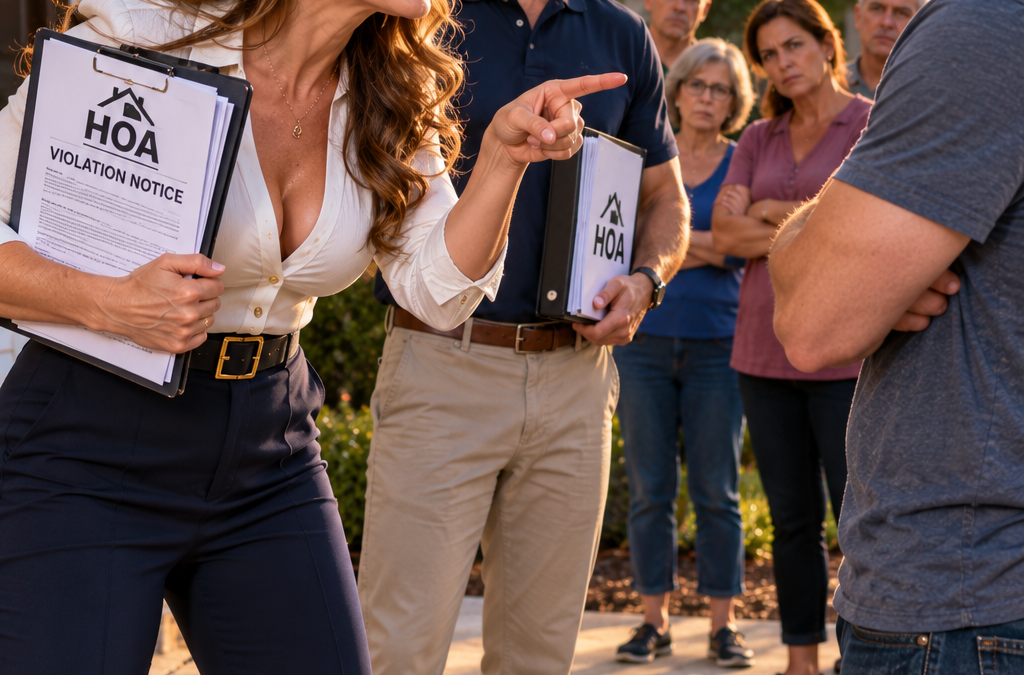
Karen or Kevin arrived with papers. They used words like bylaws, enforcement, interest, collections, and legal escalation. If anyone questioned them, they produced a thick binder full of printed rules and a laminated badge with the fake association’s name. People got nervous. Some paid because the amount was small enough that fighting felt like more trouble than surrendering.
That was how Karen won.
Not with legal power.
With exhaustion.
With fear.
With the quiet embarrassment people feel when someone confident tells them they have broken a rule they did not know existed.
I tried to stay calm.
I told myself to gather facts before doing anything dramatic.
Then Karen came to my house.
It was late afternoon, golden sunlight cutting through the maple trees, when I heard a sharp knock at my front door. Not a neighbor knock. Not the friendly rhythm of someone dropping by to borrow a tool. Three hard knocks, evenly spaced.
When I opened the door, Karen stood on my porch.
Kevin was a step behind her.
Karen wore a white blouse tucked into fitted navy pants, gold hoops, red lipstick, and a smile that had never once reached her eyes. She held a notice between two fingers like a royal decree.
“You’re in violation,” she said.
No hello.
No introduction.
Just accusation.
I looked at the paper, then at her.
“Of what?”
“Article 5, Subsection 3.”
“That clears it up.”
Her smile tightened.
“You’ve been parking in the driveway.”
I waited for the rest.
There was no rest.
“It’s my driveway,” I said.
“It functions as a shared pedestrian pathway.”
“No, it doesn’t.”
“People use it as a shortcut.”
“Because I allow them to. That doesn’t make it public access.”
Kevin stepped forward slightly.
“The association has determined that long-standing neighborhood use creates a shared access expectation.”
I stared at him.
“Did you practice saying that in the mirror?”
Karen’s lips parted in offense.
“You can be sarcastic if you want, but fines begin immediately. Seventy-five dollars for the first notice. Additional violations may result in escalating penalties.”
“Karen,” I said, keeping my voice level, “there is no HOA here.”
Her eyes flashed.
“There is now.”
“No, there isn’t.”
“We are a legally constituted neighborhood standards association.”
“Then you won’t mind showing me where it’s registered.”
“We are not required to satisfy your personal curiosity.”
“You’re required to exist before you fine me.”
Kevin’s face reddened. Karen’s remained cool, but the hand holding the notice stiffened.
“You should be very careful,” she said softly. “People who refuse to comply often find themselves dealing with consequences they could have avoided.”
“Are you threatening me?”
“I’m educating you.”
“Then I’ll educate you. Check the deeds. Check the county records. Check the municipality. My driveway is on my property. Your fake Article 5 does not change that.”
For a moment, none of us spoke.
Karen looked past me into my house, as if she expected to find something else she could criticize. Then her gaze returned to my face.
“You’re going to be difficult,” she said.
“I’m going to be accurate.”
She leaned closer.
Up close, her perfume was expensive and suffocating.
“You know,” she said, voice dropping, “we had big plans for this neighborhood. Beautiful plans. Standards. Pride. A sense of exclusivity. But there is always someone who mistakes selfishness for freedom.”
“There is always someone who mistakes fraud for leadership.”
That did it.
Her smile vanished.
Kevin reached for her elbow, maybe to calm her, maybe to stop her from saying something worse. She yanked her arm away.
“We’ll see how brave you are when the late fees start,” she snapped.
She slapped the notice against my doorframe, turned, and walked away with Kevin following behind her like a nervous shadow.
I watched them go.
Then I picked up the notice and smiled for the first time.
Because now I had my own copy.
I spent that night digging.
The fake association name appeared nowhere in county records. Nowhere in state nonprofit registrations. Nowhere in municipal filings. The registration number printed on the notices did not correspond to any legal entity I could find. The address listed was a rented mailbox at a shipping store two towns over.
The next morning, I called the municipality.
The clerk on the phone was patient at first, then confused, then audibly irritated on my behalf.
“No,” she said. “There is no homeowners association recorded for Willow Creek Lane.”
“Could one have been created without homeowners signing anything?”
“Not like that.”
“Could a private couple collect fines?”
“No.”
“Could they threaten liens?”
There was a pause.
“Sir, you may want to speak with an attorney. Possibly law enforcement.”
That was when my anger became something colder and more useful.
I went door to door.
At first, people were hesitant. Embarrassed. Some were ashamed they had paid. Some were scared Karen would retaliate. Others had convinced themselves that maybe the fake association was real because admitting they had been tricked hurt too much.
So I did not start with speeches.
I started with questions.
“Did you receive a notice?”
“Did you pay?”
“Who did you pay?”
“What did they tell you would happen if you refused?”
“Did you ever sign anything agreeing to an HOA?”
“Did anyone ever vote?”
Slowly, the truth spread from porch to porch.
By Saturday, fifteen neighbors had gathered in my living room. By Sunday, it was twenty-three in the park pavilion. People brought their notices in folders, envelopes, trembling hands. Checks. Receipts. Text messages. Emails from Karen filled with phrases like FINAL WARNING and LEGAL ESCALATION PENDING. Kevin had sent one neighbor a message saying refusal to comply could “impact asset security.”
A retired accountant named Bill looked at all of it and said, “This is not an HOA. This is a shakedown.”
Nobody argued.
Mrs. Alvarez sat near the front, her hands folded tightly around her purse.
“How much do you think they took?” she asked.
Bill adjusted his glasses.
“Based on what people have admitted so far? Several thousand.”
A silence fell over the pavilion.
Several thousand dollars.
From retirees. Young parents. People on fixed incomes. People who trusted neighbors because that was how our neighborhood had always worked.
Karen had not simply stolen money.
She had stolen trust.
The next question was what to do.
Some people wanted to confront Karen immediately. Others wanted to hire an attorney. Someone suggested going to the news. Someone else said we should just refuse to pay from then on and avoid drama.
That last suggestion came from a man named Pete, who hated conflict so much he once apologized to a mailbox after bumping into it.
“No,” Mrs. Alvarez said suddenly.
Everyone turned.
She looked nervous, but she lifted her chin.
“No more avoiding. That’s how she got away with it. I paid because I was afraid. I am still afraid. But I’m angrier now.”
That was the moment the neighborhood came back to life.
Not all at once.
Not perfectly.
But enough.
We agreed to stop paying. We agreed to preserve every notice and message. We agreed to speak as a group, not as isolated targets. We agreed to contact the police and consult an attorney.
The following Tuesday, Karen and Kevin came to the park.
I still do not know who told them we were meeting there. Maybe they saw the crowd. Maybe one of their few supporters warned them. Maybe Karen simply sensed control slipping and followed the smell of rebellion.
She arrived dressed like she was attending a country club luncheon. Pale green fitted dress. Gold sandals. Sunglasses. Hair loose over her shoulders. Kevin walked beside her carrying the binder.
Karen smiled when she saw us gathered.
It was almost impressive.
Most people, facing thirty angry neighbors holding evidence of their lies, might hesitate.
Karen looked delighted to have an audience.
“Well,” she said, “isn’t this dramatic?”
I stepped forward.
“Karen, we’ve checked the county, the state, and the municipality. There is no legally registered HOA or neighborhood standards association for Willow Creek Lane.”
Her smile did not move.
“You checked incorrectly.”
“No,” Bill said, holding up printed records. “We didn’t.”
Kevin cleared his throat.
“We are a private residential standards organization.”
“Created by whom?” I asked.
“Concerned homeowners.”
“Which homeowners?”
Karen lifted her chin.
“Leadership does not require mob approval.”
A murmur moved through the group.
“You took money,” Mrs. Alvarez said, her voice shaking but audible. “You told me I could get a lien on my house.”
Karen looked at her with fake sympathy.
“We warned you of possible enforcement consequences. If you misunderstood—”
“You scared me,” Mrs. Alvarez said.
Karen’s eyes cooled.
“Compliance often feels uncomfortable to people unused to standards.”
Something ugly moved through the crowd.
Kevin opened the binder.
“We have documentation.”
“No,” I said. “You have paper.”
Karen’s head snapped toward me.
“You are ruining this neighborhood.”
“No. We are taking it back.”
Her laugh was sharp.
“From what? Improvement? Accountability? Pride? You people were living like this street was a free-for-all.”
“You moved here three months ago,” someone shouted.
“And in three months,” Karen said, raising her voice, “I have done more to establish order than all of you did in ten years.”
I stepped closer.
“You mean you collected fake fines.”
“I mean we tried to create value.”
“For yourselves.”
Kevin’s face tightened.
“You need to be careful with accusations.”
“Gladly,” I said. “Let’s use precise words. You created a fake association, issued fake violation notices, threatened legal action you had no authority to take, and collected money from frightened neighbors.”
Karen’s eyes burned.
“We are the owners of this place.”
The sentence hung in the air.
Even Kevin looked at her sharply.
I smiled slightly.
“No, Karen. That is exactly the problem. You bought one house. Not the street. Not the park. Not the people.”
Her face flushed deep red under her makeup.
“We have big plans.”
“So do we,” I said. “And yours are not ours.”
Mrs. Alvarez stood then, small and trembling but upright.
“I want my money back.”
Others joined.
“Me too.”
“You owe us.”
“Refund everyone.”
Karen laughed.
Not because it was funny.
Because she could not allow herself to look cornered.
“You people are unbelievable. You paid voluntarily.”
“Because you lied,” Bill said.
“We advised.”
“You threatened.”
Kevin shut the binder.
“This meeting is over.”
“No,” I said. “Your scam is over.”
That was the first time Karen looked afraid.
Not much.
Just enough.
Her eyes flicked across the crowd and saw something she had not expected: unity.
People like Karen do not fear anger. They know how to redirect anger. They know how to turn one person’s outrage into a complaint about tone, manners, hostility, drama.
What they fear is a group.
A group compares notes.
A group remembers.
A group makes fear less lonely.
Karen grabbed Kevin’s arm.
“We’re leaving,” she said.
Nobody stopped them.
We had already decided our next step.
The police investigation started quietly.
We handed over everything. Notices. Receipts. Emails. Text messages. Copies of the fake rulebook. Photos of the laminated badges. Records searches proving no such HOA existed. Statements from neighbors who had paid. Statements from neighbors who had been threatened.
At first, I think some people worried the police would shrug it off as a civil dispute.
They did not.
Once money changed hands under false pretenses, once legal threats were used to obtain payment, once fake organizational authority was presented as real, the situation became something else.
Fraud.
Theft by deception.
Karen did not take the investigation well.
She sent a letter to several neighbors accusing us of harassment and defamation. Then, after someone presumably told her that sending more threatening documents was a bad idea, she stopped writing and started glaring. She drove slowly past houses. Kevin stood in their yard on his phone, watching people like he was taking mental inventory of traitors.
For a few weeks, the neighborhood felt tense.
But not defeated.
Something had changed. People who had stopped walking in the evenings started walking again, only now they walked in pairs and waved deliberately at Karen’s house. The paint-and-wine group met again in Denise’s garage. Someone organized a small potluck even before the case moved forward, partly because we missed each other and partly because we refused to let Karen decide when we were allowed to gather.
Karen did not come.
For once, she stayed behind her curtains.
The arrests happened on a Thursday morning.
I did not see them taken into custody myself, but the news moved through Willow Creek faster than any official announcement ever could.
Mrs. Alvarez called me first.
“They’re at Karen’s house,” she whispered.
“Who?”
“The police.”
By the time I walked down the street, two patrol cars were parked outside Karen and Kevin’s house. Neighbors stood on porches pretending not to watch. Karen came out first.
Even then, even being led toward a patrol car, she tried to perform dignity.
White blouse. Sunglasses. Hair neat. Chin high. But her mouth was tight, and her eyes were wild behind the lenses.
She saw us watching.
For a second, her mask slipped completely.
The hatred in her face was breathtaking.
“You did this,” she shouted at me.
“No,” I said from the sidewalk. “You did.”
Kevin came out next, pale and silent.
They were charged with fraud and theft by deception. They were released on bail later, pending court proceedings, but the damage was done. Their authority, fake as it had been, evaporated the moment everyone saw them placed in police cars.
Karen tried to come back from it.
Of course she did.
People like her never simply accept exposure. She posted in a neighborhood social media group claiming she and Kevin were victims of a “coordinated smear campaign” led by people who hated accountability. She said the association had been “in formation” and that payments were “good-faith community contributions.” She claimed we had misunderstood the structure.
Nobody believed her anymore.
Not even the few neighbors who had defended her at first.
The court case dragged on for months.
That was harder than people expected. Real justice is not cinematic most of the time. It is paperwork, continuances, waiting, statements, questions, and the slow grind of proving things that feel obvious. Some neighbors became tired. Some became discouraged. Restitution was uncertain. The money was mostly gone.
That part hurt.
Karen and Kevin had spent much of what they collected. We never learned exactly on what. Their mortgage? Clothes? Credit cards? Their fake paperwork operation? A vacation? It almost did not matter. For people like Mrs. Alvarez, even one hundred and fifty dollars mattered. For a young couple with a newborn, seventy-five dollars mattered. For retired people, fixed-income people, careful people, that money represented groceries, medicine, bills, savings.
The eventual conviction brought relief, but not full repair.
Karen and Kevin were convicted. There were fines, probation terms, and orders for restitution. Some neighbors received small payments. Most never recovered everything.
That was the ugly truth.
Winning did not undo the theft.
But it stopped the bleeding.
Not long after conviction, Karen and Kevin sold their house.
The day the moving truck arrived, half the neighborhood discovered urgent reasons to be outside. Plants needed watering. Mailboxes needed checking. Dogs needed walking. Garages needed sweeping. It was petty, maybe, but after months of fear, people wanted to witness the ending.
Karen stepped out wearing oversized sunglasses and a tight black dress, looking more like a movie star leaving rehab than a woman moving because her fraud scheme collapsed. Kevin carried boxes silently.
I was standing near the sidewalk with Bill when Karen walked over.
“Enjoy your little victory,” she said.
I looked at her.
There was still something striking about her. Even after everything, she was beautiful. Controlled. Angry. But the glamour no longer worked the way it once had. I no longer saw polish as power. I saw costume.
“It was never little,” I said.
Her smile curled.
“You think this neighborhood is better without standards?”
“No,” I said. “It’s better without thieves.”
Her eyes flashed.
“You people deserve the chaos you live in.”
I looked past her at Mrs. Alvarez’s roses, at the Martins’ beige fence, at children chalking crooked stars on a driveway, at Denise setting up folding tables in her garage for paint night.
“If this is chaos,” I said, “we missed it.”
For once, Karen had no final line sharp enough.
She turned and walked away.
The moving truck left before sunset.
And Willow Creek exhaled.
The first real event after they left was a potluck in the park.
Nothing fancy. Folding tables, mismatched chairs, too many casseroles, paper plates, kids running wild, Bill arguing with someone about whether chili needed beans, Mrs. Alvarez bringing lemon bars that disappeared in eight minutes. Someone hung string lights between two trees. Someone else brought a speaker that kept cutting out unless it was tilted at a strange angle.
It was imperfect.
It was beautiful.
At one point, I stood near the edge of the park and watched the neighborhood gather itself back together.
For months, Karen and Kevin had made us smaller. People stopped organizing because they were afraid the couple would show up and criticize, demand, inspect, or ruin things. Neighbors who used to chat in driveways became cautious. People began looking at notices on doors with dread. We had lived under a fake authority because it sounded official enough to scare us.
And now Mrs. Alvarez was laughing so hard at something Denise said that she had to wipe her eyes.
That felt like justice too.
Maybe not the kind courts can order.
But the kind communities need.
Later that evening, as the sun dropped and the string lights flickered on, Pete raised a plastic cup.
“To no HOA,” he said.
Everyone cheered.
Bill added, “And to checking paperwork before paying anything.”
More cheers.
Mrs. Alvarez lifted her cup next.
“To not being afraid alone.”
That one quieted us.
Because that was the lesson.
Not that bad people exist. We already knew that.
Not that fake documents can fool good people. We learned that the hard way.
The real lesson was that fear isolates, and isolation makes scams easier. Karen did not beat us because she was smarter. She beat people one at a time. Porch by porch. Notice by notice. Whispered threat by whispered threat.
We beat her together.
I still have my fake driveway-parking notice.
I keep it in a folder with copies of the records search, police report, and a photo someone took of all of us gathered in the park after the first big meeting. Every now and then, when a new neighbor moves in, I tell them the story. Not to scare them, but to explain what Willow Creek is and what it is not.
We are not perfect.
Your fence can be purple if you want.
Your flowers can outnumber your grass.
Your driveway is yours.
Your trash cans should probably come in eventually, but nobody is fining you if life gets busy.
And if anyone shows up with a binder, a badge, and a smile that feels like a threat, you do not pay first and ask questions later.
You knock on a neighbor’s door.
Because that is what Karen never understood.
A neighborhood is not a title you invent.
It is not a logo on fake letterhead.
It is not fear dressed up as order or theft disguised as standards.
A neighborhood is people who notice when someone is being bullied. People who compare stories. People who stand beside the ones who are scared. People who lose money and still choose to rebuild joy. People who bring casseroles after court dates and lemon bars after fraud convictions and folding chairs to the park because community, real community, does not need bylaws to exist.
Karen thought she could move into Willow Creek and become queen.
She thought beauty would soften suspicion, confidence would replace legality, and fear would make decent people hand over money quietly.
For a little while, she was right.
That is the part I hate admitting.
But only for a little while.
In the end, the same neighborhood she tried to control became the reason she had to leave.
We planned our potlucks again.
We brought back paint nights.
We held barbecues.
We planted too many flowers.
We parked in our driveways.
And no one ever again mistook a printed rulebook for the truth.
𝗧𝗛𝗘 𝗘𝗡𝗗
Karen Invented an HOA to Fine My Whole Street, Then Found Out Our Neighborhood Still Knew How to Fight Back
Karen arrived with glossy lips, a fake rulebook, and the confidence of a woman who thought fear could be turned into monthly income.
She told my neighbors they could lose their cars, their homes, and everything they owned if they refused to pay her “HOA fines.”
The only problem was that our neighborhood had never had an HOA.
I had lived on Willow Creek Lane for a little over ten years before Karen and Kevin moved in.
Back then, our neighborhood was the kind of place people usually pretend only exists in old sitcoms or real estate brochures written by liars. It was not perfect, because no place full of humans is perfect, but it was ours. The houses were different colors. The fences leaned in different directions. Some people had neat square lawns, some had vegetable gardens, some had flower beds that looked like they had exploded out of the earth after a rainstorm and simply refused to apologize.
Nobody cared.
That was the beauty of it.
We did not have a homeowners association. We did not want one. We had never needed one. If someone’s tree branch fell across the sidewalk, somebody helped cut it. If a new family moved in, somebody brought brownies. If an elderly neighbor’s porch light burned out, one of the teenagers on the block would climb a ladder before she even asked. We had committees, technically, but they were not official in the stiff, miserable way committees can become. They were just groups of neighbors who liked doing things.
A barbecue committee. A holiday lights committee. A summer movie-night committee. A paint-and-wine group that met once a month in somebody’s garage and produced art so bad it became good again. We had potlucks in the park at the end of the street, Fourth of July cookouts, Halloween candy tables, and spring cleanups that ended with more gossip than cleaning.
It worked because nobody was in charge in a way that mattered.
We organized because we wanted to.
We participated because it made life warmer.
Then Karen and Kevin bought the house three doors down from me.
I noticed Karen first.
Everyone did.
She was around forty, maybe a little older, but polished so carefully that guessing her age felt like guessing the price of an expensive handbag. She had thick chestnut hair that always looked professionally blown out, even on humid days. She wore fitted sundresses, bright lipstick, gold jewelry, and heels to check the mailbox. She was beautiful in a sharp, glossy, dangerous way, like a knife displayed under boutique lighting.
Kevin was quieter. Tall, narrow-faced, always in polos, always looking slightly embarrassed or slightly annoyed. With Karen beside him, though, he transformed. He became her backup singer, her assistant prosecutor, the man who nodded while she spoke and stepped forward when she needed a second body to make intimidation feel official.
At first, I thought they were just unfriendly.
Every neighborhood has people who wave too late or don’t come to barbecues or think small talk is a disease. That is fine. Not everyone has to be social.
But Karen did not simply keep to herself.
She inspected.
Within two weeks of moving in, she started walking the neighborhood with a folder tucked under one arm, pausing in front of houses like she was judging livestock at a county fair. She complained about paint colors. She complained about fences. She complained that the Robinsons had “too many flowers and not enough grass,” which was a sentence so ridiculous I laughed when I first heard it.
Then nobody laughed anymore.
Because the notices started.
Part 2
The first person I knew who received one was Mrs. Alvarez, a retired school secretary who lived near the corner and grew roses like she had made a private deal with God.
She came to my house on a Tuesday morning holding a piece of paper with trembling hands.
“Do you know anything about this?” she asked.
The paper looked official at first glance. Bold header. Logo. Reference number. Words like VIOLATION NOTICE and COMMUNITY STANDARDS ENFORCEMENT printed in stern capital letters.
It said she was in violation of “Article 4, Subsection 2B” for excessive ornamental landscaping obstructing neighborhood visual uniformity.
The fine was one hundred and fifty dollars.
I read it twice.
“Mrs. Alvarez,” I said slowly, “we don’t have a neighborhood HOA.”
Her mouth tightened.
“I know we never did before.”
“Before?”
She looked down at the paper. “Karen told me the community association was legally established after the last property transfers. She said the documents were filed and that homeowners were automatically bound because of neighborhood interest protections.”
“That sounds like nonsense.”
“She had a rulebook.”
“Anyone can print a rulebook.”
“She said if I didn’t pay, they would add interest. Then collections. Then maybe a lien.”
Her voice broke slightly on the word lien.
That was the first time I felt real anger.
Not annoyance. Not irritation.
Anger.
Because Mrs. Alvarez was not careless or foolish. She was kind. She was widowed. She was the type of woman who paid bills the day they arrived because she believed responsible people did not wait. And Karen had stood in front of her rose bushes, wearing lip gloss and authority like armor, and scared her into thinking she could lose her home over flowers.
“Did you pay it?” I asked.
Mrs. Alvarez looked ashamed.
“I did.”
“How?”
“Check. Made out to Willow Creek Residential Standards Association.”
I stared at that fake name until it seemed to blur.
“There is no Willow Creek Residential Standards Association.”
“I thought maybe I missed something.”
“You didn’t.”
She sat at my kitchen table and cried quietly while I made tea I did not know how to make properly. By the end of that conversation, I knew two things.
Karen was not just annoying.
And this was not going to stop by itself.
Over the next week, I started hearing more stories.
The Martins had paid two hundred dollars because their fence was “noncompliant beige.” Henry from across the park had received a fine because his trash cans were visible from the street for forty-six minutes after pickup. The Nguyen family got a notice because their front door wreath was “seasonally inappropriate.” A young couple with a newborn paid seventy-five dollars because their stroller had been left on the porch overnight.
Each story had the same shape.
Karen or Kevin arrived with papers. They used words like bylaws, enforcement, interest, collections, and legal escalation. If anyone questioned them, they produced a thick binder full of printed rules and a laminated badge with the fake association’s name. People got nervous. Some paid because the amount was small enough that fighting felt like more trouble than surrendering.
That was how Karen won.
Not with legal power.
With exhaustion.
With fear.
With the quiet embarrassment people feel when someone confident tells them they have broken a rule they did not know existed.
I tried to stay calm.
I told myself to gather facts before doing anything dramatic.
Then Karen came to my house.
It was late afternoon, golden sunlight cutting through the maple trees, when I heard a sharp knock at my front door. Not a neighbor knock. Not the friendly rhythm of someone dropping by to borrow a tool. Three hard knocks, evenly spaced.
When I opened the door, Karen stood on my porch.
Kevin was a step behind her.
Karen wore a white blouse tucked into fitted navy pants, gold hoops, red lipstick, and a smile that had never once reached her eyes. She held a notice between two fingers like a royal decree.
“You’re in violation,” she said.
No hello.
No introduction.
Just accusation.
I looked at the paper, then at her.
“Of what?”
“Article 5, Subsection 3.”
“That clears it up.”
Her smile tightened.
“You’ve been parking in the driveway.”
I waited for the rest.
There was no rest.
“It’s my driveway,” I said.
“It functions as a shared pedestrian pathway.”
“No, it doesn’t.”
“People use it as a shortcut.”
“Because I allow them to. That doesn’t make it public access.”
Kevin stepped forward slightly.
“The association has determined that long-standing neighborhood use creates a shared access expectation.”
I stared at him.
“Did you practice saying that in the mirror?”
Karen’s lips parted in offense.
“You can be sarcastic if you want, but fines begin immediately. Seventy-five dollars for the first notice. Additional violations may result in escalating penalties.”
“Karen,” I said, keeping my voice level, “there is no HOA here.”
Her eyes flashed.
“There is now.”
“No, there isn’t.”
“We are a legally constituted neighborhood standards association.”
“Then you won’t mind showing me where it’s registered.”
“We are not required to satisfy your personal curiosity.”
“You’re required to exist before you fine me.”
Kevin’s face reddened. Karen’s remained cool, but the hand holding the notice stiffened.
“You should be very careful,” she said softly. “People who refuse to comply often find themselves dealing with consequences they could have avoided.”
“Are you threatening me?”
“I’m educating you.”
“Then I’ll educate you. Check the deeds. Check the county records. Check the municipality. My driveway is on my property. Your fake Article 5 does not change that.”
For a moment, none of us spoke.
Karen looked past me into my house, as if she expected to find something else she could criticize. Then her gaze returned to my face.
“You’re going to be difficult,” she said.
“I’m going to be accurate.”
She leaned closer.
Up close, her perfume was expensive and suffocating.
“You know,” she said, voice dropping, “we had big plans for this neighborhood. Beautiful plans. Standards. Pride. A sense of exclusivity. But there is always someone who mistakes selfishness for freedom.”
“There is always someone who mistakes fraud for leadership.”
That did it.
Her smile vanished.
Kevin reached for her elbow, maybe to calm her, maybe to stop her from saying something worse. She yanked her arm away.
“We’ll see how brave you are when the late fees start,” she snapped.
She slapped the notice against my doorframe, turned, and walked away with Kevin following behind her like a nervous shadow.
I watched them go.
Then I picked up the notice and smiled for the first time.
Because now I had my own copy.
I spent that night digging.
The fake association name appeared nowhere in county records. Nowhere in state nonprofit registrations. Nowhere in municipal filings. The registration number printed on the notices did not correspond to any legal entity I could find. The address listed was a rented mailbox at a shipping store two towns over.
The next morning, I called the municipality.
The clerk on the phone was patient at first, then confused, then audibly irritated on my behalf.
“No,” she said. “There is no homeowners association recorded for Willow Creek Lane.”
“Could one have been created without homeowners signing anything?”
“Not like that.”
“Could a private couple collect fines?”
“No.”
“Could they threaten liens?”
There was a pause.
“Sir, you may want to speak with an attorney. Possibly law enforcement.”
That was when my anger became something colder and more useful.
I went door to door.
At first, people were hesitant. Embarrassed. Some were ashamed they had paid. Some were scared Karen would retaliate. Others had convinced themselves that maybe the fake association was real because admitting they had been tricked hurt too much.
So I did not start with speeches.
I started with questions.
“Did you receive a notice?”
“Did you pay?”
“Who did you pay?”
“What did they tell you would happen if you refused?”
“Did you ever sign anything agreeing to an HOA?”
“Did anyone ever vote?”
Slowly, the truth spread from porch to porch.
By Saturday, fifteen neighbors had gathered in my living room. By Sunday, it was twenty-three in the park pavilion. People brought their notices in folders, envelopes, trembling hands. Checks. Receipts. Text messages. Emails from Karen filled with phrases like FINAL WARNING and LEGAL ESCALATION PENDING. Kevin had sent one neighbor a message saying refusal to comply could “impact asset security.”
A retired accountant named Bill looked at all of it and said, “This is not an HOA. This is a shakedown.”
Nobody argued.
Mrs. Alvarez sat near the front, her hands folded tightly around her purse.
“How much do you think they took?” she asked.
Bill adjusted his glasses.
“Based on what people have admitted so far? Several thousand.”
A silence fell over the pavilion.
Several thousand dollars.
From retirees. Young parents. People on fixed incomes. People who trusted neighbors because that was how our neighborhood had always worked.
Karen had not simply stolen money.
She had stolen trust.
The next question was what to do.
Some people wanted to confront Karen immediately. Others wanted to hire an attorney. Someone suggested going to the news. Someone else said we should just refuse to pay from then on and avoid drama.
That last suggestion came from a man named Pete, who hated conflict so much he once apologized to a mailbox after bumping into it.
“No,” Mrs. Alvarez said suddenly.
Everyone turned.
She looked nervous, but she lifted her chin.
“No more avoiding. That’s how she got away with it. I paid because I was afraid. I am still afraid. But I’m angrier now.”
That was the moment the neighborhood came back to life.
Not all at once.
Not perfectly.
But enough.
We agreed to stop paying. We agreed to preserve every notice and message. We agreed to speak as a group, not as isolated targets. We agreed to contact the police and consult an attorney.
The following Tuesday, Karen and Kevin came to the park.
I still do not know who told them we were meeting there. Maybe they saw the crowd. Maybe one of their few supporters warned them. Maybe Karen simply sensed control slipping and followed the smell of rebellion.
She arrived dressed like she was attending a country club luncheon. Pale green fitted dress. Gold sandals. Sunglasses. Hair loose over her shoulders. Kevin walked beside her carrying the binder.
Karen smiled when she saw us gathered.
It was almost impressive.
Most people, facing thirty angry neighbors holding evidence of their lies, might hesitate.
Karen looked delighted to have an audience.
“Well,” she said, “isn’t this dramatic?”
I stepped forward.
“Karen, we’ve checked the county, the state, and the municipality. There is no legally registered HOA or neighborhood standards association for Willow Creek Lane.”
Her smile did not move.
“You checked incorrectly.”
“No,” Bill said, holding up printed records. “We didn’t.”
Kevin cleared his throat.
“We are a private residential standards organization.”
“Created by whom?” I asked.
“Concerned homeowners.”
“Which homeowners?”
Karen lifted her chin.
“Leadership does not require mob approval.”
A murmur moved through the group.
“You took money,” Mrs. Alvarez said, her voice shaking but audible. “You told me I could get a lien on my house.”
Karen looked at her with fake sympathy.
“We warned you of possible enforcement consequences. If you misunderstood—”
“You scared me,” Mrs. Alvarez said.
Karen’s eyes cooled.
“Compliance often feels uncomfortable to people unused to standards.”
Something ugly moved through the crowd.
Kevin opened the binder.
“We have documentation.”
“No,” I said. “You have paper.”
Karen’s head snapped toward me.
“You are ruining this neighborhood.”
“No. We are taking it back.”
Her laugh was sharp.
“From what? Improvement? Accountability? Pride? You people were living like this street was a free-for-all.”
“You moved here three months ago,” someone shouted.
“And in three months,” Karen said, raising her voice, “I have done more to establish order than all of you did in ten years.”
I stepped closer.
“You mean you collected fake fines.”
“I mean we tried to create value.”
“For yourselves.”
Kevin’s face tightened.
“You need to be careful with accusations.”
“Gladly,” I said. “Let’s use precise words. You created a fake association, issued fake violation notices, threatened legal action you had no authority to take, and collected money from frightened neighbors.”
Karen’s eyes burned.
“We are the owners of this place.”
The sentence hung in the air.
Even Kevin looked at her sharply.
I smiled slightly.
“No, Karen. That is exactly the problem. You bought one house. Not the street. Not the park. Not the people.”
Her face flushed deep red under her makeup.
“We have big plans.”
“So do we,” I said. “And yours are not ours.”
Mrs. Alvarez stood then, small and trembling but upright.
“I want my money back.”
Others joined.
“Me too.”
“You owe us.”
“Refund everyone.”
Karen laughed.
Not because it was funny.
Because she could not allow herself to look cornered.
“You people are unbelievable. You paid voluntarily.”
“Because you lied,” Bill said.
“We advised.”
“You threatened.”
Kevin shut the binder.
“This meeting is over.”
“No,” I said. “Your scam is over.”
That was the first time Karen looked afraid.
Not much.
Just enough.
Her eyes flicked across the crowd and saw something she had not expected: unity.
People like Karen do not fear anger. They know how to redirect anger. They know how to turn one person’s outrage into a complaint about tone, manners, hostility, drama.
What they fear is a group.
A group compares notes.
A group remembers.
A group makes fear less lonely.
Karen grabbed Kevin’s arm.
“We’re leaving,” she said.
Nobody stopped them.
We had already decided our next step.
The police investigation started quietly.
We handed over everything. Notices. Receipts. Emails. Text messages. Copies of the fake rulebook. Photos of the laminated badges. Records searches proving no such HOA existed. Statements from neighbors who had paid. Statements from neighbors who had been threatened.
At first, I think some people worried the police would shrug it off as a civil dispute.
They did not.
Once money changed hands under false pretenses, once legal threats were used to obtain payment, once fake organizational authority was presented as real, the situation became something else.
Fraud.
Theft by deception.
Karen did not take the investigation well.
She sent a letter to several neighbors accusing us of harassment and defamation. Then, after someone presumably told her that sending more threatening documents was a bad idea, she stopped writing and started glaring. She drove slowly past houses. Kevin stood in their yard on his phone, watching people like he was taking mental inventory of traitors.
For a few weeks, the neighborhood felt tense.
But not defeated.
Something had changed. People who had stopped walking in the evenings started walking again, only now they walked in pairs and waved deliberately at Karen’s house. The paint-and-wine group met again in Denise’s garage. Someone organized a small potluck even before the case moved forward, partly because we missed each other and partly because we refused to let Karen decide when we were allowed to gather.
Karen did not come.
For once, she stayed behind her curtains.
The arrests happened on a Thursday morning.
I did not see them taken into custody myself, but the news moved through Willow Creek faster than any official announcement ever could.
Mrs. Alvarez called me first.
“They’re at Karen’s house,” she whispered.
“Who?”
“The police.”
By the time I walked down the street, two patrol cars were parked outside Karen and Kevin’s house. Neighbors stood on porches pretending not to watch. Karen came out first.
Even then, even being led toward a patrol car, she tried to perform dignity.
White blouse. Sunglasses. Hair neat. Chin high. But her mouth was tight, and her eyes were wild behind the lenses.
She saw us watching.
For a second, her mask slipped completely.
The hatred in her face was breathtaking.
“You did this,” she shouted at me.
“No,” I said from the sidewalk. “You did.”
Kevin came out next, pale and silent.
They were charged with fraud and theft by deception. They were released on bail later, pending court proceedings, but the damage was done. Their authority, fake as it had been, evaporated the moment everyone saw them placed in police cars.
Karen tried to come back from it.
Of course she did.
People like her never simply accept exposure. She posted in a neighborhood social media group claiming she and Kevin were victims of a “coordinated smear campaign” led by people who hated accountability. She said the association had been “in formation” and that payments were “good-faith community contributions.” She claimed we had misunderstood the structure.
Nobody believed her anymore.
Not even the few neighbors who had defended her at first.
The court case dragged on for months.
That was harder than people expected. Real justice is not cinematic most of the time. It is paperwork, continuances, waiting, statements, questions, and the slow grind of proving things that feel obvious. Some neighbors became tired. Some became discouraged. Restitution was uncertain. The money was mostly gone.
That part hurt.
Karen and Kevin had spent much of what they collected. We never learned exactly on what. Their mortgage? Clothes? Credit cards? Their fake paperwork operation? A vacation? It almost did not matter. For people like Mrs. Alvarez, even one hundred and fifty dollars mattered. For a young couple with a newborn, seventy-five dollars mattered. For retired people, fixed-income people, careful people, that money represented groceries, medicine, bills, savings.
The eventual conviction brought relief, but not full repair.
Karen and Kevin were convicted. There were fines, probation terms, and orders for restitution. Some neighbors received small payments. Most never recovered everything.
That was the ugly truth.
Winning did not undo the theft.
But it stopped the bleeding.
Not long after conviction, Karen and Kevin sold their house.
The day the moving truck arrived, half the neighborhood discovered urgent reasons to be outside. Plants needed watering. Mailboxes needed checking. Dogs needed walking. Garages needed sweeping. It was petty, maybe, but after months of fear, people wanted to witness the ending.
Karen stepped out wearing oversized sunglasses and a tight black dress, looking more like a movie star leaving rehab than a woman moving because her fraud scheme collapsed. Kevin carried boxes silently.
I was standing near the sidewalk with Bill when Karen walked over.
“Enjoy your little victory,” she said.
I looked at her.
There was still something striking about her. Even after everything, she was beautiful. Controlled. Angry. But the glamour no longer worked the way it once had. I no longer saw polish as power. I saw costume.
“It was never little,” I said.
Her smile curled.
“You think this neighborhood is better without standards?”
“No,” I said. “It’s better without thieves.”
Her eyes flashed.
“You people deserve the chaos you live in.”
I looked past her at Mrs. Alvarez’s roses, at the Martins’ beige fence, at children chalking crooked stars on a driveway, at Denise setting up folding tables in her garage for paint night.
“If this is chaos,” I said, “we missed it.”
For once, Karen had no final line sharp enough.
She turned and walked away.
The moving truck left before sunset.
And Willow Creek exhaled.
The first real event after they left was a potluck in the park.
Nothing fancy. Folding tables, mismatched chairs, too many casseroles, paper plates, kids running wild, Bill arguing with someone about whether chili needed beans, Mrs. Alvarez bringing lemon bars that disappeared in eight minutes. Someone hung string lights between two trees. Someone else brought a speaker that kept cutting out unless it was tilted at a strange angle.
It was imperfect.
It was beautiful.
At one point, I stood near the edge of the park and watched the neighborhood gather itself back together.
For months, Karen and Kevin had made us smaller. People stopped organizing because they were afraid the couple would show up and criticize, demand, inspect, or ruin things. Neighbors who used to chat in driveways became cautious. People began looking at notices on doors with dread. We had lived under a fake authority because it sounded official enough to scare us.
And now Mrs. Alvarez was laughing so hard at something Denise said that she had to wipe her eyes.
That felt like justice too.
Maybe not the kind courts can order.
But the kind communities need.
Later that evening, as the sun dropped and the string lights flickered on, Pete raised a plastic cup.
“To no HOA,” he said.
Everyone cheered.
Bill added, “And to checking paperwork before paying anything.”
More cheers.
Mrs. Alvarez lifted her cup next.
“To not being afraid alone.”
That one quieted us.
Because that was the lesson.
Not that bad people exist. We already knew that.
Not that fake documents can fool good people. We learned that the hard way.
The real lesson was that fear isolates, and isolation makes scams easier. Karen did not beat us because she was smarter. She beat people one at a time. Porch by porch. Notice by notice. Whispered threat by whispered threat.
We beat her together.
I still have my fake driveway-parking notice.
I keep it in a folder with copies of the records search, police report, and a photo someone took of all of us gathered in the park after the first big meeting. Every now and then, when a new neighbor moves in, I tell them the story. Not to scare them, but to explain what Willow Creek is and what it is not.
We are not perfect.
Your fence can be purple if you want.
Your flowers can outnumber your grass.
Your driveway is yours.
Your trash cans should probably come in eventually, but nobody is fining you if life gets busy.
And if anyone shows up with a binder, a badge, and a smile that feels like a threat, you do not pay first and ask questions later.
You knock on a neighbor’s door.
Because that is what Karen never understood.
A neighborhood is not a title you invent.
It is not a logo on fake letterhead.
It is not fear dressed up as order or theft disguised as standards.
A neighborhood is people who notice when someone is being bullied. People who compare stories. People who stand beside the ones who are scared. People who lose money and still choose to rebuild joy. People who bring casseroles after court dates and lemon bars after fraud convictions and folding chairs to the park because community, real community, does not need bylaws to exist.
Karen thought she could move into Willow Creek and become queen.
She thought beauty would soften suspicion, confidence would replace legality, and fear would make decent people hand over money quietly.
For a little while, she was right.
That is the part I hate admitting.
But only for a little while.
In the end, the same neighborhood she tried to control became the reason she had to leave.
We planned our potlucks again.
We brought back paint nights.
We held barbecues.
We planted too many flowers.
We parked in our driveways.
And no one ever again mistook a printed rulebook for the truth.