FULL ENDING Karen Hit My Son With Her Car, Then Learned His Cracked Helmet Could Testify
part2
The call came on an ordinary afternoon.
That is how terror usually enters your life. Not with thunder. Not with warning. Just a phone ringing while you are standing in the kitchen trying to decide whether leftovers count as dinner.
I was rinsing a coffee mug when my phone vibrated on the counter.
Ethan’s name lit up the screen.
I answered with the distracted half-smile parents get when their kids call from somewhere close.
“Hey, buddy. What’s up?”
For one second, I heard only breathing.
Then his voice came, thin and shaky.
“Dad?”
Every nerve in my body went alert.
“What happened?”
“I’m okay.”
Those two words are how children terrify parents.
“What happened, Ethan?”
“I fell.”
“Where are you?”
“On Briar Lane. Near the corner.”
“Are you hurt?”
“I don’t think so. I mean, kind of. My arm hurts. My leg hurts. My helmet broke.”
My helmet broke.
The mug slipped from my hand and cracked against the sink.
“I’m coming.”
I do not remember locking the door. I do not remember grabbing shoes. I remember running.
Briar Lane was only two streets over, but that distance stretched forever in my mind. Every horrible possibility arrived before I did. Broken bones. Blood. A car. A stranger. A head injury. My son alone in the street trying to sound brave because he did not want to scare me.
When I turned the corner, I saw him sitting on the curb beside his bike.
He was upright.
Conscious.
That was the first miracle.
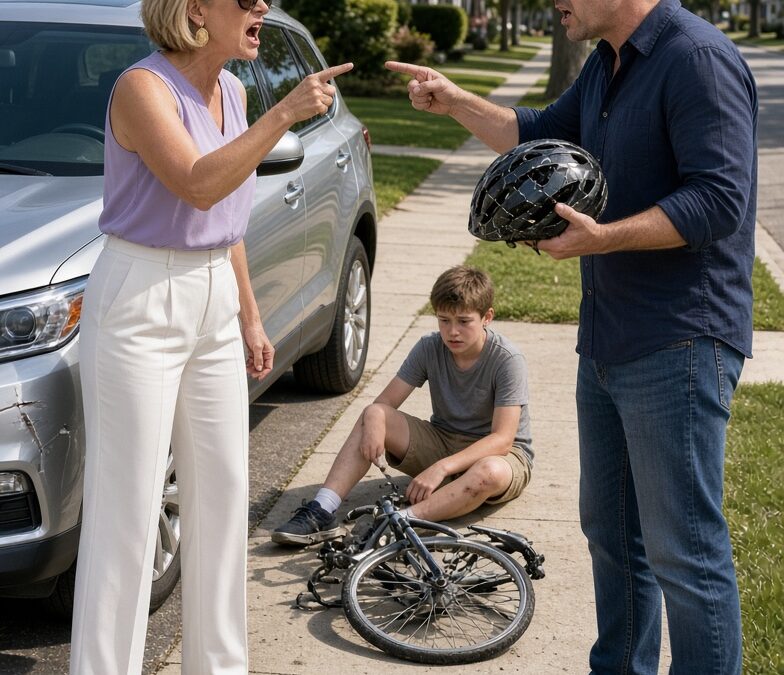
His bike lay twisted on its side, front wheel bent at a sick angle. Ethan had one knee pulled to his chest, one hand pressed to his elbow, and his helmet sitting in his lap.
I slowed only when I reached him because if I came in too fast, I knew I would frighten him more.
“Ethan.”
He looked up.
His face crumpled.
“I’m sorry.”
That broke me more than blood would have.
I dropped to my knees in front of him.
“No. No, buddy. You don’t apologize. Let me see you.”
His elbow was scraped raw. His knee was already swelling. There was a dark bruise forming along his hip. His hands trembled. But he was breathing. Talking. Looking at me clearly.
Then I saw the helmet.
It had a brutal crack running across one side, deep enough that the outer shell had nearly split. The foam inside was crushed where the impact had hit.
For a moment, all sound vanished.
No birds.
No distant lawn mower.
No Ethan sniffling.
Just the sight of that helmet and the impossible image of what might have happened if he had not been wearing it.
My hand shook when I touched it.
“What hit you?”
He swallowed.
“A car.”
My stomach dropped.
“Where is the driver?”
He looked away.
“She left.”
“She left?”
He nodded, cheeks burning with embarrassment and fear.
“I tried to get up, and she yelled at me.”
“What did she say?”
His mouth twisted.
“That I was stupid. That I had no right playing in the road. That kids like me are why neighborhoods have rules.”
I knew before I asked.
Some part of me already knew.
“What car?”
“Silver SUV.”
My vision sharpened.
“Was it Karen?”
Ethan hesitated.
That hesitation told me everything. He knew what saying her name meant. He knew I had spent months telling him not to worry about HOA drama, not to let Karen ruin the neighborhood for him, not to engage with her when she said something rude.
Now she had nearly killed him.
“I think so,” he whispered. “It looked like her. She was wearing those big sunglasses.”
Rage came so fast I had to close my eyes against it.
When I opened them, I forced my voice steady.
“Listen to me. You did the right thing calling me. You did nothing wrong.”
“But I was in the street.”
“Were you riding carefully?”
“Yes.”
“Helmet on?”
“Yes.”
“Looking?”
“Yes. I was near the side. She turned too fast.”
I believed him.
Not because he was my son and I wanted to.
Because Ethan was not reckless. He was the kid who stopped at driveways because I drilled it into him. The kid who wore his helmet even when other boys said it looked dumb. The kid who apologized when adults hurt him.
I photographed everything.
His injuries. The bike. The helmet. The tire marks near the curb. A piece of silver paint transfer on the bent frame. A scrape on the pavement where he had fallen.
Then I walked him home.
I wanted to go straight to Karen’s house, but I forced myself to clean Ethan’s cuts first, give him water, and check his pupils the way every parent with internet access thinks they know how to do. He insisted he was okay. Kids always do when they are scared of becoming a burden.
“You’re going to the doctor,” I said.
“Dad—”
“No argument.”
He nodded.
Only after he was inside, sitting on the couch with an ice pack and Mrs. Patel watching him because she had seen us come home and rushed over, did I walk down the street to Karen’s house.
Every step was a fight against the version of myself that wanted to pound on her door until it shook.
By the time I reached her porch, my hands were fists.
I rang the bell.
Waited.
Rang again.
When Karen opened the door, the first thing that hit me was the smell.
Alcohol.
Sharp, sour, unmistakable.
It came off her in a wave before she said a word.
Her hair was slightly loose, her lipstick uneven, and she leaned one hand against the doorframe like the house was moving under her feet. The sunglasses were gone. Without them, her eyes looked glassy and red.
“What do you want?” she snapped.
“You hit my son with your car.”
She blinked.
Not surprise.
Calculation.
“I don’t know what you’re talking about.”
“Briar Lane. Fifteen minutes ago. Silver Lexus.”
Her mouth tightened.
“Oh. That.”
My blood went cold.
That.
Like I was asking about a misplaced lawn chair.
“You hit a child and left.”
“He was riding in the middle of the road.”
“He was near the curb.”
“He should not have been playing there.”
“He was riding a bike on a neighborhood street.”
“Children need supervision.”
“He is twelve.”
“That is still a child.”
“Yes,” I said, stepping closer before I caught myself. “A child you hit with your car.”
She lifted her chin.
“I barely bumped him.”
My breath stopped.
So now it had happened.
“You just said you didn’t know what I was talking about.”
“I said I didn’t know what you meant.”
“No. You lied.”
Her face reddened.
“You need to watch your tone.”
I almost laughed.
There it was.
My child’s helmet was split open, and Karen was worried about tone.
I pulled out my phone and showed her the photos. Ethan’s scraped elbow. His bruised hip. The cracked helmet. The broken bike.
For the first time, uncertainty crossed her face.
It vanished quickly.
“That looks staged.”
I stared at her.
“What?”
“Kids fall. Parents exaggerate. I know how people work.”
“Are you drunk right now?”
Her eyes flashed.
“How dare you.”
“You smell like a bar.”
“I had wine with lunch.”
“You drove drunk and hit my son.”
“He rode into me.”
“You fled.”
“I did no such thing.”
“You left the scene.”
“There was no scene.”
I lowered the phone slowly.
“What is wrong with you?”
Her expression became hard and mean.
“Your son has always been careless. Your family has always ignored community standards. Maybe if you attended meetings and respected neighborhood rules, things like this would not happen.”
That was the moment I understood I would get nothing from her.
No remorse.
No apology.
No truth.
Only shifting lies and HOA language wrapped around a crime.
I wanted to scream at her. I wanted to tell her that if Ethan had not worn his helmet, I might be planning a funeral instead of standing on her porch. I wanted to make her feel even one percent of the fear she had put into my chest.
But Karen was drunk, defensive, and already building a story.
I needed to be smarter than my anger.
So I stepped back.
“This is not over.”
She smiled.
It was small and ugly.
“Threatening me now?”
“No,” I said. “Documenting you.”
Then I turned and walked away.
At home, Ethan was trying to act normal for Mrs. Patel, which meant he was talking too much about absolutely nothing. His voice had that bright, brittle edge kids use when they are close to crying but would rather perform calm for adults.
I thanked Mrs. Patel, then drove him to urgent care.
They examined him, cleaned the scrapes, checked his reflexes, and sent us for imaging because of the helmet impact. Waiting for results was its own private torture. Ethan fell asleep in the chair beside me, exhaustion finally winning. I watched his face, the faint bruise near his temple, the dried tear tracks he had tried to wipe away.
I thought about Karen saying he deserved it.
Something settled inside me then.
Not rage.
Purpose.
When the tests came back clear, I nearly broke down from relief. No brain bleed. No fracture. No serious internal injury. Bruising, abrasions, soreness, and a concussion watch list that made my stomach twist, but my son would be okay.
Physically.
The rest would take longer.
That night, after Ethan finally slept, I sat at the kitchen table and began building the case.
Photos first.
I uploaded them to two places.
Then I wrote everything down while it was fresh. The call. What Ethan said. Where he was. What the scene looked like. Karen’s smell of alcohol. Her changing story. Her exact words as best as I could remember.
Then I pulled out the HOA folder.
I had kept Karen’s notices because some petty part of me liked having proof that she was absurd. I never imagined they would become evidence of a pattern.
There were years of them.
Rude letters. Condescending emails. Warnings phrased like moral judgments. Notes that mentioned my parenting, my supposed lack of community involvement, my son’s bike, my trash cans, my porch, my “attitude.”
I read through them with new eyes.
Before, they had been annoying.
Now, they were context.
Karen had not simply had a bad day behind the wheel. She had spent years creating a record of hostility toward my family. She had treated us like a problem before she ever hit my child.
I called the police.
The officer who came to take my statement was younger than I expected, but serious. I gave him the photos, the helmet, the bike, and my written account. Ethan gave his statement too, small voice, hands twisting in his lap. I hated every second of watching him explain that an adult had hit him and yelled at him afterward.
The officer asked careful questions.
Where exactly were you?
Which direction was the car going?
Did she stop?
Did she ask if you were hurt?
Did she leave before your father arrived?
Ethan answered everything.
When the officer left our house, he walked down the street toward Karen’s.
I watched from the window like a man staring at weather that would decide whether his roof survived.
I could not hear what happened, but I saw Karen open the door. Saw the officer step back slightly, probably from the smell. Saw him speak. Saw her gesture too much. Then her garage door opened, and the silver Lexus sat inside.
Even from my window, I could see a fresh scrape near the front bumper.
I took a breath for what felt like the first time in hours.
The next morning, I started knocking on doors.
At first, I thought I was looking for one witness.
Maybe someone had been walking a dog. Maybe a doorbell camera had caught the street. Maybe someone had seen Karen speeding around the corner.
What I found was much bigger.
Mrs. Patel had not seen the crash, but she had seen Karen speeding down Briar Lane at least twice that week.
Mr. Donnelly had warned Karen months earlier to slow down because kids played nearby. She had told him to mind his own business and stop acting like the neighborhood police.
A teenager named Lacey had nearly been clipped by Karen’s Lexus while backing out of a driveway. Her parents had not reported it because they did not want HOA trouble.
The Harrisons had a doorbell camera that did not capture the accident itself but did capture Karen’s SUV speeding away seconds afterward.
Another neighbor had footage of Karen running a stop sign earlier that afternoon.
Then came the harassment stories.
I thought I was Karen’s special project.
I was wrong.
Half a dozen residents had received letters like mine. Worse than mine, in some cases. One older couple had been bullied for months over garden decorations until they moved. A young family had been fined repeatedly for noise because their toddler cried on the porch. Another homeowner admitted Karen had threatened to “make things difficult” if they opposed her preferred board decisions.
Most people had stayed quiet because they feared retaliation.
That was the thing about Karen.
Her power did not come from being liked.
It came from people assuming they were alone.
Once I started asking questions, the isolation broke.
By the end of the week, I had statements, videos, letters, emails, photos, and a list of people willing to talk to police or an attorney. I had a cracked helmet in a plastic bag on my dining room table and a son who flinched every time a silver SUV drove past.
When the police called us in for a formal statement, I brought everything.
The officer looked at the binder, then at me.
“You’ve been busy.”
“My son got hit by a drunk driver who left him in the street.”
He nodded once.
“Fair enough.”
Then he told me something I had not known.
Karen’s license had already been suspended.
I stared at him.
“She was driving illegally?”
“Yes.”
“And drunk?”
“When an officer made contact with her, she appeared impaired. Breathalyzer was well over the limit.”
I sat back.
There are moments when anger becomes so large it turns quiet again.
“She could have killed him,” I said.
The officer’s expression softened.
“Yes.”
He explained that charges were moving forward. DUI. Hit and run. Driving on a suspended license. Leaving the scene of an accident involving a minor. Child endangerment was being considered. He could not promise outcomes, but his tone told me Karen had a serious problem.
He also said the evidence of her pattern—reckless driving, harassment, prior warnings—could matter.
Then he said, “You may want to speak with a lawyer about civil options.”
I already had an appointment scheduled.
The lawyer’s name was Rebecca Shaw, and she had the kind of calm that made me trust her immediately. She listened without interrupting, reviewed the photos, the medical paperwork, the helmet, the HOA notices, the neighbor statements, and the videos.
By the time she finished reading, her expression had changed from professional concern to something sharper.
“This is not just an accident claim,” she said.
“No?”
“No. The hit-and-run, intoxication, suspended license, injury to a minor, and pattern of harassment all change the landscape.”
“I just want Ethan’s medical bills covered.”
Rebecca looked at me over the top of the papers.
“That is the floor, not the ceiling.”
I did not care about money then.
I cared about accountability.
But money is part of accountability in civil court. It is one of the few languages reckless adults understand when apologies are beyond them.
Rebecca filed the claim.
Karen’s insurance company responded quickly, which I later learned usually meant they knew their insured was a disaster. Karen herself did not respond quickly. According to Rebecca, she changed stories through her attorney the same way she had changed them on her porch.
Ethan rode into her.
She barely tapped him.
She did not know she hit him.
She stopped, but he ran away.
She had not been drunk until after she got home.
The helmet crack was unrelated.
The injuries were exaggerated.
It was an insurance scheme.
Every version contradicted the last.
Every contradiction helped us.
Meanwhile, the HOA began to fracture.
That surprised me.
I had assumed Karen and the board were one entity, all equally invested in protecting their little kingdom. But once the accident became public, I learned there were factions. Karen had a loyal little clique, yes, but many board members disliked her. Some feared her. Some had been waiting for a reason to push back and finally had one powerful enough that silence looked worse than confrontation.
For the first time in my life, I looked forward to HOA notices.
Not because Karen wrote them.
Because she no longer controlled them.
The first one announced an emergency board meeting regarding leadership conduct and community safety.
The second announced that Karen had been suspended from her duties pending review.
The third was worded carefully, but everyone understood it: Karen had been removed from her position.
At the next meeting, I attended for the first time in years.
Not because I wanted HOA politics in my life, but because Ethan deserved to see adults stand up after one adult had failed him so completely.
He did not come with me. He was not ready.
But I went for both of us.
The room was packed.
Neighbors who had ignored meetings for years showed up. People stood along the walls. The new acting board chair, a tired-looking woman named Elaine, opened the meeting with a statement about safety, accountability, and restoring trust.
Then residents started speaking.
Mr. Donnelly stood first.
He talked about warning Karen to slow down and being dismissed.
Mrs. Patel spoke about seeing Karen drive recklessly near children.
The Harrisons played their doorbell footage.
A young mother read one of Karen’s letters aloud, voice shaking with anger as she described being threatened over her toddler’s sidewalk chalk.
Then I stood.
The room quieted.
I did not bring drama.
I brought the helmet.
I placed it on the table in front of the board.
The crack was visible from the back row.
“This is what saved my son’s life,” I said.
Nobody moved.
“Karen did not just hit a child. She drove drunk on a suspended license, struck him, yelled at him, left him there, and then lied about it. And when I confronted her, she used the same language she has used in HOA notices for years. She blamed him. She blamed my parenting. She blamed our family for not respecting the community.”
I looked at the board.
“That is not community leadership. That is a danger you gave authority to.”
Elaine’s face tightened with shame.
“You’re right,” she said.
Those two words mattered more than I expected.
After that meeting, Karen’s remaining allies went quiet.
Some resigned. Some apologized in vague, careful ways. Some pretended they had never supported her at all. That is how people behave when power shifts. They rewrite their own courage.
I was too tired to care.
Ethan became my focus.
His bruises turned dark purple, then green, then yellow. His elbow scabbed over. His knee healed. The doctors cleared him physically. No lasting injury. No hidden brain trauma. Every clean test result felt like being handed my child again.
But fear lingered.
For weeks, his bike stayed in the garage.
He said he just did not feel like riding. I did not push. Then one Saturday, I found him standing beside it, touching the bent front wheel.
“I hate that she ruined it,” he said.
“The bike?”
He shrugged.
“Everything.”
I leaned against the workbench.
“She didn’t ruin everything.”
He looked at me with the exhausted seriousness of a child forced too close to adult ugliness.
“She could have killed me.”
“I know.”
“She didn’t even care.”
That one hurt because I could not soften it without lying.
“No,” I said. “She didn’t.”
His eyes filled.
“I don’t understand people like that.”
I crossed the garage and pulled him into my arms.
“I hope you never do.”
We bought him a new bike.
Not immediately, but soon enough that fear did not get to grow roots too deep. The first time he rode again, I walked beside him like he was five years old. He rolled his eyes, but he let me. Mr. Donnelly stood at the corner, arms crossed, pretending he just happened to be outside. Mrs. Patel watched from her porch. The Harrisons’ kids rode slowly with him, forming a small protective convoy.
That was my neighborhood too.
Not Karen.
This.
The criminal case took months.
Karen’s lawyer tried for a plea deal, but according to Rebecca, the prosecutor was not feeling generous. The suspended license hurt her. The DUI hurt her more. The hit-and-run involving a child hurt her worst of all. Her lack of remorse did not help.
She apparently tried the same strategy in court that she had used everywhere else.
Blame. Deny. Reframe. Minimize.
She claimed Ethan had been reckless.
The prosecutor showed photos of the bike near the curb.
She claimed she had not known she struck him.
The damaged bumper and her own changing statements complicated that.
She claimed she was not intoxicated while driving.
The timeline, officer testimony, and breathalyzer made that absurd.
She claimed she was being targeted because of HOA politics.
The judge did not appreciate that.
In the end, Karen was convicted on DUI, hit and run, driving on a suspended license, and child endangerment-related charges. She received eighteen months in county jail and three years of probation.
When Rebecca called to tell me, I sat down at the kitchen table.
Ethan was at school.
The house was quiet.
For months, I had imagined I would feel triumphant when that call came. I thought maybe I would smile. Maybe cry. Maybe call everyone who had helped us.
Instead, I felt tired.
Deeply, completely tired.
Justice is necessary, but it does not erase the moment your child calls you from the curb.
It does not uncrack the helmet.
It does not remove the sound from your memory when your son asks why she did not care.
Still, I was grateful.
Grateful she could not drive through our streets for a while. Grateful a judge had seen through her. Grateful Ethan would know that adults can lie, but evidence can answer.
The civil case settled out of court.
I cannot share the exact amount, but Rebecca was right. Medical bills were the floor, not the ceiling. Between the injury, emotional distress, hit-and-run, intoxication, and documented history of harassment, Karen’s side had every reason to avoid trial.
The settlement covered Ethan’s medical expenses, therapy, the destroyed bike, and more.
I put most of it into his college fund.
When I told him, he frowned.
“So Karen is helping pay for college?”
“In a way.”
He thought about that.
Then he said, “Good.”
I agreed.
Karen’s life unraveled quickly after that.
Her husband filed for divorce. Her house went up for sale. Rumor said she could no longer afford the mortgage between legal bills, fines, insurance fallout, and whatever personal chaos had been waiting behind the walls of that perfect HOA-board-member house.
I did not celebrate the divorce.
I did not celebrate the house sale.
But I did feel relief when the sign went up.
A few months later, new neighbors moved in. A young couple with a baby, two rescue dogs, and absolutely no interest in HOA politics. The first week they lived there, they brought us cookies and apologized if the dogs barked too much during the adjustment.
I almost laughed.
After Karen, ordinary neighborly awkwardness felt like a gift.
The HOA changed too.
Without Karen, the atmosphere softened. Notices became polite. Meetings became boring in the way meetings should be boring. Elaine became the official president and made a point of reviewing how communications were written. Several residents who had stopped attending came back. The board created a traffic safety committee, added speed reminders, and worked with the city to improve signage near the park.
For the first time, I saw the HOA do something useful.
I attended a few meetings after that.
Not every one. I am not a changed man in that regard. Life is too short to spend every Tuesday night debating mulch guidelines. But I showed up when safety issues were discussed. So did other parents. So did Mr. Donnelly, who volunteered to stand outside with a radar sign until someone told him civilians probably should not do that.
Ethan healed in pieces.
He rode again.
First slowly. Then normally. Then too fast for my comfort, which I tried to see as progress even while my heart climbed into my throat.
One afternoon, almost a year after the accident, I watched him race down the street with the Harrison kids. All helmets on. All laughing. His new bike flashed blue in the sunlight. He turned the corner carefully, exactly like I had taught him, and disappeared toward the park.
For a moment, fear rose.
Then pride.
Then something like peace.
Mrs. Patel came to stand beside me.
“He looks happy,” she said.
“He does.”
“You too?”
I thought about that.
“Getting there.”
She nodded.
“That is enough for today.”
She was right.
People sometimes ask why I did not act sooner against Karen.
Why I let the letters slide.
Why I ignored the rudeness.
Why I did not gather neighbors earlier, attend meetings earlier, push back harder when the pattern first began.
I have asked myself the same questions.
The honest answer is that I wanted peace.
I wanted my son to grow up in a neighborhood that felt safe, and I thought absorbing Karen’s petty cruelty was the cost of preserving that safety. I thought if I stayed calm, kept my yard clean, answered what needed answering, and ignored the rest, her behavior would remain annoying but harmless.
That was wrong.
Cruelty with authority rarely stays small.
It tests fences.
If nobody stops it, it moves.
Karen moved from rude letters to harassment, from harassment to reckless entitlement, from reckless entitlement to leaving a child hurt in the street and blaming him for the damage she caused.
I cannot change what I ignored.
But I can tell the truth about it now.
Document early.
Keep the letters.
Save the emails.
Talk to neighbors.
Do not assume you are the only target.
And when someone in a position of petty power shows you they are willing to lie, believe that they will lie bigger when the stakes rise.
The cracked helmet is still in my garage.
Ethan asked once why I kept it.
I told him the truth.
“Because it reminds me how close we came.”
He looked uncomfortable.
So I added the other truth.
“And because it reminds me you survived.”
That, he accepted.
Sometimes I see the helmet when I am looking for tools or holiday decorations. It sits on a high shelf in a clear storage box, the crack still ugly across the side. I do not like seeing it. But I do not hide it either.
It is evidence.
Not for court anymore.
For me.
Evidence that my child was protected by a piece of plastic and foam when an adult failed every moral test placed in front of her.
Evidence that Karen’s version of events could not survive contact with reality.
Evidence that a neighborhood can be quiet for years, but when the truth becomes loud enough, people may finally start speaking.
Most importantly, evidence that Ethan got to grow past that day.
He is taller now. His voice is changing. He eats like groceries are a rumor. He still rides his bike, though sometimes he slows at intersections more than other kids. I do not mind. Caution is not weakness when you earned it honestly.
He asked me once if I hated Karen.
We were driving home from the store, passing the house she used to live in. The new neighbors had put up a swing on the porch, and their dogs were barking at a squirrel with deep professional commitment.
“I don’t know,” I said.
He looked at me.
“You don’t know?”
“Hate takes a lot of energy.”
“She deserves it.”
“Maybe.”
“Then why not?”
I kept my eyes on the road.
“Because I would rather spend that energy on you.”
He was quiet for a while.
Then he said, “I still hate her a little.”
“That is allowed.”
He nodded.
“Okay.”
I will never tell my son he owes forgiveness to someone who never asked for it.
What I hope, someday, is that Karen becomes less important to him than the people who showed up afterward. Mrs. Patel with the ice packs. Mr. Donnelly with the witness statement. The Harrisons with the video. Rebecca with the legal firepower. Elaine with the apology. The neighbors who finally admitted what they had seen. The friends who rode beside him when he got back on the bike.
Karen was the harm.
But she was not the whole story.
The whole story is bigger.
It is a cracked helmet and a child who lived.
It is a father learning that peace without accountability is only silence with better manners.
It is a neighborhood realizing that one cruel woman had made too many people feel alone.
It is the day Karen stood in court and discovered that changing her story did not change the facts.
It is my son riding past the corner now, older and stronger, while I stand on the porch and let him go farther than fear wants me to.
I still love my neighborhood.
Differently now.
Less innocently.
I no longer believe safe places stay safe by accident. They stay safe because people tell the truth, because neighbors compare notes, because parents refuse to let powerful bullies rewrite harm as rule enforcement, because communities stop confusing politeness with goodness.
Karen thought HOA authority made her untouchable.
Then she hit my child.
And suddenly every rude letter, every reckless turn, every whispered complaint, every neighbor she had intimidated, every lie she told on her porch, every drink she had before getting behind the wheel, every version of the story she changed became part of one undeniable truth.
She was not protecting the neighborhood.
The neighborhood needed protection from her.
And this time, we gave it exactly that.
𝗧𝗛𝗘 𝗘𝗡𝗗
Karen Hit My Son With Her Car, Then Learned His Cracked Helmet Could Testify
Karen thought a cracked helmet, a bruised child, and a drunk hit-and-run could be talked away with HOA arrogance.
But she forgot one thing about parents: when you hurt our children, we stop ignoring patterns and start collecting proof.
I used to love my neighborhood.
That is the part that still makes everything complicated.
People hear a story like this and assume I must have lived in some miserable little suburban war zone where everyone glared through blinds, weaponized bylaws, and measured lawns with rulers. But it was not like that. Not at first. Not for most of us.
I chose that neighborhood because I wanted a safe place to raise my child.
Wide streets. Big shade trees. Sidewalks mostly free of cracks. A park within walking distance. Families who waved when you drove by. Kids who still rode bikes until the streetlights came on. Neighbors who brought soup when someone was sick and tools when someone’s fence broke in a storm.
After my divorce, I needed stability more than anything.
My son, Ethan, was twelve when we moved in. Old enough to understand more than I wanted him to, young enough to still pretend he was fine because he thought that would make things easier for me. He was a good kid. Gentle, funny, careful in the ways children become careful when they have watched adults disappoint them.
The first week in the new house, he helped me unpack his room and asked if we were going to stay this time.
I remember standing there with a box of books in my hands, feeling like someone had pressed a thumb into the softest part of my heart.
“Yeah, buddy,” I told him. “We’re staying.”
So I tried to make that true.
I painted his room the blue he picked. I fixed the loose railing on the porch. I planted flowers I had no talent for keeping alive. I introduced myself to neighbors, joined block cleanups, donated to school fundraisers, and did everything a person does when they are trying to tell a child, See? We belong here.
For the most part, it worked.
Ethan made friends. I made friends too, in the slow adult way where friendship begins with borrowed hedge clippers and ends with someone knowing how you take your coffee. Our neighbors on the left, the Harrisons, had three kids and a trampoline that became the unofficial meeting spot for half the block. Mrs. Patel across the street brought us mango pickle and then laughed when I underestimated how spicy it was. Mr. Donnelly, a retired firefighter, helped Ethan patch his first bike tire and treated it like a sacred rite of passage.
It was a good place.
Except for Karen.
Karen Whitmore was on the HOA board, though she acted like the entire association existed as a personal extension of her nervous system. She was the kind of woman who could turn a friendly reminder into a threat and a volunteer position into a monarchy. Mid-fifties, stiff blond hair, expensive sunglasses, permanently pursed mouth. She drove a silver Lexus SUV too fast through streets full of children and somehow always looked offended that stop signs existed.
I never knew exactly what I had done to make her dislike me.
Maybe I had parked too close to her house once. Maybe I had skipped a meeting she considered mandatory even though it was not. Maybe she simply saw a single father who was polite but not submissive and decided I needed correcting.
From the beginning, she was rude.
On good days, she ignored us. On bad days, she made a project of us.
It started small. Notes in the mailbox. Emails with “courtesy reminder” in the subject line and insults buried two paragraphs down. HOA notices phrased like I was a delinquent child.
I know you may not be familiar with our community standards, but responsible homeowners keep trash bins out of public view.
Just in case you would like to finally show you care about the neighborhood, the board encourages attendance at Tuesday’s meeting.
As you may not understand how HOA procedures work, please review the attached guidelines.
I was not an active HOA participant, and Karen seemed to take that personally. I paid what I owed. I kept my yard clean. I followed the rules that applied to me. I simply did not treat HOA meetings like church services or Karen like a priest.
That was enough.
At first, I ignored her.
That is what people always tell you to do with difficult personalities. Ignore her. Don’t feed into it. She wants a reaction. Be the bigger person. Keep the peace.
So I kept the peace.
I kept it when she sent me a warning because Ethan’s basketball had been left near the porch steps overnight.
I kept it when she told me my mailbox numbers looked “tired” and reflected poorly on community pride.
I kept it when she cornered me at a summer picnic and said, “Some parents think neighborhoods raise their children for them,” while watching Ethan and his friends ride bikes near the park.
I told myself she was just miserable.
I told myself miserable people spread misery because it is the only thing they know how to share.
Then she hit my son with her car.
part2
The call came on an ordinary afternoon.
That is how terror usually enters your life. Not with thunder. Not with warning. Just a phone ringing while you are standing in the kitchen trying to decide whether leftovers count as dinner.
I was rinsing a coffee mug when my phone vibrated on the counter.
Ethan’s name lit up the screen.
I answered with the distracted half-smile parents get when their kids call from somewhere close.
“Hey, buddy. What’s up?”
For one second, I heard only breathing.
Then his voice came, thin and shaky.
“Dad?”
Every nerve in my body went alert.
“What happened?”
“I’m okay.”
Those two words are how children terrify parents.
“What happened, Ethan?”
“I fell.”
“Where are you?”
“On Briar Lane. Near the corner.”
“Are you hurt?”
“I don’t think so. I mean, kind of. My arm hurts. My leg hurts. My helmet broke.”
My helmet broke.
The mug slipped from my hand and cracked against the sink.
“I’m coming.”
I do not remember locking the door. I do not remember grabbing shoes. I remember running.
Briar Lane was only two streets over, but that distance stretched forever in my mind. Every horrible possibility arrived before I did. Broken bones. Blood. A car. A stranger. A head injury. My son alone in the street trying to sound brave because he did not want to scare me.
When I turned the corner, I saw him sitting on the curb beside his bike.
He was upright.
Conscious.
That was the first miracle.
His bike lay twisted on its side, front wheel bent at a sick angle. Ethan had one knee pulled to his chest, one hand pressed to his elbow, and his helmet sitting in his lap.
I slowed only when I reached him because if I came in too fast, I knew I would frighten him more.
“Ethan.”
He looked up.
His face crumpled.
“I’m sorry.”
That broke me more than blood would have.
I dropped to my knees in front of him.
“No. No, buddy. You don’t apologize. Let me see you.”
His elbow was scraped raw. His knee was already swelling. There was a dark bruise forming along his hip. His hands trembled. But he was breathing. Talking. Looking at me clearly.
Then I saw the helmet.
It had a brutal crack running across one side, deep enough that the outer shell had nearly split. The foam inside was crushed where the impact had hit.
For a moment, all sound vanished.
No birds.
No distant lawn mower.
No Ethan sniffling.
Just the sight of that helmet and the impossible image of what might have happened if he had not been wearing it.
My hand shook when I touched it.
“What hit you?”
He swallowed.
“A car.”
My stomach dropped.
“Where is the driver?”
He looked away.
“She left.”
“She left?”
He nodded, cheeks burning with embarrassment and fear.
“I tried to get up, and she yelled at me.”
“What did she say?”
His mouth twisted.
“That I was stupid. That I had no right playing in the road. That kids like me are why neighborhoods have rules.”
I knew before I asked.
Some part of me already knew.
“What car?”
“Silver SUV.”
My vision sharpened.
“Was it Karen?”
Ethan hesitated.
That hesitation told me everything. He knew what saying her name meant. He knew I had spent months telling him not to worry about HOA drama, not to let Karen ruin the neighborhood for him, not to engage with her when she said something rude.
Now she had nearly killed him.
“I think so,” he whispered. “It looked like her. She was wearing those big sunglasses.”
Rage came so fast I had to close my eyes against it.
When I opened them, I forced my voice steady.
“Listen to me. You did the right thing calling me. You did nothing wrong.”
“But I was in the street.”
“Were you riding carefully?”
“Yes.”
“Helmet on?”
“Yes.”
“Looking?”
“Yes. I was near the side. She turned too fast.”
I believed him.
Not because he was my son and I wanted to.
Because Ethan was not reckless. He was the kid who stopped at driveways because I drilled it into him. The kid who wore his helmet even when other boys said it looked dumb. The kid who apologized when adults hurt him.
I photographed everything.
His injuries. The bike. The helmet. The tire marks near the curb. A piece of silver paint transfer on the bent frame. A scrape on the pavement where he had fallen.
Then I walked him home.
I wanted to go straight to Karen’s house, but I forced myself to clean Ethan’s cuts first, give him water, and check his pupils the way every parent with internet access thinks they know how to do. He insisted he was okay. Kids always do when they are scared of becoming a burden.
“You’re going to the doctor,” I said.
“Dad—”
“No argument.”
He nodded.
Only after he was inside, sitting on the couch with an ice pack and Mrs. Patel watching him because she had seen us come home and rushed over, did I walk down the street to Karen’s house.
Every step was a fight against the version of myself that wanted to pound on her door until it shook.
By the time I reached her porch, my hands were fists.
I rang the bell.
Waited.
Rang again.
When Karen opened the door, the first thing that hit me was the smell.
Alcohol.
Sharp, sour, unmistakable.
It came off her in a wave before she said a word.
Her hair was slightly loose, her lipstick uneven, and she leaned one hand against the doorframe like the house was moving under her feet. The sunglasses were gone. Without them, her eyes looked glassy and red.
“What do you want?” she snapped.
“You hit my son with your car.”
She blinked.
Not surprise.
Calculation.
“I don’t know what you’re talking about.”
“Briar Lane. Fifteen minutes ago. Silver Lexus.”
Her mouth tightened.
“Oh. That.”
My blood went cold.
That.
Like I was asking about a misplaced lawn chair.
“You hit a child and left.”
“He was riding in the middle of the road.”
“He was near the curb.”
“He should not have been playing there.”
“He was riding a bike on a neighborhood street.”
“Children need supervision.”
“He is twelve.”
“That is still a child.”
“Yes,” I said, stepping closer before I caught myself. “A child you hit with your car.”
She lifted her chin.
“I barely bumped him.”
My breath stopped.
So now it had happened.
“You just said you didn’t know what I was talking about.”
“I said I didn’t know what you meant.”
“No. You lied.”
Her face reddened.
“You need to watch your tone.”
I almost laughed.
There it was.
My child’s helmet was split open, and Karen was worried about tone.
I pulled out my phone and showed her the photos. Ethan’s scraped elbow. His bruised hip. The cracked helmet. The broken bike.
For the first time, uncertainty crossed her face.
It vanished quickly.
“That looks staged.”
I stared at her.
“What?”
“Kids fall. Parents exaggerate. I know how people work.”
“Are you drunk right now?”
Her eyes flashed.
“How dare you.”
“You smell like a bar.”
“I had wine with lunch.”
“You drove drunk and hit my son.”
“He rode into me.”
“You fled.”
“I did no such thing.”
“You left the scene.”
“There was no scene.”
I lowered the phone slowly.
“What is wrong with you?”
Her expression became hard and mean.
“Your son has always been careless. Your family has always ignored community standards. Maybe if you attended meetings and respected neighborhood rules, things like this would not happen.”
That was the moment I understood I would get nothing from her.
No remorse.
No apology.
No truth.
Only shifting lies and HOA language wrapped around a crime.
I wanted to scream at her. I wanted to tell her that if Ethan had not worn his helmet, I might be planning a funeral instead of standing on her porch. I wanted to make her feel even one percent of the fear she had put into my chest.
But Karen was drunk, defensive, and already building a story.
I needed to be smarter than my anger.
So I stepped back.
“This is not over.”
She smiled.
It was small and ugly.
“Threatening me now?”
“No,” I said. “Documenting you.”
Then I turned and walked away.
At home, Ethan was trying to act normal for Mrs. Patel, which meant he was talking too much about absolutely nothing. His voice had that bright, brittle edge kids use when they are close to crying but would rather perform calm for adults.
I thanked Mrs. Patel, then drove him to urgent care.
They examined him, cleaned the scrapes, checked his reflexes, and sent us for imaging because of the helmet impact. Waiting for results was its own private torture. Ethan fell asleep in the chair beside me, exhaustion finally winning. I watched his face, the faint bruise near his temple, the dried tear tracks he had tried to wipe away.
I thought about Karen saying he deserved it.
Something settled inside me then.
Not rage.
Purpose.
When the tests came back clear, I nearly broke down from relief. No brain bleed. No fracture. No serious internal injury. Bruising, abrasions, soreness, and a concussion watch list that made my stomach twist, but my son would be okay.
Physically.
The rest would take longer.
That night, after Ethan finally slept, I sat at the kitchen table and began building the case.
Photos first.
I uploaded them to two places.
Then I wrote everything down while it was fresh. The call. What Ethan said. Where he was. What the scene looked like. Karen’s smell of alcohol. Her changing story. Her exact words as best as I could remember.
Then I pulled out the HOA folder.
I had kept Karen’s notices because some petty part of me liked having proof that she was absurd. I never imagined they would become evidence of a pattern.
There were years of them.
Rude letters. Condescending emails. Warnings phrased like moral judgments. Notes that mentioned my parenting, my supposed lack of community involvement, my son’s bike, my trash cans, my porch, my “attitude.”
I read through them with new eyes.
Before, they had been annoying.
Now, they were context.
Karen had not simply had a bad day behind the wheel. She had spent years creating a record of hostility toward my family. She had treated us like a problem before she ever hit my child.
I called the police.
The officer who came to take my statement was younger than I expected, but serious. I gave him the photos, the helmet, the bike, and my written account. Ethan gave his statement too, small voice, hands twisting in his lap. I hated every second of watching him explain that an adult had hit him and yelled at him afterward.
The officer asked careful questions.
Where exactly were you?
Which direction was the car going?
Did she stop?
Did she ask if you were hurt?
Did she leave before your father arrived?
Ethan answered everything.
When the officer left our house, he walked down the street toward Karen’s.
I watched from the window like a man staring at weather that would decide whether his roof survived.
I could not hear what happened, but I saw Karen open the door. Saw the officer step back slightly, probably from the smell. Saw him speak. Saw her gesture too much. Then her garage door opened, and the silver Lexus sat inside.
Even from my window, I could see a fresh scrape near the front bumper.
I took a breath for what felt like the first time in hours.
The next morning, I started knocking on doors.
At first, I thought I was looking for one witness.
Maybe someone had been walking a dog. Maybe a doorbell camera had caught the street. Maybe someone had seen Karen speeding around the corner.
What I found was much bigger.
Mrs. Patel had not seen the crash, but she had seen Karen speeding down Briar Lane at least twice that week.
Mr. Donnelly had warned Karen months earlier to slow down because kids played nearby. She had told him to mind his own business and stop acting like the neighborhood police.
A teenager named Lacey had nearly been clipped by Karen’s Lexus while backing out of a driveway. Her parents had not reported it because they did not want HOA trouble.
The Harrisons had a doorbell camera that did not capture the accident itself but did capture Karen’s SUV speeding away seconds afterward.
Another neighbor had footage of Karen running a stop sign earlier that afternoon.
Then came the harassment stories.
I thought I was Karen’s special project.
I was wrong.
Half a dozen residents had received letters like mine. Worse than mine, in some cases. One older couple had been bullied for months over garden decorations until they moved. A young family had been fined repeatedly for noise because their toddler cried on the porch. Another homeowner admitted Karen had threatened to “make things difficult” if they opposed her preferred board decisions.
Most people had stayed quiet because they feared retaliation.
That was the thing about Karen.
Her power did not come from being liked.
It came from people assuming they were alone.
Once I started asking questions, the isolation broke.
By the end of the week, I had statements, videos, letters, emails, photos, and a list of people willing to talk to police or an attorney. I had a cracked helmet in a plastic bag on my dining room table and a son who flinched every time a silver SUV drove past.
When the police called us in for a formal statement, I brought everything.
The officer looked at the binder, then at me.
“You’ve been busy.”
“My son got hit by a drunk driver who left him in the street.”
He nodded once.
“Fair enough.”
Then he told me something I had not known.
Karen’s license had already been suspended.
I stared at him.
“She was driving illegally?”
“Yes.”
“And drunk?”
“When an officer made contact with her, she appeared impaired. Breathalyzer was well over the limit.”
I sat back.
There are moments when anger becomes so large it turns quiet again.
“She could have killed him,” I said.
The officer’s expression softened.
“Yes.”
He explained that charges were moving forward. DUI. Hit and run. Driving on a suspended license. Leaving the scene of an accident involving a minor. Child endangerment was being considered. He could not promise outcomes, but his tone told me Karen had a serious problem.
He also said the evidence of her pattern—reckless driving, harassment, prior warnings—could matter.
Then he said, “You may want to speak with a lawyer about civil options.”
I already had an appointment scheduled.
The lawyer’s name was Rebecca Shaw, and she had the kind of calm that made me trust her immediately. She listened without interrupting, reviewed the photos, the medical paperwork, the helmet, the HOA notices, the neighbor statements, and the videos.
By the time she finished reading, her expression had changed from professional concern to something sharper.
“This is not just an accident claim,” she said.
“No?”
“No. The hit-and-run, intoxication, suspended license, injury to a minor, and pattern of harassment all change the landscape.”
“I just want Ethan’s medical bills covered.”
Rebecca looked at me over the top of the papers.
“That is the floor, not the ceiling.”
I did not care about money then.
I cared about accountability.
But money is part of accountability in civil court. It is one of the few languages reckless adults understand when apologies are beyond them.
Rebecca filed the claim.
Karen’s insurance company responded quickly, which I later learned usually meant they knew their insured was a disaster. Karen herself did not respond quickly. According to Rebecca, she changed stories through her attorney the same way she had changed them on her porch.
Ethan rode into her.
She barely tapped him.
She did not know she hit him.
She stopped, but he ran away.
She had not been drunk until after she got home.
The helmet crack was unrelated.
The injuries were exaggerated.
It was an insurance scheme.
Every version contradicted the last.
Every contradiction helped us.
Meanwhile, the HOA began to fracture.
That surprised me.
I had assumed Karen and the board were one entity, all equally invested in protecting their little kingdom. But once the accident became public, I learned there were factions. Karen had a loyal little clique, yes, but many board members disliked her. Some feared her. Some had been waiting for a reason to push back and finally had one powerful enough that silence looked worse than confrontation.
For the first time in my life, I looked forward to HOA notices.
Not because Karen wrote them.
Because she no longer controlled them.
The first one announced an emergency board meeting regarding leadership conduct and community safety.
The second announced that Karen had been suspended from her duties pending review.
The third was worded carefully, but everyone understood it: Karen had been removed from her position.
At the next meeting, I attended for the first time in years.
Not because I wanted HOA politics in my life, but because Ethan deserved to see adults stand up after one adult had failed him so completely.
He did not come with me. He was not ready.
But I went for both of us.
The room was packed.
Neighbors who had ignored meetings for years showed up. People stood along the walls. The new acting board chair, a tired-looking woman named Elaine, opened the meeting with a statement about safety, accountability, and restoring trust.
Then residents started speaking.
Mr. Donnelly stood first.
He talked about warning Karen to slow down and being dismissed.
Mrs. Patel spoke about seeing Karen drive recklessly near children.
The Harrisons played their doorbell footage.
A young mother read one of Karen’s letters aloud, voice shaking with anger as she described being threatened over her toddler’s sidewalk chalk.
Then I stood.
The room quieted.
I did not bring drama.
I brought the helmet.
I placed it on the table in front of the board.
The crack was visible from the back row.
“This is what saved my son’s life,” I said.
Nobody moved.
“Karen did not just hit a child. She drove drunk on a suspended license, struck him, yelled at him, left him there, and then lied about it. And when I confronted her, she used the same language she has used in HOA notices for years. She blamed him. She blamed my parenting. She blamed our family for not respecting the community.”
I looked at the board.
“That is not community leadership. That is a danger you gave authority to.”
Elaine’s face tightened with shame.
“You’re right,” she said.
Those two words mattered more than I expected.
After that meeting, Karen’s remaining allies went quiet.
Some resigned. Some apologized in vague, careful ways. Some pretended they had never supported her at all. That is how people behave when power shifts. They rewrite their own courage.
I was too tired to care.
Ethan became my focus.
His bruises turned dark purple, then green, then yellow. His elbow scabbed over. His knee healed. The doctors cleared him physically. No lasting injury. No hidden brain trauma. Every clean test result felt like being handed my child again.
But fear lingered.
For weeks, his bike stayed in the garage.
He said he just did not feel like riding. I did not push. Then one Saturday, I found him standing beside it, touching the bent front wheel.
“I hate that she ruined it,” he said.
“The bike?”
He shrugged.
“Everything.”
I leaned against the workbench.
“She didn’t ruin everything.”
He looked at me with the exhausted seriousness of a child forced too close to adult ugliness.
“She could have killed me.”
“I know.”
“She didn’t even care.”
That one hurt because I could not soften it without lying.
“No,” I said. “She didn’t.”
His eyes filled.
“I don’t understand people like that.”
I crossed the garage and pulled him into my arms.
“I hope you never do.”
We bought him a new bike.
Not immediately, but soon enough that fear did not get to grow roots too deep. The first time he rode again, I walked beside him like he was five years old. He rolled his eyes, but he let me. Mr. Donnelly stood at the corner, arms crossed, pretending he just happened to be outside. Mrs. Patel watched from her porch. The Harrisons’ kids rode slowly with him, forming a small protective convoy.
That was my neighborhood too.
Not Karen.
This.
The criminal case took months.
Karen’s lawyer tried for a plea deal, but according to Rebecca, the prosecutor was not feeling generous. The suspended license hurt her. The DUI hurt her more. The hit-and-run involving a child hurt her worst of all. Her lack of remorse did not help.
She apparently tried the same strategy in court that she had used everywhere else.
Blame. Deny. Reframe. Minimize.
She claimed Ethan had been reckless.
The prosecutor showed photos of the bike near the curb.
She claimed she had not known she struck him.
The damaged bumper and her own changing statements complicated that.
She claimed she was not intoxicated while driving.
The timeline, officer testimony, and breathalyzer made that absurd.
She claimed she was being targeted because of HOA politics.
The judge did not appreciate that.
In the end, Karen was convicted on DUI, hit and run, driving on a suspended license, and child endangerment-related charges. She received eighteen months in county jail and three years of probation.
When Rebecca called to tell me, I sat down at the kitchen table.
Ethan was at school.
The house was quiet.
For months, I had imagined I would feel triumphant when that call came. I thought maybe I would smile. Maybe cry. Maybe call everyone who had helped us.
Instead, I felt tired.
Deeply, completely tired.
Justice is necessary, but it does not erase the moment your child calls you from the curb.
It does not uncrack the helmet.
It does not remove the sound from your memory when your son asks why she did not care.
Still, I was grateful.
Grateful she could not drive through our streets for a while. Grateful a judge had seen through her. Grateful Ethan would know that adults can lie, but evidence can answer.
The civil case settled out of court.
I cannot share the exact amount, but Rebecca was right. Medical bills were the floor, not the ceiling. Between the injury, emotional distress, hit-and-run, intoxication, and documented history of harassment, Karen’s side had every reason to avoid trial.
The settlement covered Ethan’s medical expenses, therapy, the destroyed bike, and more.
I put most of it into his college fund.
When I told him, he frowned.
“So Karen is helping pay for college?”
“In a way.”
He thought about that.
Then he said, “Good.”
I agreed.
Karen’s life unraveled quickly after that.
Her husband filed for divorce. Her house went up for sale. Rumor said she could no longer afford the mortgage between legal bills, fines, insurance fallout, and whatever personal chaos had been waiting behind the walls of that perfect HOA-board-member house.
I did not celebrate the divorce.
I did not celebrate the house sale.
But I did feel relief when the sign went up.
A few months later, new neighbors moved in. A young couple with a baby, two rescue dogs, and absolutely no interest in HOA politics. The first week they lived there, they brought us cookies and apologized if the dogs barked too much during the adjustment.
I almost laughed.
After Karen, ordinary neighborly awkwardness felt like a gift.
The HOA changed too.
Without Karen, the atmosphere softened. Notices became polite. Meetings became boring in the way meetings should be boring. Elaine became the official president and made a point of reviewing how communications were written. Several residents who had stopped attending came back. The board created a traffic safety committee, added speed reminders, and worked with the city to improve signage near the park.
For the first time, I saw the HOA do something useful.
I attended a few meetings after that.
Not every one. I am not a changed man in that regard. Life is too short to spend every Tuesday night debating mulch guidelines. But I showed up when safety issues were discussed. So did other parents. So did Mr. Donnelly, who volunteered to stand outside with a radar sign until someone told him civilians probably should not do that.
Ethan healed in pieces.
He rode again.
First slowly. Then normally. Then too fast for my comfort, which I tried to see as progress even while my heart climbed into my throat.
One afternoon, almost a year after the accident, I watched him race down the street with the Harrison kids. All helmets on. All laughing. His new bike flashed blue in the sunlight. He turned the corner carefully, exactly like I had taught him, and disappeared toward the park.
For a moment, fear rose.
Then pride.
Then something like peace.
Mrs. Patel came to stand beside me.
“He looks happy,” she said.
“He does.”
“You too?”
I thought about that.
“Getting there.”
She nodded.
“That is enough for today.”
She was right.
People sometimes ask why I did not act sooner against Karen.
Why I let the letters slide.
Why I ignored the rudeness.
Why I did not gather neighbors earlier, attend meetings earlier, push back harder when the pattern first began.
I have asked myself the same questions.
The honest answer is that I wanted peace.
I wanted my son to grow up in a neighborhood that felt safe, and I thought absorbing Karen’s petty cruelty was the cost of preserving that safety. I thought if I stayed calm, kept my yard clean, answered what needed answering, and ignored the rest, her behavior would remain annoying but harmless.
That was wrong.
Cruelty with authority rarely stays small.
It tests fences.
If nobody stops it, it moves.
Karen moved from rude letters to harassment, from harassment to reckless entitlement, from reckless entitlement to leaving a child hurt in the street and blaming him for the damage she caused.
I cannot change what I ignored.
But I can tell the truth about it now.
Document early.
Keep the letters.
Save the emails.
Talk to neighbors.
Do not assume you are the only target.
And when someone in a position of petty power shows you they are willing to lie, believe that they will lie bigger when the stakes rise.
The cracked helmet is still in my garage.
Ethan asked once why I kept it.
I told him the truth.
“Because it reminds me how close we came.”
He looked uncomfortable.
So I added the other truth.
“And because it reminds me you survived.”
That, he accepted.
Sometimes I see the helmet when I am looking for tools or holiday decorations. It sits on a high shelf in a clear storage box, the crack still ugly across the side. I do not like seeing it. But I do not hide it either.
It is evidence.
Not for court anymore.
For me.
Evidence that my child was protected by a piece of plastic and foam when an adult failed every moral test placed in front of her.
Evidence that Karen’s version of events could not survive contact with reality.
Evidence that a neighborhood can be quiet for years, but when the truth becomes loud enough, people may finally start speaking.
Most importantly, evidence that Ethan got to grow past that day.
He is taller now. His voice is changing. He eats like groceries are a rumor. He still rides his bike, though sometimes he slows at intersections more than other kids. I do not mind. Caution is not weakness when you earned it honestly.
He asked me once if I hated Karen.
We were driving home from the store, passing the house she used to live in. The new neighbors had put up a swing on the porch, and their dogs were barking at a squirrel with deep professional commitment.
“I don’t know,” I said.
He looked at me.
“You don’t know?”
“Hate takes a lot of energy.”
“She deserves it.”
“Maybe.”
“Then why not?”
I kept my eyes on the road.
“Because I would rather spend that energy on you.”
He was quiet for a while.
Then he said, “I still hate her a little.”
“That is allowed.”
He nodded.
“Okay.”
I will never tell my son he owes forgiveness to someone who never asked for it.
What I hope, someday, is that Karen becomes less important to him than the people who showed up afterward. Mrs. Patel with the ice packs. Mr. Donnelly with the witness statement. The Harrisons with the video. Rebecca with the legal firepower. Elaine with the apology. The neighbors who finally admitted what they had seen. The friends who rode beside him when he got back on the bike.
Karen was the harm.
But she was not the whole story.
The whole story is bigger.
It is a cracked helmet and a child who lived.
It is a father learning that peace without accountability is only silence with better manners.
It is a neighborhood realizing that one cruel woman had made too many people feel alone.
It is the day Karen stood in court and discovered that changing her story did not change the facts.
It is my son riding past the corner now, older and stronger, while I stand on the porch and let him go farther than fear wants me to.
I still love my neighborhood.
Differently now.
Less innocently.
I no longer believe safe places stay safe by accident. They stay safe because people tell the truth, because neighbors compare notes, because parents refuse to let powerful bullies rewrite harm as rule enforcement, because communities stop confusing politeness with goodness.
Karen thought HOA authority made her untouchable.
Then she hit my child.
And suddenly every rude letter, every reckless turn, every whispered complaint, every neighbor she had intimidated, every lie she told on her porch, every drink she had before getting behind the wheel, every version of the story she changed became part of one undeniable truth.
She was not protecting the neighborhood.
The neighborhood needed protection from her.
And this time, we gave it exactly that.