𝗙𝗨𝗟𝗟 𝗦𝗧𝗢𝗥𝗬 Karen Forced My Grandparents’ Old Farm Into Her HOA, Then I Opened the Rulebook She Never Wanted Me to Read
part2
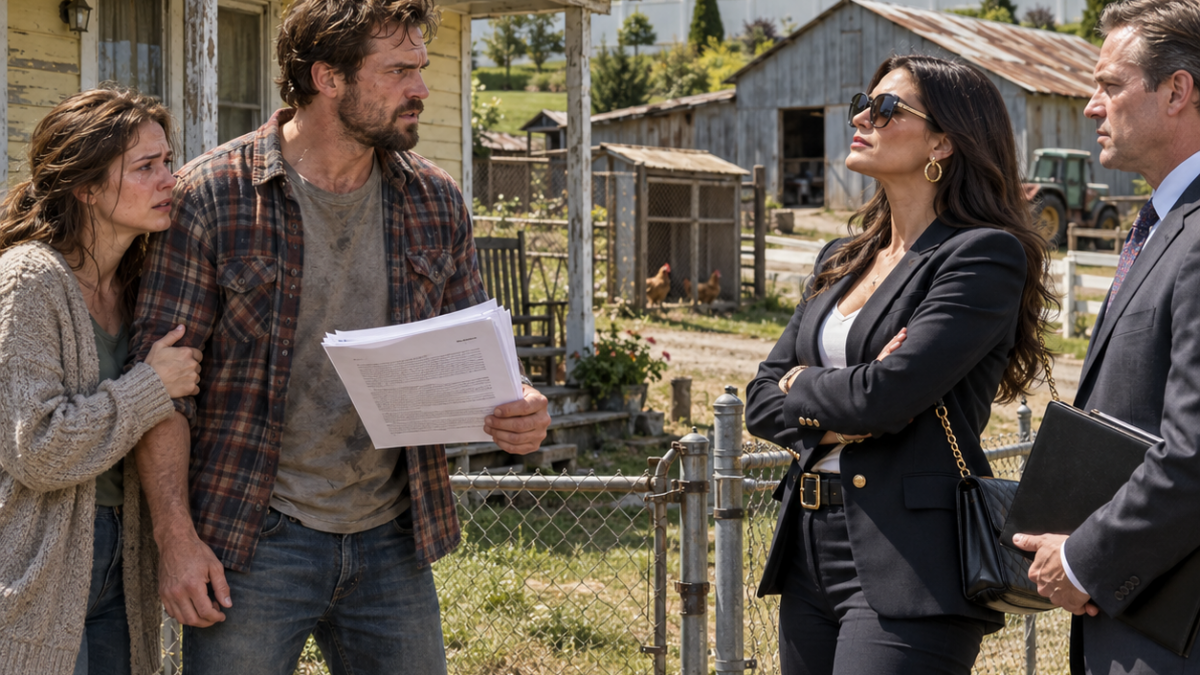
The first letter came three weeks after the funeral.
Not a condolence card.
Not a neighborly note.
A legal demand.
It was from a polished law firm representing the Ascent Estates Homeowners Association. The envelope was thick, heavy, and expensive-feeling, like intimidation printed on linen paper. I opened it at my kitchen table while Emily sorted through a box of my grandmother’s recipes beside me.
By the time I reached the second page, my hands were shaking.
The letter claimed that now that the original owners—my grandparents—were deceased, the so-called “protective covenant” of Ascent Estates was no longer “in abeyance.” I had to look that word up, and I hated everyone involved a little more after I did.
According to the letter, my grandparents’ five-acre property was and had always been subject to Ascent Estates’ covenants, conditions, and restrictions, but the HOA had “graciously deferred enforcement” out of respect for my elderly grandparents.
Graciously.
That word did a lot of work for people who had harassed two old people for years.
The letter listed violations.
Article 4.2: unapproved exterior paint color, described as peeling yellow.
Article 5.1: failure to maintain landscaping, meaning five acres of weeds.
Article 6.3: unapproved outbuildings, meaning my grandfather’s metal barn.
Article 6.5: prohibited livestock structures, meaning the empty chicken coop.
Article 9.1: unapproved fencing, meaning the chain-link fence.
There were more. Nearly thirty total. Some were ridiculous. Some were technically true if, and only if, the property was actually subject to their rules, which I was certain it was not.
Then came the demand.
Fourteen days to pay an initial membership fee of $2,500, plus first month’s dues of $300, and submit a rectification plan for all violations.
If I failed, the HOA would pursue “all available legal remedies,” including daily fines, attorney fees, and a lien against the property.
I read that line three times.
A lien.
On my grandparents’ house.
Before I could even grieve properly, before we had figured out whether we could repair the roof, before I had finished cleaning out the pantry where my grandmother still had jars labeled in her careful handwriting, these people were threatening to take legal action against us.
Emily took the letter from my hand.
She read silently.
When she finished, her face had gone pale with anger.
“They waited,” she said.
“What?”
“They waited until your grandparents died.”
That was exactly what it felt like.
Predatory patience.
I called the law firm.
The man who answered became my enemy within thirty seconds.
His name was Brent Slade, but in my head I called him Mr. Sleaze from that day forward. He had one of those voices lawyers sometimes use when they want you to know they are smiling while sharpening a knife. Smooth. Slow. Condescending. Every sentence sounded like he had already billed someone for it.
I tried to stay polite.
“My grandparents’ property was never part of Ascent Estates,” I said. “It predates the subdivision.”
“That is a common misunderstanding,” Slade replied.
“It is not a misunderstanding. Their deed does not submit to the HOA.”
“Your grandparents’ use of Ascent Estates infrastructure creates obligations.”
“What infrastructure?”
“The forty-foot stretch of private road connecting the cul-de-sac to your driveway.”
I stared at the wall.
“That access was arranged decades ago.”
“Yes. Through agreements entangled with the subdivision’s development documents. Your continued use of that private amenity constitutes implied consent.”
“Implied consent to join an HOA?”
“There is also a successor-owner covenant that activates upon transfer of title.”
“That sounds absurd.”
“It is in the county records.”
“Then send me the exact reference.”
“I suggest you retain counsel if you are confused.”
I closed my eyes.
“Mr. Slade, my grandparents told me for years that they were never part of this HOA.”
“With respect,” he said, meaning with none, “your grandparents are deceased.”
Something inside me went cold.
He continued.
“The association deferred enforcement for elderly original occupants. That courtesy ended with the transfer of title. You are now required to join. If you fight this, I will personally ensure my legal fees are added to the lien. Pay the fee, submit your plan, or I will see you in court. Your choice.”
He hung up before I could answer.
I sat there holding the phone, staring at my reflection in the dark kitchen window.
Emily looked at me.
“What did he say?”
“He said we’re required to join.”
“Can they do that?”
“I don’t know.”
That was the worst part.
I didn’t know.
So I hired a real property lawyer.
Her name was Denise Park, and unlike Slade, she did not sound like she enjoyed frightening people. She spent a week digging through county records, old easement agreements, developer filings, utility documents, and whatever legal spaghetti had been cooked in the 1980s when Ascent Estates was built around my grandparents’ land.
When she called us into her office, I expected reassurance.
I did not get it.
“He’s not exactly wrong,” she said.
My stomach dropped.
“But he’s not exactly right either,” she added quickly.
Emily leaned forward. “What does that mean?”
Denise rubbed her forehead. “It means there’s a gray area. Your grandparents’ property was never clearly annexed into the HOA. That part is true. But there are old easement and utility agreements tied into early development documents. There is one ambiguous clause regarding successor owners and private road access. Slade is using that as leverage.”
“So he can force us in?” I asked.
“He can try.”
“Would he win?”
Denise hesitated.
That hesitation told me everything.
“If you litigate, I’d call it fifty-fifty,” she said. “Maybe better with the right judge, maybe worse with the wrong one. It could take a year or two. It will be expensive. And while the case is pending, selling the property would be nearly impossible.”
Emily’s face tightened.
Denise continued, gently now.
“Slade knows you’re grieving. He knows you just inherited a property that needs work. He knows you probably don’t have unlimited money to fight. This is a pressure tactic.”
I laughed once, without humor.
“He’s counting on us folding.”
“Yes.”
For days, Emily and I argued, researched, paced, and stared at numbers.
We did not have infinite money. The property needed a roof. The barn needed stabilization. The house needed plumbing repairs. We could fight and maybe win, but if we lost, we would still owe the HOA, plus legal fees, plus possibly their legal fees. If we tried to sell, the pending fight would scare off buyers or drag the price down.
It felt like my grandparents had left us a piece of family history wrapped in barbed wire.
One evening, we sat on their old porch watching the weeds sway in the field. The executive homes beyond the property line glowed warm and perfect as the sun went down. Somewhere behind one of those houses, people were probably drinking wine on a patio and complaining about the view.
Emily sat beside me, silent for a long time.
Then she said, “What if we just pay it?”
I turned to her.
“What?”
She held up a hand.
“Not surrender. Listen.”
“Emily—”
“What if we comply?”
I stared at her.
She leaned forward, elbows on knees, eyes bright in a way I knew meant her brain had found a dangerous idea.
“He insists we have to be members, right?”
“Yes.”
“So let’s be members.”
“That’s letting them win.”
“No,” she said slowly. “That’s making them regret inviting us.”
I frowned.
She continued.
“If we pay dues, we get rights. We get the bylaws. We get financial records. We get meetings. We get votes, maybe. We get to ask questions. If they force us into their stupid club, we become the most active, annoying, rule-reading members they’ve ever had.”
I looked at the old barn. The weeds. The chain-link fence. The expensive houses beyond.
Then I felt my grandfather somewhere in the bones of that land, laughing.
The next day, I overnighted a cashier’s check for $2,500 to Slade’s office, plus $300 for the first month’s dues.
With it, I included a letter.
Dear Mr. Slade,
After careful consideration of your legal position, we have decided to comply with your demand that our property join the Ascent Estates Homeowners Association.
We accept all rights and responsibilities of membership. Please send our full welcome packet, including unredacted CC&Rs, bylaws, architectural guidelines, financial statements for the last five years, current vendor contracts, and the schedule for all upcoming board meetings.
We look forward to being active and engaged members of the community.
Sincerely,
Me.
Slade’s reply was short and smug.
Membership confirmed.
Attached was a link to a 350-page PDF.
He thought he had won.
That was his first mistake.
I am not a lawyer, but I am patient. My wife is even worse. She is a bookkeeper, which means she can stare at numbers for hours and emerge with either answers or vengeance. For two weeks, our dining table disappeared under printed bylaws, CC&Rs, architectural guidelines, meeting minutes, violation schedules, and highlighted sections.
The documents were a disaster.
A beautiful disaster.
Rules contradicted other rules. Definitions changed from section to section. Committees were referenced before being created. Enforcement procedures were vague in some places and weirdly specific in others. The architectural guidelines looked like they had been updated by different boards over twenty years, each one adding pet peeves without removing anything old.
But inside that mess were weapons.
The first test came quickly.
A letter arrived from the HOA president.
Karen Whitmore.
I knew of Karen before I met her. Everyone did. She lived in one of the big Phase One homes with a curved driveway, white brick, black shutters, and landscaping so perfect it looked afraid of her. She was around forty, maybe forty-two, with long chestnut hair, bright green eyes, a body she liked to show off in fitted designer dresses, and the polished confidence of a woman who had never entered a room without expecting it to rearrange itself around her.
She was beautiful in a dangerous way.
The kind of beautiful that made some men overlook cruelty because it smiled at them first.
Karen had been HOA president for years. She ran Ascent Estates like a private kingdom. I had seen her once at the grocery store before any of this happened, laughing too loudly with some man by the wine display, one hand resting on his sleeve while her diamond wedding ring flashed under fluorescent lights. She had looked glamorous, charming, and entirely aware of the attention she drew.
Her letter was not charming.
Welcome to Ascent Estates, it began.
I could hear the poison through the paper.
We are pleased that you have chosen to bring your grandparents’ property into compliance with the community standards that preserve value for all residents.
As your first order of business, the board has formally rejected the existing exterior structures.
Per Article 6.2, the metal barn is unapproved and must be demolished.
Per Article 9.1, the chain-link fence is unapproved and must be removed within thirty days.
Failure to comply will result in fines.
I checked our notes.
Article 6.2 did not say unapproved outbuildings must be demolished. It said outbuildings required approval by the Home Beautification Board, known as the HBB.
Article 9.1 said fencing required approval.
Not that ours was banned.
Required approval.
So I filed applications.
Application one: repaint existing metal barn in “heritage red,” citing Article 4.5, which allowed traditional farmhouse colors.
Application two: remove existing chain-link fence and replace it with a new fence fully compliant with Article 9.2.
The barn application was rejected almost immediately.
Existing structure is incompatible with community standards. Removal required.
No surprise.
The fence application, however, was approved.
Approval granted for removal of non-compliant chain-link fence. Replacement fence must comply with Article 9.2: wood or vinyl; neutral color, including white, beige, or natural wood; maximum height six feet.
I read the approval three times.
Then I smiled.
Emily looked up from her laptop.
“What?”
“They approved the fence.”
“Really?”
“Yes.”
“That seems… stupid of them.”
“It is.”
She leaned over and read it.
Then she started laughing.
Karen and the board had assumed I would tear down the old chain-link and leave the property open. That would expose the weeds, the barn, the house, everything they wanted to complain about. It would also give the surrounding executive homes their lovely open view back.
They forgot one crucial detail.
My property was five acres.
It was surrounded on three sides by expensive homes whose backyards faced us.
And their rules allowed a six-foot natural wood privacy fence.
So I called a fencing contractor.
“I need a six-foot solid-panel natural cedar privacy fence,” I said.
“How much fence?”
I gave him the measurements.
He went quiet.
“That’s over eighteen hundred linear feet.”
“I know.”
“That’s a lot of fence.”
“I know.”
“You sure?”
“I need it built exactly to these HOA specifications.”
The quote was astronomical.
I stared at the number for a long time.
It was still less than two years of litigation.
“Do it,” I said.
The crew started the following week.
At first, neighbors watched with curiosity. Then confusion. Then horror.
The cedar panels went up section by section, post by post, creating a solid six-foot wall along the property line. It was beautiful, honestly. Clean, natural, sturdy. Exactly compliant. It also completely destroyed the open pastoral view those executive homes had enjoyed for years.
Their back patios, outdoor kitchens, fire pits, and infinity-edge landscaping no longer looked across my grandparents’ field.
They looked at cedar.
Eighteen hundred feet of it.
By day four, my phone rang.
It was Karen.
I recognized the number from HOA paperwork.
Her voice was tight enough to snap.
“What have you done?”
“Good afternoon, Karen.”
“Do not good-afternoon me. What is that monstrosity?”
“My approved fence.”
“You cannot do this.”
“I can. The HBB approved it.”
“You are blocking everyone’s view.”
“There is no protected view easement in the bylaws.”
“You knew what you were doing.”
“Yes.”
Silence.
Then, lower, colder, “You think you’re clever.”
“I think I’m compliant.”
“You’re making enemies.”
“Karen, you forced me into this HOA. I’m simply following the rules.”
“You will be fined.”
“For what?”
“For—” She stopped.
“For building the exact fence your committee approved?”
Her breathing came hard through the phone.
I looked out the window at the cedar panels going up.
“By the way,” I added, “your front door appears to be purple. Article 4.3 limits doors to white, black, or natural wood stain. I’ll be sending a formal notice to the management company.”
“You wouldn’t dare.”
“I’m an active and engaged member now.”
I hung up.
That was the moment war became official.
The HOA, led by Karen and armed by Slade, came at us from every direction.
First, a cease-and-desist letter demanding construction stop immediately.
I replied with the HBB approval letter.
Then a demolition order for the barn.
I replied asking them to cite the specific provision allowing the board to compel demolition without a county unsafe-structure declaration. The barn was ugly, but not unsafe. I had paid an inspector to say so.
Then came fines.
Fifty dollars for visible trash cans. They had been out for ten minutes after pickup.
One hundred dollars for noxious weeds inside the new fence.
Two hundred dollars for peeling paint on the house, even though I was collecting quotes for roof and exterior work.
Seventy-five dollars for an “unapproved agricultural remnant,” which turned out to mean the empty chicken coop.
Karen wanted to bleed us into submission.
Her mistake was thinking money was the only thing being spent.
I paid every fine on time, under protest, with letters preserving my objection. It hurt. Of course it hurt. We were not rich. Every check felt like swallowing glass. But paying kept me a member in good standing.
And members in good standing had rights.
Bylaw Article 12, Section 4.
Right to inspect books and records.
I sent a certified letter.
Pursuant to Bylaw Article 12, Section 4, I formally request access to all financial statements, balance sheets, bank records, receipts, vendor contracts, invoices, and active service agreements for the last twenty-four months.
The management company tried to stall.
Slade sent a letter calling the request “overly broad and burdensome.”
I replied:
Bylaw Article 12, Section 4 contains no limitation for broadness or burden. It states that a member may inspect the books. My next request will be through a legal motion to compel. Please provide the documents.
A week later, a Dropbox link arrived.
Thousands of pages.
They dumped everything on us, clearly thinking no normal person would read it.
They underestimated Emily.
For the next month, our evenings became spreadsheets and rage.
Emily built categories. I renamed files. We cross-referenced invoices against bank withdrawals, contracts against minutes, payments against approvals. At first, it was just messy. Typical HOA nonsense. Overpriced mulch. Vague maintenance invoices. Legal fees that made my eyes twitch.
Then Emily stopped moving.
I looked up.
“What?”
She tapped the screen.
“Who owns Karen’s Beautiful Borders?”
I leaned closer.
The HOA had a landscaping contract for $20,000 a month.
Twenty thousand.
Every month.
For front entrance landscaping, pocket park upkeep, and grass along private roads.
The vendor was Karen’s Beautiful Borders.
Emily pulled up the state business registry.
Sole proprietor: Karen Whitmore.
The HOA president.
Karen was paying herself $240,000 a year from HOA funds.
I felt the room tilt.
“Maybe it was disclosed,” I said, because part of me still wanted corruption to have limits.
Emily’s eyes were sharp.
“Find the board minutes.”
We did.
There was no competitive bidding process.
No membership disclosure.
No proper vote.
Two years earlier, Karen had used “emergency presidential authority” during a supposed landscaping crisis to approve the contract temporarily.
Temporary had become permanent.
The bylaws were clear.
Article 8, Section 2: no board member may engage in self-dealing or hold any association contract without full disclosure to the membership and competitive bidding with at least three bids.
Karen had done none of that.
Then we dug into Slade.
His firm had billed the HOA an average of $15,000 a month for years. Retainers. Violation letters. Enforcement reviews. Legal opinions. His bills spiked every time Karen picked a fight with someone. My fence dispute alone had generated $8,000 in legal fees billed to the HOA.
Slade was not just representing the HOA.
He was feeding on it.
And Karen was serving him the plate.
Still, something about his original threat bothered me.
That successor-owner covenant.
He had been too smug. Too certain. Too rehearsed.
So I went to the county records office.
I was done looking only at my grandparents’ deed.
I wanted theirs.
Ascent Estates had been built in three phases.
Phase One: the first twenty homes.
Phase Two: the next thirty.
Phase Three: the final forty.
Karen’s home was in Phase One. So were the homes of the treasurer and secretary, her two loyal board allies.
I pulled Karen’s deed first.
I read it.
Then I read it again.
Then I whispered, “No way.”
There was no HOA covenant.
No “subject to Ascent Estates Homeowners Association.”
No governance language.
Nothing.
I pulled the treasurer’s deed.
Same thing.
Secretary’s deed.
Same thing.
Then Phase Two.
There it was.
This property is subject to the covenants, conditions, restrictions, and governance of the Ascent Estates Homeowners Association.
Phase Three had it too.
I sat at a county records table with my heart pounding so hard I could hear it.
The developer had messed up.
When filing Phase One, someone had failed to attach the HOA governance properly to the deeds. They corrected it in Phases Two and Three, but it was too late for Phase One.
Karen and her two cronies were not legally members of the HOA they controlled.
They had no right to sit on the board.
No right to vote.
No right to fine anyone.
No right to hire Slade.
No right to award Karen’s company contracts.
No right to force me into anything.
They were running an HOA that did not legally include them.
And Slade, a lawyer specializing in HOA enforcement, had to have known or should have known. A lawyer threatening liens based on covenants checks deeds. That is not advanced legal theory. That is the floor.
He was either incompetent beyond belief or complicit.
Maybe both.
His fatal mistake was forcing me in.
Because thanks to his bullying, thanks to the membership form he made me sign and the dues he made me pay, my inherited property was now treated as a dues-paying, voting member.
And unlike Karen, I had paperwork saying so.
The bylaws allowed a special meeting if ten percent of legal members signed a petition.
That meant Phase Two and Phase Three homeowners.
Not Phase One.
So I went door to door.
I did not lead with fraud.
That would sound too wild.
I led with money.
“Hi,” I said at the first house, holding a folder. “I’m the guy from the old farmhouse.”
The woman at the door looked over my shoulder toward the cedar fence in the distance.
“Oh.”
“Yeah. That guy. The HOA forced us to join, so I reviewed the budget. Did you know the HOA is paying Karen Whitmore’s landscaping company $240,000 a year?”
Her expression changed.
“What?”
“And did you know Slade’s law firm is billing over $150,000 a year?”
She opened the door wider.
I showed her the documents.
Then the next house.
And the next.
People hated Karen.
They had been afraid of her for years. Afraid of fines. Afraid of Slade’s letters. Afraid of liens, legal fees, retaliation, social punishment. But anger had been sitting under that fear like dry grass waiting for flame.
We got the signatures in one afternoon.
I filed the petition.
The board was legally required to hold the meeting.
Karen scheduled it for a Tuesday night, probably hoping nobody would show.
I printed evidence packets.
Emily built a PowerPoint.
The community center was packed.
Every Phase Two and Phase Three homeowner seemed to be there. People lined the walls. The air buzzed with anger and curiosity. Karen sat at the front table in a fitted cream dress, gold earrings, and perfect makeup, looking like a queen forced to attend a peasant complaint session. On one side sat the treasurer and secretary. On the other sat Slade, thin-lipped, gray-suited, and watchful.
Karen opened the meeting.
“We are here,” she said, smiling with all her teeth, “because this man has made reckless, slanderous accusations against the board.”
She pointed at me.
The room shifted.
“We will allow him to speak, and then our legal counsel will address these concerns properly.”
I stood.
My legs felt strangely steady.
I walked to the podium and plugged in my laptop.
The first slide appeared.
A photo of my grandparents’ farmhouse behind the new cedar fence.
“My name is OP,” I said. “Most of you know me as the guy with the fence.”
A few people laughed.
Karen did not.
“The HOA, through Mr. Slade, insisted that my inherited property must join this association. They forced me to pay $2,500 and $300 a month in dues by claiming covenants applied to my deed.”
I looked directly at Slade.
“So I complied.”
His eyes narrowed.
“And as a member, I exercised my right to inspect the association’s financial records.”
Next slide.
Karen’s Beautiful Borders contract.
A murmur moved through the room.
“This is a landscaping contract for $20,000 per month.”
Next slide.
State business registry.
“The sole proprietor of Karen’s Beautiful Borders is Karen Whitmore, your HOA president.”
The room exploded.
People shouted.
“What?”
“Are you kidding me?”
“Thief!”
Karen stood.
“This is confidential information!”
I raised my voice.
“No, it is association financial information available to members under the bylaws.”
Slade jumped up. “This is slander.”
“It’s a state business record and an HOA contract. Which part is false?”
He did not answer.
Next slide.
Article 8, Section 2.
“This bylaw prohibits board self-dealing without full disclosure to the membership and competitive bidding with at least three bids. I found no disclosure. No three bids. No valid approval.”
Karen’s face had gone pale under her makeup.
I clicked again.
Slade’s legal invoices.
“And this is what the HOA paid Mr. Slade’s firm. Over $150,000 a year on average, including thousands generated by enforcement actions he encouraged.”
Slade’s jaw clenched.
“But,” I said, “that is not the worst part.”
The room quieted.
I clicked.
Karen’s deed.
“This is the deed for Karen Whitmore’s property. Public record, obtained from the county. Notice what is missing.”
I let them stare.
“No covenant. No submission to Ascent Estates HOA. No governance language.”
Next slide.
A Phase Two deed.
“This is one of yours. Notice the line: subject to the covenants, conditions, restrictions, and governance of the Ascent Estates Homeowners Association.”
I placed them side by side.
“I checked every Phase One board member’s deed. Karen. The treasurer. The secretary. None of them are legally members of this HOA.”
The room erupted again, louder this time.
Slade shouted over the noise.
“This is a procedural misunderstanding!”
“No,” I said, my voice cutting through. “It’s fraud.”
Karen’s eyes snapped to mine.
I held the podium because my hands had started shaking, not from fear now, but from the force of what was happening.
“This board has been collecting dues, issuing fines, hiring vendors, awarding contracts, and spending your money without legal authority. The president has paid her own company nearly a quarter million dollars a year. The lawyer threatening all of you either knew the board had no legal standing or failed to do the most basic due diligence required of his profession.”
I turned to Slade.
“Which is it?”
For the first time since I had met him, Brent Slade had no smooth answer.
I clicked to the final slide.
Bylaw Article 3, Section 1.
All board members must be members of the association.
“You insisted I had to be a member,” I said. “I am. You insisted I follow the bylaws. I am. And the bylaws state board members must be members.”
I faced Karen.
“Karen Whitmore, you are not a member of this association. You are removed from the board effective immediately.”
Her mouth opened.
No sound came out.
“Treasurer, same for you. Secretary, same for you.”
People began clapping.
Then shouting.
Then standing.
“This HOA,” I said, raising my voice, “now belongs to its actual legal members. First order of business: motion to terminate Brent Slade’s law firm effective immediately.”
A man in the front row shouted, “So moved!”
“All in favor?”
Hands shot up across the room.
A sea of them.
Slade grabbed his briefcase.
“You’ll all be hearing from me,” he hissed.
I leaned toward the microphone.
“Oh, I promise you’ll be hearing from us.”
That night, the actual members held an emergency election.
Against my better judgment, I was elected interim president.
Emily, who looked far too delighted by chaos, became interim treasurer.
Our first act was hiring Denise Park, my lawyer, with HOA funds, to stabilize the legal situation.
Our second act was sending a massive evidence packet to the district attorney detailing Karen’s self-dealing, unauthorized board actions, and financial records.
Our third act was filing a formal bar complaint against Slade.
The fallout was not instant.
Real consequences rarely move as fast as anger wants them to.
But they came.
Slade was investigated by the state bar. Our case opened doors to others. It turned out he had been involved in predatory HOA enforcement practices elsewhere, always skirting lines, always profiting from conflict. This time, the documents were too clear. He was eventually disbarred.
Karen and her two cronies were arrested months later.
Wire fraud. Grand larceny. Embezzlement-related charges. Other counts I barely understood but enjoyed hearing anyway. Karen’s Beautiful Borders dissolved. A lien was placed on her house to recover stolen funds. The management company faced a class action from actual members for ignoring fiduciary duties and allowing a legally invalid board to operate.
Karen did not look glamorous in court.
She tried.
The hair was still perfect. The fitted dresses continued. The lipstick stayed bright. But the glow was gone. Without power, her beauty looked like a costume after closing night.
She never apologized.
Not once.
At one hearing, she saw me in the hallway and hissed, “You destroyed this community.”
I looked at her for a long moment.
“No,” I said. “I read the paperwork.”
That wounded her more than shouting would have.
Emily and I ran the HOA for six months.
Only six.
Long enough to stop the bleeding, clean the books, fire the bad vendors, settle urgent maintenance issues, and hold transparent meetings where people could speak without Karen glaring them into silence.
Then I presented the members with a choice.
“We can keep the HOA,” I said, standing in the same community center where Karen had lost her throne. “Lower dues, rebuild it properly, use the money for roads, the pool, common areas, and actual maintenance. Or we can dissolve it.”
The room was quiet.
I clicked to the final motion.
A motion to formally dissolve the Ascent Estates Homeowners Association and release all applicable properties from its covenants, subject to required legal process.
The vote passed with ninety-eight percent in favor.
It took another year of paperwork.
But it happened.
The HOA died.
Legally. Fully. Permanently.
The covenants were voided where they could be voided. Common maintenance was transferred through a simpler neighborhood agreement with voluntary contributions and municipal arrangements where possible. The Phase Two and Three homeowners were free. They painted doors whatever color they wanted. Some planted vegetable gardens. One man installed a mailbox shaped like a bass just because he could.
Property values went up.
Apparently, people liked houses more when they did not come with a tiny dictatorship attached.
Karen had to sell her house to pay legal fees and restitution.
I watched the moving truck from my grandparents’ porch.
Not proudly, exactly.
But peacefully.
She came outside wearing oversized sunglasses and a fitted black dress, still trying to look untouchable. For one second, she glanced toward my property. Toward the cedar fence. Toward the old farmhouse still standing beyond it.
I lifted my coffee in a small salute.
She looked away first.
As for us, we kept the five acres.
We fixed the roof. Stabilized the barn. Cleared weeds slowly, not because Karen demanded it, but because the land deserved care. The house is still yellow, though now it is painted properly. The chicken coop is gone, but only because it was too far rotted to save. Emily planted lavender near the porch. I restored part of my grandfather’s garden.
And the eighteen-hundred-foot, six-foot-tall solid cedar fence?
Still there.
Beautiful.
Some of the neighbors planted ivy on their side. A few added climbing roses. What began as a wall of spite became, over time, a boundary everyone respected.
We get along fine now.
Better than fine, actually.
People wave. They ask about the garden. They bring over extra tomatoes. A few of the former Ascent residents have told me my grandparents were right all along.
I already knew that.
Sometimes I stand by the barn at sunset and look at the houses beyond the fence. I think about my grandfather telling developers to go pound sand. I think about my grandmother burning HOA letters in the stove. I think about how Karen and Slade believed death had finally made the land vulnerable.
They thought my grandparents were the obstacle.
They were wrong.
The obstacle was never just two stubborn old people.
It was the paper they kept.
The deed they protected.
The boundaries they understood.
The refusal they passed down like inheritance.
Karen forced me into her HOA because she wanted control.
Instead, she gave me access.
She gave me records.
She gave me standing.
She gave me the rulebook.
And buried inside that rulebook was the end of everything she had built.
𝗧𝗛𝗘 𝗘𝗡𝗗
Karen Forced My Grandparents’ Old Farm Into Her HOA, Then I Opened the Rulebook She Never Wanted Me to Read
Karen thought grief would make me easy to bully, so she sent her lawyer after the land my grandparents had protected for fifty years.
She wanted dues, fines, control, and a public surrender from the old farmhouse her perfect subdivision had never been able to swallow.
But when she forced me into her HOA, she accidentally gave me the one thing she should have kept out of my hands: membership rights.
This whole thing started with death.
Two deaths, actually.
My grandparents passed away within a few months of each other, first my grandmother, then my grandfather, like some stubborn part of him had simply refused to keep living in a world where she wasn’t sitting across from him at the kitchen table anymore. They were old. They had lived full, difficult, funny, opinionated lives. We knew the end was coming, or at least we told ourselves we knew, but knowing something is coming doesn’t stop it from hitting you in the ribs when it arrives.
My wife, Emily, and I inherited their property.
That part wasn’t a shock. My parents had moved out of state years ago, my aunt wanted nothing to do with “that old weed patch,” and my grandparents had always said I understood the place better than anyone else. What shocked us was what inheriting it actually meant.
Five acres.
A small, sturdy, stubborn little house built in the 1960s.
A sagging metal barn big enough to hold three lifetimes of tools, lumber, rusted mystery parts, and my grandfather’s unfinished projects.
A garden plot that had once fed half the family, now mostly overtaken by weeds.
A chicken coop that had not held chickens in years but still smelled faintly like history and dust.
A chain-link fence around the front and sides.
A dirt driveway.
A roof that needed replacing.
A porch that groaned under your feet like it had opinions.
It was not fancy. It was not beautiful in the glossy magazine sense. It was rough, tired, and honest. My grandparents had bought that land back when it was still way outside the city. Back then, there were fields, woods, gravel roads, and enough quiet that my grandmother used to say she could hear storms deciding whether to come their way.
But cities grow.
And the city had grown around them like a tide.
Decades after my grandparents bought their five acres, a developer purchased nearly all the surrounding land and built a massive master-planned community called Ascent Estates. Not the real name, but close enough. It was the kind of neighborhood with stone entrance signs, decorative ponds, sidewalks too clean to look used, and houses large enough to make you wonder how many rooms one family needed to avoid speaking to each other.
The developer tried to buy my grandparents out more times than I could count.
My grandfather’s response never changed.
“No.”
Sometimes, if he was feeling generous, he added, “Go pound sand.”
So the developer built around him.
Ascent Estates wrapped itself around those five acres like a velvet glove closing around a splinter. Their paved roads stopped at the edge of my grandparents’ dirt drive. The backyards of expensive executive homes pressed against his property line. Perfect lawns faced his weeds. Stone patios looked toward his old barn. White vinyl fences ended where his chain-link began.
The HOA hated it.
Of course they did.
My grandparents were never part of the HOA. Their land predated it. Their deed did not submit to it. Their house existed before Ascent Estates was even a sales brochure. The HOA could complain, and they did. They sent letters about grass height, exterior paint, fencing, outbuildings, livestock structures, and “community visual harmony.” My grandmother used those letters as kindling.
“They burn nice,” she once told me, feeding one into the woodstove.
That was the thing about my grandparents. They did not care if the subdivision liked them. They had survived recessions, storms, layoffs, hospital bills, and one spectacularly mean rooster named Richard. An HOA board with letterhead did not frighten them.
Then they were gone.
And almost immediately, Karen arrived.
part2
The first letter came three weeks after the funeral.
Not a condolence card.
Not a neighborly note.
A legal demand.
It was from a polished law firm representing the Ascent Estates Homeowners Association. The envelope was thick, heavy, and expensive-feeling, like intimidation printed on linen paper. I opened it at my kitchen table while Emily sorted through a box of my grandmother’s recipes beside me.
By the time I reached the second page, my hands were shaking.
The letter claimed that now that the original owners—my grandparents—were deceased, the so-called “protective covenant” of Ascent Estates was no longer “in abeyance.” I had to look that word up, and I hated everyone involved a little more after I did.
According to the letter, my grandparents’ five-acre property was and had always been subject to Ascent Estates’ covenants, conditions, and restrictions, but the HOA had “graciously deferred enforcement” out of respect for my elderly grandparents.
Graciously.
That word did a lot of work for people who had harassed two old people for years.
The letter listed violations.
Article 4.2: unapproved exterior paint color, described as peeling yellow.
Article 5.1: failure to maintain landscaping, meaning five acres of weeds.
Article 6.3: unapproved outbuildings, meaning my grandfather’s metal barn.
Article 6.5: prohibited livestock structures, meaning the empty chicken coop.
Article 9.1: unapproved fencing, meaning the chain-link fence.
There were more. Nearly thirty total. Some were ridiculous. Some were technically true if, and only if, the property was actually subject to their rules, which I was certain it was not.
Then came the demand.
Fourteen days to pay an initial membership fee of $2,500, plus first month’s dues of $300, and submit a rectification plan for all violations.
If I failed, the HOA would pursue “all available legal remedies,” including daily fines, attorney fees, and a lien against the property.
I read that line three times.
A lien.
On my grandparents’ house.
Before I could even grieve properly, before we had figured out whether we could repair the roof, before I had finished cleaning out the pantry where my grandmother still had jars labeled in her careful handwriting, these people were threatening to take legal action against us.
Emily took the letter from my hand.
She read silently.
When she finished, her face had gone pale with anger.
“They waited,” she said.
“What?”
“They waited until your grandparents died.”
That was exactly what it felt like.
Predatory patience.
I called the law firm.
The man who answered became my enemy within thirty seconds.
His name was Brent Slade, but in my head I called him Mr. Sleaze from that day forward. He had one of those voices lawyers sometimes use when they want you to know they are smiling while sharpening a knife. Smooth. Slow. Condescending. Every sentence sounded like he had already billed someone for it.
I tried to stay polite.
“My grandparents’ property was never part of Ascent Estates,” I said. “It predates the subdivision.”
“That is a common misunderstanding,” Slade replied.
“It is not a misunderstanding. Their deed does not submit to the HOA.”
“Your grandparents’ use of Ascent Estates infrastructure creates obligations.”
“What infrastructure?”
“The forty-foot stretch of private road connecting the cul-de-sac to your driveway.”
I stared at the wall.
“That access was arranged decades ago.”
“Yes. Through agreements entangled with the subdivision’s development documents. Your continued use of that private amenity constitutes implied consent.”
“Implied consent to join an HOA?”
“There is also a successor-owner covenant that activates upon transfer of title.”
“That sounds absurd.”
“It is in the county records.”
“Then send me the exact reference.”
“I suggest you retain counsel if you are confused.”
I closed my eyes.
“Mr. Slade, my grandparents told me for years that they were never part of this HOA.”
“With respect,” he said, meaning with none, “your grandparents are deceased.”
Something inside me went cold.
He continued.
“The association deferred enforcement for elderly original occupants. That courtesy ended with the transfer of title. You are now required to join. If you fight this, I will personally ensure my legal fees are added to the lien. Pay the fee, submit your plan, or I will see you in court. Your choice.”
He hung up before I could answer.
I sat there holding the phone, staring at my reflection in the dark kitchen window.
Emily looked at me.
“What did he say?”
“He said we’re required to join.”
“Can they do that?”
“I don’t know.”
That was the worst part.
I didn’t know.
So I hired a real property lawyer.
Her name was Denise Park, and unlike Slade, she did not sound like she enjoyed frightening people. She spent a week digging through county records, old easement agreements, developer filings, utility documents, and whatever legal spaghetti had been cooked in the 1980s when Ascent Estates was built around my grandparents’ land.
When she called us into her office, I expected reassurance.
I did not get it.
“He’s not exactly wrong,” she said.
My stomach dropped.
“But he’s not exactly right either,” she added quickly.
Emily leaned forward. “What does that mean?”
Denise rubbed her forehead. “It means there’s a gray area. Your grandparents’ property was never clearly annexed into the HOA. That part is true. But there are old easement and utility agreements tied into early development documents. There is one ambiguous clause regarding successor owners and private road access. Slade is using that as leverage.”
“So he can force us in?” I asked.
“He can try.”
“Would he win?”
Denise hesitated.
That hesitation told me everything.
“If you litigate, I’d call it fifty-fifty,” she said. “Maybe better with the right judge, maybe worse with the wrong one. It could take a year or two. It will be expensive. And while the case is pending, selling the property would be nearly impossible.”
Emily’s face tightened.
Denise continued, gently now.
“Slade knows you’re grieving. He knows you just inherited a property that needs work. He knows you probably don’t have unlimited money to fight. This is a pressure tactic.”
I laughed once, without humor.
“He’s counting on us folding.”
“Yes.”
For days, Emily and I argued, researched, paced, and stared at numbers.
We did not have infinite money. The property needed a roof. The barn needed stabilization. The house needed plumbing repairs. We could fight and maybe win, but if we lost, we would still owe the HOA, plus legal fees, plus possibly their legal fees. If we tried to sell, the pending fight would scare off buyers or drag the price down.
It felt like my grandparents had left us a piece of family history wrapped in barbed wire.
One evening, we sat on their old porch watching the weeds sway in the field. The executive homes beyond the property line glowed warm and perfect as the sun went down. Somewhere behind one of those houses, people were probably drinking wine on a patio and complaining about the view.
Emily sat beside me, silent for a long time.
Then she said, “What if we just pay it?”
I turned to her.
“What?”
She held up a hand.
“Not surrender. Listen.”
“Emily—”
“What if we comply?”
I stared at her.
She leaned forward, elbows on knees, eyes bright in a way I knew meant her brain had found a dangerous idea.
“He insists we have to be members, right?”
“Yes.”
“So let’s be members.”
“That’s letting them win.”
“No,” she said slowly. “That’s making them regret inviting us.”
I frowned.
She continued.
“If we pay dues, we get rights. We get the bylaws. We get financial records. We get meetings. We get votes, maybe. We get to ask questions. If they force us into their stupid club, we become the most active, annoying, rule-reading members they’ve ever had.”
I looked at the old barn. The weeds. The chain-link fence. The expensive houses beyond.
Then I felt my grandfather somewhere in the bones of that land, laughing.
The next day, I overnighted a cashier’s check for $2,500 to Slade’s office, plus $300 for the first month’s dues.
With it, I included a letter.
Dear Mr. Slade,
After careful consideration of your legal position, we have decided to comply with your demand that our property join the Ascent Estates Homeowners Association.
We accept all rights and responsibilities of membership. Please send our full welcome packet, including unredacted CC&Rs, bylaws, architectural guidelines, financial statements for the last five years, current vendor contracts, and the schedule for all upcoming board meetings.
We look forward to being active and engaged members of the community.
Sincerely,
Me.
Slade’s reply was short and smug.
Membership confirmed.
Attached was a link to a 350-page PDF.
He thought he had won.
That was his first mistake.
I am not a lawyer, but I am patient. My wife is even worse. She is a bookkeeper, which means she can stare at numbers for hours and emerge with either answers or vengeance. For two weeks, our dining table disappeared under printed bylaws, CC&Rs, architectural guidelines, meeting minutes, violation schedules, and highlighted sections.
The documents were a disaster.
A beautiful disaster.
Rules contradicted other rules. Definitions changed from section to section. Committees were referenced before being created. Enforcement procedures were vague in some places and weirdly specific in others. The architectural guidelines looked like they had been updated by different boards over twenty years, each one adding pet peeves without removing anything old.
But inside that mess were weapons.
The first test came quickly.
A letter arrived from the HOA president.
Karen Whitmore.
I knew of Karen before I met her. Everyone did. She lived in one of the big Phase One homes with a curved driveway, white brick, black shutters, and landscaping so perfect it looked afraid of her. She was around forty, maybe forty-two, with long chestnut hair, bright green eyes, a body she liked to show off in fitted designer dresses, and the polished confidence of a woman who had never entered a room without expecting it to rearrange itself around her.
She was beautiful in a dangerous way.
The kind of beautiful that made some men overlook cruelty because it smiled at them first.
Karen had been HOA president for years. She ran Ascent Estates like a private kingdom. I had seen her once at the grocery store before any of this happened, laughing too loudly with some man by the wine display, one hand resting on his sleeve while her diamond wedding ring flashed under fluorescent lights. She had looked glamorous, charming, and entirely aware of the attention she drew.
Her letter was not charming.
Welcome to Ascent Estates, it began.
I could hear the poison through the paper.
We are pleased that you have chosen to bring your grandparents’ property into compliance with the community standards that preserve value for all residents.
As your first order of business, the board has formally rejected the existing exterior structures.
Per Article 6.2, the metal barn is unapproved and must be demolished.
Per Article 9.1, the chain-link fence is unapproved and must be removed within thirty days.
Failure to comply will result in fines.
I checked our notes.
Article 6.2 did not say unapproved outbuildings must be demolished. It said outbuildings required approval by the Home Beautification Board, known as the HBB.
Article 9.1 said fencing required approval.
Not that ours was banned.
Required approval.
So I filed applications.
Application one: repaint existing metal barn in “heritage red,” citing Article 4.5, which allowed traditional farmhouse colors.
Application two: remove existing chain-link fence and replace it with a new fence fully compliant with Article 9.2.
The barn application was rejected almost immediately.
Existing structure is incompatible with community standards. Removal required.
No surprise.
The fence application, however, was approved.
Approval granted for removal of non-compliant chain-link fence. Replacement fence must comply with Article 9.2: wood or vinyl; neutral color, including white, beige, or natural wood; maximum height six feet.
I read the approval three times.
Then I smiled.
Emily looked up from her laptop.
“What?”
“They approved the fence.”
“Really?”
“Yes.”
“That seems… stupid of them.”
“It is.”
She leaned over and read it.
Then she started laughing.
Karen and the board had assumed I would tear down the old chain-link and leave the property open. That would expose the weeds, the barn, the house, everything they wanted to complain about. It would also give the surrounding executive homes their lovely open view back.
They forgot one crucial detail.
My property was five acres.
It was surrounded on three sides by expensive homes whose backyards faced us.
And their rules allowed a six-foot natural wood privacy fence.
So I called a fencing contractor.
“I need a six-foot solid-panel natural cedar privacy fence,” I said.
“How much fence?”
I gave him the measurements.
He went quiet.
“That’s over eighteen hundred linear feet.”
“I know.”
“That’s a lot of fence.”
“I know.”
“You sure?”
“I need it built exactly to these HOA specifications.”
The quote was astronomical.
I stared at the number for a long time.
It was still less than two years of litigation.
“Do it,” I said.
The crew started the following week.
At first, neighbors watched with curiosity. Then confusion. Then horror.
The cedar panels went up section by section, post by post, creating a solid six-foot wall along the property line. It was beautiful, honestly. Clean, natural, sturdy. Exactly compliant. It also completely destroyed the open pastoral view those executive homes had enjoyed for years.
Their back patios, outdoor kitchens, fire pits, and infinity-edge landscaping no longer looked across my grandparents’ field.
They looked at cedar.
Eighteen hundred feet of it.
By day four, my phone rang.
It was Karen.
I recognized the number from HOA paperwork.
Her voice was tight enough to snap.
“What have you done?”
“Good afternoon, Karen.”
“Do not good-afternoon me. What is that monstrosity?”
“My approved fence.”
“You cannot do this.”
“I can. The HBB approved it.”
“You are blocking everyone’s view.”
“There is no protected view easement in the bylaws.”
“You knew what you were doing.”
“Yes.”
Silence.
Then, lower, colder, “You think you’re clever.”
“I think I’m compliant.”
“You’re making enemies.”
“Karen, you forced me into this HOA. I’m simply following the rules.”
“You will be fined.”
“For what?”
“For—” She stopped.
“For building the exact fence your committee approved?”
Her breathing came hard through the phone.
I looked out the window at the cedar panels going up.
“By the way,” I added, “your front door appears to be purple. Article 4.3 limits doors to white, black, or natural wood stain. I’ll be sending a formal notice to the management company.”
“You wouldn’t dare.”
“I’m an active and engaged member now.”
I hung up.
That was the moment war became official.
The HOA, led by Karen and armed by Slade, came at us from every direction.
First, a cease-and-desist letter demanding construction stop immediately.
I replied with the HBB approval letter.
Then a demolition order for the barn.
I replied asking them to cite the specific provision allowing the board to compel demolition without a county unsafe-structure declaration. The barn was ugly, but not unsafe. I had paid an inspector to say so.
Then came fines.
Fifty dollars for visible trash cans. They had been out for ten minutes after pickup.
One hundred dollars for noxious weeds inside the new fence.
Two hundred dollars for peeling paint on the house, even though I was collecting quotes for roof and exterior work.
Seventy-five dollars for an “unapproved agricultural remnant,” which turned out to mean the empty chicken coop.
Karen wanted to bleed us into submission.
Her mistake was thinking money was the only thing being spent.
I paid every fine on time, under protest, with letters preserving my objection. It hurt. Of course it hurt. We were not rich. Every check felt like swallowing glass. But paying kept me a member in good standing.
And members in good standing had rights.
Bylaw Article 12, Section 4.
Right to inspect books and records.
I sent a certified letter.
Pursuant to Bylaw Article 12, Section 4, I formally request access to all financial statements, balance sheets, bank records, receipts, vendor contracts, invoices, and active service agreements for the last twenty-four months.
The management company tried to stall.
Slade sent a letter calling the request “overly broad and burdensome.”
I replied:
Bylaw Article 12, Section 4 contains no limitation for broadness or burden. It states that a member may inspect the books. My next request will be through a legal motion to compel. Please provide the documents.
A week later, a Dropbox link arrived.
Thousands of pages.
They dumped everything on us, clearly thinking no normal person would read it.
They underestimated Emily.
For the next month, our evenings became spreadsheets and rage.
Emily built categories. I renamed files. We cross-referenced invoices against bank withdrawals, contracts against minutes, payments against approvals. At first, it was just messy. Typical HOA nonsense. Overpriced mulch. Vague maintenance invoices. Legal fees that made my eyes twitch.
Then Emily stopped moving.
I looked up.
“What?”
She tapped the screen.
“Who owns Karen’s Beautiful Borders?”
I leaned closer.
The HOA had a landscaping contract for $20,000 a month.
Twenty thousand.
Every month.
For front entrance landscaping, pocket park upkeep, and grass along private roads.
The vendor was Karen’s Beautiful Borders.
Emily pulled up the state business registry.
Sole proprietor: Karen Whitmore.
The HOA president.
Karen was paying herself $240,000 a year from HOA funds.
I felt the room tilt.
“Maybe it was disclosed,” I said, because part of me still wanted corruption to have limits.
Emily’s eyes were sharp.
“Find the board minutes.”
We did.
There was no competitive bidding process.
No membership disclosure.
No proper vote.
Two years earlier, Karen had used “emergency presidential authority” during a supposed landscaping crisis to approve the contract temporarily.
Temporary had become permanent.
The bylaws were clear.
Article 8, Section 2: no board member may engage in self-dealing or hold any association contract without full disclosure to the membership and competitive bidding with at least three bids.
Karen had done none of that.
Then we dug into Slade.
His firm had billed the HOA an average of $15,000 a month for years. Retainers. Violation letters. Enforcement reviews. Legal opinions. His bills spiked every time Karen picked a fight with someone. My fence dispute alone had generated $8,000 in legal fees billed to the HOA.
Slade was not just representing the HOA.
He was feeding on it.
And Karen was serving him the plate.
Still, something about his original threat bothered me.
That successor-owner covenant.
He had been too smug. Too certain. Too rehearsed.
So I went to the county records office.
I was done looking only at my grandparents’ deed.
I wanted theirs.
Ascent Estates had been built in three phases.
Phase One: the first twenty homes.
Phase Two: the next thirty.
Phase Three: the final forty.
Karen’s home was in Phase One. So were the homes of the treasurer and secretary, her two loyal board allies.
I pulled Karen’s deed first.
I read it.
Then I read it again.
Then I whispered, “No way.”
There was no HOA covenant.
No “subject to Ascent Estates Homeowners Association.”
No governance language.
Nothing.
I pulled the treasurer’s deed.
Same thing.
Secretary’s deed.
Same thing.
Then Phase Two.
There it was.
This property is subject to the covenants, conditions, restrictions, and governance of the Ascent Estates Homeowners Association.
Phase Three had it too.
I sat at a county records table with my heart pounding so hard I could hear it.
The developer had messed up.
When filing Phase One, someone had failed to attach the HOA governance properly to the deeds. They corrected it in Phases Two and Three, but it was too late for Phase One.
Karen and her two cronies were not legally members of the HOA they controlled.
They had no right to sit on the board.
No right to vote.
No right to fine anyone.
No right to hire Slade.
No right to award Karen’s company contracts.
No right to force me into anything.
They were running an HOA that did not legally include them.
And Slade, a lawyer specializing in HOA enforcement, had to have known or should have known. A lawyer threatening liens based on covenants checks deeds. That is not advanced legal theory. That is the floor.
He was either incompetent beyond belief or complicit.
Maybe both.
His fatal mistake was forcing me in.
Because thanks to his bullying, thanks to the membership form he made me sign and the dues he made me pay, my inherited property was now treated as a dues-paying, voting member.
And unlike Karen, I had paperwork saying so.
The bylaws allowed a special meeting if ten percent of legal members signed a petition.
That meant Phase Two and Phase Three homeowners.
Not Phase One.
So I went door to door.
I did not lead with fraud.
That would sound too wild.
I led with money.
“Hi,” I said at the first house, holding a folder. “I’m the guy from the old farmhouse.”
The woman at the door looked over my shoulder toward the cedar fence in the distance.
“Oh.”
“Yeah. That guy. The HOA forced us to join, so I reviewed the budget. Did you know the HOA is paying Karen Whitmore’s landscaping company $240,000 a year?”
Her expression changed.
“What?”
“And did you know Slade’s law firm is billing over $150,000 a year?”
She opened the door wider.
I showed her the documents.
Then the next house.
And the next.
People hated Karen.
They had been afraid of her for years. Afraid of fines. Afraid of Slade’s letters. Afraid of liens, legal fees, retaliation, social punishment. But anger had been sitting under that fear like dry grass waiting for flame.
We got the signatures in one afternoon.
I filed the petition.
The board was legally required to hold the meeting.
Karen scheduled it for a Tuesday night, probably hoping nobody would show.
I printed evidence packets.
Emily built a PowerPoint.
The community center was packed.
Every Phase Two and Phase Three homeowner seemed to be there. People lined the walls. The air buzzed with anger and curiosity. Karen sat at the front table in a fitted cream dress, gold earrings, and perfect makeup, looking like a queen forced to attend a peasant complaint session. On one side sat the treasurer and secretary. On the other sat Slade, thin-lipped, gray-suited, and watchful.
Karen opened the meeting.
“We are here,” she said, smiling with all her teeth, “because this man has made reckless, slanderous accusations against the board.”
She pointed at me.
The room shifted.
“We will allow him to speak, and then our legal counsel will address these concerns properly.”
I stood.
My legs felt strangely steady.
I walked to the podium and plugged in my laptop.
The first slide appeared.
A photo of my grandparents’ farmhouse behind the new cedar fence.
“My name is OP,” I said. “Most of you know me as the guy with the fence.”
A few people laughed.
Karen did not.
“The HOA, through Mr. Slade, insisted that my inherited property must join this association. They forced me to pay $2,500 and $300 a month in dues by claiming covenants applied to my deed.”
I looked directly at Slade.
“So I complied.”
His eyes narrowed.
“And as a member, I exercised my right to inspect the association’s financial records.”
Next slide.
Karen’s Beautiful Borders contract.
A murmur moved through the room.
“This is a landscaping contract for $20,000 per month.”
Next slide.
State business registry.
“The sole proprietor of Karen’s Beautiful Borders is Karen Whitmore, your HOA president.”
The room exploded.
People shouted.
“What?”
“Are you kidding me?”
“Thief!”
Karen stood.
“This is confidential information!”
I raised my voice.
“No, it is association financial information available to members under the bylaws.”
Slade jumped up. “This is slander.”
“It’s a state business record and an HOA contract. Which part is false?”
He did not answer.
Next slide.
Article 8, Section 2.
“This bylaw prohibits board self-dealing without full disclosure to the membership and competitive bidding with at least three bids. I found no disclosure. No three bids. No valid approval.”
Karen’s face had gone pale under her makeup.
I clicked again.
Slade’s legal invoices.
“And this is what the HOA paid Mr. Slade’s firm. Over $150,000 a year on average, including thousands generated by enforcement actions he encouraged.”
Slade’s jaw clenched.
“But,” I said, “that is not the worst part.”
The room quieted.
I clicked.
Karen’s deed.
“This is the deed for Karen Whitmore’s property. Public record, obtained from the county. Notice what is missing.”
I let them stare.
“No covenant. No submission to Ascent Estates HOA. No governance language.”
Next slide.
A Phase Two deed.
“This is one of yours. Notice the line: subject to the covenants, conditions, restrictions, and governance of the Ascent Estates Homeowners Association.”
I placed them side by side.
“I checked every Phase One board member’s deed. Karen. The treasurer. The secretary. None of them are legally members of this HOA.”
The room erupted again, louder this time.
Slade shouted over the noise.
“This is a procedural misunderstanding!”
“No,” I said, my voice cutting through. “It’s fraud.”
Karen’s eyes snapped to mine.
I held the podium because my hands had started shaking, not from fear now, but from the force of what was happening.
“This board has been collecting dues, issuing fines, hiring vendors, awarding contracts, and spending your money without legal authority. The president has paid her own company nearly a quarter million dollars a year. The lawyer threatening all of you either knew the board had no legal standing or failed to do the most basic due diligence required of his profession.”
I turned to Slade.
“Which is it?”
For the first time since I had met him, Brent Slade had no smooth answer.
I clicked to the final slide.
Bylaw Article 3, Section 1.
All board members must be members of the association.
“You insisted I had to be a member,” I said. “I am. You insisted I follow the bylaws. I am. And the bylaws state board members must be members.”
I faced Karen.
“Karen Whitmore, you are not a member of this association. You are removed from the board effective immediately.”
Her mouth opened.
No sound came out.
“Treasurer, same for you. Secretary, same for you.”
People began clapping.
Then shouting.
Then standing.
“This HOA,” I said, raising my voice, “now belongs to its actual legal members. First order of business: motion to terminate Brent Slade’s law firm effective immediately.”
A man in the front row shouted, “So moved!”
“All in favor?”
Hands shot up across the room.
A sea of them.
Slade grabbed his briefcase.
“You’ll all be hearing from me,” he hissed.
I leaned toward the microphone.
“Oh, I promise you’ll be hearing from us.”
That night, the actual members held an emergency election.
Against my better judgment, I was elected interim president.
Emily, who looked far too delighted by chaos, became interim treasurer.
Our first act was hiring Denise Park, my lawyer, with HOA funds, to stabilize the legal situation.
Our second act was sending a massive evidence packet to the district attorney detailing Karen’s self-dealing, unauthorized board actions, and financial records.
Our third act was filing a formal bar complaint against Slade.
The fallout was not instant.
Real consequences rarely move as fast as anger wants them to.
But they came.
Slade was investigated by the state bar. Our case opened doors to others. It turned out he had been involved in predatory HOA enforcement practices elsewhere, always skirting lines, always profiting from conflict. This time, the documents were too clear. He was eventually disbarred.
Karen and her two cronies were arrested months later.
Wire fraud. Grand larceny. Embezzlement-related charges. Other counts I barely understood but enjoyed hearing anyway. Karen’s Beautiful Borders dissolved. A lien was placed on her house to recover stolen funds. The management company faced a class action from actual members for ignoring fiduciary duties and allowing a legally invalid board to operate.
Karen did not look glamorous in court.
She tried.
The hair was still perfect. The fitted dresses continued. The lipstick stayed bright. But the glow was gone. Without power, her beauty looked like a costume after closing night.
She never apologized.
Not once.
At one hearing, she saw me in the hallway and hissed, “You destroyed this community.”
I looked at her for a long moment.
“No,” I said. “I read the paperwork.”
That wounded her more than shouting would have.
Emily and I ran the HOA for six months.
Only six.
Long enough to stop the bleeding, clean the books, fire the bad vendors, settle urgent maintenance issues, and hold transparent meetings where people could speak without Karen glaring them into silence.
Then I presented the members with a choice.
“We can keep the HOA,” I said, standing in the same community center where Karen had lost her throne. “Lower dues, rebuild it properly, use the money for roads, the pool, common areas, and actual maintenance. Or we can dissolve it.”
The room was quiet.
I clicked to the final motion.
A motion to formally dissolve the Ascent Estates Homeowners Association and release all applicable properties from its covenants, subject to required legal process.
The vote passed with ninety-eight percent in favor.
It took another year of paperwork.
But it happened.
The HOA died.
Legally. Fully. Permanently.
The covenants were voided where they could be voided. Common maintenance was transferred through a simpler neighborhood agreement with voluntary contributions and municipal arrangements where possible. The Phase Two and Three homeowners were free. They painted doors whatever color they wanted. Some planted vegetable gardens. One man installed a mailbox shaped like a bass just because he could.
Property values went up.
Apparently, people liked houses more when they did not come with a tiny dictatorship attached.
Karen had to sell her house to pay legal fees and restitution.
I watched the moving truck from my grandparents’ porch.
Not proudly, exactly.
But peacefully.
She came outside wearing oversized sunglasses and a fitted black dress, still trying to look untouchable. For one second, she glanced toward my property. Toward the cedar fence. Toward the old farmhouse still standing beyond it.
I lifted my coffee in a small salute.
She looked away first.
As for us, we kept the five acres.
We fixed the roof. Stabilized the barn. Cleared weeds slowly, not because Karen demanded it, but because the land deserved care. The house is still yellow, though now it is painted properly. The chicken coop is gone, but only because it was too far rotted to save. Emily planted lavender near the porch. I restored part of my grandfather’s garden.
And the eighteen-hundred-foot, six-foot-tall solid cedar fence?
Still there.
Beautiful.
Some of the neighbors planted ivy on their side. A few added climbing roses. What began as a wall of spite became, over time, a boundary everyone respected.
We get along fine now.
Better than fine, actually.
People wave. They ask about the garden. They bring over extra tomatoes. A few of the former Ascent residents have told me my grandparents were right all along.
I already knew that.
Sometimes I stand by the barn at sunset and look at the houses beyond the fence. I think about my grandfather telling developers to go pound sand. I think about my grandmother burning HOA letters in the stove. I think about how Karen and Slade believed death had finally made the land vulnerable.
They thought my grandparents were the obstacle.
They were wrong.
The obstacle was never just two stubborn old people.
It was the paper they kept.
The deed they protected.
The boundaries they understood.
The refusal they passed down like inheritance.
Karen forced me into her HOA because she wanted control.
Instead, she gave me access.
She gave me records.
She gave me standing.
She gave me the rulebook.
And buried inside that rulebook was the end of everything she had built.