FULL ENDING Karen Fired Me From the Tech Company I Built, Then Called 911 When I Proved I Owned It
Part 2
I heard the commotion before I saw her.
A woman’s voice cut through the normal store noise, sharp and rising. At first, I ignored it because retail comes with difficult customers the way summer comes with mosquitoes. But then I heard Marcus, my front counter lead, trying to calm her down.
Marcus is the most patient human being I have ever employed.
I once watched him spend forty-five minutes explaining to an elderly man that we could not retrieve photos from a Samsung phone when the man had lost them on an iPhone he no longer owned. Marcus did it kindly. With diagrams. The man left thanking him.
So when Marcus sounded stressed, I knew something was genuinely wrong.
I set down the laptop board, wiped my hands on a rag, and stepped out front.
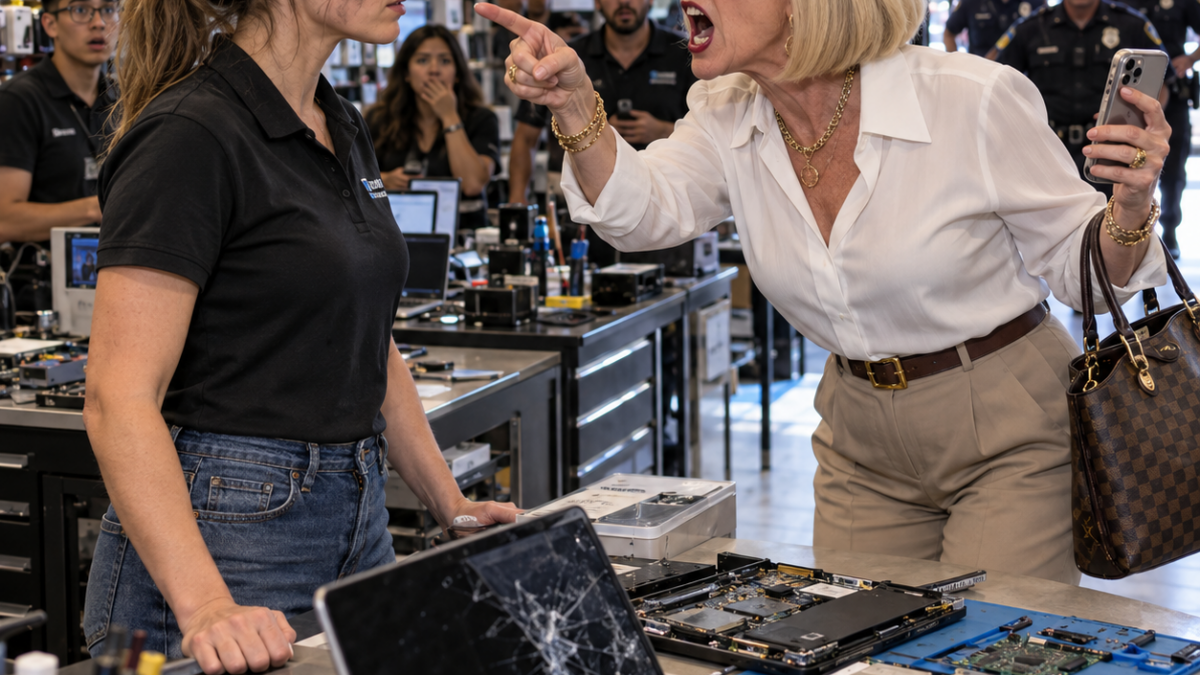
The woman at the counter was probably in her mid-fifties, dressed like she had come directly from a country club brunch where the mimosas had been stronger than advertised. She had the haircut people joke about online—the angled, aggressive bob that looks like it demands to speak to management even when no one has done anything wrong. Her makeup was immaculate but heavy. Gold jewelry. Designer handbag. White blouse. Tailored slacks. Expensive sunglasses pushed onto her head like a crown.
One hand held a half-empty Starbucks cup she was waving dangerously close to the card reader.
The other was pointed directly in Marcus’s face.
“I don’t care what your little system says,” she snapped. “I was told this would be handled immediately.”
Marcus had both hands raised in the universal retail gesture of please don’t make this worse.
“Ma’am, I understand the frustration, but the timeline on the ticket says—”
“I don’t want excuses.”
Her voice had that brittle, high-pitched edge that makes everyone nearby go silent without meaning to.
I approached from the side.
“Hi,” I said. “What seems to be the problem?”
Her head snapped toward me.
Her eyes moved over me in one slow, insulting sweep. Sneakers. Jeans. Company polo. Ponytail. Grease smudge. No makeup beyond whatever had survived the morning. I could almost see the decision forming behind her eyes.
Unimportant.
Disposable.
A target.
“You,” she said. “Finally. Maybe you can explain why this incompetent boy has been holding my laptop hostage.”
Marcus, who was thirty-four and had a mortgage, looked briefly at the ceiling as if asking God for strength.
“I can pull up the ticket,” I said.
“I don’t need a ticket. I need my laptop.”
I stepped to the terminal and typed in her name while she continued.
“It has been weeks. Weeks. I have never experienced customer service this poor in my life. Nobody here knows what they’re doing. I should have gone somewhere reputable.”
The ticket opened.
I blinked.
She had dropped off her laptop two days earlier.
Two.
The screen was cracked, and the replacement part had to be ordered. The quoted timeline was three to five business days. The part had arrived that morning. The repair was scheduled for Monday, which meant we were actually ahead of schedule.
I turned back to her.
“Good news,” I said, keeping my voice calm. “Your part arrived this morning. We quoted you three to five business days, and we’re on track to finish early. It should be ready Monday.”
I thought that would help.
I really did.
Karen leaned forward, eyes narrowing.
“I don’t want to hear excuses from the help.”
The help.
She actually said it like we were in some period drama and I had forgotten to curtsy.
“My laptop is here,” she continued. “The part is here. So go fix it. Right now. I’ll wait.”
“I can’t bump your repair ahead of customers already in the queue.”
“I’m here now.”
“So are their devices.”
Her face reddened.
“Do you understand who I am?”
I had no idea who she was. I was beginning to suspect she didn’t either.
“I understand you’re a customer with a repair ticket, and we’re handling it according to the timeline you agreed to.”
That was when the sexism arrived.
Not gradually.
Not disguised.
She opened the door and let it sprint straight into the room.
“This is exactly why women shouldn’t work in tech,” she said.
The store went quiet.
A man browsing phone cases turned around. A teenager waiting for a screen protector lowered his phone. Marcus’s face changed from stressed to furious, though he stayed silent.
Karen kept going.
“You don’t understand urgency. You don’t understand efficiency. Girls want to play with tools now instead of learning how to actually serve customers.”
I felt something in me go very still.
I had dealt with sexism in tech for years. You either grow thick skin or you leave. When I first tried opening vendor accounts, one supplier refused to speak with me because he wanted “whoever actually runs the business.” His competitor got my orders for the next five years, and I made sure he knew exactly why.
So Karen’s words were not new.
But hearing them in my own store, aimed at me while my employees watched, gave them a special flavor.
Rotten.
“I’m qualified to review your repair status,” I said. “And if you’d like—”
She cut me off.
“I want a real technician.”
“I am a technician.”
“I mean a man.”
Marcus made a sound like a cough.
Karen pointed toward the back workshop.
“Not some secretary playing dress-up.”
“I’m not a secretary.”
“Oh, please. Look at you.”
I glanced down at my jeans, my polo, my tool belt.
Then back at her.
“I am looking.”
She leaned closer.
I could smell alcohol on her breath now. Not enough to explain everything. Enough to explain some of the volume. It was two in the afternoon on a Saturday, and apparently brunch had been liquid.
“I want your manager,” she said.
“I can help you.”
“No. You cannot. Women like you are what’s wrong with customer service now. You all think you can talk back because companies are afraid to discipline you.”
I took a slow breath.
“Ma’am, I’m going to ask you to lower your voice.”
Her eyes widened.
“Did you just tell me what to do?”
“I asked you to lower your voice.”
“You don’t get to ask me anything. I am a paying customer. The customer is always right.”
“That phrase does not mean what people think it means.”
“It means you do what I say.”
“No, it doesn’t.”
She straightened.
Then she said the words that made the entire day swerve from awful into absurd.
“You’re fired.”
I stared at her.
Marcus stared at her.
The teenager in the corner slowly raised his phone higher, like he sensed content approaching.
Karen pointed dramatically toward the door.
“You heard me. I am firing you effective immediately. Get out of my sight before I call corporate.”
For one long second, the only sound was the soft hum of the display monitors.
A bigger person might have de-escalated.
A wiser person might have said, “Ma’am, customers cannot fire employees,” and moved on.
But I had been called the help, a secretary, a girl playing dress-up, and now fired from my own company in front of my staff.
And I saw an opportunity.
So I sighed.
Not a small sigh.
A theatrical, exhausted, Oscar-worthy sigh.
“Well,” I said, “I guess I’ve been fired.”
Karen blinked.
I reached for my lanyard, removed my key card, and placed it gently on the counter in front of Marcus.
“Marcus,” I said solemnly, “apparently I’m no longer employed here. I’ll be over by the phone accessory wall if anyone needs me.”
Marcus’s mouth twitched.
He knew me well enough to understand the game immediately.
I walked away from the counter, leaned against the display of phone cases, and crossed my arms.
Karen looked triumphant.
Absolutely triumphant.
Like she had restored order to the universe by banishing an incompetent peasant.
She turned back to Marcus.
“Now,” she said, “fix my laptop.”
Marcus put on his finest apologetic customer-service expression. It was a masterpiece. Soft eyes. Concerned eyebrows. Just enough regret.
“I’m really sorry, ma’am,” he said. “But I can’t authorize changes to the repair queue.”
Her smile fell.
“What?”
“Only the owner can approve priority changes.”
“Then call the owner.”
Marcus glanced toward me.
“Well, that’s going to be difficult.”
“Why?”
“Because you just fired her.”
The store became perfectly silent.
Karen’s face shifted through several emotions at once: confusion, irritation, disbelief, and then confusion again because the first round had not solved anything.
“What are you talking about?”
Marcus gestured toward me with his chin.
“She’s the owner.”
Karen looked at me.
Then at Marcus.
Then back at me.
“No.”
Marcus nodded. “Yes.”
“No, she is not.”
“She is.”
“That’s ridiculous.”
I stepped forward again, slowly, because I wanted to savor the moment without being unprofessional enough to visibly enjoy it.
I pulled a business card from my back pocket and held it out.
She snatched it from my hand.
On it, in clean black letters, were my name, direct number, and title.
Founder & CEO, TechFix Solutions.
I smiled.
“That’s the owner’s direct line,” I said. “It rings my phone.”
Her face darkened.
“I don’t believe this.”
“That is your choice.”
“There is no way.”
“Yet here we are.”
“There has to be someone above you.”
“No.”
“Your father?”
“No.”
“Your husband?”
“Also no.”
She looked genuinely offended by the possibility that no man was hidden behind the curtain.
“I founded the company five years ago,” I said. “Started in my garage. Four locations now. You fired me from my own business, which is a new experience, so thank you for keeping life interesting.”
A few customers laughed.
That was when Karen broke.
Not loudly at first. It happened behind her eyes. A system error. The blue screen of Karen. She had built her entire performance around the assumption that I was powerless, and now reality had contradicted her in public.
Instead of apologizing, she doubled down.
Of course she did.
“That card is fake.”
“It isn’t.”
“You probably printed it yourself.”
“I own a business. I print lots of things.”
“There is no way a woman your age owns a tech company.”
“I’m thirty-two, not twelve.”
“You slept your way into it.”
I tilted my head.
“I started the company alone in my garage, so that would be a fascinating accusation to diagram.”
Marcus made a choking noise behind the counter.
Karen’s voice rose.
“I want the real owner.”
“You have her.”
“I want corporate.”
“You are standing in it.”
“I want your supervisor.”
“I report to the IRS and my accountant. Neither is available today.”
More laughter from the customers.
That made everything worse.
Karen turned on them.
“This is not funny.”
The teenager with the phone said, softly, “It’s kind of funny.”
I decided we were done.
“Ma’am,” I said, “I’m going to ask you to leave. Your laptop will be completed according to the original timeline. We’ll contact you when it’s ready.”
“I am not leaving without my property.”
“Your laptop is in the repair queue. You’ll get it when the repair is complete.”
“You’re holding it hostage.”
“No. We’re repairing it.”
“You can’t kick me out. I’m a customer.”
“I can absolutely ask you to leave when you’re insulting staff and causing a disturbance.”
At that point, I pulled out my phone.
I wanted documentation. We had security cameras, but when a customer gets this volatile, I like having multiple records. I opened the camera app.
Karen saw the phone and lunged.
One second she was at the counter.
The next, she was in my space, grabbing for my hand.
“Don’t you record me!”
I pulled back.
She shoved me.
Hard.
I stumbled into the phone accessories display. My hip slammed against the corner, and an entire rack of PopSockets exploded onto the floor like colorful shrapnel. Pain shot down my side, but for a second, shock mattered more.
She had actually put her hands on me.
In my store.
In front of employees and customers.
Marcus moved immediately, stepping between us.
“Do not touch her,” he said, and his voice was so cold I barely recognized it.
DeShawn, another tech who had come out from the back, was already dialing 911.
The teenager was still recording. At this point, I was grateful.
Karen pointed at me, breathing hard.
“She attacked me.”
I almost laughed.
“You shoved me into a display.”
“You tried to record me illegally.”
“This is a public-facing business with posted security cameras.”
“You’re impersonating the owner.”
“I am the owner.”
“You’re a child.”
“I’m thirty-two.”
“You’re committing fraud.”
“Ma’am,” Marcus said, “you need to leave.”
Karen pulled out her own phone.
“Fine,” she snapped. “I’ll call the police myself.”
I watched her dial 911 and thought, incredibly, she is about to dig the hole deeper while standing inside it.
Her call was wild.
I could hear her side clearly.
“Yes, I’m at a business where a young woman is impersonating the owner. She’s refusing to return my laptop. She attacked me when I tried to retrieve my property. I think this is some kind of scam. Send someone immediately.”
She paused.
“No, I am not safe.”
Another pause.
“Yes, she claims she owns the company. She obviously doesn’t. Women like that don’t own tech companies.”
Marcus closed his eyes.
I quietly told my team, “Save the security footage. Do not argue with her. Let her talk.”
That is one of the most useful lessons I have learned in business.
When someone is committed to destroying their own credibility, don’t interrupt.
Within ten minutes, two officers walked through the door.
Karen rushed toward them like salvation had arrived wearing badges.
“Officers, thank God,” she said. “That woman is a fraud. She’s pretending to own this business, she assaulted me, and she’s stealing my laptop.”
The officers looked from her to me.
One of them, a tall officer with tired eyes, said, “Okay. Let’s slow down.”
Karen did not slow down.
“She needs to be arrested. I want my property. I want the real owner contacted. This is discrimination. I know the mayor.”
The second officer glanced at his partner with the look of a man realizing paperwork had just multiplied.
They separated us.
One officer stayed with Karen while the other came to me.
“Can you explain what happened?”
I kept my voice calm.
“My name is on the business registration. I’m the founder and owner of TechFix Solutions. This customer became angry when I explained the repair timeline on her laptop. She insulted me and my staff, said women shouldn’t work in tech, claimed I couldn’t be the owner, then physically shoved me when I tried to document the incident.”
He nodded.
“Do you have identification?”
“Yes.”
“Can you verify ownership?”
“Immediately.”
I took him to the back office.
On my computer, I pulled up the state business registration. My name. My company. My registered agent information. Everything matched my driver’s license. I also had our certificate of organization framed on the wall because my mother insisted all accomplishments should be displayed where rude people might accidentally see them.
Then I pulled up the security footage.
We watched it together.
There was Karen at the counter, pointing.
There I was approaching.
There she was yelling.
There I was stepping away after being “fired.”
There was Marcus explaining I was the owner.
There was Karen lunging for my phone and shoving me into the display.
The officer’s expression shifted from neutral to sympathetic.
“Do you want to press charges for assault?”
“Yes,” I said. “Absolutely.”
We returned to the front.
Karen was still ranting.
“…and I know she’s lying because there is no way someone like her owns four stores. Nobody believes that. She probably bribed these employees to cover for her.”
The officer who had stayed with her looked relieved to see his partner.
The tall officer addressed Karen.
“Ma’am, we’ve verified that she is the owner and founder of this business.”
Karen froze.
“We also reviewed the security footage,” he continued. “It shows you shoving her.”
“No, it doesn’t.”
“It does.”
“She edited it.”
“In the last five minutes?”
“She’s a tech person. They can do things.”
“Ma’am.”
“I want your supervisor.”
Of course she did.
The officer remained calm. “Right now, we’re discussing the incident that occurred here.”
“No. I am discussing police corruption. She has clearly bribed you. I want your supervisor, the mayor, and the real owner.”
The teenager in the corner whispered, “Triple combo.”
I had to look away.
Karen heard him and spun around.
“Stop recording me!”
The officer held up a hand.
“Ma’am, do not approach anyone.”
“I have rights.”
“Yes, you do. You also need to calm down.”
“Do not tell me to calm down.”
“Ma’am—”
“I am the victim here.”
Then she made the astonishing decision to push past the officers toward the back workshop.
Maybe she thought she could retrieve her laptop by force. Maybe she wanted to prove there was some secret male owner hiding behind the repair benches. Maybe the alcohol and entitlement had merged into a single catastrophic thought: I can still win.
One officer stepped in front of her.
“Stop.”
She did not stop.
She shoved his arm.
Everything happened fast after that.
The officer grabbed her wrist to restrain her. Karen shrieked like she had been attacked by wolves. She twisted, flailed, scratched at his forearm, and screamed about police brutality. The second officer moved in to help. She kicked backward and caught him in the shin.
“Stop resisting,” one officer ordered.
“I am not resisting!”
She was, in fact, resisting with her entire body.
They tried to get her hands behind her back. She bent forward, snapped her head sideways, and actually tried to bite one officer’s arm.
Not metaphorically.
Bite.
Like a feral raccoon in designer slacks.
The other officer gave a clear warning.
“If you do not stop resisting, you will be tased.”
Karen’s response was to kick again.
The taser deployed.
She dropped.
For one stunned second, the whole store went silent except for the tiny electronic clicking sound and Karen yelling from the floor about lawsuits, discrimination, and how she would have everyone’s jobs.
The officers cuffed her within seconds.
Even then, she kept screaming.
“You can’t do this! I know people! She’s lying! That little girl is lying!”
Little girl.
I stood beside a pile of scattered PopSockets, hip throbbing, watching a woman in her fifties get hauled out of my store because she could not accept that I owned it.
It would have been funnier if it had not been so disturbing.
One officer came back inside after putting her in the patrol car.
“We’ll need your formal statement and copies of the footage,” he said.
“Of course.”
He glanced at the wreckage near the display.
“You okay?”
“I’ll have a bruise.”
“You still want to press charges?”
“Yes.”
He nodded.
“She’ll likely be charged with assault on you, assault on an officer, resisting arrest, disorderly conduct, and filing a false report. Depending on how the prosecutor reviews the 911 call, maybe more.”
Then he sighed.
“This is going to be a lot of paperwork.”
Marcus, deadpan, said, “We offer printer repair if that helps.”
The officer laughed.
The whole thing took nearly three hours.
Statements. Footage. Photos of the display. Photos of the bruise starting on my hip. Customer witnesses. Employee witnesses. The teenager, who looked thrilled to be involved in something more interesting than a screen protector replacement, gave a statement too.
By the time the officers left, it was almost closing.
The remaining customers were shockingly patient. A few had stayed just to watch, which I could not really blame them for. One older gentleman told me it was the best show he had seen in years and asked if we did this every Saturday.
“Only for special customers,” I said.
He laughed and bought two phone cases.
Karen’s laptop was finished Monday, exactly as originally scheduled.
My technician did a beautiful job on the screen replacement.
Obviously, we did not allow Karen back into the store.
We shipped the laptop to her home address at her expense, signature required. Inside the package was the repaired laptop, her paid invoice, and a formal letter from our attorney informing her that she was permanently banned from all TechFix Solutions locations.
I also included a business card.
Just in case she forgot who I was.
The criminal case took a few months.
I gave a deposition and prepared to testify, but it never went to trial. The footage did most of the work. Her attorney tried to argue that she had been having a mental health episode, or that alcohol had impaired her judgment, or that the situation had escalated beyond her control.
The judge was not particularly sympathetic.
Especially not after hearing that she called 911 to make false accusations, then assaulted an officer when reality failed to support her version of events.
She ended up pleading guilty to reduced charges in exchange for avoiding jail time. She got probation, mandatory anger management classes, a fine, restitution for the damaged display, and a no-contact order that included me and every TechFix Solutions location.
She also got a criminal record.
Actions meet consequences.
That should have been the end.
In a practical sense, it was.
But the story did something I did not expect.
Someone did post part of the incident online. Not the worst parts, thankfully. Not the taser. Mostly the moment Marcus told her she had fired the owner. The clip spread locally, then a little farther. For about two weeks, people came into the store saying things like, “Are you the CEO she fired?” and “Is this the place with the laptop lady?”
It was embarrassing at first.
Then business increased.
Apparently, a woman-owned tech repair company with employees who can keep straight faces through customer meltdowns is good publicity.
My mother called to say she had watched the video twelve times.
Then she said, “Daughter Knows Best would have gone viral faster.”
I hung up on her lovingly.
The incident also changed how I trained staff.
Not because they did anything wrong. They were excellent. Marcus earned a bonus large enough to make him blink twice when he saw it. DeShawn got one too. We updated our escalation policy, improved panic button access, adjusted camera angles, and added more visible signage about abusive behavior not being tolerated.
Retail workers deserve better than being treated like punching bags with name tags.
Tech workers deserve better than being treated like servants because customers don’t understand the difference between “repair queue” and “personal emergency.”
Women in technical fields deserve better than having to prove, over and over, that we belong in rooms we built ourselves.
That last part stayed with me the most.
Karen was extreme, yes. Most people do not shove business owners into accessory displays or try to bite police officers. But her assumptions were not rare. They were just louder than usual.
I have seen quieter versions of Karen for years.
The vendor who asked for my boss.
The customer who ignored my explanation until a male employee repeated it.
The investor who asked whether I had a “technical cofounder” because he assumed I couldn’t possibly understand repair operations myself.
The man who congratulated my husband for “letting” me run a business even though my husband is a high school history teacher who still asks me to reset the router.
Karen did not invent that attitude.
She just poured a mimosa on it and gave it volume.
But here is what she never understood.
I did not build TechFix Solutions by waiting for people like her to believe in me.
I built it because I knew what I could do.
I built it one repair at a time. One customer at a time. One lease negotiation, payroll scare, vendor problem, broken display case, and impossible motherboard diagnosis at a time. I built it with employees who trust me because I know their jobs, customers who come back because we fix things properly, and stubbornness strong enough to outlast every person who assumed there had to be a man above me.
Karen walked in and saw jeans, sneakers, a ponytail, and a smudge on my face.
She thought that meant I was nobody.
She thought firing me would put me in my place.
Instead, she created the most unforgettable customer-service training video my company will ever have.
I still work repair benches.
I still visit unannounced.
I still wear jeans, sneakers, and company polos.
Sometimes I still get underestimated, though less often now at that location because the staff likes telling new hires the legend of the customer who fired the CEO and left in handcuffs.
The PopSocket display has been replaced.
My hip healed.
Marcus still works the counter and still has the patience of a saint, though now when a customer gets rude, he sometimes looks at me and says, “Please don’t get fired again. The paperwork is terrible.”
And every time I hand someone my business card, I remember Karen staring at it like it had betrayed the natural order of the universe.
Founder & CEO.
My name.
My company.
My work.
She demanded the real owner.
She got her.
She just didn’t like that the real owner was the woman with grease on her cheek.
𝗧𝗛𝗘 𝗘𝗡𝗗
Karen Fired Me From the Tech Company I Built, Then Called 911 When I Proved I Owned It
Karen walked into my repair shop, looked me in the eye, and fired me from the company I had built with my own hands.
She said women couldn’t run tech businesses, that I was just “the help,” and that the real owner had to be a man somewhere above me.
Then she shoved me in front of my employees, called 911 on herself without realizing it, and gave the police every reason they needed to put her in handcuffs.
I started TechFix Solutions in my garage.
I know. The name is not especially creative. My mother wanted me to call it Daughter Knows Best Tech Services, which is exactly why I make the branding decisions and not her. TechFix Solutions was plain, easy to remember, and did what it needed to do. Back then, “what it needed to do” meant fit on a homemade flyer I printed at a copy shop and taped to community boards beside babysitting ads and missing-cat posters.
I was twenty-seven when I started.
I had a business degree, a workbench, a box of secondhand tools, and the stubborn belief that I could fix almost anything if I had enough time, enough light, and enough caffeine. Phones came first. Cracked screens, dead charging ports, swollen batteries that made me whisper “absolutely not” under my breath before putting on gloves. Then laptops. Then gaming consoles. Then custom PCs. Then data recovery jobs that made grown adults cry when I saved baby photos, tax files, or half-finished novels they had never backed up.
At first, it was friends.
Then friends of friends.
Then strangers who had heard about me from friends of friends.
Then people I had never met started knocking on my garage door at weird hours, holding phones like injured birds and asking, “Can you save it?”
Five years later, TechFix Solutions had four locations across the metro area, about twenty employees, and enough revenue that sometimes I still opened the books and stared at the numbers like they belonged to someone else.
I was the founder.
I was the CEO.
I signed the leases, negotiated vendor accounts, handled payroll emergencies, hired techs, fired one guy who thought wiping customer devices without permission was “faster,” and once spent three hours under a front counter fixing a wiring mistake because an electrician swore it “wasn’t his problem.”
But despite all that, I still loved the repair bench most.
Management mattered. Strategy mattered. Cash flow, insurance, taxes, staffing schedules—all the glamorous things nobody tells you about when they say “be your own boss.” But nothing felt as good as diagnosing a dead board, tracing the failure, replacing one microscopic component, and watching a machine come back to life under my hands.
That feeling never got old.
So I visited each store at least once a month, usually unannounced. Partly to check quality. Partly to see how the staff treated customers when they didn’t know the boss was watching. And partly because I missed the work.
Also, my employees behaved very differently when they thought nobody important was around.
Once, I caught a night-shift tech filming “Will It Blend?” style videos with old broken parts customers had abandoned. I should have been furious. Instead, I watched him drop a shattered tablet frame into the blender, scream “for science,” and get 40,000 views by morning. He still works for me. His channel is weirdly popular. I pretend not to know.
The day everything happened, I was at one of our newer locations on the north side of town.
It was a Saturday afternoon, which meant chaos. Saturday was when working people finally had time to bring in devices, and every store felt like a hospital emergency room for electronics. Phones with spiderweb screens. Laptops that had “just stopped working” after someone spilled wine into them. Tablets dropped by toddlers. Gaming PCs producing noises no machine should make unless it was haunted.
I was in the back workshop helping one of my newer technicians, Jay, with a gaming laptop motherboard issue. It had power, no display, weird fan behavior, and the kind of intermittent short that makes you question your life choices. I was wearing my usual repair-day outfit: jeans, sneakers, and a company polo shirt. No blazer. No fancy watch. No name tag that said CEO because I’ve always hated being treated differently when people realize I own the place.
My hair was in a ponytail. There was probably a smudge of thermal paste near my cheek. I had a screwdriver tucked behind one ear and coffee going cold somewhere behind me.
In other words, I looked like someone who worked there.
Which, to be fair, I did.
Just not in the way one particular customer expected.
Part 2
I heard the commotion before I saw her.
A woman’s voice cut through the normal store noise, sharp and rising. At first, I ignored it because retail comes with difficult customers the way summer comes with mosquitoes. But then I heard Marcus, my front counter lead, trying to calm her down.
Marcus is the most patient human being I have ever employed.
I once watched him spend forty-five minutes explaining to an elderly man that we could not retrieve photos from a Samsung phone when the man had lost them on an iPhone he no longer owned. Marcus did it kindly. With diagrams. The man left thanking him.
So when Marcus sounded stressed, I knew something was genuinely wrong.
I set down the laptop board, wiped my hands on a rag, and stepped out front.
The woman at the counter was probably in her mid-fifties, dressed like she had come directly from a country club brunch where the mimosas had been stronger than advertised. She had the haircut people joke about online—the angled, aggressive bob that looks like it demands to speak to management even when no one has done anything wrong. Her makeup was immaculate but heavy. Gold jewelry. Designer handbag. White blouse. Tailored slacks. Expensive sunglasses pushed onto her head like a crown.
One hand held a half-empty Starbucks cup she was waving dangerously close to the card reader.
The other was pointed directly in Marcus’s face.
“I don’t care what your little system says,” she snapped. “I was told this would be handled immediately.”
Marcus had both hands raised in the universal retail gesture of please don’t make this worse.
“Ma’am, I understand the frustration, but the timeline on the ticket says—”
“I don’t want excuses.”
Her voice had that brittle, high-pitched edge that makes everyone nearby go silent without meaning to.
I approached from the side.
“Hi,” I said. “What seems to be the problem?”
Her head snapped toward me.
Her eyes moved over me in one slow, insulting sweep. Sneakers. Jeans. Company polo. Ponytail. Grease smudge. No makeup beyond whatever had survived the morning. I could almost see the decision forming behind her eyes.
Unimportant.
Disposable.
A target.
“You,” she said. “Finally. Maybe you can explain why this incompetent boy has been holding my laptop hostage.”
Marcus, who was thirty-four and had a mortgage, looked briefly at the ceiling as if asking God for strength.
“I can pull up the ticket,” I said.
“I don’t need a ticket. I need my laptop.”
I stepped to the terminal and typed in her name while she continued.
“It has been weeks. Weeks. I have never experienced customer service this poor in my life. Nobody here knows what they’re doing. I should have gone somewhere reputable.”
The ticket opened.
I blinked.
She had dropped off her laptop two days earlier.
Two.
The screen was cracked, and the replacement part had to be ordered. The quoted timeline was three to five business days. The part had arrived that morning. The repair was scheduled for Monday, which meant we were actually ahead of schedule.
I turned back to her.
“Good news,” I said, keeping my voice calm. “Your part arrived this morning. We quoted you three to five business days, and we’re on track to finish early. It should be ready Monday.”
I thought that would help.
I really did.
Karen leaned forward, eyes narrowing.
“I don’t want to hear excuses from the help.”
The help.
She actually said it like we were in some period drama and I had forgotten to curtsy.
“My laptop is here,” she continued. “The part is here. So go fix it. Right now. I’ll wait.”
“I can’t bump your repair ahead of customers already in the queue.”
“I’m here now.”
“So are their devices.”
Her face reddened.
“Do you understand who I am?”
I had no idea who she was. I was beginning to suspect she didn’t either.
“I understand you’re a customer with a repair ticket, and we’re handling it according to the timeline you agreed to.”
That was when the sexism arrived.
Not gradually.
Not disguised.
She opened the door and let it sprint straight into the room.
“This is exactly why women shouldn’t work in tech,” she said.
The store went quiet.
A man browsing phone cases turned around. A teenager waiting for a screen protector lowered his phone. Marcus’s face changed from stressed to furious, though he stayed silent.
Karen kept going.
“You don’t understand urgency. You don’t understand efficiency. Girls want to play with tools now instead of learning how to actually serve customers.”
I felt something in me go very still.
I had dealt with sexism in tech for years. You either grow thick skin or you leave. When I first tried opening vendor accounts, one supplier refused to speak with me because he wanted “whoever actually runs the business.” His competitor got my orders for the next five years, and I made sure he knew exactly why.
So Karen’s words were not new.
But hearing them in my own store, aimed at me while my employees watched, gave them a special flavor.
Rotten.
“I’m qualified to review your repair status,” I said. “And if you’d like—”
She cut me off.
“I want a real technician.”
“I am a technician.”
“I mean a man.”
Marcus made a sound like a cough.
Karen pointed toward the back workshop.
“Not some secretary playing dress-up.”
“I’m not a secretary.”
“Oh, please. Look at you.”
I glanced down at my jeans, my polo, my tool belt.
Then back at her.
“I am looking.”
She leaned closer.
I could smell alcohol on her breath now. Not enough to explain everything. Enough to explain some of the volume. It was two in the afternoon on a Saturday, and apparently brunch had been liquid.
“I want your manager,” she said.
“I can help you.”
“No. You cannot. Women like you are what’s wrong with customer service now. You all think you can talk back because companies are afraid to discipline you.”
I took a slow breath.
“Ma’am, I’m going to ask you to lower your voice.”
Her eyes widened.
“Did you just tell me what to do?”
“I asked you to lower your voice.”
“You don’t get to ask me anything. I am a paying customer. The customer is always right.”
“That phrase does not mean what people think it means.”
“It means you do what I say.”
“No, it doesn’t.”
She straightened.
Then she said the words that made the entire day swerve from awful into absurd.
“You’re fired.”
I stared at her.
Marcus stared at her.
The teenager in the corner slowly raised his phone higher, like he sensed content approaching.
Karen pointed dramatically toward the door.
“You heard me. I am firing you effective immediately. Get out of my sight before I call corporate.”
For one long second, the only sound was the soft hum of the display monitors.
A bigger person might have de-escalated.
A wiser person might have said, “Ma’am, customers cannot fire employees,” and moved on.
But I had been called the help, a secretary, a girl playing dress-up, and now fired from my own company in front of my staff.
And I saw an opportunity.
So I sighed.
Not a small sigh.
A theatrical, exhausted, Oscar-worthy sigh.
“Well,” I said, “I guess I’ve been fired.”
Karen blinked.
I reached for my lanyard, removed my key card, and placed it gently on the counter in front of Marcus.
“Marcus,” I said solemnly, “apparently I’m no longer employed here. I’ll be over by the phone accessory wall if anyone needs me.”
Marcus’s mouth twitched.
He knew me well enough to understand the game immediately.
I walked away from the counter, leaned against the display of phone cases, and crossed my arms.
Karen looked triumphant.
Absolutely triumphant.
Like she had restored order to the universe by banishing an incompetent peasant.
She turned back to Marcus.
“Now,” she said, “fix my laptop.”
Marcus put on his finest apologetic customer-service expression. It was a masterpiece. Soft eyes. Concerned eyebrows. Just enough regret.
“I’m really sorry, ma’am,” he said. “But I can’t authorize changes to the repair queue.”
Her smile fell.
“What?”
“Only the owner can approve priority changes.”
“Then call the owner.”
Marcus glanced toward me.
“Well, that’s going to be difficult.”
“Why?”
“Because you just fired her.”
The store became perfectly silent.
Karen’s face shifted through several emotions at once: confusion, irritation, disbelief, and then confusion again because the first round had not solved anything.
“What are you talking about?”
Marcus gestured toward me with his chin.
“She’s the owner.”
Karen looked at me.
Then at Marcus.
Then back at me.
“No.”
Marcus nodded. “Yes.”
“No, she is not.”
“She is.”
“That’s ridiculous.”
I stepped forward again, slowly, because I wanted to savor the moment without being unprofessional enough to visibly enjoy it.
I pulled a business card from my back pocket and held it out.
She snatched it from my hand.
On it, in clean black letters, were my name, direct number, and title.
Founder & CEO, TechFix Solutions.
I smiled.
“That’s the owner’s direct line,” I said. “It rings my phone.”
Her face darkened.
“I don’t believe this.”
“That is your choice.”
“There is no way.”
“Yet here we are.”
“There has to be someone above you.”
“No.”
“Your father?”
“No.”
“Your husband?”
“Also no.”
She looked genuinely offended by the possibility that no man was hidden behind the curtain.
“I founded the company five years ago,” I said. “Started in my garage. Four locations now. You fired me from my own business, which is a new experience, so thank you for keeping life interesting.”
A few customers laughed.
That was when Karen broke.
Not loudly at first. It happened behind her eyes. A system error. The blue screen of Karen. She had built her entire performance around the assumption that I was powerless, and now reality had contradicted her in public.
Instead of apologizing, she doubled down.
Of course she did.
“That card is fake.”
“It isn’t.”
“You probably printed it yourself.”
“I own a business. I print lots of things.”
“There is no way a woman your age owns a tech company.”
“I’m thirty-two, not twelve.”
“You slept your way into it.”
I tilted my head.
“I started the company alone in my garage, so that would be a fascinating accusation to diagram.”
Marcus made a choking noise behind the counter.
Karen’s voice rose.
“I want the real owner.”
“You have her.”
“I want corporate.”
“You are standing in it.”
“I want your supervisor.”
“I report to the IRS and my accountant. Neither is available today.”
More laughter from the customers.
That made everything worse.
Karen turned on them.
“This is not funny.”
The teenager with the phone said, softly, “It’s kind of funny.”
I decided we were done.
“Ma’am,” I said, “I’m going to ask you to leave. Your laptop will be completed according to the original timeline. We’ll contact you when it’s ready.”
“I am not leaving without my property.”
“Your laptop is in the repair queue. You’ll get it when the repair is complete.”
“You’re holding it hostage.”
“No. We’re repairing it.”
“You can’t kick me out. I’m a customer.”
“I can absolutely ask you to leave when you’re insulting staff and causing a disturbance.”
At that point, I pulled out my phone.
I wanted documentation. We had security cameras, but when a customer gets this volatile, I like having multiple records. I opened the camera app.
Karen saw the phone and lunged.
One second she was at the counter.
The next, she was in my space, grabbing for my hand.
“Don’t you record me!”
I pulled back.
She shoved me.
Hard.
I stumbled into the phone accessories display. My hip slammed against the corner, and an entire rack of PopSockets exploded onto the floor like colorful shrapnel. Pain shot down my side, but for a second, shock mattered more.
She had actually put her hands on me.
In my store.
In front of employees and customers.
Marcus moved immediately, stepping between us.
“Do not touch her,” he said, and his voice was so cold I barely recognized it.
DeShawn, another tech who had come out from the back, was already dialing 911.
The teenager was still recording. At this point, I was grateful.
Karen pointed at me, breathing hard.
“She attacked me.”
I almost laughed.
“You shoved me into a display.”
“You tried to record me illegally.”
“This is a public-facing business with posted security cameras.”
“You’re impersonating the owner.”
“I am the owner.”
“You’re a child.”
“I’m thirty-two.”
“You’re committing fraud.”
“Ma’am,” Marcus said, “you need to leave.”
Karen pulled out her own phone.
“Fine,” she snapped. “I’ll call the police myself.”
I watched her dial 911 and thought, incredibly, she is about to dig the hole deeper while standing inside it.
Her call was wild.
I could hear her side clearly.
“Yes, I’m at a business where a young woman is impersonating the owner. She’s refusing to return my laptop. She attacked me when I tried to retrieve my property. I think this is some kind of scam. Send someone immediately.”
She paused.
“No, I am not safe.”
Another pause.
“Yes, she claims she owns the company. She obviously doesn’t. Women like that don’t own tech companies.”
Marcus closed his eyes.
I quietly told my team, “Save the security footage. Do not argue with her. Let her talk.”
That is one of the most useful lessons I have learned in business.
When someone is committed to destroying their own credibility, don’t interrupt.
Within ten minutes, two officers walked through the door.
Karen rushed toward them like salvation had arrived wearing badges.
“Officers, thank God,” she said. “That woman is a fraud. She’s pretending to own this business, she assaulted me, and she’s stealing my laptop.”
The officers looked from her to me.
One of them, a tall officer with tired eyes, said, “Okay. Let’s slow down.”
Karen did not slow down.
“She needs to be arrested. I want my property. I want the real owner contacted. This is discrimination. I know the mayor.”
The second officer glanced at his partner with the look of a man realizing paperwork had just multiplied.
They separated us.
One officer stayed with Karen while the other came to me.
“Can you explain what happened?”
I kept my voice calm.
“My name is on the business registration. I’m the founder and owner of TechFix Solutions. This customer became angry when I explained the repair timeline on her laptop. She insulted me and my staff, said women shouldn’t work in tech, claimed I couldn’t be the owner, then physically shoved me when I tried to document the incident.”
He nodded.
“Do you have identification?”
“Yes.”
“Can you verify ownership?”
“Immediately.”
I took him to the back office.
On my computer, I pulled up the state business registration. My name. My company. My registered agent information. Everything matched my driver’s license. I also had our certificate of organization framed on the wall because my mother insisted all accomplishments should be displayed where rude people might accidentally see them.
Then I pulled up the security footage.
We watched it together.
There was Karen at the counter, pointing.
There I was approaching.
There she was yelling.
There I was stepping away after being “fired.”
There was Marcus explaining I was the owner.
There was Karen lunging for my phone and shoving me into the display.
The officer’s expression shifted from neutral to sympathetic.
“Do you want to press charges for assault?”
“Yes,” I said. “Absolutely.”
We returned to the front.
Karen was still ranting.
“…and I know she’s lying because there is no way someone like her owns four stores. Nobody believes that. She probably bribed these employees to cover for her.”
The officer who had stayed with her looked relieved to see his partner.
The tall officer addressed Karen.
“Ma’am, we’ve verified that she is the owner and founder of this business.”
Karen froze.
“We also reviewed the security footage,” he continued. “It shows you shoving her.”
“No, it doesn’t.”
“It does.”
“She edited it.”
“In the last five minutes?”
“She’s a tech person. They can do things.”
“Ma’am.”
“I want your supervisor.”
Of course she did.
The officer remained calm. “Right now, we’re discussing the incident that occurred here.”
“No. I am discussing police corruption. She has clearly bribed you. I want your supervisor, the mayor, and the real owner.”
The teenager in the corner whispered, “Triple combo.”
I had to look away.
Karen heard him and spun around.
“Stop recording me!”
The officer held up a hand.
“Ma’am, do not approach anyone.”
“I have rights.”
“Yes, you do. You also need to calm down.”
“Do not tell me to calm down.”
“Ma’am—”
“I am the victim here.”
Then she made the astonishing decision to push past the officers toward the back workshop.
Maybe she thought she could retrieve her laptop by force. Maybe she wanted to prove there was some secret male owner hiding behind the repair benches. Maybe the alcohol and entitlement had merged into a single catastrophic thought: I can still win.
One officer stepped in front of her.
“Stop.”
She did not stop.
She shoved his arm.
Everything happened fast after that.
The officer grabbed her wrist to restrain her. Karen shrieked like she had been attacked by wolves. She twisted, flailed, scratched at his forearm, and screamed about police brutality. The second officer moved in to help. She kicked backward and caught him in the shin.
“Stop resisting,” one officer ordered.
“I am not resisting!”
She was, in fact, resisting with her entire body.
They tried to get her hands behind her back. She bent forward, snapped her head sideways, and actually tried to bite one officer’s arm.
Not metaphorically.
Bite.
Like a feral raccoon in designer slacks.
The other officer gave a clear warning.
“If you do not stop resisting, you will be tased.”
Karen’s response was to kick again.
The taser deployed.
She dropped.
For one stunned second, the whole store went silent except for the tiny electronic clicking sound and Karen yelling from the floor about lawsuits, discrimination, and how she would have everyone’s jobs.
The officers cuffed her within seconds.
Even then, she kept screaming.
“You can’t do this! I know people! She’s lying! That little girl is lying!”
Little girl.
I stood beside a pile of scattered PopSockets, hip throbbing, watching a woman in her fifties get hauled out of my store because she could not accept that I owned it.
It would have been funnier if it had not been so disturbing.
One officer came back inside after putting her in the patrol car.
“We’ll need your formal statement and copies of the footage,” he said.
“Of course.”
He glanced at the wreckage near the display.
“You okay?”
“I’ll have a bruise.”
“You still want to press charges?”
“Yes.”
He nodded.
“She’ll likely be charged with assault on you, assault on an officer, resisting arrest, disorderly conduct, and filing a false report. Depending on how the prosecutor reviews the 911 call, maybe more.”
Then he sighed.
“This is going to be a lot of paperwork.”
Marcus, deadpan, said, “We offer printer repair if that helps.”
The officer laughed.
The whole thing took nearly three hours.
Statements. Footage. Photos of the display. Photos of the bruise starting on my hip. Customer witnesses. Employee witnesses. The teenager, who looked thrilled to be involved in something more interesting than a screen protector replacement, gave a statement too.
By the time the officers left, it was almost closing.
The remaining customers were shockingly patient. A few had stayed just to watch, which I could not really blame them for. One older gentleman told me it was the best show he had seen in years and asked if we did this every Saturday.
“Only for special customers,” I said.
He laughed and bought two phone cases.
Karen’s laptop was finished Monday, exactly as originally scheduled.
My technician did a beautiful job on the screen replacement.
Obviously, we did not allow Karen back into the store.
We shipped the laptop to her home address at her expense, signature required. Inside the package was the repaired laptop, her paid invoice, and a formal letter from our attorney informing her that she was permanently banned from all TechFix Solutions locations.
I also included a business card.
Just in case she forgot who I was.
The criminal case took a few months.
I gave a deposition and prepared to testify, but it never went to trial. The footage did most of the work. Her attorney tried to argue that she had been having a mental health episode, or that alcohol had impaired her judgment, or that the situation had escalated beyond her control.
The judge was not particularly sympathetic.
Especially not after hearing that she called 911 to make false accusations, then assaulted an officer when reality failed to support her version of events.
She ended up pleading guilty to reduced charges in exchange for avoiding jail time. She got probation, mandatory anger management classes, a fine, restitution for the damaged display, and a no-contact order that included me and every TechFix Solutions location.
She also got a criminal record.
Actions meet consequences.
That should have been the end.
In a practical sense, it was.
But the story did something I did not expect.
Someone did post part of the incident online. Not the worst parts, thankfully. Not the taser. Mostly the moment Marcus told her she had fired the owner. The clip spread locally, then a little farther. For about two weeks, people came into the store saying things like, “Are you the CEO she fired?” and “Is this the place with the laptop lady?”
It was embarrassing at first.
Then business increased.
Apparently, a woman-owned tech repair company with employees who can keep straight faces through customer meltdowns is good publicity.
My mother called to say she had watched the video twelve times.
Then she said, “Daughter Knows Best would have gone viral faster.”
I hung up on her lovingly.
The incident also changed how I trained staff.
Not because they did anything wrong. They were excellent. Marcus earned a bonus large enough to make him blink twice when he saw it. DeShawn got one too. We updated our escalation policy, improved panic button access, adjusted camera angles, and added more visible signage about abusive behavior not being tolerated.
Retail workers deserve better than being treated like punching bags with name tags.
Tech workers deserve better than being treated like servants because customers don’t understand the difference between “repair queue” and “personal emergency.”
Women in technical fields deserve better than having to prove, over and over, that we belong in rooms we built ourselves.
That last part stayed with me the most.
Karen was extreme, yes. Most people do not shove business owners into accessory displays or try to bite police officers. But her assumptions were not rare. They were just louder than usual.
I have seen quieter versions of Karen for years.
The vendor who asked for my boss.
The customer who ignored my explanation until a male employee repeated it.
The investor who asked whether I had a “technical cofounder” because he assumed I couldn’t possibly understand repair operations myself.
The man who congratulated my husband for “letting” me run a business even though my husband is a high school history teacher who still asks me to reset the router.
Karen did not invent that attitude.
She just poured a mimosa on it and gave it volume.
But here is what she never understood.
I did not build TechFix Solutions by waiting for people like her to believe in me.
I built it because I knew what I could do.
I built it one repair at a time. One customer at a time. One lease negotiation, payroll scare, vendor problem, broken display case, and impossible motherboard diagnosis at a time. I built it with employees who trust me because I know their jobs, customers who come back because we fix things properly, and stubbornness strong enough to outlast every person who assumed there had to be a man above me.
Karen walked in and saw jeans, sneakers, a ponytail, and a smudge on my face.
She thought that meant I was nobody.
She thought firing me would put me in my place.
Instead, she created the most unforgettable customer-service training video my company will ever have.
I still work repair benches.
I still visit unannounced.
I still wear jeans, sneakers, and company polos.
Sometimes I still get underestimated, though less often now at that location because the staff likes telling new hires the legend of the customer who fired the CEO and left in handcuffs.
The PopSocket display has been replaced.
My hip healed.
Marcus still works the counter and still has the patience of a saint, though now when a customer gets rude, he sometimes looks at me and says, “Please don’t get fired again. The paperwork is terrible.”
And every time I hand someone my business card, I remember Karen staring at it like it had betrayed the natural order of the universe.
Founder & CEO.
My name.
My company.
My work.
She demanded the real owner.
She got her.
She just didn’t like that the real owner was the woman with grease on her cheek.