𝗙𝗨𝗟𝗟 𝗦𝗧𝗢𝗥𝗬 Karen Fired Me for Asking for a Raise, Then Learned Her Company’s Golden Goose Needed More Than a Recipe Card
𝗙𝗨𝗟𝗟 𝗦𝗧𝗢𝗥𝗬
From her first week, she looked at R&D like we were a decorative expense the company had forgotten to cancel. My department consisted of me and two junior developers, both smart, hardworking, and underpaid. We handled new product development, reformulation, troubleshooting, line trials, supplier changes, shelf-life testing, quality deviations, and emergency production problems when something went wrong at two in the morning.
Karen saw three salaries.
That was it.
Her second week, she called me into a conference room with glass walls and a table too shiny for a building that smelled faintly of vinegar.
She did not ask me to sit.
She had a spreadsheet open on her laptop.
“OP,” she said, eyes on the screen instead of me, “I’m seeing that you spend roughly twenty hours a week on the floor during Midnight Glaze production runs.”
“Yes.”
“That seems inefficient.”
“It’s necessary.”
Her eyes finally lifted. They were a cool green, pretty and bored.
“Necessary is a word people use when they don’t have a measurable process.”
I took a breath.
“Midnight Glaze is sensitive. The viscosity fluctuates depending on humidity in the plant, the temperature of incoming garlic paste, and the starch batch variation. I’m there to adjust slurry ratios and mixer speeds in real time so we don’t lose product.”
Karen leaned back in her chair.
“That sounds like a lack of standardization.”
“It’s food production. Variation happens.”
“If the formula is correct, the result should be consistent.”
“That’s not how this product works.”
“It needs to be how this product works.” She tapped something on her laptop. “We need to automate your instinct.”
The phrase made my teeth hurt.
“My instinct is experience.”
“Experience is expensive when it only lives in one person’s head.”
That was the first time I felt the warning bell.
I should have listened harder.
Six months later, the company had its best year ever. Midnight Glaze drove most of that growth. We had expanded into two new grocery chains. Holiday orders were projected to be the largest in company history. I was working sixty-hour weeks because one shift supervisor quit and Karen refused to replace him quickly. I covered floor runs, supervised junior staff, answered quality questions, handled new product trials, and kept Midnight Glaze stable while Karen praised operational “efficiency” in leadership meetings.
I was exhausted.
Not tired.
Exhausted.
The kind where your hands shake from too much coffee and your brain keeps solving production problems while you brush your teeth. The kind where you wake up at 3 a.m. wondering if Tank 2’s last pH reading was a little too high. The kind where your spouse stops asking if you’ll be home for dinner because the answer has become obvious.
So I scheduled my annual review with Karen.
I did not walk in emotional. I did not wing it. I built a presentation like I was defending a thesis.
Revenue growth from Midnight Glaze.
Cost savings from a preservative-mix adjustment I had developed the previous year.
Waste reduction from process changes I implemented.
Labor savings from supervisor training.
Market salary comparisons.
A proposal for a title change to Director of Innovation and a twenty-percent raise.
It was not greedy.
Honestly, it was conservative.
I was underpaid for the market, under-titled for my responsibilities, and carrying the company’s flagship product on my back.
Karen’s assistant told me to go in at 9:00 a.m.
Karen was typing when I entered.
She wore a fitted charcoal suit and silk blouse, her hair pinned back elegantly, diamond studs catching the overhead light. She did not look up.
“Make it quick,” she said. “I have a packaging vendor call in ten.”
I stood there holding my folder.
“Good morning to you too.”
That made her eyes flick upward.
“Do you want to reschedule?”
“No,” I said. “Ten minutes is enough.”
It should not have been. But I knew then that whatever happened in that office would not be decided by my data.
Still, I made my case.
I showed the graphs. I walked through the revenue. I explained the risk concentration around Midnight Glaze. I pointed out that while the formula was company property, the production process depended heavily on undocumented practical knowledge because previous management had never approved the time to formalize every working note into official SOP revisions.
Karen stopped typing when I mentioned risk.
For one hopeful second, I thought she was finally listening.
Then she laughed.
Dry. Soft. Cruel.
“A promotion?”
I stared at her.
“Yes.”
She took off her glasses slowly, like a judge preparing to deliver a sentence.
“OP, let’s be realistic.”
Nothing good ever follows that sentence.
“You cook sauce,” she said. “You are not management material. You’re a technician.”
I felt something cold move through me.
“I’m a food scientist.”
She waved one manicured hand.
“You mix ingredients we buy from suppliers. The brand sells the product. Marketing sells the product. Distribution sells the product.”
“I created the product.”
“The company owns the product.”
“I know that.”
“Then I’m glad we agree.”
I set my jaw.
“Karen, Midnight Glaze accounts for forty-five percent of revenue. I’m not asking for a vanity title. I’m asking for compensation that reflects the value I bring and the responsibility I already carry.”
Her face changed.
Not much.
Just enough.
People like Karen can tolerate disagreement if it sounds like pleading. They cannot tolerate a subordinate speaking as if the numbers are on their side.
Because mine were.
“You have an inflated sense of importance,” she said.
“No. I have production data.”
“Anyone can follow a recipe.”
“That isn’t true.”
She leaned forward.
“I could pull a temp off the street, hand them the recipe card, and get the same result.”
“No, you couldn’t.”
Her eyes flashed.
“The recipe is written down.”
“The recipe card is percentages. It does not explain how to handle the thermal shock of cold black garlic paste hitting the hot syrup base. It doesn’t tell you how to stage the starch slurry so the oil doesn’t float. It doesn’t tell you how to listen to the transfer pump when viscosity starts climbing too fast. It doesn’t tell you when to lower mixer frequency before the bond structure breaks.”
Karen rolled her eyes.
Actually rolled them.
“Stop trying to make yourself sound important with technical mumbo jumbo.”
I was silent for a moment because I knew if I spoke too quickly, my voice would shake.
“It isn’t mumbo jumbo,” I said. “It’s the difference between bottled product and waste.”
“I’m not approving a raise.”
I nodded once.
“And?”
“And,” she said, her mouth curving, “I’m reviewing your department’s budget. I think we can eliminate one of your junior roles after the holidays. You can absorb the slack.”
I stared at her.
“You want to cut R&D when we’re expanding?”
“I want to trim fat.”
“My junior developers are not fat.”
“Everyone thinks their team is essential.”
“Mine is.”
Her smile vanished.
“You need to be careful.”
“No, Karen. You need to be careful. If you deny this promotion, keep underpaying me, and cut my staff, I’m going to have to reconsider my options.”
She stood.
It was theatrical, sudden, and meant to remind me she had power.
“Are you threatening me?”
“No. I’m negotiating.”
“I don’t take kindly to ultimatums from subordinates.”
“I know my worth.”
Her face went red.
There it was.
The line I was not supposed to cross. Not because I had insulted her. Not because I had lied. Because I had said out loud that my value existed whether she recognized it or not.
“You have no worth outside this company,” she snapped. “You’re an overpaid cook.”
The words hit harder than I expected.
Not because I believed them.
Because fifteen years of work, skill, study, sweat, missed dinners, ruined shoes, burned hands, and solved emergencies had just been reduced to a sneer by a woman who had never stood over a splitting batch and saved fifty thousand dollars with an ice-water adjustment and a stopwatch.
I closed my folder.
“I think we’re done.”
Karen’s expression sharpened.
“Yes,” she said. “We are.”
Then something malicious sparked in her eyes.
“You know what? I am tired of your arrogance. You’re fired, effective immediately.”
For a second, I did not understand the words.
“You’re firing me?”
“Yes.”
“Holiday production starts next week.”
“We’ll manage.”
“Triple shifts.”
“Anyone can follow a recipe, remember?”
“That was your claim, not mine.”
“And now we’ll prove it.” She sat down again, already reaching for her laptop. “I want you out of the building by noon. Turn in your badge. Leave all company files, documents, records, data, and formulas on the server. If you take one piece of paper, I will sue you for theft of trade secrets.”
My heartbeat was loud in my ears.
She looked up.
“And delete your personal clutter from the drive. I don’t want your messy drafts confusing the handover.”
That was the moment the world became very clear.
Crystal clear.
“You want me to leave all official company documents,” I said slowly.
“Yes.”
“And delete personal working files.”
“Yes. Nonofficial drafts, personal notes, clutter. Gone. Clean handover.”
I nodded.
“Understood.”
Karen smiled like she had won.
“Good. Get out.”
I went back to my lab.
I had two hours.
My juniors, Maya and Devon, looked up when I walked in. They knew from my face.
“What happened?” Maya asked.
“I’ve been fired.”
Devon went pale.
“What?”
“Effective noon.”
“That’s insane,” Maya said. “Holiday runs start next week.”
“I’m aware.”
“Who’s going to run Midnight?”
I looked toward Karen’s office through the glass.
“Apparently anyone.”
I packed slowly at first. Personal mug. Lab notebook that belonged to me, not the company. A framed photo from a trade show. Spare shoes. A ridiculous sauce-themed birthday card the crew had given me two years earlier.
Then I turned to the computer.
Here is the thing about documentation in food manufacturing. There are official master files, and then there are working files.
The official master files are the regulatory documents. Ingredient percentages. Allergen declarations. nutritional data. Critical control points. Approved process summaries. Safety requirements. The documents auditors review. They were accurate.
Technically accurate.
But they did not contain the art.
They did not contain the notes from Trial 38 through Trial 112. They did not contain my comments about adjusting slurry ratios on rainy days or lowering the mixer to 20 Hz after ten minutes to preserve texture. They did not include the warning that the black garlic supplier’s winter lots ran slightly colder and needed staging. They did not include the pump sounds, the emergency fixes, the “if this happens, do that” logic collected over four years of battle.
I had tried to formalize those notes into expanded SOPs the previous year.
Marcus had supported it, but production deadlines kept pushing it back. After Karen arrived, she refused to approve documentation time because, in her words, “writing down what already works is not value-added labor.”
So the official files were official.
The working notes were mine.
Drafts. Personal process notes. Nonofficial documents. Exactly the kind of “clutter” Karen had ordered me to delete.
I opened the folder labeled OP_Working_Notes.
For a moment, my hand hovered over the mouse.
I am not going to pretend I felt nothing.
That folder represented years of my life. Frustration. Discovery. Mistakes. Tiny triumphs nobody applauded because nobody knew they happened. It was the brain behind Midnight Glaze.
Then I remembered Karen’s face.
You’re an overpaid cook.
I dragged the folder to the recycle bin.
Emptied it.
Then I checked the shared drive. The official master files were there. The regulatory files were there. The approved recipe was there. The basic SOPs were there.
Technically accurate.
Technically complete.
Technically exactly what Karen had demanded.
At 11:55, I walked past her office carrying my box.
Karen was on the phone, laughing at something.
I paused in the doorway.
“All done.”
She glanced up.
“I left the official recipes and approved documentation on the server. Deleted my personal drafts and nonofficial working files, like you asked.”
“Good riddance,” she said.
She did not even mute the call.
I walked out.
The sun hit my face in the parking lot, and I stood there for a moment, holding a cardboard box full of my life from that building.
I expected panic.
Instead, I felt light.
For the first time in years, I did not have to worry about whether the corn syrup base was heating too fast or whether the third shift would forget to pre-chill the slurry water.
I went home.
Emily opened the door before I knocked because I had texted her.
She looked at the box.
Then at my face.
“Fired?”
“Fired.”
“She’s an idiot.”
“Yes.”
“What now?”
I looked down at the box, then back at her.
“Sleep.”
And that was exactly what I did.
For the first week, the company stayed quiet.
I slept late. Fixed things in the garden. Updated my résumé. Changed my LinkedIn status to open to work. Made real breakfast. Took a walk at 2 p.m. just because I could. It felt illegal and wonderful.
Then my phone buzzed.
It was Woody.
Woody was the maintenance chief, a broad-shouldered man with a gray beard, grease permanently embedded under his fingernails, and more practical intelligence than half the leadership team combined.
Dude, he texted. She put Greg in charge of Glaze.
Greg was a shift supervisor. Good guy. Not a scientist.
I replied: Is Greg okay?
Woody: Physically? yes. Spiritually? no. Batch looks weird. Too pale.
Me: Tell them to follow the recipe.
Woody: They are. That’s the problem.
I laughed for the first time in days.
Not because I wanted the crew to suffer. I didn’t. I liked those people. They were the ones who would pay first for Karen’s arrogance. But there was something painfully satisfying about reality tapping Karen on the shoulder so quickly.
Two days later, Woody texted again.
Bad. Texture unstable. QA holding batch.
Then:
They bottled 5,000 units from Tuesday. Some are swelling in warehouse. Smells like Satan ate garlic.
I winced.
I knew exactly what had happened.
They had followed the master file: add oil and starch.
What the master file did not say was that the starch had to be made into a cold-water slurry first and introduced in stages. It did not say the oil had to shear in slowly over twenty minutes at a controlled mixer frequency. Dumping everything in produced a sauce that looked fine for about ten minutes, then separated into layers like a failed science fair project.
By week two, HR emailed me.
Dear OP, we have noticed that certain production protocol files related to Midnight Glaze appear to be missing from the shared drive. Please advise where these documents are located.
I read it aloud to Emily.
She looked up from her laptop.
“Do they think you hid them under a rock?”
“They think I’ll panic and help.”
“Will you?”
I typed my reply.
Per Karen’s explicit instruction upon my termination, I deleted all personal working drafts and nonofficial documents to clean the server. All approved master files and regulatory documentation remain in the shared folder.
I sent it.
No response.
Week three was when holiday production truly began collapsing.
The biggest grocery chain in the country had a delivery deadline tied to holiday promotional displays. Missing it meant massive penalties and potentially losing shelf space the following year. In grocery, shelf space is everything. You lose it once, a competitor fills the gap, and getting back in can take years.
My phone rang from a number I did not recognize.
I answered.
“Hello?”
“OP.”
Karen.
Her voice sounded different.
Gone was the smooth executive edge. Gone was the bored superiority. She sounded tight and thin, like a violin string pulled too far.
“Karen,” I said. “To what do I owe the pleasure? I believe you fired me.”
A pause.
“We are having a slight technical hiccup on the glaze line.”
I looked out my kitchen window at the basil plant Emily had been trying not to kill.
“A hiccup?”
“The texture is not holding.”
“That sounds unfortunate.”
“We’ve had to dump the last four batches.”
I let the silence sit.
She filled it.
“That’s nearly fifty thousand dollars in raw materials.”
“Have you checked the recipe?”
Her breath sharpened.
“Yes, we checked the recipe. We are following your recipe to the letter, and it is coming out like soup.”
“My recipe?”
“The company recipe.”
“Then you should be fine. Anyone can follow it.”
Another pause.
In the background, I heard factory noise. Beeping. Voices. Someone shouting something about Tank 3.
“What did you change?” Karen demanded. “Did you sabotage the file?”
My voice cooled.
“Be very careful.”
She went silent.
“I left the master files untouched,” I said. “You ordered me to delete personal notes and nonofficial drafts. I complied.”
“You know what I meant.”
“I do. You meant you wanted a clean handover.”
“OP—”
“You also said anyone could follow a recipe.”
Her voice broke slightly.
“I need those notes.”
“I don’t have access to the company server.”
“Do you have a backup?”
“Maybe.”
“Then send it.”
“No.”
“You can’t do that.”
“I absolutely can. Anything not officially assigned, approved, or stored as company documentation after my termination is my personal material. You told me to delete personal working files from the company drive. I did.”
“I need you to come in.”
“I’m busy.”
“Busy doing what? You’re unemployed.”
“Busy not being yelled at by you.”
“Don’t be childish.”
I smiled into my coffee.
“Good luck with the soup.”
Then I hung up.
Thirty minutes later, my phone rang again.
This time, it was the owner.
I had not spoken to Mr. Whitaker in two years. He spent most of his time at the corporate office or on what people politely called “strategic travel,” which I suspected meant golf. He was not a bad man exactly. He was just distant enough from the factory floor to believe systems worked because spreadsheets said they should.
“OP,” he said. “What the hell is going on?”
“Good morning to you too.”
“Karen tells me you sabotaged the Midnight Glaze line before you left.”
“No, sir. Karen fired me for asking for a raise and title change. She told me my work required no skill. She ordered me to leave official documents and delete personal drafts. I followed that order exactly.”
“She says critical files are missing.”
“Critical files she called clutter.”
He sighed heavily.
“We’re bleeding money.”
“I believe it.”
“We’ve lost a week of production. The warehouse smells like rotten garlic. The holiday shipment is at risk.”
“That sounds like an operations problem.”
“OP.”
“Yes?”
“What will it take to get you back?”
I looked at Emily, who had walked into the kitchen and was now staring at me with wide eyes.
“I don’t want to come back.”
“Not permanently. We need the line fixed.”
“I won’t work for Karen.”
“Karen is under review.”
“That is not the same as gone.”
“Name your price.”
I had thought about this. Not because I expected it so soon, but because I knew, eventually, the phone would ring.
“I’ll come in as an independent consultant,” I said. “Five hundred dollars per hour. Minimum retainer of forty hours, paid up front.”
He made a choking sound.
“You were making forty dollars an hour as an employee.”
“That was the employee price. This is the emergency fix-it price.”
“That’s extortion.”
“No. It’s market correction.”
“Be reasonable.”
“I am. I am also requiring a written apology from Karen stating that my role is critical skilled labor and that my termination was a management error.”
Emily covered her mouth.
Mr. Whitaker was silent for a long moment.
“I’ll call you back.”
He did not call back that day.
Apparently, they decided my price was too high.
According to Woody, they brought in an outside process consultant the next morning. The consultant usually worked with dairy products, which is not the same thing as acidic garlic barbecue sauce no matter what LinkedIn says about transferable expertise.
At 2:17 p.m., Woody texted:
Oh my god.
Then:
Dairy guy told them to heat it higher.
Then:
Sauce turned into toffee inside the transfer lines.
Then:
Main pump motor smoking.
Then:
Fire department here. Whole plant shut down. I wish you could see Karen’s face.
I stared at the messages for a full minute.
Then I set my phone down and laughed until I had tears in my eyes.
At 4:03 p.m., Mr. Whitaker called again.
His voice sounded twenty years older.
“Send the contract,” he said.
“Consulting agreement. Forty-hour retainer. Five hundred an hour.”
“Yes.”
“Paid up front.”
“Yes.”
“And the apology?”
A pause.
“Karen is writing it now.”
I had my attorney review the consulting agreement that evening. Payment cleared the next morning. The apology arrived as a signed PDF.
It was stiff, bloodless, clearly forced, and absolutely beautiful.
I printed a copy.
For my records.
When I walked into the factory the next morning, the lobby smelled faintly of smoke, vinegar, and defeat.
Karen was waiting near the entrance.
She looked terrible.
Still beautiful, technically. The bones were there. The glossy hair, the sharp cheekbones, the expensive suit. But the suit was wrinkled, her eyes were shadowed, and her lipstick had been applied with less precision than usual. She looked like someone who had not slept in three days and had discovered, against her will, that reality does not report to her.
“OP,” she said.
“Karen.”
Her jaw tightened.
For one glorious second, I thought she might try to assert authority.
Then she remembered I was no longer her employee.
“The floor is this way,” she said.
“I remember.”
Woody nearly hugged me when I walked onto the production floor.
“Thank God,” he said. “The dairy guy said to increase heat.”
“I heard.”
“He almost killed Tank 3.”
“I can smell that.”
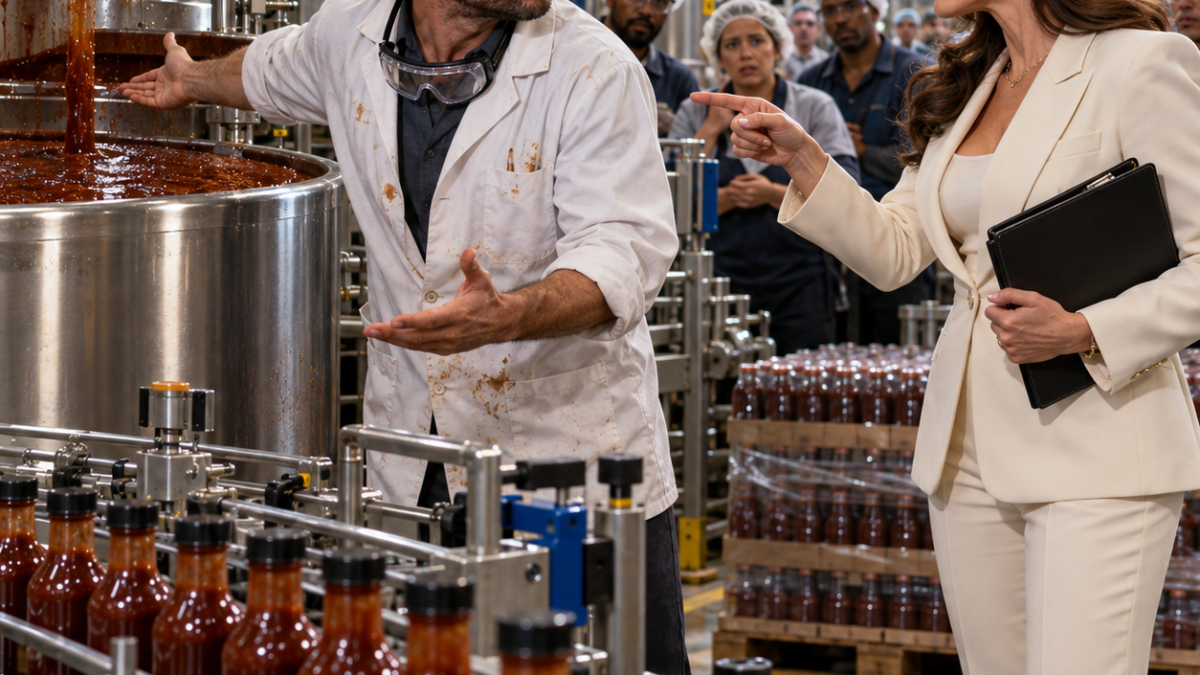
The line looked like a battlefield. Tank 3 was a disaster. Transfer lines clogged. One pump dead. QA samples lined up like evidence. Shift workers stood around with the exhausted, haunted look of people who had spent days being blamed for leadership stupidity.
I clapped my hands once.
“Okay. Tank 3 is gone. Don’t try to save it. We’ll waste more time pretending. Dismantle the transfer lines and replace the elbows. Cleaning them will take too long. Get the spare high-torque pump from storage. Not the standard one. The ugly one Marcus hated because it sounded like a lawn mower.”
Woody grinned.
“I knew you’d ask for that one.”
I turned to the shift lead.
“Tank 4 might be salvageable. Bring me twenty kilos cold water, ice, and the small batch paddle. We’re going to shock it to stop the reaction before it breaks completely.”
Karen hovered at the edge of the floor.
I ignored her.
For the next ten hours, I conducted a symphony of controlled chaos.
I did not touch a machine myself. That was important. I was not there as an employee. I was not there to save them with unpaid labor and old loyalty. I was there as a consultant, and they were paying for knowledge.
I told the crew what to do.
When to ramp the mixer to 40 Hz.
When to hold.
When to drop to 20.
When to stage oil.
When to chill slurry.
When to reject a batch before wasting bottles.
When to stop listening to the master file and start listening to the sauce.
I pulled my personal notes from my backup drive and printed the real process instructions under the terms of my consulting agreement. The shift lead, Greg, stared at them like they were scripture.
“The master file just says mix,” he said.
“Exactly.”
By midnight, the line was stable.
By Friday afternoon, bottles were coming off the capper in perfect glossy black. Smooth. Rich. No separation. No swelling. No soup. No garlic toffee.
I opened one bottle, dipped a tasting spoon, and tried it.
There it was.
Midnight Glaze.
Umami first, sweet smoke next, truffle at the edge, acid clean on the finish.
Perfect.
I walked upstairs to Mr. Whitaker’s office.
Karen was sitting in the corner.
She looked at the floor when I entered.
“It’s fixed,” I said.
Mr. Whitaker closed his eyes for a moment.
“We’ll hit the shipment?”
“Mostly. You lost about a hundred and fifty thousand in raw materials and downtime. The pump replacement adds more. My invoice adds more. But yes, the grocery contract is safe for now.”
He nodded slowly.
“Thank you.”
I said nothing.
He leaned forward.
“We cannot let this happen again.”
“No,” I said. “You can’t.”
“I want to offer you your job back. Director of Innovation. Twenty-five percent raise. Full benefits. You’d report directly to me.”
Karen’s head lifted slightly.
There it was.
The thing I had wanted only weeks earlier.
Title. Raise. Recognition.
All it had taken was smoke, waste, panic, and the near collapse of the company’s biggest product.
“No,” I said.
Mr. Whitaker blinked.
“No?”
“No, thank you.”
“But this is what you asked for.”
I looked at Karen.
Then back at him.
“It was what I asked for before you let her treat the people who make your company money like disposable parts.”
Karen flinched.
Good.
“You only care now because the line failed,” I continued. “Not because I was right. Not because the work mattered. Because the failure became expensive enough to notice.”
Mr. Whitaker’s face tightened.
“That’s not fair.”
“It’s accurate.”
I placed my final invoice on his desk.
“I’m starting my own consulting firm. Crisis management, SOP audits, specialty food production troubleshooting. Congratulations, you’re my first client.”
He stared at the invoice.
I smiled.
“You can use me as a reference.”
I walked out of that factory for the last time with a retainer, overtime consulting fees, and a kind of peace I had not felt in years.
Two weeks later, Woody called.
“She’s gone,” he said.
“Karen?”
“Escorted out by security this morning. Board found out about the toffee incident and the near-loss of the grocery contract. They were not amused.”
I sat back in my chair.
“How do you feel?”
“Like I should be happier.”
“That place drains happiness.”
“They offered me R&D manager.”
“That’s not a bad title.”
“No,” he said. “But they still don’t respect us. They just got scared.”
I smiled.
“You want a job?”
There was a pause.
“With you?”
“I picked up two more clients who need SOP audits. I need someone who understands what a pump sounds like when it’s about to ruin my day.”
Woody laughed.
“When do I start?”
The company scrambled after that.
They hired a new food scientist eventually. From what I heard, she was smart and competent, but she walked into a battlefield without the history. Without my working notes beyond what I had provided during the paid consulting emergency. Without the years of trial scars that had created Midnight Glaze in the first place.
The product survived.
Sort of.
But the quality dipped. Not disastrously. Not enough for an immediate recall or scandal. Just enough. The gloss was less consistent. The smoke note sometimes came through too hard. The texture drifted from silky to heavy in some batches. Loyal customers noticed before executives did. They always do.
Sales dropped fifteen percent the following year.
The grocery chain did not renew the exclusivity deal.
Meanwhile, my consulting firm grew faster than I expected.
Apparently, food companies are full of executives who believe “anyone can follow a recipe” until yogurt explodes, salad dressing separates, or a sauce line shuts down five days before a national launch. I charged high rates. I wrote beautiful SOPs. I trained teams. I built systems that respected both science and the people doing the work.
I also put one clause in every contract.
Process knowledge is skilled labor.
It sounds simple.
It is not.
People like Karen hate that sentence because it threatens the fantasy that everything valuable can be reduced to a spreadsheet, outsourced, automated, or handed to a temp with a laminated instruction card. They want workers to be replaceable until replacement fails. They want expertise invisible until the absence of it starts smoking through a pump motor.
I never saw Karen again.
I heard she landed somewhere in logistics after a few months, which felt appropriate. Far away from garlic, starch, emulsifiers, and me.
I do not wish her disaster.
That may sound generous, but it is not. Disaster is messy and tends to splash innocent people nearby. I simply hope that every time she sees a bottle of sauce on a shelf, some tiny part of her remembers standing in that factory lobby, exhausted and desperate, waiting for the overpaid cook to rescue the product she thought anyone could make.
Because here is the truth.
A recipe is not always a recipe.
Sometimes it is a map drawn by someone who walked the terrain in the dark.
Sometimes it is a list of ingredients sitting on top of years of judgment, failure, adjustment, and listening.
Sometimes “mix” means ramp to 40 Hz, hold ten minutes, drop to 20 before the bonds break, and pray nobody like Karen cut the department that knew why.
And sometimes the person stirring the pot is the only reason the whole company has something to sell.
𝗧𝗛𝗘 𝗘𝗡𝗗
Karen Fired Me for Asking for a Raise, Then Learned Her Company’s Golden Goose Needed More Than a Recipe Card
Karen called me an overpaid cook while standing in the factory my sauce had helped keep alive.
She thought anyone could follow a recipe until the pumps seized, the warehouse smelled like rotten garlic, and the company’s biggest holiday contract started slipping through her manicured fingers.
By the time she begged me to come back, my price had changed.
I spent fifteen years learning that food is never just food.
Not at scale.
Not when you are making twenty-thousand bottles of sauce before sunrise, not when a grocery chain expects every single unit to taste identical whether it lands on a shelf in January or July, and definitely not when one bad batch can cost more than most people make in a year.
People hear “food scientist” and imagine someone in a crisp white lab coat dramatically tasting soup from a silver spoon.
The reality is less glamorous.
Hairnets. Safety goggles. Steel-toed shoes. Clipboards stained with tomato paste. Viscosity charts taped to the wall. Steam fogging your glasses. The sour smell of vinegar clinging to your clothes long after you go home. Hours spent tasting things that are one adjustment away from delicious and one adjustment away from salted cardboard.
I loved it anyway.
There was something deeply satisfying about taking chaos—oil, acid, sugar, starch, spice, heat, pressure, time—and forcing it into consistency. I liked the problem-solving. I liked the factory floor before dawn when the machines were quiet and the tanks sat waiting like giant sleeping animals. I liked knowing that if I did my job right, nobody buying the product would ever think about me.
They would just open a bottle, pour it on dinner, and smile.
For seven years, I worked as the lead product developer for a mid-sized food manufacturing company that specialized in artisanal sauces, marinades, and dressings. We were not a giant corporation, but we were not a little family shop either. We supplied major grocery chains across the country. Our labels sat on shelves next to brands with marketing budgets ten times ours, and somehow, we held our own.
Mostly because of one product.
Midnight Glaze.
That was not its real name, but it captures the feeling of it. A black garlic and truffle-infused barbecue sauce with a glossy, almost lacquered finish, deep umami, subtle smoke, sweetness that hit late, and just enough acidity to keep it from becoming heavy. I developed it four years earlier after months of failed trials, late nights, and batches so disgusting one junior tech still referred to Trial 17 as “the mushroom crime.”
Trial 38 changed everything.
Midnight Glaze won three national taste awards. It got featured in a major food magazine. Restaurant reviewers started mentioning it. Home cooks posted pictures of it online like they had discovered fire. Grocery chains increased orders. Then increased them again.
By the time Karen arrived, Midnight Glaze accounted for about forty-five percent of the company’s total revenue.
Forty-five percent.
One sauce.
My sauce.
Of course, legally, the intellectual property belonged to the company. I understood that. I had signed the agreements. I was not naive. But the product lived in my head in a way no contract could fully capture.
Because the recipe was not the product.
The process was.
And the process was temperamental, unforgiving, and full of tiny adjustments that only looked like “instinct” to people who did not understand how much knowledge hides inside instinct.
If you added the emulsifier at the wrong temperature, even by two degrees, the batch separated into oil and sludge. If the shear rate on the industrial mixer ran too high for too long, the starch bonds broke and the sauce turned thin as dirty water. If the black garlic paste hit the syrup base too cold, it caused thermal shock that threw off the texture. If pasteurization went too long, the garlic became bitter and metallic. If humidity shifted in the plant, the starch slurry ratio had to shift with it.
The official master file had percentages.
I had the product’s pulse.
Part 2
I knew when the pumps sounded wrong.
I knew when the mixer was fighting the batch instead of folding it.
I knew from the way the surface moved in Tank 4 whether the viscosity would hold after bottling or collapse two days later in storage. I had written the standard operating procedures, calibrated the machines, trained the shift supervisors, and stood on that floor through enough production runs that the crew joked I could hear Midnight Glaze thinking.
Then our old VP of operations retired.
His name was Marcus, and he had been old-school factory through and through. He did not always understand the science, but he respected the people who did. He had hands like leather, a voice like gravel, and a rule that probably saved the company more money than any consultant ever had.
“If the machine makes a weird noise,” he used to say, “stop and listen before it starts screaming.”
Marcus trusted the floor. He trusted maintenance. He trusted quality assurance. He trusted me.
When he retired, the company hired Karen.
Karen was about forty, maybe forty-two, and she entered that factory like she had been sent from corporate heaven to rescue us from ourselves. She was beautiful in a polished, expensive, slightly predatory way. Tall, fit, glossy brunette hair cut in perfect waves around her shoulders, tailored cream suits, sharp heels that clicked across the concrete floor like warnings. Her makeup was always flawless, her nails always immaculate, her perfume expensive enough to announce her before she entered a room.
She had the kind of smile people mistake for warmth until they realize it never reaches the eyes.
Karen did not come from food manufacturing. She had worked in logistics, maybe shipping or supply chain, and had an MBA she mentioned so often I started wondering if it came with a quota. Her vocabulary was ninety percent buzzwords.
Lean manufacturing.
Trimming the fat.
Optimizing labor utilization.
Synergistic workflow.
Value stream alignment.
Every meeting felt like being trapped inside a business-school brochure.
From her first week, she looked at R&D like we were a decorative expense the company had forgotten to cancel. My department consisted of me and two junior developers, both smart, hardworking, and underpaid. We handled new product development, reformulation, troubleshooting, line trials, supplier changes, shelf-life testing, quality deviations, and emergency production problems when something went wrong at two in the morning.
Karen saw three salaries.
That was it.
Her second week, she called me into a conference room with glass walls and a table too shiny for a building that smelled faintly of vinegar.
She did not ask me to sit.
She had a spreadsheet open on her laptop.
“OP,” she said, eyes on the screen instead of me, “I’m seeing that you spend roughly twenty hours a week on the floor during Midnight Glaze production runs.”
“Yes.”
“That seems inefficient.”
“It’s necessary.”
Her eyes finally lifted. They were a cool green, pretty and bored.
“Necessary is a word people use when they don’t have a measurable process.”
I took a breath.
“Midnight Glaze is sensitive. The viscosity fluctuates depending on humidity in the plant, the temperature of incoming garlic paste, and the starch batch variation. I’m there to adjust slurry ratios and mixer speeds in real time so we don’t lose product.”
Karen leaned back in her chair.
“That sounds like a lack of standardization.”
“It’s food production. Variation happens.”
“If the formula is correct, the result should be consistent.”
“That’s not how this product works.”
“It needs to be how this product works.” She tapped something on her laptop. “We need to automate your instinct.”
The phrase made my teeth hurt.
“My instinct is experience.”
“Experience is expensive when it only lives in one person’s head.”
That was the first time I felt the warning bell.
I should have listened harder.
Six months later, the company had its best year ever. Midnight Glaze drove most of that growth. We had expanded into two new grocery chains. Holiday orders were projected to be the largest in company history. I was working sixty-hour weeks because one shift supervisor quit and Karen refused to replace him quickly. I covered floor runs, supervised junior staff, answered quality questions, handled new product trials, and kept Midnight Glaze stable while Karen praised operational “efficiency” in leadership meetings.
I was exhausted.
Not tired.
Exhausted.
The kind where your hands shake from too much coffee and your brain keeps solving production problems while you brush your teeth. The kind where you wake up at 3 a.m. wondering if Tank 2’s last pH reading was a little too high. The kind where your spouse stops asking if you’ll be home for dinner because the answer has become obvious.
So I scheduled my annual review with Karen.
I did not walk in emotional. I did not wing it. I built a presentation like I was defending a thesis.
Revenue growth from Midnight Glaze.
Cost savings from a preservative-mix adjustment I had developed the previous year.
Waste reduction from process changes I implemented.
Labor savings from supervisor training.
Market salary comparisons.
A proposal for a title change to Director of Innovation and a twenty-percent raise.
It was not greedy.
Honestly, it was conservative.
I was underpaid for the market, under-titled for my responsibilities, and carrying the company’s flagship product on my back.
Karen’s assistant told me to go in at 9:00 a.m.
Karen was typing when I entered.
She wore a fitted charcoal suit and silk blouse, her hair pinned back elegantly, diamond studs catching the overhead light. She did not look up.
“Make it quick,” she said. “I have a packaging vendor call in ten.”
I stood there holding my folder.
“Good morning to you too.”
That made her eyes flick upward.
“Do you want to reschedule?”
“No,” I said. “Ten minutes is enough.”
It should not have been. But I knew then that whatever happened in that office would not be decided by my data.
Still, I made my case.
I showed the graphs. I walked through the revenue. I explained the risk concentration around Midnight Glaze. I pointed out that while the formula was company property, the production process depended heavily on undocumented practical knowledge because previous management had never approved the time to formalize every working note into official SOP revisions.
Karen stopped typing when I mentioned risk.
For one hopeful second, I thought she was finally listening.
Then she laughed.
Dry. Soft. Cruel.
“A promotion?”
I stared at her.
“Yes.”
She took off her glasses slowly, like a judge preparing to deliver a sentence.
“OP, let’s be realistic.”
Nothing good ever follows that sentence.
“You cook sauce,” she said. “You are not management material. You’re a technician.”
I felt something cold move through me.
“I’m a food scientist.”
She waved one manicured hand.
“You mix ingredients we buy from suppliers. The brand sells the product. Marketing sells the product. Distribution sells the product.”
“I created the product.”
“The company owns the product.”
“I know that.”
“Then I’m glad we agree.”
I set my jaw.
“Karen, Midnight Glaze accounts for forty-five percent of revenue. I’m not asking for a vanity title. I’m asking for compensation that reflects the value I bring and the responsibility I already carry.”
Her face changed.
Not much.
Just enough.
People like Karen can tolerate disagreement if it sounds like pleading. They cannot tolerate a subordinate speaking as if the numbers are on their side.
Because mine were.
“You have an inflated sense of importance,” she said.
“No. I have production data.”
“Anyone can follow a recipe.”
“That isn’t true.”
She leaned forward.
“I could pull a temp off the street, hand them the recipe card, and get the same result.”
“No, you couldn’t.”
Her eyes flashed.
“The recipe is written down.”
“The recipe card is percentages. It does not explain how to handle the thermal shock of cold black garlic paste hitting the hot syrup base. It doesn’t tell you how to stage the starch slurry so the oil doesn’t float. It doesn’t tell you how to listen to the transfer pump when viscosity starts climbing too fast. It doesn’t tell you when to lower mixer frequency before the bond structure breaks.”
Karen rolled her eyes.
Actually rolled them.
“Stop trying to make yourself sound important with technical mumbo jumbo.”
I was silent for a moment because I knew if I spoke too quickly, my voice would shake.
“It isn’t mumbo jumbo,” I said. “It’s the difference between bottled product and waste.”
“I’m not approving a raise.”
I nodded once.
“And?”
“And,” she said, her mouth curving, “I’m reviewing your department’s budget. I think we can eliminate one of your junior roles after the holidays. You can absorb the slack.”
I stared at her.
“You want to cut R&D when we’re expanding?”
“I want to trim fat.”
“My junior developers are not fat.”
“Everyone thinks their team is essential.”
“Mine is.”
Her smile vanished.
“You need to be careful.”
“No, Karen. You need to be careful. If you deny this promotion, keep underpaying me, and cut my staff, I’m going to have to reconsider my options.”
She stood.
It was theatrical, sudden, and meant to remind me she had power.
“Are you threatening me?”
“No. I’m negotiating.”
“I don’t take kindly to ultimatums from subordinates.”
“I know my worth.”
Her face went red.
There it was.
The line I was not supposed to cross. Not because I had insulted her. Not because I had lied. Because I had said out loud that my value existed whether she recognized it or not.
“You have no worth outside this company,” she snapped. “You’re an overpaid cook.”
The words hit harder than I expected.
Not because I believed them.
Because fifteen years of work, skill, study, sweat, missed dinners, ruined shoes, burned hands, and solved emergencies had just been reduced to a sneer by a woman who had never stood over a splitting batch and saved fifty thousand dollars with an ice-water adjustment and a stopwatch.
I closed my folder.
“I think we’re done.”
Karen’s expression sharpened.
“Yes,” she said. “We are.”
Then something malicious sparked in her eyes.
“You know what? I am tired of your arrogance. You’re fired, effective immediately.”
For a second, I did not understand the words.
“You’re firing me?”
“Yes.”
“Holiday production starts next week.”
“We’ll manage.”
“Triple shifts.”
“Anyone can follow a recipe, remember?”
“That was your claim, not mine.”
“And now we’ll prove it.” She sat down again, already reaching for her laptop. “I want you out of the building by noon. Turn in your badge. Leave all company files, documents, records, data, and formulas on the server. If you take one piece of paper, I will sue you for theft of trade secrets.”
My heartbeat was loud in my ears.
She looked up.
“And delete your personal clutter from the drive. I don’t want your messy drafts confusing the handover.”
That was the moment the world became very clear.
Crystal clear.
“You want me to leave all official company documents,” I said slowly.
“Yes.”
“And delete personal working files.”
“Yes. Nonofficial drafts, personal notes, clutter. Gone. Clean handover.”
I nodded.
“Understood.”
Karen smiled like she had won.
“Good. Get out.”
I went back to my lab.
I had two hours.
My juniors, Maya and Devon, looked up when I walked in. They knew from my face.
“What happened?” Maya asked.
“I’ve been fired.”
Devon went pale.
“What?”
“Effective noon.”
“That’s insane,” Maya said. “Holiday runs start next week.”
“I’m aware.”
“Who’s going to run Midnight?”
I looked toward Karen’s office through the glass.
“Apparently anyone.”
I packed slowly at first. Personal mug. Lab notebook that belonged to me, not the company. A framed photo from a trade show. Spare shoes. A ridiculous sauce-themed birthday card the crew had given me two years earlier.
Then I turned to the computer.
Here is the thing about documentation in food manufacturing. There are official master files, and then there are working files.
The official master files are the regulatory documents. Ingredient percentages. Allergen declarations. nutritional data. Critical control points. Approved process summaries. Safety requirements. The documents auditors review. They were accurate.
Technically accurate.
But they did not contain the art.
They did not contain the notes from Trial 38 through Trial 112. They did not contain my comments about adjusting slurry ratios on rainy days or lowering the mixer to 20 Hz after ten minutes to preserve texture. They did not include the warning that the black garlic supplier’s winter lots ran slightly colder and needed staging. They did not include the pump sounds, the emergency fixes, the “if this happens, do that” logic collected over four years of battle.
I had tried to formalize those notes into expanded SOPs the previous year.
Marcus had supported it, but production deadlines kept pushing it back. After Karen arrived, she refused to approve documentation time because, in her words, “writing down what already works is not value-added labor.”
So the official files were official.
The working notes were mine.
Drafts. Personal process notes. Nonofficial documents. Exactly the kind of “clutter” Karen had ordered me to delete.
I opened the folder labeled OP_Working_Notes.
For a moment, my hand hovered over the mouse.
I am not going to pretend I felt nothing.
That folder represented years of my life. Frustration. Discovery. Mistakes. Tiny triumphs nobody applauded because nobody knew they happened. It was the brain behind Midnight Glaze.
Then I remembered Karen’s face.
You’re an overpaid cook.
I dragged the folder to the recycle bin.
Emptied it.
Then I checked the shared drive. The official master files were there. The regulatory files were there. The approved recipe was there. The basic SOPs were there.
Technically accurate.
Technically complete.
Technically exactly what Karen had demanded.
At 11:55, I walked past her office carrying my box.
Karen was on the phone, laughing at something.
I paused in the doorway.
“All done.”
She glanced up.
“I left the official recipes and approved documentation on the server. Deleted my personal drafts and nonofficial working files, like you asked.”
“Good riddance,” she said.
She did not even mute the call.
I walked out.
The sun hit my face in the parking lot, and I stood there for a moment, holding a cardboard box full of my life from that building.
I expected panic.
Instead, I felt light.
For the first time in years, I did not have to worry about whether the corn syrup base was heating too fast or whether the third shift would forget to pre-chill the slurry water.
I went home.
Emily opened the door before I knocked because I had texted her.
She looked at the box.
Then at my face.
“Fired?”
“Fired.”
“She’s an idiot.”
“Yes.”
“What now?”
I looked down at the box, then back at her.
“Sleep.”
And that was exactly what I did.
For the first week, the company stayed quiet.
I slept late. Fixed things in the garden. Updated my résumé. Changed my LinkedIn status to open to work. Made real breakfast. Took a walk at 2 p.m. just because I could. It felt illegal and wonderful.
Then my phone buzzed.
It was Woody.
Woody was the maintenance chief, a broad-shouldered man with a gray beard, grease permanently embedded under his fingernails, and more practical intelligence than half the leadership team combined.
Dude, he texted. She put Greg in charge of Glaze.
Greg was a shift supervisor. Good guy. Not a scientist.
I replied: Is Greg okay?
Woody: Physically? yes. Spiritually? no. Batch looks weird. Too pale.
Me: Tell them to follow the recipe.
Woody: They are. That’s the problem.
I laughed for the first time in days.
Not because I wanted the crew to suffer. I didn’t. I liked those people. They were the ones who would pay first for Karen’s arrogance. But there was something painfully satisfying about reality tapping Karen on the shoulder so quickly.
Two days later, Woody texted again.
Bad. Texture unstable. QA holding batch.
Then:
They bottled 5,000 units from Tuesday. Some are swelling in warehouse. Smells like Satan ate garlic.
I winced.
I knew exactly what had happened.
They had followed the master file: add oil and starch.
What the master file did not say was that the starch had to be made into a cold-water slurry first and introduced in stages. It did not say the oil had to shear in slowly over twenty minutes at a controlled mixer frequency. Dumping everything in produced a sauce that looked fine for about ten minutes, then separated into layers like a failed science fair project.
By week two, HR emailed me.
Dear OP, we have noticed that certain production protocol files related to Midnight Glaze appear to be missing from the shared drive. Please advise where these documents are located.
I read it aloud to Emily.
She looked up from her laptop.
“Do they think you hid them under a rock?”
“They think I’ll panic and help.”
“Will you?”
I typed my reply.
Per Karen’s explicit instruction upon my termination, I deleted all personal working drafts and nonofficial documents to clean the server. All approved master files and regulatory documentation remain in the shared folder.
I sent it.
No response.
Week three was when holiday production truly began collapsing.
The biggest grocery chain in the country had a delivery deadline tied to holiday promotional displays. Missing it meant massive penalties and potentially losing shelf space the following year. In grocery, shelf space is everything. You lose it once, a competitor fills the gap, and getting back in can take years.
My phone rang from a number I did not recognize.
I answered.
“Hello?”
“OP.”
Karen.
Her voice sounded different.
Gone was the smooth executive edge. Gone was the bored superiority. She sounded tight and thin, like a violin string pulled too far.
“Karen,” I said. “To what do I owe the pleasure? I believe you fired me.”
A pause.
“We are having a slight technical hiccup on the glaze line.”
I looked out my kitchen window at the basil plant Emily had been trying not to kill.
“A hiccup?”
“The texture is not holding.”
“That sounds unfortunate.”
“We’ve had to dump the last four batches.”
I let the silence sit.
She filled it.
“That’s nearly fifty thousand dollars in raw materials.”
“Have you checked the recipe?”
Her breath sharpened.
“Yes, we checked the recipe. We are following your recipe to the letter, and it is coming out like soup.”
“My recipe?”
“The company recipe.”
“Then you should be fine. Anyone can follow it.”
Another pause.
In the background, I heard factory noise. Beeping. Voices. Someone shouting something about Tank 3.
“What did you change?” Karen demanded. “Did you sabotage the file?”
My voice cooled.
“Be very careful.”
She went silent.
“I left the master files untouched,” I said. “You ordered me to delete personal notes and nonofficial drafts. I complied.”
“You know what I meant.”
“I do. You meant you wanted a clean handover.”
“OP—”
“You also said anyone could follow a recipe.”
Her voice broke slightly.
“I need those notes.”
“I don’t have access to the company server.”
“Do you have a backup?”
“Maybe.”
“Then send it.”
“No.”
“You can’t do that.”
“I absolutely can. Anything not officially assigned, approved, or stored as company documentation after my termination is my personal material. You told me to delete personal working files from the company drive. I did.”
“I need you to come in.”
“I’m busy.”
“Busy doing what? You’re unemployed.”
“Busy not being yelled at by you.”
“Don’t be childish.”
I smiled into my coffee.
“Good luck with the soup.”
Then I hung up.
Thirty minutes later, my phone rang again.
This time, it was the owner.
I had not spoken to Mr. Whitaker in two years. He spent most of his time at the corporate office or on what people politely called “strategic travel,” which I suspected meant golf. He was not a bad man exactly. He was just distant enough from the factory floor to believe systems worked because spreadsheets said they should.
“OP,” he said. “What the hell is going on?”
“Good morning to you too.”
“Karen tells me you sabotaged the Midnight Glaze line before you left.”
“No, sir. Karen fired me for asking for a raise and title change. She told me my work required no skill. She ordered me to leave official documents and delete personal drafts. I followed that order exactly.”
“She says critical files are missing.”
“Critical files she called clutter.”
He sighed heavily.
“We’re bleeding money.”
“I believe it.”
“We’ve lost a week of production. The warehouse smells like rotten garlic. The holiday shipment is at risk.”
“That sounds like an operations problem.”
“OP.”
“Yes?”
“What will it take to get you back?”
I looked at Emily, who had walked into the kitchen and was now staring at me with wide eyes.
“I don’t want to come back.”
“Not permanently. We need the line fixed.”
“I won’t work for Karen.”
“Karen is under review.”
“That is not the same as gone.”
“Name your price.”
I had thought about this. Not because I expected it so soon, but because I knew, eventually, the phone would ring.
“I’ll come in as an independent consultant,” I said. “Five hundred dollars per hour. Minimum retainer of forty hours, paid up front.”
He made a choking sound.
“You were making forty dollars an hour as an employee.”
“That was the employee price. This is the emergency fix-it price.”
“That’s extortion.”
“No. It’s market correction.”
“Be reasonable.”
“I am. I am also requiring a written apology from Karen stating that my role is critical skilled labor and that my termination was a management error.”
Emily covered her mouth.
Mr. Whitaker was silent for a long moment.
“I’ll call you back.”
He did not call back that day.
Apparently, they decided my price was too high.
According to Woody, they brought in an outside process consultant the next morning. The consultant usually worked with dairy products, which is not the same thing as acidic garlic barbecue sauce no matter what LinkedIn says about transferable expertise.
At 2:17 p.m., Woody texted:
Oh my god.
Then:
Dairy guy told them to heat it higher.
Then:
Sauce turned into toffee inside the transfer lines.
Then:
Main pump motor smoking.
Then:
Fire department here. Whole plant shut down. I wish you could see Karen’s face.
I stared at the messages for a full minute.
Then I set my phone down and laughed until I had tears in my eyes.
At 4:03 p.m., Mr. Whitaker called again.
His voice sounded twenty years older.
“Send the contract,” he said.
“Consulting agreement. Forty-hour retainer. Five hundred an hour.”
“Yes.”
“Paid up front.”
“Yes.”
“And the apology?”
A pause.
“Karen is writing it now.”
I had my attorney review the consulting agreement that evening. Payment cleared the next morning. The apology arrived as a signed PDF.
It was stiff, bloodless, clearly forced, and absolutely beautiful.
I printed a copy.
For my records.
When I walked into the factory the next morning, the lobby smelled faintly of smoke, vinegar, and defeat.
Karen was waiting near the entrance.
She looked terrible.
Still beautiful, technically. The bones were there. The glossy hair, the sharp cheekbones, the expensive suit. But the suit was wrinkled, her eyes were shadowed, and her lipstick had been applied with less precision than usual. She looked like someone who had not slept in three days and had discovered, against her will, that reality does not report to her.
“OP,” she said.
“Karen.”
Her jaw tightened.
For one glorious second, I thought she might try to assert authority.
Then she remembered I was no longer her employee.
“The floor is this way,” she said.
“I remember.”
Woody nearly hugged me when I walked onto the production floor.
“Thank God,” he said. “The dairy guy said to increase heat.”
“I heard.”
“He almost killed Tank 3.”
“I can smell that.”
The line looked like a battlefield. Tank 3 was a disaster. Transfer lines clogged. One pump dead. QA samples lined up like evidence. Shift workers stood around with the exhausted, haunted look of people who had spent days being blamed for leadership stupidity.
I clapped my hands once.
“Okay. Tank 3 is gone. Don’t try to save it. We’ll waste more time pretending. Dismantle the transfer lines and replace the elbows. Cleaning them will take too long. Get the spare high-torque pump from storage. Not the standard one. The ugly one Marcus hated because it sounded like a lawn mower.”
Woody grinned.
“I knew you’d ask for that one.”
I turned to the shift lead.
“Tank 4 might be salvageable. Bring me twenty kilos cold water, ice, and the small batch paddle. We’re going to shock it to stop the reaction before it breaks completely.”
Karen hovered at the edge of the floor.
I ignored her.
For the next ten hours, I conducted a symphony of controlled chaos.
I did not touch a machine myself. That was important. I was not there as an employee. I was not there to save them with unpaid labor and old loyalty. I was there as a consultant, and they were paying for knowledge.
I told the crew what to do.
When to ramp the mixer to 40 Hz.
When to hold.
When to drop to 20.
When to stage oil.
When to chill slurry.
When to reject a batch before wasting bottles.
When to stop listening to the master file and start listening to the sauce.
I pulled my personal notes from my backup drive and printed the real process instructions under the terms of my consulting agreement. The shift lead, Greg, stared at them like they were scripture.
“The master file just says mix,” he said.
“Exactly.”
By midnight, the line was stable.
By Friday afternoon, bottles were coming off the capper in perfect glossy black. Smooth. Rich. No separation. No swelling. No soup. No garlic toffee.
I opened one bottle, dipped a tasting spoon, and tried it.
There it was.
Midnight Glaze.
Umami first, sweet smoke next, truffle at the edge, acid clean on the finish.
Perfect.
I walked upstairs to Mr. Whitaker’s office.
Karen was sitting in the corner.
She looked at the floor when I entered.
“It’s fixed,” I said.
Mr. Whitaker closed his eyes for a moment.
“We’ll hit the shipment?”
“Mostly. You lost about a hundred and fifty thousand in raw materials and downtime. The pump replacement adds more. My invoice adds more. But yes, the grocery contract is safe for now.”
He nodded slowly.
“Thank you.”
I said nothing.
He leaned forward.
“We cannot let this happen again.”
“No,” I said. “You can’t.”
“I want to offer you your job back. Director of Innovation. Twenty-five percent raise. Full benefits. You’d report directly to me.”
Karen’s head lifted slightly.
There it was.
The thing I had wanted only weeks earlier.
Title. Raise. Recognition.
All it had taken was smoke, waste, panic, and the near collapse of the company’s biggest product.
“No,” I said.
Mr. Whitaker blinked.
“No?”
“No, thank you.”
“But this is what you asked for.”
I looked at Karen.
Then back at him.
“It was what I asked for before you let her treat the people who make your company money like disposable parts.”
Karen flinched.
Good.
“You only care now because the line failed,” I continued. “Not because I was right. Not because the work mattered. Because the failure became expensive enough to notice.”
Mr. Whitaker’s face tightened.
“That’s not fair.”
“It’s accurate.”
I placed my final invoice on his desk.
“I’m starting my own consulting firm. Crisis management, SOP audits, specialty food production troubleshooting. Congratulations, you’re my first client.”
He stared at the invoice.
I smiled.
“You can use me as a reference.”
I walked out of that factory for the last time with a retainer, overtime consulting fees, and a kind of peace I had not felt in years.
Two weeks later, Woody called.
“She’s gone,” he said.
“Karen?”
“Escorted out by security this morning. Board found out about the toffee incident and the near-loss of the grocery contract. They were not amused.”
I sat back in my chair.
“How do you feel?”
“Like I should be happier.”
“That place drains happiness.”
“They offered me R&D manager.”
“That’s not a bad title.”
“No,” he said. “But they still don’t respect us. They just got scared.”
I smiled.
“You want a job?”
There was a pause.
“With you?”
“I picked up two more clients who need SOP audits. I need someone who understands what a pump sounds like when it’s about to ruin my day.”
Woody laughed.
“When do I start?”
The company scrambled after that.
They hired a new food scientist eventually. From what I heard, she was smart and competent, but she walked into a battlefield without the history. Without my working notes beyond what I had provided during the paid consulting emergency. Without the years of trial scars that had created Midnight Glaze in the first place.
The product survived.
Sort of.
But the quality dipped. Not disastrously. Not enough for an immediate recall or scandal. Just enough. The gloss was less consistent. The smoke note sometimes came through too hard. The texture drifted from silky to heavy in some batches. Loyal customers noticed before executives did. They always do.
Sales dropped fifteen percent the following year.
The grocery chain did not renew the exclusivity deal.
Meanwhile, my consulting firm grew faster than I expected.
Apparently, food companies are full of executives who believe “anyone can follow a recipe” until yogurt explodes, salad dressing separates, or a sauce line shuts down five days before a national launch. I charged high rates. I wrote beautiful SOPs. I trained teams. I built systems that respected both science and the people doing the work.
I also put one clause in every contract.
Process knowledge is skilled labor.
It sounds simple.
It is not.
People like Karen hate that sentence because it threatens the fantasy that everything valuable can be reduced to a spreadsheet, outsourced, automated, or handed to a temp with a laminated instruction card. They want workers to be replaceable until replacement fails. They want expertise invisible until the absence of it starts smoking through a pump motor.
I never saw Karen again.
I heard she landed somewhere in logistics after a few months, which felt appropriate. Far away from garlic, starch, emulsifiers, and me.
I do not wish her disaster.
That may sound generous, but it is not. Disaster is messy and tends to splash innocent people nearby. I simply hope that every time she sees a bottle of sauce on a shelf, some tiny part of her remembers standing in that factory lobby, exhausted and desperate, waiting for the overpaid cook to rescue the product she thought anyone could make.
Because here is the truth.
A recipe is not always a recipe.
Sometimes it is a map drawn by someone who walked the terrain in the dark.
Sometimes it is a list of ingredients sitting on top of years of judgment, failure, adjustment, and listening.
Sometimes “mix” means ramp to 40 Hz, hold ten minutes, drop to 20 before the bonds break, and pray nobody like Karen cut the department that knew why.
And sometimes the person stirring the pot is the only reason the whole company has something to sell.