𝗙𝗨𝗟𝗟 𝗦𝗧𝗢𝗥𝗬 Karen Fined My Farm $250,000, Then Learned the Land She Wanted Had Never Belonged to Her HOA
PART 2
For the rest of that day, I kept replaying the conversation in my head while I worked.
The sensible part of me said it had to be a misunderstanding. Maybe she was new. Maybe the old HOA files were messy. Maybe someone had told her the entire surrounding area was under association control, and she had believed it without checking. I did not want conflict. I have never been the kind of person who enjoys arguing with neighbors, attending meetings, or turning every disagreement into a war. I just wanted to take care of my animals, sell my milk and eggs, support my family, and be left alone.
So I told myself the letter would come, I would send back proof, and that would be it.
A week later, the letter arrived.
It was not a letter.
It was a manifesto.
Thick envelope. HOA letterhead. Pages of violations written in that cold official tone people use when they want nonsense to sound legal. I stood in the kitchen reading it while my wife, Emily, rinsed vegetables at the sink.
At first, she only glanced over.
Then she noticed my face.
“What is it?”
“Karen sent her list.”
“Bad?”
I laughed once, but there was no humor in it.
“She thinks the entire farm is a violation.”
Emily dried her hands and came over.
The list was absurd.
Animals making noise after 10 p.m., in violation of HOA quiet hours.
Animals producing offensive smells affecting neighborhood enjoyment.
Improper waste management.
Visible agricultural equipment.
Rusted tractor creating an eyesore.
Barn exterior not meeting architectural standards.
House exterior allegedly deteriorating.
Unapproved fencing materials.
Unscreened feed storage.
Unauthorized commercial activity due to farmers market sales.
Unapproved signage.
Nonconforming driveway.
Noncompliant outbuildings.
The list went on and on.
It was not one or two complaints. It was everything. Every part of my working farm had been translated into an offense against suburban taste.
Emily read over my shoulder, her mouth tightening.
“She wants you to stop being a farm.”
“Pretty much.”
“Can she do this?”
“No.”
But even as I said it, I felt the uneasiness underneath.
Because no was the legal answer.
No did not stop people from making your life miserable.
No did not stop someone from sending letters, hiring lawyers, filing claims, scaring your family, or dragging you into fights that cost money you did not have.
I looked again at the quiet-hours violation.
“She expects me to tell cows not to moo after ten.”
Emily stared at me.
“She wrote that?”
“Apparently, our cows need watches.”
My son, Tyler, walked in at that moment, grabbed an apple from the counter, and asked, “Who needs watches?”
“The cows,” I said.
He blinked. “That tracks.”
Emily did not laugh.
That told me she was more worried than she wanted to admit.
“What are you going to do?” she asked.
“I’m going to ignore it.”
“Is that smart?”
“I’m not in the HOA. Their standards don’t apply.”
She folded the papers slowly.
“I know. But she doesn’t seem like someone who cares what applies.”
That was the problem exactly.
Still, I ignored it.
Part of me thought responding would give Karen’s delusion oxygen. I had already told her the truth in person. My property predated the HOA. I had no membership agreement. No dues. No access to their pool, clubhouse, tennis courts, trails, or whatever else residents paid for. I had never signed anything. The farm was outside their control.
So I went back to my life.
For about three weeks, nothing happened.
Then the second envelope arrived.
It was thinner than the first, but somehow felt heavier in my hand.
I opened it at the kitchen table.
This time, I did not laugh.
The HOA claimed I owed $250,000 in fines, accumulated over years of violations.
A quarter of a million dollars.
I stared at the number until the digits stopped looking real.
Karen had taken every alleged violation from her list, assigned a fine, multiplied it backward across years, added late fees, penalties, administrative costs, and interest for violations I had only been told about for the first time weeks earlier.
Late fees on fines she had just invented.
I sat there with the paper in my hand, unable to move.
Emily came in from the mudroom carrying a basket of eggs.
“What’s wrong?”
I turned the letter toward her.
She set the basket down slowly.
Her eyes moved over the page. Then moved again. Then stopped at the total.
“Oh my God.”
Tyler came in behind her, saw our faces, and immediately went still.
“What happened?”
Emily did not answer.
I handed him the letter.
He read it, and I watched anger replace confusion in my son’s eyes.
“They can’t do this.”
“No,” I said. “They can’t.”
But my voice did not sound as certain as I wanted it to.
Because Karen had written it down. She had put an impossible number on official paper and sent it to my home. It was nonsense, but it was nonsense aimed directly at our life. At the roof over our heads. At the land we worked. At the animals that fed us. At everything we had built.
That is what people like Karen understand instinctively.
A fake threat can still terrify a real family.
The letter said if I did not pay or come into compliance, the HOA would pursue collection through all available legal remedies.
Legal remedies.
That phrase sat like a stone in my stomach.
The next morning, I gathered every document I had: deed, old property records, survey, closing paperwork, anything showing the farm predated the subdivision and was not part of the HOA. I put it all in a folder and drove to the HOA office.
I still believed, foolishly maybe, that facts could end this.
Karen was there.
Of course she was.
The HOA office sat inside their clubhouse, a building with clean stone walls, polished floors, and framed photos of smiling residents doing community things. Karen stood behind a desk in a fitted navy dress, hair perfect, lips glossy, leaning over a tablet while a man in golf clothes nodded at whatever she was saying.
When she saw me, her smile appeared slowly.
“Mr. Walker.”
“I need to speak with you.”
“I have a meeting in ten minutes.”
“This won’t take that long.”
The man in golf clothes looked between us and wisely excused himself.
I placed the folder on the desk.
“These papers show my farm is not part of the HOA. I want the fines withdrawn.”
Karen did not open the folder.
She barely glanced at it.
“I don’t care what papers you brought.”
I felt my jaw tighten.
“You should.”
“You are within the community boundary.”
“No, I’m beside it.”
“You benefit from the community.”
“I don’t use a single thing here.”
“Your property affects our residents and our values.”
“That doesn’t give you authority over it.”
Karen leaned forward, and for the first time I saw something hungry behind her eyes.
“Actually, we expect payment.”
“You expect me to pay $250,000 for rules I never agreed to?”
“We gave you an opportunity to comply.”
“Most of your complaints are lies. The rest are farm things happening on a farm.”
She lifted one shoulder in a small, elegant shrug.
“Then we’ll sue.”
The words were simple.
Quiet.
Almost bored.
But they struck harder than if she had shouted.
I looked at her, really looked, and realized she was enjoying this. Not the legal argument. Not the paperwork. The pressure. She liked watching me understand that even being right might not save me from stress, cost, and risk.
Karen tapped one red nail on the folder.
“Your property is large,” she said. “Large enough to fit multiple homes, actually.”
There it was.
The truth.
Not the cows. Not the smell. Not the tractor. Not the barn. Not quiet hours or aesthetics.
Land.
She saw my farm as empty potential. Lots that could be carved up, sold, added to the HOA, fined, managed, controlled, and milked for dues. My home was just a stubborn obstacle sitting where more beige houses could go.
“You want my land.”
Her smile widened.
“I want community standards respected.”
“No,” I said. “You want me scared enough to sell.”
Karen’s expression chilled.
“You should be very careful accusing people of things you cannot prove.”
“You should be careful threatening farmers who keep records.”
For the first time, her smile faltered.
Only for a second.
Then she leaned back.
“We have very good lawyers, Mr. Walker.”
I picked up my folder.
“So do property records.”
I walked out with my heart pounding, my hands shaking, and a rage in me so deep it felt almost calm.
That night, I called a lawyer friend named Daniel.
He was not my official attorney, at least not then, but he knew property disputes and had enough patience to listen while I explained the whole mess. I emailed him copies of the letters and documents.
He called me back the next morning.
“She’s wrong,” he said.
“I know that.”
“But wrong doesn’t mean harmless.”
That sentence did more to scare me than Karen had.
Daniel explained that while the HOA had no legal basis to enforce rules against my property, they could still try to sue. They could file claims. They could force me to respond. They could make the process expensive and stressful, especially if the board was willing to burn HOA money on a fight. Being right helped, but it did not make court free.
“So what do I do?”
“Do not pay. Do not acknowledge the debt. Do not sign anything. Keep every letter. Document every interaction. And if they file anything official, call me immediately.”
“Can I stop them before that?”
“You can make it politically painful.”
“What does that mean?”
“It means HOAs are run by people, and people can lose power when the neighbors find out what they’ve been doing.”
That was the first seed.
Political pain.
I did not like conflict, but Karen had already brought conflict to my door. She had threatened my home, my family, and my livelihood. She had stood there in that polished office and looked at my farm like meat on a butcher’s table.
I could either wait for her next move, or I could start watching.
So I watched.
At first, I focused on Karen.
She had built a public image carefully. To some residents, she was the strong new president who was cleaning things up, enforcing fairness, and protecting property values. She posted cheerful updates online. She posed for photos at community events. She hosted little gatherings and stood in the middle of them like a pageant queen accepting tribute.
People liked her, or at least some did.
But then I started hearing other things.
At the farmers market, one woman who lived in Willow Creek bought eggs and mentioned under her breath that Karen had fined her $600 for holiday lights left up two days too long.
Another resident said the HOA had sent him a violation for a basketball hoop while Karen’s friend had one visible from the street for months.
Someone else complained about lawn fines, trash can fines, mailbox fines, fence fines.
Always selective.
Always personal.
Karen did not enforce rules evenly.
She weaponized them.
I started reading the bylaws.
All of them.
It was miserable work. HOA documents are written in a language designed to make ordinary people give up, but farming teaches endurance. I read at night after chores. I highlighted sections. I made notes. I compared rules against what I could see in the neighborhood.
That was when the hypocrisy became almost funny.
Karen had built a backyard pool.
Pools were heavily restricted. Possibly prohibited depending on how the bylaw language was interpreted. At minimum, hers had required approvals I doubted she properly obtained.
A board member hosted loud parties that clearly violated quiet-hour rules.
Another had unapproved decorative structures in the yard.
Karen’s close friend had seasonal decorations up far beyond the allowed window.
Several board allies had sheds, fences, outdoor fixtures, and landscaping features that technically violated the same rules Karen used against everyone else.
I took photos.
Carefully.
From public streets, from places I was allowed to be, never trespassing. I documented dates. Times. Rules. Violations. I took screenshots of public social media posts when Karen bragged about events that violated HOA policies. I photographed the pool from a legal vantage point where it was plainly visible. I collected copies of violation letters residents were willing to share.
Within two weeks, I had more than enough.
Emily watched me at the kitchen table one night as I organized everything into folders.
“You look different,” she said.
“How?”
“Focused.”
“I’m mad.”
“I know. But this is not how you usually get mad.”
She was right.
Usually, my anger burned out through work. Split wood. Fix something. Walk the fence. Haul feed until my back complained louder than my thoughts.
This anger needed structure.
Karen had paperwork.
I needed truth.
My first thought was to go straight to the next HOA meeting and lay everything out. But Daniel advised patience.
“If you walk in alone, they paint you as an outsider with a grudge,” he said. “If residents walk in angry about their own fines, Karen has a problem.”
“So how do I get them together?”
He paused.
“How good are you with social media?”
“Terrible.”
“Then ask your son.”
Tyler loved that part.
For the first time since the $250,000 letter arrived, I saw him smile like this was not just terrifying, but a challenge.
“We can make a private group,” he said. “Not like an attack page. More like a neighborhood accountability page.”
“I’m not in the neighborhood.”
“Exactly. You invite the people who are upset, but you don’t make it about you first.”
My sixteen-year-old had a better instinct for public strategy than I did.
So we created a private page.
Nothing dramatic. No screaming title. No personal insults. It looked like a place for Willow Creek residents to discuss fairness and HOA enforcement. We invited people carefully, residents who had bought from me, people I knew were frustrated, people who had mentioned fines, people who were not part of Karen’s inner circle.
The page grew faster than I expected.
At first, I posted general questions.
Has anyone received inconsistent fines?
Has anyone seen rules enforced against some homes but ignored for others?
Would residents be willing to share violation letters privately?
Then I posted photos.
Not Karen’s first. That would have looked personal.
I posted side-by-side examples.
A resident fined for decorations after the approved period, beside a board ally with decorations up even longer.
A homeowner fined for visible equipment, beside a board member’s yard full of unapproved outdoor storage.
A resident fined for noise, beside photos and public posts from a loud board-hosted party.
No insults.
Just evidence.
The comments exploded.
People who had stayed quiet because they thought they were alone suddenly realized there was a pattern. Karen had been selective. Vindictive. Favoring friends. Punishing people who questioned her. Using fines like a whip.
Then someone asked, “What about your farm? Didn’t she fine you too?”
That was when I posted my story.
I uploaded the $250,000 fine letter, with personal details covered. I posted the proof that my farm predated the HOA. I explained that I had never joined, never paid dues, never used amenities, never signed covenants. I wrote, as calmly as I could, that the HOA president had threatened legal action over rules that did not apply to my property and had pointed out my land could fit multiple homes.
The response was immediate.
Not everyone cared about me at first. That is human nature. People care most when something touches their own lives. But by then, the fines had touched plenty of them. My story became proof that Karen’s abuse was bigger than inconvenience. If she could target a farm outside the HOA for a quarter of a million dollars, nobody inside was safe.
The group changed after that.
Anger turned organized.
Residents began uploading their own letters. Fine amounts. Photos. Stories. Screenshots. Some were small and petty. Others were serious. Elderly residents fined for things they had not understood. Young families hit with penalties while Karen’s friends got warnings or nothing. People afraid to speak at meetings because Karen humiliated them or dismissed them.
I read every post.
By the time the next HOA meeting approached, the page had become something Karen could not control.
I posted one final message.
Bring your letters. Bring your proof. Speak calmly. Take turns. Ask for answers. Do not let them make this about one person’s complaint.
Emily read the post before I published it.
“You sound like a union organizer.”
“I’m a farmer.”
“Same thing, apparently.”
The night of the meeting, I almost turned around twice.
The clubhouse parking lot was packed when I arrived. That alone told me something had shifted. Usually, from what residents had told me, HOA meetings were sleepy events attended by the same dozen people. That night, people stood in clusters outside, holding folders, envelopes, printed photos, and phones.
I was not an HOA member, so I did not plan to vote. I was not even sure they would let me speak. But my name, my farm, and that impossible fine had become part of the reason many people were there.
Inside, Karen sat at the front table with the board.
She looked perfect.
Of course she did.
A fitted red dress under a cream blazer, hair smooth, lips shining, one ankle crossed over the other. She smiled when people entered, but I could see the strain around her eyes. She knew. Maybe not everything, but enough. She had probably seen the sudden increase in attendance. She had probably heard about the page. Someone in her circle must have warned her that the peasants had found each other.
When she saw me, her smile sharpened.
“Mr. Walker,” she said from across the room. “This is a member meeting.”
“I’m aware.”
A man in the second row said, “He should stay.”
Several others agreed.
Karen’s jaw tightened, but she did not push it.
The meeting began with routine nonsense. Minutes. Budget notes. Maintenance updates. Karen tried to move quickly, as if speed could outrun what was coming.
Then came the public comment portion.
A woman named Sandra stood first.
She was in her sixties, with silver hair and a folder clutched in both hands. Her voice shook at first, then strengthened.
“I was fined $400 for leaving my trash cans visible behind my side fence for one afternoon after my husband’s surgery. I appealed and was denied. But I have photos of Board Member Ellis leaving his cans visible for five consecutive days with no fine.”
She held up the photos.
Murmurs moved through the room.
Karen leaned toward the microphone.
“Sandra, individual enforcement matters are not really appropriate—”
“They were appropriate when you sent me four letters,” Sandra said.
A few people clapped.
Then a young father stood.
He had been fined for a portable basketball hoop. Karen’s friend had one too. His fine stood. Hers vanished.
Then another resident.
Holiday decorations.
Then another.
Noise complaint.
Then another.
Mailbox color.
Then another.
Lawn height.
Each person spoke calmly, just as the group had planned. That made it worse for Karen. If they had shouted, she could have dismissed them as a mob. But they did not shout. They presented evidence. Dates. Photos. Letters. Comparisons. Rules.
With every speaker, Karen’s posture changed.
At first, she sat tall, smiling tightly.
Then her hands folded.
Then unfolded.
Then she began whispering to the board member beside her.
Then she stopped smiling.
Finally, someone called my name.
I stood.
The room turned.
I walked to the front holding the $250,000 letter.
“I’m not a member of this HOA,” I said.
Karen immediately leaned toward the microphone.
“Then your comments should be limited.”
“No,” said a man in the back. “Let him talk.”
More voices agreed.
I looked at Karen.
She looked furious now. Not frightened yet. Furious.
“This is the fine letter your president sent me,” I said, holding it up. “Two hundred fifty thousand dollars for alleged farm violations going back years. My farm existed before this subdivision. I never joined your HOA. I never signed your covenants. I do not use your amenities. I do not owe dues. Your president refused to look at my documents and threatened to sue me.”
I let that settle.
Then I said the part everyone needed to hear.
“She also told me my property was large enough to fit multiple homes.”
The room changed.
People understood.
Because now it was not just unfair fines. It was motive. Land. Development. Expansion. Dues. Control.
Karen stood.
“That is a gross misrepresentation.”
I turned toward her.
“You said it in your office.”
“I said your property has impact.”
“You said it was large enough for multiple homes.”
“That does not mean—”
“You fined me a quarter of a million dollars for cows making noise.”
A laugh broke from the back of the room.
Then another.
Karen flushed.
“This is not funny,” she snapped.
“No,” I said. “It isn’t. You threatened my family’s livelihood with fines you had no authority to issue. You used the same pattern these people are describing tonight: selective rules, inflated penalties, intimidation, and refusal to listen.”
A board member, a pale man named Ellis, tried to interrupt.
“We should consult counsel before—”
“You should have consulted counsel before fining a nonmember $250,000,” someone shouted.
The room erupted.
Not wild. Not violent. But loud. Angry. Finally awake.
Karen tried to restore order.
She hit the microphone button. “Everyone needs to calm down.”
That was the wrong thing to say.
People who have been fined, dismissed, mocked, and threatened do not like being told to calm down by the person who profited from their silence.
A man near the aisle stood and called for a motion to remove Karen and the board pending review of enforcement practices.
Karen’s face went white.
“You cannot do that.”
A woman in the front row lifted a copy of the bylaws.
“Actually, we can.”
That was the moment I knew Karen had lost.
Not legally. Not officially. Not yet.
But emotionally, publicly, completely.
Her power had depended on people feeling isolated. One homeowner ashamed of a fine. One family afraid of retaliation. One farmer outside the HOA thinking no one inside would care. She had kept control by making every fight feel private.
That night, the fights became one.
The debate took a while. There were procedures. Arguments. Motions. Bylaw references. Residents demanded an emergency vote. Some board members tried to stall. Karen insisted the meeting had been hijacked by misinformation. But every time she spoke, someone had another document, another example, another fine letter, another photo.
Her beauty did not help her.
Her smile did not help her.
Her title did not help her.
Facts had filled the room, and there was no space left for charm.
By the end of the night, Karen and the board were forced to step down from their positions pending formal replacement. Temporary members were appointed according to the bylaws, and a proper election was scheduled. I did not vote. I could not, and I did not pretend otherwise.
But I watched.
That was enough.
Karen gathered her papers slowly after the vote. Her hands were not as steady as before. She looked around the room, and for the first time since I had met her, people did not look away.
When she passed me near the aisle, she stopped.
Her perfume was the same. Her face was composed again, though barely.
“You think you won?” she whispered.
I looked at her.
“No,” I said. “I think everybody saw you.”
That hurt her more than any insult would have.
She walked out without another word.
The social media group exploded that night, then slowly quieted over the next week. People posted updates, thanked each other, shared information about the upcoming election, and debated how to prevent future abuse. I kept the page active but stepped back. It was not my HOA, and I was careful not to act like it was. My role had been to expose what Karen was doing, not to control what came after.
A week after the new temporary board took over, I received another envelope from Willow Creek.
I stared at it for a long time before opening it.
Emily stood beside me.
“Want me to read it?”
“No.”
My hands were steady this time.
The letter was long. Formal. Apologetic in the stiff way organizations apologize when lawyers are nearby. But it said what mattered.
All fines against my property were withdrawn.
The HOA acknowledged that my farm was not part of the association and had never been subject to its bylaws.
I owed nothing.
Not a penny.
The board apologized for the prior leadership acting beyond its scope and promised to record internal documentation making clear that my property predated the HOA and was excluded from enforcement.
I read that paragraph twice.
Then I handed the letter to Emily.
She read it, covered her mouth, and closed her eyes.
Tyler took it next.
“So it’s over?” he asked.
“For now.”
“For real?”
I looked out the kitchen window toward the barn, the pasture, the animals moving in the late afternoon light.
“For real enough.”
That evening, I walked the farm alone.
The place looked exactly the way it had before Karen entered my life. The barn still needed a patch of paint on the south wall. The tractor still had rust along one fender. The cows still smelled like cows. Chickens still muttered nonsense in the coop. A stack of hay bales sat where Karen would have hated seeing it. The house was old, solid, imperfect, and ours.
Nothing had changed.
Everything had changed.
A few residents from Willow Creek continued buying from us at the farmers market. Some apologized, even though they had not done anything wrong. Some told me stories about Karen I had never heard. How she had humiliated people in meetings. How she had favored friends. How she had made older homeowners cry over tiny fines. How everyone had thought they were the only ones being targeted.
That is what bullies do best.
They make people feel alone.
Karen sold her house six months later.
At least, that was what Sandra told me at the market one Saturday while buying eggs. She leaned close, enjoying the gossip more than she wanted to admit.
“For sale sign went up yesterday.”
“Really?”
“Oh yes. And you’ll appreciate this. Apparently, the new board denied her request to waive certain moving-related fees.”
I smiled despite myself.
“Rules are rules.”
Sandra laughed.
“Exactly what someone told her.”
I did not go see the house. I did not need to. I had no interest in standing outside Karen’s property like she had stood outside mine. But I would be lying if I said I did not feel satisfaction knowing she was leaving the community she had tried so hard to control.
The new HOA board was not perfect. No board ever is. But they were careful. They reviewed enforcement policies. They dismissed questionable fines. They created a clearer appeal process. They stopped bothering me. Most importantly, they seemed to understand that their authority ended where their legal documents ended.
The farm stayed mine.
Sometimes, late in the evening, after chores were done, I thought about how close I had come to giving in early.
If Karen had asked for one small thing, maybe repainting a fence post or moving a piece of equipment out of view, I might have done it just to avoid conflict. I might have told myself it was easier. I might have given her the inch she needed to claim the mile.
That thought bothers me.
Not because compromise is always wrong. It is not. Neighbors should compromise all the time. But there is a difference between kindness and surrender. There is a difference between being peaceful and letting someone put a collar around your neck because arguing feels uncomfortable.
Karen counted on discomfort.
She counted on people hating conflict. She counted on residents paying fines just to make letters stop. She counted on me being too busy, too tired, too worried about legal costs to fight back. She counted on the isolation of every target.
She did not count on documentation.
She did not count on residents comparing stories.
She did not count on the farmer she threatened learning her rules better than she did.
The $250,000 letter is still in my filing cabinet.
I keep it with the apology letter from the new board.
Two documents. Same HOA letterhead. Same property. Two completely different realities.
One says I owe a quarter of a million dollars for the crime of existing beside people who wanted control.
The other says the truth.
I owe nothing.
My farm was here first.
My land was never hers.
And no matter how beautiful Karen looked standing in my driveway, no matter how smooth her voice was, no matter how many bylaws she waved around like weapons, she could not turn a lie into law just by saying it with confidence.
That is the lesson I took from all of it.
Confidence is not authority.
Paper is not truth just because it has a logo.
And a farmer who does not like conflict can still become very dangerous when someone threatens his family, his livelihood, and his home.
The cows still make noise after ten sometimes.
The chickens still do not care about quiet hours.
The tractor still looks like it has lived an honest life.
The barn still stands.
And every Saturday at the farmers market, when someone from Willow Creek buys eggs and asks how things are going, I tell them the same thing.
“Peaceful.”
Then I smile, because peaceful means more now than it used to.
It no longer means nobody is trying to take something from me.
It means they tried.
And failed.
h𝗧𝗛𝗘 𝗘𝗡𝗗
Karen Fined My Farm $250,000, Then Learned the Land She Wanted Had Never Belonged to Her HOA
Karen looked at my farm and saw violations, money, and land she thought she could steal one fine at a time.
She said I owed her HOA a quarter of a million dollars, even though my family’s farm existed before her subdivision was ever built.
What she did not understand was that farmers know how to wait, watch, document, and turn a whole community against the person abusing it.
I met the most entitled woman I have ever known about a year after she decided a neighborhood title made her queen of land she did not own.
Before Karen came into my life, my farm was peaceful.
Not easy. Never easy. Anyone who thinks a small farm is some soft, pretty life filled with golden sunsets, clean boots, and friendly animals has never tried to milk a stubborn cow before sunrise or convince chickens that nesting in the wrong place is not a personal right protected by God. Farming is work from the moment your eyes open until your body finally gives up at night. There are fences to mend, feed bags to haul, equipment to fix, stalls to clean, eggs to collect, animals to check, markets to prepare for, and a thousand tiny problems waiting behind every quiet hour.
But it was mine.
That mattered more than comfort.
My farm was not huge. I was not running some giant operation shipping products across the country. It was a small local farm, family-run, the kind of place where people at the farmers market knew my name and asked about specific cows like they were distant relatives. We had a few animals, mostly enough to keep us busy and provide excess milk and eggs we could sell locally. My wife helped when she could. My oldest son was old enough to pitch in and young enough to still complain about it in the dramatic way teenagers do when asked to lift anything heavier than a phone.
We were not rich.
We were not trying to be.
We kept the place clean, organized, and honest. That is something people who do not understand farms often miss. They see dirt and think disorder. They smell animals and think neglect. They see a tractor with faded paint and think junk. But a working farm is not a showroom. It is supposed to show use. It is supposed to smell like animals, hay, soil, feed, sweat, and weather. You cannot make cows smell like lavender. You cannot ask chickens to observe quiet hours. You cannot polish every tool until it looks decorative and still expect work to get done.
Still, I took pride in my place.
The barn was maintained. The animals were cared for. Waste was handled properly. Equipment was stored where it needed to be. My house was old but solid. The tractor had weathered paint, sure, but it ran better than half the shiny trucks in town. There was nothing dangerous, abandoned, or filthy about my farm.
It just looked like a farm.
That, apparently, was enough to offend Karen.
There was an HOA near my property, but my farm was not part of it. The subdivision had been built after the farm was already there. The old board knew that. For years, nobody bothered me. Some of the residents even bought milk and eggs from me at the farmers market. A few waved when they passed. The old HOA people seemed relaxed enough to understand that their rules stopped where their property did.
Then Karen became president.
I did not know who she was at first.
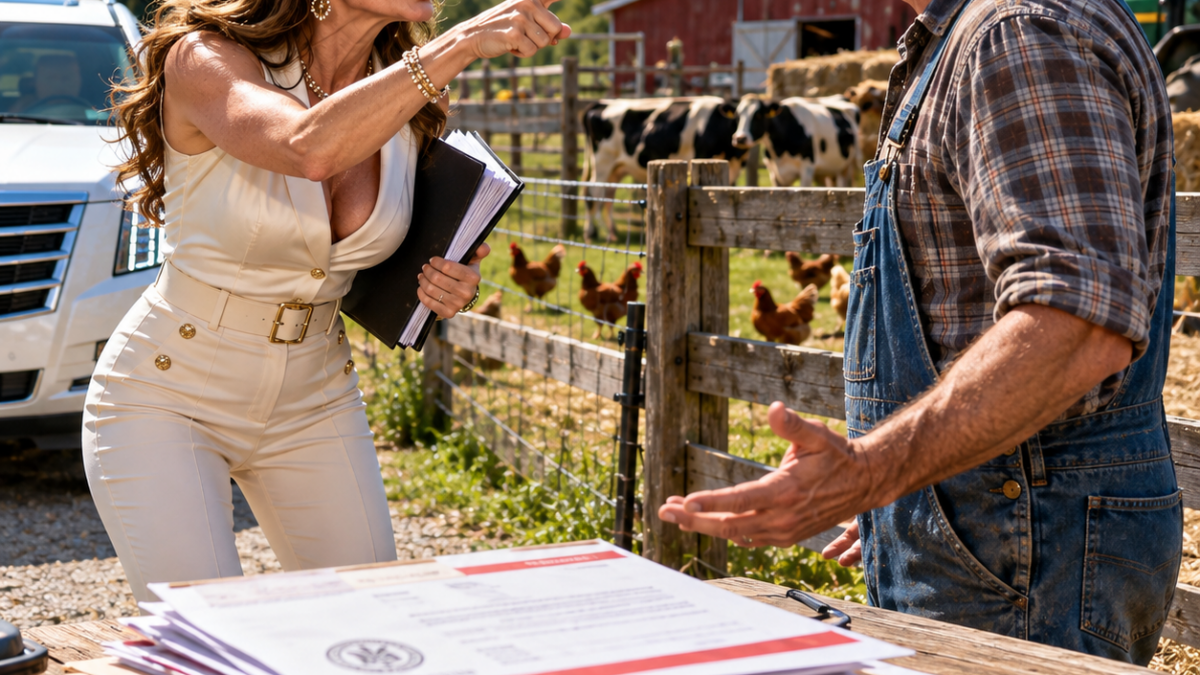
She showed up one afternoon while I was working near the side of the barn, trying to repair a stubborn latch that had been giving me trouble all week. I heard gravel crunch behind me and turned to see a woman stepping out of a white SUV that looked too clean to have ever driven through a real puddle.
She was around forty, maybe a little older, beautiful in a polished, dangerous way. Glossy chestnut hair fell over her shoulders in loose waves. She wore tight cream pants, a sleeveless blouse that looked expensive, gold jewelry, and sunglasses large enough to hide half her expression. Everything about her seemed arranged to be noticed. The walk, the perfume, the smile that appeared before her eyes had decided whether to join it.
She looked around my farm like she had stepped into a restaurant and found a hair in her food.
Then she said, “Can I speak to you for a second?”
I already did not like her tone.
It was not a request. It was an announcement wearing manners.
I should have said no. I should have kept working. I should have let that latch have my full attention and forced her to stand there awkwardly until she got back into her SUV and left.
Instead, I wiped my hands on a rag and said, “Sure. I only have a couple minutes.”
She smiled as if I had just been granted the privilege of listening.
“I’m Karen Whitmore, the new HOA president.”
“That so?”
“And I noticed your farm is violating many of our bylaws.”
For a second, I thought I had misunderstood her.
“My farm isn’t in your HOA.”
Her smile tightened.
“Actually, your farm is within the HOA area, so it needs to follow the same rules as everyone else.”
The way she said farm bothered me. Not because of the word itself, but because she lifted her fingers into little air quotes, like the place where I lived and worked was some pretend excuse I had invented to avoid her standards.
“No,” I said carefully. “My property is grandfathered in. It existed before the HOA. I never joined.”
Karen removed her sunglasses slowly.
“You cannot just make things up because you don’t want to follow rules.”
“I’m not making anything up.”
“I’ll be sending you a list of the issues on this property,” she said. “I suggest you fix them before we start fining you. Honestly, from what I’ve seen, some of these violations have been going on for years. You should be grateful I’m giving you a chance to correct them first.”
Grateful.
She stood on my land, accused me of breaking rules I had never agreed to, threatened fines she had no right to issue, and told me I should be grateful.
I watched her climb back into that white SUV and drive away, leaving perfume in the air and confusion burning in my chest.
That was the first time I realized Karen was not here to ask.
She was here to take.
PART 2
For the rest of that day, I kept replaying the conversation in my head while I worked.
The sensible part of me said it had to be a misunderstanding. Maybe she was new. Maybe the old HOA files were messy. Maybe someone had told her the entire surrounding area was under association control, and she had believed it without checking. I did not want conflict. I have never been the kind of person who enjoys arguing with neighbors, attending meetings, or turning every disagreement into a war. I just wanted to take care of my animals, sell my milk and eggs, support my family, and be left alone.
So I told myself the letter would come, I would send back proof, and that would be it.
A week later, the letter arrived.
It was not a letter.
It was a manifesto.
Thick envelope. HOA letterhead. Pages of violations written in that cold official tone people use when they want nonsense to sound legal. I stood in the kitchen reading it while my wife, Emily, rinsed vegetables at the sink.
At first, she only glanced over.
Then she noticed my face.
“What is it?”
“Karen sent her list.”
“Bad?”
I laughed once, but there was no humor in it.
“She thinks the entire farm is a violation.”
Emily dried her hands and came over.
The list was absurd.
Animals making noise after 10 p.m., in violation of HOA quiet hours.
Animals producing offensive smells affecting neighborhood enjoyment.
Improper waste management.
Visible agricultural equipment.
Rusted tractor creating an eyesore.
Barn exterior not meeting architectural standards.
House exterior allegedly deteriorating.
Unapproved fencing materials.
Unscreened feed storage.
Unauthorized commercial activity due to farmers market sales.
Unapproved signage.
Nonconforming driveway.
Noncompliant outbuildings.
The list went on and on.
It was not one or two complaints. It was everything. Every part of my working farm had been translated into an offense against suburban taste.
Emily read over my shoulder, her mouth tightening.
“She wants you to stop being a farm.”
“Pretty much.”
“Can she do this?”
“No.”
But even as I said it, I felt the uneasiness underneath.
Because no was the legal answer.
No did not stop people from making your life miserable.
No did not stop someone from sending letters, hiring lawyers, filing claims, scaring your family, or dragging you into fights that cost money you did not have.
I looked again at the quiet-hours violation.
“She expects me to tell cows not to moo after ten.”
Emily stared at me.
“She wrote that?”
“Apparently, our cows need watches.”
My son, Tyler, walked in at that moment, grabbed an apple from the counter, and asked, “Who needs watches?”
“The cows,” I said.
He blinked. “That tracks.”
Emily did not laugh.
That told me she was more worried than she wanted to admit.
“What are you going to do?” she asked.
“I’m going to ignore it.”
“Is that smart?”
“I’m not in the HOA. Their standards don’t apply.”
She folded the papers slowly.
“I know. But she doesn’t seem like someone who cares what applies.”
That was the problem exactly.
Still, I ignored it.
Part of me thought responding would give Karen’s delusion oxygen. I had already told her the truth in person. My property predated the HOA. I had no membership agreement. No dues. No access to their pool, clubhouse, tennis courts, trails, or whatever else residents paid for. I had never signed anything. The farm was outside their control.
So I went back to my life.
For about three weeks, nothing happened.
Then the second envelope arrived.
It was thinner than the first, but somehow felt heavier in my hand.
I opened it at the kitchen table.
This time, I did not laugh.
The HOA claimed I owed $250,000 in fines, accumulated over years of violations.
A quarter of a million dollars.
I stared at the number until the digits stopped looking real.
Karen had taken every alleged violation from her list, assigned a fine, multiplied it backward across years, added late fees, penalties, administrative costs, and interest for violations I had only been told about for the first time weeks earlier.
Late fees on fines she had just invented.
I sat there with the paper in my hand, unable to move.
Emily came in from the mudroom carrying a basket of eggs.
“What’s wrong?”
I turned the letter toward her.
She set the basket down slowly.
Her eyes moved over the page. Then moved again. Then stopped at the total.
“Oh my God.”
Tyler came in behind her, saw our faces, and immediately went still.
“What happened?”
Emily did not answer.
I handed him the letter.
He read it, and I watched anger replace confusion in my son’s eyes.
“They can’t do this.”
“No,” I said. “They can’t.”
But my voice did not sound as certain as I wanted it to.
Because Karen had written it down. She had put an impossible number on official paper and sent it to my home. It was nonsense, but it was nonsense aimed directly at our life. At the roof over our heads. At the land we worked. At the animals that fed us. At everything we had built.
That is what people like Karen understand instinctively.
A fake threat can still terrify a real family.
The letter said if I did not pay or come into compliance, the HOA would pursue collection through all available legal remedies.
Legal remedies.
That phrase sat like a stone in my stomach.
The next morning, I gathered every document I had: deed, old property records, survey, closing paperwork, anything showing the farm predated the subdivision and was not part of the HOA. I put it all in a folder and drove to the HOA office.
I still believed, foolishly maybe, that facts could end this.
Karen was there.
Of course she was.
The HOA office sat inside their clubhouse, a building with clean stone walls, polished floors, and framed photos of smiling residents doing community things. Karen stood behind a desk in a fitted navy dress, hair perfect, lips glossy, leaning over a tablet while a man in golf clothes nodded at whatever she was saying.
When she saw me, her smile appeared slowly.
“Mr. Walker.”
“I need to speak with you.”
“I have a meeting in ten minutes.”
“This won’t take that long.”
The man in golf clothes looked between us and wisely excused himself.
I placed the folder on the desk.
“These papers show my farm is not part of the HOA. I want the fines withdrawn.”
Karen did not open the folder.
She barely glanced at it.
“I don’t care what papers you brought.”
I felt my jaw tighten.
“You should.”
“You are within the community boundary.”
“No, I’m beside it.”
“You benefit from the community.”
“I don’t use a single thing here.”
“Your property affects our residents and our values.”
“That doesn’t give you authority over it.”
Karen leaned forward, and for the first time I saw something hungry behind her eyes.
“Actually, we expect payment.”
“You expect me to pay $250,000 for rules I never agreed to?”
“We gave you an opportunity to comply.”
“Most of your complaints are lies. The rest are farm things happening on a farm.”
She lifted one shoulder in a small, elegant shrug.
“Then we’ll sue.”
The words were simple.
Quiet.
Almost bored.
But they struck harder than if she had shouted.
I looked at her, really looked, and realized she was enjoying this. Not the legal argument. Not the paperwork. The pressure. She liked watching me understand that even being right might not save me from stress, cost, and risk.
Karen tapped one red nail on the folder.
“Your property is large,” she said. “Large enough to fit multiple homes, actually.”
There it was.
The truth.
Not the cows. Not the smell. Not the tractor. Not the barn. Not quiet hours or aesthetics.
Land.
She saw my farm as empty potential. Lots that could be carved up, sold, added to the HOA, fined, managed, controlled, and milked for dues. My home was just a stubborn obstacle sitting where more beige houses could go.
“You want my land.”
Her smile widened.
“I want community standards respected.”
“No,” I said. “You want me scared enough to sell.”
Karen’s expression chilled.
“You should be very careful accusing people of things you cannot prove.”
“You should be careful threatening farmers who keep records.”
For the first time, her smile faltered.
Only for a second.
Then she leaned back.
“We have very good lawyers, Mr. Walker.”
I picked up my folder.
“So do property records.”
I walked out with my heart pounding, my hands shaking, and a rage in me so deep it felt almost calm.
That night, I called a lawyer friend named Daniel.
He was not my official attorney, at least not then, but he knew property disputes and had enough patience to listen while I explained the whole mess. I emailed him copies of the letters and documents.
He called me back the next morning.
“She’s wrong,” he said.
“I know that.”
“But wrong doesn’t mean harmless.”
That sentence did more to scare me than Karen had.
Daniel explained that while the HOA had no legal basis to enforce rules against my property, they could still try to sue. They could file claims. They could force me to respond. They could make the process expensive and stressful, especially if the board was willing to burn HOA money on a fight. Being right helped, but it did not make court free.
“So what do I do?”
“Do not pay. Do not acknowledge the debt. Do not sign anything. Keep every letter. Document every interaction. And if they file anything official, call me immediately.”
“Can I stop them before that?”
“You can make it politically painful.”
“What does that mean?”
“It means HOAs are run by people, and people can lose power when the neighbors find out what they’ve been doing.”
That was the first seed.
Political pain.
I did not like conflict, but Karen had already brought conflict to my door. She had threatened my home, my family, and my livelihood. She had stood there in that polished office and looked at my farm like meat on a butcher’s table.
I could either wait for her next move, or I could start watching.
So I watched.
At first, I focused on Karen.
She had built a public image carefully. To some residents, she was the strong new president who was cleaning things up, enforcing fairness, and protecting property values. She posted cheerful updates online. She posed for photos at community events. She hosted little gatherings and stood in the middle of them like a pageant queen accepting tribute.
People liked her, or at least some did.
But then I started hearing other things.
At the farmers market, one woman who lived in Willow Creek bought eggs and mentioned under her breath that Karen had fined her $600 for holiday lights left up two days too long.
Another resident said the HOA had sent him a violation for a basketball hoop while Karen’s friend had one visible from the street for months.
Someone else complained about lawn fines, trash can fines, mailbox fines, fence fines.
Always selective.
Always personal.
Karen did not enforce rules evenly.
She weaponized them.
I started reading the bylaws.
All of them.
It was miserable work. HOA documents are written in a language designed to make ordinary people give up, but farming teaches endurance. I read at night after chores. I highlighted sections. I made notes. I compared rules against what I could see in the neighborhood.
That was when the hypocrisy became almost funny.
Karen had built a backyard pool.
Pools were heavily restricted. Possibly prohibited depending on how the bylaw language was interpreted. At minimum, hers had required approvals I doubted she properly obtained.
A board member hosted loud parties that clearly violated quiet-hour rules.
Another had unapproved decorative structures in the yard.
Karen’s close friend had seasonal decorations up far beyond the allowed window.
Several board allies had sheds, fences, outdoor fixtures, and landscaping features that technically violated the same rules Karen used against everyone else.
I took photos.
Carefully.
From public streets, from places I was allowed to be, never trespassing. I documented dates. Times. Rules. Violations. I took screenshots of public social media posts when Karen bragged about events that violated HOA policies. I photographed the pool from a legal vantage point where it was plainly visible. I collected copies of violation letters residents were willing to share.
Within two weeks, I had more than enough.
Emily watched me at the kitchen table one night as I organized everything into folders.
“You look different,” she said.
“How?”
“Focused.”
“I’m mad.”
“I know. But this is not how you usually get mad.”
She was right.
Usually, my anger burned out through work. Split wood. Fix something. Walk the fence. Haul feed until my back complained louder than my thoughts.
This anger needed structure.
Karen had paperwork.
I needed truth.
My first thought was to go straight to the next HOA meeting and lay everything out. But Daniel advised patience.
“If you walk in alone, they paint you as an outsider with a grudge,” he said. “If residents walk in angry about their own fines, Karen has a problem.”
“So how do I get them together?”
He paused.
“How good are you with social media?”
“Terrible.”
“Then ask your son.”
Tyler loved that part.
For the first time since the $250,000 letter arrived, I saw him smile like this was not just terrifying, but a challenge.
“We can make a private group,” he said. “Not like an attack page. More like a neighborhood accountability page.”
“I’m not in the neighborhood.”
“Exactly. You invite the people who are upset, but you don’t make it about you first.”
My sixteen-year-old had a better instinct for public strategy than I did.
So we created a private page.
Nothing dramatic. No screaming title. No personal insults. It looked like a place for Willow Creek residents to discuss fairness and HOA enforcement. We invited people carefully, residents who had bought from me, people I knew were frustrated, people who had mentioned fines, people who were not part of Karen’s inner circle.
The page grew faster than I expected.
At first, I posted general questions.
Has anyone received inconsistent fines?
Has anyone seen rules enforced against some homes but ignored for others?
Would residents be willing to share violation letters privately?
Then I posted photos.
Not Karen’s first. That would have looked personal.
I posted side-by-side examples.
A resident fined for decorations after the approved period, beside a board ally with decorations up even longer.
A homeowner fined for visible equipment, beside a board member’s yard full of unapproved outdoor storage.
A resident fined for noise, beside photos and public posts from a loud board-hosted party.
No insults.
Just evidence.
The comments exploded.
People who had stayed quiet because they thought they were alone suddenly realized there was a pattern. Karen had been selective. Vindictive. Favoring friends. Punishing people who questioned her. Using fines like a whip.
Then someone asked, “What about your farm? Didn’t she fine you too?”
That was when I posted my story.
I uploaded the $250,000 fine letter, with personal details covered. I posted the proof that my farm predated the HOA. I explained that I had never joined, never paid dues, never used amenities, never signed covenants. I wrote, as calmly as I could, that the HOA president had threatened legal action over rules that did not apply to my property and had pointed out my land could fit multiple homes.
The response was immediate.
Not everyone cared about me at first. That is human nature. People care most when something touches their own lives. But by then, the fines had touched plenty of them. My story became proof that Karen’s abuse was bigger than inconvenience. If she could target a farm outside the HOA for a quarter of a million dollars, nobody inside was safe.
The group changed after that.
Anger turned organized.
Residents began uploading their own letters. Fine amounts. Photos. Stories. Screenshots. Some were small and petty. Others were serious. Elderly residents fined for things they had not understood. Young families hit with penalties while Karen’s friends got warnings or nothing. People afraid to speak at meetings because Karen humiliated them or dismissed them.
I read every post.
By the time the next HOA meeting approached, the page had become something Karen could not control.
I posted one final message.
Bring your letters. Bring your proof. Speak calmly. Take turns. Ask for answers. Do not let them make this about one person’s complaint.
Emily read the post before I published it.
“You sound like a union organizer.”
“I’m a farmer.”
“Same thing, apparently.”
The night of the meeting, I almost turned around twice.
The clubhouse parking lot was packed when I arrived. That alone told me something had shifted. Usually, from what residents had told me, HOA meetings were sleepy events attended by the same dozen people. That night, people stood in clusters outside, holding folders, envelopes, printed photos, and phones.
I was not an HOA member, so I did not plan to vote. I was not even sure they would let me speak. But my name, my farm, and that impossible fine had become part of the reason many people were there.
Inside, Karen sat at the front table with the board.
She looked perfect.
Of course she did.
A fitted red dress under a cream blazer, hair smooth, lips shining, one ankle crossed over the other. She smiled when people entered, but I could see the strain around her eyes. She knew. Maybe not everything, but enough. She had probably seen the sudden increase in attendance. She had probably heard about the page. Someone in her circle must have warned her that the peasants had found each other.
When she saw me, her smile sharpened.
“Mr. Walker,” she said from across the room. “This is a member meeting.”
“I’m aware.”
A man in the second row said, “He should stay.”
Several others agreed.
Karen’s jaw tightened, but she did not push it.
The meeting began with routine nonsense. Minutes. Budget notes. Maintenance updates. Karen tried to move quickly, as if speed could outrun what was coming.
Then came the public comment portion.
A woman named Sandra stood first.
She was in her sixties, with silver hair and a folder clutched in both hands. Her voice shook at first, then strengthened.
“I was fined $400 for leaving my trash cans visible behind my side fence for one afternoon after my husband’s surgery. I appealed and was denied. But I have photos of Board Member Ellis leaving his cans visible for five consecutive days with no fine.”
She held up the photos.
Murmurs moved through the room.
Karen leaned toward the microphone.
“Sandra, individual enforcement matters are not really appropriate—”
“They were appropriate when you sent me four letters,” Sandra said.
A few people clapped.
Then a young father stood.
He had been fined for a portable basketball hoop. Karen’s friend had one too. His fine stood. Hers vanished.
Then another resident.
Holiday decorations.
Then another.
Noise complaint.
Then another.
Mailbox color.
Then another.
Lawn height.
Each person spoke calmly, just as the group had planned. That made it worse for Karen. If they had shouted, she could have dismissed them as a mob. But they did not shout. They presented evidence. Dates. Photos. Letters. Comparisons. Rules.
With every speaker, Karen’s posture changed.
At first, she sat tall, smiling tightly.
Then her hands folded.
Then unfolded.
Then she began whispering to the board member beside her.
Then she stopped smiling.
Finally, someone called my name.
I stood.
The room turned.
I walked to the front holding the $250,000 letter.
“I’m not a member of this HOA,” I said.
Karen immediately leaned toward the microphone.
“Then your comments should be limited.”
“No,” said a man in the back. “Let him talk.”
More voices agreed.
I looked at Karen.
She looked furious now. Not frightened yet. Furious.
“This is the fine letter your president sent me,” I said, holding it up. “Two hundred fifty thousand dollars for alleged farm violations going back years. My farm existed before this subdivision. I never joined your HOA. I never signed your covenants. I do not use your amenities. I do not owe dues. Your president refused to look at my documents and threatened to sue me.”
I let that settle.
Then I said the part everyone needed to hear.
“She also told me my property was large enough to fit multiple homes.”
The room changed.
People understood.
Because now it was not just unfair fines. It was motive. Land. Development. Expansion. Dues. Control.
Karen stood.
“That is a gross misrepresentation.”
I turned toward her.
“You said it in your office.”
“I said your property has impact.”
“You said it was large enough for multiple homes.”
“That does not mean—”
“You fined me a quarter of a million dollars for cows making noise.”
A laugh broke from the back of the room.
Then another.
Karen flushed.
“This is not funny,” she snapped.
“No,” I said. “It isn’t. You threatened my family’s livelihood with fines you had no authority to issue. You used the same pattern these people are describing tonight: selective rules, inflated penalties, intimidation, and refusal to listen.”
A board member, a pale man named Ellis, tried to interrupt.
“We should consult counsel before—”
“You should have consulted counsel before fining a nonmember $250,000,” someone shouted.
The room erupted.
Not wild. Not violent. But loud. Angry. Finally awake.
Karen tried to restore order.
She hit the microphone button. “Everyone needs to calm down.”
That was the wrong thing to say.
People who have been fined, dismissed, mocked, and threatened do not like being told to calm down by the person who profited from their silence.
A man near the aisle stood and called for a motion to remove Karen and the board pending review of enforcement practices.
Karen’s face went white.
“You cannot do that.”
A woman in the front row lifted a copy of the bylaws.
“Actually, we can.”
That was the moment I knew Karen had lost.
Not legally. Not officially. Not yet.
But emotionally, publicly, completely.
Her power had depended on people feeling isolated. One homeowner ashamed of a fine. One family afraid of retaliation. One farmer outside the HOA thinking no one inside would care. She had kept control by making every fight feel private.
That night, the fights became one.
The debate took a while. There were procedures. Arguments. Motions. Bylaw references. Residents demanded an emergency vote. Some board members tried to stall. Karen insisted the meeting had been hijacked by misinformation. But every time she spoke, someone had another document, another example, another fine letter, another photo.
Her beauty did not help her.
Her smile did not help her.
Her title did not help her.
Facts had filled the room, and there was no space left for charm.
By the end of the night, Karen and the board were forced to step down from their positions pending formal replacement. Temporary members were appointed according to the bylaws, and a proper election was scheduled. I did not vote. I could not, and I did not pretend otherwise.
But I watched.
That was enough.
Karen gathered her papers slowly after the vote. Her hands were not as steady as before. She looked around the room, and for the first time since I had met her, people did not look away.
When she passed me near the aisle, she stopped.
Her perfume was the same. Her face was composed again, though barely.
“You think you won?” she whispered.
I looked at her.
“No,” I said. “I think everybody saw you.”
That hurt her more than any insult would have.
She walked out without another word.
The social media group exploded that night, then slowly quieted over the next week. People posted updates, thanked each other, shared information about the upcoming election, and debated how to prevent future abuse. I kept the page active but stepped back. It was not my HOA, and I was careful not to act like it was. My role had been to expose what Karen was doing, not to control what came after.
A week after the new temporary board took over, I received another envelope from Willow Creek.
I stared at it for a long time before opening it.
Emily stood beside me.
“Want me to read it?”
“No.”
My hands were steady this time.
The letter was long. Formal. Apologetic in the stiff way organizations apologize when lawyers are nearby. But it said what mattered.
All fines against my property were withdrawn.
The HOA acknowledged that my farm was not part of the association and had never been subject to its bylaws.
I owed nothing.
Not a penny.
The board apologized for the prior leadership acting beyond its scope and promised to record internal documentation making clear that my property predated the HOA and was excluded from enforcement.
I read that paragraph twice.
Then I handed the letter to Emily.
She read it, covered her mouth, and closed her eyes.
Tyler took it next.
“So it’s over?” he asked.
“For now.”
“For real?”
I looked out the kitchen window toward the barn, the pasture, the animals moving in the late afternoon light.
“For real enough.”
That evening, I walked the farm alone.
The place looked exactly the way it had before Karen entered my life. The barn still needed a patch of paint on the south wall. The tractor still had rust along one fender. The cows still smelled like cows. Chickens still muttered nonsense in the coop. A stack of hay bales sat where Karen would have hated seeing it. The house was old, solid, imperfect, and ours.
Nothing had changed.
Everything had changed.
A few residents from Willow Creek continued buying from us at the farmers market. Some apologized, even though they had not done anything wrong. Some told me stories about Karen I had never heard. How she had humiliated people in meetings. How she had favored friends. How she had made older homeowners cry over tiny fines. How everyone had thought they were the only ones being targeted.
That is what bullies do best.
They make people feel alone.
Karen sold her house six months later.
At least, that was what Sandra told me at the market one Saturday while buying eggs. She leaned close, enjoying the gossip more than she wanted to admit.
“For sale sign went up yesterday.”
“Really?”
“Oh yes. And you’ll appreciate this. Apparently, the new board denied her request to waive certain moving-related fees.”
I smiled despite myself.
“Rules are rules.”
Sandra laughed.
“Exactly what someone told her.”
I did not go see the house. I did not need to. I had no interest in standing outside Karen’s property like she had stood outside mine. But I would be lying if I said I did not feel satisfaction knowing she was leaving the community she had tried so hard to control.
The new HOA board was not perfect. No board ever is. But they were careful. They reviewed enforcement policies. They dismissed questionable fines. They created a clearer appeal process. They stopped bothering me. Most importantly, they seemed to understand that their authority ended where their legal documents ended.
The farm stayed mine.
Sometimes, late in the evening, after chores were done, I thought about how close I had come to giving in early.
If Karen had asked for one small thing, maybe repainting a fence post or moving a piece of equipment out of view, I might have done it just to avoid conflict. I might have told myself it was easier. I might have given her the inch she needed to claim the mile.
That thought bothers me.
Not because compromise is always wrong. It is not. Neighbors should compromise all the time. But there is a difference between kindness and surrender. There is a difference between being peaceful and letting someone put a collar around your neck because arguing feels uncomfortable.
Karen counted on discomfort.
She counted on people hating conflict. She counted on residents paying fines just to make letters stop. She counted on me being too busy, too tired, too worried about legal costs to fight back. She counted on the isolation of every target.
She did not count on documentation.
She did not count on residents comparing stories.
She did not count on the farmer she threatened learning her rules better than she did.
The $250,000 letter is still in my filing cabinet.
I keep it with the apology letter from the new board.
Two documents. Same HOA letterhead. Same property. Two completely different realities.
One says I owe a quarter of a million dollars for the crime of existing beside people who wanted control.
The other says the truth.
I owe nothing.
My farm was here first.
My land was never hers.
And no matter how beautiful Karen looked standing in my driveway, no matter how smooth her voice was, no matter how many bylaws she waved around like weapons, she could not turn a lie into law just by saying it with confidence.
That is the lesson I took from all of it.
Confidence is not authority.
Paper is not truth just because it has a logo.
And a farmer who does not like conflict can still become very dangerous when someone threatens his family, his livelihood, and his home.
The cows still make noise after ten sometimes.
The chickens still do not care about quiet hours.
The tractor still looks like it has lived an honest life.
The barn still stands.
And every Saturday at the farmers market, when someone from Willow Creek buys eggs and asks how things are going, I tell them the same thing.
“Peaceful.”
Then I smile, because peaceful means more now than it used to.
It no longer means nobody is trying to take something from me.
It means they tried.
And failed.