FULL ENDING Karen Drained My Pool to Teach Me HOA Rules I Never Agreed To Follow
part2
The emails started a few months later.
The first one had the subject line: HOA COMPLIANCE CONCERN.
I almost deleted it unread because, again, I was not in the HOA. Curiosity won. That was my second mistake.
The message was three paragraphs of fake professionalism explaining that my backyard pool created a safety concern, aesthetic inconsistency, and possible regulatory exposure for the community. Karen wrote that I was required to bring the property into HOA compliance immediately.
Her proposed solution was simple.
Remove the pool.
I laughed out loud.
Not because it was funny, exactly. Because the alternative was staring at my screen until my soul left my body.
I replied with one sentence.
I am not a member of your HOA, my property is not subject to your rules, and I will not be removing my pool.
She did not answer that email directly.
Instead, she escalated.
More emails came. Longer ones. Then printed letters. Then an unofficial notice taped to my front door, signed proudly by Karen in blue ink like she was issuing a royal decree. The letters became more dramatic each time. Community safety. Attractive nuisance. Insurance exposure. Federal regulations. Neighborhood harmony.
She also posted vague rants on the neighborhood Facebook group.
She never used my name, but everyone knew.
Some homeowners continue to disregard basic safety and aesthetic standards.
Private pools can endanger children, lower community values, and create unnecessary liability.
Rules exist for a reason.
A few people commented with polite confusion.
Isn’t his house outside the HOA?
Karen ignored those.
My next-door neighbor on the left, Mrs. Donnelly, called me after one of the posts.
“You know she’s talking about you, right?”
“Yes.”
“She’s been watching your fence.”
“I know.”
“No, I mean really watching. She stood near the corner yesterday pretending to take a phone call.”
I looked out my window toward the yard.
Mrs. Donnelly continued before I could answer.
“That woman has too much time and not enough shame.”
Mrs. Donnelly was a little dramatic on an average day, but she was not wrong.
Still, I told myself Karen would not actually do anything.
She would complain, threaten, write letters, maybe try to get the HOA board to send something official. But surely she would not cross into my fenced yard and touch my property.
That was my third mistake.
The day she drained the pool was brutally hot.
The kind of humid, heavy heat that makes every shirt feel like plastic wrap. I worked in an office then, which meant dress shirt, tie, slacks, and shoes that made summer feel personal. By the time I drove home, my collar was damp, my patience was gone, and all I wanted was to change into swim trunks and sink into cool water for half an hour before dinner.
I remember walking into the house and dropping my keys in the bowl by the door.
I remember thinking, Pool first, food later.
I changed fast, grabbed a towel, slid open the back door, and stepped outside.
Then I stopped.
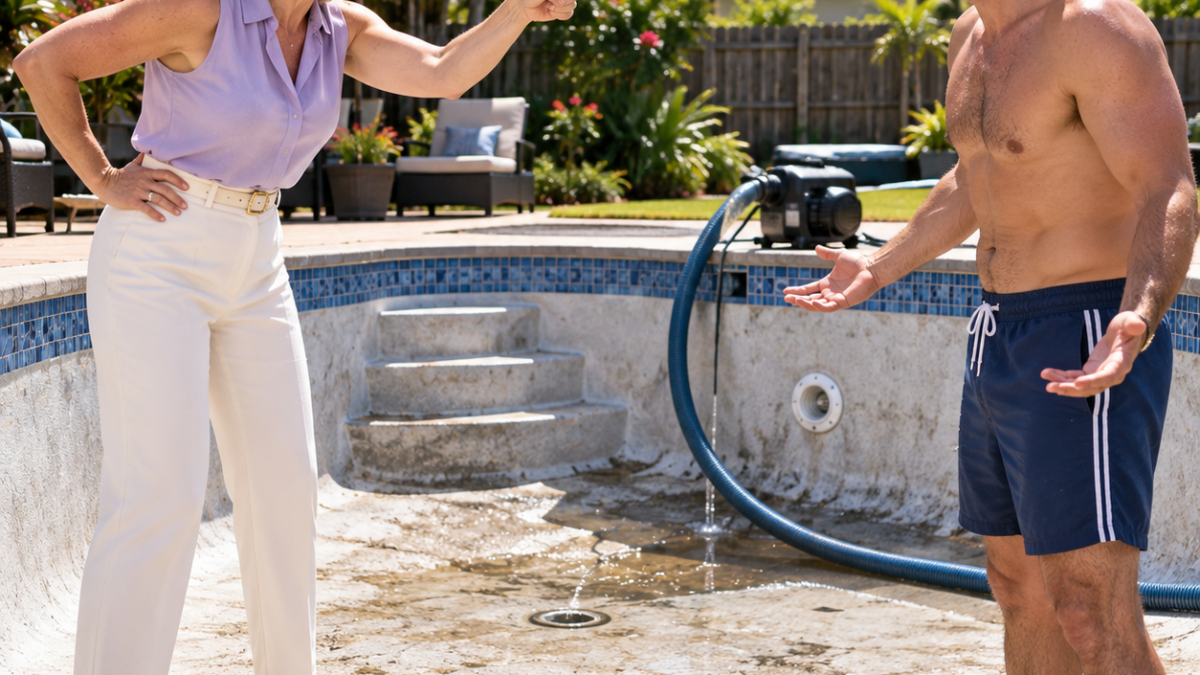
The pool was empty.
Not low.
Not leaking a little.
Empty.
The blue tile walls were exposed. The bottom was stained and dry in patches, with shallow puddles left in uneven spots. The pool looked wrong without water, like a body with the life pulled out of it.
For several seconds, my brain tried to solve the impossible.
Evaporation? No. Not unless the sun had become a weapon from science fiction.
Pump failure? No. Even a serious issue would not drain the entire thing like that.
Broken pipe? Maybe, but there was no obvious flooding.
Then I saw the hose and equipment disturbed near the side.
Someone had drained it.
My first feeling was not anger.
It was disbelief so strong it almost felt calm.
I walked around the pool, checking damage, looking for anything obvious. Whoever had done it had not done it properly. I knew enough to know that draining an in-ground pool incorrectly can cause real damage. Pressure changes. Structural stress. Equipment problems. Surfaces exposed to heat. It is not something you just do because you feel morally superior on a Tuesday.
I should have had cameras.
That thought hit me hard.
I had known Karen hated the pool. I had known she was escalating. I had known she was exactly the kind of person who thought rules applied to everyone except herself when she was enforcing her imaginary kingdom.
And I had not installed cameras.
I stood in my backyard in swim trunks, holding a towel, staring at an empty pool, feeling like an idiot.
Then I went to talk to the neighbors.
Mrs. Donnelly opened her door before I even knocked properly.
“Oh, thank God,” she said, grabbing my wrist. “I saw her. I saw that awful woman. I told her she shouldn’t be there, but she did it anyway.”
“Karen?”
“Who else?”
My stomach tightened.
“Start from the beginning.”
Mrs. Donnelly was already worked up, waving one hand as if she could pull the whole afternoon out of the air.
“She came with a ladder. A ladder, Daniel. Climbed right over your fence like some raccoon in slacks. I was watering my hanging baskets, and I saw her in your yard. I yelled, ‘Karen, you can’t be in there.’ She told me she was acting under community safety authority.”
I closed my eyes.
Community safety authority.
Of course.
“She said the pool was illegal,” Mrs. Donnelly continued. “Said you had ignored repeated notices. Said children could drown. I told her there are no children in your yard, and she told me I didn’t understand liability.”
“What exactly did she do?”
“I don’t know all the pool things. She messed with your equipment and hose. Water started draining out toward the back. She stayed there a long time. I called her crazy.”
Despite everything, I almost smiled.
“Thank you.”
“Oh, don’t thank me. I should’ve called the police right then.”
“I’m going to.”
The police came, took a report, and spoke with Mrs. Donnelly.
They were polite. They were sympathetic. They were also limited.
One eyewitness, no video, no physical evidence directly placing Karen there beyond Mrs. Donnelly’s statement. They could document it. They could talk to Karen. But an immediate arrest was not happening.
The officer suggested cameras.
I nearly laughed.
“Yes,” I said. “I figured that part out.”
He also suggested civil court for damages.
That word—damages—started to settle over the situation in a new way.
Until then, I had been thinking in emotional terms. Trespass. Violation. Anger. Revenge. But now I was looking at the pool as an expensive structure improperly drained by someone with no right to touch it.
Repairs.
Inspection.
Refill cost.
Equipment issues.
Legal fees.
Karen had not just annoyed me.
She had created a bill.
And I was going to hand it back to her.
But first, I did something I probably should not have done.
I went to her house.
I know. On paper, not smart. My logical brain understood that. My emotional brain had just come home in a suit on a miserable hot day to find my pool empty because the neighborhood dictator climbed my fence with a ladder.
So I walked over.
Karen answered the door wearing linen pants, a sleeveless blouse, and the expression of a woman who had been waiting to feel important.
“Daniel,” she said.
“I know you drained my pool.”
She did not even flinch.
That told me everything.
“I won’t deny it to you,” she said.
For one strange second, I was so shocked by the confession that I forgot to be angry.
Then she kept talking.
“That pool was a safety hazard and a violation of community standards. I gave you multiple opportunities to comply.”
“I am not in your HOA.”
“You live in the neighborhood.”
“Not your HOA.”
“Technicalities don’t matter when public safety is involved.”
“It’s in my fenced backyard.”
“Children drown in pools every year.”
“Children also get hit by cars. Are you draining driveways now?”
Her face hardened.
“Do not mock safety.”
“Do not climb my fence.”
“I acted responsibly.”
“You trespassed and damaged my property.”
“The HOA has my back.”
That almost made me laugh because it was so obviously untrue.
“Did they tell you to do it?”
She hesitated.
Tiny pause.
Tiny but important.
“I acted under my authority as president.”
“Your authority ends at my property line.”
“Federal safety codes—”
“Do not apply to my private backyard pool the way you think they do.”
Her lips pressed together.
“You are lucky I handled this before someone died.”
I stared at her.
The worst part was not that she lied.
The worst part was that she believed enough of her own nonsense to think she had done something noble.
“I’m going to sue you,” I said.
She smiled.
“You’ll lose.”
“No, Karen. I really don’t think I will.”
I left before I said something that would help her.
The next week became a blur of documentation.
I emailed Karen, summarizing our conversation and asking her to confirm that she had entered my fenced yard and drained the pool.
She did.
Not in those exact words, but close enough.
Her reply was a masterpiece of self-incrimination.
She wrote that she had taken “necessary corrective action” after my “continued refusal to bring the property into compliance.” She said the pool presented a “known drowning hazard” and that her action was “justified under federal safety principles and community welfare obligations.”
I stared at the email like it was a gift from a very stupid angel.
Then I forwarded it to myself, printed it, saved it as a PDF, backed it up, and sent it to my attorney.
Yes, I got an attorney.
Before that, I called the HOA board directly.
Their response was immediate panic.
Tom, one of the board members who was not insane, called me within an hour.
“Daniel, I need to be very clear. The HOA did not authorize Karen to enter your property.”
“Good.”
“She acted independently.”
“Convenient.”
“I understand how that sounds, but it’s true. We told her multiple times that your property is not in the HOA.”
“She said the HOA had her back.”
Tom sighed in a way that suggested Karen had shortened his lifespan.
“She says a lot of things.”
“Then you may want to put your position in writing.”
“We will.”
They did.
The HOA sent an email stating that my property was not part of the association, that no board vote authorized any action involving my pool, and that Karen had acted independently.
Were they covering themselves? Absolutely.
Did that help me? Also absolutely.
I sent Karen’s admission to the police. That reopened the trespassing side of things. The officer told me they would handle the criminal matter separately, though he warned me the consequences there might not be dramatic.
That was fine.
I was more interested in the civil case.
I checked property records again, just to make sure every document was clean. The parcel was not subject to HOA covenants. I pulled county ordinances. I pulled pool regulations. I pulled actual safety requirements. I pulled HOA rules too, partly to understand what imaginary kingdom Karen thought she was ruling.
Then I hired a pool professional to inspect the damage.
He stood at the edge of the empty pool and shook his head.
“Who drained this?”
“A woman with a clipboard and too much confidence.”
He looked at me.
“That’s not funny, but it is believable.”
The inspection confirmed what I feared. Improper draining had caused damage to the pool surface and equipment. The refill would not be cheap either. Cleaning, repairs, water cost, system checks, labor—it added up fast.
My attorney filed the civil suit.
We asked for repair costs, refill costs, inspection fees, legal fees, and emotional distress.
The emotional distress claim was a long shot, and my lawyer told me not to get attached to it.
“I included it because what she did was intrusive,” he said. “But property damages and fees are our strongest ground.”
“That’s fine.”
“You understand she may try to paint herself as protecting the community.”
“I’m counting on it.”
He smiled.
Court did not happen as quickly as I wanted, because nothing involving courts happens as quickly as the angry part of your brain demands.
In the meantime, I installed cameras.
Not one.
Several.
Driveway, front door, backyard, pool area, fence line. Motion alerts. Night vision. Cloud storage. If Karen so much as sneezed in the direction of my yard, I wanted footage from three angles.
The pool repairs started after the inspection and documentation were complete. Watching workers fix damage that should never have happened made me angry all over again. Watching the pool refill helped.
Water slowly rising against the blue tile felt like life returning.
The first evening it was usable again, I went outside and sat on the edge with my feet in the water.
I did not swim.
I just sat there, listening to the pump run properly, watching the lights reflect from the house windows, and thinking about how absurd it was that peace sometimes has to be defended with invoices and court filings.
Karen, meanwhile, was not quiet.
She told people I was suing her for protecting children.
She told others I had an illegal pool.
She told at least one neighbor that I was “anti-community,” which made me laugh because I had not trespassed into anyone’s yard that week.
But the neighborhood was not as supportive as she seemed to expect.
People were tired of her.
Even HOA members were tired of her. Her rules had become too much even for people who originally liked having standards. Bird fountains, sidewalk tiles, porch colors, lawn ornaments, pool paranoia—eventually people realized Karen did not want order.
She wanted obedience.
Court day arrived.
I expected Karen to deny everything.
I expected claims that the emails were fake, that Mrs. Donnelly was lying, that I had drained the pool myself to frame her. I had prepared emotionally for the full Karen circus.
Instead, she proudly defended what she had done.
That was better.
The judge asked whether she entered my property.
Karen tried to reframe.
“I entered the area to address a safety hazard.”
“So yes?”
“I acted in my capacity as HOA president.”
“Is his property part of the HOA?”
Karen’s lawyer looked like he wanted to dissolve into the floor.
Karen said, “It benefits from being near the HOA.”
That was not the question, and everyone knew it.
My lawyer presented the property records. Not in the HOA. No covenant authority. No membership. No agreement.
Then came the pool regulations.
Karen had printed pages of federal safety material, most of which dealt with public pools, commercial facilities, or standards that had nothing to do with a fenced private residential pool. She kept insisting that because federal documents mentioned drowning prevention, she was “protected by federal law.”
The judge listened with the strained patience of a person being forced to hear nonsense at professional volume.
My lawyer showed the actual county compliance documents and inspection report.
Private pool.
Legal.
Fenced.
Covered.
No outstanding violations.
Then he showed her email.
Necessary corrective action.
Continued refusal.
Community welfare obligations.
He let the words sit in the room.
Karen did not even seem embarrassed.
That was the astonishing thing. She looked proud, like the email proved she had been brave.
My lawyer asked, “Mrs. Whitcomb, did my client ever give you permission to enter his yard?”
“No.”
“Did any court authorize you to enter his yard?”
“No.”
“Did the HOA board vote to authorize you to enter his yard?”
“The board was aware of the concern.”
“That is not what I asked.”
Karen’s jaw tightened.
“No.”
“Did you hire a licensed pool professional to drain the pool?”
“I did what was necessary.”
“Are you a licensed pool professional?”
“No.”
“Did your actions cause damage?”
“I dispute that.”
The pool inspection report answered for her.
By the end, even her own lawyer had stopped trying to make her sound reasonable and focused only on reducing damages.
The judge ruled in my favor.
Karen had to pay for the pool repairs, refill costs, inspection expenses, and legal fees. Emotional distress did not stick, which my lawyer had expected.
I did not care.
The important part was that Karen had to pay for every dollar of damage her arrogance caused.
She was furious.
As we left the courtroom, I heard her asking her lawyer how to go above the judge.
He said, very carefully, that appealing would likely cost more than paying.
She did not like that answer.
For a while, I thought that would be enough.
It was not.
I am not going to pretend I became noble after winning.
I wanted revenge.
Not illegal revenge. Not cruel revenge. But something proportional. Something that reminded Karen how much she loved rules when they were pointed at other people.
And then I remembered her she shed.
Karen talked about that shed constantly. She called it a she shed, though from what little I could see over fences and from public angles, it looked less like a cozy retreat and more like a small detached building that had grown too confident.
She bragged about it all the time.
Custom shelves. Sitting area. Craft space. Climate control. Big enough for entertaining. Bigger than most garden sheds. Built without “all the red tape” because she knew how to get things done.
That phrase stuck with me.
Without all the red tape.
So I looked up county accessory structure rules.
Then I looked at satellite imagery and visible dimensions from public records.
Then I made a report to code enforcement.
I did not lie.
I did not exaggerate.
I simply asked whether the structure appeared to comply with size and permit requirements.
It did not.
Code enforcement inspected.
Karen’s she shed was too large for what was allowed without proper approvals, and apparently some parts had not been permitted correctly. She was ordered to bring it into compliance or remove it.
She fought.
Of course she fought.
She argued. Complained. Claimed selective enforcement. Said someone was retaliating against her. Maybe she was right about that last part, though retaliation is a strong word for “reporting the same kind of rule violation she built a personality around enforcing.”
In the end, she had to get rid of it.
Watching that shed come down was satisfying in a way I will not pretend was mature.
I did not throw a party.
I did not stand outside with popcorn.
But I did open my blinds.
Karen lost thousands in court, lost her oversized little backyard kingdom, and still had criminal trespass issues pending in the background. By then, even the HOA was done pretending she was a strong leader.
The next board election came a few months later.
Karen lost.
Fair and square.
That may have been the best part. Not because I hated her more than I loved peace, but because she could not claim a technicality. She could not blame the judge. She could not blame me entirely. The people she claimed to represent had looked at her behavior and decided they wanted someone else holding the clipboard.
She was voted out.
The HOA began talking about rewriting bylaws, removing some of Karen’s more ridiculous rules, and limiting unilateral enforcement power. I was not part of the HOA, so I did not attend meetings, but rumors travel faster than official minutes. From what I heard, the new board wanted fewer fights about harmless personal choices and more focus on things that actually mattered.
Imagine that.
A homeowners association discovering homes belong to homeowners.
As for my pool, I made an addition.
Underwater color-changing lights.
Not obnoxious. Not bright enough to bother anyone normal. Just soft, shifting colors that made the water glow at night. Blue, green, purple, warm white. Beautiful in a quiet way.
My friends loved it.
Mrs. Donnelly said it looked like “a fancy resort for people who don’t deserve humidity.”
Even a few HOA members complimented it.
Karen hated it.
I know because she could see just enough glow over the fence line from certain angles if she happened to be walking by slowly, which she did more often than coincidence required.
The first time she noticed, she stopped on the sidewalk.
I was in the backyard, sitting with a drink, the new cameras quietly watching from their corners.
The pool glowed deep blue.
Karen looked through the fence gap for half a second before remembering cameras existed and turning away.
I smiled.
Not big.
Not dramatic.
Just enough.
I do not know what became of Karen after that in any meaningful way. She still lives nearby. She still exists. She still has opinions. But power is different after people stop fearing your paperwork.
She walks quieter now.
That might sound strange, but it is true. Before, Karen moved through the neighborhood like she owned the oxygen. Now she moves like someone who knows every doorbell might be recording and every neighbor might have learned the phrase “civil liability.”
I am not pro-chaos.
I do not think neighborhoods need to become junkyards of personal expression with zero regard for anyone else. Reasonable rules can help when people are reasonable. Shared spaces need care. Nobody wants abandoned cars in lawns or trash blowing down the street.
But Karen was never protecting the neighborhood from chaos.
She was protecting herself from difference.
A colorful sidewalk tile bothered her because she had not approved it.
A bird fountain bothered her because joy without permission confused her.
My pool bothered her because it sat outside her authority, clean and blue and legal, reminding her every day that her power had a property line.
So she crossed mine.
That was her mistake.
Not just morally, but strategically.
People like Karen often get away with harassment because they stay just vague enough. Notes. Comments. Emails. Facebook posts. Threats dressed as concern. They create stress without creating evidence.
But draining the pool turned her obsession into damages.
Admitting it in writing turned damages into a case.
And bragging about rules while violating her own turned neighbors against her faster than any speech I could have given.
The pool is better now than it was before.
That is the part I enjoy most.
New lights. Better equipment inspection schedule. Security cameras. Cleaner records. A lawyer whose number is saved in my phone. A neighborhood that knows I am not afraid to respond if someone mistakes my silence for permission.
On hot days, I still come home from work, change out of office clothes, and walk straight outside.
The water is full.
The fence is locked.
The cameras blink softly.
Sometimes I float on my back and watch the sky go from gold to purple while the underwater lights slowly shift beneath me. It is peaceful in the exact way Karen wanted to make impossible.
That feels like the real win.
Not the lawsuit.
Not the money.
Not the shed coming down, though I will admit that one still warms my petty little heart.
The real win is that Karen tried to erase something I enjoyed, and when all was said and done, I made it brighter.
She wanted the pool gone.
Instead, it glows.
𝗧𝗛𝗘 𝗘𝗡𝗗
Karen Drained My Pool to Teach Me HOA Rules I Never Agreed To Follow
Karen hated my pool because it was colorful, private, legal, and completely outside her control.
So one hot afternoon, she climbed into my fenced yard, drained the whole thing, and told herself she was protecting the neighborhood.
What she forgot was that people who confess in writing usually make revenge almost too easy.
I knew Karen had a problem with my pool long before she drained it.
People like her do not hide obsession well. They think they do, because they wrap it in words like safety, standards, community, and concern, but you can always see the truth if you watch their eyes. Karen never looked at my backyard pool like it was a pool. She looked at it like it was disobedience filled with water.
That was the real issue.
Not drowning statistics. Not property values. Not neighborhood aesthetics. Not whatever federal law she later claimed I was violating.
Control.
Karen was the president of the local HOA, and that title had done something terrible to her personality. Maybe she had always been that way and the HOA just gave it paperwork. I do not know. What I do know is that she seemed to believe the entire neighborhood existed as a personal extension of her clipboard.
The funny part was that I was not even in her HOA.
That was one of the first things I checked when I bought the house. The neighborhood had an optional homeowners association, and the previous owner had never opted in. I made sure that status carried over. I read the documents. I checked the property records. I asked the closing attorney twice because I knew myself well enough to know I would not last five minutes under someone else’s decorative shrubbery rules.
I like peace.
I also like color, privacy, and the ability to make decisions about my own home without asking permission from a committee of people who think beige is a lifestyle.
My house was not outrageous. It was not some neon-painted rebellion against suburban order. It was a normal single-story home with a decent lawn, a fenced backyard, and an in-ground swimming pool that had been one of the main reasons I bought the place.
The pool was beautiful.
Not enormous, not flashy, but beautiful to me. Blue tile, clean coping, a shaded seating area, and enough room to float after work when the summer heat made the air feel like wet cloth. It sat entirely inside my fenced backyard, invisible from the street unless someone went out of their way to be nosy.
Karen went out of her way.
Her HOA had rules for everything. Sidewalk tiles could not be too colorful. Garden decorations had to fit “community tone.” Bird fountains were apparently controversial. One poor neighbor got fined because her front porch planters were “visually inconsistent.” Another man had to repaint a mailbox post because Karen claimed the shade of white created “discord.”
Discord.
From a mailbox post.
That should tell you everything.
Karen wanted homes to look like they had been designed by a printer running out of ink. Dull lawns. Dull doors. Dull yards. Dull people nodding obediently while she declared every interesting choice a violation.
My pool offended her because it was not dull.
Worse, she could not fine it.
At first, she made little comments.
“Pools can be such a liability.”
“You know, not everyone wants to look at recreational clutter.”
“Standing water attracts problems.”
“It doesn’t fit the character of the area.”
I ignored her because ignoring Karen felt like the healthiest option.
That was my first mistake.
part2
The emails started a few months later.
The first one had the subject line: HOA COMPLIANCE CONCERN.
I almost deleted it unread because, again, I was not in the HOA. Curiosity won. That was my second mistake.
The message was three paragraphs of fake professionalism explaining that my backyard pool created a safety concern, aesthetic inconsistency, and possible regulatory exposure for the community. Karen wrote that I was required to bring the property into HOA compliance immediately.
Her proposed solution was simple.
Remove the pool.
I laughed out loud.
Not because it was funny, exactly. Because the alternative was staring at my screen until my soul left my body.
I replied with one sentence.
I am not a member of your HOA, my property is not subject to your rules, and I will not be removing my pool.
She did not answer that email directly.
Instead, she escalated.
More emails came. Longer ones. Then printed letters. Then an unofficial notice taped to my front door, signed proudly by Karen in blue ink like she was issuing a royal decree. The letters became more dramatic each time. Community safety. Attractive nuisance. Insurance exposure. Federal regulations. Neighborhood harmony.
She also posted vague rants on the neighborhood Facebook group.
She never used my name, but everyone knew.
Some homeowners continue to disregard basic safety and aesthetic standards.
Private pools can endanger children, lower community values, and create unnecessary liability.
Rules exist for a reason.
A few people commented with polite confusion.
Isn’t his house outside the HOA?
Karen ignored those.
My next-door neighbor on the left, Mrs. Donnelly, called me after one of the posts.
“You know she’s talking about you, right?”
“Yes.”
“She’s been watching your fence.”
“I know.”
“No, I mean really watching. She stood near the corner yesterday pretending to take a phone call.”
I looked out my window toward the yard.
Mrs. Donnelly continued before I could answer.
“That woman has too much time and not enough shame.”
Mrs. Donnelly was a little dramatic on an average day, but she was not wrong.
Still, I told myself Karen would not actually do anything.
She would complain, threaten, write letters, maybe try to get the HOA board to send something official. But surely she would not cross into my fenced yard and touch my property.
That was my third mistake.
The day she drained the pool was brutally hot.
The kind of humid, heavy heat that makes every shirt feel like plastic wrap. I worked in an office then, which meant dress shirt, tie, slacks, and shoes that made summer feel personal. By the time I drove home, my collar was damp, my patience was gone, and all I wanted was to change into swim trunks and sink into cool water for half an hour before dinner.
I remember walking into the house and dropping my keys in the bowl by the door.
I remember thinking, Pool first, food later.
I changed fast, grabbed a towel, slid open the back door, and stepped outside.
Then I stopped.
The pool was empty.
Not low.
Not leaking a little.
Empty.
The blue tile walls were exposed. The bottom was stained and dry in patches, with shallow puddles left in uneven spots. The pool looked wrong without water, like a body with the life pulled out of it.
For several seconds, my brain tried to solve the impossible.
Evaporation? No. Not unless the sun had become a weapon from science fiction.
Pump failure? No. Even a serious issue would not drain the entire thing like that.
Broken pipe? Maybe, but there was no obvious flooding.
Then I saw the hose and equipment disturbed near the side.
Someone had drained it.
My first feeling was not anger.
It was disbelief so strong it almost felt calm.
I walked around the pool, checking damage, looking for anything obvious. Whoever had done it had not done it properly. I knew enough to know that draining an in-ground pool incorrectly can cause real damage. Pressure changes. Structural stress. Equipment problems. Surfaces exposed to heat. It is not something you just do because you feel morally superior on a Tuesday.
I should have had cameras.
That thought hit me hard.
I had known Karen hated the pool. I had known she was escalating. I had known she was exactly the kind of person who thought rules applied to everyone except herself when she was enforcing her imaginary kingdom.
And I had not installed cameras.
I stood in my backyard in swim trunks, holding a towel, staring at an empty pool, feeling like an idiot.
Then I went to talk to the neighbors.
Mrs. Donnelly opened her door before I even knocked properly.
“Oh, thank God,” she said, grabbing my wrist. “I saw her. I saw that awful woman. I told her she shouldn’t be there, but she did it anyway.”
“Karen?”
“Who else?”
My stomach tightened.
“Start from the beginning.”
Mrs. Donnelly was already worked up, waving one hand as if she could pull the whole afternoon out of the air.
“She came with a ladder. A ladder, Daniel. Climbed right over your fence like some raccoon in slacks. I was watering my hanging baskets, and I saw her in your yard. I yelled, ‘Karen, you can’t be in there.’ She told me she was acting under community safety authority.”
I closed my eyes.
Community safety authority.
Of course.
“She said the pool was illegal,” Mrs. Donnelly continued. “Said you had ignored repeated notices. Said children could drown. I told her there are no children in your yard, and she told me I didn’t understand liability.”
“What exactly did she do?”
“I don’t know all the pool things. She messed with your equipment and hose. Water started draining out toward the back. She stayed there a long time. I called her crazy.”
Despite everything, I almost smiled.
“Thank you.”
“Oh, don’t thank me. I should’ve called the police right then.”
“I’m going to.”
The police came, took a report, and spoke with Mrs. Donnelly.
They were polite. They were sympathetic. They were also limited.
One eyewitness, no video, no physical evidence directly placing Karen there beyond Mrs. Donnelly’s statement. They could document it. They could talk to Karen. But an immediate arrest was not happening.
The officer suggested cameras.
I nearly laughed.
“Yes,” I said. “I figured that part out.”
He also suggested civil court for damages.
That word—damages—started to settle over the situation in a new way.
Until then, I had been thinking in emotional terms. Trespass. Violation. Anger. Revenge. But now I was looking at the pool as an expensive structure improperly drained by someone with no right to touch it.
Repairs.
Inspection.
Refill cost.
Equipment issues.
Legal fees.
Karen had not just annoyed me.
She had created a bill.
And I was going to hand it back to her.
But first, I did something I probably should not have done.
I went to her house.
I know. On paper, not smart. My logical brain understood that. My emotional brain had just come home in a suit on a miserable hot day to find my pool empty because the neighborhood dictator climbed my fence with a ladder.
So I walked over.
Karen answered the door wearing linen pants, a sleeveless blouse, and the expression of a woman who had been waiting to feel important.
“Daniel,” she said.
“I know you drained my pool.”
She did not even flinch.
That told me everything.
“I won’t deny it to you,” she said.
For one strange second, I was so shocked by the confession that I forgot to be angry.
Then she kept talking.
“That pool was a safety hazard and a violation of community standards. I gave you multiple opportunities to comply.”
“I am not in your HOA.”
“You live in the neighborhood.”
“Not your HOA.”
“Technicalities don’t matter when public safety is involved.”
“It’s in my fenced backyard.”
“Children drown in pools every year.”
“Children also get hit by cars. Are you draining driveways now?”
Her face hardened.
“Do not mock safety.”
“Do not climb my fence.”
“I acted responsibly.”
“You trespassed and damaged my property.”
“The HOA has my back.”
That almost made me laugh because it was so obviously untrue.
“Did they tell you to do it?”
She hesitated.
Tiny pause.
Tiny but important.
“I acted under my authority as president.”
“Your authority ends at my property line.”
“Federal safety codes—”
“Do not apply to my private backyard pool the way you think they do.”
Her lips pressed together.
“You are lucky I handled this before someone died.”
I stared at her.
The worst part was not that she lied.
The worst part was that she believed enough of her own nonsense to think she had done something noble.
“I’m going to sue you,” I said.
She smiled.
“You’ll lose.”
“No, Karen. I really don’t think I will.”
I left before I said something that would help her.
The next week became a blur of documentation.
I emailed Karen, summarizing our conversation and asking her to confirm that she had entered my fenced yard and drained the pool.
She did.
Not in those exact words, but close enough.
Her reply was a masterpiece of self-incrimination.
She wrote that she had taken “necessary corrective action” after my “continued refusal to bring the property into compliance.” She said the pool presented a “known drowning hazard” and that her action was “justified under federal safety principles and community welfare obligations.”
I stared at the email like it was a gift from a very stupid angel.
Then I forwarded it to myself, printed it, saved it as a PDF, backed it up, and sent it to my attorney.
Yes, I got an attorney.
Before that, I called the HOA board directly.
Their response was immediate panic.
Tom, one of the board members who was not insane, called me within an hour.
“Daniel, I need to be very clear. The HOA did not authorize Karen to enter your property.”
“Good.”
“She acted independently.”
“Convenient.”
“I understand how that sounds, but it’s true. We told her multiple times that your property is not in the HOA.”
“She said the HOA had her back.”
Tom sighed in a way that suggested Karen had shortened his lifespan.
“She says a lot of things.”
“Then you may want to put your position in writing.”
“We will.”
They did.
The HOA sent an email stating that my property was not part of the association, that no board vote authorized any action involving my pool, and that Karen had acted independently.
Were they covering themselves? Absolutely.
Did that help me? Also absolutely.
I sent Karen’s admission to the police. That reopened the trespassing side of things. The officer told me they would handle the criminal matter separately, though he warned me the consequences there might not be dramatic.
That was fine.
I was more interested in the civil case.
I checked property records again, just to make sure every document was clean. The parcel was not subject to HOA covenants. I pulled county ordinances. I pulled pool regulations. I pulled actual safety requirements. I pulled HOA rules too, partly to understand what imaginary kingdom Karen thought she was ruling.
Then I hired a pool professional to inspect the damage.
He stood at the edge of the empty pool and shook his head.
“Who drained this?”
“A woman with a clipboard and too much confidence.”
He looked at me.
“That’s not funny, but it is believable.”
The inspection confirmed what I feared. Improper draining had caused damage to the pool surface and equipment. The refill would not be cheap either. Cleaning, repairs, water cost, system checks, labor—it added up fast.
My attorney filed the civil suit.
We asked for repair costs, refill costs, inspection fees, legal fees, and emotional distress.
The emotional distress claim was a long shot, and my lawyer told me not to get attached to it.
“I included it because what she did was intrusive,” he said. “But property damages and fees are our strongest ground.”
“That’s fine.”
“You understand she may try to paint herself as protecting the community.”
“I’m counting on it.”
He smiled.
Court did not happen as quickly as I wanted, because nothing involving courts happens as quickly as the angry part of your brain demands.
In the meantime, I installed cameras.
Not one.
Several.
Driveway, front door, backyard, pool area, fence line. Motion alerts. Night vision. Cloud storage. If Karen so much as sneezed in the direction of my yard, I wanted footage from three angles.
The pool repairs started after the inspection and documentation were complete. Watching workers fix damage that should never have happened made me angry all over again. Watching the pool refill helped.
Water slowly rising against the blue tile felt like life returning.
The first evening it was usable again, I went outside and sat on the edge with my feet in the water.
I did not swim.
I just sat there, listening to the pump run properly, watching the lights reflect from the house windows, and thinking about how absurd it was that peace sometimes has to be defended with invoices and court filings.
Karen, meanwhile, was not quiet.
She told people I was suing her for protecting children.
She told others I had an illegal pool.
She told at least one neighbor that I was “anti-community,” which made me laugh because I had not trespassed into anyone’s yard that week.
But the neighborhood was not as supportive as she seemed to expect.
People were tired of her.
Even HOA members were tired of her. Her rules had become too much even for people who originally liked having standards. Bird fountains, sidewalk tiles, porch colors, lawn ornaments, pool paranoia—eventually people realized Karen did not want order.
She wanted obedience.
Court day arrived.
I expected Karen to deny everything.
I expected claims that the emails were fake, that Mrs. Donnelly was lying, that I had drained the pool myself to frame her. I had prepared emotionally for the full Karen circus.
Instead, she proudly defended what she had done.
That was better.
The judge asked whether she entered my property.
Karen tried to reframe.
“I entered the area to address a safety hazard.”
“So yes?”
“I acted in my capacity as HOA president.”
“Is his property part of the HOA?”
Karen’s lawyer looked like he wanted to dissolve into the floor.
Karen said, “It benefits from being near the HOA.”
That was not the question, and everyone knew it.
My lawyer presented the property records. Not in the HOA. No covenant authority. No membership. No agreement.
Then came the pool regulations.
Karen had printed pages of federal safety material, most of which dealt with public pools, commercial facilities, or standards that had nothing to do with a fenced private residential pool. She kept insisting that because federal documents mentioned drowning prevention, she was “protected by federal law.”
The judge listened with the strained patience of a person being forced to hear nonsense at professional volume.
My lawyer showed the actual county compliance documents and inspection report.
Private pool.
Legal.
Fenced.
Covered.
No outstanding violations.
Then he showed her email.
Necessary corrective action.
Continued refusal.
Community welfare obligations.
He let the words sit in the room.
Karen did not even seem embarrassed.
That was the astonishing thing. She looked proud, like the email proved she had been brave.
My lawyer asked, “Mrs. Whitcomb, did my client ever give you permission to enter his yard?”
“No.”
“Did any court authorize you to enter his yard?”
“No.”
“Did the HOA board vote to authorize you to enter his yard?”
“The board was aware of the concern.”
“That is not what I asked.”
Karen’s jaw tightened.
“No.”
“Did you hire a licensed pool professional to drain the pool?”
“I did what was necessary.”
“Are you a licensed pool professional?”
“No.”
“Did your actions cause damage?”
“I dispute that.”
The pool inspection report answered for her.
By the end, even her own lawyer had stopped trying to make her sound reasonable and focused only on reducing damages.
The judge ruled in my favor.
Karen had to pay for the pool repairs, refill costs, inspection expenses, and legal fees. Emotional distress did not stick, which my lawyer had expected.
I did not care.
The important part was that Karen had to pay for every dollar of damage her arrogance caused.
She was furious.
As we left the courtroom, I heard her asking her lawyer how to go above the judge.
He said, very carefully, that appealing would likely cost more than paying.
She did not like that answer.
For a while, I thought that would be enough.
It was not.
I am not going to pretend I became noble after winning.
I wanted revenge.
Not illegal revenge. Not cruel revenge. But something proportional. Something that reminded Karen how much she loved rules when they were pointed at other people.
And then I remembered her she shed.
Karen talked about that shed constantly. She called it a she shed, though from what little I could see over fences and from public angles, it looked less like a cozy retreat and more like a small detached building that had grown too confident.
She bragged about it all the time.
Custom shelves. Sitting area. Craft space. Climate control. Big enough for entertaining. Bigger than most garden sheds. Built without “all the red tape” because she knew how to get things done.
That phrase stuck with me.
Without all the red tape.
So I looked up county accessory structure rules.
Then I looked at satellite imagery and visible dimensions from public records.
Then I made a report to code enforcement.
I did not lie.
I did not exaggerate.
I simply asked whether the structure appeared to comply with size and permit requirements.
It did not.
Code enforcement inspected.
Karen’s she shed was too large for what was allowed without proper approvals, and apparently some parts had not been permitted correctly. She was ordered to bring it into compliance or remove it.
She fought.
Of course she fought.
She argued. Complained. Claimed selective enforcement. Said someone was retaliating against her. Maybe she was right about that last part, though retaliation is a strong word for “reporting the same kind of rule violation she built a personality around enforcing.”
In the end, she had to get rid of it.
Watching that shed come down was satisfying in a way I will not pretend was mature.
I did not throw a party.
I did not stand outside with popcorn.
But I did open my blinds.
Karen lost thousands in court, lost her oversized little backyard kingdom, and still had criminal trespass issues pending in the background. By then, even the HOA was done pretending she was a strong leader.
The next board election came a few months later.
Karen lost.
Fair and square.
That may have been the best part. Not because I hated her more than I loved peace, but because she could not claim a technicality. She could not blame the judge. She could not blame me entirely. The people she claimed to represent had looked at her behavior and decided they wanted someone else holding the clipboard.
She was voted out.
The HOA began talking about rewriting bylaws, removing some of Karen’s more ridiculous rules, and limiting unilateral enforcement power. I was not part of the HOA, so I did not attend meetings, but rumors travel faster than official minutes. From what I heard, the new board wanted fewer fights about harmless personal choices and more focus on things that actually mattered.
Imagine that.
A homeowners association discovering homes belong to homeowners.
As for my pool, I made an addition.
Underwater color-changing lights.
Not obnoxious. Not bright enough to bother anyone normal. Just soft, shifting colors that made the water glow at night. Blue, green, purple, warm white. Beautiful in a quiet way.
My friends loved it.
Mrs. Donnelly said it looked like “a fancy resort for people who don’t deserve humidity.”
Even a few HOA members complimented it.
Karen hated it.
I know because she could see just enough glow over the fence line from certain angles if she happened to be walking by slowly, which she did more often than coincidence required.
The first time she noticed, she stopped on the sidewalk.
I was in the backyard, sitting with a drink, the new cameras quietly watching from their corners.
The pool glowed deep blue.
Karen looked through the fence gap for half a second before remembering cameras existed and turning away.
I smiled.
Not big.
Not dramatic.
Just enough.
I do not know what became of Karen after that in any meaningful way. She still lives nearby. She still exists. She still has opinions. But power is different after people stop fearing your paperwork.
She walks quieter now.
That might sound strange, but it is true. Before, Karen moved through the neighborhood like she owned the oxygen. Now she moves like someone who knows every doorbell might be recording and every neighbor might have learned the phrase “civil liability.”
I am not pro-chaos.
I do not think neighborhoods need to become junkyards of personal expression with zero regard for anyone else. Reasonable rules can help when people are reasonable. Shared spaces need care. Nobody wants abandoned cars in lawns or trash blowing down the street.
But Karen was never protecting the neighborhood from chaos.
She was protecting herself from difference.
A colorful sidewalk tile bothered her because she had not approved it.
A bird fountain bothered her because joy without permission confused her.
My pool bothered her because it sat outside her authority, clean and blue and legal, reminding her every day that her power had a property line.
So she crossed mine.
That was her mistake.
Not just morally, but strategically.
People like Karen often get away with harassment because they stay just vague enough. Notes. Comments. Emails. Facebook posts. Threats dressed as concern. They create stress without creating evidence.
But draining the pool turned her obsession into damages.
Admitting it in writing turned damages into a case.
And bragging about rules while violating her own turned neighbors against her faster than any speech I could have given.
The pool is better now than it was before.
That is the part I enjoy most.
New lights. Better equipment inspection schedule. Security cameras. Cleaner records. A lawyer whose number is saved in my phone. A neighborhood that knows I am not afraid to respond if someone mistakes my silence for permission.
On hot days, I still come home from work, change out of office clothes, and walk straight outside.
The water is full.
The fence is locked.
The cameras blink softly.
Sometimes I float on my back and watch the sky go from gold to purple while the underwater lights slowly shift beneath me. It is peaceful in the exact way Karen wanted to make impossible.
That feels like the real win.
Not the lawsuit.
Not the money.
Not the shed coming down, though I will admit that one still warms my petty little heart.
The real win is that Karen tried to erase something I enjoyed, and when all was said and done, I made it brighter.
She wanted the pool gone.
Instead, it glows.