❤️ Karen Demanded the Owner, Then Pulled a Gun When She Realized I Was the One She Couldn’t Overrule
PART 2
I tried another approach.
“Do you have an order number, phone number, or maybe another last name it could be under?”
“It’s under my name.”
“I don’t see it.”
“Then your system is wrong.”
“That’s possible, but I still need something to connect the purchase to the shop.”
She crossed her arms.
“I was just here.”
“When?”
“A few days ago.”
“Do you remember who helped you?”
“You people all look the same behind the counter.”
I was the only person behind the counter.
Actually, that day I was the only person working the entire front of the shop.
“I understand you’re frustrated,” I said. “If the item is defective and under warranty, we can inspect it and help with the claim. If it was purchased here within the return window, we can discuss refund or exchange options. But I need proof of purchase first.”
Her lips curled.
“Why are you making this difficult?”
“I’m not. I’m following the return policy.”
She pointed to the box.
“It shut off by itself and almost hurt someone.”
That stopped me.
The product in question had no battery.
No motor.
No power switch.
No electronics of any kind.
It was about as capable of shutting itself off as my counter was of filing taxes.
“What do you mean it shut off?”
“It stopped working.”
“Can you explain how?”
“It’s junk.”
“Okay. I can take it to the bench and test it right now.”
“I don’t want it tested. I want a refund.”
“I can’t refund something I can’t verify was bought here.”
She leaned over the counter.
“Get your manager.”
There it was.
The retail anthem.
The magic phrase people use when they believe authority is a vending machine and if they press the right button, someone will come out and give them what they want.
I said, “I’m the manager on duty.”
She gave me a slow once-over, from my plain black shirt to my work apron to my name tag.
“No. I want the owner.”
“I can help you with that too.”
“The owner will fix this. I don’t deal with underlings.”
She really said underlings.
Not employees.
Not staff.
Underlings.
Something inside me smiled.
Not outside. Outside, I stayed professional.
But inside, I could feel the malicious compliance waking up.
“One moment,” I said.
I walked into the back.
Not because there was anyone to get.
There wasn’t.
The owner was me.
The manager was me.
On some days, the customer service desk, repair intake, inventory control, janitor, bookkeeper, and emotional support animal were also me.
But I took a moment.
I washed my hands.
Breathed.
Checked my posture in the small mirror by the sink.
Then I opened the drawer where I kept a few spare name tags and took out the black one with white letters that said OWNER.
I clipped it on.
Then I grabbed a fresh copy of our return policy, the order lookup tablet, and an incident documentation form.
Whenever something goes sideways, I write it down while the details are fresh. Time, date, description, witnesses, exact words if I can remember them. That habit had saved me more than once.
When I walked back out, Karen was mid-rant to my regular at the counter.
“This place used to be good before they changed management,” she said.
We had never changed management.
It had always been me.
I stepped behind the counter, put both hands lightly on the surface, and smiled.
“Hi. I’m the owner. How can I help?”
Karen blinked.
It was a beautiful sequence.
Surprise.
Confusion.
Denial.
Anger.
All in less than three seconds.
Then she laughed.
“No. I want the real owner.”
I pointed at the tag.
Then I pointed to the framed business license on the wall behind me, the one with my name on it.
“I am the real owner.”
Her eyes flicked to the license.
Then back to me.
“I’m not interested in games.”
“Neither am I.”
“I want someone above you.”
“There is no one above the owner unless you want to speak to my landlord or my mother, and only one of those will answer the phone.”
One of my regulars made the mistake of smirking.
Karen’s head snapped toward him.
He immediately became fascinated by the floor.
She slapped one manicured hand onto the box.
“Refund. Now.”
I placed the policy sheet on the counter.
“I’m happy to process a return if we can confirm it is defective under warranty and you can provide proof of purchase. Without proof of purchase, the most I can offer is store credit at the most recent sale price minus a restocking fee, but only if the item is in resellable condition. If it’s damaged, used beyond testing, or not from our store, we cannot accept it as a return.”
She stared at me as if I had spoken a dead language.
“Other stores don’t make things this hard.”
“I can’t speak for other stores.”
“You can look me up by my face. Check your cameras.”
“We don’t use facial recognition because we are not a dystopian airport.”
The regular at the counter coughed into his hand.
Karen’s cheeks flushed.
“Do you know who I am?”
“I’m sorry, I don’t.”
“I know people in this city.”
“Okay.”
“I know the mayor.”
“The mayor does not handle our refunds.”
Her eyes narrowed.
“You’re being very disrespectful.”
“I’m applying our policy.”
“I said get your manager.”
I looked down at the OWNER tag.
Then back at her.
“Still me.”
She made a noise like air leaking from a tire.
For a moment, I thought she might explode right there, but instead she grabbed the box awkwardly and began dragging it back toward the door.
Halfway there, she stopped.
Turned.
And pointed at the box.
“Carry this to my car.”
“I can offer you a dolly.”
“No. You carry it.”
“I’m not going to carry an open, disputed product to your car.”
“That is customer service.”
“No. Customer service is helping within reasonable limits. I can give you the dolly.”
She glared.
“You are lazy.”
“Okay.”
“I’m reporting you to the owner.”
I tapped my name tag.
“Copy that.”
Her lips twisted.
Then she delivered the line that changed the entire situation.
“I’m going to come back with my husband, and he won’t be as nice as me.”
The store went quiet.
Threats have texture.
Some are just noise.
Some are performance.
Some tell you a person is considering escalation.
This one had the wrong texture.
I kept my voice flat.
“For safety and documentation, I’m noting that you threatened to return with someone else to escalate the situation. If you come back, bring proof of purchase. We will not tolerate aggressive behavior.”
She laughed sharply.
“Enjoy unemployment.”
Then she dragged the box out, the bell chiming weakly behind her.
I wrote everything down.
Her description.
Time.
What she said.
Who witnessed it.
The regular at the counter shook his head.
“You handled that better than I would have.”
“I’ve had practice.”
I thought that was the end of it.
I have heard “I’ll be back with my husband” more times than I can count, and usually it means nothing. It is part of the script. A final attempt to leave with some illusion of power after policy fails.
But Karen was not done.
She returned later that week, just after opening.
Same box.
No husband.
Different energy.
The first visit had been loud, dramatic, theatrical.
This time, she seemed more controlled. That almost made it worse.
She set the box down carefully on the counter and slid a printed page toward me like she was revealing a winning hand in poker.
“We’re doing this properly. You’re going to test it, and then you’re going to refund me.”
I looked at the paper.
It was a screenshot of a receipt.
Not one of ours.
Same item.
Different store across town.
Wrong vendor.
Wrong receipt format.
Wrong serial number.
I looked up at her.
“Karen, this is from another store.”
“It’s the same product.”
“That doesn’t matter. I can only refund something purchased here.”
“You sell it.”
“Yes.”
“So take it back.”
“No.”
Her composure cracked slightly.
“Why not?”
“Because then I would be paying you for another store’s sale with my money.”
She waved that away like profit margins were an optional belief system.
“You’re all the same.”
“No. We are not.”
“I want it tested.”
“That I can do.”
I carried the item to the back bench.
The test took less than ten minutes.
Visual inspection.
Basic operation.
Check for obvious misuse.
Confirm serial number.
Document condition.
It worked perfectly.
No defect.
No mechanical problem.
Nothing out of spec.
It looked like it had been used a couple of times, repacked badly, and dragged across my floor by a woman with more entitlement than patience.
I brought it back.
“No defect found. It works as designed.”
“It turned off.”
“It doesn’t turn on, Karen. It has no power source.”
“Then I installed it wrong.”
“It doesn’t install.”
She stared at me.
“It sits where you put it.”
“This is harassment.”
“No. This is an inspection.”
“You are harassing me by refusing service.”
“I’m refusing a refund without proof of purchase from my store.”
She snapped, “Get your manager.”
I touched the tag.
“Owner.”
“Get your boss.”
“My mother is unavailable.”
A regular near the side aisle snorted softly and immediately pretended to inspect a price tag like it contained the meaning of life.
Karen heard it.
Her face changed.
Humiliation can make some people leave.
In Karen, it became something darker.
She reached into her oversized purse.
I expected a phone.
Another fake receipt.
Maybe a credit card she would slam down for dramatic effect.
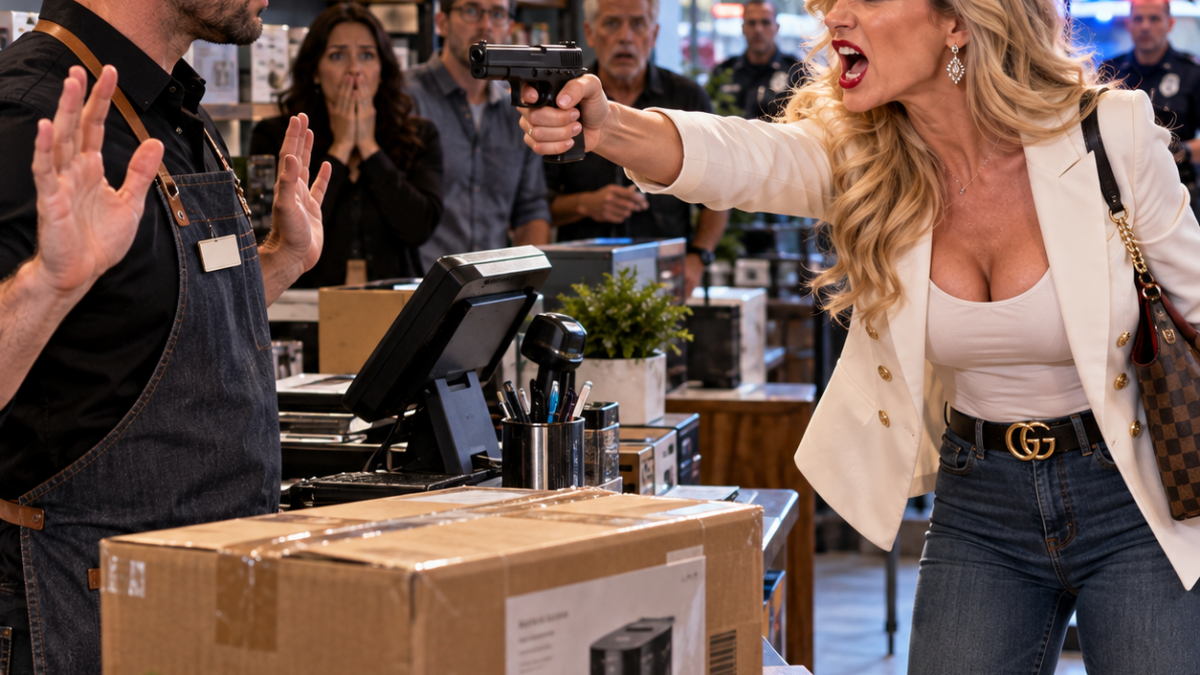
Instead, she pulled out a small handgun.
The shop went silent.
Every sound disappeared except the pounding of my own heartbeat.
She did not point it directly at me at first.
She held it angled down by her side.
But it was out.
In my store.
In her hand.
Over a refund.
The regular froze.
A customer in the aisle stumbled backward and knocked something off a shelf.
My body reacted before my mind caught up.
Hands visible.
Slow movements.
No sudden reaching.
No hero nonsense.
There is no customer service training that prepares you for a gun at the counter. The only rule is simple.
Survive.
Karen’s voice went frighteningly calm.
“Maybe you’ll take me seriously now.”
I placed both hands on the counter, palms up.
“Okay. We’re going to slow down. You need to put that away.”
“Give me my refund.”
“I cannot process any transaction while a weapon is out.”
Her eyes were wide, but not in fear.
In fury.
“You think I care about your policy?”
“This is not policy anymore. This is safety.”
The regular beside me had shifted slightly. I could see, from the corner of my eye, his phone low near a display. He was calling 911.
Bless that man forever.
I kept my eyes on Karen’s hands.
Not the gun.
The hands.
Hands tell you what happens next.
“If you put it away,” I said carefully, “we can continue talking.”
“We’re done talking.”
“Then you need to leave.”
“Last chance.”
The words landed like ice.
Last chance.
Over money she wasn’t owed.
For a product she hadn’t bought from me.
I swallowed.
My mouth was dry.
My hands wanted to shake, but I pressed my palms harder against the counter.
Then I gave her exactly what she had been demanding from the beginning.
“You wanted someone above me.”
She blinked.
“What?”
“You demanded the manager. You demanded the owner. I am both. There is no one above me inside this business.”
She tightened her grip.
“I want my refund.”
“The only authority above me now is the law.”
Her eyes shifted.
For the first time, uncertainty entered her face.
The regular raised his voice slightly, just enough for the phone to catch it.
“She’s holding a gun.”
Karen’s head snapped toward him.
“You called the police?”
I said, “You brought a firearm into a retail store and used it to demand money.”
“I didn’t threaten anyone.”
“You are threatening everyone.”
“This is my right.”
“No. Brandishing a gun to force a refund is not a right.”
She panicked.
The gun came up—not fully aimed, not steady, but high enough that everyone in the room reacted at once.
The customer in the aisle ducked.
The regular stepped back.
My hands went higher.
I heard sirens.
Then everything happened fast.
The door burst open with a violence that made the bell shriek.
Police entered with weapons drawn, shouting commands.
“Drop the gun!”
Karen turned toward the sound, confused, furious, too slow.
A taser fired.
She collapsed hard, the gun skittering across the floor.
Officers moved in instantly.
Hands.
Cuffs.
Commands.
“Do not move.”
“Hands behind your back.”
“Secure the weapon.”
I stayed behind the counter with my hands raised because my brain had decided that was the safest place for them to be.
The regular still had his phone up.
The other customer was pressed against the wall, pale and shaking.
It was over in seconds.
But my body did not understand that.
The lead officer looked at me.
“Is anyone hurt?”
I tried to speak.
Nothing came out at first.
Then I managed, “No.”
“What happened?”
I looked at Karen on the floor, still yelling that she hadn’t threatened anybody.
“She pulled a gun over a return.”
The officer blinked once.
I could see him process the sentence and silently decide he had heard both stranger and stupider things, though maybe not today.
The next hour blurred.
Statements.
Separate interviews.
Camera footage.
Evidence collection.
The gun removed.
Karen taken outside still talking, still insisting she had only wanted service, still saying she hadn’t pointed it directly at anyone as if that made everything normal.
An officer told her, “Ma’am, stop talking.”
She did not.
That seemed to be a pattern in her life.
I gave my statement slowly.
The first visit.
The missing receipt.
The demand for the manager.
The owner name tag.
The threat to return with her husband.
The second visit.
The fake receipt from another store.
The test showing no defect.
The demand for refund.
The gun.
The 911 call.
The police response.
Yes, I wanted to press charges.
Absolutely yes.
I wanted a line in the legal record that said no one gets to walk into a small business, terrorize people with a firearm, and then treat it like a customer service disagreement.
The officers reviewed my security cameras.
Four angles caught everything.
I had installed them years earlier for theft prevention and liability, never imagining I would one day be grateful for the view they gave of a woman pulling a gun at my counter.
One officer watched a clip and said, “That’s clear.”
I felt oddly proud of the camera placement.
Trauma does strange things.
After they left with Karen, the shop became too quiet.
The regular stayed a while.
He put both hands on the counter and asked, “You okay?”
I said something incredibly intelligent like, “I think I need to sit down.”
So I did.
I sat on the stool behind the register and shook.
Not a little.
My whole body trembled like it had been holding itself together with string and someone had finally cut it.
I made coffee I never drank.
Then I called my spouse.
The second I heard her voice, mine broke.
Until then, I had been calm because I had to be. Policy voice. Owner voice. Survival voice. Statement voice.
But hearing someone who loved me ask, “What happened?” took all of that away.
I closed the shop for the rest of the day.
No sale was worth pretending I could stand behind that counter like nothing had happened.
The charges were serious.
Brandishing a firearm.
Menacing.
Assault with a deadly weapon, because using a gun to demand money does not require firing it to become a threat.
Resisting when officers tried to cuff her, because she apparently flailed and twisted even after being tased.
A few smaller charges connected to the disturbance.
The gun was legal for her to own, from what I later heard.
That did not help her much.
A legal gun used illegally is still evidence.
I filed for a restraining order.
The temporary order was granted quickly. Later, after a hearing, it was extended for a set number of years. She could not come near me, my shop, my staff, or contact us. She could not post about us in a way intended to cause harm. She could not send other people to harass us.
People sometimes think restraining orders are just paper.
They are not magic shields, no.
But they give police a clear legal hook if someone shows up where they are not supposed to be.
That mattered.
For weeks after, I looked up every time the bell rang.
My stomach tightened whenever a woman with blonde hair came through the door.
I moved the counter display that had hidden the regular’s phone during the 911 call and left that space open, like some irrational part of me believed the shop needed a clear escape path for sound.
The regular who called 911 became one of my favorite people on earth.
I offered him free service more than once.
He refused.
“Just keep the cameras working,” he said.
I did.
Business recovered.
Slowly.
The story got around town, as stories do. Some people came in just to see the shop where “that crazy return lady pulled a gun.” I hated that at first. Then I realized many of them bought something, and I decided survival could include a sense of humor.
A few customers asked if I changed my policies after that.
I did not.
The policies were never the problem.
The problem was a woman who believed rules existed only until she became loud enough, pretty enough, connected enough, or frightening enough to break them.
Karen had walked into my store demanding hierarchy.
Manager.
Owner.
Someone above you.
She believed there was always another person she could manipulate, charm, threaten, or bully into overruling the underling in front of her.
But small businesses are different.
Sometimes the underling is the owner.
Sometimes the person mopping the floor also signs the lease.
Sometimes the person saying no is the highest authority in the building.
Karen could not accept that.
She kept demanding someone above me until she found them.
They wore badges.
They came through my door with commands.
And they did not care about her fake receipt, her wounded pride, her expensive purse, or whether she knew the mayor.
The law became the manager she asked for.
It overruled her completely.
Months later, after the court proceedings had moved along enough that I no longer checked for updates every day, I took the owner tag out of the drawer and looked at it for a long time.
It was just black plastic with white letters.
A little scratched now.
Nothing special.
But I remembered clipping it on before walking back out to face Karen the first time.
At that moment, the tag had felt funny.
Petty.
A harmless little way to give her exactly what she asked for.
Now it felt heavier.
Because being the owner means you do not get to disappear when things get ugly.
You are the manager.
You are the policy.
You are the one customers demand.
You are the person employees look to, even when the only employee in the room is you.
You are also the person who has to decide, while staring at a gun, whether your voice can stay steady enough to keep everyone alive until help arrives.
I still love my shop.
That surprises some people.
They assume an experience like that ruins a place.
For a while, it did change how the room felt.
The counter seemed too exposed.
The bell sounded too sharp.
The spot where Karen fell seemed marked even after I mopped the floor twice.
But the regulars came back.
The good customers came back.
The routine returned.
Repairs.
Orders.
Coffee gone cold behind the register.
Small victories when customers left happy.
That is what Karen did not destroy.
She frightened us, yes.
She changed the way I think about documentation, cameras, and keeping exits clear.
But she did not get her refund.
She did not break the policy.
She did not make me apologize for rules that existed to keep my business alive.
And she did not turn my shop into a place where the loudest person wins.
Every so often, someone still says, “Can I speak to the manager?”
Most of the time, they are normal.
They have a real issue.
They are frustrated, not dangerous.
I help them if I can.
But every time I hear those words, I glance toward the drawer where the owner tag lives.
And I remember Karen.
Dragging that box.
Pointing at my chest.
Calling me an underling.
Demanding someone above me.
Then discovering, in the worst possible way, that the only authority higher than the owner was waiting one phone call away.
So if there is a lesson in all of this, it is not just “don’t pull a gun over a return,” though that should be obvious to anyone with a functioning brain.
The lesson is simpler.
When you demand the manager, be careful what you are really asking for.
Because sometimes the manager is the owner.
Sometimes the owner has already said no.
And sometimes, if you keep escalating, the next manager comes with a badge, handcuffs, and absolutely no interest in your refund.
𝗧𝗛𝗘 𝗘𝗡𝗗
Karen Demanded the Owner, Then Pulled a Gun When She Realized I Was the One She Couldn’t Overrule
Karen stormed into my shop dragging a box across the floor and demanding a refund for something she could not prove she had bought from me.
When I told her the policy was simple—receipt, inspection, then options—she smiled like she had already won and demanded to speak to the owner.
So I walked into the back, put on my owner name tag, came back out, and watched her realize there was no one above me for her to bully—at least not until she pulled a gun and invited the police to become the highest authority in the room.
My shop is not big.
It sits on a modest commercial street between a bakery and an insurance office, with old brick out front, a bell on the door, shelves along the walls, and a narrow counter that has probably saved me from more bad customer decisions than I care to count. The front room is retail. The back room is repairs, custom work, and whatever chaos has to be hidden from customers so they can keep believing small businesses run on charm instead of caffeine, duct tape, and unpaid overtime.
I built that place from nothing.
Years before, I had worked for other people and promised myself that if I ever owned a shop, I would run it differently. I would be fair. I would be patient. I would treat customers like people and employees like humans instead of replaceable parts.
Then I actually opened the shop and discovered that ownership is less “living your dream” and more “arguing with suppliers at two in the morning about shipping charges while wondering whether the air conditioner can survive one more summer.”
I mopped my own floors.
Fixed my own shelves.
Answered my own phones.
Handled my own angry emails.
Sometimes I ate lunch standing beside the back sink because I did not have ten minutes to sit down.
But I loved it.
I loved my regulars. I loved the rhythm of the place. I loved the little victories: finishing a repair that looked impossible, tracking down a replacement part for someone who thought their item was dead forever, watching a customer leave happy because the thing they cared about had been saved.
Because I was small, my policies had to be clear.
I had them printed on a sheet at the counter and laminated near the door.
No returns on custom orders.
Restocking fee on opened items if they could still be resold.
No exchanges without proof of purchase.
Warranty claims required inspection.
Aggressive or abusive behavior could result in refusal of service.
Those rules were not there because I enjoyed saying no.
They existed because one chaotic interaction can wipe out an entire week’s margin in a small shop. A big chain can absorb someone returning a used, damaged product they might not have even bought there. I could not. A corporate store can shrug off a screaming customer and write off the loss somewhere deep in an accounting department. I was the accounting department.
Most people understood.
Regulars would tap the sign and laugh when they forgot a receipt.
“That one’s on me,” they’d say. “I’ll come back.”
And when someone was polite, I was flexible where I could be.
Then Karen came in.
I knew before she reached the counter that she had rehearsed the fight in the parking lot.
There is a specific energy some people carry when they do not enter a business looking for help. They enter looking for an audience.
The bell chimed when she shoved the door open, and even the bell sounded tired of her before I was.
She was probably in her early forties, maybe mid-forties, and she was dressed like a woman who believed presentation was proof of superiority. Long blonde hair blown out perfectly, oversized sunglasses pushed on top of her head, glossy red lips, fitted white blazer, tight jeans, gold bracelets, perfume sharp enough to announce her before she spoke.
She dragged a large box across the floor behind her, scraping it over the tile like the damage was part of her entrance.
Two regulars were browsing near the side shelves. Another customer was at the counter discussing a custom piece with me. It had been a calm morning until Karen decided calm needed to die.
She dropped the box in the middle of the floor and announced to the room, “I need a full refund immediately.”
No hello.
No explanation.
No receipt.
Just volume.
I shifted into customer-service mode automatically.
Calm voice.
Neutral posture.
Hands visible.
Friendly expression.
I had learned long ago that the louder someone became, the quieter I had to get.
“Good morning,” I said. “What seems to be the problem?”
“It’s defective,” she snapped. “It doesn’t work. I want my money back.”
“Okay. Do you have your receipt?”
She made the face every retail worker knows.
The face that says, I do not have the thing you need, and I have already decided that is your fault.
“I ordered it online from you people. Look it up.”
“Sure. I can look up online orders. What name is it under?”
She gave me a first name.
Only a first name.
I waited.
“And the last name?”
She sighed dramatically and gave it.
I typed it in.
Nothing.
“Do you have the email used for the order?”
“I don’t give out my email.”
I looked at her for a moment.
“You ordered online.”
“Yes.”
“But you don’t give out your email.”
“That’s right.”
I let that statement sit in the air.
Behind her, one of my regulars suddenly found the shelf tags very interesting.
PART 2
I tried another approach.
“Do you have an order number, phone number, or maybe another last name it could be under?”
“It’s under my name.”
“I don’t see it.”
“Then your system is wrong.”
“That’s possible, but I still need something to connect the purchase to the shop.”
She crossed her arms.
“I was just here.”
“When?”
“A few days ago.”
“Do you remember who helped you?”
“You people all look the same behind the counter.”
I was the only person behind the counter.
Actually, that day I was the only person working the entire front of the shop.
“I understand you’re frustrated,” I said. “If the item is defective and under warranty, we can inspect it and help with the claim. If it was purchased here within the return window, we can discuss refund or exchange options. But I need proof of purchase first.”
Her lips curled.
“Why are you making this difficult?”
“I’m not. I’m following the return policy.”
She pointed to the box.
“It shut off by itself and almost hurt someone.”
That stopped me.
The product in question had no battery.
No motor.
No power switch.
No electronics of any kind.
It was about as capable of shutting itself off as my counter was of filing taxes.
“What do you mean it shut off?”
“It stopped working.”
“Can you explain how?”
“It’s junk.”
“Okay. I can take it to the bench and test it right now.”
“I don’t want it tested. I want a refund.”
“I can’t refund something I can’t verify was bought here.”
She leaned over the counter.
“Get your manager.”
There it was.
The retail anthem.
The magic phrase people use when they believe authority is a vending machine and if they press the right button, someone will come out and give them what they want.
I said, “I’m the manager on duty.”
She gave me a slow once-over, from my plain black shirt to my work apron to my name tag.
“No. I want the owner.”
“I can help you with that too.”
“The owner will fix this. I don’t deal with underlings.”
She really said underlings.
Not employees.
Not staff.
Underlings.
Something inside me smiled.
Not outside. Outside, I stayed professional.
But inside, I could feel the malicious compliance waking up.
“One moment,” I said.
I walked into the back.
Not because there was anyone to get.
There wasn’t.
The owner was me.
The manager was me.
On some days, the customer service desk, repair intake, inventory control, janitor, bookkeeper, and emotional support animal were also me.
But I took a moment.
I washed my hands.
Breathed.
Checked my posture in the small mirror by the sink.
Then I opened the drawer where I kept a few spare name tags and took out the black one with white letters that said OWNER.
I clipped it on.
Then I grabbed a fresh copy of our return policy, the order lookup tablet, and an incident documentation form.
Whenever something goes sideways, I write it down while the details are fresh. Time, date, description, witnesses, exact words if I can remember them. That habit had saved me more than once.
When I walked back out, Karen was mid-rant to my regular at the counter.
“This place used to be good before they changed management,” she said.
We had never changed management.
It had always been me.
I stepped behind the counter, put both hands lightly on the surface, and smiled.
“Hi. I’m the owner. How can I help?”
Karen blinked.
It was a beautiful sequence.
Surprise.
Confusion.
Denial.
Anger.
All in less than three seconds.
Then she laughed.
“No. I want the real owner.”
I pointed at the tag.
Then I pointed to the framed business license on the wall behind me, the one with my name on it.
“I am the real owner.”
Her eyes flicked to the license.
Then back to me.
“I’m not interested in games.”
“Neither am I.”
“I want someone above you.”
“There is no one above the owner unless you want to speak to my landlord or my mother, and only one of those will answer the phone.”
One of my regulars made the mistake of smirking.
Karen’s head snapped toward him.
He immediately became fascinated by the floor.
She slapped one manicured hand onto the box.
“Refund. Now.”
I placed the policy sheet on the counter.
“I’m happy to process a return if we can confirm it is defective under warranty and you can provide proof of purchase. Without proof of purchase, the most I can offer is store credit at the most recent sale price minus a restocking fee, but only if the item is in resellable condition. If it’s damaged, used beyond testing, or not from our store, we cannot accept it as a return.”
She stared at me as if I had spoken a dead language.
“Other stores don’t make things this hard.”
“I can’t speak for other stores.”
“You can look me up by my face. Check your cameras.”
“We don’t use facial recognition because we are not a dystopian airport.”
The regular at the counter coughed into his hand.
Karen’s cheeks flushed.
“Do you know who I am?”
“I’m sorry, I don’t.”
“I know people in this city.”
“Okay.”
“I know the mayor.”
“The mayor does not handle our refunds.”
Her eyes narrowed.
“You’re being very disrespectful.”
“I’m applying our policy.”
“I said get your manager.”
I looked down at the OWNER tag.
Then back at her.
“Still me.”
She made a noise like air leaking from a tire.
For a moment, I thought she might explode right there, but instead she grabbed the box awkwardly and began dragging it back toward the door.
Halfway there, she stopped.
Turned.
And pointed at the box.
“Carry this to my car.”
“I can offer you a dolly.”
“No. You carry it.”
“I’m not going to carry an open, disputed product to your car.”
“That is customer service.”
“No. Customer service is helping within reasonable limits. I can give you the dolly.”
She glared.
“You are lazy.”
“Okay.”
“I’m reporting you to the owner.”
I tapped my name tag.
“Copy that.”
Her lips twisted.
Then she delivered the line that changed the entire situation.
“I’m going to come back with my husband, and he won’t be as nice as me.”
The store went quiet.
Threats have texture.
Some are just noise.
Some are performance.
Some tell you a person is considering escalation.
This one had the wrong texture.
I kept my voice flat.
“For safety and documentation, I’m noting that you threatened to return with someone else to escalate the situation. If you come back, bring proof of purchase. We will not tolerate aggressive behavior.”
She laughed sharply.
“Enjoy unemployment.”
Then she dragged the box out, the bell chiming weakly behind her.
I wrote everything down.
Her description.
Time.
What she said.
Who witnessed it.
The regular at the counter shook his head.
“You handled that better than I would have.”
“I’ve had practice.”
I thought that was the end of it.
I have heard “I’ll be back with my husband” more times than I can count, and usually it means nothing. It is part of the script. A final attempt to leave with some illusion of power after policy fails.
But Karen was not done.
She returned later that week, just after opening.
Same box.
No husband.
Different energy.
The first visit had been loud, dramatic, theatrical.
This time, she seemed more controlled. That almost made it worse.
She set the box down carefully on the counter and slid a printed page toward me like she was revealing a winning hand in poker.
“We’re doing this properly. You’re going to test it, and then you’re going to refund me.”
I looked at the paper.
It was a screenshot of a receipt.
Not one of ours.
Same item.
Different store across town.
Wrong vendor.
Wrong receipt format.
Wrong serial number.
I looked up at her.
“Karen, this is from another store.”
“It’s the same product.”
“That doesn’t matter. I can only refund something purchased here.”
“You sell it.”
“Yes.”
“So take it back.”
“No.”
Her composure cracked slightly.
“Why not?”
“Because then I would be paying you for another store’s sale with my money.”
She waved that away like profit margins were an optional belief system.
“You’re all the same.”
“No. We are not.”
“I want it tested.”
“That I can do.”
I carried the item to the back bench.
The test took less than ten minutes.
Visual inspection.
Basic operation.
Check for obvious misuse.
Confirm serial number.
Document condition.
It worked perfectly.
No defect.
No mechanical problem.
Nothing out of spec.
It looked like it had been used a couple of times, repacked badly, and dragged across my floor by a woman with more entitlement than patience.
I brought it back.
“No defect found. It works as designed.”
“It turned off.”
“It doesn’t turn on, Karen. It has no power source.”
“Then I installed it wrong.”
“It doesn’t install.”
She stared at me.
“It sits where you put it.”
“This is harassment.”
“No. This is an inspection.”
“You are harassing me by refusing service.”
“I’m refusing a refund without proof of purchase from my store.”
She snapped, “Get your manager.”
I touched the tag.
“Owner.”
“Get your boss.”
“My mother is unavailable.”
A regular near the side aisle snorted softly and immediately pretended to inspect a price tag like it contained the meaning of life.
Karen heard it.
Her face changed.
Humiliation can make some people leave.
In Karen, it became something darker.
She reached into her oversized purse.
I expected a phone.
Another fake receipt.
Maybe a credit card she would slam down for dramatic effect.
Instead, she pulled out a small handgun.
The shop went silent.
Every sound disappeared except the pounding of my own heartbeat.
She did not point it directly at me at first.
She held it angled down by her side.
But it was out.
In my store.
In her hand.
Over a refund.
The regular froze.
A customer in the aisle stumbled backward and knocked something off a shelf.
My body reacted before my mind caught up.
Hands visible.
Slow movements.
No sudden reaching.
No hero nonsense.
There is no customer service training that prepares you for a gun at the counter. The only rule is simple.
Survive.
Karen’s voice went frighteningly calm.
“Maybe you’ll take me seriously now.”
I placed both hands on the counter, palms up.
“Okay. We’re going to slow down. You need to put that away.”
“Give me my refund.”
“I cannot process any transaction while a weapon is out.”
Her eyes were wide, but not in fear.
In fury.
“You think I care about your policy?”
“This is not policy anymore. This is safety.”
The regular beside me had shifted slightly. I could see, from the corner of my eye, his phone low near a display. He was calling 911.
Bless that man forever.
I kept my eyes on Karen’s hands.
Not the gun.
The hands.
Hands tell you what happens next.
“If you put it away,” I said carefully, “we can continue talking.”
“We’re done talking.”
“Then you need to leave.”
“Last chance.”
The words landed like ice.
Last chance.
Over money she wasn’t owed.
For a product she hadn’t bought from me.
I swallowed.
My mouth was dry.
My hands wanted to shake, but I pressed my palms harder against the counter.
Then I gave her exactly what she had been demanding from the beginning.
“You wanted someone above me.”
She blinked.
“What?”
“You demanded the manager. You demanded the owner. I am both. There is no one above me inside this business.”
She tightened her grip.
“I want my refund.”
“The only authority above me now is the law.”
Her eyes shifted.
For the first time, uncertainty entered her face.
The regular raised his voice slightly, just enough for the phone to catch it.
“She’s holding a gun.”
Karen’s head snapped toward him.
“You called the police?”
I said, “You brought a firearm into a retail store and used it to demand money.”
“I didn’t threaten anyone.”
“You are threatening everyone.”
“This is my right.”
“No. Brandishing a gun to force a refund is not a right.”
She panicked.
The gun came up—not fully aimed, not steady, but high enough that everyone in the room reacted at once.
The customer in the aisle ducked.
The regular stepped back.
My hands went higher.
I heard sirens.
Then everything happened fast.
The door burst open with a violence that made the bell shriek.
Police entered with weapons drawn, shouting commands.
“Drop the gun!”
Karen turned toward the sound, confused, furious, too slow.
A taser fired.
She collapsed hard, the gun skittering across the floor.
Officers moved in instantly.
Hands.
Cuffs.
Commands.
“Do not move.”
“Hands behind your back.”
“Secure the weapon.”
I stayed behind the counter with my hands raised because my brain had decided that was the safest place for them to be.
The regular still had his phone up.
The other customer was pressed against the wall, pale and shaking.
It was over in seconds.
But my body did not understand that.
The lead officer looked at me.
“Is anyone hurt?”
I tried to speak.
Nothing came out at first.
Then I managed, “No.”
“What happened?”
I looked at Karen on the floor, still yelling that she hadn’t threatened anybody.
“She pulled a gun over a return.”
The officer blinked once.
I could see him process the sentence and silently decide he had heard both stranger and stupider things, though maybe not today.
The next hour blurred.
Statements.
Separate interviews.
Camera footage.
Evidence collection.
The gun removed.
Karen taken outside still talking, still insisting she had only wanted service, still saying she hadn’t pointed it directly at anyone as if that made everything normal.
An officer told her, “Ma’am, stop talking.”
She did not.
That seemed to be a pattern in her life.
I gave my statement slowly.
The first visit.
The missing receipt.
The demand for the manager.
The owner name tag.
The threat to return with her husband.
The second visit.
The fake receipt from another store.
The test showing no defect.
The demand for refund.
The gun.
The 911 call.
The police response.
Yes, I wanted to press charges.
Absolutely yes.
I wanted a line in the legal record that said no one gets to walk into a small business, terrorize people with a firearm, and then treat it like a customer service disagreement.
The officers reviewed my security cameras.
Four angles caught everything.
I had installed them years earlier for theft prevention and liability, never imagining I would one day be grateful for the view they gave of a woman pulling a gun at my counter.
One officer watched a clip and said, “That’s clear.”
I felt oddly proud of the camera placement.
Trauma does strange things.
After they left with Karen, the shop became too quiet.
The regular stayed a while.
He put both hands on the counter and asked, “You okay?”
I said something incredibly intelligent like, “I think I need to sit down.”
So I did.
I sat on the stool behind the register and shook.
Not a little.
My whole body trembled like it had been holding itself together with string and someone had finally cut it.
I made coffee I never drank.
Then I called my spouse.
The second I heard her voice, mine broke.
Until then, I had been calm because I had to be. Policy voice. Owner voice. Survival voice. Statement voice.
But hearing someone who loved me ask, “What happened?” took all of that away.
I closed the shop for the rest of the day.
No sale was worth pretending I could stand behind that counter like nothing had happened.
The charges were serious.
Brandishing a firearm.
Menacing.
Assault with a deadly weapon, because using a gun to demand money does not require firing it to become a threat.
Resisting when officers tried to cuff her, because she apparently flailed and twisted even after being tased.
A few smaller charges connected to the disturbance.
The gun was legal for her to own, from what I later heard.
That did not help her much.
A legal gun used illegally is still evidence.
I filed for a restraining order.
The temporary order was granted quickly. Later, after a hearing, it was extended for a set number of years. She could not come near me, my shop, my staff, or contact us. She could not post about us in a way intended to cause harm. She could not send other people to harass us.
People sometimes think restraining orders are just paper.
They are not magic shields, no.
But they give police a clear legal hook if someone shows up where they are not supposed to be.
That mattered.
For weeks after, I looked up every time the bell rang.
My stomach tightened whenever a woman with blonde hair came through the door.
I moved the counter display that had hidden the regular’s phone during the 911 call and left that space open, like some irrational part of me believed the shop needed a clear escape path for sound.
The regular who called 911 became one of my favorite people on earth.
I offered him free service more than once.
He refused.
“Just keep the cameras working,” he said.
I did.
Business recovered.
Slowly.
The story got around town, as stories do. Some people came in just to see the shop where “that crazy return lady pulled a gun.” I hated that at first. Then I realized many of them bought something, and I decided survival could include a sense of humor.
A few customers asked if I changed my policies after that.
I did not.
The policies were never the problem.
The problem was a woman who believed rules existed only until she became loud enough, pretty enough, connected enough, or frightening enough to break them.
Karen had walked into my store demanding hierarchy.
Manager.
Owner.
Someone above you.
She believed there was always another person she could manipulate, charm, threaten, or bully into overruling the underling in front of her.
But small businesses are different.
Sometimes the underling is the owner.
Sometimes the person mopping the floor also signs the lease.
Sometimes the person saying no is the highest authority in the building.
Karen could not accept that.
She kept demanding someone above me until she found them.
They wore badges.
They came through my door with commands.
And they did not care about her fake receipt, her wounded pride, her expensive purse, or whether she knew the mayor.
The law became the manager she asked for.
It overruled her completely.
Months later, after the court proceedings had moved along enough that I no longer checked for updates every day, I took the owner tag out of the drawer and looked at it for a long time.
It was just black plastic with white letters.
A little scratched now.
Nothing special.
But I remembered clipping it on before walking back out to face Karen the first time.
At that moment, the tag had felt funny.
Petty.
A harmless little way to give her exactly what she asked for.
Now it felt heavier.
Because being the owner means you do not get to disappear when things get ugly.
You are the manager.
You are the policy.
You are the one customers demand.
You are the person employees look to, even when the only employee in the room is you.
You are also the person who has to decide, while staring at a gun, whether your voice can stay steady enough to keep everyone alive until help arrives.
I still love my shop.
That surprises some people.
They assume an experience like that ruins a place.
For a while, it did change how the room felt.
The counter seemed too exposed.
The bell sounded too sharp.
The spot where Karen fell seemed marked even after I mopped the floor twice.
But the regulars came back.
The good customers came back.
The routine returned.
Repairs.
Orders.
Coffee gone cold behind the register.
Small victories when customers left happy.
That is what Karen did not destroy.
She frightened us, yes.
She changed the way I think about documentation, cameras, and keeping exits clear.
But she did not get her refund.
She did not break the policy.
She did not make me apologize for rules that existed to keep my business alive.
And she did not turn my shop into a place where the loudest person wins.
Every so often, someone still says, “Can I speak to the manager?”
Most of the time, they are normal.
They have a real issue.
They are frustrated, not dangerous.
I help them if I can.
But every time I hear those words, I glance toward the drawer where the owner tag lives.
And I remember Karen.
Dragging that box.
Pointing at my chest.
Calling me an underling.
Demanding someone above me.
Then discovering, in the worst possible way, that the only authority higher than the owner was waiting one phone call away.
So if there is a lesson in all of this, it is not just “don’t pull a gun over a return,” though that should be obvious to anyone with a functioning brain.
The lesson is simpler.
When you demand the manager, be careful what you are really asking for.
Because sometimes the manager is the owner.
Sometimes the owner has already said no.
And sometimes, if you keep escalating, the next manager comes with a badge, handcuffs, and absolutely no interest in your refund.