Karen Climbed a Ladder to Photograph Me in My Own Pool, Then Told the Whole Town I Was the Predator
part2
People who have never spent a summer in certain parts of Eastern Europe imagine cool breezes, old stone streets, and weather that politely respects history.
That is nonsense.
The heat came heavy and wet. Not desert heat. Worse, in my opinion. Humid heat. The kind that wraps around your neck, crawls under your shirt, and makes even shade feel used. Some afternoons reached around twenty-seven degrees Celsius, eighty-two Fahrenheit, sometimes more. That does not sound unbearable on paper, but paper does not sweat.
The house trapped warmth.
The town slowed.
Even the cats looked offended by the sun.
One afternoon, after visiting my grandmother and carrying groceries back through air that felt thick enough to chew, I decided I had earned the pool. I closed the gate, checked the fence, dropped my towel on a chair, and stood there in the privacy of my backyard.
There is no elegant way to say this.
I decided to swim naked.
I know some people find that strange. I understand. In public, absolutely not. At a community pool, never. Around neighbors, no. But this was my private backyard, behind a tall fence I had paid for, in a pool I had restored, on a day when even clothing felt like an insult.
So I did it.
I slipped into the water and felt the heat fall away from my skin like a burden.
For almost an hour, I floated.
That is all.
No scandal. No performance. No invitation. No audience.
Just me, the water, the sun, and one of those circular floaties that made me look ridiculous but comfortable. I watched small clouds drift above the fence line. I listened to birds, distant voices, a lawn tool buzzing somewhere down the street. For the first time since the move, I felt fully at home in my own space.
Then I felt watched.
You know the feeling.
The hair at the back of the neck before the brain has evidence. A shift in the air. A sense that privacy has cracked.
At first, I ignored it.
I told myself I was being paranoid because the neighbors had filled my head with Karen stories. Then the feeling sharpened. My stomach tightened. I turned my head slowly toward the fence between my yard and hers.
There she was.
Karen.
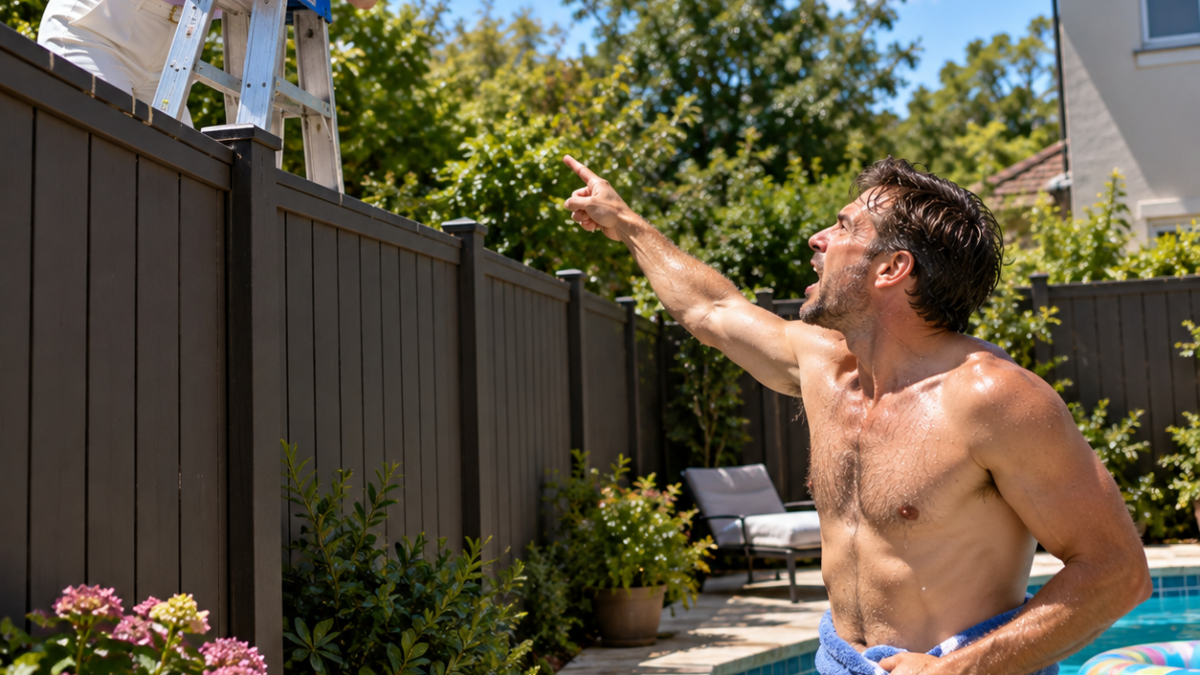
Above a fence over two meters high.
Standing on a ladder.
Holding up her phone.
Taking pictures of me.
For a second, my body forgot what to do.
Then panic hit.
I rolled off the floatie, splashed hard, and covered myself with my arms as best I could.
“What the hell are you doing?” I shouted.
Karen froze, phone still in hand.
She was a narrow woman in her late fifties, with dyed hair pulled into a stiff bun and a face arranged in permanent suspicion. She wore a sleeveless blouse and a look of righteous disgust, as if I had climbed into her yard and offended her deliberately.
“Put that phone down!” I yelled.
She disappeared behind the fence.
I heard the ladder scrape.
I shouted again, louder, angrier, my voice cracking.
No answer.
I stood in the pool shaking, suddenly cold despite the heat. The violation of it hit me in layers. Not just being seen. Not even just being photographed. It was the effort she had made. The ladder. The waiting. The decision to turn my privacy into evidence of something.
I climbed out, grabbed my towel, wrapped it around myself, and ran inside.
My hands were shaking so badly I struggled to pull on clothes.
Once dressed, I marched to her house and pounded on the door.
At first, I tried knocking like a civilized person.
Then I hit the door with the side of my fist hard enough to hurt.
“Karen!” I shouted. “Open the door!”
Nothing.
I could hear movement inside. I was sure of it. A floor creak. Maybe a curtain. But nobody answered.
I stood there far too long, breathing hard, aware that if someone saw me yelling outside a neighbor’s house, I would look like the unstable one. That thought made me even angrier, because people like Karen count on exactly that. They violate quietly, then wait for you to react loudly.
Finally, I walked home.
I did not call the police.
That was my first mistake.
At the time, I had no proof. No camera angle. No witness. I thought Karen might already have deleted the photos. I imagined trying to explain to an officer, in a language I spoke but not with perfect emotional precision, that my neighbor had climbed a ladder to photograph me naked in my own private pool. I imagined Karen denying everything. I imagined becoming the foreign guy who created drama two months after moving in.
So instead, I called my mother.
That may have been more dangerous than calling the police.
She exploded.
She cursed in three languages, threatened to walk over and tear Karen’s phone from her hand, then threatened to bring my grandmother, which somehow sounded worse. My mother is not a large woman, but when angry she becomes ancestral. I spent twenty minutes calming her down, which was absurd because I was the one who had been photographed.
“Do not go there,” I told her. “Please.”
“She took pictures of you!”
“I know.”
“She must delete them.”
“I know.”
“She must be taught shame.”
“I agree, but not tonight.”
My mother was silent for a moment.
Then she said, “I warned you that town women can be devils.”
“You warned me after telling me everyone was wonderful.”
“Both can be true.”
That night, I tried to sleep.
I couldn’t.
Every time I closed my eyes, I saw Karen above the fence, phone raised, face tight with satisfaction. I kept wondering what she had captured. How much. From what angle. Whether she had sent anything to anyone. Whether she was looking at the photos while I lay there feeling my own skin become unfamiliar.
Around ten o’clock, the doorbell rang.
I froze.
Then I went downstairs and opened the door.
A police officer stood outside.
He was middle-aged, tired-looking, polite. Behind him, the street was quiet.
“Good evening,” he said. “We received a complaint.”
My stomach dropped.
“From my neighbor?”
He did not answer directly.
“The complaint alleges indecent exposure.”
For a moment, all I could do was stare at him.
Then I laughed once, not because anything was funny, but because the alternative was screaming.
“She climbed a ladder to look over my fence and photograph me in my own pool,” I said. “And she called you on me?”
His face shifted slightly.
“May I ask what happened?”
I explained.
Everything.
The heat. The private yard. The fence. The pool. Karen on the ladder. The phone. My confrontation. Her refusal to answer the door.
I admitted I had been nude, because lying would have made me feel dirtier than the accusation. I emphasized that I had been completely inside my own fenced property, not visible to anyone unless they climbed high enough to spy.
The officer listened, but I could see skepticism in his face. Not disbelief exactly. More like he had entered expecting one kind of problem and found a neighbor dispute wearing very little dignity.
He asked to see the backyard.
I showed him the fence.
He looked up at it.
“You are saying she saw over this?”
“Yes. From a ladder.”
He nodded slowly.
“I will speak with her and with other neighbors.”
“Can you make her delete the photos?”
“If photos exist, we will address it.”
If photos exist.
I hated that phrase.
He left.
The next day, he returned and told me he had spoken to other neighbors, none of whom had seen me do anything inappropriate. He apologized for the disturbance and said he had warned Karen about making accusations she could not support. I asked again about the photos. He said he would tell her to delete anything she had taken.
I wanted to believe that was the end.
It wasn’t.
For about two weeks, something in the neighborhood changed.
At first, I thought I was imagining it. People who had waved warmly now looked away. Conversations stopped when I approached. A woman who used to smile at me outside the bakery lowered her eyes and walked past. Two men who had come to my housewarming party went quiet when I greeted them near the corner shop.
I am not naturally social enough to demand explanations from people, especially in a new place, so I withdrew.
Maybe I had misunderstood.
Maybe people were busy.
Maybe the friendly beginning had simply cooled.
But shame makes you sensitive to temperature.
And the neighborhood had gone cold.
Then one afternoon, a woman named Ana knocked on my door.
She lived three houses down, a kind woman in her forties who had brought cake when I moved in and had known my mother as a girl. She stood on my doorstep twisting her hands together.
“I need to speak with you privately,” she said.
My chest tightened.
“Of course.”
She came inside, refused tea, then sat at my kitchen table and took out her phone.
“I am sorry,” she said before showing me anything.
That is never a good beginning.
She opened a community forum.
There were the photos.
My photos.
Taken from above my fence, zoomed in, violating, blurry in places but clear enough. Me in the pool. Me on the floatie. Me turning in alarm. Me trying to cover myself.
My throat closed.
Ana looked away respectfully while I stared.
“She posted these?” I asked.
“Not only there,” Ana said quietly. “She sent them in messages too.”
I gripped the edge of the table.
“What did she say?”
Ana swallowed.
“She said you exposed yourself at the public pool near the neighborhood. She said you were dangerous. A sexual predator.”
The room seemed to tilt.
I had done nothing to Karen.
Nothing.
I had avoided her, respected distance, kept to myself, lived quietly, restored my pool, visited my grandmother, and tried to build a new life in a town where my family roots ran deep but my own face was still unfamiliar.
And she had taken stolen images of my naked body and used them to brand me a predator.
Not creepy.
Not inappropriate.
Not strange.
A predator.
That word does not merely damage a reputation. It burns a mark into it.
I sat down because my legs felt unreliable.
Ana leaned forward.
“I do not believe her.”
I looked at her.
“I saw the angle,” she said. “Anyone can see these were taken from above. And I know that public pool. This is not it. This is your yard.”
Relief and humiliation collided so sharply I almost cried.
“Do other people know?”
“Some believe her. Some are unsure. Many do not know you well enough yet.”
That hurt because it was true.
Karen had chosen her moment perfectly. I was new. Friendly, but not established. People liked my mother, remembered my grandmother, but they did not know me. When a community has not yet decided who you are, a lie can arrive first and sit in your chair.
Ana touched my hand.
“You should not let this pass.”
I didn’t.
The next morning, I called a lawyer.
His name was Petar, and he came recommended by one of my mother’s cousins, who described him as “expensive but not stupid,” which in my family is high praise. I met him in a small office above a pharmacy, carrying printed screenshots, Ana’s written statement, the police visit information, and every detail I could remember.
Petar listened without interrupting.
When I finished, he leaned back and said, “You are completely in the right.”
Hearing it stated so plainly nearly undid me.
“You were on your private property,” he continued. “Behind a high fence. Nude swimming in that context is not illegal. Her climbing to photograph you is the problem. Posting and distributing those images is a much bigger problem. Defamation, privacy violation, possible criminal exposure depending on how far this went.”
“Can I make her take them down?”
“Yes.”
“Can I make her apologize?”
“Likely.”
“Can I sue?”
He gave me a thin smile.
“Absolutely.”
I did not want to go straight to court.
That may sound weak. Maybe it was. But I had just moved there. My mother and grandmother lived nearby. I did not want this ugly thing to become the defining story of our family’s return. I wanted the photos gone, the lie corrected, and my neighbors to stop looking at me like a danger.
Petar warned me that giving Karen a chance might let her destroy evidence or twist the story again.
I knew he was right.
Still, I wanted to try.
Not because Karen deserved grace.
Because I wanted control over how large the fire became.
I saw her two days later in her yard.
She was hanging laundry with quick, irritated movements. The second she saw me coming, she tried to retreat toward her back door.
“Karen!” I called.
She moved faster.
I did too.
By the time she reached the steps, I was at the fence gate between the front paths.
“We need to talk.”
“I have nothing to say to you,” she snapped.
“You took photos of me in my private pool and posted them online.”
Her face went still, then rearranged itself into outrage.
“I don’t know what you’re talking about.”
“I have screenshots.”
Her eyes flickered.
“I was protecting the community.”
“You told people I exposed myself at the public pool.”
“You were naked.”
“Because you climbed a ladder to spy into my private yard.”
She crossed her arms.
“If you behave indecently, people will see.”
“Not unless they bring equipment.”
Her mouth tightened.
“You people come here and think you can do anything.”
You people.
There it was.
Not just prudishness.
Territory.
I stepped closer to the gate.
“I spoke to a lawyer. What you did is illegal. The photos, the post, the accusation. All of it. I can sue you. I can go back to the police. I can make this very serious.”
Color drained slightly from her face.
For the first time, Karen looked less righteous than afraid.
“I did not mean—”
“Yes, you did. But I am giving you one chance. Take down every photo. Delete every message you can. Post publicly that you lied, that I am not a predator, and that the incident did not happen at the public pool. If you do not, I go forward legally.”
She stared at me.
I could almost see the calculation in her eyes. Deny? Cry? Attack? Run? She had probably spent years causing trouble and escaping consequences through noise and stubbornness. But stolen nude photos and false accusations were not the same as complaining about hedges. This had weight.
Finally, she said, “Fine.”
I blinked.
I had expected a fight.
“Tonight,” I said.
“Fine.”
“And if you leave even one photo up—”
“I said fine.”
She slammed the door.
That night, I refreshed the community forum until my eyes hurt.
At 9:42 p.m., Karen posted.
Her paragraph was short, stiff, and clearly painful for her to write.
She stated that her previous post about me had been false. She wrote that I was not a sexual predator, that the incident had not occurred at the public pool, and that she had made an “error in judgment.” She did not explicitly admit she had climbed a ladder or taken the photos without permission, but she removed them.
The comments began almost immediately.
What?
Karen, what did you do?
So those photos were from his yard?
You lied about this?
Ana commented first:
He was in his private backyard. You should be ashamed.
After that, the tide turned quickly.
People apologized.
Some publicly.
Some privately.
Several neighbors came to my door over the next week. One brought pastries. Another brought wine. One older man who had avoided my eyes at the shop stood awkwardly on my doorstep and said, “I should have known better. Your grandmother’s family are good people.”
That apology was imperfect.
But I accepted it.
The thing about reputation is that even when repaired, you still remember who believed the first version.
I did not hate them for doubting me.
I understood it, sort of. The accusation was serious. People wanted to believe they were protecting others. But I also felt the bruise of how quickly warmth can become suspicion when someone weaponizes shame.
Karen’s apology did not end things the way she hoped.
Her public post led to more questions. People had seen the photos. They understood the angle. They began asking why she had them in the first place. Someone reported the situation again. Ana gave a statement. The original officer came back, this time with a very different expression.
There was an investigation.
Karen had not deleted everything. That did not surprise me. People who take photos like trophies rarely discard all trophies. Some images were recovered from messages she had sent. Her claim that I had exposed myself in a public place collapsed quickly once the pool, fence, and photo angles were documented.
In the end, she had to pay compensation.
The amount was roughly equivalent to one thousand American dollars. Not life-changing money. Not enough to erase the humiliation. But enough to make the point official.
She had done wrong.
Not me.
I also installed a security camera after that.
Not aimed into Karen’s property. I was not going to become what she was. The camera faced my fence line, covering the top edge where she had peered over, with motion detection that alerted me if anyone approached that side from a height. The installer asked if I had problems with animals.
“In a way,” I said.
Karen left me alone after that.
Completely.
No looks over the fence. No comments. No complaints that reached me. No forum posts. She seemed to vanish from the neighborhood’s public life, which, according to Ana, was the closest Karen had ever come to self-improvement.
People stopped listening to her the way they had before.
That may have been the deepest punishment for her. Not the fine. Not the police. Not the legal fear. Karen had built herself into the town’s unofficial alarm bell, always ringing about someone else’s behavior. After this, when she rang, people checked the source of the noise instead of running toward it.
My life in the town slowly healed.
That is the word I would use.
Healed.
Not instantly. For months, I felt exposed even fully clothed. In the pool, I kept glancing at the fence. The first time I swam again, I wore trunks, checked the camera twice, and lasted only fifteen minutes before going inside. It made me furious that she had taken ease from me. Privacy, once violated, does not simply return because someone pays a fine.
But piece by piece, I took it back.
My mother came over one afternoon and sat by the pool like a security guard in a summer dress, daring the fence to move. My grandmother visited once, walking slowly with her cane, and looked at the fence, the camera, the water, and then at me.
“Bad people hate curtains,” she said.
I frowned.
“What?”
“They hate when others close curtains. They think every window belongs to them.”
It sounded better in her language.
Still, I understood.
She patted my hand.
“Swim. This is your house.”
So I did.
Not naked that day.
I was not ready.
But I swam.
The water held me the same as before. That felt important. Karen had changed the air around the pool, but not the pool itself. Not the sunlight. Not the way water loosened something inside me. Not the reason I had restored it in the first place.
Summer continued.
The humidity stayed rude.
My grandmother’s health rose and fell in small waves. Some days she felt strong enough to argue about recipes. Other days she slept most of the afternoon while my mother sat near her bed pretending not to worry. I visited daily. I learned more family stories. I repaired things around my house. I practiced the local dialect. I got better at buying vegetables from women who judged tomatoes like precious stones.
The neighborhood warmed again.
Differently this time.
Less bright, maybe, but deeper. People knew me now not only as my mother’s son or Grandma’s grandson, not only as the man from the west who bought the little house with the old pool, but as someone who had been wronged and did not disappear. There is a strange kind of belonging that comes after a public test. I would not recommend it, but I cannot deny it changed how people saw me.
And maybe how I saw myself.
Before Karen, I had thought moving there was my attempt to escape a life that felt empty.
After Karen, I understood I was not escaping.
I was choosing.
Choosing family.
Choosing place.
Choosing the difficult tenderness of returning to roots I had known only in pieces.
Choosing to stay even after someone tried to make me ashamed in my own backyard.
That mattered.
As for Karen, I saw her occasionally.
At the shop. Across the street. Once near the church, speaking to a woman who kept glancing at me while pretending not to. Karen never approached. Never apologized properly. Never looked me directly in the eyes for more than a second.
That was fine.
I did not need her remorse to know the truth.
The truth had already been written in screenshots, police notes, lawyer letters, recovered messages, and a forced public correction she probably typed with clenched teeth.
Sometimes, even now, I think about the moment I looked up and saw her above the fence.
It still makes my stomach tighten.
Not because of my body.
That is the lesson I fought hardest to keep.
My body was never the shameful thing.
Her gaze was.
Her ladder was.
Her phone was.
Her lie was.
She tried to turn privacy into guilt, nudity into predation, and a stranger’s trust into a weapon. She counted on people being too disgusted or frightened by the accusation to ask practical questions. Where was the photo taken? How did she see over the fence? Why would a predator be floating alone in his own pool behind two meters of wood?
Lies often depend on speed.
Truth takes longer because it has to gather its documents.
But truth is patient.
By the end, everyone knew.
Karen had climbed.
Karen had photographed.
Karen had lied.
And I had been exactly where I said I was.
At home.
In my own pool.
Behind my own fence.
Living my own life.
The next summer, during the first truly hot week, I went swimming again in the afternoon. The fence stood solid. The camera light blinked quietly. Birds argued in the trees. Somewhere down the street, a neighbor laughed. The water was cool enough to make me gasp.
I floated on the same ridiculous circular floatie.
I looked up at the sky.
For a moment, I felt that old peace return—not untouched, not innocent, but mine.
That is what privacy is, I think.
Not secrecy.
Not shame.
A boundary.
A simple human right to exist without becoming someone else’s spectacle.
Karen needed a ladder to violate that boundary.
I needed courage, witnesses, law, and one stubborn refusal to let her version of me become the town’s truth.
She paid for what she did.
But more importantly, she failed.
She wanted to make me feel like I did not belong.
Instead, she showed the whole neighborhood exactly why I deserved to be left in peace.
𝗧𝗛𝗘 𝗘𝗡𝗗
Karen Climbed a Ladder to Photograph Me in My Own Pool, Then Told the Whole Town I Was the Predator
Karen needed a ladder to see over my fence, but somehow she still told the police I had exposed myself to her.
She thought one ugly lie would turn my new neighbors against me before I had a chance to belong.
What she did not know was that lies built on stolen photos have a way of developing fingerprints.
I moved east because my grandmother was getting old.
That is the simplest way to explain it, though nothing about leaving one life behind for another is ever truly simple. I was born in Western Europe, raised in a country where everything ran on schedules, paperwork, quiet efficiency, and a strange kind of loneliness I had never been able to name. My family, though, came from Eastern Europe. My mother was born in a small town there, the kind of town where everybody knew who had painted their fence badly, who had married too quickly, who still made the best plum cake, and which old men could not be trusted with homemade liquor after sunset.
My grandmother still lived there.
She had always refused to leave.
When I was a child, we visited once or twice a year. I remember her kitchen before I remember almost anything else about the town. The smell of onions frying in butter, dried herbs hanging near the window, thick curtains, the old radio murmuring in the corner, my grandmother pressing food on me like hunger was a personal insult to her honor. She had hands that were always warm, always busy, always stronger than they looked.
As I got older, the visits became less magical and more complicated. Life got busy. Work happened. Relationships happened. Bills happened. I became the kind of adult who told himself he would call tomorrow, visit next summer, make time soon.
Then my mother called and said Grandma’s health was getting worse.
Not suddenly. Not dramatically. Worse in that slow, frightening way that gives you enough time to feel guilty but not enough time to undo the years. She was still herself, still sharp enough to criticize the way doctors pronounced things, still stubborn enough to pretend she did not need help. But she was tired. More tired than she admitted.
My mother wanted to go back.
Not for a visit.
To stay.
She wanted to live in her family home again, take care of Grandma, and spend whatever time remained close enough to hear her voice every day.
I surprised both of us when I said I would come too.
Part of it was duty. Part of it was love. But if I am honest, part of it was escape. I was dissatisfied with the life I had built where I was. Nothing catastrophic had happened. No dramatic breakup, no bankruptcy, no scandal. Just a quiet emptiness that had settled into my routine until every day felt like a copy of the one before it. Work, apartment, grocery store, polite conversations, sleep, repeat. I had become efficient at living and terrible at feeling alive.
Moving to my mother’s hometown frightened me.
That was one reason I did it.
My mother moved into Grandma’s house, which was too small for all three of us but perfect for the two of them. I bought a little house nearby. It was cheap compared to anything I could have afforded back west, small but solid, with old windows, creaky floors, and a backyard that looked neglected but full of possibility. I could walk to my mother and grandmother’s house in ten minutes. That mattered more than square meters.
The house had one strange luxury.
A pool.
An old one.
When I first saw it, luxury was not the word that came to mind. It sat in the backyard like an abandoned memory, drained and stained, full of leaves, dirt, and whatever else the seasons had dropped into it while nobody cared. The tiles were grimy. The pump system needed work. The bottom had dark marks that made me wonder if I was looking at mineral stains or the outline of some ancient swamp creature.
The realtor called it “a charming feature.”
I called it a project.
But I have always loved swimming.
Water has a way of quieting the noise in my head. So after I bought the house, I decided to restore the pool. It took months. Cleaning, repairs, new parts, more money than I wanted to admit, and help from a local guy who looked at the old pump and said several things in a dialect I only half understood, none of them flattering.
Eventually, though, the pool came back to life.
Clear water.
Blue tiles.
Sunlight rippling over the bottom.
I also installed a fence around the backyard.
A tall one, around two meters high, a little over six and a half feet. Not because I wanted to be unfriendly. Quite the opposite. The town had welcomed me warmly. My mother’s old neighbors had brought bread, fruit, flowers, jars of preserved vegetables, and opinions about my house before I had unpacked two boxes. They organized an impromptu housewarming party that got out of hand in the best possible way. Several men drank too much, refused to leave, and ended up arguing cheerfully about football in my kitchen until midnight.
People were kind.
Direct, sometimes too direct.
Curious, sometimes too curious.
But kind.
During that party, several neighbors warned me about the woman next door.
Karen.
Not her real name, of course, though honestly it should have been.
She was, according to everyone, the neighborhood menace. Rude. Controlling. Suspicious. Always watching, always complaining, always making herself the victim of situations she created. One man told me she once called the municipal office because a neighbor’s grapevine had grown “too joyfully” near her fence.
I assumed they were exaggerating.
Every neighborhood has gossip.
Every town has one person everyone blames for every bad mood.
Still, I took the advice.
I stayed away from Karen.
For a few peaceful weeks, it worked.
Then summer arrived.
And so did the heat.
part2
People who have never spent a summer in certain parts of Eastern Europe imagine cool breezes, old stone streets, and weather that politely respects history.
That is nonsense.
The heat came heavy and wet. Not desert heat. Worse, in my opinion. Humid heat. The kind that wraps around your neck, crawls under your shirt, and makes even shade feel used. Some afternoons reached around twenty-seven degrees Celsius, eighty-two Fahrenheit, sometimes more. That does not sound unbearable on paper, but paper does not sweat.
The house trapped warmth.
The town slowed.
Even the cats looked offended by the sun.
One afternoon, after visiting my grandmother and carrying groceries back through air that felt thick enough to chew, I decided I had earned the pool. I closed the gate, checked the fence, dropped my towel on a chair, and stood there in the privacy of my backyard.
There is no elegant way to say this.
I decided to swim naked.
I know some people find that strange. I understand. In public, absolutely not. At a community pool, never. Around neighbors, no. But this was my private backyard, behind a tall fence I had paid for, in a pool I had restored, on a day when even clothing felt like an insult.
So I did it.
I slipped into the water and felt the heat fall away from my skin like a burden.
For almost an hour, I floated.
That is all.
No scandal. No performance. No invitation. No audience.
Just me, the water, the sun, and one of those circular floaties that made me look ridiculous but comfortable. I watched small clouds drift above the fence line. I listened to birds, distant voices, a lawn tool buzzing somewhere down the street. For the first time since the move, I felt fully at home in my own space.
Then I felt watched.
You know the feeling.
The hair at the back of the neck before the brain has evidence. A shift in the air. A sense that privacy has cracked.
At first, I ignored it.
I told myself I was being paranoid because the neighbors had filled my head with Karen stories. Then the feeling sharpened. My stomach tightened. I turned my head slowly toward the fence between my yard and hers.
There she was.
Karen.
Above a fence over two meters high.
Standing on a ladder.
Holding up her phone.
Taking pictures of me.
For a second, my body forgot what to do.
Then panic hit.
I rolled off the floatie, splashed hard, and covered myself with my arms as best I could.
“What the hell are you doing?” I shouted.
Karen froze, phone still in hand.
She was a narrow woman in her late fifties, with dyed hair pulled into a stiff bun and a face arranged in permanent suspicion. She wore a sleeveless blouse and a look of righteous disgust, as if I had climbed into her yard and offended her deliberately.
“Put that phone down!” I yelled.
She disappeared behind the fence.
I heard the ladder scrape.
I shouted again, louder, angrier, my voice cracking.
No answer.
I stood in the pool shaking, suddenly cold despite the heat. The violation of it hit me in layers. Not just being seen. Not even just being photographed. It was the effort she had made. The ladder. The waiting. The decision to turn my privacy into evidence of something.
I climbed out, grabbed my towel, wrapped it around myself, and ran inside.
My hands were shaking so badly I struggled to pull on clothes.
Once dressed, I marched to her house and pounded on the door.
At first, I tried knocking like a civilized person.
Then I hit the door with the side of my fist hard enough to hurt.
“Karen!” I shouted. “Open the door!”
Nothing.
I could hear movement inside. I was sure of it. A floor creak. Maybe a curtain. But nobody answered.
I stood there far too long, breathing hard, aware that if someone saw me yelling outside a neighbor’s house, I would look like the unstable one. That thought made me even angrier, because people like Karen count on exactly that. They violate quietly, then wait for you to react loudly.
Finally, I walked home.
I did not call the police.
That was my first mistake.
At the time, I had no proof. No camera angle. No witness. I thought Karen might already have deleted the photos. I imagined trying to explain to an officer, in a language I spoke but not with perfect emotional precision, that my neighbor had climbed a ladder to photograph me naked in my own private pool. I imagined Karen denying everything. I imagined becoming the foreign guy who created drama two months after moving in.
So instead, I called my mother.
That may have been more dangerous than calling the police.
She exploded.
She cursed in three languages, threatened to walk over and tear Karen’s phone from her hand, then threatened to bring my grandmother, which somehow sounded worse. My mother is not a large woman, but when angry she becomes ancestral. I spent twenty minutes calming her down, which was absurd because I was the one who had been photographed.
“Do not go there,” I told her. “Please.”
“She took pictures of you!”
“I know.”
“She must delete them.”
“I know.”
“She must be taught shame.”
“I agree, but not tonight.”
My mother was silent for a moment.
Then she said, “I warned you that town women can be devils.”
“You warned me after telling me everyone was wonderful.”
“Both can be true.”
That night, I tried to sleep.
I couldn’t.
Every time I closed my eyes, I saw Karen above the fence, phone raised, face tight with satisfaction. I kept wondering what she had captured. How much. From what angle. Whether she had sent anything to anyone. Whether she was looking at the photos while I lay there feeling my own skin become unfamiliar.
Around ten o’clock, the doorbell rang.
I froze.
Then I went downstairs and opened the door.
A police officer stood outside.
He was middle-aged, tired-looking, polite. Behind him, the street was quiet.
“Good evening,” he said. “We received a complaint.”
My stomach dropped.
“From my neighbor?”
He did not answer directly.
“The complaint alleges indecent exposure.”
For a moment, all I could do was stare at him.
Then I laughed once, not because anything was funny, but because the alternative was screaming.
“She climbed a ladder to look over my fence and photograph me in my own pool,” I said. “And she called you on me?”
His face shifted slightly.
“May I ask what happened?”
I explained.
Everything.
The heat. The private yard. The fence. The pool. Karen on the ladder. The phone. My confrontation. Her refusal to answer the door.
I admitted I had been nude, because lying would have made me feel dirtier than the accusation. I emphasized that I had been completely inside my own fenced property, not visible to anyone unless they climbed high enough to spy.
The officer listened, but I could see skepticism in his face. Not disbelief exactly. More like he had entered expecting one kind of problem and found a neighbor dispute wearing very little dignity.
He asked to see the backyard.
I showed him the fence.
He looked up at it.
“You are saying she saw over this?”
“Yes. From a ladder.”
He nodded slowly.
“I will speak with her and with other neighbors.”
“Can you make her delete the photos?”
“If photos exist, we will address it.”
If photos exist.
I hated that phrase.
He left.
The next day, he returned and told me he had spoken to other neighbors, none of whom had seen me do anything inappropriate. He apologized for the disturbance and said he had warned Karen about making accusations she could not support. I asked again about the photos. He said he would tell her to delete anything she had taken.
I wanted to believe that was the end.
It wasn’t.
For about two weeks, something in the neighborhood changed.
At first, I thought I was imagining it. People who had waved warmly now looked away. Conversations stopped when I approached. A woman who used to smile at me outside the bakery lowered her eyes and walked past. Two men who had come to my housewarming party went quiet when I greeted them near the corner shop.
I am not naturally social enough to demand explanations from people, especially in a new place, so I withdrew.
Maybe I had misunderstood.
Maybe people were busy.
Maybe the friendly beginning had simply cooled.
But shame makes you sensitive to temperature.
And the neighborhood had gone cold.
Then one afternoon, a woman named Ana knocked on my door.
She lived three houses down, a kind woman in her forties who had brought cake when I moved in and had known my mother as a girl. She stood on my doorstep twisting her hands together.
“I need to speak with you privately,” she said.
My chest tightened.
“Of course.”
She came inside, refused tea, then sat at my kitchen table and took out her phone.
“I am sorry,” she said before showing me anything.
That is never a good beginning.
She opened a community forum.
There were the photos.
My photos.
Taken from above my fence, zoomed in, violating, blurry in places but clear enough. Me in the pool. Me on the floatie. Me turning in alarm. Me trying to cover myself.
My throat closed.
Ana looked away respectfully while I stared.
“She posted these?” I asked.
“Not only there,” Ana said quietly. “She sent them in messages too.”
I gripped the edge of the table.
“What did she say?”
Ana swallowed.
“She said you exposed yourself at the public pool near the neighborhood. She said you were dangerous. A sexual predator.”
The room seemed to tilt.
I had done nothing to Karen.
Nothing.
I had avoided her, respected distance, kept to myself, lived quietly, restored my pool, visited my grandmother, and tried to build a new life in a town where my family roots ran deep but my own face was still unfamiliar.
And she had taken stolen images of my naked body and used them to brand me a predator.
Not creepy.
Not inappropriate.
Not strange.
A predator.
That word does not merely damage a reputation. It burns a mark into it.
I sat down because my legs felt unreliable.
Ana leaned forward.
“I do not believe her.”
I looked at her.
“I saw the angle,” she said. “Anyone can see these were taken from above. And I know that public pool. This is not it. This is your yard.”
Relief and humiliation collided so sharply I almost cried.
“Do other people know?”
“Some believe her. Some are unsure. Many do not know you well enough yet.”
That hurt because it was true.
Karen had chosen her moment perfectly. I was new. Friendly, but not established. People liked my mother, remembered my grandmother, but they did not know me. When a community has not yet decided who you are, a lie can arrive first and sit in your chair.
Ana touched my hand.
“You should not let this pass.”
I didn’t.
The next morning, I called a lawyer.
His name was Petar, and he came recommended by one of my mother’s cousins, who described him as “expensive but not stupid,” which in my family is high praise. I met him in a small office above a pharmacy, carrying printed screenshots, Ana’s written statement, the police visit information, and every detail I could remember.
Petar listened without interrupting.
When I finished, he leaned back and said, “You are completely in the right.”
Hearing it stated so plainly nearly undid me.
“You were on your private property,” he continued. “Behind a high fence. Nude swimming in that context is not illegal. Her climbing to photograph you is the problem. Posting and distributing those images is a much bigger problem. Defamation, privacy violation, possible criminal exposure depending on how far this went.”
“Can I make her take them down?”
“Yes.”
“Can I make her apologize?”
“Likely.”
“Can I sue?”
He gave me a thin smile.
“Absolutely.”
I did not want to go straight to court.
That may sound weak. Maybe it was. But I had just moved there. My mother and grandmother lived nearby. I did not want this ugly thing to become the defining story of our family’s return. I wanted the photos gone, the lie corrected, and my neighbors to stop looking at me like a danger.
Petar warned me that giving Karen a chance might let her destroy evidence or twist the story again.
I knew he was right.
Still, I wanted to try.
Not because Karen deserved grace.
Because I wanted control over how large the fire became.
I saw her two days later in her yard.
She was hanging laundry with quick, irritated movements. The second she saw me coming, she tried to retreat toward her back door.
“Karen!” I called.
She moved faster.
I did too.
By the time she reached the steps, I was at the fence gate between the front paths.
“We need to talk.”
“I have nothing to say to you,” she snapped.
“You took photos of me in my private pool and posted them online.”
Her face went still, then rearranged itself into outrage.
“I don’t know what you’re talking about.”
“I have screenshots.”
Her eyes flickered.
“I was protecting the community.”
“You told people I exposed myself at the public pool.”
“You were naked.”
“Because you climbed a ladder to spy into my private yard.”
She crossed her arms.
“If you behave indecently, people will see.”
“Not unless they bring equipment.”
Her mouth tightened.
“You people come here and think you can do anything.”
You people.
There it was.
Not just prudishness.
Territory.
I stepped closer to the gate.
“I spoke to a lawyer. What you did is illegal. The photos, the post, the accusation. All of it. I can sue you. I can go back to the police. I can make this very serious.”
Color drained slightly from her face.
For the first time, Karen looked less righteous than afraid.
“I did not mean—”
“Yes, you did. But I am giving you one chance. Take down every photo. Delete every message you can. Post publicly that you lied, that I am not a predator, and that the incident did not happen at the public pool. If you do not, I go forward legally.”
She stared at me.
I could almost see the calculation in her eyes. Deny? Cry? Attack? Run? She had probably spent years causing trouble and escaping consequences through noise and stubbornness. But stolen nude photos and false accusations were not the same as complaining about hedges. This had weight.
Finally, she said, “Fine.”
I blinked.
I had expected a fight.
“Tonight,” I said.
“Fine.”
“And if you leave even one photo up—”
“I said fine.”
She slammed the door.
That night, I refreshed the community forum until my eyes hurt.
At 9:42 p.m., Karen posted.
Her paragraph was short, stiff, and clearly painful for her to write.
She stated that her previous post about me had been false. She wrote that I was not a sexual predator, that the incident had not occurred at the public pool, and that she had made an “error in judgment.” She did not explicitly admit she had climbed a ladder or taken the photos without permission, but she removed them.
The comments began almost immediately.
What?
Karen, what did you do?
So those photos were from his yard?
You lied about this?
Ana commented first:
He was in his private backyard. You should be ashamed.
After that, the tide turned quickly.
People apologized.
Some publicly.
Some privately.
Several neighbors came to my door over the next week. One brought pastries. Another brought wine. One older man who had avoided my eyes at the shop stood awkwardly on my doorstep and said, “I should have known better. Your grandmother’s family are good people.”
That apology was imperfect.
But I accepted it.
The thing about reputation is that even when repaired, you still remember who believed the first version.
I did not hate them for doubting me.
I understood it, sort of. The accusation was serious. People wanted to believe they were protecting others. But I also felt the bruise of how quickly warmth can become suspicion when someone weaponizes shame.
Karen’s apology did not end things the way she hoped.
Her public post led to more questions. People had seen the photos. They understood the angle. They began asking why she had them in the first place. Someone reported the situation again. Ana gave a statement. The original officer came back, this time with a very different expression.
There was an investigation.
Karen had not deleted everything. That did not surprise me. People who take photos like trophies rarely discard all trophies. Some images were recovered from messages she had sent. Her claim that I had exposed myself in a public place collapsed quickly once the pool, fence, and photo angles were documented.
In the end, she had to pay compensation.
The amount was roughly equivalent to one thousand American dollars. Not life-changing money. Not enough to erase the humiliation. But enough to make the point official.
She had done wrong.
Not me.
I also installed a security camera after that.
Not aimed into Karen’s property. I was not going to become what she was. The camera faced my fence line, covering the top edge where she had peered over, with motion detection that alerted me if anyone approached that side from a height. The installer asked if I had problems with animals.
“In a way,” I said.
Karen left me alone after that.
Completely.
No looks over the fence. No comments. No complaints that reached me. No forum posts. She seemed to vanish from the neighborhood’s public life, which, according to Ana, was the closest Karen had ever come to self-improvement.
People stopped listening to her the way they had before.
That may have been the deepest punishment for her. Not the fine. Not the police. Not the legal fear. Karen had built herself into the town’s unofficial alarm bell, always ringing about someone else’s behavior. After this, when she rang, people checked the source of the noise instead of running toward it.
My life in the town slowly healed.
That is the word I would use.
Healed.
Not instantly. For months, I felt exposed even fully clothed. In the pool, I kept glancing at the fence. The first time I swam again, I wore trunks, checked the camera twice, and lasted only fifteen minutes before going inside. It made me furious that she had taken ease from me. Privacy, once violated, does not simply return because someone pays a fine.
But piece by piece, I took it back.
My mother came over one afternoon and sat by the pool like a security guard in a summer dress, daring the fence to move. My grandmother visited once, walking slowly with her cane, and looked at the fence, the camera, the water, and then at me.
“Bad people hate curtains,” she said.
I frowned.
“What?”
“They hate when others close curtains. They think every window belongs to them.”
It sounded better in her language.
Still, I understood.
She patted my hand.
“Swim. This is your house.”
So I did.
Not naked that day.
I was not ready.
But I swam.
The water held me the same as before. That felt important. Karen had changed the air around the pool, but not the pool itself. Not the sunlight. Not the way water loosened something inside me. Not the reason I had restored it in the first place.
Summer continued.
The humidity stayed rude.
My grandmother’s health rose and fell in small waves. Some days she felt strong enough to argue about recipes. Other days she slept most of the afternoon while my mother sat near her bed pretending not to worry. I visited daily. I learned more family stories. I repaired things around my house. I practiced the local dialect. I got better at buying vegetables from women who judged tomatoes like precious stones.
The neighborhood warmed again.
Differently this time.
Less bright, maybe, but deeper. People knew me now not only as my mother’s son or Grandma’s grandson, not only as the man from the west who bought the little house with the old pool, but as someone who had been wronged and did not disappear. There is a strange kind of belonging that comes after a public test. I would not recommend it, but I cannot deny it changed how people saw me.
And maybe how I saw myself.
Before Karen, I had thought moving there was my attempt to escape a life that felt empty.
After Karen, I understood I was not escaping.
I was choosing.
Choosing family.
Choosing place.
Choosing the difficult tenderness of returning to roots I had known only in pieces.
Choosing to stay even after someone tried to make me ashamed in my own backyard.
That mattered.
As for Karen, I saw her occasionally.
At the shop. Across the street. Once near the church, speaking to a woman who kept glancing at me while pretending not to. Karen never approached. Never apologized properly. Never looked me directly in the eyes for more than a second.
That was fine.
I did not need her remorse to know the truth.
The truth had already been written in screenshots, police notes, lawyer letters, recovered messages, and a forced public correction she probably typed with clenched teeth.
Sometimes, even now, I think about the moment I looked up and saw her above the fence.
It still makes my stomach tighten.
Not because of my body.
That is the lesson I fought hardest to keep.
My body was never the shameful thing.
Her gaze was.
Her ladder was.
Her phone was.
Her lie was.
She tried to turn privacy into guilt, nudity into predation, and a stranger’s trust into a weapon. She counted on people being too disgusted or frightened by the accusation to ask practical questions. Where was the photo taken? How did she see over the fence? Why would a predator be floating alone in his own pool behind two meters of wood?
Lies often depend on speed.
Truth takes longer because it has to gather its documents.
But truth is patient.
By the end, everyone knew.
Karen had climbed.
Karen had photographed.
Karen had lied.
And I had been exactly where I said I was.
At home.
In my own pool.
Behind my own fence.
Living my own life.
The next summer, during the first truly hot week, I went swimming again in the afternoon. The fence stood solid. The camera light blinked quietly. Birds argued in the trees. Somewhere down the street, a neighbor laughed. The water was cool enough to make me gasp.
I floated on the same ridiculous circular floatie.
I looked up at the sky.
For a moment, I felt that old peace return—not untouched, not innocent, but mine.
That is what privacy is, I think.
Not secrecy.
Not shame.
A boundary.
A simple human right to exist without becoming someone else’s spectacle.
Karen needed a ladder to violate that boundary.
I needed courage, witnesses, law, and one stubborn refusal to let her version of me become the town’s truth.
She paid for what she did.
But more importantly, she failed.
She wanted to make me feel like I did not belong.
Instead, she showed the whole neighborhood exactly why I deserved to be left in peace.