.Karen Came to My Ranch With Fake Papers and Left Without Her Law Career
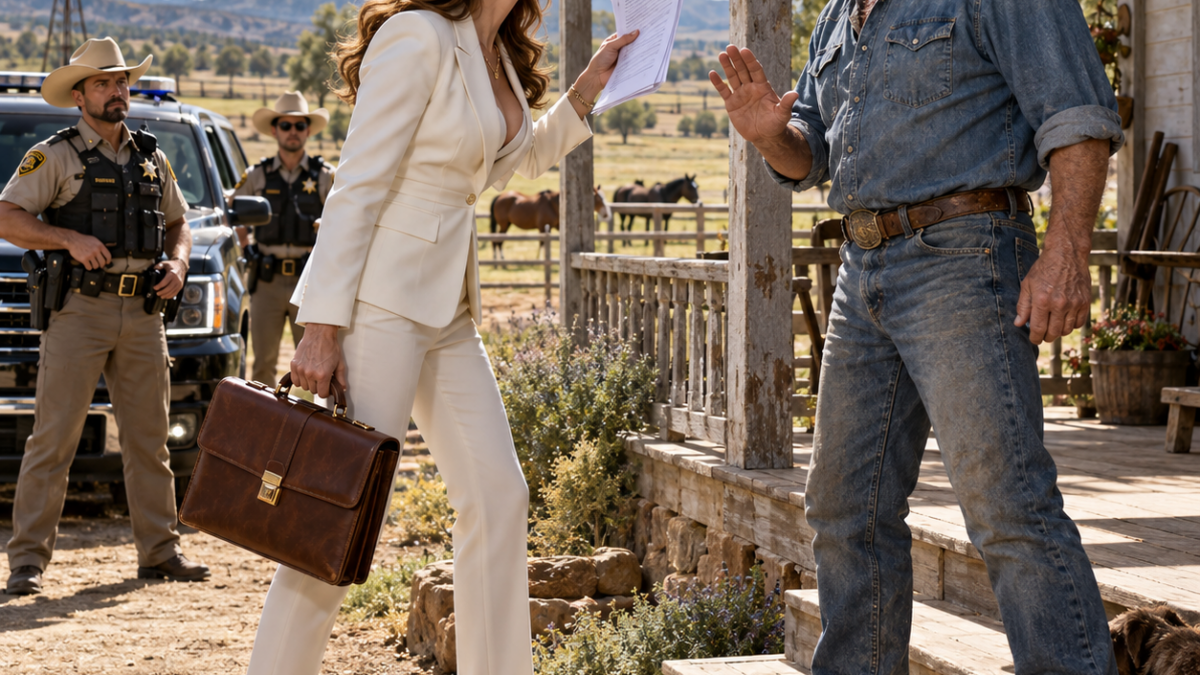
PART 2
For a second, I just looked at her.
Then I laughed.
Not politely.
Not gently.
I laughed hard enough that a gelding near the fence lifted his head to see what was so funny.
Karen did not appreciate it.
“I don’t have dementia,” I said.
“That may be your perception.”
“My perception is doing just fine.”
“Mr. Hollis, denial is very common in these circumstances.”
I stepped down from the porch, one stair at a time.
“Lady, I remember the serial number on a tractor engine I replaced in 1986. I remember which mare kicked my cousin through a gate in 1979. I remember my wife’s biscuit recipe, though she swore she never wrote it down because she liked keeping me humble. I also remember never giving power of attorney to a woman I’ve never met.”
Karen’s eyes flickered.
Only for a moment.
Then the smile returned.
“I understand this is upsetting.”
“No. You don’t.”
She pulled a document from the folder.
“I have paperwork granting me authority to act on your behalf regarding this property.”
“Let me see it.”
She hesitated.
That told me plenty.
“I can provide copies once we begin the formal transfer process.”
I held out my hand.
“Let me see it now.”
She looked at my hand as if it were dirty.
“This is not optional. You previously signed documents authorizing me to manage and dispose of real property assets due to your diminished capacity.”
“You’re saying I signed my ranch over to you?”
“I’m saying you granted me legal authority.”
“When?”
“A while ago.”
“What day?”
“That is not relevant at this stage.”
“It is relevant to me.”
Her voice cooled.
“Mr. Hollis, difficult behavior will not change the legal reality.”
I looked at her white suit, the gold watch on her wrist, the perfect nails wrapped around my supposed future.
“You are standing on my porch telling me I’m too senile to remember giving you my land, and you think I’m the one behaving difficult?”
Her jaw tightened.
“I did not come here to argue.”
“Good. Then leave.”
“I’m afraid I can’t do that.”
I straightened.
“You can. Watch how easy it is. Turn around. Walk to the shiny car. Drive away.”
Karen’s smile vanished completely.
“You need to be careful. Refusing lawful authority can create consequences.”
“So can trespassing.”
Her eyes narrowed.
“I am not trespassing. I have a legal interest in this property.”
“No, ma’am. You have a briefcase and too much perfume.”
She stared at me.
There are moments in a conflict when you can see a person decide who they think you are. Karen had arrived expecting a confused old rancher, lonely and frightened, maybe embarrassed by his own uncertainty. She expected me to fold under big words, documents, and the quiet shame people attach to age.
But I was not confused.
And I was not alone in the way she needed me to be.
Still, I was the only one home at that moment. My daughter was in town. My grandson was at work. There were no witnesses except the horses, and horses make poor statements unless the court accepts snorting.
Karen took out her phone.
“If you refuse to cooperate, I’ll involve law enforcement.”
“Please do.”
She dialed.
Then, standing in my own yard, she told the sheriff’s office that an elderly man was refusing to surrender property under a valid legal authority. Her voice changed while she spoke, becoming breathless and concerned.
Then she said something that made my blood go cold.
She claimed I had stolen assets from an estate.
Then she claimed there might be criminal activity on the ranch.
I stepped closer.
“You better be careful with that mouth.”
She covered the phone and smiled sweetly.
“Threatening me will only make this worse.”
“I’m warning you about lying to the law.”
She turned away and kept talking.
The deputies arrived twenty minutes later.
Two young men stepped out of the cruiser. One of them recognized me immediately.
“Mr. Hollis?”
“Afternoon, Deputy Reed.”
His eyes moved from me to Karen, then to the folder in her hand.
“We got a call.”
“I heard some of it.”
Karen marched toward them before I could say more.
“Officers, thank goodness. This man is refusing to comply with a lawful property transfer. He is confused, combative, and may be mentally incompetent.”
Deputy Reed looked at me.
I raised an eyebrow.
He looked like he would rather be anywhere else.
Karen continued. “I have power of attorney, and I need him removed from the premises if necessary so the property can be secured.”
The second deputy blinked.
“Removed from his own ranch?”
Karen’s lips tightened.
“It is not legally his to control anymore.”
“Do you have a court order?” Deputy Reed asked.
“I have power of attorney.”
“Do you have a court order?”
“That is not required.”
“Do you have documentation proving current ownership changed?”
Karen shifted.
“The transfer is in process.”
Deputy Reed looked at me again.
“Mr. Hollis, do you want her here?”
“No.”
He turned back to Karen.
“Ma’am, this sounds civil. Without a court order, we’re not removing him from property he appears to occupy and own.”
Karen’s face flushed.
“You’re failing to act.”
“We’re not arresting a man on his porch because you brought papers you won’t show us.”
“I’m an attorney.”
“That doesn’t change what I just said.”
Her voice sharpened.
“He is unstable.”
I laughed once.
“Ask him who taught him how to drive a stick.”
Deputy Reed bit the inside of his cheek.
The other deputy looked confused.
I pointed at Reed.
“His daddy did. After this one put my truck in a ditch trying to impress a girl at seventeen.”
Reed looked at the ground.
Karen stared at both of us like the universe had broken protocol.
“Ma’am,” Reed said, recovering, “you need to leave the property.”
“This is outrageous.”
“Maybe. But it’s still what’s happening.”
Karen gathered her folder with stiff, furious hands.
As she passed me on the way to her SUV, she leaned close enough that only I could hear.
“This isn’t over, old man.”
I looked her dead in the eye.
“Not for you, it isn’t.”
I wanted to believe that would be the end.
At my age, you learn not to waste energy on every fool who crosses your cattle guard. Sometimes people drive away and become a story you tell over coffee. Sometimes they become trouble.
Karen became trouble.
Two days later, my grandson Tyler called from the south pasture.
“Granddad,” he said, breathless, “you need to get down here.”
Tyler is twenty-four, strong, patient, and better with computers than any person needs to be. He moved back nearby after college and helps me with records, invoices, equipment orders, and all the online foolishness I refuse to pretend I enjoy. He also checks fence lines when my hip acts up.
“What is it?”
“There’s a woman setting stakes.”
My hand tightened around the phone.
“White suit?”
“Not today. Red blouse. Same attitude.”
I drove the side-by-side down there fast enough to make my back complain for the next week.
Karen was in my pasture with two men I did not know, pounding cheap wooden stakes into the ground and running orange construction fencing between them. She wore tight black pants, boots too clean for pasture work, and a red blouse that caught the sun like a warning flag.
Tyler stood thirty feet away, recording on his phone.
Karen saw me coming and put one hand on her hip.
“You again,” I said.
“This portion of land is under dispute.”
“No, it isn’t.”
“It will be.”
I got out slowly.
One of the men with her stopped working. He looked hired, not committed.
“You two,” I said, pointing at them. “You are trespassing. Pack up.”
They looked at Karen.
She snapped, “Continue.”
I raised my voice.
“Boys, I don’t know what she told you, but if you put one more stake in my land, your names go in the sheriff’s report with hers.”
That got their attention.
Karen’s eyes flashed.
“You are interfering with a lawful boundary marking.”
“Lady, you couldn’t lawfully mark a church bake sale.”
Tyler made a choking sound behind me.
Karen pointed one red nail at my chest.
“You’re going to regret mocking me.”
“I regret letting you talk this long.”
“The lien will make things clear.”
That word stopped me.
Lien.
“What lien?”
She smiled then.
Slowly.
Cruelly.
“The one I filed against this property for unpaid obligations and legal costs related to your breach of fiduciary cooperation.”
It was gibberish.
But legal gibberish can still cloud title.
I knew that much.
“You filed a lien on my ranch?”
“I did what was necessary.”
“You forged something.”
“I exercised my rights.”
“You don’t have rights here.”
Her voice dropped.
“Sign the transfer documents, and all this stops. Keep fighting, and I will tie this property up until you die.”
The pasture went quiet except for wind moving through grass.
That was the first time she truly scared me.
Not because I believed she owned anything.
Because she was not just pretending anymore. She was filing papers, creating records, using systems built for honest disputes as weapons against someone she thought might not live long enough to win.
I stepped close enough to see the fine lines around her mouth beneath the perfect lipstick.
“You listen to me,” I said. “My father died on this ranch. My wife is buried a quarter mile from where you’re standing. My grandchildren ride these fields. You do not get to steal that with a printer and a law degree.”
For a second, something hard and hateful moved across her face.
Then she turned to the two men.
“We’re done for today.”
They left fast.
Karen followed, but not before Tyler got clear photos of her, the stakes, the fencing, her vehicle, and every inch of nonsense she had tried to plant in my pasture.
The lien notice arrived in the mail that week.
Tyler read it first because I had learned long ago that small print is where snakes hide.
At first, he laughed.
Then he stopped laughing.
“Granddad,” he said, “this is bad.”
“Bad how?”
“It’s obviously fraudulent, but it’s filed. That means it exists in the county system until it gets removed. If you ever needed to sell, refinance, or transfer anything, this could be a problem.”
“I’m not selling.”
“That’s not the point.”
He was right.
The lien claimed I owed Karen Whitmore Legal Services more than $180,000 for estate management, protective filings, property recovery costs, and enforcement actions. It included legal descriptions that were wrong in some places, copied in others, and mangled everywhere. It referenced a power of attorney document I had never signed and a deed transfer that had never happened.
At the bottom, there was a signature that looked almost like mine if you squinted, had never met me, and were willing to commit a felony.
My grandson looked up at me.
“We need to fight smart.”
I hated that he was right again.
I wanted to handle Karen the old way: tell her to get off my land, call the sheriff, and trust common sense to do the rest. But Karen was not fighting with common sense. She was fighting with paper. Fake paper, but paper all the same.
So we went to the county recorder’s office.
I called an old friend first.
Earl worked there, and though he was not the official decision-maker on everything, he knew how records moved through that office better than most people knew their own kitchens. He had helped my wife and me file a boundary correction thirty years earlier, back when his hair was black and mine still existed in useful quantity.
Earl met us at the counter and shook his head before we even explained.
“I heard a little,” he said.
“Then you know I didn’t give some red-lipped rattlesnake my ranch.”
He snorted.
“Let’s pull the filings.”
We went through them one by one.
The more Earl printed, the worse it got.
Wrong parcel descriptions.
References to documents that did not exist.
A supposed power of attorney recorded with formatting from a modern template but backdated years.
A notary seal that looked suspicious.
My alleged signature placed unevenly above a line, like it had been copied and pasted.
And, in one spot so stupid it almost made me admire the arrogance, Karen had written her own name where a deed reference number should have gone.
Earl leaned back.
“Well,” he said. “That’s not a mistake.”
Tyler took photos of every page.
Earl printed certified copies.
Then he lowered his voice.
“You need to take this to the sheriff. Not a deputy call. The sheriff.”
So we did.
Sheriff Cal Morris had known me longer than Karen had been alive. He had a face weathered by sun and bureaucracy and the calm manner of a man who had seen human stupidity arrive in every possible vehicle.
When Tyler and I laid the packet on his desk, he read quietly.
At first, his eyebrows moved.
Then his jaw.
Then he sat back and said, “She filed this?”
“Yes.”
“And she came onto the property?”
“Twice.”
“And she called us claiming criminal activity?”
“Yes.”
Tyler showed him the photos and video.
Cal watched Karen ordering men to stake my pasture. He watched her threaten lawsuits. He watched her tell me the lien would make things clear.
When the video ended, he looked at me.
“She picked the wrong old man.”
“That’s what I told her.”
Cal tapped the papers.
“Forgery. Fraudulent filing. Possible elder exploitation. False report. Trespass. If she’s actually licensed, the bar will want to know.”
Tyler sat forward.
“We already thought of that.”
I looked at him.
“We did?”
He smiled.
“We are about to.”
The sheriff opened an investigation.
Tyler and I went home and built a second packet for the state bar association.
If Karen was really a lawyer, then she had not merely lied as a private crook. She had abused a license, a title, and the trust people place in legal authority. She had used legal language to scare an elderly property owner into surrendering land.
Tyler helped me write the complaint. I dictated parts because I wanted it in my words.
I told them she came to my ranch claiming power of attorney.
I told them she alleged dementia I did not have.
I told them she refused to leave.
I told them she made false accusations to law enforcement.
I told them she tried to rope off part of my pasture.
I told them she filed a lien using forged documents.
Then I wrote one sentence myself, slowly, with my hand aching.
A lawyer who uses her license to frighten old people out of their homes should not be trusted with anyone’s law.
We mailed it with copies of everything.
Then came the waiting.
People think justice feels like lightning.
Mostly it feels like checking your mailbox and trying not to let anger poison your breakfast.
Karen did not vanish immediately.
For weeks, she still moved around town like she owned more than she did. I saw her once at the diner, sitting in a corner booth with her laptop open, speaking loudly into a phone about “property recovery actions.” When she noticed me, she smiled and lifted her coffee cup as if we were two professionals on opposite sides of a negotiation.
I walked over.
The diner went quiet in that small-town way where forks keep moving but conversations stop breathing.
“Karen,” I said.
“Mr. Hollis.”
“Still pretending to own things?”
Her smile tightened.
“Still confused about legal reality?”
I leaned one hand on the table.
“No. But you will be soon.”
For a moment, I saw uncertainty.
Just a crack.
Then she shut the laptop.
“You should be careful making threats in public.”
I looked around the diner.
“Anybody here hear a threat?”
Old Mrs. Donnelly at the counter said, “Nope.”
Someone else muttered, “Heard a warning.”
A few people chuckled.
Karen’s face flushed.
She gathered her things and left without finishing her coffee.
Small towns talk.
At first, folks only knew a fancy lawyer had come after my ranch. Then they heard about the lien. Then the sheriff’s investigation. Then someone at the recorder’s office told someone’s cousin’s wife that the paperwork looked forged. By the end of the month, Karen could not buy eggs without people lowering their voices and watching her.
I did not start the gossip.
I also did not stop it.
A woman who weaponizes reputation should not expect mercy when hers catches fire.
The county moved first.
I received official notice that the lien had been invalidated. The filing was declared defective and fraudulent, and my deed was reaffirmed as solely mine. Earl called me before the letter even arrived because he knew I had been sleeping badly.
“You’re clear,” he said.
I sat down at the kitchen table.
For a moment, I could not speak.
“You still there?” Earl asked.
“Yeah.”
“You okay?”
I looked through the window toward the pasture Karen had tried to rope off.
“I am now.”
But the county notice was only the beginning.
The sheriff’s office escalated its investigation after confirming the notary stamp did not match any legitimate record. The supposed power of attorney had never been filed properly because it never existed properly. The signature was forged. The legal descriptions were cobbled together from public records. Karen had apparently created a fantasy chain of authority and expected fear to do what law could not.
Then the state bar contacted me.
Not with a form letter.
With an investigator.
Her name was Ms. Alvarez, and she drove out to the ranch on a gray morning with a tablet, a folder, and the expression of someone who had read enough to already dislike Karen professionally. She sat at my kitchen table while Tyler recorded with permission.
She asked careful questions.
Dates. Times. Exact words. Whether Karen identified herself as my attorney. Whether I had ever signed anything. Whether I had ever been evaluated for incapacity. Whether I knew her before the day she appeared.
“No,” I said again and again.
No, I never hired her.
No, I never gave her power of attorney.
No, I never authorized a lien.
No, I never agreed to transfer my ranch.
No, I do not have dementia.
Ms. Alvarez listened without condescension.
That mattered.
Many people speak to old folks like we are already halfway gone. They turn sentences soft and slow, not out of kindness but assumption. Ms. Alvarez did not do that. She treated me like a witness, a property owner, and a man who knew what had happened to him.
When she left, Tyler walked her to the truck.
I stayed at the table and put one hand flat on the wood.
My wife and I bought that table the year our daughter was born. Every mark on it has history. A burn from a too-hot pan. A scratch from Tyler’s toy truck. A dent from the time I dropped a wrench while fixing the ceiling fan.
Karen would have looked at that table and seen old furniture.
She looked at my land and saw unclaimed value.
She looked at me and saw an opportunity wrapped in wrinkles.
That was her mistake.
The bar moved faster than I expected.
Within months, Karen was placed under interim restrictions while disciplinary proceedings began. The notice used formal language, but Tyler translated it in plain English.
“They’re coming for her license, Granddad.”
“Good.”
The sheriff’s investigation led to charges being filed for forgery, fraudulent recording, attempted theft by deception, trespass, and filing a false report. I later learned they were also looking into other complaints. Apparently, I was not the first elderly property owner Karen had approached with sudden paperwork and convenient claims of incapacity.
I was just the first one who had a grandson with a phone, friends in the county office, and a sheriff who knew exactly who owned what.
Karen’s law office shut down before the disciplinary hearing finished.
If you could call it a law office.
It had been a narrow storefront between a tax preparer and a nail salon, with gold lettering on the window and almost no evidence clients ever went inside. After the story spread, people began mentioning odd things. How Karen had offered “estate protection consultations” to older residents. How she asked too many questions about property, heirs, and whether children lived nearby. How she seemed especially interested in people who lived alone.
That chilled me more than her threats.
I had not merely defended my ranch.
I had interrupted a pattern.
The day of her bar hearing, Tyler drove me to the city.
I did not have to attend, but I wanted to see her face when she realized big words were no longer enough. Karen arrived in a charcoal dress, heels, and pearl earrings. Her hair was perfect. Her makeup was soft and expensive. She looked less like a criminal defendant and more like a woman arriving at a charity luncheon.
When she saw me, her expression hardened.
During the hearing, she tried everything.
She claimed misunderstanding.
She claimed she had relied on documents provided by an unnamed third party.
She claimed concern for my wellbeing.
She claimed I appeared confused and vulnerable.
She claimed the lien was filed to preserve disputed rights pending clarification.
Then the panel reviewed the documents.
The fake power of attorney.
The forged signature.
The false lien.
The video of her staking my pasture.
The sheriff’s report.
The county’s invalidation.
My testimony.
Tyler’s testimony.
Earl’s records.
Ms. Alvarez’s findings.
Karen’s story collapsed piece by piece.
At one point, one of the panel members asked her a simple question.
“Ms. Whitmore, if your concern was Mr. Hollis’s wellbeing, why did you attempt to transfer his ranch to yourself?”
Karen opened her mouth.
Closed it.
Then said, “That characterization is inaccurate.”
The panel member leaned forward.
“How would you characterize it?”
Karen had no good answer.
By the end, the recommendation was disbarment.
Formal final action would take paperwork, because everything takes paperwork, but the result was clear. Karen had abused her license, fabricated authority, attempted to deprive an elderly man of property, and filed fraudulent documents with public offices.
Outside the building, she finally spoke to me.
I was standing near Tyler’s truck when she walked up, jaw tight, eyes burning.
“You ruined me,” she said.
I looked at her for a long moment.
“No, ma’am. I kept records.”
Her face twisted.
“You think you’re clever?”
“No. I think I’m the wrong rancher.”
She stepped closer.
“You have no idea what this has cost me.”
I leaned on my cane and looked her up and down: the perfect hair, the expensive dress, the fury of a woman who still believed consequences were insults.
“You tried to steal the place where my wife’s lilacs grow.”
For the first time, she looked away.
Only for a second.
But I saw it.
“You should have chosen a man with less memory,” I said.
Tyler opened the truck door for me.
We left her standing there.
After that, Karen disappeared from town slowly, then all at once.
First, her office went dark. Then the lettering came off the window. Then her SUV stopped appearing outside the diner. Someone said she moved to another county. Someone else said she left the state. The sheriff told me only what he could: the criminal case was proceeding, and she was no longer in any position to threaten my land.
Good enough.
The ranch quieted again.
That is the thing about land. It absorbs drama slower than people do, but it also returns to itself if you let it.
The orange fencing came down. Tyler and I pulled every stake Karen had placed, stacked them by the barn, and used them later to mark rows in the vegetable garden. That gave me more satisfaction than it probably should have.
The horses stopped staring at the south pasture like strangers might reappear.
The gate kept complaining in the wind.
The lilacs bloomed.
Neighbors came by for weeks.
Some brought pie. Some brought coffee. Some brought gossip dressed as concern. A few older folks asked Tyler to help them check their own property records, just in case. He did, gladly. Earl at the recorder’s office said half the town suddenly cared about deeds and liens, which he considered a miracle and a nuisance.
One afternoon, Sheriff Cal stopped by in plain clothes.
He brought a bag of feed he owed me from a bet I did not remember making but accepted anyway.
We sat on the porch while the sun went low.
“Could’ve gone worse,” he said.
“Could’ve gone better.”
He nodded.
“You scared?”
I watched the pasture.
“I was.”
He did not answer right away.
Then he said, “No shame in that.”
“I know.”
And I did.
That surprised me.
When I was young, fear felt like something to hide. Men of my generation were taught to swallow it, bury it, call it anger or caution or common sense. But when Karen filed that lien, when she threatened to tie up the ranch until I died, I was afraid. Not of losing money. Not of court. Not even of her.
I was afraid that one day my grandchildren might have to fight for land I failed to protect.
That fear made me smart.
Anger made me loud.
Fear made me careful.
Careful won.
My grandson says people online might learn something from this, so here is what I know.
If someone shows up with papers and pressure, do not sign anything because they sound confident.
If someone says you gave them authority and you do not remember it, call family, call a lawyer, call the county, call whoever you trust. Do not let shame make you quiet. Scammers love shame. They love making old people feel embarrassed for asking questions. They love making confusion seem like proof.
Ask anyway.
Check records.
Take pictures.
Keep copies.
Trust your memory, but verify with paper.
And if you are younger, check on the old people in your life. Not because we are useless. Not because we are children. Because predators look for people they think are isolated, and the best fence against that is community.
Karen thought I was alone.
She thought my age made me soft.
She thought legal jargon could scare me off land my family had held longer than she had been alive.
She thought wrong.
I am still here.
My ranch is still mine. The well still runs. The barns still stand. My wife’s lilacs still bloom by the porch. The south pasture still catches gold light in the evening. My grandson still teases me about not understanding the internet, and I still tell him the internet seems like a place where common sense goes to get trampled.
But I let him help me write this because maybe somebody needs to hear it.
Old does not mean stupid.
Polite does not mean weak.
And a fake document, no matter how many legal words it wears, is still just a lie looking for a victim.
Karen came to my ranch with a briefcase full of lies and left with her career burning behind her.
All I did was show the truth.
Sometimes that is enough.
Sometimes the rope is already there.
All you have to do is let the liar tie her own noose.
𝗧𝗛𝗘 𝗘𝗡𝗗
Karen Came to My Ranch With Fake Papers and Left Without Her Law Career
The woman in the white suit told me I was too old to remember signing away my ranch.
She smiled like my land was already hers, like my age had made me weak, confused, and easy to erase.
But I had buried family on that soil, raised horses on that pasture, and remembered every inch of it better than Karen remembered the lies she carried in her briefcase.
I have owned my ranch long enough to know the sound of my own gate in the wind.
That may sound strange to someone who has spent life in apartments, subdivisions, or places where every driveway looks like the next one. But land has a voice if you stay with it long enough. A loose hinge makes one kind of complaint in January and another in July. Cottonwoods move differently before rain. Horses step softer when coyotes are near. A pump about to fail has a rhythm to it days before it finally quits. Even gravel tells on strangers if you listen.
I am an old man now, but I am not a helpless one.
My knees ache. My hands are thick with arthritis. My back complains every morning before I do. I move slower than I used to, and I have made peace with the fact that bales of hay are no longer impressed by stubbornness. But my mind is clear. My memory is sharp. I still remember the day my father put a posthole digger in my hands and told me that land did not stay yours because a paper said so. It stayed yours because you knew it, worked it, respected it, and defended it when somebody decided they wanted it more than they deserved it.
My ranch has been mine for decades.
Before that, it belonged to my father. Before that, pieces of it belonged to people whose names are now carved into stones behind the old windbreak. It has its own well, two barns, a hay shed, a machine shop, a creek that runs strong in wet years and thin in dry ones, and enough pasture to keep my horses happy if the grass behaves. My children grew up there. My grandchildren learned to ride there. My wife planted lilacs near the porch, and even now, years after she passed, they bloom like she is reminding me she still has opinions about beauty.
People in town know me.
That matters in a small place. Not because I am important, but because I have stayed. I bought feed from the same family for thirty years. I helped pull trucks from ditches before cell phones made everyone less neighborly. I served on the volunteer fire board. I fixed fences for widows and lent equipment to men too proud to ask twice. The sheriff and I go back far enough that I remember him as a skinny kid who once backed his father’s truck into my water trough.
So when Karen Whitmore came up my drive one hot Thursday afternoon and told me she had legal authority over my ranch, I knew two things immediately.
One, she was lying.
Two, she had mistaken age for weakness.
Karen was about forty, maybe a few years older, but she carried herself like a woman who expected mirrors to flatter her and men to make room. She stepped out of a black luxury SUV wearing a fitted white suit, gold heels, red lipstick, and sunglasses too large for honest work. Her hair was glossy chestnut, curled over one shoulder like she had prepared for a photograph. She had the polished, curvy, expensive look of someone who knew exactly how attractive she was and used it the way some people use a badge.
When she smiled, it did not warm her face.
It sharpened it.
She walked toward my porch with a leather briefcase in one hand and confidence in every step, like the ranch house, the pasture, the barns, and I were all items on an agenda she intended to close before lunch.
“Mr. Hollis?” she asked.
“That depends on who’s asking.”
She removed her sunglasses slowly.
“My name is Karen Whitmore. I’m an attorney.”
I looked past her at the SUV.
“Most attorneys call before visiting.”
“This matter is urgent.”
“Most urgent matters still know how to knock.”
Her smile tightened.
“I’m here regarding transfer of authority over this property.”
I leaned one hand against the porch rail.
“You want to say that again in English?”
She opened the briefcase and pulled out a folder.
“I represent interests connected to your estate planning and protective legal arrangements. It appears there has been some confusion due to your condition.”
“My condition?”
“Yes.” Her voice softened in that false way people use when they want witnesses to think they are kind. “Your dementia.”
PART 2
For a second, I just looked at her.
Then I laughed.
Not politely.
Not gently.
I laughed hard enough that a gelding near the fence lifted his head to see what was so funny.
Karen did not appreciate it.
“I don’t have dementia,” I said.
“That may be your perception.”
“My perception is doing just fine.”
“Mr. Hollis, denial is very common in these circumstances.”
I stepped down from the porch, one stair at a time.
“Lady, I remember the serial number on a tractor engine I replaced in 1986. I remember which mare kicked my cousin through a gate in 1979. I remember my wife’s biscuit recipe, though she swore she never wrote it down because she liked keeping me humble. I also remember never giving power of attorney to a woman I’ve never met.”
Karen’s eyes flickered.
Only for a moment.
Then the smile returned.
“I understand this is upsetting.”
“No. You don’t.”
She pulled a document from the folder.
“I have paperwork granting me authority to act on your behalf regarding this property.”
“Let me see it.”
She hesitated.
That told me plenty.
“I can provide copies once we begin the formal transfer process.”
I held out my hand.
“Let me see it now.”
She looked at my hand as if it were dirty.
“This is not optional. You previously signed documents authorizing me to manage and dispose of real property assets due to your diminished capacity.”
“You’re saying I signed my ranch over to you?”
“I’m saying you granted me legal authority.”
“When?”
“A while ago.”
“What day?”
“That is not relevant at this stage.”
“It is relevant to me.”
Her voice cooled.
“Mr. Hollis, difficult behavior will not change the legal reality.”
I looked at her white suit, the gold watch on her wrist, the perfect nails wrapped around my supposed future.
“You are standing on my porch telling me I’m too senile to remember giving you my land, and you think I’m the one behaving difficult?”
Her jaw tightened.
“I did not come here to argue.”
“Good. Then leave.”
“I’m afraid I can’t do that.”
I straightened.
“You can. Watch how easy it is. Turn around. Walk to the shiny car. Drive away.”
Karen’s smile vanished completely.
“You need to be careful. Refusing lawful authority can create consequences.”
“So can trespassing.”
Her eyes narrowed.
“I am not trespassing. I have a legal interest in this property.”
“No, ma’am. You have a briefcase and too much perfume.”
She stared at me.
There are moments in a conflict when you can see a person decide who they think you are. Karen had arrived expecting a confused old rancher, lonely and frightened, maybe embarrassed by his own uncertainty. She expected me to fold under big words, documents, and the quiet shame people attach to age.
But I was not confused.
And I was not alone in the way she needed me to be.
Still, I was the only one home at that moment. My daughter was in town. My grandson was at work. There were no witnesses except the horses, and horses make poor statements unless the court accepts snorting.
Karen took out her phone.
“If you refuse to cooperate, I’ll involve law enforcement.”
“Please do.”
She dialed.
Then, standing in my own yard, she told the sheriff’s office that an elderly man was refusing to surrender property under a valid legal authority. Her voice changed while she spoke, becoming breathless and concerned.
Then she said something that made my blood go cold.
She claimed I had stolen assets from an estate.
Then she claimed there might be criminal activity on the ranch.
I stepped closer.
“You better be careful with that mouth.”
She covered the phone and smiled sweetly.
“Threatening me will only make this worse.”
“I’m warning you about lying to the law.”
She turned away and kept talking.
The deputies arrived twenty minutes later.
Two young men stepped out of the cruiser. One of them recognized me immediately.
“Mr. Hollis?”
“Afternoon, Deputy Reed.”
His eyes moved from me to Karen, then to the folder in her hand.
“We got a call.”
“I heard some of it.”
Karen marched toward them before I could say more.
“Officers, thank goodness. This man is refusing to comply with a lawful property transfer. He is confused, combative, and may be mentally incompetent.”
Deputy Reed looked at me.
I raised an eyebrow.
He looked like he would rather be anywhere else.
Karen continued. “I have power of attorney, and I need him removed from the premises if necessary so the property can be secured.”
The second deputy blinked.
“Removed from his own ranch?”
Karen’s lips tightened.
“It is not legally his to control anymore.”
“Do you have a court order?” Deputy Reed asked.
“I have power of attorney.”
“Do you have a court order?”
“That is not required.”
“Do you have documentation proving current ownership changed?”
Karen shifted.
“The transfer is in process.”
Deputy Reed looked at me again.
“Mr. Hollis, do you want her here?”
“No.”
He turned back to Karen.
“Ma’am, this sounds civil. Without a court order, we’re not removing him from property he appears to occupy and own.”
Karen’s face flushed.
“You’re failing to act.”
“We’re not arresting a man on his porch because you brought papers you won’t show us.”
“I’m an attorney.”
“That doesn’t change what I just said.”
Her voice sharpened.
“He is unstable.”
I laughed once.
“Ask him who taught him how to drive a stick.”
Deputy Reed bit the inside of his cheek.
The other deputy looked confused.
I pointed at Reed.
“His daddy did. After this one put my truck in a ditch trying to impress a girl at seventeen.”
Reed looked at the ground.
Karen stared at both of us like the universe had broken protocol.
“Ma’am,” Reed said, recovering, “you need to leave the property.”
“This is outrageous.”
“Maybe. But it’s still what’s happening.”
Karen gathered her folder with stiff, furious hands.
As she passed me on the way to her SUV, she leaned close enough that only I could hear.
“This isn’t over, old man.”
I looked her dead in the eye.
“Not for you, it isn’t.”
I wanted to believe that would be the end.
At my age, you learn not to waste energy on every fool who crosses your cattle guard. Sometimes people drive away and become a story you tell over coffee. Sometimes they become trouble.
Karen became trouble.
Two days later, my grandson Tyler called from the south pasture.
“Granddad,” he said, breathless, “you need to get down here.”
Tyler is twenty-four, strong, patient, and better with computers than any person needs to be. He moved back nearby after college and helps me with records, invoices, equipment orders, and all the online foolishness I refuse to pretend I enjoy. He also checks fence lines when my hip acts up.
“What is it?”
“There’s a woman setting stakes.”
My hand tightened around the phone.
“White suit?”
“Not today. Red blouse. Same attitude.”
I drove the side-by-side down there fast enough to make my back complain for the next week.
Karen was in my pasture with two men I did not know, pounding cheap wooden stakes into the ground and running orange construction fencing between them. She wore tight black pants, boots too clean for pasture work, and a red blouse that caught the sun like a warning flag.
Tyler stood thirty feet away, recording on his phone.
Karen saw me coming and put one hand on her hip.
“You again,” I said.
“This portion of land is under dispute.”
“No, it isn’t.”
“It will be.”
I got out slowly.
One of the men with her stopped working. He looked hired, not committed.
“You two,” I said, pointing at them. “You are trespassing. Pack up.”
They looked at Karen.
She snapped, “Continue.”
I raised my voice.
“Boys, I don’t know what she told you, but if you put one more stake in my land, your names go in the sheriff’s report with hers.”
That got their attention.
Karen’s eyes flashed.
“You are interfering with a lawful boundary marking.”
“Lady, you couldn’t lawfully mark a church bake sale.”
Tyler made a choking sound behind me.
Karen pointed one red nail at my chest.
“You’re going to regret mocking me.”
“I regret letting you talk this long.”
“The lien will make things clear.”
That word stopped me.
Lien.
“What lien?”
She smiled then.
Slowly.
Cruelly.
“The one I filed against this property for unpaid obligations and legal costs related to your breach of fiduciary cooperation.”
It was gibberish.
But legal gibberish can still cloud title.
I knew that much.
“You filed a lien on my ranch?”
“I did what was necessary.”
“You forged something.”
“I exercised my rights.”
“You don’t have rights here.”
Her voice dropped.
“Sign the transfer documents, and all this stops. Keep fighting, and I will tie this property up until you die.”
The pasture went quiet except for wind moving through grass.
That was the first time she truly scared me.
Not because I believed she owned anything.
Because she was not just pretending anymore. She was filing papers, creating records, using systems built for honest disputes as weapons against someone she thought might not live long enough to win.
I stepped close enough to see the fine lines around her mouth beneath the perfect lipstick.
“You listen to me,” I said. “My father died on this ranch. My wife is buried a quarter mile from where you’re standing. My grandchildren ride these fields. You do not get to steal that with a printer and a law degree.”
For a second, something hard and hateful moved across her face.
Then she turned to the two men.
“We’re done for today.”
They left fast.
Karen followed, but not before Tyler got clear photos of her, the stakes, the fencing, her vehicle, and every inch of nonsense she had tried to plant in my pasture.
The lien notice arrived in the mail that week.
Tyler read it first because I had learned long ago that small print is where snakes hide.
At first, he laughed.
Then he stopped laughing.
“Granddad,” he said, “this is bad.”
“Bad how?”
“It’s obviously fraudulent, but it’s filed. That means it exists in the county system until it gets removed. If you ever needed to sell, refinance, or transfer anything, this could be a problem.”
“I’m not selling.”
“That’s not the point.”
He was right.
The lien claimed I owed Karen Whitmore Legal Services more than $180,000 for estate management, protective filings, property recovery costs, and enforcement actions. It included legal descriptions that were wrong in some places, copied in others, and mangled everywhere. It referenced a power of attorney document I had never signed and a deed transfer that had never happened.
At the bottom, there was a signature that looked almost like mine if you squinted, had never met me, and were willing to commit a felony.
My grandson looked up at me.
“We need to fight smart.”
I hated that he was right again.
I wanted to handle Karen the old way: tell her to get off my land, call the sheriff, and trust common sense to do the rest. But Karen was not fighting with common sense. She was fighting with paper. Fake paper, but paper all the same.
So we went to the county recorder’s office.
I called an old friend first.
Earl worked there, and though he was not the official decision-maker on everything, he knew how records moved through that office better than most people knew their own kitchens. He had helped my wife and me file a boundary correction thirty years earlier, back when his hair was black and mine still existed in useful quantity.
Earl met us at the counter and shook his head before we even explained.
“I heard a little,” he said.
“Then you know I didn’t give some red-lipped rattlesnake my ranch.”
He snorted.
“Let’s pull the filings.”
We went through them one by one.
The more Earl printed, the worse it got.
Wrong parcel descriptions.
References to documents that did not exist.
A supposed power of attorney recorded with formatting from a modern template but backdated years.
A notary seal that looked suspicious.
My alleged signature placed unevenly above a line, like it had been copied and pasted.
And, in one spot so stupid it almost made me admire the arrogance, Karen had written her own name where a deed reference number should have gone.
Earl leaned back.
“Well,” he said. “That’s not a mistake.”
Tyler took photos of every page.
Earl printed certified copies.
Then he lowered his voice.
“You need to take this to the sheriff. Not a deputy call. The sheriff.”
So we did.
Sheriff Cal Morris had known me longer than Karen had been alive. He had a face weathered by sun and bureaucracy and the calm manner of a man who had seen human stupidity arrive in every possible vehicle.
When Tyler and I laid the packet on his desk, he read quietly.
At first, his eyebrows moved.
Then his jaw.
Then he sat back and said, “She filed this?”
“Yes.”
“And she came onto the property?”
“Twice.”
“And she called us claiming criminal activity?”
“Yes.”
Tyler showed him the photos and video.
Cal watched Karen ordering men to stake my pasture. He watched her threaten lawsuits. He watched her tell me the lien would make things clear.
When the video ended, he looked at me.
“She picked the wrong old man.”
“That’s what I told her.”
Cal tapped the papers.
“Forgery. Fraudulent filing. Possible elder exploitation. False report. Trespass. If she’s actually licensed, the bar will want to know.”
Tyler sat forward.
“We already thought of that.”
I looked at him.
“We did?”
He smiled.
“We are about to.”
The sheriff opened an investigation.
Tyler and I went home and built a second packet for the state bar association.
If Karen was really a lawyer, then she had not merely lied as a private crook. She had abused a license, a title, and the trust people place in legal authority. She had used legal language to scare an elderly property owner into surrendering land.
Tyler helped me write the complaint. I dictated parts because I wanted it in my words.
I told them she came to my ranch claiming power of attorney.
I told them she alleged dementia I did not have.
I told them she refused to leave.
I told them she made false accusations to law enforcement.
I told them she tried to rope off part of my pasture.
I told them she filed a lien using forged documents.
Then I wrote one sentence myself, slowly, with my hand aching.
A lawyer who uses her license to frighten old people out of their homes should not be trusted with anyone’s law.
We mailed it with copies of everything.
Then came the waiting.
People think justice feels like lightning.
Mostly it feels like checking your mailbox and trying not to let anger poison your breakfast.
Karen did not vanish immediately.
For weeks, she still moved around town like she owned more than she did. I saw her once at the diner, sitting in a corner booth with her laptop open, speaking loudly into a phone about “property recovery actions.” When she noticed me, she smiled and lifted her coffee cup as if we were two professionals on opposite sides of a negotiation.
I walked over.
The diner went quiet in that small-town way where forks keep moving but conversations stop breathing.
“Karen,” I said.
“Mr. Hollis.”
“Still pretending to own things?”
Her smile tightened.
“Still confused about legal reality?”
I leaned one hand on the table.
“No. But you will be soon.”
For a moment, I saw uncertainty.
Just a crack.
Then she shut the laptop.
“You should be careful making threats in public.”
I looked around the diner.
“Anybody here hear a threat?”
Old Mrs. Donnelly at the counter said, “Nope.”
Someone else muttered, “Heard a warning.”
A few people chuckled.
Karen’s face flushed.
She gathered her things and left without finishing her coffee.
Small towns talk.
At first, folks only knew a fancy lawyer had come after my ranch. Then they heard about the lien. Then the sheriff’s investigation. Then someone at the recorder’s office told someone’s cousin’s wife that the paperwork looked forged. By the end of the month, Karen could not buy eggs without people lowering their voices and watching her.
I did not start the gossip.
I also did not stop it.
A woman who weaponizes reputation should not expect mercy when hers catches fire.
The county moved first.
I received official notice that the lien had been invalidated. The filing was declared defective and fraudulent, and my deed was reaffirmed as solely mine. Earl called me before the letter even arrived because he knew I had been sleeping badly.
“You’re clear,” he said.
I sat down at the kitchen table.
For a moment, I could not speak.
“You still there?” Earl asked.
“Yeah.”
“You okay?”
I looked through the window toward the pasture Karen had tried to rope off.
“I am now.”
But the county notice was only the beginning.
The sheriff’s office escalated its investigation after confirming the notary stamp did not match any legitimate record. The supposed power of attorney had never been filed properly because it never existed properly. The signature was forged. The legal descriptions were cobbled together from public records. Karen had apparently created a fantasy chain of authority and expected fear to do what law could not.
Then the state bar contacted me.
Not with a form letter.
With an investigator.
Her name was Ms. Alvarez, and she drove out to the ranch on a gray morning with a tablet, a folder, and the expression of someone who had read enough to already dislike Karen professionally. She sat at my kitchen table while Tyler recorded with permission.
She asked careful questions.
Dates. Times. Exact words. Whether Karen identified herself as my attorney. Whether I had ever signed anything. Whether I had ever been evaluated for incapacity. Whether I knew her before the day she appeared.
“No,” I said again and again.
No, I never hired her.
No, I never gave her power of attorney.
No, I never authorized a lien.
No, I never agreed to transfer my ranch.
No, I do not have dementia.
Ms. Alvarez listened without condescension.
That mattered.
Many people speak to old folks like we are already halfway gone. They turn sentences soft and slow, not out of kindness but assumption. Ms. Alvarez did not do that. She treated me like a witness, a property owner, and a man who knew what had happened to him.
When she left, Tyler walked her to the truck.
I stayed at the table and put one hand flat on the wood.
My wife and I bought that table the year our daughter was born. Every mark on it has history. A burn from a too-hot pan. A scratch from Tyler’s toy truck. A dent from the time I dropped a wrench while fixing the ceiling fan.
Karen would have looked at that table and seen old furniture.
She looked at my land and saw unclaimed value.
She looked at me and saw an opportunity wrapped in wrinkles.
That was her mistake.
The bar moved faster than I expected.
Within months, Karen was placed under interim restrictions while disciplinary proceedings began. The notice used formal language, but Tyler translated it in plain English.
“They’re coming for her license, Granddad.”
“Good.”
The sheriff’s investigation led to charges being filed for forgery, fraudulent recording, attempted theft by deception, trespass, and filing a false report. I later learned they were also looking into other complaints. Apparently, I was not the first elderly property owner Karen had approached with sudden paperwork and convenient claims of incapacity.
I was just the first one who had a grandson with a phone, friends in the county office, and a sheriff who knew exactly who owned what.
Karen’s law office shut down before the disciplinary hearing finished.
If you could call it a law office.
It had been a narrow storefront between a tax preparer and a nail salon, with gold lettering on the window and almost no evidence clients ever went inside. After the story spread, people began mentioning odd things. How Karen had offered “estate protection consultations” to older residents. How she asked too many questions about property, heirs, and whether children lived nearby. How she seemed especially interested in people who lived alone.
That chilled me more than her threats.
I had not merely defended my ranch.
I had interrupted a pattern.
The day of her bar hearing, Tyler drove me to the city.
I did not have to attend, but I wanted to see her face when she realized big words were no longer enough. Karen arrived in a charcoal dress, heels, and pearl earrings. Her hair was perfect. Her makeup was soft and expensive. She looked less like a criminal defendant and more like a woman arriving at a charity luncheon.
When she saw me, her expression hardened.
During the hearing, she tried everything.
She claimed misunderstanding.
She claimed she had relied on documents provided by an unnamed third party.
She claimed concern for my wellbeing.
She claimed I appeared confused and vulnerable.
She claimed the lien was filed to preserve disputed rights pending clarification.
Then the panel reviewed the documents.
The fake power of attorney.
The forged signature.
The false lien.
The video of her staking my pasture.
The sheriff’s report.
The county’s invalidation.
My testimony.
Tyler’s testimony.
Earl’s records.
Ms. Alvarez’s findings.
Karen’s story collapsed piece by piece.
At one point, one of the panel members asked her a simple question.
“Ms. Whitmore, if your concern was Mr. Hollis’s wellbeing, why did you attempt to transfer his ranch to yourself?”
Karen opened her mouth.
Closed it.
Then said, “That characterization is inaccurate.”
The panel member leaned forward.
“How would you characterize it?”
Karen had no good answer.
By the end, the recommendation was disbarment.
Formal final action would take paperwork, because everything takes paperwork, but the result was clear. Karen had abused her license, fabricated authority, attempted to deprive an elderly man of property, and filed fraudulent documents with public offices.
Outside the building, she finally spoke to me.
I was standing near Tyler’s truck when she walked up, jaw tight, eyes burning.
“You ruined me,” she said.
I looked at her for a long moment.
“No, ma’am. I kept records.”
Her face twisted.
“You think you’re clever?”
“No. I think I’m the wrong rancher.”
She stepped closer.
“You have no idea what this has cost me.”
I leaned on my cane and looked her up and down: the perfect hair, the expensive dress, the fury of a woman who still believed consequences were insults.
“You tried to steal the place where my wife’s lilacs grow.”
For the first time, she looked away.
Only for a second.
But I saw it.
“You should have chosen a man with less memory,” I said.
Tyler opened the truck door for me.
We left her standing there.
After that, Karen disappeared from town slowly, then all at once.
First, her office went dark. Then the lettering came off the window. Then her SUV stopped appearing outside the diner. Someone said she moved to another county. Someone else said she left the state. The sheriff told me only what he could: the criminal case was proceeding, and she was no longer in any position to threaten my land.
Good enough.
The ranch quieted again.
That is the thing about land. It absorbs drama slower than people do, but it also returns to itself if you let it.
The orange fencing came down. Tyler and I pulled every stake Karen had placed, stacked them by the barn, and used them later to mark rows in the vegetable garden. That gave me more satisfaction than it probably should have.
The horses stopped staring at the south pasture like strangers might reappear.
The gate kept complaining in the wind.
The lilacs bloomed.
Neighbors came by for weeks.
Some brought pie. Some brought coffee. Some brought gossip dressed as concern. A few older folks asked Tyler to help them check their own property records, just in case. He did, gladly. Earl at the recorder’s office said half the town suddenly cared about deeds and liens, which he considered a miracle and a nuisance.
One afternoon, Sheriff Cal stopped by in plain clothes.
He brought a bag of feed he owed me from a bet I did not remember making but accepted anyway.
We sat on the porch while the sun went low.
“Could’ve gone worse,” he said.
“Could’ve gone better.”
He nodded.
“You scared?”
I watched the pasture.
“I was.”
He did not answer right away.
Then he said, “No shame in that.”
“I know.”
And I did.
That surprised me.
When I was young, fear felt like something to hide. Men of my generation were taught to swallow it, bury it, call it anger or caution or common sense. But when Karen filed that lien, when she threatened to tie up the ranch until I died, I was afraid. Not of losing money. Not of court. Not even of her.
I was afraid that one day my grandchildren might have to fight for land I failed to protect.
That fear made me smart.
Anger made me loud.
Fear made me careful.
Careful won.
My grandson says people online might learn something from this, so here is what I know.
If someone shows up with papers and pressure, do not sign anything because they sound confident.
If someone says you gave them authority and you do not remember it, call family, call a lawyer, call the county, call whoever you trust. Do not let shame make you quiet. Scammers love shame. They love making old people feel embarrassed for asking questions. They love making confusion seem like proof.
Ask anyway.
Check records.
Take pictures.
Keep copies.
Trust your memory, but verify with paper.
And if you are younger, check on the old people in your life. Not because we are useless. Not because we are children. Because predators look for people they think are isolated, and the best fence against that is community.
Karen thought I was alone.
She thought my age made me soft.
She thought legal jargon could scare me off land my family had held longer than she had been alive.
She thought wrong.
I am still here.
My ranch is still mine. The well still runs. The barns still stand. My wife’s lilacs still bloom by the porch. The south pasture still catches gold light in the evening. My grandson still teases me about not understanding the internet, and I still tell him the internet seems like a place where common sense goes to get trampled.
But I let him help me write this because maybe somebody needs to hear it.
Old does not mean stupid.
Polite does not mean weak.
And a fake document, no matter how many legal words it wears, is still just a lie looking for a victim.
Karen came to my ranch with a briefcase full of lies and left with her career burning behind her.
All I did was show the truth.
Sometimes that is enough.
Sometimes the rope is already there.
All you have to do is let the liar tie her own noose.