FULL ENDING Karen Came Into My Family’s Grocery Store to Make Us Feel Like Strangers, Then Spat on the Cop Who Came to Stop Her
part2
Karen came back the next week.
Then again after that.
Every visit followed the same pattern, except each time she became a little louder, a little uglier, and a little more comfortable treating us like we were trespassing inside our own store.
“This packaging should be in English.”
“This fish is disgusting.”
“Why is everything so expensive?”
“How do I know what’s even in this?”
“Are you people allowed to sell this stuff?”
You people.
That phrase started appearing more.
My employees noticed. Our regulars noticed. Even customers who had never seen her before could sense the change in the room when Karen arrived. Conversations quieted. People watched from the corners of their eyes. Some looked embarrassed for her. Others looked angry.
One afternoon, she heard one of my employees talking to another customer in English with a mild Chinese accent.
Karen snapped her head around.
“What did you just say?”
My employee, Mei, blinked.
“I asked if she wanted the large bag or small bag.”
Karen stepped closer.
“No. You were speaking some other language about me.”
Mei looked stunned.
“I was speaking English.”
“Well, it didn’t sound like English.”
I came around the counter before Mei had to answer.
“Is there something I can help you with?”
Karen turned that cold smile on me.
“I just think it’s rude when employees talk about customers in foreign languages.”
“She was not talking about you.”
“You don’t know that.”
“She was standing three feet from me.”
Karen scoffed.
“Of course you’d defend her.”
That sentence told me more than she realized.
From then on, I knew this was not ordinary rudeness.
This was the kind of customer who walked into our store and saw every shelf, every accent, every label, every face as evidence against us. Karen did not dislike our business. She disliked that it existed comfortably in a town she believed should reflect only people like her.
One of our regular customers, Mr. Allen, pulled me aside after she left.
“You should start documenting this,” he said.
“I don’t want to make it bigger than it is.”
He looked toward the door.
“It’s already bigger than you want it to be.”
He suggested calling the non-emergency police line to make a record in case she escalated. I felt strange doing it. Part of me worried I would sound dramatic. Another part of me had been trained by years in a family business to smooth things over, keep conflict small, not scare away customers, not be difficult.
But I called.
The officer who answered listened carefully. He told me I was not overreacting, that documenting repeated harassment was reasonable, and that if she threatened anyone or refused to leave, we should call immediately.
I hung up feeling relieved.
I thought maybe that was enough.
I thought Karen would get bored.
I thought people like her eventually run out of energy when no one gives them the fight they want.
That was my mistake.
The day everything exploded started like any other weekday.
Deliveries had come early. We were restocking greens, rotating chilled items, and breaking down cardboard near the back. The store smelled like ginger, cilantro, dried shrimp, roasted sesame oil, and the faint salty chill from the seafood case. To me, it smelled like work and home.
Mrs. Liang came in around noon.
She was one of our oldest customers, not just in age but in loyalty. She had shopped with my grandparents before I was born. She knew my parents by their first names. She brought red envelopes during Lunar New Year even after we told her she did not have to. She moved slowly now, using one hand on her cart and the other wrapped around a cloth shopping bag she had probably owned for twenty years.
She was choosing bok choy when Karen entered.
I felt it before I looked up.
The bell above the door rang, and the room tightened.
Karen stood just inside the entrance, scanning the store as if she expected filth to rise and identify itself.
I saw Mei’s shoulders stiffen.
I saw Mr. Alvarez near the sauces roll his eyes.
I stepped from behind the counter, ready to intercept if necessary.
For the first few minutes, Karen muttered to herself. Complaints about prices. Comments about smells. Little darts thrown just loud enough for people to hear, not quite loud enough to make intervention simple.
Then she saw Mrs. Liang.
I do not know what exactly set Karen off.
Maybe Mrs. Liang spoke softly to herself in Cantonese while reading a label. Maybe Karen was already looking for someone who seemed vulnerable. Maybe cruelty, like water, runs downhill until it finds the easiest place to pool.
Karen moved toward her.
“You people need to learn how things work here.”
Mrs. Liang looked up, confused.
“I’m sorry?”
Karen’s voice rose.
“I said, if you’re going to live in this country, you need to speak English.”
My blood went cold.
I started walking fast.
Mrs. Liang’s hand tightened around her basket.
“I speak English,” she said quietly.
“Then use it,” Karen snapped. “I’m sick of coming into places like this and hearing all this chatter like normal people don’t belong.”
By then I was between them.
“That’s enough,” I said.
Karen looked at me like I had interrupted her performance.
“Excuse me?”
“You need to leave.”
Her eyebrows lifted.
“I am a customer.”
“No. You are harassing another customer. Leave.”
Her face flushed.
“I was having a conversation.”
“You were telling an elderly woman to speak English in a store owned by an Asian family.”
Karen leaned to the side, trying to look around me at Mrs. Liang.
“You don’t get to hide behind him. Go back where you—”
“Stop.”
My voice came out louder than I expected.
The store went completely silent.
For one second, Karen looked thrilled. Like she had finally pulled anger out of me and could use it.
Then she tried to reach past me.
I shifted to block her.
She shoved forward, not hard enough to move me much, but enough that her arm knocked Mrs. Liang’s basket from her hands. Greens, jars, noodles, and fruit spilled across the floor.
Mrs. Liang gasped.
Mei rushed over and helped her back.
Another employee, David, grabbed the phone and called 911.
I did not know that yet. I was too focused on keeping Karen from touching anyone while not touching her more than absolutely necessary.
“You’re assaulting me,” Karen screamed.
“I’m standing between you and a woman you’re harassing.”
“You people think you can do anything.”
“Leave.”
“You all need to learn English and go back to China!”
There it was, fully out in the open now.
No more hints.
No more pretending she was concerned about prices or packaging.
Just hate, loud and ugly, bouncing off shelves my family had stocked for generations.
She kept going. Same lines repeated. Learn English. Go back to China. This is America. Something about MSG. Something about dirty markets. She was not creative, but bigotry rarely is. It borrows old phrases because imagination would require humanity.
After a few minutes of shouting, Karen stormed toward the door.
I thought, for half a breath, that it was over.
Then I saw her outside screaming at a man in a pickup truck.
He was large. Broad shoulders. Thick arms. Baseball cap pulled low. He got out of the driver’s seat with the slow confidence of someone who enjoyed being used as a weapon.
Karen pointed back at the store.
The man looked toward me.
Then both of them came in.
“You’re going to regret disrespecting me,” Karen said, almost laughing as she walked past the counter.
The man followed behind her.
I later learned he was her son.
At that moment, all I knew was that the situation had changed shape. Karen alone was loud, racist, and destructive. Karen with a large angry man at her back was dangerous.
One of my employees whispered, “Police are coming.”
Good.
But police are not magic. They do not appear just because you need them. Until they arrived, it was still my store, my employees, my customers, and my responsibility.
Karen marched to the refrigerated section and yanked open a door.
“What’s this?” she shouted, pulling out a frozen dinner. “More mystery garbage?”
“Put that back,” I said.
She threw it onto the floor.
The package split.
Her son stepped between us before I could move closer.
“Back up,” he said.
“This is my store.”
He smirked.
“Not for long if you keep messing with my mother.”
Karen grabbed another package.
“Maybe people should see what kind of disgusting stuff you sell.”
She threw that too.
I tried to step around him.
He shoved me.
Hard.
I stumbled backward and caught myself on the edge of an aisle.
A few customers gasped.
He grinned.
“What’s wrong, China boy? You think you’re better than us Americans?”
I remember that phrase clearly because it was so stupid it almost stunned me more than the shove.
Us Americans.
As if my family had not paid taxes, opened early, closed late, sponsored school fundraisers, donated food after storms, and served this town before Karen had ever decided we were foreign inside it.
I said nothing.
That took effort.
During all of this, several customers remained in the store. I did not understand why until later. They stayed because they were worried about us. They stayed to witness. They stayed because sometimes community is not a grand speech or a parade. Sometimes it is ordinary people standing near the opposite wall, frightened but unwilling to abandon you to someone else’s cruelty.
Then two things happened almost at the same time.
First, the police arrived.
They did not use sirens. The first sign was the door opening and two officers stepping inside. From where I stood, I saw them over the aisle displays.
Karen and her son did not.
Second, her son shoved me again.
This time, there was no possible excuse. I was not moving toward Karen. I was not touching anyone. I was standing near the aisle, trying to keep distance, when he stepped forward and slammed both hands into my chest.
My back hit the shelf hard enough to make the entire aisle wobble.
Several jars rattled.
One fell and shattered.
The officers saw everything.
“What’s going on here?” one of them barked.
Karen turned, and I watched her face transform.
At first, she looked delighted.
Police.
Authority.
People she assumed would take her side.
Maybe because they were white. Maybe because she had spent her whole life believing certain faces carried automatic credibility and others carried suspicion. I cannot know for sure. But I saw the calculation in her eyes.
Then the officer pointed at her son.
“Is he with you?”
The delight drained out of her.
“He’s my son,” she said.
The officer looked at me, then at the wobbling shelf, then at the broken jar on the floor.
“I just watched him shove this man.”
Karen jabbed a finger toward my chest.
“He was harassing us. My son had to protect me.”
Before I could answer, the store erupted.
“No, she started it,” Mr. Alvarez said.
“She’s been coming in here for weeks,” another customer added.
“She was yelling at that old woman,” Mei said.
“She knocked her basket down,” David said.
“She was throwing food,” said a young mother near the noodles.
“She called them racist names,” someone else said.
Karen spun around, furious.
“You all are lying!”
The older officer looked at me.
“We had prior reports about a customer causing problems here over the last couple months,” he said. “Is this the same woman?”
“Yes,” I said.
Karen started screeching over me.
The officer ignored her.
That may have been the first time all day someone with legal authority treated her noise like noise.
Her son had gone quiet. The smirk was gone. He looked confused, as if consequences were a language he did not speak fluently.
One officer moved toward him with handcuffs.
He did not resist.
Karen did.
Not physically at first. Verbally. Loudly. Wildly.
“This is discrimination!”
“They attacked me!”
“This is my country!”
“You’re taking their side?”
The younger officer tried to control the scene while the older one secured her son. Karen stepped closer, still shouting.
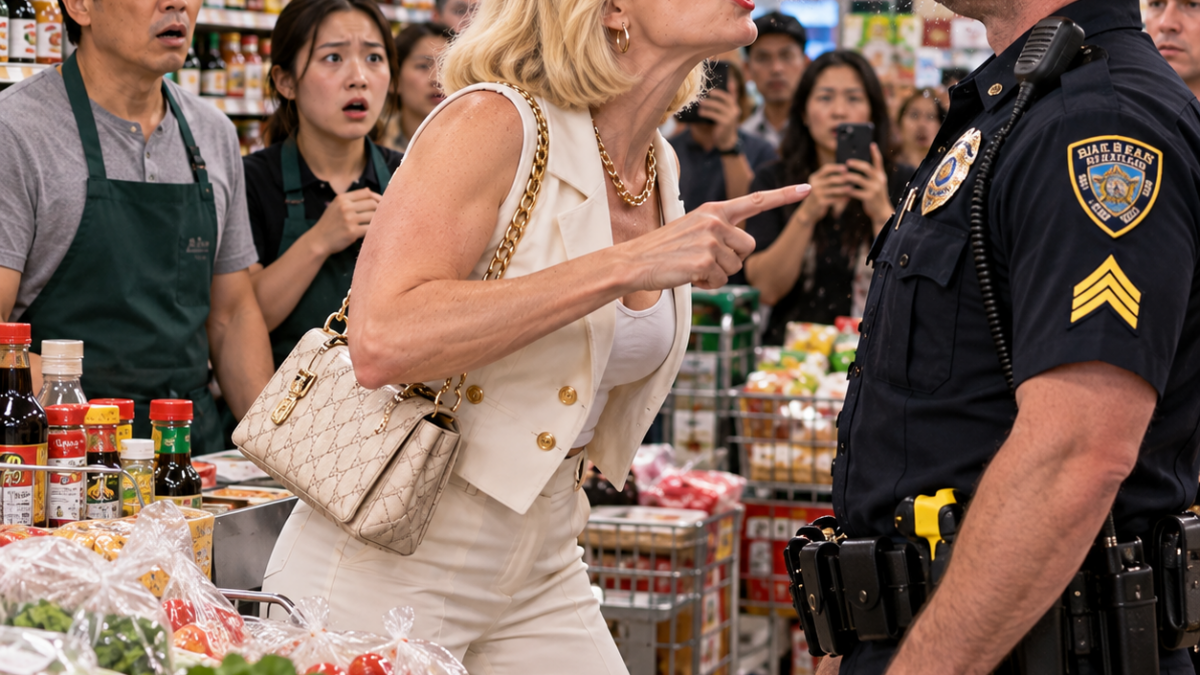
Then she spat in the officer’s face.
Everything stopped.
I had seen a lot of bad customer behavior in my life. People throwing money. People cursing. People knocking over displays. People threatening bad reviews like they were federal warrants.
I had never seen someone spit on a police officer.
The officer froze.
His expression was not anger at first.
It was disbelief.
A wet mark glistened on his cheek.
He slowly turned his head toward her.
“Did she just—”
“She spat on you,” I said immediately.
Several customers confirmed it at once.
“Yes.”
“She did.”
“I saw it.”
Karen’s face changed as if she finally realized her body had done something her mouth could not talk its way out of.
The officer wiped his cheek with one sleeve, looked at her, and said in a voice that had gone very calm, “Turn around.”
“I didn’t—”
“Turn around.”
Within seconds, Karen was in handcuffs.
She kept screaming while they read her rights. Felony assault on an officer was the phrase I heard. There were other words too. Hate crime. Disturbance. Assault. Property damage. Her son was being arrested for attacking me. Karen had entered the store that day determined to make us feel powerless.
She left with her hands behind her back.
The store remained silent long after the patrol cars pulled away.
For a while, none of us knew what to do.
The floor was still a mess. Frozen packages split open. Sauce from the broken jar spread under the shelf. Mrs. Liang sat in a chair near the front, trembling while Mei held her hand. Customers stood around awkwardly, as if leaving too quickly would feel like betrayal.
Then Mr. Alvarez picked up a fallen package.
“Where do you want this?”
I blinked.
“You don’t have to—”
“Where?”
I pointed toward a cart.
He put it there.
The young mother grabbed paper towels.
A college student helped David move damaged items.
Mei made tea for Mrs. Liang.
And just like that, the store began putting itself back together.
Not because we were fine.
Because people decided we were not going to be left alone in the wreckage.
My parents came in after I called them.
My mother went straight to Mrs. Liang and hugged her. My father stood in the refrigerated aisle, staring at the broken food and smeared floor, his jaw tight in a way I had seen only a few times in my life.
He asked me what happened.
I told him.
When I got to the part about Karen spitting on the officer, he closed his eyes.
“Stupid woman,” he said.
That was all.
From my father, that was a thunderstorm.
The next days were strange.
Police took statements. Officers reviewed what customers had recorded on their phones. Our earlier non-emergency report mattered, because it showed a pattern. Karen had not simply had one bad outburst. She had been harassing the store for weeks. She had escalated from complaints to racist accusations to targeting an elderly customer to bringing her son back as physical intimidation.
Her son got into trouble too, though less than Karen.
From what I heard, he faced charges for assaulting me and participating in the disturbance. He had shoved me in full view of officers. That made things difficult for him to deny.
Karen faced more.
Spitting on an officer would have been bad enough by itself. Doing it while being arrested after a racially charged attack inside a small immigrant-owned family business made everything worse. I am not an expert in legal details, and I will not pretend I understood every charge the first time I heard them, but I understood this much:
Karen had talked herself out of a warning, screamed herself out of sympathy, and spit herself into a serious criminal case.
If she had left when I asked, she might have been banned.
If she had left after shouting at Mrs. Liang, maybe she would have faced a report and a trespass notice.
If her son had not shoved me in front of police, maybe he could have pretended confusion.
If she had not spat on the officer, maybe she could have stood in court and performed regret.
But Karen did not know when to stop.
People like her rarely do, because stopping requires recognizing that other people are real.
The story spread through town quickly.
At first, that scared me.
I did not want our store to become known as the place where a racist incident happened. I did not want people coming in just to stare or ask painful questions. I did not want Mrs. Liang’s fear turned into gossip. I did not want my parents’ life’s work reduced to a dramatic local headline.
But what happened next surprised me.
People showed up.
Not for spectacle.
For support.
Regular customers came in even when they did not need groceries. Some bought extra. Some brought flowers. Some brought cards. One local teacher brought her students’ handmade notes after discussing kindness and community in class. A church group organized a “shop local” day and told everyone to buy at least one thing from our store. A neighborhood association—not Karen’s kind of association, a real one—helped plan a small event outside our storefront about standing together against bigotry.
They did not put Karen’s name on the flyers.
They did not need to.
Everyone knew.
For weeks, people came through the door and said some version of the same thing.
“We’re sorry that happened.”
“You belong here.”
“We love this store.”
“My family has been shopping here for years.”
“She doesn’t represent us.”
At first, I did not know how much I needed to hear that.
I had told myself I was fine. Angry, yes. Tired, yes. But fine.
Then an elderly white man named Harold, who had bought jasmine rice from us every month for as long as I could remember, came in holding his hat against his chest.
“I should’ve said something sooner,” he told me.
“What do you mean?”
“I was here once when she was running her mouth. I thought, well, the staff handled it. Didn’t want to make a scene.” He looked down. “Should’ve made a scene.”
I did not know what to say.
He continued, “People like that count on the rest of us being polite.”
That stayed with me.
Because he was right.
Karen had been protected, in small ways, by everyone’s desire not to escalate. My desire. Customers’ desire. Even the basic social instinct to avoid ugliness in public spaces. She used that politeness like shelter until she finally stepped too far into the open.
The court process took time.
Karen did not become more sympathetic.
I heard from people who attended parts of the hearings that she continued insisting she had been provoked, misunderstood, targeted. She cried at the wrong moments and glared at the wrong people. She seemed more upset about being called racist than about anything she had said or done.
That did not help her.
Her son, from what I heard, behaved better. He was quiet. He admitted more. Maybe he understood sooner that his mother’s version of events had led him straight into handcuffs. His sentence was lighter.
Karen’s was not.
I will not pretend I danced when I heard she was facing real time behind bars. Life is more complicated than that, and I was raised not to celebrate human ruin casually.
But I did feel relief.
And I did not feel guilty for that relief.
There is a difference between wanting revenge and wanting a person stopped.
I wanted Karen stopped.
For Mrs. Liang.
For Mei.
For my parents.
For the customers who had to listen to hate in a place where they came for groceries.
For every small business owner who has smiled politely while someone treated them like they were less than human because the customer thought money, skin color, or volume gave them power.
The store became busier after the incident.
That was the strangest irony.
Karen had wanted to make us feel unwelcome in our own town. Instead, she reminded the town to welcome us louder.
People who had never come in before started visiting. Some admitted they had always been curious but nervous because they did not know what to buy. We started putting up little recipe cards near certain products. Mei suggested a beginner shelf: easy sauces, noodles, snacks, and instructions. My mother began doing Saturday tastings. My father pretended not to enjoy the extra attention while secretly arranging displays better than ever.
Mrs. Liang came back two weeks after the incident.
We had offered to deliver anything she needed, but she insisted.
She walked in slowly, holding her cloth bag.
The whole store seemed to notice without staring.
My mother came from behind the counter.
Mrs. Liang patted her arm and said, “I am not afraid of grocery shopping.”
My mother’s eyes filled with tears.
“Good,” she said.
Mrs. Liang looked at me.
“You did well.”
I shook my head.
“I wish I had stopped it sooner.”
“You stood there,” she said. “That matters.”
I think about that often.
You stood there.
At the time, standing there felt inadequate. I had not delivered some heroic speech. I had not physically thrown Karen out. I had not shielded everyone from hearing those words. I had mostly kept my body between a hateful woman and an elderly customer until help came.
But maybe sometimes that is what courage looks like in real life.
Not clean.
Not cinematic.
Just standing in the ugly place because someone else should not have to stand there alone.
Months have passed now.
The store feels like itself again, but changed in a way I cannot fully describe. There is more laughter, somehow. More regulars greeting each other across aisles. More people asking questions without embarrassment. More local support than we ever expected.
The broken refrigerated shelf was repaired.
The floor was cleaned.
The spilled groceries were replaced.
But I did not throw away every reminder.
Behind the counter, near the old register, I keep a copy of the first non-emergency report number written on a small slip of paper. It reminds me to trust my instincts earlier. It reminds me that documentation is not drama. It is protection. It reminds me that waiting for someone hateful to get bored is not a safety plan.
My father keeps something else.
After the community event, a child drew a picture of our store with people of different skin tones standing outside holding grocery bags. Across the top, in uneven marker letters, it said:
EVERYONE CAN EAT HERE.
My father taped it near the office door.
He says it is because the colors are nice.
My mother and I know better.
Karen probably thought she was defending America that day.
People like her always do. They confuse cruelty with patriotism, English with worthiness, whiteness with ownership, and volume with truth. They walk into places built by other people’s labor and demand gratitude for their contempt.
But America, at least the version I still believe in, was not Karen screaming in aisle three.
It was Mrs. Liang coming back.
It was customers speaking up.
It was police officers refusing to accept her lies.
It was neighbors organizing support.
It was my parents opening the store the next morning because fear did not get to decide whether we belonged.
We belonged before Karen entered.
We belonged while she screamed.
We belonged after she left in handcuffs.
And every time the bell above the door rings now, I remember that belonging is not something people like Karen give.
It is something they fail to take away.
𝗧𝗛𝗘 𝗘𝗡𝗗
Karen Came Into My Family’s Grocery Store to Make Us Feel Like Strangers, Then Spat on the Cop Who Came to Stop Her
Karen walked into my family’s grocery store like she had come to inspect a country she already hated.
She insulted our food, our language, our customers, and our right to belong there.
Then the police arrived, and instead of walking away with a warning, she spat straight into an officer’s face and turned her own prejudice into handcuffs.
My family has run the same small Asian grocery store for generations.
That may sound ordinary if you have never stood behind a counter and watched your parents build a life one customer at a time. But to me, that store was never just a store. It was where my grandfather learned enough English to argue with suppliers. It was where my grandmother kept a handwritten notebook full of regular customers’ favorite items. It was where my parents worked twelve-hour days without calling it sacrifice because they believed survival looked better when you did not complain too loudly about it.
The store sat on a corner in a working-class neighborhood where people knew us by name.
Not everyone who shopped there was Asian. That was part of what I loved about it. We had Chinese grandmothers buying fresh greens and dried mushrooms. Filipino families coming in for noodles, sauces, and snacks their kids begged for. College students wandering the aisles because they had discovered instant ramen could be more than the sad orange packets sold at big-box stores. Local cooks came for spices. Curious neighbors came for dumplings, rice cakes, tea, chili oil, fish sauce, soy sauce, curry pastes, produce they had never learned to pronounce but enjoyed anyway.
Our business depended almost entirely on repeat customers.
That meant respect mattered.
My parents taught me early that a customer did not have to know everything to be welcome. If someone asked what something was, we explained. If they mispronounced a product, we helped without laughing. If they looked overwhelmed, we showed them simple recipes. Food is one of the gentlest ways people cross into each other’s lives, and our store had always been a place where that crossing felt normal.
Not perfect.
Normal.
Then Karen started coming in.
I do not know whether she had just moved to town or whether she had lived nearby for years and somehow avoided us until then. She appeared one afternoon like a bad smell nobody could find the source of at first. Mid-fifties, stiff blond hair, expensive-looking sunglasses perched on top of her head, bright lipstick, and the kind of expression that made every aisle feel guilty before she even spoke.
The first time, I tried to greet her like anyone else.
“Hi. Let me know if you need help finding anything.”
She looked at me, then looked past me at the shelves.
“What is this smell?”
I paused.
“We have fresh seafood in the back, dried goods, spices—”
“It reeks.”
A woman holding a basket near the rice aisle turned her head.
I kept my voice polite.
“Some ingredients have strong aromas if you’re not used to them.”
Karen wrinkled her nose.
“I’m used to clean stores.”
That was the first cut.
Not deep enough to bleed, but sharp enough to remember.
I told myself she was just rude.
Every business gets rude customers. People having bad days. People who think retail workers are furniture with pulse. People who believe prices are personally invented by whoever happens to stand behind the register. You learn to breathe through it.
Karen walked the aisles for ten minutes, complained that she could not read half the packaging, said everything was overpriced, said the produce looked rotten even though it had been delivered that morning, complained again about the smell, then left without buying anything.
We all assumed she would never come back.
We were wrong.
part2
Karen came back the next week.
Then again after that.
Every visit followed the same pattern, except each time she became a little louder, a little uglier, and a little more comfortable treating us like we were trespassing inside our own store.
“This packaging should be in English.”
“This fish is disgusting.”
“Why is everything so expensive?”
“How do I know what’s even in this?”
“Are you people allowed to sell this stuff?”
You people.
That phrase started appearing more.
My employees noticed. Our regulars noticed. Even customers who had never seen her before could sense the change in the room when Karen arrived. Conversations quieted. People watched from the corners of their eyes. Some looked embarrassed for her. Others looked angry.
One afternoon, she heard one of my employees talking to another customer in English with a mild Chinese accent.
Karen snapped her head around.
“What did you just say?”
My employee, Mei, blinked.
“I asked if she wanted the large bag or small bag.”
Karen stepped closer.
“No. You were speaking some other language about me.”
Mei looked stunned.
“I was speaking English.”
“Well, it didn’t sound like English.”
I came around the counter before Mei had to answer.
“Is there something I can help you with?”
Karen turned that cold smile on me.
“I just think it’s rude when employees talk about customers in foreign languages.”
“She was not talking about you.”
“You don’t know that.”
“She was standing three feet from me.”
Karen scoffed.
“Of course you’d defend her.”
That sentence told me more than she realized.
From then on, I knew this was not ordinary rudeness.
This was the kind of customer who walked into our store and saw every shelf, every accent, every label, every face as evidence against us. Karen did not dislike our business. She disliked that it existed comfortably in a town she believed should reflect only people like her.
One of our regular customers, Mr. Allen, pulled me aside after she left.
“You should start documenting this,” he said.
“I don’t want to make it bigger than it is.”
He looked toward the door.
“It’s already bigger than you want it to be.”
He suggested calling the non-emergency police line to make a record in case she escalated. I felt strange doing it. Part of me worried I would sound dramatic. Another part of me had been trained by years in a family business to smooth things over, keep conflict small, not scare away customers, not be difficult.
But I called.
The officer who answered listened carefully. He told me I was not overreacting, that documenting repeated harassment was reasonable, and that if she threatened anyone or refused to leave, we should call immediately.
I hung up feeling relieved.
I thought maybe that was enough.
I thought Karen would get bored.
I thought people like her eventually run out of energy when no one gives them the fight they want.
That was my mistake.
The day everything exploded started like any other weekday.
Deliveries had come early. We were restocking greens, rotating chilled items, and breaking down cardboard near the back. The store smelled like ginger, cilantro, dried shrimp, roasted sesame oil, and the faint salty chill from the seafood case. To me, it smelled like work and home.
Mrs. Liang came in around noon.
She was one of our oldest customers, not just in age but in loyalty. She had shopped with my grandparents before I was born. She knew my parents by their first names. She brought red envelopes during Lunar New Year even after we told her she did not have to. She moved slowly now, using one hand on her cart and the other wrapped around a cloth shopping bag she had probably owned for twenty years.
She was choosing bok choy when Karen entered.
I felt it before I looked up.
The bell above the door rang, and the room tightened.
Karen stood just inside the entrance, scanning the store as if she expected filth to rise and identify itself.
I saw Mei’s shoulders stiffen.
I saw Mr. Alvarez near the sauces roll his eyes.
I stepped from behind the counter, ready to intercept if necessary.
For the first few minutes, Karen muttered to herself. Complaints about prices. Comments about smells. Little darts thrown just loud enough for people to hear, not quite loud enough to make intervention simple.
Then she saw Mrs. Liang.
I do not know what exactly set Karen off.
Maybe Mrs. Liang spoke softly to herself in Cantonese while reading a label. Maybe Karen was already looking for someone who seemed vulnerable. Maybe cruelty, like water, runs downhill until it finds the easiest place to pool.
Karen moved toward her.
“You people need to learn how things work here.”
Mrs. Liang looked up, confused.
“I’m sorry?”
Karen’s voice rose.
“I said, if you’re going to live in this country, you need to speak English.”
My blood went cold.
I started walking fast.
Mrs. Liang’s hand tightened around her basket.
“I speak English,” she said quietly.
“Then use it,” Karen snapped. “I’m sick of coming into places like this and hearing all this chatter like normal people don’t belong.”
By then I was between them.
“That’s enough,” I said.
Karen looked at me like I had interrupted her performance.
“Excuse me?”
“You need to leave.”
Her eyebrows lifted.
“I am a customer.”
“No. You are harassing another customer. Leave.”
Her face flushed.
“I was having a conversation.”
“You were telling an elderly woman to speak English in a store owned by an Asian family.”
Karen leaned to the side, trying to look around me at Mrs. Liang.
“You don’t get to hide behind him. Go back where you—”
“Stop.”
My voice came out louder than I expected.
The store went completely silent.
For one second, Karen looked thrilled. Like she had finally pulled anger out of me and could use it.
Then she tried to reach past me.
I shifted to block her.
She shoved forward, not hard enough to move me much, but enough that her arm knocked Mrs. Liang’s basket from her hands. Greens, jars, noodles, and fruit spilled across the floor.
Mrs. Liang gasped.
Mei rushed over and helped her back.
Another employee, David, grabbed the phone and called 911.
I did not know that yet. I was too focused on keeping Karen from touching anyone while not touching her more than absolutely necessary.
“You’re assaulting me,” Karen screamed.
“I’m standing between you and a woman you’re harassing.”
“You people think you can do anything.”
“Leave.”
“You all need to learn English and go back to China!”
There it was, fully out in the open now.
No more hints.
No more pretending she was concerned about prices or packaging.
Just hate, loud and ugly, bouncing off shelves my family had stocked for generations.
She kept going. Same lines repeated. Learn English. Go back to China. This is America. Something about MSG. Something about dirty markets. She was not creative, but bigotry rarely is. It borrows old phrases because imagination would require humanity.
After a few minutes of shouting, Karen stormed toward the door.
I thought, for half a breath, that it was over.
Then I saw her outside screaming at a man in a pickup truck.
He was large. Broad shoulders. Thick arms. Baseball cap pulled low. He got out of the driver’s seat with the slow confidence of someone who enjoyed being used as a weapon.
Karen pointed back at the store.
The man looked toward me.
Then both of them came in.
“You’re going to regret disrespecting me,” Karen said, almost laughing as she walked past the counter.
The man followed behind her.
I later learned he was her son.
At that moment, all I knew was that the situation had changed shape. Karen alone was loud, racist, and destructive. Karen with a large angry man at her back was dangerous.
One of my employees whispered, “Police are coming.”
Good.
But police are not magic. They do not appear just because you need them. Until they arrived, it was still my store, my employees, my customers, and my responsibility.
Karen marched to the refrigerated section and yanked open a door.
“What’s this?” she shouted, pulling out a frozen dinner. “More mystery garbage?”
“Put that back,” I said.
She threw it onto the floor.
The package split.
Her son stepped between us before I could move closer.
“Back up,” he said.
“This is my store.”
He smirked.
“Not for long if you keep messing with my mother.”
Karen grabbed another package.
“Maybe people should see what kind of disgusting stuff you sell.”
She threw that too.
I tried to step around him.
He shoved me.
Hard.
I stumbled backward and caught myself on the edge of an aisle.
A few customers gasped.
He grinned.
“What’s wrong, China boy? You think you’re better than us Americans?”
I remember that phrase clearly because it was so stupid it almost stunned me more than the shove.
Us Americans.
As if my family had not paid taxes, opened early, closed late, sponsored school fundraisers, donated food after storms, and served this town before Karen had ever decided we were foreign inside it.
I said nothing.
That took effort.
During all of this, several customers remained in the store. I did not understand why until later. They stayed because they were worried about us. They stayed to witness. They stayed because sometimes community is not a grand speech or a parade. Sometimes it is ordinary people standing near the opposite wall, frightened but unwilling to abandon you to someone else’s cruelty.
Then two things happened almost at the same time.
First, the police arrived.
They did not use sirens. The first sign was the door opening and two officers stepping inside. From where I stood, I saw them over the aisle displays.
Karen and her son did not.
Second, her son shoved me again.
This time, there was no possible excuse. I was not moving toward Karen. I was not touching anyone. I was standing near the aisle, trying to keep distance, when he stepped forward and slammed both hands into my chest.
My back hit the shelf hard enough to make the entire aisle wobble.
Several jars rattled.
One fell and shattered.
The officers saw everything.
“What’s going on here?” one of them barked.
Karen turned, and I watched her face transform.
At first, she looked delighted.
Police.
Authority.
People she assumed would take her side.
Maybe because they were white. Maybe because she had spent her whole life believing certain faces carried automatic credibility and others carried suspicion. I cannot know for sure. But I saw the calculation in her eyes.
Then the officer pointed at her son.
“Is he with you?”
The delight drained out of her.
“He’s my son,” she said.
The officer looked at me, then at the wobbling shelf, then at the broken jar on the floor.
“I just watched him shove this man.”
Karen jabbed a finger toward my chest.
“He was harassing us. My son had to protect me.”
Before I could answer, the store erupted.
“No, she started it,” Mr. Alvarez said.
“She’s been coming in here for weeks,” another customer added.
“She was yelling at that old woman,” Mei said.
“She knocked her basket down,” David said.
“She was throwing food,” said a young mother near the noodles.
“She called them racist names,” someone else said.
Karen spun around, furious.
“You all are lying!”
The older officer looked at me.
“We had prior reports about a customer causing problems here over the last couple months,” he said. “Is this the same woman?”
“Yes,” I said.
Karen started screeching over me.
The officer ignored her.
That may have been the first time all day someone with legal authority treated her noise like noise.
Her son had gone quiet. The smirk was gone. He looked confused, as if consequences were a language he did not speak fluently.
One officer moved toward him with handcuffs.
He did not resist.
Karen did.
Not physically at first. Verbally. Loudly. Wildly.
“This is discrimination!”
“They attacked me!”
“This is my country!”
“You’re taking their side?”
The younger officer tried to control the scene while the older one secured her son. Karen stepped closer, still shouting.
Then she spat in the officer’s face.
Everything stopped.
I had seen a lot of bad customer behavior in my life. People throwing money. People cursing. People knocking over displays. People threatening bad reviews like they were federal warrants.
I had never seen someone spit on a police officer.
The officer froze.
His expression was not anger at first.
It was disbelief.
A wet mark glistened on his cheek.
He slowly turned his head toward her.
“Did she just—”
“She spat on you,” I said immediately.
Several customers confirmed it at once.
“Yes.”
“She did.”
“I saw it.”
Karen’s face changed as if she finally realized her body had done something her mouth could not talk its way out of.
The officer wiped his cheek with one sleeve, looked at her, and said in a voice that had gone very calm, “Turn around.”
“I didn’t—”
“Turn around.”
Within seconds, Karen was in handcuffs.
She kept screaming while they read her rights. Felony assault on an officer was the phrase I heard. There were other words too. Hate crime. Disturbance. Assault. Property damage. Her son was being arrested for attacking me. Karen had entered the store that day determined to make us feel powerless.
She left with her hands behind her back.
The store remained silent long after the patrol cars pulled away.
For a while, none of us knew what to do.
The floor was still a mess. Frozen packages split open. Sauce from the broken jar spread under the shelf. Mrs. Liang sat in a chair near the front, trembling while Mei held her hand. Customers stood around awkwardly, as if leaving too quickly would feel like betrayal.
Then Mr. Alvarez picked up a fallen package.
“Where do you want this?”
I blinked.
“You don’t have to—”
“Where?”
I pointed toward a cart.
He put it there.
The young mother grabbed paper towels.
A college student helped David move damaged items.
Mei made tea for Mrs. Liang.
And just like that, the store began putting itself back together.
Not because we were fine.
Because people decided we were not going to be left alone in the wreckage.
My parents came in after I called them.
My mother went straight to Mrs. Liang and hugged her. My father stood in the refrigerated aisle, staring at the broken food and smeared floor, his jaw tight in a way I had seen only a few times in my life.
He asked me what happened.
I told him.
When I got to the part about Karen spitting on the officer, he closed his eyes.
“Stupid woman,” he said.
That was all.
From my father, that was a thunderstorm.
The next days were strange.
Police took statements. Officers reviewed what customers had recorded on their phones. Our earlier non-emergency report mattered, because it showed a pattern. Karen had not simply had one bad outburst. She had been harassing the store for weeks. She had escalated from complaints to racist accusations to targeting an elderly customer to bringing her son back as physical intimidation.
Her son got into trouble too, though less than Karen.
From what I heard, he faced charges for assaulting me and participating in the disturbance. He had shoved me in full view of officers. That made things difficult for him to deny.
Karen faced more.
Spitting on an officer would have been bad enough by itself. Doing it while being arrested after a racially charged attack inside a small immigrant-owned family business made everything worse. I am not an expert in legal details, and I will not pretend I understood every charge the first time I heard them, but I understood this much:
Karen had talked herself out of a warning, screamed herself out of sympathy, and spit herself into a serious criminal case.
If she had left when I asked, she might have been banned.
If she had left after shouting at Mrs. Liang, maybe she would have faced a report and a trespass notice.
If her son had not shoved me in front of police, maybe he could have pretended confusion.
If she had not spat on the officer, maybe she could have stood in court and performed regret.
But Karen did not know when to stop.
People like her rarely do, because stopping requires recognizing that other people are real.
The story spread through town quickly.
At first, that scared me.
I did not want our store to become known as the place where a racist incident happened. I did not want people coming in just to stare or ask painful questions. I did not want Mrs. Liang’s fear turned into gossip. I did not want my parents’ life’s work reduced to a dramatic local headline.
But what happened next surprised me.
People showed up.
Not for spectacle.
For support.
Regular customers came in even when they did not need groceries. Some bought extra. Some brought flowers. Some brought cards. One local teacher brought her students’ handmade notes after discussing kindness and community in class. A church group organized a “shop local” day and told everyone to buy at least one thing from our store. A neighborhood association—not Karen’s kind of association, a real one—helped plan a small event outside our storefront about standing together against bigotry.
They did not put Karen’s name on the flyers.
They did not need to.
Everyone knew.
For weeks, people came through the door and said some version of the same thing.
“We’re sorry that happened.”
“You belong here.”
“We love this store.”
“My family has been shopping here for years.”
“She doesn’t represent us.”
At first, I did not know how much I needed to hear that.
I had told myself I was fine. Angry, yes. Tired, yes. But fine.
Then an elderly white man named Harold, who had bought jasmine rice from us every month for as long as I could remember, came in holding his hat against his chest.
“I should’ve said something sooner,” he told me.
“What do you mean?”
“I was here once when she was running her mouth. I thought, well, the staff handled it. Didn’t want to make a scene.” He looked down. “Should’ve made a scene.”
I did not know what to say.
He continued, “People like that count on the rest of us being polite.”
That stayed with me.
Because he was right.
Karen had been protected, in small ways, by everyone’s desire not to escalate. My desire. Customers’ desire. Even the basic social instinct to avoid ugliness in public spaces. She used that politeness like shelter until she finally stepped too far into the open.
The court process took time.
Karen did not become more sympathetic.
I heard from people who attended parts of the hearings that she continued insisting she had been provoked, misunderstood, targeted. She cried at the wrong moments and glared at the wrong people. She seemed more upset about being called racist than about anything she had said or done.
That did not help her.
Her son, from what I heard, behaved better. He was quiet. He admitted more. Maybe he understood sooner that his mother’s version of events had led him straight into handcuffs. His sentence was lighter.
Karen’s was not.
I will not pretend I danced when I heard she was facing real time behind bars. Life is more complicated than that, and I was raised not to celebrate human ruin casually.
But I did feel relief.
And I did not feel guilty for that relief.
There is a difference between wanting revenge and wanting a person stopped.
I wanted Karen stopped.
For Mrs. Liang.
For Mei.
For my parents.
For the customers who had to listen to hate in a place where they came for groceries.
For every small business owner who has smiled politely while someone treated them like they were less than human because the customer thought money, skin color, or volume gave them power.
The store became busier after the incident.
That was the strangest irony.
Karen had wanted to make us feel unwelcome in our own town. Instead, she reminded the town to welcome us louder.
People who had never come in before started visiting. Some admitted they had always been curious but nervous because they did not know what to buy. We started putting up little recipe cards near certain products. Mei suggested a beginner shelf: easy sauces, noodles, snacks, and instructions. My mother began doing Saturday tastings. My father pretended not to enjoy the extra attention while secretly arranging displays better than ever.
Mrs. Liang came back two weeks after the incident.
We had offered to deliver anything she needed, but she insisted.
She walked in slowly, holding her cloth bag.
The whole store seemed to notice without staring.
My mother came from behind the counter.
Mrs. Liang patted her arm and said, “I am not afraid of grocery shopping.”
My mother’s eyes filled with tears.
“Good,” she said.
Mrs. Liang looked at me.
“You did well.”
I shook my head.
“I wish I had stopped it sooner.”
“You stood there,” she said. “That matters.”
I think about that often.
You stood there.
At the time, standing there felt inadequate. I had not delivered some heroic speech. I had not physically thrown Karen out. I had not shielded everyone from hearing those words. I had mostly kept my body between a hateful woman and an elderly customer until help came.
But maybe sometimes that is what courage looks like in real life.
Not clean.
Not cinematic.
Just standing in the ugly place because someone else should not have to stand there alone.
Months have passed now.
The store feels like itself again, but changed in a way I cannot fully describe. There is more laughter, somehow. More regulars greeting each other across aisles. More people asking questions without embarrassment. More local support than we ever expected.
The broken refrigerated shelf was repaired.
The floor was cleaned.
The spilled groceries were replaced.
But I did not throw away every reminder.
Behind the counter, near the old register, I keep a copy of the first non-emergency report number written on a small slip of paper. It reminds me to trust my instincts earlier. It reminds me that documentation is not drama. It is protection. It reminds me that waiting for someone hateful to get bored is not a safety plan.
My father keeps something else.
After the community event, a child drew a picture of our store with people of different skin tones standing outside holding grocery bags. Across the top, in uneven marker letters, it said:
EVERYONE CAN EAT HERE.
My father taped it near the office door.
He says it is because the colors are nice.
My mother and I know better.
Karen probably thought she was defending America that day.
People like her always do. They confuse cruelty with patriotism, English with worthiness, whiteness with ownership, and volume with truth. They walk into places built by other people’s labor and demand gratitude for their contempt.
But America, at least the version I still believe in, was not Karen screaming in aisle three.
It was Mrs. Liang coming back.
It was customers speaking up.
It was police officers refusing to accept her lies.
It was neighbors organizing support.
It was my parents opening the store the next morning because fear did not get to decide whether we belonged.
We belonged before Karen entered.
We belonged while she screamed.
We belonged after she left in handcuffs.
And every time the bell above the door rings now, I remember that belonging is not something people like Karen give.
It is something they fail to take away.