𝙍𝙚𝙖𝙙𝙈𝙤𝙧𝙚👉 Karen Called the Police Because I Was Disabled in My Own Pool, but She Forgot the Whole Neighborhood Could Hear Her Hate
part2
Karen became a weather system.
Not constant at first, but always threatening to roll in.
I would be floating in the pool, eyes closed, water holding me up in that rare painless way, and I would hear her voice from the other side of the fence.
“Should you be doing that?”
Or:
“Does your doctor know you’re out here in the sun?”
Or:
“I just worry what children might think if they saw all that.”
All that.
My braces. My bruises. My body.
The first few times, I tried being polite.
“Yes, my doctor knows I swim.”
“No, I don’t need help.”
“Yes, I’m fine.”
“No, I’m not injured; I have a connective tissue disorder.”
Every answer only gave her more to chew on.
One afternoon, I was stretching gently in the shallow end when she appeared over the fence, perched high enough that I could see her shoulders. She must have dragged a step stool or chair over. The absurdity of that should have been funny. It wasn’t. Being watched is only funny when you do not feel hunted.
“What exactly is wrong with you?” she asked.
I stopped moving.
“Excuse me?”
“Your joints.” She fluttered her hands in a grotesque little imitation of looseness. “Are they all floppy like that?”
I stared at her.
“It’s called Ehlers-Danlos syndrome.”
She repeated it badly, wrinkling her nose.
“Is it contagious?”
“No.”
“Well, that’s something.”
I swam to the edge and folded my arms on the warm concrete.
“Karen, why are you looking into my yard?”
“I’m being neighborly.”
“Neighborly people knock on doors. They don’t climb fences.”
She ignored that.
“If I had something like that,” she said, “I don’t think I’d ever leave the house.”
I felt the words hit and tried not to show it.
“That sounds sad for you.”
Her eyes narrowed.
“I just think some things should be private.”
“This is private.”
“You know what I mean.”
“I really don’t think I do.”
She gave a little huff and glanced toward her own yard, where I had occasionally heard children playing. Grandchildren, I assumed, though I later learned they were her sister’s kids who came over some afternoons.
“There are children around,” she said.
“And?”
“They shouldn’t have to ask questions about people like you.”
People like you.
There are phrases that do not simply offend. They unlock whole rooms of old pain.
People like you shouldn’t be out alone.
People like you are so inspiring.
People like you need special care.
People like you make others uncomfortable.
I lifted myself carefully out of the pool, one hand braced on the rail, movements slow because anger makes my joints less predictable. I reached for my towel and wrapped it around my waist.
“Then maybe the adults around them should learn how to answer questions without being cruel.”
Karen’s mouth pinched.
“I am not cruel. I am honest.”
“Cruel people love saying that.”
She disappeared from the fence.
For a week, I barely went outside.
I told myself it was the pain. Some of it was. A bad shoulder flare. A knee that felt like it had been assembled incorrectly. But mostly, it was Karen’s voice. I hated admitting that. I hated how quickly one hateful woman could turn my favorite place into a stage where I suddenly felt exposed.
Evan noticed, because Evan noticed everything.
“You haven’t been in the pool,” he said one evening while making dinner.
I sat at the kitchen island, one knee propped on a stool, ice pack strapped around it.
“Shoulder’s bad.”
“Your shoulder was worse last month and you still floated for an hour every day.”
I picked at the edge of the ice pack.
“She watches.”
He turned from the stove.
“Karen?”
“She says things.”
“What things?”
I shrugged, then immediately regretted it because my shoulder zapped pain down my arm.
“Claire.”
I hated the softness in his voice more than if he had yelled.
“She thinks I’m disgusting,” I said. “Or that kids shouldn’t see me. Or that if I had any decency, I’d hide inside wearing a full-body tarp.”
Evan’s face changed.
He was not a large man, not intimidating in the obvious way, but there was a stillness that came over him when he was angry. The kind architects probably use when a contractor says a load-bearing wall is optional.
“She said that?”
“Not those exact words.”
“Close enough?”
“Close enough.”
He turned off the burner.
“I’ll talk to her.”
“No.”
“Claire—”
“No. If you talk to her, she’ll make it about you threatening her. Or she’ll cry. Or she’ll say I misunderstood. I don’t want some fence war.”
He came around the counter and put his hands flat on the island, careful not to crowd me.
“What do you want?”
I looked toward the sliding glass door.
Outside, the pool reflected the last of the evening light.
“I want my backyard back.”
The next day, I tried.
Not bravely. Not dramatically. I simply put on a one-piece swimsuit, strapped my knee braces over it, taped my wrist, grabbed my cane, and went outside with the stubborn determination of a woman going to war against her own anxiety.
The sun was warm.
The deck smelled faintly of chlorine and cedar.
For fifteen minutes, everything was fine.
Then Karen’s voice cut over the fence.
“You really shouldn’t do that where people can see you.”
I closed my eyes.
“Good afternoon to you too.”
“I’m serious.”
“So am I.”
“You’re out there practically naked.”
I looked down at my navy one-piece suit.
“Karen, this covers more than most dresses.”
“You know that isn’t the issue.”
“Then what is?”
There was a pause.
Then she said it.
“The braces. The bruises. The way you move. It’s upsetting.”
Something inside me went cold.
I stood slowly from the lounge chair. My hip protested. My ankle wobbled, then steadied. I walked to the fence, cane tapping the deck boards, and looked up.
Karen was perched again, sunglasses on, lips pursed.
“Stop looking,” I said.
“This neighborhood has standards.”
“You don’t get to set standards for my body.”
“You are exposing yourself to children.”
“I am wearing a swimsuit at my own pool.”
“You are exposing them to sickness.”
“I’m not sick in the way you mean.”
“You know what?” Her voice rose. “This neighborhood is not a hospital. If you’re so fragile, maybe you should be somewhere appropriate.”
I laughed once because if I did not, I might cry.
“Like where? A bell tower? A cave? A decorative cabinet?”
“You think you’re funny.”
“I think you’re creepy.”
Her eyebrows shot up.
“How dare you?”
“You are standing on something to spy over a six-foot fence at a woman in her own backyard, and you think I’m the inappropriate one?”
Her face flushed.
“My children can see you.”
“Then your children are climbing furniture too.”
“They ask questions.”
“Answer them better.”
“You are disgusting,” she snapped.
There it was.
No filter left.
No concern.
No standards.
Just disgust.
The word hung between us.
For a second, I felt very far away from my body, like I was watching myself from the other side of the yard. The old reflex rose fast: cover up, apologize, retreat, disappear. The version of me from ten years earlier would have gone inside and cried until pain and shame became indistinguishable.
But thirty-one-year-old me had therapy, rage, and a cane in my hand.
“If my body disgusts you,” I said, voice shaking but clear, “stop breaking your neck to look at it.”
Then I went into the pool.
I heard her make a sharp noise of outrage before dropping from the fence.
The police came the next afternoon.
I was on the lounge chair again, reading, wearing the same one-piece suit and wrist braces. Evan was inside on a work call. I heard tires in the driveway, then a knock at the side gate.
“Police department.”
My stomach dropped so fast I felt nauseated.
I reached for my cane and stood carefully. Moving quickly is one of the many luxuries my body refuses me. By the time I made it to the gate, two officers stood outside: a man in his forties with tired eyes and a younger woman holding a notepad.
Behind them, on her side of the fence, Karen hovered like a storm cloud in coral lipstick.
“Ma’am,” the older officer said gently, “we received a complaint.”
“I figured.”
Karen shouted from behind them, “She’s exposing herself!”
The younger officer turned her head slightly.
“Ma’am, please let us speak with her.”
Karen pointed at me.
“My children are terrified. She’s half naked, showing her body, showing all those things on her limbs, trying to lure children over here.”
The words hit so hard I almost lost my grip on the cane.
Lure children.
There are accusations so ugly they leave a stain even when false.
The older officer’s face tightened.
“Ma’am,” he said to Karen, “that is a serious claim.”
“It’s true!”
I opened the gate wider.
“You can come in. I’m not hiding anything.”
The officers stepped into the yard.
Their eyes moved to the pool, the lounge chair, my book, my towel, my braces, my swimsuit. I watched them see the obvious: a disabled woman in a one-piece bathing suit standing in her own fenced backyard looking more tired than dangerous.
I explained.
EDS. Joint braces. Pool therapy. Private yard. Six-foot fence. Karen repeatedly looking over. Comments. Harassment.
The younger officer looked toward the fence.
“How does she see into the yard?”
I pointed. “By standing on something.”
Karen yelled, “I can see enough!”
The older officer rubbed his forehead.
“Ma’am, you are on private property,” he said to me. “You’re clothed. You’re behind a fence. There’s no violation here.”
Karen made an outraged sound.
“No. Arrest her.”
The younger officer’s eyebrows rose.
“For what?”
“She is showing skin in public.”
“This is not public.”
“She is frightening my children with her disability.”
The older officer’s voice hardened.
“Mrs. Whitaker, being disabled in a swimsuit is not a crime.”
“She looks obscene!”
“No,” he said, “she looks like a person using her own pool.”
Karen sputtered.
The younger officer stepped closer to the fence, voice calm but sharp.
“If you continue making false reports, especially reports implying sexual misconduct where none exists, you may be the one facing consequences.”
Karen went silent.
For one beautiful second, she looked completely unable to process the idea that authority had not bent toward her.
The older officer gave me an apologetic look.
“I’m sorry for the disturbance.”
“Thank you.”
They left after warning Karen to stay on her side of the fence and stop looking into my yard.
Evan came outside the second the cruiser pulled away.
He had heard enough through the open kitchen window.
His face was pale with anger.
“She called you a—”
“Don’t,” I said.
The word pedophile had not crossed my lips, and I did not want it inside my house.
He pulled me into his arms carefully, the way he always did, mindful of joints and pain and pressure points. I let him hold me.
That night, we laughed a little.
Not because it was funny.
Because sometimes laughter is how fear exits the body without permission.
Evan imitated the officer saying, “Being disabled in a swimsuit is not a crime,” in the voice of a courtroom judge, and I nearly choked on tea. For a while, it helped.
But when I lay in bed, pain humming through my hips, I stared into the dark and understood something clearly.
Karen had tried to turn my body into a police matter.
She had failed.
But she had not changed.
And if I went quiet now, she would count it as a delayed victory.
The next morning, I texted five friends.
All disabled.
All familiar with the exhausting spectrum of public ignorance, from awkward pity to outright cruelty.
I wrote: How do you feel about a pool party this weekend? Swimsuits, snacks, mobility aids welcome. Theme: existing loudly.
The replies came fast.
Maya: Say less.
Tessa: I am bringing the biggest hat known to medicine.
June: Is this for fun or revenge?
Me: Yes.
By Saturday afternoon, my backyard looked like joy had rolled in on wheels, braces, canes, and stubbornness.
Maya arrived first in a bright yellow swimsuit, forearm crutches decorated with flower stickers. Tessa came wearing a massive pink sunhat and knee braces over a red one-piece. June used a wheelchair that day because her hips were acting up, and she had attached a tiny pride flag to the back. My friend Leanne brought fruit, chips, and a portable speaker. Another friend, Rowan, came in swim trunks, compression sleeves, and sunglasses shaped like stars.
We were not a huge group.
We were enough.
There were braces, splints, scars, canes, crutches, tape, wheelchairs, mobility limitations, careful movements, dark humor, and more sunscreen than any one backyard had ever seen.
Evan set out drinks and snacks like a man preparing a diplomatic summit. Then he disappeared for an errand, refusing to tell me where he was going.
We played relaxing spa music just loud enough to drift over the fence.
Not loud enough for a noise complaint.
Absolutely loud enough for Karen.
For twenty minutes, she resisted.
Then the top of her head appeared.
Maya, floating on a pool noodle, whispered, “Is that the bigot?”
“That’s the one,” I said.
Tessa adjusted her enormous hat and looked directly at the fence.
“Oh, this is nice,” she said loudly. “I love a party where ableist weirdos aren’t invited.”
June nearly spit out her drink.
Karen disappeared.
Then reappeared higher, probably on a better chair.
Her face was red.
“What is going on over there?” she shouted.
“A pool party,” I called.
“This is inappropriate.”
“Swimming?”
“All of this.”
Maya lifted one crutch from beside her chair and waved it like a royal scepter.
“Define this, fence lady.”
Karen’s mouth opened, but nothing came out fast enough.
Rowan called, “We’re contagious with self-esteem. Careful.”
Everyone laughed.
Karen vanished again.
I thought that might be the end of it.
Then Evan returned.
He came through the side gate carrying a rectangular sign, homemade and slightly crooked, painted in bold black letters.
PRIVATE POOL
WARNING: MAY CONTAIN DISABLED PEOPLE
For one second, nobody spoke.
Then I laughed so hard my ribs hurt.
Evan looked proud and embarrassed.
“I know it’s not professional.”
“It’s perfect,” I said.
We propped it near the deck where Karen could see if she made her usual effort.
She did.
Within minutes, she was on her porch, yelling.
“That is harassment!”
Neighbors began to notice.
That was inevitable. Karen was loud, and not in a fun pool-party way. Doors opened. A man from two houses down stepped into his yard. Mrs. Patel from across the street came around the side of her house with garden gloves still on. A couple walking a dog slowed near the sidewalk.
Karen shouted, “They are making fun of me!”
I stood near the fence, cane in hand, heart beating hard but steady.
“No,” I called back. “We are making fun of the idea that disabled people should hide indoors because you don’t like seeing us.”
Mrs. Patel’s face changed.
“What?” she said from the sidewalk.
Karen froze.
I turned toward the gathering neighbors.
“Karen has been looking over my fence for weeks, commenting on my braces, calling my body disgusting, and yesterday she called the police claiming I was exposing myself to children because I was in a swimsuit in my own fenced backyard.”
The silence that followed was different from the silence after Karen yelled.
This one had weight.
Mrs. Patel looked at Karen.
“You called the police on Claire?”
Karen stepped off her porch.
“That is not what happened.”
“It is exactly what happened,” I said. “The officers told her to stop making false reports.”
A man named Greg, who had once helped Evan carry a heavy delivery inside when my shoulder was out, frowned.
“Karen, is that true?”
Karen’s face tightened.
“She is twisting it. I was concerned for the children.”
Tessa called from behind me, “Concerned they might learn disabled people exist?”
Maya added, “The horror.”
A few neighbors laughed, but not kindly toward Karen.
Karen pointed at me.
“She is always outside half naked with all those braces. Back in my day, people like that were kept somewhere appropriate. Hospitals. Facilities. They weren’t parading around where children had to ask questions.”
There are moments when a person destroys herself so completely that all you have to do is let the words finish leaving her mouth.
This was one of them.
Mrs. Patel’s expression went cold.
“People like that?”
Karen seemed to realize, too late, that she had said the quiet part loudly enough for witnesses.
“I didn’t mean—”
“Yes,” Greg said, “you did.”
The dog-walking couple moved away from Karen like hate might splash.
I stood there gripping my cane, feeling strangely light.
Not because her words did not hurt. They did.
But because, for once, I was not alone with them.
The neighborhood heard her.
The mask slipped in public, and underneath it was exactly what I had been saying.
Karen tried damage control over the next few days.
She told one neighbor she had only been worried about “public decency.” She told another she feared I might need medical help and did not know how to say it. She told someone else the police call was “misunderstood.” She even tried telling Mrs. Patel that my friends had staged the party to bully her.
Mrs. Patel, who had raised three children and intimidated every solicitor who ever knocked on her door, reportedly said, “Good.”
Word spread fast.
Not dramatically at first.
Just small changes.
People stopped lingering when Karen tried to talk at the mailbox. The dog-walking couple crossed the street before passing her house. A woman who had previously invited Karen to a weekly book club quietly stopped texting reminders. Kids who used to cut through Karen’s yard to play with her visiting relatives stopped coming.
Meanwhile, my backyard became a place people wanted to be.
Not because of drama.
Because the first party had been fun.
The next weekend, Mrs. Patel brought samosas and asked if she could sit on the deck with us. Greg came over with his wife and a cooler. The couple with the dog brought lemonade. Evan grilled. My friends came back. More neighbors came in swimsuits, shorts, sundresses, braces, scars, sunhats, ordinary bodies, aging bodies, tired bodies, beautiful bodies, human bodies.
Karen watched from behind her curtains.
I knew because I saw them move.
For once, I did not care.
Summer settled into a pattern.
On good weekends, we had people over. Nothing wild. Food, music, swimming, gossip, laughter. If I was in pain, I stayed on a lounge chair with pillows. If I felt strong enough, I floated. Nobody made my braces strange. Nobody treated my wheelchair like tragedy. Nobody stared at bruises except once when a kid asked why my skin had purple spots, and his mother started to shush him.
I stopped her.
“It’s okay,” I said. “My body bruises easily because my connective tissue works differently.”
The kid nodded.
“Does it hurt?”
“Sometimes.”
“My grandma’s knees hurt.”
“Mine too.”
Then he asked if he could have chips.
That was how simple it could have been all along.
Children were never the problem.
Adults like Karen were.
Karen slowly became a ghost in the neighborhood while still living in it. People were not cruel to her exactly. They were worse, from her perspective. They were polite and unavailable. Brief waves. No invitations. No porch chats. No sympathy. Her power had depended on the assumption that her disgust was shared, or at least socially acceptable. Once people saw it clearly, she had nowhere respectable to stand.
She never apologized.
I did not expect her to.
An apology would have required her to admit she had not been protecting children, standards, or decency. She had been protecting herself from discomfort. She saw my disabled body and felt entitled to remove it from her view. When the police would not help, and the neighbors would not agree, she retreated.
That was enough.
The last time Karen tried anything direct was about a month later.
I was outside alone, early evening, sitting with my feet in the pool. The sun was low, warm on my shoulders. My cane rested beside me. I had taken off my knee braces for a bit because the heat rash under one strap was getting annoying.
I heard movement near the fence.
Then her voice, smaller than usual.
“You didn’t have to turn everyone against me.”
I did not look up right away.
When I did, only the top half of her face was visible.
Still spying.
Still unable to stop.
“I didn’t,” I said.
“You told them lies.”
“I told them what you did.”
“You humiliated me.”
“You called the police and accused me of exposing myself to children because you didn’t like my disability.”
She looked away.
“I was uncomfortable.”
“I know.”
“You don’t understand what it’s like to have to explain things to children.”
That almost made me laugh.
“Karen, I spend my life explaining things to adults who should know better.”
Her mouth tightened.
“I didn’t mean for all this.”
“Yes, you did,” I said. “You just thought I would be the only one hurt by it.”
She dropped from the fence.
I never saw her peering over again.
Not once.
The sign Evan made eventually faded in the sun. The black letters chipped. One corner warped after a storm. I kept it up longer than necessary because it made me smile every time I passed it.
PRIVATE POOL. WARNING: MAY CONTAIN DISABLED PEOPLE.
It was silly.
It was defiant.
It was ours.
A year later, Karen sold her house.
I watched movers carry boxes to a truck while she stood in the driveway wearing sunglasses and pretending not to notice the neighborhood noticing her. No one threw a party when she left. No one had to. Her absence settled over the street like a deep breath.
The family who moved in after her had two kids, a golden retriever, and a grandmother who used a walker. The first week they lived there, the mother came over with a plate of cookies and apologized because their dog barked at squirrels.
I nearly cried from the normalcy of it.
That summer, her kids asked if they could swim sometime. I said yes, with a parent present. Their grandmother came too, sitting in the shade with Mrs. Patel, both of them complaining about humidity like old friends. One of the kids asked about my braces, and his mother began to correct him.
I shook my head.
“It’s fine.”
So I explained.
He listened, nodded, and then said, “Can you still do cannonballs?”
“No,” I said. “But I judge them harshly.”
He grinned and immediately performed one of the worst cannonballs I had ever seen.
I gave it a three.
He demanded a rematch.
That became life after Karen.
Not perfect. I still have bad days. Pain still takes what it takes. My joints still make plans without consulting me. I still sometimes catch strangers staring at braces or bruises or the cane and feel the old instinct to shrink.
But my backyard no longer feels like a place I need permission to enjoy.
That matters.
Karen thought she was punishing indecency.
What she really did was introduce me to my own courage in front of witnesses.
Before her, I believed standing up for myself had to look dramatic to count. A speech. A legal victory. A confrontation where I suddenly became fearless. It was not like that. It was smaller and harder. It was going outside again after humiliation. It was telling the police the truth while my hands shook. It was inviting friends over instead of hiding. It was letting neighbors hear the ugliness I had been carrying alone. It was refusing to cover my braces because someone else confused visibility with offense.
There is a particular cruelty in telling disabled people that our bodies are inappropriate simply because they are not easy for others to look at. As if children are harmed by seeing a cane, a scar, a wheelchair, a brace, a tremor, a body that moves differently. As if hiding us would make the world kinder instead of smaller.
Karen wanted me invisible.
Instead, my yard filled with people.
Disabled people.
Nondisabled people.
Neighbors, friends, kids, old ladies, dogs, Evan at the grill, music floating over the fence, water shining in the sun.
The exact nightmare she imagined.
The exact life I deserved.
Sometimes I still sit by the pool alone in the late afternoon, when the deck is warm and the water turns gold. I stretch my wrists carefully. I check my knees. I breathe through pain when it comes. I let the sun touch skin that Karen once called disgusting, and I remind myself that shame is not a diagnosis.
It is something other people try to hand you.
You do not have to take it.
My body is complicated.
It is painful, stubborn, fragile in strange places, strong in others. It has carried me through hospital rooms, bad mornings, therapy appointments, grief, joy, love, and one very satisfying pool party. It has every right to exist in sunlight.
Karen called the police because she thought a disabled woman in a swimsuit was a threat.
She was right about one thing.
I was a threat.
Not to children.
Not to decency.
Not to the neighborhood.
I was a threat to the lie that people like me should hide so people like her can stay comfortable.
And once that lie broke, even Karen could not climb high enough to put it back together.
𝗧𝗛𝗘 𝗘𝗡𝗗
Karen Called the Police Because I Was Disabled in My Own Pool, but She Forgot the Whole Neighborhood Could Hear Her Hate
Karen looked over my fence, saw my braces, my bruises, and my swimsuit, then decided my body was something the police needed to remove.
She thought shame would push me back indoors.
Instead, I opened the gate, turned up the music, and let the whole neighborhood see exactly who the real problem was.
For most of my life, I had treated comfort like something I had to earn in small, careful pieces.
Comfort in public.
Comfort in my own skin.
Comfort walking into a room without first scanning every face for pity, curiosity, disgust, or that bright fake kindness people use when they do not know what to do with someone like me.
I was thirty-one years old when Karen moved in next door, and by then I thought I had built a decent shield around myself. Not perfect. Nothing about me was perfect, especially not my joints, which was kind of the point. But I had survived enough doctors, enough strangers, enough whispered comments, enough “What happened to you?” questions from people who did not really want the answer, that I believed I could handle one nosy neighbor.
I was wrong.
My name is Claire, and I have Ehlers-Danlos syndrome.
Most people who have heard of it know the party-trick version: stretchy skin, bendy joints, fingers that move too far backward, shoulders that dislocate like they are trying to leave the conversation. That version sounds almost cute if you say it fast enough. Flexible. Quirky. Interesting.
The reality is less charming.
EDS affects connective tissue, and connective tissue is everywhere. On good days, I can move around with a cane and joint braces, pacing myself like every errand has a hidden tax. On bad days, pain locks me in bed while heating pads and ice packs take turns pretending they can negotiate with my body. My knees slip. My wrists ache. My hips complain. My shoulders sometimes feel like they are held together by wet paper and stubbornness.
I bruise easily.
I scar strangely.
My skin marks up from things most people never notice: a blood pressure cuff, a grocery bag handle, leaning against a counter too long. I have braces for my wrists, knees, and ankles. Sometimes I use a wheelchair. Sometimes I do not. That confuses people who think disability is supposed to look the same every hour of every day, like a uniform.
For years, I tried to make myself visually convenient.
Long sleeves even when it was hot.
Loose clothes over braces.
Laughing off pain so nobody felt awkward.
Choosing corners in restaurants.
Apologizing when I needed help.
Apologizing when I didn’t.
Therapy helped me unlearn some of that. So did getting older. So did falling in love with Evan, who had the rare ability to help without making me feel managed. He was an architect by profession and, through no formal training but a ridiculous amount of patience, the best nurse I had ever had outside an actual hospital. He knew which shoulder liked to betray me first. He knew when I was pretending the pain was only a three. He knew how to make coffee, tape a joint, argue with insurance, and make me laugh while doing all three.
When we bought our house, the backyard pool was not a luxury to me.
It was freedom.
The house itself was modest, a little older, tucked into a quiet neighborhood with big trees and privacy fences. But the backyard had an in-ground pool, a wide wooden deck, and enough sun in the afternoon to make the water shimmer like a promise. Water physical therapy is one of the few things that lets my body feel light. In the pool, gravity loosens its grip. My joints stop screaming for a while. I can stretch, float, move, and remember that my body is not only a problem to solve.
Sunbathing helped too.
Not in a medical-miracle way. I am not claiming vitamin D cured anything. But lying in warmth after being trapped inside by pain did something for my mind. It reminded me I was alive beyond appointments, medications, braces, and careful calculations.
So most afternoons, when I could manage it, I went outside.
Sometimes in a one-piece suit.
Sometimes in a bikini.
Sometimes with braces visible.
Sometimes with bruises visible.
Always in my own private backyard.
The fence between our yard and the house next door was over six feet tall. Solid wood. Not decorative. Not see-through. If someone wanted to see into our yard, they had to work for it.
Karen worked for it.
She moved in on a Tuesday.
By Thursday, I had already seen her eyes over the fence.
At first, I thought I imagined it. A flash of blond hair above the boards. The top of a forehead. Sunglasses. Then gone.
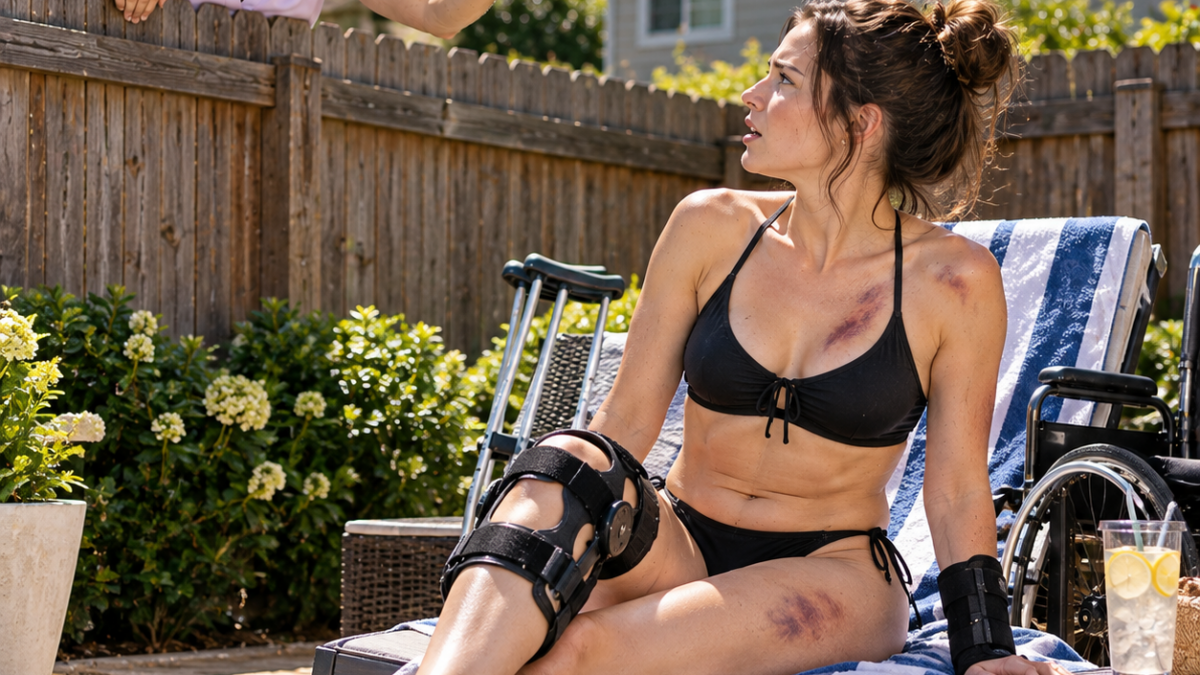
I was on a lounge chair by the pool, wearing a black bikini and knee braces, one wrist taped because I had overdone it folding laundry the day before. I froze, waiting. A few seconds later, her face appeared again.
She was in her fifties, maybe older, with a sharp haircut sprayed into place, heavy makeup, and an expression of sour curiosity. She looked like someone who had spent her whole life mistaking judgment for standards. Her hands gripped the top of the fence, and I could tell she was standing on something because no adult woman was naturally that tall unless she came with stilts.
“Oh,” she said, as if I had startled her by existing in my own yard. “Hello.”
I sat up slowly.
“Hi.”
She smiled.
It was not friendly.
“You must be the neighbor.”
“I live here, yes.”
“I’m Karen.”
Of course she was.
“Claire.”
Her eyes traveled down my body, not with attraction, not even curiosity exactly, but inspection. She paused at my knee braces. My wrist tape. A bruise blooming purple near my hip where I had bumped the bathroom counter two days earlier.
Then she tilted her head.
“You’re very brave.”
People say that to disabled people when what they really mean is I would be embarrassed if I were you.
I kept my voice level.
“For what?”
“For wearing that.” She gave a small laugh. “Outside.”
I glanced down at my swimsuit.
“In my backyard?”
“Well, yes, but still. Some people can see.”
“Only if they climb the fence.”
Her smile twitched.
“I just mean, with your… condition.”
There it was.
My condition.
Not my body. Not my braces. Not my medical reality.
My condition, like a stain on the patio.
I put my sunglasses on.
“Enjoy your day, Karen.”
She lingered another second, clearly disappointed that I had not invited her to say more. Then her face dropped out of sight.
I hoped that would be the end.
It was not.
part2
Karen became a weather system.
Not constant at first, but always threatening to roll in.
I would be floating in the pool, eyes closed, water holding me up in that rare painless way, and I would hear her voice from the other side of the fence.
“Should you be doing that?”
Or:
“Does your doctor know you’re out here in the sun?”
Or:
“I just worry what children might think if they saw all that.”
All that.
My braces. My bruises. My body.
The first few times, I tried being polite.
“Yes, my doctor knows I swim.”
“No, I don’t need help.”
“Yes, I’m fine.”
“No, I’m not injured; I have a connective tissue disorder.”
Every answer only gave her more to chew on.
One afternoon, I was stretching gently in the shallow end when she appeared over the fence, perched high enough that I could see her shoulders. She must have dragged a step stool or chair over. The absurdity of that should have been funny. It wasn’t. Being watched is only funny when you do not feel hunted.
“What exactly is wrong with you?” she asked.
I stopped moving.
“Excuse me?”
“Your joints.” She fluttered her hands in a grotesque little imitation of looseness. “Are they all floppy like that?”
I stared at her.
“It’s called Ehlers-Danlos syndrome.”
She repeated it badly, wrinkling her nose.
“Is it contagious?”
“No.”
“Well, that’s something.”
I swam to the edge and folded my arms on the warm concrete.
“Karen, why are you looking into my yard?”
“I’m being neighborly.”
“Neighborly people knock on doors. They don’t climb fences.”
She ignored that.
“If I had something like that,” she said, “I don’t think I’d ever leave the house.”
I felt the words hit and tried not to show it.
“That sounds sad for you.”
Her eyes narrowed.
“I just think some things should be private.”
“This is private.”
“You know what I mean.”
“I really don’t think I do.”
She gave a little huff and glanced toward her own yard, where I had occasionally heard children playing. Grandchildren, I assumed, though I later learned they were her sister’s kids who came over some afternoons.
“There are children around,” she said.
“And?”
“They shouldn’t have to ask questions about people like you.”
People like you.
There are phrases that do not simply offend. They unlock whole rooms of old pain.
People like you shouldn’t be out alone.
People like you are so inspiring.
People like you need special care.
People like you make others uncomfortable.
I lifted myself carefully out of the pool, one hand braced on the rail, movements slow because anger makes my joints less predictable. I reached for my towel and wrapped it around my waist.
“Then maybe the adults around them should learn how to answer questions without being cruel.”
Karen’s mouth pinched.
“I am not cruel. I am honest.”
“Cruel people love saying that.”
She disappeared from the fence.
For a week, I barely went outside.
I told myself it was the pain. Some of it was. A bad shoulder flare. A knee that felt like it had been assembled incorrectly. But mostly, it was Karen’s voice. I hated admitting that. I hated how quickly one hateful woman could turn my favorite place into a stage where I suddenly felt exposed.
Evan noticed, because Evan noticed everything.
“You haven’t been in the pool,” he said one evening while making dinner.
I sat at the kitchen island, one knee propped on a stool, ice pack strapped around it.
“Shoulder’s bad.”
“Your shoulder was worse last month and you still floated for an hour every day.”
I picked at the edge of the ice pack.
“She watches.”
He turned from the stove.
“Karen?”
“She says things.”
“What things?”
I shrugged, then immediately regretted it because my shoulder zapped pain down my arm.
“Claire.”
I hated the softness in his voice more than if he had yelled.
“She thinks I’m disgusting,” I said. “Or that kids shouldn’t see me. Or that if I had any decency, I’d hide inside wearing a full-body tarp.”
Evan’s face changed.
He was not a large man, not intimidating in the obvious way, but there was a stillness that came over him when he was angry. The kind architects probably use when a contractor says a load-bearing wall is optional.
“She said that?”
“Not those exact words.”
“Close enough?”
“Close enough.”
He turned off the burner.
“I’ll talk to her.”
“No.”
“Claire—”
“No. If you talk to her, she’ll make it about you threatening her. Or she’ll cry. Or she’ll say I misunderstood. I don’t want some fence war.”
He came around the counter and put his hands flat on the island, careful not to crowd me.
“What do you want?”
I looked toward the sliding glass door.
Outside, the pool reflected the last of the evening light.
“I want my backyard back.”
The next day, I tried.
Not bravely. Not dramatically. I simply put on a one-piece swimsuit, strapped my knee braces over it, taped my wrist, grabbed my cane, and went outside with the stubborn determination of a woman going to war against her own anxiety.
The sun was warm.
The deck smelled faintly of chlorine and cedar.
For fifteen minutes, everything was fine.
Then Karen’s voice cut over the fence.
“You really shouldn’t do that where people can see you.”
I closed my eyes.
“Good afternoon to you too.”
“I’m serious.”
“So am I.”
“You’re out there practically naked.”
I looked down at my navy one-piece suit.
“Karen, this covers more than most dresses.”
“You know that isn’t the issue.”
“Then what is?”
There was a pause.
Then she said it.
“The braces. The bruises. The way you move. It’s upsetting.”
Something inside me went cold.
I stood slowly from the lounge chair. My hip protested. My ankle wobbled, then steadied. I walked to the fence, cane tapping the deck boards, and looked up.
Karen was perched again, sunglasses on, lips pursed.
“Stop looking,” I said.
“This neighborhood has standards.”
“You don’t get to set standards for my body.”
“You are exposing yourself to children.”
“I am wearing a swimsuit at my own pool.”
“You are exposing them to sickness.”
“I’m not sick in the way you mean.”
“You know what?” Her voice rose. “This neighborhood is not a hospital. If you’re so fragile, maybe you should be somewhere appropriate.”
I laughed once because if I did not, I might cry.
“Like where? A bell tower? A cave? A decorative cabinet?”
“You think you’re funny.”
“I think you’re creepy.”
Her eyebrows shot up.
“How dare you?”
“You are standing on something to spy over a six-foot fence at a woman in her own backyard, and you think I’m the inappropriate one?”
Her face flushed.
“My children can see you.”
“Then your children are climbing furniture too.”
“They ask questions.”
“Answer them better.”
“You are disgusting,” she snapped.
There it was.
No filter left.
No concern.
No standards.
Just disgust.
The word hung between us.
For a second, I felt very far away from my body, like I was watching myself from the other side of the yard. The old reflex rose fast: cover up, apologize, retreat, disappear. The version of me from ten years earlier would have gone inside and cried until pain and shame became indistinguishable.
But thirty-one-year-old me had therapy, rage, and a cane in my hand.
“If my body disgusts you,” I said, voice shaking but clear, “stop breaking your neck to look at it.”
Then I went into the pool.
I heard her make a sharp noise of outrage before dropping from the fence.
The police came the next afternoon.
I was on the lounge chair again, reading, wearing the same one-piece suit and wrist braces. Evan was inside on a work call. I heard tires in the driveway, then a knock at the side gate.
“Police department.”
My stomach dropped so fast I felt nauseated.
I reached for my cane and stood carefully. Moving quickly is one of the many luxuries my body refuses me. By the time I made it to the gate, two officers stood outside: a man in his forties with tired eyes and a younger woman holding a notepad.
Behind them, on her side of the fence, Karen hovered like a storm cloud in coral lipstick.
“Ma’am,” the older officer said gently, “we received a complaint.”
“I figured.”
Karen shouted from behind them, “She’s exposing herself!”
The younger officer turned her head slightly.
“Ma’am, please let us speak with her.”
Karen pointed at me.
“My children are terrified. She’s half naked, showing her body, showing all those things on her limbs, trying to lure children over here.”
The words hit so hard I almost lost my grip on the cane.
Lure children.
There are accusations so ugly they leave a stain even when false.
The older officer’s face tightened.
“Ma’am,” he said to Karen, “that is a serious claim.”
“It’s true!”
I opened the gate wider.
“You can come in. I’m not hiding anything.”
The officers stepped into the yard.
Their eyes moved to the pool, the lounge chair, my book, my towel, my braces, my swimsuit. I watched them see the obvious: a disabled woman in a one-piece bathing suit standing in her own fenced backyard looking more tired than dangerous.
I explained.
EDS. Joint braces. Pool therapy. Private yard. Six-foot fence. Karen repeatedly looking over. Comments. Harassment.
The younger officer looked toward the fence.
“How does she see into the yard?”
I pointed. “By standing on something.”
Karen yelled, “I can see enough!”
The older officer rubbed his forehead.
“Ma’am, you are on private property,” he said to me. “You’re clothed. You’re behind a fence. There’s no violation here.”
Karen made an outraged sound.
“No. Arrest her.”
The younger officer’s eyebrows rose.
“For what?”
“She is showing skin in public.”
“This is not public.”
“She is frightening my children with her disability.”
The older officer’s voice hardened.
“Mrs. Whitaker, being disabled in a swimsuit is not a crime.”
“She looks obscene!”
“No,” he said, “she looks like a person using her own pool.”
Karen sputtered.
The younger officer stepped closer to the fence, voice calm but sharp.
“If you continue making false reports, especially reports implying sexual misconduct where none exists, you may be the one facing consequences.”
Karen went silent.
For one beautiful second, she looked completely unable to process the idea that authority had not bent toward her.
The older officer gave me an apologetic look.
“I’m sorry for the disturbance.”
“Thank you.”
They left after warning Karen to stay on her side of the fence and stop looking into my yard.
Evan came outside the second the cruiser pulled away.
He had heard enough through the open kitchen window.
His face was pale with anger.
“She called you a—”
“Don’t,” I said.
The word pedophile had not crossed my lips, and I did not want it inside my house.
He pulled me into his arms carefully, the way he always did, mindful of joints and pain and pressure points. I let him hold me.
That night, we laughed a little.
Not because it was funny.
Because sometimes laughter is how fear exits the body without permission.
Evan imitated the officer saying, “Being disabled in a swimsuit is not a crime,” in the voice of a courtroom judge, and I nearly choked on tea. For a while, it helped.
But when I lay in bed, pain humming through my hips, I stared into the dark and understood something clearly.
Karen had tried to turn my body into a police matter.
She had failed.
But she had not changed.
And if I went quiet now, she would count it as a delayed victory.
The next morning, I texted five friends.
All disabled.
All familiar with the exhausting spectrum of public ignorance, from awkward pity to outright cruelty.
I wrote: How do you feel about a pool party this weekend? Swimsuits, snacks, mobility aids welcome. Theme: existing loudly.
The replies came fast.
Maya: Say less.
Tessa: I am bringing the biggest hat known to medicine.
June: Is this for fun or revenge?
Me: Yes.
By Saturday afternoon, my backyard looked like joy had rolled in on wheels, braces, canes, and stubbornness.
Maya arrived first in a bright yellow swimsuit, forearm crutches decorated with flower stickers. Tessa came wearing a massive pink sunhat and knee braces over a red one-piece. June used a wheelchair that day because her hips were acting up, and she had attached a tiny pride flag to the back. My friend Leanne brought fruit, chips, and a portable speaker. Another friend, Rowan, came in swim trunks, compression sleeves, and sunglasses shaped like stars.
We were not a huge group.
We were enough.
There were braces, splints, scars, canes, crutches, tape, wheelchairs, mobility limitations, careful movements, dark humor, and more sunscreen than any one backyard had ever seen.
Evan set out drinks and snacks like a man preparing a diplomatic summit. Then he disappeared for an errand, refusing to tell me where he was going.
We played relaxing spa music just loud enough to drift over the fence.
Not loud enough for a noise complaint.
Absolutely loud enough for Karen.
For twenty minutes, she resisted.
Then the top of her head appeared.
Maya, floating on a pool noodle, whispered, “Is that the bigot?”
“That’s the one,” I said.
Tessa adjusted her enormous hat and looked directly at the fence.
“Oh, this is nice,” she said loudly. “I love a party where ableist weirdos aren’t invited.”
June nearly spit out her drink.
Karen disappeared.
Then reappeared higher, probably on a better chair.
Her face was red.
“What is going on over there?” she shouted.
“A pool party,” I called.
“This is inappropriate.”
“Swimming?”
“All of this.”
Maya lifted one crutch from beside her chair and waved it like a royal scepter.
“Define this, fence lady.”
Karen’s mouth opened, but nothing came out fast enough.
Rowan called, “We’re contagious with self-esteem. Careful.”
Everyone laughed.
Karen vanished again.
I thought that might be the end of it.
Then Evan returned.
He came through the side gate carrying a rectangular sign, homemade and slightly crooked, painted in bold black letters.
PRIVATE POOL
WARNING: MAY CONTAIN DISABLED PEOPLE
For one second, nobody spoke.
Then I laughed so hard my ribs hurt.
Evan looked proud and embarrassed.
“I know it’s not professional.”
“It’s perfect,” I said.
We propped it near the deck where Karen could see if she made her usual effort.
She did.
Within minutes, she was on her porch, yelling.
“That is harassment!”
Neighbors began to notice.
That was inevitable. Karen was loud, and not in a fun pool-party way. Doors opened. A man from two houses down stepped into his yard. Mrs. Patel from across the street came around the side of her house with garden gloves still on. A couple walking a dog slowed near the sidewalk.
Karen shouted, “They are making fun of me!”
I stood near the fence, cane in hand, heart beating hard but steady.
“No,” I called back. “We are making fun of the idea that disabled people should hide indoors because you don’t like seeing us.”
Mrs. Patel’s face changed.
“What?” she said from the sidewalk.
Karen froze.
I turned toward the gathering neighbors.
“Karen has been looking over my fence for weeks, commenting on my braces, calling my body disgusting, and yesterday she called the police claiming I was exposing myself to children because I was in a swimsuit in my own fenced backyard.”
The silence that followed was different from the silence after Karen yelled.
This one had weight.
Mrs. Patel looked at Karen.
“You called the police on Claire?”
Karen stepped off her porch.
“That is not what happened.”
“It is exactly what happened,” I said. “The officers told her to stop making false reports.”
A man named Greg, who had once helped Evan carry a heavy delivery inside when my shoulder was out, frowned.
“Karen, is that true?”
Karen’s face tightened.
“She is twisting it. I was concerned for the children.”
Tessa called from behind me, “Concerned they might learn disabled people exist?”
Maya added, “The horror.”
A few neighbors laughed, but not kindly toward Karen.
Karen pointed at me.
“She is always outside half naked with all those braces. Back in my day, people like that were kept somewhere appropriate. Hospitals. Facilities. They weren’t parading around where children had to ask questions.”
There are moments when a person destroys herself so completely that all you have to do is let the words finish leaving her mouth.
This was one of them.
Mrs. Patel’s expression went cold.
“People like that?”
Karen seemed to realize, too late, that she had said the quiet part loudly enough for witnesses.
“I didn’t mean—”
“Yes,” Greg said, “you did.”
The dog-walking couple moved away from Karen like hate might splash.
I stood there gripping my cane, feeling strangely light.
Not because her words did not hurt. They did.
But because, for once, I was not alone with them.
The neighborhood heard her.
The mask slipped in public, and underneath it was exactly what I had been saying.
Karen tried damage control over the next few days.
She told one neighbor she had only been worried about “public decency.” She told another she feared I might need medical help and did not know how to say it. She told someone else the police call was “misunderstood.” She even tried telling Mrs. Patel that my friends had staged the party to bully her.
Mrs. Patel, who had raised three children and intimidated every solicitor who ever knocked on her door, reportedly said, “Good.”
Word spread fast.
Not dramatically at first.
Just small changes.
People stopped lingering when Karen tried to talk at the mailbox. The dog-walking couple crossed the street before passing her house. A woman who had previously invited Karen to a weekly book club quietly stopped texting reminders. Kids who used to cut through Karen’s yard to play with her visiting relatives stopped coming.
Meanwhile, my backyard became a place people wanted to be.
Not because of drama.
Because the first party had been fun.
The next weekend, Mrs. Patel brought samosas and asked if she could sit on the deck with us. Greg came over with his wife and a cooler. The couple with the dog brought lemonade. Evan grilled. My friends came back. More neighbors came in swimsuits, shorts, sundresses, braces, scars, sunhats, ordinary bodies, aging bodies, tired bodies, beautiful bodies, human bodies.
Karen watched from behind her curtains.
I knew because I saw them move.
For once, I did not care.
Summer settled into a pattern.
On good weekends, we had people over. Nothing wild. Food, music, swimming, gossip, laughter. If I was in pain, I stayed on a lounge chair with pillows. If I felt strong enough, I floated. Nobody made my braces strange. Nobody treated my wheelchair like tragedy. Nobody stared at bruises except once when a kid asked why my skin had purple spots, and his mother started to shush him.
I stopped her.
“It’s okay,” I said. “My body bruises easily because my connective tissue works differently.”
The kid nodded.
“Does it hurt?”
“Sometimes.”
“My grandma’s knees hurt.”
“Mine too.”
Then he asked if he could have chips.
That was how simple it could have been all along.
Children were never the problem.
Adults like Karen were.
Karen slowly became a ghost in the neighborhood while still living in it. People were not cruel to her exactly. They were worse, from her perspective. They were polite and unavailable. Brief waves. No invitations. No porch chats. No sympathy. Her power had depended on the assumption that her disgust was shared, or at least socially acceptable. Once people saw it clearly, she had nowhere respectable to stand.
She never apologized.
I did not expect her to.
An apology would have required her to admit she had not been protecting children, standards, or decency. She had been protecting herself from discomfort. She saw my disabled body and felt entitled to remove it from her view. When the police would not help, and the neighbors would not agree, she retreated.
That was enough.
The last time Karen tried anything direct was about a month later.
I was outside alone, early evening, sitting with my feet in the pool. The sun was low, warm on my shoulders. My cane rested beside me. I had taken off my knee braces for a bit because the heat rash under one strap was getting annoying.
I heard movement near the fence.
Then her voice, smaller than usual.
“You didn’t have to turn everyone against me.”
I did not look up right away.
When I did, only the top half of her face was visible.
Still spying.
Still unable to stop.
“I didn’t,” I said.
“You told them lies.”
“I told them what you did.”
“You humiliated me.”
“You called the police and accused me of exposing myself to children because you didn’t like my disability.”
She looked away.
“I was uncomfortable.”
“I know.”
“You don’t understand what it’s like to have to explain things to children.”
That almost made me laugh.
“Karen, I spend my life explaining things to adults who should know better.”
Her mouth tightened.
“I didn’t mean for all this.”
“Yes, you did,” I said. “You just thought I would be the only one hurt by it.”
She dropped from the fence.
I never saw her peering over again.
Not once.
The sign Evan made eventually faded in the sun. The black letters chipped. One corner warped after a storm. I kept it up longer than necessary because it made me smile every time I passed it.
PRIVATE POOL. WARNING: MAY CONTAIN DISABLED PEOPLE.
It was silly.
It was defiant.
It was ours.
A year later, Karen sold her house.
I watched movers carry boxes to a truck while she stood in the driveway wearing sunglasses and pretending not to notice the neighborhood noticing her. No one threw a party when she left. No one had to. Her absence settled over the street like a deep breath.
The family who moved in after her had two kids, a golden retriever, and a grandmother who used a walker. The first week they lived there, the mother came over with a plate of cookies and apologized because their dog barked at squirrels.
I nearly cried from the normalcy of it.
That summer, her kids asked if they could swim sometime. I said yes, with a parent present. Their grandmother came too, sitting in the shade with Mrs. Patel, both of them complaining about humidity like old friends. One of the kids asked about my braces, and his mother began to correct him.
I shook my head.
“It’s fine.”
So I explained.
He listened, nodded, and then said, “Can you still do cannonballs?”
“No,” I said. “But I judge them harshly.”
He grinned and immediately performed one of the worst cannonballs I had ever seen.
I gave it a three.
He demanded a rematch.
That became life after Karen.
Not perfect. I still have bad days. Pain still takes what it takes. My joints still make plans without consulting me. I still sometimes catch strangers staring at braces or bruises or the cane and feel the old instinct to shrink.
But my backyard no longer feels like a place I need permission to enjoy.
That matters.
Karen thought she was punishing indecency.
What she really did was introduce me to my own courage in front of witnesses.
Before her, I believed standing up for myself had to look dramatic to count. A speech. A legal victory. A confrontation where I suddenly became fearless. It was not like that. It was smaller and harder. It was going outside again after humiliation. It was telling the police the truth while my hands shook. It was inviting friends over instead of hiding. It was letting neighbors hear the ugliness I had been carrying alone. It was refusing to cover my braces because someone else confused visibility with offense.
There is a particular cruelty in telling disabled people that our bodies are inappropriate simply because they are not easy for others to look at. As if children are harmed by seeing a cane, a scar, a wheelchair, a brace, a tremor, a body that moves differently. As if hiding us would make the world kinder instead of smaller.
Karen wanted me invisible.
Instead, my yard filled with people.
Disabled people.
Nondisabled people.
Neighbors, friends, kids, old ladies, dogs, Evan at the grill, music floating over the fence, water shining in the sun.
The exact nightmare she imagined.
The exact life I deserved.
Sometimes I still sit by the pool alone in the late afternoon, when the deck is warm and the water turns gold. I stretch my wrists carefully. I check my knees. I breathe through pain when it comes. I let the sun touch skin that Karen once called disgusting, and I remind myself that shame is not a diagnosis.
It is something other people try to hand you.
You do not have to take it.
My body is complicated.
It is painful, stubborn, fragile in strange places, strong in others. It has carried me through hospital rooms, bad mornings, therapy appointments, grief, joy, love, and one very satisfying pool party. It has every right to exist in sunlight.
Karen called the police because she thought a disabled woman in a swimsuit was a threat.
She was right about one thing.
I was a threat.
Not to children.
Not to decency.
Not to the neighborhood.
I was a threat to the lie that people like me should hide so people like her can stay comfortable.
And once that lie broke, even Karen could not climb high enough to put it back together.