𝗙𝗨𝗟𝗟 𝗦𝗧𝗢𝗥𝗬 Karen Called the Police Because I Didn’t Look Like I Belonged in My Own Family’s Porsche
𝗙𝗨𝗟𝗟 𝗦𝗧𝗢𝗥𝗬
Her eyes sharpened.
I knew they didn’t because I had been waved through plenty of times. Contractors registered. Long-term guests registered. Delivery vans registered. A niece bringing mangoes to her aunt did not need to present ownership documents to a woman in wedge heels clutching a clipboard.
“My aunt is expecting me,” I said. “Have a nice day.”
I moved around her and opened the gate.
Karen followed me.
Not to the sidewalk. Not to the edge of the property. She followed me through my aunt’s gate, onto the path leading to the front door.
That was when my patience cracked.
I turned around.
“Please don’t come inside the gate.”
Karen did not even blink.
“If you belong here, you won’t mind clearing this up.”
There it was.
If you belong here.
Not if there’s a security issue. Not if this is standard procedure. Not if I need to confirm something.
If you belong here.
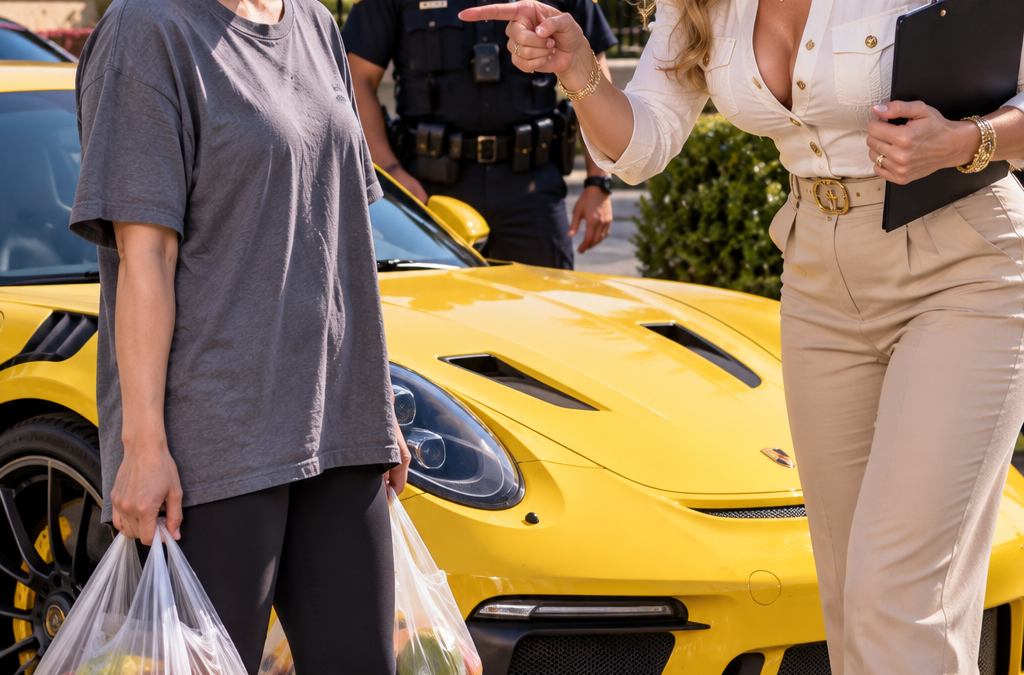
I held the grocery bag tighter.
“I already told you who I am.”
“Then tell me your aunt’s full name.”
“No.”
Her eyebrows rose. “No?”
“No.”
She gave me a look so condescending it almost had texture.
“That’s not helping your case.”
“I’m not presenting a case. I’m visiting family.”
Karen glanced over her shoulder at the car again. Her eyes lingered on it with open suspicion.
“It’s probably rented,” she said, loud enough for anyone nearby to hear. “Or borrowed.”
I felt my stomach tighten.
Her voice changed then, becoming softer, uglier, more intimate.
“We’ve had issues with girls coming in here, pretending they live in the neighborhood because some man brought them around.”
There are sentences that carry entire histories of contempt inside them.
That was one.
She did not say the nastiest version out loud. She was too careful for that. But I heard it anyway. Asian women. Foreign men. Money. Shame. Suspicion. All wrapped in a sweet voice and a linen blouse.
I looked at her for a long moment.
“You should leave my aunt’s property.”
“I’ll leave when I’m satisfied nothing suspicious is happening.”
I turned my back on her and knocked on my aunt’s door.
The door opened almost immediately.
My aunt was in her late seventies, tiny, sharp-eyed, and nosy in the best possible way. She had probably been watching through the peephole since the Porsche engine turned onto her street.
Her face brightened when she saw me.
Then her eyes moved past me to Karen.
The brightness disappeared.
“What are you doing?” my aunt asked.
Karen switched modes so quickly it would have been impressive if it were not disgusting. Her posture softened. Her smile became respectful. Her voice rose into that overly polite tone some people reserve for elders they plan to manipulate.
“Mrs. Santos, I’m just making sure everything is all right. There was a suspicious vehicle outside your home.”
My aunt looked past her at the Porsche.
Then she looked at me.
Then back at Karen.
“That is my niece.”
Karen’s eyes flickered.
“She comes here all the time,” my aunt added.
“Well,” Karen said slowly, stretching the word until it snapped, “it is unusual.”
“My niece is unusual?”
“The car is unusual.”
“Good. Then you noticed it properly.”
I almost smiled, but I knew better than to encourage auntie mode too early. My aunt could turn a sentence into a blade without raising her voice.
“It’s fine,” I said gently. “Let’s have coffee.”
Karen’s jaw tightened.
She hated being dismissed. I could feel it. Her entire body resisted the idea that this interaction could end without her permission.
My aunt stepped back to let me in.
Karen leaned forward like she might follow.
My aunt’s hand shot to the doorframe.
“No,” she said.
Karen stopped.
For the first time, her smile disappeared entirely.
My aunt closed the door in her face.
Inside, I set the groceries on the kitchen counter and released a breath I had not realized I was holding.
“She’s worse every month,” my aunt said, already moving toward the kettle.
“She follows people into their gates?”
“She follows people everywhere. With that clipboard. Always the clipboard. If a leaf falls in the wrong direction, she writes it down.”
“Why do you put up with her?”
My aunt shrugged. “I am old. I don’t want meetings.”
That, more than anything, made me angry.
Karen had built her power on people like my aunt. People who paid their fees, kept to themselves, hated conflict, and assumed unreasonable people would eventually get bored if ignored.
But people like Karen do not get bored.
They get hungry.
We sat in the kitchen drinking coffee while my aunt complained about a neighbor’s loud motorcycle, which was her way of pretending she was not upset. I had just taken a bite of mango when we heard another knock.
Not a neighbor knock.
Not a friendly knock.
A firm, official knock.
My aunt went still.
She looked through the peephole and muttered something in our language that was definitely not a prayer.
Then she opened the door.
Two police officers stood outside.
They were polite. Neutral. Careful. But there is a particular heaviness that enters a house when police stand at the door, even when you have done nothing wrong.
“Good afternoon,” one officer said. “We received a report of a suspicious person and suspicious vehicle possibly casing homes in the neighborhood.”
My aunt’s face became terrifyingly calm.
“That woman called you,” she said, pointing through the window.
I looked past the officers.
Karen stood near the curb, arms crossed, chin raised, wearing the concerned-citizen expression of someone waiting to be congratulated for protecting civilization.
My heartbeat slowed in a way I did not like.
There are moments when anger becomes too clean to be loud.
I stepped forward.
“Hi,” I said. “I’m her niece. That’s my car. I’m just visiting.”
The younger officer glanced from me to my aunt, then toward the Porsche.
“Can we see some identification?”
“Of course.”
I handed over my ID.
“Vehicle registration?”
“It’s in the car.”
We all walked outside.
Karen drifted closer immediately, as if the scene needed narration.
“She refused to identify herself properly,” Karen said. “She became aggressive when questioned.”
I was in yoga pants holding car keys and mango juice on my fingers.
The officer gave her a brief look. “Ma’am, please wait over there.”
Karen’s mouth tightened.
I unlocked the Porsche and retrieved the registration. The officers checked my ID, the car documents, and whatever system they needed to check. It took only a few minutes, but those minutes stretched.
Neighbors began appearing.
Not openly, of course. That would be rude. They stepped out with watering cans. They adjusted porch plants. Curtains shifted. A man across the street pretended to inspect a mailbox with the intensity of an engineer evaluating a bridge.
Karen stood there waiting for her victory.
It never came.
The officer handed my documents back.
“All right, ma’am. Sorry for the disturbance.”
Karen’s head snapped toward him.
“You’re just letting her go?”
The officer looked at her.
“There’s nothing to let go. She’s visiting her family.”
“But the car—”
“Is registered to her.”
Karen’s face twitched.
“Well, how was I supposed to know?” she said. “She doesn’t look like—”
She stopped herself.
Too late.
Everyone heard the missing ending.
My aunt did not let it pass.
“She doesn’t look like what?” my aunt demanded.
Karen flushed. “That is not what I meant.”
“You have seen her before,” my aunt said, stepping onto the porch now. Her voice rose, sharp and clear. “She visits me every month. You stand in the street with your clipboard watching everyone, and suddenly you don’t know who comes to my house?”
“I can’t remember every visitor.”
“You remember what you want to remember.”
Karen’s eyes flicked toward the neighbors.
She realized she was losing the performance.
So she reached for the role she knew best.
Authority.
“I will be reporting this incident to the board.”
My aunt laughed.
Actually laughed.
It was short, dry, and merciless.
“Report it to God if you want.”
The police left after a few more polite words.
Karen stormed away with her clipboard pressed against her chest like a shield. Her heels clicked angrily against the pavement. The neighbors pretended to stop watching. My aunt pulled me back inside, slammed the door, and called Karen a name in our language that would have made my mother gasp and then secretly agree.
I should have let it go.
If Karen had simply embarrassed herself on the street, I probably would have. I have dealt with enough small-minded people to know not every insult deserves a war. I had work. I had responsibilities. I did not have time to make one racist HOA queen the center of my life.
But she had called the police.
Not because she was afraid.
Because she wanted me put in my place.
She looked at an Asian woman in casual clothes, carrying groceries to an elderly aunt, beside a car she decided I could not possibly own, and she escalated to law enforcement because reality had disobeyed her prejudice.
And she did it on my aunt’s porch.
That was the part I could not swallow.
My aunt, who had been quietly enduring Karen’s nonsense for years because she hated conflict. My aunt, who kept her older fence because she liked it. My aunt, whose garden looked “messy and dated” because it had fruit trees, herbs, and memories instead of ornamental plants selected by committee.
Karen had not just insulted me.
She had brought fear to my aunt’s door.
I left that afternoon still replaying the whole thing in my head. I drove too carefully because the anger made my hands tight on the wheel. The Porsche growled beneath me, bright and ridiculous and mine.
Halfway home, I called my mother.
My mother has a dangerous kind of calm. Other people raise their voices when angry. My mother becomes interested.
I told her everything. Karen, the gate, the car, the police, the “she doesn’t look like” that got swallowed too late.
My mother listened without interrupting.
When I finished, she said, “That subdivision is on your grandfather’s land.”
I almost missed a turn.
“What?”
“Your aunt’s subdivision,” she said, like she was telling me the weather. “The land under it belongs to our holding company.”
I slowed the car.
“The homeowners don’t own the land?”
“They own their houses. The development is on a long-term ground lease. Your grandfather arranged it years ago.”
I pictured my grandfather, who could negotiate like a gangster while wearing sandals and eating peanuts, quietly signing documents decades earlier and never mentioning them because to him land was not drama. Land was stability.
“Why did no one tell me this?”
“You never asked.”
That was such a family answer I nearly laughed.
“The HOA pays ground rent?”
“Yes.”
“To us?”
“To the holding company. The property management firm handles reports.”
I drove in silence for a few seconds.
My mother said, “Why?”
I told her again, but shorter.
This time, when I finished, there was a pause.
Not angry.
Interested.
Much worse.
“Send me the subdivision name,” she said.
“Why?”
“Because if that woman is causing trouble for your aunt, she is probably causing trouble for other people too. And if the HOA is mismanaged, it can become our problem eventually.”
My family is not dramatic about money.
That may sound strange given what happened next, but it is true. We are not flashy landlords cackling over rent increases. Our business is boring on purpose. Agriculture, storage, land, leases, long-term stability. My parents’ idea of a crisis is a late shipment, a bad harvest, or a bank officer who does not understand seasonal cash flow.
But we hate carelessness.
And we really hate being dragged into someone else’s stupidity.
When I got home, I showered, changed, sat at my desk, and did something I had never bothered to do before.
I opened the shared family drive and searched for my aunt’s subdivision.
There it was.
Ground lease agreement. Amendments. Extensions. Annual rent summaries. Property management emails I had ignored for years because the subject lines were things like “Annual Remittance Confirmation” and “Lease Compliance Archive.”
I started reading.
By midnight, I had learned three things.
First, the ground lease had a rent review clause every five years.
Second, nobody in my family had triggered the review in a long time because the rent was acceptable, the relationship was quiet, and no one cared enough to squeeze more money out of a stable arrangement.
Third, and most interesting, the lease required landowner approval for permanent modifications to common areas.
Not notification.
Approval.
The development had been busy.
A guardhouse expansion. Clubhouse modifications. Pool area upgrades. Decorative landscaping walls. New signage. Small structures near the common walkways. Things that looked normal if you were a resident. Things that looked very different if you were the landowner whose consent was supposed to be requested before they were built.
The next morning, I called the property management firm that handled the ground lease.
I did not yell.
I did not threaten.
I asked questions.
“Do we still own the land under Paradise Grove?”
“Yes, ma’am.”
“Has the rent review clause been exercised recently?”
A pause.
“Not recently, no.”
“Why?”
“It must be initiated by the landowner.”
“Have you recommended it?”
Another pause.
“We have noted market changes in annual reports.”
Translation: We told you, and no one cared.
“Have they requested approval for common area modifications?”
A longer pause.
“No, ma’am. We have sent reminders requesting documentation, but the HOA has not responded consistently.”
“Do you have those reminders in writing?”
“Yes.”
I sat back in my chair and stared at the wall.
At first, revenge had been something small in my head. Embarrass Karen. Get her removed from the board. Make her apologize to my aunt. Something satisfying and personal.
But this was not personal.
Not anymore.
This was structural.
Karen had built her little kingdom on the belief that ownership was whatever she performed loudly enough. She controlled gates, visitors, gardens, cars, fences, and people’s sense of belonging because everyone around her had accepted her authority as inevitable.
But the land under her kingdom did not belong to her.
And the paperwork did not care about her clipboard.
I called my mother again.
She listened while I explained.
When I finished, she said, “If you want to handle this, handle it properly.”
“What does properly mean?”
“No shouting. No social media. No revenge that becomes messy. Use the lease.”
“Define messy.”
“Anything that ends up on the news.”
“Fair.”
So I handled it properly.
First, I instructed the property management firm to conduct a full compliance review. I wanted every structure, modification, approval request, missing document, ignored reminder, and relevant lease clause identified.
Second, I asked them to confirm the HOA’s official address for service and current board contacts.
Third, I instructed them to initiate the rent review under the lease.
This was not me saying, “Raise their rent because Karen hurt my feelings.” The rent was genuinely below market because it had gone untouched for too long. The review required external valuation. Professionals would determine the adjustment according to the agreement already in place.
At the same time, I instructed the firm to send formal notice regarding unauthorized common-area structures.
Not “tear everything down tomorrow.”
Not “punish every resident.”
The notice was simple: You are out of compliance. Provide as-built documentation and submit retroactive approval requests within the required period. Pay administrative fees outlined in the lease. If approval cannot be granted, remediate.
I did not want residents hurt because Karen was awful.
My aunt lived there. Other decent people lived there. Families, retirees, kids, quiet people who just wanted working lights and trimmed hedges. My goal was not destruction.
My goal was correction.
And yes, I wanted Karen to feel the consequences of pretending she owned what she did not.
The first letter went out.
Then the second.
The HOA’s response came back angry enough to fog the screen.
It accused the property management firm of harassment. It claimed the HOA had never been properly informed of approval requirements. It demanded the rent remain unchanged “for the good of the community.” It implied the landowner was suddenly acting in bad faith.
I love when people put nonsense in writing.
The property manager forwarded everything to me with a short note: How would you like to proceed?
I replied: Proceed exactly as the lease allows.
A few days later, Karen contacted me directly.
Her email was a masterpiece of entitlement wearing legal-sounding shoes.
She demanded that I “cease interfering” with private community governance. She claimed my actions were retaliatory. She said the community would pursue “all available remedies.” Then, near the end, she wrote a sentence I read three times to make sure I was not hallucinating.
“We do not appreciate being bullied by locals with money.”
Locals with money.
That was the phrase.
Not landowners.
Not contracting party.
Not lessor.
Locals with money.
I forwarded it to my mother.
She called me thirty seconds later.
Her voice was very calm.
“She wrote this?”
“Yes.”
“In an email?”
“Yes.”
“Wonderful.”
When my mother says wonderful like that, someone is about to have a terrible week.
I replied to Karen with one sentence.
Please direct all correspondence through the property management company pursuant to the ground lease.
That was it.
No emotion. No defense. No argument.
Karen could not handle it.
Because Karen’s power was not real power. It was social power. Clipboard power. Neighborhood rumor power. The power of cornering old women at their gates, intimidating guards, shaming residents at meetings, and making people feel that disobeying her would cost them peace.
That kind of power works on people who want a quiet life.
It does not work on lease documents.
Two weeks after the notices, the HOA called an emergency meeting.
My aunt got herself invited because, according to her, “I have lived here longer than that woman’s sunscreen.”
She called me afterward sounding delighted in the way only elderly women can sound delighted after witnessing social disaster.
“She is panicking,” my aunt said.
“Karen?”
“Who else? She stood up and talked about you like you are a criminal mastermind.”
“Did anyone believe her?”
“Some people always believe the loudest person. But not everyone. People are tired.”
The board had finally realized the problem was bigger than Karen’s bruised ego.
The rent review could affect their budget. The unauthorized structures could require fees, documentation, and retroactive approval. The ignored reminders made them look incompetent. Karen wanted war. The board wanted a compromise.
So I offered one.
Through the property management company, I proposed a phased rent adjustment instead of an immediate jump, contingent on compliance milestones. Submit documentation. Pay the administrative fees. Bring common-area modifications into the proper approval process. Adopt basic governance standards. Stop pretending the lease did not exist.
Then I made the part Karen would hate most.
During the remediation period, the HOA had to appoint an independent professional administrator to liaise with the property management firm.
Not Karen.
Not one of Karen’s friends.
A qualified, neutral administrator.
The board resisted.
They called it humiliating.
They said it was unnecessary.
The property management firm sent them copies of the ignored reminders, the missing approvals, the compliance history, and Karen’s “locals with money” email.
That email quietly circulated among board members.
Not because everyone suddenly cared about racism. Some did. Some probably did not. But even people who can ignore prejudice often become alert when prejudice becomes expensive.
Karen transformed overnight from “strong leader protecting community standards” into “liability with lipstick.”
The board accepted the administrator.
Karen escalated.
Of course she did.
That is what people like Karen do when the walls close in. They do not reflect. They attack the nearest soft target.
The soft target was my aunt.
I was visiting her again a few days later, in my normal boring car because I was tired of the Porsche being treated like a neighborhood scandal. I had barely stepped inside when my aunt called from the living room.
“She is here.”
The way she said it made my shoulders tense.
I walked in and found Karen sitting on my aunt’s couch.
On my aunt’s couch.
Legs crossed, sunglasses pushed into her hair, smiling too hard, one hand resting lightly on her clipboard like it was a weapon within reach. She wore a pale pink dress that hugged her figure elegantly, gold earrings brushing her neck, a faint shimmer on her collarbone. She looked soft, expensive, controlled, and completely out of place in my aunt’s living room full of family photos, old furniture, and plants that refused to be disciplined.
My aunt sat in the armchair across from her, spine straight, mouth flat.
Karen turned when I entered.
“There you are,” she said, as if we had an appointment.
I looked at my aunt.
My aunt said, “She walked in.”
Karen laughed lightly. “Your aunt invited me to sit.”
“I did not,” my aunt said.
Karen ignored that.
“We need to have an adult conversation,” she said to me.
“That would be easier if one more adult were present.”
Her smile tightened.
“The HOA is considering restrictions on disruptive vehicles entering the community.”
“You mean my car.”
“I mean vehicles that disturb the peace.”
“You called the police because you thought it was stolen.”
“I called the police because you behaved suspiciously.”
“I brought mangoes to my aunt.”
“You refused to identify yourself to the HOA president.”
“You are not border control.”
My aunt made a sound that might have been a cough or a laugh.
Karen leaned forward, and her voice dropped into something intimate and poisonous.
“People like you don’t understand how communities like this work.”
I stared at her.
She continued.
“This is an expat area. We maintain standards. We cannot have anyone just coming in and acting like they own the place.”
There are gifts your enemy gives you because they cannot resist hearing themselves speak.
That sentence was one.
My aunt stood.
She was tiny, but the room changed when she rose.
“Get out of my house.”
Karen blinked.
“Excuse me?”
“Get out.”
Karen laughed as if my aunt had made a joke.
My aunt pointed at the door.
“Now.”
Karen stood slowly. The charm drained from her face, leaving something sharp and ugly beneath the beauty.
“You will regret this,” she said.
I stepped aside, giving her a clear path to the door.
“Please put any future threats in writing through the administrator.”
For one second, I genuinely thought she might slap me.
Her hand twitched. Her eyes burned. But even Karen remembered consequences existed when witnesses stood nearby.
She stormed out.
My aunt closed the door behind her and locked it.
Then she turned to me and said, with perfect calm, “I hate her.”
“Same.”
Two days later, the professional administrator started.
And because the administrator was competent, neutral, and not emotionally invested in Karen’s mythology, they did the worst possible thing to a petty tyrant.
They requested records.
Budgets. Vendor contracts. Approval logs. Meeting minutes. Complaint histories. Fine records. Security reports. Maintenance requests. Gate access policies.
Karen hated that.
For years, she had treated HOA operations like her private notebook. Rules existed where she needed them. Silence existed where rules were inconvenient. Some residents got letters for tiny violations. Others, usually her friends, got nothing. Vendors she liked were protected. Residents who questioned her got watched.
Selective governance thrives in darkness.
The administrator turned on the lights.
Complaints resurfaced.
A landscaping crew Karen had accused of theft without evidence. A local family she had cited for “inappropriate cultural decorations” that were not actually against the bylaws. An elderly widower fined repeatedly for leaving a bench in front of his home while Karen’s friends placed entire outdoor furniture sets near common walkways. A young mixed couple whose visiting relatives were repeatedly questioned at the gate.
Patterns became visible.
And once a pattern becomes visible in a neighborhood, it spreads like fire through dry grass.
A residents’ meeting was scheduled.
I did not want to go.
Truly, I did not. Despite the Porsche, despite the business, despite my capacity for corporate warfare when provoked, I hate being the center of attention. I did not want to stand in a room full of people who had watched police check my ID on my aunt’s street. I did not want to become a symbol. I did not want whispers.
My mother told me to go.
“You started the process,” she said. “Show your face once. Calmly.”
“I can be calm from home.”
“You can also be a coward from home.”
Asian mothers do not require volume to wound effectively.
So I went.
I did not dress up.
That was important to me. I wore exactly what I might normally wear to my aunt’s house: loose black pants, an oversized white shirt, flat sandals, hair tied back, no makeup. I did not bring the Porsche. I did not bring a lawyer. I did not bring any visible sign of wealth or power.
The point was not to prove Karen wrong by performing richness.
The point was that Karen did not get to decide who looked like they belonged.
The clubhouse was packed.
Residents filled the chairs and lined the walls. The administrator sat at a table with files arranged neatly in front of them. The board chair, a local man named Mr. Alvarez, looked exhausted before the meeting even began. My aunt sat in the front row with a purse on her lap and the expression of a woman attending theater.
Karen stood near the front.
She looked flawless.
Of course she did.
Navy wrap dress, heels, pearls, hair blown smooth, makeup perfect. Beautiful, controlled, glowing with the brittle energy of someone one insult away from collapse.
When she saw me, her smile appeared.
Slow. Cold. Almost flirtatious in its contempt.
She enjoyed an audience.
The meeting began with the administrator summarizing the compliance review. Missing approvals. Required documentation. Rent review process. Phased adjustment proposal. Governance remediation. It was dry, professional, and devastating.
Karen waited maybe six minutes before interrupting.
“I think everyone here understands what is really happening,” she said, stepping forward.
Mr. Alvarez closed his eyes briefly, like a man praying for strength.
Karen turned to the room.
“This community is being targeted because I tried to protect our security standards. We had an incident involving an unregistered vehicle, and now suddenly the landowner’s family is punishing all of us.”
A man stood near the back.
“You called the police on someone’s niece over a car.”
Karen’s smile sharpened.
“I called the police on a suspicious person.”
“She was visiting family.”
“She refused to cooperate.”
Another woman spoke.
“You post pictures of people’s cars in the group. It’s creepy.”
Karen turned toward her. “We monitor vehicles for security.”
“You monitor people you don’t like.”
Murmurs spread.
Karen raised her voice. “This is exactly the problem. People don’t appreciate how much work I do to keep this community safe and respectable.”
An older local man in the second row lifted his hand, then spoke without waiting to be acknowledged.
“We are discussing lease compliance and finances, not your personal feelings about who looks like they should drive what.”
The room went still.
Karen’s face changed.
You could see it happen. The moment she lost the room. People like Karen do not gracefully adjust when that happens. They do not pause, breathe, and choose humility.
They flail.
“I am being attacked,” she said. “I have given years to this community. Years. And now everyone wants to pretend I’m the problem because a wealthy local family wants to throw its weight around.”
I finally stood.
The room turned toward me.
My aunt looked back and gave me one small nod.
I kept my voice calm.
“I did not trigger the lease review because I was offended. I triggered it because the HOA has been out of compliance for years. Approval requests were not submitted. Notices were ignored. The rent review clause exists in the lease whether I like it or not.”
Karen laughed.
It came out thin.
I looked at her.
“And I didn’t call the police. You did.”
Silence.
Karen’s lips parted.
For once, she did not have a prepared answer.
Then she made the mistake that finished her.
“Well, you have to understand where I come from,” she said. “If someone shows up in that kind of car, and she looks like that—”
The room shifted.
Not a dramatic gasp.
Worse.
A collective discomfort. People turning slightly away. Eyes dropping. Mouths tightening. The sound of a woman saying the quiet part out loud and everyone recognizing it.
Mr. Alvarez said, “Karen, stop.”
She did not.
“Do not tell me to stop when I’m the only person honest enough to say what everyone was thinking,” Karen snapped. “We have girls coming in and out of these neighborhoods all the time. Cheap-looking women with expensive cars and foreign men and stories about family. I am supposed to believe she bought that car herself? That someone like her deserves—”
“Madam,” the administrator said evenly, “that is not relevant to the agenda. It is also inappropriate.”
Karen spun toward them.
“And who are you to tell me what is appropriate? I am the president.”
Mr. Alvarez stood.
His face was pale, but his voice was steady.
“Not anymore.”
Karen went very still.
He continued.
“Effective immediately, you are removed as HOA president pending formal ratification under the bylaws. An interim committee will work with the administrator through the remediation period.”
For a second, her brain seemed unable to accept the words.
Then she exploded.
“You can’t do that.”
“We can.”
“This is illegal.”
“It isn’t.”
“I will sue every person in this room.”
Someone near the back said, “Go home, Karen.”
Another voice added, “Stop embarrassing yourself.”
Karen looked around for supporters.
She found a few lowered eyes. A few frightened faces. But no rescue.
The same people who had once let her dominate meetings now watched her like a storm they had finally decided to stop sheltering.
My aunt leaned toward the woman beside her and whispered loudly, “This is better than television.”
Karen grabbed her bag.
“You will regret this,” she said.
But the words had lost their old power.
She stormed out with her head high, heels striking the floor like gunshots, performing dignity all the way to the door.
No one followed.
No one begged her to stay.
The HOA worked with the administrator after that.
Not perfectly. Communities are messy. People argued about fees, timelines, budgets, responsibility, fairness. Some residents resented the rent adjustment even phased over time. Some blamed Karen. Some blamed the old board. A few probably blamed me because blaming the person who uncovers the problem is easier than admitting you ignored it for years.
But the process moved.
The HOA submitted documentation for the common-area structures. Retroactive approvals were granted where appropriate. Administrative fees were paid. The rent adjustment was phased in to avoid shocking residents. The board adopted clearer governance rules. Gate procedures were rewritten so “security” could not be used as a personal weapon. Complaint handling was standardized. The administrator remained in place through remediation.
My aunt said the neighborhood became quieter.
Not silent. Never silent. HOA people can argue about mailbox colors like philosophers debating morality. But quieter. Less afraid. Less watched.
Karen resigned from the board entirely two weeks later.
Her husband stopped attending events.
Their house went on the market within three months.
The last time I saw her in that neighborhood, she was standing near a moving truck in white shorts and a sleeveless blouse, looking furious at the existence of cardboard boxes. I had gone to my aunt’s house, again in the Porsche because by then I was done making myself smaller for anyone’s comfort.
Karen saw the car first.
Then she saw me.
For a second, I thought she would look away.
She didn’t.
She walked toward me.
Even defeated, Karen had presence. I’ll give her that. Her hair was perfect despite the heat. Her sunglasses were expensive. Her body moved with the confidence of a woman who had spent her whole life being looked at and had learned to turn that into leverage.
She stopped a few feet away.
“You must be proud,” she said.
I closed the Porsche door.
“Not especially.”
“You ruined my reputation.”
“No. I made it harder for you to hide it.”
Her smile twisted.
“You people always stick together.”
I almost laughed.
“You still haven’t learned.”
“I learned exactly what this place is,” she said, voice low. “Money pretending to be morality.”
“You called police on me because I didn’t look rich enough for my car.”
“You acted suspicious.”
“I carried mangoes.”
“You know what I mean.”
“Yes,” I said. “That has always been the problem.”
Her face hardened.
For once, I did not feel angry.
I felt tired.
Tired of her. Tired of people like her. Tired of the performance, the insinuations, the way bigotry tries to dress itself as caution, taste, security, standards, concern.
“You could have just apologized,” I said.
Karen laughed.
“Women like you always want apologies.”
“No,” I said. “I wanted you to stop.”
That landed.
Not as remorse. I do not think she was capable of that then. But something in her expression flickered, as if she realized that despite all her words, all her beauty, all her power games, she had failed at the one thing she wanted most.
She had not made me feel like I did not belong.
Not permanently.
She glanced at the Porsche.
Then at my aunt’s house.
Then at the street she no longer controlled.
Without another word, she turned and walked away.
I thought that was the end.
It would have been enough.
Karen removed from power. HOA forced into compliance. My aunt left alone. The residents given an administrator instead of a queen. The lease respected. The structures documented. The rent adjusted properly. The yellow Porsche no longer treated like probable evidence.
But life, occasionally, has a taste for symmetry.
A few months later, I met a friend for lunch.
She worked in immigration services, and we were catching up over noodles when I mentioned “the Porsche HOA Karen” because by then the story had become something my friends requested like gossip dessert.
My friend stopped with her tea halfway to her mouth.
“Wait,” she said. “Her name was Karen?”
I gave her the full name.
Her eyes widened.
“Oh.”
I leaned forward. “Oh what?”
She hesitated, then lowered her voice.
“I can’t tell you details I shouldn’t. But if it’s the same woman, she had problems.”
“What kind of problems?”
“The kind foreigners should not have if they enjoy staying in the country.”
Over the next few weeks, the pieces reached me through neighborhood gossip, my aunt’s suspiciously innocent comments, and public facts people were very happy to repeat.
Karen had been living on a visa that did not permit local work. For years, apparently, she had been running an unregistered consulting side business. Interior styling, relocation advice, expat community services, “neighborhood integration packages”—whatever polished name she used for charging people under the table while telling everyone else how to follow rules.
She had not declared the income.
She had not paid taxes on it.
She had failed to update her address properly after one of her earlier moves.
Someone tipped off immigration and tax authorities.
I do not know who.
My aunt, however, spent several weeks looking extremely pleased with herself while claiming she knew nothing about anything.
The authorities did not treat Karen’s case like a neighborhood dispute.
They treated it like tax evasion and visa fraud.
Because that is what it was.
She was detained for a week. Fined heavily. From what I heard, the fine wiped out whatever comfortable cushion she had expected to carry into her next reinvention. Then she was deported and blacklisted from re-entering the country.
The woman who called police on me because she believed I did not belong in my aunt’s neighborhood was removed from the entire country because she had not followed the rules she loved weaponizing against everyone else.
I would love to tell you I felt noble about it.
I did not.
I felt satisfied.
Not joyful exactly. Not cruel. Just satisfied in the deep, quiet way you feel when a crooked picture finally gets straightened after annoying you for years.
Karen had spent her time deciding who belonged.
She questioned my aunt’s garden, my car, my clothes, my presence, my right to walk through a gate with groceries in my hand. She wrapped prejudice in the language of standards. She called suspicion security. She called control leadership. She thought being an expat with a clipboard made her more legitimate than the people whose land held up the streets beneath her feet.
In the end, paperwork answered her.
Not shouting.
Not revenge posts.
Not public humiliation for its own sake.
Paperwork.
The ground lease. The ignored reminders. The rent review clause. The approval requirements. The emails she was arrogant enough to send. The visa conditions. The tax records. The systems she assumed existed only to protect people like her from people like me.
My aunt still lives in that house.
Her fence is still old.
Her garden is still too alive for HOA taste. Fruit trees lean where they want. Herbs spill from pots. Flowers bloom in colors no committee approved. She still forgets to lock the gate, though now the guards know better than to let anyone follow her guests inside.
Sometimes I visit in the Porsche.
Not always. It is still terrible over speed bumps.
But sometimes.
And when I do, people look. Of course they look. It is a bright yellow Porsche in a quiet gated subdivision. Looking is allowed.
The difference is that no one calls the police.
A little boy once asked me if it was fast. His mother looked embarrassed, but I smiled and said, “Very.”
He asked if it was mine.
I said, “Yes.”
He nodded, accepted reality without needing it justified, and went back to kicking a soccer ball against the curb.
Children can do what Karen could not.
They can learn.
My aunt likes to sit at her front window when I leave. She pretends she is not watching, but I always see the curtain move. I wave anyway. Then I ease the Porsche over the ridiculous speed bumps and drive past the clubhouse, past the trimmed hedges, past the guardhouse that finally has proper approval in the file.
Every time I leave, I think about that first day.
Karen standing on the sidewalk, beautiful and poisonous, asking whose car it was.
Mine.
That was the answer she could not survive.
Not because of the car, not really.
Because mine meant I had a life outside her permission. Mine meant I did not need her recognition to be real. Mine meant the story she had written in her head about who belonged, who owned, who deserved, and who could be questioned at a gate was wrong from the first sentence.
She called the police because I did not look like I belonged in my own Porsche.
She lost her presidency because she did not understand she was standing on land my family owned.
She lost the country because she believed rules were weapons for other people, never walls that could close around her too.
As for me, I still dress casually. I still show up to warehouses with messy hair. I still argue about fertilizer. I still bring mangoes to my aunt. I still drive my ridiculous yellow car when the mood strikes.
And I no longer shrink, explain, soften, or smile politely when someone like Karen mistakes prejudice for authority.
Some gates have guards.
Some gates have clipboards.
Some gates have women like Karen standing in front of them, deciding who looks right enough to pass.
But the older I get, the more I understand something my grandfather probably knew when he signed that boring ground lease decades ago.
The loudest person at the gate is not always the owner.
Sometimes she is just standing on someone else’s land, making threats she cannot afford.
𝗧𝗛𝗘 𝗘𝗡𝗗
Karen Called the Police Because I Didn’t Look Like I Belonged in My Own Family’s Porsche
Karen thought the yellow Porsche was stolen because the woman carrying mangoes to her aunt’s front door looked too Asian, too casual, and too ordinary to own it.
She called the police before she ever asked herself the one question that would have saved her entire life from unraveling.
What she didn’t know was that her precious gated community sat on land my family owned.
I have never been the kind of woman strangers expect to see stepping out of a bright yellow Porsche 911 GT3 RS.
That’s not insecurity. It’s just an observation based on years of watching people’s faces rearrange themselves when reality refuses to match whatever little story they had already written in their heads.
I’m Asian, late thirties to early forties depending on lighting, stress, and whether I’ve had enough sleep. I usually dress like I’m five minutes away from checking a broken pump motor in a warehouse. Yoga pants, oversized shirt, hair in a messy bun, no makeup unless someone has died, married, or is paying me to attend a formal dinner. On most days, if you saw me at the supermarket, you’d assume I was buying ginger, rice noodles, and maybe arguing with a vegetable seller about the price of chilies.
You would not assume I was the owner of a six-figure sports car.
That car was my one ridiculous indulgence.
My family has been in agriculture for decades. Rice, coconut, shipping contracts, warehouses, processing equipment, fertilizer arguments, weather panic, logistics headaches—the kind of business that makes money without looking glamorous. I run one side of it now. Not because I inherited a princess throne, but because I worked my way through enough years of mud, spreadsheets, delayed shipments, and men twice my age calling me “little girl” until they realized I knew the numbers better than they did.
After a string of very good years, I bought the Porsche with my own money.
Bright yellow. Loud. Low. Completely impractical. Absolutely perfect.
My mother said it was stupid.
My father walked around it twice, said nothing for ten minutes, then asked if he could sit in it.
I loved that car in a way that made no sense and needed no defense. I didn’t drive it every day because the roads where we live were not exactly built for German engineering with a dramatic ego. Most days, I drove something normal and boring. But when the Porsche came out, it felt like a little private declaration.
I am an adult.
I earned this.
No one can stop me.
That day, my usual car was being serviced, and I needed to visit my aunt.
My aunt lived in a gated subdivision built for wealthy locals, retirees, and foreign expats who wanted manicured hedges, guards at the entrance, matching roof tiles, and a neighborhood Facebook group where people discussed barking dogs like war crimes. She had lived there for years, long before it became as polished and fussy as it was now. Her house was older than the others, a little stubborn, a little dated, and full of plants she refused to trim because she believed a garden should look alive rather than obedient.
I adored her.
She would never admit she needed help, but she loved when I showed up with groceries. So that afternoon, I picked up mangoes, fruit, and a few things she had claimed she did not need but absolutely did.
Then I drove to her subdivision in the Porsche.
The guard waved me through after squinting at the car for a moment longer than usual. I drove slowly over the aggressive speed bumps, wincing every time the front end came close to scraping. The Porsche announced itself through the quiet streets like a firework in a library. Heads turned. Curtains moved. A gardener paused mid-trim and stared.
I parked in front of my aunt’s house, grabbed the grocery bag from the passenger seat, and had made it halfway to her gate when I heard the voice.
“Excuse me.”
Two words.
Bright. Polished. Fake-friendly.
I turned and saw Karen crossing the street toward me.
I had seen her before. Everyone had seen Karen before.
She was the HOA president, though she wore the position less like an elected role and more like a crown no one had agreed to place on her head. She was a foreign expat woman, probably around forty, strikingly beautiful in a cold, expensive way. Tall, glossy dark-blonde hair, white linen blouse tied at the waist, fitted tan trousers, gold bracelets, oversized sunglasses, lips painted a careful coral shade. She had that polished resort-wife look, like she had stepped out of a lifestyle magazine titled Controlling Other People’s Property.
She always carried a clipboard.
Always.
As if any moment might require documentation.
She smiled as she approached, but her eyes had already moved past me to the car.
Part 2
“Can I help you?” I asked, still walking toward my aunt’s gate.
Karen’s smile widened. It was the kind of smile people use when they want witnesses to believe they are being reasonable.
“I was about to ask you the same thing.”
“I’m visiting my aunt.”
I nodded toward the house.
Karen did not look at the house. She looked at the Porsche, then back at me, as if the two things had personally offended her by existing in the same afternoon.
“That is Mrs. Santos’s house,” she said.
The way she said my aunt’s name annoyed me instantly. Not because she got it wrong, but because she said it with ownership. Like my aunt was part of the neighborhood inventory.
“Yes,” I said. “She’s my aunt.”
Karen let out a small laugh.
Not a real laugh.
The kind of laugh that means, Sure, sweetheart.
“I know her quite well,” Karen said. “She’s never mentioned a niece with a car like this.”
I stared at her for half a second.
“Congratulations on maintaining a niece database.”
Her smile froze.
I continued walking.
Karen stepped into my path, not fully blocking me, but enough to force the kind of confrontation she clearly enjoyed.
“Whose car is it?”
“Mine.”
Another little laugh.
“Yours?”
“Yes.”
“I’m the HOA president,” she said, like that answered a question I had not asked. “We keep track of vehicles for security purposes. That car is not registered with the community.”
“I don’t live here.”
“Visitors register as well.”
“No, they don’t.”
Her eyes sharpened.
I knew they didn’t because I had been waved through plenty of times. Contractors registered. Long-term guests registered. Delivery vans registered. A niece bringing mangoes to her aunt did not need to present ownership documents to a woman in wedge heels clutching a clipboard.
“My aunt is expecting me,” I said. “Have a nice day.”
I moved around her and opened the gate.
Karen followed me.
Not to the sidewalk. Not to the edge of the property. She followed me through my aunt’s gate, onto the path leading to the front door.
That was when my patience cracked.
I turned around.
“Please don’t come inside the gate.”
Karen did not even blink.
“If you belong here, you won’t mind clearing this up.”
There it was.
If you belong here.
Not if there’s a security issue. Not if this is standard procedure. Not if I need to confirm something.
If you belong here.
I held the grocery bag tighter.
“I already told you who I am.”
“Then tell me your aunt’s full name.”
“No.”
Her eyebrows rose. “No?”
“No.”
She gave me a look so condescending it almost had texture.
“That’s not helping your case.”
“I’m not presenting a case. I’m visiting family.”
Karen glanced over her shoulder at the car again. Her eyes lingered on it with open suspicion.
“It’s probably rented,” she said, loud enough for anyone nearby to hear. “Or borrowed.”
I felt my stomach tighten.
Her voice changed then, becoming softer, uglier, more intimate.
“We’ve had issues with girls coming in here, pretending they live in the neighborhood because some man brought them around.”
There are sentences that carry entire histories of contempt inside them.
That was one.
She did not say the nastiest version out loud. She was too careful for that. But I heard it anyway. Asian women. Foreign men. Money. Shame. Suspicion. All wrapped in a sweet voice and a linen blouse.
I looked at her for a long moment.
“You should leave my aunt’s property.”
“I’ll leave when I’m satisfied nothing suspicious is happening.”
I turned my back on her and knocked on my aunt’s door.
The door opened almost immediately.
My aunt was in her late seventies, tiny, sharp-eyed, and nosy in the best possible way. She had probably been watching through the peephole since the Porsche engine turned onto her street.
Her face brightened when she saw me.
Then her eyes moved past me to Karen.
The brightness disappeared.
“What are you doing?” my aunt asked.
Karen switched modes so quickly it would have been impressive if it were not disgusting. Her posture softened. Her smile became respectful. Her voice rose into that overly polite tone some people reserve for elders they plan to manipulate.
“Mrs. Santos, I’m just making sure everything is all right. There was a suspicious vehicle outside your home.”
My aunt looked past her at the Porsche.
Then she looked at me.
Then back at Karen.
“That is my niece.”
Karen’s eyes flickered.
“She comes here all the time,” my aunt added.
“Well,” Karen said slowly, stretching the word until it snapped, “it is unusual.”
“My niece is unusual?”
“The car is unusual.”
“Good. Then you noticed it properly.”
I almost smiled, but I knew better than to encourage auntie mode too early. My aunt could turn a sentence into a blade without raising her voice.
“It’s fine,” I said gently. “Let’s have coffee.”
Karen’s jaw tightened.
She hated being dismissed. I could feel it. Her entire body resisted the idea that this interaction could end without her permission.
My aunt stepped back to let me in.
Karen leaned forward like she might follow.
My aunt’s hand shot to the doorframe.
“No,” she said.
Karen stopped.
For the first time, her smile disappeared entirely.
My aunt closed the door in her face.
Inside, I set the groceries on the kitchen counter and released a breath I had not realized I was holding.
“She’s worse every month,” my aunt said, already moving toward the kettle.
“She follows people into their gates?”
“She follows people everywhere. With that clipboard. Always the clipboard. If a leaf falls in the wrong direction, she writes it down.”
“Why do you put up with her?”
My aunt shrugged. “I am old. I don’t want meetings.”
That, more than anything, made me angry.
Karen had built her power on people like my aunt. People who paid their fees, kept to themselves, hated conflict, and assumed unreasonable people would eventually get bored if ignored.
But people like Karen do not get bored.
They get hungry.
We sat in the kitchen drinking coffee while my aunt complained about a neighbor’s loud motorcycle, which was her way of pretending she was not upset. I had just taken a bite of mango when we heard another knock.
Not a neighbor knock.
Not a friendly knock.
A firm, official knock.
My aunt went still.
She looked through the peephole and muttered something in our language that was definitely not a prayer.
Then she opened the door.
Two police officers stood outside.
They were polite. Neutral. Careful. But there is a particular heaviness that enters a house when police stand at the door, even when you have done nothing wrong.
“Good afternoon,” one officer said. “We received a report of a suspicious person and suspicious vehicle possibly casing homes in the neighborhood.”
My aunt’s face became terrifyingly calm.
“That woman called you,” she said, pointing through the window.
I looked past the officers.
Karen stood near the curb, arms crossed, chin raised, wearing the concerned-citizen expression of someone waiting to be congratulated for protecting civilization.
My heartbeat slowed in a way I did not like.
There are moments when anger becomes too clean to be loud.
I stepped forward.
“Hi,” I said. “I’m her niece. That’s my car. I’m just visiting.”
The younger officer glanced from me to my aunt, then toward the Porsche.
“Can we see some identification?”
“Of course.”
I handed over my ID.
“Vehicle registration?”
“It’s in the car.”
We all walked outside.
Karen drifted closer immediately, as if the scene needed narration.
“She refused to identify herself properly,” Karen said. “She became aggressive when questioned.”
I was in yoga pants holding car keys and mango juice on my fingers.
The officer gave her a brief look. “Ma’am, please wait over there.”
Karen’s mouth tightened.
I unlocked the Porsche and retrieved the registration. The officers checked my ID, the car documents, and whatever system they needed to check. It took only a few minutes, but those minutes stretched.
Neighbors began appearing.
Not openly, of course. That would be rude. They stepped out with watering cans. They adjusted porch plants. Curtains shifted. A man across the street pretended to inspect a mailbox with the intensity of an engineer evaluating a bridge.
Karen stood there waiting for her victory.
It never came.
The officer handed my documents back.
“All right, ma’am. Sorry for the disturbance.”
Karen’s head snapped toward him.
“You’re just letting her go?”
The officer looked at her.
“There’s nothing to let go. She’s visiting her family.”
“But the car—”
“Is registered to her.”
Karen’s face twitched.
“Well, how was I supposed to know?” she said. “She doesn’t look like—”
She stopped herself.
Too late.
Everyone heard the missing ending.
My aunt did not let it pass.
“She doesn’t look like what?” my aunt demanded.
Karen flushed. “That is not what I meant.”
“You have seen her before,” my aunt said, stepping onto the porch now. Her voice rose, sharp and clear. “She visits me every month. You stand in the street with your clipboard watching everyone, and suddenly you don’t know who comes to my house?”
“I can’t remember every visitor.”
“You remember what you want to remember.”
Karen’s eyes flicked toward the neighbors.
She realized she was losing the performance.
So she reached for the role she knew best.
Authority.
“I will be reporting this incident to the board.”
My aunt laughed.
Actually laughed.
It was short, dry, and merciless.
“Report it to God if you want.”
The police left after a few more polite words.
Karen stormed away with her clipboard pressed against her chest like a shield. Her heels clicked angrily against the pavement. The neighbors pretended to stop watching. My aunt pulled me back inside, slammed the door, and called Karen a name in our language that would have made my mother gasp and then secretly agree.
I should have let it go.
If Karen had simply embarrassed herself on the street, I probably would have. I have dealt with enough small-minded people to know not every insult deserves a war. I had work. I had responsibilities. I did not have time to make one racist HOA queen the center of my life.
But she had called the police.
Not because she was afraid.
Because she wanted me put in my place.
She looked at an Asian woman in casual clothes, carrying groceries to an elderly aunt, beside a car she decided I could not possibly own, and she escalated to law enforcement because reality had disobeyed her prejudice.
And she did it on my aunt’s porch.
That was the part I could not swallow.
My aunt, who had been quietly enduring Karen’s nonsense for years because she hated conflict. My aunt, who kept her older fence because she liked it. My aunt, whose garden looked “messy and dated” because it had fruit trees, herbs, and memories instead of ornamental plants selected by committee.
Karen had not just insulted me.
She had brought fear to my aunt’s door.
I left that afternoon still replaying the whole thing in my head. I drove too carefully because the anger made my hands tight on the wheel. The Porsche growled beneath me, bright and ridiculous and mine.
Halfway home, I called my mother.
My mother has a dangerous kind of calm. Other people raise their voices when angry. My mother becomes interested.
I told her everything. Karen, the gate, the car, the police, the “she doesn’t look like” that got swallowed too late.
My mother listened without interrupting.
When I finished, she said, “That subdivision is on your grandfather’s land.”
I almost missed a turn.
“What?”
“Your aunt’s subdivision,” she said, like she was telling me the weather. “The land under it belongs to our holding company.”
I slowed the car.
“The homeowners don’t own the land?”
“They own their houses. The development is on a long-term ground lease. Your grandfather arranged it years ago.”
I pictured my grandfather, who could negotiate like a gangster while wearing sandals and eating peanuts, quietly signing documents decades earlier and never mentioning them because to him land was not drama. Land was stability.
“Why did no one tell me this?”
“You never asked.”
That was such a family answer I nearly laughed.
“The HOA pays ground rent?”
“Yes.”
“To us?”
“To the holding company. The property management firm handles reports.”
I drove in silence for a few seconds.
My mother said, “Why?”
I told her again, but shorter.
This time, when I finished, there was a pause.
Not angry.
Interested.
Much worse.
“Send me the subdivision name,” she said.
“Why?”
“Because if that woman is causing trouble for your aunt, she is probably causing trouble for other people too. And if the HOA is mismanaged, it can become our problem eventually.”
My family is not dramatic about money.
That may sound strange given what happened next, but it is true. We are not flashy landlords cackling over rent increases. Our business is boring on purpose. Agriculture, storage, land, leases, long-term stability. My parents’ idea of a crisis is a late shipment, a bad harvest, or a bank officer who does not understand seasonal cash flow.
But we hate carelessness.
And we really hate being dragged into someone else’s stupidity.
When I got home, I showered, changed, sat at my desk, and did something I had never bothered to do before.
I opened the shared family drive and searched for my aunt’s subdivision.
There it was.
Ground lease agreement. Amendments. Extensions. Annual rent summaries. Property management emails I had ignored for years because the subject lines were things like “Annual Remittance Confirmation” and “Lease Compliance Archive.”
I started reading.
By midnight, I had learned three things.
First, the ground lease had a rent review clause every five years.
Second, nobody in my family had triggered the review in a long time because the rent was acceptable, the relationship was quiet, and no one cared enough to squeeze more money out of a stable arrangement.
Third, and most interesting, the lease required landowner approval for permanent modifications to common areas.
Not notification.
Approval.
The development had been busy.
A guardhouse expansion. Clubhouse modifications. Pool area upgrades. Decorative landscaping walls. New signage. Small structures near the common walkways. Things that looked normal if you were a resident. Things that looked very different if you were the landowner whose consent was supposed to be requested before they were built.
The next morning, I called the property management firm that handled the ground lease.
I did not yell.
I did not threaten.
I asked questions.
“Do we still own the land under Paradise Grove?”
“Yes, ma’am.”
“Has the rent review clause been exercised recently?”
A pause.
“Not recently, no.”
“Why?”
“It must be initiated by the landowner.”
“Have you recommended it?”
Another pause.
“We have noted market changes in annual reports.”
Translation: We told you, and no one cared.
“Have they requested approval for common area modifications?”
A longer pause.
“No, ma’am. We have sent reminders requesting documentation, but the HOA has not responded consistently.”
“Do you have those reminders in writing?”
“Yes.”
I sat back in my chair and stared at the wall.
At first, revenge had been something small in my head. Embarrass Karen. Get her removed from the board. Make her apologize to my aunt. Something satisfying and personal.
But this was not personal.
Not anymore.
This was structural.
Karen had built her little kingdom on the belief that ownership was whatever she performed loudly enough. She controlled gates, visitors, gardens, cars, fences, and people’s sense of belonging because everyone around her had accepted her authority as inevitable.
But the land under her kingdom did not belong to her.
And the paperwork did not care about her clipboard.
I called my mother again.
She listened while I explained.
When I finished, she said, “If you want to handle this, handle it properly.”
“What does properly mean?”
“No shouting. No social media. No revenge that becomes messy. Use the lease.”
“Define messy.”
“Anything that ends up on the news.”
“Fair.”
So I handled it properly.
First, I instructed the property management firm to conduct a full compliance review. I wanted every structure, modification, approval request, missing document, ignored reminder, and relevant lease clause identified.
Second, I asked them to confirm the HOA’s official address for service and current board contacts.
Third, I instructed them to initiate the rent review under the lease.
This was not me saying, “Raise their rent because Karen hurt my feelings.” The rent was genuinely below market because it had gone untouched for too long. The review required external valuation. Professionals would determine the adjustment according to the agreement already in place.
At the same time, I instructed the firm to send formal notice regarding unauthorized common-area structures.
Not “tear everything down tomorrow.”
Not “punish every resident.”
The notice was simple: You are out of compliance. Provide as-built documentation and submit retroactive approval requests within the required period. Pay administrative fees outlined in the lease. If approval cannot be granted, remediate.
I did not want residents hurt because Karen was awful.
My aunt lived there. Other decent people lived there. Families, retirees, kids, quiet people who just wanted working lights and trimmed hedges. My goal was not destruction.
My goal was correction.
And yes, I wanted Karen to feel the consequences of pretending she owned what she did not.
The first letter went out.
Then the second.
The HOA’s response came back angry enough to fog the screen.
It accused the property management firm of harassment. It claimed the HOA had never been properly informed of approval requirements. It demanded the rent remain unchanged “for the good of the community.” It implied the landowner was suddenly acting in bad faith.
I love when people put nonsense in writing.
The property manager forwarded everything to me with a short note: How would you like to proceed?
I replied: Proceed exactly as the lease allows.
A few days later, Karen contacted me directly.
Her email was a masterpiece of entitlement wearing legal-sounding shoes.
She demanded that I “cease interfering” with private community governance. She claimed my actions were retaliatory. She said the community would pursue “all available remedies.” Then, near the end, she wrote a sentence I read three times to make sure I was not hallucinating.
“We do not appreciate being bullied by locals with money.”
Locals with money.
That was the phrase.
Not landowners.
Not contracting party.
Not lessor.
Locals with money.
I forwarded it to my mother.
She called me thirty seconds later.
Her voice was very calm.
“She wrote this?”
“Yes.”
“In an email?”
“Yes.”
“Wonderful.”
When my mother says wonderful like that, someone is about to have a terrible week.
I replied to Karen with one sentence.
Please direct all correspondence through the property management company pursuant to the ground lease.
That was it.
No emotion. No defense. No argument.
Karen could not handle it.
Because Karen’s power was not real power. It was social power. Clipboard power. Neighborhood rumor power. The power of cornering old women at their gates, intimidating guards, shaming residents at meetings, and making people feel that disobeying her would cost them peace.
That kind of power works on people who want a quiet life.
It does not work on lease documents.
Two weeks after the notices, the HOA called an emergency meeting.
My aunt got herself invited because, according to her, “I have lived here longer than that woman’s sunscreen.”
She called me afterward sounding delighted in the way only elderly women can sound delighted after witnessing social disaster.
“She is panicking,” my aunt said.
“Karen?”
“Who else? She stood up and talked about you like you are a criminal mastermind.”
“Did anyone believe her?”
“Some people always believe the loudest person. But not everyone. People are tired.”
The board had finally realized the problem was bigger than Karen’s bruised ego.
The rent review could affect their budget. The unauthorized structures could require fees, documentation, and retroactive approval. The ignored reminders made them look incompetent. Karen wanted war. The board wanted a compromise.
So I offered one.
Through the property management company, I proposed a phased rent adjustment instead of an immediate jump, contingent on compliance milestones. Submit documentation. Pay the administrative fees. Bring common-area modifications into the proper approval process. Adopt basic governance standards. Stop pretending the lease did not exist.
Then I made the part Karen would hate most.
During the remediation period, the HOA had to appoint an independent professional administrator to liaise with the property management firm.
Not Karen.
Not one of Karen’s friends.
A qualified, neutral administrator.
The board resisted.
They called it humiliating.
They said it was unnecessary.
The property management firm sent them copies of the ignored reminders, the missing approvals, the compliance history, and Karen’s “locals with money” email.
That email quietly circulated among board members.
Not because everyone suddenly cared about racism. Some did. Some probably did not. But even people who can ignore prejudice often become alert when prejudice becomes expensive.
Karen transformed overnight from “strong leader protecting community standards” into “liability with lipstick.”
The board accepted the administrator.
Karen escalated.
Of course she did.
That is what people like Karen do when the walls close in. They do not reflect. They attack the nearest soft target.
The soft target was my aunt.
I was visiting her again a few days later, in my normal boring car because I was tired of the Porsche being treated like a neighborhood scandal. I had barely stepped inside when my aunt called from the living room.
“She is here.”
The way she said it made my shoulders tense.
I walked in and found Karen sitting on my aunt’s couch.
On my aunt’s couch.
Legs crossed, sunglasses pushed into her hair, smiling too hard, one hand resting lightly on her clipboard like it was a weapon within reach. She wore a pale pink dress that hugged her figure elegantly, gold earrings brushing her neck, a faint shimmer on her collarbone. She looked soft, expensive, controlled, and completely out of place in my aunt’s living room full of family photos, old furniture, and plants that refused to be disciplined.
My aunt sat in the armchair across from her, spine straight, mouth flat.
Karen turned when I entered.
“There you are,” she said, as if we had an appointment.
I looked at my aunt.
My aunt said, “She walked in.”
Karen laughed lightly. “Your aunt invited me to sit.”
“I did not,” my aunt said.
Karen ignored that.
“We need to have an adult conversation,” she said to me.
“That would be easier if one more adult were present.”
Her smile tightened.
“The HOA is considering restrictions on disruptive vehicles entering the community.”
“You mean my car.”
“I mean vehicles that disturb the peace.”
“You called the police because you thought it was stolen.”
“I called the police because you behaved suspiciously.”
“I brought mangoes to my aunt.”
“You refused to identify yourself to the HOA president.”
“You are not border control.”
My aunt made a sound that might have been a cough or a laugh.
Karen leaned forward, and her voice dropped into something intimate and poisonous.
“People like you don’t understand how communities like this work.”
I stared at her.
She continued.
“This is an expat area. We maintain standards. We cannot have anyone just coming in and acting like they own the place.”
There are gifts your enemy gives you because they cannot resist hearing themselves speak.
That sentence was one.
My aunt stood.
She was tiny, but the room changed when she rose.
“Get out of my house.”
Karen blinked.
“Excuse me?”
“Get out.”
Karen laughed as if my aunt had made a joke.
My aunt pointed at the door.
“Now.”
Karen stood slowly. The charm drained from her face, leaving something sharp and ugly beneath the beauty.
“You will regret this,” she said.
I stepped aside, giving her a clear path to the door.
“Please put any future threats in writing through the administrator.”
For one second, I genuinely thought she might slap me.
Her hand twitched. Her eyes burned. But even Karen remembered consequences existed when witnesses stood nearby.
She stormed out.
My aunt closed the door behind her and locked it.
Then she turned to me and said, with perfect calm, “I hate her.”
“Same.”
Two days later, the professional administrator started.
And because the administrator was competent, neutral, and not emotionally invested in Karen’s mythology, they did the worst possible thing to a petty tyrant.
They requested records.
Budgets. Vendor contracts. Approval logs. Meeting minutes. Complaint histories. Fine records. Security reports. Maintenance requests. Gate access policies.
Karen hated that.
For years, she had treated HOA operations like her private notebook. Rules existed where she needed them. Silence existed where rules were inconvenient. Some residents got letters for tiny violations. Others, usually her friends, got nothing. Vendors she liked were protected. Residents who questioned her got watched.
Selective governance thrives in darkness.
The administrator turned on the lights.
Complaints resurfaced.
A landscaping crew Karen had accused of theft without evidence. A local family she had cited for “inappropriate cultural decorations” that were not actually against the bylaws. An elderly widower fined repeatedly for leaving a bench in front of his home while Karen’s friends placed entire outdoor furniture sets near common walkways. A young mixed couple whose visiting relatives were repeatedly questioned at the gate.
Patterns became visible.
And once a pattern becomes visible in a neighborhood, it spreads like fire through dry grass.
A residents’ meeting was scheduled.
I did not want to go.
Truly, I did not. Despite the Porsche, despite the business, despite my capacity for corporate warfare when provoked, I hate being the center of attention. I did not want to stand in a room full of people who had watched police check my ID on my aunt’s street. I did not want to become a symbol. I did not want whispers.
My mother told me to go.
“You started the process,” she said. “Show your face once. Calmly.”
“I can be calm from home.”
“You can also be a coward from home.”
Asian mothers do not require volume to wound effectively.
So I went.
I did not dress up.
That was important to me. I wore exactly what I might normally wear to my aunt’s house: loose black pants, an oversized white shirt, flat sandals, hair tied back, no makeup. I did not bring the Porsche. I did not bring a lawyer. I did not bring any visible sign of wealth or power.
The point was not to prove Karen wrong by performing richness.
The point was that Karen did not get to decide who looked like they belonged.
The clubhouse was packed.
Residents filled the chairs and lined the walls. The administrator sat at a table with files arranged neatly in front of them. The board chair, a local man named Mr. Alvarez, looked exhausted before the meeting even began. My aunt sat in the front row with a purse on her lap and the expression of a woman attending theater.
Karen stood near the front.
She looked flawless.
Of course she did.
Navy wrap dress, heels, pearls, hair blown smooth, makeup perfect. Beautiful, controlled, glowing with the brittle energy of someone one insult away from collapse.
When she saw me, her smile appeared.
Slow. Cold. Almost flirtatious in its contempt.
She enjoyed an audience.
The meeting began with the administrator summarizing the compliance review. Missing approvals. Required documentation. Rent review process. Phased adjustment proposal. Governance remediation. It was dry, professional, and devastating.
Karen waited maybe six minutes before interrupting.
“I think everyone here understands what is really happening,” she said, stepping forward.
Mr. Alvarez closed his eyes briefly, like a man praying for strength.
Karen turned to the room.
“This community is being targeted because I tried to protect our security standards. We had an incident involving an unregistered vehicle, and now suddenly the landowner’s family is punishing all of us.”
A man stood near the back.
“You called the police on someone’s niece over a car.”
Karen’s smile sharpened.
“I called the police on a suspicious person.”
“She was visiting family.”
“She refused to cooperate.”
Another woman spoke.
“You post pictures of people’s cars in the group. It’s creepy.”
Karen turned toward her. “We monitor vehicles for security.”
“You monitor people you don’t like.”
Murmurs spread.
Karen raised her voice. “This is exactly the problem. People don’t appreciate how much work I do to keep this community safe and respectable.”
An older local man in the second row lifted his hand, then spoke without waiting to be acknowledged.
“We are discussing lease compliance and finances, not your personal feelings about who looks like they should drive what.”
The room went still.
Karen’s face changed.
You could see it happen. The moment she lost the room. People like Karen do not gracefully adjust when that happens. They do not pause, breathe, and choose humility.
They flail.
“I am being attacked,” she said. “I have given years to this community. Years. And now everyone wants to pretend I’m the problem because a wealthy local family wants to throw its weight around.”
I finally stood.
The room turned toward me.
My aunt looked back and gave me one small nod.
I kept my voice calm.
“I did not trigger the lease review because I was offended. I triggered it because the HOA has been out of compliance for years. Approval requests were not submitted. Notices were ignored. The rent review clause exists in the lease whether I like it or not.”
Karen laughed.
It came out thin.
I looked at her.
“And I didn’t call the police. You did.”
Silence.
Karen’s lips parted.
For once, she did not have a prepared answer.
Then she made the mistake that finished her.
“Well, you have to understand where I come from,” she said. “If someone shows up in that kind of car, and she looks like that—”
The room shifted.
Not a dramatic gasp.
Worse.
A collective discomfort. People turning slightly away. Eyes dropping. Mouths tightening. The sound of a woman saying the quiet part out loud and everyone recognizing it.
Mr. Alvarez said, “Karen, stop.”
She did not.
“Do not tell me to stop when I’m the only person honest enough to say what everyone was thinking,” Karen snapped. “We have girls coming in and out of these neighborhoods all the time. Cheap-looking women with expensive cars and foreign men and stories about family. I am supposed to believe she bought that car herself? That someone like her deserves—”
“Madam,” the administrator said evenly, “that is not relevant to the agenda. It is also inappropriate.”
Karen spun toward them.
“And who are you to tell me what is appropriate? I am the president.”
Mr. Alvarez stood.
His face was pale, but his voice was steady.
“Not anymore.”
Karen went very still.
He continued.
“Effective immediately, you are removed as HOA president pending formal ratification under the bylaws. An interim committee will work with the administrator through the remediation period.”
For a second, her brain seemed unable to accept the words.
Then she exploded.
“You can’t do that.”
“We can.”
“This is illegal.”
“It isn’t.”
“I will sue every person in this room.”
Someone near the back said, “Go home, Karen.”
Another voice added, “Stop embarrassing yourself.”
Karen looked around for supporters.
She found a few lowered eyes. A few frightened faces. But no rescue.
The same people who had once let her dominate meetings now watched her like a storm they had finally decided to stop sheltering.
My aunt leaned toward the woman beside her and whispered loudly, “This is better than television.”
Karen grabbed her bag.
“You will regret this,” she said.
But the words had lost their old power.
She stormed out with her head high, heels striking the floor like gunshots, performing dignity all the way to the door.
No one followed.
No one begged her to stay.
The HOA worked with the administrator after that.
Not perfectly. Communities are messy. People argued about fees, timelines, budgets, responsibility, fairness. Some residents resented the rent adjustment even phased over time. Some blamed Karen. Some blamed the old board. A few probably blamed me because blaming the person who uncovers the problem is easier than admitting you ignored it for years.
But the process moved.
The HOA submitted documentation for the common-area structures. Retroactive approvals were granted where appropriate. Administrative fees were paid. The rent adjustment was phased in to avoid shocking residents. The board adopted clearer governance rules. Gate procedures were rewritten so “security” could not be used as a personal weapon. Complaint handling was standardized. The administrator remained in place through remediation.
My aunt said the neighborhood became quieter.
Not silent. Never silent. HOA people can argue about mailbox colors like philosophers debating morality. But quieter. Less afraid. Less watched.
Karen resigned from the board entirely two weeks later.
Her husband stopped attending events.
Their house went on the market within three months.
The last time I saw her in that neighborhood, she was standing near a moving truck in white shorts and a sleeveless blouse, looking furious at the existence of cardboard boxes. I had gone to my aunt’s house, again in the Porsche because by then I was done making myself smaller for anyone’s comfort.
Karen saw the car first.
Then she saw me.
For a second, I thought she would look away.
She didn’t.
She walked toward me.
Even defeated, Karen had presence. I’ll give her that. Her hair was perfect despite the heat. Her sunglasses were expensive. Her body moved with the confidence of a woman who had spent her whole life being looked at and had learned to turn that into leverage.
She stopped a few feet away.
“You must be proud,” she said.
I closed the Porsche door.
“Not especially.”
“You ruined my reputation.”
“No. I made it harder for you to hide it.”
Her smile twisted.
“You people always stick together.”
I almost laughed.
“You still haven’t learned.”
“I learned exactly what this place is,” she said, voice low. “Money pretending to be morality.”
“You called police on me because I didn’t look rich enough for my car.”
“You acted suspicious.”
“I carried mangoes.”
“You know what I mean.”
“Yes,” I said. “That has always been the problem.”
Her face hardened.
For once, I did not feel angry.
I felt tired.
Tired of her. Tired of people like her. Tired of the performance, the insinuations, the way bigotry tries to dress itself as caution, taste, security, standards, concern.
“You could have just apologized,” I said.
Karen laughed.
“Women like you always want apologies.”
“No,” I said. “I wanted you to stop.”
That landed.
Not as remorse. I do not think she was capable of that then. But something in her expression flickered, as if she realized that despite all her words, all her beauty, all her power games, she had failed at the one thing she wanted most.
She had not made me feel like I did not belong.
Not permanently.
She glanced at the Porsche.
Then at my aunt’s house.
Then at the street she no longer controlled.
Without another word, she turned and walked away.
I thought that was the end.
It would have been enough.
Karen removed from power. HOA forced into compliance. My aunt left alone. The residents given an administrator instead of a queen. The lease respected. The structures documented. The rent adjusted properly. The yellow Porsche no longer treated like probable evidence.
But life, occasionally, has a taste for symmetry.
A few months later, I met a friend for lunch.
She worked in immigration services, and we were catching up over noodles when I mentioned “the Porsche HOA Karen” because by then the story had become something my friends requested like gossip dessert.
My friend stopped with her tea halfway to her mouth.
“Wait,” she said. “Her name was Karen?”
I gave her the full name.
Her eyes widened.
“Oh.”
I leaned forward. “Oh what?”
She hesitated, then lowered her voice.
“I can’t tell you details I shouldn’t. But if it’s the same woman, she had problems.”
“What kind of problems?”
“The kind foreigners should not have if they enjoy staying in the country.”
Over the next few weeks, the pieces reached me through neighborhood gossip, my aunt’s suspiciously innocent comments, and public facts people were very happy to repeat.
Karen had been living on a visa that did not permit local work. For years, apparently, she had been running an unregistered consulting side business. Interior styling, relocation advice, expat community services, “neighborhood integration packages”—whatever polished name she used for charging people under the table while telling everyone else how to follow rules.
She had not declared the income.
She had not paid taxes on it.
She had failed to update her address properly after one of her earlier moves.
Someone tipped off immigration and tax authorities.
I do not know who.
My aunt, however, spent several weeks looking extremely pleased with herself while claiming she knew nothing about anything.
The authorities did not treat Karen’s case like a neighborhood dispute.
They treated it like tax evasion and visa fraud.
Because that is what it was.
She was detained for a week. Fined heavily. From what I heard, the fine wiped out whatever comfortable cushion she had expected to carry into her next reinvention. Then she was deported and blacklisted from re-entering the country.
The woman who called police on me because she believed I did not belong in my aunt’s neighborhood was removed from the entire country because she had not followed the rules she loved weaponizing against everyone else.
I would love to tell you I felt noble about it.
I did not.
I felt satisfied.
Not joyful exactly. Not cruel. Just satisfied in the deep, quiet way you feel when a crooked picture finally gets straightened after annoying you for years.
Karen had spent her time deciding who belonged.
She questioned my aunt’s garden, my car, my clothes, my presence, my right to walk through a gate with groceries in my hand. She wrapped prejudice in the language of standards. She called suspicion security. She called control leadership. She thought being an expat with a clipboard made her more legitimate than the people whose land held up the streets beneath her feet.
In the end, paperwork answered her.
Not shouting.
Not revenge posts.
Not public humiliation for its own sake.
Paperwork.
The ground lease. The ignored reminders. The rent review clause. The approval requirements. The emails she was arrogant enough to send. The visa conditions. The tax records. The systems she assumed existed only to protect people like her from people like me.
My aunt still lives in that house.
Her fence is still old.
Her garden is still too alive for HOA taste. Fruit trees lean where they want. Herbs spill from pots. Flowers bloom in colors no committee approved. She still forgets to lock the gate, though now the guards know better than to let anyone follow her guests inside.
Sometimes I visit in the Porsche.
Not always. It is still terrible over speed bumps.
But sometimes.
And when I do, people look. Of course they look. It is a bright yellow Porsche in a quiet gated subdivision. Looking is allowed.
The difference is that no one calls the police.
A little boy once asked me if it was fast. His mother looked embarrassed, but I smiled and said, “Very.”
He asked if it was mine.
I said, “Yes.”
He nodded, accepted reality without needing it justified, and went back to kicking a soccer ball against the curb.
Children can do what Karen could not.
They can learn.
My aunt likes to sit at her front window when I leave. She pretends she is not watching, but I always see the curtain move. I wave anyway. Then I ease the Porsche over the ridiculous speed bumps and drive past the clubhouse, past the trimmed hedges, past the guardhouse that finally has proper approval in the file.
Every time I leave, I think about that first day.
Karen standing on the sidewalk, beautiful and poisonous, asking whose car it was.
Mine.
That was the answer she could not survive.
Not because of the car, not really.
Because mine meant I had a life outside her permission. Mine meant I did not need her recognition to be real. Mine meant the story she had written in her head about who belonged, who owned, who deserved, and who could be questioned at a gate was wrong from the first sentence.
She called the police because I did not look like I belonged in my own Porsche.
She lost her presidency because she did not understand she was standing on land my family owned.
She lost the country because she believed rules were weapons for other people, never walls that could close around her too.
As for me, I still dress casually. I still show up to warehouses with messy hair. I still argue about fertilizer. I still bring mangoes to my aunt. I still drive my ridiculous yellow car when the mood strikes.
And I no longer shrink, explain, soften, or smile politely when someone like Karen mistakes prejudice for authority.
Some gates have guards.
Some gates have clipboards.
Some gates have women like Karen standing in front of them, deciding who looks right enough to pass.
But the older I get, the more I understand something my grandfather probably knew when he signed that boring ground lease decades ago.
The loudest person at the gate is not always the owner.
Sometimes she is just standing on someone else’s land, making threats she cannot afford.