𝗙𝗨𝗟𝗟 𝗦𝗧𝗢𝗥𝗬 Karen Called the Cops on My Bunker During a Storm, Then Came Begging for My Supplies
part2
The storm came in late August with a polite name and an ugly soul.
Weather reports had been warning us for days, but people along the coast develop strange relationships with warnings. Some prepare. Some panic. Some shrug because the last one turned. Some buy bread, milk, and candles, then act shocked when wind does not care about grocery receipts.
I took it seriously.
Not dramatically. Seriously.
I secured loose items around the house, tied down what needed tying, checked the generator, topped off the water tanks, charged the battery bank, moved supplies higher, and walked the property twice. The oak trees worried me, but old trees always worry a man who knows what wind can do.
By the time the first bands came through, the sky had turned the color of old metal.
The rain started hard and sideways.
Then the wind arrived.
Not a breeze. Not gusts you could laugh about from a porch. This was a living thing pressing against the house, roaring through trees, throwing branches into the dark, making the walls hum and the windows tremble. The power went out before midnight. Somewhere beyond my land, a transformer blew with a flash that lit the clouds green for half a second.
I went down into the bunker around two in the morning after a branch punched through part of the workshop roof.
The solar panels had already taken damage from flying debris, but the battery bank was fully charged. I had LED lights, radio, water, heat, food, and enough quiet to think. I monitored emergency channels and county updates while rain hammered the world above me.
The next morning, the county was a mess.
Roads flooded. Trees down. Lines down. Calls stacking up. People trapped in houses by water, elderly residents needing medical equipment, stranded drivers, gas stations closed, cell service spotty.
Magnolia Point Estates got hit hard.
Their entrance road flooded at the low spot near the decorative fountain Karen had fought to install two years earlier. Several streets became shallow canals. Power was out. Water pressure failed in parts of the community. A few houses had roof damage. Garages flooded. Refrigerators warmed. Medical devices lost power. Panic spread faster than official updates.
Me?
I had roof damage, a few downed limbs, a soaked section of fence, and mud everywhere.
But I was all right.
By day three, the worst of the wind had passed, but rain still fell in punishing sheets. I was outside in a rain jacket, clearing debris from a drainage ditch, when I saw Karen coming across the muddy strip between our properties.
She looked nothing like the HOA queen from sunny afternoons.
Her designer raincoat was plastered to her. Her hair had collapsed into wet strings around her face. One boot sank ankle-deep in mud, and she nearly fell, which would have been funny if her expression had not been so full of rage.
She carried a soggy notepad in one hand.
“You!” she shouted.
I leaned on my rake.
“Morning, Karen.”
“Don’t you ‘morning’ me.”
“Would afternoon be better?”
Her finger shot toward my house.
“You’re sitting over here comfortable while everyone in our community is suffering.”
“I’m clearing a ditch in the rain.”
“You have lights.”
“I have batteries.”
“You have water.”
“I stored water.”
“You have food.”
“That tends to be the idea.”
Her face twisted.
“That bunker of yours is causing trouble.”
I stared at her.
Of all the nonsense I expected, that one took a second to process.
“My bunker caused the storm?”
“You are hoarding supplies.”
“I am using supplies I bought.”
“It’s not fair to the community.”
“I’m not in your HOA.”
“You live beside us.”
“Correct.”
“That means your choices affect us.”
I set the rake down.
“Karen, my property did not knock out your power. My canned beans did not flood your streets. My battery bank did not close your gate road. Maybe instead of taking notes on my shed for six months, you should have stocked some water.”
Her mouth opened slightly.
Then closed.
Then opened again.
“Don’t you smart-mouth me.”
“Then don’t walk onto my land and say foolish things.”
Her eyes narrowed.
“I knew something illegal was going on over here.”
“Nothing illegal is going on.”
“You’re prepping illegally.”
“That’s not a thing.”
“I bet you have weapons down there. Chemicals. Dangerous materials. Something that puts us all at risk.”
I almost laughed, then realized she wanted me to.
Karen loved reactions. They gave her raw material.
So I folded my arms.
“I have soup, water, first aid supplies, radios, batteries, and enough paperwork to bore a judge into a coma.”
“I’m reporting you.”
“For soup?”
“For creating a hazard during an emergency.”
“Karen, go home.”
Instead, she pulled out her phone.
Right there, in the rain, mud on her boots, hair stuck to her cheeks, she dialed 911.
I watched her do it.
I could hear pieces.
“Secret bunker…”
“Stockpiling…”
“Possible weapons…”
“Hazard to residents…”
“Yes, during the storm…”
“No, he won’t cooperate…”
I had worked with law enforcement plenty during my firefighter years. I knew exactly how serious misuse of emergency services could be, especially during a countywide weather crisis. Dispatchers were dealing with real emergencies. Downed lines. Medical calls. Water rescues. Trees through roofs.
Karen was tying up time because she was mad my lights worked.
When she hung up, she looked triumphant.
“They’re coming.”
“Eventually,” I said. “Maybe after they rescue the people who actually need help.”
Her mouth tightened.
“You think you’re untouchable.”
“No. I think I have permits.”
She stomped back through the mud, slipping once, catching herself on the fence, and glaring at me like gravity was my fault.
I went back to clearing the ditch.
The deputies came the next afternoon.
By then, the rain had slowed to a cold mist, but the county still looked beaten. The sheriff’s SUV pulled up with mud sprayed along the doors and branches caught under the bumper. Two deputies climbed out looking like they had not slept properly since the storm hit.
The older one introduced himself as Deputy Coleman. He had gray in his mustache, deep lines around his eyes, and the tired patience of a man who had spent too many hours separating real problems from loud ones.
The younger deputy, Lopez, looked curious but worn down, rain dripping from the edge of his hat.
Karen arrived behind them in a different raincoat, cleaner now, carrying another notepad like it was evidence.
Deputy Coleman looked from her to me.
“You Mr. Dawson?”
“Yes, sir.”
“Property owner?”
“That’s right.”
“We received a complaint about an underground structure.”
I nodded.
“I’ve got a storm bunker. Fully permitted. Happy to show you.”
Karen made a sharp noise.
“Storm bunker? That is not what you told me.”
“I didn’t tell you anything. You snooped.”
Coleman held up one hand.
“Let’s keep it calm.”
Karen stepped forward.
“He’s hoarding supplies while our residents go without. He has power while we don’t. No one knows what’s down there. This is a security risk.”
Deputy Lopez raised one eyebrow.
“A security risk?”
“He’s not transparent.”
“I’m not a government agency,” I said.
Coleman looked at me.
“You have paperwork?”
“Inside the bunker.”
That got Lopez’s attention.
“Well,” he said, “let’s take a look.”
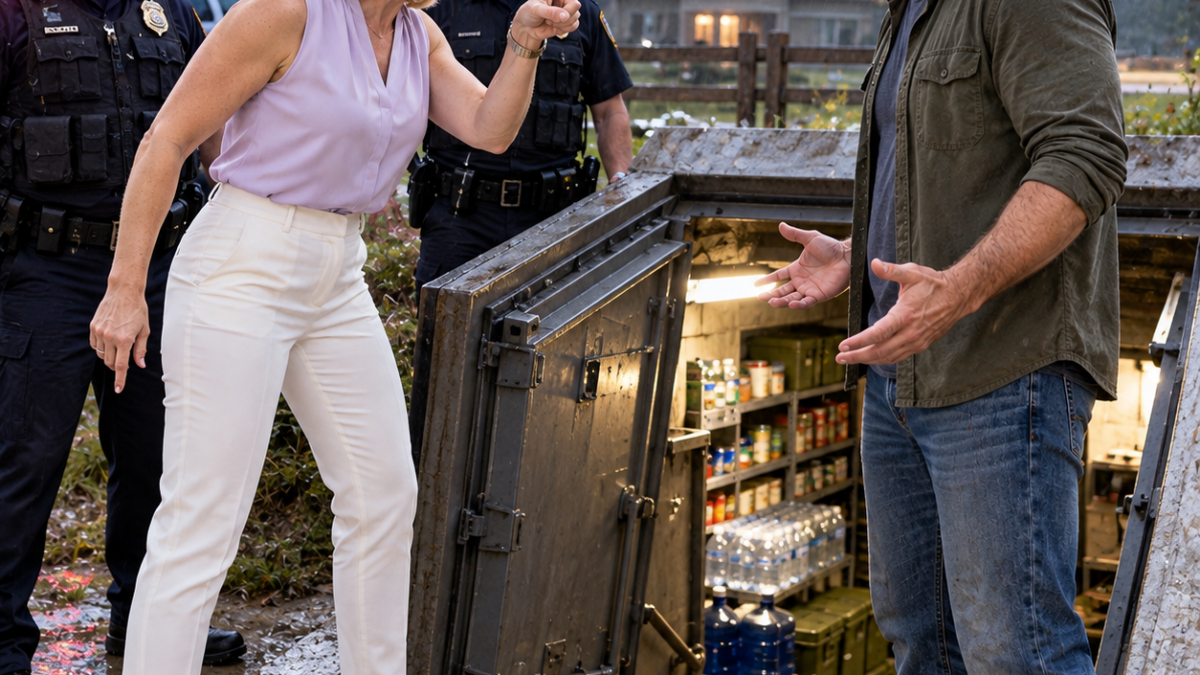
I led them to the shed and unlocked the outer door. The shed itself was deliberately boring—tools, garden supplies, seed trays, a workbench. Under a reinforced floor panel was the hatch. I unlocked that too and pulled it open.
Karen hovered outside, craning her neck.
“You can wait up here,” Coleman told her.
“I am the HOA president.”
“And this is not HOA property.”
Her lips pressed together so tightly they nearly disappeared.
The deputies followed me down the concrete steps.
The bunker was tidy because that was the point. Chaos outside, order inside. Shelves labeled by date. Water tanks strapped properly. Food rotated. Battery system secured. First aid station. Radio corner. Ventilation panel. Fire extinguisher. Tool rack. A laminated checklist clipped near the door.
Lopez gave a low whistle.
“Man. My uncle would love this.”
Coleman looked around slowly.
“This is solid work.”
“Thank you.”
“You build it yourself?”
“With help. I’m a retired volunteer firefighter. Saw too many floods. I wanted a backup plan.”
“Permits?”
I opened the waterproof box and handed him the folder.
He flipped through the county permits, inspection approvals, blueprints, electrical inspection, ventilation sign-off, storage notes.
Lopez checked the battery bank without touching anything.
“You’re not running a generator underground?”
“No. Battery bank. Solar charging when panels are intact. Propane is stored outside in a vented locker, not down here.”
Coleman nodded.
“Good.”
Karen’s voice came from above.
“This can’t be legal. He has enough food to feed an army.”
Coleman sighed.
It was not a loud sigh, but it carried years.
He climbed halfway back up the stairs.
“Ma’am, storing food on private property is not illegal.”
“He’s hoarding.”
“He prepared.”
“He has supplies we need.”
“That does not make them yours.”
“But he lives beside us.”
Coleman’s voice hardened slightly.
“And you called 911 during a weather emergency because your neighbor had canned goods and a permitted structure?”
Karen recoiled.
“I called because I was concerned for community safety.”
“I don’t see anything illegal down here. His paperwork is in order. He is not causing your outage. He is not responsible for your lack of supplies. And he is not part of your HOA.”
Karen’s face flushed.
Lopez came up behind Coleman and muttered, “Some folks got no priorities.”
Karen heard it.
Her eyes flashed.
“I will be escalating this.”
Coleman stepped fully out of the hatch.
“Ma’am, you need to understand something. Misusing emergency services can carry consequences, especially when resources are strained. Do not call 911 again for a non-emergency neighbor dispute.”
“It is not a dispute. It is a hazard.”
“It is not.”
For once, Karen had no immediate answer.
She turned and marched away through the wet grass, shoulders stiff, dignity dragging behind her like a soaked flag.
Coleman handed me back my folder.
“Sorry for the trouble.”
“I figured you had better things to do.”
“We do.”
He gave a tired half-smile.
“But at least your bunker’s nicer than most basements I’ve been in this week.”
After they left, I locked the hatch, went upstairs, and poured coffee from my thermos.
Round one, Karen.
And somehow, she had lost even though she was the only one playing.
The storm dragged on in pieces for days.
Rain. Wind. Gray sky. Mud. Humidity. Silence where electricity should have been.
Magnolia Point Estates deteriorated fast.
I got updates from my friend Jarrett, a mechanic who lived inside the HOA. Jarrett had been on the board for three years, mostly because he believed if decent people refused to sit in boring meetings, people like Karen ended up running everything.
He came by on day four, boots muddy, face grim.
“You would not believe the mess over there,” he said.
“I’ve seen some of it.”
“No, I mean the people. Garages flooded. Food spoiled. No power for folks with medical equipment. Half the board can’t find its own emergency plan, assuming we ever had one. Karen’s holding crisis meetings in her driveway like she’s Churchill.”
“Blaming me?”
He gave me a look.
“How did you guess?”
I handed him a cup of coffee.
He took it gratefully.
“She’s telling people your bunker is a security threat. Says you’re hoarding resources that should be shared with the community.”
“My resources?”
“According to Karen, preparedness within visual range of an HOA is theft.”
“Impressive theory.”
“She’s got Brenda nodding along. You know Brenda? Red hair, corner lot, always has opinions?”
“I’ve seen her glare at my rain barrels.”
“That’s the one. She suggested they investigate your property themselves.”
I looked at him.
Jarrett lifted a hand quickly.
“I shut that down. Told them trespassing after a sheriff warning would be stupid even by our standards.”
I appreciated that.
But that night, I sat in my kitchen, listening to rain tick against the windows, and thought about the people behind that fence.
Karen was one thing.
But the widow whose medications needed clean water did not deserve to suffer because Karen was useless.
The young family with twins did not deserve dark nights because their HOA president cared more about control than planning.
The retired teacher who had once complained about my compost bins did not deserve to eat crackers for dinner because nobody on their board had bothered with emergency supplies.
I could have stayed out of it.
Legally, morally, practically, I owed them nothing.
My bunker was stocked for me, and I had prepared because experience taught me to. Karen had mocked me for it, reported me for it, accused me of crimes for it.
But I also knew what fear looked like after disasters.
I had seen kids cry because the dark felt endless.
I had seen old people ration water because they did not know when help would come.
I had seen pride disappear when people needed batteries, bandages, medicine, or a way to heat soup.
So the next morning, I loaded a wheelbarrow.
Bottled water. Canned soup. Batteries. Bandages. Flashlights. Ibuprofen. A few water purification tablets. Not everything. Not enough to empty my shelves. Enough to matter.
I took it to Jarrett’s house first.
He opened the door and stared at the supplies.
“You serious?”
“I’m not giving away the farm,” I said. “But if people need help, send them to my gate. Politely.”
He smiled.
“You know Karen is going to lose what’s left of her mind.”
“Then she should keep a better grip on it.”
Word spread fast.
By noon, neighbors started showing up.
Not in a mob. Not demanding. Embarrassed, mostly. Quiet. Muddy. Tired.
Mrs. Ransford came first, a widow with arthritis who lived near the flooded cul-de-sac. She leaned on a cane, her hands swollen, her voice barely above a whisper.
“Jarrett said you might have water.”
“I do.”
“I hate to ask.”
“I know.”
I gave her a case of bottled water and ibuprofen. She tried to pay me. I refused.
Then came Ben, a young father with twins who had been sleeping in the living room because a tree had punched through part of their upstairs ceiling. He needed batteries and flashlights. I gave him both, plus soup.
Miss Harper, the retired teacher who had once told the diner waitress that “people like me” were the reason property lines should have aesthetic buffers, arrived looking like she had swallowed a lemon and pride at the same time.
“I suppose Jarrett told you I might come,” she said.
“He mentioned you might need food.”
“I have food.”
“Food you can cook?”
Her eyes dropped.
“No.”
I handed her canned soup, crackers, water, and a small camp stove after making her repeat basic safety instructions twice.
She looked at me for a long moment.
“You’re right, you know.”
“About what?”
“Preparedness.”
It was not an apology.
But it was close enough for a storm.
I made one thing clear to everyone.
“I am not part of your HOA. I’m not obligated to do this. I’m helping because people need help. That’s all.”
Most nodded.
Some thanked me.
A few looked ashamed.
Then Karen arrived.
Of course she did.
She came striding down the road in a raincoat that flapped behind her like a cape, Brenda following half a step behind with folded arms and a face pinched tight from disapproval.
“What is this?” Karen demanded.
I was handing Ben a jug of water.
“Looks like water.”
“You are sabotaging my leadership.”
I stared at her.
“Karen, your residents need supplies.”
“You are making the HOA look incompetent.”
A man near the gate muttered, “Bit late for that.”
Someone else coughed to hide a laugh.
Karen heard it.
Her face reddened.
“These handouts undermine community unity.”
“No,” I said. “Lack of planning undermined community safety. I’m just helping people out.”
Brenda stepped forward.
“You’re trying to turn residents against the board.”
“Brenda, I don’t care about your board.”
Karen pointed at the wheelbarrow.
“If you had these supplies all along, you should have disclosed them.”
“Disclosed them to who?”
“To the HOA.”
“I’m not in the HOA.”
The sentence had become so familiar I felt like I should print it on a shirt.
Karen’s voice rose.
“This is exactly the selfish survivalist behavior I warned people about.”
Ben, still holding the water I had given him, turned around.
“My kids slept with flashlights last night because of him.”
Karen blinked.
Mrs. Ransford lifted her chin.
“I needed water for my medication.”
Miss Harper, to my eternal surprise, said, “Karen, stop.”
The road went quiet.
Karen stared at her.
“You too?”
Miss Harper’s face did not soften.
“Especially me.”
Something shifted then.
Not a dramatic rebellion. Not shouting. Not applause.
Just the quiet, collective realization that the woman who had claimed authority had nothing useful in her hands, while the man she had accused had water.
Karen felt it.
I saw it in her face.
For the first time, she looked less powerful than alone.
She turned sharply and walked away.
Brenda followed, but slower.
The storm finally cleared after eight days.
Power came back in sections. Roads drained. Chainsaws started. Insurance calls began. Contractors appeared like mushrooms after rain. Magnolia Point Estates, bruised but functional, started returning to its glossy version of normal.
But something had changed.
People waved now.
Not all of them. Not dramatically. But more than before.
Mrs. Ransford sent a thank-you card written in careful, shaky cursive. Ben’s twins drew me a picture of my shed with superhero lightning bolts around it, which I put on the refrigerator. Miss Harper brought over tamales, which confused me because I did not know she made tamales and delighted me because they were excellent.
Jarrett stopped by two weeks after power returned.
He had a folder under one arm and a look on his face I recognized from old fire calls when someone found the source of a smell.
“You got coffee?” he asked.
“For that expression? Absolutely.”
We sat at my kitchen table.
He opened the folder.
“You remember how Karen kept saying the HOA didn’t have emergency supplies?”
“I remember many things Karen said against my will.”
“Well, we were supposed to.”
I leaned back.
“What do you mean?”
“Our budget includes an emergency preparedness fund. Water. Basic medical supplies. Battery lanterns. Temporary pumps. Sandbags. Generator maintenance for the clubhouse. Small stuff, but enough to keep people from panicking.”
“And?”
“And there’s almost nothing. No supplies. No working generator. No updated inventory. No contracts. No emergency vendor list.”
“Where did the money go?”
Jarrett tapped the folder.
“That is the question.”
It turned out Karen had done more than fail to prepare.
She had been quietly redirecting HOA funds for years.
Not in cartoon villain amounts. Not suitcases of cash. Karen was smarter than that, or at least she thought she was. It was smaller things. Beautification expenses. Decorative projects. Consultant fees. Reimbursements with vague descriptions. Personal purchases hidden under community improvement. That stupid fountain near the entrance had cost nearly three times what residents were told. Landscaping contracts went to a company connected to Brenda’s brother. Emergency funds had been “temporarily reallocated” and never restored.
Fifteen thousand dollars at first.
Then more questions.
More records.
More missing pieces.
Jarrett and two other board members demanded documents. Karen resisted. They brought in an accountant. Karen called it a witch hunt. Residents who had stood in line at my gate for water were less willing to take her word than they had been before the storm.
The meetings got ugly.
I did not attend because, once again, I was not in the HOA.
But I heard plenty.
Jarrett told me Karen tried to blame “external hostility” for their community instability, which I assumed meant me and my criminal canned soup. Brenda argued that financial questions were inappropriate during recovery. Someone asked why a decorative fountain had been funded before a working emergency generator. Someone else asked why the HOA president had called 911 on a prepared neighbor while hiding the fact that their own emergency fund was empty.
That one apparently got applause.
Six months after the storm, Karen was voted out.
Seven to two.
Brenda was one of the two.
The county opened an investigation into possible fraud. Residents began discussing a class action lawsuit. The board froze discretionary spending. The new acting president, a quiet accountant named Tom Avery, sent a letter to every homeowner detailing emergency reforms, financial transparency rules, and a full audit schedule.
Jarrett brought me a copy.
“Thought you’d enjoy this,” he said.
I read the heading.
THE NEIGHBORLY ACCORD.
I laughed so hard I had to set down my coffee.
“Who named it that?”
“Tom.”
“Tom has a sense of humor.”
“Tom has spreadsheets. That’s better.”
The new rules limited presidential authority, required two signatures for fund transfers, mandated quarterly financial disclosures, created an actual emergency supply inventory, and established a preparedness committee.
Then Jarrett said the sentence I had feared.
“They want you to speak at a workshop.”
“No.”
“You don’t even know the date.”
“No.”
“Come on.”
“I’m not a speaker.”
“You’re a retired firefighter with a bunker who fed half the HOA while our president screamed in a raincoat.”
“I did not feed half the HOA.”
“Fine. A quarter.”
“I gave out soup.”
“And water. And batteries. And dignity, though Karen misplaced hers.”
“I don’t do crowds.”
“It’ll be small.”
“You’re lying.”
“A little.”
I sighed.
He smiled because he knew he had me.
The workshop happened in the clubhouse three weeks later.
I stood in front of people who, a year earlier, had mostly known me as the weird guy beyond the fence. Now they sat with notebooks, coffee, and the uncomfortable humility of people who had learned something the hard way.
Mrs. Ransford sat in the front row.
Ben and his wife came with the twins.
Miss Harper sat with her arms crossed, pretending not to be interested while taking the most notes.
Karen did not attend.
But I saw Brenda in the back, lips pursed.
Good enough.
I did not give them doomsday talk. No fearmongering. No fantasies. No dramatic predictions. Just basics.
Water storage.
Food rotation.
Flashlights.
Battery banks.
Medication plans.
Document copies.
Evacuation routes.
Pet supplies.
Generator safety.
Knowing your neighbors.
Not waiting for the government, the HOA, or luck to save you from your own lack of planning.
At the end, a man asked, “How much is enough?”
I thought about that.
“Enough to keep panic from making your decisions,” I said.
The room went quiet.
“That’s all preparedness really is. You make some choices when you’re calm so fear doesn’t make them for you later.”
Afterward, Miss Harper approached me.
“I still think your shed is ugly.”
I blinked.
“Good to see you too.”
“But,” she said, “I bought water containers.”
“That’s a start.”
“And a battery radio.”
“Even better.”
She looked annoyed by my approval.
“Don’t get smug.”
“Wouldn’t dream of it.”
She handed me another container of tamales.
I accepted the peace offering with grace.
Or at least with both hands.
Karen kept a low profile after that.
For a while, I only saw her from a distance. Driving past the HOA gate. Standing in her yard on the phone. Once at the grocery store, where she turned her cart sharply into another aisle as soon as she saw me.
Then one afternoon, I was unloading new water filters from my truck when her SUV slowed near the property line.
Old habit, I guessed.
She looked thinner. Less polished. Still blond, still sharp-eyed, but diminished somehow. Titles can be scaffolding for people like Karen. Remove them, and you see how much of their height was borrowed.
I raised my hand in a big, cheerful wave.
She stared straight ahead and drove on.
I should have felt triumphant.
I did, a little.
I am human.
But mostly I felt tired.
Karen had caused a lot of trouble because she could not stand the existence of something outside her control. That was all it came down to. My bunker was never the threat. My supplies were never the threat. My ten acres, my shed, my rain barrels, my battery bank—none of it harmed her.
What harmed Karen was the idea that someone nearby could live without needing her permission.
The storm exposed that.
Not because I wanted it to.
Because storms strip away performance.
During normal weather, Karen could perform leadership with rules and fines and landscaping memos. During a disaster, leadership became water, batteries, medical plans, honest accounting, and the ability to admit you were wrong.
She had none of those things.
For a while, I wondered if I had been too harsh with her in my mind. Then Jarrett told me the county investigation had found enough irregularities for charges to be seriously considered, and the sympathy passed.
Residents had paid dues trusting their board to prepare, maintain, and protect the community. Karen had used that trust like a personal wallet and a stage.
The criminal case moved slowly.
These things usually do.
There were interviews, subpoenas, records, meetings, denials, revised denials, and statements from vendors who suddenly remembered things differently when county investigators asked instead of HOA members.
Karen eventually took a plea on lesser charges tied to misappropriation and falsified reimbursement records. She avoided prison, which angered some residents, but she paid restitution, resigned permanently from any HOA role, and was barred under the new governing documents from holding office again.
Brenda moved the following year.
No one cried, at least not publicly.
Magnolia Point changed after that.
Not perfectly. No community becomes wise overnight just because one tyrant falls. People still argued about lawns. Someone still complained about trash bins. A man named Elliot still believed leaf blowers before 9 a.m. were proof civilization had failed.
But the HOA became less ridiculous.
More practical.
They stocked emergency supplies in the clubhouse. They bought a generator and actually maintained it. They organized volunteer check-ins for elderly residents before major storms. They created a group text for emergencies that did not include complaints about wreaths.
And a few people became preppers.
Not bunker people. Not full backup-plan people like me.
But prepared enough.
Tom installed a battery backup.
Mrs. Ransford stored three weeks of water and medication supplies.
Ben bought crank radios for his family.
Miss Harper became the neighborhood’s unofficial canned-food rotation dictator, which was terrifyingly effective.
Jarrett joked that I had started a cult of reasonable preparedness.
I told him there were worse cults.
My life settled again.
I went back to my routines. Vegetable patch in the morning. Repairs when needed. Shed checks once a week. Food rotation every few months. Radio tests. Water filters. Solar maintenance. Quiet evenings under the oaks.
The bunker did what I built it to do.
It kept me safe.
Then it let me help.
That part mattered more than I expected.
I had always thought of preparedness as personal. A private agreement between a man and the future. But the storm reminded me of something I used to know as a firefighter and had maybe forgotten after years of wanting peace.
No one survives alone as cleanly as they imagine.
Self-reliance is good.
Community is better when it is not built on control.
Karen’s version of community meant obedience. Matching shutters. Approved landscaping. A board president with too much power and too little accountability. It looked organized until pressure came, then folded like wet cardboard.
Real community looked like Jarrett walking through mud to warn me what was happening. Ben holding water for his kids. Mrs. Ransford admitting she needed help. Miss Harper swallowing pride. Neighbors learning to prepare not because Karen ordered them to, but because experience taught them why it mattered.
The next storm season, Magnolia Point did not panic.
A tropical system came close enough to rattle everyone, though it turned before landfall. Still, people filled containers, charged batteries, checked on neighbors, secured outdoor furniture, and asked practical questions instead of waiting for Karen’s driveway speeches.
I watched from my porch as Jarrett helped Mrs. Ransford move sandbags.
Ben tested flashlights with his twins like it was a game.
Tom sent out a clean financial report and emergency checklist.
Miss Harper called me to say my radio frequency list was missing one local channel and she had corrected it for her copy.
I thanked her.
She said, “Naturally.”
That evening, I walked down to the shed and opened the hatch.
The bunker smelled like concrete, metal shelving, dry goods, and quiet.
I checked the battery readings. Logged the water levels. Looked over the shelves. Everything in place. Everything boring.
Good preparedness is boring until it is not.
I sat down on the bottom step for a while and listened to the faint sound of wind moving over the hatch above me.
I thought about Karen standing in the rain, accusing me of hoarding.
I thought about Deputy Coleman flipping through my permits while she hovered at the hatch, desperate for the world to confirm her suspicion.
I thought about the line of neighbors at my gate, embarrassed and grateful.
I thought about that first flood years ago, the one that taught me how quickly comfort disappears.
Then I thought about something my old fire captain used to say.
“You don’t rise to the emergency. You fall to your preparation.”
Karen fell exactly that far.
So did her HOA.
The difference was they chose to climb back up.
She did not.
Sometimes I still see her around town. She keeps her distance. Her fake smile is gone now, or maybe she simply stopped wasting it on me. Once, at the diner, I overheard someone mention emergency supplies and saw her stiffen in a booth near the window.
I did not look over.
Some lessons are loud enough without eye contact.
People ask me sometimes if I regret helping the HOA after the way Karen treated me.
I do not.
Helping them did not excuse her.
It exposed her.
Every bottle of water I handed out showed the difference between preparation and performance. Every battery, every can of soup, every bandage made her accusations smaller and her failure clearer. She wanted people to see me as dangerous.
Instead, they saw me as useful.
That destroyed her more thoroughly than any argument could have.
I am still not a guy who likes to make waves.
I still prefer quiet mornings, strong coffee, working soil, and a sky that behaves itself. I still do not care what color shutters people choose. I still do not want to be part of any HOA, reformed or otherwise.
My land remains my land.
My bunker remains legal.
My supplies remain rotated.
And when the next storm rolls in, I will be ready.
But this time, I will not be the only one.
Magnolia Point has water now.
Radios.
Generators.
Checklists.
Neighbors who know which elderly residents need help and which families have small children and which streets flood first.
They also have transparent accounts and a board president who understands that leadership is not a crown.
It is a responsibility.
Karen never learned that.
She thought power was the right to control people who never agreed to follow her.
She thought my independence was an insult.
She thought my preparedness was a crime.
Then the wind came, the lights went out, the streets flooded, and all her authority could not boil water, charge a radio, or keep a frightened child warm.
In the end, my bunker did not make me the threat.
It made me the neighbor she should have been.
And that was the one emergency Karen Whitcomb could not survive.
𝗧𝗛𝗘 𝗘𝗡𝗗
Karen Called the Cops on My Bunker During a Storm, Then Came Begging for My Supplies
Karen said my bunker made me a criminal, a hoarder, and a threat to her perfect HOA community.
Then the storm knocked out their power, flooded their streets, and left her people standing at my gate asking for water.
She thought calling the police would expose me, but all it exposed was the truth she had been hiding from everyone she claimed to lead.
I have never been the kind of man who goes looking for trouble.
That surprises people sometimes, especially when they find out I spent fifteen years as a volunteer firefighter in rural Tennessee before I moved to coastal Georgia. They expect firefighters to have a certain appetite for chaos, like we all secretly enjoy sirens and smoke and adrenaline. Maybe some do. I never did.
I respected chaos too much to enjoy it.
I have seen what one spark can do to a dry field when the wind is wrong. I have seen a calm creek become a brown wall of water in less than an hour. I have seen families stand barefoot in the rain, staring at the place where their living room used to be, clutching plastic grocery bags full of whatever they grabbed before the roof gave way.
People who have never watched order collapse think preparedness is paranoia.
People who have watched it happen call it common sense.
That is why I built the bunker.
Not because I thought the world was ending every Tuesday. Not because I spent my evenings shouting about conspiracy theories into a webcam. Not because I wanted to play soldier or scare the neighbors. I built it because a bad flood in 2018 tore through half the county where I was living then, and I learned, again, that help can be honest and hardworking and still arrive too late.
When I bought my ten acres outside Magnolia Point Estates, I made sure of two things before signing anything.
First, the land was mine.
Second, it was not part of the HOA.
The realtor looked at me like I was being dramatic when I asked for every boundary map, covenant document, county record, and parcel note she could pull. She told me the gated community next door was very desirable, very well managed, very quiet.
I told her that sounded nice for them.
I wanted room to breathe.
My place was a sturdy brick two-story surrounded by old oaks, with a gravel drive, a vegetable patch, a workshop, and a shed out back that looked ordinary unless you knew what was under it. Behind a locked floor hatch, concrete steps led down to a small underground room I had built properly and legally.
Nothing fancy.
Concrete walls. Ventilation. Shelves of canned food. Rice. Beans. Water tanks. A battery bank tied to solar panels. A propane stove. First aid kits. Blankets. Radios. Flashlights. Filters. Tools. Spare boots. A few old firefighter habits I could not shake if I tried.
Every permit was filed.
Every inspection passed.
Every receipt and county approval sat in a labeled folder inside a waterproof box.
I did not advertise it, but I did not hide it like I was ashamed either. Sometimes supplies came in bulk. Sometimes I hauled water containers or checked rain barrels or rotated food. Most people nearby ignored me. A few asked questions at the diner. I answered honestly.
Then there was Karen Whitcomb.
Karen was the president of Magnolia Point Estates HOA, and she wore that title like a crown polished daily by fear. She was in her early fifties, tall and narrow, with carefully highlighted blond hair, a permanent fake smile, and the kind of pastel blazers that looked chosen to make cruelty seem professional. Her SUV was always spotless. Her nails were always perfect. Her eyes were always looking for something that offended her.
She had a reputation before I ever met her properly.
She once made a family repaint their shutters because they were “too nautical.”
In coastal Georgia.
She fined a retired teacher because a birdbath was “visually inconsistent with community tone.” She argued over mailbox flags, wreath sizes, garbage can visibility, and the exact shade of mulch allowed near driveways.
People laughed about her, but nervously.
That told me all I needed to know.
Karen liked rules, but only because rules gave her a stick to swing.
For a while, I was just her curiosity.
Then I became her problem.
I first noticed her SUV slowing near my property line about six months before the storm. The HOA’s back fence ran along one side of my land, and from certain places, you could see my shed through the trees if you worked hard enough at being nosy.
Karen worked hard.
I would be stacking bags of rice or checking the water barrels, and there she would be, parked where the asphalt ended, staring through the fence like she was watching a crime scene. Sometimes she tapped on her phone. Sometimes she took pictures. Sometimes she pretended she had stopped to check messages, but nobody checks messages with binoculars in the cupholder.
One afternoon, she cornered me at the gas station while I was filling diesel cans.
“Mr. Dawson,” she said.
I looked up from the pump.
“Karen.”
She did not like that I used her first name without reverence.
“I’ve received several concerns.”
“About what?”
“About your stockpiling.”
I glanced at the diesel cans.
“You mean fuel?”
“I mean the bunker nonsense.”
The pump clicked off.
I replaced the handle slowly.
“My emergency setup is on my property.”
“It is creating anxiety.”
“For who?”
“For potential buyers. For residents. For people who want to live in a safe, normal community.”
I tightened the cap on the first can.
“Good thing I’m not in your community.”
Her smile stayed in place, but her jaw tightened.
“Your behavior affects us whether you acknowledge it or not.”
“My canned soup is not lowering your property values, Karen.”
“You think this is funny.”
“I think it’s none of your business.”
That was the first time I saw the real Karen peek out from under the polished one.
Her eyes went flat.
“You may not be as outside our authority as you believe.”
I laughed once.
Not loudly. Not cruelly.
Just enough.
She hated it.
“I checked before I bought,” I said. “My land is private. Not HOA. Not subject to your covenants. Not your headache unless you choose to make it one.”
Her face colored.
“We’ll see.”
I should have known then that Karen Whitcomb did not hear boundaries as facts.
She heard them as challenges.
part2
The storm came in late August with a polite name and an ugly soul.
Weather reports had been warning us for days, but people along the coast develop strange relationships with warnings. Some prepare. Some panic. Some shrug because the last one turned. Some buy bread, milk, and candles, then act shocked when wind does not care about grocery receipts.
I took it seriously.
Not dramatically. Seriously.
I secured loose items around the house, tied down what needed tying, checked the generator, topped off the water tanks, charged the battery bank, moved supplies higher, and walked the property twice. The oak trees worried me, but old trees always worry a man who knows what wind can do.
By the time the first bands came through, the sky had turned the color of old metal.
The rain started hard and sideways.
Then the wind arrived.
Not a breeze. Not gusts you could laugh about from a porch. This was a living thing pressing against the house, roaring through trees, throwing branches into the dark, making the walls hum and the windows tremble. The power went out before midnight. Somewhere beyond my land, a transformer blew with a flash that lit the clouds green for half a second.
I went down into the bunker around two in the morning after a branch punched through part of the workshop roof.
The solar panels had already taken damage from flying debris, but the battery bank was fully charged. I had LED lights, radio, water, heat, food, and enough quiet to think. I monitored emergency channels and county updates while rain hammered the world above me.
The next morning, the county was a mess.
Roads flooded. Trees down. Lines down. Calls stacking up. People trapped in houses by water, elderly residents needing medical equipment, stranded drivers, gas stations closed, cell service spotty.
Magnolia Point Estates got hit hard.
Their entrance road flooded at the low spot near the decorative fountain Karen had fought to install two years earlier. Several streets became shallow canals. Power was out. Water pressure failed in parts of the community. A few houses had roof damage. Garages flooded. Refrigerators warmed. Medical devices lost power. Panic spread faster than official updates.
Me?
I had roof damage, a few downed limbs, a soaked section of fence, and mud everywhere.
But I was all right.
By day three, the worst of the wind had passed, but rain still fell in punishing sheets. I was outside in a rain jacket, clearing debris from a drainage ditch, when I saw Karen coming across the muddy strip between our properties.
She looked nothing like the HOA queen from sunny afternoons.
Her designer raincoat was plastered to her. Her hair had collapsed into wet strings around her face. One boot sank ankle-deep in mud, and she nearly fell, which would have been funny if her expression had not been so full of rage.
She carried a soggy notepad in one hand.
“You!” she shouted.
I leaned on my rake.
“Morning, Karen.”
“Don’t you ‘morning’ me.”
“Would afternoon be better?”
Her finger shot toward my house.
“You’re sitting over here comfortable while everyone in our community is suffering.”
“I’m clearing a ditch in the rain.”
“You have lights.”
“I have batteries.”
“You have water.”
“I stored water.”
“You have food.”
“That tends to be the idea.”
Her face twisted.
“That bunker of yours is causing trouble.”
I stared at her.
Of all the nonsense I expected, that one took a second to process.
“My bunker caused the storm?”
“You are hoarding supplies.”
“I am using supplies I bought.”
“It’s not fair to the community.”
“I’m not in your HOA.”
“You live beside us.”
“Correct.”
“That means your choices affect us.”
I set the rake down.
“Karen, my property did not knock out your power. My canned beans did not flood your streets. My battery bank did not close your gate road. Maybe instead of taking notes on my shed for six months, you should have stocked some water.”
Her mouth opened slightly.
Then closed.
Then opened again.
“Don’t you smart-mouth me.”
“Then don’t walk onto my land and say foolish things.”
Her eyes narrowed.
“I knew something illegal was going on over here.”
“Nothing illegal is going on.”
“You’re prepping illegally.”
“That’s not a thing.”
“I bet you have weapons down there. Chemicals. Dangerous materials. Something that puts us all at risk.”
I almost laughed, then realized she wanted me to.
Karen loved reactions. They gave her raw material.
So I folded my arms.
“I have soup, water, first aid supplies, radios, batteries, and enough paperwork to bore a judge into a coma.”
“I’m reporting you.”
“For soup?”
“For creating a hazard during an emergency.”
“Karen, go home.”
Instead, she pulled out her phone.
Right there, in the rain, mud on her boots, hair stuck to her cheeks, she dialed 911.
I watched her do it.
I could hear pieces.
“Secret bunker…”
“Stockpiling…”
“Possible weapons…”
“Hazard to residents…”
“Yes, during the storm…”
“No, he won’t cooperate…”
I had worked with law enforcement plenty during my firefighter years. I knew exactly how serious misuse of emergency services could be, especially during a countywide weather crisis. Dispatchers were dealing with real emergencies. Downed lines. Medical calls. Water rescues. Trees through roofs.
Karen was tying up time because she was mad my lights worked.
When she hung up, she looked triumphant.
“They’re coming.”
“Eventually,” I said. “Maybe after they rescue the people who actually need help.”
Her mouth tightened.
“You think you’re untouchable.”
“No. I think I have permits.”
She stomped back through the mud, slipping once, catching herself on the fence, and glaring at me like gravity was my fault.
I went back to clearing the ditch.
The deputies came the next afternoon.
By then, the rain had slowed to a cold mist, but the county still looked beaten. The sheriff’s SUV pulled up with mud sprayed along the doors and branches caught under the bumper. Two deputies climbed out looking like they had not slept properly since the storm hit.
The older one introduced himself as Deputy Coleman. He had gray in his mustache, deep lines around his eyes, and the tired patience of a man who had spent too many hours separating real problems from loud ones.
The younger deputy, Lopez, looked curious but worn down, rain dripping from the edge of his hat.
Karen arrived behind them in a different raincoat, cleaner now, carrying another notepad like it was evidence.
Deputy Coleman looked from her to me.
“You Mr. Dawson?”
“Yes, sir.”
“Property owner?”
“That’s right.”
“We received a complaint about an underground structure.”
I nodded.
“I’ve got a storm bunker. Fully permitted. Happy to show you.”
Karen made a sharp noise.
“Storm bunker? That is not what you told me.”
“I didn’t tell you anything. You snooped.”
Coleman held up one hand.
“Let’s keep it calm.”
Karen stepped forward.
“He’s hoarding supplies while our residents go without. He has power while we don’t. No one knows what’s down there. This is a security risk.”
Deputy Lopez raised one eyebrow.
“A security risk?”
“He’s not transparent.”
“I’m not a government agency,” I said.
Coleman looked at me.
“You have paperwork?”
“Inside the bunker.”
That got Lopez’s attention.
“Well,” he said, “let’s take a look.”
I led them to the shed and unlocked the outer door. The shed itself was deliberately boring—tools, garden supplies, seed trays, a workbench. Under a reinforced floor panel was the hatch. I unlocked that too and pulled it open.
Karen hovered outside, craning her neck.
“You can wait up here,” Coleman told her.
“I am the HOA president.”
“And this is not HOA property.”
Her lips pressed together so tightly they nearly disappeared.
The deputies followed me down the concrete steps.
The bunker was tidy because that was the point. Chaos outside, order inside. Shelves labeled by date. Water tanks strapped properly. Food rotated. Battery system secured. First aid station. Radio corner. Ventilation panel. Fire extinguisher. Tool rack. A laminated checklist clipped near the door.
Lopez gave a low whistle.
“Man. My uncle would love this.”
Coleman looked around slowly.
“This is solid work.”
“Thank you.”
“You build it yourself?”
“With help. I’m a retired volunteer firefighter. Saw too many floods. I wanted a backup plan.”
“Permits?”
I opened the waterproof box and handed him the folder.
He flipped through the county permits, inspection approvals, blueprints, electrical inspection, ventilation sign-off, storage notes.
Lopez checked the battery bank without touching anything.
“You’re not running a generator underground?”
“No. Battery bank. Solar charging when panels are intact. Propane is stored outside in a vented locker, not down here.”
Coleman nodded.
“Good.”
Karen’s voice came from above.
“This can’t be legal. He has enough food to feed an army.”
Coleman sighed.
It was not a loud sigh, but it carried years.
He climbed halfway back up the stairs.
“Ma’am, storing food on private property is not illegal.”
“He’s hoarding.”
“He prepared.”
“He has supplies we need.”
“That does not make them yours.”
“But he lives beside us.”
Coleman’s voice hardened slightly.
“And you called 911 during a weather emergency because your neighbor had canned goods and a permitted structure?”
Karen recoiled.
“I called because I was concerned for community safety.”
“I don’t see anything illegal down here. His paperwork is in order. He is not causing your outage. He is not responsible for your lack of supplies. And he is not part of your HOA.”
Karen’s face flushed.
Lopez came up behind Coleman and muttered, “Some folks got no priorities.”
Karen heard it.
Her eyes flashed.
“I will be escalating this.”
Coleman stepped fully out of the hatch.
“Ma’am, you need to understand something. Misusing emergency services can carry consequences, especially when resources are strained. Do not call 911 again for a non-emergency neighbor dispute.”
“It is not a dispute. It is a hazard.”
“It is not.”
For once, Karen had no immediate answer.
She turned and marched away through the wet grass, shoulders stiff, dignity dragging behind her like a soaked flag.
Coleman handed me back my folder.
“Sorry for the trouble.”
“I figured you had better things to do.”
“We do.”
He gave a tired half-smile.
“But at least your bunker’s nicer than most basements I’ve been in this week.”
After they left, I locked the hatch, went upstairs, and poured coffee from my thermos.
Round one, Karen.
And somehow, she had lost even though she was the only one playing.
The storm dragged on in pieces for days.
Rain. Wind. Gray sky. Mud. Humidity. Silence where electricity should have been.
Magnolia Point Estates deteriorated fast.
I got updates from my friend Jarrett, a mechanic who lived inside the HOA. Jarrett had been on the board for three years, mostly because he believed if decent people refused to sit in boring meetings, people like Karen ended up running everything.
He came by on day four, boots muddy, face grim.
“You would not believe the mess over there,” he said.
“I’ve seen some of it.”
“No, I mean the people. Garages flooded. Food spoiled. No power for folks with medical equipment. Half the board can’t find its own emergency plan, assuming we ever had one. Karen’s holding crisis meetings in her driveway like she’s Churchill.”
“Blaming me?”
He gave me a look.
“How did you guess?”
I handed him a cup of coffee.
He took it gratefully.
“She’s telling people your bunker is a security threat. Says you’re hoarding resources that should be shared with the community.”
“My resources?”
“According to Karen, preparedness within visual range of an HOA is theft.”
“Impressive theory.”
“She’s got Brenda nodding along. You know Brenda? Red hair, corner lot, always has opinions?”
“I’ve seen her glare at my rain barrels.”
“That’s the one. She suggested they investigate your property themselves.”
I looked at him.
Jarrett lifted a hand quickly.
“I shut that down. Told them trespassing after a sheriff warning would be stupid even by our standards.”
I appreciated that.
But that night, I sat in my kitchen, listening to rain tick against the windows, and thought about the people behind that fence.
Karen was one thing.
But the widow whose medications needed clean water did not deserve to suffer because Karen was useless.
The young family with twins did not deserve dark nights because their HOA president cared more about control than planning.
The retired teacher who had once complained about my compost bins did not deserve to eat crackers for dinner because nobody on their board had bothered with emergency supplies.
I could have stayed out of it.
Legally, morally, practically, I owed them nothing.
My bunker was stocked for me, and I had prepared because experience taught me to. Karen had mocked me for it, reported me for it, accused me of crimes for it.
But I also knew what fear looked like after disasters.
I had seen kids cry because the dark felt endless.
I had seen old people ration water because they did not know when help would come.
I had seen pride disappear when people needed batteries, bandages, medicine, or a way to heat soup.
So the next morning, I loaded a wheelbarrow.
Bottled water. Canned soup. Batteries. Bandages. Flashlights. Ibuprofen. A few water purification tablets. Not everything. Not enough to empty my shelves. Enough to matter.
I took it to Jarrett’s house first.
He opened the door and stared at the supplies.
“You serious?”
“I’m not giving away the farm,” I said. “But if people need help, send them to my gate. Politely.”
He smiled.
“You know Karen is going to lose what’s left of her mind.”
“Then she should keep a better grip on it.”
Word spread fast.
By noon, neighbors started showing up.
Not in a mob. Not demanding. Embarrassed, mostly. Quiet. Muddy. Tired.
Mrs. Ransford came first, a widow with arthritis who lived near the flooded cul-de-sac. She leaned on a cane, her hands swollen, her voice barely above a whisper.
“Jarrett said you might have water.”
“I do.”
“I hate to ask.”
“I know.”
I gave her a case of bottled water and ibuprofen. She tried to pay me. I refused.
Then came Ben, a young father with twins who had been sleeping in the living room because a tree had punched through part of their upstairs ceiling. He needed batteries and flashlights. I gave him both, plus soup.
Miss Harper, the retired teacher who had once told the diner waitress that “people like me” were the reason property lines should have aesthetic buffers, arrived looking like she had swallowed a lemon and pride at the same time.
“I suppose Jarrett told you I might come,” she said.
“He mentioned you might need food.”
“I have food.”
“Food you can cook?”
Her eyes dropped.
“No.”
I handed her canned soup, crackers, water, and a small camp stove after making her repeat basic safety instructions twice.
She looked at me for a long moment.
“You’re right, you know.”
“About what?”
“Preparedness.”
It was not an apology.
But it was close enough for a storm.
I made one thing clear to everyone.
“I am not part of your HOA. I’m not obligated to do this. I’m helping because people need help. That’s all.”
Most nodded.
Some thanked me.
A few looked ashamed.
Then Karen arrived.
Of course she did.
She came striding down the road in a raincoat that flapped behind her like a cape, Brenda following half a step behind with folded arms and a face pinched tight from disapproval.
“What is this?” Karen demanded.
I was handing Ben a jug of water.
“Looks like water.”
“You are sabotaging my leadership.”
I stared at her.
“Karen, your residents need supplies.”
“You are making the HOA look incompetent.”
A man near the gate muttered, “Bit late for that.”
Someone else coughed to hide a laugh.
Karen heard it.
Her face reddened.
“These handouts undermine community unity.”
“No,” I said. “Lack of planning undermined community safety. I’m just helping people out.”
Brenda stepped forward.
“You’re trying to turn residents against the board.”
“Brenda, I don’t care about your board.”
Karen pointed at the wheelbarrow.
“If you had these supplies all along, you should have disclosed them.”
“Disclosed them to who?”
“To the HOA.”
“I’m not in the HOA.”
The sentence had become so familiar I felt like I should print it on a shirt.
Karen’s voice rose.
“This is exactly the selfish survivalist behavior I warned people about.”
Ben, still holding the water I had given him, turned around.
“My kids slept with flashlights last night because of him.”
Karen blinked.
Mrs. Ransford lifted her chin.
“I needed water for my medication.”
Miss Harper, to my eternal surprise, said, “Karen, stop.”
The road went quiet.
Karen stared at her.
“You too?”
Miss Harper’s face did not soften.
“Especially me.”
Something shifted then.
Not a dramatic rebellion. Not shouting. Not applause.
Just the quiet, collective realization that the woman who had claimed authority had nothing useful in her hands, while the man she had accused had water.
Karen felt it.
I saw it in her face.
For the first time, she looked less powerful than alone.
She turned sharply and walked away.
Brenda followed, but slower.
The storm finally cleared after eight days.
Power came back in sections. Roads drained. Chainsaws started. Insurance calls began. Contractors appeared like mushrooms after rain. Magnolia Point Estates, bruised but functional, started returning to its glossy version of normal.
But something had changed.
People waved now.
Not all of them. Not dramatically. But more than before.
Mrs. Ransford sent a thank-you card written in careful, shaky cursive. Ben’s twins drew me a picture of my shed with superhero lightning bolts around it, which I put on the refrigerator. Miss Harper brought over tamales, which confused me because I did not know she made tamales and delighted me because they were excellent.
Jarrett stopped by two weeks after power returned.
He had a folder under one arm and a look on his face I recognized from old fire calls when someone found the source of a smell.
“You got coffee?” he asked.
“For that expression? Absolutely.”
We sat at my kitchen table.
He opened the folder.
“You remember how Karen kept saying the HOA didn’t have emergency supplies?”
“I remember many things Karen said against my will.”
“Well, we were supposed to.”
I leaned back.
“What do you mean?”
“Our budget includes an emergency preparedness fund. Water. Basic medical supplies. Battery lanterns. Temporary pumps. Sandbags. Generator maintenance for the clubhouse. Small stuff, but enough to keep people from panicking.”
“And?”
“And there’s almost nothing. No supplies. No working generator. No updated inventory. No contracts. No emergency vendor list.”
“Where did the money go?”
Jarrett tapped the folder.
“That is the question.”
It turned out Karen had done more than fail to prepare.
She had been quietly redirecting HOA funds for years.
Not in cartoon villain amounts. Not suitcases of cash. Karen was smarter than that, or at least she thought she was. It was smaller things. Beautification expenses. Decorative projects. Consultant fees. Reimbursements with vague descriptions. Personal purchases hidden under community improvement. That stupid fountain near the entrance had cost nearly three times what residents were told. Landscaping contracts went to a company connected to Brenda’s brother. Emergency funds had been “temporarily reallocated” and never restored.
Fifteen thousand dollars at first.
Then more questions.
More records.
More missing pieces.
Jarrett and two other board members demanded documents. Karen resisted. They brought in an accountant. Karen called it a witch hunt. Residents who had stood in line at my gate for water were less willing to take her word than they had been before the storm.
The meetings got ugly.
I did not attend because, once again, I was not in the HOA.
But I heard plenty.
Jarrett told me Karen tried to blame “external hostility” for their community instability, which I assumed meant me and my criminal canned soup. Brenda argued that financial questions were inappropriate during recovery. Someone asked why a decorative fountain had been funded before a working emergency generator. Someone else asked why the HOA president had called 911 on a prepared neighbor while hiding the fact that their own emergency fund was empty.
That one apparently got applause.
Six months after the storm, Karen was voted out.
Seven to two.
Brenda was one of the two.
The county opened an investigation into possible fraud. Residents began discussing a class action lawsuit. The board froze discretionary spending. The new acting president, a quiet accountant named Tom Avery, sent a letter to every homeowner detailing emergency reforms, financial transparency rules, and a full audit schedule.
Jarrett brought me a copy.
“Thought you’d enjoy this,” he said.
I read the heading.
THE NEIGHBORLY ACCORD.
I laughed so hard I had to set down my coffee.
“Who named it that?”
“Tom.”
“Tom has a sense of humor.”
“Tom has spreadsheets. That’s better.”
The new rules limited presidential authority, required two signatures for fund transfers, mandated quarterly financial disclosures, created an actual emergency supply inventory, and established a preparedness committee.
Then Jarrett said the sentence I had feared.
“They want you to speak at a workshop.”
“No.”
“You don’t even know the date.”
“No.”
“Come on.”
“I’m not a speaker.”
“You’re a retired firefighter with a bunker who fed half the HOA while our president screamed in a raincoat.”
“I did not feed half the HOA.”
“Fine. A quarter.”
“I gave out soup.”
“And water. And batteries. And dignity, though Karen misplaced hers.”
“I don’t do crowds.”
“It’ll be small.”
“You’re lying.”
“A little.”
I sighed.
He smiled because he knew he had me.
The workshop happened in the clubhouse three weeks later.
I stood in front of people who, a year earlier, had mostly known me as the weird guy beyond the fence. Now they sat with notebooks, coffee, and the uncomfortable humility of people who had learned something the hard way.
Mrs. Ransford sat in the front row.
Ben and his wife came with the twins.
Miss Harper sat with her arms crossed, pretending not to be interested while taking the most notes.
Karen did not attend.
But I saw Brenda in the back, lips pursed.
Good enough.
I did not give them doomsday talk. No fearmongering. No fantasies. No dramatic predictions. Just basics.
Water storage.
Food rotation.
Flashlights.
Battery banks.
Medication plans.
Document copies.
Evacuation routes.
Pet supplies.
Generator safety.
Knowing your neighbors.
Not waiting for the government, the HOA, or luck to save you from your own lack of planning.
At the end, a man asked, “How much is enough?”
I thought about that.
“Enough to keep panic from making your decisions,” I said.
The room went quiet.
“That’s all preparedness really is. You make some choices when you’re calm so fear doesn’t make them for you later.”
Afterward, Miss Harper approached me.
“I still think your shed is ugly.”
I blinked.
“Good to see you too.”
“But,” she said, “I bought water containers.”
“That’s a start.”
“And a battery radio.”
“Even better.”
She looked annoyed by my approval.
“Don’t get smug.”
“Wouldn’t dream of it.”
She handed me another container of tamales.
I accepted the peace offering with grace.
Or at least with both hands.
Karen kept a low profile after that.
For a while, I only saw her from a distance. Driving past the HOA gate. Standing in her yard on the phone. Once at the grocery store, where she turned her cart sharply into another aisle as soon as she saw me.
Then one afternoon, I was unloading new water filters from my truck when her SUV slowed near the property line.
Old habit, I guessed.
She looked thinner. Less polished. Still blond, still sharp-eyed, but diminished somehow. Titles can be scaffolding for people like Karen. Remove them, and you see how much of their height was borrowed.
I raised my hand in a big, cheerful wave.
She stared straight ahead and drove on.
I should have felt triumphant.
I did, a little.
I am human.
But mostly I felt tired.
Karen had caused a lot of trouble because she could not stand the existence of something outside her control. That was all it came down to. My bunker was never the threat. My supplies were never the threat. My ten acres, my shed, my rain barrels, my battery bank—none of it harmed her.
What harmed Karen was the idea that someone nearby could live without needing her permission.
The storm exposed that.
Not because I wanted it to.
Because storms strip away performance.
During normal weather, Karen could perform leadership with rules and fines and landscaping memos. During a disaster, leadership became water, batteries, medical plans, honest accounting, and the ability to admit you were wrong.
She had none of those things.
For a while, I wondered if I had been too harsh with her in my mind. Then Jarrett told me the county investigation had found enough irregularities for charges to be seriously considered, and the sympathy passed.
Residents had paid dues trusting their board to prepare, maintain, and protect the community. Karen had used that trust like a personal wallet and a stage.
The criminal case moved slowly.
These things usually do.
There were interviews, subpoenas, records, meetings, denials, revised denials, and statements from vendors who suddenly remembered things differently when county investigators asked instead of HOA members.
Karen eventually took a plea on lesser charges tied to misappropriation and falsified reimbursement records. She avoided prison, which angered some residents, but she paid restitution, resigned permanently from any HOA role, and was barred under the new governing documents from holding office again.
Brenda moved the following year.
No one cried, at least not publicly.
Magnolia Point changed after that.
Not perfectly. No community becomes wise overnight just because one tyrant falls. People still argued about lawns. Someone still complained about trash bins. A man named Elliot still believed leaf blowers before 9 a.m. were proof civilization had failed.
But the HOA became less ridiculous.
More practical.
They stocked emergency supplies in the clubhouse. They bought a generator and actually maintained it. They organized volunteer check-ins for elderly residents before major storms. They created a group text for emergencies that did not include complaints about wreaths.
And a few people became preppers.
Not bunker people. Not full backup-plan people like me.
But prepared enough.
Tom installed a battery backup.
Mrs. Ransford stored three weeks of water and medication supplies.
Ben bought crank radios for his family.
Miss Harper became the neighborhood’s unofficial canned-food rotation dictator, which was terrifyingly effective.
Jarrett joked that I had started a cult of reasonable preparedness.
I told him there were worse cults.
My life settled again.
I went back to my routines. Vegetable patch in the morning. Repairs when needed. Shed checks once a week. Food rotation every few months. Radio tests. Water filters. Solar maintenance. Quiet evenings under the oaks.
The bunker did what I built it to do.
It kept me safe.
Then it let me help.
That part mattered more than I expected.
I had always thought of preparedness as personal. A private agreement between a man and the future. But the storm reminded me of something I used to know as a firefighter and had maybe forgotten after years of wanting peace.
No one survives alone as cleanly as they imagine.
Self-reliance is good.
Community is better when it is not built on control.
Karen’s version of community meant obedience. Matching shutters. Approved landscaping. A board president with too much power and too little accountability. It looked organized until pressure came, then folded like wet cardboard.
Real community looked like Jarrett walking through mud to warn me what was happening. Ben holding water for his kids. Mrs. Ransford admitting she needed help. Miss Harper swallowing pride. Neighbors learning to prepare not because Karen ordered them to, but because experience taught them why it mattered.
The next storm season, Magnolia Point did not panic.
A tropical system came close enough to rattle everyone, though it turned before landfall. Still, people filled containers, charged batteries, checked on neighbors, secured outdoor furniture, and asked practical questions instead of waiting for Karen’s driveway speeches.
I watched from my porch as Jarrett helped Mrs. Ransford move sandbags.
Ben tested flashlights with his twins like it was a game.
Tom sent out a clean financial report and emergency checklist.
Miss Harper called me to say my radio frequency list was missing one local channel and she had corrected it for her copy.
I thanked her.
She said, “Naturally.”
That evening, I walked down to the shed and opened the hatch.
The bunker smelled like concrete, metal shelving, dry goods, and quiet.
I checked the battery readings. Logged the water levels. Looked over the shelves. Everything in place. Everything boring.
Good preparedness is boring until it is not.
I sat down on the bottom step for a while and listened to the faint sound of wind moving over the hatch above me.
I thought about Karen standing in the rain, accusing me of hoarding.
I thought about Deputy Coleman flipping through my permits while she hovered at the hatch, desperate for the world to confirm her suspicion.
I thought about the line of neighbors at my gate, embarrassed and grateful.
I thought about that first flood years ago, the one that taught me how quickly comfort disappears.
Then I thought about something my old fire captain used to say.
“You don’t rise to the emergency. You fall to your preparation.”
Karen fell exactly that far.
So did her HOA.
The difference was they chose to climb back up.
She did not.
Sometimes I still see her around town. She keeps her distance. Her fake smile is gone now, or maybe she simply stopped wasting it on me. Once, at the diner, I overheard someone mention emergency supplies and saw her stiffen in a booth near the window.
I did not look over.
Some lessons are loud enough without eye contact.
People ask me sometimes if I regret helping the HOA after the way Karen treated me.
I do not.
Helping them did not excuse her.
It exposed her.
Every bottle of water I handed out showed the difference between preparation and performance. Every battery, every can of soup, every bandage made her accusations smaller and her failure clearer. She wanted people to see me as dangerous.
Instead, they saw me as useful.
That destroyed her more thoroughly than any argument could have.
I am still not a guy who likes to make waves.
I still prefer quiet mornings, strong coffee, working soil, and a sky that behaves itself. I still do not care what color shutters people choose. I still do not want to be part of any HOA, reformed or otherwise.
My land remains my land.
My bunker remains legal.
My supplies remain rotated.
And when the next storm rolls in, I will be ready.
But this time, I will not be the only one.
Magnolia Point has water now.
Radios.
Generators.
Checklists.
Neighbors who know which elderly residents need help and which families have small children and which streets flood first.
They also have transparent accounts and a board president who understands that leadership is not a crown.
It is a responsibility.
Karen never learned that.
She thought power was the right to control people who never agreed to follow her.
She thought my independence was an insult.
She thought my preparedness was a crime.
Then the wind came, the lights went out, the streets flooded, and all her authority could not boil water, charge a radio, or keep a frightened child warm.
In the end, my bunker did not make me the threat.
It made me the neighbor she should have been.
And that was the one emergency Karen Whitcomb could not survive.