.Karen Called My Pool a Hazard, Then Threw an HOA Party in It While I Was Gone
part2
It was one of those hot afternoons where the sun seemed determined to prove a point.
My kids had a few friends over, and I was playing lifeguard, parent, snack distributor, and grill supervisor all at once. My wife was inside prepping drinks and cutting fruit, because she is the only reason any gathering at our house ever looks like adults planned it.
The kids were in the water laughing, shrieking, splashing, doing whatever kids do when a pool turns them temporarily feral.
I heard the latch on the side gate rattle.
Then Karen’s voice.
“Excuse me.”
I looked over.
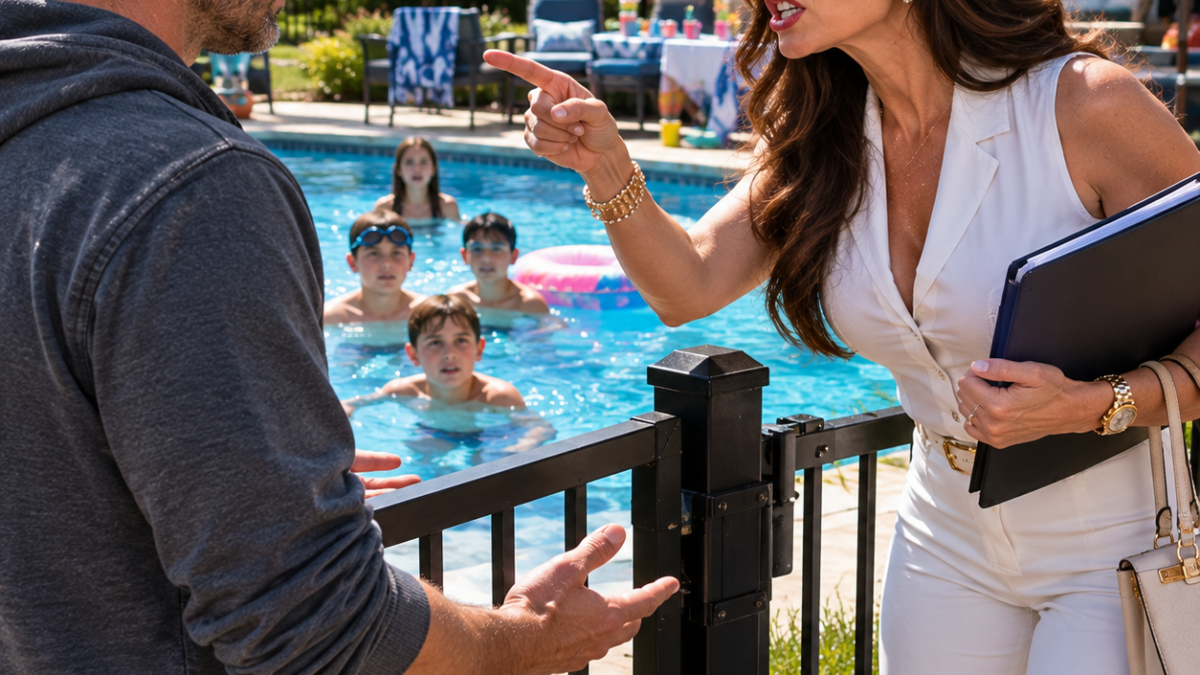
She stood outside the gate in white capri pants, a fitted sleeveless blouse, wedge sandals, and sunglasses that made her look like she was about to inspect a yacht. She had one hand on her hip and the other gripping a folder.
I walked toward the gate but did not open it.
“Can I help you?”
“You need to evacuate the pool immediately.”
I stared at her.
“What?”
“The pool,” she said, pointing past me like I might be unfamiliar with the large body of water in my own yard. “It is unsafe.”
A few kids went quiet.
My daughter looked at me from the shallow end.
“Dad?”
“It’s fine,” I told her, keeping my voice calm.
Karen lifted her chin.
“I work with HOA enforcement, and this pool presents a public health hazard.”
I almost laughed.
Almost.
“Karen, I’m not in your HOA.”
She ignored that.
“Standing water attracts mosquitoes. Mosquitoes carry diseases. I have received concerns.”
“From who?”
“Concerned residents.”
“Of the HOA I’m not in?”
Her mouth tightened.
“This affects the whole community.”
“It’s a maintained pool with a pump, filters, chemicals, permits, and inspections.”
“I will need to see proof of that.”
“No, you won’t.”
Her eyebrows lifted above the sunglasses.
“Excuse me?”
“You don’t need to see anything because you have no authority here.”
For a moment, the charming version of Karen tried to appear.
She softened her mouth and lowered her voice.
“Look, I’m trying to protect everyone, including your children.”
“My children are supervised.”
“There are many children in that pool.”
“Yes. Because I invited them.”
“And if something happens?”
“Then it happens on my property under my supervision, with adults present, around a legal pool.”
She leaned closer to the gate.
“I’m going to give you one chance to clear everyone out before I call the police.”
That made the kids go silent again.
My son whispered, “Are we in trouble?”
Something in my chest tightened.
I looked at Karen.
“No, we are not.”
Then I turned toward the kids.
“Everybody out for a minute. Inside. Movie and snacks.”
Groans erupted, but my wife came to the back door, saw my face, and immediately took over.
“Come on, everyone,” she called. “Towels first. No dripping on my floor unless you want to mop.”
The kids climbed out, grumbling.
Once they were inside, I turned back to Karen.
“Happy?”
She pulled out her phone.
“I’m calling.”
“Go ahead.”
She dialed like she had been waiting her whole life for that moment.
Her voice changed when the dispatcher answered. She became calm, official, concerned.
“Yes, I need to report an unsafe pool situation. There are unsupervised children, possible health violations, and the homeowner is refusing to cooperate.”
I stood there listening to her lie with the confidence of a woman who had never considered evidence an obstacle.
The police arrived faster than I expected.
Apparently, “unsupervised children in a pool” gets attention, which I understand. If I were a dispatcher hearing that, I would send someone too.
Two officers came to the gate. I let them in, gave them my name, showed them the pool area, then handed over copies of the permits I kept in a folder in the kitchen for exactly this kind of nonsense.
My wife, calm as ever, explained that the kids had been supervised the entire time.
She is a school nurse, and in stressful situations she turns into the emotional equivalent of stainless steel. Cool, clean, impossible to bend.
One officer looked over the paperwork.
The other spoke with Karen outside the gate.
I could see her gesturing dramatically.
After a few minutes, the officer came back to me.
“Everything appears to be in order.”
“I know.”
He gave me the tired little smile of someone who had dealt with too many unnecessary calls.
“She can file a complaint with the county if she believes there’s a code issue, but this isn’t a police matter.”
“Thank you.”
He turned toward Karen and told her essentially the same thing.
She did not take it well.
Her mouth opened.
Closed.
Opened again.
“But the children—”
“Were supervised,” the officer said.
“The water—”
“Appears maintained.”
“The HOA—”
“He isn’t in your HOA.”
That sentence was worth the entire inconvenience.
Karen’s face flushed.
She made a sharp sound through her nose, gathered her folder, and walked away without looking at me.
I thought that would be the end.
I should have known better.
For a couple of weeks, nothing happened besides the occasional slow drive past my house. Karen would roll by in her SUV, sunglasses on, lips tight, looking at my fence like it had personally insulted her.
Then came the Saturday that turned her from nuisance into trespasser.
My wife and I took the kids out for most of the day. Errands first, then lunch, then a stop at my in-laws’ house. It was one of those busy family days where you leave thinking you’ll be gone two hours and somehow return six hours later exhausted, sunburned, and carrying more bags than you remember buying.
As we turned onto our street, I noticed cars.
Too many cars.
Parked along the curb near our house.
In front of our driveway.
Across the street.
My wife frowned.
“Is someone having a party?”
My stomach dropped before I even answered.
Then we pulled closer, and I heard music.
Coming from my backyard.
My backyard.
I parked crooked in the driveway and got out.
Laughter carried over the fence.
Splashes.
Voices.
A woman shouting, “More drinks are on the table!”
My wife’s face went pale.
“No.”
I told the kids to stay in the car for a second.
Then I walked to the side gate.
It was open.
Not broken.
Open.
Someone had either reached over and released the latch or Karen had found another way in. I did not care which.
I stepped through and saw strangers in my pool.
Dozens of them.
Adults standing waist-deep in the water with plastic cups.
Kids jumping in from the side.
People sitting in my patio chairs.
Someone using my grill.
My towels—my family’s towels—were draped across strangers’ shoulders and chairs.
There were coolers near the wall, folding tables set up under the shade, and a bright printed sign taped near the patio door that read:
HOA SUMMER POOL PARTY.
For a moment, I genuinely could not move.
It was too absurd.
My brain refused to accept that a woman who had called police on my pool for being unsafe had now turned it into an HOA event without my permission.
Then I saw Karen.
She was standing near a folding table in a white swimsuit cover-up, oversized sunglasses, wedges, and a sunhat so wide it looked like it needed its own ZIP code. She had a clipboard in one hand and was laughing with two women like she owned the place.
I walked straight toward her.
“Karen.”
She turned.
Her smile froze for half a second, then returned brighter than before.
“Oh, you’re back.”
I stared at her.
“Why are there people in my pool?”
She gave a light laugh.
“Don’t be dramatic. We’re having a community event.”
“On my property.”
“This pool serves the neighborhood.”
“No, it serves my family.”
Her smile tightened.
“Your pool has been a continuing concern for the HOA. The board determined that if it affects the community, it should be made available under community supervision.”
I looked around again, wondering if I was hallucinating.
“You called the police because you said it was unsafe.”
“And now it’s being used safely.”
“By people I did not invite.”
“Most of them are HOA members.”
“I am not.”
She leaned closer and lowered her voice.
“Let’s not create a scene.”
That sentence almost made me laugh.
There were strangers swimming in my pool, sitting on my furniture, using my grill, and collecting money at a table in my yard, and Karen thought I was the one creating a scene.
“Get everyone out.”
“No.”
The word was soft.
Calm.
Confident.
I looked at her.
“What did you say?”
“I said no.”
The music played behind us.
Someone splashed.
A child screamed joyfully.
Karen’s mouth curved into a smile that finally revealed what this was really about.
Power.
“You have resisted community cooperation long enough,” she said. “This is the best compromise.”
“Compromise requires my agreement.”
“You’re being selfish.”
“This is my backyard.”
“Your property impacts our neighborhood.”
“My property is not yours.”
“It is visible from HOA homes.”
That sentence was so stupid I actually paused.
“Visible?”
“Yes.”
“So anything you can see belongs to you?”
She lifted her chin.
“Don’t twist my words.”
“I don’t have to. They arrived twisted.”
My wife appeared in the doorway behind me, the kids inside now, her expression furious in a way I rarely saw.
“Do you want me to call the police?” she asked.
I almost said yes.
That would have been the obvious move. Legal. Clean. Correct.
But as I looked around my backyard, at Karen’s sign, at strangers treating our home like an amenity, at people laughing with no idea what was happening, I realized calling the police would solve only the moment.
Karen would spin it.
She would claim misunderstanding.
She would say the HOA had believed permission existed.
She would cry about community.
She would make herself the victim of an overreaction.
And then she would keep pushing.
I knew it.
My wife knew it.
Karen had not just crossed a boundary.
She was trying to erase it.
I turned and walked inside.
My wife followed.
“What are you doing?”
“Trying not to do something stupid.”
She looked out the window at the pool, then back at me.
“Do you want my opinion?”
“Always.”
Her face was calm, but her eyes were not.
“She said the pool was unsafe.”
“Yes.”
“She said it should be cleared.”
“Yes.”
“Then clear it.”
I stared at her.
Slowly, I understood.
My wife raised an eyebrow.
“It’s your pool.”
I smiled for the first time all afternoon.
“Yes, it is.”
The key was timing.
I did not want anyone hurt, panicked, or trapped. I did not want chaos. I did not want to endanger children or create some sudden dangerous suction issue, so I handled it carefully, the way the system was designed to be handled. Slowly. Controlled. Visible if anyone bothered to pay attention.
I waited.
The afternoon got hotter.
More people got in the pool.
More guests arrived.
Karen’s confidence grew with every minute I did nothing.
She probably thought I had surrendered.
She had a little check-in table set up near my patio, complete with name tags, soda coolers, snack trays, and some guy collecting money for “event supplies.”
People I had never seen before were taking photos and posting them online.
I could see captions later.
HOA Summer Bash!
Great neighborhood pool day!
Thanks Karen for organizing!
My property was becoming Karen’s content.
That was when I walked to the equipment area behind the fence and opened the drain.
Nothing dramatic happened at first.
That was the beauty of it.
The pump hummed.
The water level started dropping quietly.
Inch by inch.
Slow enough that the first few minutes passed unnoticed.
I went back to the porch and watched.
Karen stood near the table, laughing, accepting compliments, soaking in the attention like sunlight.
“Such a great idea.”
“We needed this.”
“The kids love it.”
“You should make this monthly.”
That last one made my jaw tighten.
Monthly.
In my backyard.
Without me.
The water kept dropping.
At first, only I noticed.
Then the shallow end looked a little too shallow.
A couple of kids stopped jumping from the side because the depth felt different.
One man in the pool looked down, frowned, and said something to his wife.
Karen kept smiling.
The water slipped lower.
The top step emerged.
Then the second.
A beach ball drifted strangely near the slope, touched the floor, and stopped moving like a stranded planet.
Someone said, “Is the water going down?”
A few people laughed.
Then stopped.
Karen turned toward the pool.
Her smile faltered.
“What’s happening?”
No one answered.
The water continued its slow retreat.
Kids began climbing out.
Parents followed, suddenly uncomfortable. Nobody wanted their child in a draining pool they did not own, especially once the atmosphere shifted from party to problem.
Karen hurried toward the equipment side.
I stepped down from the porch.
“Looking for something?”
Her head snapped toward me.
“What did you do?”
“My pool was unsafe, remember?”
Her face changed.
“This is childish.”
“I agree. Throwing a pool party on someone else’s property is extremely childish.”
“You can’t just drain it while people are using it.”
“I can drain my pool whenever I decide it needs maintenance.”
“This is an HOA event.”
“No. This is trespassing with decorations.”
People were listening now.
The music had been turned down.
A woman near the snack table looked from Karen to me.
“Wait, you didn’t approve this?”
I laughed once.
“No.”
Another man looked at Karen.
“You said the HOA had permission.”
Karen’s mouth tightened.
“The pool is part of the affected neighborhood area.”
The man blinked.
“What does that mean?”
“It means nothing,” I said.
Karen pointed at me.
“He is being hostile.”
“No, Karen. I’m being restrained.”
The water reached the lower steps.
The HOA POOL PARTY sign, which had fallen from wherever it was taped, drifted sideways in the thinning water and stuck absurdly near the drain.
That image alone was almost worth the water bill.
Guests started leaving.
Quietly at first.
Then quickly.
Parents gathered towels.
Kids complained.
Someone knocked over a soda.
A woman muttered, “I’m not getting sued over this.”
One by one, Karen’s party dissolved.
Her country club became a damp patio full of embarrassed people holding paper plates.
She stood in the middle of it, still trying to look powerful, but power needs followers, and hers were heading for their cars.
Within twenty minutes, the yard was nearly empty.
Karen remained.
She stared at the hollowing pool, her face red beneath the shade of her ridiculous hat.
“You’ll pay for this.”
“I already paid for it. That’s why it’s mine.”
She stepped closer.
“I will make sure the HOA takes action.”
“You are standing in my backyard after organizing an unauthorized party on my property. Please, Karen, take action.”
Her lips trembled with fury.
“You embarrassed me.”
“No. I exposed you.”
“You humiliated me in front of my neighbors.”
“Your neighbors left because they realized you lied to them.”
Her eyes narrowed.
“You think you’ve won.”
I looked at the empty pool.
A few beach balls sat at the bottom. The party sign clung wetly to the floor. My towels lay abandoned on chairs like evidence after a crime scene.
“No,” I said. “I think I’m going to change the gate code.”
For once, she had no comeback.
She left through the side gate without closing it behind her.
I waited until her car drove away before I shut off the system and locked everything properly.
Then I stood there with my wife in the quiet backyard.
The pool was mostly empty, the late sun reflecting off the wet floor.
My kids watched from inside through the glass door.
My wife looked at the mess, then at me.
“That was expensive.”
“Yes.”
“Still worth it?”
I looked at the HOA sign stuck at the bottom of the pool.
“Absolutely.”
She laughed first.
Then I did.
Not loudly.
Not dramatically.
Just that quiet kind of laugh that comes when anger finally has somewhere to go.
Later that afternoon, the police came by.
Someone had called.
Maybe Karen.
Maybe a guest.
Maybe a neighbor who saw the crowd leave and wondered what disaster had occurred.
The officers asked questions. I showed them property documents, pool permits, photos of the unauthorized party, and the gate. I explained that my family had returned home to find strangers on our property and that I had drained my own pool.
The officer looked toward the empty shell.
“You drained it?”
“Yes.”
“Your pool?”
“Yes.”
“On your property?”
“Yes.”
He looked like he was trying very hard not to smile.
“That’s a civil matter at most.”
“I figured.”
“Do you want to pursue trespassing?”
I looked at my wife.
Then back at him.
“Not against the guests. Most of them didn’t know.”
“Against the organizer?”
I thought about Karen’s face when the water level dropped.
“Not today.”
The officer nodded.
“Document everything.”
“I already have.”
Of course I had.
Photos.
Videos.
Screenshots from social media.
The sign.
The unlocked gate.
The party table.
Karen standing in my yard like a queen surveying stolen land.
Word spread fast.
At first, stories varied.
Some people said I had gone insane and drained the pool with children still in it.
False.
Everyone was able to get out safely and gradually.
Some said Karen had misunderstood.
Also false.
Some said I had overreacted.
Maybe.
But every time facts caught up, Karen looked worse.
She had called police on a legal pool.
She had claimed it was unsafe.
Then she had organized an HOA party at that same pool without permission.
She had told guests the association had access.
She had used private property as a community amenity because she wanted to prove she could.
Once people understood that, sympathy shifted fast.
A week later, I received a letter from the HOA board.
Not Karen.
The board.
It apologized for the unauthorized use of my property, stated that the HOA had never approved any event at my residence, and said Karen had been removed as president following an emergency meeting.
Apparently, several guests complained after learning the truth. A few were angry that Karen had exposed them to potential trespassing accusations. Others were embarrassed that they had brought children to a private pool under false pretenses.
The board threw Karen overboard quickly.
I did not respond.
I refilled the pool.
Yes, it was expensive.
Yes, I had to rebalance everything.
Yes, my wife reminded me more than once that there were cheaper ways to make a point.
But sometimes the price of peace includes making one lesson unforgettable.
Karen never came to my gate again.
She still drove by occasionally.
Slowly.
Sunglasses on.
Mouth tight.
Looking at the fence like she was hoping for a rematch.
But she never stopped.
The new HOA leadership sent notices to their members clarifying that properties outside the boundary were not HOA assets, amenities, or enforcement zones.
Imagine needing to clarify that a private family pool does not belong to people because they can see it from their street.
Still, apparently, some people needed the reminder.
A few weeks later, we hosted our own gathering.
Small.
Family only.
Burgers on the grill.
Music at a reasonable volume.
Kids splashing.
My wife on her raft pretending my playlist annoyed her.
The pool looked normal again.
Water clear.
Towels folded.
Chairs where they belonged.
Gate locked.
I sat near the edge with my feet in the water and watched my kids play.
That was what Karen had never understood.
The pool was not status to me.
It was not a neighborhood feature.
It was not an amenity.
It was not an aesthetic issue or a governance question or a thing she could absorb into her imaginary jurisdiction.
It was where my family lived its happiest summer moments.
That was why her party bothered me so deeply.
Not because strangers used water I paid for.
Not because someone touched my towels.
Not even because she trespassed, though that was bad enough.
It was because she tried to claim ownership over joy.
She looked at something my family loved and decided that if she could not control it as a hazard, she would control it as an asset.
Unsafe when it belonged to me.
Useful when she wanted it.
That was Karen’s entire philosophy in one backyard.
Rules for others.
Exceptions for herself.
Concern when it gave her leverage.
Community when it gave her access.
Authority when no one stopped her.
But that day, the waterline dropped and so did the illusion.
Her guests saw the truth in real time.
Every exposed step.
Every stranded beach ball.
Every awkward towel gathered in silence.
Every whispered question.
Did she actually have permission?
No.
No, she did not.
Sometimes I wonder what would have happened if I had simply called the police the second I got home.
They would have cleared everyone out.
Karen might have received a warning.
Maybe a trespass notice.
Maybe nothing.
She would have argued, cried, blamed confusion, and probably told everyone I had ruined a harmless community event out of spite.
Instead, I let her own contradiction destroy her.
If the pool was dangerous, it needed to be emptied.
If it was hers to use, then surely she could not object to the owner maintaining it.
If it was mine, then she had no business being there.
Either way, Karen lost.
That is the beauty of giving someone exactly what their own words demanded.
She called my pool unsafe.
So I made it unavailable.
She called it an HOA concern.
So I forced the HOA to explain why their president was hosting events on land they did not own.
She told people it was a neighborhood pool.
So I showed them it was private property by doing the one thing only the owner could do.
I drained it.
Today, the pool is still there.
Full.
Clean.
Legal.
Mine.
My kids still swim in it. My wife still floats in it. I still grill badly beside it. The summer still feels like ours when the sun hits the water just right and the backyard fills with laughter.
Karen lost her title.
I kept my pool.
And every time I walk past the equipment area, I remember standing on that porch as her little HOA pool party slowly sank into silence.
I remember the look on her face when she realized confidence does not create ownership.
I remember the sign sticking to the bottom like a confession.
And I smile.
Because some people need a fence to understand a boundary.
Karen needed the whole pool drained.
𝗧𝗛𝗘 𝗘𝗡𝗗
Karen Called My Pool a Hazard, Then Threw an HOA Party in It While I Was Gone
Karen stood at my gate screaming that my backyard pool was dangerous, disgusting, and a threat to the neighborhood children.
Three weeks later, I came home to find her hosting an HOA pool party in that same pool, with strangers using my towels, sitting in my chairs, and treating my private yard like a country club she had conquered.
So I gave her exactly what she had claimed to want from the beginning: an empty pool.
I like my life simple.
That might sound boring to some people, but boring is underrated when you have kids, a mortgage, a job that drains the life out of you by Wednesday, and a house that always seems to need one more repair. Simple means coming home, dropping my keys in the same bowl near the door, hearing my kids yelling somewhere in the house, and knowing that whatever chaos waits for me belongs to people I love.
I work hard.
My wife works hard.
We are not rich, and we do not pretend to be. We budget, we plan, we stretch when we have to, and every now and then, we decide something is worth saving for even if it looks slightly ridiculous on paper.
That was the pool.
It was not Olympic-sized. It was not one of those resort-style backyard lagoons with waterfalls, fire bowls, and a swim-up bar. It was just a nice in-ground pool, nicer than anything I ever thought I would own, and yes, it was a stretch financially.
But it was our stretch.
I wanted a place where my kids could spend summer days cannonballing until their legs got tired. I wanted a backyard where my wife could sit with her feet in the water pretending not to like my music while secretly tapping along to it. I wanted to grill badly, drink something cold, and feel, for a few hours, like all the work had bought us something more than bills.
That pool became the center of our summers.
My daughter learned to swim there.
My son learned that yelling “Watch this!” before jumping usually meant everyone should move back.
My wife floated around on a blue raft with sunglasses on like she was vacationing somewhere expensive instead of fifteen feet from our back door.
It was ours.
On our property.
Behind our fence.
Paid for with money I earned and installed with permits I made absolutely sure were correct.
I knew better than to give people openings.
There was an HOA a few doors down from us, but my house was not part of it. We lived outside the boundary lines. I knew that when we bought the place, and I double-checked it before we signed because I had heard enough HOA horror stories to last a lifetime.
The association had no authority over me.
Not my house.
Not my lawn.
Not my fence.
Not my pool.
Unfortunately, people like Karen do not always care where their authority actually ends. They only care where they can pretend it continues.
Karen was the HOA president.
She was around forty, maybe forty-two, and looked like the kind of woman who turned every errand into a power move. Long dark hair, expensive sunglasses, fitted sundresses in the summer, high heels at meetings, glossy lipstick, gold bracelets, and a smile so controlled it never reached her eyes.
She was attractive. I will give her that.
But she carried her beauty like a weapon, using charm first, embarrassment second, and threats third. She could lean in and sound sweet when she wanted something. She could laugh softly like she was letting you in on a private joke. Then, when that failed, her face would harden and you would see the real Karen underneath—the woman who believed every room needed a ruler and could not understand why it should not be her.
She ran the HOA like a CEO with no shareholders.
People inside the boundary joked nervously about her measuring tape. They complained about her approved paint colors, approved mailbox styles, approved holiday decoration windows, approved trash-can placement, and approved joy.
The woman hated unsupervised happiness.
Especially in summer.
Backyard noise bothered her.
Kids playing bothered her.
Water features bothered her.
Music bothered her.
Grills probably bothered her because smoke did not file the proper paperwork before drifting into the air.
For a while, she limited herself to comments.
The pool cover was the wrong color.
The sound of children splashing carried too far.
My backyard lights were “inconsistent with the neighborhood aesthetic.”
I ignored her because ignoring unreasonable people is usually cheaper than engaging them.
Then she showed up at my gate.
part2
It was one of those hot afternoons where the sun seemed determined to prove a point.
My kids had a few friends over, and I was playing lifeguard, parent, snack distributor, and grill supervisor all at once. My wife was inside prepping drinks and cutting fruit, because she is the only reason any gathering at our house ever looks like adults planned it.
The kids were in the water laughing, shrieking, splashing, doing whatever kids do when a pool turns them temporarily feral.
I heard the latch on the side gate rattle.
Then Karen’s voice.
“Excuse me.”
I looked over.
She stood outside the gate in white capri pants, a fitted sleeveless blouse, wedge sandals, and sunglasses that made her look like she was about to inspect a yacht. She had one hand on her hip and the other gripping a folder.
I walked toward the gate but did not open it.
“Can I help you?”
“You need to evacuate the pool immediately.”
I stared at her.
“What?”
“The pool,” she said, pointing past me like I might be unfamiliar with the large body of water in my own yard. “It is unsafe.”
A few kids went quiet.
My daughter looked at me from the shallow end.
“Dad?”
“It’s fine,” I told her, keeping my voice calm.
Karen lifted her chin.
“I work with HOA enforcement, and this pool presents a public health hazard.”
I almost laughed.
Almost.
“Karen, I’m not in your HOA.”
She ignored that.
“Standing water attracts mosquitoes. Mosquitoes carry diseases. I have received concerns.”
“From who?”
“Concerned residents.”
“Of the HOA I’m not in?”
Her mouth tightened.
“This affects the whole community.”
“It’s a maintained pool with a pump, filters, chemicals, permits, and inspections.”
“I will need to see proof of that.”
“No, you won’t.”
Her eyebrows lifted above the sunglasses.
“Excuse me?”
“You don’t need to see anything because you have no authority here.”
For a moment, the charming version of Karen tried to appear.
She softened her mouth and lowered her voice.
“Look, I’m trying to protect everyone, including your children.”
“My children are supervised.”
“There are many children in that pool.”
“Yes. Because I invited them.”
“And if something happens?”
“Then it happens on my property under my supervision, with adults present, around a legal pool.”
She leaned closer to the gate.
“I’m going to give you one chance to clear everyone out before I call the police.”
That made the kids go silent again.
My son whispered, “Are we in trouble?”
Something in my chest tightened.
I looked at Karen.
“No, we are not.”
Then I turned toward the kids.
“Everybody out for a minute. Inside. Movie and snacks.”
Groans erupted, but my wife came to the back door, saw my face, and immediately took over.
“Come on, everyone,” she called. “Towels first. No dripping on my floor unless you want to mop.”
The kids climbed out, grumbling.
Once they were inside, I turned back to Karen.
“Happy?”
She pulled out her phone.
“I’m calling.”
“Go ahead.”
She dialed like she had been waiting her whole life for that moment.
Her voice changed when the dispatcher answered. She became calm, official, concerned.
“Yes, I need to report an unsafe pool situation. There are unsupervised children, possible health violations, and the homeowner is refusing to cooperate.”
I stood there listening to her lie with the confidence of a woman who had never considered evidence an obstacle.
The police arrived faster than I expected.
Apparently, “unsupervised children in a pool” gets attention, which I understand. If I were a dispatcher hearing that, I would send someone too.
Two officers came to the gate. I let them in, gave them my name, showed them the pool area, then handed over copies of the permits I kept in a folder in the kitchen for exactly this kind of nonsense.
My wife, calm as ever, explained that the kids had been supervised the entire time.
She is a school nurse, and in stressful situations she turns into the emotional equivalent of stainless steel. Cool, clean, impossible to bend.
One officer looked over the paperwork.
The other spoke with Karen outside the gate.
I could see her gesturing dramatically.
After a few minutes, the officer came back to me.
“Everything appears to be in order.”
“I know.”
He gave me the tired little smile of someone who had dealt with too many unnecessary calls.
“She can file a complaint with the county if she believes there’s a code issue, but this isn’t a police matter.”
“Thank you.”
He turned toward Karen and told her essentially the same thing.
She did not take it well.
Her mouth opened.
Closed.
Opened again.
“But the children—”
“Were supervised,” the officer said.
“The water—”
“Appears maintained.”
“The HOA—”
“He isn’t in your HOA.”
That sentence was worth the entire inconvenience.
Karen’s face flushed.
She made a sharp sound through her nose, gathered her folder, and walked away without looking at me.
I thought that would be the end.
I should have known better.
For a couple of weeks, nothing happened besides the occasional slow drive past my house. Karen would roll by in her SUV, sunglasses on, lips tight, looking at my fence like it had personally insulted her.
Then came the Saturday that turned her from nuisance into trespasser.
My wife and I took the kids out for most of the day. Errands first, then lunch, then a stop at my in-laws’ house. It was one of those busy family days where you leave thinking you’ll be gone two hours and somehow return six hours later exhausted, sunburned, and carrying more bags than you remember buying.
As we turned onto our street, I noticed cars.
Too many cars.
Parked along the curb near our house.
In front of our driveway.
Across the street.
My wife frowned.
“Is someone having a party?”
My stomach dropped before I even answered.
Then we pulled closer, and I heard music.
Coming from my backyard.
My backyard.
I parked crooked in the driveway and got out.
Laughter carried over the fence.
Splashes.
Voices.
A woman shouting, “More drinks are on the table!”
My wife’s face went pale.
“No.”
I told the kids to stay in the car for a second.
Then I walked to the side gate.
It was open.
Not broken.
Open.
Someone had either reached over and released the latch or Karen had found another way in. I did not care which.
I stepped through and saw strangers in my pool.
Dozens of them.
Adults standing waist-deep in the water with plastic cups.
Kids jumping in from the side.
People sitting in my patio chairs.
Someone using my grill.
My towels—my family’s towels—were draped across strangers’ shoulders and chairs.
There were coolers near the wall, folding tables set up under the shade, and a bright printed sign taped near the patio door that read:
HOA SUMMER POOL PARTY.
For a moment, I genuinely could not move.
It was too absurd.
My brain refused to accept that a woman who had called police on my pool for being unsafe had now turned it into an HOA event without my permission.
Then I saw Karen.
She was standing near a folding table in a white swimsuit cover-up, oversized sunglasses, wedges, and a sunhat so wide it looked like it needed its own ZIP code. She had a clipboard in one hand and was laughing with two women like she owned the place.
I walked straight toward her.
“Karen.”
She turned.
Her smile froze for half a second, then returned brighter than before.
“Oh, you’re back.”
I stared at her.
“Why are there people in my pool?”
She gave a light laugh.
“Don’t be dramatic. We’re having a community event.”
“On my property.”
“This pool serves the neighborhood.”
“No, it serves my family.”
Her smile tightened.
“Your pool has been a continuing concern for the HOA. The board determined that if it affects the community, it should be made available under community supervision.”
I looked around again, wondering if I was hallucinating.
“You called the police because you said it was unsafe.”
“And now it’s being used safely.”
“By people I did not invite.”
“Most of them are HOA members.”
“I am not.”
She leaned closer and lowered her voice.
“Let’s not create a scene.”
That sentence almost made me laugh.
There were strangers swimming in my pool, sitting on my furniture, using my grill, and collecting money at a table in my yard, and Karen thought I was the one creating a scene.
“Get everyone out.”
“No.”
The word was soft.
Calm.
Confident.
I looked at her.
“What did you say?”
“I said no.”
The music played behind us.
Someone splashed.
A child screamed joyfully.
Karen’s mouth curved into a smile that finally revealed what this was really about.
Power.
“You have resisted community cooperation long enough,” she said. “This is the best compromise.”
“Compromise requires my agreement.”
“You’re being selfish.”
“This is my backyard.”
“Your property impacts our neighborhood.”
“My property is not yours.”
“It is visible from HOA homes.”
That sentence was so stupid I actually paused.
“Visible?”
“Yes.”
“So anything you can see belongs to you?”
She lifted her chin.
“Don’t twist my words.”
“I don’t have to. They arrived twisted.”
My wife appeared in the doorway behind me, the kids inside now, her expression furious in a way I rarely saw.
“Do you want me to call the police?” she asked.
I almost said yes.
That would have been the obvious move. Legal. Clean. Correct.
But as I looked around my backyard, at Karen’s sign, at strangers treating our home like an amenity, at people laughing with no idea what was happening, I realized calling the police would solve only the moment.
Karen would spin it.
She would claim misunderstanding.
She would say the HOA had believed permission existed.
She would cry about community.
She would make herself the victim of an overreaction.
And then she would keep pushing.
I knew it.
My wife knew it.
Karen had not just crossed a boundary.
She was trying to erase it.
I turned and walked inside.
My wife followed.
“What are you doing?”
“Trying not to do something stupid.”
She looked out the window at the pool, then back at me.
“Do you want my opinion?”
“Always.”
Her face was calm, but her eyes were not.
“She said the pool was unsafe.”
“Yes.”
“She said it should be cleared.”
“Yes.”
“Then clear it.”
I stared at her.
Slowly, I understood.
My wife raised an eyebrow.
“It’s your pool.”
I smiled for the first time all afternoon.
“Yes, it is.”
The key was timing.
I did not want anyone hurt, panicked, or trapped. I did not want chaos. I did not want to endanger children or create some sudden dangerous suction issue, so I handled it carefully, the way the system was designed to be handled. Slowly. Controlled. Visible if anyone bothered to pay attention.
I waited.
The afternoon got hotter.
More people got in the pool.
More guests arrived.
Karen’s confidence grew with every minute I did nothing.
She probably thought I had surrendered.
She had a little check-in table set up near my patio, complete with name tags, soda coolers, snack trays, and some guy collecting money for “event supplies.”
People I had never seen before were taking photos and posting them online.
I could see captions later.
HOA Summer Bash!
Great neighborhood pool day!
Thanks Karen for organizing!
My property was becoming Karen’s content.
That was when I walked to the equipment area behind the fence and opened the drain.
Nothing dramatic happened at first.
That was the beauty of it.
The pump hummed.
The water level started dropping quietly.
Inch by inch.
Slow enough that the first few minutes passed unnoticed.
I went back to the porch and watched.
Karen stood near the table, laughing, accepting compliments, soaking in the attention like sunlight.
“Such a great idea.”
“We needed this.”
“The kids love it.”
“You should make this monthly.”
That last one made my jaw tighten.
Monthly.
In my backyard.
Without me.
The water kept dropping.
At first, only I noticed.
Then the shallow end looked a little too shallow.
A couple of kids stopped jumping from the side because the depth felt different.
One man in the pool looked down, frowned, and said something to his wife.
Karen kept smiling.
The water slipped lower.
The top step emerged.
Then the second.
A beach ball drifted strangely near the slope, touched the floor, and stopped moving like a stranded planet.
Someone said, “Is the water going down?”
A few people laughed.
Then stopped.
Karen turned toward the pool.
Her smile faltered.
“What’s happening?”
No one answered.
The water continued its slow retreat.
Kids began climbing out.
Parents followed, suddenly uncomfortable. Nobody wanted their child in a draining pool they did not own, especially once the atmosphere shifted from party to problem.
Karen hurried toward the equipment side.
I stepped down from the porch.
“Looking for something?”
Her head snapped toward me.
“What did you do?”
“My pool was unsafe, remember?”
Her face changed.
“This is childish.”
“I agree. Throwing a pool party on someone else’s property is extremely childish.”
“You can’t just drain it while people are using it.”
“I can drain my pool whenever I decide it needs maintenance.”
“This is an HOA event.”
“No. This is trespassing with decorations.”
People were listening now.
The music had been turned down.
A woman near the snack table looked from Karen to me.
“Wait, you didn’t approve this?”
I laughed once.
“No.”
Another man looked at Karen.
“You said the HOA had permission.”
Karen’s mouth tightened.
“The pool is part of the affected neighborhood area.”
The man blinked.
“What does that mean?”
“It means nothing,” I said.
Karen pointed at me.
“He is being hostile.”
“No, Karen. I’m being restrained.”
The water reached the lower steps.
The HOA POOL PARTY sign, which had fallen from wherever it was taped, drifted sideways in the thinning water and stuck absurdly near the drain.
That image alone was almost worth the water bill.
Guests started leaving.
Quietly at first.
Then quickly.
Parents gathered towels.
Kids complained.
Someone knocked over a soda.
A woman muttered, “I’m not getting sued over this.”
One by one, Karen’s party dissolved.
Her country club became a damp patio full of embarrassed people holding paper plates.
She stood in the middle of it, still trying to look powerful, but power needs followers, and hers were heading for their cars.
Within twenty minutes, the yard was nearly empty.
Karen remained.
She stared at the hollowing pool, her face red beneath the shade of her ridiculous hat.
“You’ll pay for this.”
“I already paid for it. That’s why it’s mine.”
She stepped closer.
“I will make sure the HOA takes action.”
“You are standing in my backyard after organizing an unauthorized party on my property. Please, Karen, take action.”
Her lips trembled with fury.
“You embarrassed me.”
“No. I exposed you.”
“You humiliated me in front of my neighbors.”
“Your neighbors left because they realized you lied to them.”
Her eyes narrowed.
“You think you’ve won.”
I looked at the empty pool.
A few beach balls sat at the bottom. The party sign clung wetly to the floor. My towels lay abandoned on chairs like evidence after a crime scene.
“No,” I said. “I think I’m going to change the gate code.”
For once, she had no comeback.
She left through the side gate without closing it behind her.
I waited until her car drove away before I shut off the system and locked everything properly.
Then I stood there with my wife in the quiet backyard.
The pool was mostly empty, the late sun reflecting off the wet floor.
My kids watched from inside through the glass door.
My wife looked at the mess, then at me.
“That was expensive.”
“Yes.”
“Still worth it?”
I looked at the HOA sign stuck at the bottom of the pool.
“Absolutely.”
She laughed first.
Then I did.
Not loudly.
Not dramatically.
Just that quiet kind of laugh that comes when anger finally has somewhere to go.
Later that afternoon, the police came by.
Someone had called.
Maybe Karen.
Maybe a guest.
Maybe a neighbor who saw the crowd leave and wondered what disaster had occurred.
The officers asked questions. I showed them property documents, pool permits, photos of the unauthorized party, and the gate. I explained that my family had returned home to find strangers on our property and that I had drained my own pool.
The officer looked toward the empty shell.
“You drained it?”
“Yes.”
“Your pool?”
“Yes.”
“On your property?”
“Yes.”
He looked like he was trying very hard not to smile.
“That’s a civil matter at most.”
“I figured.”
“Do you want to pursue trespassing?”
I looked at my wife.
Then back at him.
“Not against the guests. Most of them didn’t know.”
“Against the organizer?”
I thought about Karen’s face when the water level dropped.
“Not today.”
The officer nodded.
“Document everything.”
“I already have.”
Of course I had.
Photos.
Videos.
Screenshots from social media.
The sign.
The unlocked gate.
The party table.
Karen standing in my yard like a queen surveying stolen land.
Word spread fast.
At first, stories varied.
Some people said I had gone insane and drained the pool with children still in it.
False.
Everyone was able to get out safely and gradually.
Some said Karen had misunderstood.
Also false.
Some said I had overreacted.
Maybe.
But every time facts caught up, Karen looked worse.
She had called police on a legal pool.
She had claimed it was unsafe.
Then she had organized an HOA party at that same pool without permission.
She had told guests the association had access.
She had used private property as a community amenity because she wanted to prove she could.
Once people understood that, sympathy shifted fast.
A week later, I received a letter from the HOA board.
Not Karen.
The board.
It apologized for the unauthorized use of my property, stated that the HOA had never approved any event at my residence, and said Karen had been removed as president following an emergency meeting.
Apparently, several guests complained after learning the truth. A few were angry that Karen had exposed them to potential trespassing accusations. Others were embarrassed that they had brought children to a private pool under false pretenses.
The board threw Karen overboard quickly.
I did not respond.
I refilled the pool.
Yes, it was expensive.
Yes, I had to rebalance everything.
Yes, my wife reminded me more than once that there were cheaper ways to make a point.
But sometimes the price of peace includes making one lesson unforgettable.
Karen never came to my gate again.
She still drove by occasionally.
Slowly.
Sunglasses on.
Mouth tight.
Looking at the fence like she was hoping for a rematch.
But she never stopped.
The new HOA leadership sent notices to their members clarifying that properties outside the boundary were not HOA assets, amenities, or enforcement zones.
Imagine needing to clarify that a private family pool does not belong to people because they can see it from their street.
Still, apparently, some people needed the reminder.
A few weeks later, we hosted our own gathering.
Small.
Family only.
Burgers on the grill.
Music at a reasonable volume.
Kids splashing.
My wife on her raft pretending my playlist annoyed her.
The pool looked normal again.
Water clear.
Towels folded.
Chairs where they belonged.
Gate locked.
I sat near the edge with my feet in the water and watched my kids play.
That was what Karen had never understood.
The pool was not status to me.
It was not a neighborhood feature.
It was not an amenity.
It was not an aesthetic issue or a governance question or a thing she could absorb into her imaginary jurisdiction.
It was where my family lived its happiest summer moments.
That was why her party bothered me so deeply.
Not because strangers used water I paid for.
Not because someone touched my towels.
Not even because she trespassed, though that was bad enough.
It was because she tried to claim ownership over joy.
She looked at something my family loved and decided that if she could not control it as a hazard, she would control it as an asset.
Unsafe when it belonged to me.
Useful when she wanted it.
That was Karen’s entire philosophy in one backyard.
Rules for others.
Exceptions for herself.
Concern when it gave her leverage.
Community when it gave her access.
Authority when no one stopped her.
But that day, the waterline dropped and so did the illusion.
Her guests saw the truth in real time.
Every exposed step.
Every stranded beach ball.
Every awkward towel gathered in silence.
Every whispered question.
Did she actually have permission?
No.
No, she did not.
Sometimes I wonder what would have happened if I had simply called the police the second I got home.
They would have cleared everyone out.
Karen might have received a warning.
Maybe a trespass notice.
Maybe nothing.
She would have argued, cried, blamed confusion, and probably told everyone I had ruined a harmless community event out of spite.
Instead, I let her own contradiction destroy her.
If the pool was dangerous, it needed to be emptied.
If it was hers to use, then surely she could not object to the owner maintaining it.
If it was mine, then she had no business being there.
Either way, Karen lost.
That is the beauty of giving someone exactly what their own words demanded.
She called my pool unsafe.
So I made it unavailable.
She called it an HOA concern.
So I forced the HOA to explain why their president was hosting events on land they did not own.
She told people it was a neighborhood pool.
So I showed them it was private property by doing the one thing only the owner could do.
I drained it.
Today, the pool is still there.
Full.
Clean.
Legal.
Mine.
My kids still swim in it. My wife still floats in it. I still grill badly beside it. The summer still feels like ours when the sun hits the water just right and the backyard fills with laughter.
Karen lost her title.
I kept my pool.
And every time I walk past the equipment area, I remember standing on that porch as her little HOA pool party slowly sank into silence.
I remember the look on her face when she realized confidence does not create ownership.
I remember the sign sticking to the bottom like a confession.
And I smile.
Because some people need a fence to understand a boundary.
Karen needed the whole pool drained.