𝗙𝗨𝗟𝗟 𝗦𝗧𝗢𝗥𝗬 Karen Called 911 to Stop My Lake Wedding, Then Learned the Beach She Loved Was on My Property
Part 2
That was the beginning.
Over the next year, Karen tested every angle she could find.
She left “friendly reminders” on my mailbox that looked suspiciously like violation notices. She emailed me architectural guidelines after seeing me buy deck stain at the hardware store, copying half the board and highlighting approved colors as if my porch boards were a matter of public concern. She parked her golf cart at the corner whenever I had contractors over and filmed their vans like she had uncovered a smuggling operation instead of a plumber replacing a water heater.
Every time she demanded something, I responded with documents.
Deed.
Survey.
Recorded easement.
Subdivision boundary.
County parcel map.
I became very good at attaching PDFs.
Every time, she backed off just enough to avoid looking foolish officially, then returned from another direction a week or two later. She reminded me of a raccoon with lipstick: clever, persistent, and always trying to get into something that was not hers.
When my partner and I got engaged, we knew immediately where we wanted to get married.
Not a ballroom. Not a hotel. Not some event venue with chandeliers and a coordinator named Madison who charged extra for chairs.
We wanted the lake.
Chairs on the lawn. A simple arch by the water. A barbecue caterer. String lights. A tent in case it rained. Music from a Bluetooth speaker. Our dog in a bow tie, assuming he did not eat it before the ceremony.
It was going to be small, personal, and ours.
Because I am not reckless, I did my homework.
I called the county zoning office. I confirmed that private events under a certain guest count on private property did not require a special event permit unless we were closing a public road, selling alcohol, or bringing in a stage. We were doing none of that. I confirmed the noise ordinance. Amplified music had to stay under the decibel limit after a certain hour, and our plan stopped music well before then anyway.
I rented enough portable toilets for our guest count so nobody had to wander through the house. I bought one-day event insurance through my homeowners carrier. I arranged parking entirely on my side field. I told vendors to use my driveway and easement only. I emailed the reasonable nearby neighbors a week in advance with a friendly note explaining the event, guest count, parking plan, and music cutoff time.
I did not email the HOA board.
They were not hosting.
They were not invited as a governing body.
And they were definitely not in charge.
Five days before the wedding, Karen emailed me.
The subject line read: EVENT APPROVAL NEEDED.
She copied the entire board.
Per architectural review, any gathering of more than twenty vehicles using our private road requires prior board approval. Please provide guest list, vendor list, insurance proof, proposed parking diagram, and music plan. No amplified music allowed lakeside.
Attached were the HOA’s CC&Rs.
I stared at the email for a long time.
Then I replied with one sentence.
I am not a member of your HOA, and my event is on my private property; your CC&Rs do not apply.
Then, because my grandfather’s spirit would have haunted me if I didn’t, I attached the deed, the survey showing the subdivision boundary, the recorded easement, and the county email confirming no permit was required.
I added, briefly, that all vendors would use my easement, all parking would be on my parcel, and all noise ordinances would be followed.
Karen responded within six minutes.
We will be monitoring and will call the sheriff if there are violations.
I wrote back:
Please feel free to call the sheriff if you witness anything illegal.
I thought that would be the end of it.
That was adorable of me.
The wedding day arrived bright, warm, and impossibly beautiful.
The lake shimmered under a clean blue sky. A breeze moved through the trees just enough to keep the bugs down. My partner looked so good I forgot three separate things I was supposed to be doing. Our families were, miraculously, getting along. The dog accepted his bow tie with the solemn dignity of a creature who had been bribed with cheese.
Vendors started arriving in the morning.
Tent crew. Caterer. Photographer. Florist. A cousin with enough extension cords to power a minor festival. Everything was on schedule.
Then, about an hour before the ceremony, the tent crew leader knocked on my door.
“There’s a lady blocking the road with a golf cart,” he said. “She says we can’t bring the truck through.”
I closed my eyes for one second.
Just one.
Then I walked up the driveway.
There she was.
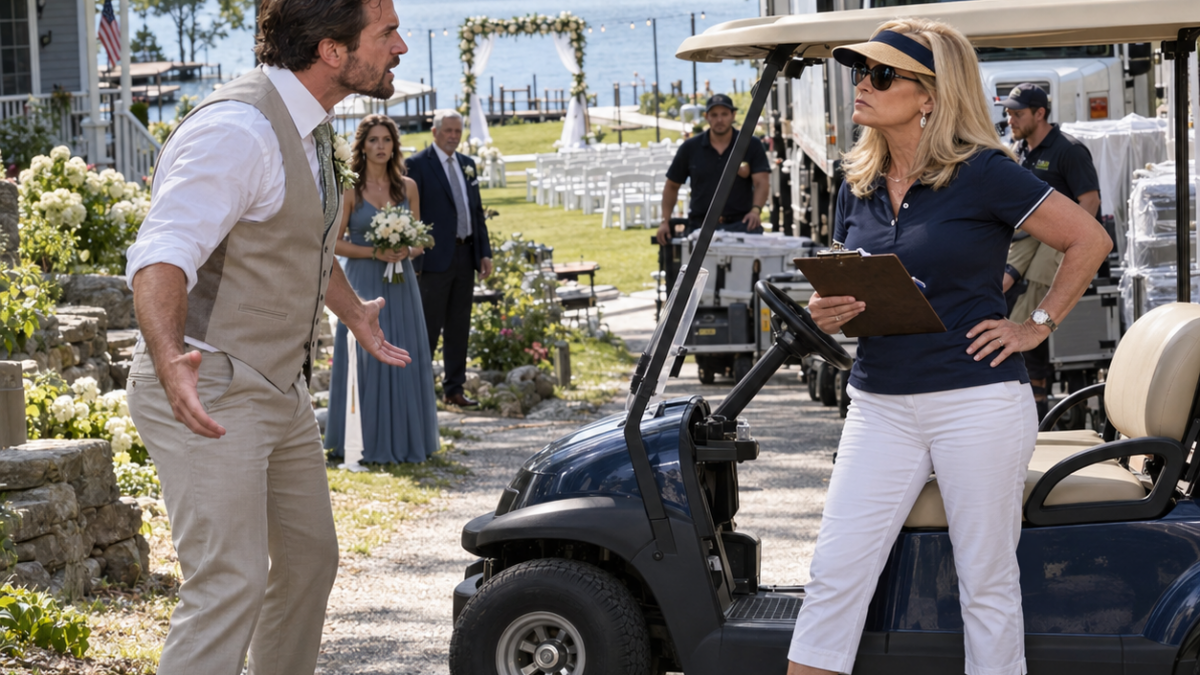
Karen had parked her golf cart sideways across the section of road my easement crossed before it turned into my driveway. She had set a folding lawn chair beside the cart, as if she had prepared for a siege. Clipboard in lap. Sunglasses on. HOA visor perfectly aligned. She looked like a crossing guard who had declared martial law.
“No trucks today,” she said before I even reached her.
“Move the cart, Karen.”
“We did not approve this event.”
“You don’t approve events on my property.”
“Our road cannot handle heavy vehicles.”
“The garbage truck uses this road every week.”
“That is a municipal service.”
“And this is a tent truck lighter than the garbage truck.”
“The board voted no.”
I looked at her.
“The board could vote to build a spaceship and it still wouldn’t make Mars part of your subdivision.”
Her lips tightened.
“You are violating community standards.”
“I am getting married.”
“You are disrupting residents.”
“You are blocking my recorded easement.”
She tapped her clipboard. “This road belongs to the HOA.”
“My right to cross it is recorded.”
“That doesn’t mean unlimited commercial access.”
“Vendors for a private event are ordinary and customary access.”
“You’re not a lawyer.”
“No,” I said. “But I can read.”
She did not move.
So I called the sheriff’s non-emergency line and explained that someone was blocking my recorded easement on my wedding day.
A deputy arrived quickly, probably because the dispatcher heard the phrase wedding day and decided this would either be easy or spectacular.
Karen launched into her version first. She said I was throwing a commercial event on “their common lake,” using HOA roads without approval, creating a noise hazard, and refusing to follow community rules.
Then it was my turn.
I had a folder ready.
Of course I had a folder ready.
Deed. Survey. Easement. County permit email. Insurance certificate. Vendor instructions. Parking diagram. Portable toilet receipt. Noise ordinance printout.
I laid it all across the hood of my truck like a science fair project titled: Please Make Karen Stop.
“This is my wedding,” I said. “It is on my deeded parcel. I am not in the HOA. The vendors are using my recorded easement. Cars will park on my grass and side field. Music stops before quiet hours. We are not closing any public roads, using HOA common areas, or selling anything.”
Karen opened her mouth.
I looked at the deputy and said the four words Karen had spent a year trying not to hear.
“This is my private property.”
Something in her face changed.
It was not exactly fear.
More like her brain freezing because the performance had finally met someone in uniform looking at stamped documents. The bluff did not vanish, but it lost oxygen.
The deputy reviewed the paperwork with the calm patience of a man who had probably handled worse disputes over fence lines and lawn clippings.
Then he turned to Karen.
“Ma’am, a recorded easement is a real property interest. You cannot block it.”
“But the road—”
“He has legal access.”
“Our rules—”
“He is not in your HOA.”
“The board—”
“Cannot override a recorded easement.”
Karen’s face went red.
The deputy gestured toward the golf cart.
“Please move it.”
She huffed, muttered something about a lawsuit, folded her chair with unnecessary violence, and moved the cart.
The deputy turned back to me.
“Congratulations, by the way.”
“Thank you.”
“I have to say this for the record. Keep your guests and vendors on your property and your easement. Don’t block the road. Don’t use common areas. Keep the sound within the ordinance. If anyone crosses property lines, it turns into a civil mess I don’t want to referee.”
“Absolutely,” I said. “We’ll keep everyone on my side.”
That sentence was where the malicious compliance began.
Because here was the thing.
For years, HOA residents had been using a narrow footpath that crossed the very edge of my land to reach what they called their community beach. Calling it a beach was generous. It was about twenty feet of rocky shoreline where people set kayaks and folding chairs. The subdivision plat showed their property line clearly, and their “beach” was partly on their side and partly on mine. Depending on lake level, some of their dock pilings sat in an area my surveyor had told me fell within my riparian rights.
I had never made it an issue.
Life is short. Nobody had been harming anything. People walked the path, waved, put kayaks in, watched sunsets. I did not want to become the villain of some neighborhood Facebook group.
But the deputy had told me to keep everyone on my property.
And Karen had threatened to call law enforcement if anyone so much as breathed wrong near her imagined jurisdiction.
Fine.
We would make the property line impossible to misunderstand.
I walked back down to the yard, found the tent crew leader and my cousin Ray, who worked construction, and said, “We’re putting up temporary fencing along the line.”
Ray grinned.
“How petty are we being?”
“Legally petty.”
“My favorite kind.”
I had the boundaries staked already from measuring for the tent. I also had a roll of bright orange construction fencing and T-posts because I had dealt with contractors before and liked keeping things obvious.
We strung the fencing right along the surveyed property line from the driveway down toward the water, including straight across the little footpath the HOA residents used. We zip-tied PRIVATE EVENT and PRIVATE PROPERTY signs every twenty feet. Along the shallow water, we placed a line of small buoys with rope following the bearing my surveyor had marked toward the ordinary high-water line.
Was it petty?
Yes.
Was it exactly what the deputy told me to do?
Also yes.
Did it ensure no wedding guest could accidentally be accused of using HOA common areas?
Absolutely.
Did it cut off the HOA shortcut to their beloved “beach”?
Beautifully.
The caterer then showed me where they planned to stage the smoker trailer and generator. Their original spot was fine, but after Karen’s nonsense, I had them shift ten feet inward so both sat clearly inside my line. The generator was a quiet inverter unit with a baffle. The smoker was legal, permitted, and not operating during the ceremony. But after an email saying no vendors could stage on HOA roads, I wanted any deputy, judge, surveyor, or bored county intern to look at photos and say, “Yes, everything is on OP’s land.”
The ceremony happened.
And despite Karen, or maybe partly because of surviving Karen, it was perfect.
My partner cried. I cried. My mother cried enough for several additional people. The dog shook himself dry at the worst possible moment and sprayed lake water on my pants. Everyone laughed. The breeze lifted the edge of the arch fabric at exactly the right time. The speaker worked. The barbecue smelled like smoke, brown sugar, and happiness.
For a little while, I forgot the golf cart, the clipboard, and the orange fence.
Then, thirty minutes into the reception, a patrol car rolled up with lights.
No siren.
Just lights.
The kind of arrival that says, Someone complained and now everyone gets to be awkward.
A different deputy walked into the yard and found me near the food table.
“Who’s the property owner?”
“I am.”
Behind him, near the road, I saw Karen.
She stood with one hand lifted like a stage manager directing actors. She had printed papers tucked under her arm, and I swear she was holding her phone with a decibel meter app open.
The deputy explained there had been a complaint about amplified music, trespassing on HOA common areas, and unauthorized use of shared lakefront.
I pointed at the orange fence.
“Everything is on my parcel. I installed a physical barrier after the previous deputy told me to keep everyone on my property. The speaker is pointed toward my house. Music is below the decibel limit. We are stopping before quiet hours. Guests are not using HOA common areas.”
He asked if he could walk the line.
“Gladly.”
We walked together. He saw the stakes. He saw the fence. He saw the buoys. He saw the footpath blocked. He saw a cluster of HOA residents standing on their side with kayaks, looking confused and offended that a shortcut they had taken for years had suddenly turned into a bright orange boundary lesson.
He also saw the dock pilings and the awkward way their so-called beach did not fit neatly onto their side.
“Looks like you did your homework,” he said.
“My grandfather raised me right.”
He walked over to Karen.
I stayed near enough to hear.
“Ma’am,” he said, “this is a civil matter. They’re on their property. They have a right to put up a temporary barrier to keep their guests on their property. Noise is within ordinance. If you don’t want their guests crossing HOA common areas, they’ve solved that for you.”
Karen started sputtering about beach rights.
“If the HOA has a recorded easement across his land, produce it,” the deputy said. “If there isn’t one, then using a path out of habit is not the same as having a right to it.”
Karen’s mouth opened and closed.
For once, nothing useful came out.
The deputy returned to me.
“Keep it inside the fence, keep the road clear, and enjoy your evening.”
So we did.
Somehow, knowing Karen had called the sheriff and been told to back off made the party better. People smiled bigger. The ribs tasted smokier. The lake looked like it had decided to show off. Every time I glanced toward the road, I saw HOA residents standing on their side like children locked out of a treehouse they had assumed belonged to them.
By sunset, guests were dancing softly on the lawn, string lights glowing overhead, and my partner leaned into me and whispered, “Best wedding drama ever.”
“Give it time,” I said.
Because the fence was only the beginning.
Remember those dock pilings?
A month before the wedding, while measuring for the tent, I had emailed the county shoreline management office to ask where the ordinary high-water mark fell for temporary event stakes. I included my survey. The officer had responded with a map and a note explaining that dock structures require permits and must be located within the riparian area associated with the upland parcel.
At the time, I ignored the dock comment.
I was not trying to be that guy.
After Karen tried to weaponize law enforcement on my wedding day, I became extremely interested in being that guy, but politely.
After the reception ended, after guests left, after grandparents were sent home with leftover coleslaw and my new spouse had fallen asleep sitting upright in a chair, I downloaded the photos I had taken.
Fence line.
Buoys.
Survey stakes.
The dock.
The shed near the HOA’s beach.
The kayak cluster.
The patrol car incident number.
Then I wrote the shoreline officer a calm email.
Thank you again for your earlier guidance regarding the ordinary high-water mark. For my own understanding and compliance, could you confirm whether the dock pictured here appears to be within the riparian area of the parcel to which it is attached? My survey suggests the pilings may not be entirely within that projected shoreline area.
I copied the HOA’s generic email address.
Because I am generous.
Three days later, the shoreline office replied.
Based on the survey provided and GIS overlays, the dock pilings shown appear to encroach outside the riparian area associated with the HOA parcel, and our records do not reflect an active dock permit for that structure. We will open a case and coordinate with the property owner and HOA.
They copied code enforcement.
I did not attach confetti to my response.
But I wanted to.
The next two weeks were a lesson in cause and effect.
The county inspector came out with a clipboard—the useful kind—and walked the shoreline with measuring equipment. He knocked on my door and asked if I would show him the survey stakes. I did. He took photos. Then he went over to the HOA clubhouse and took more photos.
Later that week, a notice appeared on the HOA board.
NOTICE OF VIOLATION: UNPERMITTED SHORELINE STRUCTURE.
It turned out the dock was not the only issue.
The HOA had also built a small storage shed near the beach for paddles, life jackets, and kayak equipment. It had been there so long nobody thought to question it. Unfortunately for them, part of it sat about three feet onto my land.
Apparently, when you wake the county bear with photos, maps, and a wedding-day incident number, the bear starts reading everything.
The notice required the HOA either to remove the dock or apply for a permit and reconfigure it within their riparian area. The shed had to be moved entirely onto HOA land, demolished, or covered by an easement from me with compensation and recording.
There were potential daily fines for noncompliance.
The HOA, suddenly polite, emailed me.
Not Karen.
The actual HOA president.
He asked whether I would consider a boundary adjustment or easement for the shed.
If they had been decent from the beginning, I probably would have granted a narrow easement for a token amount. I had lived with the shed for years. It had not hurt me.
But after Karen blocked my wedding vendors, called the sheriff twice, and turned my ceremony day into a property-law seminar, I found myself deeply committed to rules.
I replied that I would consider a short-term revocable license allowing access while they moved the shed. I would not grant an easement. I would not agree to a boundary adjustment.
They wrote back that the shed had stood without issue for years.
I responded with the deputy’s words:
Please keep your guests and belongings on your property.
Then, because I had learned from the best, I attached a screenshot from their own CC&Rs stating that no structure may encroach on adjacent property.
If they wanted to be rule people, we could be rule people.
Someone floated the idea that the footpath across my land had become a prescriptive easement because residents had used it for years.
That is one of those legal phrases people learn online and then use like a magic wand. Prescriptive easements are not automatic. They require strict elements. Open, notorious, continuous, hostile use for the full statutory period, and usually a court fight to prove it. Permission destroys the hostile element.
And my grandparents, bless them, had documented permission.
I had old notes from my grandfather to prior HOA presidents asking residents to stay on their side when the kids were fishing and making clear that access over our land was being allowed as a courtesy. Courtesy is not surrender. Tolerance is not title. Kindness is not a deed.
Meanwhile, the HOA’s internal drama went nuclear.
I did not attend their emergency board meeting because I value my blood pressure, but neighbors talk. One resident who was normal and not on the board told my partner that the neighborhood Facebook group had turned into a battlefield.
Half the comments were furious that we had fenced off “their” beach path.
The other half were asking why Karen had tried to shut down someone’s wedding on land the HOA did not own.
Someone posted a screenshot of the deputy’s comment about easements. Someone else posted a photo of the county violation notice. The phrase “maybe we should have checked the property lines before calling 911” apparently became the comment that launched forty-seven replies.
At the emergency meeting, Karen tried to double down. She wanted the HOA to assert beach access rights in court.
One of the other board members, who was an actual attorney, reportedly told her that filing a claim they could not win just to bully a neighbor was a good way to create liability for the association and possibly for the board personally.
Then he said, according to my source, “This all started because someone couldn’t resist playing cop on a day that wasn’t about her.”
I may have made that quote my phone wallpaper for a week.
A few days later, the HOA president emailed me a formal letter.
Congratulations on your marriage. On behalf of the board, we regret any interruptions that occurred. We would like to resolve the shoreline compliance items with the county in a cooperative manner.
It was not a full apology, but it was a start.
He asked if county staff could access my lot for measurements. I said yes because I wanted everything documented in triplicate and because, unlike Karen, I was not trying to make the situation harder just for sport.
The county issued official orders.
The dock had to be removed and reinstalled within the HOA’s riparian lines if they wanted to keep it. The shed had to be moved entirely onto their property or demolished. The footpath across my property was not recognized as an access right. If they wanted an easement, they could ask. I did not have to agree.
I did not agree.
The insurer eventually contacted me because moving docks and sheds costs money, and apparently insurers prefer resolving things before angry lakefront property owners start using phrases like quiet enjoyment and documented interference.
The insurer asked me to sign a temporary access agreement so contractors could come onto my parcel to dismantle and move the shed.
They also asked whether I had any claims related to interference with my wedding day.
I had not planned to sue.
I did, however, have receipts.
Extra fencing. T-posts. Signs. Extra labor paid to my cousin and the tent crew because Karen delayed setup and forced us to install the barrier quickly. Caterer overtime from the roadblock delay. Rental of a small backup generator after we moved staging locations. I attached the deputy’s incident number and wrote a factual summary.
I am not seeking damages for emotional stress on my wedding day. I am seeking reimbursement for out-of-pocket costs incurred directly due to your insured’s attempt to interfere with my private event and the subsequent need to comply with law enforcement instruction to keep all guests and vendors on my parcel.
Two weeks later, a check arrived.
It was not life-changing money.
But it paid for a very nice weekend trip my spouse and I took as a second mini-moon. More importantly, it was a piece of paper from the HOA’s insurer that effectively said: yes, our insured caused this problem.
The shed came down first.
It was more expensive for them than expected because they had to hire contractors, patch the ground, replant the disturbed area, and pour a small pad on their own side that complied with setback requirements.
The dock was worse.
They had to apply for proper permits, hire a marine contractor, and pull the pilings. Because of timing and seasonal lake restrictions related to fish spawning habitat, the county required the dock to be removed entirely for a while before work could happen. For most of that summer, the HOA had no dock.
Residents had to carry kayaks over their rocky shoreline instead of strolling down the gentle slope across my land.
Was that inconvenient?
Yes.
Was it my problem?
No.
Karen did not survive the fallout.
The board held a recall vote. I did not attend because, again, not my circus and technically not my HOA. But the grapevine reported that the vote passed easily. Karen was removed from the board. I stopped seeing her golf cart parked like a checkpoint near my driveway. The clipboard disappeared from my line of sight.
A few months later, a FOR SALE BY OWNER sign appeared in her yard.
The listing, I was told, optimistically mentioned “lake access.”
That made me laugh harder than it probably should have.
To be fair, the property did have access to the lake on the HOA side.
Just not through me.
Eventually, the HOA president came by in person.
Not with a clipboard. Not with demands. Just himself, wearing jeans and looking embarrassed.
“I owe you an apology,” he said.
I leaned against the porch railing.
“I’m listening.”
“I should have shut Karen down before it got that far. You’re not in our HOA. You’re not our problem. We made you our problem.”
That was the first honest thing anyone from the board had said to me.
“I appreciate that,” I said.
He looked toward the lake, where the orange fence was gone but the property line was now very much understood.
“We don’t want to be enemies.”
“Neither do I.”
“Would you ever consider reopening the footpath?”
“No.”
He nodded slowly, like he had expected that.
“Fair.”
I softened a little.
“Look, I didn’t fence it because I hate your residents. I fenced it because your board member repeatedly threatened me, blocked my vendors, called law enforcement on my wedding, and then a deputy told me to keep everyone on my property. If you don’t want fences, don’t create situations that require fences.”
He nodded again.
“You’re right.”
That mattered.
Not enough to reopen the path.
But enough to move forward without hostility.
These days, things are calmer.
The dock eventually got rebuilt, smaller and properly permitted, entirely within the HOA’s side. The shed is gone. The path remains closed. Some residents still give me sour looks when they carry kayaks over rocks, but most are fine. A few have even apologized in passing, usually in that awkward way people do when they were not personally responsible but benefited from the behavior for years.
Karen moved away before winter.
I heard she tried to tell buyers the neighborhood was hostile and that I had “stolen beach access.” Unfortunately for her, survey maps are less emotional than she is.
My spouse and I still live in the lake house.
The wedding photos are beautiful.
In some of them, if you look carefully, you can see a bright orange construction fence in the background. At first, I was annoyed by it. Then I grew fond of it. Now it makes me laugh.
There is one photo in particular that I love.
We are standing by the water, holding hands, wind lifting the edge of my partner’s veil. The lake is silver behind us. The dog is sitting proudly at our feet in his bow tie. And far in the background, just barely visible, is a line of orange fencing marking exactly where my patience ended.
I framed that one.
Because, to me, it tells the whole story.
Karen thought ownership was a feeling.
She felt entitled to the road, the lake, the view, the path, the beach, and the power to approve or deny joy happening near her.
My grandfather knew better.
Ownership is not a feeling.
It is paper, boundaries, signatures, recorded easements, surveys, maps, permits, and sometimes a deputy standing beside your wedding tent telling an HOA board member to move her golf cart.
Karen wanted to ruin my wedding.
Instead, she gave me a reason to protect every inch of what my grandparents left behind.
She wanted everyone kept off “her” common areas.
So I kept everyone on my property.
Exactly on my property.
Painfully, brightly, legally on my property.
And once everyone could see the line, they discovered the truth Karen had spent years ignoring.
A lot of what she thought was hers had only ever existed because my family had been kind enough not to make an issue of it.
Kindness ended at the golf cart.
The marriage began at the water.
And the HOA learned, finally, that a clipboard is not a deed.
𝗧𝗛𝗘 𝗘𝗡𝗗
Karen Called 911 to Stop My Lake Wedding, Then Learned the Beach She Loved Was on My Property
Karen came to my wedding with a clipboard, a golf cart, and the confidence of a woman who thought she could turn my private lakefront yard into HOA territory.
She called the sheriff right as my family was gathering by the water, convinced she had finally cornered me.
Then I said four words that changed everything: this is my property.
I own a small lakefront house that used to belong to my grandparents.
It sits on a little peninsula, tucked between a shallow cove on one side and open water on the other. It is not grand or flashy. The siding needs washing every spring, the porch boards complain when the weather shifts, and the kitchen cabinets still have the stubborn old hinges my grandmother insisted were “perfectly fine” for thirty years. But the place has a kind of soul that newer houses never quite manage to fake.
My grandfather built the dock with two friends and a cooler full of beer sometime in the seventies. My grandmother planted the hydrangeas near the side steps. There is a maple tree by the driveway with a scar down one side from the time my dad backed a boat trailer into it when he was sixteen. Every inch of that place holds some family memory, even the inconvenient ones.
So when I inherited it and eventually moved in full-time, it felt less like buying a house and more like stepping into a story that had been waiting for me.
The house predates the subdivision next door by decades.
That detail matters.
When the developer built the subdivision years after my grandparents were already there, the neighborhood wrapped around the back of our parcel like a horseshoe. The developer needed access arrangements, signatures, and recorded easements to make the roads work, so my grandparents had everything documented. My driveway crosses a short section of the subdivision road by recorded easement. My land, including the strip that runs down to the water, is not part of the HOA. My deed says so plainly. It even references the easement language by book and page number.
I knew this because my grandfather was the kind of man who kept paperwork in labeled folders and believed every handshake should eventually become a document.
The HOA did not seem to know it.
Or maybe they knew and hoped I didn’t.
Most of the residents were fine. Some were friendly. They waved from golf carts, asked about fishing, and occasionally chatted with me at the mailbox. A few seemed to think the lake was their personal backdrop, but it was harmless enough most of the time. They used the little rocky shoreline near their clubhouse, set kayaks down near the water, and sometimes wandered close to my side without realizing where the line actually ran.
I was not looking for a fight.
Then Karen found me.
She was on the HOA board, and she introduced herself during my first week living there full-time. I was unloading lumber from my truck when a golf cart rolled to a stop at the end of my driveway. Karen stepped out wearing white capri pants, a fitted navy polo with the HOA logo embroidered over the chest, oversized sunglasses, and a visor that somehow made her look more threatening than ridiculous.
She had a clipboard.
Of course she had a clipboard.
Karen was probably in her late forties, maybe early fifties, with the polished, athletic look of a woman who measured her self-worth in tennis wins, board votes, and how many people lowered their voices when she entered a room. Her blond hair was cut to her shoulders and curled under perfectly. Her smile was bright, practiced, and completely empty.
She did not wave.
She did not introduce herself properly.
She looked at my trailer, then at my boat, then at me.
“We like things tidy on this road,” she said.
I set down the lumber.
“Good morning.”
“Your trailer needs to be screened from road view, and boats cannot be stored outside.”
I stared at her.
“Excuse me?”
She tapped the clipboard with her pen. “HOA rules. I can email you the relevant sections.”
“I’m not in the HOA.”
Her smile tightened a fraction.
“Everyone who uses our roads follows our rules.”
“My driveway crosses the road by recorded easement. My property is not part of the subdivision.”
Karen gave a soft little laugh, as if I had made a charming but incorrect attempt at legal language.
“We’ll see.”
Part 2
That was the beginning.
Over the next year, Karen tested every angle she could find.
She left “friendly reminders” on my mailbox that looked suspiciously like violation notices. She emailed me architectural guidelines after seeing me buy deck stain at the hardware store, copying half the board and highlighting approved colors as if my porch boards were a matter of public concern. She parked her golf cart at the corner whenever I had contractors over and filmed their vans like she had uncovered a smuggling operation instead of a plumber replacing a water heater.
Every time she demanded something, I responded with documents.
Deed.
Survey.
Recorded easement.
Subdivision boundary.
County parcel map.
I became very good at attaching PDFs.
Every time, she backed off just enough to avoid looking foolish officially, then returned from another direction a week or two later. She reminded me of a raccoon with lipstick: clever, persistent, and always trying to get into something that was not hers.
When my partner and I got engaged, we knew immediately where we wanted to get married.
Not a ballroom. Not a hotel. Not some event venue with chandeliers and a coordinator named Madison who charged extra for chairs.
We wanted the lake.
Chairs on the lawn. A simple arch by the water. A barbecue caterer. String lights. A tent in case it rained. Music from a Bluetooth speaker. Our dog in a bow tie, assuming he did not eat it before the ceremony.
It was going to be small, personal, and ours.
Because I am not reckless, I did my homework.
I called the county zoning office. I confirmed that private events under a certain guest count on private property did not require a special event permit unless we were closing a public road, selling alcohol, or bringing in a stage. We were doing none of that. I confirmed the noise ordinance. Amplified music had to stay under the decibel limit after a certain hour, and our plan stopped music well before then anyway.
I rented enough portable toilets for our guest count so nobody had to wander through the house. I bought one-day event insurance through my homeowners carrier. I arranged parking entirely on my side field. I told vendors to use my driveway and easement only. I emailed the reasonable nearby neighbors a week in advance with a friendly note explaining the event, guest count, parking plan, and music cutoff time.
I did not email the HOA board.
They were not hosting.
They were not invited as a governing body.
And they were definitely not in charge.
Five days before the wedding, Karen emailed me.
The subject line read: EVENT APPROVAL NEEDED.
She copied the entire board.
Per architectural review, any gathering of more than twenty vehicles using our private road requires prior board approval. Please provide guest list, vendor list, insurance proof, proposed parking diagram, and music plan. No amplified music allowed lakeside.
Attached were the HOA’s CC&Rs.
I stared at the email for a long time.
Then I replied with one sentence.
I am not a member of your HOA, and my event is on my private property; your CC&Rs do not apply.
Then, because my grandfather’s spirit would have haunted me if I didn’t, I attached the deed, the survey showing the subdivision boundary, the recorded easement, and the county email confirming no permit was required.
I added, briefly, that all vendors would use my easement, all parking would be on my parcel, and all noise ordinances would be followed.
Karen responded within six minutes.
We will be monitoring and will call the sheriff if there are violations.
I wrote back:
Please feel free to call the sheriff if you witness anything illegal.
I thought that would be the end of it.
That was adorable of me.
The wedding day arrived bright, warm, and impossibly beautiful.
The lake shimmered under a clean blue sky. A breeze moved through the trees just enough to keep the bugs down. My partner looked so good I forgot three separate things I was supposed to be doing. Our families were, miraculously, getting along. The dog accepted his bow tie with the solemn dignity of a creature who had been bribed with cheese.
Vendors started arriving in the morning.
Tent crew. Caterer. Photographer. Florist. A cousin with enough extension cords to power a minor festival. Everything was on schedule.
Then, about an hour before the ceremony, the tent crew leader knocked on my door.
“There’s a lady blocking the road with a golf cart,” he said. “She says we can’t bring the truck through.”
I closed my eyes for one second.
Just one.
Then I walked up the driveway.
There she was.
Karen had parked her golf cart sideways across the section of road my easement crossed before it turned into my driveway. She had set a folding lawn chair beside the cart, as if she had prepared for a siege. Clipboard in lap. Sunglasses on. HOA visor perfectly aligned. She looked like a crossing guard who had declared martial law.
“No trucks today,” she said before I even reached her.
“Move the cart, Karen.”
“We did not approve this event.”
“You don’t approve events on my property.”
“Our road cannot handle heavy vehicles.”
“The garbage truck uses this road every week.”
“That is a municipal service.”
“And this is a tent truck lighter than the garbage truck.”
“The board voted no.”
I looked at her.
“The board could vote to build a spaceship and it still wouldn’t make Mars part of your subdivision.”
Her lips tightened.
“You are violating community standards.”
“I am getting married.”
“You are disrupting residents.”
“You are blocking my recorded easement.”
She tapped her clipboard. “This road belongs to the HOA.”
“My right to cross it is recorded.”
“That doesn’t mean unlimited commercial access.”
“Vendors for a private event are ordinary and customary access.”
“You’re not a lawyer.”
“No,” I said. “But I can read.”
She did not move.
So I called the sheriff’s non-emergency line and explained that someone was blocking my recorded easement on my wedding day.
A deputy arrived quickly, probably because the dispatcher heard the phrase wedding day and decided this would either be easy or spectacular.
Karen launched into her version first. She said I was throwing a commercial event on “their common lake,” using HOA roads without approval, creating a noise hazard, and refusing to follow community rules.
Then it was my turn.
I had a folder ready.
Of course I had a folder ready.
Deed. Survey. Easement. County permit email. Insurance certificate. Vendor instructions. Parking diagram. Portable toilet receipt. Noise ordinance printout.
I laid it all across the hood of my truck like a science fair project titled: Please Make Karen Stop.
“This is my wedding,” I said. “It is on my deeded parcel. I am not in the HOA. The vendors are using my recorded easement. Cars will park on my grass and side field. Music stops before quiet hours. We are not closing any public roads, using HOA common areas, or selling anything.”
Karen opened her mouth.
I looked at the deputy and said the four words Karen had spent a year trying not to hear.
“This is my private property.”
Something in her face changed.
It was not exactly fear.
More like her brain freezing because the performance had finally met someone in uniform looking at stamped documents. The bluff did not vanish, but it lost oxygen.
The deputy reviewed the paperwork with the calm patience of a man who had probably handled worse disputes over fence lines and lawn clippings.
Then he turned to Karen.
“Ma’am, a recorded easement is a real property interest. You cannot block it.”
“But the road—”
“He has legal access.”
“Our rules—”
“He is not in your HOA.”
“The board—”
“Cannot override a recorded easement.”
Karen’s face went red.
The deputy gestured toward the golf cart.
“Please move it.”
She huffed, muttered something about a lawsuit, folded her chair with unnecessary violence, and moved the cart.
The deputy turned back to me.
“Congratulations, by the way.”
“Thank you.”
“I have to say this for the record. Keep your guests and vendors on your property and your easement. Don’t block the road. Don’t use common areas. Keep the sound within the ordinance. If anyone crosses property lines, it turns into a civil mess I don’t want to referee.”
“Absolutely,” I said. “We’ll keep everyone on my side.”
That sentence was where the malicious compliance began.
Because here was the thing.
For years, HOA residents had been using a narrow footpath that crossed the very edge of my land to reach what they called their community beach. Calling it a beach was generous. It was about twenty feet of rocky shoreline where people set kayaks and folding chairs. The subdivision plat showed their property line clearly, and their “beach” was partly on their side and partly on mine. Depending on lake level, some of their dock pilings sat in an area my surveyor had told me fell within my riparian rights.
I had never made it an issue.
Life is short. Nobody had been harming anything. People walked the path, waved, put kayaks in, watched sunsets. I did not want to become the villain of some neighborhood Facebook group.
But the deputy had told me to keep everyone on my property.
And Karen had threatened to call law enforcement if anyone so much as breathed wrong near her imagined jurisdiction.
Fine.
We would make the property line impossible to misunderstand.
I walked back down to the yard, found the tent crew leader and my cousin Ray, who worked construction, and said, “We’re putting up temporary fencing along the line.”
Ray grinned.
“How petty are we being?”
“Legally petty.”
“My favorite kind.”
I had the boundaries staked already from measuring for the tent. I also had a roll of bright orange construction fencing and T-posts because I had dealt with contractors before and liked keeping things obvious.
We strung the fencing right along the surveyed property line from the driveway down toward the water, including straight across the little footpath the HOA residents used. We zip-tied PRIVATE EVENT and PRIVATE PROPERTY signs every twenty feet. Along the shallow water, we placed a line of small buoys with rope following the bearing my surveyor had marked toward the ordinary high-water line.
Was it petty?
Yes.
Was it exactly what the deputy told me to do?
Also yes.
Did it ensure no wedding guest could accidentally be accused of using HOA common areas?
Absolutely.
Did it cut off the HOA shortcut to their beloved “beach”?
Beautifully.
The caterer then showed me where they planned to stage the smoker trailer and generator. Their original spot was fine, but after Karen’s nonsense, I had them shift ten feet inward so both sat clearly inside my line. The generator was a quiet inverter unit with a baffle. The smoker was legal, permitted, and not operating during the ceremony. But after an email saying no vendors could stage on HOA roads, I wanted any deputy, judge, surveyor, or bored county intern to look at photos and say, “Yes, everything is on OP’s land.”
The ceremony happened.
And despite Karen, or maybe partly because of surviving Karen, it was perfect.
My partner cried. I cried. My mother cried enough for several additional people. The dog shook himself dry at the worst possible moment and sprayed lake water on my pants. Everyone laughed. The breeze lifted the edge of the arch fabric at exactly the right time. The speaker worked. The barbecue smelled like smoke, brown sugar, and happiness.
For a little while, I forgot the golf cart, the clipboard, and the orange fence.
Then, thirty minutes into the reception, a patrol car rolled up with lights.
No siren.
Just lights.
The kind of arrival that says, Someone complained and now everyone gets to be awkward.
A different deputy walked into the yard and found me near the food table.
“Who’s the property owner?”
“I am.”
Behind him, near the road, I saw Karen.
She stood with one hand lifted like a stage manager directing actors. She had printed papers tucked under her arm, and I swear she was holding her phone with a decibel meter app open.
The deputy explained there had been a complaint about amplified music, trespassing on HOA common areas, and unauthorized use of shared lakefront.
I pointed at the orange fence.
“Everything is on my parcel. I installed a physical barrier after the previous deputy told me to keep everyone on my property. The speaker is pointed toward my house. Music is below the decibel limit. We are stopping before quiet hours. Guests are not using HOA common areas.”
He asked if he could walk the line.
“Gladly.”
We walked together. He saw the stakes. He saw the fence. He saw the buoys. He saw the footpath blocked. He saw a cluster of HOA residents standing on their side with kayaks, looking confused and offended that a shortcut they had taken for years had suddenly turned into a bright orange boundary lesson.
He also saw the dock pilings and the awkward way their so-called beach did not fit neatly onto their side.
“Looks like you did your homework,” he said.
“My grandfather raised me right.”
He walked over to Karen.
I stayed near enough to hear.
“Ma’am,” he said, “this is a civil matter. They’re on their property. They have a right to put up a temporary barrier to keep their guests on their property. Noise is within ordinance. If you don’t want their guests crossing HOA common areas, they’ve solved that for you.”
Karen started sputtering about beach rights.
“If the HOA has a recorded easement across his land, produce it,” the deputy said. “If there isn’t one, then using a path out of habit is not the same as having a right to it.”
Karen’s mouth opened and closed.
For once, nothing useful came out.
The deputy returned to me.
“Keep it inside the fence, keep the road clear, and enjoy your evening.”
So we did.
Somehow, knowing Karen had called the sheriff and been told to back off made the party better. People smiled bigger. The ribs tasted smokier. The lake looked like it had decided to show off. Every time I glanced toward the road, I saw HOA residents standing on their side like children locked out of a treehouse they had assumed belonged to them.
By sunset, guests were dancing softly on the lawn, string lights glowing overhead, and my partner leaned into me and whispered, “Best wedding drama ever.”
“Give it time,” I said.
Because the fence was only the beginning.
Remember those dock pilings?
A month before the wedding, while measuring for the tent, I had emailed the county shoreline management office to ask where the ordinary high-water mark fell for temporary event stakes. I included my survey. The officer had responded with a map and a note explaining that dock structures require permits and must be located within the riparian area associated with the upland parcel.
At the time, I ignored the dock comment.
I was not trying to be that guy.
After Karen tried to weaponize law enforcement on my wedding day, I became extremely interested in being that guy, but politely.
After the reception ended, after guests left, after grandparents were sent home with leftover coleslaw and my new spouse had fallen asleep sitting upright in a chair, I downloaded the photos I had taken.
Fence line.
Buoys.
Survey stakes.
The dock.
The shed near the HOA’s beach.
The kayak cluster.
The patrol car incident number.
Then I wrote the shoreline officer a calm email.
Thank you again for your earlier guidance regarding the ordinary high-water mark. For my own understanding and compliance, could you confirm whether the dock pictured here appears to be within the riparian area of the parcel to which it is attached? My survey suggests the pilings may not be entirely within that projected shoreline area.
I copied the HOA’s generic email address.
Because I am generous.
Three days later, the shoreline office replied.
Based on the survey provided and GIS overlays, the dock pilings shown appear to encroach outside the riparian area associated with the HOA parcel, and our records do not reflect an active dock permit for that structure. We will open a case and coordinate with the property owner and HOA.
They copied code enforcement.
I did not attach confetti to my response.
But I wanted to.
The next two weeks were a lesson in cause and effect.
The county inspector came out with a clipboard—the useful kind—and walked the shoreline with measuring equipment. He knocked on my door and asked if I would show him the survey stakes. I did. He took photos. Then he went over to the HOA clubhouse and took more photos.
Later that week, a notice appeared on the HOA board.
NOTICE OF VIOLATION: UNPERMITTED SHORELINE STRUCTURE.
It turned out the dock was not the only issue.
The HOA had also built a small storage shed near the beach for paddles, life jackets, and kayak equipment. It had been there so long nobody thought to question it. Unfortunately for them, part of it sat about three feet onto my land.
Apparently, when you wake the county bear with photos, maps, and a wedding-day incident number, the bear starts reading everything.
The notice required the HOA either to remove the dock or apply for a permit and reconfigure it within their riparian area. The shed had to be moved entirely onto HOA land, demolished, or covered by an easement from me with compensation and recording.
There were potential daily fines for noncompliance.
The HOA, suddenly polite, emailed me.
Not Karen.
The actual HOA president.
He asked whether I would consider a boundary adjustment or easement for the shed.
If they had been decent from the beginning, I probably would have granted a narrow easement for a token amount. I had lived with the shed for years. It had not hurt me.
But after Karen blocked my wedding vendors, called the sheriff twice, and turned my ceremony day into a property-law seminar, I found myself deeply committed to rules.
I replied that I would consider a short-term revocable license allowing access while they moved the shed. I would not grant an easement. I would not agree to a boundary adjustment.
They wrote back that the shed had stood without issue for years.
I responded with the deputy’s words:
Please keep your guests and belongings on your property.
Then, because I had learned from the best, I attached a screenshot from their own CC&Rs stating that no structure may encroach on adjacent property.
If they wanted to be rule people, we could be rule people.
Someone floated the idea that the footpath across my land had become a prescriptive easement because residents had used it for years.
That is one of those legal phrases people learn online and then use like a magic wand. Prescriptive easements are not automatic. They require strict elements. Open, notorious, continuous, hostile use for the full statutory period, and usually a court fight to prove it. Permission destroys the hostile element.
And my grandparents, bless them, had documented permission.
I had old notes from my grandfather to prior HOA presidents asking residents to stay on their side when the kids were fishing and making clear that access over our land was being allowed as a courtesy. Courtesy is not surrender. Tolerance is not title. Kindness is not a deed.
Meanwhile, the HOA’s internal drama went nuclear.
I did not attend their emergency board meeting because I value my blood pressure, but neighbors talk. One resident who was normal and not on the board told my partner that the neighborhood Facebook group had turned into a battlefield.
Half the comments were furious that we had fenced off “their” beach path.
The other half were asking why Karen had tried to shut down someone’s wedding on land the HOA did not own.
Someone posted a screenshot of the deputy’s comment about easements. Someone else posted a photo of the county violation notice. The phrase “maybe we should have checked the property lines before calling 911” apparently became the comment that launched forty-seven replies.
At the emergency meeting, Karen tried to double down. She wanted the HOA to assert beach access rights in court.
One of the other board members, who was an actual attorney, reportedly told her that filing a claim they could not win just to bully a neighbor was a good way to create liability for the association and possibly for the board personally.
Then he said, according to my source, “This all started because someone couldn’t resist playing cop on a day that wasn’t about her.”
I may have made that quote my phone wallpaper for a week.
A few days later, the HOA president emailed me a formal letter.
Congratulations on your marriage. On behalf of the board, we regret any interruptions that occurred. We would like to resolve the shoreline compliance items with the county in a cooperative manner.
It was not a full apology, but it was a start.
He asked if county staff could access my lot for measurements. I said yes because I wanted everything documented in triplicate and because, unlike Karen, I was not trying to make the situation harder just for sport.
The county issued official orders.
The dock had to be removed and reinstalled within the HOA’s riparian lines if they wanted to keep it. The shed had to be moved entirely onto their property or demolished. The footpath across my property was not recognized as an access right. If they wanted an easement, they could ask. I did not have to agree.
I did not agree.
The insurer eventually contacted me because moving docks and sheds costs money, and apparently insurers prefer resolving things before angry lakefront property owners start using phrases like quiet enjoyment and documented interference.
The insurer asked me to sign a temporary access agreement so contractors could come onto my parcel to dismantle and move the shed.
They also asked whether I had any claims related to interference with my wedding day.
I had not planned to sue.
I did, however, have receipts.
Extra fencing. T-posts. Signs. Extra labor paid to my cousin and the tent crew because Karen delayed setup and forced us to install the barrier quickly. Caterer overtime from the roadblock delay. Rental of a small backup generator after we moved staging locations. I attached the deputy’s incident number and wrote a factual summary.
I am not seeking damages for emotional stress on my wedding day. I am seeking reimbursement for out-of-pocket costs incurred directly due to your insured’s attempt to interfere with my private event and the subsequent need to comply with law enforcement instruction to keep all guests and vendors on my parcel.
Two weeks later, a check arrived.
It was not life-changing money.
But it paid for a very nice weekend trip my spouse and I took as a second mini-moon. More importantly, it was a piece of paper from the HOA’s insurer that effectively said: yes, our insured caused this problem.
The shed came down first.
It was more expensive for them than expected because they had to hire contractors, patch the ground, replant the disturbed area, and pour a small pad on their own side that complied with setback requirements.
The dock was worse.
They had to apply for proper permits, hire a marine contractor, and pull the pilings. Because of timing and seasonal lake restrictions related to fish spawning habitat, the county required the dock to be removed entirely for a while before work could happen. For most of that summer, the HOA had no dock.
Residents had to carry kayaks over their rocky shoreline instead of strolling down the gentle slope across my land.
Was that inconvenient?
Yes.
Was it my problem?
No.
Karen did not survive the fallout.
The board held a recall vote. I did not attend because, again, not my circus and technically not my HOA. But the grapevine reported that the vote passed easily. Karen was removed from the board. I stopped seeing her golf cart parked like a checkpoint near my driveway. The clipboard disappeared from my line of sight.
A few months later, a FOR SALE BY OWNER sign appeared in her yard.
The listing, I was told, optimistically mentioned “lake access.”
That made me laugh harder than it probably should have.
To be fair, the property did have access to the lake on the HOA side.
Just not through me.
Eventually, the HOA president came by in person.
Not with a clipboard. Not with demands. Just himself, wearing jeans and looking embarrassed.
“I owe you an apology,” he said.
I leaned against the porch railing.
“I’m listening.”
“I should have shut Karen down before it got that far. You’re not in our HOA. You’re not our problem. We made you our problem.”
That was the first honest thing anyone from the board had said to me.
“I appreciate that,” I said.
He looked toward the lake, where the orange fence was gone but the property line was now very much understood.
“We don’t want to be enemies.”
“Neither do I.”
“Would you ever consider reopening the footpath?”
“No.”
He nodded slowly, like he had expected that.
“Fair.”
I softened a little.
“Look, I didn’t fence it because I hate your residents. I fenced it because your board member repeatedly threatened me, blocked my vendors, called law enforcement on my wedding, and then a deputy told me to keep everyone on my property. If you don’t want fences, don’t create situations that require fences.”
He nodded again.
“You’re right.”
That mattered.
Not enough to reopen the path.
But enough to move forward without hostility.
These days, things are calmer.
The dock eventually got rebuilt, smaller and properly permitted, entirely within the HOA’s side. The shed is gone. The path remains closed. Some residents still give me sour looks when they carry kayaks over rocks, but most are fine. A few have even apologized in passing, usually in that awkward way people do when they were not personally responsible but benefited from the behavior for years.
Karen moved away before winter.
I heard she tried to tell buyers the neighborhood was hostile and that I had “stolen beach access.” Unfortunately for her, survey maps are less emotional than she is.
My spouse and I still live in the lake house.
The wedding photos are beautiful.
In some of them, if you look carefully, you can see a bright orange construction fence in the background. At first, I was annoyed by it. Then I grew fond of it. Now it makes me laugh.
There is one photo in particular that I love.
We are standing by the water, holding hands, wind lifting the edge of my partner’s veil. The lake is silver behind us. The dog is sitting proudly at our feet in his bow tie. And far in the background, just barely visible, is a line of orange fencing marking exactly where my patience ended.
I framed that one.
Because, to me, it tells the whole story.
Karen thought ownership was a feeling.
She felt entitled to the road, the lake, the view, the path, the beach, and the power to approve or deny joy happening near her.
My grandfather knew better.
Ownership is not a feeling.
It is paper, boundaries, signatures, recorded easements, surveys, maps, permits, and sometimes a deputy standing beside your wedding tent telling an HOA board member to move her golf cart.
Karen wanted to ruin my wedding.
Instead, she gave me a reason to protect every inch of what my grandparents left behind.
She wanted everyone kept off “her” common areas.
So I kept everyone on my property.
Exactly on my property.
Painfully, brightly, legally on my property.
And once everyone could see the line, they discovered the truth Karen had spent years ignoring.
A lot of what she thought was hers had only ever existed because my family had been kind enough not to make an issue of it.
Kindness ended at the golf cart.
The marriage began at the water.
And the HOA learned, finally, that a clipboard is not a deed.