Karen Called 911 on My Grandpa for Fishing, Then the Whole Town Brought Their Rods
part2
Papa did not tell the story dramatically.
That is not his way.
He told it like he was discussing a flat tire or a stubborn gate latch. Small problem. Minor inconvenience. Nothing to fuss over.
But the more he talked, the angrier I got.
He had gone fishing that morning at his usual spot along the canal. He had his folding chair, tackle box, cooler, hat, and state fishing license in his wallet like always. There were a few other people along the bank—two men farther down, a father with a teenage son, and an older couple sitting beneath an umbrella.
Everything was normal until Karen showed up.
Karen is technically the president of Papa’s HOA.
I say technically because she behaves less like a president and more like a woman who watched one documentary about dictatorships and decided she liked the administrative possibilities. She is in her early sixties, always dressed like she is about to attend a brunch where someone will be judged, and she has a voice that can cut through drywall. She moved into the neighborhood several years back and somehow collected authority the way burrs collect on jeans.
Papa is part of the HOA because his small retirement house falls inside its boundary.
The canal does not.
That distinction mattered to everyone except Karen.
Papa said he was sitting there with his line in the water when he heard her before he saw her.
“Mr. Whitaker!”
He turned, hoping maybe there was another Mr. Whitaker behind him.
There was not.
Karen came marching down the path in white tennis shoes, pressed shorts, a bright coral blouse, and sunglasses large enough to hide whatever humanity might have been in her eyes. Her face was already tight with outrage, as if Papa had personally offended the clouds.
“You cannot fish here,” she snapped.
Papa looked around at the water, the bank, his own fishing pole, and the other people fishing nearby.
“Morning to you too,” he said.
“Do not get smart with me.”
“I was aiming for polite.”
She planted herself beside his chair.
“Fishing is not allowed under HOA standards.”
Papa blinked.
“This canal ain’t HOA property.”
“You are an HOA resident.”
“I am also a citizen of the state of Texas, last I checked.”
“That does not give you the right to violate community rules.”
Papa reached into his shirt pocket, pulled out his folded fishing license, and showed it to her.
“I’m licensed. This is public water. There’s no sign saying otherwise.”
Karen barely glanced at it.
“That is not the point.”
“It usually is when somebody says I’m breaking a fishing rule.”
She crossed her arms.
“You are disturbing the family-friendly atmosphere.”
Papa looked behind her at the father and son fishing thirty yards away.
“Seems pretty family-friendly to me.”
“You are scaring children.”
That one confused him enough that he actually laughed.
“Ma’am, I’ve been called a lot of things, but frightening ain’t often one of them.”
“You are an old man sitting here with hooks and dead bait. It’s disgusting.”
Papa stopped smiling.
That hurt him.
I could hear it in his voice when he told me.
He is not vain. He knows he is old. He jokes about it constantly. But there is a difference between teasing age and using it like a reason someone should disappear from public view.
He told her, still polite, “I’m not bothering anybody.”
“You are bothering me.”
“Then you are welcome to walk somewhere else.”
Karen’s mouth opened and closed like she could not believe he had offered such a reasonable solution without asking her permission first.
Then she began throwing rocks into the water.
Not skipping stones. Not tossing pebbles absentmindedly. Throwing rocks.
Splash after splash near his line.
The father with the teenage son stared. The older couple lowered their sunglasses. One of the men down the bank yelled, “Lady, what are you doing?”
Karen ignored them.
Papa reeled in his line before she could snag it on something.
“Now, why would you act like that?” he asked.
“I am stopping an illegal activity.”
“You’re scaring fish.”
“That is the idea.”
Papa said he tried to remain calm, but there is only so much foolishness a man can absorb before it starts leaking out his ears.
“Lady,” he told her, “I worked cattle longer than you’ve been bossing neighbors. I have been yelled at by bulls, bankers, drill sergeants, my late wife, and one sheriff with kidney stones. You are not the first person to raise your voice at me, and you will not be the one who makes me leave public land.”
Karen called the police.
She stood right there beside him and told 911 that an elderly man was illegally fishing, harassing her, refusing to leave, and creating a public disturbance.
Papa did not move.
“I figured if the police were coming,” he said, “I might as well let them come find me sitting still.”
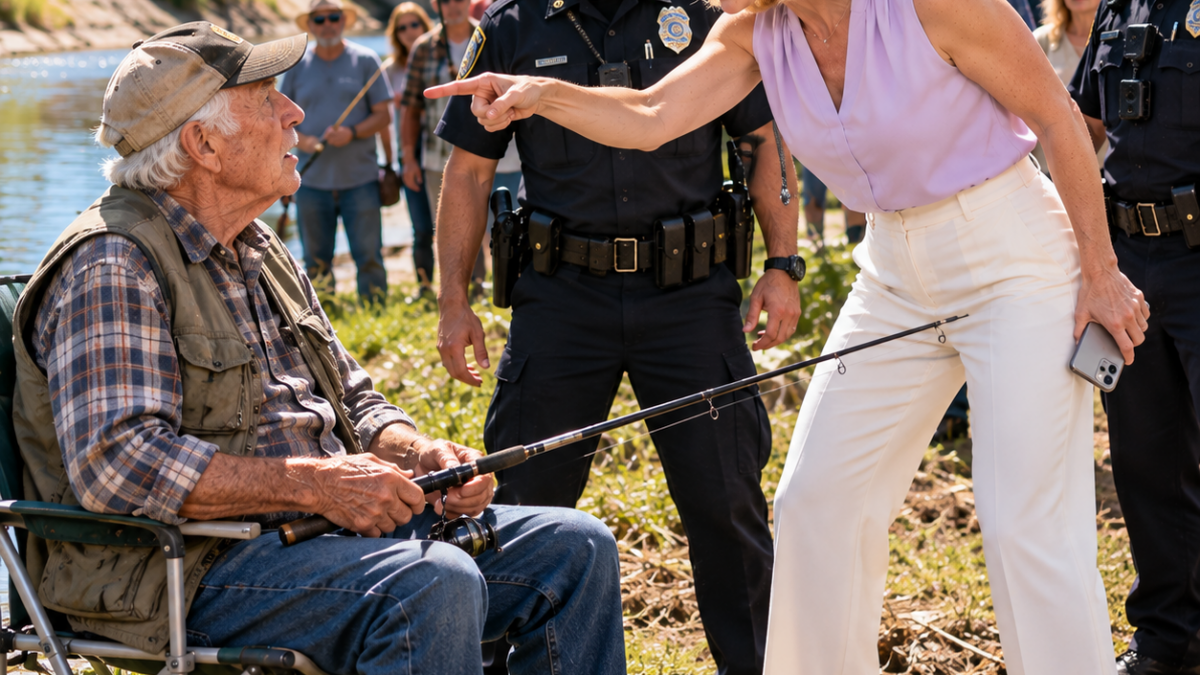
When officers arrived, Karen was still furious and Papa was still in his chair, though no longer fishing because she had ruined the spot. He showed the officers his license. The officers confirmed the canal was public. They told Karen there was no violation. They told Papa he was free to continue fishing.
Karen did not like that.
People like Karen do not experience correction as information.
They experience it as betrayal.
Papa came home embarrassed and angry, which is a miserable combination in a proud old man. He thought maybe it would end there.
It did not.
Two days later, he received an official-looking letter from the HOA.
He pulled it from his pocket and handed it to me there on the porch.
The paper was creased from being folded and unfolded too many times. HOA letterhead at the top. Karen’s name at the bottom. The letter informed him that fishing was hereby banned for HOA residents at the canal and that he was prohibited from continuing his “disruptive public activity.” It said the canal area should remain family-friendly and that nobody wanted to see “elderly individuals engaging in unsuitable outdoor behavior.” It suggested he find “indoor hobbies more appropriate to his stage of life.”
I read it once.
Then again.
By the end, I was shaking.
“Papa.”
He looked down at his hands.
“She can’t do that, right?”
“No. She absolutely cannot do that.”
“I didn’t think so.”
The fact that he sounded unsure made me want to drive to Karen’s house and introduce her to every curse word my mother taught me never to say.
Instead, I took a picture of the letter.
Then I took a breath.
Legal action felt premature. She had not fined him yet. She had not physically stopped him beyond the rock-throwing incident. But she had abused her position, lied about HOA authority, called the police on him, humiliated him, and made him question whether he was allowed to enjoy the last peaceful hobby age had left him.
Karen had power because she controlled the HOA narrative.
So we changed the audience.
Papa did not know much about the internet. His phone was mostly for calls, blurry photos of fish, and accidentally turning on the flashlight. But everybody in town knew him, and Facebook was still the fastest way to reach half of them before supper.
So I made him a page.
He objected at first.
“I don’t need one of them internet billboards.”
“You do now.”
“What am I supposed to put on it?”
“The truth.”
We chose a photo of him holding a largemouth bass from a few months earlier. He was smiling under his old tan hat, sun on his face, fish held proudly but gently. I wrote the first post with him sitting beside me, correcting details when I got too dramatic and adding “don’t call her names” when I absolutely wanted to call her names.
The post explained what happened.
That Papa had gone fishing at a public canal.
That he had a permit.
That Karen, HOA president, yelled at him, claimed fishing was against HOA rules, threw rocks in the water, called the police, and later sent a letter trying to ban him from public property.
Then Papa added one line himself.
I just want to know if folks really think an old man fishing quietly is hurting the community.
I posted it.
Then I added neighbors, family, church friends, old ranching contacts, the mayor, the sheriff’s office public page, the feed store, the barbecue place, and anyone else Papa recognized.
Within an hour, the comments started.
Within four, the post had spread everywhere.
By the next morning, everyone had seen it.
People were furious.
Not mildly annoyed.
Furious.
You do not mess with a beloved old man in a Texas town and expect silence. Especially not one who fixed half the county’s fences over the years, taught half its kids to bait hooks, and still donated catfish to church fish fries.
Comments poured in.
Papa, you fish wherever it’s legal.
Who does she think she is?
That canal is public.
She yelled at my mother last month for walking too slow near the clubhouse.
She told my dad he shouldn’t sit outside because it made the neighborhood look like a nursing home.
I saw her bother Mr. Whitaker before.
Report her to the board.
Somebody take Papa fishing.
The last comment caught my eye.
Then an idea formed.
But before we could act, Karen doubled down.
Because of course she did.
She scheduled an emergency HOA meeting to tell “the real story.”
Those were her words.
The real story.
Papa did not want to go at first.
“She already made enough fuss,” he said.
“Papa, she called a meeting about you.”
“I know.”
“So we’re going.”
He sighed.
“You get that stubborn from your grandma.”
“I know.”
The meeting was packed.
I mean standing-room-only packed. People who had not attended HOA meetings in years showed up. Some were HOA residents. Some were not. Some came because of Papa. Some came because Karen had apparently been bothering them too, and public anger gave them courage.
Karen sat at the front behind a folding table like a judge at a county fair no one wanted to attend.
She opened with a speech about order, community values, safety after the floods, and the importance of respecting HOA leadership during “emotionally sensitive times.”
Then she tried to explain why Papa fishing was offensive.
I wish I could say she made a coherent argument.
She did not.
Her main point seemed to be that because Texas had recently experienced flooding, an old man fishing in a canal was somehow mocking flood victims.
The room went silent.
Not respectful silent.
The kind of silence that happens when people collectively wonder if they heard something correctly.
A man in the back said, “What?”
Karen lifted her chin.
“Fishing in recently affected waterways sends an insensitive message.”
Papa leaned toward me and whispered, “What message?”
I whispered back, “That fish live in water?”
He had to cough into his hand to cover a laugh.
Karen continued digging.
She claimed the canal needed to remain a calm family space. She claimed older residents should avoid activities that could disturb children. She claimed public visibility mattered after a crisis. She claimed the HOA had a responsibility to promote appropriate conduct by its members.
Then people started talking.
Not one at a time.
Not politely.
Everyone.
A retired teacher said Karen had yelled at her for walking laps near the clubhouse because “frail people made the neighborhood look depressing.”
A man with a cane said Karen once told him benches were not for “loitering seniors.”
A woman said her father had stopped attending HOA events because Karen made comments about older people taking up space.
Story after story came out.
Papa sat beside me, looking smaller and angrier with each one.
He had never told me Karen had bothered him before. Not about walking. Not about sitting outside. Not about her telling him he should keep to his own property if he wanted “fresh air at his age.”
I looked at him.
He avoided my eyes.
That hurt too.
How many little humiliations had he swallowed because he did not want to trouble anyone?
At the end of the meeting, Karen slammed her hand on the table.
“If Mr. Whitaker fishes there again, I will call the police again.”
A few people actually laughed.
Not because it was funny.
Because it was so absurd there was nowhere else for the sound to go.
On the drive home, Papa was quiet again.
This time, I was not going to let quiet win.
“What are you thinking?” I asked.
He looked out the window at the dark road.
“I’m thinking I want to fish Friday.”
I smiled.
“Good.”
“And I’m thinking maybe I don’t want to fish alone.”
That was how the fishing derby was born.
Not official.
Not permitted.
Not organized in any fancy sense.
Just a plan made by an old man, his granddaughter, a few retired friends, and the kind of community that understands when a line has been crossed.
We had one day.
Thursday morning, I posted from Papa’s page:
Papa is going fishing at the canal tomorrow morning. Anyone with a valid fishing license who wants to join him is welcome. Bring a chair, bring a rod, bring coffee. No drama. Just neighbors fishing together.
Within minutes, people responded.
I’m in.
Dad’s coming.
Bringing worms.
Can kids come?
I’ll bring water bottles.
My boys want to help.
By Thursday night, it had become bigger than we expected.
A group of school kids asked if they could set up a lemonade stand and donate the money to flood victims. One of their mothers offered cookies. A local bait shop said they would donate worms. A man who used to fish tournaments said he would bring extra rods. Someone jokingly called it the Papa Whitaker Invitational, and Papa said absolutely not, because he was not “putting on airs.”
So we called it a friendly fishing morning.
The kids made signs anyway.
Friday came bright and humid.
Papa wore his best fishing hat.
Not the cleanest one. The luckiest one.
I picked him up just after sunrise. His tackle box was ready by the door. He had packed sandwiches even though I told him people were bringing food.
“A man does not attend a thing without snacks,” he said.
“It is not a thing.”
He looked at me.
“It became a thing.”
When we reached the canal, there were already people there.
Not a few.
Dozens.
Chairs lined the bank. Coolers sat in the shade. Rods leaned against buckets. Men and women of every age talked quietly, laughed, baited hooks, and waved when Papa stepped out of the truck. A couple of kids held up handmade signs with fish drawn on them. One read FRIENDLY FISHING DERBY. Another read LET PAPA FISH.
The lemonade stand had been set up beneath a blue canopy. A cardboard sign said DONATIONS FOR FLOOD VICTIMS.
Papa stood beside the truck for a moment, blinking hard.
“You did all this?” he asked.
“No,” I said. “You did.”
He shook his head.
“I just wanted to fish.”
“That’s why they came.”
He walked down the bank slowly, and people greeted him like he was arriving at his own birthday party. Someone handed him a cup of coffee. Someone else offered the best spot beneath a tree. A little boy asked if Papa could show him how to tie a hook. Papa sat down, opened his tackle box, and became himself again.
For nearly an hour, it was perfect.
Lines in the water.
Kids running lemonade back and forth.
Old men arguing about bait.
Women comparing flood cleanup stories.
People laughing.
Nobody blocking paths. Nobody disturbing anything. Just neighbors reclaiming a public place from one woman’s cruelty.
Then Karen arrived.
She came down the path in a state of visible fury, carrying her phone like a weapon. Her sunglasses were on, but they could not hide the way her mouth twisted when she saw the crowd.
“What is this?” she shouted.
Nobody answered at first.
Papa reeled in his line, stood slowly, and turned.
“Morning, Karen.”
“Do not morning me. Who authorized this event?”
“I woke up and decided to fish.”
“This is not fishing. This is a gathering.”
“Looks like several people fishing to me.”
She pointed toward the lemonade stand.
“They are selling food without approval.”
A little girl behind the table froze with a paper cup in her hand.
I stepped closer.
“They’re raising money for flood victims.”
Karen snapped, “They do not have HOA permission.”
“This is not HOA property.”
Her face reddened.
“Everything involving HOA residents affects the HOA.”
Papa lifted one hand.
“Karen, if you want to call the police, call them. I’ll be right here.”
She did.
You would think after the first time, after the meeting, after the public backlash, after being told by officers that Papa was doing nothing illegal, she might hesitate.
She did not.
She called police while half the canal bank recorded her.
When the patrol car arrived, Karen was smiling.
Actually smiling.
Like she believed this time the universe would finally recognize her authority.
Two officers stepped out.
One of them had responded to the first call. I recognized him, and from the look on his face, he recognized all of us.
Karen rushed forward.
“Officers, you need to arrest this man. He is fishing on HOA property without permission and hosting an unauthorized event.”
The officer looked past her at thirty people holding fishing rods.
Then at Papa.
“Morning, Mr. Whitaker.”
Papa tipped his hat.
“Morning.”
The officer’s mouth twitched.
“Having an event?”
Papa shrugged.
“Not really. Bunch of us just wanted to fish. You know how competitive people can get about bass.”
A man down the bank called, “He’s only saying that because he’s losing.”
Papa yelled back, “Boy, I was catching fish before your daddy learned buttons.”
People laughed.
Karen did not.
“He is lying,” she said. “They have signs. They have a lemonade stand. They are disturbing the peace.”
The second officer looked at the lemonade stand.
A child waved.
The officer waved back.
“Looks like lemonade.”
“They sold out before you got here,” Karen said, as if revealing a criminal conspiracy.
“What are they doing with the money?” he asked.
One of the kids said, “Flood victims, sir.”
The officer reached into his pocket, walked over, and dropped a ten-dollar bill into the jar.
The crowd erupted.
Karen looked like she might explode.
“But the fish!” she shouted.
Everyone went quiet again, mostly because nobody knew what that meant.
The officer turned back.
“The fish?”
“He is ruining the canal after the floods.”
“Ma’am,” the officer said carefully, “this is public property. Fishing is legal here with the proper license. If everyone fishing has a valid permit, there is no issue.”
“He is in the HOA.”
“The canal is not.”
“He is violating HOA rules.”
“HOA rules do not override public land use laws.”
She argued.
Of course she argued.
The officer explained again.
She argued again.
He explained a third time.
By the end, even he looked tired.
Finally, he said, “Ma’am, calling emergency services repeatedly over legal fishing may become an issue for you if this continues.”
That landed.
Karen’s face changed.
Not into remorse.
Never remorse.
But into calculation.
The first flicker of understanding that the law might not be a tool she could swing forever without it swinging back.
Papa, being Papa, offered the officers bottled water.
They accepted.
Then one of them asked how long he had been fishing.
That was a mistake if they were in a hurry.
Papa told them about his first catfish, his favorite bass lure, the time my mama dropped a tackle box in the water, the flood years ago when the canal nearly jumped its banks, and how fishing was mostly about patience unless you were young enough to think excitement helped.
Karen stood there, irrelevant and furious, while the police chatted with the old man she had tried to have arrested.
When she finally turned and left, people clapped.
Not wild applause.
Just enough.
The kind of sound that says a community has chosen sides.
Papa sat back down and caught the biggest fish of the morning twenty minutes later.
Someone had brought one of those ridiculous plastic singing fish plaques—the kind that hangs on a wall and flaps while singing. They presented it to him as the derby trophy.
Papa laughed so hard he had to wipe his eyes.
He held it up for photos like it was a championship belt.
I posted one on his page that afternoon.
Papa with his fish in one hand and the plastic trophy in the other, grin wide as Texas.
The caption read:
Still fishing. Still legal. Still not scared.
It spread faster than the first post.
By the next day, Karen was done.
Not officially at first. HOA people love procedures almost as much as they love pretending procedures are courage. But the board met without her allies being able to protect her. Too many residents were angry. Too many stories had surfaced. Too many people had videos of her screaming at children, insulting older residents, wasting police time, and claiming authority over land she did not control.
She was asked to step down.
From what I heard, she tried to frame it as a temporary break for health reasons.
Nobody believed her.
The new HOA leadership issued a dry little notice about respectful conduct, proper jurisdiction, and the importance of not misrepresenting association authority. It did not mention Papa by name, but everyone knew.
Papa received no apology from Karen.
He did not expect one.
“I’d rather have quiet than apology,” he said.
He got something better than quiet.
He got his spot back.
He went fishing the next week.
And the week after that.
Sometimes alone. Sometimes with two friends. Sometimes with half a dozen people who had seen the Facebook posts and wanted to sit with him. The lemonade kids came back once, though this time they actually had lemonade left when I arrived. The bait shop owner started joking that Papa was bad for business because people kept donating bait to him.
Papa learned to use Facebook in his own dangerous way.
He still could not post without help at first, but he enjoyed dictating captions.
“Put: Caught this one before breakfast. Karen did not assist.”
“Papa.”
“What? It’s true.”
Another time:
“Put: Fish were biting. Nobody arrested.”
“Papa.”
“You’re no fun.”
Eventually, he figured out how to upload blurry pictures by himself. Half were sideways. One was mostly his thumb. The town loved them anyway.
What changed most was not the fishing.
It was him.
Before all this, Karen had made him feel like maybe the world was shrinking around him. Like old age meant he was supposed to retreat indoors, be quiet, become invisible, and thank younger, louder people for tolerating the space he took up.
Afterward, he remembered what the rest of us already knew.
He belonged.
Not because he was sweet. Not because he was old. Not because people pitied him.
Because public life belongs to the public.
Because retirement is not exile.
Because aging does not cancel your right to sunlight, water, hobbies, laughter, stubbornness, and one good fishing spot.
I still think about that HOA meeting sometimes.
About all those older residents admitting Karen had shamed them for walking, sitting, resting, existing outside where others might see age up close. I think about how many people quietly changed routines because one cruel woman made them feel like burdens.
That is what makes me angriest.
Karen did not simply dislike fishing.
She disliked reminders that people age.
That bodies slow down.
That communities are supposed to include people who move differently, hear differently, see differently, need benches, take longer, talk slower, and remember what the land looked like before all the houses came.
She wanted a neighborhood that looked tidy from the outside.
Papa reminded her that life is not tidy.
It wrinkles. It limps. It sits by canals with bait under its fingernails. It tells long stories. It takes up space. It smells like sunscreen and fish and coffee. It refuses to vanish just because someone with a title finds aging inconvenient.
The best part is that the community saw it too.
After Karen stepped down, people started acting differently. Small things. A bench appeared near the walking path by the clubhouse. Someone organized morning walks for seniors, though Papa refused to call himself a senior because “that sounds like a school year.” The HOA newsletter, for once, mentioned accessibility and respect instead of mailbox finishes and lawn edging.
The canal stayed busy.
Not crowded every day, but alive.
People fished. Kids watched. Neighbors stopped to talk. The lemonade girls raised more money for flood relief than anyone expected. Someone suggested making the fishing morning an annual event, and Papa pretended to complain while secretly glowing.
The next year, they held the first official Papa Whitaker Fishing Day.
He said the name was ridiculous.
He wore a new hat embroidered with it anyway.
At the event, the mayor gave a short speech. Mercifully short, because Papa had warned him not to “turn fishing into church.” He talked about community, resilience after floods, and public spaces belonging to everyone. Then he handed Papa a small plaque shaped like a bass.
Papa accepted it, looked at the crowd, and said, “I only came to fish.”
That got the biggest laugh of the morning.
Then he added, quieter, “But I’m glad y’all came too.”
I had to look away.
Some people teach lessons with speeches.
Papa teaches by sitting in a chair with a rod in his hand, refusing to move from a place he has every right to be.
Karen thought calling 911 would make him leave.
Instead, she accidentally reminded a whole town why they loved him.
She thought HOA letterhead could intimidate an old rancher.
Instead, it became evidence.
She thought age made him weak.
Instead, it made him beloved, connected, and very difficult to bully without consequences.
I wish I could say Karen learned something.
I doubt it.
People like her usually do not learn the lesson we want them to learn. They learn only where the fence is now. They learn which tactics stopped working. They learn who is no longer easy to isolate.
But that is still something.
Papa does not talk about her much anymore. When someone brings her up, he usually shrugs and changes the subject to fish, weather, or whether the Rangers have a chance this year. He got what he wanted. Not revenge, exactly. Just restoration.
His chair by the canal.
His line in the water.
His right to be left alone.
A few weeks ago, I took him fishing before sunrise. The sky was still purple at the edges, and the canal was smooth except for insects touching the surface. Papa moved slowly, leaning on my arm more than he used to. I set up his chair. He opened his tackle box, selected a lure with great seriousness, and looked out over the water.
“You know,” he said, “your grandma would’ve liked all this fuss.”
“The fishing derby?”
“The part where that woman made a fool of herself.”
I laughed.
“She would have loved that.”
He smiled.
Then he cast his line.
The lure landed cleanly, sending ripples out into the morning.
For a while, neither of us spoke.
That is the thing about fishing. Silence does not feel empty. It feels like waiting with purpose.
After a few minutes, Papa said, “Thank you.”
I looked at him.
“For what?”
“For not letting me get used to being pushed aside.”
My throat tightened.
“You never should have had to thank me for that.”
“Maybe not,” he said. “But I’m doing it anyway.”
The sun came up slowly over the canal, turning the water gold.
A fish struck his line a moment later.
Papa’s whole face changed.
Old hands, quick reflexes, bright eyes.
“Got one,” he said.
And there he was.
Not fragile.
Not unsuitable.
Not some old man who needed to stay indoors where Karen thought age belonged.
Just my papa.
Fishing in public water.
Exactly where he had every right to be.
𝗧𝗛𝗘 𝗘𝗡𝗗
Karen Called 911 on My Grandpa for Fishing, Then the Whole Town Brought Their Rods
Karen thought an 82-year-old man with a fishing pole was breaking HOA law on public land.
By Friday morning, thirty neighbors, a lemonade stand, two police officers, and one plastic singing fish taught her exactly how wrong she was.
My papa has always been the kind of man people underestimate at their own risk.
He is eighty-two years old, though he would tell you age is just “a number doctors use when they want to boss you around.” His back is bent now, and his hands shake a little when he buttons his shirt, but those same hands spent decades fixing fences, pulling calves, sharpening knives, gutting fish, building porch steps, and holding mine when I was small enough to believe his palm was the safest place in Texas.
Everyone in our town calls him Papa.
Not just me.
The mailman calls him Papa. The woman at the feed store calls him Papa. Half the sheriff’s department calls him Papa because he knew them back when they were kids stealing peaches from Mr. Robles’s orchard. Even the mayor calls him Papa in public, which is funny because Papa still calls the mayor “little Jimmy” and once reminded him at a city council picnic that he used to cry whenever his mama made him wear church shoes.
Papa earned that kind of love the slow way.
He was a rancher most of his life. Not the TV kind with a giant hat, endless money, and dramatic sunsets behind a thousand head of cattle. The real kind. The kind who woke before dawn because animals do not care how tired you are. The kind who kept working with cracked knuckles and bad knees because hay does not stack itself and fences do not apologize for breaking. The kind who could stretch one dollar into three meals and still find enough to help a neighbor whose truck died.
He raised my mama that way, and when I came along, he helped raise me too.
Some of my earliest memories are of riding beside him in his old pickup, legs sticking straight out because I was too small for the seat, listening to country radio and the rattle of tools in the back. He smelled like sun, leather, coffee, and a little bit of pipe tobacco he swore he had quit. He taught me how to bait a hook before anyone taught me how to do long division. He taught me how to shoot cans off a fence post, not because he thought girls needed to prove anything, but because he thought everyone should know how to handle tools safely, whether those tools were rifles, tractors, or words.
Back then, some men his age still acted like hunting and fishing belonged only to boys.
Papa never did.
“You got hands?” he asked me once when I was seven and some old man at the bait shop said little girls had no business holding a rod.
I nodded.
“You got patience?”
I shrugged because patience has never been my strongest gift.
He smiled.
“Then you can fish. Patience can be learned.”
He cannot hunt anymore. His eyesight is too poor, and though he complains about it, he knows better than to go out with a rifle when his vision is not what it used to be. Fishing, though, stayed with him. Fishing gave him a reason to get up early, pack a cooler, check the weather, and sit in the sun with a line in the water while the world moved at a pace his body could still trust.
There is a canal not far from where we live.
It is public land. Not private. Not HOA property. Public.
After the flooding, that canal became a strange place for people. The water ran high and muddy for a while, and debris collected along the banks—branches, bottles, bits of broken fencing, things the storm had stolen from people and carried without caring where they belonged. We were lucky compared with other parts of Texas. Our town had damage, yes, but nothing like the devastation people saw on the news. Still, storms leave more than mud behind. They leave people nervous, watchful, grateful, guilty, and looking for somewhere to put all that emotion.
Papa put his in fishing.
The day after one of those tense family dinners where everyone was still talking about road closures, property damage, and who had lost what, Papa seemed quieter than usual.
That was the first sign something was wrong.
Papa is not a loud man in the annoying sense, but he is present. He hums when he eats. He tells little stories that wander so far from the point you forget what the point was and then somehow he brings it back with perfect timing. He asks whether everyone got enough before taking seconds himself. He teases my cousin Luke for putting hot sauce on food before tasting it.
That night, he only pushed beans around his plate.
I watched him from across the table.
His baseball cap sat beside him, and his white hair was flattened where it had been. His hands rested near his glass of tea, fingers still stained slightly from bait even though he had scrubbed them. He looked tired in a way that was not physical.
After dinner, I followed him onto the porch.
The air smelled like wet earth and citronella candles. Frogs had started up in the drainage ditch. Somewhere down the road, a generator kicked on and then coughed itself quiet again.
I sat beside him on the swing.
“You going to tell me what’s wrong?”
He looked at me sideways.
“Who says something’s wrong?”
“You ate half a biscuit and did not comment on Aunt Rachel’s dry chicken.”
His mouth twitched.
“Chicken was dry.”
“I know. That’s why I’m concerned.”
He sighed through his nose and looked out toward the dark yard.
“Had a little trouble at the canal.”
And just like that, my stomach tightened.
part2
Papa did not tell the story dramatically.
That is not his way.
He told it like he was discussing a flat tire or a stubborn gate latch. Small problem. Minor inconvenience. Nothing to fuss over.
But the more he talked, the angrier I got.
He had gone fishing that morning at his usual spot along the canal. He had his folding chair, tackle box, cooler, hat, and state fishing license in his wallet like always. There were a few other people along the bank—two men farther down, a father with a teenage son, and an older couple sitting beneath an umbrella.
Everything was normal until Karen showed up.
Karen is technically the president of Papa’s HOA.
I say technically because she behaves less like a president and more like a woman who watched one documentary about dictatorships and decided she liked the administrative possibilities. She is in her early sixties, always dressed like she is about to attend a brunch where someone will be judged, and she has a voice that can cut through drywall. She moved into the neighborhood several years back and somehow collected authority the way burrs collect on jeans.
Papa is part of the HOA because his small retirement house falls inside its boundary.
The canal does not.
That distinction mattered to everyone except Karen.
Papa said he was sitting there with his line in the water when he heard her before he saw her.
“Mr. Whitaker!”
He turned, hoping maybe there was another Mr. Whitaker behind him.
There was not.
Karen came marching down the path in white tennis shoes, pressed shorts, a bright coral blouse, and sunglasses large enough to hide whatever humanity might have been in her eyes. Her face was already tight with outrage, as if Papa had personally offended the clouds.
“You cannot fish here,” she snapped.
Papa looked around at the water, the bank, his own fishing pole, and the other people fishing nearby.
“Morning to you too,” he said.
“Do not get smart with me.”
“I was aiming for polite.”
She planted herself beside his chair.
“Fishing is not allowed under HOA standards.”
Papa blinked.
“This canal ain’t HOA property.”
“You are an HOA resident.”
“I am also a citizen of the state of Texas, last I checked.”
“That does not give you the right to violate community rules.”
Papa reached into his shirt pocket, pulled out his folded fishing license, and showed it to her.
“I’m licensed. This is public water. There’s no sign saying otherwise.”
Karen barely glanced at it.
“That is not the point.”
“It usually is when somebody says I’m breaking a fishing rule.”
She crossed her arms.
“You are disturbing the family-friendly atmosphere.”
Papa looked behind her at the father and son fishing thirty yards away.
“Seems pretty family-friendly to me.”
“You are scaring children.”
That one confused him enough that he actually laughed.
“Ma’am, I’ve been called a lot of things, but frightening ain’t often one of them.”
“You are an old man sitting here with hooks and dead bait. It’s disgusting.”
Papa stopped smiling.
That hurt him.
I could hear it in his voice when he told me.
He is not vain. He knows he is old. He jokes about it constantly. But there is a difference between teasing age and using it like a reason someone should disappear from public view.
He told her, still polite, “I’m not bothering anybody.”
“You are bothering me.”
“Then you are welcome to walk somewhere else.”
Karen’s mouth opened and closed like she could not believe he had offered such a reasonable solution without asking her permission first.
Then she began throwing rocks into the water.
Not skipping stones. Not tossing pebbles absentmindedly. Throwing rocks.
Splash after splash near his line.
The father with the teenage son stared. The older couple lowered their sunglasses. One of the men down the bank yelled, “Lady, what are you doing?”
Karen ignored them.
Papa reeled in his line before she could snag it on something.
“Now, why would you act like that?” he asked.
“I am stopping an illegal activity.”
“You’re scaring fish.”
“That is the idea.”
Papa said he tried to remain calm, but there is only so much foolishness a man can absorb before it starts leaking out his ears.
“Lady,” he told her, “I worked cattle longer than you’ve been bossing neighbors. I have been yelled at by bulls, bankers, drill sergeants, my late wife, and one sheriff with kidney stones. You are not the first person to raise your voice at me, and you will not be the one who makes me leave public land.”
Karen called the police.
She stood right there beside him and told 911 that an elderly man was illegally fishing, harassing her, refusing to leave, and creating a public disturbance.
Papa did not move.
“I figured if the police were coming,” he said, “I might as well let them come find me sitting still.”
When officers arrived, Karen was still furious and Papa was still in his chair, though no longer fishing because she had ruined the spot. He showed the officers his license. The officers confirmed the canal was public. They told Karen there was no violation. They told Papa he was free to continue fishing.
Karen did not like that.
People like Karen do not experience correction as information.
They experience it as betrayal.
Papa came home embarrassed and angry, which is a miserable combination in a proud old man. He thought maybe it would end there.
It did not.
Two days later, he received an official-looking letter from the HOA.
He pulled it from his pocket and handed it to me there on the porch.
The paper was creased from being folded and unfolded too many times. HOA letterhead at the top. Karen’s name at the bottom. The letter informed him that fishing was hereby banned for HOA residents at the canal and that he was prohibited from continuing his “disruptive public activity.” It said the canal area should remain family-friendly and that nobody wanted to see “elderly individuals engaging in unsuitable outdoor behavior.” It suggested he find “indoor hobbies more appropriate to his stage of life.”
I read it once.
Then again.
By the end, I was shaking.
“Papa.”
He looked down at his hands.
“She can’t do that, right?”
“No. She absolutely cannot do that.”
“I didn’t think so.”
The fact that he sounded unsure made me want to drive to Karen’s house and introduce her to every curse word my mother taught me never to say.
Instead, I took a picture of the letter.
Then I took a breath.
Legal action felt premature. She had not fined him yet. She had not physically stopped him beyond the rock-throwing incident. But she had abused her position, lied about HOA authority, called the police on him, humiliated him, and made him question whether he was allowed to enjoy the last peaceful hobby age had left him.
Karen had power because she controlled the HOA narrative.
So we changed the audience.
Papa did not know much about the internet. His phone was mostly for calls, blurry photos of fish, and accidentally turning on the flashlight. But everybody in town knew him, and Facebook was still the fastest way to reach half of them before supper.
So I made him a page.
He objected at first.
“I don’t need one of them internet billboards.”
“You do now.”
“What am I supposed to put on it?”
“The truth.”
We chose a photo of him holding a largemouth bass from a few months earlier. He was smiling under his old tan hat, sun on his face, fish held proudly but gently. I wrote the first post with him sitting beside me, correcting details when I got too dramatic and adding “don’t call her names” when I absolutely wanted to call her names.
The post explained what happened.
That Papa had gone fishing at a public canal.
That he had a permit.
That Karen, HOA president, yelled at him, claimed fishing was against HOA rules, threw rocks in the water, called the police, and later sent a letter trying to ban him from public property.
Then Papa added one line himself.
I just want to know if folks really think an old man fishing quietly is hurting the community.
I posted it.
Then I added neighbors, family, church friends, old ranching contacts, the mayor, the sheriff’s office public page, the feed store, the barbecue place, and anyone else Papa recognized.
Within an hour, the comments started.
Within four, the post had spread everywhere.
By the next morning, everyone had seen it.
People were furious.
Not mildly annoyed.
Furious.
You do not mess with a beloved old man in a Texas town and expect silence. Especially not one who fixed half the county’s fences over the years, taught half its kids to bait hooks, and still donated catfish to church fish fries.
Comments poured in.
Papa, you fish wherever it’s legal.
Who does she think she is?
That canal is public.
She yelled at my mother last month for walking too slow near the clubhouse.
She told my dad he shouldn’t sit outside because it made the neighborhood look like a nursing home.
I saw her bother Mr. Whitaker before.
Report her to the board.
Somebody take Papa fishing.
The last comment caught my eye.
Then an idea formed.
But before we could act, Karen doubled down.
Because of course she did.
She scheduled an emergency HOA meeting to tell “the real story.”
Those were her words.
The real story.
Papa did not want to go at first.
“She already made enough fuss,” he said.
“Papa, she called a meeting about you.”
“I know.”
“So we’re going.”
He sighed.
“You get that stubborn from your grandma.”
“I know.”
The meeting was packed.
I mean standing-room-only packed. People who had not attended HOA meetings in years showed up. Some were HOA residents. Some were not. Some came because of Papa. Some came because Karen had apparently been bothering them too, and public anger gave them courage.
Karen sat at the front behind a folding table like a judge at a county fair no one wanted to attend.
She opened with a speech about order, community values, safety after the floods, and the importance of respecting HOA leadership during “emotionally sensitive times.”
Then she tried to explain why Papa fishing was offensive.
I wish I could say she made a coherent argument.
She did not.
Her main point seemed to be that because Texas had recently experienced flooding, an old man fishing in a canal was somehow mocking flood victims.
The room went silent.
Not respectful silent.
The kind of silence that happens when people collectively wonder if they heard something correctly.
A man in the back said, “What?”
Karen lifted her chin.
“Fishing in recently affected waterways sends an insensitive message.”
Papa leaned toward me and whispered, “What message?”
I whispered back, “That fish live in water?”
He had to cough into his hand to cover a laugh.
Karen continued digging.
She claimed the canal needed to remain a calm family space. She claimed older residents should avoid activities that could disturb children. She claimed public visibility mattered after a crisis. She claimed the HOA had a responsibility to promote appropriate conduct by its members.
Then people started talking.
Not one at a time.
Not politely.
Everyone.
A retired teacher said Karen had yelled at her for walking laps near the clubhouse because “frail people made the neighborhood look depressing.”
A man with a cane said Karen once told him benches were not for “loitering seniors.”
A woman said her father had stopped attending HOA events because Karen made comments about older people taking up space.
Story after story came out.
Papa sat beside me, looking smaller and angrier with each one.
He had never told me Karen had bothered him before. Not about walking. Not about sitting outside. Not about her telling him he should keep to his own property if he wanted “fresh air at his age.”
I looked at him.
He avoided my eyes.
That hurt too.
How many little humiliations had he swallowed because he did not want to trouble anyone?
At the end of the meeting, Karen slammed her hand on the table.
“If Mr. Whitaker fishes there again, I will call the police again.”
A few people actually laughed.
Not because it was funny.
Because it was so absurd there was nowhere else for the sound to go.
On the drive home, Papa was quiet again.
This time, I was not going to let quiet win.
“What are you thinking?” I asked.
He looked out the window at the dark road.
“I’m thinking I want to fish Friday.”
I smiled.
“Good.”
“And I’m thinking maybe I don’t want to fish alone.”
That was how the fishing derby was born.
Not official.
Not permitted.
Not organized in any fancy sense.
Just a plan made by an old man, his granddaughter, a few retired friends, and the kind of community that understands when a line has been crossed.
We had one day.
Thursday morning, I posted from Papa’s page:
Papa is going fishing at the canal tomorrow morning. Anyone with a valid fishing license who wants to join him is welcome. Bring a chair, bring a rod, bring coffee. No drama. Just neighbors fishing together.
Within minutes, people responded.
I’m in.
Dad’s coming.
Bringing worms.
Can kids come?
I’ll bring water bottles.
My boys want to help.
By Thursday night, it had become bigger than we expected.
A group of school kids asked if they could set up a lemonade stand and donate the money to flood victims. One of their mothers offered cookies. A local bait shop said they would donate worms. A man who used to fish tournaments said he would bring extra rods. Someone jokingly called it the Papa Whitaker Invitational, and Papa said absolutely not, because he was not “putting on airs.”
So we called it a friendly fishing morning.
The kids made signs anyway.
Friday came bright and humid.
Papa wore his best fishing hat.
Not the cleanest one. The luckiest one.
I picked him up just after sunrise. His tackle box was ready by the door. He had packed sandwiches even though I told him people were bringing food.
“A man does not attend a thing without snacks,” he said.
“It is not a thing.”
He looked at me.
“It became a thing.”
When we reached the canal, there were already people there.
Not a few.
Dozens.
Chairs lined the bank. Coolers sat in the shade. Rods leaned against buckets. Men and women of every age talked quietly, laughed, baited hooks, and waved when Papa stepped out of the truck. A couple of kids held up handmade signs with fish drawn on them. One read FRIENDLY FISHING DERBY. Another read LET PAPA FISH.
The lemonade stand had been set up beneath a blue canopy. A cardboard sign said DONATIONS FOR FLOOD VICTIMS.
Papa stood beside the truck for a moment, blinking hard.
“You did all this?” he asked.
“No,” I said. “You did.”
He shook his head.
“I just wanted to fish.”
“That’s why they came.”
He walked down the bank slowly, and people greeted him like he was arriving at his own birthday party. Someone handed him a cup of coffee. Someone else offered the best spot beneath a tree. A little boy asked if Papa could show him how to tie a hook. Papa sat down, opened his tackle box, and became himself again.
For nearly an hour, it was perfect.
Lines in the water.
Kids running lemonade back and forth.
Old men arguing about bait.
Women comparing flood cleanup stories.
People laughing.
Nobody blocking paths. Nobody disturbing anything. Just neighbors reclaiming a public place from one woman’s cruelty.
Then Karen arrived.
She came down the path in a state of visible fury, carrying her phone like a weapon. Her sunglasses were on, but they could not hide the way her mouth twisted when she saw the crowd.
“What is this?” she shouted.
Nobody answered at first.
Papa reeled in his line, stood slowly, and turned.
“Morning, Karen.”
“Do not morning me. Who authorized this event?”
“I woke up and decided to fish.”
“This is not fishing. This is a gathering.”
“Looks like several people fishing to me.”
She pointed toward the lemonade stand.
“They are selling food without approval.”
A little girl behind the table froze with a paper cup in her hand.
I stepped closer.
“They’re raising money for flood victims.”
Karen snapped, “They do not have HOA permission.”
“This is not HOA property.”
Her face reddened.
“Everything involving HOA residents affects the HOA.”
Papa lifted one hand.
“Karen, if you want to call the police, call them. I’ll be right here.”
She did.
You would think after the first time, after the meeting, after the public backlash, after being told by officers that Papa was doing nothing illegal, she might hesitate.
She did not.
She called police while half the canal bank recorded her.
When the patrol car arrived, Karen was smiling.
Actually smiling.
Like she believed this time the universe would finally recognize her authority.
Two officers stepped out.
One of them had responded to the first call. I recognized him, and from the look on his face, he recognized all of us.
Karen rushed forward.
“Officers, you need to arrest this man. He is fishing on HOA property without permission and hosting an unauthorized event.”
The officer looked past her at thirty people holding fishing rods.
Then at Papa.
“Morning, Mr. Whitaker.”
Papa tipped his hat.
“Morning.”
The officer’s mouth twitched.
“Having an event?”
Papa shrugged.
“Not really. Bunch of us just wanted to fish. You know how competitive people can get about bass.”
A man down the bank called, “He’s only saying that because he’s losing.”
Papa yelled back, “Boy, I was catching fish before your daddy learned buttons.”
People laughed.
Karen did not.
“He is lying,” she said. “They have signs. They have a lemonade stand. They are disturbing the peace.”
The second officer looked at the lemonade stand.
A child waved.
The officer waved back.
“Looks like lemonade.”
“They sold out before you got here,” Karen said, as if revealing a criminal conspiracy.
“What are they doing with the money?” he asked.
One of the kids said, “Flood victims, sir.”
The officer reached into his pocket, walked over, and dropped a ten-dollar bill into the jar.
The crowd erupted.
Karen looked like she might explode.
“But the fish!” she shouted.
Everyone went quiet again, mostly because nobody knew what that meant.
The officer turned back.
“The fish?”
“He is ruining the canal after the floods.”
“Ma’am,” the officer said carefully, “this is public property. Fishing is legal here with the proper license. If everyone fishing has a valid permit, there is no issue.”
“He is in the HOA.”
“The canal is not.”
“He is violating HOA rules.”
“HOA rules do not override public land use laws.”
She argued.
Of course she argued.
The officer explained again.
She argued again.
He explained a third time.
By the end, even he looked tired.
Finally, he said, “Ma’am, calling emergency services repeatedly over legal fishing may become an issue for you if this continues.”
That landed.
Karen’s face changed.
Not into remorse.
Never remorse.
But into calculation.
The first flicker of understanding that the law might not be a tool she could swing forever without it swinging back.
Papa, being Papa, offered the officers bottled water.
They accepted.
Then one of them asked how long he had been fishing.
That was a mistake if they were in a hurry.
Papa told them about his first catfish, his favorite bass lure, the time my mama dropped a tackle box in the water, the flood years ago when the canal nearly jumped its banks, and how fishing was mostly about patience unless you were young enough to think excitement helped.
Karen stood there, irrelevant and furious, while the police chatted with the old man she had tried to have arrested.
When she finally turned and left, people clapped.
Not wild applause.
Just enough.
The kind of sound that says a community has chosen sides.
Papa sat back down and caught the biggest fish of the morning twenty minutes later.
Someone had brought one of those ridiculous plastic singing fish plaques—the kind that hangs on a wall and flaps while singing. They presented it to him as the derby trophy.
Papa laughed so hard he had to wipe his eyes.
He held it up for photos like it was a championship belt.
I posted one on his page that afternoon.
Papa with his fish in one hand and the plastic trophy in the other, grin wide as Texas.
The caption read:
Still fishing. Still legal. Still not scared.
It spread faster than the first post.
By the next day, Karen was done.
Not officially at first. HOA people love procedures almost as much as they love pretending procedures are courage. But the board met without her allies being able to protect her. Too many residents were angry. Too many stories had surfaced. Too many people had videos of her screaming at children, insulting older residents, wasting police time, and claiming authority over land she did not control.
She was asked to step down.
From what I heard, she tried to frame it as a temporary break for health reasons.
Nobody believed her.
The new HOA leadership issued a dry little notice about respectful conduct, proper jurisdiction, and the importance of not misrepresenting association authority. It did not mention Papa by name, but everyone knew.
Papa received no apology from Karen.
He did not expect one.
“I’d rather have quiet than apology,” he said.
He got something better than quiet.
He got his spot back.
He went fishing the next week.
And the week after that.
Sometimes alone. Sometimes with two friends. Sometimes with half a dozen people who had seen the Facebook posts and wanted to sit with him. The lemonade kids came back once, though this time they actually had lemonade left when I arrived. The bait shop owner started joking that Papa was bad for business because people kept donating bait to him.
Papa learned to use Facebook in his own dangerous way.
He still could not post without help at first, but he enjoyed dictating captions.
“Put: Caught this one before breakfast. Karen did not assist.”
“Papa.”
“What? It’s true.”
Another time:
“Put: Fish were biting. Nobody arrested.”
“Papa.”
“You’re no fun.”
Eventually, he figured out how to upload blurry pictures by himself. Half were sideways. One was mostly his thumb. The town loved them anyway.
What changed most was not the fishing.
It was him.
Before all this, Karen had made him feel like maybe the world was shrinking around him. Like old age meant he was supposed to retreat indoors, be quiet, become invisible, and thank younger, louder people for tolerating the space he took up.
Afterward, he remembered what the rest of us already knew.
He belonged.
Not because he was sweet. Not because he was old. Not because people pitied him.
Because public life belongs to the public.
Because retirement is not exile.
Because aging does not cancel your right to sunlight, water, hobbies, laughter, stubbornness, and one good fishing spot.
I still think about that HOA meeting sometimes.
About all those older residents admitting Karen had shamed them for walking, sitting, resting, existing outside where others might see age up close. I think about how many people quietly changed routines because one cruel woman made them feel like burdens.
That is what makes me angriest.
Karen did not simply dislike fishing.
She disliked reminders that people age.
That bodies slow down.
That communities are supposed to include people who move differently, hear differently, see differently, need benches, take longer, talk slower, and remember what the land looked like before all the houses came.
She wanted a neighborhood that looked tidy from the outside.
Papa reminded her that life is not tidy.
It wrinkles. It limps. It sits by canals with bait under its fingernails. It tells long stories. It takes up space. It smells like sunscreen and fish and coffee. It refuses to vanish just because someone with a title finds aging inconvenient.
The best part is that the community saw it too.
After Karen stepped down, people started acting differently. Small things. A bench appeared near the walking path by the clubhouse. Someone organized morning walks for seniors, though Papa refused to call himself a senior because “that sounds like a school year.” The HOA newsletter, for once, mentioned accessibility and respect instead of mailbox finishes and lawn edging.
The canal stayed busy.
Not crowded every day, but alive.
People fished. Kids watched. Neighbors stopped to talk. The lemonade girls raised more money for flood relief than anyone expected. Someone suggested making the fishing morning an annual event, and Papa pretended to complain while secretly glowing.
The next year, they held the first official Papa Whitaker Fishing Day.
He said the name was ridiculous.
He wore a new hat embroidered with it anyway.
At the event, the mayor gave a short speech. Mercifully short, because Papa had warned him not to “turn fishing into church.” He talked about community, resilience after floods, and public spaces belonging to everyone. Then he handed Papa a small plaque shaped like a bass.
Papa accepted it, looked at the crowd, and said, “I only came to fish.”
That got the biggest laugh of the morning.
Then he added, quieter, “But I’m glad y’all came too.”
I had to look away.
Some people teach lessons with speeches.
Papa teaches by sitting in a chair with a rod in his hand, refusing to move from a place he has every right to be.
Karen thought calling 911 would make him leave.
Instead, she accidentally reminded a whole town why they loved him.
She thought HOA letterhead could intimidate an old rancher.
Instead, it became evidence.
She thought age made him weak.
Instead, it made him beloved, connected, and very difficult to bully without consequences.
I wish I could say Karen learned something.
I doubt it.
People like her usually do not learn the lesson we want them to learn. They learn only where the fence is now. They learn which tactics stopped working. They learn who is no longer easy to isolate.
But that is still something.
Papa does not talk about her much anymore. When someone brings her up, he usually shrugs and changes the subject to fish, weather, or whether the Rangers have a chance this year. He got what he wanted. Not revenge, exactly. Just restoration.
His chair by the canal.
His line in the water.
His right to be left alone.
A few weeks ago, I took him fishing before sunrise. The sky was still purple at the edges, and the canal was smooth except for insects touching the surface. Papa moved slowly, leaning on my arm more than he used to. I set up his chair. He opened his tackle box, selected a lure with great seriousness, and looked out over the water.
“You know,” he said, “your grandma would’ve liked all this fuss.”
“The fishing derby?”
“The part where that woman made a fool of herself.”
I laughed.
“She would have loved that.”
He smiled.
Then he cast his line.
The lure landed cleanly, sending ripples out into the morning.
For a while, neither of us spoke.
That is the thing about fishing. Silence does not feel empty. It feels like waiting with purpose.
After a few minutes, Papa said, “Thank you.”
I looked at him.
“For what?”
“For not letting me get used to being pushed aside.”
My throat tightened.
“You never should have had to thank me for that.”
“Maybe not,” he said. “But I’m doing it anyway.”
The sun came up slowly over the canal, turning the water gold.
A fish struck his line a moment later.
Papa’s whole face changed.
Old hands, quick reflexes, bright eyes.
“Got one,” he said.
And there he was.
Not fragile.
Not unsuitable.
Not some old man who needed to stay indoors where Karen thought age belonged.
Just my papa.
Fishing in public water.
Exactly where he had every right to be.