FULL ENDING Karen Burned My Family Farm to the Ground, Then Learned Ashes Can Still Testify
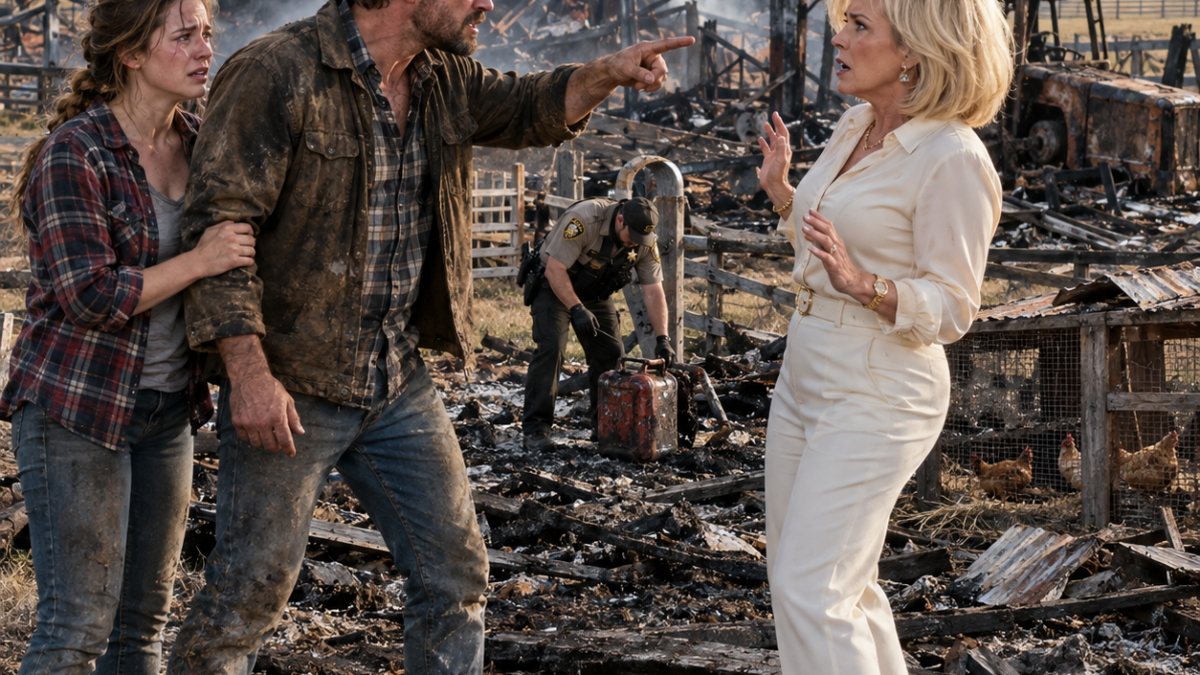
part2
The first letter arrived three years after my parents died.
My father went first, a heart attack during harvest season. My mother followed less than a year later. The doctor said it was complications, but Emily and I knew grief had hollowed her out. They had been married forty-five years. She had never learned how to be old without him.
Emily and I inherited the farm together.
Selling never crossed our minds.
I handled the business side—farmers markets, suppliers, buyers, taxes, repairs, invoices, equipment loans, seasonal planning. Emily handled the animals and most of the garden. We were not making a fortune, but the farm was profitable enough to survive. More importantly, it still felt like home.
Then the envelope came.
It had a clean logo printed at the top: Willow Creek Estates Homeowners Association.
I laughed when I saw it.
Willow Creek Estates.
That was their name for the cluster of mansions built where the Baker and Lewis farms used to be. They had named it after the creek that had run through our land for more than a century, as if branding could make them native to the soil.
The letter informed me that, as a property owner within the Willow Creek development area, I was subject to association fees, architectural guidelines, and community standards.
I read the sentence three times.
Then I read the list of violations.
Noncompliant structures.
That meant our barn and chicken coops.
Noise ordinance concerns.
That meant animals making animal sounds.
Unsightly agricultural equipment visible from roadway.
That meant our tractor, baler, hay rake, and everything else needed to run an actual farm.
Failure to maintain landscaping to community standards.
That meant we had pastures and crop rows instead of decorative grass that existed only to be mowed.
Emily watched me from the other side of the table, a mug of coffee cupped in both hands.
“What is it?” she asked.
“Apparently, we joined an HOA in our sleep.”
She frowned.
I slid the letter across.
She read it, and her face changed the way it always did when people became too loud, too pushy, too close. Not fear yet. Just retreat.
“They can’t do that,” she said.
“No.”
“Can they?”
“No.”
I called the number at the bottom of the page.
A woman answered on the second ring.
“Willow Creek Estates Homeowners Association, this is Karen Whitmore, president.”
Her voice was smooth, clipped, and polished in that expensive way people use when they think education is the same thing as authority.
“My name is Daniel Mercer,” I said. “I own the farm on County Road 12. I received a letter saying I’m part of your HOA. That’s a mistake.”
There was a pause.
Then she said, “Oh. The farm.”
Not my farm.
The farm.
“Yes,” I said. “The farm that predates your development by about ninety years.”
Her voice cooled immediately.
“Mr. Mercer, your property sits within the broader Willow Creek community impact zone. Your land affects our homeowners’ quality of life and property values.”
“Community impact zone is not a legal boundary.”
“It is an association designation.”
“It’s nonsense.”
Her tone sharpened.
“Excuse me?”
“I’m not part of your HOA. I never joined. My parents never joined. My great-grandfather bought this land before any of those houses existed. We are not paying dues, following your rules, or replacing pastures with lawn.”
Karen laughed softly.
Not because I had amused her.
Because she wanted me to feel small.
“Listen, you backward hillbilly,” she said. “This area is changing whether you like it or not. We have invested serious money in making this a proper neighborhood, and we are not going to let some smelly farm ruin it for everyone else. You can get with the program, or you can find somewhere else to play farmer.”
For a moment, I could not speak.
Not because I was intimidated.
Because there are certain insults that travel backward through generations.
I thought of my father’s hands.
My mother’s garden.
Emily asleep in the barn as a little girl with a baby goat curled against her knees.
I thought of Karen sitting in some mansion built on old farmland, calling me a pretend farmer.
Then I hung up.
Emily had gone pale.
“What did she say?”
“Nothing worth repeating.”
But Emily knew me too well. She saw the anger in my jaw and wrapped both hands tighter around her mug.
“Same thing as always?” she asked quietly.
“Different decade,” I said. “Same rich people thinking they can push farmers around.”
We thought that would be the end of it.
It should have been.
It was not.
The letters kept coming.
At first, I ignored them. That was my mistake. I thought a fake authority deserved no response. Karen thought silence meant weakness.
The fines started small.
Fifty dollars for maintaining a rooster within earshot of residential property.
One hundred dollars for visible farm equipment.
Two hundred dollars for excessive noise during hay harvest.
Late fees followed. Interest. Administrative penalties. Review charges. By the end of six months, the HOA claimed we owed more than three thousand dollars for rules we had never agreed to follow.
Then the phone calls began.
Karen called during dinner. Board members called during chores. Some called late at night, long after Emily had gone to bed. They complained about animal sounds, compost smells, machinery, dust, flies, lights, mud on the road, vegetable crates stacked near the shed, and once, unbelievably, the “psychological discomfort” caused by seeing livestock from an upstairs window.
I stopped answering.
Then they left voicemails.
Emily started flinching every time the phone rang.
I would find her standing still in the kitchen, shoulders up, breath held, waiting for the machine to play another complaint in Karen’s cold voice.
You are damaging the community.
You are refusing reasonable cooperation.
You are making this harder than it has to be.
Emily tried to stay strong, but confrontation had never been her language. Her peace lived in the barn, the goat pen, the garden rows. When people became cruel, she did not get louder. She folded inward.
One evening, after Karen left a message threatening “further enforcement action,” Emily sat on the porch steps with her arms wrapped around herself.
“She wants us gone,” she said.
“She can want whatever she wants.”
“What if wanting turns into doing?”
I wanted to tell her it would not.
But farm kids learn early not to promise weather.
So I said, “Then we’ll handle it.”
The first government complaint came two weeks later.
Animal control arrived because someone reported we were hoarding livestock in unsanitary conditions. The officer looked around our barns, checked the feed storage, water access, bedding, fencing, and vet records, then shook his head.
“I wish half the commercial setups I inspect looked this good,” he said.
I knew who had called.
So did he, though he did not say it.
The health department came next. Contaminated water sources. Improper waste disposal. Hazardous runoff.
Our well tested cleaner than city tap water. Our compost operation met every guideline. The inspector apologized before leaving.
Then came noise complaints to the sheriff’s department.
Deputies started showing up once or twice a week, usually embarrassed before they got out of their cruisers. Loud machinery. Animals disturbing the peace. Suspicious activity after dark, which turned out to be me checking a fence with a flashlight. One sergeant finally said, off the record, that the calls were obviously bogus, but they still had to respond.
“Document everything,” he told me.
I started a binder.
Then another.
Letters, fines, inspection reports, complaint numbers, voicemail transcripts, photos, dates, times.
The binders became a record of harassment so organized it looked almost professional.
Then Karen crossed a line I had not known existed.
I was in town buying feed when Emily called screaming.
Not crying.
Screaming.
“Danny, there are police everywhere. They have guns. They’re yelling for me to come outside.”
My hand went numb around the phone.
“What?”
“They said someone’s dead. They said you—Danny, they think you killed me.”
I do not remember the drive home clearly. I remember tires screaming when I pulled out of the feed store. I remember calling the sheriff’s office on speaker. I remember my own voice sounding strange, controlled and terrified.
When I reached the farm, the driveway was blocked by patrol cars and tactical vehicles. Officers in body armor moved around my yard. Emily sat in the back of a cruiser wrapped in a blanket, shaking so hard her teeth chattered.
Someone had called in a report claiming I had murdered my sister and was hiding her body in the house.
A SWAT team had surrounded our home over a lie.
The situation cleared once they saw I was not inside with a weapon and Emily was alive, but the damage was done. The officers apologized. The sergeant looked furious, not at us but at whoever had made the call. They promised to investigate.
But that night, Emily slept on my couch with every light in the house on.
For weeks, she jumped at every engine sound.
She stopped going into town unless I went with her. She started checking windows. She startled when a branch scraped the siding. She began seeing a therapist twice a month, then once a week.
The farm, which had been her sanctuary, started feeling surrounded.
Still, the animals helped her breathe.
Especially Daisy.
Daisy was a brown-and-white doe Emily had raised from a bottle. That goat followed her everywhere. If Emily worked in the garden, Daisy watched from the fence. If Emily cried, Daisy pressed her head against her hip like she knew something human words could not reach.
Then someone poisoned Daisy.
Three goats died that morning.
I found them first in the lower pasture, bodies stiff in the cold dawn grass. Daisy was one of them. Emily came running when she heard me shout, then stopped so suddenly I thought she might fall.
The vet confirmed antifreeze poisoning.
A deliberate death.
A cruel death.
Emily knelt beside Daisy and made a sound I hope I never hear from another human being again.
Not a scream. Not a sob.
Something torn out of the deepest place grief can reach.
After that, my sister changed.
She still fed the remaining goats. Still tended the garden. Still tried to smile when customers at the farmers market asked how she was. But her hands shook. She slept badly. Panic attacks began waking her at night. Her therapist increased the sessions, but trauma is not a fence you can repair by tightening wire.
One cold morning in late fall, I found Emily collapsed in the barn.
She had been feeding the goats.
One bucket lay on its side. Grain had spilled across the packed dirt. The goats stood silent around her, as if even they understood something sacred had broken.
The paramedics said she was gone before I called.
A massive heart attack.
The doctor said chronic stress had weakened her body, and recent trauma had likely triggered the event.
I heard the medical language.
I understood the real cause.
Karen had killed my sister without ever touching her.
After the funeral, I drove straight to Karen’s mansion.
I did not plan what I would say. Grief drove. Rage held the wheel.
Her house sat on a hill where pasture used to be, a ridiculous stone-and-glass monument to money without taste. The landscaping probably cost more than our annual equipment budget. A fountain burbled near the driveway, useless and smug.
Karen opened the door wearing cream slacks, a cashmere sweater, and a diamond necklace shaped like a cross.
She looked me up and down like I had tracked mud onto her world.
“What do you want?”
“My sister is dead,” I said.
Her expression did not change.
“The stress from your harassment campaign gave her a heart attack.”
Karen rolled her eyes.
Actually rolled them.
“Oh, please. People die all the time.”
The sentence hit me harder than any punch ever could have.
“You poisoned her animals,” I said. “You had us swatted. You filed false reports. You tormented us for years.”
“I have no idea what you’re talking about.”
But she smiled when she said it.
A small, ugly smile.
“If you think we’re going to stop trying to clean up this area because you are having personal problems, you are wrong.”
My hands curled into fists.
Not because I wanted to hit her.
Because if I did not make them fists, they would shake.
Karen leaned against the doorframe.
“If you think we’ve done something illegal, why don’t you sue us?” she asked. “Oh, wait. I forgot. You can’t afford a lawyer, can you? You’re just a powerless little farmer who thinks he can stand in the way of progress.”
She stepped closer.
“I dare you to take us to court. You’ll lose everything you have left, and we’ll still get your land in the end.”
There are moments in life when anger becomes direction.
Clear. Cold. Exact.
I looked her in the eyes.
“You know what, Karen? I think I will sue you.”
She laughed.
“Good luck with that, hillbilly.”
That was her mistake.
Karen thought overalls meant ignorance. She thought grief meant weakness. She thought because I worked land, I did not understand money, records, contracts, or law.
What she did not know was that I had a business degree.
I had worked in finance for three years before my father’s health failed and I came home. My parents had been careful savers. The farm was profitable. Emily and I had inherited not only land, but investment accounts my father had built quietly over decades.
I could afford a lawyer.
I simply had not wanted to spend money fighting people I thought might eventually get bored.
Emily was dead now.
Boredom was no longer part of the equation.
The next week, I hired a law firm that specialized in harassment, property rights, and complex civil litigation. Then I hired a private investigator named Ray Callahan, a former state investigator with gray hair, sharp eyes, and a voice that made liars nervous before he asked a single question.
My lawyer, Marisol Vega, sat across from me in her office with my binders spread across the table.
“This is not neighbor conflict,” she said after an hour of reading.
“No.”
“This is organized.”
“Yes.”
“We’re going to need everything. Letters. Calls. Videos. Reports. Vet records. Medical records. Police reports. Inspection results. Anything your sister told her therapist may be protected, but we can document treatment and timeline.”
I nodded.
“Can we prove they poisoned the goats?”
“Maybe. Maybe not. But civil cases are built with patterns. And this pattern is ugly.”
Ray started digging.
I organized everything.
The more we looked, the bigger the picture became.
The HOA had not only targeted us.
They had gone after anyone who did not fit Karen’s vision of Willow Creek.
An elderly beekeeper had been fined repeatedly for “unsafe insect colonies.” A family running a small horse-boarding operation had been cited for odors and commercial activity. A widower who refused to sell five wooded acres had received threatening letters about fire hazards and drainage violations.
Karen’s goal was always the same.
Pressure people until they broke.
Then buy low.
Then resell to developers.
Ray found shell companies tied to Karen’s relatives. He found suspicious land transfers. He found forged survey documents. He found parcels developed without clear ownership. He found that Karen had claimed the HOA clubhouse as a religious facility to dodge taxes, even though its only sacred rituals seemed to be wine tastings and architectural review meetings.
She had used HOA money for personal travel, calling vacations “community research.” She had bought a luxury SUV with association funds and listed it as a community vehicle, though no one else drove it. She had paid vendors connected to board members. She had billed homeowners for services never performed.
Then discovery began.
Marisol filed the lawsuit against Karen, the HOA, the board members involved, and several associated shell companies. Harassment. Fraud. Conspiracy. Property damage. Intentional infliction of emotional distress. Business interference. Wrongful death.
Karen’s lawyers tried to laugh us out of court.
Their first argument was that because I was not an HOA member, the association had no legal relationship with me and therefore could not be liable for harassment.
Marisol destroyed that in one hearing.
“You cannot bill someone, fine someone, threaten someone, call agencies on someone, file complaints against someone, and claim authority over someone for years,” she told the judge, “then argue you have no connection to them when they sue.”
The judge allowed the case to move forward.
That was when the dam cracked.
We subpoenaed HOA records. Financials. Emails. Meeting minutes. Phone logs. Internal messages. Vendor agreements. Enforcement notes.
Karen had written everything down.
That still amazes me.
Arrogant people trust their own cleverness so much they forget records survive moods.
There were emails discussing how to “make life unbearable for the Mercer farm.” Messages about which government agencies were most responsive to anonymous tips. Notes on how to create “persistent enforcement fatigue.” Karen had researched our finances, trying to determine how much pressure it would take before legal costs forced us to sell.
One email chain showed Karen coordinating with teenage residents to vandalize our property.
She promised to cover their families’ HOA fees if the boys helped “encourage the farmer to reconsider his position.”
Another discussed the SWAT call indirectly, with one board member writing, “Emergency response pressure may finally scare the sister enough to push him toward sale.”
Then came the email that made the room go silent.
Karen had written to another board member:
The sister is too attached to those goats. If something happened to them, she might convince her brother it is time to leave.
I read that line in Marisol’s office.
Once.
Twice.
Then I stood and walked into the hallway because if I stayed in that room, I was afraid grief would split me open in front of strangers.
Daisy had not been random.
Emily’s pain had been part of Karen’s strategy.
When the state revenue department got involved, Karen’s empire started collapsing from multiple directions.
The tax fraud was massive. The fake religious exemption for the clubhouse alone triggered years of penalties. The land fraud brought in the county prosecutor. Forged deeds and false surveys connected Karen to illegal development on parcels she did not own. Absentee landowners began receiving calls informing them that parts of their property had been sold, paved, or built on without their consent.
The local newspaper picked up the story.
At first, they called it a property dispute.
Then Ray leaked enough public-record breadcrumbs to make them dig deeper.
Within weeks, the headline changed.
THE HOA FROM HELL: FRAUD, HARASSMENT, AND A FAMILY FARM UNDER ATTACK.
Reporters came to the farm.
I hated the attention, but Marisol said public pressure mattered. So I stood by the barn and told Emily’s story without crying until the cameras turned off.
The beekeeper sued.
The horse family sued.
Several HOA homeowners sued when they learned their dues had funded Karen’s personal expenses and legal intimidation campaign.
Property values in Willow Creek dropped so fast the same people who once complained about rooster noise began complaining about Karen in public.
The HOA declared bankruptcy within six months.
Karen’s assets were frozen.
Board members turned on each other.
Several took plea deals.
For the first time in years, I thought maybe it was ending.
I was wrong.
Karen could not accept that a “powerless little farmer” had beaten her.
By then, her mansion was in foreclosure. Her SUV had been seized. Her husband, Thomas, had stayed mostly in the background during the HOA years, but desperation pulled him into the open. They blamed me for everything. Not Karen’s fraud. Not her cruelty. Not the tax evasion or forged documents.
Me.
One night in early spring, I woke to the smell of smoke.
At first, my half-asleep mind tried to make it into something harmless. Burn pile. Chimney backdraft. Distant brush fire.
Then orange light flickered across my bedroom wall.
I ran outside barefoot.
The barn was burning.
Flames climbed the old wood like they had been waiting for permission. The fire had already spread toward the farmhouse, moving too fast, too hungry. Later, investigators would confirm accelerant had been used in multiple locations.
In that moment, all I saw was my childhood turning red.
The animals came first.
They always do.
I ran to the barn, coughing, shouting, pulling open gates, cutting leads, slapping stall doors wide. The horses were in the far pasture and safe. The cattle too. The chickens screamed in their coop, panicked by smoke. I kicked open the side door and dragged crates out until my lungs burned. The remaining goats were wild-eyed but alive. I pushed them toward the paddock, shouting until my throat tore.
The farmhouse caught next.
Windows cracked from the heat.
The porch where my mother had shelled peas collapsed in a burst of sparks.
Inside were photographs. Letters. My father’s tools. My mother’s recipe cards. Emily’s childhood drawings. The quilt my grandmother made. Four generations of proof that we had lived there.
Fire eats without mercy.
While sirens wailed in the distance, I saw movement near the tree line.
Two figures running toward the old logging road.
One carried a gas can.
I do not remember deciding to grab the shotgun.
I remember my hand closing around it. I remember running. I remember the taste of smoke and rage. I remember thinking Emily’s name with every step.
I caught them at the car.
Karen and Thomas.
Their faces glowed orange from the burning farm behind me. Gas cans lay near their feet. Road flares were in Thomas’s hand.
For one second, none of us moved.
Then Thomas reached into his jacket.
I fired into the air.
The blast split the night.
“On the ground!” I shouted.
Karen screamed.
Thomas froze with his hand half inside his coat.
“On the ground now!”
They dropped.
By the time police arrived, firefighters were fighting the blaze and I was standing over Karen and her husband with the shotgun pointed safely down but ready, my whole body shaking so hard I could barely breathe.
The security cameras captured everything.
Karen and Thomas entering the property.
Gas cans.
Flares.
Them setting the fires.
Them running.
Thomas reaching for a pistol when confronted.
No ambiguity. No rumor. No Karen performance.
Only evidence.
They were arrested on the spot.
The farmhouse was gone.
The barn was gone.
Equipment, feed, tools, family records, photographs, heirlooms—gone.
I spent the next morning standing in ash where the kitchen had been.
The stone foundation remained, blackened and cracked. A cast-iron skillet lay in the debris, warped from heat. I found the metal frame of my mother’s canning shelf, my father’s belt buckle, and a small ceramic goat Emily had kept by the windowsill.
I held that goat in both hands and finally cried.
Not in a clean way.
Not in a cinematic way.
I folded down in the ash and broke.
Karen’s arson trial was almost anticlimactic compared with everything before it.
The evidence was overwhelming. Security footage. Fingerprints on gas cans. Purchase records from the hardware store. Accelerant analysis. Thomas’s pistol. Their financial motive. Karen’s documented history of threats and retaliation.
Thomas took a plea deal.
He testified that Karen planned the fire. She believed that if the farm structures were destroyed, I would finally sell. She had told him the land would be easier to take if I had nothing left worth protecting.
He got fifteen years.
Karen refused to admit anything.
Even during sentencing, she called herself the victim of a vindictive farmer and a biased legal system. She said she had only wanted to improve the community. She said I had ruined lives by refusing reasonable progress.
The judge listened with a face like stone.
Then he sentenced her to twenty-five years to life.
I thought I would feel joy.
I did not.
I felt tired.
I felt old.
I felt Emily’s absence beside me like an empty chair.
The civil judgments came next.
Between my lawsuit and the other victims, Karen’s estate owed more than two million dollars in damages. Her mansion, cars, jewelry, investment accounts, and remaining properties were liquidated. The state added hundreds of thousands in tax liens and penalties. Fraudulent parcels were seized and returned where possible. Several board members received lighter sentences for cooperation, but none escaped untouched.
The HOA ceased to exist.
Willow Creek Estates became a cautionary phrase whispered by real estate agents.
My wrongful death settlement and property damages provided enough money to rebuild the farm.
At first, I did not want to.
That is the truth people do not expect.
Everyone assumed I would rebuild immediately, stronger than before, proud and defiant. But for months, the land felt less like home and more like a crime scene with grass growing over it.
Everywhere I looked, I saw loss.
The new foundation site was where my mother’s garden had been visible from the kitchen window. The barn pad was where Emily had died. The lower pasture still felt haunted by Daisy. The creek kept moving as if nothing had happened, and sometimes I hated it for that.
I considered selling.
More than once.
I would walk the property at dusk and think, Karen is in prison. The lawsuits are over. You could leave. You could buy a small house somewhere nobody knows your name. You could stop waking up to ghosts.
Then I would remember Emily kneeling in the garden with dirt on her cheek.
My father teaching me to stretch wire tight.
My mother placing jars of tomatoes in perfect rows.
My great-grandfather seeing possibility where other people saw worthless hills.
Selling would not free me from grief.
It would only give Karen the last piece of what she wanted.
So I rebuilt.
Slowly.
The new farmhouse was larger, safer, and more modern, but I designed it to honor the old one. Wide porch. White siding. Green shutters like my mother loved. A kitchen facing east so morning light could find it. The new barn had fire suppression systems, security cameras, reinforced doors, and better ventilation. I replaced equipment. Rebuilt fencing. Restocked carefully.
The first spring after reconstruction, I planted Emily’s garden.
Not as well as she would have.
Not even close.
But I planted tomatoes, beans, squash, basil, peppers, and sunflowers because she loved sunflowers even though she always claimed they were impractical.
The work saved me.
Not all at once.
Healing never arrived like a sunrise.
It came like farm work.
One task after another.
Fence post. Seed row. Water trough. Market table. Goat feed. Tractor repair. Invoice. Rain barrel. Soil test. Morning. Evening. Morning again.
About two years after the trial, I met Claire.
She was a veterinarian who came out to check on a new group of goats I had bought from a breeder two counties over. I expected someone brisk, clinical, efficient. Instead, Claire climbed out of her truck, crouched beside the smallest doe, and spoke to her in the same soft nonsense voice Emily used with nervous animals.
That almost made me tell her to leave.
Not because she had done anything wrong.
Because grief is strange and selfish. It sees resemblance and calls it theft.
But Claire was patient.
With the goats.
With me.
She understood farm life in a way most people did not. She did not romanticize it. She knew manure froze in winter and births went wrong and farmers sometimes cried in barns where nobody could see them. She never pushed me to talk about Emily, Karen, or the fire before I was ready.
When I finally told her everything, she listened without trying to make it smaller.
We married a year later.
A simple wedding on the farm.
No mansion. No hotel ballroom. No polished performance. Just friends, surviving neighbors, a few relatives, a long table under string lights, and animals making inappropriate noises during the vows.
For the first time in years, the land held laughter without pain standing too close.
Claire brought new energy to the farm. We expanded goat breeding. She opened a small veterinary practice serving rural families who had been driving too far for care. We diversified crops, sold directly to restaurants and farmers markets, and slowly the farm became more profitable than it had ever been.
The surrounding area changed too.
Without Karen’s intimidation machine, people began making their own choices again. Some Willow Creek families sold and moved back to suburbs where HOAs made more sense. The buyers who replaced them were different. Families who wanted chickens. Couples interested in orchards. A young farming pair bought Karen’s mansion at auction for a fraction of what she had paid, tore out the ridiculous landscaping, and turned the land back into production.
That pleased me more than I care to admit.
Her fountain became a stock tank.
Her putting green became a vegetable plot.
Her imported ornamental trees came down to make room for apple saplings.
The area did not become exactly what it had been. Time does not reverse itself out of guilt. But it began moving toward something honest again.
We formed a community association, though nobody dared call it an HOA.
No fines. No architectural committees. No clipboard tyrants. Just neighbors helping with harvests, sharing storm warnings, watching each other’s property, and making sure no one faced harassment alone.
The first meeting was held in my new barn.
I stood near the door watching people arrive with coffee, folding chairs, pies, tool catalogs, muddy boots, and children who immediately found the barn cats.
Mr. Alvarez, the beekeeper Karen had harassed, clapped me on the shoulder.
“Your daddy would like this,” he said.
I had to look away for a moment.
“I hope so.”
“He would.”
Later that evening, after everyone left, Claire and I stood in the doorway of the barn while the sky darkened over the pasture.
“You okay?” she asked.
I looked at the new fences, the rebuilt house, the goats settling near the shelter, the garden rows dark and neat beyond the yard.
“No,” I said.
She slid her hand into mine.
I breathed in.
“But I’m better than I was.”
That was the most honest answer I had.
I still have bad days.
There are nights when the smell of smoke from someone’s burn pile takes me back so fast I have to sit down. There are mornings when I walk into the barn and, for half a second, expect to see Emily with a feed bucket. There are court documents in a locked file cabinet that I do not open unless I have to. There is a small ceramic goat on the kitchen shelf, smoke-stained but intact.
Karen tried to turn our farm into a warning.
Instead, it became testimony.
The land testified in survey records Karen forged and failed to bury.
The cameras testified when flames rose in the dark.
Emails testified because arrogance leaves fingerprints.
Neighbors testified because some of them finally learned silence has a price.
Even ash testified.
Investigators sifted through what remained of my childhood home and found accelerant patterns, melted containers, burned truth that still knew how to speak.
Karen believed destruction was an ending.
Farmers know better.
Fire clears, but it also reveals what roots remain alive beneath the soil.
These days, when I walk the lower pasture, goats follow me again. None of them is Daisy. I would never pretend otherwise. But one little brown doe has taken to trailing Claire like a shadow, and sometimes when she presses her head against Claire’s hip, I feel grief and gratitude pass through me at the same time.
The creek still runs.
The hills still roll.
The farmhouse lights still come on at dusk.
My sister is buried beneath a young oak near the garden, beside our parents. I planted sunflowers around the fence there, even though they are still impractical. Every summer they grow taller than they should, bright-faced and stubborn, turning toward the sun like Emily taught them personally.
Sometimes I sit there and tell her what has changed.
Karen is gone.
The HOA is dead.
The farm survived.
I survived.
I wish that were enough to bring her peace. Maybe it does. Maybe peace travels differently where she is.
People sometimes ask if I regret waiting so long to sue.
Yes.
I do.
I regret every month I thought ignoring Karen would starve the problem. I regret every call I let go unanswered without legal action. I regret believing that because we were right, we were safe. Being right is not a shield unless you raise it.
I cannot change that.
All I can do is tell the truth now.
Document early.
Trust patterns.
Do not let polished cruelty convince you it is only annoyance.
Do not mistake wealth for legitimacy or confidence for law.
And never, ever assume someone will stop simply because their actions are obviously wrong.
Karen did not stop when the county proved us clean.
She did not stop when police knew the reports were false.
She did not stop when animals died.
She did not stop when Emily died.
She stopped only when evidence, law, and consequences became stronger than her money.
That lesson cost me more than I can measure.
But the farm is still here.
Not the same farm.
The old farmhouse is gone. The original barn is gone. Some family photos are gone forever. Emily is gone, and that absence is a field no rain can restore.
But the land remains.
And on good mornings, when mist lifts from the creek and Claire is already in the barn talking softly to a goat that does not deserve such praise, I feel something like hope moving through the place again.
Not the bright, easy hope of people who have never been burned.
A harder hope.
Scarred.
Rooted.
Earned.
Karen once stood in her doorway and told me I was a powerless little farmer.
I think about that sometimes while driving fence posts into the ground she tried to steal. While signing contracts with restaurants that buy our produce. While watching young families move into former mansion lots and plant fruit trees. While seeing children from down the road chase chickens during community harvest days.
Powerless.
She never understood power.
She thought power was money, lawyers, fake documents, board titles, and fear.
My father knew better.
Power is neighbors who answer the phone at midnight.
Power is records kept when your hands are shaking.
Power is a sister who loved animals so deeply that her love became evidence of cruelty.
Power is rebuilding after someone burns what they cannot take.
Power is refusing to let the person who destroyed your peace define the rest of your life.
The last time I passed the prison where Karen will likely grow old, I did not stop.
I had feed in the truck, a vet appointment to meet, and tomatoes waiting to be delivered to a restaurant that now prints our farm’s name on its menu. Life had work for me, and that felt better than revenge.
Still, as I drove by, I thought of her behind walls, far from the hills she wanted, far from the community she tried to control, far from every piece of land she believed money entitled her to own.
Then I thought of Emily’s sunflowers.
Tall.
Ridiculous.
Beautiful.
Still turning toward light.
I kept driving home.
𝗧𝗛𝗘 𝗘𝗡𝗗
Karen Burned My Family Farm to the Ground, Then Learned Ashes Can Still Testify
Karen thought grief would make me weak, poverty would keep me quiet, and fire would erase what she had done.
She was wrong about all three.
I was born on that farm, and for most of my life, I believed I would die there too.
Not in a dramatic way. Not with some grand speech under a storm-dark sky. I mean the quiet kind of ending farm people imagine when they let themselves think that far ahead. Old bones, slow mornings, maybe a chair on the porch facing the hills, a cup of coffee going cold in my hand while the creek moved through the lower pasture the same way it had moved when my great-grandfather first bought the land.
Our farm had been in the family for four generations.
My great-grandfather bought it when nobody wanted land that far out. Back then, people called it useless because the nearest town was small, the road was mostly dirt, and the hills made certain fields difficult to work. He saw what other people missed. He saw creek water, grazing slopes, soil that would reward patience, and enough space for a family to build a life without asking anyone’s permission.
By the time I was a kid, the place felt eternal.
Rolling hills. Pastures stitched together with wire fence. A barn painted red so many times the boards seemed to hold the color in their bones. Chicken coops behind the house. A vegetable garden my mother guarded like a holy place. A creek that ran clear over stones and sang at night when the rest of the farm settled down.
My father woke before sunrise every day of his adult life. I used to hear his boots on the kitchen floor before the sky even started to pale. He checked the animals first, always. Cattle, goats, chickens, horses when we had them. My mother would already be at the stove by then, tying her hair back with one hand and stirring oatmeal with the other. She canned vegetables every summer, mended torn shirts, balanced farm accounts, and could shame a tomato plant into producing more fruit just by standing over it with her hands on her hips.
My sister Emily and I learned early that farm life was not a backdrop.
It was work.
By ten, I was feeding chickens and collecting eggs before school. By fifteen, I was repairing fences beside my father, pretending I was not exhausted because I wanted him to see me as useful. Emily was different. She was quieter, softer with people, but animals trusted her instantly. A spooked horse would lower its head when she spoke. Goats followed her like she carried sunlight in her pockets. Even our meanest rooster, a hateful little tyrant named Chester, tolerated her in a way he tolerated no one else.
We were not rich, but we had enough.
Enough food. Enough land. Enough purpose. Enough history under our boots to know who we were.
Then the rich people discovered the hills.
At first, it happened in waves. Every few years, a developer or some wealthy family would come down our road in a clean car that had clearly never carried feed, offering money and words like progress, opportunity, and modernization. I remember one developer showing up when I was twelve. He wore an expensive suit into our kitchen and actually wrinkled his nose like the smell of coffee, biscuits, and farm dogs offended him.
He told my father we were holding the area back.
My father listened politely until politeness no longer served any purpose.
Then he said, “This land fed my family before your company existed. Get off it.”
A week later, our mailbox was knocked down.
Then trash appeared in the driveway.
Then someone drove circles through our wheat field, ruining months of work.
The final straw came when somebody cut a fence and half our cattle wandered onto the main road.
Back then, the farming families still stood together. Mr. Baker organized night drives. Mrs. Lewis started a phone tree. The Thompson brothers, both veterans, made it clear around town that strangers asking too many questions about our farms would be remembered. The harassment stopped because the people causing it learned something important.
We were not isolated.
That mattered.
For years, every outsider who tried to push us learned the same lesson. Farmers might argue among ourselves about fences, weather, politics, or whose bull got loose, but when developers came circling, we closed ranks.
My father used to say, “A field is easier to break when every stalk stands alone.”
I did not understand how much that meant until the years took those neighbors away.
Mr. Baker’s arthritis got so bad he could barely hold a pitchfork. His kids lived in the city and wanted nothing to do with livestock, so he sold. Mrs. Lewis had a stroke. Her family sold too. The Thompsons held out longer than anyone expected, but cancer bills swallowed their savings and the land went next.
One by one, old farms became country estates.
The new houses were enormous and glassy, all sharp lines and dramatic lighting, built by people who claimed to love rural life until the rural life made noise or smelled like animals. They wanted views of pasture, not manure. They wanted sunrise, not roosters. They wanted space, but not the work that made space meaningful.
For a while, they mostly kept to themselves.
Then they formed an HOA.
part2
The first letter arrived three years after my parents died.
My father went first, a heart attack during harvest season. My mother followed less than a year later. The doctor said it was complications, but Emily and I knew grief had hollowed her out. They had been married forty-five years. She had never learned how to be old without him.
Emily and I inherited the farm together.
Selling never crossed our minds.
I handled the business side—farmers markets, suppliers, buyers, taxes, repairs, invoices, equipment loans, seasonal planning. Emily handled the animals and most of the garden. We were not making a fortune, but the farm was profitable enough to survive. More importantly, it still felt like home.
Then the envelope came.
It had a clean logo printed at the top: Willow Creek Estates Homeowners Association.
I laughed when I saw it.
Willow Creek Estates.
That was their name for the cluster of mansions built where the Baker and Lewis farms used to be. They had named it after the creek that had run through our land for more than a century, as if branding could make them native to the soil.
The letter informed me that, as a property owner within the Willow Creek development area, I was subject to association fees, architectural guidelines, and community standards.
I read the sentence three times.
Then I read the list of violations.
Noncompliant structures.
That meant our barn and chicken coops.
Noise ordinance concerns.
That meant animals making animal sounds.
Unsightly agricultural equipment visible from roadway.
That meant our tractor, baler, hay rake, and everything else needed to run an actual farm.
Failure to maintain landscaping to community standards.
That meant we had pastures and crop rows instead of decorative grass that existed only to be mowed.
Emily watched me from the other side of the table, a mug of coffee cupped in both hands.
“What is it?” she asked.
“Apparently, we joined an HOA in our sleep.”
She frowned.
I slid the letter across.
She read it, and her face changed the way it always did when people became too loud, too pushy, too close. Not fear yet. Just retreat.
“They can’t do that,” she said.
“No.”
“Can they?”
“No.”
I called the number at the bottom of the page.
A woman answered on the second ring.
“Willow Creek Estates Homeowners Association, this is Karen Whitmore, president.”
Her voice was smooth, clipped, and polished in that expensive way people use when they think education is the same thing as authority.
“My name is Daniel Mercer,” I said. “I own the farm on County Road 12. I received a letter saying I’m part of your HOA. That’s a mistake.”
There was a pause.
Then she said, “Oh. The farm.”
Not my farm.
The farm.
“Yes,” I said. “The farm that predates your development by about ninety years.”
Her voice cooled immediately.
“Mr. Mercer, your property sits within the broader Willow Creek community impact zone. Your land affects our homeowners’ quality of life and property values.”
“Community impact zone is not a legal boundary.”
“It is an association designation.”
“It’s nonsense.”
Her tone sharpened.
“Excuse me?”
“I’m not part of your HOA. I never joined. My parents never joined. My great-grandfather bought this land before any of those houses existed. We are not paying dues, following your rules, or replacing pastures with lawn.”
Karen laughed softly.
Not because I had amused her.
Because she wanted me to feel small.
“Listen, you backward hillbilly,” she said. “This area is changing whether you like it or not. We have invested serious money in making this a proper neighborhood, and we are not going to let some smelly farm ruin it for everyone else. You can get with the program, or you can find somewhere else to play farmer.”
For a moment, I could not speak.
Not because I was intimidated.
Because there are certain insults that travel backward through generations.
I thought of my father’s hands.
My mother’s garden.
Emily asleep in the barn as a little girl with a baby goat curled against her knees.
I thought of Karen sitting in some mansion built on old farmland, calling me a pretend farmer.
Then I hung up.
Emily had gone pale.
“What did she say?”
“Nothing worth repeating.”
But Emily knew me too well. She saw the anger in my jaw and wrapped both hands tighter around her mug.
“Same thing as always?” she asked quietly.
“Different decade,” I said. “Same rich people thinking they can push farmers around.”
We thought that would be the end of it.
It should have been.
It was not.
The letters kept coming.
At first, I ignored them. That was my mistake. I thought a fake authority deserved no response. Karen thought silence meant weakness.
The fines started small.
Fifty dollars for maintaining a rooster within earshot of residential property.
One hundred dollars for visible farm equipment.
Two hundred dollars for excessive noise during hay harvest.
Late fees followed. Interest. Administrative penalties. Review charges. By the end of six months, the HOA claimed we owed more than three thousand dollars for rules we had never agreed to follow.
Then the phone calls began.
Karen called during dinner. Board members called during chores. Some called late at night, long after Emily had gone to bed. They complained about animal sounds, compost smells, machinery, dust, flies, lights, mud on the road, vegetable crates stacked near the shed, and once, unbelievably, the “psychological discomfort” caused by seeing livestock from an upstairs window.
I stopped answering.
Then they left voicemails.
Emily started flinching every time the phone rang.
I would find her standing still in the kitchen, shoulders up, breath held, waiting for the machine to play another complaint in Karen’s cold voice.
You are damaging the community.
You are refusing reasonable cooperation.
You are making this harder than it has to be.
Emily tried to stay strong, but confrontation had never been her language. Her peace lived in the barn, the goat pen, the garden rows. When people became cruel, she did not get louder. She folded inward.
One evening, after Karen left a message threatening “further enforcement action,” Emily sat on the porch steps with her arms wrapped around herself.
“She wants us gone,” she said.
“She can want whatever she wants.”
“What if wanting turns into doing?”
I wanted to tell her it would not.
But farm kids learn early not to promise weather.
So I said, “Then we’ll handle it.”
The first government complaint came two weeks later.
Animal control arrived because someone reported we were hoarding livestock in unsanitary conditions. The officer looked around our barns, checked the feed storage, water access, bedding, fencing, and vet records, then shook his head.
“I wish half the commercial setups I inspect looked this good,” he said.
I knew who had called.
So did he, though he did not say it.
The health department came next. Contaminated water sources. Improper waste disposal. Hazardous runoff.
Our well tested cleaner than city tap water. Our compost operation met every guideline. The inspector apologized before leaving.
Then came noise complaints to the sheriff’s department.
Deputies started showing up once or twice a week, usually embarrassed before they got out of their cruisers. Loud machinery. Animals disturbing the peace. Suspicious activity after dark, which turned out to be me checking a fence with a flashlight. One sergeant finally said, off the record, that the calls were obviously bogus, but they still had to respond.
“Document everything,” he told me.
I started a binder.
Then another.
Letters, fines, inspection reports, complaint numbers, voicemail transcripts, photos, dates, times.
The binders became a record of harassment so organized it looked almost professional.
Then Karen crossed a line I had not known existed.
I was in town buying feed when Emily called screaming.
Not crying.
Screaming.
“Danny, there are police everywhere. They have guns. They’re yelling for me to come outside.”
My hand went numb around the phone.
“What?”
“They said someone’s dead. They said you—Danny, they think you killed me.”
I do not remember the drive home clearly. I remember tires screaming when I pulled out of the feed store. I remember calling the sheriff’s office on speaker. I remember my own voice sounding strange, controlled and terrified.
When I reached the farm, the driveway was blocked by patrol cars and tactical vehicles. Officers in body armor moved around my yard. Emily sat in the back of a cruiser wrapped in a blanket, shaking so hard her teeth chattered.
Someone had called in a report claiming I had murdered my sister and was hiding her body in the house.
A SWAT team had surrounded our home over a lie.
The situation cleared once they saw I was not inside with a weapon and Emily was alive, but the damage was done. The officers apologized. The sergeant looked furious, not at us but at whoever had made the call. They promised to investigate.
But that night, Emily slept on my couch with every light in the house on.
For weeks, she jumped at every engine sound.
She stopped going into town unless I went with her. She started checking windows. She startled when a branch scraped the siding. She began seeing a therapist twice a month, then once a week.
The farm, which had been her sanctuary, started feeling surrounded.
Still, the animals helped her breathe.
Especially Daisy.
Daisy was a brown-and-white doe Emily had raised from a bottle. That goat followed her everywhere. If Emily worked in the garden, Daisy watched from the fence. If Emily cried, Daisy pressed her head against her hip like she knew something human words could not reach.
Then someone poisoned Daisy.
Three goats died that morning.
I found them first in the lower pasture, bodies stiff in the cold dawn grass. Daisy was one of them. Emily came running when she heard me shout, then stopped so suddenly I thought she might fall.
The vet confirmed antifreeze poisoning.
A deliberate death.
A cruel death.
Emily knelt beside Daisy and made a sound I hope I never hear from another human being again.
Not a scream. Not a sob.
Something torn out of the deepest place grief can reach.
After that, my sister changed.
She still fed the remaining goats. Still tended the garden. Still tried to smile when customers at the farmers market asked how she was. But her hands shook. She slept badly. Panic attacks began waking her at night. Her therapist increased the sessions, but trauma is not a fence you can repair by tightening wire.
One cold morning in late fall, I found Emily collapsed in the barn.
She had been feeding the goats.
One bucket lay on its side. Grain had spilled across the packed dirt. The goats stood silent around her, as if even they understood something sacred had broken.
The paramedics said she was gone before I called.
A massive heart attack.
The doctor said chronic stress had weakened her body, and recent trauma had likely triggered the event.
I heard the medical language.
I understood the real cause.
Karen had killed my sister without ever touching her.
After the funeral, I drove straight to Karen’s mansion.
I did not plan what I would say. Grief drove. Rage held the wheel.
Her house sat on a hill where pasture used to be, a ridiculous stone-and-glass monument to money without taste. The landscaping probably cost more than our annual equipment budget. A fountain burbled near the driveway, useless and smug.
Karen opened the door wearing cream slacks, a cashmere sweater, and a diamond necklace shaped like a cross.
She looked me up and down like I had tracked mud onto her world.
“What do you want?”
“My sister is dead,” I said.
Her expression did not change.
“The stress from your harassment campaign gave her a heart attack.”
Karen rolled her eyes.
Actually rolled them.
“Oh, please. People die all the time.”
The sentence hit me harder than any punch ever could have.
“You poisoned her animals,” I said. “You had us swatted. You filed false reports. You tormented us for years.”
“I have no idea what you’re talking about.”
But she smiled when she said it.
A small, ugly smile.
“If you think we’re going to stop trying to clean up this area because you are having personal problems, you are wrong.”
My hands curled into fists.
Not because I wanted to hit her.
Because if I did not make them fists, they would shake.
Karen leaned against the doorframe.
“If you think we’ve done something illegal, why don’t you sue us?” she asked. “Oh, wait. I forgot. You can’t afford a lawyer, can you? You’re just a powerless little farmer who thinks he can stand in the way of progress.”
She stepped closer.
“I dare you to take us to court. You’ll lose everything you have left, and we’ll still get your land in the end.”
There are moments in life when anger becomes direction.
Clear. Cold. Exact.
I looked her in the eyes.
“You know what, Karen? I think I will sue you.”
She laughed.
“Good luck with that, hillbilly.”
That was her mistake.
Karen thought overalls meant ignorance. She thought grief meant weakness. She thought because I worked land, I did not understand money, records, contracts, or law.
What she did not know was that I had a business degree.
I had worked in finance for three years before my father’s health failed and I came home. My parents had been careful savers. The farm was profitable. Emily and I had inherited not only land, but investment accounts my father had built quietly over decades.
I could afford a lawyer.
I simply had not wanted to spend money fighting people I thought might eventually get bored.
Emily was dead now.
Boredom was no longer part of the equation.
The next week, I hired a law firm that specialized in harassment, property rights, and complex civil litigation. Then I hired a private investigator named Ray Callahan, a former state investigator with gray hair, sharp eyes, and a voice that made liars nervous before he asked a single question.
My lawyer, Marisol Vega, sat across from me in her office with my binders spread across the table.
“This is not neighbor conflict,” she said after an hour of reading.
“No.”
“This is organized.”
“Yes.”
“We’re going to need everything. Letters. Calls. Videos. Reports. Vet records. Medical records. Police reports. Inspection results. Anything your sister told her therapist may be protected, but we can document treatment and timeline.”
I nodded.
“Can we prove they poisoned the goats?”
“Maybe. Maybe not. But civil cases are built with patterns. And this pattern is ugly.”
Ray started digging.
I organized everything.
The more we looked, the bigger the picture became.
The HOA had not only targeted us.
They had gone after anyone who did not fit Karen’s vision of Willow Creek.
An elderly beekeeper had been fined repeatedly for “unsafe insect colonies.” A family running a small horse-boarding operation had been cited for odors and commercial activity. A widower who refused to sell five wooded acres had received threatening letters about fire hazards and drainage violations.
Karen’s goal was always the same.
Pressure people until they broke.
Then buy low.
Then resell to developers.
Ray found shell companies tied to Karen’s relatives. He found suspicious land transfers. He found forged survey documents. He found parcels developed without clear ownership. He found that Karen had claimed the HOA clubhouse as a religious facility to dodge taxes, even though its only sacred rituals seemed to be wine tastings and architectural review meetings.
She had used HOA money for personal travel, calling vacations “community research.” She had bought a luxury SUV with association funds and listed it as a community vehicle, though no one else drove it. She had paid vendors connected to board members. She had billed homeowners for services never performed.
Then discovery began.
Marisol filed the lawsuit against Karen, the HOA, the board members involved, and several associated shell companies. Harassment. Fraud. Conspiracy. Property damage. Intentional infliction of emotional distress. Business interference. Wrongful death.
Karen’s lawyers tried to laugh us out of court.
Their first argument was that because I was not an HOA member, the association had no legal relationship with me and therefore could not be liable for harassment.
Marisol destroyed that in one hearing.
“You cannot bill someone, fine someone, threaten someone, call agencies on someone, file complaints against someone, and claim authority over someone for years,” she told the judge, “then argue you have no connection to them when they sue.”
The judge allowed the case to move forward.
That was when the dam cracked.
We subpoenaed HOA records. Financials. Emails. Meeting minutes. Phone logs. Internal messages. Vendor agreements. Enforcement notes.
Karen had written everything down.
That still amazes me.
Arrogant people trust their own cleverness so much they forget records survive moods.
There were emails discussing how to “make life unbearable for the Mercer farm.” Messages about which government agencies were most responsive to anonymous tips. Notes on how to create “persistent enforcement fatigue.” Karen had researched our finances, trying to determine how much pressure it would take before legal costs forced us to sell.
One email chain showed Karen coordinating with teenage residents to vandalize our property.
She promised to cover their families’ HOA fees if the boys helped “encourage the farmer to reconsider his position.”
Another discussed the SWAT call indirectly, with one board member writing, “Emergency response pressure may finally scare the sister enough to push him toward sale.”
Then came the email that made the room go silent.
Karen had written to another board member:
The sister is too attached to those goats. If something happened to them, she might convince her brother it is time to leave.
I read that line in Marisol’s office.
Once.
Twice.
Then I stood and walked into the hallway because if I stayed in that room, I was afraid grief would split me open in front of strangers.
Daisy had not been random.
Emily’s pain had been part of Karen’s strategy.
When the state revenue department got involved, Karen’s empire started collapsing from multiple directions.
The tax fraud was massive. The fake religious exemption for the clubhouse alone triggered years of penalties. The land fraud brought in the county prosecutor. Forged deeds and false surveys connected Karen to illegal development on parcels she did not own. Absentee landowners began receiving calls informing them that parts of their property had been sold, paved, or built on without their consent.
The local newspaper picked up the story.
At first, they called it a property dispute.
Then Ray leaked enough public-record breadcrumbs to make them dig deeper.
Within weeks, the headline changed.
THE HOA FROM HELL: FRAUD, HARASSMENT, AND A FAMILY FARM UNDER ATTACK.
Reporters came to the farm.
I hated the attention, but Marisol said public pressure mattered. So I stood by the barn and told Emily’s story without crying until the cameras turned off.
The beekeeper sued.
The horse family sued.
Several HOA homeowners sued when they learned their dues had funded Karen’s personal expenses and legal intimidation campaign.
Property values in Willow Creek dropped so fast the same people who once complained about rooster noise began complaining about Karen in public.
The HOA declared bankruptcy within six months.
Karen’s assets were frozen.
Board members turned on each other.
Several took plea deals.
For the first time in years, I thought maybe it was ending.
I was wrong.
Karen could not accept that a “powerless little farmer” had beaten her.
By then, her mansion was in foreclosure. Her SUV had been seized. Her husband, Thomas, had stayed mostly in the background during the HOA years, but desperation pulled him into the open. They blamed me for everything. Not Karen’s fraud. Not her cruelty. Not the tax evasion or forged documents.
Me.
One night in early spring, I woke to the smell of smoke.
At first, my half-asleep mind tried to make it into something harmless. Burn pile. Chimney backdraft. Distant brush fire.
Then orange light flickered across my bedroom wall.
I ran outside barefoot.
The barn was burning.
Flames climbed the old wood like they had been waiting for permission. The fire had already spread toward the farmhouse, moving too fast, too hungry. Later, investigators would confirm accelerant had been used in multiple locations.
In that moment, all I saw was my childhood turning red.
The animals came first.
They always do.
I ran to the barn, coughing, shouting, pulling open gates, cutting leads, slapping stall doors wide. The horses were in the far pasture and safe. The cattle too. The chickens screamed in their coop, panicked by smoke. I kicked open the side door and dragged crates out until my lungs burned. The remaining goats were wild-eyed but alive. I pushed them toward the paddock, shouting until my throat tore.
The farmhouse caught next.
Windows cracked from the heat.
The porch where my mother had shelled peas collapsed in a burst of sparks.
Inside were photographs. Letters. My father’s tools. My mother’s recipe cards. Emily’s childhood drawings. The quilt my grandmother made. Four generations of proof that we had lived there.
Fire eats without mercy.
While sirens wailed in the distance, I saw movement near the tree line.
Two figures running toward the old logging road.
One carried a gas can.
I do not remember deciding to grab the shotgun.
I remember my hand closing around it. I remember running. I remember the taste of smoke and rage. I remember thinking Emily’s name with every step.
I caught them at the car.
Karen and Thomas.
Their faces glowed orange from the burning farm behind me. Gas cans lay near their feet. Road flares were in Thomas’s hand.
For one second, none of us moved.
Then Thomas reached into his jacket.
I fired into the air.
The blast split the night.
“On the ground!” I shouted.
Karen screamed.
Thomas froze with his hand half inside his coat.
“On the ground now!”
They dropped.
By the time police arrived, firefighters were fighting the blaze and I was standing over Karen and her husband with the shotgun pointed safely down but ready, my whole body shaking so hard I could barely breathe.
The security cameras captured everything.
Karen and Thomas entering the property.
Gas cans.
Flares.
Them setting the fires.
Them running.
Thomas reaching for a pistol when confronted.
No ambiguity. No rumor. No Karen performance.
Only evidence.
They were arrested on the spot.
The farmhouse was gone.
The barn was gone.
Equipment, feed, tools, family records, photographs, heirlooms—gone.
I spent the next morning standing in ash where the kitchen had been.
The stone foundation remained, blackened and cracked. A cast-iron skillet lay in the debris, warped from heat. I found the metal frame of my mother’s canning shelf, my father’s belt buckle, and a small ceramic goat Emily had kept by the windowsill.
I held that goat in both hands and finally cried.
Not in a clean way.
Not in a cinematic way.
I folded down in the ash and broke.
Karen’s arson trial was almost anticlimactic compared with everything before it.
The evidence was overwhelming. Security footage. Fingerprints on gas cans. Purchase records from the hardware store. Accelerant analysis. Thomas’s pistol. Their financial motive. Karen’s documented history of threats and retaliation.
Thomas took a plea deal.
He testified that Karen planned the fire. She believed that if the farm structures were destroyed, I would finally sell. She had told him the land would be easier to take if I had nothing left worth protecting.
He got fifteen years.
Karen refused to admit anything.
Even during sentencing, she called herself the victim of a vindictive farmer and a biased legal system. She said she had only wanted to improve the community. She said I had ruined lives by refusing reasonable progress.
The judge listened with a face like stone.
Then he sentenced her to twenty-five years to life.
I thought I would feel joy.
I did not.
I felt tired.
I felt old.
I felt Emily’s absence beside me like an empty chair.
The civil judgments came next.
Between my lawsuit and the other victims, Karen’s estate owed more than two million dollars in damages. Her mansion, cars, jewelry, investment accounts, and remaining properties were liquidated. The state added hundreds of thousands in tax liens and penalties. Fraudulent parcels were seized and returned where possible. Several board members received lighter sentences for cooperation, but none escaped untouched.
The HOA ceased to exist.
Willow Creek Estates became a cautionary phrase whispered by real estate agents.
My wrongful death settlement and property damages provided enough money to rebuild the farm.
At first, I did not want to.
That is the truth people do not expect.
Everyone assumed I would rebuild immediately, stronger than before, proud and defiant. But for months, the land felt less like home and more like a crime scene with grass growing over it.
Everywhere I looked, I saw loss.
The new foundation site was where my mother’s garden had been visible from the kitchen window. The barn pad was where Emily had died. The lower pasture still felt haunted by Daisy. The creek kept moving as if nothing had happened, and sometimes I hated it for that.
I considered selling.
More than once.
I would walk the property at dusk and think, Karen is in prison. The lawsuits are over. You could leave. You could buy a small house somewhere nobody knows your name. You could stop waking up to ghosts.
Then I would remember Emily kneeling in the garden with dirt on her cheek.
My father teaching me to stretch wire tight.
My mother placing jars of tomatoes in perfect rows.
My great-grandfather seeing possibility where other people saw worthless hills.
Selling would not free me from grief.
It would only give Karen the last piece of what she wanted.
So I rebuilt.
Slowly.
The new farmhouse was larger, safer, and more modern, but I designed it to honor the old one. Wide porch. White siding. Green shutters like my mother loved. A kitchen facing east so morning light could find it. The new barn had fire suppression systems, security cameras, reinforced doors, and better ventilation. I replaced equipment. Rebuilt fencing. Restocked carefully.
The first spring after reconstruction, I planted Emily’s garden.
Not as well as she would have.
Not even close.
But I planted tomatoes, beans, squash, basil, peppers, and sunflowers because she loved sunflowers even though she always claimed they were impractical.
The work saved me.
Not all at once.
Healing never arrived like a sunrise.
It came like farm work.
One task after another.
Fence post. Seed row. Water trough. Market table. Goat feed. Tractor repair. Invoice. Rain barrel. Soil test. Morning. Evening. Morning again.
About two years after the trial, I met Claire.
She was a veterinarian who came out to check on a new group of goats I had bought from a breeder two counties over. I expected someone brisk, clinical, efficient. Instead, Claire climbed out of her truck, crouched beside the smallest doe, and spoke to her in the same soft nonsense voice Emily used with nervous animals.
That almost made me tell her to leave.
Not because she had done anything wrong.
Because grief is strange and selfish. It sees resemblance and calls it theft.
But Claire was patient.
With the goats.
With me.
She understood farm life in a way most people did not. She did not romanticize it. She knew manure froze in winter and births went wrong and farmers sometimes cried in barns where nobody could see them. She never pushed me to talk about Emily, Karen, or the fire before I was ready.
When I finally told her everything, she listened without trying to make it smaller.
We married a year later.
A simple wedding on the farm.
No mansion. No hotel ballroom. No polished performance. Just friends, surviving neighbors, a few relatives, a long table under string lights, and animals making inappropriate noises during the vows.
For the first time in years, the land held laughter without pain standing too close.
Claire brought new energy to the farm. We expanded goat breeding. She opened a small veterinary practice serving rural families who had been driving too far for care. We diversified crops, sold directly to restaurants and farmers markets, and slowly the farm became more profitable than it had ever been.
The surrounding area changed too.
Without Karen’s intimidation machine, people began making their own choices again. Some Willow Creek families sold and moved back to suburbs where HOAs made more sense. The buyers who replaced them were different. Families who wanted chickens. Couples interested in orchards. A young farming pair bought Karen’s mansion at auction for a fraction of what she had paid, tore out the ridiculous landscaping, and turned the land back into production.
That pleased me more than I care to admit.
Her fountain became a stock tank.
Her putting green became a vegetable plot.
Her imported ornamental trees came down to make room for apple saplings.
The area did not become exactly what it had been. Time does not reverse itself out of guilt. But it began moving toward something honest again.
We formed a community association, though nobody dared call it an HOA.
No fines. No architectural committees. No clipboard tyrants. Just neighbors helping with harvests, sharing storm warnings, watching each other’s property, and making sure no one faced harassment alone.
The first meeting was held in my new barn.
I stood near the door watching people arrive with coffee, folding chairs, pies, tool catalogs, muddy boots, and children who immediately found the barn cats.
Mr. Alvarez, the beekeeper Karen had harassed, clapped me on the shoulder.
“Your daddy would like this,” he said.
I had to look away for a moment.
“I hope so.”
“He would.”
Later that evening, after everyone left, Claire and I stood in the doorway of the barn while the sky darkened over the pasture.
“You okay?” she asked.
I looked at the new fences, the rebuilt house, the goats settling near the shelter, the garden rows dark and neat beyond the yard.
“No,” I said.
She slid her hand into mine.
I breathed in.
“But I’m better than I was.”
That was the most honest answer I had.
I still have bad days.
There are nights when the smell of smoke from someone’s burn pile takes me back so fast I have to sit down. There are mornings when I walk into the barn and, for half a second, expect to see Emily with a feed bucket. There are court documents in a locked file cabinet that I do not open unless I have to. There is a small ceramic goat on the kitchen shelf, smoke-stained but intact.
Karen tried to turn our farm into a warning.
Instead, it became testimony.
The land testified in survey records Karen forged and failed to bury.
The cameras testified when flames rose in the dark.
Emails testified because arrogance leaves fingerprints.
Neighbors testified because some of them finally learned silence has a price.
Even ash testified.
Investigators sifted through what remained of my childhood home and found accelerant patterns, melted containers, burned truth that still knew how to speak.
Karen believed destruction was an ending.
Farmers know better.
Fire clears, but it also reveals what roots remain alive beneath the soil.
These days, when I walk the lower pasture, goats follow me again. None of them is Daisy. I would never pretend otherwise. But one little brown doe has taken to trailing Claire like a shadow, and sometimes when she presses her head against Claire’s hip, I feel grief and gratitude pass through me at the same time.
The creek still runs.
The hills still roll.
The farmhouse lights still come on at dusk.
My sister is buried beneath a young oak near the garden, beside our parents. I planted sunflowers around the fence there, even though they are still impractical. Every summer they grow taller than they should, bright-faced and stubborn, turning toward the sun like Emily taught them personally.
Sometimes I sit there and tell her what has changed.
Karen is gone.
The HOA is dead.
The farm survived.
I survived.
I wish that were enough to bring her peace. Maybe it does. Maybe peace travels differently where she is.
People sometimes ask if I regret waiting so long to sue.
Yes.
I do.
I regret every month I thought ignoring Karen would starve the problem. I regret every call I let go unanswered without legal action. I regret believing that because we were right, we were safe. Being right is not a shield unless you raise it.
I cannot change that.
All I can do is tell the truth now.
Document early.
Trust patterns.
Do not let polished cruelty convince you it is only annoyance.
Do not mistake wealth for legitimacy or confidence for law.
And never, ever assume someone will stop simply because their actions are obviously wrong.
Karen did not stop when the county proved us clean.
She did not stop when police knew the reports were false.
She did not stop when animals died.
She did not stop when Emily died.
She stopped only when evidence, law, and consequences became stronger than her money.
That lesson cost me more than I can measure.
But the farm is still here.
Not the same farm.
The old farmhouse is gone. The original barn is gone. Some family photos are gone forever. Emily is gone, and that absence is a field no rain can restore.
But the land remains.
And on good mornings, when mist lifts from the creek and Claire is already in the barn talking softly to a goat that does not deserve such praise, I feel something like hope moving through the place again.
Not the bright, easy hope of people who have never been burned.
A harder hope.
Scarred.
Rooted.
Earned.
Karen once stood in her doorway and told me I was a powerless little farmer.
I think about that sometimes while driving fence posts into the ground she tried to steal. While signing contracts with restaurants that buy our produce. While watching young families move into former mansion lots and plant fruit trees. While seeing children from down the road chase chickens during community harvest days.
Powerless.
She never understood power.
She thought power was money, lawyers, fake documents, board titles, and fear.
My father knew better.
Power is neighbors who answer the phone at midnight.
Power is records kept when your hands are shaking.
Power is a sister who loved animals so deeply that her love became evidence of cruelty.
Power is rebuilding after someone burns what they cannot take.
Power is refusing to let the person who destroyed your peace define the rest of your life.
The last time I passed the prison where Karen will likely grow old, I did not stop.
I had feed in the truck, a vet appointment to meet, and tomatoes waiting to be delivered to a restaurant that now prints our farm’s name on its menu. Life had work for me, and that felt better than revenge.
Still, as I drove by, I thought of her behind walls, far from the hills she wanted, far from the community she tried to control, far from every piece of land she believed money entitled her to own.
Then I thought of Emily’s sunflowers.
Tall.
Ridiculous.
Beautiful.
Still turning toward light.
I kept driving home.