FULL ENDING Karen Built Her HOA Clubhouse on My Land While I Was Overseas, Then Called Me a Trespasser
part2
I drove down the old cracked driveway in a kind of trance.
At the end, past the line of scrub trees I remembered, the farmhouse still stood. It looked better than I expected, which somehow made everything worse. New roof. Fresh paint. The porch had been braced. The last tenants had moved out a few weeks earlier, according to my property manager, so the place was empty but not abandoned.
I parked near the house and got out slowly.
For a minute, I just stood there with my hand on the truck door, looking back toward the clubhouse.
You know that feeling when something is wrong but your mind has not caught up yet? I had felt it before. The split second before incoming becomes real. The moment before a routine drive stops being routine. Your body understands first. Your brain arrives late, carrying paperwork.
That was how I felt staring at that pool.
Wrong.
Wrong.
Wrong.
I unlocked the farmhouse, dropped my duffel bag inside the old bedroom, and walked straight through to the back door.
From behind the house, the scene looked even more insane.
The clubhouse and pool were not merely close to my property.
They were on it.
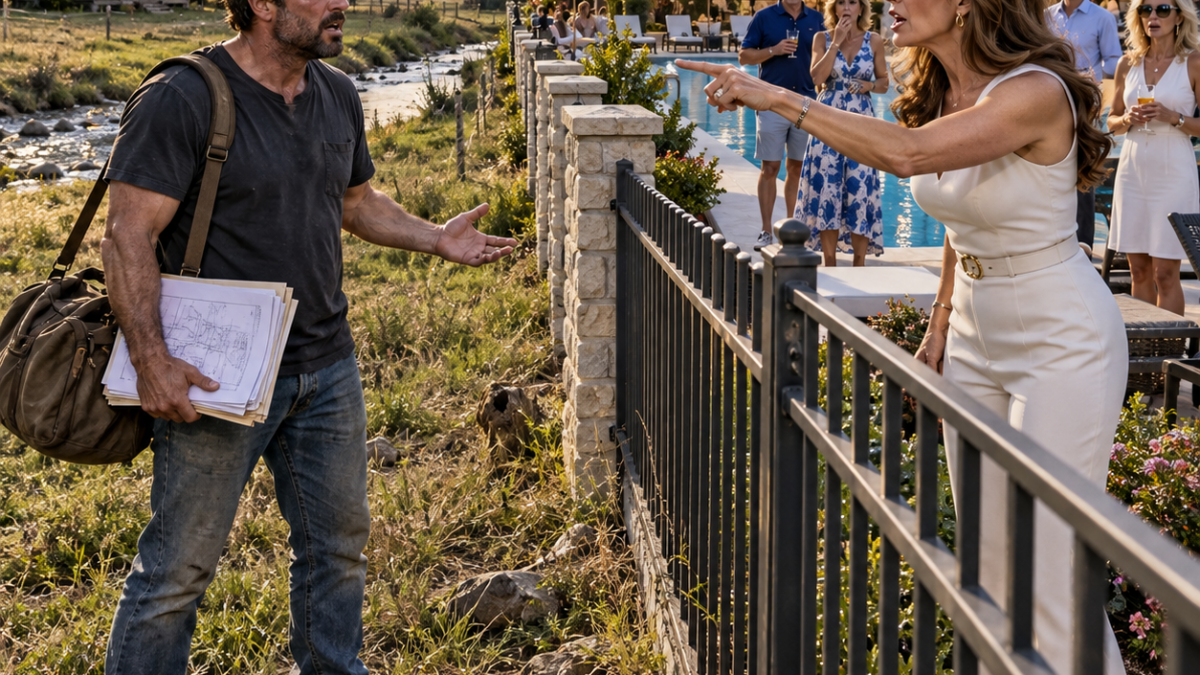
The metal fence ran down toward the creek and curved along a line that made no sense unless someone had decided the creek was the boundary and ignored the old survey entirely. A chunk of the pool deck sat where I had once planned to build a shed. The rear corner of the clubhouse looked like it had bitten into my pasture. Kids splashed in the water. Parents lounged in chairs. Someone grilled burgers. The smell of sunscreen and charcoal drifted over my grass.
It looked like a resort.
Except the resort was in my backyard.
I walked toward the fence, trying to make sense of the layout. I had walked that land in the dark before. I knew where the pasture dipped. I knew where the creek line curved. I knew the old property markers, or at least where they used to be. I knew the shape of the place in my bones.
A woman on the pool deck spotted me.
She narrowed her eyes.
Then she marched toward the fence like I had thrown a rock into the deep end.
She was around forty, maybe a little older, but she carried herself like age had only made her more certain everyone else was wrong. Beautiful in a polished, expensive way. Dark hair under a wide-brimmed sun hat. Oversized sunglasses. White linen pants. Gold jewelry. A fitted coral top that probably cost more than the boots I was wearing. She had the kind of figure and confidence that made people look twice, then regret it when she opened her mouth.
“Excuse me,” she called through the fence, voice sharp enough to cut through the pool noise. “This area is for residents only.”
I raised an eyebrow. “I own this property.”
She gave me a quick once-over, taking in the old unit T-shirt, the dusty jeans, the beat-up truck behind me, the fact that I probably looked like I had been assembled from deployment leftovers and bad sleep.
“Uh-huh,” she said. “And I’m the queen of England.”
A couple of women behind her laughed.
I pointed toward the farmhouse. “That’s my house.”
“If you’re renting nearby, you need to use your assigned access gate.” She gestured toward the sidewalk like she was directing a lost child. “This is Mallory Creek HOA common property.”
“Pretty sure this is my backyard.”
“Pretty sure it’s not.” Her smile was cold, practiced, and mean. “The clubhouse and pool are for dues-paying members. You cannot just wander back here because you see water.”
“I’m not wandering. I’m trying to figure out why there’s a pool on my land.”
Her mouth tightened. “That sounds like a personal issue.”
“No,” I said slowly. “It sounds like a property issue.”
She leaned closer to the fence. “Listen carefully. This is private HOA property. You are trespassing. If you have questions, take them up with the board.”
“Who are you?”
Her smile returned, wider this time.
“Karen Mallory. HOA president.”
Of course her name was Karen.
I almost laughed.
Instead, I looked past her at the deck, the umbrellas, the kids splashing where my field used to be.
Karen followed my gaze and misread the silence as weakness.
“We’ve already had enough trouble with law-and-order types thinking rules don’t apply to them,” she said.
“Law-and-order types?”
Her eyes dipped to my shirt again. “Military, police, whatever. This is a family community. We like things peaceful.”
A strange calm settled over me.
I had learned over the years that anger is useful only after information. Before that, anger just makes noise.
So I nodded once.
“Good to know.”
Karen looked pleased, like she had won something.
I walked back to the farmhouse without another word.
The next morning, a note was taped to my front door.
Dear homeowner,
That was the first funny part. They didn’t even know my name.
The letter said Mallory Creek Estates was a deed-restricted community governed by the Mallory Creek HOA. It claimed all properties in the subdivision were subject to recorded covenants and restrictions. It then listed my violations in neat little bullets.
Unsightly truck in driveway.
Unapproved flag holder on porch.
Noncompliant landscaping.
Exterior appearance inconsistent with community standards.
Failure to register property owner information with the HOA.
I leaned against the doorframe and laughed.
I had seen some ridiculous things in my life, but this had range.
My farmhouse predated the subdivision. I had owned it before most of those houses were even plans on a developer’s desk. My closing documents had never mentioned an HOA. My property had never been part of one. The house had been standing there when that so-called community was still dirt and trees.
I tossed the notice on the kitchen counter, opened my laptop, and pulled up county records.
It took ten minutes.
Maybe less.
There it was.
My parcel, shaded differently from the subdivision around it.
A note attached to the development documents:
EXCLUDED PARCEL – EXISTING SINGLE-FAMILY RESIDENCE
The subdivision wrapped around my land like a horseshoe.
Then I pulled satellite imagery.
The clubhouse and pool sat over the property line.
Not by inches.
Not by a small fence mistake.
A significant piece of the building, pool deck, utility lines, and fence appeared to sit on my parcel.
I stared at the screen for a long time.
While I was overseas, while I was sleeping in places where the walls shook and the air smelled like dust and metal, a board of people had apparently sat in air-conditioning and decided my land was theirs because it was convenient.
They had held meetings.
Approved plans.
Cut ribbons.
Grilled burgers.
Sent me violations.
And built a pool on my dime.
I should have exploded right then.
Instead, something colder came over me.
Information first.
Then action.
I dug through the old file box I had left in the bedroom closet years earlier. By some miracle, it was still there beneath a folded tarp and a box of electrical parts. Inside were my purchase documents, closing statement, title insurance, and original survey. The rear property line clearly ran far beyond the new metal fence. No HOA. No covenants. No shared clubhouse. No cheerful little note saying, by the way, someday a woman named Karen will decide your pasture looks better with lounge chairs.
Next, I called my property manager.
He sounded happy to hear from me for about nine seconds.
Then I asked when someone had built a subdivision around my land.
“Oh,” he said. “Yeah. That.”
“That?”
“The developer came in a few years back. Bought most of the surrounding acreage. We got notices about roadwork and utility easements near the front, but your parcel was separate.”
“Did anyone contact you about the clubhouse?”
A pause.
That pause told me a lot.
“The HOA reached out once or twice,” he said carefully. “They wanted your contact information. We gave them the mailing address we had on file.”
“And?”
“Never heard much after that. I assumed they worked everything out with you directly.”
“They didn’t.”
Another pause.
“I was afraid you might say that.”
I stared out the back window at the clubhouse roof visible beyond the trees.
“What did they think they owned?”
“From what I understood, the HOA believed the developer transferred enough land for the common area. There were survey questions early on. I thought their attorney handled it.”
“Apparently not.”
He sighed. “I’m sorry.”
“Send me everything you have. Every notice. Every email. Every letter from the developer or HOA.”
“I will.”
I hung up and watched a man in mirrored sunglasses flip burgers near the pool. He stood exactly where I had once planned to put a workshop.
I wasn’t mad at the kids swimming.
I wasn’t even mad at the residents enjoying something they believed was theirs.
I was mad at the people who had decided I was absent enough not to matter.
A few days later, I went to the HOA board meeting.
Not angry.
Prepared.
I put my original survey, county documents, satellite printouts, and the violation notice into a folder and walked to the clubhouse during a meeting advertised on a sandwich board outside.
Inside, the room smelled like new carpet and artificial lemon. Folding tables had been arranged in a rectangle. Eight people sat around them with bottled water, laptops, and the exhausted expressions of volunteers who had either taken their small power too seriously or not seriously enough.
At the head of the table sat Karen.
No sun hat this time. Just perfect hair, fitted navy dress, gold necklace, red nails, and that clipboard again. She saw me and immediately frowned.
“This is a private meeting,” she said. “Residents only.”
“I’m a resident.”
Her eyebrows rose. “Of Mallory Creek?”
“Of the farmhouse your pool is sitting behind.”
One of the older men looked up. “The old house? I thought the developer bought that.”
“Nope,” I said. “Still mine.”
Karen gave an impatient little laugh. “Look, we don’t have time for whatever this is. If you’re a tenant, talk to your landlord. If you want to dispute a violation, there’s a form.”
“I’m not a tenant,” I said. “I’m the owner. And I think we have a serious problem with where this building is sitting.”
That got attention.
Karen’s smile tightened. “The clubhouse was properly permitted. Everything was approved. This is community property.”
“Not all of it.”
I stepped forward and laid the original survey and county map on the table.
The older man leaned over first.
I tapped the property lines. “According to the county records and my original survey, your building and pool appear to be about thirty percent on HOA land and seventy percent on mine.”
Silence.
Board members leaned closer.
A woman with reading glasses pulled the map toward her. The older man picked up the survey and squinted.
“This section here,” he said slowly, “would be the pool deck.”
“And the deep end,” I said.
He looked toward Karen. “Did we ever get a recorded deed for that section?”
Karen bristled. “The developer said it was included in the transfer.”
“Was it recorded?”
“The general description matched the common area.”
“That’s not what I asked.”
Karen shot him a look so sharp he leaned back.
I almost enjoyed that.
Almost.
Then she turned on me.
“You come in here after who knows how long away and throw papers around like we’re supposed to panic?”
“I’m not throwing papers. I’m showing you land records.”
“Maybe where you came from, barking orders solves everything,” she said. “But this is not the army.”
“I didn’t bark orders.”
“You’re being aggressive.”
“I’m standing still.”
“You people always think standing there silently is neutral.” Her eyes moved over my shirt again. “Some of us have concerns about militarized attitudes in family spaces.”
A couple board members shifted uncomfortably.
I stared at her.
“I’ve been back less than a week. I’ve unpacked, cut some grass, and asked why your pool is on my land.”
“You’re trying to steal our community pool,” she snapped.
That one actually made me laugh.
“You built on land you don’t own, and I’m stealing?”
“The community voted for this clubhouse. People pay dues for this. Children use that pool. Families rely on it.”
“The developer did not own my land.”
“The developer assured us—”
“The developer,” I cut in, “is not on my deed.”
Karen’s lips pressed into a hard red line.
“If you want to claim this is your land,” she said, “get a lawyer. Until then, stay off the pool deck unless you pay dues like everyone else. And take down that flag holder on your porch. This is not a military base.”
I gathered my papers.
“Good talk,” I said.
Then I left.
I did not take down the flag holder.
I took her advice about the lawyer.
The property attorney I found came recommended by another veteran in a neighboring town. His name was Paul Hensley, and he had the calm, slightly dry manner of a man who had seen every possible way human beings could ruin a boundary line. His office smelled like old paper and coffee. The shelves behind him were full of binders, legal texts, and one framed fishing photo that looked like it had been taken during his only happy day in 1998.
I gave him everything.
He read quietly.
Then he read again.
Then he leaned back and let out a low whistle.
“Well,” he said, “they’ve really stepped in it.”
“That’s my professional assessment too.”
“In plain English, if the current survey confirms what these records suggest, this is trespass and encroachment on a very serious scale. This isn’t a fence three inches over a property line. They placed permanent improvements—building, pool, deck, utilities—on land they did not own.”
“What are my options?”
He ticked them off on his fingers. “One, you can grant an easement or sell them the encroached portion at fair market value. Two, you can demand removal and restoration. Three, you can sue for trespass, ejectment, damages, loss of use, unjust enrichment, and potentially punitive damages if we can show they knew or should have known.”
“I’m not feeling generous.”
He smiled faintly. “I suspected as much.”
“How do we prove what they knew?”
“Records. Permits. Board minutes. Developer correspondence. Attorney memos. First, we get a current survey. Then we request and subpoena what we need. After that, we send a demand letter. If they’re smart, they settle. If they’re stupid, they keep digging.”
“How patient do I need to be?”
He studied me.
“How patient are you?”
I thought about long nights waiting for movement. Months away from home. Years lived in pieces. Orders delayed, changed, delayed again. Men learn patience in the military, though not always the peaceful kind.
“I can do patient,” I said.
So we did it right.
The surveyor came out a week later with a tripod, flags, and the relaxed attitude of a man who had no idea he was about to ruin someone’s committee.
I walked the property with him while he measured and staked the lines. When we reached the pool area, his eyebrows went up.
“Yeah,” he said. “This is bad.”
“How bad?”
He pointed. “Your original survey wasn’t wrong. The rear section of the pool and a lot of the deck are on your property. Utility lines too. And that corner of the clubhouse? Over by about ten feet.”
“Could this be an honest mistake?”
He looked at the new subdivision map.
“If it were a fence, maybe. This?” He shook his head. “Someone ignored something. The excluded parcel is clearly marked.”
I paid him, took the survey, and delivered it to Paul.
Then I played nice.
Not friendly.
Nice.
I fixed up my house. Repaired broken steps. Cleaned out the old shed. Cut grass. Hauled junk. Painted trim. Neighbors got curious. Some came by and introduced themselves. Most were decent people. A retired teacher brought me banana bread. A guy named Luis helped me drag an old washing machine out from behind the barn. A woman with two kids apologized awkwardly for using the pool and said she had no idea there was a boundary issue.
I believed her.
Most residents had simply bought houses in a community with a clubhouse and assumed someone had checked the basics before building it.
That was the tragedy of it.
Ordinary people had paid dues into a system run by people arrogant enough to gamble with someone else’s land.
Karen, however, continued treating me like a threat with boots.
Every few days, another violation notice appeared.
Grass height.
Truck parked improperly.
Construction materials visible from road.
Unapproved flag display.
Storage container not compliant.
Military equipment visible from exterior.
That one referred to an old footlocker on my porch.
I made copies of each notice, dated them, and filed them.
One afternoon, I came home from the hardware store and found Karen standing in my front yard, hands on hips, staring at my porch.
I got out of the truck. “What did the flag holder do to you?”
She startled, then recovered with a sneer. “We have specific guidelines for flags. Size, placement, type, lighting, hardware. You cannot just display whatever you want because you feel patriotic.”
“It’s my house.”
“It’s within the community.”
“My property predates your community.”
“The rules apply to everyone.”
“I didn’t vote on them.”
She sniffed. “You were probably off somewhere violent.”
The words were so blunt they almost passed through me before I registered them.
“What did you say?”
Her chin lifted. “Some of us chose peaceful lives. I don’t see why your personal history should give you special treatment.”
“You mean my service?”
“I mean your job,” she said. “Guns, uniforms, flags, that whole culture—it makes people uncomfortable. Some children are sensitive to those things.”
“Maybe teach them what the flag means instead of being afraid of it.”
Her eyes flashed. “You’re being hostile again.”
“I just got out of my truck.”
“You’re towering.”
“I’m standing in my own yard.”
“You know,” she said, writing something on her clipboard, “some veterans struggle to adjust. I’ve read about it. You can’t just move in and intimidate people into letting you do whatever you want.”
I felt anger rise hot and fast.
Then I smiled.
Slowly.
Unpleasantly.
“You’re absolutely right, Karen. I can’t intimidate anyone into anything.”
I looked toward the clubhouse.
“But lawyers can.”
She blinked. “What’s that supposed to mean?”
“You’ll see.”
I walked inside and shut the door before I said something less useful.
Behind that door, I grinned.
Because while Karen had been busy writing me up for the crime of existing wrong, Paul had just emailed the records he’d obtained.
The HOA had known there was a boundary problem from the start.
Meeting minutes from the planning phase included a note:
Boundary question raised regarding farmhouse parcel and rear common area.
Another line said the developer had assured the board everything could be “cleaned up later by adjusting deeds.”
Their own attorney had warned in a memo that any encroachment onto the excluded parcel would need to be resolved with the owner before construction.
They never resolved it.
They built anyway.
The demand letter Paul drafted was a masterpiece of controlled destruction.
It laid out the original survey, current survey, county records, permits, board minutes, attorney memo, violation notices, and Karen’s harassment. It stated that Mallory Creek HOA had constructed significant permanent improvements on my land without consent and in knowing disregard of clear property records.
It gave them two options.
Option one: remove all structures, improvements, utilities, pool decking, and fencing from my property at their expense, restore the land as much as reasonably possible, and pay damages for trespass and loss of use.
Option two: negotiate purchase of the encroached portion at three times fair market value, plus damages, legal fees, and an annual easement fee until full payment and title transfer were complete.
If they refused, we would file suit for trespass, ejectment, damages, and name individual board members personally for knowingly continuing the encroachment.
Paul sent it certified mail and emailed the board.
Karen appeared on my porch thirty minutes later.
She didn’t knock.
She pounded.
I opened the door and leaned against the frame.
She stood there in a white blouse, designer jeans, perfect hair, and fury so bright it seemed to vibrate off her skin. She waved the demand letter in my face.
“What the hell is this?”
“Morning.”
“Are you insane?”
“No.”
“You cannot sue an entire neighborhood because you want more grass.”
“I’m suing because you built on my property.”
“This clubhouse is for children. Families. The community. You want to destroy it out of spite?”
“I want you off my land. How you do that is up to you.”
She jabbed a finger toward my chest but stopped just short of touching me.
“You waited. You knew and waited. That’s sneaky. That’s manipulative. That’s exactly the kind of thing—”
“Careful,” I said.
Her eyes narrowed. “You could have come to us like a normal person.”
“I did. You told me to get a lawyer.”
“That was before you went behind our backs.”
“You mean before I listened?”
Her nostrils flared.
“The developer told us it was included.”
“The developer is not on my deed. I am.”
“You’re going to be responsible for kids losing their pool. Do you understand that? Do you want that on your conscience?”
“My conscience is fine.”
“Of course it is.” Her voice dropped, dripping poison. “I suppose after what you people do overseas, a few crying children won’t bother you.”
There it was.
The line even she should have known not to cross.
For a second, the whole world narrowed to her face.
Then I stepped back.
“Talk to your lawyer, Karen.”
She opened her mouth.
I closed the door.
A week later, we filed suit.
The legal process took months.
HOA lawyers tried every argument they could find. Adverse possession. Prescriptive easement. Implied consent. Reliance on developer representations. Community hardship. Public benefit. Some nonsense about my failure to object during construction, as if I was supposed to sense from another continent that strangers were pouring concrete into my pasture.
Paul swatted each argument down patiently.
The records were brutal for them.
They had been warned.
They had failed to contact me properly.
They had built anyway.
Then, once I came home, they harassed me with fake violations while knowing there was a boundary problem.
Depositions were the best and worst part.
Best because people under oath often reveal more than they intend.
Worst because listening to Karen talk about me like I was a contamination in her neighborhood made my hands curl into fists under the table.
When Paul asked why they never resolved the boundary issue with me before construction, Karen said, “We tried. He was off doing military things. We weren’t going to reward absentee ownership by bending over backwards.”
The court reporter paused.
Just slightly.
Then kept typing.
When asked if she understood what trespass meant, Karen said, “Trespass is when someone enters property where they do not belong. Like when he came back and started harassing residents at the pool.”
Paul looked at her.
“You understand the question concerns the HOA’s structures being located on my client’s land?”
Karen replied, “That is his interpretation.”
“It’s the surveyor’s interpretation.”
“Surveyors can be wrong.”
“And recorded deeds?”
“They can be outdated.”
“And property rights?”
She smiled.
That polished, poisonous smile.
“Communities evolve.”
Paul told me afterward, “She is extremely helpful.”
“I thought she was terrible.”
“She is. That’s why she’s helpful.”
Eventually, mediation was ordered.
We met in a beige room with bad coffee, a long table, and a mediator who looked like he had watched too many people ruin their own lives over fences. On one side sat me and Paul. On the other sat Karen, two board members who looked physically ill, and the HOA’s exhausted attorney.
The mediator went through the usual speech about compromise, cost, uncertainty, and avoiding trial.
Then he looked at the HOA side.
“Here is the situation as I see it. The surveys and records show substantial encroachment. The clubhouse, pool deck, utility lines, and related improvements are partially located on OP’s property. The law does not allow an HOA to build permanent structures on land it does not own merely because the community benefits from them.”
Karen crossed her arms.
The HOA attorney spoke first. “We are willing to purchase the strip at fair market value.”
Paul slid our number across the table.
Three times their appraisal.
Legal fees.
Damages.
Annual easement fee until full transfer.
Structured payments secured by HOA common funds.
Karen stared at the paper.
Then she laughed once.
“That is extortion.”
“No,” Paul said. “That is compensation for years of trespass and the luxury of not having to rip out your clubhouse and pool.”
One of the other board members rubbed his forehead. “We don’t have that kind of money.”
“Then remove the encroachment,” Paul said. “Based on contractor estimates, that will cost significantly more and may compromise the structure.”
The mediator nodded. “The choice is between painful surgery and amputation.”
Karen glared at me. “You’re a veteran. You get benefits. Why do you need this money?”
I stared at her.
“Because it’s mine.”
She opened her mouth.
I cut her off.
“And because you decided my land was your playground.”
The other board member asked for a private moment.
They stepped into the hallway.
The walls were thin.
Karen’s voice rose above the others, using words like principle, precedent, and we cannot let him win.
The others used words like bankruptcy, liability, and special assessment.
Fifteen minutes later, they returned.
The HOA attorney looked like a man surrendering a fort nobody should have built.
“We can agree to the framework,” he said, “with discussion on payment schedule.”
Paul and I had already discussed this.
I was angry, but I was not trying to force families out of homes overnight. The homeowners would pay because their board had created the mess, but I didn’t need blood from every random resident who had simply bought into a community without knowing the pool sat on stolen ground.
So we agreed to structured payments over several years.
They would pay my legal fees up front.
They would pay damages and the inflated purchase price over time, secured by HOA funds and special assessments if necessary. The land under the encroached portion would remain legally mine until the final payment cleared. They would cease all enforcement actions against me. They would acknowledge in writing that my parcel was not and had never been subject to HOA covenants, dues, fines, or architectural control.
I walked out of mediation feeling lighter than I had in years.
Then the special assessment notices went out.
That was when the neighborhood learned the truth.
People were furious.
Not at first at me, though Karen tried hard to make that happen. She went door to door telling people I was exploiting a technicality, punishing families, attacking children, and destroying peace. She called me a warmonger with a lawyer, which would have been funnier if she had not meant it.
Then someone leaked portions of the court filings into the neighborhood Facebook group.
Survey overlays.
Board minutes.
The attorney memo warning them not to build without resolving the encroachment.
Excerpts from Karen’s deposition about “military types” and “family values.”
The tone changed fast.
Residents realized they had not been protected by Karen’s leadership.
They had been financially endangered by it.
The recall vote happened within a week.
I did not attend the meeting.
I didn’t need to.
Half the neighborhood told me what happened afterward.
Karen apparently gave a speech about peace, unity, and refusing to bow to intimidation. Then someone asked why peace and unity required building on someone else’s land. Someone else asked why she ignored the attorney’s warning. A veteran who lived two streets over stood up and read one of Karen’s deposition quotes aloud.
By the end, even people who hated me for the assessment hated her more.
The recall passed by a landslide.
Karen was removed as HOA president and from the board entirely. Other board members resigned or were replaced. A new board hired outside management and a different law firm. They sent me a stiff but real apology. Not emotional. Not warm. But real enough.
A couple months later, Karen moved out.
I watched the moving truck from my porch.
I won’t pretend I didn’t.
She came outside wearing sunglasses, directing movers with sharp gestures, still trying to look in control. For a moment, she looked across the street at my farmhouse.
I raised my coffee mug.
Not a wave.
A toast.
Her mouth tightened.
Then she turned away.
One neighbor later told me Karen couldn’t afford the special assessment on top of her already stretched mortgage and had grown tired of being treated like the reason everyone’s dues had doubled. That sounded right. People like Karen can survive being disliked. They cannot survive losing the illusion that they are admired.
As for me, I used the settlement money carefully.
First, I paid off the last of my mortgage.
There are few feelings in life like knowing no bank can take your home over one missed payment. After years of orders, deployments, landlords, and temporary addresses, that one piece of certainty felt almost holy.
Second, I fixed the farmhouse properly.
New porch.
Updated wiring.
Workshop in the old shed.
A real flagpole anchored in concrete with proper lighting, installed exactly to county code and absolutely not submitted to the HOA for approval.
Third, I did something that made me smile every time I thought about it.
Until the HOA finished paying, the land under the clubhouse remained legally mine.
Paul pointed out that, as owner, I could grant temporary licenses for use of that land so long as I didn’t interfere with the settlement terms.
So I made some calls.
Within a few months, on Tuesday and Thursday evenings, the Mallory Creek “family-friendly, non-military” clubhouse hosted a free support group for local veterans.
Once a month, we held a cookout for veterans and their families.
My buddy from a nonprofit helped organize it. We brought folding tables, burgers, coffee, and people who understood the strange loneliness of coming home to a country that sometimes thanked you loudly and listened poorly.
Most residents loved it.
More veterans lived in those perfect cul-de-sacs than Karen would have liked to admit. Some told me privately they had kept their service quiet because of comments she made over the years. Now their kids swam in the same pool while their parents sat under umbrellas, swapped stories, and ate burgers grilled on land Karen once tried to keep free of “military culture.”
The first cookout, I stood near the fence at sunset and watched families spread across the deck.
For once, the pool did not look like an insult.
It looked useful.
That surprised me.
Maybe land can heal too, if people finally stop lying about who owns it.
I never joined the HOA.
I never will.
The new board asked once, politely, if I would consider some kind of associate membership since the clubhouse issue had created a connection between us.
I laughed.
They laughed too.
That was the correct response.
The farmhouse is still a work in progress. Old houses are not fixed so much as negotiated with over time. The porch creaks less now. The workshop smells like sawdust. The creek still runs behind the property after rain. Sometimes I walk down there in the evening with my dog and listen to water over stones, the same sound that made me buy the place years ago.
The subdivision lights glow beyond the trees.
The clubhouse still stands.
But now the records tell the truth.
My parcel is excluded.
My home is mine.
The HOA has no authority over my land, my flag, my truck, my shed, or my front porch. Every time Karen’s old violation notices surface in a folder, I consider framing one beside the settlement agreement just for contrast.
I don’t, because Jenna says that would be unhealthy.
She is probably right.
Mostly.
Sometimes people ask why I didn’t force them to tear it all down.
I could have pushed harder. Maybe won removal. Maybe watched excavators chew through the pool deck while residents cried about assessments and lost amenities. There was a version of me angry enough to want that.
But after months of fighting, I realized I didn’t want a crater in my pasture.
I wanted acknowledgment.
Compensation.
Security.
And peace.
The HOA paid. Karen left. My mortgage disappeared. Veterans now meet in a clubhouse she wanted to keep pure from people like us. That outcome feels better than rubble.
Still, I remember the first day.
I remember standing behind that fence while strangers swam on my land.
I remember Karen’s voice telling me I was trespassing.
I remember how easy it was for her to dismiss me because I looked tired, dusty, military, inconvenient. She saw the old T-shirt, the truck, the silence, and thought I was just another problem she could regulate into submission.
She was wrong.
The land had waited for me.
The records had waited for me.
And when I finally came home, I did exactly what she told me to do.
I got a lawyer.
Karen built her little kingdom over my boundary line because she thought absence meant surrender.
But I had survived enough to know that quiet ground is not abandoned ground.
Sometimes it is simply waiting for the owner to return.
𝗧𝗛𝗘 𝗘𝗡𝗗
Karen Built Her HOA Clubhouse on My Land While I Was Overseas, Then Called Me a Trespasser
I came home from overseas expecting weeds, dust, and a quiet farmhouse that still smelled like old wood and waiting.
Instead, I found strangers swimming in a blue pool that glittered where my back pasture used to be.
And when the HOA president marched up to the fence and told me I was trespassing on community property, I realized someone had built an entire neighborhood lie on land I had paid for with years of my life.
I bought the property before I ever set foot in a war zone.
Back then, it was just an ugly little farmhouse outside a sleepy town, the kind realtors call “full of potential” when what they really mean is nobody with options wanted to touch it. The porch sagged. The siding had faded into a color somewhere between gray and regret. The barn out back leaned like it had heard bad news. Half the fencing was down, the driveway was cracked, and the field behind the house was mostly scrub grass, wildflowers, and stubborn brush that came back no matter how often someone cut it.
But it backed up to a creek.
That was what got me.
There was a narrow little creek behind the pasture, shallow most of the year but loud after rain, with trees bending over it like they were whispering to the water. When I first walked the property, I stood near that creek in boots that still had base dust in the tread, listening to the water run over stones, and I thought, someday.
Someday I’d come back here for good.
Someday there would be no alarm at 0500 unless I set it myself. No sergeant barking because someone else forgot something. No sand in my teeth. No convoy briefings. No sleeping with one ear open. No packing my life into duffel bags every time someone with more rank and less sleep decided where I belonged next.
Just my land.
My house.
My quiet.
I was junior enlisted when I bought it. I used a VA loan, stretched every dollar until it squealed, and signed papers with the confidence of a young man who had no idea how many ways life could interrupt a plan. The idea was simple enough: fix the place slowly, rent it out whenever I deployed, and eventually turn it into a place where I could disappear from the world without actually vanishing.
For a while, that worked.
Deployments stacked up. Training rotations came and went. I lived out of bags and barracks and temporary rooms in places that mostly existed to me as coordinates, briefings, and headlines. I wasn’t home enough to mow grass or fix porches, so I hired a local property manager. He found tenants—mostly older folks who didn’t need fancy and wanted cheap rent. They kept the place lived in. I kept the taxes paid. The property more or less carried itself.
Years passed that way.
The farmhouse became less of a home and more of a promise I kept renewing from far away.
Whenever things got bad overseas, I’d picture that creek. I’d picture the pasture in summer, waist-high and buzzing with insects. I’d picture myself there with a toolbox, a dog, maybe a small business fixing things for people who didn’t ask me to salute before breakfast. I never told many people that. Soldiers don’t always say the soft things out loud. But that picture got me through more nights than I can count.
When I finally got out, I drove back with everything I owned stuffed into my truck and a duffel bag riding shotgun like an old friend.
I expected the house to look rough.
I expected weeds, dust, maybe a few problems the property manager had “forgotten” to mention. I expected to curse at a water heater, fight with the porch steps, and spend three months learning which repairs needed a professional and which ones could be handled with YouTube, stubbornness, and bad decisions.
What I did not expect was a master-planned subdivision where my dirt road used to be.
I turned off the highway and hit the brakes harder than I meant to.
Rows of identical houses stretched where there had once been fields and trees. Same mailboxes. Same trimmed lawns. Same tidy driveways. Small ornamental trees lined the new road like they had been installed by committee. There were speed bumps, children-at-play signs, decorative streetlamps, and a huge stone monument at the entrance that read:
MALLORY CREEK ESTATES
A DEED-RESTRICTED COMMUNITY
I stared at it through the windshield.
My GPS said I was in the right place.
The road name was the same. The intersection was the same. But the place felt like someone had taken my memory, paved over it, and sold it in lots with upgraded countertops.
I drove slowly, feeling the old unease build in my chest. Not combat fear. Something stranger. The feeling of coming home and realizing home had been moving without you.
Then I saw my driveway.
Or what was left of it.
It branched off the new main road at a strange angle, as if the subdivision had been designed around an inconvenience nobody wanted to acknowledge. Two SUVs were parked halfway across the entrance, forcing me to ease around them. On one side stood a row of new houses. On the other was a huge stucco building with glass doors, a covered patio, a metal fence, umbrellas, lounge chairs, a grill area, and beyond all that, a bright blue swimming pool flashing in the afternoon sun.
A sign near the gate read:
MALLORY CREEK COMMUNITY CLUBHOUSE AND POOL
RESIDENTS ONLY
For a few seconds, my brain refused to understand what my eyes were showing me.
The building sat where my back pasture should have been.
part2
I drove down the old cracked driveway in a kind of trance.
At the end, past the line of scrub trees I remembered, the farmhouse still stood. It looked better than I expected, which somehow made everything worse. New roof. Fresh paint. The porch had been braced. The last tenants had moved out a few weeks earlier, according to my property manager, so the place was empty but not abandoned.
I parked near the house and got out slowly.
For a minute, I just stood there with my hand on the truck door, looking back toward the clubhouse.
You know that feeling when something is wrong but your mind has not caught up yet? I had felt it before. The split second before incoming becomes real. The moment before a routine drive stops being routine. Your body understands first. Your brain arrives late, carrying paperwork.
That was how I felt staring at that pool.
Wrong.
Wrong.
Wrong.
I unlocked the farmhouse, dropped my duffel bag inside the old bedroom, and walked straight through to the back door.
From behind the house, the scene looked even more insane.
The clubhouse and pool were not merely close to my property.
They were on it.
The metal fence ran down toward the creek and curved along a line that made no sense unless someone had decided the creek was the boundary and ignored the old survey entirely. A chunk of the pool deck sat where I had once planned to build a shed. The rear corner of the clubhouse looked like it had bitten into my pasture. Kids splashed in the water. Parents lounged in chairs. Someone grilled burgers. The smell of sunscreen and charcoal drifted over my grass.
It looked like a resort.
Except the resort was in my backyard.
I walked toward the fence, trying to make sense of the layout. I had walked that land in the dark before. I knew where the pasture dipped. I knew where the creek line curved. I knew the old property markers, or at least where they used to be. I knew the shape of the place in my bones.
A woman on the pool deck spotted me.
She narrowed her eyes.
Then she marched toward the fence like I had thrown a rock into the deep end.
She was around forty, maybe a little older, but she carried herself like age had only made her more certain everyone else was wrong. Beautiful in a polished, expensive way. Dark hair under a wide-brimmed sun hat. Oversized sunglasses. White linen pants. Gold jewelry. A fitted coral top that probably cost more than the boots I was wearing. She had the kind of figure and confidence that made people look twice, then regret it when she opened her mouth.
“Excuse me,” she called through the fence, voice sharp enough to cut through the pool noise. “This area is for residents only.”
I raised an eyebrow. “I own this property.”
She gave me a quick once-over, taking in the old unit T-shirt, the dusty jeans, the beat-up truck behind me, the fact that I probably looked like I had been assembled from deployment leftovers and bad sleep.
“Uh-huh,” she said. “And I’m the queen of England.”
A couple of women behind her laughed.
I pointed toward the farmhouse. “That’s my house.”
“If you’re renting nearby, you need to use your assigned access gate.” She gestured toward the sidewalk like she was directing a lost child. “This is Mallory Creek HOA common property.”
“Pretty sure this is my backyard.”
“Pretty sure it’s not.” Her smile was cold, practiced, and mean. “The clubhouse and pool are for dues-paying members. You cannot just wander back here because you see water.”
“I’m not wandering. I’m trying to figure out why there’s a pool on my land.”
Her mouth tightened. “That sounds like a personal issue.”
“No,” I said slowly. “It sounds like a property issue.”
She leaned closer to the fence. “Listen carefully. This is private HOA property. You are trespassing. If you have questions, take them up with the board.”
“Who are you?”
Her smile returned, wider this time.
“Karen Mallory. HOA president.”
Of course her name was Karen.
I almost laughed.
Instead, I looked past her at the deck, the umbrellas, the kids splashing where my field used to be.
Karen followed my gaze and misread the silence as weakness.
“We’ve already had enough trouble with law-and-order types thinking rules don’t apply to them,” she said.
“Law-and-order types?”
Her eyes dipped to my shirt again. “Military, police, whatever. This is a family community. We like things peaceful.”
A strange calm settled over me.
I had learned over the years that anger is useful only after information. Before that, anger just makes noise.
So I nodded once.
“Good to know.”
Karen looked pleased, like she had won something.
I walked back to the farmhouse without another word.
The next morning, a note was taped to my front door.
Dear homeowner,
That was the first funny part. They didn’t even know my name.
The letter said Mallory Creek Estates was a deed-restricted community governed by the Mallory Creek HOA. It claimed all properties in the subdivision were subject to recorded covenants and restrictions. It then listed my violations in neat little bullets.
Unsightly truck in driveway.
Unapproved flag holder on porch.
Noncompliant landscaping.
Exterior appearance inconsistent with community standards.
Failure to register property owner information with the HOA.
I leaned against the doorframe and laughed.
I had seen some ridiculous things in my life, but this had range.
My farmhouse predated the subdivision. I had owned it before most of those houses were even plans on a developer’s desk. My closing documents had never mentioned an HOA. My property had never been part of one. The house had been standing there when that so-called community was still dirt and trees.
I tossed the notice on the kitchen counter, opened my laptop, and pulled up county records.
It took ten minutes.
Maybe less.
There it was.
My parcel, shaded differently from the subdivision around it.
A note attached to the development documents:
EXCLUDED PARCEL – EXISTING SINGLE-FAMILY RESIDENCE
The subdivision wrapped around my land like a horseshoe.
Then I pulled satellite imagery.
The clubhouse and pool sat over the property line.
Not by inches.
Not by a small fence mistake.
A significant piece of the building, pool deck, utility lines, and fence appeared to sit on my parcel.
I stared at the screen for a long time.
While I was overseas, while I was sleeping in places where the walls shook and the air smelled like dust and metal, a board of people had apparently sat in air-conditioning and decided my land was theirs because it was convenient.
They had held meetings.
Approved plans.
Cut ribbons.
Grilled burgers.
Sent me violations.
And built a pool on my dime.
I should have exploded right then.
Instead, something colder came over me.
Information first.
Then action.
I dug through the old file box I had left in the bedroom closet years earlier. By some miracle, it was still there beneath a folded tarp and a box of electrical parts. Inside were my purchase documents, closing statement, title insurance, and original survey. The rear property line clearly ran far beyond the new metal fence. No HOA. No covenants. No shared clubhouse. No cheerful little note saying, by the way, someday a woman named Karen will decide your pasture looks better with lounge chairs.
Next, I called my property manager.
He sounded happy to hear from me for about nine seconds.
Then I asked when someone had built a subdivision around my land.
“Oh,” he said. “Yeah. That.”
“That?”
“The developer came in a few years back. Bought most of the surrounding acreage. We got notices about roadwork and utility easements near the front, but your parcel was separate.”
“Did anyone contact you about the clubhouse?”
A pause.
That pause told me a lot.
“The HOA reached out once or twice,” he said carefully. “They wanted your contact information. We gave them the mailing address we had on file.”
“And?”
“Never heard much after that. I assumed they worked everything out with you directly.”
“They didn’t.”
Another pause.
“I was afraid you might say that.”
I stared out the back window at the clubhouse roof visible beyond the trees.
“What did they think they owned?”
“From what I understood, the HOA believed the developer transferred enough land for the common area. There were survey questions early on. I thought their attorney handled it.”
“Apparently not.”
He sighed. “I’m sorry.”
“Send me everything you have. Every notice. Every email. Every letter from the developer or HOA.”
“I will.”
I hung up and watched a man in mirrored sunglasses flip burgers near the pool. He stood exactly where I had once planned to put a workshop.
I wasn’t mad at the kids swimming.
I wasn’t even mad at the residents enjoying something they believed was theirs.
I was mad at the people who had decided I was absent enough not to matter.
A few days later, I went to the HOA board meeting.
Not angry.
Prepared.
I put my original survey, county documents, satellite printouts, and the violation notice into a folder and walked to the clubhouse during a meeting advertised on a sandwich board outside.
Inside, the room smelled like new carpet and artificial lemon. Folding tables had been arranged in a rectangle. Eight people sat around them with bottled water, laptops, and the exhausted expressions of volunteers who had either taken their small power too seriously or not seriously enough.
At the head of the table sat Karen.
No sun hat this time. Just perfect hair, fitted navy dress, gold necklace, red nails, and that clipboard again. She saw me and immediately frowned.
“This is a private meeting,” she said. “Residents only.”
“I’m a resident.”
Her eyebrows rose. “Of Mallory Creek?”
“Of the farmhouse your pool is sitting behind.”
One of the older men looked up. “The old house? I thought the developer bought that.”
“Nope,” I said. “Still mine.”
Karen gave an impatient little laugh. “Look, we don’t have time for whatever this is. If you’re a tenant, talk to your landlord. If you want to dispute a violation, there’s a form.”
“I’m not a tenant,” I said. “I’m the owner. And I think we have a serious problem with where this building is sitting.”
That got attention.
Karen’s smile tightened. “The clubhouse was properly permitted. Everything was approved. This is community property.”
“Not all of it.”
I stepped forward and laid the original survey and county map on the table.
The older man leaned over first.
I tapped the property lines. “According to the county records and my original survey, your building and pool appear to be about thirty percent on HOA land and seventy percent on mine.”
Silence.
Board members leaned closer.
A woman with reading glasses pulled the map toward her. The older man picked up the survey and squinted.
“This section here,” he said slowly, “would be the pool deck.”
“And the deep end,” I said.
He looked toward Karen. “Did we ever get a recorded deed for that section?”
Karen bristled. “The developer said it was included in the transfer.”
“Was it recorded?”
“The general description matched the common area.”
“That’s not what I asked.”
Karen shot him a look so sharp he leaned back.
I almost enjoyed that.
Almost.
Then she turned on me.
“You come in here after who knows how long away and throw papers around like we’re supposed to panic?”
“I’m not throwing papers. I’m showing you land records.”
“Maybe where you came from, barking orders solves everything,” she said. “But this is not the army.”
“I didn’t bark orders.”
“You’re being aggressive.”
“I’m standing still.”
“You people always think standing there silently is neutral.” Her eyes moved over my shirt again. “Some of us have concerns about militarized attitudes in family spaces.”
A couple board members shifted uncomfortably.
I stared at her.
“I’ve been back less than a week. I’ve unpacked, cut some grass, and asked why your pool is on my land.”
“You’re trying to steal our community pool,” she snapped.
That one actually made me laugh.
“You built on land you don’t own, and I’m stealing?”
“The community voted for this clubhouse. People pay dues for this. Children use that pool. Families rely on it.”
“The developer did not own my land.”
“The developer assured us—”
“The developer,” I cut in, “is not on my deed.”
Karen’s lips pressed into a hard red line.
“If you want to claim this is your land,” she said, “get a lawyer. Until then, stay off the pool deck unless you pay dues like everyone else. And take down that flag holder on your porch. This is not a military base.”
I gathered my papers.
“Good talk,” I said.
Then I left.
I did not take down the flag holder.
I took her advice about the lawyer.
The property attorney I found came recommended by another veteran in a neighboring town. His name was Paul Hensley, and he had the calm, slightly dry manner of a man who had seen every possible way human beings could ruin a boundary line. His office smelled like old paper and coffee. The shelves behind him were full of binders, legal texts, and one framed fishing photo that looked like it had been taken during his only happy day in 1998.
I gave him everything.
He read quietly.
Then he read again.
Then he leaned back and let out a low whistle.
“Well,” he said, “they’ve really stepped in it.”
“That’s my professional assessment too.”
“In plain English, if the current survey confirms what these records suggest, this is trespass and encroachment on a very serious scale. This isn’t a fence three inches over a property line. They placed permanent improvements—building, pool, deck, utilities—on land they did not own.”
“What are my options?”
He ticked them off on his fingers. “One, you can grant an easement or sell them the encroached portion at fair market value. Two, you can demand removal and restoration. Three, you can sue for trespass, ejectment, damages, loss of use, unjust enrichment, and potentially punitive damages if we can show they knew or should have known.”
“I’m not feeling generous.”
He smiled faintly. “I suspected as much.”
“How do we prove what they knew?”
“Records. Permits. Board minutes. Developer correspondence. Attorney memos. First, we get a current survey. Then we request and subpoena what we need. After that, we send a demand letter. If they’re smart, they settle. If they’re stupid, they keep digging.”
“How patient do I need to be?”
He studied me.
“How patient are you?”
I thought about long nights waiting for movement. Months away from home. Years lived in pieces. Orders delayed, changed, delayed again. Men learn patience in the military, though not always the peaceful kind.
“I can do patient,” I said.
So we did it right.
The surveyor came out a week later with a tripod, flags, and the relaxed attitude of a man who had no idea he was about to ruin someone’s committee.
I walked the property with him while he measured and staked the lines. When we reached the pool area, his eyebrows went up.
“Yeah,” he said. “This is bad.”
“How bad?”
He pointed. “Your original survey wasn’t wrong. The rear section of the pool and a lot of the deck are on your property. Utility lines too. And that corner of the clubhouse? Over by about ten feet.”
“Could this be an honest mistake?”
He looked at the new subdivision map.
“If it were a fence, maybe. This?” He shook his head. “Someone ignored something. The excluded parcel is clearly marked.”
I paid him, took the survey, and delivered it to Paul.
Then I played nice.
Not friendly.
Nice.
I fixed up my house. Repaired broken steps. Cleaned out the old shed. Cut grass. Hauled junk. Painted trim. Neighbors got curious. Some came by and introduced themselves. Most were decent people. A retired teacher brought me banana bread. A guy named Luis helped me drag an old washing machine out from behind the barn. A woman with two kids apologized awkwardly for using the pool and said she had no idea there was a boundary issue.
I believed her.
Most residents had simply bought houses in a community with a clubhouse and assumed someone had checked the basics before building it.
That was the tragedy of it.
Ordinary people had paid dues into a system run by people arrogant enough to gamble with someone else’s land.
Karen, however, continued treating me like a threat with boots.
Every few days, another violation notice appeared.
Grass height.
Truck parked improperly.
Construction materials visible from road.
Unapproved flag display.
Storage container not compliant.
Military equipment visible from exterior.
That one referred to an old footlocker on my porch.
I made copies of each notice, dated them, and filed them.
One afternoon, I came home from the hardware store and found Karen standing in my front yard, hands on hips, staring at my porch.
I got out of the truck. “What did the flag holder do to you?”
She startled, then recovered with a sneer. “We have specific guidelines for flags. Size, placement, type, lighting, hardware. You cannot just display whatever you want because you feel patriotic.”
“It’s my house.”
“It’s within the community.”
“My property predates your community.”
“The rules apply to everyone.”
“I didn’t vote on them.”
She sniffed. “You were probably off somewhere violent.”
The words were so blunt they almost passed through me before I registered them.
“What did you say?”
Her chin lifted. “Some of us chose peaceful lives. I don’t see why your personal history should give you special treatment.”
“You mean my service?”
“I mean your job,” she said. “Guns, uniforms, flags, that whole culture—it makes people uncomfortable. Some children are sensitive to those things.”
“Maybe teach them what the flag means instead of being afraid of it.”
Her eyes flashed. “You’re being hostile again.”
“I just got out of my truck.”
“You’re towering.”
“I’m standing in my own yard.”
“You know,” she said, writing something on her clipboard, “some veterans struggle to adjust. I’ve read about it. You can’t just move in and intimidate people into letting you do whatever you want.”
I felt anger rise hot and fast.
Then I smiled.
Slowly.
Unpleasantly.
“You’re absolutely right, Karen. I can’t intimidate anyone into anything.”
I looked toward the clubhouse.
“But lawyers can.”
She blinked. “What’s that supposed to mean?”
“You’ll see.”
I walked inside and shut the door before I said something less useful.
Behind that door, I grinned.
Because while Karen had been busy writing me up for the crime of existing wrong, Paul had just emailed the records he’d obtained.
The HOA had known there was a boundary problem from the start.
Meeting minutes from the planning phase included a note:
Boundary question raised regarding farmhouse parcel and rear common area.
Another line said the developer had assured the board everything could be “cleaned up later by adjusting deeds.”
Their own attorney had warned in a memo that any encroachment onto the excluded parcel would need to be resolved with the owner before construction.
They never resolved it.
They built anyway.
The demand letter Paul drafted was a masterpiece of controlled destruction.
It laid out the original survey, current survey, county records, permits, board minutes, attorney memo, violation notices, and Karen’s harassment. It stated that Mallory Creek HOA had constructed significant permanent improvements on my land without consent and in knowing disregard of clear property records.
It gave them two options.
Option one: remove all structures, improvements, utilities, pool decking, and fencing from my property at their expense, restore the land as much as reasonably possible, and pay damages for trespass and loss of use.
Option two: negotiate purchase of the encroached portion at three times fair market value, plus damages, legal fees, and an annual easement fee until full payment and title transfer were complete.
If they refused, we would file suit for trespass, ejectment, damages, and name individual board members personally for knowingly continuing the encroachment.
Paul sent it certified mail and emailed the board.
Karen appeared on my porch thirty minutes later.
She didn’t knock.
She pounded.
I opened the door and leaned against the frame.
She stood there in a white blouse, designer jeans, perfect hair, and fury so bright it seemed to vibrate off her skin. She waved the demand letter in my face.
“What the hell is this?”
“Morning.”
“Are you insane?”
“No.”
“You cannot sue an entire neighborhood because you want more grass.”
“I’m suing because you built on my property.”
“This clubhouse is for children. Families. The community. You want to destroy it out of spite?”
“I want you off my land. How you do that is up to you.”
She jabbed a finger toward my chest but stopped just short of touching me.
“You waited. You knew and waited. That’s sneaky. That’s manipulative. That’s exactly the kind of thing—”
“Careful,” I said.
Her eyes narrowed. “You could have come to us like a normal person.”
“I did. You told me to get a lawyer.”
“That was before you went behind our backs.”
“You mean before I listened?”
Her nostrils flared.
“The developer told us it was included.”
“The developer is not on my deed. I am.”
“You’re going to be responsible for kids losing their pool. Do you understand that? Do you want that on your conscience?”
“My conscience is fine.”
“Of course it is.” Her voice dropped, dripping poison. “I suppose after what you people do overseas, a few crying children won’t bother you.”
There it was.
The line even she should have known not to cross.
For a second, the whole world narrowed to her face.
Then I stepped back.
“Talk to your lawyer, Karen.”
She opened her mouth.
I closed the door.
A week later, we filed suit.
The legal process took months.
HOA lawyers tried every argument they could find. Adverse possession. Prescriptive easement. Implied consent. Reliance on developer representations. Community hardship. Public benefit. Some nonsense about my failure to object during construction, as if I was supposed to sense from another continent that strangers were pouring concrete into my pasture.
Paul swatted each argument down patiently.
The records were brutal for them.
They had been warned.
They had failed to contact me properly.
They had built anyway.
Then, once I came home, they harassed me with fake violations while knowing there was a boundary problem.
Depositions were the best and worst part.
Best because people under oath often reveal more than they intend.
Worst because listening to Karen talk about me like I was a contamination in her neighborhood made my hands curl into fists under the table.
When Paul asked why they never resolved the boundary issue with me before construction, Karen said, “We tried. He was off doing military things. We weren’t going to reward absentee ownership by bending over backwards.”
The court reporter paused.
Just slightly.
Then kept typing.
When asked if she understood what trespass meant, Karen said, “Trespass is when someone enters property where they do not belong. Like when he came back and started harassing residents at the pool.”
Paul looked at her.
“You understand the question concerns the HOA’s structures being located on my client’s land?”
Karen replied, “That is his interpretation.”
“It’s the surveyor’s interpretation.”
“Surveyors can be wrong.”
“And recorded deeds?”
“They can be outdated.”
“And property rights?”
She smiled.
That polished, poisonous smile.
“Communities evolve.”
Paul told me afterward, “She is extremely helpful.”
“I thought she was terrible.”
“She is. That’s why she’s helpful.”
Eventually, mediation was ordered.
We met in a beige room with bad coffee, a long table, and a mediator who looked like he had watched too many people ruin their own lives over fences. On one side sat me and Paul. On the other sat Karen, two board members who looked physically ill, and the HOA’s exhausted attorney.
The mediator went through the usual speech about compromise, cost, uncertainty, and avoiding trial.
Then he looked at the HOA side.
“Here is the situation as I see it. The surveys and records show substantial encroachment. The clubhouse, pool deck, utility lines, and related improvements are partially located on OP’s property. The law does not allow an HOA to build permanent structures on land it does not own merely because the community benefits from them.”
Karen crossed her arms.
The HOA attorney spoke first. “We are willing to purchase the strip at fair market value.”
Paul slid our number across the table.
Three times their appraisal.
Legal fees.
Damages.
Annual easement fee until full transfer.
Structured payments secured by HOA common funds.
Karen stared at the paper.
Then she laughed once.
“That is extortion.”
“No,” Paul said. “That is compensation for years of trespass and the luxury of not having to rip out your clubhouse and pool.”
One of the other board members rubbed his forehead. “We don’t have that kind of money.”
“Then remove the encroachment,” Paul said. “Based on contractor estimates, that will cost significantly more and may compromise the structure.”
The mediator nodded. “The choice is between painful surgery and amputation.”
Karen glared at me. “You’re a veteran. You get benefits. Why do you need this money?”
I stared at her.
“Because it’s mine.”
She opened her mouth.
I cut her off.
“And because you decided my land was your playground.”
The other board member asked for a private moment.
They stepped into the hallway.
The walls were thin.
Karen’s voice rose above the others, using words like principle, precedent, and we cannot let him win.
The others used words like bankruptcy, liability, and special assessment.
Fifteen minutes later, they returned.
The HOA attorney looked like a man surrendering a fort nobody should have built.
“We can agree to the framework,” he said, “with discussion on payment schedule.”
Paul and I had already discussed this.
I was angry, but I was not trying to force families out of homes overnight. The homeowners would pay because their board had created the mess, but I didn’t need blood from every random resident who had simply bought into a community without knowing the pool sat on stolen ground.
So we agreed to structured payments over several years.
They would pay my legal fees up front.
They would pay damages and the inflated purchase price over time, secured by HOA funds and special assessments if necessary. The land under the encroached portion would remain legally mine until the final payment cleared. They would cease all enforcement actions against me. They would acknowledge in writing that my parcel was not and had never been subject to HOA covenants, dues, fines, or architectural control.
I walked out of mediation feeling lighter than I had in years.
Then the special assessment notices went out.
That was when the neighborhood learned the truth.
People were furious.
Not at first at me, though Karen tried hard to make that happen. She went door to door telling people I was exploiting a technicality, punishing families, attacking children, and destroying peace. She called me a warmonger with a lawyer, which would have been funnier if she had not meant it.
Then someone leaked portions of the court filings into the neighborhood Facebook group.
Survey overlays.
Board minutes.
The attorney memo warning them not to build without resolving the encroachment.
Excerpts from Karen’s deposition about “military types” and “family values.”
The tone changed fast.
Residents realized they had not been protected by Karen’s leadership.
They had been financially endangered by it.
The recall vote happened within a week.
I did not attend the meeting.
I didn’t need to.
Half the neighborhood told me what happened afterward.
Karen apparently gave a speech about peace, unity, and refusing to bow to intimidation. Then someone asked why peace and unity required building on someone else’s land. Someone else asked why she ignored the attorney’s warning. A veteran who lived two streets over stood up and read one of Karen’s deposition quotes aloud.
By the end, even people who hated me for the assessment hated her more.
The recall passed by a landslide.
Karen was removed as HOA president and from the board entirely. Other board members resigned or were replaced. A new board hired outside management and a different law firm. They sent me a stiff but real apology. Not emotional. Not warm. But real enough.
A couple months later, Karen moved out.
I watched the moving truck from my porch.
I won’t pretend I didn’t.
She came outside wearing sunglasses, directing movers with sharp gestures, still trying to look in control. For a moment, she looked across the street at my farmhouse.
I raised my coffee mug.
Not a wave.
A toast.
Her mouth tightened.
Then she turned away.
One neighbor later told me Karen couldn’t afford the special assessment on top of her already stretched mortgage and had grown tired of being treated like the reason everyone’s dues had doubled. That sounded right. People like Karen can survive being disliked. They cannot survive losing the illusion that they are admired.
As for me, I used the settlement money carefully.
First, I paid off the last of my mortgage.
There are few feelings in life like knowing no bank can take your home over one missed payment. After years of orders, deployments, landlords, and temporary addresses, that one piece of certainty felt almost holy.
Second, I fixed the farmhouse properly.
New porch.
Updated wiring.
Workshop in the old shed.
A real flagpole anchored in concrete with proper lighting, installed exactly to county code and absolutely not submitted to the HOA for approval.
Third, I did something that made me smile every time I thought about it.
Until the HOA finished paying, the land under the clubhouse remained legally mine.
Paul pointed out that, as owner, I could grant temporary licenses for use of that land so long as I didn’t interfere with the settlement terms.
So I made some calls.
Within a few months, on Tuesday and Thursday evenings, the Mallory Creek “family-friendly, non-military” clubhouse hosted a free support group for local veterans.
Once a month, we held a cookout for veterans and their families.
My buddy from a nonprofit helped organize it. We brought folding tables, burgers, coffee, and people who understood the strange loneliness of coming home to a country that sometimes thanked you loudly and listened poorly.
Most residents loved it.
More veterans lived in those perfect cul-de-sacs than Karen would have liked to admit. Some told me privately they had kept their service quiet because of comments she made over the years. Now their kids swam in the same pool while their parents sat under umbrellas, swapped stories, and ate burgers grilled on land Karen once tried to keep free of “military culture.”
The first cookout, I stood near the fence at sunset and watched families spread across the deck.
For once, the pool did not look like an insult.
It looked useful.
That surprised me.
Maybe land can heal too, if people finally stop lying about who owns it.
I never joined the HOA.
I never will.
The new board asked once, politely, if I would consider some kind of associate membership since the clubhouse issue had created a connection between us.
I laughed.
They laughed too.
That was the correct response.
The farmhouse is still a work in progress. Old houses are not fixed so much as negotiated with over time. The porch creaks less now. The workshop smells like sawdust. The creek still runs behind the property after rain. Sometimes I walk down there in the evening with my dog and listen to water over stones, the same sound that made me buy the place years ago.
The subdivision lights glow beyond the trees.
The clubhouse still stands.
But now the records tell the truth.
My parcel is excluded.
My home is mine.
The HOA has no authority over my land, my flag, my truck, my shed, or my front porch. Every time Karen’s old violation notices surface in a folder, I consider framing one beside the settlement agreement just for contrast.
I don’t, because Jenna says that would be unhealthy.
She is probably right.
Mostly.
Sometimes people ask why I didn’t force them to tear it all down.
I could have pushed harder. Maybe won removal. Maybe watched excavators chew through the pool deck while residents cried about assessments and lost amenities. There was a version of me angry enough to want that.
But after months of fighting, I realized I didn’t want a crater in my pasture.
I wanted acknowledgment.
Compensation.
Security.
And peace.
The HOA paid. Karen left. My mortgage disappeared. Veterans now meet in a clubhouse she wanted to keep pure from people like us. That outcome feels better than rubble.
Still, I remember the first day.
I remember standing behind that fence while strangers swam on my land.
I remember Karen’s voice telling me I was trespassing.
I remember how easy it was for her to dismiss me because I looked tired, dusty, military, inconvenient. She saw the old T-shirt, the truck, the silence, and thought I was just another problem she could regulate into submission.
She was wrong.
The land had waited for me.
The records had waited for me.
And when I finally came home, I did exactly what she told me to do.
I got a lawyer.
Karen built her little kingdom over my boundary line because she thought absence meant surrender.
But I had survived enough to know that quiet ground is not abandoned ground.
Sometimes it is simply waiting for the owner to return.