FULL ENDING Karen Built Her Dream Neighborhood on My Land, but She Never Asked Why No One Else Would Build There
part2
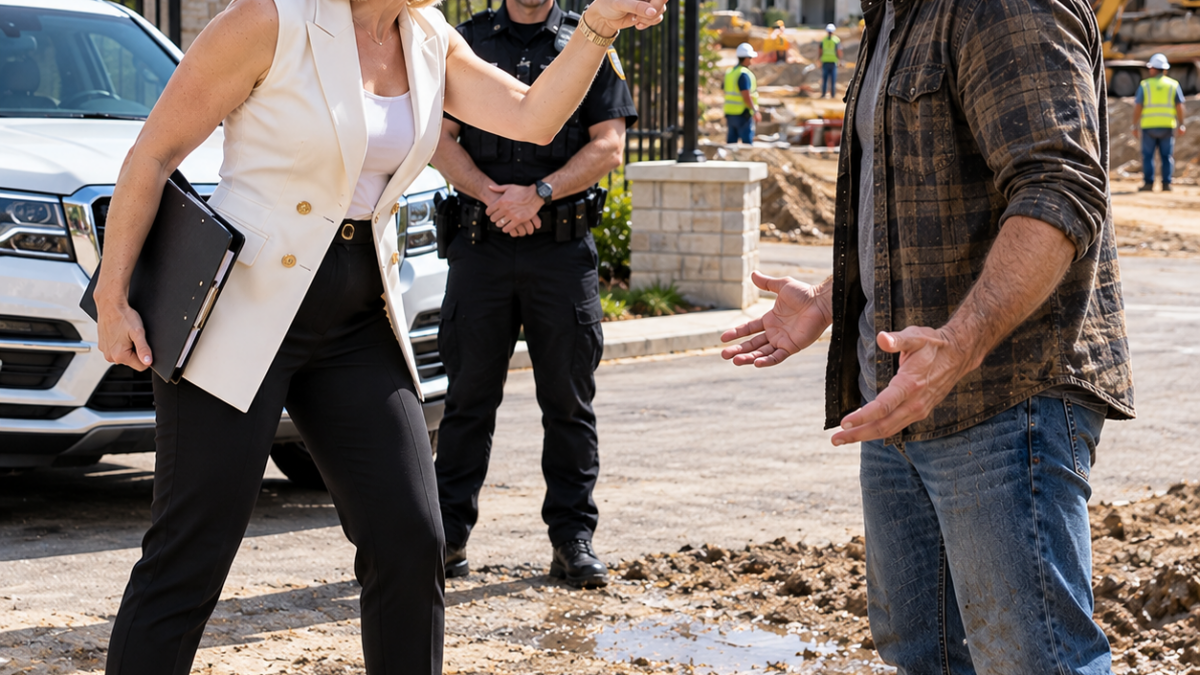
Karen did not introduce herself right away.
People like her rarely do when they think you are beneath them. They introduce their authority first, their name second, and their humanity only if forced.
She looked at my dusty shoes, then at the taxi behind me, then back at my face.
“This development is owned by Silver Creek Rural Living Corporation,” she said. “Access is restricted to residents, contractors, and approved visitors.”
The words came out smooth and bored, as if she had been trained to dismiss complaints without absorbing them.
I took out my passport, still in my hand from the airport, then stopped because it felt ridiculous. What was I going to do? Show a passport to prove I could own land?
“My name is Daniel Reyes,” I said. “My father owned this property. It passed to me when he died. I have the deed.”
That got a flicker from her.
Not fear.
Calculation.
“I’m Karen Whitmore,” she said finally. “President of Silver Creek Rural Living Corporation and interim HOA chair for the community.”
Interim HOA chair.
On my land.
I almost laughed, but my chest was too tight.
“There is no community,” I said. “There was my land.”
Her smile sharpened.
“Mr. Reyes, I understand rural property records can be emotional for families. But this land was legally acquired for development through proper channels.”
“No, it wasn’t.”
Her eyes cooled.
“If you have a concern, you may contact our legal department.”
“I’m standing on my property.”
She glanced at the guard, and for a second, I saw how easily she could make the next minutes ugly. I was alone, jet-lagged, holding luggage in the back of a taxi, facing a woman with money, guards, workers, official-looking signs, and the kind of confidence corrupt paperwork gives people.
So I did something my father would have understood.
I swallowed my rage.
For now.
“Fine,” I said. “I’ll contact legal.”
Karen’s smile returned, triumphant and faintly amused.
“That would be best. And please understand, we take trespassing seriously.”
Trespassing.
The word landed so hard I felt it in my teeth.
Behind her, a cement mixer groaned. Men shouted near a foundation. A house with a balcony stood where my father used to keep a small herd during dry months.
I nodded once, turned back to the taxi, and told the driver to take me into town.
I spent the next several days unraveling what had happened.
At first, every answer led to another closed door.
The municipal office said the land had been classified as abandoned and transferred for development in the public interest. The clerk would not meet my eyes. The land registry had documents bearing stamps that looked official enough to frighten a person who did not know better. My cousin Paulo, who had promised to watch the property, avoided my calls for two days before finally meeting me behind his house, looking like a man waiting for a beating.
“I thought you sold,” he said before I even asked.
“You thought I sold fifteen hectares without telling you?”
He rubbed both hands over his face.
“They came with documents. Officials. Police once. They said if I interfered, I could be charged. Then someone from their company said you had signed papers abroad.”
“Who?”
“I don’t know. A woman.”
“Karen?”
He looked away.
“I think so.”
“Did they pay you?”
His face crumpled.
That was answer enough.
“How much?”
“Not much.”
I stared at him until he looked smaller than I had ever seen him.
“They scared me,” he whispered.
“They counted on that.”
I wanted to hate him. Part of me did. But fear is a currency too, and Karen’s people had spent it well.
The more I dug, the clearer the shape became.
A group of wealthy city investors had formed Silver Creek Rural Living Corporation to create what they called a premium countryside residential community. They had targeted my land because it was flat, large, beautiful from a distance, and apparently easy to steal while I was overseas. With the help of corrupt local officials, they produced fraudulent documents claiming the property had been abandoned, underutilized, and available for development.
Because I was out of the country, nobody with power heard an objection.
Because some locals were intimidated, nobody pushed hard.
Because money moves faster than truth when enough hands are greased, bulldozers arrived before justice found its shoes.
They had already finished eight houses.
Twenty-one foundations had been poured.
Their plan called for fifty homes, a clubhouse, a pool, walking paths, a gated entrance, and an HOA that would maintain “community standards” for wealthy city buyers who wanted rural charm without rural inconvenience.
Most people would have hired a lawyer immediately and filed every possible claim.
I nearly did.
I sat in a small attorney’s office with copies of my real deed, my father’s tax records, old boundary surveys, and the fraudulent documents I had managed to obtain. The attorney, a tired man named Emilio Santos, studied the papers for a long time.
“You are the rightful owner,” he said.
“I know.”
“But they have money. Connections. Corrupt approvals. They will fight.”
“I know that too.”
“This could take years.”
I looked through his office window at the street below, where rainwater from a short afternoon shower was already running brown along the curb.
“Could I stop construction now?”
“With an injunction? Possibly. If the judge is honest. If the documents are accepted quickly. If they do not delay. If no official interferes.”
Too many ifs.
“And if I don’t stop them?”
He turned in his chair.
“What do you mean?”
I thought of the houses sitting at ground level in the basin. The sleek walls. The expensive windows. The landscaped yards planted exactly where floodwater would gather first. I thought of Karen’s heels in the dirt, her red smile, her warning about trespassing.
“They don’t know,” I said.
“Know what?”
“That land floods.”
Emilio blinked.
“All land floods in heavy rain.”
“Not like this.”
I pulled out an old photo from my father’s papers. It showed the basin after a storm when I was twelve. Brown water stretched across the entire property, with only the tops of fence posts showing. In the distance, the roof of the caretaker shack rose like an island.
Emilio leaned closer.
“How often?”
“Every few years. Sometimes less. Sometimes more. When the big rains come, water reaches six to eight feet in the low parts. It can stay for weeks.”
His eyes moved from the photograph to the development plan.
“They built at ground level?”
“Yes.”
“No drainage?”
“Nothing that matters.”
“No raised foundations?”
“No.”
He sat back slowly.
For the first time since I had walked into his office, he almost smiled.
“You are thinking of letting them continue.”
“I am thinking,” I said carefully, “that if I fight now, they will stall, bribe, delay, and maybe finish anyway while I bleed money. But if they keep building what they are building where they are building it…”
“They ruin themselves.”
“I didn’t say that.”
“No,” Emilio said. “But the land might.”
He warned me not to do anything illegal. He warned me not to misrepresent facts. He warned me that allowing damage to happen could become complicated morally and legally if people were hurt. I listened. I took notes. I asked questions.
I did not want anyone dead.
I did not want children trapped.
I did not want some innocent buyer drowning because Karen and her investors were arrogant.
But I also understood something else.
If I marched into Silver Creek shouting about floods, Karen would laugh me out, call me a jealous local troublemaker, and keep building. If I sued too early, she would wrap me in paper. But if I let her arrogance mature, if I documented everything, if I warned people plainly when danger approached, then whatever followed would not be because I hid the truth.
It would be because she refused to hear it.
So I changed strategy.
Instead of confronting Karen as the rightful owner, I approached her as a useful local.
That part was easier than it should have been.
Wealthy developers love locals when they believe locals are cheap, grateful, and impressed.
Two weeks after my return, I shaved, put on my oldest clean shirt, and went back to Silver Creek Estates. This time, I did not arrive angry. I arrived humble.
The guard recognized me but let me wait near the office trailer after I said I wanted to speak with management about nearby land. That phrase worked like a key.
Karen came out with two men in linen shirts and one woman holding a tablet. The company president in public materials was technically a man named Victor Hale, but anyone watching for five minutes could see Karen ran the room. She had the board’s confidence, the investors’ ears, and the cold appetite of someone who knew how to turn opportunity into leverage.
“You again,” she said.
I smiled politely.
“Yes, ma’am. I wanted to apologize for the other day. I was confused.”
Her eyes glittered.
“I appreciate that.”
“I’ve been away. I didn’t understand all the changes.”
“That’s common,” she said. “Development can be difficult for rural communities to process.”
Rural communities.
Like we were children startled by electricity.
I lowered my eyes just enough.
“I can see you’re building something impressive.”
Victor, the official president, smiled for the first time.
“We are.”
Karen watched me carefully.
“So what brings you here?”
“I own some land nearby,” I said. “Not much. A few hectares adjacent to your project. It’s not useful to me. I thought maybe your company might be interested.”
The shift was immediate.
Victor straightened.
Karen’s expression softened into something almost warm.
“Adjacent?” she asked.
“Yes.”
“How much?”
“About three hectares.”
That was technically true. I did own land nearby. In fact, I owned the land under their feet, but Emilio had been very clear: never lie, but never volunteer every truth to people committing fraud against you.
“I’m just a simple farmer’s son,” I added. “I wouldn’t know how to develop it properly.”
Karen smiled like a cat hearing a bird admit its wings were tired.
“Well,” she said, “perhaps we can help each other.”
Over the following weeks, I became their favorite local contact.
I met with Karen, Victor, and the other investors several times. I played the role they had already written for me: modest, impressed, slightly intimidated, grateful for attention from sophisticated people. They explained development to me as if my family had not managed land longer than their company had existed. They described market demand, premium rural branding, lifestyle buyers, weekend residents, HOA structure, and how underutilized farmland could be “activated.”
Activated.
That was their word.
Karen loved it.
“This whole region has been sleeping,” she told me one afternoon while we stood near a newly paved road. “People here don’t see value because they’re used to poverty thinking.”
I looked out at the basin, where workers were framing another house.
“My father always said the land decides what it’s good for.”
Karen laughed softly.
“That’s charming.”
She meant stupid.
I smiled.
“I suppose people like you know better.”
“We know how to create value,” she said.
That sentence stayed with me.
Not because it was wise.
Because it was the sound of a match near dry grass.
They offered to buy the three hectares for far below market value, presenting it as a favor. I acted grateful but slow. I asked simple questions. I let them explain contracts. I let them think they were teaching me. Meanwhile, I gathered everything: brochures, site plans, schedules, investor names, pre-sale numbers, emails, expansion maps, projected budgets, lists of contractors, and environmental claims.
Their due diligence was almost nonexistent.
They had soil summaries prepared by consultants who never asked locals about flood history. Drainage notes copied from generic development templates. Government approvals signed by offices already tied to the fraudulent land transfer. No serious hydrology study. No flood elevation planning. No raised pads. No retention system that could handle anything beyond ordinary rain.
And they were expanding.
That was when I gently pushed.
“You know,” I said during one meeting, “there are other families around here with unused low farmland. If your buyers like this place, you could build much more.”
Karen’s eyes lifted from her coffee.
“How much more?”
“Ten hectares. Maybe fifteen. Some relatives. Some neighbors. Poor farming families, mostly. They might sell for the right price.”
Victor laughed.
“This is exactly what we need.”
Karen leaned back, studying me.
“You could introduce us?”
“I suppose.”
“Daniel,” she said, using my first name for the first time, “you may have just become very valuable.”
I almost told her she had no idea.
Instead, I nodded like a man honored to be useful.
My relatives and neighbors were not fools.
When I explained what had happened, anger spread fast. They had watched Silver Creek push locals around, ignore warnings, treat workers like dirt, and strut through our roads in polished SUVs. Some wanted to march in and tear down the gate. Some wanted immediate lawsuits. But when I explained the flood risk, the corrupt documents, and the possibility of letting the company expose itself fully, the mood changed.
Old farmers understand patience.
They know some traps are not sprung.
They are grown.
A few families sold or leased low basin parcels to Silver Creek at prices higher than they would ever get for flood-prone land, though still low enough for Karen to think she was winning. Some landowners refused money but allowed option agreements that gave the company confidence to announce future phases. Everyone involved knew one thing: nothing permanent should ever be built there at ground level.
Karen’s team did not ask why.
They only saw expansion.
Silver Creek’s plan grew from fifty houses to seventy, then ninety, then more than one hundred. They brought in new investors, more construction crews, more buyers from the city. The marketing became grander by the month.
A premium rural escape.
Modern elegance in harmony with nature.
Secure gated countryside living.
Lake-style recreation.
Fresh air, open space, and freedom.
Freedom, apparently, meant an HOA that fined residents for visible laundry and unapproved porch plants.
By the time the rainy season approached, twenty-one houses were completed, several occupied part-time by wealthy buyers, and a dozen more were under construction. The roads were paved. Streetlights installed. The clubhouse nearly finished. A pool area dug. Landscaping planted in neat, doomed rows.
It looked beautiful.
That was the cruelest part.
If you did not know the land, you would think Karen had won.
She certainly did.
At the opening preview weekend, she stood before buyers in a white dress and gold earrings, speaking beside a banner that read WELCOME TO SILVER CREEK ESTATES.
I attended as a “local consultant.”
Karen introduced me to a group of buyers with a smile.
“Daniel has been very helpful in connecting us with local landowners,” she said. “He understands how much this community will elevate the area.”
One man in loafers looked around at the houses and said, “It must be exciting seeing progress come here.”
Progress.
My father’s stolen land under their shoes.
I smiled.
“It’s something to see.”
Three weeks before the heaviest rains were expected, I began warning them.
That mattered to me.
I could let arrogance destroy money. I could let fraud collapse under water. But I would not let people say nobody warned them.
The first flyer was simple.
FLOOD WARNING
This area has a long history of severe flooding during heavy rainy seasons. Previous flood levels have reached six to eight feet above ground in the basin. Residents should review emergency plans and prepare to relocate during major storm warnings.
I signed it: Concerned Local Resident.
I placed copies in mailboxes, on bulletin boards, near the clubhouse, and at the sales office.
Karen’s response came that evening.
She called an emergency community meeting and invited me, still believing I was loyal or harmless enough to watch her perform. I stood near the back of the clubhouse while residents gathered in clean sandals, linen shirts, expensive watches, and mild irritation.
Karen stood at the front with Victor beside her.
“These malicious flyers,” she began, holding one up between two fingers, “are part of a smear campaign by certain locals resentful of this community’s success.”
A few residents murmured.
“We have completed all required due diligence,” she continued. “This land has been approved through proper government channels. There are no legitimate flooding concerns.”
A woman raised her hand.
“Should we check with meteorological or environmental agencies?”
Karen smiled kindly at her, which was never a good sign.
“You are welcome to check anything you like. But I assure you, if there were a genuine concern, it would have been identified in the permitting process.”
The permitting process was rotten from root to leaf.
I bit the inside of my cheek.
Victor stepped forward.
“These warnings are designed to damage property values. We will identify who is responsible and pursue legal action.”
One buyer shouted, “Good!”
Another said, “The locals don’t want us here.”
Karen nodded solemnly.
“Change often creates resentment.”
She was very good at making greed sound like bravery.
The next week, weather forecasts sharpened.
A major storm system was moving toward the region. Local meteorologists warned of sustained heavy rainfall for five to seven days. Farmers started moving animals. Families on lower ground lifted belongings. Shops stocked sandbags. Old men stood outside the feed store watching the sky with the grim recognition of people who knew what was coming.
I distributed a second flyer.
SEVERE STORM WARNING
Heavy rainfall predicted beginning this weekend. Historical flood patterns indicate serious danger in low basin areas. Residents of Silver Creek Estates should evacuate to higher ground before road access becomes unsafe.
This time, Karen hired private security to watch for whoever was leaving flyers.
She also sent an official HOA notice:
Residents should disregard fear-based misinformation being spread by individuals hostile to the success of Silver Creek Estates. Our infrastructure has been professionally designed. A community barbecue will proceed this Saturday as a show of unity and confidence.
A barbecue.
During a flood warning.
When my neighbor Tomas heard that, he laughed so hard he spilled coffee down his shirt.
“City people,” he said.
“No,” my aunt replied. “Stupid people. Don’t insult cities.”
Saturday morning, the rain began.
Not dramatic at first.
A steady gray curtain. The kind of rain that makes people say, Well, the plants needed it.
At Silver Creek, the barbecue tents went up beside the clubhouse. I watched from the hillside road in my truck for a while, wipers ticking back and forth. Residents arrived with umbrellas and coolers. Children ran between puddles. Karen stood under a tent laughing with a glass in her hand.
By afternoon, water had begun collecting in the lowest lawns.
By evening, the ditches were full.
That night, rain hammered the roof of my aunt’s house so hard conversation became shouting. I slept little. Before dawn, I drove to the high ridge overlooking the basin.
Silver Creek’s main road was underwater.
Not deep yet, but enough.
Brown sheets of water moved across the asphalt. The landscaped entrance beds were gone beneath runoff. The pool excavation had become an actual pool, only uglier. A few residents stood on porches looking out, phones in hand.
At 8:15, Silver Creek sent another notice.
Minor drainage issues are being monitored. Residents should remain calm.
By noon, water reached the front steps of the lowest houses.
By late afternoon, cars were being moved to higher spots, but there were not enough higher spots because Karen’s community had been built in a bowl.
By Sunday morning, panic arrived.
The access road was impassable. Water rushed over curbs and through garages. Houses that had looked so elegant days earlier now stood knee-deep in muddy water. Residents called emergency services. Some tried to drive out and stalled. Others retreated upstairs. Construction materials floated through the streets. A stack of lumber smashed through a decorative fence. The clubhouse doors burst inward under pressure.
I watched from the ridge with binoculars, my stomach tight.
Satisfaction is not simple when people are frightened.
I was angry enough to want Karen ruined.
I was not cruel enough to enjoy children crying on balconies.
Rescue crews came as fast as they could, but the storm had hit the entire region. Roads washed out. Low villages flooded. Emergency boats were stretched thin. By Sunday night, water had reached the second floor windows of many homes.
Expensive cars floated like toys.
Streetlights flickered and died.
The Silver Creek sign disappeared under brown water, only the top edge visible for a few hours before debris knocked it loose.
Residents were evacuated by boats and, in a few cases, helicopters. It took nearly three days to get everyone out safely. Nobody died, thank God. Several people were injured. Many lost nearly everything they had brought into those homes.
Karen appeared on local news standing under a rescue tent, hair wet, makeup gone, face pale with fury and fear.
“This was an unprecedented natural disaster,” she said. “No one could have predicted this.”
I turned off the television.
My father would have hated that sentence.
The flood lasted for weeks.
When the water finally receded, Silver Creek Estates looked like a drowned lie.
Every completed house was ruined beyond repair. Walls warped. Foundations shifted. Septic systems failed. Roads buckled. Streetlights leaned at strange angles. The clubhouse smelled like rot and sewage. The pool filled with mud, dead fish, and pieces of somebody’s patio furniture. The landscaping Karen had praised as transformative lay flat under silt.
The financial damage was catastrophic.
Twenty-one finished houses, more under construction, millions in investor money, buyer deposits, loans, equipment, materials, infrastructure. All gone or compromised.
That was when I moved.
Not with rage.
With paperwork.
Emilio filed comprehensive legal claims proving my ownership of the original fifteen hectares. By then, I had gathered everything: family deeds, tax records, historical maps, photographs, witness statements, proof I had been abroad, evidence of fraudulent abandonment claims, copies of forged or improperly obtained documents, and names of officials involved.
Silver Creek, once arrogant and flush with money, was suddenly drowning in more than water.
Their investors were panicking. Buyers were suing. Insurance companies were denying claims based on flood exclusions, misrepresentations, and improper site disclosures. Lenders wanted answers. Contractors wanted payment. Government officials who had once stamped documents now became unreachable, ill, transferred, retired, or conveniently forgetful.
Karen’s lawyers tried the most insulting argument first.
They claimed that even if there were defects in the ownership process, Silver Creek had made valuable improvements to the land and deserved compensation.
Improvements.
Twenty-one destroyed houses.
Ruined roads.
Broken utilities.
Debris fields.
Contaminated mud.
My land, stolen, reshaped, and left with wreckage.
Emilio’s reply was cold enough to frost glass.
“You cannot demand payment for improvements made on land you obtained through fraud, especially when those improvements were destroyed because you ignored known environmental risks.”
Karen attended one hearing in person.
She wore black, maybe for seriousness, maybe because white would no longer survive the mud. She sat across from me with her lawyers, lips pressed together, eyes fixed on the table. When Emilio presented the old flood photographs and copies of warning flyers, she looked up sharply.
The judge asked, “Were these warnings distributed before the storm?”
Karen’s attorney stood. “Your Honor, they were anonymous and malicious in nature.”
The judge looked at him.
“That was not the question.”
“Yes,” he admitted. “They were distributed.”
“Did the company investigate the claims?”
Karen leaned toward her attorney, whispering.
He said, “The company relied on prior approvals and professional assessments.”
The judge looked at the flood photos again.
“Professional assessments that failed to identify a recurring flood basin?”
No answer.
It took months.
Legal processes always take months when truth has to fight money, even weakened money. But Silver Creek had been built on fraud, arrogance, and debt. The flood stripped away their illusion of permanence. They did not have the resources to keep pretending forever.
The court restored full legal ownership of the land to me.
All of it.
Silver Creek Rural Living Corporation dissolved not long after. Investors sued each other. Buyers sued the company. Investigations opened into the officials who helped produce the fraudulent documents. Some vanished into bureaucratic fog. A few faced consequences. Not enough, maybe. Corruption rarely dies all at once. But it bled.
Karen lost everything tied to Silver Creek.
Her position, her reputation, her investors’ trust, her future developments, her polished certainty. She tried once, through a lawyer, to claim I had deceived them by encouraging expansion without revealing flood history strongly enough.
Emilio read the letter aloud and laughed for the first time in all the months I had known him.
“You distributed flyers warning them to evacuate.”
“I did.”
“They held a barbecue.”
“They did.”
He wiped his glasses.
“I almost admire the nerve.”
Karen eventually called me directly.
I do not know how she got my number. People like Karen always find numbers when they want to accuse someone.
I was at the property that day, standing near what used to be the entrance gate. The decorative stone had cracked, and weeds were already pushing through gaps in the asphalt.
When I answered, she did not say hello.
“You planned this.”
Her voice was raw.
“I planned to get my land back.”
“You manipulated us.”
“You stole from me.”
“You pretended to help.”
“I said I owned land nearby. I did.”
“You knew it would flood.”
“So did every local. So did every flyer I left. So did the weather forecast.”
“You should have stopped us.”
That sentence nearly made me laugh.
Not because it was funny.
Because Karen had spent months treating me like a poor idiot whose value began and ended with whatever land she could extract from me. She ignored warnings, mocked locals, discouraged residents from taking precautions, built ground-level houses in a flood basin, relied on corrupt documents, and then somehow still believed I owed her rescue.
“I tried to warn your residents,” I said. “You called it fear-mongering.”
“You knew we had investors.”
“I knew you had my land.”
“You destroyed people.”
“No, Karen. You sold people safety you never verified, on land you never owned, in a place you never respected. The flood only revealed what you built.”
She was silent for a long moment.
Then she said, quieter, “You’re going to pay for this.”
“No,” I said. “For once, I’m not.”
I hung up.
A year after the court restored my title, I hired cleanup crews.
At first, I dreaded it. I thought it would cost more than I could bear. But Silver Creek had left behind a strange kind of salvage. Scrap metal, wiring, fixtures, structural steel, equipment, materials still usable in pieces. We sold enough salvage to offset much of the cleanup. What could not be saved was hauled away. Broken asphalt was removed in sections. Foundations were cracked and pulled. The clubhouse came down last.
That one felt symbolic.
When the land was cleared, it looked almost like it had when my father owned it, only flatter in places and with strange scars under the grass. The basin remained the basin. Water still gathered in low spots after heavy rain. Birds returned first, then frogs. Grass came back stubbornly. Nature is not sentimental, but it is persistent.
Sometimes I walk there in the evening.
If you know where to look, you can still see faint traces of Silver Creek. A line where a road used to curve. A buried edge of concrete. A decorative stone half-submerged near a drainage ditch. Small ghosts of ambition.
The land remembers.
These days, people ask why I did not stop them sooner.
The answer depends on who asks.
If it is someone looking for a clean moral lesson, they usually want me to say revenge is wrong, or patience is justice, or greed destroys itself. Those are all partly true and too simple.
The truth is messier.
I was angry.
I wanted them punished.
I also knew that fighting them immediately would mean entering a system already bent by their money. They had forged papers, bought silence, intimidated family, and built fast. I chose the ground where they were weakest: reality. Not a courtroom at first. Not public opinion. Not their investor presentations. Reality.
Floodwater does not care how rich you are.
It does not respect brochures.
It does not stop at gates.
It does not read HOA covenants.
It goes where the land tells it to go.
Karen’s mistake was believing ownership came from documents she could manipulate, warnings she could dismiss, and people she could talk down to. She thought rural knowledge was backward superstition. She thought locals were obstacles or tools, never witnesses. She thought my father’s land was empty because she could not recognize what it was full of.
History.
Pattern.
Memory.
Danger.
I have considered developing part of the higher slope someday.
Carefully.
Honestly.
With real drainage studies, real ownership, real permits, and buildings placed where water has never reached. If I do, there will be no glossy lie about conquering nature. The first page of every plan will say what my father said:
Land remembers.
Build accordingly.
Until then, it is quiet again.
The caretaker shack is still there, repaired now. I keep tools inside and old maps in a metal cabinet. On the wall, I hung one framed thing from the entire Silver Creek disaster.
Not a court order.
Not a news article.
Not even the restored title.
It is one of my flood warning flyers, wrinkled and stained, the ink slightly blurred from rain.
FLOOD WARNING.
Concerned Local Resident.
Karen called those words malicious.
I call them mercy she refused to accept.
The last time I saw her was outside the courthouse after the final property ruling. She stood near the steps with Victor and two lawyers, all of them looking smaller in daylight than they had ever looked on the construction site. She saw me and walked over before anyone could stop her.
For a second, I saw the woman from the gate again—the cream blazer, the red smile, the confidence. But it was cracked now. The smile was gone. The arrogance remained, but without money behind it, arrogance looks a lot like panic.
“You think you won,” she said.
I looked past her toward the road leading out of town.
“No, Karen.”
Her eyes narrowed.
“You didn’t?”
“I got back what was mine.”
“That’s winning.”
“No,” I said. “Winning would have been coming home to my father’s land untouched.”
For once, she had nothing to say.
I left her there.
I drove out to the property, parked near the ridge, and walked down into the basin. The ground was dry then, firm under my boots. Wind moved across the open grass. In the distance, a few cattle from a neighbor’s field grazed near the fence. The sun sat low over the hills, turning the whole place gold.
For the first time since I had come home from abroad, I could stand there without seeing Karen’s houses.
I saw my father.
Not literally. I am not that kind of storyteller. But I saw him in the way the land stretched quiet and patient, in the high-water marks still visible on old trees, in the stubborn grass returning where asphalt had been, in the lesson he had left me without knowing how badly I would need it.
Land remembers what people forget.
Karen forgot humility.
The investors forgot due diligence.
The officials forgot duty.
The buyers forgot that beauty is not safety.
My cousin forgot courage.
For a while, even I forgot patience.
But the land remembered everything.
It remembered the storms.
It remembered the basin.
It remembered my family’s name on the deed.
And when the rain came, it told the truth in a language even Karen could not talk over.
𝗧𝗛𝗘 𝗘𝗡𝗗
Karen Built Her Dream Neighborhood on My Land, but She Never Asked Why No One Else Would Build There
Karen smiled at me like I was too poor, too rural, and too simple to understand what she had stolen.
So I let her keep building, because every shovel of concrete only made the truth heavier.
My father used to say land remembers what people forget.
When I was younger, I thought that was just one of those old farmer sayings men repeat when they have run out of practical advice but still want to sound wise. My father had plenty of those. He believed storms had moods, cows judged character, and government offices only moved fast when they were making mistakes. He had a way of saying things with a straight face that made you laugh years later when life proved him right.
The land he left me was fifteen hectares of mostly flat rural ground with a low slope on one side and a wide basin spreading out below it like an open palm.
To city people, it looked perfect.
That was the problem.
From the road, you saw space. Clean horizon. Soft green in the rainy season, dry gold in the heat. You saw a place where a person could imagine neat houses, white fences, paved roads, a swimming pool, maybe a community center with glass doors and a sign about exclusive countryside living. You saw quiet.
Locals saw water.
Not the pretty kind.
We saw floodwater thick with mud, branches, snakes, broken fencing, drowned grass, and everything else a storm decided to carry down from higher ground. Every few years, when the rainy season grew teeth and a storm system parked itself over the region, that flat beautiful land turned into a brown inland sea. It did not flood politely. It swallowed. It rose fast, sat heavy, and stayed for weeks.
My grandfather knew it.
My father knew it.
Every farmer, shopkeeper, schoolteacher, mechanic, and old woman selling vegetables near the crossroads knew it. That was why the older villages sat on higher ground. That was why nobody built anything permanent down in the basin unless they wanted to watch it float away. My father used the land for grazing when the weather allowed, a little seasonal planting, and not much else. He used to joke that the land was useful because it taught patience. You could not force it to be what it was not.
After he died, I inherited it.
I was in my early thirties then, old enough to know grief was not a clean wound and young enough to feel insulted by how much paperwork death required. The land passed to me with old tax records, maps, boundary descriptions, and a rusted key to a caretaker shack my father had always meant to repair but never did. I did not have grand plans for it. Maybe someday I would raise part of it, develop the higher section properly, or lease it for seasonal agriculture. Mostly, I let it sit.
Then I got a job opportunity abroad.
It was supposed to be one year. Good money. The kind of contract that makes a practical person pack quickly and ask emotional questions later. I checked the fences, locked the caretaker shack, asked my cousin Paulo to keep an eye on things, and left believing the land would do what it had always done: wait.
Fifteen months later, I came home.
I remember the taxi turning off the main road and my first thought being that the driver had taken the wrong turn.
There was asphalt where there had never been asphalt.
Streetlights.
Fresh curbs.
A painted entrance wall with decorative stone and a name in elegant black letters:
Silver Creek Estates.
I stared through the windshield.
Beyond the gate, on my father’s land, stood houses.
Not one or two accidental structures.
Rows.
Modern two-story houses with wide windows, pale walls, sharp roofs, landscaped front yards, and paved lanes curling between them. Some were finished. Others were half-built, wrapped in scaffolding, workers moving around them in hard hats. There was a guardhouse by the gate, and an actual security guard stepped out as the taxi slowed.
He looked at me like I was the one trespassing.
“Sir,” he said, “this is private property. Do you have business here?”
I opened the taxi door slowly.
The air smelled like wet cement, diesel, cut grass, and betrayal.
“This is my land,” I said.
The guard blinked.
Then, with the confidence of a man repeating something he had been told by richer people, he said, “No, sir. This is a private HOA development.”
Behind him, one of the houses gleamed in the afternoon sun.
A house built where my father once stood in rubber boots, pointing at water lines on trees and saying, Remember, son, land remembers.
For a moment, I could not breathe.
Then a white SUV rolled up from inside the development, and the woman who stepped out looked me over like mud had learned to speak.
She wore a cream blazer, black trousers, sunglasses, and heels completely unsuited for a construction site. Her blond hair was tucked into a perfect smooth bob, and her lipstick was the exact red of expensive warning signs. She held a phone in one hand and a folder in the other. The guard straightened when he saw her.
“Is there a problem?” she asked.
I looked past her at the houses.
“Yes,” I said. “You built on my land.”
Her mouth curved into a smile so polished it felt rehearsed.
“I think you must be confused.”
That was my first meeting with Karen Whitmore.
And by the time she was done smiling at me, I understood one thing clearly.
She had no idea what she had stolen.
part2
Karen did not introduce herself right away.
People like her rarely do when they think you are beneath them. They introduce their authority first, their name second, and their humanity only if forced.
She looked at my dusty shoes, then at the taxi behind me, then back at my face.
“This development is owned by Silver Creek Rural Living Corporation,” she said. “Access is restricted to residents, contractors, and approved visitors.”
The words came out smooth and bored, as if she had been trained to dismiss complaints without absorbing them.
I took out my passport, still in my hand from the airport, then stopped because it felt ridiculous. What was I going to do? Show a passport to prove I could own land?
“My name is Daniel Reyes,” I said. “My father owned this property. It passed to me when he died. I have the deed.”
That got a flicker from her.
Not fear.
Calculation.
“I’m Karen Whitmore,” she said finally. “President of Silver Creek Rural Living Corporation and interim HOA chair for the community.”
Interim HOA chair.
On my land.
I almost laughed, but my chest was too tight.
“There is no community,” I said. “There was my land.”
Her smile sharpened.
“Mr. Reyes, I understand rural property records can be emotional for families. But this land was legally acquired for development through proper channels.”
“No, it wasn’t.”
Her eyes cooled.
“If you have a concern, you may contact our legal department.”
“I’m standing on my property.”
She glanced at the guard, and for a second, I saw how easily she could make the next minutes ugly. I was alone, jet-lagged, holding luggage in the back of a taxi, facing a woman with money, guards, workers, official-looking signs, and the kind of confidence corrupt paperwork gives people.
So I did something my father would have understood.
I swallowed my rage.
For now.
“Fine,” I said. “I’ll contact legal.”
Karen’s smile returned, triumphant and faintly amused.
“That would be best. And please understand, we take trespassing seriously.”
Trespassing.
The word landed so hard I felt it in my teeth.
Behind her, a cement mixer groaned. Men shouted near a foundation. A house with a balcony stood where my father used to keep a small herd during dry months.
I nodded once, turned back to the taxi, and told the driver to take me into town.
I spent the next several days unraveling what had happened.
At first, every answer led to another closed door.
The municipal office said the land had been classified as abandoned and transferred for development in the public interest. The clerk would not meet my eyes. The land registry had documents bearing stamps that looked official enough to frighten a person who did not know better. My cousin Paulo, who had promised to watch the property, avoided my calls for two days before finally meeting me behind his house, looking like a man waiting for a beating.
“I thought you sold,” he said before I even asked.
“You thought I sold fifteen hectares without telling you?”
He rubbed both hands over his face.
“They came with documents. Officials. Police once. They said if I interfered, I could be charged. Then someone from their company said you had signed papers abroad.”
“Who?”
“I don’t know. A woman.”
“Karen?”
He looked away.
“I think so.”
“Did they pay you?”
His face crumpled.
That was answer enough.
“How much?”
“Not much.”
I stared at him until he looked smaller than I had ever seen him.
“They scared me,” he whispered.
“They counted on that.”
I wanted to hate him. Part of me did. But fear is a currency too, and Karen’s people had spent it well.
The more I dug, the clearer the shape became.
A group of wealthy city investors had formed Silver Creek Rural Living Corporation to create what they called a premium countryside residential community. They had targeted my land because it was flat, large, beautiful from a distance, and apparently easy to steal while I was overseas. With the help of corrupt local officials, they produced fraudulent documents claiming the property had been abandoned, underutilized, and available for development.
Because I was out of the country, nobody with power heard an objection.
Because some locals were intimidated, nobody pushed hard.
Because money moves faster than truth when enough hands are greased, bulldozers arrived before justice found its shoes.
They had already finished eight houses.
Twenty-one foundations had been poured.
Their plan called for fifty homes, a clubhouse, a pool, walking paths, a gated entrance, and an HOA that would maintain “community standards” for wealthy city buyers who wanted rural charm without rural inconvenience.
Most people would have hired a lawyer immediately and filed every possible claim.
I nearly did.
I sat in a small attorney’s office with copies of my real deed, my father’s tax records, old boundary surveys, and the fraudulent documents I had managed to obtain. The attorney, a tired man named Emilio Santos, studied the papers for a long time.
“You are the rightful owner,” he said.
“I know.”
“But they have money. Connections. Corrupt approvals. They will fight.”
“I know that too.”
“This could take years.”
I looked through his office window at the street below, where rainwater from a short afternoon shower was already running brown along the curb.
“Could I stop construction now?”
“With an injunction? Possibly. If the judge is honest. If the documents are accepted quickly. If they do not delay. If no official interferes.”
Too many ifs.
“And if I don’t stop them?”
He turned in his chair.
“What do you mean?”
I thought of the houses sitting at ground level in the basin. The sleek walls. The expensive windows. The landscaped yards planted exactly where floodwater would gather first. I thought of Karen’s heels in the dirt, her red smile, her warning about trespassing.
“They don’t know,” I said.
“Know what?”
“That land floods.”
Emilio blinked.
“All land floods in heavy rain.”
“Not like this.”
I pulled out an old photo from my father’s papers. It showed the basin after a storm when I was twelve. Brown water stretched across the entire property, with only the tops of fence posts showing. In the distance, the roof of the caretaker shack rose like an island.
Emilio leaned closer.
“How often?”
“Every few years. Sometimes less. Sometimes more. When the big rains come, water reaches six to eight feet in the low parts. It can stay for weeks.”
His eyes moved from the photograph to the development plan.
“They built at ground level?”
“Yes.”
“No drainage?”
“Nothing that matters.”
“No raised foundations?”
“No.”
He sat back slowly.
For the first time since I had walked into his office, he almost smiled.
“You are thinking of letting them continue.”
“I am thinking,” I said carefully, “that if I fight now, they will stall, bribe, delay, and maybe finish anyway while I bleed money. But if they keep building what they are building where they are building it…”
“They ruin themselves.”
“I didn’t say that.”
“No,” Emilio said. “But the land might.”
He warned me not to do anything illegal. He warned me not to misrepresent facts. He warned me that allowing damage to happen could become complicated morally and legally if people were hurt. I listened. I took notes. I asked questions.
I did not want anyone dead.
I did not want children trapped.
I did not want some innocent buyer drowning because Karen and her investors were arrogant.
But I also understood something else.
If I marched into Silver Creek shouting about floods, Karen would laugh me out, call me a jealous local troublemaker, and keep building. If I sued too early, she would wrap me in paper. But if I let her arrogance mature, if I documented everything, if I warned people plainly when danger approached, then whatever followed would not be because I hid the truth.
It would be because she refused to hear it.
So I changed strategy.
Instead of confronting Karen as the rightful owner, I approached her as a useful local.
That part was easier than it should have been.
Wealthy developers love locals when they believe locals are cheap, grateful, and impressed.
Two weeks after my return, I shaved, put on my oldest clean shirt, and went back to Silver Creek Estates. This time, I did not arrive angry. I arrived humble.
The guard recognized me but let me wait near the office trailer after I said I wanted to speak with management about nearby land. That phrase worked like a key.
Karen came out with two men in linen shirts and one woman holding a tablet. The company president in public materials was technically a man named Victor Hale, but anyone watching for five minutes could see Karen ran the room. She had the board’s confidence, the investors’ ears, and the cold appetite of someone who knew how to turn opportunity into leverage.
“You again,” she said.
I smiled politely.
“Yes, ma’am. I wanted to apologize for the other day. I was confused.”
Her eyes glittered.
“I appreciate that.”
“I’ve been away. I didn’t understand all the changes.”
“That’s common,” she said. “Development can be difficult for rural communities to process.”
Rural communities.
Like we were children startled by electricity.
I lowered my eyes just enough.
“I can see you’re building something impressive.”
Victor, the official president, smiled for the first time.
“We are.”
Karen watched me carefully.
“So what brings you here?”
“I own some land nearby,” I said. “Not much. A few hectares adjacent to your project. It’s not useful to me. I thought maybe your company might be interested.”
The shift was immediate.
Victor straightened.
Karen’s expression softened into something almost warm.
“Adjacent?” she asked.
“Yes.”
“How much?”
“About three hectares.”
That was technically true. I did own land nearby. In fact, I owned the land under their feet, but Emilio had been very clear: never lie, but never volunteer every truth to people committing fraud against you.
“I’m just a simple farmer’s son,” I added. “I wouldn’t know how to develop it properly.”
Karen smiled like a cat hearing a bird admit its wings were tired.
“Well,” she said, “perhaps we can help each other.”
Over the following weeks, I became their favorite local contact.
I met with Karen, Victor, and the other investors several times. I played the role they had already written for me: modest, impressed, slightly intimidated, grateful for attention from sophisticated people. They explained development to me as if my family had not managed land longer than their company had existed. They described market demand, premium rural branding, lifestyle buyers, weekend residents, HOA structure, and how underutilized farmland could be “activated.”
Activated.
That was their word.
Karen loved it.
“This whole region has been sleeping,” she told me one afternoon while we stood near a newly paved road. “People here don’t see value because they’re used to poverty thinking.”
I looked out at the basin, where workers were framing another house.
“My father always said the land decides what it’s good for.”
Karen laughed softly.
“That’s charming.”
She meant stupid.
I smiled.
“I suppose people like you know better.”
“We know how to create value,” she said.
That sentence stayed with me.
Not because it was wise.
Because it was the sound of a match near dry grass.
They offered to buy the three hectares for far below market value, presenting it as a favor. I acted grateful but slow. I asked simple questions. I let them explain contracts. I let them think they were teaching me. Meanwhile, I gathered everything: brochures, site plans, schedules, investor names, pre-sale numbers, emails, expansion maps, projected budgets, lists of contractors, and environmental claims.
Their due diligence was almost nonexistent.
They had soil summaries prepared by consultants who never asked locals about flood history. Drainage notes copied from generic development templates. Government approvals signed by offices already tied to the fraudulent land transfer. No serious hydrology study. No flood elevation planning. No raised pads. No retention system that could handle anything beyond ordinary rain.
And they were expanding.
That was when I gently pushed.
“You know,” I said during one meeting, “there are other families around here with unused low farmland. If your buyers like this place, you could build much more.”
Karen’s eyes lifted from her coffee.
“How much more?”
“Ten hectares. Maybe fifteen. Some relatives. Some neighbors. Poor farming families, mostly. They might sell for the right price.”
Victor laughed.
“This is exactly what we need.”
Karen leaned back, studying me.
“You could introduce us?”
“I suppose.”
“Daniel,” she said, using my first name for the first time, “you may have just become very valuable.”
I almost told her she had no idea.
Instead, I nodded like a man honored to be useful.
My relatives and neighbors were not fools.
When I explained what had happened, anger spread fast. They had watched Silver Creek push locals around, ignore warnings, treat workers like dirt, and strut through our roads in polished SUVs. Some wanted to march in and tear down the gate. Some wanted immediate lawsuits. But when I explained the flood risk, the corrupt documents, and the possibility of letting the company expose itself fully, the mood changed.
Old farmers understand patience.
They know some traps are not sprung.
They are grown.
A few families sold or leased low basin parcels to Silver Creek at prices higher than they would ever get for flood-prone land, though still low enough for Karen to think she was winning. Some landowners refused money but allowed option agreements that gave the company confidence to announce future phases. Everyone involved knew one thing: nothing permanent should ever be built there at ground level.
Karen’s team did not ask why.
They only saw expansion.
Silver Creek’s plan grew from fifty houses to seventy, then ninety, then more than one hundred. They brought in new investors, more construction crews, more buyers from the city. The marketing became grander by the month.
A premium rural escape.
Modern elegance in harmony with nature.
Secure gated countryside living.
Lake-style recreation.
Fresh air, open space, and freedom.
Freedom, apparently, meant an HOA that fined residents for visible laundry and unapproved porch plants.
By the time the rainy season approached, twenty-one houses were completed, several occupied part-time by wealthy buyers, and a dozen more were under construction. The roads were paved. Streetlights installed. The clubhouse nearly finished. A pool area dug. Landscaping planted in neat, doomed rows.
It looked beautiful.
That was the cruelest part.
If you did not know the land, you would think Karen had won.
She certainly did.
At the opening preview weekend, she stood before buyers in a white dress and gold earrings, speaking beside a banner that read WELCOME TO SILVER CREEK ESTATES.
I attended as a “local consultant.”
Karen introduced me to a group of buyers with a smile.
“Daniel has been very helpful in connecting us with local landowners,” she said. “He understands how much this community will elevate the area.”
One man in loafers looked around at the houses and said, “It must be exciting seeing progress come here.”
Progress.
My father’s stolen land under their shoes.
I smiled.
“It’s something to see.”
Three weeks before the heaviest rains were expected, I began warning them.
That mattered to me.
I could let arrogance destroy money. I could let fraud collapse under water. But I would not let people say nobody warned them.
The first flyer was simple.
FLOOD WARNING
This area has a long history of severe flooding during heavy rainy seasons. Previous flood levels have reached six to eight feet above ground in the basin. Residents should review emergency plans and prepare to relocate during major storm warnings.
I signed it: Concerned Local Resident.
I placed copies in mailboxes, on bulletin boards, near the clubhouse, and at the sales office.
Karen’s response came that evening.
She called an emergency community meeting and invited me, still believing I was loyal or harmless enough to watch her perform. I stood near the back of the clubhouse while residents gathered in clean sandals, linen shirts, expensive watches, and mild irritation.
Karen stood at the front with Victor beside her.
“These malicious flyers,” she began, holding one up between two fingers, “are part of a smear campaign by certain locals resentful of this community’s success.”
A few residents murmured.
“We have completed all required due diligence,” she continued. “This land has been approved through proper government channels. There are no legitimate flooding concerns.”
A woman raised her hand.
“Should we check with meteorological or environmental agencies?”
Karen smiled kindly at her, which was never a good sign.
“You are welcome to check anything you like. But I assure you, if there were a genuine concern, it would have been identified in the permitting process.”
The permitting process was rotten from root to leaf.
I bit the inside of my cheek.
Victor stepped forward.
“These warnings are designed to damage property values. We will identify who is responsible and pursue legal action.”
One buyer shouted, “Good!”
Another said, “The locals don’t want us here.”
Karen nodded solemnly.
“Change often creates resentment.”
She was very good at making greed sound like bravery.
The next week, weather forecasts sharpened.
A major storm system was moving toward the region. Local meteorologists warned of sustained heavy rainfall for five to seven days. Farmers started moving animals. Families on lower ground lifted belongings. Shops stocked sandbags. Old men stood outside the feed store watching the sky with the grim recognition of people who knew what was coming.
I distributed a second flyer.
SEVERE STORM WARNING
Heavy rainfall predicted beginning this weekend. Historical flood patterns indicate serious danger in low basin areas. Residents of Silver Creek Estates should evacuate to higher ground before road access becomes unsafe.
This time, Karen hired private security to watch for whoever was leaving flyers.
She also sent an official HOA notice:
Residents should disregard fear-based misinformation being spread by individuals hostile to the success of Silver Creek Estates. Our infrastructure has been professionally designed. A community barbecue will proceed this Saturday as a show of unity and confidence.
A barbecue.
During a flood warning.
When my neighbor Tomas heard that, he laughed so hard he spilled coffee down his shirt.
“City people,” he said.
“No,” my aunt replied. “Stupid people. Don’t insult cities.”
Saturday morning, the rain began.
Not dramatic at first.
A steady gray curtain. The kind of rain that makes people say, Well, the plants needed it.
At Silver Creek, the barbecue tents went up beside the clubhouse. I watched from the hillside road in my truck for a while, wipers ticking back and forth. Residents arrived with umbrellas and coolers. Children ran between puddles. Karen stood under a tent laughing with a glass in her hand.
By afternoon, water had begun collecting in the lowest lawns.
By evening, the ditches were full.
That night, rain hammered the roof of my aunt’s house so hard conversation became shouting. I slept little. Before dawn, I drove to the high ridge overlooking the basin.
Silver Creek’s main road was underwater.
Not deep yet, but enough.
Brown sheets of water moved across the asphalt. The landscaped entrance beds were gone beneath runoff. The pool excavation had become an actual pool, only uglier. A few residents stood on porches looking out, phones in hand.
At 8:15, Silver Creek sent another notice.
Minor drainage issues are being monitored. Residents should remain calm.
By noon, water reached the front steps of the lowest houses.
By late afternoon, cars were being moved to higher spots, but there were not enough higher spots because Karen’s community had been built in a bowl.
By Sunday morning, panic arrived.
The access road was impassable. Water rushed over curbs and through garages. Houses that had looked so elegant days earlier now stood knee-deep in muddy water. Residents called emergency services. Some tried to drive out and stalled. Others retreated upstairs. Construction materials floated through the streets. A stack of lumber smashed through a decorative fence. The clubhouse doors burst inward under pressure.
I watched from the ridge with binoculars, my stomach tight.
Satisfaction is not simple when people are frightened.
I was angry enough to want Karen ruined.
I was not cruel enough to enjoy children crying on balconies.
Rescue crews came as fast as they could, but the storm had hit the entire region. Roads washed out. Low villages flooded. Emergency boats were stretched thin. By Sunday night, water had reached the second floor windows of many homes.
Expensive cars floated like toys.
Streetlights flickered and died.
The Silver Creek sign disappeared under brown water, only the top edge visible for a few hours before debris knocked it loose.
Residents were evacuated by boats and, in a few cases, helicopters. It took nearly three days to get everyone out safely. Nobody died, thank God. Several people were injured. Many lost nearly everything they had brought into those homes.
Karen appeared on local news standing under a rescue tent, hair wet, makeup gone, face pale with fury and fear.
“This was an unprecedented natural disaster,” she said. “No one could have predicted this.”
I turned off the television.
My father would have hated that sentence.
The flood lasted for weeks.
When the water finally receded, Silver Creek Estates looked like a drowned lie.
Every completed house was ruined beyond repair. Walls warped. Foundations shifted. Septic systems failed. Roads buckled. Streetlights leaned at strange angles. The clubhouse smelled like rot and sewage. The pool filled with mud, dead fish, and pieces of somebody’s patio furniture. The landscaping Karen had praised as transformative lay flat under silt.
The financial damage was catastrophic.
Twenty-one finished houses, more under construction, millions in investor money, buyer deposits, loans, equipment, materials, infrastructure. All gone or compromised.
That was when I moved.
Not with rage.
With paperwork.
Emilio filed comprehensive legal claims proving my ownership of the original fifteen hectares. By then, I had gathered everything: family deeds, tax records, historical maps, photographs, witness statements, proof I had been abroad, evidence of fraudulent abandonment claims, copies of forged or improperly obtained documents, and names of officials involved.
Silver Creek, once arrogant and flush with money, was suddenly drowning in more than water.
Their investors were panicking. Buyers were suing. Insurance companies were denying claims based on flood exclusions, misrepresentations, and improper site disclosures. Lenders wanted answers. Contractors wanted payment. Government officials who had once stamped documents now became unreachable, ill, transferred, retired, or conveniently forgetful.
Karen’s lawyers tried the most insulting argument first.
They claimed that even if there were defects in the ownership process, Silver Creek had made valuable improvements to the land and deserved compensation.
Improvements.
Twenty-one destroyed houses.
Ruined roads.
Broken utilities.
Debris fields.
Contaminated mud.
My land, stolen, reshaped, and left with wreckage.
Emilio’s reply was cold enough to frost glass.
“You cannot demand payment for improvements made on land you obtained through fraud, especially when those improvements were destroyed because you ignored known environmental risks.”
Karen attended one hearing in person.
She wore black, maybe for seriousness, maybe because white would no longer survive the mud. She sat across from me with her lawyers, lips pressed together, eyes fixed on the table. When Emilio presented the old flood photographs and copies of warning flyers, she looked up sharply.
The judge asked, “Were these warnings distributed before the storm?”
Karen’s attorney stood. “Your Honor, they were anonymous and malicious in nature.”
The judge looked at him.
“That was not the question.”
“Yes,” he admitted. “They were distributed.”
“Did the company investigate the claims?”
Karen leaned toward her attorney, whispering.
He said, “The company relied on prior approvals and professional assessments.”
The judge looked at the flood photos again.
“Professional assessments that failed to identify a recurring flood basin?”
No answer.
It took months.
Legal processes always take months when truth has to fight money, even weakened money. But Silver Creek had been built on fraud, arrogance, and debt. The flood stripped away their illusion of permanence. They did not have the resources to keep pretending forever.
The court restored full legal ownership of the land to me.
All of it.
Silver Creek Rural Living Corporation dissolved not long after. Investors sued each other. Buyers sued the company. Investigations opened into the officials who helped produce the fraudulent documents. Some vanished into bureaucratic fog. A few faced consequences. Not enough, maybe. Corruption rarely dies all at once. But it bled.
Karen lost everything tied to Silver Creek.
Her position, her reputation, her investors’ trust, her future developments, her polished certainty. She tried once, through a lawyer, to claim I had deceived them by encouraging expansion without revealing flood history strongly enough.
Emilio read the letter aloud and laughed for the first time in all the months I had known him.
“You distributed flyers warning them to evacuate.”
“I did.”
“They held a barbecue.”
“They did.”
He wiped his glasses.
“I almost admire the nerve.”
Karen eventually called me directly.
I do not know how she got my number. People like Karen always find numbers when they want to accuse someone.
I was at the property that day, standing near what used to be the entrance gate. The decorative stone had cracked, and weeds were already pushing through gaps in the asphalt.
When I answered, she did not say hello.
“You planned this.”
Her voice was raw.
“I planned to get my land back.”
“You manipulated us.”
“You stole from me.”
“You pretended to help.”
“I said I owned land nearby. I did.”
“You knew it would flood.”
“So did every local. So did every flyer I left. So did the weather forecast.”
“You should have stopped us.”
That sentence nearly made me laugh.
Not because it was funny.
Because Karen had spent months treating me like a poor idiot whose value began and ended with whatever land she could extract from me. She ignored warnings, mocked locals, discouraged residents from taking precautions, built ground-level houses in a flood basin, relied on corrupt documents, and then somehow still believed I owed her rescue.
“I tried to warn your residents,” I said. “You called it fear-mongering.”
“You knew we had investors.”
“I knew you had my land.”
“You destroyed people.”
“No, Karen. You sold people safety you never verified, on land you never owned, in a place you never respected. The flood only revealed what you built.”
She was silent for a long moment.
Then she said, quieter, “You’re going to pay for this.”
“No,” I said. “For once, I’m not.”
I hung up.
A year after the court restored my title, I hired cleanup crews.
At first, I dreaded it. I thought it would cost more than I could bear. But Silver Creek had left behind a strange kind of salvage. Scrap metal, wiring, fixtures, structural steel, equipment, materials still usable in pieces. We sold enough salvage to offset much of the cleanup. What could not be saved was hauled away. Broken asphalt was removed in sections. Foundations were cracked and pulled. The clubhouse came down last.
That one felt symbolic.
When the land was cleared, it looked almost like it had when my father owned it, only flatter in places and with strange scars under the grass. The basin remained the basin. Water still gathered in low spots after heavy rain. Birds returned first, then frogs. Grass came back stubbornly. Nature is not sentimental, but it is persistent.
Sometimes I walk there in the evening.
If you know where to look, you can still see faint traces of Silver Creek. A line where a road used to curve. A buried edge of concrete. A decorative stone half-submerged near a drainage ditch. Small ghosts of ambition.
The land remembers.
These days, people ask why I did not stop them sooner.
The answer depends on who asks.
If it is someone looking for a clean moral lesson, they usually want me to say revenge is wrong, or patience is justice, or greed destroys itself. Those are all partly true and too simple.
The truth is messier.
I was angry.
I wanted them punished.
I also knew that fighting them immediately would mean entering a system already bent by their money. They had forged papers, bought silence, intimidated family, and built fast. I chose the ground where they were weakest: reality. Not a courtroom at first. Not public opinion. Not their investor presentations. Reality.
Floodwater does not care how rich you are.
It does not respect brochures.
It does not stop at gates.
It does not read HOA covenants.
It goes where the land tells it to go.
Karen’s mistake was believing ownership came from documents she could manipulate, warnings she could dismiss, and people she could talk down to. She thought rural knowledge was backward superstition. She thought locals were obstacles or tools, never witnesses. She thought my father’s land was empty because she could not recognize what it was full of.
History.
Pattern.
Memory.
Danger.
I have considered developing part of the higher slope someday.
Carefully.
Honestly.
With real drainage studies, real ownership, real permits, and buildings placed where water has never reached. If I do, there will be no glossy lie about conquering nature. The first page of every plan will say what my father said:
Land remembers.
Build accordingly.
Until then, it is quiet again.
The caretaker shack is still there, repaired now. I keep tools inside and old maps in a metal cabinet. On the wall, I hung one framed thing from the entire Silver Creek disaster.
Not a court order.
Not a news article.
Not even the restored title.
It is one of my flood warning flyers, wrinkled and stained, the ink slightly blurred from rain.
FLOOD WARNING.
Concerned Local Resident.
Karen called those words malicious.
I call them mercy she refused to accept.
The last time I saw her was outside the courthouse after the final property ruling. She stood near the steps with Victor and two lawyers, all of them looking smaller in daylight than they had ever looked on the construction site. She saw me and walked over before anyone could stop her.
For a second, I saw the woman from the gate again—the cream blazer, the red smile, the confidence. But it was cracked now. The smile was gone. The arrogance remained, but without money behind it, arrogance looks a lot like panic.
“You think you won,” she said.
I looked past her toward the road leading out of town.
“No, Karen.”
Her eyes narrowed.
“You didn’t?”
“I got back what was mine.”
“That’s winning.”
“No,” I said. “Winning would have been coming home to my father’s land untouched.”
For once, she had nothing to say.
I left her there.
I drove out to the property, parked near the ridge, and walked down into the basin. The ground was dry then, firm under my boots. Wind moved across the open grass. In the distance, a few cattle from a neighbor’s field grazed near the fence. The sun sat low over the hills, turning the whole place gold.
For the first time since I had come home from abroad, I could stand there without seeing Karen’s houses.
I saw my father.
Not literally. I am not that kind of storyteller. But I saw him in the way the land stretched quiet and patient, in the high-water marks still visible on old trees, in the stubborn grass returning where asphalt had been, in the lesson he had left me without knowing how badly I would need it.
Land remembers what people forget.
Karen forgot humility.
The investors forgot due diligence.
The officials forgot duty.
The buyers forgot that beauty is not safety.
My cousin forgot courage.
For a while, even I forgot patience.
But the land remembered everything.
It remembered the storms.
It remembered the basin.
It remembered my family’s name on the deed.
And when the rain came, it told the truth in a language even Karen could not talk over.