FULL ENDING Karen Built Her Dream House on My Empty Lot and Dared Me to Fight Her in Court
𝗙𝗨𝗟𝗟 𝗦𝗧𝗢𝗥𝗬
She took a slow sip from her coffee mug.
The whole thing had the casual arrogance of someone who had rehearsed being unbothered.
“We built legally,” she said. “Permits, inspections, approvals, everything. So if you have a problem, you can take it up with the courts.”
Then she smiled wider.
“And if you keep showing up here harassing me, I’ll sue you.”
There it was.
Sue.
She said it like a magic spell.
As if one legal-sounding word could bend land records, deeds, and reality around her manicured finger.
I looked past her at the house. It really was beautiful, which somehow made the whole thing worse. Dark roof, bright trim, wide porch, expensive windows. Whoever built it had spent real money. Whoever built it had also either made a catastrophic mistake or committed fraud with the confidence of a woman who had never been told no without punishing someone for it.
“You built a house on land you don’t own,” I said. “How do you think that’s legal?”
Her eyes hardened.
“It was vacant.”
“That doesn’t make it free.”
“You weren’t using it.”
I stared at her.
She said it so naturally. As if she had caught me leaving food untouched on a table and decided to help herself.
“You’re serious,” I said.
Her smile disappeared.
“People like you buy land and let it sit there for years, wasting space, dragging neighborhoods down, doing nothing. I made something beautiful out of it.”
“People like me?”
“Absentee owners,” she said quickly, but her tone had already shown me what she meant. “Speculators. Men who think they can neglect property and then show up acting important.”
“My name is on the deed.”
“And my home is on this land,” she snapped. “I live here. I invested here. I built here. That matters.”
“It matters that you built on the wrong property.”
Her face flushed, but not with embarrassment. With anger.
“I’m not moving,” she said. “This is my home. If you think you can bully a woman out of her house because you suddenly remembered you own a patch of weeds, you are badly mistaken.”
I glanced at the no trespassing sign.
“You put a no trespassing sign on my side.”
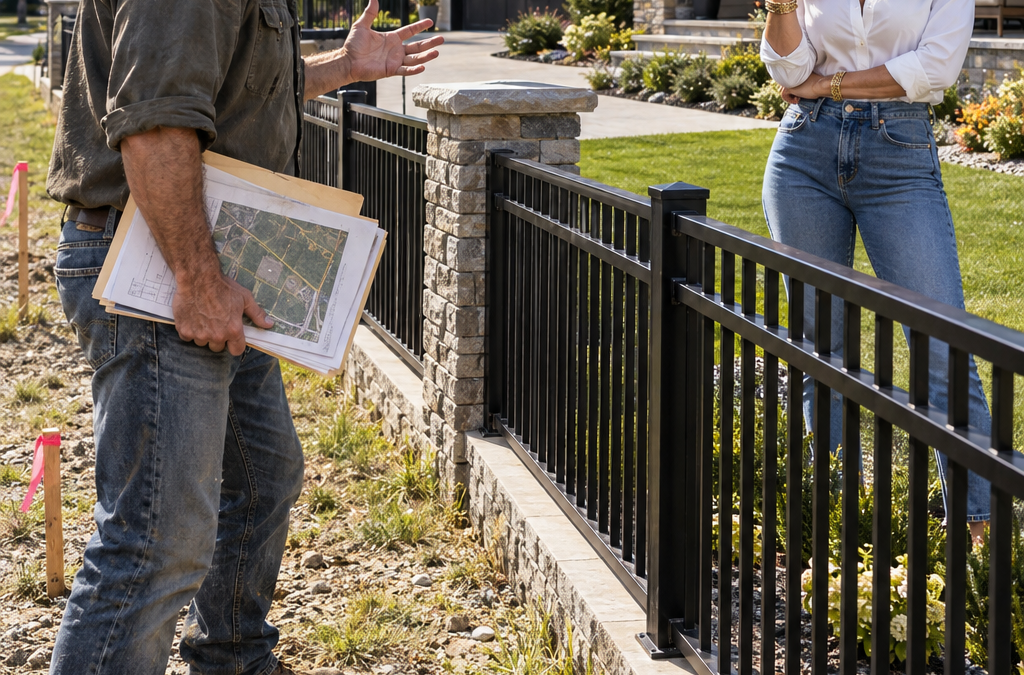
She leaned one hand against the fence, showing perfect nails wrapped around the top rail.
“This is my property line.”
“No, it isn’t.”
“Then prove it.”
“I will.”
She smiled again, but this time it was colder.
“Good. Do it legally. You won’t beat me.”
Then she pointed at my truck.
“And move your vehicle. You’re making the neighborhood look trashy.”
That almost made me laugh.
Not because it was funny, but because the woman had built an entire house on my land and was offended by where I parked on a public road.
I wanted to argue. I wanted to tell her exactly what kind of person she was. I wanted to walk up to the fence, tear down the sign, and ask who she thought she was fooling.
But I had already learned enough.
Karen was not confused.
Karen was not going to be reasoned with.
Karen wanted a fight.
And she had just told me exactly how she wanted it handled.
Legally.
So I gave her what she asked for.
I said nothing else. I pulled out my phone and started taking photos from the road. The fence line. The sign. The driveway. The house footprint from every visible angle I could capture without stepping past anything she could twist later. Karen stood there watching me, her coffee forgotten, her face tightening with each picture.
“What do you think you’re doing?” she demanded.
“Documenting.”
“You do not have permission to photograph my home.”
“I’m standing on a public road.”
“You are harassing me.”
“No,” I said. “I’m preparing.”
For the first time, a flicker of uncertainty crossed her face.
It was small.
But I saw it.
Then I got back into my truck and drove away.
That night, I pulled out every document I had. Deed. Tax records. Closing paperwork. Insurance documents. Old photos. A plat map. Everything. My wife, Emily, sat beside me at the kitchen table and read quietly while I paced behind her.
“She really said you weren’t using it?” Emily asked.
“Word for word.”
Emily looked up from the deed.
“That is cartoon villain logic.”
“I know.”
“No, seriously. By that logic, if I leave my phone on the counter, she can take it because I’m not using it.”
“Apparently.”
Emily leaned back in her chair.
“What are you going to do?”
“What she told me to do.”
“Legally?”
“Legally.”
The next morning, I called a real estate attorney named Dan Mercer. He had been recommended by a friend who described him as “boring in the most terrifying way,” which sounded perfect.
“This is going to sound ridiculous,” I said when he picked up, “but someone built a house on my land.”
There was a pause.
Then Dan said, very calmly, “First rule: do not talk to them again. Not in person, not on the phone, not by text unless I tell you. We do everything in writing from here.”
That sentence was music.
Dan immediately arranged two things: a licensed survey and a full pull of the permitting records.
The survey happened first.
A real surveyor came out with equipment, old records, measurements, markers, and a level of patience I did not possess at the time. He walked the land carefully, checked existing markers, compared records, and finally showed us the results.
The house was not a few feet over the line.
It was not a corner encroachment.
It was not one of those awkward boundary mistakes where everyone winces and tries to negotiate an easement.
The entire house footprint sat on my parcel.
Comfortably.
Deliberately.
The fence line was wrong too. It had been placed in exactly the way needed to make the lie look natural. From the street, a casual observer would assume the fence marked the boundary and the house belonged inside it. But the real line cut through Karen’s fantasy like a blade.
Dan looked at the survey, then at me.
“Well,” he said, “she wanted legal.”
The permit records made it worse.
Karen had permits.
That part shocked me. There were building permits, inspection signoffs, drawings, documents. This was not a hidden cabin in the woods or a shed slapped together over a weekend. The local office had paperwork for the build.
At first, that made my stomach drop.
Then Dan explained how it could happen.
Inspectors do not re-survey property lines at every visit. They inspect what they are asked to inspect—footings, framing, plumbing, electrical, setbacks based on submitted plans. If the applicant submits false or misleading site information, and if the lots are similar enough, and if there is a fence line creating the appearance of a boundary, the system can miss it.
Most systems function on the assumption that people are not lying about where their land is.
Karen had apparently treated that assumption like an invitation.
The drawings in the file were creative. That was the nicest word Dan used. The boundary references had been shifted. The driveway placement made sense only if you accepted the fake fence line. And attached to the packet was a survey that looked official at first glance.
Stamp. Signature. Lines. Numbers.
Our surveyor examined it and immediately started pointing out problems I would never have noticed.
Wrong license-number formatting. Missing required elements. Inconsistent references. Strange scaling. A signature that did not match any registered surveyor in the state database.
Dan confirmed through proper channels that no licensed surveyor had produced it.
That changed everything.
This was no longer, “Oops, we made a mistake.”
This was, “We built on land we didn’t own and tried to paper over it.”
Dan drafted the first formal notice. It was simple, dry, and lethal.
Karen was trespassing. The structure was located on my land according to a licensed survey. All work had to stop immediately. She needed to contact our office to discuss resolution.
Her response came through her attorney.
And it was exactly the kind of response I expected from someone like Karen.
Emotional language about her dream home. Her investment. Her hardship as a woman building independently. Her reliance on “professional representations.” Her belief that the property had been neglected and that she had acted in good faith.
Then came the proposal.
She would buy the portion of land under the house at “fair market value.”
And by fair market value, she meant a number so low it would not have covered my legal fees.
Alternatively, she suggested I compensate her for the improvements she had made because the land was now more valuable.
Emily read that part and laughed so hard she had to sit down.
“She wants you to pay her for trespassing?”
“She calls it improvements.”
“If I break into someone’s yard and build a pool, can I send them an invoice?”
“Apparently Karen would.”
Dan’s response was polite.
No.
He also noted that any claim of good faith was severely undermined by the fraudulent survey in the permit file and the deliberately inaccurate fence line.
We offered a short window to discuss voluntary removal, settlement of damages, and a practical plan to restore the land.
Karen ignored the offer.
Then she sent me a letter directly, against what I assume was her attorney’s advice.
It was three pages of rage.
She accused me of trying to steal her home. She called me a “land hoarder.” She said people like me were the reason communities couldn’t thrive. She claimed I was using a technicality to extort her. Then she wrote the sentence that told me exactly who I was dealing with.
“If you didn’t want someone to build there, you should have built there yourself.”
Emily read that line twice.
“There it is,” she said. “Her whole philosophy.”
“What?”
“She thinks wanting something badly enough makes it hers.”
Karen also began working the neighborhood.
She told people I was an absentee investor trying to throw a woman out of her dream home. She described herself as a hardworking homeowner under attack by a greedy landowner. She did not mention the fake survey. She did not mention the fence. She did not mention that the first thing she had done when I appeared was tell me to leave my own property.
A few neighbors approached me awkwardly when I visited the road again.
One older man, Mr. Dalton, walked over while I was taking photos from the roadside.
“Hey,” he said, looking uncomfortable. “I heard there’s some dispute.”
“That’s one word for it.”
“She says you’re trying to take her house.”
I pulled out the survey summary Dan had told me to carry.
“I’m trying to get my land back. The house is on my parcel.”
He looked at the document.
His mouth tightened.
“Oh.”
“Yeah.”
“She didn’t say that.”
“I’m shocked.”
He handed the paper back.
“For what it’s worth,” he said, “that fence went up before the house did. I remember thinking it was weird because it didn’t match the old markers.”
That was useful.
Very useful.
Dan took his statement later.
Karen kept escalating.
She added more signs. PRIVATE PROPERTY. NO TRESPASSING. SECURITY MONITORED. One sign actually said OWNER OCCUPIED, which was hilarious in the bleakest possible way. She parked vehicles near the fence like she was guarding a border checkpoint. She posted vague, tearful messages online about fighting “greedy land men” and “predatory lawsuits.”
Then she emailed me again.
“I’ve been here long enough that I have rights now.”
Dan loved that one.
“Keep every email,” he said. “She cannot stop helping us.”
There are legal concepts around long-term possession, sure. But they are strict, complicated, and definitely not designed for someone who built a house with a fake survey and then bragged that the owner was gone long enough that it “basically” became hers.
So we did exactly what Karen kept daring me to do.
We filed.
The case asked the court to confirm ownership, recognize the trespass, stop further alterations, and require Karen to remove the structure and restore the land. We also sought damages, fees, and costs.
Dan also requested a temporary order preventing Karen from doing any additional construction while the case was pending.
That part mattered because Karen had already mentioned online that she wanted to add a detached garage and possibly a pool. The idea of her building more on my land made my blood pressure learn new tricks.
The court granted the temporary order.
Plain English: stop building, stop altering, preserve the status quo.
Karen hated that.
She had wanted court as a threat, not a process. People like Karen love the word legal when it is hypothetical. They love saying, “My lawyer will be in touch,” or “I’ll sue,” or “Take it to court,” because they imagine law as a dramatic curtain they can hide behind.
What they hate is deadlines.
Discovery.
Evidence.
Sworn statements.
Invoices.
Records.
Orders they can violate only at real cost.
At first, Karen tried to keep working anyway. Workers arrived with materials one morning, and a neighbor called me. I called Dan. Dan called the appropriate people. Karen claimed it was “minor maintenance,” but photographs showed framing materials, concrete forms, and tools that had nothing to do with maintenance.
The judge was not amused.
Karen got warned.
After that, she became more careful, not because she respected the order, but because she realized consequences were becoming real.
She filed counterclaims.
Of course she did.
Harassment. Emotional distress. Abuse of process. Interference with her enjoyment of her home.
The audacity of saying I was harassing her by owning the land she had built on would have been impressive if it had not been so exhausting.
My malicious compliance was not dramatic.
I did not sneak around. I did not shout. I did not post online. I did not call her names where anyone could screenshot them.
I became boring.
Painfully, relentlessly boring.
I documented everything. Every email. Every letter. Every sign. Every neighbor conversation. Every attempted violation. Every social media post that accused me of crimes. I took photos from public places. I backed everything up. I forwarded everything to Dan.
Karen could not stop talking.
That was her weakness.
She loved threats. She loved dramatic language. She loved acting like confidence was evidence. She wrote things no competent lawyer would want a client to write. She sent messages saying, “You abandoned the land.” She said, “Everyone knows it was wasted.” She said, “You only care now because I improved it.” She said, “Any judge will see that I made it into something valuable.”
Every sentence helped us.
Mediation came months later.
It was required before the case could move forward, and I went in determined not to let Karen turn it into theater.
Karen arrived like she was attending a television interview. Cream suit, heels, glossy hair, diamond studs, perfect makeup, perfume filling the room before she entered. She looked beautiful. She looked expensive. She looked wronged.
Then she opened her mouth.
She talked about her home. Her sacrifice. Her design choices. Her vision. Her stress. Her sleepless nights. Her poor emotional health because of my “aggression.” She placed one hand over her heart several times. She dabbed at her eyes without producing many tears.
Then she said, “He wasn’t using it.”
The mediator, a man with the calmest face I had ever seen, wrote something down.
Karen continued. “Who buys land and leaves it empty? That should not be allowed. Communities need people who invest, not people who sit on dirt and wait to profit.”
Dan said nothing.
I said nothing.
Karen’s attorney looked tired.
Her offer was insulting.
She wanted to buy only the land directly under and around the house at a price so low it would not cover what I had already spent dealing with her fraud.
When that failed, she suggested I buy the house from her.
Dan blinked slowly.
“Let me make sure I understand,” he said. “You want my client to pay you for a house you built on his land?”
Karen lifted her chin.
“That would be fair.”
“Why?”
“Because otherwise I lose everything.”
The mediator looked at her.
“That is not the same as fair.”
Karen’s face went red.
We did not settle.
After mediation failed, discovery began in earnest, and Karen’s confidence started turning into legal exhaustion.
She had to produce documents.
She had to explain the permit file.
She had to answer questions about the fence, the survey, the drawings, the timeline, and what she knew when she started construction.
Her contradictions multiplied.
She claimed the fence line had always been there. Older photos showed it had not.
She claimed she had relied on a professional survey. She could not produce a legitimate surveyor.
She claimed she believed the lot was hers. Her own emails said things like, “You were gone so long,” and “You should have built if you cared.”
She claimed she had not known anyone owned it. But she also claimed the owner had abandoned it, neglected it, wasted it, and failed to stop her.
Those are different ideas.
One means mistake.
The other means gamble.
Karen had gambled that no one would come back.
And when I did, she tried to bully me into selling her the consequences.
The financial pressure began crushing her too.
She could not refinance because the property was in dispute. She could not sell because no sane buyer wanted a house that might have to be removed. She could not keep improving because of the court order. Her beautiful dream home became a frozen asset sitting on someone else’s land, eating money every month.
At the final hearing, the central question was simple.
Whose land was it?
We presented my deed, tax records, insurance documents, photos, survey, permit file analysis, witness statements, and proof that the survey in Karen’s packet was not legitimate.
Karen presented permits, emotion, and outrage.
The judge asked her why she had not confirmed the boundary with a licensed surveyor before building.
Karen said she had.
Then the fake survey problem swallowed her answer.
The judge asked why her fence line did not match the licensed survey.
Karen said the old markers must have been wrong.
“Based on what?” the judge asked.
Karen hesitated.
Her attorney looked down.
Karen said, “It didn’t make sense for the land to sit unused that way.”
The room went very still.
The judge leaned back.
“That is not a basis for moving a boundary.”
Karen flushed.
Then came the question that sealed it.
“Did you know the parcel belonged to someone else when construction began?”
Karen tried to dodge.
She said she understood the land had been vacant for years. She said no one maintained it. She said the neighborhood believed it was abandoned. She said she acted in reliance on information available to her.
The judge repeated the question.
Karen’s face tightened.
Finally, she said, “I didn’t know anyone would come back.”
Not, “I thought I owned it.”
Not, “I had valid title.”
Not, “I made an honest mistake.”
I didn’t know anyone would come back.
That sentence landed like a brick dropped in a silent room.
The decision came later, but by then I knew.
The court confirmed what had been true from the beginning.
The land was mine.
Karen had no legal claim to it.
Her counterclaims failed.
Her good-faith argument collapsed under the fraudulent survey, the fence line, and her own statements. The order required her to remove the structure, vacate my land, restore the property, and pay damages for trespass along with a portion of costs and fees.
It was not the gentle compromise Karen had imagined.
She reacted exactly how you would expect.
She cried publicly. She threatened appeals. She claimed removal was impossible. She gave interviews to anyone willing to listen in the neighborhood Facebook group. She posted about losing her family home, conveniently forgetting that she had built that home on land she did not own.
For a few weeks, she still tried to perform victimhood.
Then the deadlines arrived.
Real deadlines.
Court-backed deadlines.
And suddenly the performance mattered less than the machinery of consequences.
Contractors came first.
Then dumpsters.
Then arguments between Karen and the people she had hired to dismantle the house. I drove by only when necessary, but each time I did, the sight was surreal.
The dream home came apart piece by piece.
Porch railings removed.
Siding stripped.
Windows taken out.
Interior materials hauled away.
Framing exposed.
Landscaping ripped up.
The fence came down too. That was the part that gave me the deepest, pettiest satisfaction. Watching workers pull out the posts that had held her NO TRESPASSING sign felt like seeing a lie lose its spine.
One afternoon, I saw Karen standing near the half-dismantled house.
She looked smaller without the fence.
Her hair was pulled back. No heels. No polished smile. No coffee mug, no performance. Just a woman in designer sunglasses watching men tear apart the thing she had convinced herself she deserved.
For one second, I felt bad.
Not because she was innocent.
She was not.
But because ruin, even deserved ruin, is still ugly up close.
Then she saw me and the softness vanished from her face.
“You’re happy now?” she called.
I stood by my truck.
“No.”
“Liar.”
“I’m not happy,” I said. “I’m relieved.”
She laughed bitterly.
“You destroyed my life over dirt.”
“No,” I said. “You risked your life over dirt that wasn’t yours.”
Her mouth twisted.
“I made it beautiful.”
“You made it stolen.”
That shut her up.
Not for long, probably. Karen did not seem like a woman built for silence. But for that moment, she had nothing.
The house came down completely over the next few weeks.
When the land was finally cleared, I had it graded and stabilized. Heavy construction had left ruts, compacted soil, and torn-up drainage. I paid to fix what had been damaged, though the judgment softened the financial blow.
I had the boundaries marked clearly again.
Properly this time.
I arranged periodic checks. Not because I wanted to live paranoid, but because I had learned something I wished I had not needed to learn: empty land attracts imagination, and sometimes imagination comes with a fake survey and a woman named Karen.
I did not build immediately.
People expected me to.
Some neighbors asked when construction would start, as if the only satisfying ending would be me putting up a house right away just to prove the land had a purpose.
But I refused to let Karen dictate my timeline.
That was the final piece of getting my property back.
Not just clearing her house.
Not just removing the fence.
Not just winning in court.
Getting my land back meant remembering that I had bought it as a someday thing, and someday still belonged to me.
Not to Karen.
Not to the neighborhood.
Not to the judge.
Not to the story people told about land being wasted if it was quiet.
Mine.
A few months after everything ended, Emily and I drove out there together. The lot looked rough but peaceful. Grass had started returning in patches. The trees along the back still stood. The air smelled like damp soil and cut wood.
Emily stood beside me near the real boundary marker.
“It looks smaller without the house,” she said.
“It feels bigger.”
She looked at me and smiled.
“Because it’s yours again.”
I nodded.
Across the street, Mr. Dalton raised a hand in greeting. No drama. No whispers. No polished woman with a coffee mug pretending theft was vision.
Just quiet.
The kind of quiet I had bought in the first place.
Karen eventually sold what remained of her actual property and left town. I heard through neighbors that the legal bills hit hard. Her reputation hit harder. The forged survey became the kind of story people told whenever someone mentioned permits or boundaries. “Remember Karen?” they would say. “The one who built a house on someone else’s lot?”
That became her legacy.
Not the beautiful home.
Not the expensive windows.
Not the perfect porch.
The fake fence.
The fake survey.
The sentence she could never take back.
I didn’t know anyone would come back.
But I did come back.
And when I did, I did exactly what she dared me to do.
I handled it legally.
I let the survey speak.
I let the deed speak.
I let her own emails speak.
I let the court speak.
And in the end, all of Karen’s confidence, beauty, money, threats, and carefully arranged lies could not change the simplest fact in the world.
Vacant land is not abandoned land.
Unused land is not free land.
A dream home built on theft is still theft with windows.
And the owner she thought would never return came back with a folder, a lawyer, and enough patience to watch her kingdom come down one board at a time.
𝗧𝗛𝗘 𝗘𝗡𝗗
Karen Built Her Dream House on My Empty Lot and Dared Me to Fight Her in Court
Karen smiled from behind the fence she had planted across my land and told me the house sitting on my property was hers because I had “left it unused.”
She thought her beauty, her money, and a stack of fake paperwork could turn theft into ownership.
By the time the judge finished reading the decision, her dream home was already becoming a monument to her own arrogance.
I bought the land as a someday thing.
That is the best way I can explain it. It was not a massive estate, not some dramatic hilltop acreage with a view that belonged on postcards. It was just a good, quiet lot in an older neighborhood where houses sat far enough apart that people could breathe. There were trees along the back, a rough patch of grass near the road, enough room for a normal house, a shed, maybe a garden, maybe a workshop if life ever gave me the time and money to build one.
When I signed the papers, I had this clear picture in my head of what it could become.
A small house with a deep porch. Morning coffee under shade. A gravel driveway. Maybe a few fruit trees if I got ambitious. Nothing fancy, nothing made for showing off. Just something mine.
Then life did what life does.
Work moved. Family problems came up. Money had to go toward things that were more urgent than dreams. One year became two. Two became three. The land stayed empty, but it was never abandoned. I paid the taxes. I kept insurance on it. I kept every document in a folder so organized my wife joked that if our house ever caught fire, I would save the deed before the wedding album.
The property had markers. Nothing dramatic, just enough that anyone acting in good faith would understand it belonged to someone. I checked on it whenever I came through town. Sometimes there were fallen branches. Once someone dumped two old tires near the ditch, and I had them hauled away. That was the worst of it.
Or so I thought.
After nearly three years away, I came back into town for a few days and decided to drive past the lot.
I expected weeds.
Maybe overgrowth.
Maybe a neighbor had let leaves pile along the edge.
Instead, I turned onto the road, slowed down, and saw a house.
A whole house.
Not a foundation. Not framing. Not construction materials under a tarp. A finished, expensive-looking house with fresh siding, oversized windows, landscaped stone beds, porch lights, a driveway cut into the land, and a shiny new fence wrapped around it like a ribbon around stolen goods.
For several seconds, my brain refused to accept what I was looking at.
I actually checked the street sign.
Then I checked the lot number.
Then I pulled over and dug my folder out of the glove compartment with hands that had gone cold.
Same parcel.
Same boundaries.
Same land.
My land.
But there it was: a brand-new house sitting comfortably where my someday life was supposed to be.
Then I noticed the fence line.
It was not just slightly wrong. It had been pushed inward in a way that swallowed my lot and made the house appear to belong there. On the road-facing side, attached to the fence, was a glossy sign that read NO TRESPASSING.
Facing me.
On my own property.
I sat in the car staring at it, caught somewhere between laughing and throwing up.
That was when the front door opened.
A woman stepped onto the porch holding a white coffee mug.
She was about forty, maybe a little older, but fighting every year with expensive dedication. Long chestnut hair curled loose over one shoulder. White fitted blouse. High-waisted jeans that looked tailored. Gold bracelets flashing in the sun. Full lips painted a deep berry shade. She was undeniably beautiful, the kind of woman who knew men looked twice and had turned that knowledge into a weapon.
She saw my car, narrowed her eyes, and started walking toward the fence like she was approaching a trespasser.
Which, according to her sign, I apparently was.
Part 2
I got out but stayed near the roadside.
I was angry, but not stupid. Something about the new fence, the polished house, the too-perfect confidence in her stride told me this was not a simple misunderstanding where two reasonable adults would compare paperwork and laugh nervously.
“Can I help you?” she called.
Her voice was sweet in the way poison can be sweet if mixed with enough sugar.
“I was going to ask you the same thing,” I said. “I’m trying to figure out why there’s a house on my land.”
She stopped at the fence.
For one second, her expression went blank.
Then she laughed.
Not because anything was funny. Because she wanted me to feel ridiculous.
“Your land?”
“Yes.”
She looked me up and down, lingering on my dusty shoes, my old truck, the folder in my hand. Her mouth curved.
“Oh, honey,” she said. “No. This is my property.”
I hated the honey immediately.
“I own this parcel,” I said. “I’ve paid taxes on it for years. If you think you own it, then something is seriously wrong, and I’m willing to look at whatever documents you have.”
She took a slow sip from her coffee mug.
The whole thing had the casual arrogance of someone who had rehearsed being unbothered.
“We built legally,” she said. “Permits, inspections, approvals, everything. So if you have a problem, you can take it up with the courts.”
Then she smiled wider.
“And if you keep showing up here harassing me, I’ll sue you.”
There it was.
Sue.
She said it like a magic spell.
As if one legal-sounding word could bend land records, deeds, and reality around her manicured finger.
I looked past her at the house. It really was beautiful, which somehow made the whole thing worse. Dark roof, bright trim, wide porch, expensive windows. Whoever built it had spent real money. Whoever built it had also either made a catastrophic mistake or committed fraud with the confidence of a woman who had never been told no without punishing someone for it.
“You built a house on land you don’t own,” I said. “How do you think that’s legal?”
Her eyes hardened.
“It was vacant.”
“That doesn’t make it free.”
“You weren’t using it.”
I stared at her.
She said it so naturally. As if she had caught me leaving food untouched on a table and decided to help herself.
“You’re serious,” I said.
Her smile disappeared.
“People like you buy land and let it sit there for years, wasting space, dragging neighborhoods down, doing nothing. I made something beautiful out of it.”
“People like me?”
“Absentee owners,” she said quickly, but her tone had already shown me what she meant. “Speculators. Men who think they can neglect property and then show up acting important.”
“My name is on the deed.”
“And my home is on this land,” she snapped. “I live here. I invested here. I built here. That matters.”
“It matters that you built on the wrong property.”
Her face flushed, but not with embarrassment. With anger.
“I’m not moving,” she said. “This is my home. If you think you can bully a woman out of her house because you suddenly remembered you own a patch of weeds, you are badly mistaken.”
I glanced at the no trespassing sign.
“You put a no trespassing sign on my side.”
She leaned one hand against the fence, showing perfect nails wrapped around the top rail.
“This is my property line.”
“No, it isn’t.”
“Then prove it.”
“I will.”
She smiled again, but this time it was colder.
“Good. Do it legally. You won’t beat me.”
Then she pointed at my truck.
“And move your vehicle. You’re making the neighborhood look trashy.”
That almost made me laugh.
Not because it was funny, but because the woman had built an entire house on my land and was offended by where I parked on a public road.
I wanted to argue. I wanted to tell her exactly what kind of person she was. I wanted to walk up to the fence, tear down the sign, and ask who she thought she was fooling.
But I had already learned enough.
Karen was not confused.
Karen was not going to be reasoned with.
Karen wanted a fight.
And she had just told me exactly how she wanted it handled.
Legally.
So I gave her what she asked for.
I said nothing else. I pulled out my phone and started taking photos from the road. The fence line. The sign. The driveway. The house footprint from every visible angle I could capture without stepping past anything she could twist later. Karen stood there watching me, her coffee forgotten, her face tightening with each picture.
“What do you think you’re doing?” she demanded.
“Documenting.”
“You do not have permission to photograph my home.”
“I’m standing on a public road.”
“You are harassing me.”
“No,” I said. “I’m preparing.”
For the first time, a flicker of uncertainty crossed her face.
It was small.
But I saw it.
Then I got back into my truck and drove away.
That night, I pulled out every document I had. Deed. Tax records. Closing paperwork. Insurance documents. Old photos. A plat map. Everything. My wife, Emily, sat beside me at the kitchen table and read quietly while I paced behind her.
“She really said you weren’t using it?” Emily asked.
“Word for word.”
Emily looked up from the deed.
“That is cartoon villain logic.”
“I know.”
“No, seriously. By that logic, if I leave my phone on the counter, she can take it because I’m not using it.”
“Apparently.”
Emily leaned back in her chair.
“What are you going to do?”
“What she told me to do.”
“Legally?”
“Legally.”
The next morning, I called a real estate attorney named Dan Mercer. He had been recommended by a friend who described him as “boring in the most terrifying way,” which sounded perfect.
“This is going to sound ridiculous,” I said when he picked up, “but someone built a house on my land.”
There was a pause.
Then Dan said, very calmly, “First rule: do not talk to them again. Not in person, not on the phone, not by text unless I tell you. We do everything in writing from here.”
That sentence was music.
Dan immediately arranged two things: a licensed survey and a full pull of the permitting records.
The survey happened first.
A real surveyor came out with equipment, old records, measurements, markers, and a level of patience I did not possess at the time. He walked the land carefully, checked existing markers, compared records, and finally showed us the results.
The house was not a few feet over the line.
It was not a corner encroachment.
It was not one of those awkward boundary mistakes where everyone winces and tries to negotiate an easement.
The entire house footprint sat on my parcel.
Comfortably.
Deliberately.
The fence line was wrong too. It had been placed in exactly the way needed to make the lie look natural. From the street, a casual observer would assume the fence marked the boundary and the house belonged inside it. But the real line cut through Karen’s fantasy like a blade.
Dan looked at the survey, then at me.
“Well,” he said, “she wanted legal.”
The permit records made it worse.
Karen had permits.
That part shocked me. There were building permits, inspection signoffs, drawings, documents. This was not a hidden cabin in the woods or a shed slapped together over a weekend. The local office had paperwork for the build.
At first, that made my stomach drop.
Then Dan explained how it could happen.
Inspectors do not re-survey property lines at every visit. They inspect what they are asked to inspect—footings, framing, plumbing, electrical, setbacks based on submitted plans. If the applicant submits false or misleading site information, and if the lots are similar enough, and if there is a fence line creating the appearance of a boundary, the system can miss it.
Most systems function on the assumption that people are not lying about where their land is.
Karen had apparently treated that assumption like an invitation.
The drawings in the file were creative. That was the nicest word Dan used. The boundary references had been shifted. The driveway placement made sense only if you accepted the fake fence line. And attached to the packet was a survey that looked official at first glance.
Stamp. Signature. Lines. Numbers.
Our surveyor examined it and immediately started pointing out problems I would never have noticed.
Wrong license-number formatting. Missing required elements. Inconsistent references. Strange scaling. A signature that did not match any registered surveyor in the state database.
Dan confirmed through proper channels that no licensed surveyor had produced it.
That changed everything.
This was no longer, “Oops, we made a mistake.”
This was, “We built on land we didn’t own and tried to paper over it.”
Dan drafted the first formal notice. It was simple, dry, and lethal.
Karen was trespassing. The structure was located on my land according to a licensed survey. All work had to stop immediately. She needed to contact our office to discuss resolution.
Her response came through her attorney.
And it was exactly the kind of response I expected from someone like Karen.
Emotional language about her dream home. Her investment. Her hardship as a woman building independently. Her reliance on “professional representations.” Her belief that the property had been neglected and that she had acted in good faith.
Then came the proposal.
She would buy the portion of land under the house at “fair market value.”
And by fair market value, she meant a number so low it would not have covered my legal fees.
Alternatively, she suggested I compensate her for the improvements she had made because the land was now more valuable.
Emily read that part and laughed so hard she had to sit down.
“She wants you to pay her for trespassing?”
“She calls it improvements.”
“If I break into someone’s yard and build a pool, can I send them an invoice?”
“Apparently Karen would.”
Dan’s response was polite.
No.
He also noted that any claim of good faith was severely undermined by the fraudulent survey in the permit file and the deliberately inaccurate fence line.
We offered a short window to discuss voluntary removal, settlement of damages, and a practical plan to restore the land.
Karen ignored the offer.
Then she sent me a letter directly, against what I assume was her attorney’s advice.
It was three pages of rage.
She accused me of trying to steal her home. She called me a “land hoarder.” She said people like me were the reason communities couldn’t thrive. She claimed I was using a technicality to extort her. Then she wrote the sentence that told me exactly who I was dealing with.
“If you didn’t want someone to build there, you should have built there yourself.”
Emily read that line twice.
“There it is,” she said. “Her whole philosophy.”
“What?”
“She thinks wanting something badly enough makes it hers.”
Karen also began working the neighborhood.
She told people I was an absentee investor trying to throw a woman out of her dream home. She described herself as a hardworking homeowner under attack by a greedy landowner. She did not mention the fake survey. She did not mention the fence. She did not mention that the first thing she had done when I appeared was tell me to leave my own property.
A few neighbors approached me awkwardly when I visited the road again.
One older man, Mr. Dalton, walked over while I was taking photos from the roadside.
“Hey,” he said, looking uncomfortable. “I heard there’s some dispute.”
“That’s one word for it.”
“She says you’re trying to take her house.”
I pulled out the survey summary Dan had told me to carry.
“I’m trying to get my land back. The house is on my parcel.”
He looked at the document.
His mouth tightened.
“Oh.”
“Yeah.”
“She didn’t say that.”
“I’m shocked.”
He handed the paper back.
“For what it’s worth,” he said, “that fence went up before the house did. I remember thinking it was weird because it didn’t match the old markers.”
That was useful.
Very useful.
Dan took his statement later.
Karen kept escalating.
She added more signs. PRIVATE PROPERTY. NO TRESPASSING. SECURITY MONITORED. One sign actually said OWNER OCCUPIED, which was hilarious in the bleakest possible way. She parked vehicles near the fence like she was guarding a border checkpoint. She posted vague, tearful messages online about fighting “greedy land men” and “predatory lawsuits.”
Then she emailed me again.
“I’ve been here long enough that I have rights now.”
Dan loved that one.
“Keep every email,” he said. “She cannot stop helping us.”
There are legal concepts around long-term possession, sure. But they are strict, complicated, and definitely not designed for someone who built a house with a fake survey and then bragged that the owner was gone long enough that it “basically” became hers.
So we did exactly what Karen kept daring me to do.
We filed.
The case asked the court to confirm ownership, recognize the trespass, stop further alterations, and require Karen to remove the structure and restore the land. We also sought damages, fees, and costs.
Dan also requested a temporary order preventing Karen from doing any additional construction while the case was pending.
That part mattered because Karen had already mentioned online that she wanted to add a detached garage and possibly a pool. The idea of her building more on my land made my blood pressure learn new tricks.
The court granted the temporary order.
Plain English: stop building, stop altering, preserve the status quo.
Karen hated that.
She had wanted court as a threat, not a process. People like Karen love the word legal when it is hypothetical. They love saying, “My lawyer will be in touch,” or “I’ll sue,” or “Take it to court,” because they imagine law as a dramatic curtain they can hide behind.
What they hate is deadlines.
Discovery.
Evidence.
Sworn statements.
Invoices.
Records.
Orders they can violate only at real cost.
At first, Karen tried to keep working anyway. Workers arrived with materials one morning, and a neighbor called me. I called Dan. Dan called the appropriate people. Karen claimed it was “minor maintenance,” but photographs showed framing materials, concrete forms, and tools that had nothing to do with maintenance.
The judge was not amused.
Karen got warned.
After that, she became more careful, not because she respected the order, but because she realized consequences were becoming real.
She filed counterclaims.
Of course she did.
Harassment. Emotional distress. Abuse of process. Interference with her enjoyment of her home.
The audacity of saying I was harassing her by owning the land she had built on would have been impressive if it had not been so exhausting.
My malicious compliance was not dramatic.
I did not sneak around. I did not shout. I did not post online. I did not call her names where anyone could screenshot them.
I became boring.
Painfully, relentlessly boring.
I documented everything. Every email. Every letter. Every sign. Every neighbor conversation. Every attempted violation. Every social media post that accused me of crimes. I took photos from public places. I backed everything up. I forwarded everything to Dan.
Karen could not stop talking.
That was her weakness.
She loved threats. She loved dramatic language. She loved acting like confidence was evidence. She wrote things no competent lawyer would want a client to write. She sent messages saying, “You abandoned the land.” She said, “Everyone knows it was wasted.” She said, “You only care now because I improved it.” She said, “Any judge will see that I made it into something valuable.”
Every sentence helped us.
Mediation came months later.
It was required before the case could move forward, and I went in determined not to let Karen turn it into theater.
Karen arrived like she was attending a television interview. Cream suit, heels, glossy hair, diamond studs, perfect makeup, perfume filling the room before she entered. She looked beautiful. She looked expensive. She looked wronged.
Then she opened her mouth.
She talked about her home. Her sacrifice. Her design choices. Her vision. Her stress. Her sleepless nights. Her poor emotional health because of my “aggression.” She placed one hand over her heart several times. She dabbed at her eyes without producing many tears.
Then she said, “He wasn’t using it.”
The mediator, a man with the calmest face I had ever seen, wrote something down.
Karen continued. “Who buys land and leaves it empty? That should not be allowed. Communities need people who invest, not people who sit on dirt and wait to profit.”
Dan said nothing.
I said nothing.
Karen’s attorney looked tired.
Her offer was insulting.
She wanted to buy only the land directly under and around the house at a price so low it would not cover what I had already spent dealing with her fraud.
When that failed, she suggested I buy the house from her.
Dan blinked slowly.
“Let me make sure I understand,” he said. “You want my client to pay you for a house you built on his land?”
Karen lifted her chin.
“That would be fair.”
“Why?”
“Because otherwise I lose everything.”
The mediator looked at her.
“That is not the same as fair.”
Karen’s face went red.
We did not settle.
After mediation failed, discovery began in earnest, and Karen’s confidence started turning into legal exhaustion.
She had to produce documents.
She had to explain the permit file.
She had to answer questions about the fence, the survey, the drawings, the timeline, and what she knew when she started construction.
Her contradictions multiplied.
She claimed the fence line had always been there. Older photos showed it had not.
She claimed she had relied on a professional survey. She could not produce a legitimate surveyor.
She claimed she believed the lot was hers. Her own emails said things like, “You were gone so long,” and “You should have built if you cared.”
She claimed she had not known anyone owned it. But she also claimed the owner had abandoned it, neglected it, wasted it, and failed to stop her.
Those are different ideas.
One means mistake.
The other means gamble.
Karen had gambled that no one would come back.
And when I did, she tried to bully me into selling her the consequences.
The financial pressure began crushing her too.
She could not refinance because the property was in dispute. She could not sell because no sane buyer wanted a house that might have to be removed. She could not keep improving because of the court order. Her beautiful dream home became a frozen asset sitting on someone else’s land, eating money every month.
At the final hearing, the central question was simple.
Whose land was it?
We presented my deed, tax records, insurance documents, photos, survey, permit file analysis, witness statements, and proof that the survey in Karen’s packet was not legitimate.
Karen presented permits, emotion, and outrage.
The judge asked her why she had not confirmed the boundary with a licensed surveyor before building.
Karen said she had.
Then the fake survey problem swallowed her answer.
The judge asked why her fence line did not match the licensed survey.
Karen said the old markers must have been wrong.
“Based on what?” the judge asked.
Karen hesitated.
Her attorney looked down.
Karen said, “It didn’t make sense for the land to sit unused that way.”
The room went very still.
The judge leaned back.
“That is not a basis for moving a boundary.”
Karen flushed.
Then came the question that sealed it.
“Did you know the parcel belonged to someone else when construction began?”
Karen tried to dodge.
She said she understood the land had been vacant for years. She said no one maintained it. She said the neighborhood believed it was abandoned. She said she acted in reliance on information available to her.
The judge repeated the question.
Karen’s face tightened.
Finally, she said, “I didn’t know anyone would come back.”
Not, “I thought I owned it.”
Not, “I had valid title.”
Not, “I made an honest mistake.”
I didn’t know anyone would come back.
That sentence landed like a brick dropped in a silent room.
The decision came later, but by then I knew.
The court confirmed what had been true from the beginning.
The land was mine.
Karen had no legal claim to it.
Her counterclaims failed.
Her good-faith argument collapsed under the fraudulent survey, the fence line, and her own statements. The order required her to remove the structure, vacate my land, restore the property, and pay damages for trespass along with a portion of costs and fees.
It was not the gentle compromise Karen had imagined.
She reacted exactly how you would expect.
She cried publicly. She threatened appeals. She claimed removal was impossible. She gave interviews to anyone willing to listen in the neighborhood Facebook group. She posted about losing her family home, conveniently forgetting that she had built that home on land she did not own.
For a few weeks, she still tried to perform victimhood.
Then the deadlines arrived.
Real deadlines.
Court-backed deadlines.
And suddenly the performance mattered less than the machinery of consequences.
Contractors came first.
Then dumpsters.
Then arguments between Karen and the people she had hired to dismantle the house. I drove by only when necessary, but each time I did, the sight was surreal.
The dream home came apart piece by piece.
Porch railings removed.
Siding stripped.
Windows taken out.
Interior materials hauled away.
Framing exposed.
Landscaping ripped up.
The fence came down too. That was the part that gave me the deepest, pettiest satisfaction. Watching workers pull out the posts that had held her NO TRESPASSING sign felt like seeing a lie lose its spine.
One afternoon, I saw Karen standing near the half-dismantled house.
She looked smaller without the fence.
Her hair was pulled back. No heels. No polished smile. No coffee mug, no performance. Just a woman in designer sunglasses watching men tear apart the thing she had convinced herself she deserved.
For one second, I felt bad.
Not because she was innocent.
She was not.
But because ruin, even deserved ruin, is still ugly up close.
Then she saw me and the softness vanished from her face.
“You’re happy now?” she called.
I stood by my truck.
“No.”
“Liar.”
“I’m not happy,” I said. “I’m relieved.”
She laughed bitterly.
“You destroyed my life over dirt.”
“No,” I said. “You risked your life over dirt that wasn’t yours.”
Her mouth twisted.
“I made it beautiful.”
“You made it stolen.”
That shut her up.
Not for long, probably. Karen did not seem like a woman built for silence. But for that moment, she had nothing.
The house came down completely over the next few weeks.
When the land was finally cleared, I had it graded and stabilized. Heavy construction had left ruts, compacted soil, and torn-up drainage. I paid to fix what had been damaged, though the judgment softened the financial blow.
I had the boundaries marked clearly again.
Properly this time.
I arranged periodic checks. Not because I wanted to live paranoid, but because I had learned something I wished I had not needed to learn: empty land attracts imagination, and sometimes imagination comes with a fake survey and a woman named Karen.
I did not build immediately.
People expected me to.
Some neighbors asked when construction would start, as if the only satisfying ending would be me putting up a house right away just to prove the land had a purpose.
But I refused to let Karen dictate my timeline.
That was the final piece of getting my property back.
Not just clearing her house.
Not just removing the fence.
Not just winning in court.
Getting my land back meant remembering that I had bought it as a someday thing, and someday still belonged to me.
Not to Karen.
Not to the neighborhood.
Not to the judge.
Not to the story people told about land being wasted if it was quiet.
Mine.
A few months after everything ended, Emily and I drove out there together. The lot looked rough but peaceful. Grass had started returning in patches. The trees along the back still stood. The air smelled like damp soil and cut wood.
Emily stood beside me near the real boundary marker.
“It looks smaller without the house,” she said.
“It feels bigger.”
She looked at me and smiled.
“Because it’s yours again.”
I nodded.
Across the street, Mr. Dalton raised a hand in greeting. No drama. No whispers. No polished woman with a coffee mug pretending theft was vision.
Just quiet.
The kind of quiet I had bought in the first place.
Karen eventually sold what remained of her actual property and left town. I heard through neighbors that the legal bills hit hard. Her reputation hit harder. The forged survey became the kind of story people told whenever someone mentioned permits or boundaries. “Remember Karen?” they would say. “The one who built a house on someone else’s lot?”
That became her legacy.
Not the beautiful home.
Not the expensive windows.
Not the perfect porch.
The fake fence.
The fake survey.
The sentence she could never take back.
I didn’t know anyone would come back.
But I did come back.
And when I did, I did exactly what she dared me to do.
I handled it legally.
I let the survey speak.
I let the deed speak.
I let her own emails speak.
I let the court speak.
And in the end, all of Karen’s confidence, beauty, money, threats, and carefully arranged lies could not change the simplest fact in the world.
Vacant land is not abandoned land.
Unused land is not free land.
A dream home built on theft is still theft with windows.
And the owner she thought would never return came back with a folder, a lawyer, and enough patience to watch her kingdom come down one board at a time.