FULL ENDING Karen Built Four Houses on My Land While I Was Overseas, Then Told Me I Should Thank Her
𝗙𝗨𝗟𝗟 𝗦𝗧𝗢𝗥𝗬
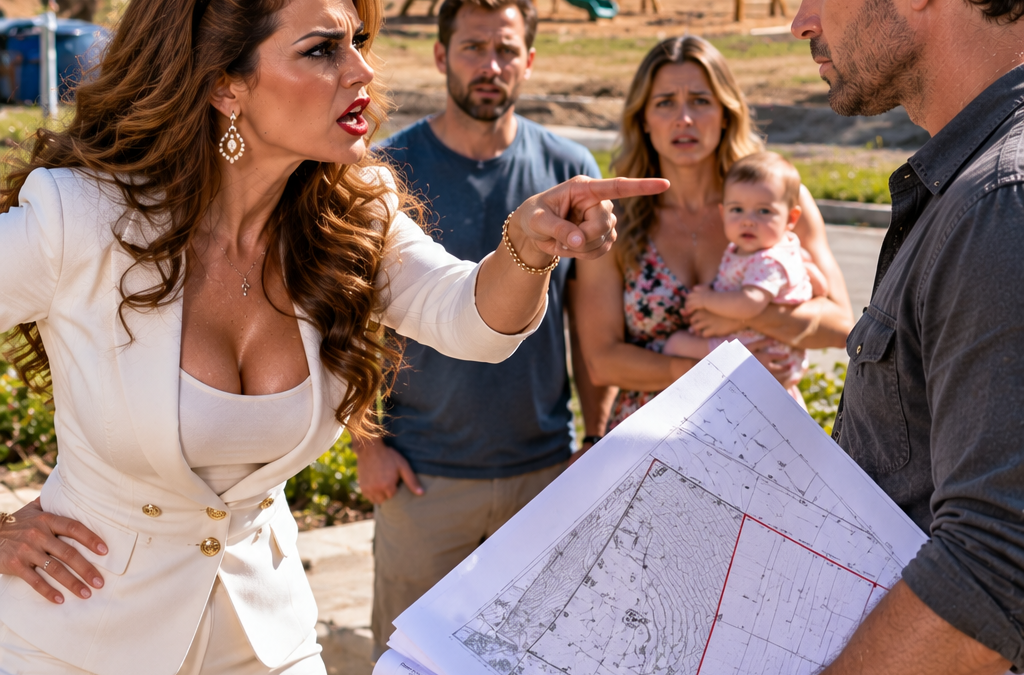
I had seen Karen before I left the country, though we had only spoken once. She lived in the neighboring subdivision and had taken over the HOA like a hostile nation with bylaws. She was around forty, maybe a little older, but she worked hard to look ageless—glossy chestnut hair, red lips, manicured nails, designer sunglasses, fitted white blazers, and a perfume trail strong enough to linger in open air.
She was beautiful in the way expensive things are beautiful when they have sharp edges.
The one time we met, she had come to my front gate to ask whether I would consider “cooperating with the community vision” by selling my land to the HOA. I told her no. Politely. She smiled like I had misunderstood the question and said vacant land created uncertainty for surrounding property values.
I told her my grandfather liked uncertainty just fine.
She did not laugh.
Now, standing in front of four houses on my property, I understood something I should have understood then.
Karen had not heard no.
She had heard not yet.
I hung up with Ray and drove slowly toward the nearest house.
The woman with the baby was still outside. Her face tightened as I approached, probably because I looked the way I felt: exhausted from travel, dusty from the road, and one bad sentence away from becoming someone’s emergency call.
“Hi,” I said, stepping out of the truck. “I’m sorry to bother you. My name is Daniel Mercer. I own this property.”
She frowned.
“This house?”
“This land.”
Her eyes moved toward the other houses.
“I don’t understand.”
“Neither do I.”
Her husband came out a minute later, holding a burp cloth in one hand and wearing the expression of a man trying not to panic in front of his wife. Their names were Emily and Aaron. They had bought the lot from Willow Ridge HOA eighteen months earlier. They showed me a folder full of documents: a purchase agreement, a survey map, HOA approval letters, permit paperwork, utility connection receipts, architectural review forms, even invoices for monthly HOA dues and special assessments.
Everything looked official.
Everything was wrong.
The survey showed their lot as part of Willow Ridge’s East Meadow Expansion.
My land.
Their purchase price had been $168,000 for the lot alone. Then they spent hundreds of thousands building the house. They had poured their savings into it. They had a newborn upstairs and a nursery painted pale yellow.
Emily started crying before I finished explaining.
“We didn’t know,” she whispered.
“I believe you.”
And I did.
That was the worst part.
The families living there were not villains. They had been deceived. They thought they had bought legitimate lots inside a growing HOA community. They had trusted permits, maps, contracts, and the woman who told them everything was legal.
Karen.
By sunset, I had spoken to all four households.
A retired couple named Frank and Linda who had downsized and put nearly everything they owned into their dream home.
A single mother named Tasha who had bought the smallest of the four houses so her sons could live near a “safe community playground.”
Emily and Aaron with their newborn.
And a software consultant named Brett who kept saying, “But the title company cleared it,” like repetition might bend reality back into place.
They were stunned.
I was furious.
But the target of my fury was not standing in front of me with a baby, or a mortgage, or a retirement plan collapsing in real time.
The target was Karen Vale.
I found her the next morning at the Willow Ridge clubhouse.
The clubhouse looked like every HOA clubhouse I had ever seen: beige stone, manicured shrubs, a fake lake, and a flagpole in front so residents could feel patriotic while arguing about trash bins. Karen was inside, standing near a long conference table with two board members and a man in a polo shirt.
She turned when I entered.
For one fraction of a second, surprise crossed her face.
Then she smiled.
“Mr. Mercer,” she said, as if we had an appointment. “You’re back.”
I walked toward her.
“We need to talk.”
The board members exchanged glances.
Karen wore a cream blouse tucked into fitted tan trousers, gold hoops at her ears, and nude heels that clicked lightly as she shifted her weight. Her hair fell in perfect waves. Her makeup was flawless. She looked calm, elegant, and completely unbothered by the fact that she had apparently sold my land out from under me.
“Of course,” she said. “Let’s keep this professional.”
“You built four houses on my property.”
Her smile did not move.
“The East Meadow Expansion has been a tremendous success.”
“My property.”
“The community has invested significantly in that area.”
“That area belongs to me.”
Karen tilted her head slightly, the way people do when they want an audience to think they are being patient with someone unreasonable.
“Daniel, you were gone for years.”
“Two and a half.”
“You abandoned the land.”
“I took an overseas engineering assignment.”
“You were not maintaining it. You were not using it. The HOA had to consider the broader community interest.”
I stared at her.
“You thought you could take it because I wasn’t standing on it?”
“I wouldn’t phrase it that way.”
“How would you phrase it?”
“We acted based on established access rights, historical use, and community development authority.”
“Show me the documents.”
Her eyes cooled.
“Our attorney is reviewing them.”
“That means you don’t have them.”
“It means I’m not going to be bullied in my own clubhouse by someone who neglected his property and now wants to punish innocent families.”
That landed.
Because she knew exactly where to press.
The families were innocent. She had placed them between us like human shields, then dared me to swing.
“I spoke with them,” I said. “They had no idea.”
“Then don’t hurt them.”
“You did this.”
“I improved unused land.”
“You stole it.”
The room went silent.
The man in the polo shifted uncomfortably.
Karen stepped closer. Her perfume was sweet, expensive, and suffocating.
“Careful,” she said softly.
“No.”
Her eyes narrowed.
“You need to understand something. Those homes are built. Families live there. Children sleep there. Utilities are connected. The county issued permits. The HOA has maintained roads and common areas. This situation cannot simply be undone because you came home angry.”
“You sold land you didn’t own.”
“We relied on documentation.”
“What documentation?”
Again, that pause.
Then she smiled.
“We can resolve this. Sell the affected parcels to the HOA at the original lot price. Everyone wins.”
I laughed once.
I could not help it.
“You want me to sell you my land for the price you fraudulently charged people for it?”
“It was a fair price for undeveloped rural acreage.”
“It has four houses on it now because you built them there without permission.”
“Exactly. Which means your property value has increased. You should be thanking us.”
There it was.
The sentence that turned my anger into certainty.
You should be thanking us.
I looked at her for a long moment.
She had the audacity to hold my gaze.
“No,” I said.
Karen’s smile finally disappeared.
“Excuse me?”
“No. I’m not selling you anything.”
Her voice dropped.
“You are making a very expensive mistake.”
“I own the land.”
“And we have legal resources.”
“So do I.”
“The HOA will fight this for years if necessary.”
“Then I hope you kept good records.”
Her cheeks colored.
“You allowed this to happen by being absent.”
I stepped closer.
“I did not allow anything.”
“You failed to monitor your property.”
“You failed to own it before selling it.”
Karen’s eyes flashed.
“Get out.”
“With pleasure.”
As I turned to leave, she called after me.
“Those families will hate you if you displace them.”
I stopped at the door.
“They should hate the person who sold them stolen land.”
That afternoon, I hired a real estate fraud attorney named Naomi Reed.
Naomi was in her fifties, sharp-eyed, precise, and terrifying in a quiet way. She had spent decades handling boundary disputes, forged deeds, fraudulent transfers, and title disasters. When I sat in her office and explained that an HOA had built four houses on my property while I was overseas, she did not gasp.
She smiled.
Not because it was funny.
Because some lawyers hunt boring cases for a living and then, once in a while, someone drops a dragon on their desk.
“Do you have your deed?” she asked.
“Yes.”
“Original survey?”
“Yes.”
“Recent survey?”
“Not yet.”
“Get one. Immediately. I want every structure mapped. Every driveway. Every utility line. Every streetlight. Every inch of encroachment.”
Within a week, the updated survey confirmed what I already knew.
All four houses sat entirely inside my property lines.
Not barely.
Not accidentally.
The closest structure was two hundred feet inside my boundary.
Two hundred feet.
No honest surveyor misses that.
Naomi sent a formal demand to the HOA requesting every document they claimed authorized the expansion: easements, rights of way, surveys, permits, board approvals, title records, contracts, payments, and communications with the county.
Karen stalled.
First she said the documents were with counsel.
Then she said they were archived.
Then she said the HOA had experienced a digital filing issue.
Then, after Naomi filed the first round of legal motions and involved the county building department, Karen produced the “historical easement.”
I remember sitting in Naomi’s conference room when she placed the document in front of me.
It was aged yellow, with a fake-looking notary stamp and language supposedly dating back decades. It claimed my grandfather’s property had granted Willow Ridge development access and future expansion rights over the east field.
I stared at my grandfather’s forged signature.
My throat tightened.
“That’s not his handwriting,” I said.
Naomi’s face was expressionless.
“I know.”
The forensic document examiner confirmed it.
The easement was fabricated.
Not mistaken.
Not misfiled.
Fabricated.
The paper had been artificially aged. The document had been created using modern software. The formatting, fonts, ink patterns, and notary seal were inconsistent with the date it claimed. My grandfather’s signature had been copied from an old county filing and digitally manipulated.
That changed everything.
Local police had initially shrugged at the situation and called it civil.
Naomi sent them the forensic report.
Suddenly, the word civil disappeared.
The county opened an investigation. The building department froze all related permits. The state attorney general’s office requested records. A forensic accountant began tracing payments.
And Karen started unraveling.
At first, she tried pressure.
She called me at night from blocked numbers.
“You are ruining families.”
Then she sent board members.
One older man came to my porch and told me I needed to be reasonable.
I asked him whether he knew the easement was forged.
He left without answering.
Then Karen came herself.
I saw her through the front window one evening, standing under my porch light in a white coat, her hair perfect despite the wind, her lips painted deep red. She looked like she belonged in a perfume ad, not at the center of a land fraud investigation.
I opened the door but did not invite her in.
“You won’t answer my calls,” she said.
“My attorney told me not to.”
“You always hide behind lawyers?”
“You always hide behind innocent families?”
Her mouth tightened.
“I’m trying to solve a problem.”
“You created the problem.”
“I created homes.”
“On land you stole.”
She took a step closer.
“Do you know what those houses are worth? Do you know what your empty field was worth before we improved it?”
“My land was not empty to me.”
“Oh, don’t be sentimental.”
The contempt in her voice was unmistakable.
“It was grass,” she continued. “Unused, unproductive grass. We created value. We brought in utilities, roads, lighting. We created a neighborhood.”
“You created evidence.”
Her eyes flashed.
“You should accept the settlement.”
“Two hundred thousand dollars for land you already sold for over eight hundred thousand?”
For the first time, she looked surprised that I knew the number.
Naomi’s accountant had found it.
Karen recovered quickly.
“That money went to development costs.”
“And HOA dues? Special assessments? Utility fees?”
Her jaw tightened.
“I’m not discussing finances with you.”
“No. You’ll discuss them with investigators.”
Karen’s face changed.
The charm vanished.
The beauty remained, but sharpened into something ugly.
“You think you’re untouchable because you have a deed,” she said.
“I think I’m the owner because I have a deed.”
“You’re going to be blamed for this.”
“For what?”
“For displacing families. For destroying homes. For putting people on the street because you care more about dirt than children.”
There it was again.
The human shield.
I leaned against the doorframe.
“Karen, I feel terrible for those families. That is why I’m not screaming at them. But don’t confuse compassion with surrender.”
“You don’t have a choice.”
I smiled.
That made her pause.
“I do,” I said. “And tomorrow you’re going to learn what it is.”
The next morning, four official notices went out.
Not eviction notices.
Rent notices.
Karen had spent weeks insisting that the families had legitimate living arrangements on my property and that I had to respect their residency. Fine. I respected it.
Under the correct legal framework.
If they were living in houses on land I legally owned, then I was the landlord of the land beneath them. Naomi researched comparable rental values for similar homes in the area. Fair market rent came to approximately $2,800 per month per house.
They had been living there an average of eighteen months.
Back rent totaled just over $200,000 across all four households.
Each family received a formal notice: pay back rent and begin monthly payments, negotiate a temporary occupancy agreement, or vacate within thirty days while pursuing claims against the party that sold them invalid lots.
It sounds harsh.
It was harsh.
But it was also strategic.
Karen had trapped me in a moral corner. If I demanded removal, I looked cruel. If I sold cheap, she won. If I did nothing, my ownership eroded while she strengthened her lie.
So I accepted her premise.
People live there? Good.
Then occupation has value.
Residency has terms.
Use of land requires payment.
Karen called within an hour, screaming so loudly I held the phone away from my ear.
“You can’t charge them rent!”
“You said they have established residency.”
“They bought those homes!”
“From someone who had no right to sell the land.”
“They have purchase agreements!”
“With you.”
“You are extorting victims!”
“No, Karen. I am identifying the correct landlord.”
“You are not their landlord.”
“I own the land.”
“They own the houses.”
“Then they can either rent the land beneath them or move the houses.”
She made a sound somewhere between a laugh and a growl.
“This will never hold up.”
“Then challenge it in court.”
She hung up.
But Naomi had been right.
The rent notices changed the battlefield overnight.
Three of the four families contacted me directly within days.
Emily and Aaron came first.
They sat at my kitchen table with their baby asleep in a carrier beside them. Emily looked exhausted, her eyes red from days of crying. Aaron had a folder full of documents and the hollow look of a man doing math he could not survive.
“We can’t pay fifty thousand dollars,” he said.
“I know.”
“We didn’t know.”
“I know that too.”
Emily wiped her face.
“Are you going to make us leave?”
I looked at their baby.
Then back at them.
“I don’t want to. But I can’t let Karen’s fraud become my loss.”
“What do we do?”
“You sue her. You cooperate with investigators. And for now, if you want to stay, we sign a temporary lease at fair rent going forward while this gets sorted out. Back rent becomes part of your damages claim against the HOA.”
They agreed.
Frank and Linda agreed too. They were furious, but not at me. Frank brought a binder so organized it made Naomi later say, “I wish every client had retired military energy.” They had paid the HOA in cashier’s checks and kept copies of everything.
Tasha, the single mother, decided to move. Not because she blamed me, but because she could not handle the uncertainty with two kids. She cried when she told me.
“I thought this place was safe,” she said.
“I’m sorry.”
“I know you didn’t do it.”
That sentence meant more than I expected.
Brett, the software consultant, tried to fight. His lawyer sent Naomi an aggressive letter claiming detrimental reliance, constructive ownership, unjust enrichment, emotional damages, and half a dozen other phrases thrown like darts at a wall.
Naomi replied with a letter so concise it almost felt rude.
Our client owns the land. Your client may pursue remedies against the fraudulent seller.
Two weeks later, Brett signed a temporary occupancy agreement.
Karen doubled down publicly.
She posted statements to the HOA portal claiming outside forces were attacking Willow Ridge. She accused me of exploiting families. She blamed “land record ambiguity.” She blamed the county. She blamed outdated maps. She blamed administrative confusion. She blamed everyone except herself.
Then investigators found the money.
The forensic accountant discovered Karen had collected over $800,000 from the four homeowners for the lots on my property, plus roughly $150,000 in dues, assessments, utility fees, and road maintenance charges over eighteen months.
But that was only the beginning.
The building permits had been approved by a county inspector named Mark Ellison.
Karen’s brother-in-law.
The investigation found payments from Karen-controlled accounts to entities connected to Mark. Consulting fees. Expedited review payments. Reimbursement transfers. A pattern of approvals for questionable projects tied to properties with absentee owners.
My land was not Karen’s first fraud.
It was just her boldest.
Over five years, she had targeted at least twelve property owners across multiple counties. People who lived out of state. Elderly owners in nursing homes. Families holding inherited land they rarely visited. She forged easements, created fake development rights, pushed permits through her brother-in-law, sold lots, collected fees, and wrapped everything in HOA legitimacy.
She did not act like a criminal hiding in shadows.
She acted like a community leader cutting ribbons.
That was what made it work.
People trusted the signs, the letterhead, the permits, the board approvals, the polished woman in heels who smiled at young families and said, “Welcome home.”
When federal agents arrested her, I was not there.
I saw it later through rumor, then through court filings, then through one shaky phone video someone definitely should not have taken but everyone in the area watched anyway.
Karen was leaving the Willow Ridge clubhouse in a white suit when they approached her. Even in handcuffs, she tried to maintain dignity. Chin high. Hair perfect. Sunglasses on. The video caught her saying, “This is a misunderstanding,” while an agent guided her into the car.
It was not a misunderstanding.
The charges were massive.
Mail fraud.
Wire fraud.
Conspiracy.
Money laundering.
Forgery.
Real estate fraud.
RICO-related charges tied to the HOA structure.
Mark, her brother-in-law, was charged with bribery, corruption, and conspiracy.
The HOA itself became a legal corpse, picked apart by prosecutors, creditors, insurers, and victims’ attorneys.
Karen rejected the first plea deal.
Naomi told me that was expected.
“People like her believe consequences are something that happen to less attractive defendants,” she said.
The trial lasted longer than I wanted and shorter than Karen deserved.
Evidence buried her.
Forged easements. Fake permits. Bank transfers. Emails. Text messages. Depositions from families she had deceived. Testimony from prior victims. Expert reports showing fabricated documents. Financial records tracing stolen money into luxury cars, vacations, designer purchases, and a vacation home in another state.
Her defense tried to paint her as an overzealous HOA president who relied on bad advice.
Then prosecutors showed emails where she wrote, “Absentee owner. Low risk. Push through before anyone notices.”
The jury took less than four hours.
Guilty on all major counts.
Karen stood very still when the verdict was read.
No tears.
No collapse.
No dramatic pleading.
Just a blank, frozen face, like her mind had rejected the possibility that a room full of ordinary people had judged her and found her powerless.
At sentencing, the judge spoke for a long time about trust.
About how property ownership depends on records, honesty, and the expectation that public systems will not be corrupted by private greed. About how Karen had not merely stolen money; she had weaponized community authority, forged history, and placed innocent families in legal and financial ruin.
Karen got nine years in federal prison.
Mark took a plea deal and got five years, plus permanent disqualification from government employment.
The restitution order ran into millions.
The HOA was dissolved. Its assets were liquidated. Insurance carriers fought, then paid. The vacation home Karen bought with stolen money was seized. Her luxury cars were repossessed. Her personal residence went into foreclosure when the legal bills ate whatever remained.
And my land?
That took longer.
The federal court ordered HOA assets and insurance proceeds to cover removal of unauthorized structures from my property if I wanted them gone. For two houses, that is exactly what happened. Tasha had already moved out, and Brett eventually accepted a restitution settlement and walked away. Their homes were removed or demolished through court-supervised contractors. The utilities were disconnected, foundations cleared, and the land restored as much as land can be restored after being violated by concrete and fraud.
Emily and Aaron stayed.
So did Frank and Linda.
They paid rent during the legal process. They cooperated fully. They sued the HOA, Karen, and related parties. Once their claims resolved and their finances stabilized, they approached me about buying the parcels beneath their homes.
I thought about saying no.
Part of me wanted every inch back exactly as it had been.
But land changes. Life changes. And my grandfather, stubborn as he was, also believed in making a good deal when it served a real purpose.
So I sold each family the land under and around their homes at fair market value.
Not Karen’s fake price.
Not a punishment price.
Fair.
Emily cried at closing.
Frank shook my hand like we had survived a war together.
In a way, maybe we had.
The two remaining families became actual neighbors, not fraud victims occupying stolen ground. The road Karen built was narrowed, properly recorded, and converted into a legal access lane for those parcels. The playground came down. The streetlights stayed after being transferred into a private maintenance agreement.
The east field was never the same.
I had to accept that.
But it was mine again in the ways that mattered.
Legally.
Financially.
Emotionally, that took longer.
For months after the trial, I would stand on the porch at sunset and look toward the place where open grass had once rolled uninterrupted to the trees. I would feel anger rise again, not sharp like before, but deep and heavy. Not only because Karen stole from me, but because she had turned my grandfather’s land into a battlefield where innocent people got hurt.
I remembered him walking that field with me when I was young, pointing out where the ground dipped, where water collected after spring rain, where deer crossed at dusk.
He used to say land remembers.
I never knew if I believed that.
But after everything, I understood that people remember through land.
A pasture is not just grass when your grandfather taught you how to mend a fence there. A tree line is not just trees when it was the place you ran to as a kid when you wanted to disappear. An empty field is not empty if someone you loved spent sixty years choosing not to sell it.
Karen looked at my land and saw unused value.
My grandfather looked at it and saw permanence.
I was somewhere in between.
The final time I saw Karen was at sentencing.
She turned before the marshals led her away and looked back at the courtroom. For one second, her eyes found mine.
She did not look sorry.
That would have been too much to expect.
She looked offended.
As if the world had committed a procedural error by holding her accountable.
I thought about the day in the clubhouse when she told me I should thank her. I thought about her standing on my porch, calling my grandfather’s field unproductive grass. I thought about every family she had smiled at while selling them a lie.
Then she was gone.
Naomi leaned toward me and said quietly, “That’s the end of her part.”
She was right.
But it was not the end of mine.
I repaired what I could. Sold what made sense. Fenced what remained. Updated every survey, every title record, every boundary marker. I installed cameras, not because I wanted to live paranoid, but because trust without verification had cost enough already.
Ray apologized more than once for not realizing what was happening.
I told him the truth.
“This was not your fault.”
But I hired a professional land management company anyway.
Compassion does not require repeating mistakes.
The money worked out better than I expected.
The settlements, insurance payments, rent, and eventual land sales left me in a stronger financial position than before. That fact still feels strange. Karen tried to steal my property and somehow left me wealthier, while she lost her freedom, her reputation, her home, her cars, and every illusion of power she had built around herself.
But money was never the real victory.
The real victory was hearing the county recorder confirm, again and again, that the land was mine.
The real victory was watching forged documents collapse under real scrutiny.
The real victory was realizing Karen’s favorite weapon—pressure—had no power once I stopped trying to seem reasonable to an unreasonable person.
She wanted me trapped by empathy.
She wanted me afraid of being seen as cruel.
She wanted the innocent families to become a wall between her crime and my rights.
And for a while, it nearly worked.
But there is a difference between protecting innocent people and surrendering to the person who endangered them.
I learned that the hard way.
You can be fair without being weak.
You can be compassionate without absorbing someone else’s fraud.
You can care about victims without letting the criminal keep what she stole.
That is what Karen never understood.
She thought kindness was leverage.
She thought absence was abandonment.
She thought unused land was ownerless land.
She thought beauty, confidence, paperwork, and the letters HOA could make theft look official.
For a while, they did.
But only for a while.
Because paper can lie.
People can lie.
Permits can be corrupted.
Maps can be forged.
And a woman with a clipboard, red lipstick, and a voice full of authority can convince people that stolen land is a community expansion.
But the truth has weight.
A real deed has weight.
A real survey has weight.
A family history has weight.
And eventually, if you stand still long enough and refuse to be moved, all that weight comes down.
Karen built four houses on my land while I was overseas.
She told me to be reasonable.
She told me to sell cheap.
She told me to thank her.
Instead, I charged rent, exposed the fraud, watched her HOA dissolve, and took back what my grandfather left me.
Not because the land was empty.
Because it never was.
𝗧𝗛𝗘 𝗘𝗡𝗗
Karen Built Four Houses on My Land While I Was Overseas, Then Told Me I Should Thank Her
I came home after two and a half years overseas and found four families living on land my grandfather had left me.
Karen smiled like she had done me a favor.
Then she told me if I wanted my own property back, I would have to fight her entire HOA for it.
For a few seconds, I honestly thought I had taken the wrong road.
That sounds ridiculous now, because I knew that road better than I knew most people. I had driven it with my grandfather when I was little, sitting in the passenger seat of his old truck with my knees pulled up, watching the fence posts flick past the window. I had learned to steer on that road when he let me sit in his lap and hold the wheel while he worked the pedals. I had walked it alone after his funeral five years earlier, trying to understand how fifteen acres could feel so large and so empty without him on it.
So no, I had not taken the wrong road.
I knew every curve. Every dip. Every old oak on the east side. Every rusted section of wire fence he kept meaning to replace but never did because, as he liked to say, “A fence only needs to stop honest people. A determined idiot will always find a way through.”
My grandfather was right about a lot of things.
But even he would not have believed what I saw that afternoon.
Where there had once been open pasture, waist-high grass, and a long clear view toward the back tree line, there were now houses.
Not sheds.
Not trailers.
Not some temporary construction mistake.
Houses.
Four full-size, single-family homes stood on my land like they had grown there while I was gone. Fresh paint. Shingled roofs. Concrete driveways. Little mailboxes. Landscaped yards. One had a swing set. Another had a flower bed with red mulch. There were streetlights along a newly paved lane that cut through my property. Near the end, someone had built a small playground with two slides and a bright blue climbing frame.
I stopped my truck in the middle of the gravel road and just stared.
For a long moment, my brain refused to understand what my eyes were giving it.
I had been away for almost two and a half years on an engineering assignment overseas. It was supposed to be eighteen months, but infrastructure projects have a way of swallowing calendars whole. Delays turned into extensions. Extensions turned into new contracts. New contracts turned into another winter away from home. I had paid my taxes, kept my insurance active, arranged for basic mowing near the main house, and trusted that my family land would still be there when I returned.
The land had been in my family for more than sixty years.
My grandfather bought it when the area outside the city limits was still quiet and mostly rural. The nearby HOA development came decades later, all gated entries, identical stone signs, strict landscaping rules, and people who treated mailbox paint like a moral issue. My grandfather had never joined them. My property predated their association by so long that their entire neighborhood felt like an awkward guest built around an old family story.
There had never been HOA involvement.
No covenants.
No easements.
No shared ownership.
No community claim.
Just fifteen acres, a main house, some pasture, old trees, and my grandfather’s name on the deed until it became mine.
And now four families were living on it.
A woman stepped out of the nearest house holding a baby against her shoulder. She saw my truck and gave me a cautious wave, the kind neighbors give when they are trying to figure out whether you are lost, delivering something, or about to complain.
I could not wave back.
My hands were locked around the steering wheel.
Behind the houses, beyond the little playground, I saw a large sign I had never authorized.
WELCOME TO WILLOW RIDGE HOA — EAST MEADOW EXPANSION.
East Meadow.
That was what my grandfather used to call the open section where he let the grass grow tall in summer because the deer bedded down there at dusk.
They had renamed it.
They had built on it.
They had sold it.
And somewhere inside me, grief turned into something much hotter.
PART 2
The first person I called was not a lawyer.
It was my property manager.
Technically, property manager was too generous a term. He was a local guy named Ray who checked on the main house once a month, made sure no windows were broken, hired someone to mow around the driveway, and texted me if storms knocked down branches. He was not responsible for patrolling all fifteen acres, but at that moment, staring at four unauthorized houses, I needed someone else to confirm I had not gone insane.
Ray answered on the third ring.
“Hey, man. You back?”
“Ray,” I said, my voice strangely calm, “why are there houses on my land?”
There was a pause.
“What?”
“Houses. Four of them. On the east field.”
Another pause. Longer this time.
“I thought that was HOA land.”
My stomach dropped.
“Why would you think that?”
“They had signs up. Survey crews. Construction permits. I figured you sold a section before you left or something.”
“I did not sell anything.”
“Jesus.”
“Who built them?”
“I don’t know the details. Some HOA expansion thing. The woman running it came by once when I asked about trucks crossing near the driveway. She said everything had been approved.”
“What woman?”
“You know that HOA president. Karen Vale.”
Of course her name was Karen.
I had seen Karen before I left the country, though we had only spoken once. She lived in the neighboring subdivision and had taken over the HOA like a hostile nation with bylaws. She was around forty, maybe a little older, but she worked hard to look ageless—glossy chestnut hair, red lips, manicured nails, designer sunglasses, fitted white blazers, and a perfume trail strong enough to linger in open air.
She was beautiful in the way expensive things are beautiful when they have sharp edges.
The one time we met, she had come to my front gate to ask whether I would consider “cooperating with the community vision” by selling my land to the HOA. I told her no. Politely. She smiled like I had misunderstood the question and said vacant land created uncertainty for surrounding property values.
I told her my grandfather liked uncertainty just fine.
She did not laugh.
Now, standing in front of four houses on my property, I understood something I should have understood then.
Karen had not heard no.
She had heard not yet.
I hung up with Ray and drove slowly toward the nearest house.
The woman with the baby was still outside. Her face tightened as I approached, probably because I looked the way I felt: exhausted from travel, dusty from the road, and one bad sentence away from becoming someone’s emergency call.
“Hi,” I said, stepping out of the truck. “I’m sorry to bother you. My name is Daniel Mercer. I own this property.”
She frowned.
“This house?”
“This land.”
Her eyes moved toward the other houses.
“I don’t understand.”
“Neither do I.”
Her husband came out a minute later, holding a burp cloth in one hand and wearing the expression of a man trying not to panic in front of his wife. Their names were Emily and Aaron. They had bought the lot from Willow Ridge HOA eighteen months earlier. They showed me a folder full of documents: a purchase agreement, a survey map, HOA approval letters, permit paperwork, utility connection receipts, architectural review forms, even invoices for monthly HOA dues and special assessments.
Everything looked official.
Everything was wrong.
The survey showed their lot as part of Willow Ridge’s East Meadow Expansion.
My land.
Their purchase price had been $168,000 for the lot alone. Then they spent hundreds of thousands building the house. They had poured their savings into it. They had a newborn upstairs and a nursery painted pale yellow.
Emily started crying before I finished explaining.
“We didn’t know,” she whispered.
“I believe you.”
And I did.
That was the worst part.
The families living there were not villains. They had been deceived. They thought they had bought legitimate lots inside a growing HOA community. They had trusted permits, maps, contracts, and the woman who told them everything was legal.
Karen.
By sunset, I had spoken to all four households.
A retired couple named Frank and Linda who had downsized and put nearly everything they owned into their dream home.
A single mother named Tasha who had bought the smallest of the four houses so her sons could live near a “safe community playground.”
Emily and Aaron with their newborn.
And a software consultant named Brett who kept saying, “But the title company cleared it,” like repetition might bend reality back into place.
They were stunned.
I was furious.
But the target of my fury was not standing in front of me with a baby, or a mortgage, or a retirement plan collapsing in real time.
The target was Karen Vale.
I found her the next morning at the Willow Ridge clubhouse.
The clubhouse looked like every HOA clubhouse I had ever seen: beige stone, manicured shrubs, a fake lake, and a flagpole in front so residents could feel patriotic while arguing about trash bins. Karen was inside, standing near a long conference table with two board members and a man in a polo shirt.
She turned when I entered.
For one fraction of a second, surprise crossed her face.
Then she smiled.
“Mr. Mercer,” she said, as if we had an appointment. “You’re back.”
I walked toward her.
“We need to talk.”
The board members exchanged glances.
Karen wore a cream blouse tucked into fitted tan trousers, gold hoops at her ears, and nude heels that clicked lightly as she shifted her weight. Her hair fell in perfect waves. Her makeup was flawless. She looked calm, elegant, and completely unbothered by the fact that she had apparently sold my land out from under me.
“Of course,” she said. “Let’s keep this professional.”
“You built four houses on my property.”
Her smile did not move.
“The East Meadow Expansion has been a tremendous success.”
“My property.”
“The community has invested significantly in that area.”
“That area belongs to me.”
Karen tilted her head slightly, the way people do when they want an audience to think they are being patient with someone unreasonable.
“Daniel, you were gone for years.”
“Two and a half.”
“You abandoned the land.”
“I took an overseas engineering assignment.”
“You were not maintaining it. You were not using it. The HOA had to consider the broader community interest.”
I stared at her.
“You thought you could take it because I wasn’t standing on it?”
“I wouldn’t phrase it that way.”
“How would you phrase it?”
“We acted based on established access rights, historical use, and community development authority.”
“Show me the documents.”
Her eyes cooled.
“Our attorney is reviewing them.”
“That means you don’t have them.”
“It means I’m not going to be bullied in my own clubhouse by someone who neglected his property and now wants to punish innocent families.”
That landed.
Because she knew exactly where to press.
The families were innocent. She had placed them between us like human shields, then dared me to swing.
“I spoke with them,” I said. “They had no idea.”
“Then don’t hurt them.”
“You did this.”
“I improved unused land.”
“You stole it.”
The room went silent.
The man in the polo shifted uncomfortably.
Karen stepped closer. Her perfume was sweet, expensive, and suffocating.
“Careful,” she said softly.
“No.”
Her eyes narrowed.
“You need to understand something. Those homes are built. Families live there. Children sleep there. Utilities are connected. The county issued permits. The HOA has maintained roads and common areas. This situation cannot simply be undone because you came home angry.”
“You sold land you didn’t own.”
“We relied on documentation.”
“What documentation?”
Again, that pause.
Then she smiled.
“We can resolve this. Sell the affected parcels to the HOA at the original lot price. Everyone wins.”
I laughed once.
I could not help it.
“You want me to sell you my land for the price you fraudulently charged people for it?”
“It was a fair price for undeveloped rural acreage.”
“It has four houses on it now because you built them there without permission.”
“Exactly. Which means your property value has increased. You should be thanking us.”
There it was.
The sentence that turned my anger into certainty.
You should be thanking us.
I looked at her for a long moment.
She had the audacity to hold my gaze.
“No,” I said.
Karen’s smile finally disappeared.
“Excuse me?”
“No. I’m not selling you anything.”
Her voice dropped.
“You are making a very expensive mistake.”
“I own the land.”
“And we have legal resources.”
“So do I.”
“The HOA will fight this for years if necessary.”
“Then I hope you kept good records.”
Her cheeks colored.
“You allowed this to happen by being absent.”
I stepped closer.
“I did not allow anything.”
“You failed to monitor your property.”
“You failed to own it before selling it.”
Karen’s eyes flashed.
“Get out.”
“With pleasure.”
As I turned to leave, she called after me.
“Those families will hate you if you displace them.”
I stopped at the door.
“They should hate the person who sold them stolen land.”
That afternoon, I hired a real estate fraud attorney named Naomi Reed.
Naomi was in her fifties, sharp-eyed, precise, and terrifying in a quiet way. She had spent decades handling boundary disputes, forged deeds, fraudulent transfers, and title disasters. When I sat in her office and explained that an HOA had built four houses on my property while I was overseas, she did not gasp.
She smiled.
Not because it was funny.
Because some lawyers hunt boring cases for a living and then, once in a while, someone drops a dragon on their desk.
“Do you have your deed?” she asked.
“Yes.”
“Original survey?”
“Yes.”
“Recent survey?”
“Not yet.”
“Get one. Immediately. I want every structure mapped. Every driveway. Every utility line. Every streetlight. Every inch of encroachment.”
Within a week, the updated survey confirmed what I already knew.
All four houses sat entirely inside my property lines.
Not barely.
Not accidentally.
The closest structure was two hundred feet inside my boundary.
Two hundred feet.
No honest surveyor misses that.
Naomi sent a formal demand to the HOA requesting every document they claimed authorized the expansion: easements, rights of way, surveys, permits, board approvals, title records, contracts, payments, and communications with the county.
Karen stalled.
First she said the documents were with counsel.
Then she said they were archived.
Then she said the HOA had experienced a digital filing issue.
Then, after Naomi filed the first round of legal motions and involved the county building department, Karen produced the “historical easement.”
I remember sitting in Naomi’s conference room when she placed the document in front of me.
It was aged yellow, with a fake-looking notary stamp and language supposedly dating back decades. It claimed my grandfather’s property had granted Willow Ridge development access and future expansion rights over the east field.
I stared at my grandfather’s forged signature.
My throat tightened.
“That’s not his handwriting,” I said.
Naomi’s face was expressionless.
“I know.”
The forensic document examiner confirmed it.
The easement was fabricated.
Not mistaken.
Not misfiled.
Fabricated.
The paper had been artificially aged. The document had been created using modern software. The formatting, fonts, ink patterns, and notary seal were inconsistent with the date it claimed. My grandfather’s signature had been copied from an old county filing and digitally manipulated.
That changed everything.
Local police had initially shrugged at the situation and called it civil.
Naomi sent them the forensic report.
Suddenly, the word civil disappeared.
The county opened an investigation. The building department froze all related permits. The state attorney general’s office requested records. A forensic accountant began tracing payments.
And Karen started unraveling.
At first, she tried pressure.
She called me at night from blocked numbers.
“You are ruining families.”
Then she sent board members.
One older man came to my porch and told me I needed to be reasonable.
I asked him whether he knew the easement was forged.
He left without answering.
Then Karen came herself.
I saw her through the front window one evening, standing under my porch light in a white coat, her hair perfect despite the wind, her lips painted deep red. She looked like she belonged in a perfume ad, not at the center of a land fraud investigation.
I opened the door but did not invite her in.
“You won’t answer my calls,” she said.
“My attorney told me not to.”
“You always hide behind lawyers?”
“You always hide behind innocent families?”
Her mouth tightened.
“I’m trying to solve a problem.”
“You created the problem.”
“I created homes.”
“On land you stole.”
She took a step closer.
“Do you know what those houses are worth? Do you know what your empty field was worth before we improved it?”
“My land was not empty to me.”
“Oh, don’t be sentimental.”
The contempt in her voice was unmistakable.
“It was grass,” she continued. “Unused, unproductive grass. We created value. We brought in utilities, roads, lighting. We created a neighborhood.”
“You created evidence.”
Her eyes flashed.
“You should accept the settlement.”
“Two hundred thousand dollars for land you already sold for over eight hundred thousand?”
For the first time, she looked surprised that I knew the number.
Naomi’s accountant had found it.
Karen recovered quickly.
“That money went to development costs.”
“And HOA dues? Special assessments? Utility fees?”
Her jaw tightened.
“I’m not discussing finances with you.”
“No. You’ll discuss them with investigators.”
Karen’s face changed.
The charm vanished.
The beauty remained, but sharpened into something ugly.
“You think you’re untouchable because you have a deed,” she said.
“I think I’m the owner because I have a deed.”
“You’re going to be blamed for this.”
“For what?”
“For displacing families. For destroying homes. For putting people on the street because you care more about dirt than children.”
There it was again.
The human shield.
I leaned against the doorframe.
“Karen, I feel terrible for those families. That is why I’m not screaming at them. But don’t confuse compassion with surrender.”
“You don’t have a choice.”
I smiled.
That made her pause.
“I do,” I said. “And tomorrow you’re going to learn what it is.”
The next morning, four official notices went out.
Not eviction notices.
Rent notices.
Karen had spent weeks insisting that the families had legitimate living arrangements on my property and that I had to respect their residency. Fine. I respected it.
Under the correct legal framework.
If they were living in houses on land I legally owned, then I was the landlord of the land beneath them. Naomi researched comparable rental values for similar homes in the area. Fair market rent came to approximately $2,800 per month per house.
They had been living there an average of eighteen months.
Back rent totaled just over $200,000 across all four households.
Each family received a formal notice: pay back rent and begin monthly payments, negotiate a temporary occupancy agreement, or vacate within thirty days while pursuing claims against the party that sold them invalid lots.
It sounds harsh.
It was harsh.
But it was also strategic.
Karen had trapped me in a moral corner. If I demanded removal, I looked cruel. If I sold cheap, she won. If I did nothing, my ownership eroded while she strengthened her lie.
So I accepted her premise.
People live there? Good.
Then occupation has value.
Residency has terms.
Use of land requires payment.
Karen called within an hour, screaming so loudly I held the phone away from my ear.
“You can’t charge them rent!”
“You said they have established residency.”
“They bought those homes!”
“From someone who had no right to sell the land.”
“They have purchase agreements!”
“With you.”
“You are extorting victims!”
“No, Karen. I am identifying the correct landlord.”
“You are not their landlord.”
“I own the land.”
“They own the houses.”
“Then they can either rent the land beneath them or move the houses.”
She made a sound somewhere between a laugh and a growl.
“This will never hold up.”
“Then challenge it in court.”
She hung up.
But Naomi had been right.
The rent notices changed the battlefield overnight.
Three of the four families contacted me directly within days.
Emily and Aaron came first.
They sat at my kitchen table with their baby asleep in a carrier beside them. Emily looked exhausted, her eyes red from days of crying. Aaron had a folder full of documents and the hollow look of a man doing math he could not survive.
“We can’t pay fifty thousand dollars,” he said.
“I know.”
“We didn’t know.”
“I know that too.”
Emily wiped her face.
“Are you going to make us leave?”
I looked at their baby.
Then back at them.
“I don’t want to. But I can’t let Karen’s fraud become my loss.”
“What do we do?”
“You sue her. You cooperate with investigators. And for now, if you want to stay, we sign a temporary lease at fair rent going forward while this gets sorted out. Back rent becomes part of your damages claim against the HOA.”
They agreed.
Frank and Linda agreed too. They were furious, but not at me. Frank brought a binder so organized it made Naomi later say, “I wish every client had retired military energy.” They had paid the HOA in cashier’s checks and kept copies of everything.
Tasha, the single mother, decided to move. Not because she blamed me, but because she could not handle the uncertainty with two kids. She cried when she told me.
“I thought this place was safe,” she said.
“I’m sorry.”
“I know you didn’t do it.”
That sentence meant more than I expected.
Brett, the software consultant, tried to fight. His lawyer sent Naomi an aggressive letter claiming detrimental reliance, constructive ownership, unjust enrichment, emotional damages, and half a dozen other phrases thrown like darts at a wall.
Naomi replied with a letter so concise it almost felt rude.
Our client owns the land. Your client may pursue remedies against the fraudulent seller.
Two weeks later, Brett signed a temporary occupancy agreement.
Karen doubled down publicly.
She posted statements to the HOA portal claiming outside forces were attacking Willow Ridge. She accused me of exploiting families. She blamed “land record ambiguity.” She blamed the county. She blamed outdated maps. She blamed administrative confusion. She blamed everyone except herself.
Then investigators found the money.
The forensic accountant discovered Karen had collected over $800,000 from the four homeowners for the lots on my property, plus roughly $150,000 in dues, assessments, utility fees, and road maintenance charges over eighteen months.
But that was only the beginning.
The building permits had been approved by a county inspector named Mark Ellison.
Karen’s brother-in-law.
The investigation found payments from Karen-controlled accounts to entities connected to Mark. Consulting fees. Expedited review payments. Reimbursement transfers. A pattern of approvals for questionable projects tied to properties with absentee owners.
My land was not Karen’s first fraud.
It was just her boldest.
Over five years, she had targeted at least twelve property owners across multiple counties. People who lived out of state. Elderly owners in nursing homes. Families holding inherited land they rarely visited. She forged easements, created fake development rights, pushed permits through her brother-in-law, sold lots, collected fees, and wrapped everything in HOA legitimacy.
She did not act like a criminal hiding in shadows.
She acted like a community leader cutting ribbons.
That was what made it work.
People trusted the signs, the letterhead, the permits, the board approvals, the polished woman in heels who smiled at young families and said, “Welcome home.”
When federal agents arrested her, I was not there.
I saw it later through rumor, then through court filings, then through one shaky phone video someone definitely should not have taken but everyone in the area watched anyway.
Karen was leaving the Willow Ridge clubhouse in a white suit when they approached her. Even in handcuffs, she tried to maintain dignity. Chin high. Hair perfect. Sunglasses on. The video caught her saying, “This is a misunderstanding,” while an agent guided her into the car.
It was not a misunderstanding.
The charges were massive.
Mail fraud.
Wire fraud.
Conspiracy.
Money laundering.
Forgery.
Real estate fraud.
RICO-related charges tied to the HOA structure.
Mark, her brother-in-law, was charged with bribery, corruption, and conspiracy.
The HOA itself became a legal corpse, picked apart by prosecutors, creditors, insurers, and victims’ attorneys.
Karen rejected the first plea deal.
Naomi told me that was expected.
“People like her believe consequences are something that happen to less attractive defendants,” she said.
The trial lasted longer than I wanted and shorter than Karen deserved.
Evidence buried her.
Forged easements. Fake permits. Bank transfers. Emails. Text messages. Depositions from families she had deceived. Testimony from prior victims. Expert reports showing fabricated documents. Financial records tracing stolen money into luxury cars, vacations, designer purchases, and a vacation home in another state.
Her defense tried to paint her as an overzealous HOA president who relied on bad advice.
Then prosecutors showed emails where she wrote, “Absentee owner. Low risk. Push through before anyone notices.”
The jury took less than four hours.
Guilty on all major counts.
Karen stood very still when the verdict was read.
No tears.
No collapse.
No dramatic pleading.
Just a blank, frozen face, like her mind had rejected the possibility that a room full of ordinary people had judged her and found her powerless.
At sentencing, the judge spoke for a long time about trust.
About how property ownership depends on records, honesty, and the expectation that public systems will not be corrupted by private greed. About how Karen had not merely stolen money; she had weaponized community authority, forged history, and placed innocent families in legal and financial ruin.
Karen got nine years in federal prison.
Mark took a plea deal and got five years, plus permanent disqualification from government employment.
The restitution order ran into millions.
The HOA was dissolved. Its assets were liquidated. Insurance carriers fought, then paid. The vacation home Karen bought with stolen money was seized. Her luxury cars were repossessed. Her personal residence went into foreclosure when the legal bills ate whatever remained.
And my land?
That took longer.
The federal court ordered HOA assets and insurance proceeds to cover removal of unauthorized structures from my property if I wanted them gone. For two houses, that is exactly what happened. Tasha had already moved out, and Brett eventually accepted a restitution settlement and walked away. Their homes were removed or demolished through court-supervised contractors. The utilities were disconnected, foundations cleared, and the land restored as much as land can be restored after being violated by concrete and fraud.
Emily and Aaron stayed.
So did Frank and Linda.
They paid rent during the legal process. They cooperated fully. They sued the HOA, Karen, and related parties. Once their claims resolved and their finances stabilized, they approached me about buying the parcels beneath their homes.
I thought about saying no.
Part of me wanted every inch back exactly as it had been.
But land changes. Life changes. And my grandfather, stubborn as he was, also believed in making a good deal when it served a real purpose.
So I sold each family the land under and around their homes at fair market value.
Not Karen’s fake price.
Not a punishment price.
Fair.
Emily cried at closing.
Frank shook my hand like we had survived a war together.
In a way, maybe we had.
The two remaining families became actual neighbors, not fraud victims occupying stolen ground. The road Karen built was narrowed, properly recorded, and converted into a legal access lane for those parcels. The playground came down. The streetlights stayed after being transferred into a private maintenance agreement.
The east field was never the same.
I had to accept that.
But it was mine again in the ways that mattered.
Legally.
Financially.
Emotionally, that took longer.
For months after the trial, I would stand on the porch at sunset and look toward the place where open grass had once rolled uninterrupted to the trees. I would feel anger rise again, not sharp like before, but deep and heavy. Not only because Karen stole from me, but because she had turned my grandfather’s land into a battlefield where innocent people got hurt.
I remembered him walking that field with me when I was young, pointing out where the ground dipped, where water collected after spring rain, where deer crossed at dusk.
He used to say land remembers.
I never knew if I believed that.
But after everything, I understood that people remember through land.
A pasture is not just grass when your grandfather taught you how to mend a fence there. A tree line is not just trees when it was the place you ran to as a kid when you wanted to disappear. An empty field is not empty if someone you loved spent sixty years choosing not to sell it.
Karen looked at my land and saw unused value.
My grandfather looked at it and saw permanence.
I was somewhere in between.
The final time I saw Karen was at sentencing.
She turned before the marshals led her away and looked back at the courtroom. For one second, her eyes found mine.
She did not look sorry.
That would have been too much to expect.
She looked offended.
As if the world had committed a procedural error by holding her accountable.
I thought about the day in the clubhouse when she told me I should thank her. I thought about her standing on my porch, calling my grandfather’s field unproductive grass. I thought about every family she had smiled at while selling them a lie.
Then she was gone.
Naomi leaned toward me and said quietly, “That’s the end of her part.”
She was right.
But it was not the end of mine.
I repaired what I could. Sold what made sense. Fenced what remained. Updated every survey, every title record, every boundary marker. I installed cameras, not because I wanted to live paranoid, but because trust without verification had cost enough already.
Ray apologized more than once for not realizing what was happening.
I told him the truth.
“This was not your fault.”
But I hired a professional land management company anyway.
Compassion does not require repeating mistakes.
The money worked out better than I expected.
The settlements, insurance payments, rent, and eventual land sales left me in a stronger financial position than before. That fact still feels strange. Karen tried to steal my property and somehow left me wealthier, while she lost her freedom, her reputation, her home, her cars, and every illusion of power she had built around herself.
But money was never the real victory.
The real victory was hearing the county recorder confirm, again and again, that the land was mine.
The real victory was watching forged documents collapse under real scrutiny.
The real victory was realizing Karen’s favorite weapon—pressure—had no power once I stopped trying to seem reasonable to an unreasonable person.
She wanted me trapped by empathy.
She wanted me afraid of being seen as cruel.
She wanted the innocent families to become a wall between her crime and my rights.
And for a while, it nearly worked.
But there is a difference between protecting innocent people and surrendering to the person who endangered them.
I learned that the hard way.
You can be fair without being weak.
You can be compassionate without absorbing someone else’s fraud.
You can care about victims without letting the criminal keep what she stole.
That is what Karen never understood.
She thought kindness was leverage.
She thought absence was abandonment.
She thought unused land was ownerless land.
She thought beauty, confidence, paperwork, and the letters HOA could make theft look official.
For a while, they did.
But only for a while.
Because paper can lie.
People can lie.
Permits can be corrupted.
Maps can be forged.
And a woman with a clipboard, red lipstick, and a voice full of authority can convince people that stolen land is a community expansion.
But the truth has weight.
A real deed has weight.
A real survey has weight.
A family history has weight.
And eventually, if you stand still long enough and refuse to be moved, all that weight comes down.
Karen built four houses on my land while I was overseas.
She told me to be reasonable.
She told me to sell cheap.
She told me to thank her.
Instead, I charged rent, exposed the fraud, watched her HOA dissolve, and took back what my grandfather left me.
Not because the land was empty.
Because it never was.