Karen Built 27 Cabins on My Land, Then Claimed My Dead Grandpa Had Given Her Permission
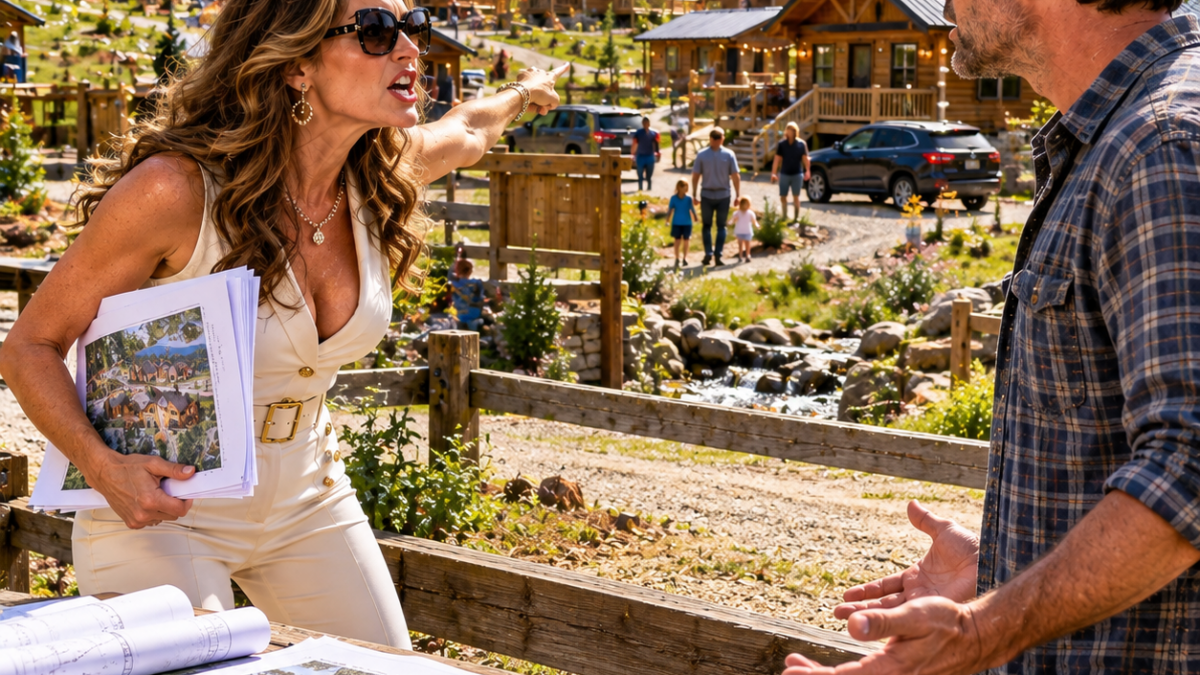
PART 2
I first met Karen Delaney not long after I inherited the property.
She owned the neighboring land to the east, though owned is probably too gentle a word for how she treated it. Karen was around forty, beautiful in a way that felt sharpened rather than softened by age. Glossy dark hair, bright eyes, a smile that could turn cold without changing shape, and the kind of figure she knew how to display without ever looking accidental. She dressed like rural life was a costume designed around expensive boots and fitted jackets. Even on muddy roads, she somehow looked like she was posing for an ad about vineyard ownership.
She was friendly and unfriendly at the same time.
That sounds contradictory, but if you have ever met someone like her, you understand. She asked personal questions with a warm voice and dead eyes. She laughed at the right moments but never in a way that made you feel included. She stood too close, remembered too much, and always seemed to be collecting information rather than making conversation.
The first time we met, she leaned on the fence between our properties and smiled like she had been expecting me.
“You’re the grandson,” she said.
“That’s me.”
“I’m Karen. Your grandparents and I used to talk now and then.”
That surprised me. My grandparents had never mentioned her, but they had known plenty of people I did not.
“They loved this place,” I said.
“Oh, your grandfather especially.” Her smile softened, almost convincingly. “He had ideas.”
“What kind of ideas?”
She looked out over the pasture.
“Development potential. Cabins. Homes. Rural retreats. People pay a lot now for quiet.”
I remember giving a polite laugh.
“My grandfather hated traffic on the dirt road. I can’t imagine him wanting a neighborhood back here.”
Karen tilted her head.
“People change when they see opportunity.”
Something about that answer bothered me.
Not enough to argue. Just enough to remember.
Over the next few visits, I ran into her twice more. Each conversation left me tired. She asked strange questions. What kind of insurance did I carry on the land? Had my grandparents ever held any business licenses? Was the property under any conservation restriction? Did I intend to build? Did I have partners? Did my wife like the place? Would we move soon? Was the estate fully settled?
At the time, I wrote it off as nosiness.
Looking back, she was mapping the weaknesses.
She was learning I lived far away. Learning my wife’s residency kept us tied to the city. Learning we were busy. Learning the property sat mostly unattended. Learning I had inherited emotionally, not operationally. Learning, in other words, that I was the kind of owner she thought she could outrun.
One conversation stuck with me later.
Karen stood beside her SUV near the old gate, sunglasses in her hair, a sleeveless white blouse catching the sun. She pointed out toward the back pasture.
“You could build a lot here,” she said.
I shrugged. “Maybe someday we’ll build one house.”
“One?” She laughed softly. “That’s sentimental. You could fit a dozen homes. More, probably, if you were smart about layout.”
“I’m not looking to turn it into a subdivision.”
“No, no, not subdivision.” Her smile widened. “Cabins. Vacation rentals. Rural escapes. City people love pretending they’re rustic for two nights at a time.”
I laughed because I thought she was joking.
She was not.
At the time, I just said, “Sounds like more work than I need.”
Karen’s eyes moved across my pasture with a hunger I did not yet understand.
“Sometimes the work is worth it.”
That was the last time I saw her before life pulled me away for years.
When I finally came back, it was early autumn. Laura’s residency was finished, and she had accepted a position as an attending physician at a hospital two hours from the property. For the first time in years, the idea of doing something with the land felt possible. Not immediate, not easy, but possible. We talked about weekends there. Maybe building a modest house eventually. Maybe restoring the creek area. Maybe letting the kids, older now, reclaim the green space they had loved when they were small.
I decided to drive out alone first.
I wanted to see what condition the land was in before bringing everyone. I expected guilt. I expected overgrowth. Maybe vandalism. Maybe storm damage. I rehearsed apologies to ghosts the entire drive.
Then I turned onto the old access road and saw a professionally carved sign.
Whispering Creek Cabins.
Below it, in smaller letters, was a phone number and website.
For a second, I thought I had taken the wrong road.
I stopped the truck, looked around, checked the old tree line, the bend near the ditch, the slope of the hill. No. This was the road. My road.
A gravel entrance had been widened where the old farm track used to be. Fresh stones crunched under my tires as I drove in slowly. The pasture was no longer open pasture. It had been carved into lanes and lots. Cabins stood where grass and wildflowers used to grow. Small porches faced the creek. Decorative lanterns lined pathways. The old patch of forest had been thinned brutally, trees removed to open views. The creek bank had been cleared, edged, and dressed up for guests.
My grandfather’s quiet place had been turned into a business.
I counted the cabins because my brain needed something factual to hold onto.
Twenty-seven.
Twenty-seven fully built vacation cabins.
Occupied.
Smoke rose from chimneys. People sat on decks drinking coffee. A couple walked a dog along a gravel path. A little girl ran past one cabin holding a beach ball. Somewhere, music played softly. It was not abandoned construction. It was not a mistake. It was operating.
I got out of the truck and stood there, hands on my head, looking around like the land might rearrange itself back into something sane if I waited long enough.
That was when Karen appeared.
Of course she did.
She came walking down one of the gravel paths wearing tight jeans, a fitted black top, and a tan jacket that probably cost more than my first car. Her hair was in loose waves, her makeup perfect, her smile bright and proud.
“Looks good, doesn’t it?” she called.
I turned toward her slowly.
For a moment, I could not speak.
She kept walking, arms spread slightly as if presenting a gift.
“I wondered when you’d come see it.”
“What did you do?”
Her smile dimmed just enough to become dangerous.
“What do you mean?”
“This is my land.”
Karen laughed softly.
Not nervously.
Not guiltily.
Like I had made a cute mistake.
“Your grandfather and I discussed all of this before he passed.”
The words hit me like cold water.
“No.”
“Yes,” she said smoothly. “He wanted the land used. He knew you wouldn’t have time. We had an understanding.”
“My grandfather would never have agreed to this without telling my family.”
“Well, grief does strange things to memory.”
That was the first moment anger cut through the shock.
“Do you have a signed agreement?”
Karen’s smile tightened.
“It was more verbal. Old-school. He trusted me.”
“My grandfather trusted paper.”
Her eyes flashed.
“Listen, I took the risk. I invested the money. I handled construction, permits, utilities, marketing, operations, everything. You should be grateful. I was actually planning to offer you five percent.”
I stared at her.
“Five percent.”
“For doing nothing,” she said, still smiling. “That’s generous.”
For doing nothing.
She had bulldozed my grandparents’ land, cut trees, built cabins, installed roads, rented them to strangers, and now stood in front of me offering five percent as if she had found a forgotten dollar in my coat pocket.
“I never gave you permission.”
“Your grandfather did.”
“He’s dead.”
“And I respected his wishes.”
The way she said it made me want to scream.
Instead, I pulled out my phone.
Karen’s eyes narrowed.
“What are you doing?”
“Documenting.”
I started taking pictures. Cabins. Road signs. Guest cars. Utility hookups. The business sign. The website printed near the office cabin. The creek access. The cleared forest. The number plates. Anything and everything.
Karen stepped closer.
“You need to calm down.”
“You need to stop talking.”
“This can still be civil.”
“You built twenty-seven cabins on land you don’t own.”
Her voice dropped.
“I built value on land your family abandoned.”
That one got through.
I turned on her so fast she took a step back.
“Abandoned?”
“Well.” Her smile returned, small and cruel. “You didn’t come for years.”
“I paid taxes. I held the deed. My family owns this land.”
“You neglected it.”
“And you stole it.”
For the first time, the mask cracked fully.
Karen’s face hardened.
“Be careful, Daniel.”
She remembered my name too easily.
“I have permits,” she said. “I have approvals. I have years of investment here. You cannot just walk in and ruin a business because you suddenly feel sentimental.”
“Show me the permits.”
“You can request them properly.”
“Show me the agreement with my grandfather.”
“I already told you it was verbal.”
“Then you have nothing.”
“I have cabins full of paying guests,” she snapped. “And lawyers.”
I looked around at the cabins again.
Guests were starting to notice. A man on a porch lowered his coffee cup. Someone near a parked SUV paused with luggage in hand.
I forced myself to breathe.
“Enjoy this,” I told Karen quietly. “Whatever this is. Because it’s the last calm day you’re going to have.”
Her smile came back, but it looked painted on.
“You don’t scare me.”
“That’s okay,” I said. “The deed will.”
I left before I did something stupid.
On the drive home, my hands shook so badly I had to pull over twice.
By the time I reached the city, shock had turned into something colder and more useful. I uploaded every photo into folders. I took screenshots of the website. Whispering Creek Cabins had a booking page, guest reviews, seasonal rates, a map, social media accounts, professional photos, and a cheerful description about “forty acres of private countryside.”
Private.
Yes.
Mine.
I dug through the website and found dates. The earliest reviews were nearly two years old. Karen had not recently built on my land. She had been operating for years. Some guests mentioned returning for their third visit. Others praised the creek access and “owner Karen’s hospitality.” One review thanked her for recommending cabin eleven because it had the best view of the old windmill.
My old windmill.
I calculated roughly based on advertised rates and availability calendars.
Even conservatively, she had made hundreds of thousands of dollars.
Maybe more.
I barely slept that night.
Laura sat beside me at the kitchen table long after the kids went to bed. I told her everything. Showed her the photos. The website. Karen’s messages. The cabins.
She covered her mouth when she saw them.
“She built all of that?”
“On our land.”
“And people are staying there?”
“Yes.”
“Can she claim your grandfather gave permission?”
“She can claim anything. Proving it is different.”
Laura’s face tightened in a way I rarely saw. She spent her days in hospitals, trained to stay calm when things went wrong. But this was not a medical emergency. This was personal.
“She bulldozed your grandparents’ land.”
“I know.”
“What are we going to do?”
I looked at the photo of the business sign again.
“We’re going to bury her in paper.”
The next morning, I started digging.
Property records first. The deed was clear. The forty acres were mine. No transfer. No easement granting development rights. No recorded lease. No sale. No gift. No subdivision. No partnership with Karen. Nothing.
Then permits.
That took longer. The county was rural, understaffed, and still partly paper-based. Some requests had to be made by phone. Some required forms. Some required patience I did not have but forced myself to perform.
What came back made my blood pressure rise.
Karen had obtained permits listing herself as owner or authorized representative. Some used parcel information that did not match cleanly. Others referenced supposed permission letters from my grandfather. One document had a signature that made my stomach turn.
It was my grandfather’s name.
But not his hand.
My grandfather’s signature had been sharp, angular, and consistent. I had seen it on birthday cards, old checks, tool receipts, letters, deeds, everything. The permit signature tried to imitate it but missed the pressure, the rhythm, the way he crossed certain letters. It looked like someone copying a shape rather than writing a name.
Attached was a notary seal.
The notary turned out to be a friend of Karen’s.
Her commission had expired two years before the document date.
That was when fear and anger became something almost like fascination.
Karen had not just built illegally. She had built a whole false reality around the theft. Fake permission. Bad parcel numbers. Expired notary. Owner misrepresentation. Utility applications. Insurance.
Insurance.
That thought hit me at midnight.
I searched business records and filings, then asked around through the public channels available. Eventually, through my lawyer later, we learned Karen had taken out commercial liability insurance listing herself as the property owner. That meant another fraudulent document. Worse, it meant guests had been staying in cabins on land she did not own under a policy that could collapse the second the truth surfaced.
If someone had been injured?
If a child had fallen near the creek?
If a fire had started?
The liability could have been catastrophic.
Karen had not only stolen from me.
She had put everyone at risk to protect her scam.
I hired a lawyer two days later.
Not a billboard lawyer. Not a loud man with catchy ads. A property attorney named William Hart who specialized in rural land disputes, boundary issues, fraud claims, and the kind of legal mess that grows in places where handshake stories outlive honest records.
I sent him everything before our first meeting.
He still looked stunned when I sat across from him.
“Let me make sure I understand,” he said, flipping through photos. “This woman built twenty-seven cabins on your land without a written agreement.”
“Yes.”
“And she claims your deceased grandfather verbally authorized it.”
“Yes.”
“Do you have any reason to believe that is true?”
“No.”
“Did he ever mention her?”
“Not once.”
“Did your grandmother?”
“No.”
He tapped the forged permission letter.
“And this signature?”
“Fake.”
“We’ll need handwriting comparison eventually, but I agree it looks suspicious.”
“She also forged ownership on permits.”
“So it appears.”
“And she’s been renting them for years.”
“Yes.”
William leaned back in his chair and stared at the ceiling for a second.
Then he said, “This is either one of the boldest frauds I’ve seen or one of the stupidest.”
“Can it be both?”
“Usually is.”
I expected him to talk about demolition or damages or years of litigation. Instead, he said a word I had never heard before in my life.
“Accession.”
I blinked.
“What?”
“Doctrine of accession. In simple terms, when someone builds permanent improvements on another person’s land without permission, especially in bad faith, those improvements can become part of the real property.”
I stared at him.
“Meaning?”
“Meaning there is a strong argument that the cabins belong to the landowner.”
“To me.”
“To you.”
I almost laughed.
Not because it was funny. Because the idea was too perfect and too absurd. Karen had stolen my land to build a vacation business, and the law might respond by handing me the vacation business.
William held up a finger.
“Do not celebrate yet. It depends on state law, facts, intent, permits, the nature of improvements, whether removal is feasible, and the fraud. Sometimes builders can remove improvements. Sometimes courts order compensation. But with forgery, false permits, commercial use, and permanent structures, your position is very strong.”
“What do we do first?”
“Stop her from renting another cabin.”
He drafted a cease-and-desist letter immediately and prepared an emergency injunction request to prevent Karen from accepting new bookings, altering the property, destroying records, moving assets, or interfering with our investigation. He also advised me not to confront her alone again.
“She has already shown willingness to lie on legal documents,” he said. “Do not give her private conversations to misrepresent.”
The next day, I drove back to the property with William and a county deputy.
Seeing the cabins again with them beside me felt different.
The first time, I had felt like an intruder on my own land. This time, I felt the deed in my pocket like a spine.
We posted legal notices on every cabin door.
Guests came out confused, upset, worried. I could not blame them. Most had paid for vacations. They had no idea they were staying on stolen land. Some looked at me like I was ruining their trip. Others looked scared. A woman from cabin six asked if she had to leave immediately.
William had prepared for that.
“We are honoring existing reservations through checkout dates,” he told them calmly. “No one is being removed today. This is a legal ownership dispute involving the operator, not guests.”
That softened the tension.
People just wanted their vacations to continue without becoming witnesses in rural property fraud.
Karen arrived twenty minutes later.
She came fast, tires throwing gravel as her SUV slid to a stop near the office cabin. She got out wearing heels completely wrong for the terrain, a fitted black dress, and fury so intense she almost looked taller.
“What the hell do you think you’re doing?” she shouted.
William stepped forward.
“Ms. Delaney, I’m William Hart, counsel for Mr. Miller.”
“I know who you are,” she snapped. “You have no right to interfere with my business.”
“My client owns the land under your business.”
Karen pointed at me.
“He knows there was an agreement.”
William’s voice stayed calm.
“Produce it.”
“I told him. It was verbal.”
“With a deceased man whose family denies knowledge, contradicted by recorded title, and accompanied by forged documents?”
Her face flushed.
“Careful.”
“No,” William said. “You should have been careful before building twenty-seven cabins on someone else’s property.”
The deputy stood nearby, quiet but present.
Karen looked at him.
“Are you going to let them harass me?”
The deputy’s expression did not change.
“Ma’am, I’m here to keep the peace.”
“They’re trying to steal my business.”
I laughed once before I could stop myself.
Karen turned on me.
“You think this is funny?”
“No,” I said. “I think it’s familiar. You build on my land, then accuse me of theft when I show up.”
“My investment made this property valuable.”
“My grandfather made this property valuable by keeping it whole.”
Her eyes narrowed.
“You abandoned it.”
There was that word again.
This time it did not land the same way.
“No,” I said. “I trusted the world not to be insane enough for someone to build a resort on land they didn’t own.”
William handed her copies of the injunction filing and property records.
Karen snatched them, scanned the first page, then looked up with a smile so cold it almost impressed me.
“You have no idea how expensive this is going to get.”
William smiled back.
“For you, I suspect that’s true.”
The county review began soon after.
Once officials started pulling permit files, Karen’s little empire began cracking from every direction. Fake parcel numbers. Ownership misrepresentations. Permission letters with my grandfather’s forged signature. The expired notary seal. Utility documents. Insurance applications. Tax office communications where Karen had claimed she was managing the property on my behalf.
That last part made me sick.
I had wondered why the property tax reassessments had not raised louder alarms. The bills had increased, but not as dramatically as twenty-seven cabins should have triggered. Karen had been communicating with the county, feeding them stories about temporary structures, phased construction, management rights, and other half-truths designed to keep scrutiny low. Because the office was understaffed and records were partly old-fashioned, pieces slipped through.
Fraud thrives in gaps.
Karen had found every gap she could.
But once people started looking, the same gaps became evidence.
The insurance company canceled her commercial liability policy almost immediately after learning she had listed herself as owner. Guests with future bookings started demanding refunds. The county opened a fraud investigation. Law enforcement got involved when the forged signatures and expired notary came to light. The notary friend tried to claim confusion, then stopped talking without counsel.
Karen tried every story.
Misunderstanding.
Verbal agreement.
Partnership.
Management arrangement.
Family approval.
Inherited intent.
She claimed my grandfather had wanted the cabins but had been too old to handle the paperwork. She claimed he had told her I would understand. She claimed I had known more than I admitted. She claimed I was trying to steal her investment after letting her improve the land.
The problem with lies is that they need each other to survive.
Hers started eating each other.
If my grandfather had given permission, why was there no real document?
If she was only managing for us, why did she list herself as owner?
If I knew, why had she never paid me anything until offering five percent after I discovered the cabins?
If the permission was verbal, why forge written permission letters?
If the cabins were temporary, why install water, electrical lines, septic systems, permanent foundations, gravel roads, signage, and a booking office?
Every question made her smaller.
The legal process took months.
Not days. Not weeks.
Months.
Three hearings. Depositions. Motions. County inspections. Permit reviews. Insurance correspondence. Guest records. Business filings. Tax records. Photos. Website archives. Expert opinions. Handwriting analysis. Survey confirmation. More paperwork than I had ever seen in my life.
During one deposition, Karen sat across from us in a conference room wearing a pale blue suit and a diamond necklace, looking less glamorous than before but still determined to perform confidence. Her attorney looked like a man who had inherited a burning house and been told to admire the fireplace.
William asked her, “Did Mr. Miller sign any agreement authorizing you to build on his property?”
“No.”
“Did his wife?”
“No.”
“Did his grandmother?”
“No.”
“Did his grandfather sign any agreement before his death?”
Karen lifted her chin.
“He gave verbal permission.”
“That is not what I asked. Did he sign any agreement?”
“No.”
“Why did permit documents include written permission letters bearing his signature?”
Her attorney shifted.
Karen’s mouth tightened.
“I believed those reflected his intent.”
“That was not my question. Who prepared them?”
“I don’t recall.”
“Who gave them to the permitting office?”
“I’d have to check.”
“You submitted them, correct?”
“I submitted many documents.”
“Documents containing a dead man’s forged signature.”
Her eyes flashed.
“I did not forge anything.”
“Then who did?”
Silence.
For the first time since I had known her, Karen had no polished answer.
That silence was one of the most satisfying sounds I have ever heard.
The judge’s ruling came down nearly a year after I first found the cabins.
By then, I had lived with anger so long it had become part of my daily routine. Wake up. Work. Parent. Support Laura. Answer emails. Review documents. Remember that a stranger had carved up my grandparents’ land and sold weekends on it.
When we walked into court for the final ruling, I felt numb.
Karen sat on the other side, thinner than before, her beauty still there but strained around the edges. Her hair was perfect. Her posture was perfect. But the effortless arrogance was gone. She looked like someone holding a vase already cracked and pretending no one could hear it splitting.
The judge was direct.
The property belonged to me.
Karen had no valid written agreement, no ownership interest, no leasehold right, no development right, and no credible basis for claiming my grandfather had transferred or granted her the authority she asserted.
The cabins were permanent improvements built in bad faith on my land.
Under the circumstances—fraud, forged documentation, false ownership claims, commercial exploitation, and the impossibility of separating the improvements without substantial damage—the structures and their contents would remain with the land.
Meaning they belonged to me.
All twenty-seven cabins.
The office cabin.
The keys.
The furnishings.
The fixtures.
The infrastructure.
Everything.
Karen was ordered to vacate the property, cooperate with turnover, provide business records connected to reservations and operations, pay court costs, and cease representing any ownership or management interest. Related criminal and tax matters would proceed separately through the county.
I heard the words.
I understood them.
But I did not feel victory right away.
I looked at Karen.
She sat completely still, staring at the judge as if reality had committed a personal betrayal. Her attorney leaned toward her and whispered something. She did not respond. When the court officer read the order again, her face changed in tiny ways. Disbelief. Rage. Panic. Defeat.
She had spent years building an empire on a lie.
In less than ten minutes, the lie lost its roof.
Outside the courthouse, she finally spoke to me.
“You’re enjoying this,” she said.
I looked at her for a long moment.
“No.”
She laughed bitterly.
“Please.”
“I’m not enjoying any of it. You bulldozed part of my family’s land. You forged my grandfather’s name. You let strangers sleep in uninsured cabins and put everyone at risk. You made me spend a year fighting for something that was already mine.”
Her eyes shone, though whether from anger or tears, I could not tell.
“I built something.”
“You stole the place to build it.”
“I made it valuable.”
“It was valuable before you touched it.”
She looked away first.
That was the real end of her power over me.
Not the ruling. Not the legal transfer. That moment.
Karen had nothing left to say that could change what she was.
The news spread quickly in the rural community.
Old-timers who had known my grandparents stopped by or called. One man, Mr. Reeves, came to the property with his hat in both hands and stood near the old windmill for a while before speaking.
“Your granddad would’ve hated what she did,” he said.
“I know.”
“But he would’ve loved seeing her lose it.”
That made me laugh for the first time in days.
Some guests reached out too, after the transition became public. A few apologized, as if they had done something wrong by renting. They had not. Some said they were glad the real owner had taken over. Others asked whether the cabins would reopen properly.
At first, I did not know.
Part of me wanted to tear them all down.
Every cabin felt like an insult. Every gravel road cut through a memory. Every porch faced a view my grandparents had kept wild. Karen had not just stolen land. She had rearranged grief. She had turned my grandfather’s piece of peace into a product.
But then Laura walked the property with me one evening after the inspections were complete.
The kids came too.
They were older now, less likely to splash in the creek without caring about mud, but I saw the place catch them again. My daughter stood on a cabin porch watching light move through the trees. My son walked near the creek and said, “This could actually be kind of amazing if it didn’t start as a crime.”
Laura took my hand.
“We don’t have to decide from anger,” she said.
“What does that mean?”
“It means Karen built them for the wrong reason. That doesn’t mean we can’t use them for the right one.”
So we did not tear them down.
Not all of them.
We had every cabin inspected. Properly. Electrical. Plumbing. Septic. Structural. Fire safety. Insurance. Business registration. Zoning. Taxes. Everything Karen had lied about or rushed, we corrected. It cost money, time, and stress, but this time the foundation was truth.
We kept a few cabins private for family use. One near the creek became ours. Another became a guest cabin for relatives. We rented out the rest under a new name that had nothing to do with Karen’s brand.
Grandpa’s Creek Cabins.
Maybe sentimental.
I did not care.
Even at half capacity, the business earned more than I expected. Enough to maintain the land, pay for repairs, restore the creek bank, plant new trees where Karen had cleared too aggressively, and rebuild the old garden area she had bulldozed. We put in native plants. Improved drainage. Added proper safety railings. Removed some of the tackier landscaping Karen had installed for photographs. I had the old windmill repaired so it creaked again, not sadly now, but steadily.
Laura loved having a place for weekend escapes.
The kids did too, though they pretended to be too cool at first.
Sometimes we stayed in our cabin and listened to guests laugh around fire pits or walk down to the creek with coffee in the morning. At first that sound bothered me. People on the land still felt strange. But over time, it became different. They were there honestly now. Paying the rightful owner. Walking paths we maintained. Enjoying the land without stealing it.
The property was no longer exactly what my grandparents had left.
It could never be.
But it was ours again.
As for Karen, she moved out of the area not long after the ruling. Last I heard, she was still fighting fraud charges, tax problems, and civil fallout connected to refunds and business debts. The county did not forget. The insurance company did not forget. The guests who had prepaid through her old company did not forget. Her notary friend had her own trouble. Karen’s polished little empire became a pile of court dates and bills.
I wish I could say I never thought about her.
But sometimes I do.
Usually when I walk past cabin eleven, the one with the best view of the windmill. I think about her showing strangers that view, selling it as if she had created it, as if my grandfather had not stood there decades earlier wiping sweat from his neck, watching the same field move in the wind.
I think about how confidently she said, “You should be grateful.”
That still makes something in me tighten.
But then I remember the ruling.
I remember her face in court.
I remember the keys being handed over.
And I remember that greed makes people sloppy because it convinces them wanting something is the same as deserving it.
Karen wanted my land.
She wanted the profit, the view, the business, the image of herself as a visionary who saw potential where a busy family saw responsibility. She wanted my grandfather’s silence to become permission. She wanted my absence to become abandonment. She wanted paperwork fake enough to pass through sleepy offices and confidence loud enough to scare me away.
For a while, it worked.
That is the hardest part to admit.
It worked because I was gone.
It worked because life got busy.
It worked because small rural systems can be overwhelmed by people willing to lie with a straight face.
It worked until I showed up and started taking pictures.
Sometimes people ask if inheriting twenty-seven cabins was worth what happened.
I never know how to answer that.
Financially, sure. The business changed our future. It gave the land income. It created something sustainable when handled legally. It helped us restore parts of the property we might not have been able to afford otherwise.
Emotionally?
No.
I would rather have found the pasture overgrown and empty.
I would rather have walked through tall grass with my children and told them where their great-grandfather kept his tools. I would rather have rebuilt slowly, honestly, without court orders and forged signatures and strangers sleeping where my grandmother once planted beans.
But life does not offer clean trades.
Sometimes you inherit land.
Sometimes you inherit a fight.
And sometimes the thing built to steal from you becomes the tool that lets you preserve what mattered.
The cabins are quiet tonight as I write this.
A few are occupied, but the guests are settled. The creek is moving behind the trees. The repaired windmill turns slowly in the dark. Laura is asleep. The kids are older now, but they still come when they can, and when they do, I see pieces of their younger selves return near the water.
Tomorrow, I will meet a contractor about replacing a footbridge Karen installed badly. After that, I will check the new saplings near the old garden area. Then I will answer booking emails, review maintenance schedules, and probably fix something small that broke because rural property always demands tribute.
It is not the future I imagined when I inherited the land.
But it is mine.
That word still matters.
Mine does not mean I can neglect responsibility.
Mine means I protect it.
Karen taught me that in the ugliest possible way.
She built twenty-seven cabins on land she thought my family had forgotten.
She lied about my dead grandfather.
She forged, manipulated, rented, collected, and smiled.
Then the law did what she never expected it to do.
It followed the deed.
And now every cabin she built to steal my land helps me keep it.
end
Karen Built 27 Cabins on My Land, Then Claimed My Dead Grandpa Had Given Her Permission
Karen smiled at me like she had done me a favor after turning my grandparents’ quiet pasture into her private vacation business.
She said my dead grandfather had promised her the land, that I should be grateful, and that five percent of the profits was more than fair for “doing nothing.”
What she did not know was that every cabin, every gravel path, every key, and every roof she built was sitting on land that still legally belonged to me.
The first thing I felt was not anger.
It was confusion.
I stood at the edge of what used to be my grandfather’s pasture, staring at twenty-seven cabins that absolutely should not have existed, and for several long seconds my mind refused to accept what my eyes were showing it. Smoke curled from a few chimneys. Cars sat beside neat gravel paths. A family with two little kids walked across a small wooden deck carrying towels. Someone had hung string lights between two cabins near the creek. There were flower boxes under windows, a sign with a polished logo near the entrance, and little metal numbers fixed beside each front door.
It looked like a cozy rural vacation resort.
It looked profitable.
It looked intentional.
It looked like someone had spent a fortune turning my land into a business while I was too busy with life to notice.
My land.
The forty acres I had inherited from my grandparents.
For a moment, I could not move. I just stood there with one hand on the steering wheel of my truck, the driver’s door still open, dust from the road drifting around my boots. I had driven out there expecting guilt, weeds, maybe a fallen branch across the old driveway. I expected the ache of seeing the place neglected after years away. I expected memories.
I did not expect a small village.
Several years earlier, after my grandmother passed and the estate settled, the property came to me. My grandfather had died before her, and the land had been their refuge for most of their lives. It was not fancy. There was no grand farmhouse anymore, just the old foundation, a creaking windmill, pastureland, forest, and a creek that cut through the back lot like a silver ribbon. But it was special in the way family land becomes special after enough people love it.
My grandfather used to call it his piece of peace.
Not piece of land.
Piece of peace.
As a kid, I did not fully understand that. I only knew it was where summer smelled like grass and creek mud, where my grandmother kept lemonade in a glass pitcher, where my grandfather could fix anything with wire, patience, and language my grandmother pretended not to hear. When I got older, I understood more. The property was where the world got quiet enough for him to breathe.
When I inherited it, my wife, Laura, and I talked seriously about selling.
Not because we wanted to.
Because life was already full.
Laura was in a brutal hospital residency program. Our kids were young. I was working long hours. We lived in the city, several hours away. The old farmhouse was gone, and if we wanted to live there someday, we would have to build almost from scratch. It would take money, planning, time, and a version of our lives that did not yet exist.
But I could not sell it.
I tried to be practical. I really did. I looked at taxes, maintenance, distance, and the reality that keeping rural land you barely visit is not some romantic movie decision. It is responsibility. But every time I pictured signing it away, I saw my grandfather standing near that windmill with his hands in his pockets, looking over the pasture like it was a promise he had kept.
Laura understood.
She always did.
“Keep it,” she said one night, after I had spent an hour arguing with myself out loud at the kitchen table. “We may not be able to use it now, but that doesn’t mean we never will.”
So we kept it.
At first, we visited when we could. The kids loved it there. They splashed in the shallow part of the creek, pointed out trees that could become a treehouse one day, collected rocks, chased each other through grass taller than their knees, and slept hard on the drive home. The city did not give them much space to run without fences, sidewalks, traffic, or someone telling them to slow down. Out there, they could just be children.
Then life swallowed us.
Residency hours got worse. The kids started school and activities. My job got more demanding. Weekends disappeared into birthday parties, errands, practices, exhaustion, and the kind of ordinary chaos that makes three months feel like three days. I paid the property taxes through the estate account. I hired someone twice to mow the front access area. I told myself we would go next month.
Then next month became next season.
Then next season became three and a half years.
I am not proud of that.
If my grandparents were looking down, I hope they understood. I hope they knew I had not forgotten the land. I had just failed to show up for it.
And Karen had used that failure like an open gate.
PART 2
I first met Karen Delaney not long after I inherited the property.
She owned the neighboring land to the east, though owned is probably too gentle a word for how she treated it. Karen was around forty, beautiful in a way that felt sharpened rather than softened by age. Glossy dark hair, bright eyes, a smile that could turn cold without changing shape, and the kind of figure she knew how to display without ever looking accidental. She dressed like rural life was a costume designed around expensive boots and fitted jackets. Even on muddy roads, she somehow looked like she was posing for an ad about vineyard ownership.
She was friendly and unfriendly at the same time.
That sounds contradictory, but if you have ever met someone like her, you understand. She asked personal questions with a warm voice and dead eyes. She laughed at the right moments but never in a way that made you feel included. She stood too close, remembered too much, and always seemed to be collecting information rather than making conversation.
The first time we met, she leaned on the fence between our properties and smiled like she had been expecting me.
“You’re the grandson,” she said.
“That’s me.”
“I’m Karen. Your grandparents and I used to talk now and then.”
That surprised me. My grandparents had never mentioned her, but they had known plenty of people I did not.
“They loved this place,” I said.
“Oh, your grandfather especially.” Her smile softened, almost convincingly. “He had ideas.”
“What kind of ideas?”
She looked out over the pasture.
“Development potential. Cabins. Homes. Rural retreats. People pay a lot now for quiet.”
I remember giving a polite laugh.
“My grandfather hated traffic on the dirt road. I can’t imagine him wanting a neighborhood back here.”
Karen tilted her head.
“People change when they see opportunity.”
Something about that answer bothered me.
Not enough to argue. Just enough to remember.
Over the next few visits, I ran into her twice more. Each conversation left me tired. She asked strange questions. What kind of insurance did I carry on the land? Had my grandparents ever held any business licenses? Was the property under any conservation restriction? Did I intend to build? Did I have partners? Did my wife like the place? Would we move soon? Was the estate fully settled?
At the time, I wrote it off as nosiness.
Looking back, she was mapping the weaknesses.
She was learning I lived far away. Learning my wife’s residency kept us tied to the city. Learning we were busy. Learning the property sat mostly unattended. Learning I had inherited emotionally, not operationally. Learning, in other words, that I was the kind of owner she thought she could outrun.
One conversation stuck with me later.
Karen stood beside her SUV near the old gate, sunglasses in her hair, a sleeveless white blouse catching the sun. She pointed out toward the back pasture.
“You could build a lot here,” she said.
I shrugged. “Maybe someday we’ll build one house.”
“One?” She laughed softly. “That’s sentimental. You could fit a dozen homes. More, probably, if you were smart about layout.”
“I’m not looking to turn it into a subdivision.”
“No, no, not subdivision.” Her smile widened. “Cabins. Vacation rentals. Rural escapes. City people love pretending they’re rustic for two nights at a time.”
I laughed because I thought she was joking.
She was not.
At the time, I just said, “Sounds like more work than I need.”
Karen’s eyes moved across my pasture with a hunger I did not yet understand.
“Sometimes the work is worth it.”
That was the last time I saw her before life pulled me away for years.
When I finally came back, it was early autumn. Laura’s residency was finished, and she had accepted a position as an attending physician at a hospital two hours from the property. For the first time in years, the idea of doing something with the land felt possible. Not immediate, not easy, but possible. We talked about weekends there. Maybe building a modest house eventually. Maybe restoring the creek area. Maybe letting the kids, older now, reclaim the green space they had loved when they were small.
I decided to drive out alone first.
I wanted to see what condition the land was in before bringing everyone. I expected guilt. I expected overgrowth. Maybe vandalism. Maybe storm damage. I rehearsed apologies to ghosts the entire drive.
Then I turned onto the old access road and saw a professionally carved sign.
Whispering Creek Cabins.
Below it, in smaller letters, was a phone number and website.
For a second, I thought I had taken the wrong road.
I stopped the truck, looked around, checked the old tree line, the bend near the ditch, the slope of the hill. No. This was the road. My road.
A gravel entrance had been widened where the old farm track used to be. Fresh stones crunched under my tires as I drove in slowly. The pasture was no longer open pasture. It had been carved into lanes and lots. Cabins stood where grass and wildflowers used to grow. Small porches faced the creek. Decorative lanterns lined pathways. The old patch of forest had been thinned brutally, trees removed to open views. The creek bank had been cleared, edged, and dressed up for guests.
My grandfather’s quiet place had been turned into a business.
I counted the cabins because my brain needed something factual to hold onto.
Twenty-seven.
Twenty-seven fully built vacation cabins.
Occupied.
Smoke rose from chimneys. People sat on decks drinking coffee. A couple walked a dog along a gravel path. A little girl ran past one cabin holding a beach ball. Somewhere, music played softly. It was not abandoned construction. It was not a mistake. It was operating.
I got out of the truck and stood there, hands on my head, looking around like the land might rearrange itself back into something sane if I waited long enough.
That was when Karen appeared.
Of course she did.
She came walking down one of the gravel paths wearing tight jeans, a fitted black top, and a tan jacket that probably cost more than my first car. Her hair was in loose waves, her makeup perfect, her smile bright and proud.
“Looks good, doesn’t it?” she called.
I turned toward her slowly.
For a moment, I could not speak.
She kept walking, arms spread slightly as if presenting a gift.
“I wondered when you’d come see it.”
“What did you do?”
Her smile dimmed just enough to become dangerous.
“What do you mean?”
“This is my land.”
Karen laughed softly.
Not nervously.
Not guiltily.
Like I had made a cute mistake.
“Your grandfather and I discussed all of this before he passed.”
The words hit me like cold water.
“No.”
“Yes,” she said smoothly. “He wanted the land used. He knew you wouldn’t have time. We had an understanding.”
“My grandfather would never have agreed to this without telling my family.”
“Well, grief does strange things to memory.”
That was the first moment anger cut through the shock.
“Do you have a signed agreement?”
Karen’s smile tightened.
“It was more verbal. Old-school. He trusted me.”
“My grandfather trusted paper.”
Her eyes flashed.
“Listen, I took the risk. I invested the money. I handled construction, permits, utilities, marketing, operations, everything. You should be grateful. I was actually planning to offer you five percent.”
I stared at her.
“Five percent.”
“For doing nothing,” she said, still smiling. “That’s generous.”
For doing nothing.
She had bulldozed my grandparents’ land, cut trees, built cabins, installed roads, rented them to strangers, and now stood in front of me offering five percent as if she had found a forgotten dollar in my coat pocket.
“I never gave you permission.”
“Your grandfather did.”
“He’s dead.”
“And I respected his wishes.”
The way she said it made me want to scream.
Instead, I pulled out my phone.
Karen’s eyes narrowed.
“What are you doing?”
“Documenting.”
I started taking pictures. Cabins. Road signs. Guest cars. Utility hookups. The business sign. The website printed near the office cabin. The creek access. The cleared forest. The number plates. Anything and everything.
Karen stepped closer.
“You need to calm down.”
“You need to stop talking.”
“This can still be civil.”
“You built twenty-seven cabins on land you don’t own.”
Her voice dropped.
“I built value on land your family abandoned.”
That one got through.
I turned on her so fast she took a step back.
“Abandoned?”
“Well.” Her smile returned, small and cruel. “You didn’t come for years.”
“I paid taxes. I held the deed. My family owns this land.”
“You neglected it.”
“And you stole it.”
For the first time, the mask cracked fully.
Karen’s face hardened.
“Be careful, Daniel.”
She remembered my name too easily.
“I have permits,” she said. “I have approvals. I have years of investment here. You cannot just walk in and ruin a business because you suddenly feel sentimental.”
“Show me the permits.”
“You can request them properly.”
“Show me the agreement with my grandfather.”
“I already told you it was verbal.”
“Then you have nothing.”
“I have cabins full of paying guests,” she snapped. “And lawyers.”
I looked around at the cabins again.
Guests were starting to notice. A man on a porch lowered his coffee cup. Someone near a parked SUV paused with luggage in hand.
I forced myself to breathe.
“Enjoy this,” I told Karen quietly. “Whatever this is. Because it’s the last calm day you’re going to have.”
Her smile came back, but it looked painted on.
“You don’t scare me.”
“That’s okay,” I said. “The deed will.”
I left before I did something stupid.
On the drive home, my hands shook so badly I had to pull over twice.
By the time I reached the city, shock had turned into something colder and more useful. I uploaded every photo into folders. I took screenshots of the website. Whispering Creek Cabins had a booking page, guest reviews, seasonal rates, a map, social media accounts, professional photos, and a cheerful description about “forty acres of private countryside.”
Private.
Yes.
Mine.
I dug through the website and found dates. The earliest reviews were nearly two years old. Karen had not recently built on my land. She had been operating for years. Some guests mentioned returning for their third visit. Others praised the creek access and “owner Karen’s hospitality.” One review thanked her for recommending cabin eleven because it had the best view of the old windmill.
My old windmill.
I calculated roughly based on advertised rates and availability calendars.
Even conservatively, she had made hundreds of thousands of dollars.
Maybe more.
I barely slept that night.
Laura sat beside me at the kitchen table long after the kids went to bed. I told her everything. Showed her the photos. The website. Karen’s messages. The cabins.
She covered her mouth when she saw them.
“She built all of that?”
“On our land.”
“And people are staying there?”
“Yes.”
“Can she claim your grandfather gave permission?”
“She can claim anything. Proving it is different.”
Laura’s face tightened in a way I rarely saw. She spent her days in hospitals, trained to stay calm when things went wrong. But this was not a medical emergency. This was personal.
“She bulldozed your grandparents’ land.”
“I know.”
“What are we going to do?”
I looked at the photo of the business sign again.
“We’re going to bury her in paper.”
The next morning, I started digging.
Property records first. The deed was clear. The forty acres were mine. No transfer. No easement granting development rights. No recorded lease. No sale. No gift. No subdivision. No partnership with Karen. Nothing.
Then permits.
That took longer. The county was rural, understaffed, and still partly paper-based. Some requests had to be made by phone. Some required forms. Some required patience I did not have but forced myself to perform.
What came back made my blood pressure rise.
Karen had obtained permits listing herself as owner or authorized representative. Some used parcel information that did not match cleanly. Others referenced supposed permission letters from my grandfather. One document had a signature that made my stomach turn.
It was my grandfather’s name.
But not his hand.
My grandfather’s signature had been sharp, angular, and consistent. I had seen it on birthday cards, old checks, tool receipts, letters, deeds, everything. The permit signature tried to imitate it but missed the pressure, the rhythm, the way he crossed certain letters. It looked like someone copying a shape rather than writing a name.
Attached was a notary seal.
The notary turned out to be a friend of Karen’s.
Her commission had expired two years before the document date.
That was when fear and anger became something almost like fascination.
Karen had not just built illegally. She had built a whole false reality around the theft. Fake permission. Bad parcel numbers. Expired notary. Owner misrepresentation. Utility applications. Insurance.
Insurance.
That thought hit me at midnight.
I searched business records and filings, then asked around through the public channels available. Eventually, through my lawyer later, we learned Karen had taken out commercial liability insurance listing herself as the property owner. That meant another fraudulent document. Worse, it meant guests had been staying in cabins on land she did not own under a policy that could collapse the second the truth surfaced.
If someone had been injured?
If a child had fallen near the creek?
If a fire had started?
The liability could have been catastrophic.
Karen had not only stolen from me.
She had put everyone at risk to protect her scam.
I hired a lawyer two days later.
Not a billboard lawyer. Not a loud man with catchy ads. A property attorney named William Hart who specialized in rural land disputes, boundary issues, fraud claims, and the kind of legal mess that grows in places where handshake stories outlive honest records.
I sent him everything before our first meeting.
He still looked stunned when I sat across from him.
“Let me make sure I understand,” he said, flipping through photos. “This woman built twenty-seven cabins on your land without a written agreement.”
“Yes.”
“And she claims your deceased grandfather verbally authorized it.”
“Yes.”
“Do you have any reason to believe that is true?”
“No.”
“Did he ever mention her?”
“Not once.”
“Did your grandmother?”
“No.”
He tapped the forged permission letter.
“And this signature?”
“Fake.”
“We’ll need handwriting comparison eventually, but I agree it looks suspicious.”
“She also forged ownership on permits.”
“So it appears.”
“And she’s been renting them for years.”
“Yes.”
William leaned back in his chair and stared at the ceiling for a second.
Then he said, “This is either one of the boldest frauds I’ve seen or one of the stupidest.”
“Can it be both?”
“Usually is.”
I expected him to talk about demolition or damages or years of litigation. Instead, he said a word I had never heard before in my life.
“Accession.”
I blinked.
“What?”
“Doctrine of accession. In simple terms, when someone builds permanent improvements on another person’s land without permission, especially in bad faith, those improvements can become part of the real property.”
I stared at him.
“Meaning?”
“Meaning there is a strong argument that the cabins belong to the landowner.”
“To me.”
“To you.”
I almost laughed.
Not because it was funny. Because the idea was too perfect and too absurd. Karen had stolen my land to build a vacation business, and the law might respond by handing me the vacation business.
William held up a finger.
“Do not celebrate yet. It depends on state law, facts, intent, permits, the nature of improvements, whether removal is feasible, and the fraud. Sometimes builders can remove improvements. Sometimes courts order compensation. But with forgery, false permits, commercial use, and permanent structures, your position is very strong.”
“What do we do first?”
“Stop her from renting another cabin.”
He drafted a cease-and-desist letter immediately and prepared an emergency injunction request to prevent Karen from accepting new bookings, altering the property, destroying records, moving assets, or interfering with our investigation. He also advised me not to confront her alone again.
“She has already shown willingness to lie on legal documents,” he said. “Do not give her private conversations to misrepresent.”
The next day, I drove back to the property with William and a county deputy.
Seeing the cabins again with them beside me felt different.
The first time, I had felt like an intruder on my own land. This time, I felt the deed in my pocket like a spine.
We posted legal notices on every cabin door.
Guests came out confused, upset, worried. I could not blame them. Most had paid for vacations. They had no idea they were staying on stolen land. Some looked at me like I was ruining their trip. Others looked scared. A woman from cabin six asked if she had to leave immediately.
William had prepared for that.
“We are honoring existing reservations through checkout dates,” he told them calmly. “No one is being removed today. This is a legal ownership dispute involving the operator, not guests.”
That softened the tension.
People just wanted their vacations to continue without becoming witnesses in rural property fraud.
Karen arrived twenty minutes later.
She came fast, tires throwing gravel as her SUV slid to a stop near the office cabin. She got out wearing heels completely wrong for the terrain, a fitted black dress, and fury so intense she almost looked taller.
“What the hell do you think you’re doing?” she shouted.
William stepped forward.
“Ms. Delaney, I’m William Hart, counsel for Mr. Miller.”
“I know who you are,” she snapped. “You have no right to interfere with my business.”
“My client owns the land under your business.”
Karen pointed at me.
“He knows there was an agreement.”
William’s voice stayed calm.
“Produce it.”
“I told him. It was verbal.”
“With a deceased man whose family denies knowledge, contradicted by recorded title, and accompanied by forged documents?”
Her face flushed.
“Careful.”
“No,” William said. “You should have been careful before building twenty-seven cabins on someone else’s property.”
The deputy stood nearby, quiet but present.
Karen looked at him.
“Are you going to let them harass me?”
The deputy’s expression did not change.
“Ma’am, I’m here to keep the peace.”
“They’re trying to steal my business.”
I laughed once before I could stop myself.
Karen turned on me.
“You think this is funny?”
“No,” I said. “I think it’s familiar. You build on my land, then accuse me of theft when I show up.”
“My investment made this property valuable.”
“My grandfather made this property valuable by keeping it whole.”
Her eyes narrowed.
“You abandoned it.”
There was that word again.
This time it did not land the same way.
“No,” I said. “I trusted the world not to be insane enough for someone to build a resort on land they didn’t own.”
William handed her copies of the injunction filing and property records.
Karen snatched them, scanned the first page, then looked up with a smile so cold it almost impressed me.
“You have no idea how expensive this is going to get.”
William smiled back.
“For you, I suspect that’s true.”
The county review began soon after.
Once officials started pulling permit files, Karen’s little empire began cracking from every direction. Fake parcel numbers. Ownership misrepresentations. Permission letters with my grandfather’s forged signature. The expired notary seal. Utility documents. Insurance applications. Tax office communications where Karen had claimed she was managing the property on my behalf.
That last part made me sick.
I had wondered why the property tax reassessments had not raised louder alarms. The bills had increased, but not as dramatically as twenty-seven cabins should have triggered. Karen had been communicating with the county, feeding them stories about temporary structures, phased construction, management rights, and other half-truths designed to keep scrutiny low. Because the office was understaffed and records were partly old-fashioned, pieces slipped through.
Fraud thrives in gaps.
Karen had found every gap she could.
But once people started looking, the same gaps became evidence.
The insurance company canceled her commercial liability policy almost immediately after learning she had listed herself as owner. Guests with future bookings started demanding refunds. The county opened a fraud investigation. Law enforcement got involved when the forged signatures and expired notary came to light. The notary friend tried to claim confusion, then stopped talking without counsel.
Karen tried every story.
Misunderstanding.
Verbal agreement.
Partnership.
Management arrangement.
Family approval.
Inherited intent.
She claimed my grandfather had wanted the cabins but had been too old to handle the paperwork. She claimed he had told her I would understand. She claimed I had known more than I admitted. She claimed I was trying to steal her investment after letting her improve the land.
The problem with lies is that they need each other to survive.
Hers started eating each other.
If my grandfather had given permission, why was there no real document?
If she was only managing for us, why did she list herself as owner?
If I knew, why had she never paid me anything until offering five percent after I discovered the cabins?
If the permission was verbal, why forge written permission letters?
If the cabins were temporary, why install water, electrical lines, septic systems, permanent foundations, gravel roads, signage, and a booking office?
Every question made her smaller.
The legal process took months.
Not days. Not weeks.
Months.
Three hearings. Depositions. Motions. County inspections. Permit reviews. Insurance correspondence. Guest records. Business filings. Tax records. Photos. Website archives. Expert opinions. Handwriting analysis. Survey confirmation. More paperwork than I had ever seen in my life.
During one deposition, Karen sat across from us in a conference room wearing a pale blue suit and a diamond necklace, looking less glamorous than before but still determined to perform confidence. Her attorney looked like a man who had inherited a burning house and been told to admire the fireplace.
William asked her, “Did Mr. Miller sign any agreement authorizing you to build on his property?”
“No.”
“Did his wife?”
“No.”
“Did his grandmother?”
“No.”
“Did his grandfather sign any agreement before his death?”
Karen lifted her chin.
“He gave verbal permission.”
“That is not what I asked. Did he sign any agreement?”
“No.”
“Why did permit documents include written permission letters bearing his signature?”
Her attorney shifted.
Karen’s mouth tightened.
“I believed those reflected his intent.”
“That was not my question. Who prepared them?”
“I don’t recall.”
“Who gave them to the permitting office?”
“I’d have to check.”
“You submitted them, correct?”
“I submitted many documents.”
“Documents containing a dead man’s forged signature.”
Her eyes flashed.
“I did not forge anything.”
“Then who did?”
Silence.
For the first time since I had known her, Karen had no polished answer.
That silence was one of the most satisfying sounds I have ever heard.
The judge’s ruling came down nearly a year after I first found the cabins.
By then, I had lived with anger so long it had become part of my daily routine. Wake up. Work. Parent. Support Laura. Answer emails. Review documents. Remember that a stranger had carved up my grandparents’ land and sold weekends on it.
When we walked into court for the final ruling, I felt numb.
Karen sat on the other side, thinner than before, her beauty still there but strained around the edges. Her hair was perfect. Her posture was perfect. But the effortless arrogance was gone. She looked like someone holding a vase already cracked and pretending no one could hear it splitting.
The judge was direct.
The property belonged to me.
Karen had no valid written agreement, no ownership interest, no leasehold right, no development right, and no credible basis for claiming my grandfather had transferred or granted her the authority she asserted.
The cabins were permanent improvements built in bad faith on my land.
Under the circumstances—fraud, forged documentation, false ownership claims, commercial exploitation, and the impossibility of separating the improvements without substantial damage—the structures and their contents would remain with the land.
Meaning they belonged to me.
All twenty-seven cabins.
The office cabin.
The keys.
The furnishings.
The fixtures.
The infrastructure.
Everything.
Karen was ordered to vacate the property, cooperate with turnover, provide business records connected to reservations and operations, pay court costs, and cease representing any ownership or management interest. Related criminal and tax matters would proceed separately through the county.
I heard the words.
I understood them.
But I did not feel victory right away.
I looked at Karen.
She sat completely still, staring at the judge as if reality had committed a personal betrayal. Her attorney leaned toward her and whispered something. She did not respond. When the court officer read the order again, her face changed in tiny ways. Disbelief. Rage. Panic. Defeat.
She had spent years building an empire on a lie.
In less than ten minutes, the lie lost its roof.
Outside the courthouse, she finally spoke to me.
“You’re enjoying this,” she said.
I looked at her for a long moment.
“No.”
She laughed bitterly.
“Please.”
“I’m not enjoying any of it. You bulldozed part of my family’s land. You forged my grandfather’s name. You let strangers sleep in uninsured cabins and put everyone at risk. You made me spend a year fighting for something that was already mine.”
Her eyes shone, though whether from anger or tears, I could not tell.
“I built something.”
“You stole the place to build it.”
“I made it valuable.”
“It was valuable before you touched it.”
She looked away first.
That was the real end of her power over me.
Not the ruling. Not the legal transfer. That moment.
Karen had nothing left to say that could change what she was.
The news spread quickly in the rural community.
Old-timers who had known my grandparents stopped by or called. One man, Mr. Reeves, came to the property with his hat in both hands and stood near the old windmill for a while before speaking.
“Your granddad would’ve hated what she did,” he said.
“I know.”
“But he would’ve loved seeing her lose it.”
That made me laugh for the first time in days.
Some guests reached out too, after the transition became public. A few apologized, as if they had done something wrong by renting. They had not. Some said they were glad the real owner had taken over. Others asked whether the cabins would reopen properly.
At first, I did not know.
Part of me wanted to tear them all down.
Every cabin felt like an insult. Every gravel road cut through a memory. Every porch faced a view my grandparents had kept wild. Karen had not just stolen land. She had rearranged grief. She had turned my grandfather’s piece of peace into a product.
But then Laura walked the property with me one evening after the inspections were complete.
The kids came too.
They were older now, less likely to splash in the creek without caring about mud, but I saw the place catch them again. My daughter stood on a cabin porch watching light move through the trees. My son walked near the creek and said, “This could actually be kind of amazing if it didn’t start as a crime.”
Laura took my hand.
“We don’t have to decide from anger,” she said.
“What does that mean?”
“It means Karen built them for the wrong reason. That doesn’t mean we can’t use them for the right one.”
So we did not tear them down.
Not all of them.
We had every cabin inspected. Properly. Electrical. Plumbing. Septic. Structural. Fire safety. Insurance. Business registration. Zoning. Taxes. Everything Karen had lied about or rushed, we corrected. It cost money, time, and stress, but this time the foundation was truth.
We kept a few cabins private for family use. One near the creek became ours. Another became a guest cabin for relatives. We rented out the rest under a new name that had nothing to do with Karen’s brand.
Grandpa’s Creek Cabins.
Maybe sentimental.
I did not care.
Even at half capacity, the business earned more than I expected. Enough to maintain the land, pay for repairs, restore the creek bank, plant new trees where Karen had cleared too aggressively, and rebuild the old garden area she had bulldozed. We put in native plants. Improved drainage. Added proper safety railings. Removed some of the tackier landscaping Karen had installed for photographs. I had the old windmill repaired so it creaked again, not sadly now, but steadily.
Laura loved having a place for weekend escapes.
The kids did too, though they pretended to be too cool at first.
Sometimes we stayed in our cabin and listened to guests laugh around fire pits or walk down to the creek with coffee in the morning. At first that sound bothered me. People on the land still felt strange. But over time, it became different. They were there honestly now. Paying the rightful owner. Walking paths we maintained. Enjoying the land without stealing it.
The property was no longer exactly what my grandparents had left.
It could never be.
But it was ours again.
As for Karen, she moved out of the area not long after the ruling. Last I heard, she was still fighting fraud charges, tax problems, and civil fallout connected to refunds and business debts. The county did not forget. The insurance company did not forget. The guests who had prepaid through her old company did not forget. Her notary friend had her own trouble. Karen’s polished little empire became a pile of court dates and bills.
I wish I could say I never thought about her.
But sometimes I do.
Usually when I walk past cabin eleven, the one with the best view of the windmill. I think about her showing strangers that view, selling it as if she had created it, as if my grandfather had not stood there decades earlier wiping sweat from his neck, watching the same field move in the wind.
I think about how confidently she said, “You should be grateful.”
That still makes something in me tighten.
But then I remember the ruling.
I remember her face in court.
I remember the keys being handed over.
And I remember that greed makes people sloppy because it convinces them wanting something is the same as deserving it.
Karen wanted my land.
She wanted the profit, the view, the business, the image of herself as a visionary who saw potential where a busy family saw responsibility. She wanted my grandfather’s silence to become permission. She wanted my absence to become abandonment. She wanted paperwork fake enough to pass through sleepy offices and confidence loud enough to scare me away.
For a while, it worked.
That is the hardest part to admit.
It worked because I was gone.
It worked because life got busy.
It worked because small rural systems can be overwhelmed by people willing to lie with a straight face.
It worked until I showed up and started taking pictures.
Sometimes people ask if inheriting twenty-seven cabins was worth what happened.
I never know how to answer that.
Financially, sure. The business changed our future. It gave the land income. It created something sustainable when handled legally. It helped us restore parts of the property we might not have been able to afford otherwise.
Emotionally?
No.
I would rather have found the pasture overgrown and empty.
I would rather have walked through tall grass with my children and told them where their great-grandfather kept his tools. I would rather have rebuilt slowly, honestly, without court orders and forged signatures and strangers sleeping where my grandmother once planted beans.
But life does not offer clean trades.
Sometimes you inherit land.
Sometimes you inherit a fight.
And sometimes the thing built to steal from you becomes the tool that lets you preserve what mattered.
The cabins are quiet tonight as I write this.
A few are occupied, but the guests are settled. The creek is moving behind the trees. The repaired windmill turns slowly in the dark. Laura is asleep. The kids are older now, but they still come when they can, and when they do, I see pieces of their younger selves return near the water.
Tomorrow, I will meet a contractor about replacing a footbridge Karen installed badly. After that, I will check the new saplings near the old garden area. Then I will answer booking emails, review maintenance schedules, and probably fix something small that broke because rural property always demands tribute.
It is not the future I imagined when I inherited the land.
But it is mine.
That word still matters.
Mine does not mean I can neglect responsibility.
Mine means I protect it.
Karen taught me that in the ugliest possible way.
She built twenty-seven cabins on land she thought my family had forgotten.
She lied about my dead grandfather.
She forged, manipulated, rented, collected, and smiled.
Then the law did what she never expected it to do.
It followed the deed.
And now every cabin she built to steal my land helps me keep it.