Karen Brought Sixty People to My Private Lake and Called It Community Property
PART 2
The woman was hard to miss.
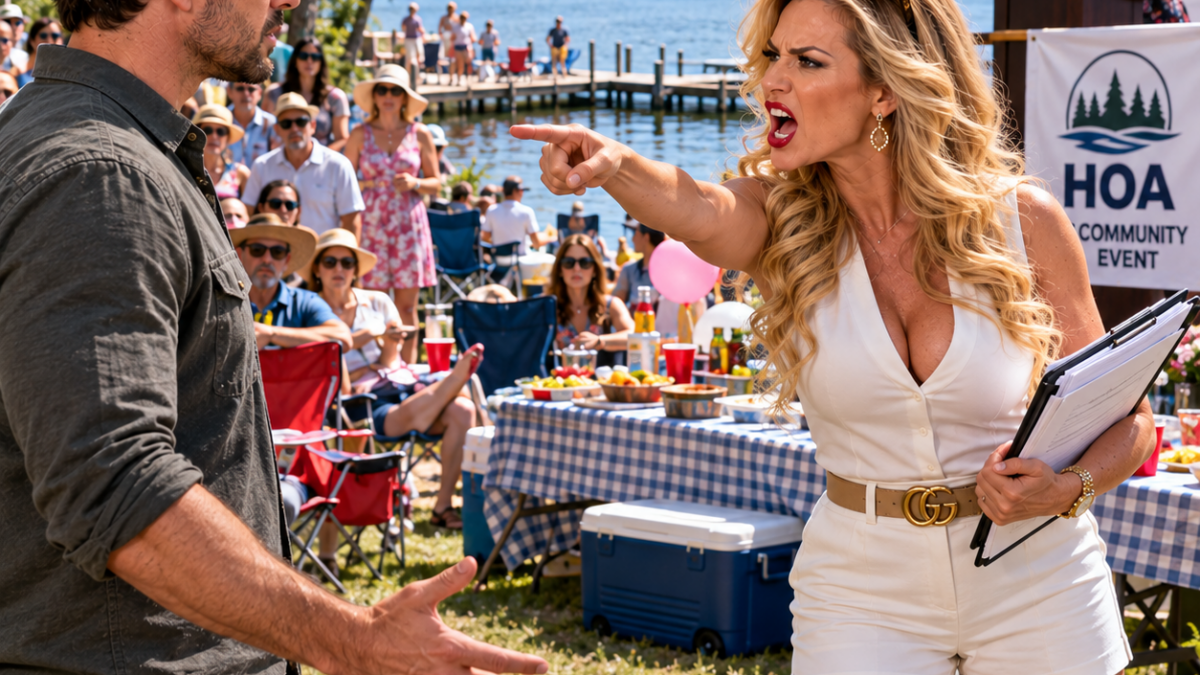
She was about forty, maybe a year or two older, but she looked like someone who spent money fighting that fact. Long blonde hair curled into glossy waves, oversized sunglasses, red lipstick too bright for morning, white shorts, a fitted sleeveless blouse, wedge sandals, gold bracelets, and the kind of expensive confidence that made ordinary things—grass, trees, picnic tables—look temporarily beneath her.
She was beautiful in a sharp way, like a polished knife.
Later, I learned her name was Tiffany Whitmore, but in my head she became Karen long before I knew her real name. Not because of the name itself, but because of the way she carried herself: entitled, glossy, aggrieved, and permanently convinced the world existed to be corrected by her.
She was arranging a tablecloth when I approached.
“Excuse me,” I said, keeping my voice polite. “This is private property.”
She looked up slowly, like I was a waiter interrupting her order.
“Oh,” she said. “You must be mistaken.”
I blinked.
“No, ma’am. I’m not.”
She smiled, and it was not a friendly smile. It was the kind people use when they believe they are about to educate someone of lower rank.
“This is community property,” she said. “I’m on the HOA board. We designated this lake area as public recreational space for residents.”
For a second, I thought I had misheard her.
“You designated my lake?”
Her smile tightened.
“The community lake.”
“My lake,” I said. “On my property.”
She laughed softly and went back to adjusting napkins.
“Sir, I don’t know who told you that, but the HOA has done a survey. This is common area.”
“No, it is not.”
“I have a reservation for my daughter’s birthday party.”
“You have a reservation for land you don’t own.”
That got her attention.
She straightened and pushed her sunglasses up onto her head. Her eyes were pale blue, cold, and annoyed.
“Listen,” she said. “I don’t have time to argue with you. If you’re an HOA resident, you should have received the updated common area guidelines.”
“I am not an HOA resident.”
She glanced toward my house on the rise above the lake.
“You live there?”
“Yes.”
“Then you’re adjacent.”
“I am the property owner.”
“That’s not what our documents say.”
“Then your documents are wrong.”
Her mouth curled.
“Deeds can be confusing. Boundaries move. Developments expand.”
“Boundaries do not move because you want lake access.”
Her face flashed with irritation.
“I’m calling the cops.”
“Please do.”
She seemed surprised by that.
I pulled my phone from my pocket.
“I’ll be happy to show them my deed.”
She made the call with the dramatic urgency of a woman reporting a home invasion instead of being asked to remove balloons from private land. Twenty minutes later, a sheriff’s deputy pulled up near the lake access path.
Tiffany rushed toward him first.
“Thank goodness,” she said. “This man is harassing me and trying to prevent my family from using community property.”
The deputy looked at me.
I said, “This is my property.”
He took statements from both of us, then asked if I had documentation. I had copies in the house, because my father had taught me long ago that owning land meant keeping proof close. I retrieved the deed and survey while Tiffany stood by the picnic table, arms crossed, tapping one wedge sandal against the grass.
The deputy reviewed the paperwork, looked toward the lake, then turned to her.
“Ma’am, he’s correct. This is private property. You need to pack up and leave.”
Tiffany’s mouth fell open.
“That’s impossible.”
“No, ma’am.”
“The HOA designated this as common area.”
“The HOA cannot designate someone else’s private property as common area.”
“There has to be a mistake.”
“The mistake appears to be yours.”
Her face went red.
“My daughter’s party is in an hour.”
“I’m sorry,” the deputy said, “but if you remain after being told to leave, you can be cited for trespassing.”
She packed up, but she made sure every motion looked like an accusation. Chairs slammed closed. Balloons were yanked down. Cooler lids snapped. Before she left, she turned to me with her sunglasses back over her eyes.
“This is not over.”
I almost laughed.
I should have known better.
People like Tiffany never say that unless they have already decided reality is negotiable.
The first letter arrived the following week.
It was addressed to “HOA Resident” and welcomed me to the new community guidelines for common area use. It described reservation systems, cleanup rules, alcohol restrictions, lakefront event policies, quiet hours, and standards for respectful enjoyment of “our shared natural amenities.”
I threw it away.
The second letter was addressed to me personally.
That one said there had been “confusion” about the property boundaries but that Lakeside HOA had confirmed the lake and surrounding recreational area were community property. It instructed me to stop interfering with residents’ lawful use and warned that continued harassment could result in legal action.
I called the number at the bottom.
After two transfers, Tiffany picked up.
“Lakeside HOA board office,” she said.
“This is Daniel Mercer. I own the lake property you keep sending letters about.”
There was a pause.
Then her voice changed.
“Oh. You.”
“That letter you sent is false.”
“It is not false.”
“My land is private. Your HOA has no rights to it.”
“We’ve done our research.”
“No, you haven’t.”
Her voice sharpened.
“We have community rights to that water feature.”
“Water feature?”
“Yes.”
“That water feature is an eight-acre natural lake my family has owned for seventy years.”
“Use history matters,” she said.
“What use history?”
“The community has been using it.”
“For a few months, because you encouraged them to trespass.”
She gave a small, theatrical sigh.
“Mr. Mercer, I understand this is emotional for you. But you cannot block an entire community from recreational access simply because your family once used the area privately.”
Once used.
I gripped the phone so hard my knuckles ached.
“This conversation is over,” I said. “If your residents come onto my property again, I’m calling the sheriff.”
“You do that,” she said.
Then she hung up.
The letters kept coming.
They grew colder, then bolder, then openly threatening. One claimed I was “grandfathered as a lake user” but could not exclude other residents. Another accused me of interfering with community recreation. Another suggested that because the subdivision had been marketed as Lakeside, the HOA had implied rights to reasonable lake access.
Implied rights.
That phrase made my lawyer laugh later.
At first, though, it made me furious.
I hired a property attorney named Harold Price, a calm, silver-haired man with wire-rim glasses and the driest voice I had ever heard. He reviewed my deed, survey, title documents, and the HOA letters.
“They’re either delusional,” he said, “or hoping you are.”
He sent a cease-and-desist letter.
It stated, clearly and without drama, that the lake was private property, that the HOA had no legal access rights, that all residents were to remain off my land, and that future trespassing would result in legal action.
I also had signs made.
PRIVATE PROPERTY. NO TRESPASSING.
I posted them around the lake, along the path, near the tree line, by the dock, and at the places where people had been crossing from the subdivision.
Tiffany called the next day.
“You can’t put signs on community property,” she snapped.
“It’s my property.”
“Those signs are vandalism.”
“No, Tiffany. They’re warnings.”
“We’ll see.”
Two days later, the signs were gone.
Every one of them.
I put up new signs.
They disappeared within forty-eight hours.
I put up more.
Gone again.
Then came another letter from the HOA accusing me of “unauthorized signage” and “destruction of community character.”
That was when my patience ran out.
I filed a formal complaint with the sheriff’s office for trespassing and theft. The deputy assigned to the follow-up was Deputy Walker, a broad-shouldered man with a slow voice and careful eyes. He walked the property with me, reviewed my documents, photographed the boundary points, and listened without rushing.
“You’re clearly the owner,” he said.
“I know.”
“But right now, unless we catch someone taking the signs or trespassing, it’s mostly statements.”
“What do you suggest?”
“Cameras.”
So I bought trail cameras.
Motion activated, night vision, weatherproof. I mounted them near the lake, along the paths, and close to the signposts. Within a week, the cameras gave me more evidence than I expected.
Footage of families swimming.
People fishing from my dock.
Teenagers using the rope swing.
Adults drinking beer at the picnic tables.
Trash left by the shore.
And, most importantly, footage of Tiffany and two other HOA board members removing my signs.
Tiffany was dressed in white capri pants and a coral top, her hair tied back with a silk scarf, looking like she had come prepared to commit misdemeanor theft at brunch.
She stood beneath one sign, looked around, and said something to the man beside her. Then he pulled it from the post while she folded it under her arm like it belonged to her.
I took the footage to Deputy Walker.
He watched it twice.
“That’s theft and trespassing,” he said.
“Yes.”
“How do you want to handle it?”
“I want charges filed against anyone we can identify.”
He nodded.
“Then let’s identify them.”
We went through the footage together.
Tiffany. Two board members. Several residents. Families I had never met. People who apparently believed HOA confidence was the same thing as permission.
Deputy Walker went to the HOA and informed them that charges were being filed. He also delivered another letter from Harold.
I thought that might finally make them stop.
Instead, Tiffany escalated.
Certified letters from the HOA’s attorney began arriving, demanding that I stop harassing residents and accusing me of blocking access to common areas. Harold read them and laughed in that quiet way lawyers laugh when the other side has started digging with both hands.
“They still don’t have a claim,” he said. “But if they want a lawsuit, they’re walking straight into one.”
Late August brought the breaking point.
It was a Friday evening. I was grilling chicken on the back porch while my kids played inside. The air smelled like charcoal and cut grass. The lake was starting to catch the orange edge of sunset. For once, the property felt almost peaceful again.
Then cars began pulling up.
At first, I thought it was one family trespassing again.
Then another car arrived.
Then another.
Then five more.
Within an hour, people were streaming from the subdivision toward my lake.
Not sneaking.
Not wandering.
Marching in like they had been invited.
They carried folding chairs, coolers, binders, signs, a podium, microphone stands, and portable speakers. Someone set up a registration table near the picnic area my dad built. People arranged chairs in rows facing the water.
Sixty people.
Maybe more.
On my land.
I stood on the porch, staring, the tongs still in my hand.
For a few seconds, all I could feel was disbelief.
Then anger came so fast it steadied me.
I turned off the grill and walked down.
A woman at the registration table smiled as if I were late.
“Name?”
“What is this?” I asked.
“Quarterly HOA general meeting,” she said brightly. “All residents should have received notice.”
“This is private property.”
Her smile faltered.
“Oh. You’ll need to speak with Tiffany.”
Of course I would.
Tiffany stood near the podium, wearing a sleeveless navy dress, wedges, gold hoops, and the satisfied expression of a woman who had decided spectacle could replace legality. When she saw me, her face tightened.
“What do you want?” she asked.
“I want to know why you’re holding a meeting on my land.”
She turned slightly so the people nearby could hear.
“This is community property.”
“No, it is not.”
“We’ve been over this.”
“Yes. With the sheriff. With my lawyer. With your own theft charges pending.”
Her smile sharpened.
A few people around us started listening.
Tiffany raised her voice.
“This gentleman has been harassing residents for months, claiming he owns community property and interfering with families who simply want to enjoy a shared recreational space.”
Murmurs rippled through the chairs.
People looked at me differently now.
Suspiciously.
Like I was the villain who had stormed into their meeting.
I felt heat climb the back of my neck, but I kept my voice steady.
“Everyone here needs to understand something,” I said loudly. “This is private property. I own this land and the lake. You are all trespassing.”
Tiffany rolled her eyes so dramatically it looked rehearsed.
“He has been saying that for months. Our board has researched this. We have community rights.”
“Then you won’t mind if I call the sheriff.”
She smiled.
“Go ahead.”
So I did.
I told dispatch that roughly sixty people were trespassing on my property and holding an unauthorized meeting. While we waited, Tiffany began the meeting anyway.
She stepped behind the podium, tapped the microphone, and started talking about budgets, community events, maintenance priorities, and “ongoing disputes over lake access.”
Every few sentences, she looked at me.
Not accidentally.
Performing.
Twenty minutes later, three sheriff’s vehicles pulled up.
The meeting went quiet.
Deputy Walker stepped out of the first one, followed by two other deputies. He walked to me first.
“Your property?”
“Yes.”
“Did you give permission for this?”
“No.”
He looked at the rows of chairs, the podium, the speaker system, the registration table, and the crowd of suddenly nervous homeowners.
“Well,” he said quietly, “that’s a new one.”
Then he walked to Tiffany.
“Ma’am, I need to speak with you.”
Tiffany left the podium with two board members trailing behind her.
“This gentleman says you’re on his private property without permission,” Deputy Walker said.
“This is community property,” she replied.
“I’ve seen his deed. It is private property.”
“Our lawyer assured us we have rights,” one board member said.
Deputy Walker looked at him.
“Do you have a court order?”
“No.”
“An easement?”
“We have community use rights.”
“Recorded where?”
The man hesitated.
Tiffany jumped in.
“This is ridiculous. We are not leaving. This is our community space.”
Deputy Walker’s voice hardened.
“Ma’am, everyone here needs to pack up and leave immediately.”
People began shifting. Chairs scraped. Someone whispered, “Are we actually trespassing?” Another person said, “Tiffany told us this was cleared.”
Tiffany raised her chin.
“I’m calling our attorney.”
“You can call whoever you want,” Walker said. “But you need to do it from somewhere else.”
“This is harassment.”
“No, ma’am. This is trespass enforcement.”
She glared at me.
“You did this.”
“You did,” I said.
It took half an hour to clear everyone out.
Most people left quickly once they realized deputies were serious. Some apologized quietly as they folded chairs. Others would not look at me. A few seemed angry, but not at me anymore. They looked at Tiffany with the kind of confusion people show when someone they trusted suddenly becomes expensive.
Tiffany was the last to leave.
She stood near the path, breathing hard, lipstick still perfect, eyes full of hatred.
“This is not over,” she said.
“You keep saying that.”
“We will sue you for everything you’re worth.”
I looked at Deputy Walker.
He looked like he was trying not to sigh.
After she left, he stayed behind.
“I’ve never seen an HOA try to hold a general meeting on someone else’s property.”
“What do I do?” I asked. “They’re not going to stop.”
“No,” he said. “Probably not.”
“What would you do?”
“Talk to your lawyer. Something stronger than cease and desist. What they did tonight was organized, intentional, and public. That matters.”
That weekend, I called Harold and told him everything.
For the first time since I had hired him, he sounded genuinely stunned.
“They held a sixty-person meeting on your property?”
“Yes.”
“After written notice?”
“Yes.”
“After police involvement?”
“Yes.”
“After sign theft charges?”
“Yes.”
He went quiet.
Then he said, “All right. We’re done asking.”
The lawsuit was filed the next week.
We sued the HOA and several individual board members for trespass, theft, harassment, intentional interference with property rights, unjust enrichment, and related claims. We sought actual damages, punitive damages, attorney’s fees, and a permanent injunction preventing anyone associated with the HOA from entering my land without written permission.
The HOA’s lawyer called Harold within twenty-four hours of being served.
They wanted to discuss settlement.
Harold asked me.
“No,” I said.
“Good,” he replied.
Discovery was where the mask came off.
The HOA had never done a real survey.
Never obtained a legal opinion confirming rights to my lake.
Never recorded an easement.
Never checked title properly.
Never had any professional basis for claiming my property.
Tiffany had simply decided that the lake should be community property and then convinced enough people that confidence could substitute for ownership.
But the emails were worse.
Much worse.
They referred to me as “the difficult property owner.”
They discussed how to “normalize community use” of the lake.
They budgeted money for lake maintenance.
They talked about building a bathhouse.
An expanded dock.
A designated swim area.
All on my property.
Then Harold found the email that ended any chance they had of pretending this was an innocent mistake.
Tiffany had written to another board member:
Even if he technically owns it, if we use it openly long enough, we can probably claim it legally. My cousin is a paralegal and says possession is nine-tenths of the law.
Harold printed that email and held it like a trophy.
“She gave us intent,” he said.
The depositions were brutal.
Tiffany arrived dressed beautifully, of course. Cream blouse, fitted blazer, soft waves, diamond earrings, mascara perfect. She tried to look like a responsible community leader being unfairly attacked by an unreasonable landowner.
Then Harold started asking questions.
“Have you ever seen Mr. Mercer’s deed?”
“No.”
“Have you reviewed the county survey?”
“No.”
“Did the HOA commission a professional boundary survey?”
“I believe we reviewed maps.”
“That was not my question.”
“No.”
“Did any attorney advise you that the HOA had recorded access rights to the lake?”
“We discussed legal concepts.”
“With an attorney?”
“Not formally.”
“Did you tell residents the lake was community property?”
“Yes.”
“On what basis?”
“The community needed access.”
“That was not my question.”
She shifted.
“The subdivision is called Lakeside.”
Harold stared at her for a moment.
“The name of the subdivision was your legal basis?”
Her lawyer objected.
The answer still hung in the room.
When asked what gave her the right to hold an HOA meeting on my property, Tiffany said, “The space was not being used.”
That sentence followed her all the way to trial.
The case went before a judge eight months later.
No jury. Just a bench trial. Three days of testimony, maps, videos, letters, emails, depositions, and Tiffany’s increasingly desperate attempts to look misunderstood instead of malicious.
Their attorney argued good faith mistake.
Harold responded with the video of Tiffany stealing signs.
Their attorney argued community reliance.
Harold showed the deed and survey.
Their attorney argued that residents believed they had access.
Harold showed Tiffany’s email admitting I “technically” owned it.
The judge was not amused.
His ruling was clear and devastating.
He found that the HOA and individual board members had committed willful trespass, theft, and harassment. He awarded me forty-five thousand dollars in actual damages based on fair rental value of unauthorized lake access and interference with my quiet enjoyment. He added twenty-five thousand dollars in punitive damages for intentional misconduct, plus thirty thousand dollars in attorney’s fees.
One hundred thousand dollars total.
But the best part came next.
The judge ruled that Tiffany and the other board members were personally liable because they acted willfully, in bad faith, and beyond the scope of proper HOA authority.
They could not hide behind the association.
They could not simply pay it all from HOA funds.
They had to answer for what they had done.
Tiffany’s face changed when she heard that.
For months, she had performed outrage, victimhood, confidence, and social authority. In that moment, something finally cracked. She looked not humbled, exactly. Tiffany was not built for humility.
She looked shocked that consequences had found her personally.
The aftermath was ugly for them.
Beautiful for me, but ugly for them.
Within two months, Tiffany and her husband listed their house for sale to cover their portion of the judgment. Two other board members sold as well. The HOA’s insurance refused to cover the damages under the willful misconduct exclusion. The association went into financial crisis. Residents, furious that their board had dragged them into an avoidable legal disaster, sued for mismanagement and breach of fiduciary duty.
The HOA dissolved about a year later.
Lakeside, the neighborhood that tried to steal lake access because it had a nice name, no longer had an HOA at all.
For a while, I thought that was the end.
Then I got a call from a real estate developer.
Apparently, all the drama had made several subdivision lots less desirable, and he was looking at buying some at reduced prices to build rental properties. I was not interested in selling my lake frontage, and I told him that immediately.
“I’m not calling to buy it,” he said.
“What are you calling for?”
“A lease.”
“For what?”
“Private fishing club access. Limited membership, controlled hours, no swimming, no events, insurance coverage, full cleanup requirements, security, and a serious annual payment.”
“How serious?”
“Fifty thousand a year.”
I looked out the window toward the lake.
The same lake Tiffany tried to claim for free.
The same lake she brought sixty strangers onto.
The same lake she insisted was community property because she wanted it badly enough.
I smiled.
“Send me the proposal.”
We negotiated hard. Harold reviewed every page. The final agreement gave the private fishing club limited, insured, controlled access under strict conditions that I could revoke for violations. No parties. No public access. No HOA involvement. No one near the house. No one on family holidays. No one leaving trash, building rope swings, or calling my lake a water feature.
The lease income was real.
Long-term.
Clean.
Legal.
And entirely on my terms.
Sometimes, early in the morning, I still sit by the lake with coffee the way my father did. The dock creaks under my boots. Mist drifts over the water. Fish break the surface near the reeds. The picnic tables are still there, though I replaced one after the HOA mess because seeing scratches from someone else’s cooler made me angrier than it should have.
My kids still swim there.
My family still gathers there.
And once in a while, members of the fishing club come through the designated access path, sign in, follow the rules, and leave without acting like ownership is contagious.
The property is quiet again.
Quieter than it was during those months when I never knew who I would find by the shore.
I still have the video of the HOA meeting saved in three places. I do not watch it often. I do not need to. The memory is sharp enough: folding chairs in rows, Tiffany at the microphone, sixty people staring at me like I was the intruder, Deputy Walker walking past them all with the deed-backed truth behind him.
That was the moment everything turned.
Not because Tiffany finally understood.
I do not think she ever truly did.
People like her rarely understand ownership unless it is theirs. She saw unused space and called it waste. She saw water and called it community. She saw my patience and called it weakness. She saw my signs and called them vandalism. She saw my family’s lake and imagined a bathhouse, a dock, a reservation calendar, birthday parties, quarterly meetings, and herself standing at the center of it all.
She wanted the lake because it made her development feel more valuable.
I protected it because it already was.
There is a difference.
The lake was never public.
It was never common area.
It was never a blank space waiting for an HOA to label it.
It was my grandfather’s mornings, my father’s ashes, my children’s summers, and my own quiet place in a world that keeps trying to turn everything beautiful into something marketable.
Tiffany brought sixty people to my private lake and called it community property.
A judge called it willful trespass.
And now, every year, the water she tried to steal earns me more money than her HOA ever had the right to touch.
I did not start that fight.
But I made sure it ended on my shore.
𝗧𝗛𝗘 𝗘𝗡𝗗
Karen Brought Sixty People to My Private Lake and Called It Community Property
Karen marched sixty strangers onto my land with folding chairs, a microphone, and the smug belief that my family’s lake belonged to her HOA.
She smiled at me from behind a podium like I was the trespasser.
Then the sheriff arrived, and the truth finally had an audience.
The lake had been in my family longer than most of the houses around it had existed.
That was the part Karen never understood. To her, land was something to be labeled on a brochure, advertised through a development office, and rebranded until people forgot who it belonged to. To me, that lake was not a marketing feature. It was not an amenity. It was not a “water feature,” as her HOA letters kept calling it later, like it had been installed with the right landscaping package.
It was eight acres of cold, clear water surrounded by trees my grandfather had planted before my father was old enough to hold a fishing pole.
My grandfather bought the fifty-acre property decades ago, back when the area outside town was still rural enough that night actually got dark and silence felt like something alive. He built the first dock with his own hands, rough cedar boards and stubborn pride. My dad repaired it twice, expanded it once, and added two picnic tables near the shore after my sister and I started bringing our friends there in summer.
When Dad died five years ago, the property came to me.
I did not inherit a mansion. The house was modest, a comfortable three-bedroom place my father built in the eighties. Brown roof, pale siding, old stone fireplace, a porch that faced the water. Nothing fancy. Nothing meant to impress anybody driving by. But it was home in the deepest sense of the word.
The lake sat completely inside my property lines.
Not touching a boundary. Not shared. Not connected to public access. The survey was clear, the deed was clear, the county records were clear, and my family history was clearer than all of it. My kids learned to swim there. I fished there before sunrise when fog sat low on the surface like breath. We held reunions there. We scattered my father’s ashes near the western bank where he used to sit with a thermos of coffee and pretend he was catching bass when really he was just avoiding phone calls.
For most of my life, nobody questioned that it was private.
Then the subdivision came.
About four years before everything blew up, developers bought the land adjacent to mine and started building what they called Lakeside HOA. I laughed the first time I saw the sign because the development did not have lake access. Some of the houses could see my water through the trees from their backyards, but seeing a lake and owning rights to it are two very different things.
At first, the new people were fine.
Middle-class families, half-acre lots, kids on bikes, dogs barking at squirrels, backyard grills, people waving when I drove by. I had no issue with them. My property predated theirs by generations, and theirs had nothing to do with mine. Different road. Different legal description. Different boundaries. Different everything.
Then, about two years in, they formed an HOA.
I was not part of it. I never signed anything, never received a membership packet, never agreed to covenants, never paid dues, never attended a meeting. My land existed before their neighborhood was ever imagined. Their association had no authority over me.
But authority, I learned, is not always the same thing as belief.
And some people believe very loudly.
It started small.
A couple walking their dog near the tree line where my property began. Kids cutting through the woods to stare at the lake. Then one afternoon I found a rope swing tied to one of my old oaks, hanging out over the water like somebody had decided my shoreline was summer camp.
I should have cut it down right then.
I did not.
That was my first mistake.
I told myself they were just kids. I told myself nobody meant any harm. I told myself being neighborly mattered, and there was no reason to start a fight over curiosity.
Then one June morning, I stepped onto my back porch with a cup of coffee and saw a woman setting up a full birthday party on my lake shore.
Tables.
Folding chairs.
A grill.
Coolers.
Balloons.
Right there on my land, fifteen minutes from my front door.
I set the coffee down and walked toward the water.
PART 2
The woman was hard to miss.
She was about forty, maybe a year or two older, but she looked like someone who spent money fighting that fact. Long blonde hair curled into glossy waves, oversized sunglasses, red lipstick too bright for morning, white shorts, a fitted sleeveless blouse, wedge sandals, gold bracelets, and the kind of expensive confidence that made ordinary things—grass, trees, picnic tables—look temporarily beneath her.
She was beautiful in a sharp way, like a polished knife.
Later, I learned her name was Tiffany Whitmore, but in my head she became Karen long before I knew her real name. Not because of the name itself, but because of the way she carried herself: entitled, glossy, aggrieved, and permanently convinced the world existed to be corrected by her.
She was arranging a tablecloth when I approached.
“Excuse me,” I said, keeping my voice polite. “This is private property.”
She looked up slowly, like I was a waiter interrupting her order.
“Oh,” she said. “You must be mistaken.”
I blinked.
“No, ma’am. I’m not.”
She smiled, and it was not a friendly smile. It was the kind people use when they believe they are about to educate someone of lower rank.
“This is community property,” she said. “I’m on the HOA board. We designated this lake area as public recreational space for residents.”
For a second, I thought I had misheard her.
“You designated my lake?”
Her smile tightened.
“The community lake.”
“My lake,” I said. “On my property.”
She laughed softly and went back to adjusting napkins.
“Sir, I don’t know who told you that, but the HOA has done a survey. This is common area.”
“No, it is not.”
“I have a reservation for my daughter’s birthday party.”
“You have a reservation for land you don’t own.”
That got her attention.
She straightened and pushed her sunglasses up onto her head. Her eyes were pale blue, cold, and annoyed.
“Listen,” she said. “I don’t have time to argue with you. If you’re an HOA resident, you should have received the updated common area guidelines.”
“I am not an HOA resident.”
She glanced toward my house on the rise above the lake.
“You live there?”
“Yes.”
“Then you’re adjacent.”
“I am the property owner.”
“That’s not what our documents say.”
“Then your documents are wrong.”
Her mouth curled.
“Deeds can be confusing. Boundaries move. Developments expand.”
“Boundaries do not move because you want lake access.”
Her face flashed with irritation.
“I’m calling the cops.”
“Please do.”
She seemed surprised by that.
I pulled my phone from my pocket.
“I’ll be happy to show them my deed.”
She made the call with the dramatic urgency of a woman reporting a home invasion instead of being asked to remove balloons from private land. Twenty minutes later, a sheriff’s deputy pulled up near the lake access path.
Tiffany rushed toward him first.
“Thank goodness,” she said. “This man is harassing me and trying to prevent my family from using community property.”
The deputy looked at me.
I said, “This is my property.”
He took statements from both of us, then asked if I had documentation. I had copies in the house, because my father had taught me long ago that owning land meant keeping proof close. I retrieved the deed and survey while Tiffany stood by the picnic table, arms crossed, tapping one wedge sandal against the grass.
The deputy reviewed the paperwork, looked toward the lake, then turned to her.
“Ma’am, he’s correct. This is private property. You need to pack up and leave.”
Tiffany’s mouth fell open.
“That’s impossible.”
“No, ma’am.”
“The HOA designated this as common area.”
“The HOA cannot designate someone else’s private property as common area.”
“There has to be a mistake.”
“The mistake appears to be yours.”
Her face went red.
“My daughter’s party is in an hour.”
“I’m sorry,” the deputy said, “but if you remain after being told to leave, you can be cited for trespassing.”
She packed up, but she made sure every motion looked like an accusation. Chairs slammed closed. Balloons were yanked down. Cooler lids snapped. Before she left, she turned to me with her sunglasses back over her eyes.
“This is not over.”
I almost laughed.
I should have known better.
People like Tiffany never say that unless they have already decided reality is negotiable.
The first letter arrived the following week.
It was addressed to “HOA Resident” and welcomed me to the new community guidelines for common area use. It described reservation systems, cleanup rules, alcohol restrictions, lakefront event policies, quiet hours, and standards for respectful enjoyment of “our shared natural amenities.”
I threw it away.
The second letter was addressed to me personally.
That one said there had been “confusion” about the property boundaries but that Lakeside HOA had confirmed the lake and surrounding recreational area were community property. It instructed me to stop interfering with residents’ lawful use and warned that continued harassment could result in legal action.
I called the number at the bottom.
After two transfers, Tiffany picked up.
“Lakeside HOA board office,” she said.
“This is Daniel Mercer. I own the lake property you keep sending letters about.”
There was a pause.
Then her voice changed.
“Oh. You.”
“That letter you sent is false.”
“It is not false.”
“My land is private. Your HOA has no rights to it.”
“We’ve done our research.”
“No, you haven’t.”
Her voice sharpened.
“We have community rights to that water feature.”
“Water feature?”
“Yes.”
“That water feature is an eight-acre natural lake my family has owned for seventy years.”
“Use history matters,” she said.
“What use history?”
“The community has been using it.”
“For a few months, because you encouraged them to trespass.”
She gave a small, theatrical sigh.
“Mr. Mercer, I understand this is emotional for you. But you cannot block an entire community from recreational access simply because your family once used the area privately.”
Once used.
I gripped the phone so hard my knuckles ached.
“This conversation is over,” I said. “If your residents come onto my property again, I’m calling the sheriff.”
“You do that,” she said.
Then she hung up.
The letters kept coming.
They grew colder, then bolder, then openly threatening. One claimed I was “grandfathered as a lake user” but could not exclude other residents. Another accused me of interfering with community recreation. Another suggested that because the subdivision had been marketed as Lakeside, the HOA had implied rights to reasonable lake access.
Implied rights.
That phrase made my lawyer laugh later.
At first, though, it made me furious.
I hired a property attorney named Harold Price, a calm, silver-haired man with wire-rim glasses and the driest voice I had ever heard. He reviewed my deed, survey, title documents, and the HOA letters.
“They’re either delusional,” he said, “or hoping you are.”
He sent a cease-and-desist letter.
It stated, clearly and without drama, that the lake was private property, that the HOA had no legal access rights, that all residents were to remain off my land, and that future trespassing would result in legal action.
I also had signs made.
PRIVATE PROPERTY. NO TRESPASSING.
I posted them around the lake, along the path, near the tree line, by the dock, and at the places where people had been crossing from the subdivision.
Tiffany called the next day.
“You can’t put signs on community property,” she snapped.
“It’s my property.”
“Those signs are vandalism.”
“No, Tiffany. They’re warnings.”
“We’ll see.”
Two days later, the signs were gone.
Every one of them.
I put up new signs.
They disappeared within forty-eight hours.
I put up more.
Gone again.
Then came another letter from the HOA accusing me of “unauthorized signage” and “destruction of community character.”
That was when my patience ran out.
I filed a formal complaint with the sheriff’s office for trespassing and theft. The deputy assigned to the follow-up was Deputy Walker, a broad-shouldered man with a slow voice and careful eyes. He walked the property with me, reviewed my documents, photographed the boundary points, and listened without rushing.
“You’re clearly the owner,” he said.
“I know.”
“But right now, unless we catch someone taking the signs or trespassing, it’s mostly statements.”
“What do you suggest?”
“Cameras.”
So I bought trail cameras.
Motion activated, night vision, weatherproof. I mounted them near the lake, along the paths, and close to the signposts. Within a week, the cameras gave me more evidence than I expected.
Footage of families swimming.
People fishing from my dock.
Teenagers using the rope swing.
Adults drinking beer at the picnic tables.
Trash left by the shore.
And, most importantly, footage of Tiffany and two other HOA board members removing my signs.
Tiffany was dressed in white capri pants and a coral top, her hair tied back with a silk scarf, looking like she had come prepared to commit misdemeanor theft at brunch.
She stood beneath one sign, looked around, and said something to the man beside her. Then he pulled it from the post while she folded it under her arm like it belonged to her.
I took the footage to Deputy Walker.
He watched it twice.
“That’s theft and trespassing,” he said.
“Yes.”
“How do you want to handle it?”
“I want charges filed against anyone we can identify.”
He nodded.
“Then let’s identify them.”
We went through the footage together.
Tiffany. Two board members. Several residents. Families I had never met. People who apparently believed HOA confidence was the same thing as permission.
Deputy Walker went to the HOA and informed them that charges were being filed. He also delivered another letter from Harold.
I thought that might finally make them stop.
Instead, Tiffany escalated.
Certified letters from the HOA’s attorney began arriving, demanding that I stop harassing residents and accusing me of blocking access to common areas. Harold read them and laughed in that quiet way lawyers laugh when the other side has started digging with both hands.
“They still don’t have a claim,” he said. “But if they want a lawsuit, they’re walking straight into one.”
Late August brought the breaking point.
It was a Friday evening. I was grilling chicken on the back porch while my kids played inside. The air smelled like charcoal and cut grass. The lake was starting to catch the orange edge of sunset. For once, the property felt almost peaceful again.
Then cars began pulling up.
At first, I thought it was one family trespassing again.
Then another car arrived.
Then another.
Then five more.
Within an hour, people were streaming from the subdivision toward my lake.
Not sneaking.
Not wandering.
Marching in like they had been invited.
They carried folding chairs, coolers, binders, signs, a podium, microphone stands, and portable speakers. Someone set up a registration table near the picnic area my dad built. People arranged chairs in rows facing the water.
Sixty people.
Maybe more.
On my land.
I stood on the porch, staring, the tongs still in my hand.
For a few seconds, all I could feel was disbelief.
Then anger came so fast it steadied me.
I turned off the grill and walked down.
A woman at the registration table smiled as if I were late.
“Name?”
“What is this?” I asked.
“Quarterly HOA general meeting,” she said brightly. “All residents should have received notice.”
“This is private property.”
Her smile faltered.
“Oh. You’ll need to speak with Tiffany.”
Of course I would.
Tiffany stood near the podium, wearing a sleeveless navy dress, wedges, gold hoops, and the satisfied expression of a woman who had decided spectacle could replace legality. When she saw me, her face tightened.
“What do you want?” she asked.
“I want to know why you’re holding a meeting on my land.”
She turned slightly so the people nearby could hear.
“This is community property.”
“No, it is not.”
“We’ve been over this.”
“Yes. With the sheriff. With my lawyer. With your own theft charges pending.”
Her smile sharpened.
A few people around us started listening.
Tiffany raised her voice.
“This gentleman has been harassing residents for months, claiming he owns community property and interfering with families who simply want to enjoy a shared recreational space.”
Murmurs rippled through the chairs.
People looked at me differently now.
Suspiciously.
Like I was the villain who had stormed into their meeting.
I felt heat climb the back of my neck, but I kept my voice steady.
“Everyone here needs to understand something,” I said loudly. “This is private property. I own this land and the lake. You are all trespassing.”
Tiffany rolled her eyes so dramatically it looked rehearsed.
“He has been saying that for months. Our board has researched this. We have community rights.”
“Then you won’t mind if I call the sheriff.”
She smiled.
“Go ahead.”
So I did.
I told dispatch that roughly sixty people were trespassing on my property and holding an unauthorized meeting. While we waited, Tiffany began the meeting anyway.
She stepped behind the podium, tapped the microphone, and started talking about budgets, community events, maintenance priorities, and “ongoing disputes over lake access.”
Every few sentences, she looked at me.
Not accidentally.
Performing.
Twenty minutes later, three sheriff’s vehicles pulled up.
The meeting went quiet.
Deputy Walker stepped out of the first one, followed by two other deputies. He walked to me first.
“Your property?”
“Yes.”
“Did you give permission for this?”
“No.”
He looked at the rows of chairs, the podium, the speaker system, the registration table, and the crowd of suddenly nervous homeowners.
“Well,” he said quietly, “that’s a new one.”
Then he walked to Tiffany.
“Ma’am, I need to speak with you.”
Tiffany left the podium with two board members trailing behind her.
“This gentleman says you’re on his private property without permission,” Deputy Walker said.
“This is community property,” she replied.
“I’ve seen his deed. It is private property.”
“Our lawyer assured us we have rights,” one board member said.
Deputy Walker looked at him.
“Do you have a court order?”
“No.”
“An easement?”
“We have community use rights.”
“Recorded where?”
The man hesitated.
Tiffany jumped in.
“This is ridiculous. We are not leaving. This is our community space.”
Deputy Walker’s voice hardened.
“Ma’am, everyone here needs to pack up and leave immediately.”
People began shifting. Chairs scraped. Someone whispered, “Are we actually trespassing?” Another person said, “Tiffany told us this was cleared.”
Tiffany raised her chin.
“I’m calling our attorney.”
“You can call whoever you want,” Walker said. “But you need to do it from somewhere else.”
“This is harassment.”
“No, ma’am. This is trespass enforcement.”
She glared at me.
“You did this.”
“You did,” I said.
It took half an hour to clear everyone out.
Most people left quickly once they realized deputies were serious. Some apologized quietly as they folded chairs. Others would not look at me. A few seemed angry, but not at me anymore. They looked at Tiffany with the kind of confusion people show when someone they trusted suddenly becomes expensive.
Tiffany was the last to leave.
She stood near the path, breathing hard, lipstick still perfect, eyes full of hatred.
“This is not over,” she said.
“You keep saying that.”
“We will sue you for everything you’re worth.”
I looked at Deputy Walker.
He looked like he was trying not to sigh.
After she left, he stayed behind.
“I’ve never seen an HOA try to hold a general meeting on someone else’s property.”
“What do I do?” I asked. “They’re not going to stop.”
“No,” he said. “Probably not.”
“What would you do?”
“Talk to your lawyer. Something stronger than cease and desist. What they did tonight was organized, intentional, and public. That matters.”
That weekend, I called Harold and told him everything.
For the first time since I had hired him, he sounded genuinely stunned.
“They held a sixty-person meeting on your property?”
“Yes.”
“After written notice?”
“Yes.”
“After police involvement?”
“Yes.”
“After sign theft charges?”
“Yes.”
He went quiet.
Then he said, “All right. We’re done asking.”
The lawsuit was filed the next week.
We sued the HOA and several individual board members for trespass, theft, harassment, intentional interference with property rights, unjust enrichment, and related claims. We sought actual damages, punitive damages, attorney’s fees, and a permanent injunction preventing anyone associated with the HOA from entering my land without written permission.
The HOA’s lawyer called Harold within twenty-four hours of being served.
They wanted to discuss settlement.
Harold asked me.
“No,” I said.
“Good,” he replied.
Discovery was where the mask came off.
The HOA had never done a real survey.
Never obtained a legal opinion confirming rights to my lake.
Never recorded an easement.
Never checked title properly.
Never had any professional basis for claiming my property.
Tiffany had simply decided that the lake should be community property and then convinced enough people that confidence could substitute for ownership.
But the emails were worse.
Much worse.
They referred to me as “the difficult property owner.”
They discussed how to “normalize community use” of the lake.
They budgeted money for lake maintenance.
They talked about building a bathhouse.
An expanded dock.
A designated swim area.
All on my property.
Then Harold found the email that ended any chance they had of pretending this was an innocent mistake.
Tiffany had written to another board member:
Even if he technically owns it, if we use it openly long enough, we can probably claim it legally. My cousin is a paralegal and says possession is nine-tenths of the law.
Harold printed that email and held it like a trophy.
“She gave us intent,” he said.
The depositions were brutal.
Tiffany arrived dressed beautifully, of course. Cream blouse, fitted blazer, soft waves, diamond earrings, mascara perfect. She tried to look like a responsible community leader being unfairly attacked by an unreasonable landowner.
Then Harold started asking questions.
“Have you ever seen Mr. Mercer’s deed?”
“No.”
“Have you reviewed the county survey?”
“No.”
“Did the HOA commission a professional boundary survey?”
“I believe we reviewed maps.”
“That was not my question.”
“No.”
“Did any attorney advise you that the HOA had recorded access rights to the lake?”
“We discussed legal concepts.”
“With an attorney?”
“Not formally.”
“Did you tell residents the lake was community property?”
“Yes.”
“On what basis?”
“The community needed access.”
“That was not my question.”
She shifted.
“The subdivision is called Lakeside.”
Harold stared at her for a moment.
“The name of the subdivision was your legal basis?”
Her lawyer objected.
The answer still hung in the room.
When asked what gave her the right to hold an HOA meeting on my property, Tiffany said, “The space was not being used.”
That sentence followed her all the way to trial.
The case went before a judge eight months later.
No jury. Just a bench trial. Three days of testimony, maps, videos, letters, emails, depositions, and Tiffany’s increasingly desperate attempts to look misunderstood instead of malicious.
Their attorney argued good faith mistake.
Harold responded with the video of Tiffany stealing signs.
Their attorney argued community reliance.
Harold showed the deed and survey.
Their attorney argued that residents believed they had access.
Harold showed Tiffany’s email admitting I “technically” owned it.
The judge was not amused.
His ruling was clear and devastating.
He found that the HOA and individual board members had committed willful trespass, theft, and harassment. He awarded me forty-five thousand dollars in actual damages based on fair rental value of unauthorized lake access and interference with my quiet enjoyment. He added twenty-five thousand dollars in punitive damages for intentional misconduct, plus thirty thousand dollars in attorney’s fees.
One hundred thousand dollars total.
But the best part came next.
The judge ruled that Tiffany and the other board members were personally liable because they acted willfully, in bad faith, and beyond the scope of proper HOA authority.
They could not hide behind the association.
They could not simply pay it all from HOA funds.
They had to answer for what they had done.
Tiffany’s face changed when she heard that.
For months, she had performed outrage, victimhood, confidence, and social authority. In that moment, something finally cracked. She looked not humbled, exactly. Tiffany was not built for humility.
She looked shocked that consequences had found her personally.
The aftermath was ugly for them.
Beautiful for me, but ugly for them.
Within two months, Tiffany and her husband listed their house for sale to cover their portion of the judgment. Two other board members sold as well. The HOA’s insurance refused to cover the damages under the willful misconduct exclusion. The association went into financial crisis. Residents, furious that their board had dragged them into an avoidable legal disaster, sued for mismanagement and breach of fiduciary duty.
The HOA dissolved about a year later.
Lakeside, the neighborhood that tried to steal lake access because it had a nice name, no longer had an HOA at all.
For a while, I thought that was the end.
Then I got a call from a real estate developer.
Apparently, all the drama had made several subdivision lots less desirable, and he was looking at buying some at reduced prices to build rental properties. I was not interested in selling my lake frontage, and I told him that immediately.
“I’m not calling to buy it,” he said.
“What are you calling for?”
“A lease.”
“For what?”
“Private fishing club access. Limited membership, controlled hours, no swimming, no events, insurance coverage, full cleanup requirements, security, and a serious annual payment.”
“How serious?”
“Fifty thousand a year.”
I looked out the window toward the lake.
The same lake Tiffany tried to claim for free.
The same lake she brought sixty strangers onto.
The same lake she insisted was community property because she wanted it badly enough.
I smiled.
“Send me the proposal.”
We negotiated hard. Harold reviewed every page. The final agreement gave the private fishing club limited, insured, controlled access under strict conditions that I could revoke for violations. No parties. No public access. No HOA involvement. No one near the house. No one on family holidays. No one leaving trash, building rope swings, or calling my lake a water feature.
The lease income was real.
Long-term.
Clean.
Legal.
And entirely on my terms.
Sometimes, early in the morning, I still sit by the lake with coffee the way my father did. The dock creaks under my boots. Mist drifts over the water. Fish break the surface near the reeds. The picnic tables are still there, though I replaced one after the HOA mess because seeing scratches from someone else’s cooler made me angrier than it should have.
My kids still swim there.
My family still gathers there.
And once in a while, members of the fishing club come through the designated access path, sign in, follow the rules, and leave without acting like ownership is contagious.
The property is quiet again.
Quieter than it was during those months when I never knew who I would find by the shore.
I still have the video of the HOA meeting saved in three places. I do not watch it often. I do not need to. The memory is sharp enough: folding chairs in rows, Tiffany at the microphone, sixty people staring at me like I was the intruder, Deputy Walker walking past them all with the deed-backed truth behind him.
That was the moment everything turned.
Not because Tiffany finally understood.
I do not think she ever truly did.
People like her rarely understand ownership unless it is theirs. She saw unused space and called it waste. She saw water and called it community. She saw my patience and called it weakness. She saw my signs and called them vandalism. She saw my family’s lake and imagined a bathhouse, a dock, a reservation calendar, birthday parties, quarterly meetings, and herself standing at the center of it all.
She wanted the lake because it made her development feel more valuable.
I protected it because it already was.
There is a difference.
The lake was never public.
It was never common area.
It was never a blank space waiting for an HOA to label it.
It was my grandfather’s mornings, my father’s ashes, my children’s summers, and my own quiet place in a world that keeps trying to turn everything beautiful into something marketable.
Tiffany brought sixty people to my private lake and called it community property.
A judge called it willful trespass.
And now, every year, the water she tried to steal earns me more money than her HOA ever had the right to touch.
I did not start that fight.
But I made sure it ended on my shore.