𝗣𝗔𝗥𝗧 𝟮 Karen Baked My Son a Cookie to Prove His Allergy Was Fake, Then Watched the Police Put Her in Handcuffs
𝗣𝗔𝗥𝗧 𝟮
He started coughing.
Then wheezing.
Someone screamed.
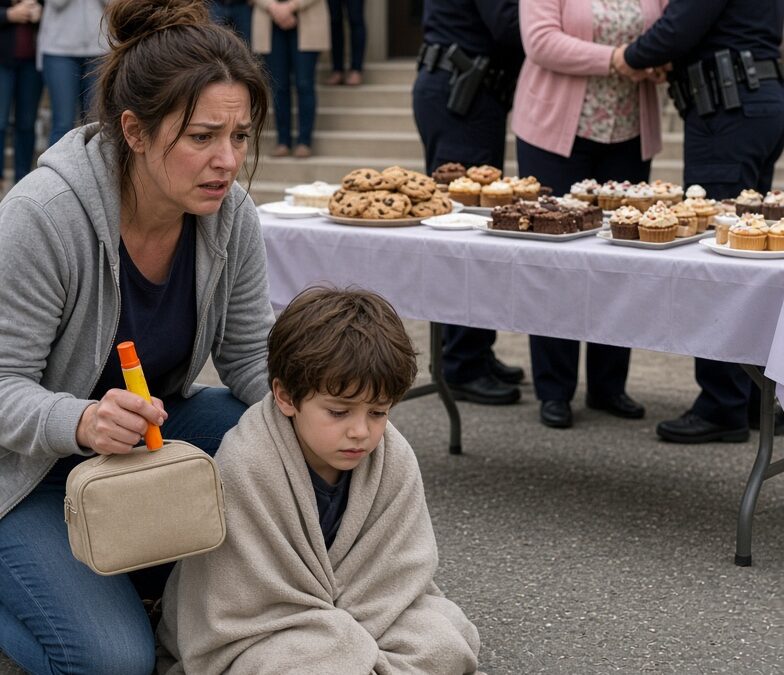
I drove the EpiPen into his thigh through his pants and held it there, counting out loud because if I stopped counting I would fall apart.
“One. Two. Three. Four…”
His little hand gripped my arm.
“Call 911!” I shouted.
The cafeteria erupted.
Teachers cleared space. Parents pulled children back. Mrs. Patterson ran for the nurse. Someone knocked over a tray of brownies. A child started crying. My son’s face swelled in front of me, his skin hot and mottled under my hands. He tried to breathe and could not get enough air.
No fear on earth compares to watching your child fight for breath.
None.
The ambulance arrived fast.
Not fast enough.
Nothing would have felt fast enough.
Paramedics gave him oxygen. Another dose. Monitored his vitals. Asked questions I answered automatically while my brain screamed one word again and again.
Cookie.
Cookie.
Cookie.
At the hospital, they kept him overnight for observation. He stabilized, thank God. The doctors said we acted quickly. They said the EpiPen saved him. They said things like “good outcome” and “severe exposure” and “monitor for biphasic reaction.”
I nodded.
I answered.
I signed forms.
I sat beside his bed all night and watched his chest rise and fall.
My son slept in short, restless bursts, one hand curled around the blanket. His face was still puffy. His voice hurt. Every time he stirred, I leaned forward, ready to fight death again if it dared walk back into that room.
My husband sat on the other side of the bed, silent and pale.
At some point around 3 a.m., he said, “It was the cookie.”
“Yes.”
“You think she did it.”
I looked at our son.
I did not want to say it.
But truth had already entered the room.
“Yes.”
The doctors confirmed peanut exposure.
Not stress.
Not panic.
Not imagination.
Peanut exposure.
The next day, after my son was safe at home with my husband, I went to Karen’s house.
I know now that I should have waited for police. Maybe part of me needed to see her face before the official process swallowed everything. Maybe part of me still wanted there to be some impossible explanation.
She opened the door in a lavender blouse, her hair neatly curled, her expression already prepared.
“Oh,” she said. “How is he?”
“How much peanut was in the cookies?”
Her face changed.
Just slightly.
Enough.
“I don’t know what you mean.”
“The hospital confirmed peanut exposure.”
Karen’s hand tightened on the door.
“Well, maybe he ate something else.”
“He ate your cookie.”
“I labeled them peanut-free.”
“Were they?”
Her lips pressed together.
“I did my best.”
“That’s not an answer.”
Her eyes hardened.
Then came the sentence that removed any last doubt.
“Maybe he panicked himself into it.”
For a moment, I could not speak.
She kept going, voice lower now.
“Children pick up on fear. You’ve trained him to react. You’ve made him fragile.”
I stared at her.
“You almost killed my child.”
Her face flushed.
“I tried to help him.”
“No,” I said. “You tried to prove he was lying.”
She leaned forward, and the sweetness vanished completely.
“You people need someone to tell you the truth.”
The truth.
My hands shook.
Not with fear.
With the kind of rage that feels almost calm because it is too large for shouting.
“You’re going to wish you never baked those cookies,” I said.
Then I turned and walked away before I did something that would make the story about me instead of what she had done.
The police were involved that same day.
I gave them everything. The history of Karen’s comments. The peanut shells in the yard. The open jar by the fence. The barbecue incident. The bake sale label. The direct conversation. The hospital confirmation.
Other people came forward.
One parent remembered hearing Karen say she was tired of “fake allergy drama.” Another said Karen had bragged at school drop-off that she was going to “prove something.” Someone else had seen her in a Facebook group complaining about parents inventing medical conditions for attention.
Then the police got the posts.
Karen, in her own words, had written about “exposing fake allergies.” She had talked about sneaking allergens into safe foods. She had ranted that parents needed to stop controlling communities with “medical lies.” She had written that peanut allergies were a conspiracy and that “a tiny amount would show whether the child was really allergic or just conditioned.”
A tiny amount.
My child stopped breathing over her tiny amount.
The police collected statements, screenshots, bake sale materials, packaging, medical records, and whatever remained of the cookies. They spoke to the school. They spoke to parents. They spoke to Karen.
Then they arrested her.
I watched from across the street as two officers walked her out of her house.
Karen looked smaller without her performance.
No lipstick. No cardigan. No retired-nurse authority. Just a pale, furious woman in slip-on shoes, wrists cuffed behind her back while half the neighborhood pretended not to stare and absolutely stared.
When she saw me, she began shouting.
“You did this!”
I stood on the sidewalk, my arms wrapped around myself.
“No,” I said, though I doubted she heard me. “You did.”
She twisted toward the officers.
“I was a nurse! I was trying to help! This is hysteria!”
One officer guided her head gently as she got into the car.
The door closed.
For the first time since the bake sale, I felt my lungs fill all the way.
Not relief.
Not exactly.
Relief would come later, in pieces.
This was satisfaction. Dark, sharp, necessary satisfaction.
I pressed charges.
I showed up to every hearing.
Every single one.
I sat in court when her lawyer tried to make her sound like a confused elderly woman who had made a mistake. I listened as they used words like misguided and unfortunate and lack of intent. I watched Karen dab at her eyes with tissues while glancing toward the judge to see if it was working.
Then the prosecutor showed the posts.
The messages.
The statements.
The pattern.
The yard incidents.
The cookie label.
The hospital records.
It stopped looking like a mistake.
Because it had never been one.
We filed a civil lawsuit too. Hospital bills. Emotional distress. Punitive damages. Therapy costs. Every expense connected to the trauma she had brought into my son’s life because she needed to be right more than she needed a child to live.
Karen fought at first.
Of course she did.
People like Karen confuse consequences with persecution. She claimed we were ruining her life. She claimed she had served people for thirty years. She claimed nobody appreciated her background. She claimed she was being targeted by “hysterical parents” and “cancel culture.”
Her lawyer must have eventually explained reality to her.
She settled.
We did not become rich, and no amount of money could undo what happened, but my son’s college fund grew significantly because the woman who tried to poison him had to pay for part of his future.
There was justice in that.
Not enough.
But some.
On the criminal side, she took a plea deal. She got time behind bars, probation afterward, and a permanent ban from volunteering at schools or school events. There were other conditions too, including staying away from my family.
Do I feel bad?
No.
Not a little.
Not for one second.
She could have killed my son because she wanted to win an argument nobody had invited her to have.
The neighborhood turned on her quickly after the truth came out.
All those people who once thought she was lonely and harmless stopped waving. Parents crossed the street with their children. Nobody invited her to potlucks, barbecues, coffee mornings, or book club. She could not walk her dog without whispers trailing behind her like smoke.
She lasted two months after the arrest before selling her house.
The day the moving truck came, I did not go outside.
I watched from behind the curtains, just as she had once watched everyone else.
Maybe that was petty.
I don’t care.
I watched her carry a box to the car, her mouth tight, her shoulders stiff. She looked older. Smaller. Angry, still, but no longer powerful. The house sold to a young couple with a baby and a golden retriever. They brought us banana bread when they moved in.
My son refused to eat it.
They understood.
That is what decent people do.
They understand.
Months have passed now.
My son is okay, physically. That is the sentence I say when people ask because it is the shortest true version.
He is okay.
He goes to school. He plays soccer again. He laughs with his friends. He still carries his EpiPen. He still checks labels. He still asks me sometimes, “Did you make this?” even when we are at home, even when the food is clearly from our kitchen, even when he knows the answer.
Trauma leaves habits behind.
We talk about it when he wants to. We do not force it when he doesn’t. A therapist helps. His teacher helps. His friends help by being normal, which is sometimes the greatest kindness children can offer.
One night, a few weeks after Karen moved away, I found him sitting at the kitchen table, turning his medical bracelet around his wrist.
“Mom?” he asked.
“Yeah?”
“Why did she hate me?”
The question hit so hard I had to grip the counter.
I sat across from him.
“She didn’t hate you,” I said, then stopped because I did not want to lie. “She hated being wrong. And she cared more about proving herself right than about keeping you safe.”
He looked down.
“That’s stupid.”
“Yes,” I said. “It is.”
“Adults are supposed to know better.”
I reached across the table and took his hand.
“They are.”
“She was a nurse.”
“She should have known better than most people.”
He was quiet for a long time.
Then he said, “I don’t want people to make food for me anymore.”
My heart broke in a clean, quiet way.
“Okay,” I said. “Then they don’t.”
“What if they get sad?”
“That is not your job to fix.”
He looked up at me.
“Really?”
“Really. Your safety matters more than anyone’s feelings.”
I wish I had taught him that sooner.
I wish I had remembered it myself before the bake sale.
That is the guilt I carry.
Because yes, Karen did it. Karen chose it. Karen lied. Karen put peanuts into food labeled safe. Karen smiled at my son while handing him danger wrapped like kindness.
But I am his mother, and guilt does not always care about logic.
I replay that moment constantly. The tray. The label. Her hand on her chest. My son’s hopeful eyes. My decision to trust, just once, because I wanted him to feel included.
People tell me not to blame myself.
I try.
Some days I succeed.
Other days, I stand in the pantry reading labels we already know are safe, and my hands shake anyway.
What helps is action.
We worked with the school to tighten procedures. No homemade “allergy-safe” items are accepted without ingredient documentation. No adult hands food directly to a child with a known severe allergy unless cleared through staff. Allergy tables are supervised more strictly. The school nurse gave a training session to teachers and volunteers. Parents complained at first about the extra rules, but after they heard what happened, most stopped.
Safety can feel inconvenient until danger becomes real.
Then suddenly everyone understands why the rules existed.
I wish Karen had understood before my son had to suffer.
But people like her do not learn through explanation.
They learn through consequences.
And she got them.
Every one I could help deliver.
Sometimes I think about the first conversation in the driveway. Her cat mug. Her dead-eyed stare. “Those allergies are all in people’s heads.” I think about how easy it is for arrogance to disguise itself as experience. How someone can wear the memory of a profession like armor and use it to dismiss every fact that threatens their pride.
I do not know what kind of nurse Karen was.
Maybe she was once good at her job. Maybe she comforted frightened patients and changed bandages and did real good in the world. Maybe she spent thirty years caring for people before bitterness turned her into someone who could look at a child and decide his medical condition was a theory she had the right to test.
Or maybe she was always like this.
I do not know.
I no longer care.
What I know is that my son survived because we were prepared.
Because the EpiPen was in my bag.
Because teachers called 911.
Because paramedics came fast.
Because doctors knew what to do.
Because we had spent years living under that quiet alarm, and when the worst happened, the system we built held long enough to save him.
Karen used to call that paranoia.
I call it the reason my child is alive.
Our neighborhood feels safe again now, but not in the same innocent way. I still check the yard. I still watch bake sale tables with a hard knot in my stomach. I still notice when someone jokes about allergies and decide immediately whether they are safe to be near my family.
But my son rides his bike again.
He laughs again.
He went back to the school cafeteria, which took courage I am not sure I would have had at his age.
He still has moments where fear wins. We all do. But fear is not weakness. Fear is information. It tells you what matters. It reminds you what is worth protecting.
My son is worth every locked door, every label read twice, every awkward conversation, every lawsuit, every hearing, every moment I spent staring Karen down from across a courtroom.
She wanted to prove allergies were fake.
Instead, she proved exactly why people like her should never be trusted with other people’s children.
And if there is one thing I want my son to carry from this, it is not that the world is full of danger.
It is that his life matters.
His boundaries matter.
His “no” matters.
His safety matters more than politeness, more than someone else’s pride, more than a neighbor’s feelings, more than an adult’s need to be right.
Karen tried to teach him that people could smile while hurting him.
I am trying to teach him something stronger.
That the people who love him will believe him, defend him, and burn the whole illusion of civility to the ground before letting anyone gamble with his life again.
Actions have consequences.
Karen learned that in handcuffs.
And my son learned that if someone ever calls his survival dramatic, fake, or inconvenient, he does not have to shrink.
He can walk away.
He can speak up.
He can refuse the cookie.
And he can know, every single time, that I will be standing right behind him.
𝗧𝗛𝗘 𝗘𝗡𝗗
Karen Baked My Son a Cookie to Prove His Allergy Was Fake, Then Watched the Police Put Her in Handcuffs
Karen smiled at my son like she had made him something special, something safe, something only for him.
Minutes later, I was on my knees at a school bake sale, driving an EpiPen into his thigh while his throat closed in front of me.
She thought she was proving a point, but what she really proved was that some people are dangerous enough to turn ignorance into attempted murder.
My son has a severe peanut allergy.
I do not mean the kind where he gets a rash, takes an antihistamine, and we all have an uncomfortable afternoon. I mean the kind of allergy that changes the way a family breathes. The kind that sits in the back of your mind at birthday parties, school events, restaurants, playgrounds, and grocery stores. The kind that means one wrong bite can turn an ordinary day into sirens, oxygen masks, shaking hands, and prayers said so fast they stop sounding like words.
We learned how serious it was when he was a toddler.
I can still remember his little face swelling, the panic in his eyes when he could not understand why breathing had suddenly become work. I remember my husband fumbling with the first EpiPen because fear had turned his hands useless. I remember the ambulance lights flashing against our living room wall. I remember a paramedic telling me, gently but firmly, that we had done the right thing and that a few minutes later might have changed everything.
After that, our lives reorganized around safety.
EpiPens became as normal to us as keys and wallets. One in my bag. One in the car. One at school. One in the kitchen drawer. Later, when my son was old enough, one in the small medical pouch he carried himself. We read labels with the seriousness other people reserve for legal contracts. We called restaurants ahead. We brought our own snacks. We taught him never to accept food unless it came from us, his teacher, the school nurse, or another trusted adult who understood the allergy.
It was exhausting.
But exhaustion is nothing compared to losing your child.
So we adapted.
By the time we moved into our house, my son was old enough to understand the basics. He knew peanuts were not just “bad for him.” He knew they were dangerous. He wore a medical bracelet. He knew how to say, “I have a severe peanut allergy,” even though I hated that a child had to learn how to advocate for his own survival before he even learned long division.
We bought that house because we wanted normal.
A quiet suburb. A good elementary school close enough to walk to. Lawns trimmed neatly enough to make the neighborhood feel safe but not so perfect that it felt fake. Kids rode bikes in little packs after dinner. Parents waved from driveways. The HOA sent cheerful newsletters about potlucks, block parties, and school fundraisers. There were dogs on leashes, basketball hoops over garages, chalk drawings on sidewalks.
It felt like the kind of place where my son could breathe.
For the most part, it was.
Then Karen moved in two houses down.
She was in her mid-sixties, retired, single, and lonely in a way that had hardened instead of softened her. At first, I felt sorry for her. She had short silver hair she styled carefully, bright lipstick that always seemed a little too young for the rest of her face, and a closet full of floral blouses and pastel cardigans. She had been pretty once, and you could tell she still believed the world owed her attention for it.
She introduced herself as a retired nurse within the first three minutes of meeting me.
Not “I used to work in healthcare.”
Not “I was a nurse.”
A retired nurse.
She said it like a title.
Like credentials could make every opinion that followed automatically correct.
At first, she seemed harmless. Nosy, yes. The type to stop you near the mailbox and turn “good morning” into a twenty-minute conversation about her cat’s digestion. The type to watch neighborhood children through blinds and then claim she was just keeping an eye on things. Annoying, maybe, but not dangerous.
That illusion lasted until our first real conversation.
It happened on a mild afternoon while my son was drawing chalk dinosaurs on our driveway. Karen walked over with her cat mug in hand, even though it was nowhere near coffee weather, and started talking about how kids today were coddled. Screens, helmets, special diets, accommodations, all of it. I nodded politely because I had not yet learned that some conversations are traps.
Then she said, “When I was young, nobody had all these allergies.”
I should have changed the subject.
Instead, because I was still trying to be neighborly, I said, “Actually, my son has a severe peanut allergy, so we have to be careful.”
Karen went still.
She looked at me with this flat, dead-eyed expression, as if I had just confessed to believing the moon was made of pudding.
Then she said, “I was a nurse for thirty years. Those allergies are mostly in people’s heads.”
For a second, I thought I had misheard her.
“What?”
“All these new allergies.” She waved one hand dismissively. “Big pharmaceutical companies want parents terrified so they can sell placebo medicine. People feed into it. Kids pick up on the anxiety.”
I glanced at my son.
He was still focused on his chalk dinosaur, but I knew children heard more than adults thought.
“It’s not anxiety,” I said carefully. “We’ve had to use epinephrine before. His throat closes.”
Karen gave a soft little laugh.
“Oh, sweetheart. Panic attacks can look very dramatic.”
Something cold moved through me.
“It wasn’t a panic attack.”
“I worked in hospitals,” she said, lifting her chin. “I know what I’m talking about.”
I bit my tongue so hard I tasted blood.
Not because I had no answer, but because I had too many, and my son was right there. So I gave the simplest one.
“This is not up for debate.”
Karen smiled, but it was not kind.
“Everything is up for debate if people would just use common sense.”
That should have been the moment I decided to keep her away from my family completely.
But neighborhoods make things complicated. She lived two houses down. We passed each other on walks. We saw each other at mailboxes and community events. And part of me thought she was just opinionated, ignorant, maybe lonely enough to repeat whatever garbage she had found online.
I told myself she was annoying, not dangerous.
I was wrong.
After that day, Karen made my son’s allergy a personal hobby.
If she saw his medical bracelet, she rolled her eyes.
Once, at the community park, she asked him directly, “Do you really need that thing, or does your mother just like people to notice?”
He looked at me, embarrassed and confused, and I stepped between them so fast Karen actually took a step back.
“Do not question my child about his medical condition,” I said.
She lifted both hands. “I was only asking.”
“No. You were not.”
At a neighborhood barbecue, we brought our own food like we always did. My son had a safe cupcake in a container while the other kids ate cookies from a shared table. He was used to it, but used to it does not mean it never hurts. Karen saw the container, gave this exaggerated sigh, and announced loud enough for the people around us to hear, “Allergies are just the latest fad. Parents love pretending their kids are special.”
My son’s face turned red.
He stared down at his shoes and seemed to shrink inside himself.
I felt rage rise in me so quickly my vision narrowed.
But he was already humiliated, and I did not want to make him the center of an even bigger scene. So I forced my voice to stay steady.
“It’s not fake. Please stop.”
Karen laughed.
“I worked in hospitals. I know the truth.”
That was the thing about Karen.
She never said anything once.
She repeated it until the air around her felt contaminated.
Allergies were fake. Parents were weak. Children were anxious because mothers made them anxious. EpiPens were overprescribed. Schools encouraged paranoia. Food labels were fear marketing. Everyone was too sensitive. Everyone was dramatic.
Then strange things started appearing in our yard.
At first, it was peanut shells near the fence.
Just a few.
I noticed them while checking the grass before letting my son play outside. My stomach tightened, but I told myself not to jump to conclusions. Birds could drop shells. Squirrels could drag food around. Other kids might have eaten peanuts while walking past. One weird incident did not mean anything.
Then it happened again.
And again.
A small scattering near the side gate. A crushed shell near the swing set. Once, several shells pushed under the fence line in a neat little pile.
I started checking the yard every morning.
My husband told me we should install another camera angle, and I agreed, but part of me still resisted saying the fear out loud. Because saying it meant admitting I suspected a neighbor might be intentionally exposing my son to something that could kill him.
Then one Saturday, I found an open jar of peanut butter near the back fence.
No lid.
No spoon.
Just sitting there in the grass, half empty, like someone had placed it and walked away.
I stood there staring at it while my son waited by the sliding door, holding his soccer ball.
“Mom?” he called. “Can I come out?”
“No,” I said too quickly.
His face fell.
I forced myself to soften. “Just give me a minute, okay?”
I put on gloves, sealed the jar in a plastic bag, cleaned the area, and tried to think like a reasonable person.
Maybe someone tossed it.
Maybe some teenager thought it was funny.
Maybe it fell from a trash bag.
Maybe.
But deep down, I knew.
I knew because Karen had looked at my son’s bracelet with contempt.
I knew because she had called his allergy fake in front of other people.
I knew because some people cannot tolerate boundaries they do not understand.
Still, without proof, I could only protect. So I protected harder.
The cameras went up. The yard checks became routine. I warned my son again not to touch anything outside without telling me. I told the school to be extra careful, though I hated the helplessness in that conversation. The school nurse listened seriously, which helped. His teacher was wonderful and already careful. Our system still worked.
Until the bake sale.
The elementary school held one every year to raise money for field trips and classroom supplies. Parents brought cookies, brownies, muffins, cupcakes, rice cereal treats, little bags of popcorn, everything labeled and arranged on long folding tables in the cafeteria. Kids came through with quarters and dollar bills, pointing at sweets behind plastic wrap. It was noisy, sticky, cheerful chaos.
Events like that were always complicated for us.
We contributed our own allergy-safe treats, made in our kitchen, labeled clearly. My son usually ate only what we brought. He was good about it. Too good, honestly. He had learned caution young, and while I was proud of him, I also hated watching him stand slightly apart from normal childhood.
A week before the bake sale, I heard Karen had signed up to bring cookies.
That alone would not have mattered.
Then she started making a performance of it.
At the mailbox, in the school parking lot, at the neighborhood walking loop, she told anyone who would listen that she was making “special allergy-safe cookies” because “no child should feel left out.”
People thought it was sweet.
I did not.
My gut twisted every time someone mentioned it.
“She’s finally coming around,” one neighbor told me.
I smiled tightly. “Maybe.”
But something felt wrong.
So I spoke to the bake sale organizer, Mrs. Patterson, a kind woman who had three children and lived on caffeine.
“Please make sure everything is clearly labeled,” I told her. “My son’s allergy is severe. Like, life-threatening severe.”
She nodded immediately. “Of course. We’ll keep the allergy-safe items separate.”
“And please don’t let anyone hand him food directly unless it’s me, his teacher, or the nurse.”
“I understand.”
I wanted to say more.
I wanted to say, I don’t trust Karen.
But I worried I would sound paranoid. Neighborhood drama can make you doubt your own instincts, especially when the person making you uncomfortable hides behind smiles and good intentions.
So I said nothing more.
That was the mistake I replayed later.
Over and over.
The day of the bake sale, the cafeteria smelled like sugar, chocolate, frosting, and paper plates. Kids shouted. Parents carried trays. Volunteers arranged treats under handwritten signs. My son stayed close to me, excited but cautious. He had helped me bake safe chocolate crinkle cookies the night before, and he was proud of them.
Then Karen arrived.
She swept in wearing a pale blue cardigan, pearl earrings, and lipstick the color of raspberries. She carried a tray wrapped in clear plastic. The cookies looked normal, beautiful even—golden chocolate chip cookies stacked neatly, each one sealed in a little bag with a printed label.
PEANUT-FREE.
She made sure everyone saw.
“These are special allergy-safe cookies,” Karen announced, setting the tray down. “Made especially for your son.”
People smiled.
Someone said, “That’s so thoughtful.”
Karen placed one hand over her chest and looked at me with shining sincerity.
“I thought it was time he felt included.”
Everything in me tightened.
I walked over.
“No peanut products?” I asked.
Karen’s eyes widened dramatically.
“Of course not.”
“No peanut flour? Peanut butter? Peanut oil? Cross-contamination?”
Her expression shifted into wounded innocence.
“I would never. I’m not a monster.”
The words would come back later like a curse.
I looked at the cookies. Then at my son.
He was watching me.
That was what broke my hesitation.
His eyes were hopeful.
Not greedy. Not careless. Hopeful.
Because he wanted, just once, to eat the cookie someone else had made for him without feeling like he was different. And Karen was a neighbor, an adult, a retired nurse, someone the other parents were praising. The label said peanut-free. The organizer had accepted them. Karen had looked me in the face and promised.
I wanted to trust the world for him.
Just once.
So I let him take one.
He smiled at Karen and said, “Thank you.”
Karen smiled back.
“My pleasure, sweetheart.”
I hate that memory more than any other.
Within minutes, everything changed.
At first, he rubbed his mouth.
Then he frowned.
“Mom,” he said quietly, “my lips feel weird.”
My body went cold.
I turned him toward me.
His lower lip was swelling.
A red rash bloomed along his neck.
“Spit it out,” I said.
“I swallowed it.”
His voice was already changing.
The cafeteria noise seemed to collapse into a tunnel. My hands moved before my thoughts fully formed. I grabbed the EpiPen from my bag. My son’s breathing hitched. His eyes filled with panic.
“Mom?”
“I’ve got you,” I said, though my own voice sounded far away. “I’ve got you.”
He started coughing.
Then wheezing.
Someone screamed.
I drove the EpiPen into his thigh through his pants and held it there, counting out loud because if I stopped counting I would fall apart.
“One. Two. Three. Four…”
His little hand gripped my arm.
“Call 911!” I shouted.
The cafeteria erupted.
Teachers cleared space. Parents pulled children back. Mrs. Patterson ran for the nurse. Someone knocked over a tray of brownies. A child started crying. My son’s face swelled in front of me, his skin hot and mottled under my hands. He tried to breathe and could not get enough air.
No fear on earth compares to watching your child fight for breath.
None.
The ambulance arrived fast.
Not fast enough.
Nothing would have felt fast enough.
Paramedics gave him oxygen. Another dose. Monitored his vitals. Asked questions I answered automatically while my brain screamed one word again and again.
Cookie.
Cookie.
Cookie.
At the hospital, they kept him overnight for observation. He stabilized, thank God. The doctors said we acted quickly. They said the EpiPen saved him. They said things like “good outcome” and “severe exposure” and “monitor for biphasic reaction.”
I nodded.
I answered.
I signed forms.
I sat beside his bed all night and watched his chest rise and fall.
My son slept in short, restless bursts, one hand curled around the blanket. His face was still puffy. His voice hurt. Every time he stirred, I leaned forward, ready to fight death again if it dared walk back into that room.
My husband sat on the other side of the bed, silent and pale.
At some point around 3 a.m., he said, “It was the cookie.”
“Yes.”
“You think she did it.”
I looked at our son.
I did not want to say it.
But truth had already entered the room.
“Yes.”
The doctors confirmed peanut exposure.
Not stress.
Not panic.
Not imagination.
Peanut exposure.
The next day, after my son was safe at home with my husband, I went to Karen’s house.
I know now that I should have waited for police. Maybe part of me needed to see her face before the official process swallowed everything. Maybe part of me still wanted there to be some impossible explanation.
She opened the door in a lavender blouse, her hair neatly curled, her expression already prepared.
“Oh,” she said. “How is he?”
“How much peanut was in the cookies?”
Her face changed.
Just slightly.
Enough.
“I don’t know what you mean.”
“The hospital confirmed peanut exposure.”
Karen’s hand tightened on the door.
“Well, maybe he ate something else.”
“He ate your cookie.”
“I labeled them peanut-free.”
“Were they?”
Her lips pressed together.
“I did my best.”
“That’s not an answer.”
Her eyes hardened.
Then came the sentence that removed any last doubt.
“Maybe he panicked himself into it.”
For a moment, I could not speak.
She kept going, voice lower now.
“Children pick up on fear. You’ve trained him to react. You’ve made him fragile.”
I stared at her.
“You almost killed my child.”
Her face flushed.
“I tried to help him.”
“No,” I said. “You tried to prove he was lying.”
She leaned forward, and the sweetness vanished completely.
“You people need someone to tell you the truth.”
The truth.
My hands shook.
Not with fear.
With the kind of rage that feels almost calm because it is too large for shouting.
“You’re going to wish you never baked those cookies,” I said.
Then I turned and walked away before I did something that would make the story about me instead of what she had done.
The police were involved that same day.
I gave them everything. The history of Karen’s comments. The peanut shells in the yard. The open jar by the fence. The barbecue incident. The bake sale label. The direct conversation. The hospital confirmation.
Other people came forward.
One parent remembered hearing Karen say she was tired of “fake allergy drama.” Another said Karen had bragged at school drop-off that she was going to “prove something.” Someone else had seen her in a Facebook group complaining about parents inventing medical conditions for attention.
Then the police got the posts.
Karen, in her own words, had written about “exposing fake allergies.” She had talked about sneaking allergens into safe foods. She had ranted that parents needed to stop controlling communities with “medical lies.” She had written that peanut allergies were a conspiracy and that “a tiny amount would show whether the child was really allergic or just conditioned.”
A tiny amount.
My child stopped breathing over her tiny amount.
The police collected statements, screenshots, bake sale materials, packaging, medical records, and whatever remained of the cookies. They spoke to the school. They spoke to parents. They spoke to Karen.
Then they arrested her.
I watched from across the street as two officers walked her out of her house.
Karen looked smaller without her performance.
No lipstick. No cardigan. No retired-nurse authority. Just a pale, furious woman in slip-on shoes, wrists cuffed behind her back while half the neighborhood pretended not to stare and absolutely stared.
When she saw me, she began shouting.
“You did this!”
I stood on the sidewalk, my arms wrapped around myself.
“No,” I said, though I doubted she heard me. “You did.”
She twisted toward the officers.
“I was a nurse! I was trying to help! This is hysteria!”
One officer guided her head gently as she got into the car.
The door closed.
For the first time since the bake sale, I felt my lungs fill all the way.
Not relief.
Not exactly.
Relief would come later, in pieces.
This was satisfaction. Dark, sharp, necessary satisfaction.
I pressed charges.
I showed up to every hearing.
Every single one.
I sat in court when her lawyer tried to make her sound like a confused elderly woman who had made a mistake. I listened as they used words like misguided and unfortunate and lack of intent. I watched Karen dab at her eyes with tissues while glancing toward the judge to see if it was working.
Then the prosecutor showed the posts.
The messages.
The statements.
The pattern.
The yard incidents.
The cookie label.
The hospital records.
It stopped looking like a mistake.
Because it had never been one.
We filed a civil lawsuit too. Hospital bills. Emotional distress. Punitive damages. Therapy costs. Every expense connected to the trauma she had brought into my son’s life because she needed to be right more than she needed a child to live.
Karen fought at first.
Of course she did.
People like Karen confuse consequences with persecution. She claimed we were ruining her life. She claimed she had served people for thirty years. She claimed nobody appreciated her background. She claimed she was being targeted by “hysterical parents” and “cancel culture.”
Her lawyer must have eventually explained reality to her.
She settled.
We did not become rich, and no amount of money could undo what happened, but my son’s college fund grew significantly because the woman who tried to poison him had to pay for part of his future.
There was justice in that.
Not enough.
But some.
On the criminal side, she took a plea deal. She got time behind bars, probation afterward, and a permanent ban from volunteering at schools or school events. There were other conditions too, including staying away from my family.
Do I feel bad?
No.
Not a little.
Not for one second.
She could have killed my son because she wanted to win an argument nobody had invited her to have.
The neighborhood turned on her quickly after the truth came out.
All those people who once thought she was lonely and harmless stopped waving. Parents crossed the street with their children. Nobody invited her to potlucks, barbecues, coffee mornings, or book club. She could not walk her dog without whispers trailing behind her like smoke.
She lasted two months after the arrest before selling her house.
The day the moving truck came, I did not go outside.
I watched from behind the curtains, just as she had once watched everyone else.
Maybe that was petty.
I don’t care.
I watched her carry a box to the car, her mouth tight, her shoulders stiff. She looked older. Smaller. Angry, still, but no longer powerful. The house sold to a young couple with a baby and a golden retriever. They brought us banana bread when they moved in.
My son refused to eat it.
They understood.
That is what decent people do.
They understand.
Months have passed now.
My son is okay, physically. That is the sentence I say when people ask because it is the shortest true version.
He is okay.
He goes to school. He plays soccer again. He laughs with his friends. He still carries his EpiPen. He still checks labels. He still asks me sometimes, “Did you make this?” even when we are at home, even when the food is clearly from our kitchen, even when he knows the answer.
Trauma leaves habits behind.
We talk about it when he wants to. We do not force it when he doesn’t. A therapist helps. His teacher helps. His friends help by being normal, which is sometimes the greatest kindness children can offer.
One night, a few weeks after Karen moved away, I found him sitting at the kitchen table, turning his medical bracelet around his wrist.
“Mom?” he asked.
“Yeah?”
“Why did she hate me?”
The question hit so hard I had to grip the counter.
I sat across from him.
“She didn’t hate you,” I said, then stopped because I did not want to lie. “She hated being wrong. And she cared more about proving herself right than about keeping you safe.”
He looked down.
“That’s stupid.”
“Yes,” I said. “It is.”
“Adults are supposed to know better.”
I reached across the table and took his hand.
“They are.”
“She was a nurse.”
“She should have known better than most people.”
He was quiet for a long time.
Then he said, “I don’t want people to make food for me anymore.”
My heart broke in a clean, quiet way.
“Okay,” I said. “Then they don’t.”
“What if they get sad?”
“That is not your job to fix.”
He looked up at me.
“Really?”
“Really. Your safety matters more than anyone’s feelings.”
I wish I had taught him that sooner.
I wish I had remembered it myself before the bake sale.
That is the guilt I carry.
Because yes, Karen did it. Karen chose it. Karen lied. Karen put peanuts into food labeled safe. Karen smiled at my son while handing him danger wrapped like kindness.
But I am his mother, and guilt does not always care about logic.
I replay that moment constantly. The tray. The label. Her hand on her chest. My son’s hopeful eyes. My decision to trust, just once, because I wanted him to feel included.
People tell me not to blame myself.
I try.
Some days I succeed.
Other days, I stand in the pantry reading labels we already know are safe, and my hands shake anyway.
What helps is action.
We worked with the school to tighten procedures. No homemade “allergy-safe” items are accepted without ingredient documentation. No adult hands food directly to a child with a known severe allergy unless cleared through staff. Allergy tables are supervised more strictly. The school nurse gave a training session to teachers and volunteers. Parents complained at first about the extra rules, but after they heard what happened, most stopped.
Safety can feel inconvenient until danger becomes real.
Then suddenly everyone understands why the rules existed.
I wish Karen had understood before my son had to suffer.
But people like her do not learn through explanation.
They learn through consequences.
And she got them.
Every one I could help deliver.
Sometimes I think about the first conversation in the driveway. Her cat mug. Her dead-eyed stare. “Those allergies are all in people’s heads.” I think about how easy it is for arrogance to disguise itself as experience. How someone can wear the memory of a profession like armor and use it to dismiss every fact that threatens their pride.
I do not know what kind of nurse Karen was.
Maybe she was once good at her job. Maybe she comforted frightened patients and changed bandages and did real good in the world. Maybe she spent thirty years caring for people before bitterness turned her into someone who could look at a child and decide his medical condition was a theory she had the right to test.
Or maybe she was always like this.
I do not know.
I no longer care.
What I know is that my son survived because we were prepared.
Because the EpiPen was in my bag.
Because teachers called 911.
Because paramedics came fast.
Because doctors knew what to do.
Because we had spent years living under that quiet alarm, and when the worst happened, the system we built held long enough to save him.
Karen used to call that paranoia.
I call it the reason my child is alive.
Our neighborhood feels safe again now, but not in the same innocent way. I still check the yard. I still watch bake sale tables with a hard knot in my stomach. I still notice when someone jokes about allergies and decide immediately whether they are safe to be near my family.
But my son rides his bike again.
He laughs again.
He went back to the school cafeteria, which took courage I am not sure I would have had at his age.
He still has moments where fear wins. We all do. But fear is not weakness. Fear is information. It tells you what matters. It reminds you what is worth protecting.
My son is worth every locked door, every label read twice, every awkward conversation, every lawsuit, every hearing, every moment I spent staring Karen down from across a courtroom.
She wanted to prove allergies were fake.
Instead, she proved exactly why people like her should never be trusted with other people’s children.
And if there is one thing I want my son to carry from this, it is not that the world is full of danger.
It is that his life matters.
His boundaries matter.
His “no” matters.
His safety matters more than politeness, more than someone else’s pride, more than a neighbor’s feelings, more than an adult’s need to be right.
Karen tried to teach him that people could smile while hurting him.
I am trying to teach him something stronger.
That the people who love him will believe him, defend him, and burn the whole illusion of civility to the ground before letting anyone gamble with his life again.
Actions have consequences.
Karen learned that in handcuffs.
And my son learned that if someone ever calls his survival dramatic, fake, or inconvenient, he does not have to shrink.
He can walk away.
He can speak up.
He can refuse the cookie.
And he can know, every single time, that I will be standing right behind him.