𝗙𝗨𝗟𝗟 𝗦𝗧𝗢𝗥𝗬 I Woke Up After Three Years in a Coma and Found an HOA Had Built Thirty-Six Houses on My Family’s Mountain
𝗣𝗔𝗥𝗧 𝟮
Months became a year.
Then another.
Then another.
Three years.
Three years of my life vanished while I lay in a hospital bed.
There were conversations about long-term prognosis that I am grateful I never had to hear.
Forms.
Consultations.
Moments when doctors warned my wife not to expect miracles.
She stayed anyway.
Every day she could.
She handled insurance.
Bills.
Our house.
My family.
Her job.
The terrifying administrative machinery that surrounds a person who can no longer speak for himself.
And somehow she kept believing I was still in there.
Then one day, I opened my eyes.
People like to imagine waking from a coma as a dramatic movie scene.
Eyes open.
Loved ones cry.
Patient immediately understands what happened.
That wasn’t my experience.
At first, nothing made sense.
Light hurt.
Voices sounded distant.
My own body felt like something I had been placed inside without instructions.
I couldn’t understand why my muscles were so weak.
Why my wife looked older.
Why everybody cried when I managed to say a word.
I thought I’d been unconscious for maybe a few weeks.
When my wife told me it had been three years, I thought she was confused.
“No.”
My voice barely worked.
She held my hand.
“Three years.”
“No.”
I shook my head.
Or tried to.
“No, it’s…”
I couldn’t remember the year.
That terrified me more than almost anything.
The calendar was wrong.
Her phone looked different.
People I knew had moved.
Children had grown.
Prices had changed.
News events had happened without me.
Three entire years had occurred, and the world had not noticed my absence enough to stop.
Recovery was brutal.
I had to relearn ordinary things.
Standing.
Walking.
Balance.
Fine motor control.
Holding utensils.
Climbing steps.
Concentrating long enough to read.
My memory came back unevenly.
Fatigue hit without warning.
Stress could trigger headaches so intense I had to lie in a dark room.
My wife became part spouse, part nurse, part coach, part historian.
She never complained.
That almost made it harder.
Sometimes I would wake at night and find her crying quietly in the bathroom because she didn’t want me to see.
I knew what those three years had cost her.
That knowledge changed me.
For a long time, the mountain property did not cross my mind.
Why would it?
It was land.
Trees.
A gate.
A tax bill so small it had been on automatic payment for years.
My wife had spent three years keeping me alive.
She had no reason to drive up a mountain and check whether the pines were still standing.
Nobody contacted her.
No certified letters.
No phone calls.
No legal notices.
Nothing suggesting a problem.
As far as either of us knew, the land had simply sat there.
Waiting.
About a year after I woke up, I improved enough to drive again.
That milestone felt almost impossible.
The first time I sat behind a steering wheel alone, my hands shook so hard I had to wait five minutes before starting the engine.
Eventually, confidence returned.
Not completely.
Enough.
One morning, I told my wife I wanted to go to the mountain.
She looked at me over her coffee.
“Today?”
“If you’re up for it.”
She studied my face.
“You sure?”
“No.”
That made her smile.
“Okay.”
She drove.
Long trips still exhausted me.
The road looked familiar at first.
Then different.
More businesses.
New homes.
Wider intersections.
Three years had altered even the route.
But once we started climbing, memory took over.
The curve near the old quarry.
The narrow bridge.
The stand of tall pines where Dad used to slow down for deer.
I became more excited the higher we went.
Not because I expected anything dramatic.
Because I wanted proof that something had remained unchanged.
The mountain had existed before my accident.
I wanted to stand there and remember who I had been.
Then we rounded the final bend.
And my land was gone.
At least, that’s what my brain told me.
Because there were houses.
Not one.
Not two.
Dozens.
I stared through the windshield.
My wife slowed the car.
“What…”
She stopped.
Neither of us finished the sentence.
A paved road curved directly across the lower section of my parcel.
Fresh curbs.
Streetlights.
Utility boxes.
Driveways.
Houses.
Some completely finished.
Some with siding going up.
Some still exposed framing.
Construction vehicles filled the area.
Stacks of lumber.
Pallets of shingles.
Cable spools.
Concrete trucks.
Workers.
And near the upper clearing—
the place where my father had said I could someday build a cabin—
stood a half-finished two-story house.
I genuinely believed my brain had failed me.
Confusion was still one of the things that scared me most after the injury.
Sometimes I lost a word.
Sometimes I walked into a room and forgot why.
So my first instinct wasn’t anger.
It was fear.
“I have the wrong place.”
My wife looked around.
“No.”
“I must.”
“This is it.”
“No.”
I pointed toward the ridge.
“The clearing should be…”
My voice stopped.
The clearing was there.
Under the house.
My wife covered her mouth.
“I didn’t know.”
I looked at her.
“I swear to you, I didn’t know.”
“I know.”
“Nobody contacted me.”
“I know.”
“No letters. Nothing.”
“I know.”
She sounded close to tears.
I touched her arm.
“This isn’t your fault.”
I needed her to hear that immediately.
She had carried enough guilt for things she could not control.
I opened the car door.
My legs were still unsteady on steep ground, but adrenaline made me forget most of that.
A construction worker in a hard hat noticed me.
“Sir? You can’t be in the active work area without PPE.”
I pointed around.
“What is this?”
He looked confused.
“The development?”
“Whose development?”
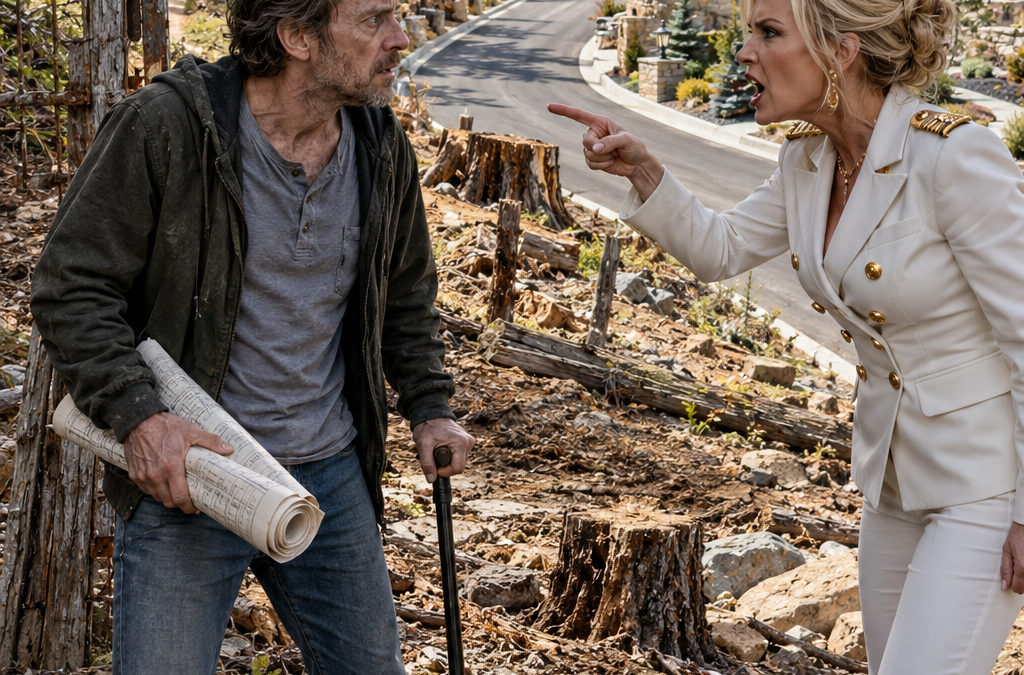
He turned and pointed toward a man in a polo shirt carrying rolled plans.
“You should talk to Greg.”
I walked toward him.
Greg smiled professionally.
“Can I help you?”
“Who owns this property?”
He frowned.
“The HOA.”
“Which HOA?”
He named the subdivision beside us.
I stared.
“All of this?”
“Yes.”
He said it casually.
Like gravity.
Like weather.
I looked toward the ridge.
“Where did the land come from?”
“I don’t know. Expansion parcel.”
“Purchased from who?”
Now Greg’s expression changed.
“I’m just site management.”
“Who told you the HOA owns it?”
“The development paperwork.”
“Have you seen the deed?”
He looked at me as though I had wandered onto the mountain from another planet.
“Sir, obviously they own it.”
Obviously.
That word almost broke something in me.
I didn’t yell.
Didn’t threaten.
Didn’t tell the workers to stop.
I had spent too long learning how dangerous stress could be for my injured brain.
My heart was already pounding hard enough that I could hear it.
So I nodded.
“Okay.”
Greg relaxed slightly.
I turned around.
Walked back to the car.
My wife looked at me.
“What did he say?”
“They think the HOA owns it.”
“What?”
“I need to go home.”
“Should we call the police?”
“No.”
“A lawyer?”
“Probably.”
“What are we going to do?”
I looked back at the half-built house sitting where my retirement cabin had existed in my imagination for half my life.
“I need to think.”
That night, I opened the closet.
My father’s papers were still there.
Old folders.
Survey maps.
Tax records.
Deeds.
Things most families keep for decades because somebody once said never throw them away.
I spread everything across our dining-room table.
My wife sat beside me.
We found the deed.
My name.
Legal description.
Parcel number.
Boundary coordinates.
Free and clear.
No mortgage.
No sale.
No transfer.
No lien.
No donation.
No abandonment.
No HOA.
Three generations of title history.
My grandfather.
My father.
Me.
I checked the county tax portal.
Taxes current.
Automatic payments had continued even while I was unconscious.
I looked at my wife.
“They built on my land.”
She stared at the deed.
“All of it?”
“As far as I can tell.”
“How?”
“I don’t know.”
“How do thirty-six houses happen by accident?”
That question would stay with me.
A fence can cross a line by mistake.
A shed can be misplaced.
A driveway can curve a few feet too far.
But thirty-six houses?
A road?
Utilities?
Sewer?
A stone entrance sign?
That requires decisions.
Money.
Plans.
People signing things.
I didn’t sleep much.
The next morning, I called the HOA.
I asked for a meeting.
The woman on the phone sounded annoyed until I gave her the parcel number.
Then she became cautious.
Two days later, my wife drove me to their office.
That’s where I met Karen.
She was the HOA president.
Forty-one or forty-two.
American.
Blond.
Beautiful.
The kind of woman who seemed to know exactly when people were looking at her and considered attention a resource to be managed.
She had a dramatic figure, a very large bust, and wore a tight white military-style uniform with decorative gold buttons, narrow shoulders, a fitted waist, and a deep neckline completely inappropriate for anything resembling an official uniform.
She looked less like the elected president of a suburban HOA than the glamorous commander of a private yacht club.
But she carried herself like a general.
Two board members sat beside her.
Karen gave me a polished smile.
“Mr. Hayes.”
“Yes.”
“We understand you have questions.”
“I have a deed.”
Her smile tightened slightly.
I placed a copy on the table.
“This parcel belongs to me.”
Karen glanced down.
Barely.
Then back at me.
“The parcel was considered abandoned.”
For several seconds, I wasn’t sure I’d heard correctly.
“Abandoned?”
“There had been no activity for several years.”
“I was in a coma.”
One board member shifted.
Karen did not.
“We understand there were personal circumstances.”
Personal circumstances.
Three years unconscious became “personal circumstances.”
“My taxes were paid.”
Karen folded her hands.
“Occupation and maintenance are different issues.”
“No.”
She frowned.
“No?”
“You can’t take land because someone doesn’t visit it.”
Karen’s expression became almost pitying.
“The community had been maintaining the boundary for years.”
“That does not make you the owner.”
“Our attorney reviewed the matter.”
“Then your attorney is wrong.”
One of the board members laughed softly.
Karen’s blue eyes sharpened.
“I assure you our counsel is very experienced.”
I pushed the deed closer.
“Read it.”
She didn’t touch it.
“The land effectively reverted to community use.”
“There is no such thing.”
“You are not an attorney.”
“Neither are you.”
That killed the smile.
The man to Karen’s right leaned forward.
“You need to understand that the property was an eyesore.”
I turned toward him.
“Excuse me?”
“Overgrown trees. Brush. Unmaintained gate.”
“It was mountain land.”
“Our residents had complained for years.”
“Your residents bought houses next to woods.”
Karen raised one hand.
“Let’s keep this civil.”
I looked back at her.
“You built thirty-six houses on land my family has owned for three generations.”
Her voice cooled.
“And we’re trying to explain the situation.”
“No. You’re explaining why you think you’re entitled to it.”
Karen’s cheeks colored slightly.
“Those homes represent a substantial community investment.”
“That doesn’t answer who owns the land.”
“We do.”
The room went quiet.
I stared at her.
“Say that again.”
Karen leaned back.
The tight white uniform pulled across her chest as she crossed her arms.
“The HOA owns the parcel.”
“Do you have a deed?”
“Our legal team has the records.”
“Do you personally have a deed?”
“I don’t need to produce documentation for you on demand.”
“I just produced mine.”
The man beside her rolled his eyes.
“The world moved on while you were out of the picture.”
My wife inhaled sharply.
I turned to him.
“What did you say?”
He shrugged.
“The development is nearly complete. Homes are already being marketed. At some point, reality matters more than old paperwork.”
Old paperwork.
The deed.
I could feel my pulse in my ears.
After the brain injury, doctors had warned me repeatedly about managing stress.
Headaches.
Blood pressure.
Neurological symptoms.
I closed my eyes for a second.
Breathed.
Then looked at Karen.
“Are you telling me, on behalf of the HOA, that your organization owns my parcel and I no longer have a claim?”
Karen smiled.
A smug, beautiful, unbearable smile.
“Yes.”
My wife gripped my hand under the table.
Karen added, “And frankly, Mr. Hayes, you’ve taken enough of our time.”
Something became very clear in that moment.
These people were not confused.
At least not in the ordinary sense.
They believed themselves.
They had poured millions into construction because somewhere along the way they’d convinced themselves that possession, neglect, community benefit, or their attorney’s opinion had transformed someone else’s land into theirs.
I could yell.
Threaten.
Call police.
Rush to court for an injunction.
Stop construction immediately.
And part of me wanted to.
I wanted bulldozers frozen.
Workers sent home.
Every nail stopped.
Then I looked through the office window toward the subdivision.
And another thought arrived.
They were spending money.
A lot of it.
My wife saw something change in my face.
“What?” she whispered.
I looked at Karen.
Then at the deed she had refused to touch.
“You know what?”
Karen lifted one eyebrow.
“Maybe you’re right.”
My wife’s fingers tightened around mine.
Karen smiled.
“I think that’s the first sensible thing you’ve said.”
“I need some time.”
“Of course.”
I gathered the deed.
The board member who had insulted me leaned back with a satisfied expression.
Karen said, “Our attorney can speak with you if you continue having difficulty accepting the situation.”
I nodded.
“I’ll think about it.”
We left.
The moment we got into the car, my wife turned toward me.
“What was that?”
“I need a lawyer.”
“You just told them they might be right.”
“I said maybe.”
“You’re scaring me.”
“I have an idea.”
“No.”
“You haven’t heard it.”
“I know your face.”
I smiled despite everything.
“That’s fair.”
She didn’t.
“We should stop them.”
“Maybe.”
“Maybe?”
“If we stop them now, what happens?”
“We keep the land.”
“Yes.”
“With half-built houses on it.”
She went quiet.
“Foundations.”
I continued.
“Roads. Trenches. Frames.”
“You’re thinking about letting them finish.”
I looked at her.
Her eyes widened.
“Oh my God.”
“I need a lawyer before I do anything.”
“You could lose everything.”
“I know.”
“What if they sell the houses?”
“I know.”
“What if waiting makes their claim stronger?”
“I know.”
“Then why even consider this?”
“Because Karen just told me, in front of witnesses, that they own the land.”
My wife stared.
“They believe it.”
“So?”
“So they’re going to keep spending.”
She leaned back.
For several seconds, only the car’s air-conditioning made noise.
Then she said, “You were unconscious for three years and woke up insane.”
“Possible.”
That night, we searched for real estate attorneys.
Not general practice.
Not a friend of a friend.
A serious property litigator.
We found one named Thomas Avery.
His office walls were covered in framed maps, old courthouse photographs, and certificates.
I brought everything.
The deed.
Surveys.
Tax records.
Old HOA notices.
My father’s correspondence.
I told him the story.
He started professionally calm.
Then surprised.
Then angry on my behalf.
Then, finally, strangely excited.
He held the deed up.
“This is clean.”
“Yes.”
“I mean extraordinarily clean.”
He examined the survey.
“The HOA parcel stops here.”
He traced a line.
“Your parcel begins here.”
“Yes.”
“And construction is here?”
“Almost all of it.”
“How many structures?”
“Thirty-six planned. Maybe twenty finished enough to recognize as houses.”
Thomas leaned back.
“Do they have any recorded interest?”
“Not that I found.”
He ordered a full title search.
Several days later, we met again.
“No deed.”
I waited.
“No sale.”
He continued.
“No transfer.”
“No easement authorizing development.”
“No adverse-possession claim remotely mature enough or factually supportable from what you’ve told me.”
“So the land is mine.”
“The land is yours.”
“What about the houses?”
Thomas folded his hands.
“That’s where this becomes very interesting.”
He explained that property improvements built without legal right could create complicated remedies depending on jurisdiction, good faith, permitting history, contracts, and other facts.
But under the circumstances his research identified, the HOA was in an extraordinarily weak position.
They had been told I owned the parcel.
They had ignored my deed.
They had continued building without securing title.
And the structures were physically attached to my land.
Thomas warned me not to assume any outcome until a court ruled.
But he understood exactly what I was thinking.
“If I stop them now?”
“You may get your land back with partially completed structures and a very expensive cleanup fight.”
“If I wait?”
“You increase the value of the improvements.”
“And the risk?”
“Also increases.”
I nodded.
He studied me.
“Have you told them you’ll give up the land?”
“No.”
“Signed anything?”
“No.”
“Accepted money?”
“No.”
“Agreed to transfer title?”
“No.”
“Promised to?”
“No.”
“What exactly did you say?”
“That maybe they were right and I needed time.”
Thomas smiled slightly.
“Good.”
My wife crossed her arms.
“You’re encouraging this.”
“I’m telling you what the law requires.”
He looked at me.
“You already informed them of your ownership.”
“Yes.”
“You physically brought them a deed.”
“Yes.”
“They refused to review it?”
“Yes.”
“They stated they owned the parcel?”
“Yes.”
“In front of board members?”
“Yes.”
Thomas leaned back.
“You are not legally obligated to spend the next six months begging someone to stop making a mistake after you’ve explicitly told them they’re on your land.”
My wife still looked worried.
“What would you do?”
Thomas smiled.
“I would never answer that question in front of my malpractice insurance.”
For the first time since finding the houses, I laughed.
We decided to wait.
Not blindly.
Thomas monitored title records.
Permits.
Sales activity.
Liens.
I documented construction.
Dates.
Photographs.
Everything.
Then I went back to Karen.
I wore my most exhausted expression.
That part wasn’t difficult.
Recovery still drained me.
Karen received me in the HOA office wearing the white uniform again.
She looked pleased before I said a word.
“I’ve thought about what you told me.”
“Yes?”
“I don’t have the energy for a legal war.”
Her smile softened.
Almost flirtatious now.
“I think that’s wise.”
“I was in the hospital a long time.”
“I understand.”
No, she didn’t.
“But maybe you’re right. Maybe the land was effectively part of the community after I disappeared.”
Karen leaned back.
“I’m glad you’re finally being realistic.”
“I don’t want trouble.”
“Nobody does.”
I nearly admired the audacity.
“Do I need to sign anything?”
That got her attention.
“We can have counsel prepare a release.”
“Okay.”
“You would simply acknowledge you no longer claim an interest.”
“I’d want to read it first.”
“Of course.”
“Send it when it’s ready.”
Karen smiled warmly.
“This is very mature of you.”
I almost laughed.
Instead, I nodded.
She thought I had surrendered.
I never signed anything.
Her attorney eventually sent a proposed document.
Thomas read it.
He laughed.
We ignored it.
Karen sent follow-up messages.
I said I was still reviewing.
Then I became difficult to reach.
Not hostile.
Just tired.
Recovering.
Overwhelmed.
Which was all true.
Meanwhile, construction accelerated.
I drove to the mountain every few weeks.
At first, it hurt.
Physically.
Emotionally.
Crews poured concrete where Grandpa had parked his pickup.
They cut trees my father and I had camped beneath.
The old fire ring disappeared under a landscaped front yard.
The rough dirt trail became part of a paved cul-de-sac.
More houses went up.
Roofs.
Siding.
Windows.
Garage doors.
Utilities.
Water.
Sewer.
Power.
Streetlights.
Fresh sod.
Small ornamental trees.
They even built a large stone sign at the entrance with the name of the new section.
Karen saw me there once.
She arrived in a golf cart wearing sunglasses and that white uniform.
“You still come up here.”
“Sometimes.”
“Hard to let go?”
“A little.”
She smiled.
“I suppose that’s understandable.”
I looked toward the houses.
“They look expensive.”
“They are.”
“How many?”
“Thirty-six.”
“All sold?”
“Several reserved. More deposits coming.”
She said it proudly.
Then she lowered her sunglasses slightly.
“You know, I’m glad you’ve found peace with what happened.”
Peace.
I had to bite the inside of my cheek.
“The community really did improve the property.”
“I can see that.”
“We’re creating tremendous value.”
“I can see that too.”
She smiled.
“You should feel good knowing your family’s old land became something useful.”
I looked at her.
“My grandfather thought it was useful before.”
Karen waved one hand.
“You know what I mean.”
“Yes.”
I did.
Money.
That was the only kind of usefulness she understood.
“Congratulations,” I said.
“Thank you.”
She drove away.
I sat in my car and called Thomas.
“They’re taking deposits.”
“I know.”
“You know?”
“We’re monitoring.”
“Should we move now?”
“Not yet.”
My stomach tightened.
“Thomas.”
“You hired me because I’m cautious.”
“I hired you because you looked excited when you saw the deed.”
“That too.”
He told me to be patient.
I tried.
Patience was horrible.
Every completed roof felt like a violation.
Every finished kitchen.
Every driveway.
Every landscaped lawn.
There were days I wanted to drive up with court papers and shut everything down.
My wife would remind me why we hadn’t.
“The lawyer says wait.”
“I know.”
“You’re the one who wanted to wait.”
“I know.”
“You’re going to give yourself another brain injury.”
That usually ended the argument.
Eventually, the development looked complete.
Thirty-six houses.
Some occupied-looking.
Others ready.
The road fully paved.
Utilities active.
Common landscaping done.
Stone entrance finished.
A small section of my mountain had become a polished residential neighborhood.
That was when Thomas said, “Now.”
We filed.
The HOA reacted exactly as expected.
Outrage.
Threats.
Claims that I had waived rights.
Claims of abandonment.
Claims of community reliance.
Claims that I had accepted their ownership.
Their lawyers sent letters so aggressive they might have been funny if the stakes weren’t enormous.
Karen called me personally once.
I answered because Thomas told me to record the time and take notes.
“What are you doing?”
“Enforcing ownership.”
“You told me you were giving up your claim.”
“No.”
“You absolutely did.”
“I said maybe you were right.”
“You asked for release documents!”
“I asked whether there were documents.”
“You deliberately misled us.”
“I brought you my deed before you finished construction.”
Silence.
Then Karen’s voice hardened.
“You knew what we were doing.”
“Yes.”
“And you let us continue.”
“I told you the land was mine.”
“You said you’d accepted the community’s ownership.”
“No. I said I didn’t have the energy to fight you.”
“That is the same thing.”
“It really isn’t.”
Her breathing became audible.
“You think you’re going to steal thirty-six houses?”
I almost admired the reversal.
“You built thirty-six houses on my property and you’re accusing me of stealing?”
“They belong to the HOA.”
“Then show the court your deed.”
She went quiet.
“You won’t win.”
“Maybe not.”
“Our attorneys are going to destroy you.”
“Okay.”
“You’re going to lose everything.”
“Karen.”
“What?”
“You already told me once to stop wasting your time.”
She didn’t answer.
“So let’s stop wasting it.”
I hung up.
Court moved more slowly than stories do.
Documents.
Filings.
Hearings.
Expert reports.
Surveyors.
Title evidence.
Arguments I understood and others I didn’t.
The HOA leaned heavily on abandonment.
They argued the parcel had been neglected.
That the association had improved it in good faith.
That I had disappeared.
That construction benefited the community.
Thomas kept returning to one question.
Where was their title?
They had none.
Then came the day ownership was addressed directly.
I sat beside my wife.
Karen sat across the room with HOA counsel.
She wore the white military-style uniform.
Of course she did.
Perfect hair.
Perfect makeup.
Gold buttons.
Deep neckline.
Straight posture.
But I could see the tension in her jaw.
Thomas introduced the chain of title.
My grandfather’s purchase.
Transfer to my father.
Transfer to me.
Current deed.
Taxes paid.
No sale.
No forfeiture.
No foreclosure.
No transfer.
No recorded HOA interest.
Nothing.
The paperwork that Karen had refused to read in her office now sat in front of the court.
Their side could not produce a competing deed.
Because one did not exist.
At one point, the judge asked their attorney a question so simple that the entire dispute seemed to collapse under it.
“What document conveyed ownership of this parcel to your client?”
Their attorney began explaining history.
Community maintenance.
Development assumptions.
Inactive use.
The judge interrupted.
“What document?”
There was no answer.
I looked at Karen.
For the first time since meeting her, she wasn’t smiling.
The case wasn’t resolved in one cinematic sentence.
But the direction became clear.
Eventually, the court confirmed what I had known from the moment I opened that box in my closet.
The mountain parcel belonged to me.
It had always belonged to me.
And under the final rulings and remedies reached in the case, the permanent improvements the HOA had constructed on my land became mine as well.
Thirty-six houses.
I remember Thomas calling me.
“It’s done.”
I sat at the kitchen table.
My wife stood across from me.
“All of them?”
“Yes.”
She sank into a chair.
For several seconds, we just stared at each other.
Then she laughed.
Not because it was funny.
Because what else do you do when you wake from a coma, discover a neighborhood on your land, and somehow end up owning the neighborhood?
The HOA was devastated.
They had spent an enormous amount of money.
Construction contracts.
Roads.
Utilities.
Permits.
Landscaping.
Homes.
Marketing.
Deposits.
And after all of it, they did not own the land beneath the development.
The buyer deposits became a nightmare.
Some families had expected to close on houses the HOA had no legal right to convey.
Deals had to be unwound.
Money returned.
Attorneys multiplied.
Existing HOA residents became furious when they realized how much association money had been exposed.
Karen did not remain president long.
I heard there was an emergency meeting.
Arguments.
Accusations.
Demands for records.
People wanted to know how any board could authorize development without verifying title.
Karen blamed legal counsel.
Legal counsel apparently blamed the information provided by the board.
Board members blamed Karen.
I wasn’t there.
Didn’t care to be.
She was removed.
That was enough for me.
At first, I thought the court victory would feel like revenge.
It didn’t.
Mostly, I felt tired.
Then came the families.
The innocent part of the mess.
People who had put deposits down.
People who had chosen floor plans.
School districts.
Moving dates.
Furniture.
They had been told these were legitimate homes.
They didn’t know about me.
Didn’t know about the deed.
Didn’t know that Karen had refused to look at it.
I couldn’t punish them for her arrogance.
And I had absolutely no use for thirty-six personal residences.
My wife stood in the kitchen one evening with a stack of documents.
“So what do we do?”
“Sell?”
“To whom?”
“Maybe all of them.”
“That’s thirty-six closings.”
“Rent them?”
She looked at me.
“You want to become a landlord to thirty-six families?”
“No.”
“Good.”
I paused.
“But we already own thirty-six houses.”
She stared.
Then started laughing again.
“What?”
“I spoon-fed you in a hospital.”
“I remember some of that.”
“No, you don’t.”
“Fair.”
She pointed at the papers.
“And now we’re discussing a rental portfolio.”
“Life is weird.”
“That is your professional analysis?”
“Yes.”
We eventually decided to rent.
Some families who had originally placed deposits with the HOA still wanted the homes.
We met with them.
Not all at once.
Small meetings.
Coffee.
Documents.
Explanations.
I told them the truth.
“The HOA did not own the land.”
One couple looked horrified.
“So are you making us leave?”
“No.”
“You own the house?”
“Yes.”
“How?”
“That answer requires about an hour.”
The husband looked at his wife.
Then back at me.
“What do you want?”
“If you still want to live here, we’ll create a fair lease.”
They stared.
“No HOA?”
I smiled.
“No HOA.”
That changed the mood.
We made reasonable arrangements.
Fair rent.
No surprise fees.
No ridiculous aesthetic rules.
Repair requests handled quickly.
If someone’s trash can stayed out, civilization continued.
If children left bicycles outside, I did not send legal notices.
If a family wanted to plant flowers, they planted flowers.
Some original buyers became renters.
Other homes filled quickly.
The views were beautiful.
The houses were new.
And the funniest part was the one thing Karen could never fix afterward.
My land had never joined the HOA.
Court didn’t change that.
So the thirty-six homes on my land were not under HOA authority.
They sat directly beside Karen’s carefully controlled subdivision like a permanent monument to overreach.
The association couldn’t fine them.
Couldn’t dictate paint colors.
Couldn’t regulate landscaping.
Couldn’t demand dues.
Couldn’t decide which cars belonged in driveways.
Nothing.
My wife took over much of the bookkeeping.
She was better at it than me.
One afternoon, I walked into our home office and found her surrounded by rent statements.
“You okay?”
She looked up.
“I used to measure your medication.”
“I know.”
“Then I helped you learn how to use a fork again.”
“I remember that one.”
“And now I have thirty-six tenants.”
“Technically we have thirty-six tenants.”
She narrowed her eyes.
“I do the spreadsheets.”
“Fair.”
She leaned back.
“You know what I want?”
“What?”
“A vacation.”
“You’ve earned one.”
“I earned one three years ago.”
That hit harder than she intended.
She saw it immediately.
“Hey.”
“I’m okay.”
She came around the desk.
“You’re here.”
I held her.
“Yes.”
Everything else suddenly felt small.
The houses.
Money.
Karen.
Court.
All of it.
There were nights during my coma when my wife had no guarantee I would ever wake.
There were mornings after I did wake when neither of us knew whether I would ever walk independently again.
So yes, the rental income changed our lives.
It gave us financial security I never expected.
But what mattered more was that we were living that life together.
Eventually, I built the cabin.
Not where I originally planned.
That clearing belonged to one of the houses now.
I found another spot higher up, outside the developed section.
Smaller clearing.
Better view.
It took longer because I insisted on keeping as many trees as possible.
One bedroom.
A porch.
Wood stove.
Nothing extravagant.
The first night my wife and I stayed there, we sat outside watching lights from the houses below.
Thirty-six little rectangles glowing across the mountainside.
She handed me coffee.
“Grandpa would’ve hated the development.”
“Yes.”
“Your dad too.”
“Probably.”
“You think they’d be mad at you?”
“For keeping it?”
“For letting it happen.”
I thought about that.
Maybe.
There are parts of what I did that still make me uncomfortable.
I could have stopped construction sooner.
I knew they were wasting money.
I let them.
But I also remember sitting in Karen’s office with a deed in front of her.
I told the truth.
The land was mine.
She refused to read it.
She told me it belonged to the HOA.
She told me the world had moved on.
She told me to stop wasting her time.
Everything afterward grew out of that arrogance.
“I think Grandpa would say they should’ve checked the paperwork.”
My wife smiled.
“That does sound like him.”
Years passed.
My health improved.
Not perfectly.
Brain injuries leave fingerprints.
Fatigue.
Occasional memory gaps.
Headaches if I push too hard.
But I have a life.
A good one.
Sometimes I drive through the development the HOA built on my land.
Children play in yards.
People wave.
Someone added a bright red front door to one house.
Karen would have hated it.
I love it.
The old HOA neighborhood still exists next door.
New president.
Different board.
Much quieter relationship.
They have never sent me another letter about brush.
Funny how a catastrophic lawsuit improves boundary awareness.
I saw Karen once after everything ended.
Grocery store.
Almost two years later.
She wasn’t wearing the white uniform.
Just jeans and a jacket.
For a moment, I wasn’t sure she’d recognize me.
Then she did.
Her expression hardened.
I expected her to walk away.
Instead, she approached.
“You ruined my life.”
No hello.
Still Karen.
I rested one hand on the shopping cart.
“I didn’t build the houses.”
“You knew.”
“Yes.”
“You knew we didn’t own the land.”
“I told you that.”
“You let us keep building.”
“I showed you the deed.”
“You manipulated us.”
“You told me your attorney had handled everything.”
Her jaw tightened.
“You pretended to surrender.”
“I never signed anything.”
“You knew what I believed.”
That sentence stayed between us.
I looked at her.
“Yes.”
Karen’s eyes flashed.
“Then you’re just as bad.”
“No.”
My voice was quiet.
“I knew what you believed after I tried to tell you it was wrong.”
She looked away.
I continued.
“You had my deed on the table.”
Nothing.
“You chose not to read it.”
She swallowed.
“You could have stopped us.”
“You could have stopped yourself.”
Karen stared at me for several seconds.
Then said, “I hope the money was worth it.”
I thought about my wife.
The hospital.
Three stolen years.
The mountain.
The cabin.
The families living peacefully without Karen controlling their paint colors.
“It isn’t about the money.”
She gave a bitter laugh.
“Of course it is.”
“No.”
I leaned slightly on the cart.
“The money is nice.”
That irritated her.
“But the part I remember is you calling my land abandoned because I was unconscious.”
Her expression changed.
Just a little.
“You told me the world moved on without me.”
“That wasn’t me.”
“One of your board members said it while you sat there.”
She said nothing.
“I had just spent years trying to return to that world.”
My voice tightened unexpectedly.
“I went to the mountain because I wanted something that still felt like mine.”
Karen looked uncomfortable for the first time.
“And you told me I should be grateful you’d turned it into something useful.”
Silence.
I took a breath.
“So no, Karen. I don’t feel guilty that you lost your presidency.”
She looked away.
“And I don’t feel guilty that the HOA lost money.”
Her eyes returned to mine.
“I tried to warn you.”
I pushed the cart past her.
That was the last conversation we ever had.
Today, the rent arrives every month.
My wife still jokes about our accidental property empire.
We keep reserves for repairs.
Treat tenants fairly.
Fix broken water heaters quickly.
Replace appliances without arguing.
I have learned more about roofs, leases, plumbing, and property management than I ever expected.
Sometimes I think about how absurd the chain of events was.
My grandfather bought unwanted mountain land because it was cheap.
My father preserved it.
I inherited it.
A truck ran a red light.
I disappeared from the world for three years.
An HOA saw silence and mistook it for surrender.
Karen saw wild land and mistook it for something ownerless.
They built thirty-six houses.
And because Karen was too arrogant to read the deed when I physically placed it in front of her, the biggest violation of my property became the thing that secured my family’s future.
I wouldn’t choose the path again.
Not the accident.
Not the coma.
Not my wife’s suffering.
Not seeing my grandfather’s trees cut.
Not watching construction crews build over memories.
But life rarely asks whether we approve of the road before putting us on it.
Sometimes all you control is what you do next.
Karen thought I was weak because I looked tired.
She was right about one thing.
I was tired.
I had spent months relearning how to exist.
I did not have strength for shouting matches.
That became my advantage.
I listened.
I watched.
I waited.
She mistook quiet for defeat.
Mistook patience for surrender.
Mistook paperwork for something she could dismiss because reality was inconvenient.
The HOA spent months driving nails into houses they believed belonged to them.
Every nail made their mistake more expensive.
Every roof.
Every utility line.
Every finished kitchen.
Every planted tree.
They thought development was strengthening their claim.
It was only increasing the value of what they had placed on someone else’s land.
The funniest part is that Karen loved talking about property values.
For years, the HOA had complained that my trees reduced them.
That my old gate hurt them.
That undeveloped mountain land was an eyesore.
In the end, they dramatically increased the value of my property.
More than I ever would have.
More than my grandfather could have imagined when he bought it.
So whenever I stand on the porch of my cabin now, I sometimes think about him.
The old pickup.
The fire ring.
His habit of buying things nobody else understood.
He probably would have laughed himself sick hearing the story.
Thirty-six houses.
Built by people who didn’t own the ground.
Transferred to the grandson everyone assumed had disappeared.
There’s a lesson in there somewhere.
Maybe several.
Check the deed before building a neighborhood.
Do not confuse inactivity with abandonment.
Do not assume illness erases ownership.
And if a brain-injury survivor comes into your office carrying proof that the land beneath your multimillion-dollar project belongs to him, maybe take thirty seconds to read the paper before telling him he has no rights.
Because sometimes the person you dismiss will argue with you.
Sometimes he’ll threaten you.
Sometimes he’ll rush to court.
And sometimes he’ll simply smile, nod, and let you finish building.
Karen wanted me to stop wasting her time.
So I did.
I stopped arguing.
Stopped pleading.
Stopped trying to convince her.
I went home.
I waited.
And she spent the next several months improving my property for free.
𝗧𝗛𝗘 𝗘𝗡𝗗
I Woke Up After Three Years in a Coma and Found an HOA Had Built Thirty-Six Houses on My Family’s Mountain
I lost three years of my life to a coma, and when I finally returned to the mountain my grandfather left me, the clearing where I had planned to retire was gone beneath a paved road and rows of expensive houses.
The HOA president looked me in the eye, called my land “abandoned,” and told me the world had moved on while I was unconscious.
So I stopped trying to save her from the mistake she was determined to finish.
The mountain had been in my family longer than I had been alive.
My grandfather bought the land back when nobody wanted it.
It was steep, heavily wooded, difficult to reach, and almost useless for farming. There were two broad clearings, a rocky stream that ran hard during spring snowmelt, and one flat shelf near the upper ridge where you could stand on a clear evening and see what felt like half the state stretched beneath you.
Grandpa paid almost nothing for it.
Everybody told him it was a bad purchase.
He called it the best bad decision he ever made.
When I was a kid, he took me there in an old pickup that sounded as if it might shake itself apart on the mountain road.
He would park near a rusted gate, hand me a canteen, and say, “Try not to fall off anything expensive.”
There wasn’t much there.
Trees.
Rock.
Brush.
Birds.
An old fire ring.
A rough trail.
But to him, it was freedom.
He never developed it.
Never cut down more than he needed.
Never tried turning it into money.
He liked knowing there was a place on earth where nobody could tell him what color the front door needed to be.
When he died, my father inherited it.
Dad treated it the same way.
Maybe even more sentimentally.
He repaired the fence line.
Replaced the old gate once.
Paid the taxes.
Took me camping.
And sometime during my twenties, he pointed toward that upper clearing and said, “You could build a cabin there someday.”
That idea stayed with me.
Not as a serious plan.
More like one of those dreams you keep in a back pocket for an older version of yourself.
Someday.
When work slowed down.
When retirement became real.
When I wanted mornings with coffee, trees, and nobody asking for anything.
My father eventually left the property to me.
By then, the area around it had changed dramatically.
Developers had discovered the mountain.
The lower slopes filled with wide streets, decorative stone entrances, three-car garages, manicured lawns, and houses with more bathrooms than the homes I grew up in had bedrooms.
A large HOA-controlled subdivision expanded right up against my property line.
Their world stopped at a fence.
Mine began on the other side.
For years, that arrangement was mostly fine.
Mostly.
The HOA occasionally mailed me notices.
The first one said parts of my wooded parcel were creating an “unmanaged visual boundary” along the community.
I read it twice because I couldn’t decide whether “unmanaged visual boundary” was the funniest phrase I’d ever heard or the most irritating.
Another notice complained about the old metal gate.
Apparently, weathered steel did not complement the neighborhood’s visual identity.
One wanted me to clear brush visible from the HOA walking trail.
Another suggested the natural tree line could negatively affect property values because it appeared “uncultivated.”
That one made me laugh.
Nature looked too much like nature.
I ignored the notices.
My property wasn’t in their association.
My father had already dealt with them once years earlier through an attorney, and the answer had been simple.
No covenant.
No membership.
No authority.
They could dislike my trees.
They could dislike my gate.
They could stand on their manicured walking path and glare at every pine needle if they wanted.
They could not tell me what to do with land my grandfather had owned before their neighborhood existed.
That should have been the end of it.
Then I had the accident.
I don’t like talking about that day.
Even now, certain sounds can pull pieces of it back.
A horn.
Brakes.
The sudden weightlessness before impact.
I was driving through an intersection when a truck ran a red light.
The collision destroyed my car.
It nearly did the same to me.
Head trauma.
Internal injuries.
Multiple fractures.
Severe brain injury.
I remember almost nothing from the first hospital.
Most of what I know comes from my wife.
She remembers everything.
Unfortunately.
Surgeries.
Machines.
Doctors.
Specialists.
Hope.
Bad news.
More hope.
Then less.
At some point, I slipped into a coma deep enough that weeks became months.
Months became a year.
Then another.
Then another.
Three years.
Three years of my life vanished while I lay in a hospital bed.
There were conversations about long-term prognosis that I am grateful I never had to hear.
Forms.
Consultations.
Moments when doctors warned my wife not to expect miracles.
She stayed anyway.
Every day she could.
She handled insurance.
Bills.
Our house.
My family.
Her job.
The terrifying administrative machinery that surrounds a person who can no longer speak for himself.
And somehow she kept believing I was still in there.
Then one day, I opened my eyes.
People like to imagine waking from a coma as a dramatic movie scene.
Eyes open.
Loved ones cry.
Patient immediately understands what happened.
That wasn’t my experience.
At first, nothing made sense.
Light hurt.
Voices sounded distant.
My own body felt like something I had been placed inside without instructions.
I couldn’t understand why my muscles were so weak.
Why my wife looked older.
Why everybody cried when I managed to say a word.
I thought I’d been unconscious for maybe a few weeks.
When my wife told me it had been three years, I thought she was confused.
“No.”
My voice barely worked.
She held my hand.
“Three years.”
“No.”
I shook my head.
Or tried to.
“No, it’s…”
I couldn’t remember the year.
That terrified me more than almost anything.
The calendar was wrong.
Her phone looked different.
People I knew had moved.
Children had grown.
Prices had changed.
News events had happened without me.
Three entire years had occurred, and the world had not noticed my absence enough to stop.
Recovery was brutal.
I had to relearn ordinary things.
Standing.
Walking.
Balance.
Fine motor control.
Holding utensils.
Climbing steps.
Concentrating long enough to read.
My memory came back unevenly.
Fatigue hit without warning.
Stress could trigger headaches so intense I had to lie in a dark room.
My wife became part spouse, part nurse, part coach, part historian.
She never complained.
That almost made it harder.
Sometimes I would wake at night and find her crying quietly in the bathroom because she didn’t want me to see.
I knew what those three years had cost her.
That knowledge changed me.
For a long time, the mountain property did not cross my mind.
Why would it?
It was land.
Trees.
A gate.
A tax bill so small it had been on automatic payment for years.
My wife had spent three years keeping me alive.
She had no reason to drive up a mountain and check whether the pines were still standing.
Nobody contacted her.
No certified letters.
No phone calls.
No legal notices.
Nothing suggesting a problem.
As far as either of us knew, the land had simply sat there.
Waiting.
About a year after I woke up, I improved enough to drive again.
That milestone felt almost impossible.
The first time I sat behind a steering wheel alone, my hands shook so hard I had to wait five minutes before starting the engine.
Eventually, confidence returned.
Not completely.
Enough.
One morning, I told my wife I wanted to go to the mountain.
She looked at me over her coffee.
“Today?”
“If you’re up for it.”
She studied my face.
“You sure?”
“No.”
That made her smile.
“Okay.”
She drove.
Long trips still exhausted me.
The road looked familiar at first.
Then different.
More businesses.
New homes.
Wider intersections.
Three years had altered even the route.
But once we started climbing, memory took over.
The curve near the old quarry.
The narrow bridge.
The stand of tall pines where Dad used to slow down for deer.
I became more excited the higher we went.
Not because I expected anything dramatic.
Because I wanted proof that something had remained unchanged.
The mountain had existed before my accident.
I wanted to stand there and remember who I had been.
Then we rounded the final bend.
And my land was gone.
At least, that’s what my brain told me.
Because there were houses.
Not one.
Not two.
Dozens.
I stared through the windshield.
My wife slowed the car.
“What…”
She stopped.
Neither of us finished the sentence.
A paved road curved directly across the lower section of my parcel.
Fresh curbs.
Streetlights.
Utility boxes.
Driveways.
Houses.
Some completely finished.
Some with siding going up.
Some still exposed framing.
Construction vehicles filled the area.
Stacks of lumber.
Pallets of shingles.
Cable spools.
Concrete trucks.
Workers.
And near the upper clearing—
the place where my father had said I could someday build a cabin—
stood a half-finished two-story house.
I genuinely believed my brain had failed me.
Confusion was still one of the things that scared me most after the injury.
Sometimes I lost a word.
Sometimes I walked into a room and forgot why.
So my first instinct wasn’t anger.
It was fear.
“I have the wrong place.”
My wife looked around.
“No.”
“I must.”
“This is it.”
“No.”
I pointed toward the ridge.
“The clearing should be…”
My voice stopped.
The clearing was there.
Under the house.
My wife covered her mouth.
“I didn’t know.”
I looked at her.
“I swear to you, I didn’t know.”
“I know.”
“Nobody contacted me.”
“I know.”
“No letters. Nothing.”
“I know.”
She sounded close to tears.
I touched her arm.
“This isn’t your fault.”
I needed her to hear that immediately.
She had carried enough guilt for things she could not control.
I opened the car door.
My legs were still unsteady on steep ground, but adrenaline made me forget most of that.
A construction worker in a hard hat noticed me.
“Sir? You can’t be in the active work area without PPE.”
I pointed around.
“What is this?”
He looked confused.
“The development?”
“Whose development?”
He turned and pointed toward a man in a polo shirt carrying rolled plans.
“You should talk to Greg.”
I walked toward him.
Greg smiled professionally.
“Can I help you?”
“Who owns this property?”
He frowned.
“The HOA.”
“Which HOA?”
He named the subdivision beside us.
I stared.
“All of this?”
“Yes.”
He said it casually.
Like gravity.
Like weather.
I looked toward the ridge.
“Where did the land come from?”
“I don’t know. Expansion parcel.”
“Purchased from who?”
Now Greg’s expression changed.
“I’m just site management.”
“Who told you the HOA owns it?”
“The development paperwork.”
“Have you seen the deed?”
He looked at me as though I had wandered onto the mountain from another planet.
“Sir, obviously they own it.”
Obviously.
That word almost broke something in me.
I didn’t yell.
Didn’t threaten.
Didn’t tell the workers to stop.
I had spent too long learning how dangerous stress could be for my injured brain.
My heart was already pounding hard enough that I could hear it.
So I nodded.
“Okay.”
Greg relaxed slightly.
I turned around.
Walked back to the car.
My wife looked at me.
“What did he say?”
“They think the HOA owns it.”
“What?”
“I need to go home.”
“Should we call the police?”
“No.”
“A lawyer?”
“Probably.”
“What are we going to do?”
I looked back at the half-built house sitting where my retirement cabin had existed in my imagination for half my life.
“I need to think.”
That night, I opened the closet.
My father’s papers were still there.
Old folders.
Survey maps.
Tax records.
Deeds.
Things most families keep for decades because somebody once said never throw them away.
I spread everything across our dining-room table.
My wife sat beside me.
We found the deed.
My name.
Legal description.
Parcel number.
Boundary coordinates.
Free and clear.
No mortgage.
No sale.
No transfer.
No lien.
No donation.
No abandonment.
No HOA.
Three generations of title history.
My grandfather.
My father.
Me.
I checked the county tax portal.
Taxes current.
Automatic payments had continued even while I was unconscious.
I looked at my wife.
“They built on my land.”
She stared at the deed.
“All of it?”
“As far as I can tell.”
“How?”
“I don’t know.”
“How do thirty-six houses happen by accident?”
That question would stay with me.
A fence can cross a line by mistake.
A shed can be misplaced.
A driveway can curve a few feet too far.
But thirty-six houses?
A road?
Utilities?
Sewer?
A stone entrance sign?
That requires decisions.
Money.
Plans.
People signing things.
I didn’t sleep much.
The next morning, I called the HOA.
I asked for a meeting.
The woman on the phone sounded annoyed until I gave her the parcel number.
Then she became cautious.
Two days later, my wife drove me to their office.
That’s where I met Karen.
She was the HOA president.
Forty-one or forty-two.
American.
Blond.
Beautiful.
The kind of woman who seemed to know exactly when people were looking at her and considered attention a resource to be managed.
She had a dramatic figure, a very large bust, and wore a tight white military-style uniform with decorative gold buttons, narrow shoulders, a fitted waist, and a deep neckline completely inappropriate for anything resembling an official uniform.
She looked less like the elected president of a suburban HOA than the glamorous commander of a private yacht club.
But she carried herself like a general.
Two board members sat beside her.
Karen gave me a polished smile.
“Mr. Hayes.”
“Yes.”
“We understand you have questions.”
“I have a deed.”
Her smile tightened slightly.
I placed a copy on the table.
“This parcel belongs to me.”
Karen glanced down.
Barely.
Then back at me.
“The parcel was considered abandoned.”
For several seconds, I wasn’t sure I’d heard correctly.
“Abandoned?”
“There had been no activity for several years.”
“I was in a coma.”
One board member shifted.
Karen did not.
“We understand there were personal circumstances.”
Personal circumstances.
Three years unconscious became “personal circumstances.”
“My taxes were paid.”
Karen folded her hands.
“Occupation and maintenance are different issues.”
“No.”
She frowned.
“No?”
“You can’t take land because someone doesn’t visit it.”
Karen’s expression became almost pitying.
“The community had been maintaining the boundary for years.”
“That does not make you the owner.”
“Our attorney reviewed the matter.”
“Then your attorney is wrong.”
One of the board members laughed softly.
Karen’s blue eyes sharpened.
“I assure you our counsel is very experienced.”
I pushed the deed closer.
“Read it.”
She didn’t touch it.
“The land effectively reverted to community use.”
“There is no such thing.”
“You are not an attorney.”
“Neither are you.”
That killed the smile.
The man to Karen’s right leaned forward.
“You need to understand that the property was an eyesore.”
I turned toward him.
“Excuse me?”
“Overgrown trees. Brush. Unmaintained gate.”
“It was mountain land.”
“Our residents had complained for years.”
“Your residents bought houses next to woods.”
Karen raised one hand.
“Let’s keep this civil.”
I looked back at her.
“You built thirty-six houses on land my family has owned for three generations.”
Her voice cooled.
“And we’re trying to explain the situation.”
“No. You’re explaining why you think you’re entitled to it.”
Karen’s cheeks colored slightly.
“Those homes represent a substantial community investment.”
“That doesn’t answer who owns the land.”
“We do.”
The room went quiet.
I stared at her.
“Say that again.”
Karen leaned back.
The tight white uniform pulled across her chest as she crossed her arms.
“The HOA owns the parcel.”
“Do you have a deed?”
“Our legal team has the records.”
“Do you personally have a deed?”
“I don’t need to produce documentation for you on demand.”
“I just produced mine.”
The man beside her rolled his eyes.
“The world moved on while you were out of the picture.”
My wife inhaled sharply.
I turned to him.
“What did you say?”
He shrugged.
“The development is nearly complete. Homes are already being marketed. At some point, reality matters more than old paperwork.”
Old paperwork.
The deed.
I could feel my pulse in my ears.
After the brain injury, doctors had warned me repeatedly about managing stress.
Headaches.
Blood pressure.
Neurological symptoms.
I closed my eyes for a second.
Breathed.
Then looked at Karen.
“Are you telling me, on behalf of the HOA, that your organization owns my parcel and I no longer have a claim?”
Karen smiled.
A smug, beautiful, unbearable smile.
“Yes.”
My wife gripped my hand under the table.
Karen added, “And frankly, Mr. Hayes, you’ve taken enough of our time.”
Something became very clear in that moment.
These people were not confused.
At least not in the ordinary sense.
They believed themselves.
They had poured millions into construction because somewhere along the way they’d convinced themselves that possession, neglect, community benefit, or their attorney’s opinion had transformed someone else’s land into theirs.
I could yell.
Threaten.
Call police.
Rush to court for an injunction.
Stop construction immediately.
And part of me wanted to.
I wanted bulldozers frozen.
Workers sent home.
Every nail stopped.
Then I looked through the office window toward the subdivision.
And another thought arrived.
They were spending money.
A lot of it.
My wife saw something change in my face.
“What?” she whispered.
I looked at Karen.
Then at the deed she had refused to touch.
“You know what?”
Karen lifted one eyebrow.
“Maybe you’re right.”
My wife’s fingers tightened around mine.
Karen smiled.
“I think that’s the first sensible thing you’ve said.”
“I need some time.”
“Of course.”
I gathered the deed.
The board member who had insulted me leaned back with a satisfied expression.
Karen said, “Our attorney can speak with you if you continue having difficulty accepting the situation.”
I nodded.
“I’ll think about it.”
We left.
The moment we got into the car, my wife turned toward me.
“What was that?”
“I need a lawyer.”
“You just told them they might be right.”
“I said maybe.”
“You’re scaring me.”
“I have an idea.”
“No.”
“You haven’t heard it.”
“I know your face.”
I smiled despite everything.
“That’s fair.”
She didn’t.
“We should stop them.”
“Maybe.”
“Maybe?”
“If we stop them now, what happens?”
“We keep the land.”
“Yes.”
“With half-built houses on it.”
She went quiet.
“Foundations.”
I continued.
“Roads. Trenches. Frames.”
“You’re thinking about letting them finish.”
I looked at her.
Her eyes widened.
“Oh my God.”
“I need a lawyer before I do anything.”
“You could lose everything.”
“I know.”
“What if they sell the houses?”
“I know.”
“What if waiting makes their claim stronger?”
“I know.”
“Then why even consider this?”
“Because Karen just told me, in front of witnesses, that they own the land.”
My wife stared.
“They believe it.”
“So?”
“So they’re going to keep spending.”
She leaned back.
For several seconds, only the car’s air-conditioning made noise.
Then she said, “You were unconscious for three years and woke up insane.”
“Possible.”
That night, we searched for real estate attorneys.
Not general practice.
Not a friend of a friend.
A serious property litigator.
We found one named Thomas Avery.
His office walls were covered in framed maps, old courthouse photographs, and certificates.
I brought everything.
The deed.
Surveys.
Tax records.
Old HOA notices.
My father’s correspondence.
I told him the story.
He started professionally calm.
Then surprised.
Then angry on my behalf.
Then, finally, strangely excited.
He held the deed up.
“This is clean.”
“Yes.”
“I mean extraordinarily clean.”
He examined the survey.
“The HOA parcel stops here.”
He traced a line.
“Your parcel begins here.”
“Yes.”
“And construction is here?”
“Almost all of it.”
“How many structures?”
“Thirty-six planned. Maybe twenty finished enough to recognize as houses.”
Thomas leaned back.
“Do they have any recorded interest?”
“Not that I found.”
He ordered a full title search.
Several days later, we met again.
“No deed.”
I waited.
“No sale.”
He continued.
“No transfer.”
“No easement authorizing development.”
“No adverse-possession claim remotely mature enough or factually supportable from what you’ve told me.”
“So the land is mine.”
“The land is yours.”
“What about the houses?”
Thomas folded his hands.
“That’s where this becomes very interesting.”
He explained that property improvements built without legal right could create complicated remedies depending on jurisdiction, good faith, permitting history, contracts, and other facts.
But under the circumstances his research identified, the HOA was in an extraordinarily weak position.
They had been told I owned the parcel.
They had ignored my deed.
They had continued building without securing title.
And the structures were physically attached to my land.
Thomas warned me not to assume any outcome until a court ruled.
But he understood exactly what I was thinking.
“If I stop them now?”
“You may get your land back with partially completed structures and a very expensive cleanup fight.”
“If I wait?”
“You increase the value of the improvements.”
“And the risk?”
“Also increases.”
I nodded.
He studied me.
“Have you told them you’ll give up the land?”
“No.”
“Signed anything?”
“No.”
“Accepted money?”
“No.”
“Agreed to transfer title?”
“No.”
“Promised to?”
“No.”
“What exactly did you say?”
“That maybe they were right and I needed time.”
Thomas smiled slightly.
“Good.”
My wife crossed her arms.
“You’re encouraging this.”
“I’m telling you what the law requires.”
He looked at me.
“You already informed them of your ownership.”
“Yes.”
“You physically brought them a deed.”
“Yes.”
“They refused to review it?”
“Yes.”
“They stated they owned the parcel?”
“Yes.”
“In front of board members?”
“Yes.”
Thomas leaned back.
“You are not legally obligated to spend the next six months begging someone to stop making a mistake after you’ve explicitly told them they’re on your land.”
My wife still looked worried.
“What would you do?”
Thomas smiled.
“I would never answer that question in front of my malpractice insurance.”
For the first time since finding the houses, I laughed.
We decided to wait.
Not blindly.
Thomas monitored title records.
Permits.
Sales activity.
Liens.
I documented construction.
Dates.
Photographs.
Everything.
Then I went back to Karen.
I wore my most exhausted expression.
That part wasn’t difficult.
Recovery still drained me.
Karen received me in the HOA office wearing the white uniform again.
She looked pleased before I said a word.
“I’ve thought about what you told me.”
“Yes?”
“I don’t have the energy for a legal war.”
Her smile softened.
Almost flirtatious now.
“I think that’s wise.”
“I was in the hospital a long time.”
“I understand.”
No, she didn’t.
“But maybe you’re right. Maybe the land was effectively part of the community after I disappeared.”
Karen leaned back.
“I’m glad you’re finally being realistic.”
“I don’t want trouble.”
“Nobody does.”
I nearly admired the audacity.
“Do I need to sign anything?”
That got her attention.
“We can have counsel prepare a release.”
“Okay.”
“You would simply acknowledge you no longer claim an interest.”
“I’d want to read it first.”
“Of course.”
“Send it when it’s ready.”
Karen smiled warmly.
“This is very mature of you.”
I almost laughed.
Instead, I nodded.
She thought I had surrendered.
I never signed anything.
Her attorney eventually sent a proposed document.
Thomas read it.
He laughed.
We ignored it.
Karen sent follow-up messages.
I said I was still reviewing.
Then I became difficult to reach.
Not hostile.
Just tired.
Recovering.
Overwhelmed.
Which was all true.
Meanwhile, construction accelerated.
I drove to the mountain every few weeks.
At first, it hurt.
Physically.
Emotionally.
Crews poured concrete where Grandpa had parked his pickup.
They cut trees my father and I had camped beneath.
The old fire ring disappeared under a landscaped front yard.
The rough dirt trail became part of a paved cul-de-sac.
More houses went up.
Roofs.
Siding.
Windows.
Garage doors.
Utilities.
Water.
Sewer.
Power.
Streetlights.
Fresh sod.
Small ornamental trees.
They even built a large stone sign at the entrance with the name of the new section.
Karen saw me there once.
She arrived in a golf cart wearing sunglasses and that white uniform.
“You still come up here.”
“Sometimes.”
“Hard to let go?”
“A little.”
She smiled.
“I suppose that’s understandable.”
I looked toward the houses.
“They look expensive.”
“They are.”
“How many?”
“Thirty-six.”
“All sold?”
“Several reserved. More deposits coming.”
She said it proudly.
Then she lowered her sunglasses slightly.
“You know, I’m glad you’ve found peace with what happened.”
Peace.
I had to bite the inside of my cheek.
“The community really did improve the property.”
“I can see that.”
“We’re creating tremendous value.”
“I can see that too.”
She smiled.
“You should feel good knowing your family’s old land became something useful.”
I looked at her.
“My grandfather thought it was useful before.”
Karen waved one hand.
“You know what I mean.”
“Yes.”
I did.
Money.
That was the only kind of usefulness she understood.
“Congratulations,” I said.
“Thank you.”
She drove away.
I sat in my car and called Thomas.
“They’re taking deposits.”
“I know.”
“You know?”
“We’re monitoring.”
“Should we move now?”
“Not yet.”
My stomach tightened.
“Thomas.”
“You hired me because I’m cautious.”
“I hired you because you looked excited when you saw the deed.”
“That too.”
He told me to be patient.
I tried.
Patience was horrible.
Every completed roof felt like a violation.
Every finished kitchen.
Every driveway.
Every landscaped lawn.
There were days I wanted to drive up with court papers and shut everything down.
My wife would remind me why we hadn’t.
“The lawyer says wait.”
“I know.”
“You’re the one who wanted to wait.”
“I know.”
“You’re going to give yourself another brain injury.”
That usually ended the argument.
Eventually, the development looked complete.
Thirty-six houses.
Some occupied-looking.
Others ready.
The road fully paved.
Utilities active.
Common landscaping done.
Stone entrance finished.
A small section of my mountain had become a polished residential neighborhood.
That was when Thomas said, “Now.”
We filed.
The HOA reacted exactly as expected.
Outrage.
Threats.
Claims that I had waived rights.
Claims of abandonment.
Claims of community reliance.
Claims that I had accepted their ownership.
Their lawyers sent letters so aggressive they might have been funny if the stakes weren’t enormous.
Karen called me personally once.
I answered because Thomas told me to record the time and take notes.
“What are you doing?”
“Enforcing ownership.”
“You told me you were giving up your claim.”
“No.”
“You absolutely did.”
“I said maybe you were right.”
“You asked for release documents!”
“I asked whether there were documents.”
“You deliberately misled us.”
“I brought you my deed before you finished construction.”
Silence.
Then Karen’s voice hardened.
“You knew what we were doing.”
“Yes.”
“And you let us continue.”
“I told you the land was mine.”
“You said you’d accepted the community’s ownership.”
“No. I said I didn’t have the energy to fight you.”
“That is the same thing.”
“It really isn’t.”
Her breathing became audible.
“You think you’re going to steal thirty-six houses?”
I almost admired the reversal.
“You built thirty-six houses on my property and you’re accusing me of stealing?”
“They belong to the HOA.”
“Then show the court your deed.”
She went quiet.
“You won’t win.”
“Maybe not.”
“Our attorneys are going to destroy you.”
“Okay.”
“You’re going to lose everything.”
“Karen.”
“What?”
“You already told me once to stop wasting your time.”
She didn’t answer.
“So let’s stop wasting it.”
I hung up.
Court moved more slowly than stories do.
Documents.
Filings.
Hearings.
Expert reports.
Surveyors.
Title evidence.
Arguments I understood and others I didn’t.
The HOA leaned heavily on abandonment.
They argued the parcel had been neglected.
That the association had improved it in good faith.
That I had disappeared.
That construction benefited the community.
Thomas kept returning to one question.
Where was their title?
They had none.
Then came the day ownership was addressed directly.
I sat beside my wife.
Karen sat across the room with HOA counsel.
She wore the white military-style uniform.
Of course she did.
Perfect hair.
Perfect makeup.
Gold buttons.
Deep neckline.
Straight posture.
But I could see the tension in her jaw.
Thomas introduced the chain of title.
My grandfather’s purchase.
Transfer to my father.
Transfer to me.
Current deed.
Taxes paid.
No sale.
No forfeiture.
No foreclosure.
No transfer.
No recorded HOA interest.
Nothing.
The paperwork that Karen had refused to read in her office now sat in front of the court.
Their side could not produce a competing deed.
Because one did not exist.
At one point, the judge asked their attorney a question so simple that the entire dispute seemed to collapse under it.
“What document conveyed ownership of this parcel to your client?”
Their attorney began explaining history.
Community maintenance.
Development assumptions.
Inactive use.
The judge interrupted.
“What document?”
There was no answer.
I looked at Karen.
For the first time since meeting her, she wasn’t smiling.
The case wasn’t resolved in one cinematic sentence.
But the direction became clear.
Eventually, the court confirmed what I had known from the moment I opened that box in my closet.
The mountain parcel belonged to me.
It had always belonged to me.
And under the final rulings and remedies reached in the case, the permanent improvements the HOA had constructed on my land became mine as well.
Thirty-six houses.
I remember Thomas calling me.
“It’s done.”
I sat at the kitchen table.
My wife stood across from me.
“All of them?”
“Yes.”
She sank into a chair.
For several seconds, we just stared at each other.
Then she laughed.
Not because it was funny.
Because what else do you do when you wake from a coma, discover a neighborhood on your land, and somehow end up owning the neighborhood?
The HOA was devastated.
They had spent an enormous amount of money.
Construction contracts.
Roads.
Utilities.
Permits.
Landscaping.
Homes.
Marketing.
Deposits.
And after all of it, they did not own the land beneath the development.
The buyer deposits became a nightmare.
Some families had expected to close on houses the HOA had no legal right to convey.
Deals had to be unwound.
Money returned.
Attorneys multiplied.
Existing HOA residents became furious when they realized how much association money had been exposed.
Karen did not remain president long.
I heard there was an emergency meeting.
Arguments.
Accusations.
Demands for records.
People wanted to know how any board could authorize development without verifying title.
Karen blamed legal counsel.
Legal counsel apparently blamed the information provided by the board.
Board members blamed Karen.
I wasn’t there.
Didn’t care to be.
She was removed.
That was enough for me.
At first, I thought the court victory would feel like revenge.
It didn’t.
Mostly, I felt tired.
Then came the families.
The innocent part of the mess.
People who had put deposits down.
People who had chosen floor plans.
School districts.
Moving dates.
Furniture.
They had been told these were legitimate homes.
They didn’t know about me.
Didn’t know about the deed.
Didn’t know that Karen had refused to look at it.
I couldn’t punish them for her arrogance.
And I had absolutely no use for thirty-six personal residences.
My wife stood in the kitchen one evening with a stack of documents.
“So what do we do?”
“Sell?”
“To whom?”
“Maybe all of them.”
“That’s thirty-six closings.”
“Rent them?”
She looked at me.
“You want to become a landlord to thirty-six families?”
“No.”
“Good.”
I paused.
“But we already own thirty-six houses.”
She stared.
Then started laughing again.
“What?”
“I spoon-fed you in a hospital.”
“I remember some of that.”
“No, you don’t.”
“Fair.”
She pointed at the papers.
“And now we’re discussing a rental portfolio.”
“Life is weird.”
“That is your professional analysis?”
“Yes.”
We eventually decided to rent.
Some families who had originally placed deposits with the HOA still wanted the homes.
We met with them.
Not all at once.
Small meetings.
Coffee.
Documents.
Explanations.
I told them the truth.
“The HOA did not own the land.”
One couple looked horrified.
“So are you making us leave?”
“No.”
“You own the house?”
“Yes.”
“How?”
“That answer requires about an hour.”
The husband looked at his wife.
Then back at me.
“What do you want?”
“If you still want to live here, we’ll create a fair lease.”
They stared.
“No HOA?”
I smiled.
“No HOA.”
That changed the mood.
We made reasonable arrangements.
Fair rent.
No surprise fees.
No ridiculous aesthetic rules.
Repair requests handled quickly.
If someone’s trash can stayed out, civilization continued.
If children left bicycles outside, I did not send legal notices.
If a family wanted to plant flowers, they planted flowers.
Some original buyers became renters.
Other homes filled quickly.
The views were beautiful.
The houses were new.
And the funniest part was the one thing Karen could never fix afterward.
My land had never joined the HOA.
Court didn’t change that.
So the thirty-six homes on my land were not under HOA authority.
They sat directly beside Karen’s carefully controlled subdivision like a permanent monument to overreach.
The association couldn’t fine them.
Couldn’t dictate paint colors.
Couldn’t regulate landscaping.
Couldn’t demand dues.
Couldn’t decide which cars belonged in driveways.
Nothing.
My wife took over much of the bookkeeping.
She was better at it than me.
One afternoon, I walked into our home office and found her surrounded by rent statements.
“You okay?”
She looked up.
“I used to measure your medication.”
“I know.”
“Then I helped you learn how to use a fork again.”
“I remember that one.”
“And now I have thirty-six tenants.”
“Technically we have thirty-six tenants.”
She narrowed her eyes.
“I do the spreadsheets.”
“Fair.”
She leaned back.
“You know what I want?”
“What?”
“A vacation.”
“You’ve earned one.”
“I earned one three years ago.”
That hit harder than she intended.
She saw it immediately.
“Hey.”
“I’m okay.”
She came around the desk.
“You’re here.”
I held her.
“Yes.”
Everything else suddenly felt small.
The houses.
Money.
Karen.
Court.
All of it.
There were nights during my coma when my wife had no guarantee I would ever wake.
There were mornings after I did wake when neither of us knew whether I would ever walk independently again.
So yes, the rental income changed our lives.
It gave us financial security I never expected.
But what mattered more was that we were living that life together.
Eventually, I built the cabin.
Not where I originally planned.
That clearing belonged to one of the houses now.
I found another spot higher up, outside the developed section.
Smaller clearing.
Better view.
It took longer because I insisted on keeping as many trees as possible.
One bedroom.
A porch.
Wood stove.
Nothing extravagant.
The first night my wife and I stayed there, we sat outside watching lights from the houses below.
Thirty-six little rectangles glowing across the mountainside.
She handed me coffee.
“Grandpa would’ve hated the development.”
“Yes.”
“Your dad too.”
“Probably.”
“You think they’d be mad at you?”
“For keeping it?”
“For letting it happen.”
I thought about that.
Maybe.
There are parts of what I did that still make me uncomfortable.
I could have stopped construction sooner.
I knew they were wasting money.
I let them.
But I also remember sitting in Karen’s office with a deed in front of her.
I told the truth.
The land was mine.
She refused to read it.
She told me it belonged to the HOA.
She told me the world had moved on.
She told me to stop wasting her time.
Everything afterward grew out of that arrogance.
“I think Grandpa would say they should’ve checked the paperwork.”
My wife smiled.
“That does sound like him.”
Years passed.
My health improved.
Not perfectly.
Brain injuries leave fingerprints.
Fatigue.
Occasional memory gaps.
Headaches if I push too hard.
But I have a life.
A good one.
Sometimes I drive through the development the HOA built on my land.
Children play in yards.
People wave.
Someone added a bright red front door to one house.
Karen would have hated it.
I love it.
The old HOA neighborhood still exists next door.
New president.
Different board.
Much quieter relationship.
They have never sent me another letter about brush.
Funny how a catastrophic lawsuit improves boundary awareness.
I saw Karen once after everything ended.
Grocery store.
Almost two years later.
She wasn’t wearing the white uniform.
Just jeans and a jacket.
For a moment, I wasn’t sure she’d recognize me.
Then she did.
Her expression hardened.
I expected her to walk away.
Instead, she approached.
“You ruined my life.”
No hello.
Still Karen.
I rested one hand on the shopping cart.
“I didn’t build the houses.”
“You knew.”
“Yes.”
“You knew we didn’t own the land.”
“I told you that.”
“You let us keep building.”
“I showed you the deed.”
“You manipulated us.”
“You told me your attorney had handled everything.”
Her jaw tightened.
“You pretended to surrender.”
“I never signed anything.”
“You knew what I believed.”
That sentence stayed between us.
I looked at her.
“Yes.”
Karen’s eyes flashed.
“Then you’re just as bad.”
“No.”
My voice was quiet.
“I knew what you believed after I tried to tell you it was wrong.”
She looked away.
I continued.
“You had my deed on the table.”
Nothing.
“You chose not to read it.”
She swallowed.
“You could have stopped us.”
“You could have stopped yourself.”
Karen stared at me for several seconds.
Then said, “I hope the money was worth it.”
I thought about my wife.
The hospital.
Three stolen years.
The mountain.
The cabin.
The families living peacefully without Karen controlling their paint colors.
“It isn’t about the money.”
She gave a bitter laugh.
“Of course it is.”
“No.”
I leaned slightly on the cart.
“The money is nice.”
That irritated her.
“But the part I remember is you calling my land abandoned because I was unconscious.”
Her expression changed.
Just a little.
“You told me the world moved on without me.”
“That wasn’t me.”
“One of your board members said it while you sat there.”
She said nothing.
“I had just spent years trying to return to that world.”
My voice tightened unexpectedly.
“I went to the mountain because I wanted something that still felt like mine.”
Karen looked uncomfortable for the first time.
“And you told me I should be grateful you’d turned it into something useful.”
Silence.
I took a breath.
“So no, Karen. I don’t feel guilty that you lost your presidency.”
She looked away.
“And I don’t feel guilty that the HOA lost money.”
Her eyes returned to mine.
“I tried to warn you.”
I pushed the cart past her.
That was the last conversation we ever had.
Today, the rent arrives every month.
My wife still jokes about our accidental property empire.
We keep reserves for repairs.
Treat tenants fairly.
Fix broken water heaters quickly.
Replace appliances without arguing.
I have learned more about roofs, leases, plumbing, and property management than I ever expected.
Sometimes I think about how absurd the chain of events was.
My grandfather bought unwanted mountain land because it was cheap.
My father preserved it.
I inherited it.
A truck ran a red light.
I disappeared from the world for three years.
An HOA saw silence and mistook it for surrender.
Karen saw wild land and mistook it for something ownerless.
They built thirty-six houses.
And because Karen was too arrogant to read the deed when I physically placed it in front of her, the biggest violation of my property became the thing that secured my family’s future.
I wouldn’t choose the path again.
Not the accident.
Not the coma.
Not my wife’s suffering.
Not seeing my grandfather’s trees cut.
Not watching construction crews build over memories.
But life rarely asks whether we approve of the road before putting us on it.
Sometimes all you control is what you do next.
Karen thought I was weak because I looked tired.
She was right about one thing.
I was tired.
I had spent months relearning how to exist.
I did not have strength for shouting matches.
That became my advantage.
I listened.
I watched.
I waited.
She mistook quiet for defeat.
Mistook patience for surrender.
Mistook paperwork for something she could dismiss because reality was inconvenient.
The HOA spent months driving nails into houses they believed belonged to them.
Every nail made their mistake more expensive.
Every roof.
Every utility line.
Every finished kitchen.
Every planted tree.
They thought development was strengthening their claim.
It was only increasing the value of what they had placed on someone else’s land.
The funniest part is that Karen loved talking about property values.
For years, the HOA had complained that my trees reduced them.
That my old gate hurt them.
That undeveloped mountain land was an eyesore.
In the end, they dramatically increased the value of my property.
More than I ever would have.
More than my grandfather could have imagined when he bought it.
So whenever I stand on the porch of my cabin now, I sometimes think about him.
The old pickup.
The fire ring.
His habit of buying things nobody else understood.
He probably would have laughed himself sick hearing the story.
Thirty-six houses.
Built by people who didn’t own the ground.
Transferred to the grandson everyone assumed had disappeared.
There’s a lesson in there somewhere.
Maybe several.
Check the deed before building a neighborhood.
Do not confuse inactivity with abandonment.
Do not assume illness erases ownership.
And if a brain-injury survivor comes into your office carrying proof that the land beneath your multimillion-dollar project belongs to him, maybe take thirty seconds to read the paper before telling him he has no rights.
Because sometimes the person you dismiss will argue with you.
Sometimes he’ll threaten you.
Sometimes he’ll rush to court.
And sometimes he’ll simply smile, nod, and let you finish building.
Karen wanted me to stop wasting her time.
So I did.
I stopped arguing.
Stopped pleading.
Stopped trying to convince her.
I went home.
I waited.
And she spent the next several months improving my property for free.