𝗙𝗨𝗟𝗟 𝗦𝗧𝗢𝗥𝗬 I Was Terrified of What the Silence in My Mother’s Garden Meant
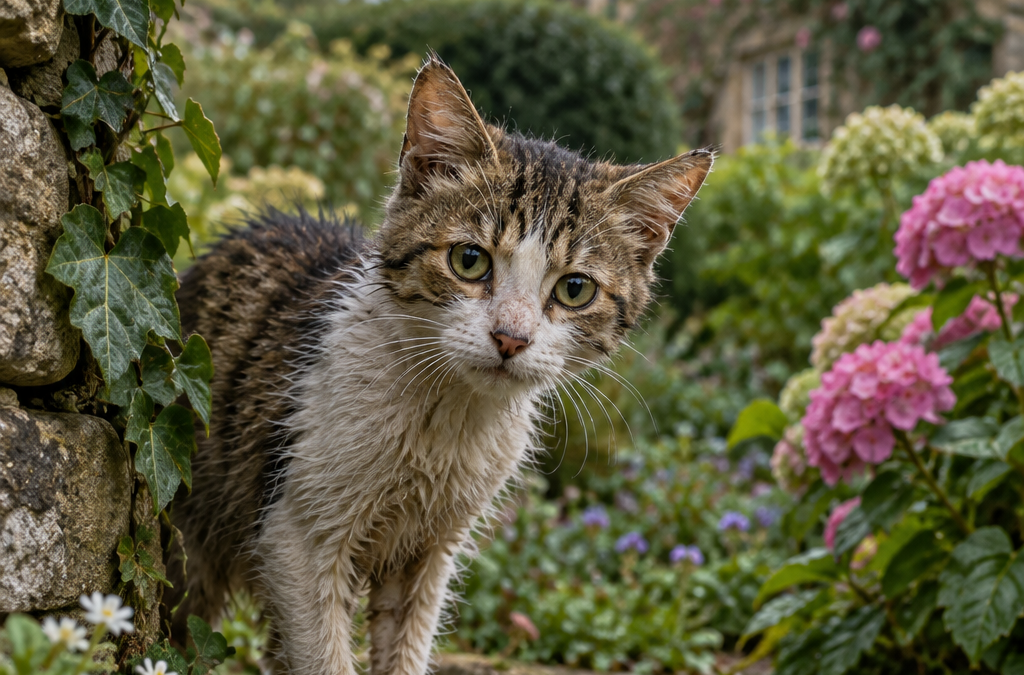
𝗙𝗨𝗟𝗟 𝗦𝗧𝗢𝗥𝗬
I agreed.
Of course he would.
He was probably just late.
But the afternoon passed.
The food remained untouched.
The patch of grass where he liked to sit was empty.
And every time I stepped outside, I felt an odd disappointment that seemed too large for such a small absence.
By evening, I was making excuses for him.
“Maybe someone’s been feeding him somewhere else.”
“Could be,” Mom said.
“Maybe he’s found a nice place to sleep.”
“That’s possible.”
I nodded.
I wanted those explanations to be true.
Before bed, I opened the back door.
The air was cool, and the garden was almost completely dark.
“Boise?”
I waited.
There was only the faint movement of leaves.
“Come on, boy.”
Nothing.
I stood there longer than I needed to.
Finally, I closed the door.
I told myself not to worry.
Cats wandered.
That was what they did.
He’d be back in the morning.
But he wasn’t.
The second day began with the same empty garden.
I checked before breakfast.
Then again afterward.
Every sound from outside made me look toward the window.
A bird moving through the plants.
Leaves rustling against the wall.
The faint scrape of something near the flowerpots.
Each time, I thought it might be him.
Each time, I was disappointed.
I started calling more often.
“Boise!”
My voice carried across the garden.
“Boise, boy! Come on!”
Usually, even when he was hidden, he would emerge after hearing me.
Now there was nothing.
The silence began to feel deliberate, as though the garden itself was refusing to answer.
My mom tried to reassure me.
“He could be perfectly fine.”
“I know.”
“Cats can wander quite far.”
“I know, Mom.”
I heard the sharpness in my own voice and immediately regretted it.
She hadn’t done anything wrong.
She was worried, too.
I could see it in the way she glanced toward the window when she thought I wasn’t looking.
“I’m sorry,” I said.
She shook her head.
“It’s all right.”
Then she looked outside.
“I hope he comes back.”
Those six words frightened me more than any reassurance could have comforted me.
Because my mom wasn’t pretending anymore.
She understood what I was beginning to fear.
Boise might not come back.
I spent much of that day thinking about the last time I’d seen him.
Had he behaved differently?
Had he been slower?
Had he looked tired?
Had I missed something?
I replayed an ordinary afternoon in my head, searching for clues that probably weren’t there.
He’d eaten.
He’d looked at me.
Then he’d wandered away, just as he always did.
I hadn’t known it might be the last time.
That was the thought I couldn’t escape.
How many final moments pass through our lives disguised as ordinary ones?
How often do we say goodbye without realizing we’re doing it?
I kept remembering the way Boise came running when I called.
And now, for the first time, I understood how little power I had to protect him.
I could put out food.
I could offer a gentle voice.
I could make our garden a place where he wasn’t afraid.
But I couldn’t follow him into every dark corner of the world.
I couldn’t stop every car.
I couldn’t know whether he’d found shelter during the night.
And I couldn’t help him if he was hurt somewhere beyond the reach of my voice.
That helplessness settled heavily in my chest.
The third day was worse.
By then, I no longer checked the garden with ordinary curiosity.
I checked it with dread.
I walked slowly around the edges, looking beneath bushes and behind anything that might conceal a small animal.
“Boise?”
I tried to make my voice sound cheerful.
“Come on, handsome. Where are you?”
I crouched near the place where he’d first appeared.
There were leaves on the ground and small gaps between the plants.
I looked into every shadow.
Nothing.
I moved toward the far side of the garden and called again.
“Boise!”
The sound of his name seemed to hang in the air.
I stood listening.
Then I called a little louder.
“Boise, please.”
It was the first time I realized I was pleading.
Not calling.
Not inviting.
Pleading.
I was asking a cat who couldn’t understand the desperation in my voice to come back and prove that he was alive.
My mom came outside.
“Any sign?”
I shook my head.
She stood beside me for a while.
Neither of us spoke.
Finally, she said, “You really love him, don’t you?”
I stared at the empty space near the garden wall.
I wanted to give her some casual answer.
Something light.
Something that would make the situation feel less frightening.
But I couldn’t.
“Yeah,” I said quietly. “I think I do.”
It hurt to admit that.
Not because loving him was something to be ashamed of.
But because saying it aloud made the possibility of losing him feel real.
I had known Boise for such a short part of my life.
I didn’t know where he came from.
I didn’t know what happened to him before he discovered our garden.
I didn’t even know whether he thought of us as anything more than reliable people who brought him food.
Yet his absence had changed the atmosphere of the entire house.
Meals felt strange.
The garden felt too quiet.
Even the ordinary sound of the back door opening seemed incomplete without the possibility of hearing his little footsteps.
That evening, I sat outside longer than usual.
The air had grown chilly.
My mom suggested I come inside.
“In a minute,” I told her.
She didn’t argue.
I sat looking toward the place where Boise usually appeared.
I thought about the first afternoon, when he’d watched us from a distance.
He hadn’t asked for anything.
He’d simply stood there, deciding whether we were worth the risk of approaching.
I wondered whether he’d ever truly known what it felt like to be safe.
And the thought that he might disappear without ever experiencing that feeling broke something inside me.
“Wherever you are,” I whispered, “I hope you’re okay.”
I waited until the light began to fade.
Then I went inside.
That night, I barely slept.
Every time I closed my eyes, I imagined him alone somewhere.
I pictured him frightened beneath a parked car, hiding from the rain, trapped in a place he couldn’t escape.
I knew I was imagining possibilities rather than facts.
But that didn’t make the images any easier to bear.
I kept reminding myself that stray cats were resourceful.
Boise had survived before meeting us.
He knew how to hide.
He knew how to find food.
He knew how to protect himself.
But I also knew how cautious he was.
And I couldn’t stop wondering what had taught him to be that way.
By the time the fourth day arrived, I had begun preparing myself for the possibility that the little cat we’d been feeding might never return.
I hated that thought.
I resisted it.
But it was there.
That afternoon, my mom and I were sitting outside.
We weren’t having any particularly important conversation. I remember the quiet more than anything else.
I had stopped looking toward the garden wall every few seconds.
Not because I’d stopped caring.
Because I was exhausted from hoping.
Then I heard something.
It was so faint that I almost dismissed it.
A small sound somewhere beyond the garden.
A meow.
My entire body went still.
“Mom.”
She looked at me.
“What?”
“Did you hear that?”
“Hear what?”
I held up my hand.
“Wait.”
For a few seconds, there was nothing.
Then it came again.
A little meow.
Distant.
Thin.
But unmistakable.
I stood so quickly that my chair scraped against the ground.
“Boise?”
My voice cracked.
I moved toward the edge of the garden.
“Boise!”
My mom stood up behind me.
We both listened.
And then I saw movement.
A familiar little shape appeared near the plants.
For one impossible moment, I couldn’t make myself believe what I was seeing.
Two ears.
A small face.
Those watchful eyes.
“Boise?”
He looked toward me.
“Boise!”
And there he was.
Walking toward us.
Not with the dramatic urgency I had imagined during three days of fear.
Not stumbling into the garden in some extraordinary scene of rescue.
Just walking toward us the way he always had, as though the last three days had meant nothing at all.
I hurried toward him, then caught myself.
I didn’t want to frighten him.
I dropped to my knees.
“Hey, boy. Hey, sweetheart.”
He kept coming.
“Oh, Boise.”
I was laughing.
At least, I think I was.
There were tears in my eyes, and my voice sounded nothing like normal.
“Where have you been, huh?”
He came closer.
“Where did you go?”
My mom was behind me.
“Oh, thank goodness.”
I held out my hand.
Boise sniffed it.
Then he stepped close enough for me to touch him.
I ran my fingers gently along his back.
He was real.
Warm.
Alive.
I hadn’t realized how much I needed that simple proof until I felt him beneath my hand.
“You scared me,” I whispered.
He looked up at me.
“You really scared me, little man.”
Of course, he had no idea.
He couldn’t know about the sleepless nights, the untouched food, the hours spent searching the garden.
He couldn’t understand that two people had been calling his name into the silence, hoping the world would return him to us.
He’d simply arrived.
And the relief was almost painful.
My mom went to get him some food.
I stayed kneeling beside him, afraid that if I stood up too quickly, he might vanish again.
“Don’t do that to us,” I murmured.
Boise rubbed briefly against my hand.
I froze.
It was such a small gesture.
But after three days of fearing I’d never touch him again, it felt enormous.
“Please,” I added quietly. “Just stay where we can find you.”
He answered with a little meow.
I laughed through the tears.
“Yeah. I know. You’ve got things to do.”
He ate his food while we watched.
I kept glancing at him, almost expecting him to disappear the moment I looked away.
But he stayed.
When he finished, he settled nearby and began washing his face.
I remember sitting on the ground, watching him perform that perfectly ordinary little ritual.
And realizing that I had never been so grateful to see a cat clean his paws.
Later, when my mom and I went inside, I kept thinking about those three days.
We still didn’t know where Boise had gone.
Maybe he’d simply wandered farther than usual.
Maybe he’d found another place to sleep.
Maybe something had frightened him into hiding.
We had no answers.
And that uncertainty made one thing painfully clear.
We couldn’t keep assuming he’d always find somewhere safe.
I wanted to give him something better than a meal and a little affection before he disappeared into the night.
I wanted him to have a place where he could rest.
Somewhere warm.
Somewhere dry.
Somewhere that would still be waiting for him when the weather turned bad.
That evening, I mentioned the idea to my mom.
“I think we should make him a shelter.”
She looked up.
“A shelter?”
“Something small. In the garden. Somewhere he can sleep.”
She considered it.
“That would be nice.”
“I don’t want him lying out there in the cold.”
“Neither do I.”
I glanced through the window.
Boise had returned to his usual spot.
“I don’t know if he’ll use it.”
My mom smiled.
“Well, we won’t know until we try.”
That was enough for me.
I decided to build him a little wooden house.
I didn’t want anything complicated or impressive. I wasn’t trying to create something that would look beautiful in a photograph.
I wanted a sturdy, sheltered place that would protect a small animal from the cold and rain.
So I began working on it.
I remember handling the pieces of wood and thinking about how strange it was that a cat could inspire so much determination without ever asking for anything.
Boise didn’t know I was building something for him.
He didn’t understand why I was checking the size of the entrance or making sure the structure would keep out the weather.
He would never appreciate the work in the way another person might.
And for some reason, that made it feel even more meaningful.
I wasn’t doing it for thanks.
I was doing it because the thought of him cold and alone had become unbearable.
My mom watched part of the process with an amused expression.
“You’re really putting your heart into this.”
I looked at the little structure taking shape.
“He’s worth it.”
She said nothing for a moment.
Then she smiled.
“Yes, he is.”
When it was finished, I placed the shelter in the garden where Boise could find it easily.
It was simple.
A small wooden house, protected from the weather, with a comfortable place inside for him to curl up.
It wasn’t grand.
It didn’t need to be.
I stood back and looked at it.
“There you go, Boise.”
He was nearby, watching me with his usual suspicion.
“Your very own house.”
He didn’t rush toward it.
Of course he didn’t.
That would have been completely unlike him.
Instead, he approached carefully.
He lowered his head and sniffed the entrance.
Then he walked around the outside.
He paused at one corner.
Sniffed again.
Looked at me.
“What?” I asked. “Not good enough?”
He continued his inspection.
My mom laughed.
“He’s making sure it’s up to his standards.”
“Well, he’s got very expensive taste for a cat who showed up without an appointment.”
Boise ignored both of us.
He circled the shelter again, then stood in front of the opening.
For a moment, I thought he might go inside.
Instead, he turned around and walked away.
I stared after him.
“Seriously?”
My mom smiled.
“Give him time.”
I sighed.
“He’s impossible.”
But I wasn’t disappointed for long.
If there was one thing Boise had taught me, it was that his trust couldn’t be rushed.
He needed to investigate.
He needed to decide.
Most importantly, he needed the freedom to say no.
So I left the shelter where it was.
Every day, he came back to the garden.
Every day, I watched to see whether he’d grown more interested in his new house.
Sometimes he sniffed it.
Sometimes he sat beside it.
Occasionally, he put his head inside before backing away again.
I resisted the urge to pick him up and place him in it.
I knew that would defeat the purpose.
The shelter was supposed to give him safety, not become another place where someone forced him to do something he didn’t understand.
Then, one cold evening, I looked outside and saw something that made me stop in the doorway.
Boise was inside.
Curled into a small, peaceful shape.
His body fit neatly within the shelter, and his eyes were half closed.
He looked comfortable.
Not alert.
Not ready to run.
Just comfortable.
I stayed absolutely still.
“Mom,” I whispered.
She came toward me.
“What is it?”
I pointed.
She leaned slightly to see past me.
“Oh, look at him.”
Neither of us spoke for a moment.
We simply watched.
Boise shifted a little, tucked himself more comfortably into his warm space, and settled again.
I felt something loosen in my chest.
He had a place to sleep.
Maybe it wasn’t a real home yet.
Maybe he still spent much of his life beyond our garden.
But that night, I knew he had somewhere dry to curl up.
A place that belonged to him.
And I hoped he understood that no one would chase him out of it.
After that, we found him using the shelter more often.
On chilly evenings, I would look outside and see him resting inside.
Sometimes only his face was visible.
Sometimes he was so deeply curled up that I had to look carefully to make sure he was there.
Each time, I felt the same quiet relief.
I began leaving the house at night with a different feeling.
Instead of staring helplessly into the darkness and wondering where he might be, I could look toward the little wooden shelter and know that he had a safe place waiting.
Not every night was the same.
Boise still came and went on his own terms.
But something had changed.
He had begun accepting the idea that comfort could belong to him.
And watching him learn that made me happier than I knew how to explain.
I thought the shelter would be the biggest step in our relationship.
I thought I understood how far he was willing to let us into his world.
Then one afternoon, he surprised me in a way I will remember for the rest of my life.
It was an ordinary afternoon.
There was no special occasion.
No dramatic change in the weather.
No food waiting in my hands.
I was sitting outside, enjoying a quiet moment, when Boise appeared nearby.
I greeted him the way I always did.
“Hello, handsome.”
He looked at me.
“How’s your day going?”
He walked closer.
I smiled.
“Coming to keep me company?”
He stopped beside my chair.
I expected him to sit near my feet.
That had become one of his habits.
Sometimes he would stretch out on the ground close enough for me to reach down and gently touch him.
Other times he simply sat nearby, content to share the space without physical contact.
That was already more than I had dared hope for when we first met.
But this time, Boise did something different.
He looked at my lap.
Then he looked at me.
And before I fully understood what was happening, he jumped up.
Straight into my lap.
I stopped breathing.
For one stunned second, I couldn’t move.
Boise adjusted his paws, turned slightly, and settled against me as though he had done it a hundred times before.
I stared down at him.
“Boise?”
He looked up.
Then, slowly, he closed his eyes.
And began to purr.
It wasn’t a timid, uncertain sound.
It was a deep, steady purr that I could feel vibrating through his little body.
I sat there completely frozen.
I was almost afraid to blink.
My mind kept telling me to reach down and stroke him, but I couldn’t bring myself to risk startling him.
So I stayed still.
And listened.
The garden seemed to grow quiet around us.
I could hear the faint sounds of the afternoon, the breeze moving through the leaves, the distant noises beyond the house.
But all of it faded beneath that soft, rumbling purr.
Boise had climbed into my lap.
He hadn’t been lured there with food.
I hadn’t picked him up.
I hadn’t called him over or tried to convince him.
He had made the decision himself.
And that was what made it extraordinary.
For so long, every step toward us had seemed to require courage.
Every touch had been a negotiation.
Every moment of closeness had been something he carefully considered before allowing it to happen.
Now he had crossed the distance on his own.
He had chosen to be close.
“Mom,” I whispered.
She was close enough to hear.
“What?”
I didn’t dare turn my head.
“Look.”
She glanced over.
Her expression changed immediately.
“Oh, my goodness.”
“Don’t move too quickly,” I murmured.
She smiled.
“I’m not going to scare him.”
I looked back down.
Boise was still purring.
My mom spoke softly.
“Well, would you look at that?”
I swallowed.
“He just jumped up.”
“I can see that.”
“I didn’t do anything.”
Her smile grew warmer.
“Maybe that’s why.”
I looked at her.
Then I looked at Boise.
And suddenly, I understood.
All those days of giving him room.
All the times I’d allowed him to walk away.
All the meals offered without demanding affection in return.
All the quiet conversations, the gentle movements, the patience.
Maybe they’d mattered more than I realized.
Maybe Boise had been watching us just as carefully as we’d been watching him.
Learning our voices.
Learning our habits.
Discovering that our hands brought food rather than pain.
That a closed door didn’t mean rejection.
That silence could be peaceful.
That he could walk away and still be welcomed back.
And perhaps, on that ordinary afternoon, he’d finally decided he didn’t need to keep his distance anymore.
I lowered my hand very slowly.
“Can I?”
Boise didn’t move.
I stroked his back.
His purr grew louder.
The sound filled me with an emotion so intense that I had to look away for a moment.
I hadn’t expected to cry.
It seemed ridiculous, in a way.
A cat had climbed into my lap.
People experienced that every day.
But they hadn’t watched this particular cat spend weeks learning that the world could be gentle.
They hadn’t seen the way he’d stopped at the garden wall, uncertain whether he dared come closer.
They hadn’t waited three terrible days for him to return.
They hadn’t watched him discover the little shelter we’d made and finally allow himself to sleep there.
I had.
And now he was resting against me as though my lap were the safest place he’d ever found.
“You’re all right,” I whispered.
My voice trembled.
“You’re safe, Boise.”
He purred.
I kept stroking him.
“You don’t have to be scared here.”
I don’t know how long we sat together.
It could have been ten minutes.
It could have been an hour.
Time didn’t seem particularly important.
What mattered was the warm weight in my lap and the trust it represented.
For the first time since Boise arrived, I wasn’t thinking about how to persuade him to come closer.
He was already there.
And the feeling was unlike anything I had expected.
When he eventually shifted his position, I was almost afraid he would jump down and disappear again.
But he simply settled more comfortably.
I laughed quietly.
“Oh, so that’s how it’s going to be?”
He closed his eyes.
“You’ve decided I’m your chair now?”
His purr continued.
“Fair enough.”
My mom shook her head affectionately.
“I think you’ve been adopted.”
I looked down at him.
For once, I didn’t have a clever answer.
Because that was exactly how it felt.
I hadn’t gone looking for a cat.
I hadn’t visited a shelter or made a plan to bring home a new pet.
I’d simply opened my life to a frightened little creature who appeared in our garden.
And now he was sitting in my lap, behaving as though he’d finally reached a decision.
I belonged to him.
And he belonged to me.
After that afternoon, everything began changing.
Boise still enjoyed the garden.
He still wandered among the plants and watched the world with the curiosity that had brought him to us in the first place.
But he no longer seemed content to remain entirely outside our lives.
He became interested in the house.
At first, he approached the back door cautiously.
He would stand near the threshold and look inside, his eyes moving from the floor to the furniture and then back toward the garden.
The first time I noticed him doing it, I smiled.
“Thinking about coming in?”
He looked at me.
“Go on, then.”
He didn’t move.
I stepped aside.
“It’s okay.”
He stretched his neck forward, sniffed the air, and placed one paw across the threshold.
Then he stopped.
I tried not to laugh.
“Very brave.”
He withdrew the paw.
Then tried again.
I could almost see him working through the decision.
Outside was familiar.
Outside was the garden, the plants, the little wooden shelter.
Inside was different.
There were walls.
Rooms.
Unfamiliar smells.
Other cats.
And doors that could close.
For an animal who had spent so much time protecting his freedom to escape, crossing into a house was no small thing.
So I didn’t rush him.
I sat nearby and let him explore at his own pace.
Eventually, Boise stepped inside.
Then he took another step.
He looked around.
His ears moved toward every sound.
He sniffed the floor.
He examined the nearest piece of furniture.
And after only a short while, he turned and went back outside.
I smiled.
“Well, that was a successful first visit.”
Mom laughed from the other room.
“Did he come in?”
“For about thirty seconds.”
“Progress.”
It was progress.
Because the next time, he stayed a little longer.
And the next time after that, longer still.
He began wandering into the house as though he was conducting a careful inspection.
Every room seemed to present a new mystery.
He sniffed corners.
He studied furniture.
He paused at doorways, looking from side to side before continuing.
Sometimes he stood perfectly still in the middle of a room, apparently trying to understand the extraordinary fact that there was a roof over his head.
I found it endlessly entertaining.
“You’re a very serious inspector,” I told him once.
Boise glanced at me and continued walking.
“Do you need me to show you the property documents?”
He ignored me.
My mom laughed.
“He’ll approve it eventually.”
And he did.
Slowly.
At first, he preferred staying close to the back door.
He liked knowing that the garden was nearby.
Then he began venturing farther into the house.
He discovered warm places.
Quiet corners.
Patches of sunlight that moved across the floor as the afternoon passed.
The first time I found him sleeping in a sunny spot indoors, I stopped in the doorway and watched him.
He was stretched out comfortably, his body relaxed, his eyes closed.
Sunlight warmed his fur.
For a moment, he looked completely different from the cat who had first appeared in the garden.
Not because his appearance had changed.
Because the tension seemed to have left him.
He wasn’t watching every movement.
He wasn’t preparing to run.
He was sleeping.
Deeply.
Peacefully.
With the complete confidence of a creature who believed nothing terrible was about to happen.
I felt the familiar ache in my chest.
“Look at you,” I whispered.
One ear moved.
“You’ve got this whole thing figured out.”
He didn’t open his eyes.
I took that as agreement.
From then on, his confidence grew rapidly.
He started following us farther into the house.
If my mom moved from one room to another, Boise would sometimes watch her and then wander after her.
If I sat down somewhere, he might appear nearby a few minutes later.
He seemed increasingly interested in whatever we were doing.
Not because we were always feeding him.
Not because we constantly entertained him.
He simply wanted to be where we were.
That realization changed something in me.
For the longest time, I had worried that Boise came to us only because he was hungry.
And there would have been nothing wrong with that.
A hungry animal deserves food whether or not he offers affection in return.
But watching Boise choose to stay close after he’d eaten made me understand that his attachment had grown beyond survival.
He was seeking company.
Comfort.
Familiarity.
He was choosing us even when he didn’t need anything.
And eventually, he discovered my bedroom.
I remember seeing him standing in the doorway for the first time, looking around as though he’d stumbled across an entirely new territory.
“Well, hello.”
He looked toward me.
“Come to inspect my room?”
He stepped inside.
Sniffed the floor.
Walked along the edge of the bed.
Stopped.
Looked up.
I could almost predict what he was thinking.
“Oh, no,” I said playfully. “Don’t even think about it.”
He jumped onto the bed.
I laughed.
“Of course.”
He walked across the blankets, testing the softness beneath his paws.
Then he turned around.
Once.
Twice.
And settled down.
Just like that.
I stared at him.
“Really?”
He blinked.
“You’re not even going to ask?”
He closed his eyes.
I shook my head.
“All right, then. Make yourself comfortable.”
He did.
Very comfortable.
It wasn’t long before my bed became one of his favorite places.
At first, he’d visit for a little while.
Then he’d stay for longer naps.
Eventually, he began treating it as though it had been made specifically for him.
I would walk into the room and find him stretched across the blankets, perfectly at ease.
Sometimes he’d lift his head when I entered.
Sometimes he wouldn’t even bother.
He had become that confident.
And every time I saw him there, I thought about the little cat who once wouldn’t approach until we stepped away from his food.
The difference was astonishing.
There was no single magical moment when all his fear vanished.
The changes had happened gradually.
A step toward my hand.
A few extra minutes in the garden.
A nap in his wooden shelter.
A jump into my lap.
One paw across the threshold.
And now, this.
A stray cat sleeping in my bed without a care in the world.
I loved him more with every small discovery.
One of my favorite things became watching movies with Boise beside me.
It was never something I’d planned.
I’d settle down in my room, put something on, and before long, he’d appear.
Sometimes he jumped onto the bed immediately.
Other times he wandered around for a while, checking that everything was as he remembered it.
Then he’d settle beside me.
He would stretch out, shift into a comfortable position, and begin purring.
I’d glance down at him while the movie played.
“Comfortable?”
He’d blink slowly.
“Good. Because you look like you’ve had a very difficult day.”
Sometimes he stretched even farther, taking up an impressive amount of space for such a small animal.
I’d move slightly to make room.
Then he’d move again.
“Boise, you’re taking over.”
He never seemed troubled by the accusation.
And I never really minded.
There were evenings when I barely paid attention to the film.
I’d find myself watching him instead.
The slow rise and fall of his breathing.
The way his paws relaxed.
The little movement of his ears when a sudden sound came from the television.
Sometimes he’d fall into such a deep sleep that nothing seemed capable of disturbing him.
And I would sit there thinking about how extraordinary it was that he could feel that safe.
I wondered whether he’d ever slept like that when he lived outside.
Whether he’d ever been able to close his eyes without listening for approaching danger.
Whether anyone had ever offered him a warm place simply because they cared about him.
I didn’t know.
I would never know.
But I knew what he had now.
Warm blankets.
A full stomach.
People who loved him.
And the freedom to relax without constantly preparing for the worst.
One evening, I looked down and found him lying beside me, his head resting against the bedding.
I reached over and stroked him gently.
“You’re not a visitor anymore, are you?”
He opened one eye.
I smiled.
“No. I don’t think you are.”
He purred.
“You’re my cat now.”
The words came out so naturally that they surprised me.
I’d been thinking of him that way for some time, but hearing myself say it made the feeling real.
He wasn’t a stray who happened to visit my mother’s garden.
He wasn’t an animal we occasionally fed.
He was part of our family.
And I couldn’t imagine the house without him.
There was, however, one thing that worried me.
The other cats.
My mom’s house wasn’t new to cats.
There were already feline personalities living there, each with their own habits, favorite places, and opinions about how the household should operate.
Anyone who has spent time around cats knows that introducing a newcomer isn’t always simple.
Some cats are territorial.
Some become jealous.
Others can turn a perfectly peaceful room into a battlefield over a particular chair or a patch of sunlight.
And Boise was still learning to feel secure.
The last thing I wanted was for him to encounter hostility just as he was discovering the comfort of living indoors.
I worried that one frightening confrontation might undo some of the trust he’d worked so hard to develop.
“What if they don’t like him?” I asked my mom.
She glanced toward the room where Boise was resting.
“We’ll have to see how they get along.”
“I don’t want him getting scared.”
“I know.”
“What if there’s fighting?”
She gave me a patient look.
“We can’t decide how they’ll react before they’ve even had a chance.”
I knew she was right.
But I couldn’t help worrying.
I’d watched Boise change from a frightened little visitor into a cat who trusted us enough to sleep beside me.
I didn’t want him to feel like an intruder in the place he’d finally begun calling home.
So I paid close attention as he became more familiar with the other cats.
I expected tension.
A few suspicious looks.
Perhaps some hissing.
At the very least, I expected Boise to become nervous around them.
Instead, he surprised me.
He was remarkably calm.
He didn’t seem interested in starting trouble.
He wasn’t aggressive.
He didn’t march around challenging everyone or trying to dominate the space.
He simply behaved as though he was pleased to be there.
The other cats seemed to accept him with far less drama than I’d imagined.
There were no terrible confrontations.
No constant fights.
No household war over his arrival.
Boise found his place among them with an ease I hadn’t expected.
I remember watching him move comfortably through the house while the other cats went about their lives.
I turned toward my mom.
“Well, that’s a relief.”
She smiled.
“I told you we’d have to see.”
“I was expecting a disaster.”
“Clearly.”
Boise walked past us, completely unconcerned.
I laughed.
“Apparently he’s better at making friends than I am.”
There was something deeply moving about that part of his transformation.
The cat who once seemed afraid of everything had learned to live among people and other animals without constantly expecting conflict.
He wasn’t merely tolerated.
He belonged.
And the house seemed to make room for him as naturally as the garden had.
I often wondered whether Boise understood what had happened to his life.
Could he remember what it felt like to be outside in the cold?
Did he ever think about the places he used to sleep?
Did he know that the people who fed him in the garden were now the people who would make sure he had everything he needed?
Of course, cats don’t understand belonging the way humans describe it.
They don’t think about addresses or ownership or the sentimental meaning of family photographs.
But they understand warmth.
They understand familiar voices.
They understand whether a hand is gentle.
They understand the difference between sleeping with one eye open and sleeping so deeply that the world disappears.
And perhaps that is enough.
Perhaps home is not an idea that needs to be explained.
Perhaps it is something an animal feels in the quiet moments when nothing hurts and no one is chasing him away.
From the day Boise first climbed into my lap, he never spent another night sleeping outside.
I still remember how significant that felt.
The little wooden shelter had been our first attempt to give him somewhere safe.
And I was grateful he’d used it.
But now he had something even better.
He had the house.
He had blankets and warm rooms and places where he could curl up without worrying about the weather.
He had regular meals.
He had companionship.
He had my mom, who spoke to him in that soft voice she used with every animal she loved.
And he had me.
I loved being the person he came to when he wanted affection.
I loved that he recognized my voice.
I loved the way he would settle beside me, sometimes purring before I’d even touched him.
Most of all, I loved that he seemed happy.
Not excited every second.
Not constantly demanding attention.
Simply happy in the quiet, everyday way that matters most.
He could sleep when he was tired.
Eat when he was hungry.
Explore when he was curious.
And approach us whenever he wanted to be close.
He no longer had to earn kindness by staying cautious or making himself small.
He could just be Boise.
Sometimes I would look at him curled on my bed and feel a wave of sadness for the life he might have known before coming to us.
I didn’t know what he’d endured, and I didn’t want to invent a history for him.
But I couldn’t forget the watchfulness in his eyes when we first met.
That wasn’t something I’d imagined.
I’d seen him hesitate at every movement.
I’d watched him approach food as though safety could disappear without warning.
I’d watched him struggle between the desire for affection and the instinct to protect himself.
And now that same cat slept beside me with his paws loose and his body completely relaxed.
I found myself wishing I could somehow reach backward into his past.
Find the frightened version of him before he discovered our garden.
Tell him that one day he would have a bed.
That people would learn his name.
That he would never need to be afraid of asking for warmth.
That one afternoon, he would climb into someone’s lap and discover that he could stay there as long as he wanted.
But life doesn’t allow us to do that.
We can’t undo everything that happened before we arrived.
We can’t guarantee that a frightened animal will forget every difficult experience.
Sometimes all we can do is make the present gentle enough that the past doesn’t have to control every moment of the future.
That became the most meaningful part of loving Boise.
I wasn’t trying to turn him into a different cat.
I didn’t need him to become more affectionate, more playful, or more outgoing to deserve his place in our family.
He had deserved kindness from the very first afternoon, when he stood at the edge of the garden and wasn’t brave enough to come close.
The affection he eventually gave us was beautiful.
But it wasn’t a payment.
It wasn’t something he owed us for feeding him.
It was a gift.
And I never stopped feeling grateful for it.
Our days together settled into a rhythm that now seems almost impossibly precious.
There were mornings when Boise appeared with the casual confidence of someone who knew breakfast would be waiting.
Afternoons when he slept in a warm patch of sunlight.
Evenings when he curled beside me while a movie played.
Moments when I’d call his name and hear the familiar sound of his feet approaching.
He began behaving like every other well-loved cat.
Which was exactly what made me happy.
The extraordinary thing was becoming ordinary.
He no longer needed to overcome fear just to be near us.
He didn’t have to make a difficult decision every time someone offered affection.
He had learned what to expect.
And what he expected was kindness.
Sometimes my mom would look at him and shake her head.
“Can you believe that’s the same little cat?”
I’d glance over.
Boise would be stretched out somewhere comfortable, looking as though the world had been created for his personal convenience.
“Not really,” I’d admit.
“Remember how nervous he was?”
“Yeah.”
“And now look at him.”
I would smile.
“I think he’s forgotten he was ever a stray.”
My mom would laugh.
“Maybe that’s a good thing.”
I think it was.
If forgetting meant he could sleep peacefully, then I hoped the memories of cold nights and uncertain meals grew more distant every day.
I hoped the garden became something different in his mind.
Not just a place where he found food.
But the place where his life began to change.
I sometimes thought about those three days when he disappeared.
The memory never quite left me.
Even after he became an indoor cat, even after he’d settled into the comfort of the house, I could still remember the feeling of standing in the garden and calling his name into the silence.
It had frightened me in a way I couldn’t fully explain at the time.
Now I understood.
I had been afraid of losing him before he knew how much he was loved.
Afraid that he’d disappear believing he was still alone in the world.
Afraid that all the kindness we’d offered would remain unfinished, with no chance to show him what a real home could feel like.
But Boise had come back.
And the life waiting for him had gradually become something neither of us could have imagined during that first uncertain meeting.
I think that’s why the memory of his first jump into my lap remains so clear.
It wasn’t just the beginning of our physical closeness.
It was the moment I understood that he trusted me enough to make himself vulnerable.
There is something incredibly powerful about that.
A frightened animal can’t pretend to feel safe.
Not in the way humans sometimes do.
We can smile while we’re anxious.
We can say we’re fine when we’re falling apart.
We can hide our fear behind polite conversation.
But Boise showed me exactly how he felt.
When he was afraid, he stepped away.
When he was uncertain, he stopped.
When he needed distance, he took it.
And when he finally felt safe enough, he climbed into my lap and closed his eyes.
No explanation.
No promise.
No grand declaration.
Just trust.
I’ve never received a more beautiful compliment.
As time passed, Boise became so completely woven into our family life that I sometimes forgot there had been a time when we didn’t know him.
He had his routines.
His favorite resting places.
His preferred ways of asking for attention.
His own quiet understanding of how the house worked.
My mom knew when he wanted food.
I knew when he was looking for a comfortable place to settle.
And the other cats had accepted his presence as part of their everyday world.
The garden remained familiar to him, but it was no longer the boundary of our relationship.
The back door no longer separated the place where Boise received kindness from the place where our family lived.
He was on the same side of that door as we were.
I wish I could say life stayed exactly that way forever.
But human lives change.
We move.
We take new opportunities.
We build routines in different places, sometimes far from the people and animals we love.
Eventually, I no longer lived at my mom’s house.
And later, whenever I returned to England, I found myself thinking about Boise before almost anything else.
That might sound strange.
Of course I wanted to see my mom.
Of course I looked forward to being back in a familiar place.
But there was something about knowing Boise was waiting there that made every return feel especially meaningful.
He had become part of what home meant to me.
Not because he was mine in the way we sometimes talk about owning pets.
But because we had shared something I couldn’t replace.
We had started as strangers.
He hadn’t trusted me.
I hadn’t known whether he’d stay.
And somehow, through countless ordinary afternoons, we’d become family.
Whenever I came back, I wondered whether he’d recognize me.
I knew cats remembered familiar people, but there was still a little nervousness in me.
What if I’d been gone too long?
What if the bond had faded?
What if he preferred his comfortable routine and barely noticed I’d returned?
The questions were probably silly.
But the first time I came back after being away, I felt a surprising amount of anticipation.
I remember arriving at the house and feeling the strange familiarity of being somewhere that had continued existing without me.
The rooms looked much the same.
My mom was there.
The familiar sounds and smells of home surrounded me.
But I was looking for one particular face.
“Where’s Boise?”
My mom smiled.
“He’s around.”
I set my things down.
“Boise?”
For a moment, I heard nothing.
Then I caught sight of him.
There he was.
My little boy.
No longer a cautious visitor who waited at the edge of the garden.
No longer an uncertain stray who needed several minutes to decide whether a human hand was safe.
He looked toward me when he heard his name.
And then he came running.
Straight to me.
My heart did the same ridiculous thing it had done so many times before.
“Boise!”
I crouched down.
“Hey, sweetheart!”
He came closer, and I reached out to stroke him.
“Oh, I’ve missed you.”
He leaned into the attention.
I laughed.
“Have you missed me?”
He didn’t answer with words.
He didn’t need to.
The familiar closeness was still there.
The trust hadn’t disappeared.
Whatever distance had grown between the places where we lived, it hadn’t erased what we’d built together.
I looked toward my mom.
“He remembers me.”
She smiled.
“Of course he does.”
I looked down at Boise again.
He was perfectly at ease.
I ran my hand gently along his back and felt that old warmth settle in my chest.
It was as though, for a moment, every afternoon we’d spent together had come back.
The meals in the garden.
The cautious approaches.
The little wooden shelter.
The sound of his purring in my lap.
The quiet evenings in my room.
All of it was there in the way he came toward me without hesitation.
I think that’s when I truly understood how much our relationship had changed.
When Boise first appeared, he came to us because he was hungry.
At least, that was what we’d assumed.
Food was the first thing we could offer him, and for a long time, it was the safest way for him to approach us.
But now, when I returned, he didn’t run toward me because I was holding a bowl.
He ran because he recognized me.
Because my voice meant something to him.
Because I was someone he associated with safety, affection, and belonging.
He had chosen me.
And he kept choosing me.
Every time I came back to England, I looked forward to seeing him.
Sometimes I would find him already comfortable in one of his favorite places.
Sometimes I had to call his name.
But he was there.
And when he came toward me, I still felt the same joy I’d experienced the first time he answered my voice from across the garden.
Only now, there was no hesitation.
No careful calculation of the distance.
No long pause while he decided whether he could trust me.
He knew.
There was something quietly miraculous about that certainty.
I often found myself looking at him and wondering whether he understood how much he’d given me.
It was easy to describe what we had given Boise.
Food.
Shelter.
Warmth.
A safe home.
A place among the other cats.
People who cared about him.
Those were visible things.
Things I could point to.
But what Boise gave me was harder to explain.
He changed the way I paid attention.
Before him, I hadn’t fully understood how much meaning could exist in the smallest gestures.
A frightened cat taking one step closer.
An animal choosing to remain nearby after a meal.
A little body finally sleeping without tension.
A paw crossing a doorway.
A warm weight settling into an empty lap.
These weren’t dramatic events.
No one outside our family would have considered them extraordinary.
But to me, they became milestones.
Each one represented a piece of trust that had been offered freely.
And I learned to appreciate them without trying to rush toward the next.
Boise also changed the way I understood patience.
We live in a world where we often expect quick results.
We want frightened animals to become affectionate.
We want relationships to feel close immediately.
We want proof that our kindness is working.
And when that proof doesn’t arrive, it’s easy to become frustrated.
But Boise never responded to what I wanted on my schedule.
He responded when he was ready.
Some days he came closer.
Some days he needed distance.
Sometimes he seemed to take a step forward, only to retreat again when something frightened him.
And I learned that none of those moments meant failure.
They simply meant he was still learning.
I think about that whenever I remember the first afternoon we met.
If I’d chased him, he might have run.
If I’d grabbed him before he trusted me, he might never have come back.
If I’d demanded affection in exchange for food, he might have decided our garden was just another place where humans wanted something from him.
Instead, we let him decide.
We kept showing up.
We kept speaking gently.
We kept making room for him.
And eventually, he made room for us.
I don’t think I will ever forget the contrast between those first cautious steps and the confidence with which he now approaches me.
Sometimes, when I’m visiting my mom, I sit with Boise beside me and remember how frightened he once seemed.
I stroke his back.
He closes his eyes.
And I feel that familiar purr beneath my hand.
“Do you remember?” I sometimes ask him.
He usually doesn’t open his eyes.
“Do you remember when you wouldn’t even come near me?”
His purr continues.
I smile.
“You were such a nervous little thing.”
He stretches comfortably.
“And now look at you.”
Sometimes I laugh at how completely he has taken over our hearts.
A cat who once treated every movement as a possible threat now lives in a house where people rearrange their own comfort to avoid disturbing his sleep.
I move to give him more room.
My mom checks that he has everything he needs.
The other cats share the household with him.
And Boise accepts this life with the quiet confidence of someone who finally understands that he is welcome.
I don’t know whether he remembers being homeless.
I don’t know whether he remembers the three days he disappeared.
I don’t know whether he remembers the afternoon he decided to climb into my lap.
But I remember.
I remember all of it.
And I think I always will.
There is one memory, in particular, that returns whenever I think about him.
It isn’t the moment I built his shelter.
It isn’t the first time I found him asleep on my bed.
And it isn’t even the fourth afternoon when he finally returned after disappearing.
It’s the sound of his purring in my lap.
I can still remember the surprise of feeling his weight settle against me.
The effort it took not to move.
The way my heart seemed to swell when he closed his eyes.
I hadn’t known that something so simple could mean so much.
But to understand that moment, you have to remember the cat he was before it happened.
You have to picture him standing alone in the garden.
Watching.
Hesitating.
Wanting to approach, but afraid of what might happen if he did.
You have to understand how much he protected himself.
How carefully he measured every interaction.
And how slowly he learned that we weren’t going to hurt him.
Then imagine the courage it took for him to climb into my lap without being invited.
To trust that my hands would be gentle.
That I wouldn’t trap him.
That he could close his eyes and nothing bad would happen.
That’s why I cried.
Not because I wanted a cuddly cat and finally got one.
But because a frightened little creature had decided the world was safe enough, at least for a while, to stop being afraid.
I think about how close we came to never knowing him at all.
If my mom hadn’t been outside that first afternoon, we might not have noticed him.
If we’d frightened him away, he might never have returned.
If we’d become impatient because he wouldn’t let us touch him, he might have remained nothing more than a passing visitor.
And if he hadn’t come back after those three terrible days, his story in our lives might have ended as a question we would never answer.
But he did come back.
And we were there.
Sometimes, that’s how love begins.
Not with certainty.
Not with a plan.
But with two lives crossing at exactly the right moment and one of them deciding not to walk away.
Boise needed somewhere safe.
We had a garden, a little food, and enough patience to let him find his way toward us.
It didn’t seem like much at the beginning.
But to him, maybe it was everything.
And to me, eventually, it became one of the most meaningful experiences of my life.
I don’t believe love always needs grand gestures.
Sometimes it looks like putting food down and stepping away so a frightened animal can eat in peace.
Sometimes it means sitting quietly while a cat decides whether he wants to be touched.
Sometimes it means building a small wooden shelter, even though you don’t know whether he’ll ever use it.
Sometimes it means accepting that trust may take longer than you’d hoped.
And sometimes it means simply being there, day after day, until a creature who once expected danger begins to expect kindness instead.
That was the gift Boise gave me.
He showed me what trust looks like when it has been earned rather than demanded.
He showed me that affection means more when someone is free to walk away but chooses to stay.
And he showed me that the greatest changes in a life aren’t always visible from the outside.
To anyone passing our house now, Boise might look like an ordinary family cat.
A comfortable little animal who enjoys sleeping in warm places, eating regular meals, and receiving attention whenever he wants it.
There would be nothing unusual about him.
Nothing to suggest how much courage he once needed just to approach a human voice.
But I know.
My mom knows.
We remember the cat in the garden.
We remember the little figure standing just beyond our reach.
We remember those three days of silence.
And we remember how extraordinary it felt when he finally came home.
The last time I visited, I found myself watching Boise resting comfortably inside the house.
There was something deeply peaceful about the scene.
He had everything he needed.
He wasn’t waiting at the edge of the garden, unsure whether he would be allowed closer.
He wasn’t searching for a dry place to sleep.
He wasn’t a visitor who might vanish without explanation.
He was home.
I sat beside him and gently stroked his back.
He lifted his head, looked at me, and settled again.
“Hello, old friend,” I whispered.
His eyes softened.
I smiled.
“You’ve come a long way, haven’t you?”
He began to purr.
I stayed with him for a while, enjoying the quiet.
I thought about how much had changed since that first afternoon.
My own life had moved forward.
I no longer lived in my mom’s house.
I came and went, returning to England when I could.
But Boise remained there, loved and safe, part of a family that couldn’t imagine life without him.
And every time I came back, I was reminded of a simple truth.
Home isn’t always the place where your story begins.
Sometimes it’s the place where you finally stop running.
I looked down at Boise.
He was completely relaxed, his breathing slow and steady.
For a brief moment, I remembered him as he’d been on the first day.
Small.
Watchful.
Uncertain.
Standing among my mom’s plants, waiting to discover what kind of people we were.
I wished I could tell that frightened little cat what was waiting for him.
That the people in the garden would learn his name.
That they would worry when he disappeared.
That they would build him a shelter and rejoice when he finally slept inside it.
That one day, he would feel brave enough to climb into someone’s lap.
And that from then on, he would have a home where he could sleep every night without fear.
But perhaps he didn’t need those promises back then.
Perhaps he needed exactly what we gave him.
A little food.
A little space.
A little patience.
And the chance to decide for himself.
As I sat beside him, Boise shifted closer to my hand.
It was such a familiar gesture now that I almost didn’t think about it.
Then I remembered how impossible it once seemed.
I kept stroking him.
“You know something?” I said softly.
He purred.
“I think you’re the one who chose us.”
He closed his eyes.
I smiled.
“And I’m so glad you did.”
I used to believe that bringing an animal into your life was mostly about the things you could give them.
A home.
Food.
Protection.
Comfort.
And all those things matter enormously.
But Boise taught me that the relationship doesn’t end there.
When you make room for a vulnerable creature, sometimes that creature finds a way to reach parts of your heart you didn’t even know were waiting.
Boise didn’t rescue me from some dramatic tragedy.
He didn’t perform a heroic act.
He didn’t do anything that would seem extraordinary to someone who didn’t know his story.
He simply trusted me.
And somehow, that was enough to change me.
I became more patient.
More attentive.
More grateful for quiet affection.
I learned to recognize the courage hidden inside small decisions.
And I learned that being chosen by a creature who once feared the world is a privilege I will never take lightly.
I still think about those three days when he was missing.
At the time, I was terrified that I’d never see him again.
But the fear taught me something important.
I hadn’t been waiting for Boise to become my cat.
Somewhere along the way, without realizing it, I had already become his person.
All those meals, all those afternoons, all those gentle conversations had created a bond that didn’t need to be announced.
It was there.
Even before he climbed into my lap.
Even before he stepped inside the house.
Even before he slept on my bed.
He had become someone I looked for.
Someone I worried about.
Someone whose absence could make an entire garden feel empty.
And when he finally returned, I understood that I didn’t want him to face the world alone anymore.
Today, when I return to England, I still call his name.
“Boise!”
And just like he did in the garden all those years ago, he comes toward me.
Only now, he doesn’t stop at a cautious distance.
He doesn’t wait to see whether I’m safe.
He doesn’t need to convince himself that approaching me is worth the risk.
He comes because he knows me.
Because I am familiar.
Because I belong to the small, safe world he has built around himself.
And because, somewhere along the way, he decided that I was his.
Every reunion takes me back to the beginning.
To the afternoon when a frightened stray cat appeared in my mother’s garden.
To the first meal he accepted.
To the first time he let me stroke him.
To the three days when I feared we’d lost him.
To the little wooden shelter.
And finally, to the moment he climbed into my lap and began to purr.
That sound has stayed with me.
Not because it was loud.
But because of everything it meant.
Boise had spent so long approaching life carefully, ready to retreat whenever he felt threatened.
Then one afternoon, he decided to stop keeping his distance.
He chose warmth.
He chose affection.
He chose trust.
And he chose us.
I don’t know what his life was like before we met.
There will always be parts of his story I can never understand.
But I know how it changed.
I know that the frightened cat who once waited outside now sleeps peacefully inside a loving home.
I know that he has people who recognize his voice, understand his habits, and make sure he never has to wonder where his next meal will come from.
I know that he is safe.
And I know that when I walk through my mother’s door and call his name, he still comes running.
For me, that is the happiest ending I could ever have hoped for.
Not because Boise became a different cat.
But because he finally had the freedom to be himself without fear.
He no longer has to search for a place where he belongs.
He found one.
And even though I live somewhere else now, a part of my heart will always remain in that house in England, with the little cat who once stood at the edge of a garden and wondered whether it was safe to come closer.
Because the truth is, I thought we were teaching Boise how to trust people.
But he was teaching me something just as important.
He was showing me that love doesn’t have to arrive all at once.
Sometimes it approaches slowly.
Sometimes it hesitates.
Sometimes it disappears for a while and leaves you frightened by how much its absence hurts.
But when it finally feels safe enough to stay, it can become one of the most beautiful things in your life.
And whenever I feel the familiar warmth of Boise curled beside me, I remember that our whole story began with a frightened little cat making one small decision.
He heard my voice.
He looked toward me.
And instead of running away, he took a step closer.
That was all it took to begin.
Today, he has a home.
He has a family.
He has a bed, warm blankets, and more love than he could ever understand.
And whenever I come back, he still has me.
But the part that moves me most is knowing that I have him, too.
Because I didn’t just give Boise somewhere to belong.
Somewhere in the quiet space between his first uncertain steps and that unforgettable afternoon in my lap, he gave me something I hadn’t known I needed.
The extraordinary feeling of being trusted completely.
And every time he runs toward me, I know that the little stray who once stood alone in my mother’s garden is no longer looking for someone to save him.
He’s already home.