𝗙𝗨𝗟𝗟 𝗦𝗧𝗢𝗥𝗬 I Was Terrified of the Cat I Had Promised Never to Abandon
𝗙𝗨𝗟𝗟 𝗦𝗧𝗢𝗥𝗬
Sometimes I sat nearby while drinking my coffee.
I talked about ordinary things because I didn’t know what else to do.
I’d tell her what I was planning that day or mention the weather outside.
Sometimes I laughed at myself.
“Well, I hope you’re enjoying our conversations, because right now they’re pretty one-sided.”
I never expected her to understand the words.
I simply wanted her to become familiar with my voice.
And I wanted her to hear it without immediately associating it with someone trying to catch her.
There were moments when I wondered whether I was doing anything useful at all.
But then I would remind myself that Barbara had gone from a quiet home with one person she trusted to an animal shelter, then into rescue care, and finally into another unfamiliar house.
People had been making decisions about her life for weeks.
She hadn’t chosen any of it.
She hadn’t chosen to lose her owner.
She hadn’t chosen to leave her home.
And she certainly hadn’t chosen to become a cat who was terrified of human contact.
The least I could do was allow her to make a few decisions for herself.
Even if the first decision she made was to stay as far away from me as possible.
I wish I could say that understanding this made the next few weeks easy.
It didn’t.
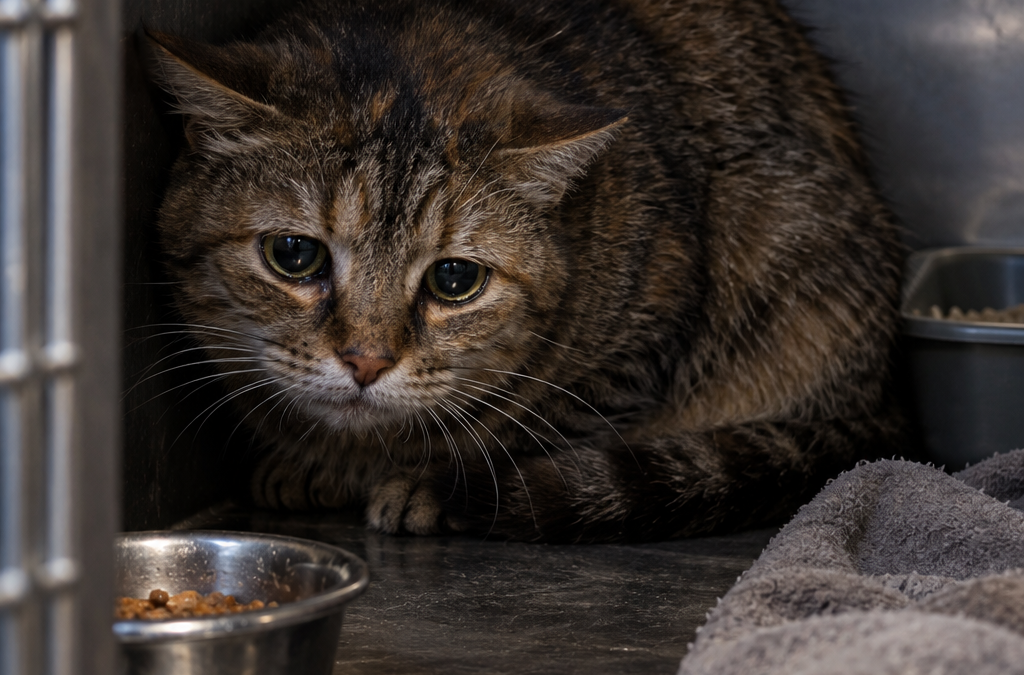
Once Barbara began spending more time outside her hiding place, an entirely different problem appeared.
She was afraid of me.
And because she was afraid of me, she could be aggressive.
I learned very quickly that she didn’t want me reaching toward her.
If I moved too close, her body would tense.
Her eyes would fix on me.
Sometimes she’d hiss.
Other times, I barely had a warning before she lunged.
The first time she came after me, I was genuinely shocked.
One moment, I was trying to move through the room.
The next, Barbara was coming toward my legs with an intensity that made me jump backward.
“Barbara! Hey! It’s okay!”
My voice came out louder than I intended.
That only made the situation worse.
I backed away, trying not to frighten her further while also trying to protect myself.
She wasn’t a large animal, but anyone who has been attacked by an angry, frightened cat knows that size means very little when sharp claws are involved.
I could feel my heart pounding.
Eventually, she retreated.
I stood there, looking down at my legs, trying to understand what had just happened.
For the first time, I wondered whether I had made a terrible mistake.
It wasn’t that I stopped caring about her.
It was that I suddenly understood how difficult our life together might become.
I had brought home a cat I couldn’t touch.
A cat who didn’t want to be near me.
A cat who sometimes seemed to regard my presence as a threat she needed to eliminate.
And I had no idea how long that might last.
There were days when simply walking through a room required caution.
I learned to watch her body language.
I learned that a certain look meant I should stop moving closer.
I learned that trying to reassure her with my hands was often the worst possible choice.
And I learned that fear in an animal doesn’t always look like trembling or hiding.
Sometimes it looks like anger.
Sometimes it looks like sharp claws and flattened ears.
Sometimes it looks like a cat chasing you across a room because she believes getting you away from her is the only way to protect herself.
There were moments when Barbara chased me so aggressively that I had to retreat.
I was scared.
I can admit that now.
At the time, I felt almost embarrassed by it.
I had adopted this cat because I wanted to help her, and now I was nervous about moving around my own home.
There is something strange about being afraid of a creature you desperately want to comfort.
I’d look at Barbara and see a frightened animal.
Then she’d charge toward me, and my instinct would be to get away.
Those two feelings existed together.
Compassion and fear.
I knew she was suffering.
But I also knew her claws could hurt me.
Eventually, I started wearing knee-high boots around the house.
That was how serious things became.
I’d pull them on before moving through areas where she might approach me.
They protected my legs, but they also reminded me how far we were from the peaceful relationship I had imagined.
Sometimes I caught sight of myself wearing those boots indoors and thought, What exactly have I gotten myself into?
I would have laughed if the situation hadn’t felt so sad.
Here I was, dressed as though I needed protection from an animal who weighed only a fraction of what I did.
And somewhere nearby was Barbara, acting as though she needed protection from me.
Neither of us felt safe around the other.
That was the hardest part.
I wasn’t just trying to earn her affection.
I was trying to establish something far more basic.
I wanted us to be able to exist in the same room without fear.
One afternoon, after another frightening encounter, I sat alone and thought about what someone else might have done.
They might have called the rescue and said it wasn’t working.
They might have decided Barbara was simply too aggressive.
They might have concluded that the shelter had been right about her.
I couldn’t pretend those thoughts never crossed my mind.
When you’re frightened in your own home, it’s natural to wonder whether the situation can continue.
But every time I considered what giving up would mean, I thought about the life Barbara had before everything fell apart.
I pictured her previous owner arriving home and finding her waiting.
I thought about the simple, ordinary love that must have existed between them.
And I imagined how terrifying it would be to wake up in a different world, surrounded by people who expected you to behave as though nothing had happened.
Barbara hadn’t been given time to understand her loss.
She’d been moved from place to place, handled by strangers, and judged according to how well she tolerated circumstances she had never experienced before.
Now she was in my home.
And I was asking her to trust me.
Why should she?
From Barbara’s perspective, I was another stranger.
Another unfamiliar voice.
Another person who had control over where she lived and what happened to her.
She didn’t know I had adopted her because I wanted to give her a permanent home.
She didn’t know I had no intention of abandoning her.
All she knew was that the person she loved had vanished and the world had become unpredictable.
One evening, I sat a comfortable distance from her and spoke quietly.
“Barbara, I know you don’t like me very much right now.”
She watched me without moving.
“That’s okay. You don’t have to.”
I looked down at my hands.
“I wish I could explain everything to you.”
Her eyes stayed fixed on me.
“I wish I could tell you what happened to him. I wish I could tell you that you didn’t do anything wrong.”
I swallowed.
“But I can’t.”
For a moment, the house was completely silent.
Then I said something I hadn’t fully understood until that moment.
“I think you’ve had enough people disappear.”
My voice caught.
“So I’m going to stay.”
I didn’t know whether she understood anything I was saying.
Probably not in the way a person would.
But saying it mattered to me.
It changed the way I approached our life together.
I stopped measuring progress by whether she would let me pet her.
I stopped imagining that every day needed to bring some dramatic breakthrough.
Instead, I focused on making our home predictable.
Food appeared regularly.
Water was always available.
Her hiding places remained hers.
When she retreated, I let her retreat.
When she warned me to stay away, I listened.
And when she was willing to be in the same space as me, I tried not to turn that into an opportunity to demand more.
There were times when I desperately wanted to reach down and touch her.
I’d see her sitting somewhere nearby and think how easy it would be to extend my hand.
Maybe, I told myself, she was finally ready.
But then I would look at the tension in her body and realize I was thinking about what I wanted.
Not what she needed.
That distinction became the center of everything.
I had always associated caring for animals with physical affection.
Holding them.
Petting them.
Comforting them with touch.
Barbara didn’t want those things.
At least, not from me.
Not yet.
And maybe she never would.
I had to consider that possibility.
What if Barbara spent the rest of her life allowing me to feed her and care for her but never letting me touch her?
What if she always needed more distance than other cats?
What if the relationship I’d hoped for simply wasn’t possible?
Those questions were uncomfortable.
But eventually, I realized that adopting Barbara meant accepting her as she was, not as I hoped she might become.
She didn’t owe me affection because I had saved her.
She didn’t owe me gratitude because I had given her a home.
And she certainly didn’t owe me trust simply because I had decided I was trustworthy.
Trust wasn’t something I could demand.
It was something she had to discover for herself.
So we continued.
Days passed.
Then weeks.
Barbara emerged from her hiding place more often, but I still couldn’t touch her.
She continued to be defensive when she felt cornered or threatened.
Sometimes our progress seemed so small that I questioned whether I was imagining it.
But there were little changes.
She became more familiar with the sounds of the house.
She seemed to understand where she could find food and where she could hide.
She began appearing while I was awake, even if she preferred to keep her distance.
I celebrated those things privately.
If she sat in the same room without trying to chase me away, I considered it a good day.
If she watched me pass without reacting, I felt encouraged.
And if she chose to remain visible instead of disappearing immediately, I tried not to disturb her.
I wanted her to learn that nothing terrible followed from simply being near me.
Still, I had no indication that she would ever become affectionate.
There were no tentative head bumps.
No curious sniffs of my fingers.
No soft purring as I walked past.
She wasn’t warming up in the way people usually describe when talking about a shy rescue cat.
She was tolerating my existence.
And even that required patience.
By the time we’d been together for approximately a month, I had settled into the idea that Barbara would need a very long time.
I wasn’t counting down the days anymore.
I wasn’t waiting for a magical moment.
I simply continued caring for her, doing my best to make sure she had what she needed.
Then one night, everything changed.
It was around three in the morning.
I was asleep when something woke me.
At first, I didn’t understand what I was hearing.
The room was dark and quiet, and for a few seconds, I lay still, trying to identify the sound.
It was soft.
Steady.
Almost like a faint vibration.
I opened my eyes.
And there was Barbara.
She was sitting right beside me.
For a moment, I genuinely thought I was dreaming.
The cat who had spent weeks hiding beneath my closet was now close enough for me to see her face in the darkness.
I didn’t move.
I barely breathed.
Then I heard the sound again.
She was purring.
Barbara was purring.
I had heard cats purr countless times in my life, but that sound was different because of everything that had happened before it.
For weeks, the sounds I associated with Barbara had been hissing, sudden movement, and the sharp warning noises she made when she wanted me to stay away.
Now she was sitting beside my face, making a sound I had almost stopped hoping I would hear.
Her purr was so close that I could feel its vibration near my ear.
I remember thinking, Don’t move. Whatever you do, don’t scare her.
My heart was pounding.
I wanted to reach out.
I wanted to stroke her head.
I wanted to tell her how happy I was that she had come to me.
But I stayed still.
Because for the first time since she arrived, Barbara had made the decision to approach me.
There had been no coaxing.
No reaching into a hiding place.
No attempt to pick her up.
She had simply come to me because she wanted to.
And I wasn’t going to ruin it by asking for more.
Then something extraordinary happened.
Barbara leaned forward.
Slowly, gently, she pressed her face against my chin.
It was the smallest gesture.
A soft nuzzle.
The kind of thing a comfortable, affectionate cat might do dozens of times in an ordinary day.
But Barbara had never done anything like that with me.
Not once.
And in that moment, I felt as though the entire weight of the previous month had settled into one tiny movement.
I could feel her warmth against my skin.
I could hear her purring beside my ear.
And I understood that something had shifted.
“Hi, Barbara,” I whispered.
My voice was barely audible.
She didn’t run.
I felt my eyes filling with tears.
“Oh, sweetheart.”
She stayed close.
I didn’t try to hold her.
I didn’t try to make the moment last longer than she wanted.
I just lay there, letting her decide what happened next.
There are moments in life that don’t look particularly extraordinary from the outside.
No one else was there.
Nothing dramatic happened.
There were no witnesses, no celebration, no sudden transformation visible to anyone but me.
It was just a woman lying awake in the darkness and a frightened cat choosing to come close.
But I have never forgotten it.
Because for the first time, Barbara wasn’t approaching me to defend herself.
She wasn’t trying to drive me away.
She wasn’t hiding.
She was seeking closeness.
She had decided that being near me felt better than being alone.
I wondered whether she had been watching me for weeks, quietly learning who I was.
Maybe all those nights when I thought nothing was changing, she had been paying attention.
Maybe she had noticed that I didn’t follow her when she retreated.
Maybe she had learned that the food would always be there, that the house would remain calm, and that my voice didn’t mean danger.
I couldn’t know.
But I knew this wasn’t something I had forced.
She had come on her own.
And that made it more meaningful than anything I could have persuaded her to do.
I thought about the man she’d lost.
I thought about the love she had known before she entered the shelter.
And I wondered how frightening it must have been for her to consider trusting another person.
Loving someone had once meant security.
Then, without any warning she could understand, that security disappeared.
I imagined that opening herself to another attachment might have felt like stepping into danger.
Maybe that was why she had spent so long pushing me away.
Maybe distance had been the only way she knew to protect herself.
And now, in the middle of the night, she was taking a chance.
I wanted to tell her that I understood what she was offering.
I wanted to promise that she would never experience that kind of loss again.
But I couldn’t make that promise.
None of us can.
Life doesn’t allow us to guarantee that the people we love will always be there.
What I could promise was something smaller and more honest.
I could be there now.
I could give her a peaceful home.
I could respect her fear and never punish her for it.
And I could love her without demanding that she forget the person who had loved her first.
As she rested close to me, I whispered, “You can stay as long as you want.”
It was a simple sentence.
But it was everything I had wanted her to understand since the day she arrived.
That night wasn’t the moment I made Barbara trust me.
It was the moment I realized she finally had.
And once she made that decision, the change was astonishing.
The cat who had hidden beneath my closet floorboards became a cat who wanted to be with me constantly.
I couldn’t believe how quickly her behavior toward me changed after that first affectionate encounter.
It was almost as though she’d spent the previous month keeping a door firmly closed and had finally decided to open it.
And when she opened it, she didn’t do anything halfway.
Barbara began following me around the house.
If I walked into another room, she wanted to know where I was going.
If I sat down, she wanted to be nearby.
If I settled in to work, she appeared beside me as though she had appointed herself my personal supervisor.
At first, I was so delighted that I welcomed every bit of attention.
After weeks of wondering whether she would ever tolerate me, I suddenly had a cat who seemed offended whenever I wasn’t paying attention to her.
I remember sitting down with my phone one day and noticing her staring at me.
She had that focused expression cats sometimes get when they’re waiting for a human to do something obvious.
“What?” I asked her.
She continued staring.
“What do you want, Barbara?”
She moved closer.
I looked back at my phone.
A moment later, there she was again, demanding my attention without saying a word.
I laughed.
“Oh, I’m sorry. Am I interrupting our quality time?”
Sometimes I imagined her saying, Put that thing down. You have a cat.
And honestly, it felt like a reasonable translation of her expression.
The transformation was almost absurd.
A few weeks earlier, I had been protecting my legs with tall boots.
Now I was discovering that Barbara had very little respect for personal space.
If I was sitting somewhere comfortable, she wanted to press herself against me.
If I was trying to work, she wanted to be involved.
If I moved, she followed.
She seemed to believe that being in the same house wasn’t close enough.
She wanted to be touching me.
Constantly.
Sometimes she’d curl against my body with such determination that I found myself adjusting whatever I was doing to make room for her.
“Barbara, sweetheart, I do need to move occasionally.”
She would look at me.
I would look back.
And more often than not, I would remain where I was a little longer.
It was hard not to.
I remembered the cat who had disappeared beneath the floorboards.
I remembered the fear in her eyes whenever I approached.
And now here she was, pressing against me as if there were no safer place in the entire world.
There were moments when her affection became almost comical.
I couldn’t sit down without her wanting to join me.
I couldn’t spend too much time concentrating on something else without feeling that familiar gaze.
Sometimes I joked that Barbara didn’t actually want to live beside me.
She wanted to become part of me.
As if she could somehow attach herself to my body and never have to worry about being separated again.
But beneath the humor, there was always something that touched me deeply.
Barbara didn’t love casually.
She didn’t spread her affection equally among everyone she met.
When she trusted someone, she committed herself completely.
I began to understand that this hadn’t changed about her.
It had probably always been who she was.
The difference was that for most of her life, the person she had chosen had been someone else.
And losing him had nearly destroyed her ability to feel safe.
At some point after Barbara settled into our life together, I learned something about her previous owner that made me see their relationship even more clearly.
I heard from one of his former coworkers.
The coworker told me that Barbara’s owner had kept pictures of her all over his cubicle.
Not just a single photograph tucked into a corner.
He had pictures of Barbara everywhere.
He was completely devoted to her.
When I heard that, I felt a rush of emotion I hadn’t expected.
It was such a small detail, but it made him real to me in a new way.
Until then, I had known him mostly through the tragedy of his death and the impact it had on Barbara.
He was the man she had lost.
The man she had been found beside.
The person whose absence seemed to explain so much of her fear.
But hearing about those photographs helped me imagine the life they had shared before everything went wrong.
I pictured him at work, surrounded by images of the cat waiting for him at home.
Maybe his coworkers teased him affectionately about how many pictures he had.
Maybe he talked about her constantly.
Maybe whenever someone asked how he was doing, he found a way to mention Barbara.
I didn’t know those details, and I didn’t need to.
The pictures told me enough.
She hadn’t simply been an animal who happened to live in his house.
She had been his family.
And he had been hers.
That realization made me think differently about her first weeks with me.
When Barbara hid beneath my closet, I had initially interpreted it as fear of a new environment.
That was certainly part of it.
But there was more to her story than unfamiliar surroundings.
She had once known a person whose presence meant everything to her.
Someone who probably understood her habits and accepted her personality without expecting her to become a different cat.
Someone who knew how she liked to be touched.
Someone who recognized her moods.
Someone who had shared ordinary days with her for years.
Then he was gone.
And because Barbara was a cat, the people around her judged the aftermath largely through her behavior.
She hissed.
She scratched.
She wouldn’t allow herself to be handled.
She was aggressive.
She was unadoptable.
Those descriptions told people what she was doing.
They didn’t explain what she’d experienced.
I thought about that often.
How easily we can mistake an animal’s defense for its entire personality.
How quickly fear can become a label.
And how dangerous those labels can be when an animal’s life depends on them.
I don’t blame people for being frightened of a cat who attacks.
I was frightened of Barbara myself.
I know what it feels like to have an animal charge toward you when you’re simply trying to walk across a room.
Fear is real, and people need to be safe.
But Barbara taught me that understanding why an animal behaves a certain way is just as important as acknowledging the behavior itself.
She wasn’t a bad cat who suddenly became good.
She was a frightened cat who eventually felt safe enough to reveal a different side of herself.
And that side was more loving than I could ever have imagined.
Sometimes, when she was lying against me, I thought about how narrowly she’d escaped death.
If Beth hadn’t heard about her, Barbara might never have left the shelter.
If nobody had been willing to give her time, the only story anyone would have remembered might have been about a cat who couldn’t be handled.
They wouldn’t have known what I knew.
They wouldn’t have heard her purr beside their ear in the middle of the night.
They wouldn’t have felt her press her face against their chin.
They wouldn’t have discovered that beneath all that fear was an animal capable of astonishing devotion.
And they would never have seen her become the companion she is today.
That thought still makes my heart ache.
Because I know Barbara isn’t the only animal whose behavior changes when the world stops feeling safe.
There are animals who lose their owners.
Animals who are surrendered after living in the same home for years.
Animals who become frightened in shelters and react in ways that make people believe they’re impossible to help.
Some need specialized behavioral support. Some need more space, particular environments, or careful management. Not every animal’s situation resolves the way Barbara’s did.
But her story reminds me how incomplete a judgment can be when it’s made without understanding what happened before the behavior began.
Barbara wasn’t a blank slate when she came to me.
She had a history.
She had attachments.
She had known love, and she had experienced a devastating loss.
She brought all of that into my house.
And I had to learn to make room for it.
One of the most important lessons she taught me was how often humans confuse affection with permission.
We see an animal we love, and we want to touch it.
We want to pick it up.
We want to hold it close and tell it that everything is going to be okay.
Those impulses come from a good place.
But an animal doesn’t necessarily experience them the way we intend.
When I first brought Barbara home, I wanted to comfort her.
I thought that if I could only pet her gently, she might understand how much I cared.
But Barbara didn’t want my hands near her.
The comfort I was trying to give would have felt like another threat.
She needed something else.
Distance.
Predictability.
The freedom to retreat.
And the opportunity to discover that I would respect her boundaries.
It sounds simple now.
At the time, it was one of the hardest things I’d ever had to practice.
Because doing nothing can feel like failing when you desperately want to help.
There were days when I wanted visible proof that my efforts mattered.
I wanted progress I could measure.
I wanted to look at Barbara and know that she understood I loved her.
Instead, I had to accept uncertainty.
I had to keep showing up without knowing whether she would ever respond.
And looking back, I think that was what made our eventual bond so powerful.
Barbara didn’t come to me because I had cornered her into accepting affection.
She came because she no longer felt the need to protect herself from me.
That difference meant everything.
As our relationship grew, I began noticing more of her personality.
She could be demanding.
She could be stubborn.
She had an incredible ability to make her preferences known without making much noise.
And she could turn an ordinary moment into something tender simply by choosing to be near me.
Working at home became a shared activity.
I’d settle down to concentrate, and Barbara would appear.
Sometimes she’d sit quietly nearby.
Other times, she wanted a better position, preferably one that involved contact with me.
“Are you helping?” I’d ask her.
She’d stare.
“Because I’m pretty sure this is taking longer with you here.”
But I never meant it as a complaint.
I loved having her beside me.
Her presence became part of the rhythm of my days.
The way she appeared when I sat down.
The way she followed me from room to room.
The way she’d curl against me when the house was quiet.
I had once watched the doorway, wondering whether she’d come out of hiding.
Now I found myself looking down to make sure she wasn’t following too closely as I walked.
It was hard to believe she was the same animal.
But she was.
And I never wanted to forget that.
Her affection wasn’t evidence that her earlier fear had been imaginary.
It was evidence that fear could change when the circumstances around it changed.
Over time, Barbara became more comfortable in the world.
Not with everyone.
That distinction is important.
She didn’t suddenly transform into a cat who welcomed every visitor.
She didn’t become the kind of animal who would happily move from one person’s lap to another.
Even after all these years, she remains selective about whom she trusts.
She has learned to tolerate a few other people.
She’s more relaxed than she was when she first arrived.
She’s no longer living in that constant state of fear I saw during our first month together.
But there’s still only one person she truly allows to touch her.
Me.
And I accept that.
Sometimes people assume that because an animal is affectionate with one person, it should be affectionate with everyone.
They see Barbara curled against me and naturally want to experience that same closeness.
I understand the impulse.
She’s a beautiful companion when she feels safe.
But I don’t try to make her prove her progress by allowing other people to handle her.
She has nothing to prove.
Her ability to tolerate someone else’s presence is already meaningful.
And if she prefers not to be touched, that’s her decision.
I think about how much our relationship changed once I stopped trying to make her comfortable according to my expectations.
I had to learn her language.
Not just the sounds she made, but the things she communicated through movement and distance.
A tense body meant something.
A hiss meant something.
Walking away meant something.
And eventually, approaching me and pressing her face against mine meant something entirely different.
Barbara was communicating from the very beginning.
I simply needed to stop expecting her to communicate in the ways that were easiest for me to understand.
That lesson followed me beyond our relationship.
Rescuing animals has become an important part of my life, and Barbara has been part of that journey.
Together, we’ve helped approximately fifty animals find new homes.
Fifty.
Sometimes I stop and think about that number.
Fifty animals who needed another chance.
Fifty lives that, in one way or another, crossed our path before moving toward a different future.
Not all of them had stories like Barbara’s.
Every rescue comes with its own needs and circumstances.
But my experience with her changed the way I thought about the animals I was trying to help.
I became more aware of how much can be hidden beneath a frightened reaction.
How important it is to give an animal a chance to settle.
And how easy it can be to misinterpret behavior when we don’t know what an animal has experienced.
Barbara was never the kind of cat who wanted to be friends with every new animal or person involved in my rescue work.
That wasn’t her role.
Her contribution was quieter.
She was my companion through that work.
The familiar presence waiting when I came home.
The cat who insisted that no matter how much attention the rest of the world required, she was still entitled to some of mine.
Sometimes, after a demanding day, I would sit down feeling emotionally exhausted.
Rescue work can be beautiful, but it can also be heartbreaking.
You see animals who have lost their homes.
You see fear and uncertainty.
You meet creatures who have been through things they cannot explain.
And you encounter situations where wanting to help doesn’t automatically mean you know what to do.
Those experiences can stay with you.
There have been evenings when I couldn’t stop thinking about an animal who needed a chance.
I’d sit quietly, carrying the emotional weight of the day.
And Barbara would appear.
She didn’t know what had happened.
She didn’t know how many decisions I had made or what worries were occupying my thoughts.
She simply knew I was there.
And she wanted to be near me.
Sometimes she’d settle against my side.
Sometimes she’d press herself so close that I had to make room for her.
And sometimes, when I was particularly overwhelmed, I would look down at her and remember exactly why second chances mattered.
Because she was living proof of what one could mean.
Not every animal will respond the same way.
Not every frightened cat will become as affectionate as Barbara.
But sometimes an animal who has been dismissed as impossible simply hasn’t found an environment where it can feel secure.
Barbara taught me never to forget that possibility.
She also taught me something about patience that I had never fully understood.
People often describe patience as waiting.
But patience with a frightened animal is much more active than that.
It’s choosing not to reach out when every part of you wants to offer comfort.
It’s watching body language instead of assuming you know what an animal needs.
It’s accepting setbacks without turning them into blame.
It’s providing consistency even when you receive no visible affection in return.
And sometimes, it’s putting on knee-high boots because you know the animal you’re trying to help is still frightened enough to hurt you.
I can laugh about those boots now.
There was nothing funny about them at the time.
But occasionally, when Barbara is lying against me and purring as though we’ve always been inseparable, I remember how I once had to protect my legs just to walk through the room.
I look at her and say, “Do you remember how you used to chase me?”
She blinks at me.
“You were terrifying, you know.”
Of course, she doesn’t answer.
She usually just continues doing whatever she’s doing, completely unconcerned by my recollections of our difficult beginning.
And I find myself smiling.
Because the same cat who once made me afraid to approach her now seems to believe my primary purpose in life is to provide her with constant affection.
Sometimes I wonder what her previous owner would think if he could see her now.
That question brings up complicated feelings.
I’m grateful that Barbara loves me.
I’m grateful that she trusted me enough to let me become part of her world.
But I never think of myself as having replaced the man who loved her first.
He wasn’t replaceable.
Their relationship was its own chapter of her life, and it mattered.
He gave her years of love and security.
He was the person who made her feel safe before I ever knew she existed.
And if I could tell him anything, I think I’d want him to know that she wasn’t forgotten.
That after he died, and after everything went wrong, someone found a way to give her another home.
I’d want him to know that the frightened cat who ended up on a euthanasia list wasn’t defined by those terrible weeks.
That she still had the capacity to trust.
That she still knew how to love.
And that whatever happened during those seven days when she remained beside him, it hadn’t erased the part of her that had been so deeply connected to another living being.
I wish I could tell him that.
Sometimes I look at Barbara curled against me and imagine how much he must have loved seeing her happy.
I think about all those photographs in his cubicle.
The ordinary pride he must have felt in his cat.
The way he had made her a visible part of his life even when he was away at work.
And I feel an unexpected connection to someone I never met.
Because I understand him now.
I understand wanting to talk about Barbara.
I understand wanting to show people her picture.
I understand thinking she’s the most extraordinary cat in the world even though, to anyone else, she might simply look like a beloved household pet.
There is something special about being chosen by an animal who doesn’t trust easily.
You don’t take that choice lightly.
You understand that their affection is not something you can assume will be given to everyone.
It’s a relationship built on a particular history.
And Barbara has made me feel the weight of that trust every single day.
She’s eleven years old now.
It’s strange to say that.
Eleven.
She’s becoming a senior cat, and I find myself paying attention to things I didn’t think about as much when she was younger.
I notice how much time has passed.
I notice how our routines have become second nature.
I think about the years we’ve shared, and sometimes I feel that familiar ache that comes with loving an animal whose life moves through time differently from our own.
I don’t want to spend her senior years worrying about the future.
I want to enjoy the fact that she’s here.
That she’s safe.
That she wakes up in a home where she knows the person who cares for her.
That she no longer has to hide beneath the floorboards to feel protected.
But being aware of her age has made me even more grateful for our ordinary days.
I appreciate the sound of her paws moving through the house.
The way she follows me when I get up.
The familiar weight of her body when she settles against me.
Her expression when she decides I’ve been paying attention to my phone for far too long.
The soft rumble of her purring when she’s comfortable.
These aren’t dramatic moments.
They’re not the kind of things that would necessarily mean anything to a stranger.
But they mean everything to me.
Because I remember what it was like when I couldn’t touch her.
I remember sitting outside my closet, speaking gently into the darkness.
I remember being relieved simply because she’d eaten something during the night.
I remember feeling frightened when she came toward me.
And I remember that first moment at three in the morning when she leaned forward and touched her face to my chin.
Every ordinary expression of affection carries a little of that history.
Sometimes I wonder what my life would have been like if I hadn’t applied to adopt her.
If I had read her story and decided I wasn’t equipped for the challenge.
If Beth hadn’t been able to rescue her.
If the shelter’s judgment had become the final decision about her future.
It’s difficult to imagine.
Because Barbara is so much a part of my life now that I can barely remember what the house felt like without her.
I can remember the events, of course.
I remember living alone with my routines before she became part of them.
But emotionally, that life feels distant.
Barbara has worked her way into everything.
She is there when I’m working.
She’s there when I’m resting.
She’s there when I’m distracted, when I’m tired, when I’m trying to accomplish something and she decides that affection is more important.
She’s there during the quiet moments when nothing particularly interesting is happening.
And those are the moments I love most.
Sometimes I sit with her and think about how much trust is contained in the simple act of sleeping beside someone.
An animal who is asleep is vulnerable.
It isn’t watching every movement or preparing to defend itself.
It’s allowing the world around it to continue without constant vigilance.
For Barbara, who once seemed frightened by my every approach, that kind of relaxation is something I never take for granted.
When she curls against me and closes her eyes, I feel a tenderness that’s difficult to describe.
It’s as though she’s telling me, without words, “I don’t have to worry right now.”
And after everything she has experienced, that is enough.
People sometimes ask whether Barbara is still aggressive.
I tell them the truth.
She’s much more relaxed now, and she’s learned to tolerate a few other people.
But she’s still Barbara.
She still has strong preferences.
She still doesn’t want everyone touching her.
And I don’t expect her to become a completely different animal just to make other people comfortable.
She has found a way to feel safe and affectionate with me.
That is a tremendous achievement for a cat who was once terrified of human contact.
It doesn’t have to look impressive to anyone else.
I know what it took.
I was there for the hiding.
I was there for the fear.
I was there for the nights when she would only come out after the house was silent.
And I was there when she finally decided she could come close.
Occasionally, I think about the word that was used to describe her before she was rescued.
Unadoptable.
It seems almost impossible to connect that word with the cat who now insists on being near me every chance she gets.
But I don’t think the word was wrong simply because Barbara eventually became affectionate.
I think it was wrong because it treated her behavior during a period of extreme distress as the final measure of who she was.
It left no room for her history.
No room for adjustment.
No room for trust to develop.
And no room for the possibility that her behavior might look completely different in the right environment.
Barbara hadn’t forgotten how to love.
She had lost the person she loved, and the world had become frightening.
I couldn’t bring that person back.
I couldn’t explain his death to her.
And I couldn’t erase the confusion of everything that happened afterward.
But I could give her a life where she didn’t have to keep losing the things that made her feel secure.
I could offer consistency.
I could respect her boundaries.
And I could let her discover affection again without trying to force it.
That’s what finally changed our relationship.
Not a particular training technique.
Not a dramatic confrontation.
Not some moment when I proved that I was stronger or more determined than she was.
I simply stopped treating affection as something that needed to happen on my schedule.
And Barbara eventually decided she was ready.
There is one memory I return to whenever I feel impatient with an animal who needs time.
I see myself sitting on the floor outside my closet.
I remember speaking softly toward the space beneath the floorboards.
I remember the silence.
And I remember wondering whether the frightened cat hiding there would ever feel comfortable enough to walk toward me.
At that point, I had no reason to believe she would one day become so attached that I could barely sit down without her climbing against me.
I didn’t know how loving she could be.
I didn’t know how much she would change my life.
All I knew was that I had made a commitment to her.
And that the commitment had to mean something even when she couldn’t give me anything in return.
I think that’s one of the most important things Barbara taught me about love.
We often think of love in terms of what we receive.
Affection.
Companionship.
The comfort of knowing someone wants to be near us.
And those things are wonderful.
I treasure every one of them with Barbara.
But the earliest part of our relationship was built on something quieter.
It was built on caring for her while she wanted nothing to do with me.
It was built on accepting that my kindness might not be recognized immediately.
It was built on giving her what she needed even when it wasn’t what I had imagined giving.
I had to love her before she could trust that love.
And I had to be willing to continue even if she never responded the way I hoped.
That experience changed me.
It made me more patient.
It made me pay attention to boundaries in a way I hadn’t before.
And it reminded me that healing doesn’t always arrive in obvious stages.
Sometimes, from the outside, it looks like nothing is happening.
A frightened animal hides.
Days pass.
The animal remains cautious.
More days pass.
There is no dramatic evidence of progress.
But beneath the surface, something may be changing.
The environment is becoming familiar.
The person providing care is becoming predictable.
The animal is learning that a certain voice doesn’t mean danger.
And one day, perhaps unexpectedly, it takes a step it couldn’t take before.
For Barbara, that step was coming to my bed at three in the morning.
For me, it was learning to remain still and let her come closer.
I think about that night whenever she presses her face against mine now.
The gesture has become familiar.
Something she does because she feels comfortable and affectionate.
But I still remember how extraordinary it felt the first time.
There was a whole month of fear behind that single movement.
A whole history of love and loss.
A shelter that had decided she had no future.
A rescue that had given her another chance.
And a frightened cat who had spent weeks trying to figure out whether I was someone she could trust.
All of it seemed to come together in that moment.
Sometimes, late at night, she still wakes me with her closeness.
I might feel her settle beside me or hear that familiar purr.
And even when I’m tired, even when I would normally prefer to sleep uninterrupted, I find it difficult to feel annoyed.
Because there was a time when the idea of Barbara voluntarily coming near my face seemed impossible.
There was a time when I would have given anything for her to feel comfortable enough to sit beside me.
Now she does it because being near me is part of her idea of home.
And I can’t forget what that means.
One night, as she rested against me, I found myself thinking again about the man who had loved her first.
For a moment, the sadness of her story returned with unexpected force.
I imagined the warmth of the life they had shared.
Then I thought about the week she spent beside him after he died.
The shelter.
The fear.
The possibility that her story might have ended before anyone discovered what was hidden beneath her defenses.
I looked down at Barbara, peaceful and trusting against me.
And I felt both grief and gratitude.
Grief for what she’d lost.
Gratitude for what she’d found again.
I gently spoke her name.
“Barbara.”
Her purring continued.
“You know you’re safe, don’t you?”
She shifted closer.
I smiled through tears I hadn’t expected.
“I hope you know that.”
Of course, I can’t know exactly what she understands.
I can’t know whether she remembers her previous home the way people remember places they’ve loved.
I can’t know whether some part of her still searches for the man who raised her.
I don’t know if she ever stopped missing him.
And I don’t think I need to know.
Her past will always be part of her story.
I have never wanted to erase it.
If anything, understanding how deeply she once loved someone else has made me appreciate her affection even more.
Because Barbara didn’t come into my life without a history.
She arrived carrying the aftermath of an attachment that had meant everything to her.
And somehow, over time, she found the courage to form another.
I don’t see that as forgetting.
I see it as surviving.
She had room in her heart for love again.
Even after the pain of losing it.
Even after all the fear that followed.
Sometimes people use the phrase “second chance” as though it’s something simple.
An animal is rescued.
It goes to a new home.
Everything is better.
But Barbara taught me that a second chance is rarely a single event.
Beth gave her a second chance when she pulled her from the shelter.
I gave her another opportunity when I brought her home.
But Barbara had to live through the difficult days that followed.
She had to learn the new sounds, the new smells, and the new routines.
She had to discover that I wasn’t going to disappear simply because she refused my affection.
And eventually, she had to decide whether she could trust me.
Her second chance wasn’t completed on the day she was adopted.
It unfolded slowly, during all those ordinary days when nothing looked particularly remarkable.
I think that’s why I feel such a deep responsibility toward the animals whose lives intersect with mine.
I know that bringing an animal to safety is only the beginning.
The rest is learning who they are.
Listening to what they need.
And being willing to adjust our expectations when those needs don’t match what we imagined.
Barbara didn’t need me to turn her into a perfect cat.
She needed a home where she was allowed to be herself.
Even when being herself meant hiding.
Even when it meant being frightened.
Even when it meant keeping her distance.
And when she finally felt safe enough to show affection, there was so much of it that I sometimes wondered how she’d managed to keep it hidden for so long.
I used to think about all the time we’d lost during those first weeks.
The time we could have spent cuddling.
The time I could have spent holding her.
The quiet moments I wanted but couldn’t have.
Now I see those weeks differently.
They weren’t wasted.
They were part of our relationship.
Every time I respected her decision to move away, I was showing her something about me.
Every time I provided food without demanding affection, I was giving her one more predictable experience.
Every time I allowed her to hide instead of forcing her into contact, I was giving her a small measure of control over her world.
I didn’t recognize the significance of those things at first.
I was too focused on the absence of affection.
But the absence of visible progress didn’t mean our relationship wasn’t developing.
It meant that Barbara was learning at her own pace.
And I was learning how to let her.
There are still moments when I wish she could understand everything I want to say to her.
I wish I could explain that the man who loved her first must have been so proud of her.
I wish I could tell her that the way she survived those terrible changes matters to me.
I wish I could reassure her about every uncertainty in the future.
But I can’t.
So I rely on the things I know she can experience.
A familiar voice.
A peaceful room.
A consistent routine.
The freedom to move away.
And the warmth of someone who respects her choice to come close.
Sometimes I think that’s enough.
Maybe it has to be.
Barbara is eleven now, and I know that the years ahead will bring changes neither of us can stop.
I can’t hold time still.
I can’t guarantee that every day will be easy.
But I can make sure that the life she has now is full of the security she once lost.
I can love her as she is.
And I can be grateful for every ordinary morning when I wake up and find her nearby.
I don’t know how many more animals will come through my rescue work or how many more lives I’ll have the opportunity to help change.
But I know that Barbara will always be the one who taught me to look beneath the behavior.
To see fear without immediately judging it.
To understand that trust can’t be hurried.
And to remember that the animals who seem hardest to love may sometimes be the ones who have lost the most.
When I look at her now, I don’t see an unadoptable cat.
I see a companion who has shared years of my life.
I see the little shadow who follows me around the house.
I see the determined face that appears whenever I spend too much time looking at my phone.
I see the cat who insists on being close enough to touch me almost every waking moment.
And sometimes, when she’s pressed so tightly against me that I can barely move, I find myself laughing.
“Barbara, you know you don’t actually have to be attached to me, right?”
She just settles in more comfortably.
“You’re not going anywhere, are you?”
Of course she isn’t.
Not if she can help it.
And I don’t mind.
Because I know how much it means that she wants to stay close.
I know what it took for her to make that choice.
I know how far she’s come from the terrified animal who disappeared beneath my closet floorboards.
And I know that beneath her demanding affection is a cat who once had every reason to believe the world wasn’t safe.
She found a way to trust again.
I will never take that lightly.
Sometimes, in the middle of the night, I wake to the soft vibration of her purring beside my ear.
The room is dark.
The house is quiet.
And Barbara is exactly where she wants to be.
Close enough that I can feel her warmth.
Close enough that, if she chooses, she can press her face against mine.
I always think back to that first night.
The moment I opened my eyes and found her beside me.
The moment I realized that the cat I’d been afraid of had finally stopped being afraid of me.
All those weeks of uncertainty seem so distant now.
Yet I can still remember the feeling of lying completely still because I was terrified that one wrong movement might frighten her away.
These days, she doesn’t disappear when I move.
She doesn’t run beneath the floorboards.
She simply adjusts her position and settles against me again.
As though it has always been this way.
As though she has always belonged here.
And maybe that’s the most beautiful part of her story.
Not that she became affectionate.
Not that she proved the shelter wrong.
Not even that she survived when her future once seemed so uncertain.
It’s that, after everything she lost, Barbara found a way to feel at home again.
I didn’t give her back the life she had with her first owner.
Nobody could have done that.
I gave her a different life.
One where she could be frightened without being rejected.
One where she could take as much time as she needed.
One where she didn’t have to earn love by behaving perfectly.
And eventually, she decided that this new life was safe enough to trust.
She chose me.
Just as she had once chosen him.
And in doing so, she changed my understanding of what it means to rescue an animal.
I used to think I was the one who would teach Barbara how to live in a loving home again.
Instead, she taught me how to love without demanding anything in return.
She taught me that safety has to be felt, not simply provided.
That boundaries are not rejection.
That patience isn’t passive.
And that sometimes the deepest expression of compassion is allowing someone to come toward you in their own time.
The shelter had once seen a cat who couldn’t be handled and decided she had no future.
But that wasn’t the end of Barbara’s story.
It was only the worst chapter.
Today, she has a home.
She has routines she recognizes.
She has the freedom to choose when she wants affection and when she needs space.
She has become my constant companion and an irreplaceable part of my life.
And through the rescue work we’ve shared, her story has continued to remind me why so many animals deserve to be seen as more than their most frightened moments.
Most importantly, Barbara is loved.
Not because she’s easy.
Not because she’s perfect.
And not because she became the affectionate cat I once hoped she might be.
She’s loved because she’s Barbara.
The same strong-willed, deeply devoted cat who once gave her whole heart to a man who adored her.
The same frightened animal who survived losing him.
The same cat who nearly lost her life because nobody believed she could learn to trust again.
And the same little creature who, one quiet night at three in the morning, climbed beside me and pressed her face against my chin.
I remember whispering her name that night, afraid to break the fragile silence between us.
Now I say it dozens of times a day.
Sometimes with affection.
Sometimes with amusement.
Sometimes because she’s sitting somewhere inconvenient and I need her to move.
And sometimes simply because I love the fact that she’s here to hear it.
“Barbara.”
She looks at me.
I smile.
“Come here, sweetheart.”
And she comes.
Not because she has to.
Not because I’ve taught her to obey.
But because she wants to.
Because after everything she survived, she finally believes that coming close doesn’t have to mean getting hurt.
I reach toward her gently, and she leans into my hand.
Her eyes soften.
Her purring begins.
And for a moment, I think about the woman I was when I first brought her home.
The woman standing in knee-high boots, frightened and uncertain, wondering whether she’d ever be able to touch the cat she’d promised to protect.
I wish I could tell that version of myself what was waiting on the other side of those difficult weeks.
I wish I could tell her that one day Barbara would follow her everywhere.
That she would become almost unbelievably affectionate.
That she’d be the familiar warmth beside her during quiet evenings and the insistent little presence demanding attention during busy afternoons.
I wish I could tell her that the cat hiding beneath the floorboards would become one of the deepest attachments of her life.
But perhaps it’s better that I didn’t know.
Because I needed to learn how to love Barbara before I knew what she would give me in return.
That was the lesson.
That was what changed everything.
And after all these years, when Barbara curls against me and purrs herself to sleep, I no longer wonder whether she knows she’s safe.
I can see it in the way she rests.
I can feel it in the way she leans against me.
And I hear it in that familiar sound beside my ear.
The cat everyone once called unadoptable didn’t need to become someone else to deserve a home.
She needed someone who understood that her fear was not the whole of who she was.
Someone willing to give her space.
Someone willing to stay.
And when Barbara finally felt safe enough to open her heart, she gave me something more precious than anything I’d ever hoped for.
She trusted me.
She gave me her companionship.
And just as she’d once done with the man who loved her first, she gave me her whole heart.
Tonight, when I turn off the lights, I know she’ll find her way to me.
Maybe she’ll curl up beside me.
Maybe she’ll settle near my pillow.
Maybe I’ll wake in the dark and feel her gently press her face against mine.
And if I do, I’ll smile, close my eyes, and let her stay as close as she wants.
Because once, Barbara spent an entire week beside the person she’d lost, unable to understand why he would never hold her again.
After that, she spent weeks hiding from the next person who wanted to love her.
But those days are behind her now.
She doesn’t have to hide.
She doesn’t have to fight.
And she doesn’t have to wonder whether she’s welcome.
She’s home.
And for as long as I have the privilege of caring for her, I’ll make sure she knows it.
Every single day.