𝗙𝗨𝗟𝗟 𝗦𝗧𝗢𝗥𝗬 I Was Only Helping an 88-Year-Old Veteran When His Beautiful but Ruthless Neighbor Decided to Make My Life a Living Hell
𝗣𝗔𝗥𝗧 𝟮
“Saying the grass is too tall. They want it cut.”
“How long have they been sending those?”
“A little while.”
He stared toward the street.
“They say if I don’t take care of it, they’ll start fining me.”
I knew those notices could become expensive.
For someone on a fixed income, even a relatively small fine could create a serious problem.
“Can you hire someone?”
He shook his head.
“Not really.”
He said it without self-pity.
That was what struck me.
He wasn’t asking for money.
He wasn’t fishing for sympathy.
He was simply explaining a situation he couldn’t solve.
“I’ve been thinking about what to do,” he added. “Just haven’t figured it out yet.”
I looked at the lawn.
Then at his cane.
Then back at him.
“I’ll take care of it.”
He turned.
“What?”
“Your lawn.”
He stared at me.
“I’ll mow it.”
He immediately shook his head.
“Oh, no. I couldn’t ask you to do that.”
“You’re not asking.”
“Son, you’ve already helped me enough today.”
“I’ve got a mower. I’ve got a free afternoon. And honestly, I don’t mind yard work.”
He looked skeptical.
“You don’t mind mowing grass?”
I smiled.
“It’s kind of therapeutic.”
He gave a quiet laugh.
“Well, that’s one way to describe it.”
I leaned forward.
“Look, I can come over every couple of weeks. Mow the front, mow the back, trim around the edges. Just enough to keep the city off your back.”
He studied my face.
“I can’t pay you.”
“I didn’t ask you to.”
“I don’t want to be a burden.”
“You’re not.”
He looked toward the yard again.
For several seconds, he didn’t speak.
Then he nodded.
“All right.”
His voice was quieter now.
“If you’re sure.”
“I’m sure.”
He reached out his hand.
I shook it.
His grip was weaker than mine, but surprisingly firm for a man his age.
“Thank you, son.”
I smiled.
“You’re welcome.”
When I walked home that afternoon, I felt good.
Not proud of myself in some dramatic way.
Just good.
I’d helped somebody who needed help.
That was all.
I didn’t know the woman next door had already noticed me.
And I certainly didn’t know she would eventually turn that simple act of kindness into a confrontation involving police officers, criminal charges, and a shattered car window.
The first few weeks were wonderful.
I began visiting the veteran roughly every other week.
Usually, I’d come by in the afternoon with my push mower, a trimmer, and a few basic gardening tools.
I’d start with the front lawn.
Then work around the side of the house.
After that, I’d mow the backyard, trim the edges, pull weeds, and clean up anything that needed attention.
It usually took less than an hour.
Sometimes a little longer if the bushes needed trimming.
The work was ordinary.
Nothing complicated.
But the difference it made was remarkable.
After the first mowing, the house looked almost transformed.
The walkway was visible again.
The driveway edges were clean.
The grass was even.
The flower beds weren’t perfect, but they no longer looked abandoned.
When the veteran stepped outside to see the finished yard, he stood silently for a while.
Then he removed his cap.
“Well, I’ll be.”
I smiled.
“Looks better, doesn’t it?”
He nodded slowly.
“Sure does.”
He walked a few steps down the porch, supporting himself with his cane.
Then he stopped beside the railing.
“My wife would have liked that.”
I looked at him.
He kept staring at the yard.
“She always wanted things looking nice.”
I didn’t know what to say.
So I simply nodded.
We developed a routine.
While I worked, he often came outside and sat on the porch.
Sometimes he watched quietly.
Sometimes he’d tell me stories when I stopped for water.
He told me about jumping from military aircraft, about the first car he bought after leaving the service, and about the factory where he’d spent so much of his working life.
He talked about his wife frequently.
Not in a way that suggested he was trapped in the past.
More like he had spent so many years sharing his life with her that it felt natural to include her in every story.
One afternoon, he told me she’d once planted an entire row of flowers without telling him.
“She said she wanted to surprise me.”
“Did it work?”
“Oh, it surprised me, all right. She dug straight through the line for the backyard lights.”
I laughed.
“What happened?”
“I spent the next Saturday fixing it.”
He smiled.
“She brought me lemonade the whole time and told me what a wonderful husband I was.”
“Sounds like she knew how to handle you.”
He chuckled.
“Better than anybody.”
Those conversations became something I looked forward to.
I’d arrive thinking about mowing grass.
I’d leave having heard another piece of a long and interesting life.
My wife noticed how much I enjoyed visiting him.
One evening, I came home and told her another story about his military days.
She listened while preparing dinner.
Then she smiled.
“You’ve made yourself a friend.”
I shrugged.
“He’s a good guy.”
“I can tell.”
“He doesn’t ask for anything.”
“Sometimes those are the people who need help the most.”
I thought about that.
She was right.
The veteran had spent a lifetime working, providing, and taking care of things.
Accepting assistance didn’t come naturally to him.
But gradually, he seemed to become more comfortable with me being there.
He stopped apologizing every time I started the mower.
He began saving a glass of cold water for me.
And once, when I arrived a little later than usual, he was already sitting on the porch.
“Thought maybe you forgot about me.”
I smiled.
“Not a chance.”
He laughed.
“Good. Because the grass doesn’t seem interested in waiting.”
Everything might have continued peacefully if not for the woman living directly next door.
Karen.
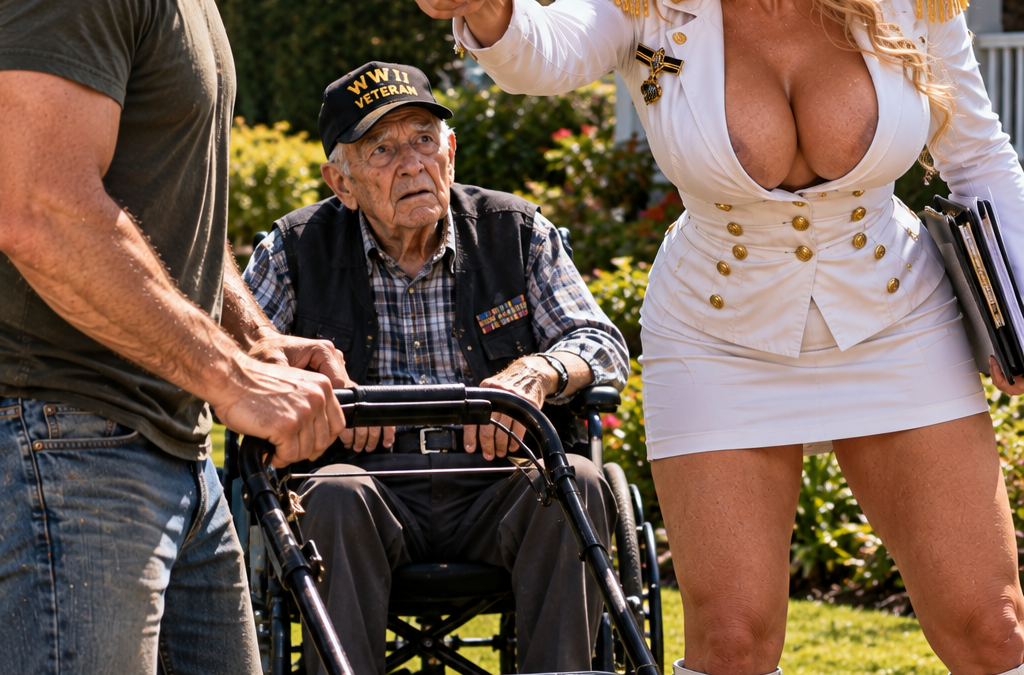
She was about forty years old, a striking blonde with a carefully maintained figure, bright blue eyes, full lips, and the kind of confident, flirtatious manner that made it obvious she enjoyed being noticed.
She was undeniably beautiful.
That was probably the first thing most people noticed about her.
But the longer you spent around her, the less her appearance mattered.
Karen had a way of looking at people that made even an ordinary conversation feel like an interrogation.
She liked to stand with her shoulders back and her chin raised, as though every sidewalk, driveway, and front lawn in the neighborhood existed under her personal supervision.
Her favorite clothing made that impression even stronger.
She often wore a fitted white military-style uniform with decorative gold buttons, a tightly tailored waist, and a deep neckline that emphasized her unusually large bust.
The outfits looked more theatrical than official, but she wore them with complete seriousness.
Sometimes she added a white belt and high heels.
Other times, she wore polished white boots.
I never learned whether she had any genuine military background.
Nothing about our interactions suggested she held any public authority.
But she certainly behaved as though she did.
Her house was immaculate.
The grass was cut to a precise height.
The bushes looked as though they had been measured with a ruler.
Decorative stones lined the flower beds in perfectly even rows.
There was nothing wrong with taking pride in a home.
The problem was that Karen seemed to believe everyone else’s property should meet her personal expectations, too.
I first noticed her watching me during my third or fourth visit.
I was mowing along the side of the veteran’s house when I looked up and saw her standing behind the fence.
She wasn’t doing anything.
Just watching.
Her arms were crossed.
Her face was expressionless.
I gave her a polite nod.
The kind you give a neighbor when you make eye contact.
She didn’t nod back.
She didn’t smile.
She simply stared.
For a moment, I wondered whether I’d accidentally blown grass clippings onto her property.
I checked the mower.
Everything looked fine.
So I went back to work.
When I glanced over again a few minutes later, she was still there.
Watching.
It was uncomfortable.
But I told myself not to make anything of it.
People have strange habits.
Maybe she was curious.
Maybe she didn’t like the sound of the mower.
Maybe she was simply having a bad day.
I finished the lawn and left.
The next visit, she spoke to me.
I was pushing the mower along the side yard when I saw Karen watering flowers near the fence.
She wore one of her fitted white outfits, the tailored jacket open enough to reveal a low-cut blouse beneath.
Her blonde hair was perfectly styled despite the warm weather.
She held a garden hose in one hand.
As I approached, she turned off the water.
“Excuse me.”
I stopped the mower.
“Yes?”
She looked me up and down.
“Do you know you’re not supposed to be doing that?”
I glanced at the mower.
“Doing what?”
She gave a small, impatient sigh.
“Working on someone else’s property without a permit.”
I stared at her.
“A permit?”
“Yes.”
“For mowing grass?”
She tilted her head.
“Are you being deliberately difficult?”
“No. I’m genuinely asking.”
She stepped closer to the fence.
“You cannot simply show up at somebody’s house and start performing work.”
“I’m helping the homeowner.”
“That doesn’t matter.”
“It seems pretty relevant.”
Her eyes narrowed.
“Listen, sweetheart, there are rules in this neighborhood.”
The way she said sweetheart made it sound more like an insult than affection.
I kept my voice calm.
“I’m mowing his lawn for free. He’s eighty-eight years old, and he asked me to help.”
She shrugged.
“I don’t care whether you’re getting paid.”
“Okay.”
“Unauthorized work creates problems.”
“What problems?”
She looked briefly annoyed by the question.
“Liability. Noise. Property standards. All kinds of problems.”
I glanced toward the veteran’s porch.
He was sitting in his usual chair.
Then I looked back at Karen.
“Well, the homeowner invited me, so I think we’re fine.”
She lifted her chin.
“That doesn’t mean you can ignore neighborhood regulations.”
I resisted the urge to laugh.
“Karen, I’m not building a shopping mall. I’m cutting grass.”
Her expression hardened.
“You have a very disrespectful attitude.”
I looked at the mower.
Then at the lawn.
Then back at her.
“I’ve got work to finish.”
I started the mower.
Karen stepped back with an offended expression.
As I moved away, I could still feel her watching.
That encounter bothered me more than I wanted to admit.
It wasn’t what she’d said about permits.
It was the tone.
The implication that she somehow had the authority to decide whether I could help an elderly man maintain his own yard.
When I finished, I sat on the veteran’s porch with a glass of water.
He looked toward Karen’s house.
“I saw her talking to you.”
I nodded.
“Yeah.”
“What’d she want?”
“Apparently, I’m supposed to have a permit to mow your lawn.”
He stared at me.
Then he laughed.
A deep, surprised laugh that ended in a cough.
“A permit?”
“That’s what she said.”
He shook his head.
“That woman.”
I leaned back in the chair.
“Does she give you trouble?”
His smile faded.
He looked toward the fence.
“Since the day I moved in.”
I waited.
He sighed.
“She complains about everything.”
“Like what?”
“My fence is too tall. My trash cans are in the wrong place. My porch light is too bright.”
He paused.
“Once she complained that my dog barked too much.”
I looked toward the empty yard.
“You have a dog?”
He shook his head.
“Never had one since my wife passed.”
I stared at him.
Then we both started laughing.
But when the laughter faded, I noticed something.
His expression had become tired.
“She just likes finding something wrong,” he said.
I looked toward Karen’s perfectly maintained yard.
“Sounds exhausting.”
He nodded.
“At my age, I don’t have much energy left for arguments.”
There was no anger in his voice.
Just resignation.
And that bothered me.
This man had survived military service, worked for decades, raised children, lost the woman he loved, and spent his old age trying to remain independent.
Now he was dealing with a neighbor who apparently enjoyed inventing problems.
I looked at him.
“Don’t worry about her.”
He gave a small smile.
“That’s what I try to do.”
I stood up.
“Same time in two weeks?”
He nodded.
“I’ll have your water ready.”
I smiled.
“Then it’s a deal.”
I thought that was the end of the matter.
It wasn’t.
Karen’s behavior became increasingly aggressive over the following weeks.
At first, it was mostly staring.
Whenever I arrived, she’d find some reason to come outside.
Sometimes she’d pretend to inspect her flower beds.
Sometimes she’d stand near the fence holding her phone.
Other times she’d simply watch from her porch.
I tried ignoring her.
That seemed like the easiest solution.
But Karen didn’t want to be ignored.
She wanted a confrontation.
One afternoon, while I was trimming grass near the veteran’s driveway, she came outside and stood behind the fence.
“You’re making a lot of noise.”
I switched off the trimmer.
“Excuse me?”
“The noise.”
She gestured toward the equipment.
“Some of us enjoy peace and quiet.”
I glanced at my watch.
It was early afternoon.
“Karen, I’m almost finished.”
“That’s what you said last time.”
“I didn’t say anything last time.”
She smiled thinly.
“Don’t get clever with me.”
I took a breath.
“I’m using ordinary lawn equipment during the day.”
“That doesn’t make it acceptable.”
“People mow their lawns all over this neighborhood.”
“Not everybody is as inconsiderate as you.”
I looked toward the veteran’s house.
“He’s received city notices about the grass. I’m helping him avoid fines.”
Karen crossed her arms.
“Then perhaps he should hire a professional.”
“He can’t afford one.”
“That’s not my problem.”
The words came out so casually that I almost didn’t believe I’d heard them.
I stared at her.
“He’s eighty-eight.”
“And?”
“He lives alone.”
“And?”
“He served this country.”
Karen rolled her eyes.
“That doesn’t make him exempt from standards.”
I felt my anger rise.
“No one said it did.”
“Then stop making excuses.”
I looked at her for a long moment.
Then I picked up the trimmer.
“I’m finishing the yard.”
She stepped closer.
“You haven’t heard the last of this.”
I didn’t respond.
I started the trimmer again.
But her words stayed with me.
The next time I visited, the veteran looked unusually troubled.
He was sitting on the porch when I arrived.
Normally, he’d greet me with a smile and a joke.
That afternoon, he barely looked up.
I leaned the mower against the porch railing.
“Everything okay?”
He nodded too quickly.
“Fine.”
I waited.
He stared at the yard.
Then sighed.
“That woman came over.”
I felt my stomach tighten.
“Karen?”
He nodded.
“What happened?”
“She knocked on the door yesterday.”
I sat beside him.
He rubbed one hand over the top of his cane.
“Said I shouldn’t let strangers onto my property.”
I stared at him.
“Strangers?”
He nodded.
“I told her you’re my friend.”
Something tightened in my chest.
He continued.
“Told her you’re helping me because I can’t do the yard myself anymore.”
“What did she say?”
He looked embarrassed.
“Said you were making too much noise.”
I closed my eyes briefly.
“Unbelievable.”
He nodded.
“She said I needed to stop letting you come over.”
I looked at him.
“Did she threaten you?”
He hesitated.
Then shrugged.
“Not exactly.”
That answer worried me.
“What does that mean?”
He stared at the porch boards.
“She talks like she has the right to tell people what to do.”
I nodded.
I’d noticed.
He continued.
“She said there would be consequences if I kept ignoring neighborhood standards.”
I felt anger settle heavily in my stomach.
“Consequences?”
He nodded.
“That’s what she said.”
I looked toward Karen’s house.
Its white siding gleamed in the afternoon sun.
The yard was immaculate.
Everything about the property suggested order and respectability.
But the woman living there had just gone to an eighty-eight-year-old man’s front door and tried to frighten him into refusing free help.
I stood.
“Do you want me to stop coming?”
His head snapped toward me.
“No.”
The answer came so quickly that it surprised me.
He gripped his cane.
“No, son.”
I sat back down.
“I don’t want to make things harder for you.”
He looked directly at me.
His eyes were suddenly bright.
“You’ve been the only person who’s helped me in years.”
I didn’t speak.
He swallowed.
“I don’t want you to stop because of her.”
Something about that sentence hit me harder than I expected.
Maybe it was the loneliness behind it.
Maybe it was the embarrassment he clearly felt admitting how much the visits meant to him.
Or maybe it was the realization that something as small as mowing a lawn had become important to a man who no longer had many people checking on him.
I looked at his hands.
They were thin and marked with age.
Hands that had once carried military equipment, operated factory machinery, repaired a house, and held his wife’s hand through decades of marriage.
Now those hands trembled slightly around the top of a cane.
I wanted to say something meaningful.
Instead, I said the only thing that mattered.
“I’m not going anywhere.”
He looked at me.
“You sure?”
“Absolutely.”
He nodded slowly.
Then he gave me a smile.
“Good.”
I stood up.
“Now, where do you want me to start?”
He pointed toward the backyard.
“Those bushes are getting out of hand.”
I laughed.
“Then let’s deal with them.”
I kept coming.
And Karen became even more determined to stop me.
Looking back, I think that was the point where she decided our disagreement was personal.
Before then, she seemed irritated by my presence.
Afterward, she acted as though every blade of grass I cut was a deliberate insult.
She had told the veteran to stop letting me help.
He hadn’t obeyed.
She had told me I needed permission.
I hadn’t obeyed.
And Karen seemed incapable of accepting that neither of us considered her opinion more important than the homeowner’s wishes.
One afternoon, I noticed her filming me from her porch.
She held her phone in front of her chest, aiming it toward the veteran’s yard.
I stopped the mower.
“Karen, what are you doing?”
“Documenting.”
“Documenting what?”
“Your activities.”
I looked at the freshly cut grass.
“You mean mowing?”
She smiled.
“If you’re doing nothing wrong, you shouldn’t mind being recorded.”
I shrugged.
“Go ahead.”
Her expression changed.
I don’t think she expected that response.
“You think this is funny?”
“No. I think it’s unnecessary.”
She stepped down from her porch.
“You’ve been warned repeatedly.”
“About what?”
“Trespassing. Noise. Unauthorized work.”
“The homeowner invited me.”
She waved one hand dismissively.
“He doesn’t understand what he’s agreeing to.”
I stared at her.
“What?”
“He’s elderly.”
“So?”
“People his age become confused.”
My jaw tightened.
“He’s not confused.”
She tilted her head.
“You’re taking advantage of him.”
That accusation made me genuinely angry.
“Taking advantage of him?”
“Yes.”
“By mowing his lawn for free?”
“You could be gaining his trust for all kinds of reasons.”
I stared.
For a moment, I couldn’t even find words.
Then I said, “Karen, that’s a disgusting thing to suggest.”
Her smile vanished.
“Watch your mouth.”
“No. You’re accusing someone of exploiting an elderly veteran because you don’t like seeing his grass cut.”
She lifted her chin.
“I’m protecting vulnerable residents.”
I shook my head.
“You’re harassing one.”
For a moment, her face flushed.
Then she smiled again.
It was a cold, deliberate expression.
“We’ll see what the authorities think.”
I didn’t answer.
I returned to work.
But I could feel her watching me until I left.
That evening, I told my wife what had happened.
She stopped folding laundry.
“She accused you of taking advantage of him?”
I nodded.
“That’s what she implied.”
My wife stared.
“That’s awful.”
“I know.”
“He’s your friend.”
“I know.”
She sat beside me.
“Do you think she’s dangerous?”
I considered the question.
Until then, I’d thought Karen was simply an entitled bully.
Someone who enjoyed controlling people.
Someone who made ordinary life harder because it gave her a feeling of importance.
But the way she’d begun escalating her accusations bothered me.
“Honestly?” I said.
My wife nodded.
“I’m not sure.”
She looked worried.
“Be careful.”
I reached for her hand.
“I will.”
I meant it.
But I didn’t realize how quickly things were about to become serious.
The next time I went to mow the veteran’s lawn, Karen was waiting.
I pulled up in my car with my mower and equipment.
It was a normal afternoon.
The sun was out.
The street was quiet.
A few houses down, someone was washing a car.
Nothing suggested anything unusual was about to happen.
Then I saw her.
Karen stood on the sidewalk directly in front of the veteran’s house.
She wore one of her white military-style uniforms, the fitted jacket emphasizing her hourglass figure and large bust.
Her blonde hair fell over her shoulders.
Her lips were painted bright red.
She held her phone in one hand.
And she was staring directly at my car.
I parked near the curb.
For a moment, I considered staying inside.
I knew she wanted an argument.
Everything about her posture said so.
But I had promised the veteran I’d come.
And I wasn’t going to abandon him because his neighbor liked making threats.
I switched off the engine.
Opened the door.
And stepped onto the street.
Karen immediately marched toward me.
“You’re trespassing.”
I hadn’t even reached the trunk.
I looked at her.
“Good afternoon to you, too.”
“Don’t play games with me.”
I took the mower out of the car.
“I’m here to cut his grass.”
“You’ve been told to stay away.”
“Not by the homeowner.”
She folded her arms.
“I’ve already called the city about you.”
I stopped.
“Okay.”
“They know what you’re doing.”
“What am I doing?”
“Coming onto someone else’s property without authorization.”
I stared at her.
“Karen, we’ve had this conversation.”
“Then perhaps you should start listening.”
“The homeowner invited me.”
She stepped closer.
“He’s old and confused.”
My jaw tightened.
“Don’t talk about him like that.”
“He doesn’t understand what he’s agreeing to.”
“He’s eighty-eight years old, not senile.”
Her cheeks reddened.
“You have no right to speak to me in that tone.”
“And you have no right to treat him like he’s incapable of making his own decisions.”
She stared at me.
For a second, her expression shifted.
The flirtatious confidence disappeared.
The polished smile was gone.
What remained was anger.
Pure and simple.
“You think you can just ignore me?”
“I’m not here for you.”
That seemed to make her even angrier.
She took another step toward me.
“You are disturbing this neighborhood.”
“I’m mowing a lawn.”
“You are trespassing.”
“No.”
“You are harassing residents.”
“No.”
“You are refusing to follow community rules.”
“Karen, stop.”
Her eyes widened.
“Did you just tell me to stop?”
I took a slow breath.
“I’m not arguing with you anymore. If the homeowner wants me to leave, I’ll leave. Otherwise, I’m going to do the work I came here to do.”
She stood motionless.
Then she raised her phone.
“Fine.”
I watched her unlock it.
“I’m calling the police.”
I looked at her.
“Go ahead.”
For a moment, she seemed surprised.
Maybe she expected me to panic.
Maybe she thought the threat would make me pack up the mower and leave.
Instead, I stood beside my car.
She pressed the phone to her ear.
When someone answered, her entire demeanor changed.
Her voice became breathless and alarmed.
“Yes, hello. I need an officer sent to my street.”
I stared at her.
She looked directly at me.
“There’s a man trespassing on my elderly neighbor’s property.”
I felt my stomach tighten.
She continued.
“He’s causing a disturbance, and he refuses to leave.”
I shook my head.
Karen turned slightly away.
“Yes, I’m concerned for my neighbor’s safety.”
Then she said something that made my blood run cold.
“He might be casing the house.”
I stared at her.
Casing the house.
As though I were some kind of criminal studying an elderly man’s property before breaking into it.
I was standing beside a push mower.
Wearing cargo shorts.
A faded T-shirt with a mustard stain near the collar.
And work shoes covered in grass clippings.
My entire purpose for being there was visible in front of me.
Yet Karen was telling the police I might be preparing to rob an eighty-eight-year-old veteran.
For the first time, I realized how dangerous her accusations could become.
It wasn’t just an annoying disagreement anymore.
She was trying to make the police believe I was a threat.
I took a step backward.
I wasn’t going to argue while she was on the phone.
Instead, I walked toward the veteran’s porch.
I knocked.
He opened the door a moment later, leaning on his cane.
His face brightened when he saw me.
“Hey, son.”
“Hey.”
Then he noticed my expression.
“What’s wrong?”
I glanced toward the sidewalk.
“Karen called the police.”
He frowned.
“For what?”
“She says I’m trespassing.”
He stared at me.
Then looked toward Karen.
She was still pacing near the curb, talking loudly into her phone.
The veteran shook his head.
“That woman is out of her mind.”
I let out a humorless laugh.
“I think we’re past that point.”
He stepped onto the porch.
“Well, I’ll tell them the truth.”
I nodded.
“That’s all we need.”
We waited together.
Karen continued pacing.
Every so often, she’d glance toward us with an expression that suggested she had already won.
She crossed her arms.
Checked her phone.
Looked down the street.
Then stared at my mower.
I could almost imagine how she pictured the scene.
A brave, responsible neighbor reporting a dangerous intruder.
A vulnerable elderly homeowner supposedly being exploited.
And herself at the center of the rescue.
But the reality was much simpler.
An old man had invited a friend to mow his lawn.
His neighbor didn’t like it.
That was all.
Still, I was nervous.
I’ve always tried to treat police officers respectfully, and I knew the situation could be resolved by a simple explanation.
But false accusations have a way of creating problems even when you’ve done nothing wrong.
What if Karen told them I’d threatened her?
What if she claimed I’d tried to force my way into the house?
What if she invented something else?
I looked at the veteran.
He was gripping his cane more tightly than usual.
“Are you okay?”
He nodded.
“I’m fine.”
But he looked embarrassed.
That bothered me.
An eighty-eight-year-old man should not have to stand on his own porch preparing to explain why he’s allowed to accept help.
I touched his shoulder.
“Don’t worry. We’ll get this cleared up.”
He looked at me.
“You’re a good kid.”
I smiled faintly.
“I’m not exactly a kid.”
He chuckled.
“At my age, everybody’s a kid.”
A few minutes later, a police cruiser came down the street.
Karen immediately straightened.
Her shoulders went back.
Her chin lifted.
She smoothed the front of her white jacket.
Then she stepped toward the curb as the patrol car slowed.
Two officers got out.
One was a little older, with a calm expression and a measured way of moving.
The other was younger and looked carefully between Karen, me, and the veteran.
Karen approached them first.
She gave the older officer a bright, almost flirtatious smile.
“Officers, thank goodness you’re here.”
He nodded politely.
“Ma’am, are you the person who called?”
“Yes.”
Her voice trembled theatrically.
“I’m very concerned about what’s happening.”
The younger officer glanced toward me.
Then at the mower.
The older officer asked Karen to explain her complaint.
She launched into it immediately.
I couldn’t hear every word, but I caught enough.
Trespassing.
Suspicious behavior.
Elderly neighbor.
Unauthorized work.
Refusal to comply.
At one point, she pointed dramatically toward my car.
The older officer held up a hand.
“All right, ma’am. Let us speak with the other parties.”
Karen looked irritated.
“But—”
“We’ll hear from everyone.”
The officers separated us.
I appreciated that.
One remained with Karen near the sidewalk.
The other approached the porch.
“Afternoon, gentlemen.”
“Afternoon, officer,” I replied.
He looked at the veteran.
“Sir, are you the homeowner?”
“Yes, I am.”
The officer nodded.
“We received a complaint about a possible trespass. Can you tell me what’s happening?”
I explained everything.
How I’d met the veteran while walking my dog.
How he’d been struggling with the spilled bag of soil.
How we’d become friends.
How the city had sent him notices about the lawn.
And how I’d offered to mow it for free.
I told the officer that Karen had been complaining for weeks.
That she’d accused me of needing a permit.
That she’d approached the veteran and pressured him to stop allowing me onto the property.
And that she’d now called the police while I was standing beside my mower.
The officer listened carefully.
He wrote a few notes.
Then turned toward the veteran.
“Sir, did you invite this man onto your property?”
The veteran straightened as much as he could.
“Yes, sir.”
The officer nodded.
“He’s here with your permission?”
“Absolutely.”
“He’s doing work for you?”
“Helping with my yard.”
“Are you paying him?”
The veteran shook his head.
“Not a penny.”
Then he looked toward me.
“He won’t take any money.”
I smiled.
The old man continued.
“I can’t do the yard myself anymore. He comes by and cuts the grass, trims things, keeps the place looking decent.”
His voice softened.
“He’s a good kid.”
The officer looked at me.
Then back at the veteran.
“All right.”
He wrote something down.
Meanwhile, the other officer was still speaking with Karen.
She was gesturing wildly.
Pointing at me.
Pointing at the house.
Pointing at my car.
Every few seconds, she seemed to interrupt whatever the officer was saying.
At one point, she placed a hand against her chest and shook her head dramatically.
The officer remained calm.
I couldn’t help noticing how different her behavior was from the confidence she’d displayed while threatening me.
She seemed determined to convince the police that she was protecting the neighborhood from some terrible danger.
Eventually, the officers spoke privately for a moment.
Then the older one returned to us.
“All right,” he said. “Here’s the situation.”
I waited.
“The homeowner has confirmed that you’re here with his permission.”
I nodded.
“Yes, sir.”
“That means you’re not trespassing.”
I felt myself exhale.
The officer continued.
“You’re free to continue the lawn work.”
“Thank you.”
He looked at the veteran.
“Sir, if anyone tries to prevent you from having invited guests on your property, you can contact us.”
The old man nodded.
“Appreciate that.”
I glanced toward Karen.
She was standing beside the sidewalk with her arms crossed.
Her face was bright red.
She looked furious.
The officers spoke with her again.
I heard the older one explain that the homeowner had invited me and that no trespass had occurred.
Karen shook her head.
“You’re making a mistake.”
The officer remained calm.
“Ma’am, the homeowner has the right to invite someone onto his property.”
“But he’s vulnerable!”
“That doesn’t change what he’s told us.”
She pointed toward me.
“He’s manipulating him!”
The officer’s tone became firmer.
“We have no evidence of that.”
Karen stared at him.
Then looked toward the veteran.
For a moment, something ugly passed across her face.
It wasn’t concern.
It wasn’t disappointment that the police hadn’t uncovered wrongdoing.
It was anger that she’d lost control.
She’d called the authorities expecting them to force me away.
Instead, they’d confirmed I was doing nothing wrong.
And she couldn’t stand it.
The officers began returning to their cruiser.
I thought the whole thing was finally over.
I genuinely believed that seeing the police dismiss her accusations would convince Karen to back off.
Maybe not apologize.
Maybe not become friendly.
But at least stop interfering.
The veteran seemed relieved, too.
He turned toward me.
“Well, that’s settled.”
I smiled.
“Looks like it.”
He pointed toward the bushes along the front walkway.
“While you’re here, could you trim those a little? They’re getting close to the steps.”
“Sure.”
I looked toward the yard.
“Those along the front?”
“Yes. Just enough to keep them from catching my sleeve when I walk past.”
I nodded.
“No problem.”
We were discussing the bushes when I heard a sharp sound from the street.
At first, I couldn’t identify it.
A sudden crack.
Then an explosive crash.
The sound of glass shattering.
I turned.
And for one impossible second, my brain couldn’t understand what I was seeing.
Karen stood beside my car.
Her right arm was still partially raised.
Fragments of glass were falling from the driver’s-side window.
A rock had just gone through it.
The window was destroyed.
Glass covered the driver’s seat.
More pieces scattered across the pavement.
The empty space where the window had been looked like a dark, jagged wound in the side of the vehicle.
I stared.
Then looked at Karen.
She stared back.
Nobody moved.
For a moment, the entire street seemed silent.
I could hear the tiny remaining pieces of glass dropping against the inside of the car door.
I looked toward the police cruiser.
The officers were still there.
They hadn’t even driven away.
One officer turned sharply.
Then the patrol car stopped moving.
The door opened.
Both officers stepped out.
And Karen remained standing beside my shattered window.
She didn’t run.
Didn’t hide the rock.
Didn’t immediately invent a story.
She just stood there, looking almost as shocked as I felt.
I walked a few steps toward my car.
Then stopped.
My hands were shaking.
Not because I was afraid of Karen.
Because the sudden violence had caught me completely off guard.
Minutes earlier, we’d been discussing a misunderstanding about mowing grass.
Now my car window was destroyed.
I looked at the broken glass.
Then at Karen.
“Did you seriously just do that?”
She didn’t answer.
Her eyes moved toward the approaching officers.
The older officer reached her first.
“Ma’am.”
She stood very still.
“Did you just throw a rock through that car window?”
Karen looked at him.
Her face had lost its color.
For a moment, I thought she might deny it.
Then she said something that I will remember for the rest of my life.
“He shouldn’t have been here.”
The officer stared.
Karen continued.
“None of this would have happened if he’d just listened to me.”
I couldn’t believe it.
She wasn’t apologizing.
She wasn’t asking whether anyone was hurt.
She wasn’t even denying what she’d done.
She was blaming me.
For being invited to mow an elderly man’s lawn.
The officer’s expression hardened.
“Ma’am, you just destroyed someone’s property.”
Karen swallowed.
“He was told to leave.”
“The homeowner invited him.”
“He shouldn’t have been here!”
Her voice rose.
The second officer stepped closer.
“Ma’am, calm down.”
Karen looked from one officer to the other.
Then toward the broken window.
Something in her expression changed.
The certainty disappeared.
Her shoulders dropped.
Her mouth opened slightly.
For the first time, she seemed to understand that what she’d done couldn’t be explained away by claiming neighborhood authority.
She had thrown a rock through a car window.
In broad daylight.
Directly in front of two police officers.
And both of them had witnessed it.
The older officer spoke again.
“Turn around.”
Karen stared at him.
“What?”
“Turn around and place your hands behind your back.”
Her eyes widened.
“No.”
The officer remained calm.
“Ma’am.”
“You can’t arrest me.”
“Turn around.”
She looked toward her house.
Then back at the officer.
For a moment, I thought she might argue.
The woman who’d spent weeks ordering people around suddenly looked very small.
Her fitted white uniform was spotless.
Her makeup was perfect.
Her hair gleamed in the afternoon sunlight.
But none of those things mattered.
She had committed an act of destruction in front of witnesses.
And this time, she couldn’t turn the situation into a story about someone else breaking the rules.
She slowly turned.
The officer secured her hands behind her back.
The metallic click of the handcuffs sounded strangely loud.
Karen lowered her head.
Her shoulders slumped.
The arrogant woman who had threatened me, insulted the veteran, and called the police because she couldn’t control someone else’s property was gone.
In her place stood someone who finally seemed to understand the seriousness of her own behavior.
I remained near my car, staring at the broken glass.
The veteran stood on the porch behind me.
He hadn’t moved.
I turned toward him.
He looked at Karen being escorted toward the patrol car.
Then shook his head.
“Well,” he said quietly, “I guess that’s that.”
I let out a long breath.
“I think so.”
One of the officers approached me.
“Sir, are you the owner of this vehicle?”
“Yes.”
He looked at the shattered window.
“We witnessed what happened.”
I nodded.
I was still having trouble processing it.
He asked if I wanted to pursue charges and document the property damage.
“Yes,” I said immediately.
My voice sounded steadier than I felt.
“Absolutely.”
He explained that Karen was being arrested in connection with the destruction of my property and that they would prepare the necessary report.
He pointed out that because the officers had witnessed the act themselves, there was no dispute about who had thrown the rock.
I looked at the car.
Glass glittered across the seat.
Several shards had landed near the steering wheel.
More had fallen into the space between the seat and the door.
I ran a hand over my face.
“I can’t believe she did that.”
The officer glanced toward the patrol car.
“Neither can she, by the look of it.”
Karen sat in the back seat.
She wasn’t shouting anymore.
She wasn’t demanding respect.
She wasn’t claiming special authority.
She simply stared straight ahead.
For one brief moment, I almost felt sorry for her.
She looked frightened.
And I knew she had just made a decision that would follow her long after the police drove away.
Then I looked at my shattered window.
I remembered the veteran standing on his porch, embarrassed because someone was making trouble over a free lawn mowing.
I remembered Karen calling him old and confused.
I remembered her accusing me of casing his house.
And whatever sympathy I’d started to feel disappeared.
She had chosen this.
Nobody forced her to pick up that rock.
Nobody made her throw it.
The police had already explained that I wasn’t trespassing.
She simply couldn’t accept being told she was wrong.
After the officers finished taking statements and documenting the damage, they drove away with Karen in the back of the cruiser.
I stood beside my car.
The neighborhood was quiet again.
Almost painfully quiet.
The veteran approached slowly with his cane.
He stopped a few feet away.
“Son?”
I looked at him.
“Yeah?”
“I’m sorry.”
I stared.
“What?”
He looked toward the broken window.
“All this trouble. You were only trying to help me.”
I shook my head.
“No.”
He frowned.
“No?”
“You’re not apologizing for this.”
He looked down.
I continued.
“You didn’t throw that rock.”
“I know, but—”
“You didn’t call the police.”
He was quiet.
“And you didn’t make her behave that way.”
He looked toward Karen’s house.
I stepped closer.
“This isn’t your fault.”
For several seconds, he said nothing.
Then he nodded.
I could tell he was struggling with the whole situation.
He’d spent weeks hearing his neighbor complain about me.
Now she’d been arrested because of the conflict.
And I suspected that, somewhere inside, he felt responsible for bringing me into it.
I wasn’t going to let him carry that.
He had done nothing wrong.
I looked at the lawn mower sitting near my car.
Then at the yard.
Then back at him.
“So,” I said, “you still want those bushes trimmed?”
He stared at me.
For a moment, I thought he hadn’t heard.
Then he laughed.
A surprised, genuine laugh.
“Well,” he said, “might as well.”
I smiled.
“That’s what I figured.”
He shook his head.
“You’re already here.”
I looked at my car.
The driver’s-side window was gone.
I’d need to arrange repairs.
There would be phone calls, paperwork, and an expense I hadn’t planned for.
But the mower still worked.
The veteran still needed his yard maintained.
And I wasn’t going to let Karen’s tantrum ruin the entire day.
So I went back to work.
I mowed the front lawn.
Then the backyard.
I trimmed along the fence.
Edged the driveway.
Pulled weeds from the flower beds.
And cut back the bushes near the porch steps so the veteran could walk past without catching his sleeve.
The old man sat in his chair.
Sometimes he watched me.
Sometimes he stared toward the street.
But gradually, the tension seemed to leave his face.
When I finished the lawn, he brought me a glass of water.
He handed it over with both hands.
“Here you go.”
“Thanks.”
I sat beside him.
For a while, neither of us spoke.
The afternoon sun was beginning to lower.
The newly cut grass smelled fresh.
A soft breeze moved through the trees.
The yard looked better than it had in years.
The veteran stared at it for a long time.
Then he spoke.
“You know, my wife used to keep this place beautiful.”
I turned toward him.
He kept looking at the flower beds.
“She loved those flowers.”
His voice became quieter.
“Every spring, she’d be out there before the weather was even warm enough.”
He gave a small smile.
“Used to tell her she’d catch cold.”
I listened.
“She’d tell me to mind my own business.”
I laughed softly.
He nodded.
“Stubborn woman.”
There was affection in every word.
Then his expression changed.
“After she died, I tried keeping up with it.”
He looked down at his hands.
“But I couldn’t.”
I said nothing.
“First it was the backyard. Then the flower beds. Then the grass.”
He swallowed.
“Every year, there was a little more I couldn’t do.”
I looked toward the yard.
He continued.
“I was embarrassed, son.”
My chest tightened.
“Embarrassed?”
He nodded.
“People walking past. Looking at the weeds. Thinking nobody cared about the place.”
He paused.
“I cared.”
I looked at him.
His eyes were wet.
“I just couldn’t keep up anymore.”
For a moment, I couldn’t find words.
The old man looked toward the freshly cut grass.
Then toward the clean garden beds.
“You made it look the way she would’ve wanted it.”
That sentence hit me harder than anything Karen had said all afternoon.
I looked away.
Not because I was uncomfortable.
Because I didn’t want him to see how emotional I’d become.
All that work.
All those afternoons pushing a mower.
All those little conversations on the porch.
I’d thought I was helping him avoid city fines.
I hadn’t realized I was helping him hold on to something much more important.
A home filled with memories.
A connection to his wife.
A little piece of the life they’d built together.
I cleared my throat.
“Well,” I said, “we’ll keep it that way.”
He looked at me.
“You don’t have to keep doing this.”
I smiled.
“We’ve already talked about that.”
He chuckled.
“I know.”
“I’m coming back.”
He nodded.
“All right.”
“And next time, you can tell me another story about your wife.”
His eyes softened.
“I’ve got plenty.”
I stood.
“Good.”
He lifted his glass.
“I’ll save you some water.”
I smiled.
“Deal.”
When I finally left, I had to drive home with the shattered window covered as best I could manage for the short trip.
The inside of the car was full of tiny glass fragments.
I was exhausted.
My nerves felt raw.
And every time I glanced toward the missing window, I remembered the sudden crash.
When I pulled into my driveway, my wife came outside.
She took one look at the car and froze.
“What happened?”
I climbed out.
“It’s a long story.”
She stared at the broken window.
“Are you hurt?”
“No.”
“Was there an accident?”
“No.”
She stepped closer.
“Then what happened?”
I took a breath.
“Karen threw a rock through my window.”
My wife stared at me.
For several seconds, she didn’t speak.
Then she said, “What?”
I explained everything.
The confrontation when I arrived.
The trespassing accusation.
The phone call to the police.
Karen claiming I might be casing the veteran’s house.
The officers questioning everyone.
The veteran confirming he’d invited me.
The police clearing me.
And then Karen throwing the rock.
My wife listened with her mouth slightly open.
When I finished, she stared at the car.
Then at me.
“Let me get this straight.”
I nodded.
“You went over there to mow an old man’s lawn for free.”
“Yes.”
“His neighbor called the police on you.”
“Yes.”
“The police said you weren’t doing anything wrong.”
“Correct.”
“And then she smashed your car window in front of the police?”
I nodded.
“That about covers it.”
My wife shook her head.
Then she started laughing.
Not because the situation was funny.
Because it was too ridiculous to process any other way.
“You cannot make this stuff up.”
I looked at the broken window.
“No,” I said. “You really can’t.”
She hugged me.
Then she stepped back.
“Are you sure you’re okay?”
I nodded.
“Just tired.”
She looked toward the car again.
“You’re still going back to help him?”
“Of course.”
Her expression softened.
“Good.”
I smiled.
“I told him I’d be there.”
She took my hand.
“Then we’ll make sure you are.”
The next few days were filled with the practical consequences of Karen’s decision.
I had to arrange repairs for the car window.
The damage cost several hundred dollars.
There was glass to clean out of the interior and paperwork to complete.
I spoke with the authorities when necessary and provided the information they requested.
Karen faced charges connected to the destruction of my property.
And she ultimately had to pay for the window repair.
The money mattered, of course.
I hadn’t asked for my car to be vandalized, and I wasn’t willing to absorb the cost of her temper.
But the financial consequences weren’t the most important part.
For weeks, Karen had tried to make me feel as though I was the one doing something wrong.
She’d accused me of trespassing.
Questioned my intentions.
Insulted the veteran’s judgment.
And tried to use the police to force me away.
Now the truth was documented.
The officers had personally witnessed her behavior.
There was no argument about who had caused the damage.
No opportunity to twist the story into another accusation against me.
Karen had finally encountered consequences she couldn’t control.
I assumed things would return to normal after that.
And in one sense, they did.
But something unexpected happened.
The story spread through the neighborhood.
At first, I didn’t know how many people had heard about it.
Then the veteran told me someone had stopped by to check on him.
A neighbor who lived farther down the street had brought him a casserole.
Another person offered to repair a leaky gutter on his roof.
A couple of residents came over just to introduce themselves.
People began realizing that the elderly man in the modest house had been living alone.
Some hadn’t known he was a veteran.
Others had seen him occasionally but hadn’t understood how much difficulty he was having with everyday tasks.
One neighbor told him she’d lived on the street for years and felt embarrassed that she’d never properly introduced herself.
The veteran laughed when he told me about it.
“She brought enough food for an army.”
I smiled.
“That’s a good problem.”
He nodded.
“Sure is.”
Over the following weeks, more people stopped by.
Not in an overwhelming way.
Just enough to make a difference.
Someone checked whether he needed anything from the grocery store.
Another neighbor offered to help with a small repair.
A few people simply sat on the porch and talked.
The veteran started recognizing people again.
He learned their names.
They learned his.
The quiet house that had seemed almost forgotten became part of the neighborhood once more.
One afternoon, after I finished mowing, he sat beside me on the porch with two glasses of water.
He looked happier than I’d seen him in months.
“You know something?”
I smiled.
“What?”
“I’ve had more visitors in the last few weeks than I’ve had in five years.”
I looked at him.
“Really?”
He nodded.
“Five years.”
He stared toward the sidewalk.
“People have been stopping by. Bringing food. Asking if I need anything.”
He smiled.
“I didn’t even know some of them.”
I laughed.
“Well, you know them now.”
He nodded.
“Sure do.”
Then he said something that stayed with me.
“It feels like I have a neighborhood again.”
I looked toward the houses lining the street.
Children rode bicycles along the sidewalks.
A couple walked their dog.
Someone waved from a driveway.
For so long, the veteran had been surrounded by people without feeling connected to them.
He’d lived among neighbors but spent most of his days alone.
Now, because of one ugly confrontation, those people had begun noticing him.
And once they noticed, many of them wanted to help.
It wasn’t that the entire neighborhood had been cruel or uncaring.
Most people had simply been busy.
Occupied with their own families, jobs, bills, and responsibilities.
They hadn’t realized what was happening a few doors away.
But once they understood, they stepped forward.
And the veteran’s life began to change.
He wasn’t suddenly young again.
His knees still hurt.
He still needed his cane.
He still missed his wife.
His children still lived far away.
But he wasn’t quite so isolated anymore.
That mattered.
It mattered more than Karen’s arrest.
More than the repaired car window.
More than proving that I’d been right.
Because the whole reason I’d begun helping him was that he needed someone.
And now he had more than one person willing to show up.
As for Karen, I didn’t see much of her after the incident.
At first, her house remained occupied, but she rarely appeared outside when I visited the veteran.
The woman who had once watched me from the fence seemed to have lost interest in supervising the neighborhood.
Her curtains stayed closed.
Her driveway was quiet.
I didn’t receive another warning from her.
She didn’t approach the veteran about my visits.
And she never again called the police on me for mowing his lawn.
I continued going over every other week.
I’d arrive with my mower.
The veteran would be waiting on the porch.
We’d talk.
I’d work.
He’d bring water.
Sometimes he’d tell stories about his military service.
Sometimes we’d talk about the weather or the neighborhood.
And sometimes he’d just sit quietly while I worked.
That was fine, too.
The important thing was that he wasn’t alone.
One afternoon, I noticed Karen’s house looked unusually empty.
There were no decorations near the front entrance.
The driveway was clear.
The windows looked bare.
I mentioned it to the veteran.
“Have you seen Karen lately?”
He glanced toward the neighboring property.
“Not much.”
I nodded.
He looked at the house for a moment.
“Think she moved.”
I stared.
“Really?”
“Looks that way.”
A few days later, I passed the property again.
The house was empty.
I never learned exactly what happened.
I don’t know whether Karen had been renting and moved somewhere else or whether she sold the house.
I didn’t go looking for information.
I didn’t contact her.
And I didn’t care enough to investigate.
One day she was simply gone.
There was no dramatic farewell.
No final confrontation.
No last threat.
Just an empty house where the woman who’d caused so much trouble had once lived.
I remember standing beside my mower, looking toward it.
For weeks, Karen had acted as though she controlled that entire stretch of sidewalk.
She’d watched me from the fence.
Ordered me to leave.
Threatened to call authorities.
Accused me of criminal intentions.
And eventually destroyed my property because I refused to obey her.
Now her house was empty.
And the veteran’s lawn was still being mowed.
I couldn’t help smiling at the irony.
The person who’d tried hardest to drive me away was the one who had left.
The veteran came onto the porch.
He looked toward Karen’s house.
Then toward me.
“Well,” he said, “it’s quieter.”
I laughed.
“Sure is.”
He nodded.
“Can’t say I mind.”
Neither could I.
After Karen left, the neighborhood felt different.
I no longer expected someone to appear at the fence whenever I started the mower.
I didn’t have to wonder whether I’d be accused of trespassing.
I didn’t have to prepare myself for another ridiculous argument about permits or noise.
I could simply arrive, unload my equipment, and help my friend.
The veteran seemed more relaxed, too.
He talked more freely.
Laughed more often.
And sometimes, when other neighbors stopped by, he’d introduce me with unmistakable pride.
“This is the young man who’s been helping me.”
I’d smile.
He’d add, “Won’t let me pay him a dime.”
People would laugh.
And he’d look pleased.
Not because he was receiving free labor.
Because he had a friend he could count on.
One day, after I’d finished mowing, he asked me to sit for a while.
The weather was beautiful.
The sun was beginning to sink behind the houses, and the front yard looked almost golden in the evening light.
We sat in our usual chairs.
My dog lay beside my feet.
The veteran held his glass of water and watched a pair of birds hopping along the edge of the flower bed.
After a few minutes, he spoke.
“You know, when you get old, people start making decisions for you.”
I turned toward him.
He continued.
“Sometimes they mean well. Sometimes they don’t.”
I nodded.
He looked at me.
“But they forget you’re still the same person inside.”
I didn’t interrupt.
He tapped the top of his cane.
“My legs don’t work like they used to. My hands shake a little. I forget where I put my glasses sometimes.”
He smiled.
“But I still know what I want.”
I thought about Karen calling him confused.
About the way she’d dismissed his permission as though it meant nothing.
“Yes, sir,” I said. “You do.”
He looked toward the lawn.
“And I wanted my yard taken care of.”
I laughed softly.
“Well, you’ve got that.”
He nodded.
“Sure do.”
Then he looked at me.
“And I wanted my friend to keep coming around.”
I felt something tighten in my chest.
I smiled.
“That’s not a problem.”
He nodded once.
“Good.”
We sat together as the light faded.
For a long time, neither of us spoke.
We didn’t need to.
There was something peaceful about that silence.
No arguments.
No accusations.
No angry neighbor waiting at the fence.
Just two people enjoying an ordinary evening.
Looking back now, I still struggle to understand Karen’s behavior.
I can understand being annoyed by noise.
I can understand wanting a tidy neighborhood.
I can understand disagreements over property boundaries, parking, or landscaping.
People have different expectations.
Different tolerances.
Different ways of living.
But there’s a difference between having preferences and believing those preferences give you authority over everyone else.
Karen crossed that line repeatedly.
She didn’t simply dislike the sound of my mower.
She wanted to decide whether I could use it.
She didn’t simply worry about the veteran.
She wanted to override his judgment.
She didn’t merely disagree with me.
She tried to turn me into a criminal because I wouldn’t obey her.
And when the police explained that I had every right to be there, she became so angry that she destroyed my car window.
I still remember the sound.
That sudden crack.
The explosion of glass.
The strange second of silence before my mind caught up with what had happened.
I remember looking at Karen’s raised arm.
I remember the officers getting out of their patrol car.
And I remember her saying that none of it would have happened if I’d simply listened.
Those words revealed more about her than anything else.
She believed her own anger excused her actions.
She believed refusing to obey her made someone responsible for whatever she chose to do next.
But it didn’t.
Her decisions were hers.
And eventually, those decisions brought consequences.
The car window was repaired.
Karen had to cover the cost.
The legal process dealt with her property destruction.
And she eventually disappeared from the neighborhood.
Those were the consequences of her behavior.
But the consequences of that afternoon extended far beyond her.
The veteran gained something he’d been missing for years.
Connection.
People who knew his name.
People who knocked on his door.
People who noticed when he needed help.
And I gained something, too.
A friendship I hadn’t expected.
I had approached him because a bag of soil had broken open.
I stayed because he was a good man.
And somewhere along the way, helping him stopped feeling like a favor.
It became part of my life.
There were afternoons when I was tired after work and didn’t particularly feel like mowing.
There were weekends when I’d rather have stayed home.
But then I’d remember him sitting on the porch.
Waiting with a glass of water.
Ready with another story.
And I would load the mower into my car.
Not out of guilt.
Not because I felt obligated.
Because I wanted to see my friend.
One Saturday, several weeks after Karen had moved away, I finished the yard a little earlier than usual.
The grass was short.
The edges were neat.
The bushes were trimmed.
The garden beds looked better than they had in a long time.
I stood at the end of the driveway, admiring the work.
The veteran came down the porch steps slowly, supporting himself with his cane.
I walked toward him.
“Careful there.”
He gave me a look.
“I’m old, son. Not made of glass.”
I laughed.
“Fair enough.”
He stopped beside me.
Together, we looked at the house.
The lawn was green and even.
The walkway was clear.
The flower beds had begun blooming again.
The front porch looked inviting.
A neighbor walking past raised a hand.
The veteran waved back.
Then he looked at me.
“My wife would’ve loved this.”
I nodded.
“I think so, too.”
He was quiet for a moment.
Then he said, “She always said a house looks different when people care about it.”
I looked at him.
He smiled faintly.
“Guess she was right.”
I thought about the first day I’d met him.
The torn bag of soil.
The dirt scattered across the porch.
The defeated expression on his face.
How reluctant he’d been to accept help.
How embarrassed he’d felt about the yard.
Then I looked at him standing beside me now.
He was still eighty-eight.
Still needed his cane.
Still moved slowly.
But his shoulders seemed a little straighter.
He had people visiting.
Friends checking on him.
Neighbors who cared whether he was doing all right.
And he had a yard he could feel proud of again.
I smiled.
“Your wife sounds like she was a pretty smart woman.”
He laughed.
“Smartest person I ever knew.”
We stood there for a while.
Then he turned toward the porch.
“Come on. I’ve got some water waiting.”
I followed him.
We sat in our usual chairs.
My dog settled beneath the railing.
The afternoon breeze carried the smell of freshly cut grass.
And the veteran began telling me another story about his wife.
This time, it was about the summer they’d first moved into the house.
How she’d insisted on planting flowers before they’d even finished unpacking.
How he’d complained that they needed furniture more than roses.
And how she’d told him a home wasn’t truly a home until something beautiful was growing outside it.
I listened.
He laughed at the memory.
And I realized I was hearing something more valuable than a story about flowers.
I was hearing a man remember being loved.
That was worth every minute I’d spent mowing his lawn.
Worth every blister.
Every afternoon in the heat.
Every bag of clippings hauled away.
Even after everything Karen had done, I wouldn’t have changed my decision to stop that first afternoon.
Because helping him had been the right thing to do.
And no amount of bullying could change that.
When I finally stood to leave, the veteran reached for my hand.
His grip was still surprisingly firm.
“Thank you, son.”
I smiled.
“You don’t have to thank me every time.”
He looked at me with those bright, tired eyes.
“I know.”
He held my hand for another second.
“But I’m going to.”
I laughed softly.
“Then I guess I’ll have to get used to it.”
He smiled.
“Guess you will.”
I walked down the porch steps.
At the sidewalk, I looked back.
He was still standing there.
One hand resting on his cane.
The other raised in a small wave.
Behind him, the house stood surrounded by a clean lawn, trimmed bushes, and flowers beginning to bloom.
Next door, Karen’s house remained empty.
For months, she’d tried to convince me that helping this man was something wrong.
Something suspicious.
Something she had the right to stop.
But the lawn was still being cared for.
The veteran was no longer forgotten.
And the only person who had truly caused trouble was gone.
I raised my hand and waved back.
“See you in two weeks!”
He smiled.
“I’ll have your water ready!”
I got into my car and drove home.
My repaired window was rolled down.
The afternoon air felt warm against my face.
And for the first time since that terrible confrontation, the sound of the wind against the car didn’t remind me of breaking glass.
It reminded me of something better.
Freedom.
Peace.
The quiet satisfaction of knowing I’d done what I believed was right.
I didn’t save the world that summer.
I didn’t perform some extraordinary act of courage.
I helped an elderly man carry a bag of soil.
Then I kept his grass cut.
That was all.
But sometimes, an ordinary act of kindness can reveal exactly who people are.
Karen revealed herself through threats, false accusations, and a moment of uncontrolled violence.
The veteran revealed himself through gratitude, dignity, and the quiet strength of a man who had spent a lifetime refusing to give up.
And the neighborhood revealed something hopeful.
That people who seem forgotten aren’t always alone because nobody cares.
Sometimes they’re alone because nobody realizes how much they need someone to show up.
Once people knew, they came.
With food.
With tools.
With friendly conversation.
With a little of their time.
And that made all the difference.
I still think about what the veteran told me that afternoon after Karen’s arrest.
How his wife had once kept the yard beautiful.
How ashamed he’d felt when he couldn’t maintain it anymore.
And how seeing it restored reminded him of the home they’d shared.
Those words changed the way I looked at the work.
I wasn’t just cutting grass.
I was helping him keep something precious.
Not his property value.
Not his reputation with the city.
His memories.
His pride.
His sense that the place he’d spent so much of his life caring for was still worth caring about.
And I understood why he’d been so determined not to let Karen drive me away.
He wasn’t asking me to fight his battles.
He just wanted his friend to keep visiting.
In the end, the car window cost a few hundred dollars to repair.
Karen paid for the damage and faced the consequences of her actions.
Then she moved away.
But the friendship remained.
The lawn remained beautiful.
And the veteran found himself surrounded by neighbors who finally knew he was there.
Every time I returned and saw him waiting on the porch, I remembered the afternoon I’d almost walked past his house without stopping.
One small decision.
One offer to help.
And a chain of events none of us could have predicted.
Karen thought she could frighten me into leaving.
Instead, she brought an entire neighborhood’s attention to a man who had been quietly struggling alone.
And every time I heard my mower start beneath the afternoon sun, I knew exactly whose home I was helping care for—and why I would never regret it.