𝗙𝗨𝗟𝗟 𝗦𝗧𝗢𝗥𝗬 I Was 2,000 Miles From Home When My HOA President Ordered a Stranger to Drill Through My Front Door
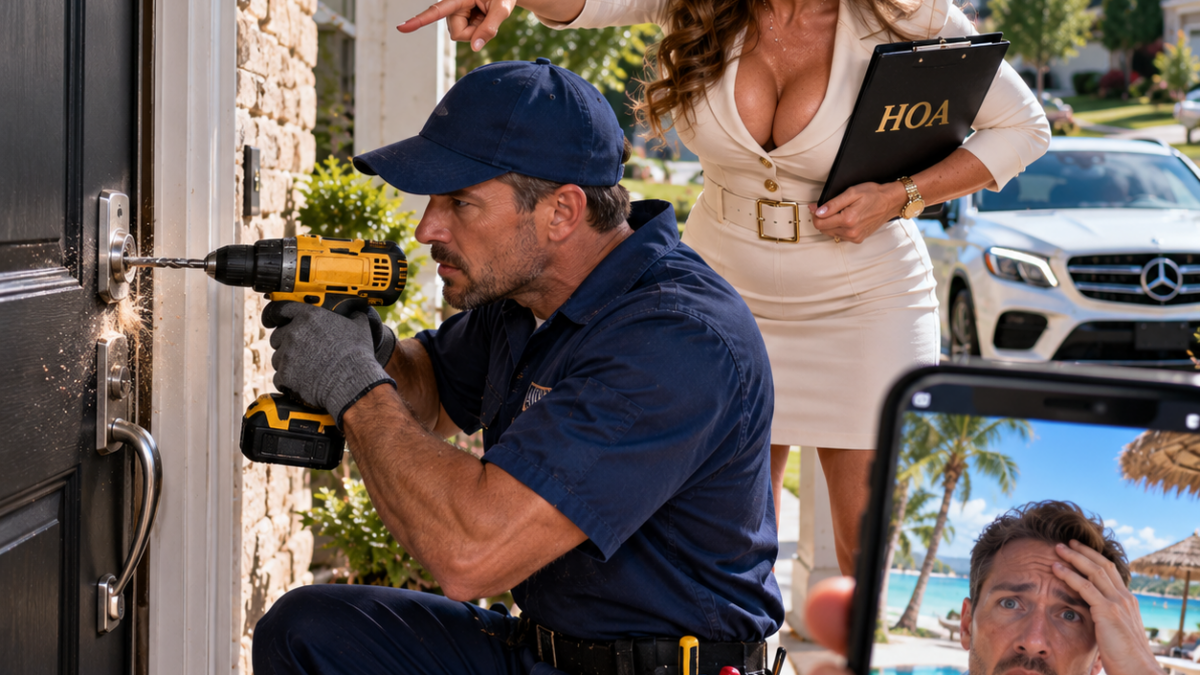
PART 2
For a second, I honestly thought I had misunderstood what I was seeing.
My brain kept looking for a reasonable explanation because the unreasonable one was too insane to accept.
Maybe there was a gas leak.
Maybe a pipe had burst.
Maybe the police had called the HOA.
Maybe something terrible had happened inside my house while I was gone.
Then Karen spoke again.
“Good,” she said. “Maybe you can explain why you’ve ignored my emails.”
I stared at the phone.
“I’m in Mexico.”
Several people near me turned.
I lowered my voice only slightly.
“Why is there a man drilling through my lock?”
Karen straightened and adjusted the sunglasses sitting on top of her head.
“We are conducting an emergency compliance inspection.”
“A what?”
“An emergency compliance inspection.”
She said it in the same tone someone might use to explain gravity to a child.
“We have reason to believe unapproved interior renovations may be occurring inside your residence.”
I looked around the beach as if someone might jump out and tell me this was a joke.
“I’m not renovating anything.”
“That remains to be verified.”
“I’m two thousand miles away.”
“Which explains why you didn’t answer the door.”
“No, Karen. It explains why nobody answered the door because nobody is home.”
She tapped the clipboard against her thigh.
“The board has authority to access units when necessary to protect the architectural and structural integrity of the community.”
“My house is not a unit.”
“You know what I mean.”
“No, actually, I don’t. Tell that man to get away from my door.”
The locksmith had stopped drilling. He looked from Karen to the camera.
Karen looked at him.
“Continue.”
He hesitated.
I felt a surge of adrenaline so hard my hands started shaking.
“Do not touch that lock.”
Karen folded her arms.
“We need to verify that no load-bearing walls have been removed.”
“I haven’t removed anything.”
“You failed to respond to multiple notices.”
“I’m on vacation.”
“Homeownership does not suspend your obligations to the association.”
There it was.
The Karen voice.
Cold. Controlled. Condescending.
The voice that said the conversation was over because she had decided she was right.
“Karen,” I said, “if you enter my house, I’m calling the police.”
She laughed.
Not loudly.
Just one dry little sound.
“The police know who I am.”
I almost couldn’t believe what I had heard.
“What does that mean?”
“It means they understand the HOA has responsibilities.”
She turned toward the locksmith.
“Keep drilling.”
He didn’t.
Instead, he slowly lowered the tool.
“Ma’am,” he said, “he’s saying this is his house.”
Karen’s head snapped toward him.
“I hired you.”
“I understand.”
“Then do the job.”
The locksmith looked directly into my doorbell camera.
“Sir, are you the homeowner?”
“Yes.”
“And you are refusing entry?”
“Absolutely. She does not have permission to enter my house.”
Karen stepped between him and the camera.
“I’m the authorized representative of the association.”
The locksmith frowned.
“Do you have a court order?”
“I don’t need one.”
“Police authorization?”
“The HOA bylaws authorize emergency access.”
He rubbed his jaw.
“What emergency?”
Karen’s mouth tightened.
“Potential structural alterations.”
He stared at her.
“So there’s no fire?”
“No.”
“Water leak?”
“No.”
“Gas?”
“No.”
“Anyone trapped inside?”
“That isn’t relevant.”
“It feels pretty relevant to me.”
For the first time, I almost liked the guy who had just partially destroyed my lock.
Karen switched tactics.
Her shoulders relaxed. The sharpness disappeared from her expression. Her voice dropped into the sweeter tone I’d heard her use with landscapers and contractors around the neighborhood.
“Listen,” she said, smiling at him. “I know this sounds complicated, but I’m the president. I’ve been handling these issues for years. You’re protected because you’re acting under my authorization.”
She touched his forearm lightly.
“Finish the lock. I’ll take care of everything else.”
The locksmith looked down at her hand.
Then he stepped backward.
“Nope.”
Her smile vanished.
“What?”
“I’m not opening a man’s house while he’s watching me on camera telling me I don’t have permission.”
“I am paying you.”
“Refund me.”
“I hired you for a service.”
“And I’m declining.”
“You are in breach of contract.”
“I’m also not catching a felony because you want to inspect somebody’s kitchen cabinets.”
He put the drill into his case.
I almost applauded from Mexico.
Karen moved in front of him.
“You cannot simply leave.”
“Watch me.”
As he carried his tools toward his van, Karen followed him halfway down my walkway.
“You were informed this was authorized!”
He didn’t turn around.
“You told me the homeowner requested emergency access.”
That stopped me.
So she’d lied to him.
Karen glanced up at the camera.
The locksmith kept walking.
“You misrepresented the job,” he called. “Call somebody else.”
Karen returned to my porch.
Her face was flushed now.
Not embarrassed.
Furious.
I had seen that expression before when neighbors questioned a violation, but never this intensely. She looked like authority itself had personally betrayed her.
“You’re making a serious mistake,” she said into the camera.
“I’m making a mistake?”
“Refusing board access carries a five-hundred-dollar fine per occurrence.”
“Send me whatever fantasy paperwork you want. Get off my property.”
“Since we cannot verify the safety of your interior modifications, additional daily penalties may apply.”
“There are no modifications.”
“Then you should have nothing to hide.”
That sentence did something to me.
Maybe because of how casually she said it.
Maybe because she was standing on my porch beside a damaged lock.
Maybe because I was looking at my own house through a camera from another country while a woman who didn’t own a single square inch of it explained why my privacy was suspicious.
I muted the microphone.
Then I called the non-emergency number for the police department back home.
I had saved it years earlier after a car break-in on our street.
The dispatcher answered.
I spoke too quickly at first.
“My name is—I’m the homeowner at Unit Forty-Two in Brookstone Ridge. I’m outside the country. I have a live video feed. The HOA president hired a locksmith and they’re trying to drill through my front-door lock.”
The dispatcher slowed me down.
“Is anyone currently inside the residence?”
“No.”
“Is the locksmith still there?”
“He’s leaving. The HOA president is still on my porch and says she’s waiting for another one.”
“Do you have video?”
“I’m watching it live.”
“Officers are on the way.”
When I reopened the camera, Karen was sitting on one of my porch chairs.
My porch chair.
She had crossed her legs and was typing on her phone like she was waiting for an Uber.
“Karen.”
She looked up.
“I’m waiting for another locksmith.”
“You need to leave.”
“I’m not going anywhere until the inspection is complete.”
“The police are coming.”
That smile returned.
“Excellent.”
The confidence in her face disturbed me more than the drill had.
She truly believed the police would arrive, look at her clipboard, recognize the sacred authority of HOA President Karen Whitcomb, and help her break into my house.
Ten minutes later, a patrol car stopped in front of my driveway.
Two officers got out.
I watched through the camera.
Karen immediately transformed.
Her posture softened. She smiled. She walked toward them with the graceful confidence of someone greeting guests at a charity event.
I couldn’t hear every word because they were farther from the microphone, but I caught pieces.
“…association president…”
“…emergency inspection…”
“…owner refusing compliance…”
She laughed at something.
One officer didn’t.
Karen handed him papers.
He read them.
Then he looked at my house.
Then back at her.
The second officer asked something.
Karen pointed toward my door.
The first officer shook his head.
Her smile disappeared.
She talked faster.
He pointed toward the street.
She gestured at her clipboard.
He pointed toward the street again.
This time his hand rested near his belt.
Karen’s shoulders went rigid.
She said something else.
He answered.
Whatever he said finally got through.
Karen spun around, walked down my driveway, climbed into her white Mercedes, and slammed the door.
She accelerated away hard enough for the engine to echo down the street.
One officer walked up to my porch.
He examined the lock.
Even through the camera I could see the damage. Bright exposed metal ringed the keyway where the drill bit had bitten into it.
The officer looked at the doorbell camera.
Then he gave me a small wave.
I let out a breath I hadn’t realized I’d been holding.
That should have been the end of it.
It wasn’t.
The next three days of my vacation were ruined.
I checked my phone constantly.
Every motion alert made my stomach tighten.
A delivery truck passed and I opened the app.
A kid rode his bicycle onto my driveway and I opened the app.
At two in the morning, Mexican time, a moth triggered the camera and I woke up convinced Karen had returned with bolt cutters.
The rational part of my mind knew the police had already removed her.
The rest of me kept picturing the drill.
Home is supposed to be the place you don’t have to defend while you’re sleeping.
Suddenly mine felt exposed from two thousand miles away.
I considered changing my flight.
I almost did.
But that would have cost me hundreds of dollars, sacrificed the only vacation I’d taken in years, and somehow made Karen even more powerful in my head.
So I stayed.
I didn’t relax.
Those were two different things.
When I finally flew home, I was exhausted before the plane landed.
I took an Uber from the airport.
As we turned onto my street, I saw Karen’s white Mercedes parked in her driveway three blocks away.
My jaw clenched automatically.
Then my house came into view.
There was a neon orange notice stuck directly to my front door.
The driver glanced at it.
“That’s… bright.”
“HOA.”
He made the universal face of a man who understood immediately.
“Good luck.”
I pulled my suitcase onto the porch.
The orange paper had been applied with enough adhesive to survive a hurricane.
Across the top, in aggressive black letters, it said:
VIOLATION NOTICE.
Underneath were three charges.
Failure to grant access for emergency inspection.
Verbal abuse of a board member.
Failure to maintain exterior entry hardware in good condition, creating an unsightly appearance.
I read that last one twice.
Karen had hired someone to damage my lock.
Then she fined me because the damaged lock looked bad.
Total penalties:
$2,500.
I laughed.
It wasn’t because anything was funny.
Sometimes your brain reaches a level of anger where laughter is the only sound left.
I ripped the notice from the door and tried my key.
It wouldn’t fit.
The drill had damaged the faceplate and pushed tiny metal burrs into the keyway.
“Unbelievable.”
I tried again.
Nothing.
My own front door had been rendered unusable by the person claiming she needed access to protect my property.
I dragged my luggage around the side of the house, opened the garage with the keypad, and entered through the interior door.
Everything was exactly as I’d left it.
No construction.
No demolition.
No missing load-bearing walls.
Just stale air, unopened mail, a forgotten coffee mug beside the sink, and the faint hum of the refrigerator.
I stood in my kitchen for a long time.
I was tired.
Jet-lagged.
Humiliated.
Furious.
My first instinct was to march straight to Karen’s house and pound on her door.
I imagined throwing the orange notice onto her kitchen table.
I imagined telling her exactly what I thought of her.
I imagined calling a lawyer and spending however much money it took to make her miserable.
Then I remembered something my father used to say whenever someone at work pushed him too far.
Don’t fight angry people while you’re angry.
They’ve had more practice.
So instead of going to Karen’s house, I opened a beer.
Then I went to the hall closet.
On the top shelf sat a thick red binder I hadn’t touched since the week I bought the house.
The Brookstone Ridge Declaration of Covenants, Conditions and Restrictions.
The CC&Rs.
The bylaws.
The architectural guidelines.
The rules Karen had spent years quoting at everyone else.
The binder was thick enough to stop a door.
I carried it to the kitchen table.
Then I started reading.
Every page.
Not skimming.
Reading.
The first hour was torture.
Setback restrictions.
Fence heights.
Roofing materials.
Mailbox standards.
Drainage responsibilities.
Pet limits.
Common-area maintenance.
Parking regulations.
I learned that a basketball hoop had to be placed a specific number of feet from the sidewalk.
I learned that decorative stone required approval if it covered more than thirty percent of a front planting bed.
I learned things no human being should know voluntarily.
Then, shortly after midnight, I reached page 114.
Section 8.4.
Emergency Access.
I read the paragraph once.
Then again.
Then a third time.
“The Board may enter a residence without prior notice only in the event of a bona fide emergency involving an immediate threat to life or property.”
Below it, the bylaws clarified examples.
Fire.
Active water leak.
Gas leak.
Comparable emergency conditions.
Then came the sentence that mattered.
All other inspections required seventy-two hours’ written notice and the homeowner’s presence unless the homeowner waived that requirement in writing.
I sat back.
Karen had called what she did an emergency compliance inspection.
There was no emergency.
No smoke.
No water pouring through a wall.
No gas.
No screaming person inside.
She suspected renovations.
That wasn’t an emergency.
That was curiosity wearing a badge it didn’t have.
I photographed the page.
Then I kept reading.
Because proving the fine was invalid would solve my problem.
I no longer wanted to solve only my problem.
At 1:37 in the morning, I found Section 4.2.
Removal of Directors.
I leaned closer.
Any director could be removed, with or without cause, by a majority vote of association members represented at a properly called special meeting, provided a quorum representing at least fifty percent of total voting power was present in person or by proxy.
A later subsection explained how homeowners could compel the board to schedule such a meeting.
Twenty-five percent of the membership had to sign a written petition.
We had 120 homes.
Twenty-five percent was thirty.
To conduct the removal vote, sixty households had to be represented.
Then a majority of those represented could remove her.
I stared at the paragraph.
For three years, Karen had treated the bylaws like a weapon only she knew how to use.
She was wrong.
The weapon wasn’t hers.
The next morning, I called a locksmith and had my damaged cylinder replaced.
Before he touched anything, I photographed the lock from every angle.
Then I downloaded the original video from my doorbell camera.
I saved a second copy to my computer.
Then a third copy to cloud storage.
I requested the police incident report.
I printed Karen’s emails.
I printed the violation notice.
I printed Section 8.4.
I printed Section 4.2.
By Saturday, my kitchen table looked less like a breakfast area and more like the evidence room for a very suburban criminal conspiracy.
Then I went to Mike Delgado’s house.
Mike opened the door wearing gym shorts and a faded Panthers shirt.
“Hey,” he said. “Vacation good?”
“Parts of it.”
He laughed.
Then he noticed the tablet in my hand.
“What happened?”
“Did you hear about somebody trying to break into my house?”
His expression changed.
“What?”
“It wasn’t a burglar.”
I opened the video.
Mike watched silently.
The drill screamed from the tablet.
Karen appeared behind the locksmith.
Then my voice came through the speaker.
Do not drill that lock.
When the clip ended, Mike stared at me.
“She did that?”
“Yes.”
“Karen?”
“Yes.”
“To your house?”
“Yes, Mike.”
He rubbed his face.
“Jesus Christ.”
Then something strange happened.
He started laughing.
Not because it was funny.
Because he had spent so long being bullied by this woman that seeing her finally cross an undeniable line produced something close to disbelief.
“You know she fined me over my truck last year?”
“The grass thing I remember.”
“Oh, the grass was nothing. She said my truck was ‘aesthetically deteriorated.'”
“What does that even mean?”
“It means it had some rust on the bumper.”
He pointed toward his driveway.
It was a ten-year-old pickup.
Not beautiful.
Not dangerous.
Not against any written rule.
“I paid it,” he said quietly. “Two hundred bucks. I was working sixty-hour weeks. My wife was sick. I didn’t have the energy to fight her.”
That sentence stayed with me.
I didn’t have the energy.
That was Karen’s real power.
Not the clipboard.
Not the presidency.
Exhaustion.
Most normal people had jobs, children, elderly parents, mortgages, medical appointments, grocery lists, deadlines.
Karen had time.
She turned that difference into control.
“I’m calling a special meeting to remove her,” I said.
Mike stared at me.
“You can do that?”
I showed him Section 4.2.
His eyes widened.
“Where do I sign?”
Mrs. Higgins lived across the street.
She was a retired elementary-school teacher in her seventies who decorated her front porch according to every season and once apologized to me because a windstorm had blown one of her flowerpots into my yard.
I showed her the video.
She covered her mouth.
“Oh, my God.”
Then her face hardened.
“She looked through my fence.”
“What?”
“Last summer.”
Mrs. Higgins lowered her voice even though Karen lived nowhere near us.
“She claimed someone reported an unauthorized vegetable garden. She stood on a step stool in the alley and looked over my fence.”
“Why?”
“Zucchini.”
I blinked.
“I’m sorry?”
“Apparently tomatoes were approved in raised containers, but she wasn’t sure whether zucchini counted as ornamental produce.”
For one perfect second, neither of us spoke.
Then Mrs. Higgins said, “Where do I sign?”
By noon, I had nine signatures.
By two, seventeen.
By four, twenty-eight.
At the next house, a father told me Karen had threatened to tow his daughter’s car because of a political bumper sticker she considered “divisive signage.”
Another homeowner had been fined because his garbage can was visible from the road at 7:14 in the morning after he worked an overnight shift.
One couple had been required to repaint their front door because Karen decided the approved shade of charcoal they selected looked “too blue in afternoon lighting.”
A young mother told me Karen had photographed her children leaving bicycles in the driveway.
A widower showed me a warning letter because his Christmas lights remained up until January 8 instead of January 6.
Some stories were ridiculous.
Some were invasive.
Some were cruel.
The common thread wasn’t rule enforcement.
It was domination.
Karen enjoyed watching people explain themselves.
She enjoyed forcing apologies.
She enjoyed the small humiliation of making an adult ask permission for ordinary things.
And she had been doing it for so long that everyone assumed resistance was more trouble than surrender.
I got my thirtieth signature before dinner.
By Sunday night, I had fifty.
I also had twenty-three signed proxies from homeowners who couldn’t guarantee they’d attend the meeting.
Monday morning, I carried the petition to the HOA office.
The association secretary was Bobby Lin, a thin man in his late sixties who always looked like he needed a vacation more than I had.
He took the stack.
Counted the pages.
Then counted them again.
“Fifty?”
“Fifty.”
He looked toward the closed door of Karen’s office.
Then back at me.
His voice dropped.
“Thank God.”
I almost laughed.
“You’re the secretary.”
“I’m aware.”
“You could’ve done something.”
“You think she doesn’t bully us?”
That surprised me.
Bobby leaned closer.
“Please show up. Please bring the proxies. She’ll try everything.”
“Is the petition valid?”
He straightened and switched back into official mode.
“It exceeds the required threshold. I’ll record it today.”
“When’s the meeting?”
He checked the bylaws and calendar.
“Three weeks.”
He exhaled.
“Three very long weeks.”
He was right.
Karen went on the offensive almost immediately.
Two days after I filed the petition, I received three additional violation notices.
Improper solicitation.
Door-to-door harassment.
Unauthorized signage.
I didn’t have a sign.
I appealed all three in writing and attached the exact bylaw sections showing why they were nonsense.
Then Karen sent a neighborhood-wide email.
The subject line read:
URGENT COMMUNITY SAFETY CONCERN.
According to Karen, a “rogue element” was attempting to dismantle safety procedures protecting Brookstone Ridge.
She didn’t use my name.
She didn’t need to.
She referred to a homeowner who had “repeatedly obstructed a legitimate structural inspection.”
She claimed there were unresolved concerns involving dangerous interior modifications.
She suggested my refusal to allow access could place adjoining properties at risk.
Our houses weren’t adjoining.
They were detached homes separated by yards.
She even wrote that “responsible homeowners understand that individual privacy cannot supersede collective safety.”
I read the email twice.
Then I printed it.
Added it to my binder.
And said nothing.
Karen hated silence.
People like her needed reaction because reaction gave them something to shape.
If I yelled, I was aggressive.
If I insulted her, I was unstable.
If I threatened her, she became the victim.
So I stopped giving her anything.
That made her reckless.
The next afternoon, I came home from work and found Karen waiting beside my driveway.
She was leaning against her Mercedes in a fitted white blouse, dark skirt, and oversized sunglasses.
She smiled when I got out of my car.
It was the same polished smile she’d used on the locksmith before he walked away.
“We should talk.”
“I think we’ve talked enough.”
“You’re angry.”
“I’m impressed you noticed.”
She ignored that.
“You’ve made your point.”
“You drilled my lock.”
“The contractor damaged your lock.”
“Under your instruction.”
“He exceeded the scope.”
“I have video of you telling him to keep drilling.”
A tiny muscle moved in her jaw.
Then the smile returned.
“I don’t want this neighborhood torn apart over a misunderstanding.”
“You fined me twenty-five hundred dollars after trying to enter my house.”
“Those fines are administrative. They can be discussed.”
There it was.
A negotiation.
For the first time, I understood what she wanted.
Not peace.
The petition gone.
“If I withdraw the petition?”
She removed her sunglasses.
Her hazel eyes locked onto mine.
“I didn’t say that.”
“You didn’t have to.”
She stepped slightly closer.
“Look, we both live here. We’re both intelligent adults. I can make the fines disappear. We can schedule a proper inspection, clear up the renovation concern, and put all of this behind us.”
“There is no renovation concern.”
“Then the inspection should be easy.”
“No.”
Her expression cooled.
“I am offering you a graceful exit.”
“From what?”
“From a fight you don’t understand.”
I almost smiled.
“Karen, I understand it perfectly now.”
“No, you don’t.”
“You thought nobody read the bylaws.”
For the first time, she went still.
I continued.
“Section 8.4.”
Her eyes narrowed.
“Don’t.”
“Emergency access. Immediate threat to life or property. Fire. Water. Gas. Every other inspection requires seventy-two hours’ written notice and the owner present.”
She stared at me.
I watched the moment she realized exactly what I had done.
Not complained.
Not threatened.
Read.
Then I said, “Section 4.2.”
Her face changed completely.
“You think those people will actually vote against me?”
“We’ll find out.”
She laughed, but there was no confidence in it.
“Half of them can’t even be bothered to attend annual meetings.”
“That’s what proxies are for.”
“You have no idea what you’ve started.”
“I think you do.”
Her voice dropped.
“I built this board.”
“You don’t own it.”
“I have protected property values in this community for eight years.”
“By measuring grass?”
“By maintaining standards.”
“By looking over fences?”
Her face hardened.
“Careful.”
“By threatening tow trucks over bumper stickers?”
“Those stories are exaggerated.”
“By hiring somebody to drill my door?”
“That video does not show the full context.”
“I was in Mexico. What context am I missing?”
She stepped closer again.
The charm was gone.
“Withdraw the petition.”
“No.”
“I’m giving you one opportunity.”
“No.”
“You’ll regret turning this neighborhood against me.”
“I didn’t turn anybody against you.”
I looked toward the houses around us.
“You did that yourself.”
She stared at me for several seconds.
Then she put her sunglasses back on.
“Enjoy the meeting.”
She opened her car door.
“You won’t enjoy what happens after.”
Then she drove away.
For the next two weeks, the pressure increased.
People who had signed the petition began receiving violation letters at suspiciously high rates.
Mike received one because his recycling bin was allegedly visible from an improper angle.
Mrs. Higgins got a warning over a decorative bird feeder.
Another petitioner was cited for faded house numbers.
One woman called me in tears because Karen had threatened a hearing over her children’s portable basketball hoop.
“Should I remove my name?” she asked.
The question hurt more than I expected.
Not because I needed her signature.
I already had enough.
Because Karen had successfully made a homeowner afraid inside her own neighborhood.
“Do what makes you feel safe,” I told her. “Your family matters more than my petition.”
There was a pause.
Then she said, “No.”
“What?”
“I’m leaving my name on it.”
Her voice steadied.
“I’m tired of being afraid of a woman with a printer.”
Word spread.
Instead of weakening support, Karen’s retaliation strengthened it.
People began forwarding me their notices.
I created a folder.
Then another.
By the week of the meeting, I had enough paper to fill a banker box.
The night before the vote, I barely slept.
That surprised me.
Logically, we had the numbers.
Emotionally, I kept imagining the room half empty.
I imagined people staying home.
I imagined proxies being disqualified.
I imagined Karen finding some obscure clause at the last second.
I imagined losing.
And if I lost, she would still be president.
She would still control violation hearings.
She would still have access to legal money funded by our dues.
And now she would know exactly who had stood against her.
The next morning, Mike texted me.
Stop counting votes. We show up tonight.
Mrs. Higgins texted five minutes later.
I baked cookies. Revolutions need snacks.
I laughed for the first time all day.
At seven that evening, I walked into the community center basement carrying my laptop, my binder, the police report, and the original videos.
I stopped inside the doorway.
I had never seen that room so full.
Normal HOA meetings attracted six people on a good night.
Maybe ten if somebody wanted to complain about the pool.
That night, every folding chair was occupied.
People stood along the walls.
Others crowded near the door.
The air conditioner hummed desperately against the heat of more than eighty bodies.
Karen sat at the front table.
She wore a dark red dress, pearl earrings, and the expression of a queen arriving at a trial she considered beneath her.
Bobby sat three chairs away.
The vice president sat even farther.
That physical distance told me everything.
Karen raised the gavel.
BANG.
“Order.”
People kept talking.
BANG.
“Order!”
The room quieted.
Karen surveyed us.
“I see many residents tonight who have never attended an association meeting before.”
Nobody responded.
“It’s unfortunate,” she continued, “that it takes misinformation and manufactured outrage to inspire participation in your own community.”
Someone behind me muttered, “Here we go.”
Karen’s eyes flashed toward the voice.
“We will follow proper procedure.”
Mike called from the back.
“That’d be a nice change.”
Laughter rolled through the room.
Karen’s jaw tightened.
“We will follow proper procedure,” she repeated. “Before any vote, the chair will address the defamatory allegations being circulated regarding enforcement action at Unit Forty-Two.”
“My house,” I said.
She ignored me.
Karen stood.
And then she gave the speech of her life.
I will admit that.
If you didn’t know the facts, she almost sounded reasonable.
She talked about standards.
Safety.
Insurance.
Property values.
She described the HOA as a “collective promise” between neighbors.
She warned that unapproved structural work could cause fires, collapses, plumbing damage, and reduced home values.
Then she moved into fear.
“If boards are prevented from acting when homeowners refuse cooperation, every family in this community becomes vulnerable.”
She looked around the room slowly.
“Rules cannot function if compliance is optional.”
A few people shifted uncomfortably.
Karen saw it.
She pressed harder.
“This campaign is not about me. It is about whether Brookstone Ridge remains a community governed by standards or becomes a place where individual homeowners decide which obligations apply to them.”
Then she looked directly at me.
“If you have nothing to hide, you have nothing to fear from reasonable inspection.”
The room went quiet.
Karen sat.
Smug.
She thought she’d done it.
She thought she’d turned a locksmith drilling through somebody’s door into a speech about responsibility.
She folded her hands.
“Does the petitioner wish to respond?”
I stood.
“Yes.”
I carried my laptop to the front.
Karen frowned.
“What are you doing?”
“Responding.”
“Comments should be verbal.”
“Show me the rule.”
She opened her mouth.
Stopped.
The projector used for budget presentations sat on a small cart beside the wall.
I connected my laptop.
The screen behind Karen lit up.
I faced the room.
“I could give a speech.”
I looked at Mike.
Mrs. Higgins.
The young mother with the basketball hoop.
Bobby.
All those tired people who had paid fines because fighting took more energy than surrendering.
“But I don’t think you need another speech.”
I clicked Play.
The video filled the wall.
Twenty feet wide.
My front porch.
The locksmith.
Karen.
The drill.
That horrible metallic scream exploded through the speakers.
Several people physically flinched.
On-screen, my voice shouted from Mexico.
HEY! WHAT THE HELL ARE YOU DOING?
The room watched Karen lean into my camera.
Oh. You’re watching.
Nobody laughed.
Then came the part where she ordered the locksmith to continue.
Keep drilling.
The man on-screen hesitated.
My voice shouted that I did not consent.
Karen told him she was the authorized representative.
He asked whether there was a fire.
No.
Water leak?
No.
Gas?
No.
Then came the sentence that changed the temperature in the room.
The locksmith said, “I’m not opening a man’s house while he’s watching me on camera telling me I don’t have permission.”
Somebody whispered, “Jesus.”
I let the video continue until Karen threatened daily fines.
Then I stopped it.
I opened the second clip.
Police arriving.
Karen smiling.
Karen presenting papers.
The officer shaking his head.
The officer pointing toward the street.
Karen arguing.
The officer pointing again.
Karen leaving.
I froze the frame.
Nobody spoke.
Even Karen was silent.
I held up the red binder.
“Page 114.”
I placed the text on the projector.
“Section 8.4.”
I read it aloud.
“Emergency entry without notice requires a bona fide emergency involving immediate threat to life or property.”
I looked at the room.
“There was no fire.”
Silence.
“No flood.”
Silence.
“No gas leak.”
I turned toward Karen.
“There wasn’t even a renovation.”
Karen stood abruptly.
“This presentation is deliberately misleading.”
I ignored her.
“All other inspections require seventy-two hours’ written notice and the homeowner’s presence unless waived by the homeowner.”
“The board had received information—”
“From whom?”
Karen stopped.
“Confidential sources.”
“What information?”
“Potential structural work.”
“What evidence?”
“This isn’t a courtroom.”
“No.”
I looked around.
“It’s our neighborhood.”
That got a murmur.
Karen stepped toward me.
“This is a manipulated presentation.”
I actually stared at her.
Then she said it.
“Video can be altered. Artificial intelligence can create extremely convincing material now.”
For one second, everyone seemed too stunned to react.
Then Mike laughed.
“You think he deepfaked you drilling his door?”
Karen pointed at him.
“Do not interrupt.”
Mrs. Higgins called from the second row.
“Did he deepfake the police too?”
People started talking at once.
Karen raised the gavel.
“This meeting is out of order!”
Bobby leaned toward his microphone.
“No, Karen.”
The room quieted.
She looked at him.
He swallowed.
Then he said it again.
“No.”
It may have been the bravest thing Bobby had done in eight years.
“The petition is valid. The required notices were sent. A quorum determination has been completed.”
Karen stared at him.
“You report to the president.”
“I’m the secretary of the association.”
“You report to this board.”
“And this meeting is being held under Section 4.2.”
Her face reddened.
“You’ve been conspiring with him.”
Bobby’s fear disappeared.
Maybe because eighty people were finally watching.
“Karen, I’ve spent six years watching you bully homeowners and three years watching you bully this board.”
A collective breath moved through the room.
The vice president looked down at the table.
Bobby continued.
“I’m tired.”
That simple sentence landed harder than anything else.
Karen looked around.
For the first time, I think she understood.
The room wasn’t afraid of her anymore.
She pointed at me.
“He’s a violator.”
I shook my head.
“Vote.”
“He verbally abused a board member.”
“Vote.”
“He obstructed a safety inspection.”
“Vote.”
“He is trying to destroy this community!”
I met her eyes.
“No, Karen.”
I pointed at the frozen image behind us.
“I’m trying to make sure nobody else watches you drill through their front door.”
Applause broke out.
Karen slammed the gavel.
BANG.
“ORDER!”
The applause got louder.
BANG.
“ORDER!”
Mike stood.
“Vote!”
Someone else repeated it.
“Vote!”
Then another.
“Vote!”
Within seconds, the entire room was saying it.
“Vote.”
“Vote.”
“Vote.”
Karen looked genuinely frightened.
Not physically threatened.
Something worse for her.
Irrelevant.
Bobby distributed the ballots.
The wording was simple.
Should Karen Whitcomb be removed from the Board of Directors of the Brookstone Ridge Homeowners Association?
YES.
NO.
Because proxies were allowed, Bobby had already verified them before the meeting.
Karen objected to twelve.
He overruled her.
She objected to seven more.
The vice president sided with Bobby.
She accused them both of misconduct.
Nobody cared.
We voted.
Then came ten of the longest minutes of my life.
Bobby counted with another board member while a homeowner volunteer observed.
Karen sat with her arms crossed.
She didn’t look at me.
She didn’t look at anyone.
The room had become so quiet I could hear folding chairs creak.
I thought about Mexico.
The drill.
The damaged lock.
The orange notice.
Mrs. Higgins’s zucchini.
Mike’s truck.
The mother who had almost removed her name because she was afraid.
Then Bobby stood.
He held a sheet of paper.
“We have eighty-five households represented in person or by valid proxy.”
Karen looked up.
“That satisfies the quorum requirement.”
My pulse hammered.
“Eighty-five votes were cast.”
He paused.
“In favor of removal…”
The room stopped breathing.
“Eighty-two.”
For half a second, nobody reacted.
Then the meaning hit.
A sound moved through the basement that was part cheer, part laugh, part collective exhale.
Bobby continued.
“Opposed: three.”
Karen stood so fast her chair tipped backward.
“This is ridiculous.”
Nobody answered.
“This vote is invalid.”
The vice president finally looked at her.
“It’s valid.”
“You don’t know what you’re talking about.”
“I do.”
“I founded this board.”
Mike called from the back.
“And now you’re leaving it.”
Karen slammed both palms onto the table.
“You cannot remove me from an organization I built.”
I couldn’t help myself.
I lifted the red binder.
“You wrote these bylaws.”
Her eyes moved to it.
Then to me.
“And we just used them.”
She looked like I had slapped her.
The vice president spoke quietly.
“Karen, you need to step down.”
For years, everyone had called her Madame President behind her back.
That night, her own vice president simply called her Karen.
No title.
No authority.
Just Karen.
She grabbed her clipboard.
Then her handbag.
Then the stack of papers she’d brought for her speech.
One slid onto the floor.
Nobody picked it up.
She walked toward the exit.
People moved aside.
Nobody apologized.
Nobody lowered their eyes.
At the door, Karen turned.
“This neighborhood will regret this.”
Mrs. Higgins said, very calmly, “Good night, Karen.”
The door slammed so hard a framed community notice rattled on the wall.
For several seconds, nobody spoke.
Then Bobby cleared his throat.
“There’s one more item.”
I looked at him.
“When a director is removed, the vacancy may be filled by membership vote at the same meeting.”
Mike immediately shouted, “I nominate him.”
Every head turned toward me.
“No.”
People laughed.
“I’m serious. No.”
Mrs. Higgins raised her hand.
“I second it.”
“Absolutely not.”
Mike grinned.
“You started the revolution. Congratulations. Now you get paperwork.”
“I don’t want to be on an HOA board.”
“None of the good people ever do,” Bobby said.
That shut me up.
I looked around the room.
Eighty-plus homeowners.
People who had spent years rolling their eyes privately while paying fines publicly.
People who had convinced themselves Karen was permanent because resisting her seemed harder than tolerating her.
Then I thought about what happened when nobody decent wanted responsibility.
Somebody like Karen decided she did.
“Fine.”
Mike clapped.
“I said fine, not yes.”
“Sounds like yes.”
I raised a hand.
“One condition.”
Bobby smiled for the first time that night.
“What?”
“We change the locks on the HOA office tomorrow.”
Laughter.
“And we conduct an access audit. Every key. Every master key. Every access code. I want to know exactly who can enter what.”
The laughter disappeared.
People nodded.
“And nobody enters a private residence without the exact authority written in these bylaws. Not because they think they have it. Not because they’re president. Not because they have a clipboard.”
Bobby nodded.
“Agreed.”
The vote was taken.
I was elected unanimously.
Apparently even the three people who had voted to keep Karen had either left or decided they didn’t want to be identified.
The next morning, we changed the HOA office locks.
My first official action was much easier.
We reviewed the fines Karen had issued against me.
All $2,500.
Emergency-access refusal.
Verbal abuse.
Damaged exterior hardware.
Improper solicitation.
Door-to-door harassment.
Imaginary signage.
Every one of them was either unsupported, procedurally defective, or based on authority that didn’t exist.
The board voided them.
$2,500 became zero.
I should have felt victorious.
Mostly, I felt tired.
Then we opened the records.
That was where things became uglier.
Karen had spent approximately $4,000 of HOA money on legal consultations related to board entry rights.
Four thousand dollars.
Not on the pool.
Not landscaping.
Not road maintenance.
Not insurance.
Legal advice about when and how the HOA could enter people’s homes.
I sat in the association office with Bobby beside me and stared at the invoices.
“Did anybody approve these?”
He rubbed his forehead.
“She classified them as compliance-related legal expenses.”
“Did the board see them?”
“Sometimes.”
“Sometimes?”
Bobby looked embarrassed.
“She controlled the agenda. She’d bring invoices in batches. We’d approve operating expenses together.”
I flipped through another bill.
The description read:
Consultation regarding enforcement authority and owner refusal of access.
Another:
Review of emergency-entry powers under governing documents.
Another:
Liability exposure associated with forced access.
I held that one up.
“She literally paid a lawyer to tell her forced entry was a liability.”
Bobby looked at it.
“Apparently.”
“And then she did it anyway.”
“Apparently.”
We couldn’t simply demand the money back because the consultations had technically been performed for the association, and untangling the approvals would have cost more than the amount itself.
But we could tell the homeowners.
So we did.
The next newsletter included a financial transparency section.
No insults.
No editorializing.
Just facts.
Approximately $4,000 spent on access-related legal consultations.
The relevant invoices.
The bylaw restrictions.
The board’s new policy.
Karen called the office eleven times the morning the newsletter arrived.
Nobody answered.
She sent an email accusing us of publicly humiliating her.
Bobby forwarded it to me with one sentence.
She’ll survive.
Without the presidency, Karen changed.
Or maybe she didn’t change at all.
Maybe we just finally saw what she looked like without power.
Her white Mercedes still moved slowly through the neighborhood, but nobody stepped outside to ask what she wanted.
She still walked with the same perfect posture.
Still wore expensive sunglasses.
Still dressed like every trip to the mailbox might become a photo shoot.
But people stopped reacting.
That was the thing she couldn’t tolerate.
When she walked her little dog, neighbors who used to force polite smiles simply kept gardening.
Mike stopped waving.
Mrs. Higgins once continued watering her flowers while Karen stood ten feet away waiting to be acknowledged.
The woman who had intimidated an entire subdivision became just another homeowner.
An angry one.
A lonely one.
A powerless one.
And because I had somehow become a board member, I found myself learning something I hadn’t expected.
Most HOA work was painfully ordinary.
A family wanted a six-foot fence instead of a five-foot fence because their dog could jump.
Approve it.
Someone wanted to replace dead shrubs with native plants.
Approve it.
A homeowner needed an extra week to repaint trim because his contractor got sick.
Fine.
Give him the week.
Nobody’s property value collapsed.
Civilization survived.
We stopped treating every small violation like a moral failure.
If someone’s trash cans stayed visible because they worked overnight, we sent a reminder instead of a fine.
If grass grew a little high after a week of rain, we waited.
Serious issues still mattered.
Dangerous structures.
Blocked fire access.
Major drainage problems.
Those were real.
A quarter inch of grass was not.
About six months after Karen’s removal, I proposed the change I cared about most.
Amendment 9.1.
We spent weeks drafting it carefully.
The final language made clear that the association could not enter a private residence without explicit written consent from the homeowner or a valid court order, except in narrowly defined emergencies involving an active fire, visible flooding, or a comparable immediate danger to life or property.
No “suspected renovations.”
No “compliance concerns.”
No president deciding curiosity was an emergency.
The proposed amendment went to the membership.
Karen campaigned against it.
Of course she did.
She sent a three-page letter warning that the amendment would “cripple the association’s ability to protect community integrity.”
Mike read it while standing beside my mailbox.
“Community integrity.”
He shook his head.
“She tried to drill through your door.”
“I remember.”
“Just checking.”
The amendment passed with ninety-eight percent support.
Karen voted against it.
I never asked who the other two percent represented because some mysteries improve life.
After that, things quieted down.
The change wasn’t dramatic.
That was the point.
People lived.
Kids left bikes in driveways occasionally.
Garage doors stayed open while people washed cars.
Mrs. Higgins grew zucchini without surveillance.
Mike’s rusty truck remained in his driveway.
Nobody died.
Property values did not collapse.
No roaming gangs of unauthorized mulch users seized control of the subdivision.
We were simply neighbors again.
Karen lasted another year.
I saw the For Sale sign on her lawn one Saturday morning while I was walking to Mike’s house.
He stood in his driveway staring at it.
“Think it’s real?”
“Looks real.”
“Could be a compliance trap.”
“Don’t touch the sign.”
We laughed.
Her house sold within six weeks.
On moving day, a truck blocked half the street.
Years earlier, Karen probably would have fined herself for that.
Nobody mentioned it.
I happened to be outside when she came from the house carrying one final box.
She saw me.
Stopped.
For a moment, I wondered whether she would say something bitter.
Maybe threaten one last lawsuit.
Maybe tell me I’d ruined her life.
Instead, she walked toward me.
She looked different without the clipboard.
Still beautiful.
Still composed.
But smaller somehow.
Not physically.
Just less important.
“I suppose you’re pleased,” she said.
“I hope you’re happy wherever you’re going.”
She gave a humorless smile.
“Florida.”
“Condo?”
Her eyes narrowed.
“Yes.”
I tried not to laugh.
“I wish the condo board good luck.”
That almost broke through her expression.
Almost.
“You always thought I was the problem.”
“No.”
That surprised her.
I continued.
“I thought the problem was that nobody stopped you.”
For once, Karen had no answer.
She looked past me at the neighborhood.
At Mike’s truck.
At Mrs. Higgins’s garden.
At the houses she had spent years monitoring.
Then she lifted her chin.
“I maintained standards.”
“Maybe.”
I shrugged.
“But you forgot we were people.”
She carried the box to her car.
She didn’t say goodbye.
By sunset, she was gone.
I’m still on the board.
Somehow, I’m the vice president now, which still feels like a punishment for reading too much legal language.
I don’t patrol the streets.
I don’t own a grass ruler.
I have no idea how tall Mike’s lawn is.
I mostly review architectural requests, approve reasonable changes, argue about pool maintenance, and remind the board that “because we can” is not the same thing as “because we should.”
Every once in a while, a new homeowner will complain that our HOA is strangely relaxed.
I consider that a compliment.
The red binder still sits in my house.
Not in the closet anymore.
It’s on a bookshelf in my office.
Page 114 has a yellow tab.
Section 4.2 has a blue one.
Amendment 9.1 has its own printed copy tucked into the back.
And I still have the doorbell video.
I’ve watched it only a few times since that meeting.
Not because I enjoy it.
I don’t.
I hate the sound of that drill.
Even now, hearing it takes me back to that beach chair—to the helplessness of watching somebody damage my home while I was two thousand miles away.
But the video reminds me of something I never understood before Karen.
Power often looks permanent only because nobody checks the paperwork.
Karen built her entire authority on the assumption that everyone else was too busy, too intimidated, or too exhausted to read the rules she kept waving in their faces.
For years, she was right.
Then she put a drill against my front door.
She believed her title was stronger than my ownership.
She believed her clipboard was stronger than my privacy.
She believed a fine would scare me into surrendering.
Instead, I opened the same bylaws she had used against everyone else.
She had spent years teaching us that rules were rules.
In the end, that was the one lesson I made sure she learned too.